
#bsp
bsp
17,101 views
226 Discussing
Hot
Latest

$BSP LONG
Can buyers develop an upward move after breaking through a local barrier? The bullish sentiment looks quite justified as long as prices hold positions near the entry zone. The initiative is gradually shifting to the buyers' side, creating good prerequisites for moving toward the set targets.
➡️Entry point: 42.01
✅Take 1: 42.51090331 (+1.19%)
✅Take 2: 43.04180662 (+2.46%)
✅Take 3: 43.83816159 (+4.35%)
🛡Protection: 41.18364503 (-1.97%)
⚠️ This is not financial advice. Trade at your own risk. DYOR.
#BSP #Worldcoin #Crypto 📈
$BSP
Can buyers develop an upward move after breaking through a local barrier? The bullish sentiment looks quite justified as long as prices hold positions near the entry zone. The initiative is gradually shifting to the buyers' side, creating good prerequisites for moving toward the set targets.
➡️Entry point: 42.01
✅Take 1: 42.51090331 (+1.19%)
✅Take 2: 43.04180662 (+2.46%)
✅Take 3: 43.83816159 (+4.35%)
🛡Protection: 41.18364503 (-1.97%)
⚠️ This is not financial advice. Trade at your own risk. DYOR.
#BSP #Worldcoin #Crypto 📈
$BSP

The old dog took a look at the BSP; over the past 24 hours it’s down 5.34%, with the current price at 41.33, but the funding rate is negative, reporting -0.0024. This setup is interesting: the price is falling, and theoretically shorts should have the advantage, but the negative funding rate means shorts are paying longs—so they’re adding to their positions against the trend.
From the “iron law” of the funding rate: fundingRate<0 means shorts are paying longs, which indicates the short camp is crowded. Now that the price is dropping and the funding rate is negative, it looks like shorts are shouldering the negative funding while slamming the sell pressure. This is a typical pre-structure for a short squeeze. Once the price rebounds even slightly, this batch of crowded shorts may be forced to close their positions, rapidly pushing the price up.
My view is that this is not the time for a trend-based bearish call on BSP. If it breaks below 40.5, I’ll consider that a bearish trend is confirmed. But before that, this looks more like a short trap. My plan is to wait—don’t chase shorts. If the price can hold above 41 and shows signs of a rebound, I’d try a small long position to bet on a short squeeze.
Where is this judgment most likely to be wrong? If BSP continues to sell off with increased volume and breaks below 40.5, and the OI also declines in sync, that would mean shorts are genuinely exiting rather than merely being crowded. Once that signal appears, my earlier judgment would be invalid—I’d immediately switch to bearish.
Trading tags: #BinanceFutures #TradFi #USDⓈM #BSP #BSPUSDT $BSP
From the “iron law” of the funding rate: fundingRate<0 means shorts are paying longs, which indicates the short camp is crowded. Now that the price is dropping and the funding rate is negative, it looks like shorts are shouldering the negative funding while slamming the sell pressure. This is a typical pre-structure for a short squeeze. Once the price rebounds even slightly, this batch of crowded shorts may be forced to close their positions, rapidly pushing the price up.
My view is that this is not the time for a trend-based bearish call on BSP. If it breaks below 40.5, I’ll consider that a bearish trend is confirmed. But before that, this looks more like a short trap. My plan is to wait—don’t chase shorts. If the price can hold above 41 and shows signs of a rebound, I’d try a small long position to bet on a short squeeze.
Where is this judgment most likely to be wrong? If BSP continues to sell off with increased volume and breaks below 40.5, and the OI also declines in sync, that would mean shorts are genuinely exiting rather than merely being crowded. Once that signal appears, my earlier judgment would be invalid—I’d immediately switch to bearish.
Trading tags: #BinanceFutures #TradFi #USDⓈM #BSP #BSPUSDT $BSP

Price drops below 42, down nearly 4% over the past 24 hours. BSP can’t withstand the narrative of Trump escalating tariffs.
This is a single-signal judgment, but the direction is very clear. The funding rate has returned to zero, indicating a temporary balance between long and short positions, with no extreme crowding. However, once the price breaks down, and the open interest is still over 18,000, it’s not good if the market just consolidates at this level. In 2025, Trump imposed “Liberation Day” tariffs, and now in his second term he’s adding even more. Tech stock supply-chain costs are skyrocketing. As an on-chain U.S. stock contract, BSP directly maps the panic in traditional markets.
An article from Medical Economics put it plainly: the selling pressure on tech stocks comes from investors rushing to offload the profit they booked from 2023–2024. The tariff blow hits the supply chains of Apple and Nvidia. BSP gets hit as well.
What’s the strongest counter-evidence? Trump himself is rebalancing his portfolio. A CNBC single-source report shows that in June he sold Meta and bought Berkshire Hathaway and RTX. If later he suddenly shifts to messaging that supports tech independence or AI infrastructure, sentiment could flip instantly. But there’s no signal like that right now. At the moment, tariffs are the main contradiction; everything else is noise.
Second-order effects: capital in tech stocks in traditional markets will keep flowing out, and some may move into safe-haven assets like gold or Treasury bonds. Liquidity for on-chain U.S. stock contracts will thin out, and volatility will increase, because both hedging positions and speculative positions are looking for direction. For a target like BSP, once liquidity worsens, the price can easily be knocked down by relatively small orders.
Conditions that would invalidate my view: two. First, BSP quickly reclaims 42.5 and holds above it, indicating the selling pressure was a false breakout. Second, the Trump administration clearly signals easing of tech tariffs, or releases specific favorable policies for tech companies. If either of these conditions appears, the bear thesis falls apart.
Action: I’m not going long on BSP right now. Instead, if it bounces to around 42.2 and faces resistance, I would consider a small short position. Contract parameters: short direction, 5x leverage, stop-loss at 42.5 (set above the recent minor high), take-profit at 39 (looking toward the prior low and the psychological level of the round number), position size 10%. If it breaks directly below 40, I won’t chase the short—wait for the bounce.
Three scenarios: the aggressive approach is to test shorting with a small position at the current price, betting the tariff narrative keeps intensifying. The steady approach is to wait for the rebound to around 42.2 and confirm the pressure there before shorting. The avoidance approach is to not touch it directly—wait for BSP and the entire tech-stock sector to digest the tariff-negative news.
Trading tag: #TradFi #链上美股 #BSP
Where do you think this set of judgments is most likely to be wrong?
This is a single-signal judgment, but the direction is very clear. The funding rate has returned to zero, indicating a temporary balance between long and short positions, with no extreme crowding. However, once the price breaks down, and the open interest is still over 18,000, it’s not good if the market just consolidates at this level. In 2025, Trump imposed “Liberation Day” tariffs, and now in his second term he’s adding even more. Tech stock supply-chain costs are skyrocketing. As an on-chain U.S. stock contract, BSP directly maps the panic in traditional markets.
An article from Medical Economics put it plainly: the selling pressure on tech stocks comes from investors rushing to offload the profit they booked from 2023–2024. The tariff blow hits the supply chains of Apple and Nvidia. BSP gets hit as well.
What’s the strongest counter-evidence? Trump himself is rebalancing his portfolio. A CNBC single-source report shows that in June he sold Meta and bought Berkshire Hathaway and RTX. If later he suddenly shifts to messaging that supports tech independence or AI infrastructure, sentiment could flip instantly. But there’s no signal like that right now. At the moment, tariffs are the main contradiction; everything else is noise.
Second-order effects: capital in tech stocks in traditional markets will keep flowing out, and some may move into safe-haven assets like gold or Treasury bonds. Liquidity for on-chain U.S. stock contracts will thin out, and volatility will increase, because both hedging positions and speculative positions are looking for direction. For a target like BSP, once liquidity worsens, the price can easily be knocked down by relatively small orders.
Conditions that would invalidate my view: two. First, BSP quickly reclaims 42.5 and holds above it, indicating the selling pressure was a false breakout. Second, the Trump administration clearly signals easing of tech tariffs, or releases specific favorable policies for tech companies. If either of these conditions appears, the bear thesis falls apart.
Action: I’m not going long on BSP right now. Instead, if it bounces to around 42.2 and faces resistance, I would consider a small short position. Contract parameters: short direction, 5x leverage, stop-loss at 42.5 (set above the recent minor high), take-profit at 39 (looking toward the prior low and the psychological level of the round number), position size 10%. If it breaks directly below 40, I won’t chase the short—wait for the bounce.
Three scenarios: the aggressive approach is to test shorting with a small position at the current price, betting the tariff narrative keeps intensifying. The steady approach is to wait for the rebound to around 42.2 and confirm the pressure there before shorting. The avoidance approach is to not touch it directly—wait for BSP and the entire tech-stock sector to digest the tariff-negative news.
Trading tag: #TradFi #链上美股 #BSP
Where do you think this set of judgments is most likely to be wrong?

$BSP Current price is 43.5. In the past 24 hours, it has risen by 1.304%. The funding rate is zero, with 11,983.61 open contracts. On the macro front, today I didn’t get any new Non-Farm Payrolls (NFP), CPI, or interest-rate pricing changes, so I won’t force a macro narrative onto this equity perpetual contract—I’ll look directly at the order book.
My view is very clear: at this price level, there’s no one-sided overcrowding. A zero funding rate means both longs and shorts are unwilling to pay, and the price has only edged up a little more than a point—likely driven by spot flows or lower-leverage long buying, while the futures/contract market hasn’t caught up. In a macro data lull, this kind of structure is the easiest to grind back and forth without giving direction.
Why I see it this way. Funding rate is the real-time “tax” reflecting sentiment in the contract market. Now it’s zero—so neither side is paying—meaning nobody is rushing to close positions, and nobody is rushing to open new ones. The number of open contracts, 11,983.61, isn’t large enough to be alarming, and it’s not small enough to signal an exit either. The 1.304% price increase is, in macro trading terms, not even enough to count as volatility—it’s just drift in risk assets while waiting for data. Holders aren’t paying direct funding costs right now; they only pay opportunity cost. Who would be forced to rebalance? You have to wait for the funding rate to move first: if it turns positive, the longs chasing higher will start paying—that would be a signal of long overcrowding. Conversely, if it turns negative, shorts begin paying, which can more easily trigger a short squeeze.
The strongest counterargument is that the move might be noise. Funding being zero doesn’t mean there’s no direction ahead—maybe it’s just calm before the start. Looking only at price and funding, I can’t rule out continued sideways action or a sudden breakout with a surge in volume to pick a side. The condition that invalidates my view is: price drops back below 42.94 from 24 hours ago, while the funding rate does not turn positive. Then even if mild buying was consumed, the neutral conclusion would be void.
Second-order impact: look a bit further out. If the funding rate turns from zero to positive and the price holds above 43.5, then incoming long contract positions will start bearing the funding cost—essentially raising the “convoy” for the front-row low-leverage longs. If the funding rate turns from zero to negative instead, the cost for shorts holding the trade rises, which could force a rebound. At the moment, neither has happened—so this contract doesn’t have a freebie direction, and there’s no squeeze that you must participate in.
For the aggressive: wait until the funding rate breaks away from zero, turns positive, and the price climbs another tick before considering a light long entry; place a stop loss at 42.94. For the conservative: don’t touch it now—wait until you see the side that’s actually paying show up.
Trading tag: #TradFi #链上美股 #BSP
Where do you think this set of judgments is most likely to be wrong?
My view is very clear: at this price level, there’s no one-sided overcrowding. A zero funding rate means both longs and shorts are unwilling to pay, and the price has only edged up a little more than a point—likely driven by spot flows or lower-leverage long buying, while the futures/contract market hasn’t caught up. In a macro data lull, this kind of structure is the easiest to grind back and forth without giving direction.
Why I see it this way. Funding rate is the real-time “tax” reflecting sentiment in the contract market. Now it’s zero—so neither side is paying—meaning nobody is rushing to close positions, and nobody is rushing to open new ones. The number of open contracts, 11,983.61, isn’t large enough to be alarming, and it’s not small enough to signal an exit either. The 1.304% price increase is, in macro trading terms, not even enough to count as volatility—it’s just drift in risk assets while waiting for data. Holders aren’t paying direct funding costs right now; they only pay opportunity cost. Who would be forced to rebalance? You have to wait for the funding rate to move first: if it turns positive, the longs chasing higher will start paying—that would be a signal of long overcrowding. Conversely, if it turns negative, shorts begin paying, which can more easily trigger a short squeeze.
The strongest counterargument is that the move might be noise. Funding being zero doesn’t mean there’s no direction ahead—maybe it’s just calm before the start. Looking only at price and funding, I can’t rule out continued sideways action or a sudden breakout with a surge in volume to pick a side. The condition that invalidates my view is: price drops back below 42.94 from 24 hours ago, while the funding rate does not turn positive. Then even if mild buying was consumed, the neutral conclusion would be void.
Second-order impact: look a bit further out. If the funding rate turns from zero to positive and the price holds above 43.5, then incoming long contract positions will start bearing the funding cost—essentially raising the “convoy” for the front-row low-leverage longs. If the funding rate turns from zero to negative instead, the cost for shorts holding the trade rises, which could force a rebound. At the moment, neither has happened—so this contract doesn’t have a freebie direction, and there’s no squeeze that you must participate in.
For the aggressive: wait until the funding rate breaks away from zero, turns positive, and the price climbs another tick before considering a light long entry; place a stop loss at 42.94. For the conservative: don’t touch it now—wait until you see the side that’s actually paying show up.
Trading tag: #TradFi #链上美股 #BSP
Where do you think this set of judgments is most likely to be wrong?
BSPUSDT current price is 43.5, up 1.304% over the past 24 hours. The funding rate is at 0, and the open interest is 11,983.61. This combo is a bit interesting: the price is moving upward, but derivative traders aren’t paying a single extra cent for going long. My first reaction is that this rally isn’t being chased by high-leverage positions; it’s more likely being pushed up by the spot side or lower-leverage bids, while both long and short sides in the futures market don’t want to pay for holding positions overnight.
A funding rate of 0 means the market isn’t showing a clear tilt in one direction. If the longs truly believe in this move up, the funding rate should start turning positive—longs would begin paying shorts for the cost of holding positions. But it hasn’t. The 24-hour increase is only 1.304%, not very large. In the order book, the displayed trading volume is 697127.73, suggesting trading isn’t completely absent, but it hasn’t reached a level that would “kick up” the funding rate. Structurally, from a derivatives perspective, the price is rising, but nobody is willing to take on additional cost to support that rise.
Right now, the only two signals I can confirm are: price is rising while funding is zero. This is a thin conclusion because I didn’t see the prior OI value, so I don’t know whether 11,983.61 is increasing or decreasing. If OI is actually rising during this rally, that means new contract positions are coming in—only they’re still in balance. If OI is falling, then it’s just existing capital rotating with a bit of churn, and the uptrend has less continuity. Without the prior value, I’m not going to pretend I know.
The strongest counter-argument is simple: if afterward the funding rate turns positive from 0 and the price holds above 43.5, then longs will start being willing to pay to chase the price—my no-leverage premium conclusion would be invalid. Then it would mean the derivatives side finally has a direction, and people chasing longs begin paying shorts. That adds fuel to the rally and also makes top-side risk start to accumulate.
On the other hand, if the price falls back below 43.5 and the funding rate stays hovering near the zero line, that indicates even spot-side buying pressure is gone—the rally has lost its support completely. If the funding rate starts turning negative, shorts begin paying; then watch whether there’s an opportunity to squeeze the shorts in a reversal—this will be decided by how the market moves.
My action is very clear. I’m not chasing longs now because there’s no premium. If you chase at this point, you won’t find a counterparty lifting the price for you. A more aggressive approach would be to wait until funding turns positive and the price doesn’t break 43.5, then consider a light long—but keep the position size small. The more cautious approach is to wait two days and see how OI actually moves.
Trading tag: #TradFi #链上美股 #BSP
Where do you think this setup is most likely to be wrong?
A funding rate of 0 means the market isn’t showing a clear tilt in one direction. If the longs truly believe in this move up, the funding rate should start turning positive—longs would begin paying shorts for the cost of holding positions. But it hasn’t. The 24-hour increase is only 1.304%, not very large. In the order book, the displayed trading volume is 697127.73, suggesting trading isn’t completely absent, but it hasn’t reached a level that would “kick up” the funding rate. Structurally, from a derivatives perspective, the price is rising, but nobody is willing to take on additional cost to support that rise.
Right now, the only two signals I can confirm are: price is rising while funding is zero. This is a thin conclusion because I didn’t see the prior OI value, so I don’t know whether 11,983.61 is increasing or decreasing. If OI is actually rising during this rally, that means new contract positions are coming in—only they’re still in balance. If OI is falling, then it’s just existing capital rotating with a bit of churn, and the uptrend has less continuity. Without the prior value, I’m not going to pretend I know.
The strongest counter-argument is simple: if afterward the funding rate turns positive from 0 and the price holds above 43.5, then longs will start being willing to pay to chase the price—my no-leverage premium conclusion would be invalid. Then it would mean the derivatives side finally has a direction, and people chasing longs begin paying shorts. That adds fuel to the rally and also makes top-side risk start to accumulate.
On the other hand, if the price falls back below 43.5 and the funding rate stays hovering near the zero line, that indicates even spot-side buying pressure is gone—the rally has lost its support completely. If the funding rate starts turning negative, shorts begin paying; then watch whether there’s an opportunity to squeeze the shorts in a reversal—this will be decided by how the market moves.
My action is very clear. I’m not chasing longs now because there’s no premium. If you chase at this point, you won’t find a counterparty lifting the price for you. A more aggressive approach would be to wait until funding turns positive and the price doesn’t break 43.5, then consider a light long—but keep the position size small. The more cautious approach is to wait two days and see how OI actually moves.
Trading tag: #TradFi #链上美股 #BSP
Where do you think this setup is most likely to be wrong?
BSPUSDT quote at 43.5; over the past 24 hours it is up 1.304%. Funding rate is 0, open interest is 11983.61, and trading volume is 697127.7321. Put these numbers together: my view is that this small uptick has no support from macro funds; it’s just price drift in a thin, quiet market.
A funding rate of zero is the key. Neither side is willing to pay for holding positions, which suggests there isn’t directional crowding in the market. If the rise were driven by short covering, the funding rate would usually be pushed into negative territory; but it’s exactly zero right now. That means longs and shorts are both placing orders around 43.5 that execute, nudging the price up slightly, but without creating one-sided pressure. As for OI at 11983.61, the absolute number has no historical comparison—I can’t say it’s high or low. I can only say the current contract’s order book is that size. Trading volume at 697127.7321 indicates turnover, but it’s measured differently from OI. I don’t compare their sizes directly; separately they suggest there is some trading, but it hasn’t amplified to the point that warrants concern.
The strongest counter-evidence: if this were probing accumulation before macro funds enter, then over the next 24 hours the funding rate would shift from 0 to positive, OI would rise quickly, and the price would stay above 43.5 without looking back. The moment you see the funding rate turn positive while price breaks upward with increased volume, my “thin-market” conclusion would no longer hold. That would indicate someone has positioned themselves in advance for a certain macro release.
Who’s paying costs right now? With the funding rate at zero, neither side pays a cost, so there’s no forced rebalancing. In the short term, there won’t be a chain reaction of liquidations. Liquidity will flow toward other places with clear catalysts, but I don’t have the data in hand, so I won’t elaborate.
In terms of action, chasing longs has no rationale, because a zero funding rate means there isn’t a short squeeze premium, and the upside is too small. An aggressive approach would be to wait for the funding rate to turn positive and for the price to hold above 43.5, then go long with a light position and set a stop loss below 43.5. A more conservative approach is to wait for the funding rate to turn negative or for the price to pull back below 43.5, and then look for bids before going long. What to avoid right now: don’t touch it. A zero funding rate means neither side has directional conviction; entering would just waste time.
Most people see the price rising and treat it as a sign that macro sentiment is improving. But a zero funding rate tells me the market is not paying for direction at all—this kind of rise doesn’t need to be trusted.
Trading tag: #TradFi #链上美股 #BSP
Where do you think this setup is most likely to be wrong?
A funding rate of zero is the key. Neither side is willing to pay for holding positions, which suggests there isn’t directional crowding in the market. If the rise were driven by short covering, the funding rate would usually be pushed into negative territory; but it’s exactly zero right now. That means longs and shorts are both placing orders around 43.5 that execute, nudging the price up slightly, but without creating one-sided pressure. As for OI at 11983.61, the absolute number has no historical comparison—I can’t say it’s high or low. I can only say the current contract’s order book is that size. Trading volume at 697127.7321 indicates turnover, but it’s measured differently from OI. I don’t compare their sizes directly; separately they suggest there is some trading, but it hasn’t amplified to the point that warrants concern.
The strongest counter-evidence: if this were probing accumulation before macro funds enter, then over the next 24 hours the funding rate would shift from 0 to positive, OI would rise quickly, and the price would stay above 43.5 without looking back. The moment you see the funding rate turn positive while price breaks upward with increased volume, my “thin-market” conclusion would no longer hold. That would indicate someone has positioned themselves in advance for a certain macro release.
Who’s paying costs right now? With the funding rate at zero, neither side pays a cost, so there’s no forced rebalancing. In the short term, there won’t be a chain reaction of liquidations. Liquidity will flow toward other places with clear catalysts, but I don’t have the data in hand, so I won’t elaborate.
In terms of action, chasing longs has no rationale, because a zero funding rate means there isn’t a short squeeze premium, and the upside is too small. An aggressive approach would be to wait for the funding rate to turn positive and for the price to hold above 43.5, then go long with a light position and set a stop loss below 43.5. A more conservative approach is to wait for the funding rate to turn negative or for the price to pull back below 43.5, and then look for bids before going long. What to avoid right now: don’t touch it. A zero funding rate means neither side has directional conviction; entering would just waste time.
Most people see the price rising and treat it as a sign that macro sentiment is improving. But a zero funding rate tells me the market is not paying for direction at all—this kind of rise doesn’t need to be trusted.
Trading tag: #TradFi #链上美股 #BSP
Where do you think this setup is most likely to be wrong?
$BSP Now at 43.5, up 1.304% over the past 24 hours. The funding rate is perfectly pinned at 0; open contracts are 11,983.61. Multiply by the price, and the current open notional is about 521 thousand. The 24-hour trading volume is 697 thousand, with a turnover multiple of 1.34. This structure has no macro narrative to lean on, so you can only read it from the financing cost and the positioning itself.
A funding rate of 0 means neither longs nor shorts are paying interest on their positions right now. The price ticks up, but neither side is being forced to subsidize the other due to crowding. This 1.3-point rise comes with trading volume that’s even higher than the open notional—meaning most of the volume is entering and exiting within the day, not continuously adding to positions. Who is paying the cost? For now, no one is clearly paying. Only when funding moves away from zero does cost allocation begin to show up. Turning positive means longs start paying shorts; the marginal cost of chasing longs will accumulate, and longs at lower levels will also want to take profit. Turning negative means shorts start paying longs, which easily triggers short covering.
The strongest counter-evidence is that the move itself is too small. A 1.3% move in a stock contract is just a minor shake. High turnover might simply be market makers scrubbing volume; directional positioning may not have built up. If tomorrow funding is still 0, and OI drops from 11,983.61 downward, and the price also fails to stand above 43.5, then I’ll treat it as having no setup. This thesis would be invalidated if we see a clear signal: as price retraces the 24-hour rise back to 42.94, OI instead rises rather than falls. That would mean someone is absorbing at lower levels—not just exiting. I would recalculate.
My move is simple. I won’t chase at the current 43.5 because when both longs and shorts aren’t paying, I have no reason to pick a side. If price returns to 42.94 and funding is still 0, I’ll check whether OI keeps shrinking—if it does, I’ll wait. If price doesn’t break 42.94, and funding turns negative instead, and OI also moves upward, that’s a sign shorts are holding the bag. I’d try long with a small position, aiming to ride this short-covering leg. I won’t set a far target because I don’t have evidence of resistance levels. More conservative people can wait for the first directional shift after funding leaves the zero line; more aggressive traders chasing longs now are basically betting that after a 1.3% move there will be another wave. I’m not doing that.
One sentence to wrap up: the most real signal of this contract right now is the funding rate at 0—when the market hasn’t reached the point where it “must pay to choose a side,” neither am I.
Trading tag: #TradFi #链上美股 #BSP
Where do you think this judgment is most likely to be wrong?
A funding rate of 0 means neither longs nor shorts are paying interest on their positions right now. The price ticks up, but neither side is being forced to subsidize the other due to crowding. This 1.3-point rise comes with trading volume that’s even higher than the open notional—meaning most of the volume is entering and exiting within the day, not continuously adding to positions. Who is paying the cost? For now, no one is clearly paying. Only when funding moves away from zero does cost allocation begin to show up. Turning positive means longs start paying shorts; the marginal cost of chasing longs will accumulate, and longs at lower levels will also want to take profit. Turning negative means shorts start paying longs, which easily triggers short covering.
The strongest counter-evidence is that the move itself is too small. A 1.3% move in a stock contract is just a minor shake. High turnover might simply be market makers scrubbing volume; directional positioning may not have built up. If tomorrow funding is still 0, and OI drops from 11,983.61 downward, and the price also fails to stand above 43.5, then I’ll treat it as having no setup. This thesis would be invalidated if we see a clear signal: as price retraces the 24-hour rise back to 42.94, OI instead rises rather than falls. That would mean someone is absorbing at lower levels—not just exiting. I would recalculate.
My move is simple. I won’t chase at the current 43.5 because when both longs and shorts aren’t paying, I have no reason to pick a side. If price returns to 42.94 and funding is still 0, I’ll check whether OI keeps shrinking—if it does, I’ll wait. If price doesn’t break 42.94, and funding turns negative instead, and OI also moves upward, that’s a sign shorts are holding the bag. I’d try long with a small position, aiming to ride this short-covering leg. I won’t set a far target because I don’t have evidence of resistance levels. More conservative people can wait for the first directional shift after funding leaves the zero line; more aggressive traders chasing longs now are basically betting that after a 1.3% move there will be another wave. I’m not doing that.
One sentence to wrap up: the most real signal of this contract right now is the funding rate at 0—when the market hasn’t reached the point where it “must pay to choose a side,” neither am I.
Trading tag: #TradFi #链上美股 #BSP
Where do you think this judgment is most likely to be wrong?
$BSP right now is 43.5, with a 24-hour increase of 1.304%. The funding rate is 0, and the open interest is 11983.61. I’ll be direct with my assessment: this setup is weak long (bullish without strength), but there’s no leveraged funding participating. Chasing higher will most likely lift the ride for the people in front.
From a macro perspective, there’s no new data today, so I’m not going to make things up with rate expectations or employment. $BSP is listed on stock-based perpetual contracts. This kind of product is more sensitive to macro liquidity than crypto-native contracts, but the current order book hasn’t priced that sensitivity into financing costs. The funding rate is 0, meaning both longs and shorts pay no costs, and nobody is forced to liquidate due to holding expenses. While the price is ticking up, the funding rate doesn’t move. That suggests the rise is driven mainly by spot or low-leverage buying, and the perpetual market hasn’t formed a consistent directional view.
Now look at two indicators. The volume field is 697127.73; the unit is unclear, so I won’t compare it directly with the open interest. The open interest of 11983.61 is only the current absolute value—without nearby time points, I can’t tell whether it’s increasing or decreasing. So today’s truly credible signals are only two: the price is up 1.304%, and the funding rate is stuck at 0. It’s a thin combination. Single-signal or dual-signal setups won’t make me place a trade at this point.
The strongest counter-argument is this: the price is rising, yet the funding rate remains 0. If more chasing-long funding enters next, the funding rate will turn from 0 to positive. In that scenario, my “don’t chase” judgment would be invalid. But conversely, once the funding rate turns positive from 0 and longs start paying shorts, holding costs for longs accumulate, and people who chase longs will feel worse. I’d rather wait for that signal to appear and then reprice, than run ahead while funding is neutral.
The second-order effects are straightforward. Right now, nobody is being forced to rebalance because the cost is 0. Once macro variables push up funding costs, stock-based contracts will first show it in the funding-rate deviation, rather than the price immediately dropping sharply. If the funding rate turns positive while the price still stays above 43.5, I’ll acknowledge it’s a leveraged long structure and consider a short-term long. If the price falls back below 43.5 and the funding rate turns negative, shorts gain the upper hand and I go straight to bearish. 43.5 is just the anchor of the current price, not a support level—I’m not assuming any key levels.
Three scenarios, made clear. If you’re aggressive: wait until the funding turns positive and the price holds steady above 43.5, then act—don’t act now. For a conservative approach: stay flat, continue to be out of the market, and trade direction only when funding and OI move in the same direction.
Trading tag: #TradFi #链上美股 #BSP
Where do you think this judgment is most likely to be wrong?
From a macro perspective, there’s no new data today, so I’m not going to make things up with rate expectations or employment. $BSP is listed on stock-based perpetual contracts. This kind of product is more sensitive to macro liquidity than crypto-native contracts, but the current order book hasn’t priced that sensitivity into financing costs. The funding rate is 0, meaning both longs and shorts pay no costs, and nobody is forced to liquidate due to holding expenses. While the price is ticking up, the funding rate doesn’t move. That suggests the rise is driven mainly by spot or low-leverage buying, and the perpetual market hasn’t formed a consistent directional view.
Now look at two indicators. The volume field is 697127.73; the unit is unclear, so I won’t compare it directly with the open interest. The open interest of 11983.61 is only the current absolute value—without nearby time points, I can’t tell whether it’s increasing or decreasing. So today’s truly credible signals are only two: the price is up 1.304%, and the funding rate is stuck at 0. It’s a thin combination. Single-signal or dual-signal setups won’t make me place a trade at this point.
The strongest counter-argument is this: the price is rising, yet the funding rate remains 0. If more chasing-long funding enters next, the funding rate will turn from 0 to positive. In that scenario, my “don’t chase” judgment would be invalid. But conversely, once the funding rate turns positive from 0 and longs start paying shorts, holding costs for longs accumulate, and people who chase longs will feel worse. I’d rather wait for that signal to appear and then reprice, than run ahead while funding is neutral.
The second-order effects are straightforward. Right now, nobody is being forced to rebalance because the cost is 0. Once macro variables push up funding costs, stock-based contracts will first show it in the funding-rate deviation, rather than the price immediately dropping sharply. If the funding rate turns positive while the price still stays above 43.5, I’ll acknowledge it’s a leveraged long structure and consider a short-term long. If the price falls back below 43.5 and the funding rate turns negative, shorts gain the upper hand and I go straight to bearish. 43.5 is just the anchor of the current price, not a support level—I’m not assuming any key levels.
Three scenarios, made clear. If you’re aggressive: wait until the funding turns positive and the price holds steady above 43.5, then act—don’t act now. For a conservative approach: stay flat, continue to be out of the market, and trade direction only when funding and OI move in the same direction.
Trading tag: #TradFi #链上美股 #BSP
Where do you think this judgment is most likely to be wrong?
$BSP 24 hours up 1.885%, trading at 43.77. The funding rate is 0.00023231 and is positive. The rise is under 3%, but a positive funding rate means longs are paying shorts’ funding costs; in the short term the market leans slightly bullish.
With the price up and the funding rate positive, this combination means the longs are chasing price while also bearing the funding cost. OI is 14139.76. It’s impossible to judge whether positions are light or heavy from that number alone—you just know it’s sitting there. The move itself is relatively weak: 1.885% in the contracts is fairly calm. The funding is positive but not in an extreme range. It may simply be the normal mildly bullish behavior of a range-bound day—nothing overcrowded. If I treat it as chasing longs, I’d overlook this layer.
The second-order effect is that if longs keep holding, the funding charge will keep raising their costs, grinding down shorts before price breaks down hard. Conversely, if price falls back below 43.77, longs must absorb both price losses and funding expenses, which will amplify the liquidation/closing pressure.
The action is: don’t chase longs now. Wait until one of two conditions appears before acting: price retests above 43.77 and funding stops rising (test long); or price breaks below 43.77 directly while the funding rate remains positive—confirming longs are trapped, and don’t touch it.
Trade tag: #TradFi #链上美股 #BSP
Where do you think this assessment is most likely to be wrong?
With the price up and the funding rate positive, this combination means the longs are chasing price while also bearing the funding cost. OI is 14139.76. It’s impossible to judge whether positions are light or heavy from that number alone—you just know it’s sitting there. The move itself is relatively weak: 1.885% in the contracts is fairly calm. The funding is positive but not in an extreme range. It may simply be the normal mildly bullish behavior of a range-bound day—nothing overcrowded. If I treat it as chasing longs, I’d overlook this layer.
The second-order effect is that if longs keep holding, the funding charge will keep raising their costs, grinding down shorts before price breaks down hard. Conversely, if price falls back below 43.77, longs must absorb both price losses and funding expenses, which will amplify the liquidation/closing pressure.
The action is: don’t chase longs now. Wait until one of two conditions appears before acting: price retests above 43.77 and funding stops rising (test long); or price breaks below 43.77 directly while the funding rate remains positive—confirming longs are trapped, and don’t touch it.
Trade tag: #TradFi #链上美股 #BSP
Where do you think this assessment is most likely to be wrong?

$BSP latest market update 🚀
Long/Short: Ranging
Entry: 42.9628–43.3772
Stop Loss: 42.7556
Targets: 43.6017/43.9471/44.3788
Analysis reason: Ah, brothers, today was really messed up by this little bit of market movement. The market changes just like that—this morning it was still in the 40s, and by the afternoon it surged to 44. I feel like I’m about to lose my mind. I originally wanted to buy the dip, but when I looked at it, the two EMA lines are still tangled up—there isn’t a clear crossover. It feels like this momentum still isn’t quite there. However, the RSI is at 28, which suggests the market still has some enthusiasm.
Overall, this行情 is just a frustrating little troublemaker—range trading. Wait until there’s a breakout or a breakdown before considering entry. For now, we should be careful. Since the risk warning is also there, the suggested stop-loss level has already been set—everyone should keep a close eye as well.
Risk Warning: Suggested Stop Loss: 42.755568, please adjust your position size according to your own risk preference
#BSP
Long/Short: Ranging
Entry: 42.9628–43.3772
Stop Loss: 42.7556
Targets: 43.6017/43.9471/44.3788
Analysis reason: Ah, brothers, today was really messed up by this little bit of market movement. The market changes just like that—this morning it was still in the 40s, and by the afternoon it surged to 44. I feel like I’m about to lose my mind. I originally wanted to buy the dip, but when I looked at it, the two EMA lines are still tangled up—there isn’t a clear crossover. It feels like this momentum still isn’t quite there. However, the RSI is at 28, which suggests the market still has some enthusiasm.
Overall, this行情 is just a frustrating little troublemaker—range trading. Wait until there’s a breakout or a breakdown before considering entry. For now, we should be careful. Since the risk warning is also there, the suggested stop-loss level has already been set—everyone should keep a close eye as well.
Risk Warning: Suggested Stop Loss: 42.755568, please adjust your position size according to your own risk preference
#BSP

🔴 $BSP REJECTS KEY RESISTANCE AS SMART MONEY PREPARES A LIQUIDITY FLUSH DOWNSTREAM! 🚨
Entry: 45.50 ⚡
Target: 43.00 / 41.00 / 39.00 🎯
Stop Loss: 48.00 ⚠️
Institutional order flow shows heavy distribution near the 45.50 level as sellers absorb remaining buying volume. 🔍 The overhead inefficiency around 48.00 acts as our invalidation threshold while price seeks lower liquidity pools down to 39.00.
📌 With local momentum shifting decisively bearish, this short configuration offers a calculated risk profile targeting unfilled fair value gaps below. 💬 Are you shorting this structural breakdown or waiting for a deeper sweep of the high? 👇
⚠️ Not financial advice. Always manage your risk. 🛡️
🏷️ #BSP #ShortSetup #Trading #Crypto #MarketStructure
🐻 🩸
Entry: 45.50 ⚡
Target: 43.00 / 41.00 / 39.00 🎯
Stop Loss: 48.00 ⚠️
Institutional order flow shows heavy distribution near the 45.50 level as sellers absorb remaining buying volume. 🔍 The overhead inefficiency around 48.00 acts as our invalidation threshold while price seeks lower liquidity pools down to 39.00.
📌 With local momentum shifting decisively bearish, this short configuration offers a calculated risk profile targeting unfilled fair value gaps below. 💬 Are you shorting this structural breakdown or waiting for a deeper sweep of the high? 👇
⚠️ Not financial advice. Always manage your risk. 🛡️
🏷️ #BSP #ShortSetup #Trading #Crypto #MarketStructure
🐻 🩸
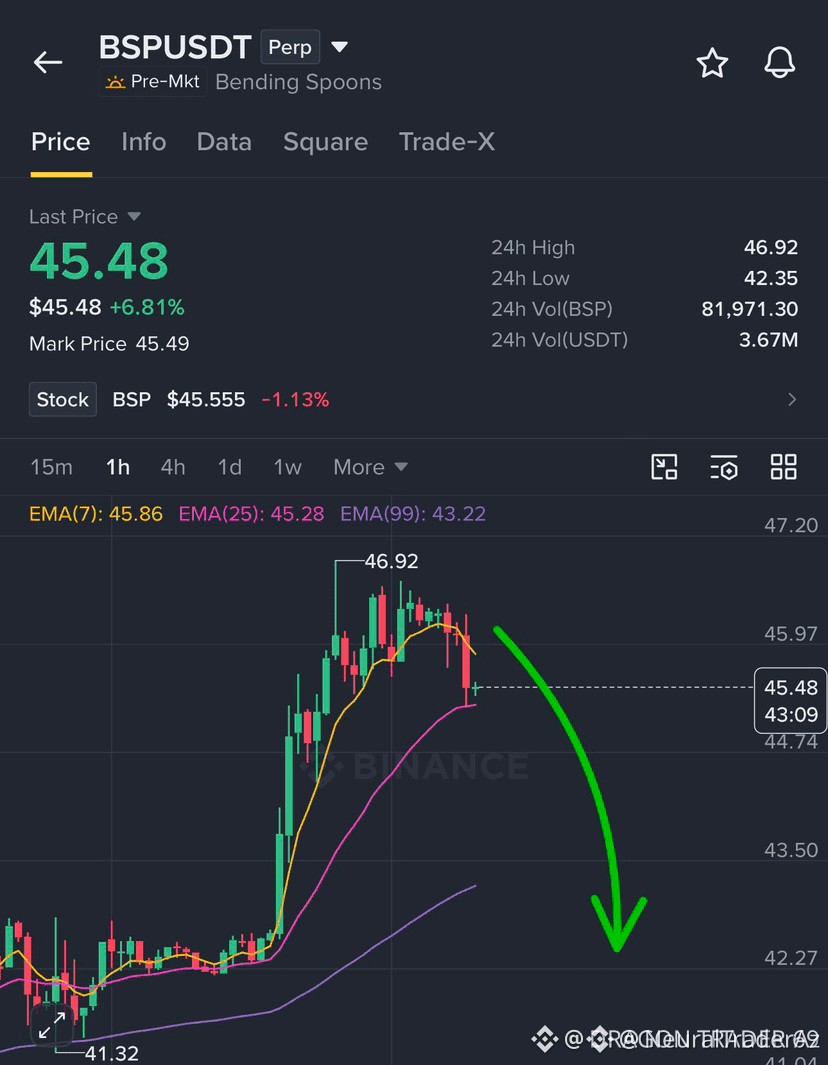

🚨 $BSP EXHAUSTION AT RESISTANCE TRIGGERS A HEAVY DISTRIBUTION SHORT SETUP! 📉
Entry: 45.50 🔻
Target: 43.00 / 41.00 / 39.00 📉
Stop Loss: 48.00 ⚠️
📌 Buyers just got rejected sharply right at key overhead supply, leaving a clear liquidity trap above 45.50. 📊 Order flow shows aggressive market selling coming in as smart money rolls over into distribution mode.
💡 If sellers maintain control of this pivot, the path of least resistance opens straight toward the lower demand pockets down to 39.00. 💬 Are you shorting this breakdown with the sellers or betting on a surprise recovery? 👇
⚠️ Not financial advice. Always manage your risk. 🛡️
🏷️ #BSP #ShortSetup #Crypto #MarketAnalysis
📉 🐻
Entry: 45.50 🔻
Target: 43.00 / 41.00 / 39.00 📉
Stop Loss: 48.00 ⚠️
📌 Buyers just got rejected sharply right at key overhead supply, leaving a clear liquidity trap above 45.50. 📊 Order flow shows aggressive market selling coming in as smart money rolls over into distribution mode.
💡 If sellers maintain control of this pivot, the path of least resistance opens straight toward the lower demand pockets down to 39.00. 💬 Are you shorting this breakdown with the sellers or betting on a surprise recovery? 👇
⚠️ Not financial advice. Always manage your risk. 🛡️
🏷️ #BSP #ShortSetup #Crypto #MarketAnalysis
📉 🐻
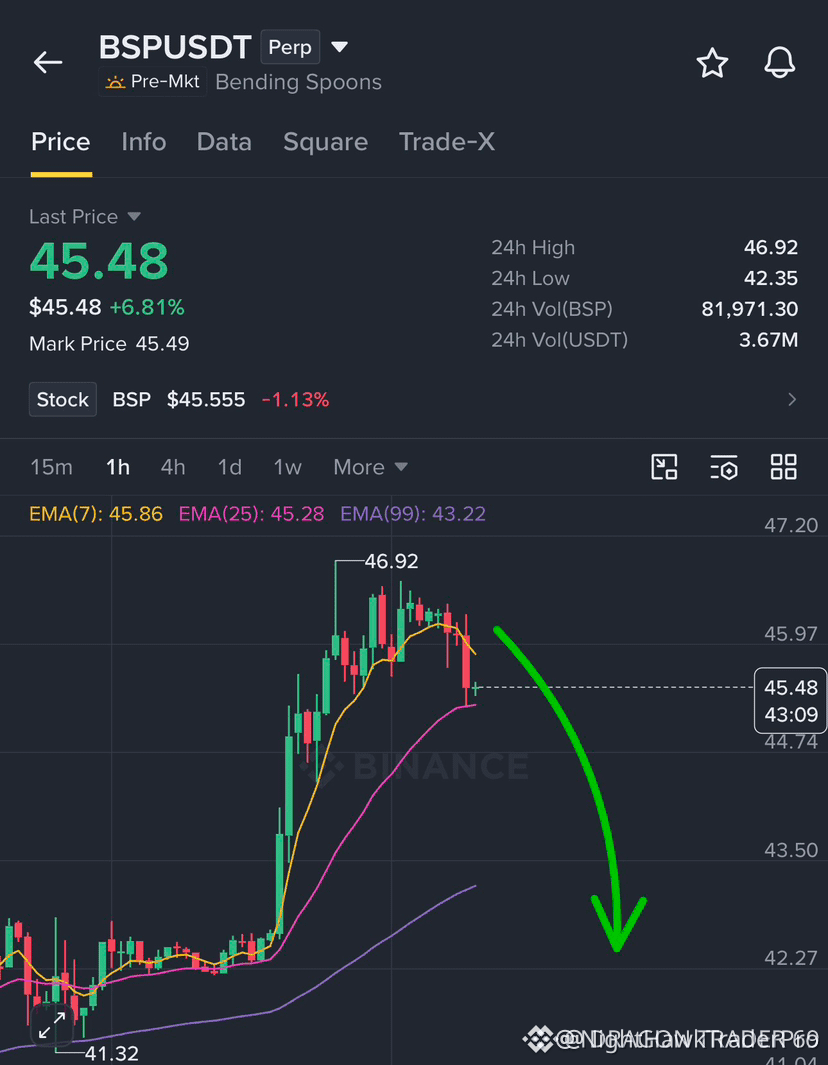
🚨 $BSP REJECTS KEY OVERHEAD SUPPLY ZONE AS BUY MOMENTUM FAILS! 📉
Entry: 46.05 - 46.20 🔴
Target: 43.87 🚀
Stop Loss: 47.26 ⚠️
$BSP ran directly into a critical overhead supply zone between 46.17 and 46.25, triggering immediate seller absorption. Upside momentum has completely stalled out, indicating buy-side liquidity was swept directly into institutional distribution. 🔍
With volume rapidly deteriorating on minor relief bounces, the structural path of least resistance tilts heavily toward the downside. Order flow favors a clean expansion toward lower sell-side liquidity targets as buyers fail to defend high ground. 📊
💬 Are you fading this resistance rejection or waiting for lower structural confirmation? 👇
⚠️ Not financial advice. Always manage your risk. 🛡️
🏷️ #BSP #ShortSetup #Crypto #MarketStructure
🎯 🐻
Entry: 46.05 - 46.20 🔴
Target: 43.87 🚀
Stop Loss: 47.26 ⚠️
$BSP ran directly into a critical overhead supply zone between 46.17 and 46.25, triggering immediate seller absorption. Upside momentum has completely stalled out, indicating buy-side liquidity was swept directly into institutional distribution. 🔍
With volume rapidly deteriorating on minor relief bounces, the structural path of least resistance tilts heavily toward the downside. Order flow favors a clean expansion toward lower sell-side liquidity targets as buyers fail to defend high ground. 📊
💬 Are you fading this resistance rejection or waiting for lower structural confirmation? 👇
⚠️ Not financial advice. Always manage your risk. 🛡️
🏷️ #BSP #ShortSetup #Crypto #MarketStructure
🎯 🐻
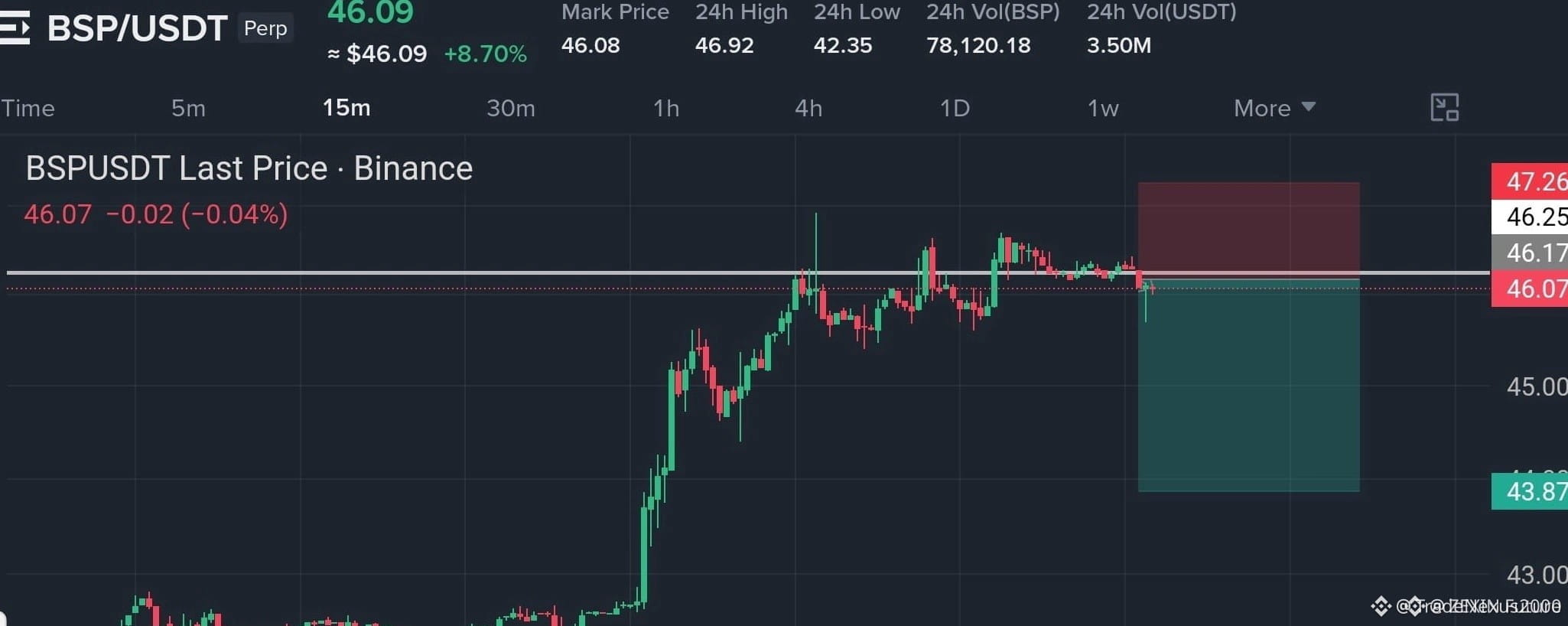

🔻 $BSP REJECTION AT RESISTANCE PREPARES A HEAVY PULLBACK SETUP! 📉
Entry: 46.05 - 46.20 ⚡
Target: 43.87 🎯
Stop Loss: 47.26 ⚠️
$BSP just ran straight into heavy supply around the 46.17–46.25 zone, and aggressive buyers are visibly losing steam. 📊 After an extended rally, order flow reveals strong seller absorption near the ceiling, signaling momentum is tipping back to the bears.
📉 A clean rejection from this level opens the runway for a deeper unwind toward lower support targets down to 43.87. 📌 Manage your execution carefully—if price manages to break and hold above 46.25, the short thesis invalidates.
🤔 Are you fading this resistance rejection or waiting for support to get swept below? 👇
⚠️ Not financial advice. Always manage your risk. 🛡️
🏷️ #BSP #ShortSetup #Pullback #Crypto #Trading
🔻 📉
Entry: 46.05 - 46.20 ⚡
Target: 43.87 🎯
Stop Loss: 47.26 ⚠️
$BSP just ran straight into heavy supply around the 46.17–46.25 zone, and aggressive buyers are visibly losing steam. 📊 After an extended rally, order flow reveals strong seller absorption near the ceiling, signaling momentum is tipping back to the bears.
📉 A clean rejection from this level opens the runway for a deeper unwind toward lower support targets down to 43.87. 📌 Manage your execution carefully—if price manages to break and hold above 46.25, the short thesis invalidates.
🤔 Are you fading this resistance rejection or waiting for support to get swept below? 👇
⚠️ Not financial advice. Always manage your risk. 🛡️
🏷️ #BSP #ShortSetup #Pullback #Crypto #Trading
🔻 📉
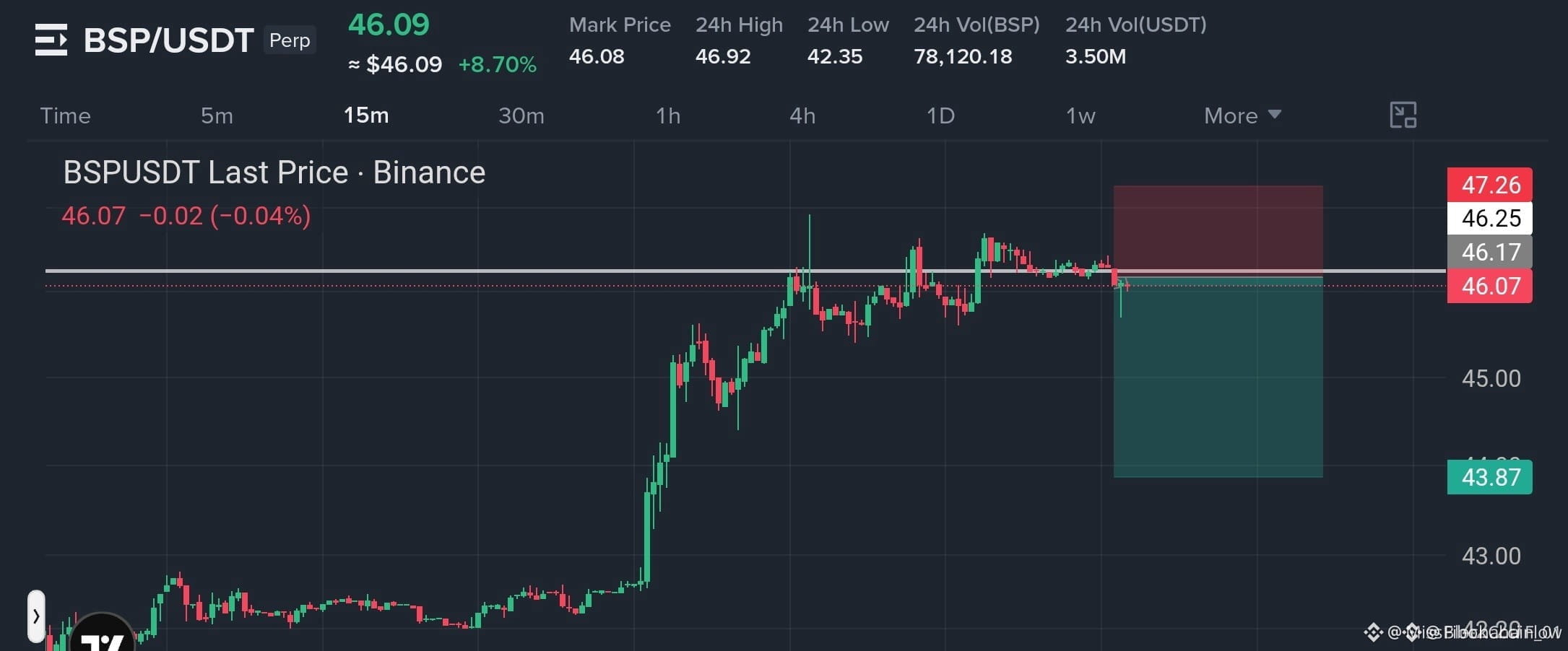

🚨 $BSP REJECTING HEAVY SUPPLY ZONE AS BUYING MOMENTUM FADES NEAR RESISTANCE! 📉 🔴
Entry: 46.05 - 46.20 ⚡
Target: 45.50 - 43.87 🔻
Stop Loss: 47.26 ⚠️
Price swept into the 46.17–46.25 overhead supply zone following an aggressive vertical move, showing clear exhaustion signatures with upper wick rejections. 🦈 Institutional sellers are stepping in to cap upside momentum, positioning for a structural rotation back down toward unmitigated lower levels.
📌 A clean failure to reclaim and hold above 46.25 validates this short setup toward primary downside liquidity targets. 📊 Maintain strict risk discipline—an invalidation close above resistance signals upside continuation. 💬 Are you shorting this structural rejection or waiting for a deeper lower low? 👇
⚠️ Not financial advice. Always manage your risk. 🛡️
🏷️ #BSP #ShortSetup #Crypto #Bearish #Trading
🐻 🔻
Entry: 46.05 - 46.20 ⚡
Target: 45.50 - 43.87 🔻
Stop Loss: 47.26 ⚠️
Price swept into the 46.17–46.25 overhead supply zone following an aggressive vertical move, showing clear exhaustion signatures with upper wick rejections. 🦈 Institutional sellers are stepping in to cap upside momentum, positioning for a structural rotation back down toward unmitigated lower levels.
📌 A clean failure to reclaim and hold above 46.25 validates this short setup toward primary downside liquidity targets. 📊 Maintain strict risk discipline—an invalidation close above resistance signals upside continuation. 💬 Are you shorting this structural rejection or waiting for a deeper lower low? 👇
⚠️ Not financial advice. Always manage your risk. 🛡️
🏷️ #BSP #ShortSetup #Crypto #Bearish #Trading
🐻 🔻
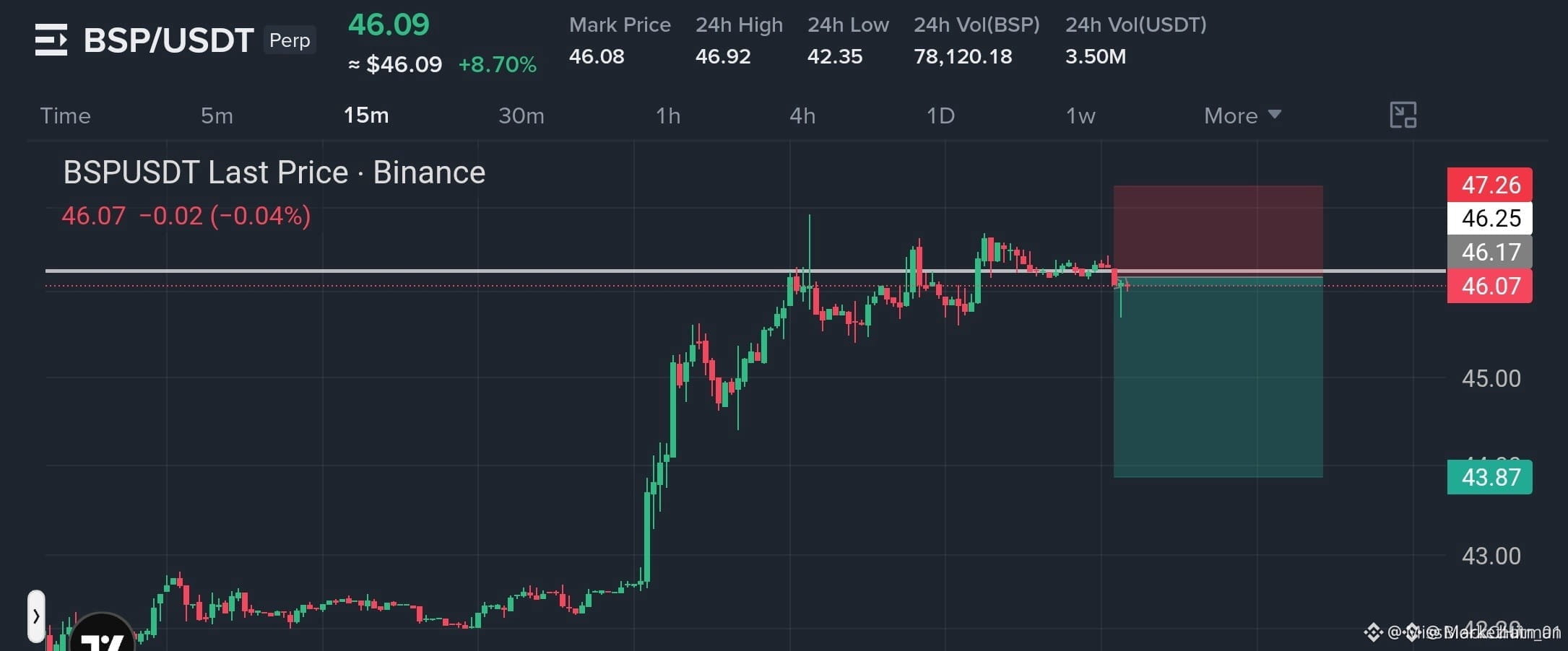

💥 $BSP BREAKOUT EXPANSION IN PLAY AS BUYERS RECLAIM TOTAL ORDER FLOW CONTROL! 🚀
Entry: 46.00 - 46.55 ⚡
Target: 47.00 - 48.50 🚀
Stop Loss: 45.40 ⚠️
$BSP is flexing textbook momentum strength right now, with persistent aggressive bids absorbing every minor dip into the 46.00 demand floor. 📊 Order flow shows buyers aggressively front-running lower liquidity pools to maintain upward trajectory.
As long as support above 45.40 remains intact, this tight consolidation acts as a launchpad for a clean drive into upper resistance targets. ⚡ Structure favors the aggressive long side while momentum remains primed for expansion.
💡 Risk is tightly defined, giving us a clean edge before the volatility kick. 💬 Are you riding this momentum trend higher or waiting for a deeper pullback into support? 👇
⚠️ Not financial advice. Always manage your risk. 🛡️
🏷️ #BSP #LongSetup #Crypto #Breakout #Altcoins
🔥 💎
Entry: 46.00 - 46.55 ⚡
Target: 47.00 - 48.50 🚀
Stop Loss: 45.40 ⚠️
$BSP is flexing textbook momentum strength right now, with persistent aggressive bids absorbing every minor dip into the 46.00 demand floor. 📊 Order flow shows buyers aggressively front-running lower liquidity pools to maintain upward trajectory.
As long as support above 45.40 remains intact, this tight consolidation acts as a launchpad for a clean drive into upper resistance targets. ⚡ Structure favors the aggressive long side while momentum remains primed for expansion.
💡 Risk is tightly defined, giving us a clean edge before the volatility kick. 💬 Are you riding this momentum trend higher or waiting for a deeper pullback into support? 👇
⚠️ Not financial advice. Always manage your risk. 🛡️
🏷️ #BSP #LongSetup #Crypto #Breakout #Altcoins
🔥 💎
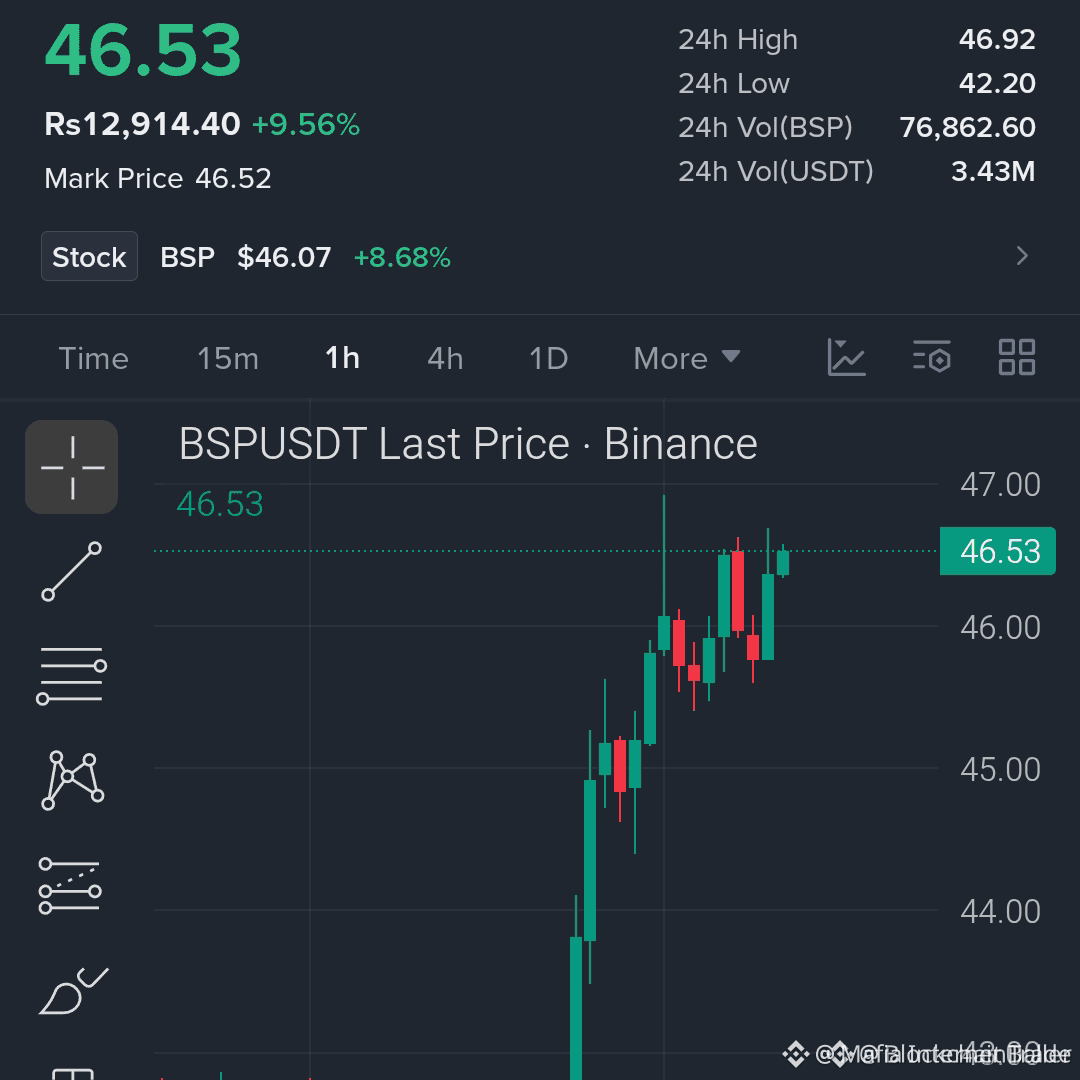
🦈 $BSP SHOWS BULLISH MARKET STRUCTURE RECLAIM WITH EXPANDING BUY-SIDE LIQUIDITY 📈
Entry: 46.00 - 46.55 ⚡
Target: 47.00 - 48.50 🎯
Stop Loss: 45.40 ⚠️
Buyers continue to defend the local higher-low structure cleanly, signaling robust order flow absorption across the 46.00 demand zone. 📊 Momentum metrics indicate persistent institutional accumulation while lower-timeframe supply blocks are rapidly eroding.
As long as price stays anchored above structural support, upside expansion toward the upper liquidity pools looks highly favored. 💡 Smart money is building positions inside this compression box prior to the next volatility spike. 💬 Are you trading this range reclaim or waiting for a higher timeframe candle close above resistance? 👇
⚠️ Not financial advice. Always manage your risk. 🛡️
🏷️ #BSP #MarketStructure #Crypto #LongSetup
🎯 🦈
Entry: 46.00 - 46.55 ⚡
Target: 47.00 - 48.50 🎯
Stop Loss: 45.40 ⚠️
Buyers continue to defend the local higher-low structure cleanly, signaling robust order flow absorption across the 46.00 demand zone. 📊 Momentum metrics indicate persistent institutional accumulation while lower-timeframe supply blocks are rapidly eroding.
As long as price stays anchored above structural support, upside expansion toward the upper liquidity pools looks highly favored. 💡 Smart money is building positions inside this compression box prior to the next volatility spike. 💬 Are you trading this range reclaim or waiting for a higher timeframe candle close above resistance? 👇
⚠️ Not financial advice. Always manage your risk. 🛡️
🏷️ #BSP #MarketStructure #Crypto #LongSetup
🎯 🦈
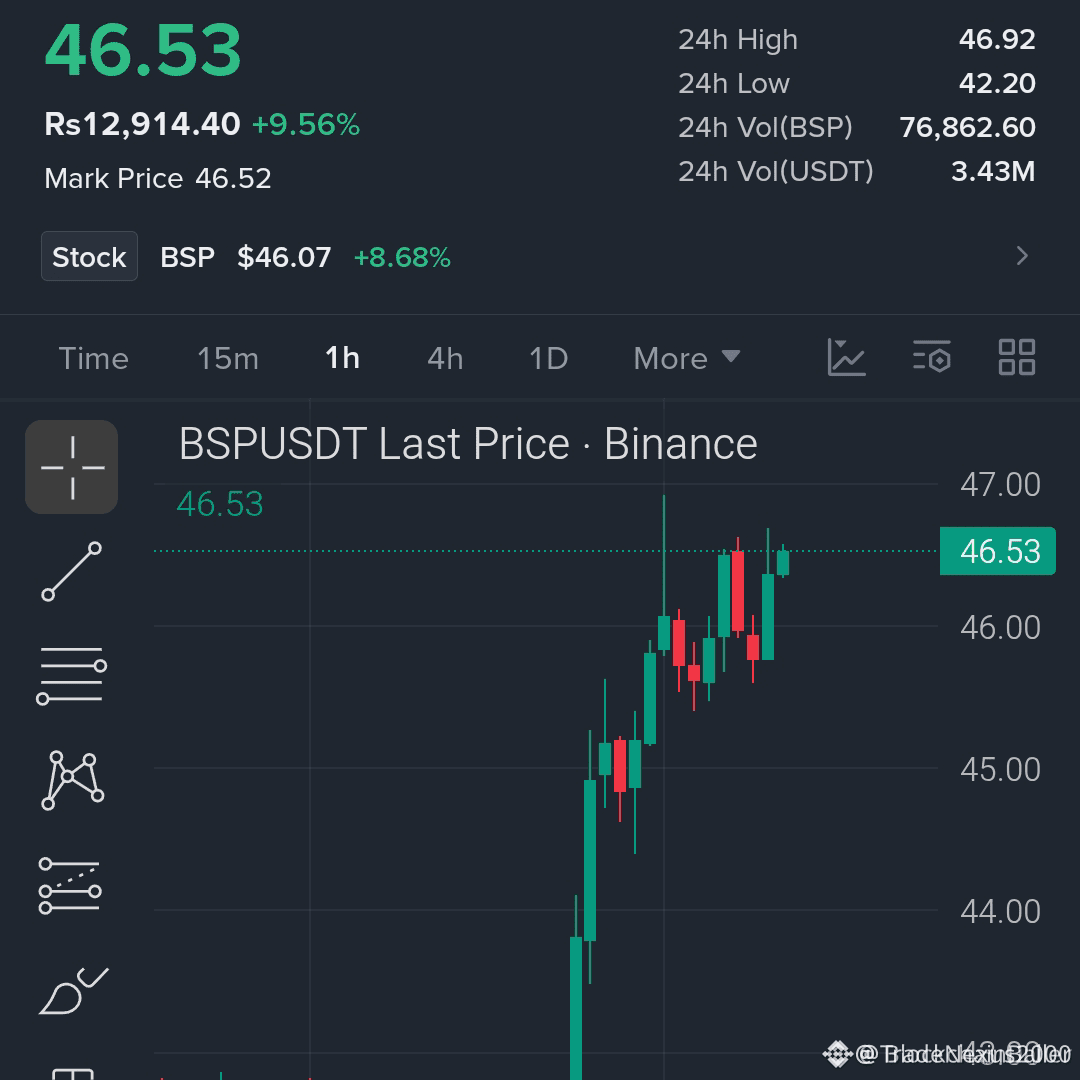

💥 $BSP BREAKOUT GAINING MOMENTUM AS BUYERS ABSORB OVERHEAD RESISTANCE! ⚡
Entry: 45.30 - 45.80 ⚡
Target 1: 46.50 🎯
Target 2: 47.30 💥
Target 3: 48.20 🚀
Stop Loss: 44.20 ⚠️
$BSP is pushing into fresh territory as aggressive market orders eat through sell walls on expanding volume. 📊 Order flow shows smart money actively defending this retest zone, signaling powerful continuation potential.
While sympathy plays like $ESP and $SNDK monitor the move, execution quality favors the momentum leader reclaiming structural highs. 💡 As long as buyers keep control above key support, the runway toward upper liquidity targets remains clear. 💬 Are you bidding this breakout right now or waiting for confirmed daily candle closure? 👇
⚠️ Not financial advice. Always manage your risk. 🛡️
🏷️ #BSP #Breakout #Altcoins #Crypto #Trading
🔥 ⚡
Entry: 45.30 - 45.80 ⚡
Target 1: 46.50 🎯
Target 2: 47.30 💥
Target 3: 48.20 🚀
Stop Loss: 44.20 ⚠️
$BSP is pushing into fresh territory as aggressive market orders eat through sell walls on expanding volume. 📊 Order flow shows smart money actively defending this retest zone, signaling powerful continuation potential.
While sympathy plays like $ESP and $SNDK monitor the move, execution quality favors the momentum leader reclaiming structural highs. 💡 As long as buyers keep control above key support, the runway toward upper liquidity targets remains clear. 💬 Are you bidding this breakout right now or waiting for confirmed daily candle closure? 👇
⚠️ Not financial advice. Always manage your risk. 🛡️
🏷️ #BSP #Breakout #Altcoins #Crypto #Trading
🔥 ⚡
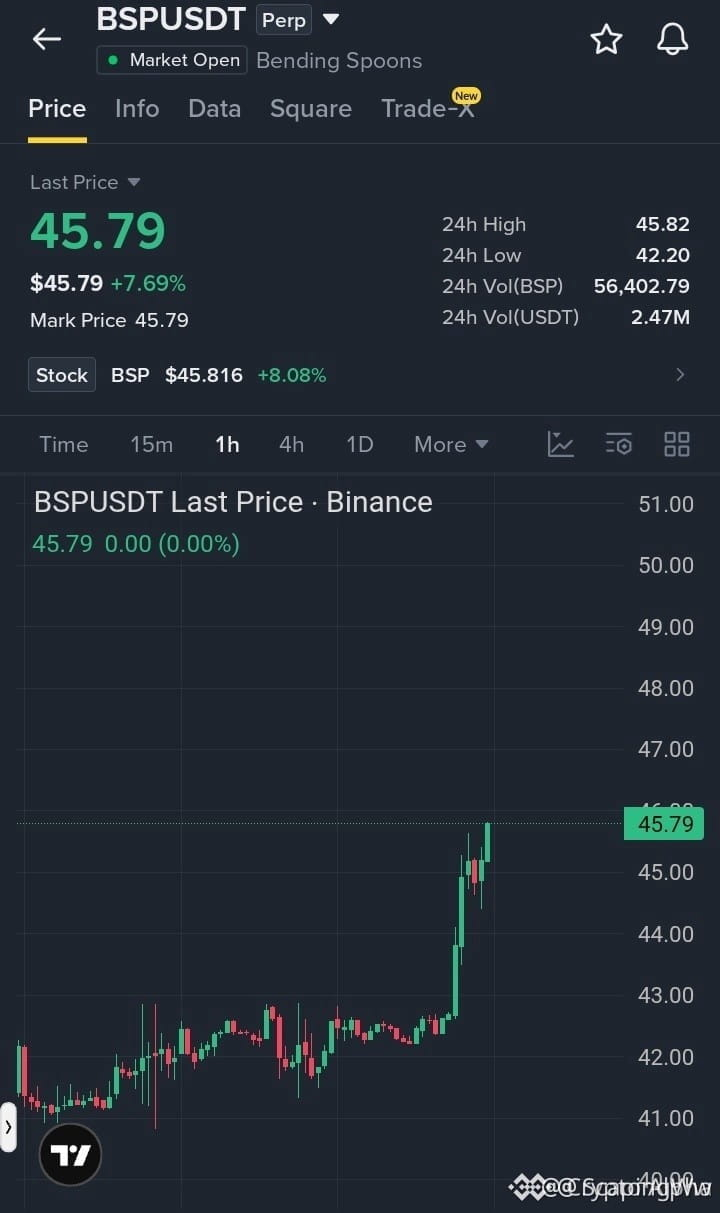
$BSP SMASHED ROUND ONE TARGETS AND IS GIVING A PERFECT SECOND ENTRY! 🚀💥
Entry: $45.00 - $45.61 ⚡
Target: $46.00 - $47.00 🚀
Stop Loss: $44.40 ⚠️
Round 1 cleared every single target effortlessly as aggressive buyers overwhelmed sell-side liquidity. 🌊 Market makers are handing out a textbook retest zone to reload long exposure before the next price expansion. ⚡
Order flow remains heavily tilted toward the bulls, with momentum indicators signaling another explosive push higher. 📊 Positioning into this structural bid ensures we ride the full leg up rather than chasing market orders at the top. 💡
Are you setting your bids inside this demand zone or watching from the sidelines as price breaks out again? 👇
⚠️ Not financial advice. Always manage your risk. 🛡️
🏷️ #BSP #LongSetup #Breakout #Crypto #Trading
🔥 💎
Entry: $45.00 - $45.61 ⚡
Target: $46.00 - $47.00 🚀
Stop Loss: $44.40 ⚠️
Round 1 cleared every single target effortlessly as aggressive buyers overwhelmed sell-side liquidity. 🌊 Market makers are handing out a textbook retest zone to reload long exposure before the next price expansion. ⚡
Order flow remains heavily tilted toward the bulls, with momentum indicators signaling another explosive push higher. 📊 Positioning into this structural bid ensures we ride the full leg up rather than chasing market orders at the top. 💡
Are you setting your bids inside this demand zone or watching from the sidelines as price breaks out again? 👇
⚠️ Not financial advice. Always manage your risk. 🛡️
🏷️ #BSP #LongSetup #Breakout #Crypto #Trading
🔥 💎
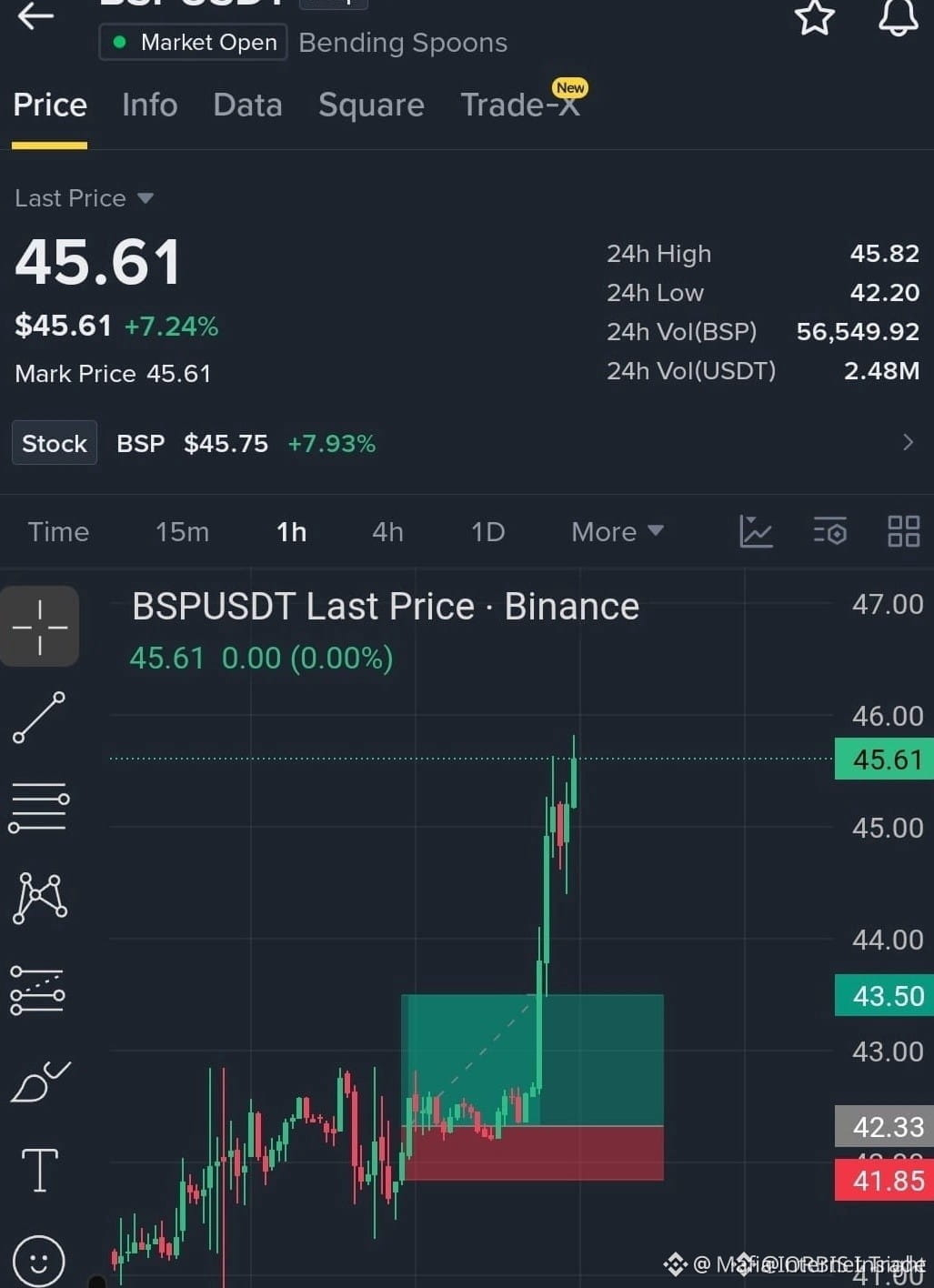

🚨 $BSP BREAKING STRUCTURAL RESISTANCE AS INSTANT EXPANSION FUELS THE NEXT UPSIDE LEG! 💥
Entry: 45.30 - 45.80 ⚡
Target: 46.50 / 47.30 / 48.20 🚀
Stop Loss: 44.20 ⚠️
Smart money accumulation around current range highs is clearing overhead supply, preparing $BSP for immediate price discovery. 📊 Institutional order flow reflects strong buying interest as price sweeps local liquidity without showing signs of exhaustion.
With secondary momentum building across correlated assets like $ESP and $SNDK , structural acceptance above 45.80 validates this continuation pattern. 💡 Buyers are maintaining market structure integrity while shifting former resistance into solid demand. 💬 Are you riding this structural breakout higher or waiting for a retest of support? 👇
⚠️ Not financial advice. Always manage your risk. 🛡️
🏷️ #BSP #Breakout #Crypto #Altcoins #Trading
🎯 🦈
Entry: 45.30 - 45.80 ⚡
Target: 46.50 / 47.30 / 48.20 🚀
Stop Loss: 44.20 ⚠️
Smart money accumulation around current range highs is clearing overhead supply, preparing $BSP for immediate price discovery. 📊 Institutional order flow reflects strong buying interest as price sweeps local liquidity without showing signs of exhaustion.
With secondary momentum building across correlated assets like $ESP and $SNDK , structural acceptance above 45.80 validates this continuation pattern. 💡 Buyers are maintaining market structure integrity while shifting former resistance into solid demand. 💬 Are you riding this structural breakout higher or waiting for a retest of support? 👇
⚠️ Not financial advice. Always manage your risk. 🛡️
🏷️ #BSP #Breakout #Crypto #Altcoins #Trading
🎯 🦈
Log in to explore more content