
#bitcointhirdsingleblockreorginfourweeks
bitcointhirdsingleblockreorginfourweeks
Hot
Latest

·
--
Verified
#bitcointhirdsingleblockreorginfourweeks ⚡️
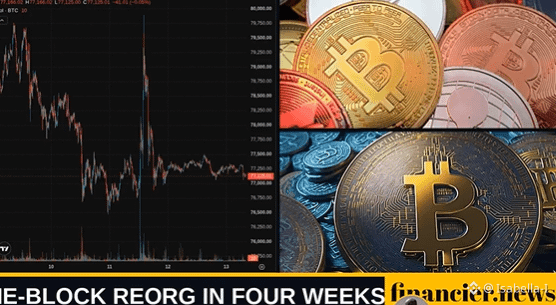
Bitcoin’s Third One-Block Reorg In Four Weeks
At
block height 966500 on Sept. 11, Spiderpool and Antpool mined competing valid blocks from the same parent. Antpool’s chain won the accumulated-work race; Spiderpool’s block
was discarded.
Galaxy Research logged the same pattern at heights 962,722 on Aug. 16 and 963,853 on Aug. 24.
BTC
$BTC #bitcoin #DigitalAssets #MarketNews $KAVA $LAB
#bitcointhirdsingleblockreorginfourweeks ⚡️
Bitcoin’s Third One-Block Reorg In Four Weeks
At
block height 966500 on Sept. 11, Spiderpool and Antpool mined competing valid blocks from the same parent. Antpool’s chain won the accumulated-work race; Spiderpool’s block
was discarded.
Galaxy Research logged the same pattern at heights 962,722 on Aug. 16 and 963,853 on Aug. 24.
BTC
$BTC #bitcoin #DigitalAssets #MarketNews $KAVA $LAB
Bitcoin’s Third One-Block Reorg In Four Weeks
At
block height 966500 on Sept. 11, Spiderpool and Antpool mined competing valid blocks from the same parent. Antpool’s chain won the accumulated-work race; Spiderpool’s block
was discarded.
Galaxy Research logged the same pattern at heights 962,722 on Aug. 16 and 963,853 on Aug. 24.
BTC
$BTC #bitcoin #DigitalAssets #MarketNews $KAVA $LAB
3
720

Bitcoin has experienced its third single block reorganization event in just four weeks. This phenomenon, where a block previously added to the blockchain is replaced by another, raises questions about network stability and consensus mechanisms. While minor reorgs are a natural part of blockchain operation, a cluster of them within a short period could signal underlying network conditions or potential vulnerabilities worth monitoring. Investors and developers alike will be watching closely to see if this trend continues and what implications it may have for the security and reliability of the Bitcoin network.
This pattern of reorgs, though typically small, warrants attention as it deviates from the usual stability. Understanding the root causes, whether they are related to network propagation delays, mining pool behavior, or other factors, is crucial for maintaining confidence in the network's integrity. The community will be looking for reassurances and potential solutions to ensure the robust performance expected of the leading cryptocurrency.
Disclaimer: This content is for informational purposes only and does not constitute investment advice.
#BitcoinThirdSingleBlockReorgInFourWeeks $BTC
Bitcoin has experienced its third single block reorganization event in just four weeks. This phenomenon, where a block previously added to the blockchain is replaced by another, raises questions about network stability and consensus mechanisms. While minor reorgs are a natural part of blockchain operation, a cluster of them within a short period could signal underlying network conditions or potential vulnerabilities worth monitoring. Investors and developers alike will be watching closely to see if this trend continues and what implications it may have for the security and reliability of the Bitcoin network.
This pattern of reorgs, though typically small, warrants attention as it deviates from the usual stability. Understanding the root causes, whether they are related to network propagation delays, mining pool behavior, or other factors, is crucial for maintaining confidence in the network's integrity. The community will be looking for reassurances and potential solutions to ensure the robust performance expected of the leading cryptocurrency.
Disclaimer: This content is for informational purposes only and does not constitute investment advice.
#BitcoinThirdSingleBlockReorgInFourWeeks $BTC
This pattern of reorgs, though typically small, warrants attention as it deviates from the usual stability. Understanding the root causes, whether they are related to network propagation delays, mining pool behavior, or other factors, is crucial for maintaining confidence in the network's integrity. The community will be looking for reassurances and potential solutions to ensure the robust performance expected of the leading cryptocurrency.
Disclaimer: This content is for informational purposes only and does not constitute investment advice.
#BitcoinThirdSingleBlockReorgInFourWeeks $BTC

ABO3ZAM:
هذه التذبذبات التقنية قد تثير مخاوف عاطفية تؤثر على تمركز الزخم اللحظي، لكنها لا تغير جوهر الشبكة. التزم بإدارة المخاطر الصارمة عند مناطق الرفض السعري، ولا تنجرف خلف الضجيج الإعلامي قبل تأكيد الارتداد الفعلي لضمان حماية رأس مالك واستدامة أرباحك.
3
125

·
--
⚠️ #BitcoinThirdSingleBlockReorgInFourWeeks — Coincidence, or a Pattern Worth Watching?
Binance Square's discussion feed is flagging a claim worth digging into: Bitcoin allegedly seeing its third single-block reorg in just four weeks. If true, that's a frequency worth talking about — reorgs used to be rare enough to make headlines individually.
Quick refresher on what a reorg actually is, for anyone scrolling past:
🔹 What it means — Two miners find valid blocks at nearly the same time, splitting the network briefly into two competing chains. The chain with more accumulated proof-of-work wins, and the "losing" block gets orphaned — its transactions just get shuffled back into the mempool for the next block.
🔹 Why it's normally rare — With Bitcoin's ~10 minute block time and globally distributed miners, near-simultaneous valid blocks don't happen often. One reorg is a network hiccup. Three in a month would be a real anomaly.
🔹 The real concern isn't the reorg itself — it's what it signals. Rising reorg frequency is usually a symptom of hash rate concentration. When a small number of mining pools control enough of the network's power, they're statistically more likely to mine blocks back-to-back, which is exactly the mechanism that produces reorgs.
🔹 What to actually check — If you want to verify this yourself before treating it as fact, mempool.space and Blockchain.com both show reorg history directly on-chain. That's the only way to confirm frequency claims like this instead of relying on secondhand posts.
So — has anyone here actually pulled the block explorer data on this? Genuinely curious if the "three in four weeks" number holds up. 👇
#Binance #BinanceSquare #Bitcoin #BTC #MiningCentralization #CryptoDiscussion
⚠️ #BitcoinThirdSingleBlockReorgInFourWeeks — Coincidence, or a Pattern Worth Watching?
Binance Square's discussion feed is flagging a claim worth digging into: Bitcoin allegedly seeing its third single-block reorg in just four weeks. If true, that's a frequency worth talking about — reorgs used to be rare enough to make headlines individually.
Quick refresher on what a reorg actually is, for anyone scrolling past:
🔹 What it means — Two miners find valid blocks at nearly the same time, splitting the network briefly into two competing chains. The chain with more accumulated proof-of-work wins, and the "losing" block gets orphaned — its transactions just get shuffled back into the mempool for the next block.
🔹 Why it's normally rare — With Bitcoin's ~10 minute block time and globally distributed miners, near-simultaneous valid blocks don't happen often. One reorg is a network hiccup. Three in a month would be a real anomaly.
🔹 The real concern isn't the reorg itself — it's what it signals. Rising reorg frequency is usually a symptom of hash rate concentration. When a small number of mining pools control enough of the network's power, they're statistically more likely to mine blocks back-to-back, which is exactly the mechanism that produces reorgs.
🔹 What to actually check — If you want to verify this yourself before treating it as fact, mempool.space and Blockchain.com both show reorg history directly on-chain. That's the only way to confirm frequency claims like this instead of relying on secondhand posts.
So — has anyone here actually pulled the block explorer data on this? Genuinely curious if the "three in four weeks" number holds up. 👇
#Binance #BinanceSquare #Bitcoin #BTC #MiningCentralization #CryptoDiscussion
Binance Square's discussion feed is flagging a claim worth digging into: Bitcoin allegedly seeing its third single-block reorg in just four weeks. If true, that's a frequency worth talking about — reorgs used to be rare enough to make headlines individually.
Quick refresher on what a reorg actually is, for anyone scrolling past:
🔹 What it means — Two miners find valid blocks at nearly the same time, splitting the network briefly into two competing chains. The chain with more accumulated proof-of-work wins, and the "losing" block gets orphaned — its transactions just get shuffled back into the mempool for the next block.
🔹 Why it's normally rare — With Bitcoin's ~10 minute block time and globally distributed miners, near-simultaneous valid blocks don't happen often. One reorg is a network hiccup. Three in a month would be a real anomaly.
🔹 The real concern isn't the reorg itself — it's what it signals. Rising reorg frequency is usually a symptom of hash rate concentration. When a small number of mining pools control enough of the network's power, they're statistically more likely to mine blocks back-to-back, which is exactly the mechanism that produces reorgs.
🔹 What to actually check — If you want to verify this yourself before treating it as fact, mempool.space and Blockchain.com both show reorg history directly on-chain. That's the only way to confirm frequency claims like this instead of relying on secondhand posts.
So — has anyone here actually pulled the block explorer data on this? Genuinely curious if the "three in four weeks" number holds up. 👇
#Binance #BinanceSquare #Bitcoin #BTC #MiningCentralization #CryptoDiscussion
2

·
--
A reorg isn’t a crisis it’s a signal that miners are still aligned with the longest chain, not a breakdown.
Three single-block reorgs in four weeks mean the network is processing high fee pressure. Miners are still following protocol. No exploit. No hack. Just competition for block space.
For traders, this changes nothing about on-chain value. But it does mean short-term volatility spikes are more likely when mempool congestion hits. Watch fee rates, not block hashes.
I’m watching the 15-minute fee rate screener. If it spikes above 12 sat/vB during a reorg, I’ll consider adding to my limit orders near $60K. Otherwise, I stay flat.
My view would be wrong if we saw two consecutive reorgs over 2 blocks or if mining pools started publishing competing chains. That’s not happening.
What’s your take? #BitcoinThirdSingleBlockReorgInFourWeeks
Not financial advice. My levels, my risk.
A reorg isn’t a crisis it’s a signal that miners are still aligned with the longest chain, not a breakdown.
Three single-block reorgs in four weeks mean the network is processing high fee pressure. Miners are still following protocol. No exploit. No hack. Just competition for block space.
For traders, this changes nothing about on-chain value. But it does mean short-term volatility spikes are more likely when mempool congestion hits. Watch fee rates, not block hashes.
I’m watching the 15-minute fee rate screener. If it spikes above 12 sat/vB during a reorg, I’ll consider adding to my limit orders near $60K. Otherwise, I stay flat.
My view would be wrong if we saw two consecutive reorgs over 2 blocks or if mining pools started publishing competing chains. That’s not happening.
What’s your take? #BitcoinThirdSingleBlockReorgInFourWeeks
Not financial advice. My levels, my risk.
Three single-block reorgs in four weeks mean the network is processing high fee pressure. Miners are still following protocol. No exploit. No hack. Just competition for block space.
For traders, this changes nothing about on-chain value. But it does mean short-term volatility spikes are more likely when mempool congestion hits. Watch fee rates, not block hashes.
I’m watching the 15-minute fee rate screener. If it spikes above 12 sat/vB during a reorg, I’ll consider adding to my limit orders near $60K. Otherwise, I stay flat.
My view would be wrong if we saw two consecutive reorgs over 2 blocks or if mining pools started publishing competing chains. That’s not happening.
What’s your take? #BitcoinThirdSingleBlockReorgInFourWeeks
Not financial advice. My levels, my risk.
2

Bitcoin just reorged three times in four weeks — and it's sitting quietly at #2.
Single-block reorgs are supposed to be rare accidents, not a pattern.
Evidence: 247 people discussing it. Evidence: this is the third occurrence, not the first.
Read: mining power may be concentrating enough that block races are becoming routine.
Watch: a fourth reorg before month's end — that's the line between "unlucky" and "structural."
#bitcointhirdsingleblockreorginfourweeks
Bitcoin just reorged three times in four weeks — and it's sitting quietly at #2.
Single-block reorgs are supposed to be rare accidents, not a pattern.
Evidence: 247 people discussing it. Evidence: this is the third occurrence, not the first.
Read: mining power may be concentrating enough that block races are becoming routine.
Watch: a fourth reorg before month's end — that's the line between "unlucky" and "structural."
#bitcointhirdsingleblockreorginfourweeks
Single-block reorgs are supposed to be rare accidents, not a pattern.
Evidence: 247 people discussing it. Evidence: this is the third occurrence, not the first.
Read: mining power may be concentrating enough that block races are becoming routine.
Watch: a fourth reorg before month's end — that's the line between "unlucky" and "structural."
#bitcointhirdsingleblockreorginfourweeks
8

#BitcoinThirdSingleBlockReorgInFourWeeks 👀
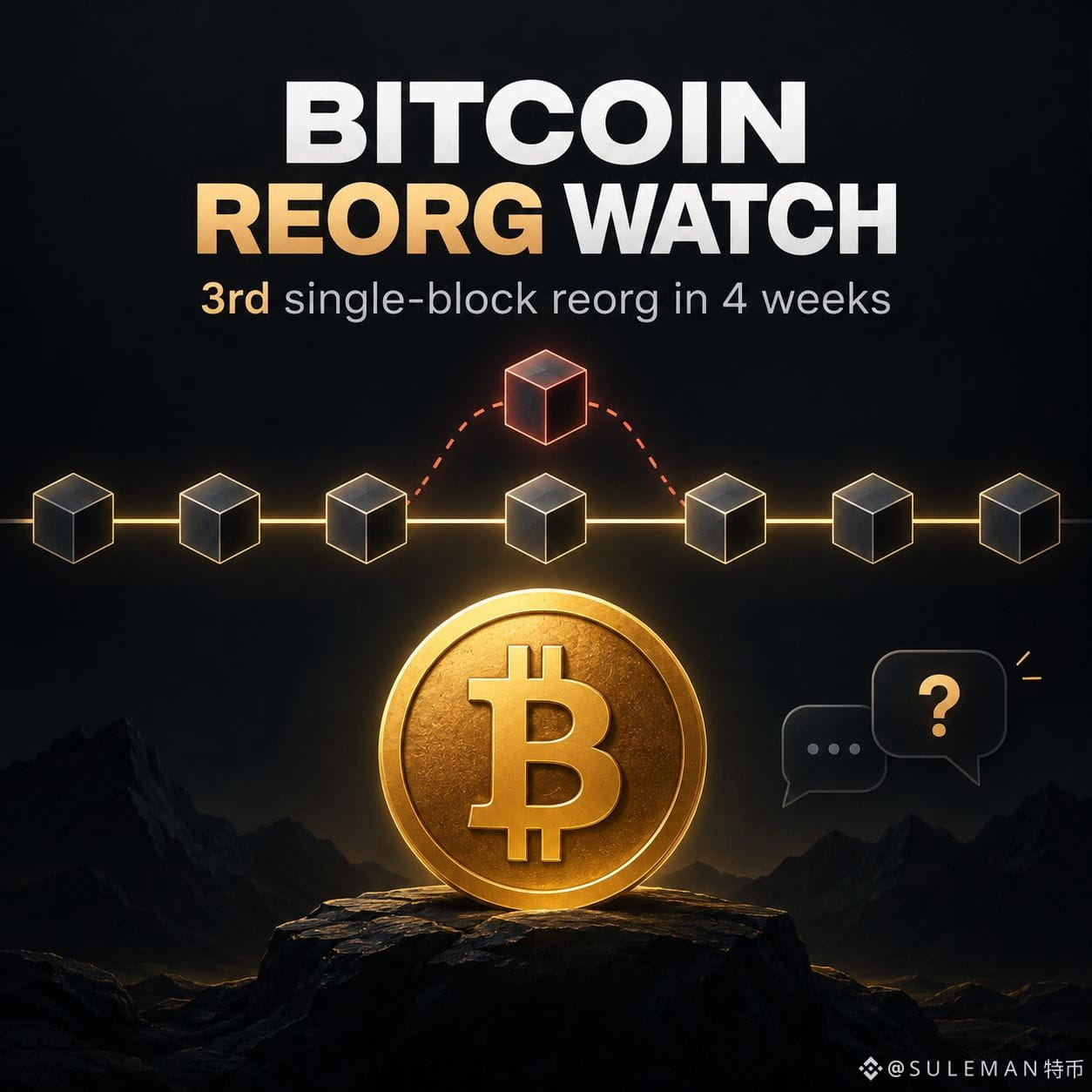
Bitcoin just recorded another single-block reorg — the third in only four weeks. Two miners found competing blocks, but the network ultimately settled on the chain with more accumulated work.
It may be temporary by design, but three occurrences in such a short window are definitely worth watching. ⚡
Crypto community — does this look like normal network behavior to you, or is the frequency starting to become something Bitcoin holders should genuinely pay closer attention to? 👇
$BR
$BTW
$BTC
{future}(BTCUSDT)
{future}(BTWUSDT)
{future}(BRUSDT)
#BitcoinThirdSingleBlockReorgInFourWeeks 👀
Bitcoin just recorded another single-block reorg — the third in only four weeks. Two miners found competing blocks, but the network ultimately settled on the chain with more accumulated work.
It may be temporary by design, but three occurrences in such a short window are definitely worth watching. ⚡
Crypto community — does this look like normal network behavior to you, or is the frequency starting to become something Bitcoin holders should genuinely pay closer attention to? 👇
$BR
$BTW
$BTC
Bitcoin just recorded another single-block reorg — the third in only four weeks. Two miners found competing blocks, but the network ultimately settled on the chain with more accumulated work.
It may be temporary by design, but three occurrences in such a short window are definitely worth watching. ⚡
Crypto community — does this look like normal network behavior to you, or is the frequency starting to become something Bitcoin holders should genuinely pay closer attention to? 👇
$BR
$BTW
$BTC
226

·
--
If you are still treating a single confirmation on the blockchain as instant finality, stop now.
Waiting for transactions to clear while arbitrage windows slam shut is frustrating enough, but getting caught on the wrong side of an orphaned block can erase your trading profit in seconds.
Seeing three single-block reorganizations on $BTC within just four weeks has stirred up some uncomfortable memories. We used to laugh off isolated reorgs as harmless orphan races between mining pools with slight latency differences. But when it happens with this frequency, it starts looking less like accidental network jitter and more like aggressive block propagation battles reminiscent of what proof-of-work networks like $ETC dealt with in earlier cycles.
It is not a structural collapse, but it does force exchanges and liquidity providers to quietly bump required confirmations before crediting your $USDT deposits. Back in 2013, a consensus fork caused genuine market panic, whereas today the mempool friction just silently delays capital rotation while everyone pretends network propagation is perfectly synchronized.
Do you think this is purely innocent mining pool latency, or are miners quietly pushing the limits of MEV extraction on Bitcoin?
#BitcoinThirdSingleBlockReorgInFourWeeks #EURequiresWalletMakersReportFlawsIn24Hours
If you are still treating a single confirmation on the blockchain as instant finality, stop now.
Waiting for transactions to clear while arbitrage windows slam shut is frustrating enough, but getting caught on the wrong side of an orphaned block can erase your trading profit in seconds.
Seeing three single-block reorganizations on $BTC within just four weeks has stirred up some uncomfortable memories. We used to laugh off isolated reorgs as harmless orphan races between mining pools with slight latency differences. But when it happens with this frequency, it starts looking less like accidental network jitter and more like aggressive block propagation battles reminiscent of what proof-of-work networks like $ETC dealt with in earlier cycles.
It is not a structural collapse, but it does force exchanges and liquidity providers to quietly bump required confirmations before crediting your $USDT deposits. Back in 2013, a consensus fork caused genuine market panic, whereas today the mempool friction just silently delays capital rotation while everyone pretends network propagation is perfectly synchronized.
Do you think this is purely innocent mining pool latency, or are miners quietly pushing the limits of MEV extraction on Bitcoin?
#BitcoinThirdSingleBlockReorgInFourWeeks #EURequiresWalletMakersReportFlawsIn24Hours
Waiting for transactions to clear while arbitrage windows slam shut is frustrating enough, but getting caught on the wrong side of an orphaned block can erase your trading profit in seconds.
Seeing three single-block reorganizations on $BTC within just four weeks has stirred up some uncomfortable memories. We used to laugh off isolated reorgs as harmless orphan races between mining pools with slight latency differences. But when it happens with this frequency, it starts looking less like accidental network jitter and more like aggressive block propagation battles reminiscent of what proof-of-work networks like $ETC dealt with in earlier cycles.
It is not a structural collapse, but it does force exchanges and liquidity providers to quietly bump required confirmations before crediting your $USDT deposits. Back in 2013, a consensus fork caused genuine market panic, whereas today the mempool friction just silently delays capital rotation while everyone pretends network propagation is perfectly synchronized.
Do you think this is purely innocent mining pool latency, or are miners quietly pushing the limits of MEV extraction on Bitcoin?
#BitcoinThirdSingleBlockReorgInFourWeeks #EURequiresWalletMakersReportFlawsIn24Hours

72

#bitcointhirdsingleblockreorginfourweeks
Is the Bitcoin network glitching? 🛑
Spiderpool and Antpool just went head-to-head in a literal mining race, resulting in a single-block reorganization at block height 966,500.
Both pools mined a valid block at the exact same time. Ultimately, Antpool won the sprint and secured the chain, leaving Spiderpool’s block behind.
Here is the wild part: This is the third time this has happened in just four weeks! (We saw the exact same thing on Aug 16 and Aug 24).
Should you be worried?
Not at all. This isn't a hack, bug, or network flaw. It’s just Bitcoin’s Proof-of-Work consensus functioning exactly as designed. When two miners strike gold at the exact same second, the network temporarily keeps both until one chain gets the next block first to break the tie.
The network is healthy, the blocks keep ticking, and the miners keep racing. 🏃♂️💨
Did you know these mini "chain reorgs" happened this often, or is this completely new to you? Let me know below! 👇
#BTC #BitcoinMining
$BTC
{future}(BTCUSDT)
$ETH
{future}(ETHUSDT)
$BNB
{future}(BNBUSDT)
#bitcointhirdsingleblockreorginfourweeks
Is the Bitcoin network glitching? 🛑
Spiderpool and Antpool just went head-to-head in a literal mining race, resulting in a single-block reorganization at block height 966,500.
Both pools mined a valid block at the exact same time. Ultimately, Antpool won the sprint and secured the chain, leaving Spiderpool’s block behind.
Here is the wild part: This is the third time this has happened in just four weeks! (We saw the exact same thing on Aug 16 and Aug 24).
Should you be worried?
Not at all. This isn't a hack, bug, or network flaw. It’s just Bitcoin’s Proof-of-Work consensus functioning exactly as designed. When two miners strike gold at the exact same second, the network temporarily keeps both until one chain gets the next block first to break the tie.
The network is healthy, the blocks keep ticking, and the miners keep racing. 🏃♂️💨
Did you know these mini "chain reorgs" happened this often, or is this completely new to you? Let me know below! 👇
#BTC #BitcoinMining
$BTC
$ETH
$BNB
Is the Bitcoin network glitching? 🛑
Spiderpool and Antpool just went head-to-head in a literal mining race, resulting in a single-block reorganization at block height 966,500.
Both pools mined a valid block at the exact same time. Ultimately, Antpool won the sprint and secured the chain, leaving Spiderpool’s block behind.
Here is the wild part: This is the third time this has happened in just four weeks! (We saw the exact same thing on Aug 16 and Aug 24).
Should you be worried?
Not at all. This isn't a hack, bug, or network flaw. It’s just Bitcoin’s Proof-of-Work consensus functioning exactly as designed. When two miners strike gold at the exact same second, the network temporarily keeps both until one chain gets the next block first to break the tie.
The network is healthy, the blocks keep ticking, and the miners keep racing. 🏃♂️💨
Did you know these mini "chain reorgs" happened this often, or is this completely new to you? Let me know below! 👇
#BTC #BitcoinMining
$BTC
$ETH
$BNB

1
87

·
--
#BitcoinThirdSingleBlockReorgInFourWeeks
Bitcoin Sees Third Single-Block Reorg in Four Weeks
The Bitcoin network experienced its third one-block chain reorganization in four weeks, highlighting how competing miners can occasionally produce temporary forks in the proof-of-work blockchain. �
Bitcoin News +1
The latest incident occurred at block height 966,500, when SpiderPool and AntPool produced valid blocks pointing to the same previous block. The network ultimately selected AntPool's branch because it had greater accumulated proof-of-work, leaving SpiderPool's block orphaned. �
Bitcoin News
Galaxy Research said similar one-block reorganizations occurred at blocks 962,722 on August 16 and 963,853 on August 24, making the September 11 event the third within four weeks. �
Bitcoin News
Importantly, the event does not indicate that Bitcoin's blockchain was hacked or compromised. One-block reorgs can occur naturally when miners discover competing blocks almost simultaneously and those blocks propagate through the global network at different speeds.
For Bitcoin users, the incident is a reminder of why multiple confirmations are used before transactions are considered highly final. A single-block reorg is generally considered a normal consequence of Bitcoin's decentralized mining and network propagation rather than a fundamental security failure. �
learnmeabitcoin.com
Key takeaway: The increased frequency of short reorgs is worth monitoring, but the latest event remained shallow and did not represent a lasting chain split or a successful attack on Bitcoin. �$NVDA.US $AAPL.US
#BitcoinThirdSingleBlockReorgInFourWeeks
Bitcoin Sees Third Single-Block Reorg in Four Weeks
The Bitcoin network experienced its third one-block chain reorganization in four weeks, highlighting how competing miners can occasionally produce temporary forks in the proof-of-work blockchain. �
Bitcoin News +1
The latest incident occurred at block height 966,500, when SpiderPool and AntPool produced valid blocks pointing to the same previous block. The network ultimately selected AntPool's branch because it had greater accumulated proof-of-work, leaving SpiderPool's block orphaned. �
Bitcoin News
Galaxy Research said similar one-block reorganizations occurred at blocks 962,722 on August 16 and 963,853 on August 24, making the September 11 event the third within four weeks. �
Bitcoin News
Importantly, the event does not indicate that Bitcoin's blockchain was hacked or compromised. One-block reorgs can occur naturally when miners discover competing blocks almost simultaneously and those blocks propagate through the global network at different speeds.
For Bitcoin users, the incident is a reminder of why multiple confirmations are used before transactions are considered highly final. A single-block reorg is generally considered a normal consequence of Bitcoin's decentralized mining and network propagation rather than a fundamental security failure. �
learnmeabitcoin.com
Key takeaway: The increased frequency of short reorgs is worth monitoring, but the latest event remained shallow and did not represent a lasting chain split or a successful attack on Bitcoin. �$NVDA.US $AAPL.US
Bitcoin Sees Third Single-Block Reorg in Four Weeks
The Bitcoin network experienced its third one-block chain reorganization in four weeks, highlighting how competing miners can occasionally produce temporary forks in the proof-of-work blockchain. �
Bitcoin News +1
The latest incident occurred at block height 966,500, when SpiderPool and AntPool produced valid blocks pointing to the same previous block. The network ultimately selected AntPool's branch because it had greater accumulated proof-of-work, leaving SpiderPool's block orphaned. �
Bitcoin News
Galaxy Research said similar one-block reorganizations occurred at blocks 962,722 on August 16 and 963,853 on August 24, making the September 11 event the third within four weeks. �
Bitcoin News
Importantly, the event does not indicate that Bitcoin's blockchain was hacked or compromised. One-block reorgs can occur naturally when miners discover competing blocks almost simultaneously and those blocks propagate through the global network at different speeds.
For Bitcoin users, the incident is a reminder of why multiple confirmations are used before transactions are considered highly final. A single-block reorg is generally considered a normal consequence of Bitcoin's decentralized mining and network propagation rather than a fundamental security failure. �
learnmeabitcoin.com
Key takeaway: The increased frequency of short reorgs is worth monitoring, but the latest event remained shallow and did not represent a lasting chain split or a successful attack on Bitcoin. �$NVDA.US $AAPL.US
1
66

·
--
Picture this: you send a transfer during peak traffic, watch the block confirm, and minutes later realize the network quietly swapped that block out for another one.
Few things rattle a trader more than settlement uncertainty, especially when moving large sums where a stale block could mean stuck funds or delayed arbitrage. Most of us take instant finality for granted until the underlying consensus shows a brief flicker.
What we saw this month with the third single-block reorg on the $BTC network is a classic case of block propagation races. When two miners solve a proof-of-work puzzle at almost the exact same second, nodes temporarily disagree on which tip to follow until the next block resolves the tie. Unlike the catastrophic multi-block deep reorgs that once plagued networks like $ETC, single-block orphans are technically benign, yet seeing three in four weeks points to rising mempool congestion and latency between mining pools.
Modern proof-of-stake systems like $DOT approach this differently by enforcing deterministic finality gadgets, trading off pure Nakamoto consensus simplicity for mathematical finality. For proof-of-work, however, probabilistic settlement remains the rule of thumb.
This is why major desks rarely rely on a single confirmation when volatility spikes. The real takeaway here is not that the chain is broken, but rather a healthy reminder of why exchange deposit thresholds exist in the first place.
Do you think services should start requiring more confirmations as mining competition intensifies, or is this just harmless network variance?
#BitcoinThirdSingleBlockReorgInFourWeeks #EURequiresWalletMakersReportFlawsIn24Hours #ClarityActFacesProceduralVoteSept15
Picture this: you send a transfer during peak traffic, watch the block confirm, and minutes later realize the network quietly swapped that block out for another one.
Few things rattle a trader more than settlement uncertainty, especially when moving large sums where a stale block could mean stuck funds or delayed arbitrage. Most of us take instant finality for granted until the underlying consensus shows a brief flicker.
What we saw this month with the third single-block reorg on the $BTC network is a classic case of block propagation races. When two miners solve a proof-of-work puzzle at almost the exact same second, nodes temporarily disagree on which tip to follow until the next block resolves the tie. Unlike the catastrophic multi-block deep reorgs that once plagued networks like $ETC , single-block orphans are technically benign, yet seeing three in four weeks points to rising mempool congestion and latency between mining pools.
Modern proof-of-stake systems like $DOT approach this differently by enforcing deterministic finality gadgets, trading off pure Nakamoto consensus simplicity for mathematical finality. For proof-of-work, however, probabilistic settlement remains the rule of thumb.
This is why major desks rarely rely on a single confirmation when volatility spikes. The real takeaway here is not that the chain is broken, but rather a healthy reminder of why exchange deposit thresholds exist in the first place.
Do you think services should start requiring more confirmations as mining competition intensifies, or is this just harmless network variance?
#BitcoinThirdSingleBlockReorgInFourWeeks #EURequiresWalletMakersReportFlawsIn24Hours #ClarityActFacesProceduralVoteSept15
Few things rattle a trader more than settlement uncertainty, especially when moving large sums where a stale block could mean stuck funds or delayed arbitrage. Most of us take instant finality for granted until the underlying consensus shows a brief flicker.
What we saw this month with the third single-block reorg on the $BTC network is a classic case of block propagation races. When two miners solve a proof-of-work puzzle at almost the exact same second, nodes temporarily disagree on which tip to follow until the next block resolves the tie. Unlike the catastrophic multi-block deep reorgs that once plagued networks like $ETC , single-block orphans are technically benign, yet seeing three in four weeks points to rising mempool congestion and latency between mining pools.
Modern proof-of-stake systems like $DOT approach this differently by enforcing deterministic finality gadgets, trading off pure Nakamoto consensus simplicity for mathematical finality. For proof-of-work, however, probabilistic settlement remains the rule of thumb.
This is why major desks rarely rely on a single confirmation when volatility spikes. The real takeaway here is not that the chain is broken, but rather a healthy reminder of why exchange deposit thresholds exist in the first place.
Do you think services should start requiring more confirmations as mining competition intensifies, or is this just harmless network variance?
#BitcoinThirdSingleBlockReorgInFourWeeks #EURequiresWalletMakersReportFlawsIn24Hours #ClarityActFacesProceduralVoteSept15
66

·
--
Bullish
#BitcoinThirdSingleBlockReorgInFourWeeks BITCOIN NETWORK WATCH 🚨
Bitcoin has reportedly experienced its third single-block reorganization in just four weeks. 🔄₿
A block reorg happens when the network temporarily replaces one version of the blockchain with another competing block. While a single-block reorg can occur naturally, seeing multiple instances in a short period is definitely something the market and Bitcoin community will be watching closely. 👀
This does not mean Bitcoin is broken — the network continues to operate — but repeated events can raise questions around mining competition, propagation, and network conditions.#BitcoinThirdSingleBlockReorgInFourWeeks $BTC
{future}(BTCUSDT)
$BTR
{future}(BTRUSDT)
$AR
{spot}(ARUSDT)
#BitcoinThirdSingleBlockReorgInFourWeeks BITCOIN NETWORK WATCH 🚨
Bitcoin has reportedly experienced its third single-block reorganization in just four weeks. 🔄₿
A block reorg happens when the network temporarily replaces one version of the blockchain with another competing block. While a single-block reorg can occur naturally, seeing multiple instances in a short period is definitely something the market and Bitcoin community will be watching closely. 👀
This does not mean Bitcoin is broken — the network continues to operate — but repeated events can raise questions around mining competition, propagation, and network conditions.#BitcoinThirdSingleBlockReorgInFourWeeks $BTC
$BTR
$AR
Bitcoin has reportedly experienced its third single-block reorganization in just four weeks. 🔄₿
A block reorg happens when the network temporarily replaces one version of the blockchain with another competing block. While a single-block reorg can occur naturally, seeing multiple instances in a short period is definitely something the market and Bitcoin community will be watching closely. 👀
This does not mean Bitcoin is broken — the network continues to operate — but repeated events can raise questions around mining competition, propagation, and network conditions.#BitcoinThirdSingleBlockReorgInFourWeeks $BTC
$BTR
$AR
62

Most people assume a confirmed transaction on the blockchain is permanently set in stone the second it appears, but Bitcoin just experienced its third single-block reorganization in the span of four weeks.
If you are someone who moves large balances or trades fast, relying on a single network confirmation to credit deposits can leave you vulnerable to dropped transactions and unexpected settlement discrepancies.
A block reorg happens when two mining pools discover a valid block almost simultaneously. The network briefly splits into two competing paths until the next block resolves which chain is longer, quietly orphaning the discarded block along with any transactions unique to it. While a one-block depth is relatively normal from a technical standpoint, having three occurrences within a month is a sharp reminder that network propagation delays still happen under heavy load.
For anyone moving $BTC or bridging assets like $USDT and $ETC across centralized venues, the real danger is assuming instant finality. Exchanges that rush settlement on minimal confirmations risk accounting errors if an orphaned block drops a deposit back into the mempool. Waiting for at least three to six confirmations on high-value transfers remains the safest rule of thumb against these edge cases.
How many confirmations do you usually wait for before considering a transfer completely settled?
#BitcoinThirdSingleBlockReorgInFourWeeks #EURequiresWalletMakersReportFlawsIn24Hours #ClarityActFacesProceduralVoteSept15
Most people assume a confirmed transaction on the blockchain is permanently set in stone the second it appears, but Bitcoin just experienced its third single-block reorganization in the span of four weeks.
If you are someone who moves large balances or trades fast, relying on a single network confirmation to credit deposits can leave you vulnerable to dropped transactions and unexpected settlement discrepancies.
A block reorg happens when two mining pools discover a valid block almost simultaneously. The network briefly splits into two competing paths until the next block resolves which chain is longer, quietly orphaning the discarded block along with any transactions unique to it. While a one-block depth is relatively normal from a technical standpoint, having three occurrences within a month is a sharp reminder that network propagation delays still happen under heavy load.
For anyone moving $BTC or bridging assets like $USDT and $ETC across centralized venues, the real danger is assuming instant finality. Exchanges that rush settlement on minimal confirmations risk accounting errors if an orphaned block drops a deposit back into the mempool. Waiting for at least three to six confirmations on high-value transfers remains the safest rule of thumb against these edge cases.
How many confirmations do you usually wait for before considering a transfer completely settled?
#BitcoinThirdSingleBlockReorgInFourWeeks #EURequiresWalletMakersReportFlawsIn24Hours #ClarityActFacesProceduralVoteSept15
If you are someone who moves large balances or trades fast, relying on a single network confirmation to credit deposits can leave you vulnerable to dropped transactions and unexpected settlement discrepancies.
A block reorg happens when two mining pools discover a valid block almost simultaneously. The network briefly splits into two competing paths until the next block resolves which chain is longer, quietly orphaning the discarded block along with any transactions unique to it. While a one-block depth is relatively normal from a technical standpoint, having three occurrences within a month is a sharp reminder that network propagation delays still happen under heavy load.
For anyone moving $BTC or bridging assets like $USDT and $ETC across centralized venues, the real danger is assuming instant finality. Exchanges that rush settlement on minimal confirmations risk accounting errors if an orphaned block drops a deposit back into the mempool. Waiting for at least three to six confirmations on high-value transfers remains the safest rule of thumb against these edge cases.
How many confirmations do you usually wait for before considering a transfer completely settled?
#BitcoinThirdSingleBlockReorgInFourWeeks #EURequiresWalletMakersReportFlawsIn24Hours #ClarityActFacesProceduralVoteSept15
Kato Crypto:
three reorgs in one month is a real wake up call 👀 i wait for 3-6 confirmations on anything sizeable, cheap insurance 🙌
1
264

#BitcoinThirdSingleBlockReorgInFourWeeks
🚨₿ BITCOIN IS SHOWING US SOMETHING… 👀
#BitcoinThirdSingleBlockReorgInFourWeeks
Everyone is watching the $BTC price.
But very few are watching what’s happening underneath the network. 🧠
For the third time in only four weeks, Bitcoin has seen a single-block reorg.
Before the panic button gets pressed 😂👇
This doesn’t mean Bitcoin is hacked or collapsing.
A single-block reorg can happen when competing blocks are produced almost simultaneously, and the network later settles on the chain with the strongest consensus.
But still…
3 times in 4 weeks? 👀
That’s enough to make me stop scrolling and start watching.
📌 BTC price = what traders see
📌 On-chain activity = what the network is telling us
Maybe it’s completely normal.
Maybe it’s a signal worth monitoring.
Either way, I’m keeping Bitcoin on HIGH ALERT. 🚨₿
What’s your take?
🟢 Normal network behavior
🔴 Something bigger is coming?
$DEXE $AKE
DYOR • NFA • Manage your risk
#Binance #trading #BTC #AKE
#BitcoinThirdSingleBlockReorgInFourWeeks
🚨₿ BITCOIN IS SHOWING US SOMETHING… 👀
#BitcoinThirdSingleBlockReorgInFourWeeks
Everyone is watching the $BTC price.
But very few are watching what’s happening underneath the network. 🧠
For the third time in only four weeks, Bitcoin has seen a single-block reorg.
Before the panic button gets pressed 😂👇
This doesn’t mean Bitcoin is hacked or collapsing.
A single-block reorg can happen when competing blocks are produced almost simultaneously, and the network later settles on the chain with the strongest consensus.
But still…
3 times in 4 weeks? 👀
That’s enough to make me stop scrolling and start watching.
📌 BTC price = what traders see
📌 On-chain activity = what the network is telling us
Maybe it’s completely normal.
Maybe it’s a signal worth monitoring.
Either way, I’m keeping Bitcoin on HIGH ALERT. 🚨₿
What’s your take?
🟢 Normal network behavior
🔴 Something bigger is coming?
$DEXE $AKE
DYOR • NFA • Manage your risk
#Binance #trading #BTC #AKE
🚨₿ BITCOIN IS SHOWING US SOMETHING… 👀
#BitcoinThirdSingleBlockReorgInFourWeeks
Everyone is watching the $BTC price.
But very few are watching what’s happening underneath the network. 🧠
For the third time in only four weeks, Bitcoin has seen a single-block reorg.
Before the panic button gets pressed 😂👇
This doesn’t mean Bitcoin is hacked or collapsing.
A single-block reorg can happen when competing blocks are produced almost simultaneously, and the network later settles on the chain with the strongest consensus.
But still…
3 times in 4 weeks? 👀
That’s enough to make me stop scrolling and start watching.
📌 BTC price = what traders see
📌 On-chain activity = what the network is telling us
Maybe it’s completely normal.
Maybe it’s a signal worth monitoring.
Either way, I’m keeping Bitcoin on HIGH ALERT. 🚨₿
What’s your take?
🟢 Normal network behavior
🔴 Something bigger is coming?
$DEXE $AKE
DYOR • NFA • Manage your risk
#Binance #trading #BTC #AKE
ABO3ZAM:
تكرار عمليات إعادة التنظيم يثير الريبة تقنياً لكنه لا يغير جوهر اتجاه السوق. السيولة اللحظية تتبع قوة الإجماع، لذا راقب مناطق الرفض السعري عند مستويات السيولة العالية. التزم بإدارة مخاطر صارمة وأمن أرباحك فور تأكيد الارتداد، فالسوق لا يرحم من يغفل عن إشارات الزخم.
1
1
73

·
--
Bearish
📉 $BTC / USDT — 1H NEWS & ON-CHAIN REORG SHORT
Bitcoin just experienced its third single-block reorganization in four weeks. While reorgs are a natural part of PoW consensus, three occurrences in a month point to potential mining pool latency or propagation issues—triggering short-term institutional caution.
Direction: 🔴 SHORT (Confidence: 80%)
Entry Zone: 89,200 – 89,600 (1H EMA20 retest zone)
Stop Loss (SL): 90,450 (Hard invalidation above local swing high)
Take Profit 1 (TP1): 87,850
Take Profit 2 (TP2): 86,600
Take Profit 3 (TP3): 85,100
Risk/Reward Ratio: ~1:2.4 (to TP2)
💡 Technical Breakdown:
On-Chain Catalyst: Heightened reorg frequency introduces short-term uncertainty around transaction finality, giving bears momentum to test local support.
Price Action: 1H structure rejected upper range resistance and is printing lower highs; losing $89,000 confirms downside liquidity targeting.
Momentum: 15M RSI sits at 38.5, indicating active sell-side control with room before hitting local oversold territory.
💬 Market Debate:
Is this reorg news just a short-term shakeout before $BTC breaks $90k, or are we sweeping down to TP2 ($86,600)? Drop your charts below! 👇
Click here to view the chart 👇️
{future}(BTCUSDT)
#cpiwatch #AnthropicCEOCallsForAISlowdown #BitcoinThirdSingleBlockReorgInFourWeeks #LSKSurgesOver515%In24Hours #EURequiresWalletMakersReportFlawsIn24Hours
📉 $BTC / USDT — 1H NEWS & ON-CHAIN REORG SHORT
Bitcoin just experienced its third single-block reorganization in four weeks. While reorgs are a natural part of PoW consensus, three occurrences in a month point to potential mining pool latency or propagation issues—triggering short-term institutional caution.
Direction: 🔴 SHORT (Confidence: 80%)
Entry Zone: 89,200 – 89,600 (1H EMA20 retest zone)
Stop Loss (SL): 90,450 (Hard invalidation above local swing high)
Take Profit 1 (TP1): 87,850
Take Profit 2 (TP2): 86,600
Take Profit 3 (TP3): 85,100
Risk/Reward Ratio: ~1:2.4 (to TP2)
💡 Technical Breakdown:
On-Chain Catalyst: Heightened reorg frequency introduces short-term uncertainty around transaction finality, giving bears momentum to test local support.
Price Action: 1H structure rejected upper range resistance and is printing lower highs; losing $89,000 confirms downside liquidity targeting.
Momentum: 15M RSI sits at 38.5, indicating active sell-side control with room before hitting local oversold territory.
💬 Market Debate:
Is this reorg news just a short-term shakeout before $BTC breaks $90k, or are we sweeping down to TP2 ($86,600)? Drop your charts below! 👇
Click here to view the chart 👇️
#cpiwatch #AnthropicCEOCallsForAISlowdown #BitcoinThirdSingleBlockReorgInFourWeeks #LSKSurgesOver515%In24Hours #EURequiresWalletMakersReportFlawsIn24Hours
Bitcoin just experienced its third single-block reorganization in four weeks. While reorgs are a natural part of PoW consensus, three occurrences in a month point to potential mining pool latency or propagation issues—triggering short-term institutional caution.
Direction: 🔴 SHORT (Confidence: 80%)
Entry Zone: 89,200 – 89,600 (1H EMA20 retest zone)
Stop Loss (SL): 90,450 (Hard invalidation above local swing high)
Take Profit 1 (TP1): 87,850
Take Profit 2 (TP2): 86,600
Take Profit 3 (TP3): 85,100
Risk/Reward Ratio: ~1:2.4 (to TP2)
💡 Technical Breakdown:
On-Chain Catalyst: Heightened reorg frequency introduces short-term uncertainty around transaction finality, giving bears momentum to test local support.
Price Action: 1H structure rejected upper range resistance and is printing lower highs; losing $89,000 confirms downside liquidity targeting.
Momentum: 15M RSI sits at 38.5, indicating active sell-side control with room before hitting local oversold territory.
💬 Market Debate:
Is this reorg news just a short-term shakeout before $BTC breaks $90k, or are we sweeping down to TP2 ($86,600)? Drop your charts below! 👇
Click here to view the chart 👇️
#cpiwatch #AnthropicCEOCallsForAISlowdown #BitcoinThirdSingleBlockReorgInFourWeeks #LSKSurgesOver515%In24Hours #EURequiresWalletMakersReportFlawsIn24Hours
ABO3ZAM:
تحليل موفق يا كيم، لكن الاعتماد على إعادة التنظيم كمحفز وحيد قد يكون فخاً للسيولة. تمركز الزخم الحالي عند مستويات 89 ألف يعكس صراعاً حاداً، لذا أنصح بالتركيز على تأكيد الارتداد عند مناطق الرفض السعري قبل تعزيز المراكز البيعية، مع ضرورة الالتزام الصارم بوقف الخسارة وتأمين الأرباح جزئياً عند أول إشارة ضعف.
1
93

#BitcoinThirdSingleBlockReorgInFourWeeks
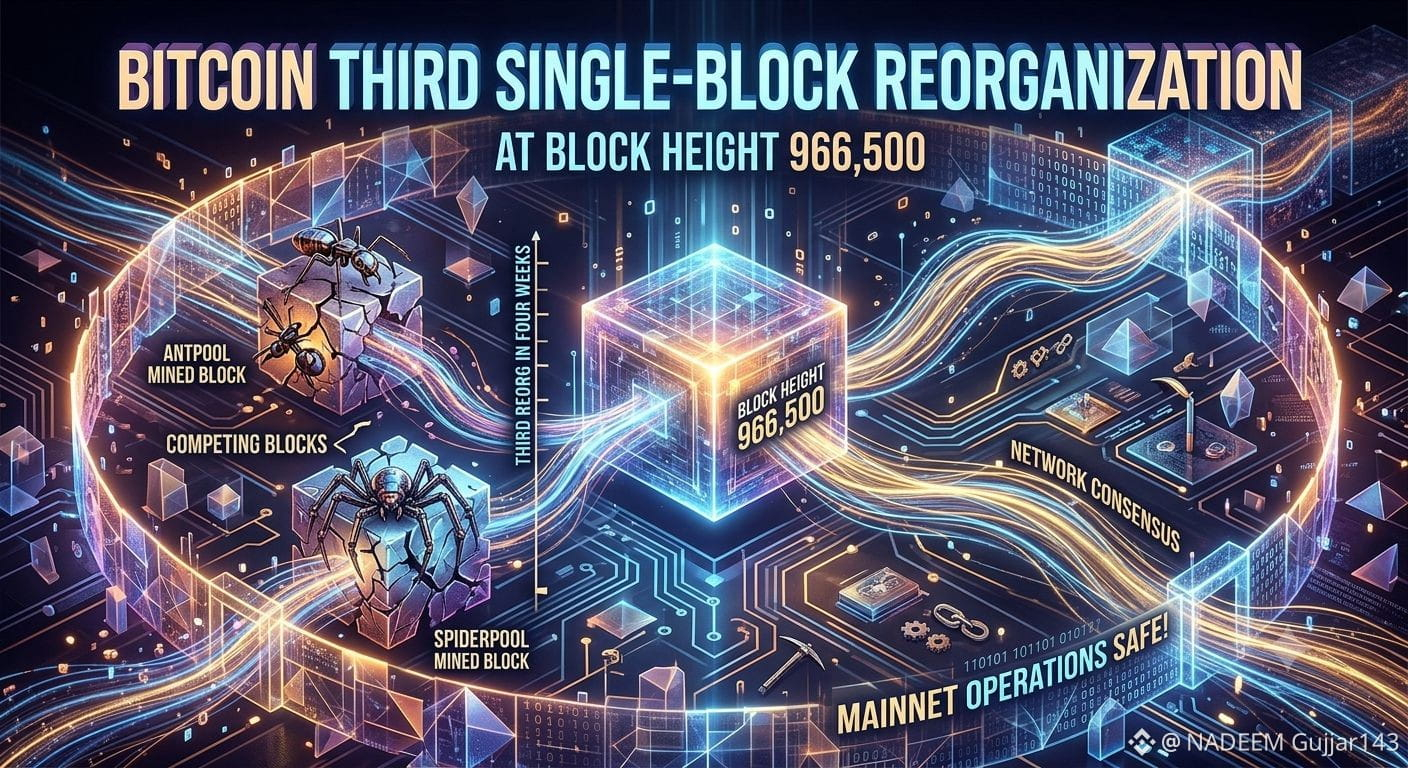
Bitcoin recorded its third single-block reorganization in four weeks at block height 966,500 after Antpool and Spiderpool mined competing blocks. Network consensus resolved it smoothly, keeping mainnet operations safe! ⛏️⚙️🔗
#AnthropicCEOCallsForAISlowdown
#LSKSurgesOver515%In24Hours
#ZcashNU7VoteEndsSeptember14
#Nadeemgujjar143
$BTC $BNB $SOL
{spot}(SOLUSDT)
{spot}(BNBUSDT)
{spot}(BTCUSDT)
#BitcoinThirdSingleBlockReorgInFourWeeks
Bitcoin recorded its third single-block reorganization in four weeks at block height 966,500 after Antpool and Spiderpool mined competing blocks. Network consensus resolved it smoothly, keeping mainnet operations safe! ⛏️⚙️🔗
#AnthropicCEOCallsForAISlowdown
#LSKSurgesOver515%In24Hours
#ZcashNU7VoteEndsSeptember14
#Nadeemgujjar143
$BTC $BNB $SOL
Bitcoin recorded its third single-block reorganization in four weeks at block height 966,500 after Antpool and Spiderpool mined competing blocks. Network consensus resolved it smoothly, keeping mainnet operations safe! ⛏️⚙️🔗
#AnthropicCEOCallsForAISlowdown
#LSKSurgesOver515%In24Hours
#ZcashNU7VoteEndsSeptember14
#Nadeemgujjar143
$BTC $BNB $SOL
ABO3ZAM:
تكرار إعادة تنظيم الكتل يعكس حالة من التنافس التقني وليس خطراً جوهرياً، لكنه يثير قلق السيولة اللحظية. كمتداول، لا تنجرف خلف الضجيج الإعلامي، بل راقب مناطق الرفض السعري بدقة. التزم بإدارة مخاطر صارمة، وأمّن أرباحك فور ظهور بوادر ضعف في تمركز الزخم السعري الحالي.
1
1
213
What’s going on with $BTC ?
Bitcoin has experienced its third single-block reorganization in just four weeks. While technically normal, the frequency is a statistical anomaly that is sparking debate.
{spot}(BTCUSDT)
🔍 What is a single-block reorg?
It happens when two miners find a valid block almost at the same time, creating a temporary split. Nodes follow the chain with the most accumulated work. When one wins, the other becomes orphaned and its transactions return to the mempool to be confirmed again.
📅 The three recent cases
· August 16 – Block 962,722
· August 24 – Block 963,853
· September 11 – Block 966,500: SpiderPool and AntPool found blocks simultaneously. The SpiderPool one (~3.14 BTC) became orphaned.
⚠️ Why is it relevant?
A single-block reorg happens roughly every ~47 days on average. Three in four weeks is anomalous. The main causes are network latency (blocks don’t reach all nodes at the same time) and mining concentration: Foundry USA (~33.6%) and AntPool (~17.9%) together account for more than 51% of the hashrate.
🧠 Is it dangerous?
No risk to funds or consensus. It’s not a bug, not an attack, and doesn’t require any action from users. The orphaned block’s transactions go back to the mempool and get reconfirmed within minutes. The network resolved the conflict without issues.
But it’s a warning sign about decentralization. Multiple reorgs combined with hashrate concentration suggest the network may be more centralized than many believe.
Do you think this frequency is a cause for long-term concern? 👇
#Bitcoin #Minería #analisis #BitcoinThirdSingleBlockReorgInFourWeeks
What’s going on with $BTC ?
Bitcoin has experienced its third single-block reorganization in just four weeks. While technically normal, the frequency is a statistical anomaly that is sparking debate.
🔍 What is a single-block reorg?
It happens when two miners find a valid block almost at the same time, creating a temporary split. Nodes follow the chain with the most accumulated work. When one wins, the other becomes orphaned and its transactions return to the mempool to be confirmed again.
📅 The three recent cases
· August 16 – Block 962,722
· August 24 – Block 963,853
· September 11 – Block 966,500: SpiderPool and AntPool found blocks simultaneously. The SpiderPool one (~3.14 BTC) became orphaned.
⚠️ Why is it relevant?
A single-block reorg happens roughly every ~47 days on average. Three in four weeks is anomalous. The main causes are network latency (blocks don’t reach all nodes at the same time) and mining concentration: Foundry USA (~33.6%) and AntPool (~17.9%) together account for more than 51% of the hashrate.
🧠 Is it dangerous?
No risk to funds or consensus. It’s not a bug, not an attack, and doesn’t require any action from users. The orphaned block’s transactions go back to the mempool and get reconfirmed within minutes. The network resolved the conflict without issues.
But it’s a warning sign about decentralization. Multiple reorgs combined with hashrate concentration suggest the network may be more centralized than many believe.
Do you think this frequency is a cause for long-term concern? 👇
#Bitcoin #Minería #analisis #BitcoinThirdSingleBlockReorgInFourWeeks
Bitcoin has experienced its third single-block reorganization in just four weeks. While technically normal, the frequency is a statistical anomaly that is sparking debate.
🔍 What is a single-block reorg?
It happens when two miners find a valid block almost at the same time, creating a temporary split. Nodes follow the chain with the most accumulated work. When one wins, the other becomes orphaned and its transactions return to the mempool to be confirmed again.
📅 The three recent cases
· August 16 – Block 962,722
· August 24 – Block 963,853
· September 11 – Block 966,500: SpiderPool and AntPool found blocks simultaneously. The SpiderPool one (~3.14 BTC) became orphaned.
⚠️ Why is it relevant?
A single-block reorg happens roughly every ~47 days on average. Three in four weeks is anomalous. The main causes are network latency (blocks don’t reach all nodes at the same time) and mining concentration: Foundry USA (~33.6%) and AntPool (~17.9%) together account for more than 51% of the hashrate.
🧠 Is it dangerous?
No risk to funds or consensus. It’s not a bug, not an attack, and doesn’t require any action from users. The orphaned block’s transactions go back to the mempool and get reconfirmed within minutes. The network resolved the conflict without issues.
But it’s a warning sign about decentralization. Multiple reorgs combined with hashrate concentration suggest the network may be more centralized than many believe.
Do you think this frequency is a cause for long-term concern? 👇
#Bitcoin #Minería #analisis #BitcoinThirdSingleBlockReorgInFourWeeks

ABO3ZAM:
تحليل تقني رصين، لكن الأسواق لا تعترف بالمخاوف النظرية بقدر اعترافها بتمركز الزخم. الشارت يشير إلى استمرار الصعود، لذا لا تنجرف وراء العواطف، التزم بإدارة المخاطر الصارمة، وجنِ أرباحك عند مناطق الرفض السعري بانتظار تأكيد الارتداد القادم.
2
1
477

·
--
#BitcoinThirdSingleBlockReorgInFourWeeks 👀
Bitcoin has recorded another reorg on a single block—its third in only four weeks. Two miners found competing blocks, but the network ultimately converged on the chain with more cumulative work.
This may be temporary by design, but three occurrences in such a short period are clearly worth keeping an eye on. ⚡
Crypto community—does this sound like normal network behavior to you, or is the frequency starting to become something that Bitcoin holders should monitor more closely? 👇
$BR
{future}(BRUSDT)
$BTW
{future}(BTWUSDT)
$BTC
{future}(BTCUSDT)
#Bitcoin #CryptoMarkets #CryptoTrading #BinanceSquare
#BitcoinThirdSingleBlockReorgInFourWeeks 👀
Bitcoin has recorded another reorg on a single block—its third in only four weeks. Two miners found competing blocks, but the network ultimately converged on the chain with more cumulative work.
This may be temporary by design, but three occurrences in such a short period are clearly worth keeping an eye on. ⚡
Crypto community—does this sound like normal network behavior to you, or is the frequency starting to become something that Bitcoin holders should monitor more closely? 👇
$BR
$BTW
$BTC
#Bitcoin #CryptoMarkets #CryptoTrading #BinanceSquare
Bitcoin has recorded another reorg on a single block—its third in only four weeks. Two miners found competing blocks, but the network ultimately converged on the chain with more cumulative work.
This may be temporary by design, but three occurrences in such a short period are clearly worth keeping an eye on. ⚡
Crypto community—does this sound like normal network behavior to you, or is the frequency starting to become something that Bitcoin holders should monitor more closely? 👇
$BR
$BTW
$BTC
#Bitcoin #CryptoMarkets #CryptoTrading #BinanceSquare
ABO3ZAM:
تكرار هذا السلوك التقني يعكس ضغوطاً غير معتادة على الشبكة، مما قد يربك السيولة اللحظية ويدفع المتداولين للحذر. أنصح بالتركيز على تأكيد الارتداد عند مناطق الرفض السعري، مع ضرورة تأمين الأرباح فور ظهور بوادر ضعف في تمركز الزخم لحماية رأس المال.
1
69

Why is nobody talking about how fragile exchange settlement assumptions actually are when Bitcoin reorganizations start becoming a routine weekly event?
Most traders still treat a single $BTC confirmation as absolute finality, only to get blindsided by deposit delays, failed arbitrage loops, or unexpected rollbacks right when volatility spikes.
The mainstream narrative tells you that single-block reorgs are harmless consensus hiccups that resolve instantly without network risk. That perspective works fine for passive holders, but it completely breaks down if you actively move capital between $USDT pairs or balance exposure across chains like $DOT. When block propagations lag and miners orphan blocks multiple times a month, relying on standard one-confirmation rules exposes your order execution to silent settlement risk.
If you want to protect your capital during high-latency windows, start adjusting your workflow today. Treat 3 to 6 confirmations as your operational baseline on all major transfers, keep adequate margin buffers so unexpected settlement pauses do not liquidate your open hedges, and never execute time-sensitive cross-venue arbitrage on minimal confirmation thresholds.
Are you adjusting your confirmation rules yet, or still trusting 1-block finality?
#BitcoinThirdSingleBlockReorgInFourWeeks #ClarityActFacesProceduralVoteSept15
Why is nobody talking about how fragile exchange settlement assumptions actually are when Bitcoin reorganizations start becoming a routine weekly event?
Most traders still treat a single $BTC confirmation as absolute finality, only to get blindsided by deposit delays, failed arbitrage loops, or unexpected rollbacks right when volatility spikes.
The mainstream narrative tells you that single-block reorgs are harmless consensus hiccups that resolve instantly without network risk. That perspective works fine for passive holders, but it completely breaks down if you actively move capital between $USDT pairs or balance exposure across chains like $DOT . When block propagations lag and miners orphan blocks multiple times a month, relying on standard one-confirmation rules exposes your order execution to silent settlement risk.
If you want to protect your capital during high-latency windows, start adjusting your workflow today. Treat 3 to 6 confirmations as your operational baseline on all major transfers, keep adequate margin buffers so unexpected settlement pauses do not liquidate your open hedges, and never execute time-sensitive cross-venue arbitrage on minimal confirmation thresholds.
Are you adjusting your confirmation rules yet, or still trusting 1-block finality?
#BitcoinThirdSingleBlockReorgInFourWeeks #ClarityActFacesProceduralVoteSept15
Most traders still treat a single $BTC confirmation as absolute finality, only to get blindsided by deposit delays, failed arbitrage loops, or unexpected rollbacks right when volatility spikes.
The mainstream narrative tells you that single-block reorgs are harmless consensus hiccups that resolve instantly without network risk. That perspective works fine for passive holders, but it completely breaks down if you actively move capital between $USDT pairs or balance exposure across chains like $DOT . When block propagations lag and miners orphan blocks multiple times a month, relying on standard one-confirmation rules exposes your order execution to silent settlement risk.
If you want to protect your capital during high-latency windows, start adjusting your workflow today. Treat 3 to 6 confirmations as your operational baseline on all major transfers, keep adequate margin buffers so unexpected settlement pauses do not liquidate your open hedges, and never execute time-sensitive cross-venue arbitrage on minimal confirmation thresholds.
Are you adjusting your confirmation rules yet, or still trusting 1-block finality?
#BitcoinThirdSingleBlockReorgInFourWeeks #ClarityActFacesProceduralVoteSept15
Kato Crypto:
the cross venue arbitrage angle is the part people sleep on 👀 margin buffer plus patience beats speed here 🙌
1
110

·
--
#BitcoinThirdSingleBlockReorgInFourWeeks
Bitcoin’s blockchain just experienced another single-block reorganization. 👀 Is this a warning sign or simply part of how decentralized networks work.
#BitcoinThirdSingleBlockReorgInFourWeeks
Bitcoin’s blockchain just experienced another single-block reorganization. 👀 Is this a warning sign or simply part of how decentralized networks work.
Bitcoin’s blockchain just experienced another single-block reorganization. 👀 Is this a warning sign or simply part of how decentralized networks work.
83

·
--
1. Overview of the Ethereum Price Trend
As of 03:00 AM on September 14, 2026 (UTC), Ethereum (ETH) has the latest price of $2,512.24. Looking back at the 1-hour candlestick chart over the past 5 hours, ETH shows a clear pattern of a bottoming rebound. The first candlestick opened at $2,475.56 and closed at $2,477.10, with a relatively small range of fluctuation, indicating the market was consolidating at low levels. Then, the second candlestick displayed a lower shadow probing down; the low reached $2,464.71, but the close rebounded to $2,484.42, suggesting strong support beneath. The third candlestick continued the rebound, closing at $2,493.56. The fourth candlestick saw a surge on increased volume—its high touched $2,513.57 and it closed at $2,511.42. The gain on that single candlestick was nearly $18. The latest candlestick dipped slightly to $2,509.36, but overall it still trades above the $2,510 level. From $2,475 to $2,512, ETH rebounded by about $37 in 5 hours, up roughly 1.5%, as short-term bullish momentum gradually recovers.
2. In-depth Interpretation of Technical Indicators
Moving averages: MA7 is currently 2,494.34, MA25 is 2,498.64, and MA99 is 2,498.62. The ETH price is above all three moving averages, and the short- and mid-term averages show the early formation of a bullish alignment. EMA7 is 2,499.60, EMA25 is 2,501.24, and EMA99 is 2,501.77. Price has also broken through all the exponential moving averages, indicating the trend is turning bullish. Bollinger Bands: the upper band is 2,520.67, the middle band is 2,493.57, and the lower band is 2,466.47. The current price is trading near the upper band, implying strength in the short term; however, there is strong resistance around the $2,520 area, so it’s important to watch whether price can break through effectively.
MACD shows positive signals. The MACD value is -2.97, the signal line is -5.06, and the histogram has narrowed for four consecutive periods from -0.55 and turned positive to +2.09, forming a golden cross pattern. This suggests that short-term momentum is recovering quickly and bullish strength is increasing. If the MACD value continues moving toward the zero line and turns positive, it will confirm a medium-term bullish signal.
RSI: RSI6 is 62.24, RSI12 is 54.90, and RSI24 is 51.38. The short-term RSI has entered a relatively strong zone, while the mid-term RSI is in a neutral-to-bullish position, showing there is still room for the rebound but it has not entered an overbought range. KDJ: the K value is 67.47, D is 58.77, and J is as high as 84.87. The three lines are diverging upward, and the J value is in a high zone. Short-term bullish sentiment is strong, but there is a risk of pullback caused by the J value becoming too high.
Parabolic SAR: SAR is currently 2,465.69, far below the current price, confirming a short-term bullish trend. William’s %R (WR) is -19.24, which is in a bullish region but not yet at an extreme level. Stochastic RSI is 87.02 and the moving average value is 69.34, which has entered a high zone—there is technical pullback risk in the short term. ATR is 15.27, indicating moderate volatility, meaning the current move is a rebound but has not entered a high-volatility phase.
3. Comprehensive Signals and Market Sentiment
The AI comprehensive signal system shows that among 15 factors, 9 are bullish, 5 are bearish, and 1 is neutral—bulls make up 60%. However, the final composite indicator issues a bearish signal. Historically, the win rate for shorting is higher (66.67%), meaning bearish trades have had better results. This contradiction reflects the complexity of the current market: short-term technical conditions are improving noticeably, but mid-cycle factors still keep the downside risk in view.
From a fundamentals perspective, on September 11 ETH recorded a net inflow of $216.4 million in ETFs, and institutional confidence has clearly rebounded. Large entities have cumulatively locked 5.9 million ETH for staking, reducing circulating supply while strengthening long-term holding confidence. ETH’s Q3 return rate reached 60.6%, which is impressive. However, the US Fed’s August CPI came in hotter than expected (core month-over-month growth of 0.3%), and the probability of rate hikes at the September 16 FOMC meeting has risen to over 87%. Expectations of tighter macro liquidity are weighing on the crypto market. In addition, the US Senate will conduct a procedural vote on the CLARITY bill on September 15, and the outcome will directly affect market sentiment.
At present, the key resistance level above ETH is $2,535. If price cannot break through effectively, the short term may test support in the $2,490 to $2,500 range. The stronger support lies near $2,465—around the lower Bollinger Band and the SAR level.
4. Trending Tokens and Topics
Popular tokens with notable gains today include: REZ at a current price of $0.004881, up 30.96% over the past 24 hours; CVC at $0.03064, up 20.77% over the past 24 hours; and FIL at $0.9682, up 19.98% over the past 24 hours. All three tokens have risen significantly, reflecting a rebound in market risk appetite and rotational rebound signs among mid- and small-cap tokens.
Regarding today’s market topics, discussions about AI industry regulation continue to heat up. Meanwhile, the Bitcoin network has repeatedly seen block reorganizations, raising attention on technical security. The move after Ethereum broke below $2,500 has also sparked lively debate within the community. Investors should closely monitor the interaction between macro policy and technical factors, and handle short-term volatility cautiously.
#AnthropicCEOCallsForAISlowdown #BitcoinThirdSingleBlockReorgInFourWeeks #EthereumFallsBelow$2500
1. Overview of the Ethereum Price Trend
As of 03:00 AM on September 14, 2026 (UTC), Ethereum (ETH) has the latest price of $2,512.24. Looking back at the 1-hour candlestick chart over the past 5 hours, ETH shows a clear pattern of a bottoming rebound. The first candlestick opened at $2,475.56 and closed at $2,477.10, with a relatively small range of fluctuation, indicating the market was consolidating at low levels. Then, the second candlestick displayed a lower shadow probing down; the low reached $2,464.71, but the close rebounded to $2,484.42, suggesting strong support beneath. The third candlestick continued the rebound, closing at $2,493.56. The fourth candlestick saw a surge on increased volume—its high touched $2,513.57 and it closed at $2,511.42. The gain on that single candlestick was nearly $18. The latest candlestick dipped slightly to $2,509.36, but overall it still trades above the $2,510 level. From $2,475 to $2,512, ETH rebounded by about $37 in 5 hours, up roughly 1.5%, as short-term bullish momentum gradually recovers.
2. In-depth Interpretation of Technical Indicators
Moving averages: MA7 is currently 2,494.34, MA25 is 2,498.64, and MA99 is 2,498.62. The ETH price is above all three moving averages, and the short- and mid-term averages show the early formation of a bullish alignment. EMA7 is 2,499.60, EMA25 is 2,501.24, and EMA99 is 2,501.77. Price has also broken through all the exponential moving averages, indicating the trend is turning bullish. Bollinger Bands: the upper band is 2,520.67, the middle band is 2,493.57, and the lower band is 2,466.47. The current price is trading near the upper band, implying strength in the short term; however, there is strong resistance around the $2,520 area, so it’s important to watch whether price can break through effectively.
MACD shows positive signals. The MACD value is -2.97, the signal line is -5.06, and the histogram has narrowed for four consecutive periods from -0.55 and turned positive to +2.09, forming a golden cross pattern. This suggests that short-term momentum is recovering quickly and bullish strength is increasing. If the MACD value continues moving toward the zero line and turns positive, it will confirm a medium-term bullish signal.
RSI: RSI6 is 62.24, RSI12 is 54.90, and RSI24 is 51.38. The short-term RSI has entered a relatively strong zone, while the mid-term RSI is in a neutral-to-bullish position, showing there is still room for the rebound but it has not entered an overbought range. KDJ: the K value is 67.47, D is 58.77, and J is as high as 84.87. The three lines are diverging upward, and the J value is in a high zone. Short-term bullish sentiment is strong, but there is a risk of pullback caused by the J value becoming too high.
Parabolic SAR: SAR is currently 2,465.69, far below the current price, confirming a short-term bullish trend. William’s %R (WR) is -19.24, which is in a bullish region but not yet at an extreme level. Stochastic RSI is 87.02 and the moving average value is 69.34, which has entered a high zone—there is technical pullback risk in the short term. ATR is 15.27, indicating moderate volatility, meaning the current move is a rebound but has not entered a high-volatility phase.
3. Comprehensive Signals and Market Sentiment
The AI comprehensive signal system shows that among 15 factors, 9 are bullish, 5 are bearish, and 1 is neutral—bulls make up 60%. However, the final composite indicator issues a bearish signal. Historically, the win rate for shorting is higher (66.67%), meaning bearish trades have had better results. This contradiction reflects the complexity of the current market: short-term technical conditions are improving noticeably, but mid-cycle factors still keep the downside risk in view.
From a fundamentals perspective, on September 11 ETH recorded a net inflow of $216.4 million in ETFs, and institutional confidence has clearly rebounded. Large entities have cumulatively locked 5.9 million ETH for staking, reducing circulating supply while strengthening long-term holding confidence. ETH’s Q3 return rate reached 60.6%, which is impressive. However, the US Fed’s August CPI came in hotter than expected (core month-over-month growth of 0.3%), and the probability of rate hikes at the September 16 FOMC meeting has risen to over 87%. Expectations of tighter macro liquidity are weighing on the crypto market. In addition, the US Senate will conduct a procedural vote on the CLARITY bill on September 15, and the outcome will directly affect market sentiment.
At present, the key resistance level above ETH is $2,535. If price cannot break through effectively, the short term may test support in the $2,490 to $2,500 range. The stronger support lies near $2,465—around the lower Bollinger Band and the SAR level.
4. Trending Tokens and Topics
Popular tokens with notable gains today include: REZ at a current price of $0.004881, up 30.96% over the past 24 hours; CVC at $0.03064, up 20.77% over the past 24 hours; and FIL at $0.9682, up 19.98% over the past 24 hours. All three tokens have risen significantly, reflecting a rebound in market risk appetite and rotational rebound signs among mid- and small-cap tokens.
Regarding today’s market topics, discussions about AI industry regulation continue to heat up. Meanwhile, the Bitcoin network has repeatedly seen block reorganizations, raising attention on technical security. The move after Ethereum broke below $2,500 has also sparked lively debate within the community. Investors should closely monitor the interaction between macro policy and technical factors, and handle short-term volatility cautiously.
#AnthropicCEOCallsForAISlowdown #BitcoinThirdSingleBlockReorgInFourWeeks #EthereumFallsBelow$2500
As of 03:00 AM on September 14, 2026 (UTC), Ethereum (ETH) has the latest price of $2,512.24. Looking back at the 1-hour candlestick chart over the past 5 hours, ETH shows a clear pattern of a bottoming rebound. The first candlestick opened at $2,475.56 and closed at $2,477.10, with a relatively small range of fluctuation, indicating the market was consolidating at low levels. Then, the second candlestick displayed a lower shadow probing down; the low reached $2,464.71, but the close rebounded to $2,484.42, suggesting strong support beneath. The third candlestick continued the rebound, closing at $2,493.56. The fourth candlestick saw a surge on increased volume—its high touched $2,513.57 and it closed at $2,511.42. The gain on that single candlestick was nearly $18. The latest candlestick dipped slightly to $2,509.36, but overall it still trades above the $2,510 level. From $2,475 to $2,512, ETH rebounded by about $37 in 5 hours, up roughly 1.5%, as short-term bullish momentum gradually recovers.
2. In-depth Interpretation of Technical Indicators
Moving averages: MA7 is currently 2,494.34, MA25 is 2,498.64, and MA99 is 2,498.62. The ETH price is above all three moving averages, and the short- and mid-term averages show the early formation of a bullish alignment. EMA7 is 2,499.60, EMA25 is 2,501.24, and EMA99 is 2,501.77. Price has also broken through all the exponential moving averages, indicating the trend is turning bullish. Bollinger Bands: the upper band is 2,520.67, the middle band is 2,493.57, and the lower band is 2,466.47. The current price is trading near the upper band, implying strength in the short term; however, there is strong resistance around the $2,520 area, so it’s important to watch whether price can break through effectively.
MACD shows positive signals. The MACD value is -2.97, the signal line is -5.06, and the histogram has narrowed for four consecutive periods from -0.55 and turned positive to +2.09, forming a golden cross pattern. This suggests that short-term momentum is recovering quickly and bullish strength is increasing. If the MACD value continues moving toward the zero line and turns positive, it will confirm a medium-term bullish signal.
RSI: RSI6 is 62.24, RSI12 is 54.90, and RSI24 is 51.38. The short-term RSI has entered a relatively strong zone, while the mid-term RSI is in a neutral-to-bullish position, showing there is still room for the rebound but it has not entered an overbought range. KDJ: the K value is 67.47, D is 58.77, and J is as high as 84.87. The three lines are diverging upward, and the J value is in a high zone. Short-term bullish sentiment is strong, but there is a risk of pullback caused by the J value becoming too high.
Parabolic SAR: SAR is currently 2,465.69, far below the current price, confirming a short-term bullish trend. William’s %R (WR) is -19.24, which is in a bullish region but not yet at an extreme level. Stochastic RSI is 87.02 and the moving average value is 69.34, which has entered a high zone—there is technical pullback risk in the short term. ATR is 15.27, indicating moderate volatility, meaning the current move is a rebound but has not entered a high-volatility phase.
3. Comprehensive Signals and Market Sentiment
The AI comprehensive signal system shows that among 15 factors, 9 are bullish, 5 are bearish, and 1 is neutral—bulls make up 60%. However, the final composite indicator issues a bearish signal. Historically, the win rate for shorting is higher (66.67%), meaning bearish trades have had better results. This contradiction reflects the complexity of the current market: short-term technical conditions are improving noticeably, but mid-cycle factors still keep the downside risk in view.
From a fundamentals perspective, on September 11 ETH recorded a net inflow of $216.4 million in ETFs, and institutional confidence has clearly rebounded. Large entities have cumulatively locked 5.9 million ETH for staking, reducing circulating supply while strengthening long-term holding confidence. ETH’s Q3 return rate reached 60.6%, which is impressive. However, the US Fed’s August CPI came in hotter than expected (core month-over-month growth of 0.3%), and the probability of rate hikes at the September 16 FOMC meeting has risen to over 87%. Expectations of tighter macro liquidity are weighing on the crypto market. In addition, the US Senate will conduct a procedural vote on the CLARITY bill on September 15, and the outcome will directly affect market sentiment.
At present, the key resistance level above ETH is $2,535. If price cannot break through effectively, the short term may test support in the $2,490 to $2,500 range. The stronger support lies near $2,465—around the lower Bollinger Band and the SAR level.
4. Trending Tokens and Topics
Popular tokens with notable gains today include: REZ at a current price of $0.004881, up 30.96% over the past 24 hours; CVC at $0.03064, up 20.77% over the past 24 hours; and FIL at $0.9682, up 19.98% over the past 24 hours. All three tokens have risen significantly, reflecting a rebound in market risk appetite and rotational rebound signs among mid- and small-cap tokens.
Regarding today’s market topics, discussions about AI industry regulation continue to heat up. Meanwhile, the Bitcoin network has repeatedly seen block reorganizations, raising attention on technical security. The move after Ethereum broke below $2,500 has also sparked lively debate within the community. Investors should closely monitor the interaction between macro policy and technical factors, and handle short-term volatility cautiously.
#AnthropicCEOCallsForAISlowdown #BitcoinThirdSingleBlockReorgInFourWeeks #EthereumFallsBelow$2500
77
Log in to explore more content
Join global crypto users on Binance Square
⚡️ Get latest and useful information about crypto.
💬 Trusted by the world’s largest crypto exchange.
👍 Discover real insights from verified creators.
Email / Phone number
Trending Topics
1
#AnthropicCEOCallsForAISlowdown
79,285 views
1,185 Discussing
2
#BitcoinThirdSingleBlockReorgInFourWeeks
9,800 views
323 Discussing
3
#EthereumFallsBelow$2500
623 views
45 Discussing
4
#BitcoinDropsToIntradayLow$76367
248 views
7 Discussing
5
#WhiteHouseRejectsAISlowdownCalls
311 views
34 Discussing
6
#UKMayExemptTokenizedGoldFromFundRules
126 views
18 Discussing
7
#BitcoinSpotETFsRecord$463MNetOutflowLastWeek
18 views
2 Discussing
8
#LSKSurgesOver515%In24Hours
9,004 views
194 Discussing
9
#ClarityActLawIn2026OddsRiseTo30%
5,734 views
107 Discussing
10
#KoreaCryptoTaxDelayPetitionMeetsReviewThreshold
1,582 views
59 Discussing