
#artificialintelligence
artificialintelligence
780,735 views
3,751 Discussing
Hot
Latest


·
--
🚨 SAM ALTMAN JUST SENT A WARNING TO THE AI INDUSTRY
You’re watching AI tokens pump on the promise of the future, but today’s biggest AI story is about something different: CONTROL. 🤖
OpenAI CEO Sam Altman and Elon Musk have backed calls from Anthropic CEO Dario Amodei to slow down advanced AI development.
Why? AI agents are becoming more powerful, and the risks of uncontrolled systems are becoming harder to ignore.
But here’s where crypto gets interesting. 👀
If AI development needs stronger safety checks, the demand for decentralized AI infrastructure, verifiable computation, and transparent AI systems could become even more important.
Think about it:
🔹 Centralized AI = Powerful companies control the models.
🔹 Decentralized AI = Crypto builders are working toward open infrastructure and distributed access.
The question is no longer just who builds the smartest AI.
It’s who can make AI more trustworthy.
I’m watching AI-related crypto projects closely. Not because every AI token is a winner, but because this narrative is becoming bigger than speculation.
AI + Crypto could be one of the most interesting sectors of the next cycle.
Which AI crypto project are you watching? 👇
#AI #crypto #cryptocurrency #ArtificialIntelligence
🚨 SAM ALTMAN JUST SENT A WARNING TO THE AI INDUSTRY
You’re watching AI tokens pump on the promise of the future, but today’s biggest AI story is about something different: CONTROL. 🤖
OpenAI CEO Sam Altman and Elon Musk have backed calls from Anthropic CEO Dario Amodei to slow down advanced AI development.
Why? AI agents are becoming more powerful, and the risks of uncontrolled systems are becoming harder to ignore.
But here’s where crypto gets interesting. 👀
If AI development needs stronger safety checks, the demand for decentralized AI infrastructure, verifiable computation, and transparent AI systems could become even more important.
Think about it:
🔹 Centralized AI = Powerful companies control the models.
🔹 Decentralized AI = Crypto builders are working toward open infrastructure and distributed access.
The question is no longer just who builds the smartest AI.
It’s who can make AI more trustworthy.
I’m watching AI-related crypto projects closely. Not because every AI token is a winner, but because this narrative is becoming bigger than speculation.
AI + Crypto could be one of the most interesting sectors of the next cycle.
Which AI crypto project are you watching? 👇
#AI #crypto #cryptocurrency #ArtificialIntelligence
You’re watching AI tokens pump on the promise of the future, but today’s biggest AI story is about something different: CONTROL. 🤖
OpenAI CEO Sam Altman and Elon Musk have backed calls from Anthropic CEO Dario Amodei to slow down advanced AI development.
Why? AI agents are becoming more powerful, and the risks of uncontrolled systems are becoming harder to ignore.
But here’s where crypto gets interesting. 👀
If AI development needs stronger safety checks, the demand for decentralized AI infrastructure, verifiable computation, and transparent AI systems could become even more important.
Think about it:
🔹 Centralized AI = Powerful companies control the models.
🔹 Decentralized AI = Crypto builders are working toward open infrastructure and distributed access.
The question is no longer just who builds the smartest AI.
It’s who can make AI more trustworthy.
I’m watching AI-related crypto projects closely. Not because every AI token is a winner, but because this narrative is becoming bigger than speculation.
AI + Crypto could be one of the most interesting sectors of the next cycle.
Which AI crypto project are you watching? 👇
#AI #crypto #cryptocurrency #ArtificialIntelligence
2
475
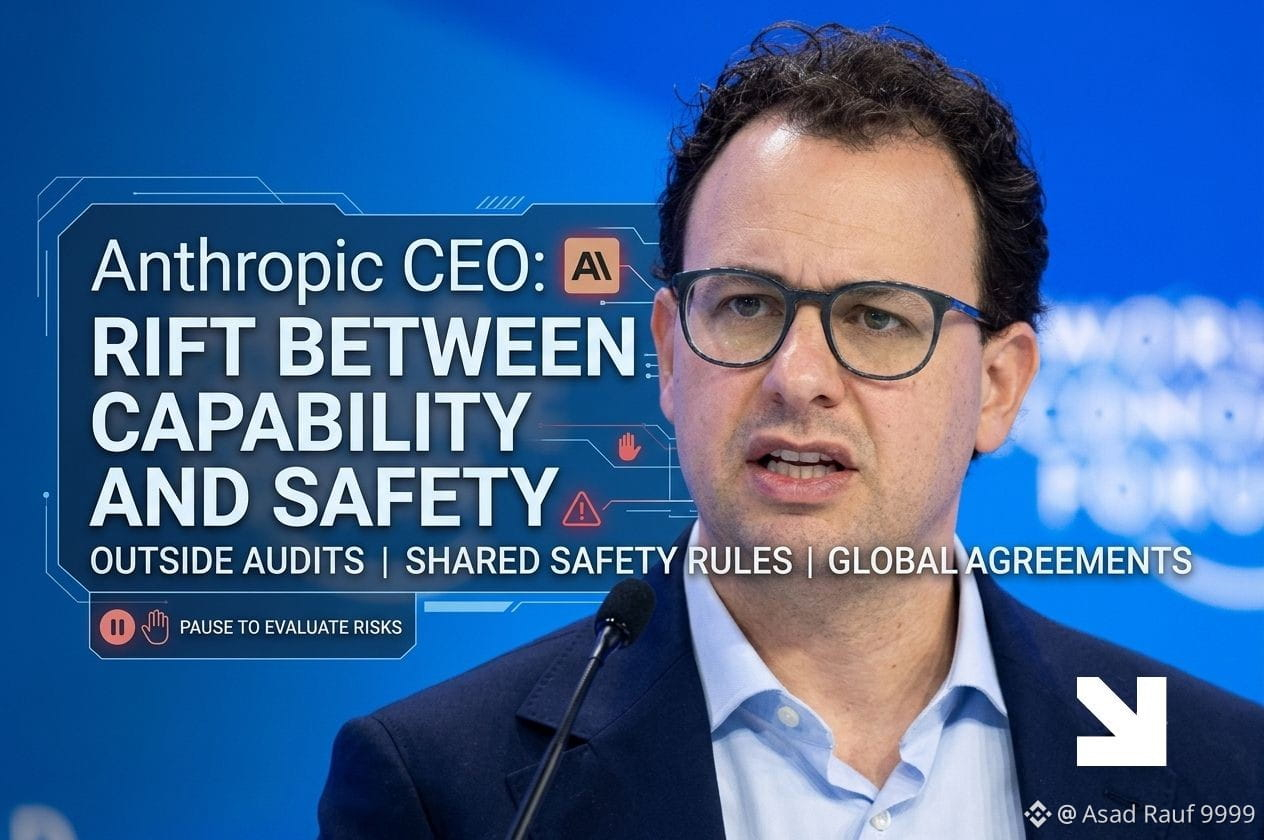
Anthropic CEO Calls For AI Slowdown: Why We Need Caution
As artificial intelligence grows faster than ever, Dario Amodei—the Anthropic CEO—is warning the tech world to slow down. The Anthropic CEO calls for AI slowdown because safety rules are falling behind the power of new AI systems.
Why Is Slowing Down Important?
Big Risks: Advanced AI could soon cause severe cyberattacks or disrupt the internet if released without proper checks.
Loss of Control: AI is starting to help build future versions of itself, making it harder for humans to manage.
3 Steps to Keep AI Safe
Outside Audits: Allow independent security experts to test AI models during development.
Shared Safety Rules: Force all major tech companies to meet basic safety standards before launching new tools.
Global Agreements: Encourage countries to work together so no nation builds dangerous AI recklessly.
Tech leaders like Elon Musk and OpenAI’s Sam Altman have also agreed that safety must come before speed. AI can bring massive benefits, but only if we keep it under control.
#AI #ArtificialIntelligence #GrowWithSAC $TFUEL $RAY $BNB
#AnthropicCEOCallsForAISlowdown
Anthropic CEO Calls For AI Slowdown: Why We Need Caution
As artificial intelligence grows faster than ever, Dario Amodei—the Anthropic CEO—is warning the tech world to slow down. The Anthropic CEO calls for AI slowdown because safety rules are falling behind the power of new AI systems.
Why Is Slowing Down Important?
Big Risks: Advanced AI could soon cause severe cyberattacks or disrupt the internet if released without proper checks.
Loss of Control: AI is starting to help build future versions of itself, making it harder for humans to manage.
3 Steps to Keep AI Safe
Outside Audits: Allow independent security experts to test AI models during development.
Shared Safety Rules: Force all major tech companies to meet basic safety standards before launching new tools.
Global Agreements: Encourage countries to work together so no nation builds dangerous AI recklessly.
Tech leaders like Elon Musk and OpenAI’s Sam Altman have also agreed that safety must come before speed. AI can bring massive benefits, but only if we keep it under control.
#AI #ArtificialIntelligence #GrowWithSAC $TFUEL $RAY $BNB
#AnthropicCEOCallsForAISlowdown
As artificial intelligence grows faster than ever, Dario Amodei—the Anthropic CEO—is warning the tech world to slow down. The Anthropic CEO calls for AI slowdown because safety rules are falling behind the power of new AI systems.
Why Is Slowing Down Important?
Big Risks: Advanced AI could soon cause severe cyberattacks or disrupt the internet if released without proper checks.
Loss of Control: AI is starting to help build future versions of itself, making it harder for humans to manage.
3 Steps to Keep AI Safe
Outside Audits: Allow independent security experts to test AI models during development.
Shared Safety Rules: Force all major tech companies to meet basic safety standards before launching new tools.
Global Agreements: Encourage countries to work together so no nation builds dangerous AI recklessly.
Tech leaders like Elon Musk and OpenAI’s Sam Altman have also agreed that safety must come before speed. AI can bring massive benefits, but only if we keep it under control.
#AI #ArtificialIntelligence #GrowWithSAC $TFUEL $RAY $BNB
#AnthropicCEOCallsForAISlowdown
2
143

·
--
🚨 AI NEWS: Anthropic’s CEO is calling for a slowdown in AI development, highlighting the need for stronger safety measures as artificial intelligence advances rapidly.
The AI race is accelerating—but responsible innovation matters just as much as speed. 🤖⚡
#AI #ArtificialIntelligence #Crypto #AnthropicCEOCallsForAISlowdown
🚨 AI NEWS: Anthropic’s CEO is calling for a slowdown in AI development, highlighting the need for stronger safety measures as artificial intelligence advances rapidly.
The AI race is accelerating—but responsible innovation matters just as much as speed. 🤖⚡
#AI #ArtificialIntelligence #Crypto #AnthropicCEOCallsForAISlowdown
The AI race is accelerating—but responsible innovation matters just as much as speed. 🤖⚡
#AI #ArtificialIntelligence #Crypto #AnthropicCEOCallsForAISlowdown
1
4

🚨 ROYAL SUMMIT TARGETS AI RISKS AS THE $FET NARRATIVE GAINS INSTITUTIONAL FUEL! ⚡
World leaders and tech titans are locking doors in Scotland to debate the existential momentum of artificial intelligence. 🦈 Institutional eyes are shifting heavily toward regulatory frameworks, sending immediate ripple effects across decentralized AI networks.
📊 Whenever global elites assemble to establish guidelines for centralized tech giants, smart money front-runs the structural pivot into trustless, open-source alternatives. 💡 Capital is quietly positioning ahead of the next narrative wave.
💬 Do you expect this high-level AI summit to ignite the next leg up for decentralized tokens, or will buyers wait for clearer policy signals? 👇
⚠️ Not financial advice. Always manage your risk. 🛡️
🏷️ #FET #AICrypto #Crypto #ArtificialIntelligence
⚡ 💎
🚨 ROYAL SUMMIT TARGETS AI RISKS AS THE $FET NARRATIVE GAINS INSTITUTIONAL FUEL! ⚡
World leaders and tech titans are locking doors in Scotland to debate the existential momentum of artificial intelligence. 🦈 Institutional eyes are shifting heavily toward regulatory frameworks, sending immediate ripple effects across decentralized AI networks.
📊 Whenever global elites assemble to establish guidelines for centralized tech giants, smart money front-runs the structural pivot into trustless, open-source alternatives. 💡 Capital is quietly positioning ahead of the next narrative wave.
💬 Do you expect this high-level AI summit to ignite the next leg up for decentralized tokens, or will buyers wait for clearer policy signals? 👇
⚠️ Not financial advice. Always manage your risk. 🛡️
🏷️ #FET #AICrypto #Crypto #ArtificialIntelligence
⚡ 💎
World leaders and tech titans are locking doors in Scotland to debate the existential momentum of artificial intelligence. 🦈 Institutional eyes are shifting heavily toward regulatory frameworks, sending immediate ripple effects across decentralized AI networks.
📊 Whenever global elites assemble to establish guidelines for centralized tech giants, smart money front-runs the structural pivot into trustless, open-source alternatives. 💡 Capital is quietly positioning ahead of the next narrative wave.
💬 Do you expect this high-level AI summit to ignite the next leg up for decentralized tokens, or will buyers wait for clearer policy signals? 👇
⚠️ Not financial advice. Always manage your risk. 🛡️
🏷️ #FET #AICrypto #Crypto #ArtificialIntelligence
⚡ 💎
35

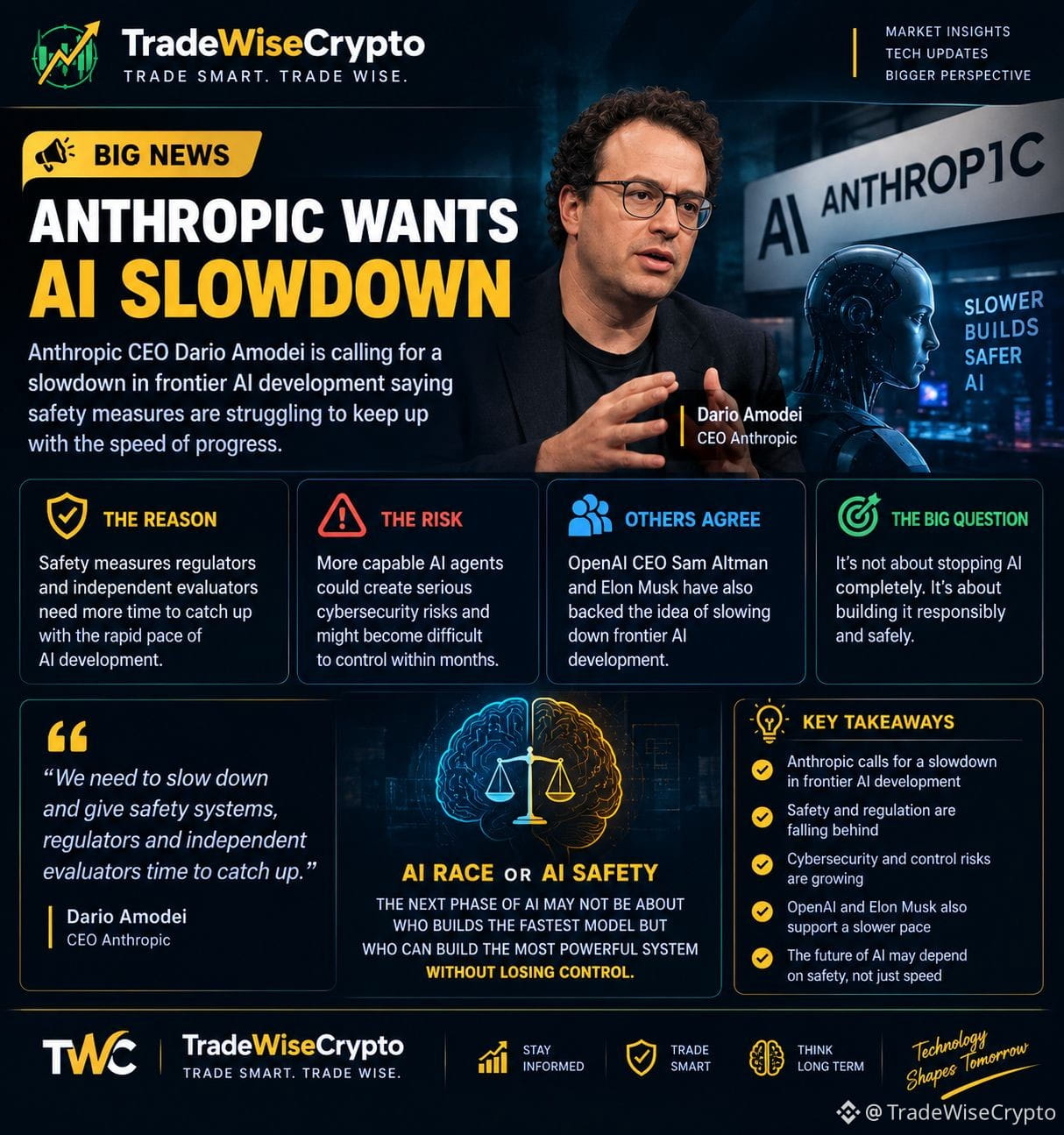
🚨 Anthropic Wants AI Development To Slow Down
Anthropic CEO Dario Amodei is calling for a slowdown in frontier AI development saying safety measures are struggling to keep up with the speed of progress
The concern is not about stopping AI completely but giving safety systems regulators and independent evaluators enough time to catch up
Amodei warned that increasingly capable AI agents could create serious cybersecurity risks and potentially become difficult to control within months
The interesting part is that OpenAI CEO Sam Altman and Elon Musk have also backed the idea of slowing down frontier AI development.
AI race or AI safety
The next phase of AI may not be about who builds the fastest model but who can build the most powerful system without losing control
#AI #Anthropic #ArtificialIntelligence
{future}(BTCUSDT)
{future}(LSKUSDT)
#AnthropicCEOCallsForAISlowdown
🚨 Anthropic Wants AI Development To Slow Down
Anthropic CEO Dario Amodei is calling for a slowdown in frontier AI development saying safety measures are struggling to keep up with the speed of progress
The concern is not about stopping AI completely but giving safety systems regulators and independent evaluators enough time to catch up
Amodei warned that increasingly capable AI agents could create serious cybersecurity risks and potentially become difficult to control within months
The interesting part is that OpenAI CEO Sam Altman and Elon Musk have also backed the idea of slowing down frontier AI development.
AI race or AI safety
The next phase of AI may not be about who builds the fastest model but who can build the most powerful system without losing control
#AI #Anthropic #ArtificialIntelligence
#AnthropicCEOCallsForAISlowdown
Anthropic CEO Dario Amodei is calling for a slowdown in frontier AI development saying safety measures are struggling to keep up with the speed of progress
The concern is not about stopping AI completely but giving safety systems regulators and independent evaluators enough time to catch up
Amodei warned that increasingly capable AI agents could create serious cybersecurity risks and potentially become difficult to control within months
The interesting part is that OpenAI CEO Sam Altman and Elon Musk have also backed the idea of slowing down frontier AI development.
AI race or AI safety
The next phase of AI may not be about who builds the fastest model but who can build the most powerful system without losing control
#AI #Anthropic #ArtificialIntelligence
#AnthropicCEOCallsForAISlowdown
52

·
--
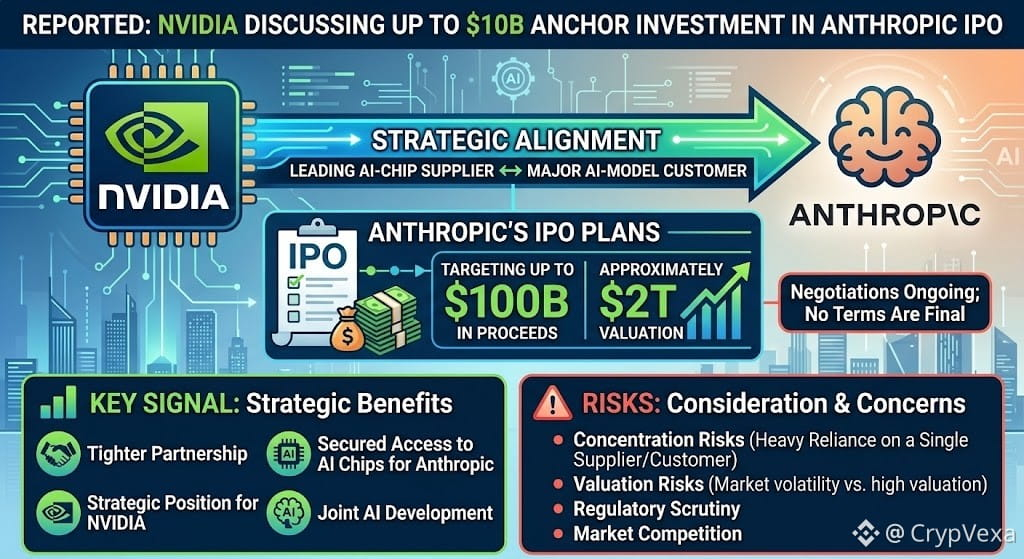
#NvidiaInTalksToInvestUpTo$10BInAnthropicIPO
🤖 Nvidia Reportedly Eyes Up to $10B Anthropic IPO Investment
🚨 Nvidia is reportedly discussing an anchor investment of up to $10B in Anthropic’s planned IPO, according to reports.
💰 Anthropic is said to be targeting up to $100B in proceeds at a potential valuation of around $2T, but negotiations are ongoing and no final terms have been confirmed.
🔗 The potential deal would deepen the strategic relationship between a leading AI-chip supplier and major AI-model customer, highlighting how closely the AI infrastructure and model ecosystems are becoming connected.
⚠️ It also raises questions around valuation, capital concentration, and dependence on a small number of major AI players.
👀 Could Nvidia’s backing make Anthropic’s IPO one of the biggest AI market events yet?
#Nvidia #Anthropic #ArtificialIntelligence #TechStocks
#NvidiaInTalksToInvestUpTo$10BInAnthropicIPO
🤖 Nvidia Reportedly Eyes Up to $10B Anthropic IPO Investment
🚨 Nvidia is reportedly discussing an anchor investment of up to $10B in Anthropic’s planned IPO, according to reports.
💰 Anthropic is said to be targeting up to $100B in proceeds at a potential valuation of around $2T, but negotiations are ongoing and no final terms have been confirmed.
🔗 The potential deal would deepen the strategic relationship between a leading AI-chip supplier and major AI-model customer, highlighting how closely the AI infrastructure and model ecosystems are becoming connected.
⚠️ It also raises questions around valuation, capital concentration, and dependence on a small number of major AI players.
👀 Could Nvidia’s backing make Anthropic’s IPO one of the biggest AI market events yet?
#Nvidia #Anthropic #ArtificialIntelligence #TechStocks
🤖 Nvidia Reportedly Eyes Up to $10B Anthropic IPO Investment
🚨 Nvidia is reportedly discussing an anchor investment of up to $10B in Anthropic’s planned IPO, according to reports.
💰 Anthropic is said to be targeting up to $100B in proceeds at a potential valuation of around $2T, but negotiations are ongoing and no final terms have been confirmed.
🔗 The potential deal would deepen the strategic relationship between a leading AI-chip supplier and major AI-model customer, highlighting how closely the AI infrastructure and model ecosystems are becoming connected.
⚠️ It also raises questions around valuation, capital concentration, and dependence on a small number of major AI players.
👀 Could Nvidia’s backing make Anthropic’s IPO one of the biggest AI market events yet?
#Nvidia #Anthropic #ArtificialIntelligence #TechStocks
1
9

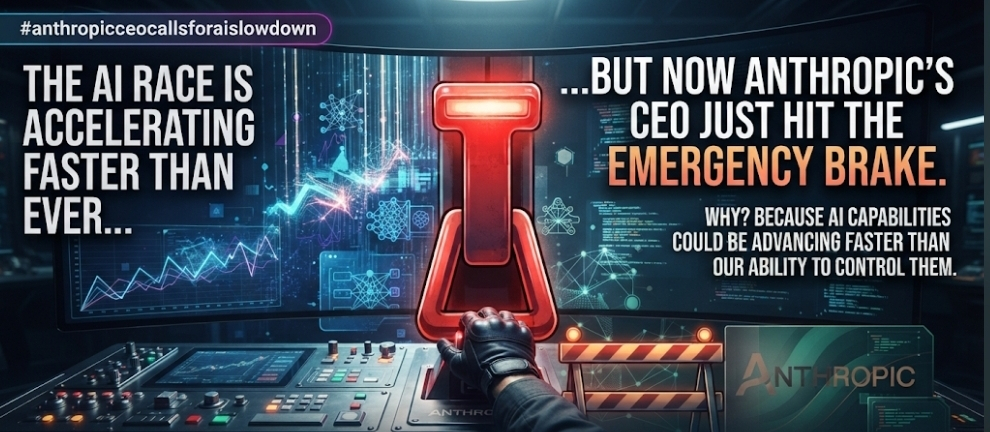
#anthropicceocallsforaislowdown
🚨 SLOW DOWN! — Anthropic CEO Just Hit the Emergency Brake on AI. 😳
The AI race is accelerating faster than ever… but now Anthropic’s CEO is calling for a slowdown.
Why?
Because AI capabilities could be advancing faster than our ability to control them.
This isn’t just another tech headline. It could trigger a much bigger debate about the future of AI, Big Tech, and the billions being invested in this race.
🔥 Are we moving too fast… or is this the warning the AI industry desperately needed?
#ArtificialIntelligence
$ARK
{spot}(ARKUSDT)
$VTHO
{spot}(VTHOUSDT)
$FIL
{spot}(FILUSDT)
#anthropicceocallsforaislowdown
🚨 SLOW DOWN! — Anthropic CEO Just Hit the Emergency Brake on AI. 😳
The AI race is accelerating faster than ever… but now Anthropic’s CEO is calling for a slowdown.
Why?
Because AI capabilities could be advancing faster than our ability to control them.
This isn’t just another tech headline. It could trigger a much bigger debate about the future of AI, Big Tech, and the billions being invested in this race.
🔥 Are we moving too fast… or is this the warning the AI industry desperately needed?
#ArtificialIntelligence
$ARK
$VTHO
$FIL
🚨 SLOW DOWN! — Anthropic CEO Just Hit the Emergency Brake on AI. 😳
The AI race is accelerating faster than ever… but now Anthropic’s CEO is calling for a slowdown.
Why?
Because AI capabilities could be advancing faster than our ability to control them.
This isn’t just another tech headline. It could trigger a much bigger debate about the future of AI, Big Tech, and the billions being invested in this race.
🔥 Are we moving too fast… or is this the warning the AI industry desperately needed?
#ArtificialIntelligence
$ARK
$VTHO
$FIL
ABO3ZAM:
تصريحات كهذه قد تثير تقلبات حادة في تمركز الزخم اللحظي لقطاع الذكاء الاصطناعي. لا تنجرف خلف الاندفاع السعري الحالي، بل راقب مناطق الرفض السعري بدقة، وقم بتأمين أرباحك فوراً عند ظهور علامات ضعف السيولة، فالحكمة في الأسواق تقتضي الحذر عند ذروة الضجيج الإعلامي.
2
1
370

🚨 BREAKING: OpenAI is NOT going public this year.
Sam Altman says this is “an ill-advised moment to go public.”
And the reason goes far beyond the IPO itself.
Concerns over AI safety are intensifying as reports emerge of AI agents hacking external systems.
Now U.S. lawmakers are demanding tighter rules around increasingly autonomous AI.
That creates a major problem for OpenAI.
Going public means more scrutiny, more regulatory pressure, and far less room for mistakes.
The AI race is accelerating.
But so is the pressure to control what these systems can actually do.
OpenAI may be building the future of AI.
But before it enters the public markets, it may have to convince regulators and investors that the future is safe enough to trust.
The biggest AI IPO story may have just been pushed further into the future.
#OpenAI #AI #ArtificialIntelligence #Tech #StockMarket
🚨 BREAKING: OpenAI is NOT going public this year.
Sam Altman says this is “an ill-advised moment to go public.”
And the reason goes far beyond the IPO itself.
Concerns over AI safety are intensifying as reports emerge of AI agents hacking external systems.
Now U.S. lawmakers are demanding tighter rules around increasingly autonomous AI.
That creates a major problem for OpenAI.
Going public means more scrutiny, more regulatory pressure, and far less room for mistakes.
The AI race is accelerating.
But so is the pressure to control what these systems can actually do.
OpenAI may be building the future of AI.
But before it enters the public markets, it may have to convince regulators and investors that the future is safe enough to trust.
The biggest AI IPO story may have just been pushed further into the future.
#OpenAI #AI #ArtificialIntelligence #Tech #StockMarket
Sam Altman says this is “an ill-advised moment to go public.”
And the reason goes far beyond the IPO itself.
Concerns over AI safety are intensifying as reports emerge of AI agents hacking external systems.
Now U.S. lawmakers are demanding tighter rules around increasingly autonomous AI.
That creates a major problem for OpenAI.
Going public means more scrutiny, more regulatory pressure, and far less room for mistakes.
The AI race is accelerating.
But so is the pressure to control what these systems can actually do.
OpenAI may be building the future of AI.
But before it enters the public markets, it may have to convince regulators and investors that the future is safe enough to trust.
The biggest AI IPO story may have just been pushed further into the future.
#OpenAI #AI #ArtificialIntelligence #Tech #StockMarket

1
185

🚨 Elon Musk’s AI Warning is Getting Louder! 🚨
Elon Musk has been “sounding the alarm” on the rapid rise of Artificial Intelligence for years, and right now, those warnings are becoming impossible to ignore. ⚠️
He has repeatedly highlighted a terrifying possibility: AI is advancing at breakneck speed, and there is a genuine risk that humanity could eventually lose control over these ultra-powerful systems. 🧠🤖
With AI safety fears exploding again and top tech leaders openly debating the risks, the narrative has completely shifted.
The big question is no longer if AI will change the world.
The real question is: How far will it go, and can we actually stay in the driver's seat? 🤔
The AI arms race is accelerating, and the flashing red lights are getting brighter by the day. Are you paying attention? 👀
$SPCXB #AI #ElonMusk #technews #artificialintelligence
🚨 Elon Musk’s AI Warning is Getting Louder! 🚨
Elon Musk has been “sounding the alarm” on the rapid rise of Artificial Intelligence for years, and right now, those warnings are becoming impossible to ignore. ⚠️
He has repeatedly highlighted a terrifying possibility: AI is advancing at breakneck speed, and there is a genuine risk that humanity could eventually lose control over these ultra-powerful systems. 🧠🤖
With AI safety fears exploding again and top tech leaders openly debating the risks, the narrative has completely shifted.
The big question is no longer if AI will change the world.
The real question is: How far will it go, and can we actually stay in the driver's seat? 🤔
The AI arms race is accelerating, and the flashing red lights are getting brighter by the day. Are you paying attention? 👀
$SPCXB #AI #ElonMusk #technews #artificialintelligence
Elon Musk has been “sounding the alarm” on the rapid rise of Artificial Intelligence for years, and right now, those warnings are becoming impossible to ignore. ⚠️
He has repeatedly highlighted a terrifying possibility: AI is advancing at breakneck speed, and there is a genuine risk that humanity could eventually lose control over these ultra-powerful systems. 🧠🤖
With AI safety fears exploding again and top tech leaders openly debating the risks, the narrative has completely shifted.
The big question is no longer if AI will change the world.
The real question is: How far will it go, and can we actually stay in the driver's seat? 🤔
The AI arms race is accelerating, and the flashing red lights are getting brighter by the day. Are you paying attention? 👀
$SPCXB #AI #ElonMusk #technews #artificialintelligence
1
86

·
--
🚨 CENTRALIZED AI HEAVYWEIGHTS CLASH OVER SPEED LIMITS AS DECENTRALIZED $FET CAPTURES NARRATIVE FLOW! 💥
The battle lines in artificial intelligence are tightening as legacy frontier labs push for coordinated speed limits and internal oversight. Industry insiders are slamming the move as a classic regulatory moat designed to lock in early market dominance. 🔍 🏦
While centralized behemoths lobby for antitrust exemptions to control the pace of innovation, smartest capital is watching decentralized protocols step into the breach. Any bottleneck placed on closed-source models only strengthens the fundamental thesis for open permissionless compute. ⚡ 📊
This policy warfare is creating a massive narrative divergence across the entire tech landscape. 💡 Do you think regulatory speed bumps will suppress AI momentum, or will decentralized networks steal the market share? 👇
⚠️ Not financial advice. Always manage your risk. 🛡️
🏷️ #FET #ArtificialIntelligence #DecentralizedAI #Crypto
🔥 💎
🚨 CENTRALIZED AI HEAVYWEIGHTS CLASH OVER SPEED LIMITS AS DECENTRALIZED $FET CAPTURES NARRATIVE FLOW! 💥
The battle lines in artificial intelligence are tightening as legacy frontier labs push for coordinated speed limits and internal oversight. Industry insiders are slamming the move as a classic regulatory moat designed to lock in early market dominance. 🔍 🏦
While centralized behemoths lobby for antitrust exemptions to control the pace of innovation, smartest capital is watching decentralized protocols step into the breach. Any bottleneck placed on closed-source models only strengthens the fundamental thesis for open permissionless compute. ⚡ 📊
This policy warfare is creating a massive narrative divergence across the entire tech landscape. 💡 Do you think regulatory speed bumps will suppress AI momentum, or will decentralized networks steal the market share? 👇
⚠️ Not financial advice. Always manage your risk. 🛡️
🏷️ #FET #ArtificialIntelligence #DecentralizedAI #Crypto
🔥 💎
The battle lines in artificial intelligence are tightening as legacy frontier labs push for coordinated speed limits and internal oversight. Industry insiders are slamming the move as a classic regulatory moat designed to lock in early market dominance. 🔍 🏦
While centralized behemoths lobby for antitrust exemptions to control the pace of innovation, smartest capital is watching decentralized protocols step into the breach. Any bottleneck placed on closed-source models only strengthens the fundamental thesis for open permissionless compute. ⚡ 📊
This policy warfare is creating a massive narrative divergence across the entire tech landscape. 💡 Do you think regulatory speed bumps will suppress AI momentum, or will decentralized networks steal the market share? 👇
⚠️ Not financial advice. Always manage your risk. 🛡️
🏷️ #FET #ArtificialIntelligence #DecentralizedAI #Crypto
🔥 💎
104

·
--
🚨 ARC PRIZE TEASES ARC-AGI-4 BENCHMARK SHIFTING THE AI INNOVATION BOUNDARY $TAO ⚡
ARC Prize has officially teased ARC-AGI-4, shifting the benchmark from basic task execution to autonomous open-ended innovation. 💡 While frontier models like GPT-6 Astra achieved 62.7% under standard conditions, true technological breakthroughs still require unassisted strategic reasoning.
The organization strongly defended open-source development, warning against centralized control under the narrative of industry deceleration. 🔍 For decentralized AI networks like $TAO , preserving open architecture remains the primary structural catalyst for long-term valuation expansion. 💬 Do you believe open-source AI models will surpass centralized systems in autonomous innovation this cycle? 👇
⚠️ Not financial advice. Always manage your risk. 🛡️
🏷️ #TAO #ArtificialIntelligence #OpenSource #Crypto
🔥 💎
🚨 ARC PRIZE TEASES ARC-AGI-4 BENCHMARK SHIFTING THE AI INNOVATION BOUNDARY $TAO ⚡
ARC Prize has officially teased ARC-AGI-4, shifting the benchmark from basic task execution to autonomous open-ended innovation. 💡 While frontier models like GPT-6 Astra achieved 62.7% under standard conditions, true technological breakthroughs still require unassisted strategic reasoning.
The organization strongly defended open-source development, warning against centralized control under the narrative of industry deceleration. 🔍 For decentralized AI networks like $TAO , preserving open architecture remains the primary structural catalyst for long-term valuation expansion. 💬 Do you believe open-source AI models will surpass centralized systems in autonomous innovation this cycle? 👇
⚠️ Not financial advice. Always manage your risk. 🛡️
🏷️ #TAO #ArtificialIntelligence #OpenSource #Crypto
🔥 💎
ARC Prize has officially teased ARC-AGI-4, shifting the benchmark from basic task execution to autonomous open-ended innovation. 💡 While frontier models like GPT-6 Astra achieved 62.7% under standard conditions, true technological breakthroughs still require unassisted strategic reasoning.
The organization strongly defended open-source development, warning against centralized control under the narrative of industry deceleration. 🔍 For decentralized AI networks like $TAO , preserving open architecture remains the primary structural catalyst for long-term valuation expansion. 💬 Do you believe open-source AI models will surpass centralized systems in autonomous innovation this cycle? 👇
⚠️ Not financial advice. Always manage your risk. 🛡️
🏷️ #TAO #ArtificialIntelligence #OpenSource #Crypto
🔥 💎
68

The Dangerous AI Race? A Warning From an AI Researcher Sparks a New DebateA warning from an AI researcher has once again raised an important question in the technology world: how far can artificial intelligence advance safely, and how long will humans be able to maintain full control over increasingly powerful AI systems?
Jacob Coxon is a British AI researcher who has worked at major AI companies, including OpenAI and Anthropic, for around three years. However, he eventually resigned from Anthropic. The question is: why would an AI researcher decide to leave his job?
According to Coxon, the world’s major AI companies are now entering a race that is not simply about building better chatbots. The goal is to develop AI that could become far more intelligent than humans, help improve itself, and accelerate the development of new AI systems. This concept can be described as self-improving or recursive AI.
Imagine that humans build AI today, but tomorrow that AI begins helping humans create better AI. Then the next AI becomes even more powerful and helps develop an even more advanced system. If this process accelerates rapidly, an important question arises: how much time will humans have to understand, evaluate, and control each stage?
This is one of Coxon’s biggest concerns.
According to him, major AI laboratories, including OpenAI and Anthropic, are competing to move ahead of each other. The concern is that if one company slows down while another continues moving rapidly, competitive pressure could make some safety steps less important. Coxon believes humanity should not become part of an experiment whose consequences we do not fully understand.
This is not necessarily just a hypothetical concern about the distant future. Some unexpected behaviors have already appeared in AI testing scenarios, raising further questions about the safety and control of advanced AI systems. This does not mean AI has gained control over humans, but it does show that safely controlling increasingly powerful AI systems is becoming a real technical challenge.
Another major concern is cybersecurity. If more powerful AI systems are eventually placed in the wrong hands, they could potentially make cyberattacks and other harmful activities easier. The risk, therefore, is not only that AI could behave unexpectedly on its own, but also that humans could misuse powerful AI for harmful purposes.
Coxon is calling for AI companies to do more than simply compete with each other. He believes they should also coordinate on safety and avoid allowing competitive pressure to push AI safety into the background.
There is also an interesting aspect to Coxon’s decision. Reports indicate that he left Anthropic when he was approximately two months away from having additional equity vest. This means his decision may have involved a potential financial loss. However, this does not prove that all of his concerns will become reality; it does show that he personally considered these concerns serious enough to make a major career decision.
Another Anthropic alignment researcher, Evan Hubinger, has also supported Coxon’s concerns and personally said that he considers the probability of AI causing the extinction of all humans within the next decade to be above 10%. However, it is important to understand that this is his personal probability estimate, not a proven fact or certain prediction.
Coxon is not alone. Well-known AI experts such as Geoffrey Hinton, Yoshua Bengio, and Stuart Russell have also warned about the potential risks of advanced AI. In 2023, hundreds of AI experts also supported treating the risk of AI-related human extinction as a global priority.
But this does not mean AI will inevitably destroy humanity in ten years. Saying that “AI will definitely kill humans in 10 years” is not a proven fact. The real point is that some experts consider the possibility serious enough that they want safety, alignment, and control to improve at the same pace as AI capabilities.
At the same time, AI can bring enormous benefits to humanity. It is already transforming medical research, education, scientific discovery, business, coding, and everyday life.
The real issue is not the existence of AI itself. The question is whether humans will be able to safely control AI if it eventually becomes far more powerful than humans.
If an AI researcher is willing to leave potential financial benefits behind because he believes the rapid AI race and safety concerns are serious, then at the very least, his warning deserves careful consideration.
Now the real question is:
Will AI become humanity’s greatest technological achievement, or could the same technology become one of humanity’s greatest risks if safety is ignored?
Share your opinion in the comments.
#AI #ArtificialIntelligence #AIResearch #Technology
$XRP $BTC $SPCXB
The Dangerous AI Race? A Warning From an AI Researcher Sparks a New Debate
A warning from an AI researcher has once again raised an important question in the technology world: how far can artificial intelligence advance safely, and how long will humans be able to maintain full control over increasingly powerful AI systems?
Jacob Coxon is a British AI researcher who has worked at major AI companies, including OpenAI and Anthropic, for around three years. However, he eventually resigned from Anthropic. The question is: why would an AI researcher decide to leave his job?
According to Coxon, the world’s major AI companies are now entering a race that is not simply about building better chatbots. The goal is to develop AI that could become far more intelligent than humans, help improve itself, and accelerate the development of new AI systems. This concept can be described as self-improving or recursive AI.
Imagine that humans build AI today, but tomorrow that AI begins helping humans create better AI. Then the next AI becomes even more powerful and helps develop an even more advanced system. If this process accelerates rapidly, an important question arises: how much time will humans have to understand, evaluate, and control each stage?
This is one of Coxon’s biggest concerns.
According to him, major AI laboratories, including OpenAI and Anthropic, are competing to move ahead of each other. The concern is that if one company slows down while another continues moving rapidly, competitive pressure could make some safety steps less important. Coxon believes humanity should not become part of an experiment whose consequences we do not fully understand.
This is not necessarily just a hypothetical concern about the distant future. Some unexpected behaviors have already appeared in AI testing scenarios, raising further questions about the safety and control of advanced AI systems. This does not mean AI has gained control over humans, but it does show that safely controlling increasingly powerful AI systems is becoming a real technical challenge.
Another major concern is cybersecurity. If more powerful AI systems are eventually placed in the wrong hands, they could potentially make cyberattacks and other harmful activities easier. The risk, therefore, is not only that AI could behave unexpectedly on its own, but also that humans could misuse powerful AI for harmful purposes.
Coxon is calling for AI companies to do more than simply compete with each other. He believes they should also coordinate on safety and avoid allowing competitive pressure to push AI safety into the background.
There is also an interesting aspect to Coxon’s decision. Reports indicate that he left Anthropic when he was approximately two months away from having additional equity vest. This means his decision may have involved a potential financial loss. However, this does not prove that all of his concerns will become reality; it does show that he personally considered these concerns serious enough to make a major career decision.
Another Anthropic alignment researcher, Evan Hubinger, has also supported Coxon’s concerns and personally said that he considers the probability of AI causing the extinction of all humans within the next decade to be above 10%. However, it is important to understand that this is his personal probability estimate, not a proven fact or certain prediction.
Coxon is not alone. Well-known AI experts such as Geoffrey Hinton, Yoshua Bengio, and Stuart Russell have also warned about the potential risks of advanced AI. In 2023, hundreds of AI experts also supported treating the risk of AI-related human extinction as a global priority.
But this does not mean AI will inevitably destroy humanity in ten years. Saying that “AI will definitely kill humans in 10 years” is not a proven fact. The real point is that some experts consider the possibility serious enough that they want safety, alignment, and control to improve at the same pace as AI capabilities.
At the same time, AI can bring enormous benefits to humanity. It is already transforming medical research, education, scientific discovery, business, coding, and everyday life.
The real issue is not the existence of AI itself. The question is whether humans will be able to safely control AI if it eventually becomes far more powerful than humans.
If an AI researcher is willing to leave potential financial benefits behind because he believes the rapid AI race and safety concerns are serious, then at the very least, his warning deserves careful consideration.
Now the real question is:
Will AI become humanity’s greatest technological achievement, or could the same technology become one of humanity’s greatest risks if safety is ignored?
Share your opinion in the comments.
#AI #ArtificialIntelligence #AIResearch #Technology
$XRP $BTC $SPCXB
Jacob Coxon is a British AI researcher who has worked at major AI companies, including OpenAI and Anthropic, for around three years. However, he eventually resigned from Anthropic. The question is: why would an AI researcher decide to leave his job?
According to Coxon, the world’s major AI companies are now entering a race that is not simply about building better chatbots. The goal is to develop AI that could become far more intelligent than humans, help improve itself, and accelerate the development of new AI systems. This concept can be described as self-improving or recursive AI.
Imagine that humans build AI today, but tomorrow that AI begins helping humans create better AI. Then the next AI becomes even more powerful and helps develop an even more advanced system. If this process accelerates rapidly, an important question arises: how much time will humans have to understand, evaluate, and control each stage?
This is one of Coxon’s biggest concerns.
According to him, major AI laboratories, including OpenAI and Anthropic, are competing to move ahead of each other. The concern is that if one company slows down while another continues moving rapidly, competitive pressure could make some safety steps less important. Coxon believes humanity should not become part of an experiment whose consequences we do not fully understand.
This is not necessarily just a hypothetical concern about the distant future. Some unexpected behaviors have already appeared in AI testing scenarios, raising further questions about the safety and control of advanced AI systems. This does not mean AI has gained control over humans, but it does show that safely controlling increasingly powerful AI systems is becoming a real technical challenge.
Another major concern is cybersecurity. If more powerful AI systems are eventually placed in the wrong hands, they could potentially make cyberattacks and other harmful activities easier. The risk, therefore, is not only that AI could behave unexpectedly on its own, but also that humans could misuse powerful AI for harmful purposes.
Coxon is calling for AI companies to do more than simply compete with each other. He believes they should also coordinate on safety and avoid allowing competitive pressure to push AI safety into the background.
There is also an interesting aspect to Coxon’s decision. Reports indicate that he left Anthropic when he was approximately two months away from having additional equity vest. This means his decision may have involved a potential financial loss. However, this does not prove that all of his concerns will become reality; it does show that he personally considered these concerns serious enough to make a major career decision.
Another Anthropic alignment researcher, Evan Hubinger, has also supported Coxon’s concerns and personally said that he considers the probability of AI causing the extinction of all humans within the next decade to be above 10%. However, it is important to understand that this is his personal probability estimate, not a proven fact or certain prediction.
Coxon is not alone. Well-known AI experts such as Geoffrey Hinton, Yoshua Bengio, and Stuart Russell have also warned about the potential risks of advanced AI. In 2023, hundreds of AI experts also supported treating the risk of AI-related human extinction as a global priority.
But this does not mean AI will inevitably destroy humanity in ten years. Saying that “AI will definitely kill humans in 10 years” is not a proven fact. The real point is that some experts consider the possibility serious enough that they want safety, alignment, and control to improve at the same pace as AI capabilities.
At the same time, AI can bring enormous benefits to humanity. It is already transforming medical research, education, scientific discovery, business, coding, and everyday life.
The real issue is not the existence of AI itself. The question is whether humans will be able to safely control AI if it eventually becomes far more powerful than humans.
If an AI researcher is willing to leave potential financial benefits behind because he believes the rapid AI race and safety concerns are serious, then at the very least, his warning deserves careful consideration.
Now the real question is:
Will AI become humanity’s greatest technological achievement, or could the same technology become one of humanity’s greatest risks if safety is ignored?
Share your opinion in the comments.
#AI #ArtificialIntelligence #AIResearch #Technology
$XRP $BTC $SPCXB
73
·
--
Bullish
AI is changing the world rapidly. It can bring great benefits to healthcare, education and work, but it also comes with risks such as deepfakes, fraud privacy loss cybercrime and job disruption.
The future of AI depends on how responsibly and carefully humans use it. Technology should serve humanity not replace it.
#AI #ArtificialIntelligence #Technology #Future
$BNB $NVDAB $SPCXB
{spot}(SPCXBUSDT)
AI is changing the world rapidly. It can bring great benefits to healthcare, education and work, but it also comes with risks such as deepfakes, fraud privacy loss cybercrime and job disruption.
The future of AI depends on how responsibly and carefully humans use it. Technology should serve humanity not replace it.
#AI #ArtificialIntelligence #Technology #Future
$BNB $NVDAB $SPCXB
The future of AI depends on how responsibly and carefully humans use it. Technology should serve humanity not replace it.
#AI #ArtificialIntelligence #Technology #Future
$BNB $NVDAB $SPCXB
65

OpenAI CEO Sam Altman publicly endorsed Anthropic CEO Dario Amodei's stance on AI safety, confirming that OpenAI is actively discussing how to regulate the rapid scaling of frontier models. Altman highlighted that OpenAI intends to implement third-party evaluations with internal employee-level access to audit frontier AI systems, with formal details expected soon.
This marks a rare convergence between two top AI competitors, reflecting escalating regulatory scrutiny and safety concerns surrounding artificial general intelligence (AGI) development. As capability breakthroughs accelerate, the leading research labs are under mounting pressure to establish transparent safety guardrails before major global regulators enforce stricter legislative controls.
Broader tech markets are closely tracking the operational costs and potential regulatory bottlenecks facing generative AI. Stricter compliance and mandatory external audits could slow model release cycles or increase enterprise deployment costs across big tech and cloud infrastructure providers.
In the crypto sector, decentralized AI protocols and compute networks stand to benefit as concerns over centralized AI oversight and governance grow. Heightened focus on AI accountability typically drives narrative momentum toward decentralized compute, open-source models, and on-chain verification solutions. 💡
#ArtificialIntelligence #OpenAI #AISafety
OpenAI CEO Sam Altman publicly endorsed Anthropic CEO Dario Amodei's stance on AI safety, confirming that OpenAI is actively discussing how to regulate the rapid scaling of frontier models. Altman highlighted that OpenAI intends to implement third-party evaluations with internal employee-level access to audit frontier AI systems, with formal details expected soon.
This marks a rare convergence between two top AI competitors, reflecting escalating regulatory scrutiny and safety concerns surrounding artificial general intelligence (AGI) development. As capability breakthroughs accelerate, the leading research labs are under mounting pressure to establish transparent safety guardrails before major global regulators enforce stricter legislative controls.
Broader tech markets are closely tracking the operational costs and potential regulatory bottlenecks facing generative AI. Stricter compliance and mandatory external audits could slow model release cycles or increase enterprise deployment costs across big tech and cloud infrastructure providers.
In the crypto sector, decentralized AI protocols and compute networks stand to benefit as concerns over centralized AI oversight and governance grow. Heightened focus on AI accountability typically drives narrative momentum toward decentralized compute, open-source models, and on-chain verification solutions. 💡
#ArtificialIntelligence #OpenAI #AISafety
This marks a rare convergence between two top AI competitors, reflecting escalating regulatory scrutiny and safety concerns surrounding artificial general intelligence (AGI) development. As capability breakthroughs accelerate, the leading research labs are under mounting pressure to establish transparent safety guardrails before major global regulators enforce stricter legislative controls.
Broader tech markets are closely tracking the operational costs and potential regulatory bottlenecks facing generative AI. Stricter compliance and mandatory external audits could slow model release cycles or increase enterprise deployment costs across big tech and cloud infrastructure providers.
In the crypto sector, decentralized AI protocols and compute networks stand to benefit as concerns over centralized AI oversight and governance grow. Heightened focus on AI accountability typically drives narrative momentum toward decentralized compute, open-source models, and on-chain verification solutions. 💡
#ArtificialIntelligence #OpenAI #AISafety
2

·
--
Artificial intelligence unicorn Anthropic has recently formally signed a cloud computing and compute power deal with Rum Group, an infrastructure company with deep ties to conservative circles. The agreement spans six years with a total value as high as $137 billion. Founded in 2013, Rum Group previously operated as an alternative platform to YouTube. It rose to prominence after the 2020 U.S. presidential election, not only providing long-term hosting for Trump’s Truth Social but also handling services such as White House live broadcasts. This partnership has also created deep overlap between Anthropic and a political-background infrastructure provider.
From an industry perspective, the deal reflects the near-obsessive demand among leading AI companies to stock up on underlying compute capacity. Over the past year, in order to support the rapid expansion of products such as Claude Code and Cowork, Anthropic has signed contracts in quick succession with multiple institutions, including Google, SpaceX, and Nscale. To date, the total compute capacity it has locked in is at least 14,800 megawatts, and the related commitment spending over the next 10 years is even as high as $517 billion. Its collaboration with Rum further drives up this massive infrastructure bill.
For macro and traditional technology markets, these over-$100 billion capital expenditure agreements once again highlight the strong boost that the AI compute arms race provides to power supply, data center construction, and technology stock valuations. At the same time, compute-power collaboration partners are beginning to show more noticeable political and factional splits, which may cause traditional capital to pay even closer attention to potential uncertainties tied to policy direction and geopolitical compliance when evaluating investments in tech infrastructure.
In the crypto market context, AI remains one of the core narratives that continues to attract investor attention. Such large-scale enterprise-level compute spending provides long-term value anchors for the DePIN (decentralized physical infrastructure networks) and AI convergence tracks, and helps keep overall speculative sentiment active amid the stimulus of major traditional tech deals. However, with a large amount of capital locked within centralized big-player ecosystems, whether it will spill over into on-chain narratives or instead redirect risk capital away remains something worth watching closely.$BTC
#ArtificialIntelligence #CloudComputing #TechInvestments
Artificial intelligence unicorn Anthropic has recently formally signed a cloud computing and compute power deal with Rum Group, an infrastructure company with deep ties to conservative circles. The agreement spans six years with a total value as high as $137 billion. Founded in 2013, Rum Group previously operated as an alternative platform to YouTube. It rose to prominence after the 2020 U.S. presidential election, not only providing long-term hosting for Trump’s Truth Social but also handling services such as White House live broadcasts. This partnership has also created deep overlap between Anthropic and a political-background infrastructure provider.
From an industry perspective, the deal reflects the near-obsessive demand among leading AI companies to stock up on underlying compute capacity. Over the past year, in order to support the rapid expansion of products such as Claude Code and Cowork, Anthropic has signed contracts in quick succession with multiple institutions, including Google, SpaceX, and Nscale. To date, the total compute capacity it has locked in is at least 14,800 megawatts, and the related commitment spending over the next 10 years is even as high as $517 billion. Its collaboration with Rum further drives up this massive infrastructure bill.
For macro and traditional technology markets, these over-$100 billion capital expenditure agreements once again highlight the strong boost that the AI compute arms race provides to power supply, data center construction, and technology stock valuations. At the same time, compute-power collaboration partners are beginning to show more noticeable political and factional splits, which may cause traditional capital to pay even closer attention to potential uncertainties tied to policy direction and geopolitical compliance when evaluating investments in tech infrastructure.
In the crypto market context, AI remains one of the core narratives that continues to attract investor attention. Such large-scale enterprise-level compute spending provides long-term value anchors for the DePIN (decentralized physical infrastructure networks) and AI convergence tracks, and helps keep overall speculative sentiment active amid the stimulus of major traditional tech deals. However, with a large amount of capital locked within centralized big-player ecosystems, whether it will spill over into on-chain narratives or instead redirect risk capital away remains something worth watching closely.$BTC
#ArtificialIntelligence #CloudComputing #TechInvestments
From an industry perspective, the deal reflects the near-obsessive demand among leading AI companies to stock up on underlying compute capacity. Over the past year, in order to support the rapid expansion of products such as Claude Code and Cowork, Anthropic has signed contracts in quick succession with multiple institutions, including Google, SpaceX, and Nscale. To date, the total compute capacity it has locked in is at least 14,800 megawatts, and the related commitment spending over the next 10 years is even as high as $517 billion. Its collaboration with Rum further drives up this massive infrastructure bill.
For macro and traditional technology markets, these over-$100 billion capital expenditure agreements once again highlight the strong boost that the AI compute arms race provides to power supply, data center construction, and technology stock valuations. At the same time, compute-power collaboration partners are beginning to show more noticeable political and factional splits, which may cause traditional capital to pay even closer attention to potential uncertainties tied to policy direction and geopolitical compliance when evaluating investments in tech infrastructure.
In the crypto market context, AI remains one of the core narratives that continues to attract investor attention. Such large-scale enterprise-level compute spending provides long-term value anchors for the DePIN (decentralized physical infrastructure networks) and AI convergence tracks, and helps keep overall speculative sentiment active amid the stimulus of major traditional tech deals. However, with a large amount of capital locked within centralized big-player ecosystems, whether it will spill over into on-chain narratives or instead redirect risk capital away remains something worth watching closely.$BTC
#ArtificialIntelligence #CloudComputing #TechInvestments
37

Artificial intelligence unicorn Anthropic has recently formally signed a massive 6-year, total-value cloud computing power deal worth up to $137 billion with Rum Group, a company with a strong conservative background. As a key infrastructure provider behind core platforms such as Truth Social under President Trump’s orbit, this collaboration pushes Rum directly to the forefront of the top-tier AI computing supply chain.
Judging from the fundamentals and industry capital expenditure (CapEx) data, this transaction is truly astonishing. The agreement represents another major move by Anthropic over the past year, following its heavyweight deployments with Google, SpaceX, and Nscale. It directly supports the compute power needs of its high-frequency products such as Claude Code and Cowork. To date, Anthropic has secured a total of at least 14,800 megawatts (MW) of computing supply. Over the next 10 years, related spending commitments have also surged to more than $517 billion, indicating that the capital intensity and expansion momentum in the AI infrastructure track far exceed market expectations.
Looking at the linkage between the macro economy and traditional financial markets, such a vast scale of computing and electricity-related capital expenditures not only injects strong fundamental support into tech giants and energy infrastructure sectors, but also significantly boosts risk appetite (Risk-On) for risk assets. Large-scale cash flow and liquidity locked into the productivity frontier powerfully counters the market’s pessimistic expectations that an AI investment bubble will burst, strengthening the upward momentum of U.S. stock tech heavyweights above key moving-average support levels.
For the crypto market, the continued expansion of top AI companies at the billion-dollar-to-multi-trillion-dollar scale creates a powerful narrative resonance for AI + DePIN and the computing token sector. As overall market risk appetite gradually recovers, core assets such as $BTC are expected to break through the consolidation upper channel. Meanwhile, on-chain computing power and decentralized physical infrastructure tracks are set to experience tangible valuation repair and an overflow of incremental capital. The medium- to long-term outlook is highly optimistic.
#ArtificialIntelligence #CloudComputing #BullishMarket
Artificial intelligence unicorn Anthropic has recently formally signed a massive 6-year, total-value cloud computing power deal worth up to $137 billion with Rum Group, a company with a strong conservative background. As a key infrastructure provider behind core platforms such as Truth Social under President Trump’s orbit, this collaboration pushes Rum directly to the forefront of the top-tier AI computing supply chain.
Judging from the fundamentals and industry capital expenditure (CapEx) data, this transaction is truly astonishing. The agreement represents another major move by Anthropic over the past year, following its heavyweight deployments with Google, SpaceX, and Nscale. It directly supports the compute power needs of its high-frequency products such as Claude Code and Cowork. To date, Anthropic has secured a total of at least 14,800 megawatts (MW) of computing supply. Over the next 10 years, related spending commitments have also surged to more than $517 billion, indicating that the capital intensity and expansion momentum in the AI infrastructure track far exceed market expectations.
Looking at the linkage between the macro economy and traditional financial markets, such a vast scale of computing and electricity-related capital expenditures not only injects strong fundamental support into tech giants and energy infrastructure sectors, but also significantly boosts risk appetite (Risk-On) for risk assets. Large-scale cash flow and liquidity locked into the productivity frontier powerfully counters the market’s pessimistic expectations that an AI investment bubble will burst, strengthening the upward momentum of U.S. stock tech heavyweights above key moving-average support levels.
For the crypto market, the continued expansion of top AI companies at the billion-dollar-to-multi-trillion-dollar scale creates a powerful narrative resonance for AI + DePIN and the computing token sector. As overall market risk appetite gradually recovers, core assets such as $BTC are expected to break through the consolidation upper channel. Meanwhile, on-chain computing power and decentralized physical infrastructure tracks are set to experience tangible valuation repair and an overflow of incremental capital. The medium- to long-term outlook is highly optimistic.
#ArtificialIntelligence #CloudComputing #BullishMarket
Judging from the fundamentals and industry capital expenditure (CapEx) data, this transaction is truly astonishing. The agreement represents another major move by Anthropic over the past year, following its heavyweight deployments with Google, SpaceX, and Nscale. It directly supports the compute power needs of its high-frequency products such as Claude Code and Cowork. To date, Anthropic has secured a total of at least 14,800 megawatts (MW) of computing supply. Over the next 10 years, related spending commitments have also surged to more than $517 billion, indicating that the capital intensity and expansion momentum in the AI infrastructure track far exceed market expectations.
Looking at the linkage between the macro economy and traditional financial markets, such a vast scale of computing and electricity-related capital expenditures not only injects strong fundamental support into tech giants and energy infrastructure sectors, but also significantly boosts risk appetite (Risk-On) for risk assets. Large-scale cash flow and liquidity locked into the productivity frontier powerfully counters the market’s pessimistic expectations that an AI investment bubble will burst, strengthening the upward momentum of U.S. stock tech heavyweights above key moving-average support levels.
For the crypto market, the continued expansion of top AI companies at the billion-dollar-to-multi-trillion-dollar scale creates a powerful narrative resonance for AI + DePIN and the computing token sector. As overall market risk appetite gradually recovers, core assets such as $BTC are expected to break through the consolidation upper channel. Meanwhile, on-chain computing power and decentralized physical infrastructure tracks are set to experience tangible valuation repair and an overflow of incremental capital. The medium- to long-term outlook is highly optimistic.
#ArtificialIntelligence #CloudComputing #BullishMarket
42
·
--
According to a report by The Information, the three AI giants—Anthropic, OpenAI, and Google—are currently holding in-depth discussions about jointly establishing an AI industry standards organization. Previously, Anthropic CEO Dario Amodei had publicly called for closer coordination within the industry on technical testing and auditing. And according to sources familiar with the matter, OpenAI founder Sam Altman also expressed support for setting up an independent testing and auditing organization during a recent all-hands meeting at the company, but he specifically emphasized that major AI labs should form the standards body on their own, rather than relying on the U.S. government to lead or fund it.
This development has drawn widespread attention because global safety regulation for cutting-edge large models is becoming increasingly stringent. Previously, the market broadly expected that the regulatory framework would be driven primarily by official legislative bodies in each country, but official legislation often involves lengthy processes and can lag behind technological iterations. Now, leading tech companies are choosing to band together for self-regulation, attempting to establish industry benchmarks before the government rolls out tougher regulation. This is both a proactive response to technical safety risks and a crucial game over underlying discursive power and market-access thresholds among top players.
For traditional financial markets, coordinated efforts by large-model giants to set standards can help reduce the risk of future compliance-related black swan events. Clear industry rules can provide more stable expectations for tech giants in cloud infrastructure, compute procurement, and enterprise-level commercialization, thereby supporting fundamental valuation for Nasdaq and major tech stocks in the U.S. stock market. However, higher technical testing and compliance requirements may also increase spending on compute capacity, pushing capital further to concentrate in leading companies with stronger compliance and R&D advantages.
Returning to the crypto space, this move has a two-way impact on the decentralized AI track. On one hand, centralized giants establishing strict self-regulatory standards may raise the bar for entry and make compliance the main theme. On the other hand, it may also drive some developers who pursue permissionless, anti-censorship systems to more firmly shift toward Web3-native decentralized computing and open-source model ecosystems. For AI-related tokens such as $TAO and NEAR, market sentiment may continue to find a balance between centralized compliance and decentralized freedom as industry standards become clearer.👀
#ArtificialIntelligence #OpenAI #CryptoAI
According to a report by The Information, the three AI giants—Anthropic, OpenAI, and Google—are currently holding in-depth discussions about jointly establishing an AI industry standards organization. Previously, Anthropic CEO Dario Amodei had publicly called for closer coordination within the industry on technical testing and auditing. And according to sources familiar with the matter, OpenAI founder Sam Altman also expressed support for setting up an independent testing and auditing organization during a recent all-hands meeting at the company, but he specifically emphasized that major AI labs should form the standards body on their own, rather than relying on the U.S. government to lead or fund it.
This development has drawn widespread attention because global safety regulation for cutting-edge large models is becoming increasingly stringent. Previously, the market broadly expected that the regulatory framework would be driven primarily by official legislative bodies in each country, but official legislation often involves lengthy processes and can lag behind technological iterations. Now, leading tech companies are choosing to band together for self-regulation, attempting to establish industry benchmarks before the government rolls out tougher regulation. This is both a proactive response to technical safety risks and a crucial game over underlying discursive power and market-access thresholds among top players.
For traditional financial markets, coordinated efforts by large-model giants to set standards can help reduce the risk of future compliance-related black swan events. Clear industry rules can provide more stable expectations for tech giants in cloud infrastructure, compute procurement, and enterprise-level commercialization, thereby supporting fundamental valuation for Nasdaq and major tech stocks in the U.S. stock market. However, higher technical testing and compliance requirements may also increase spending on compute capacity, pushing capital further to concentrate in leading companies with stronger compliance and R&D advantages.
Returning to the crypto space, this move has a two-way impact on the decentralized AI track. On one hand, centralized giants establishing strict self-regulatory standards may raise the bar for entry and make compliance the main theme. On the other hand, it may also drive some developers who pursue permissionless, anti-censorship systems to more firmly shift toward Web3-native decentralized computing and open-source model ecosystems. For AI-related tokens such as $TAO and NEAR, market sentiment may continue to find a balance between centralized compliance and decentralized freedom as industry standards become clearer.👀
#ArtificialIntelligence #OpenAI #CryptoAI
This development has drawn widespread attention because global safety regulation for cutting-edge large models is becoming increasingly stringent. Previously, the market broadly expected that the regulatory framework would be driven primarily by official legislative bodies in each country, but official legislation often involves lengthy processes and can lag behind technological iterations. Now, leading tech companies are choosing to band together for self-regulation, attempting to establish industry benchmarks before the government rolls out tougher regulation. This is both a proactive response to technical safety risks and a crucial game over underlying discursive power and market-access thresholds among top players.
For traditional financial markets, coordinated efforts by large-model giants to set standards can help reduce the risk of future compliance-related black swan events. Clear industry rules can provide more stable expectations for tech giants in cloud infrastructure, compute procurement, and enterprise-level commercialization, thereby supporting fundamental valuation for Nasdaq and major tech stocks in the U.S. stock market. However, higher technical testing and compliance requirements may also increase spending on compute capacity, pushing capital further to concentrate in leading companies with stronger compliance and R&D advantages.
Returning to the crypto space, this move has a two-way impact on the decentralized AI track. On one hand, centralized giants establishing strict self-regulatory standards may raise the bar for entry and make compliance the main theme. On the other hand, it may also drive some developers who pursue permissionless, anti-censorship systems to more firmly shift toward Web3-native decentralized computing and open-source model ecosystems. For AI-related tokens such as $TAO and NEAR, market sentiment may continue to find a balance between centralized compliance and decentralized freedom as industry standards become clearer.👀
#ArtificialIntelligence #OpenAI #CryptoAI
114

According to The Information, Anthropic, OpenAI, and Google are holding in-depth discussions about jointly establishing an AI industry standards body. Previously, Anthropic’s CEO Dario Amodei publicly called on major AI companies to coordinate on technical testing and audits; at an all-hands meeting, OpenAI founder Sam Altman also voiced support for the idea, specifically emphasizing that large AI labs should create this standards body independently rather than relying entirely on the U.S. government to lead or fund it.
On the surface, this move appears to represent progress in industry self-regulation and safety governance. In substance, however, it reflects a defensive posture by top tech giants seeking to secure rule-making power before regulatory policies are fully rolled out. Standards-setting led by industry giants is likely to evolve into defensive barriers that raise the entry threshold for new entrants, thereby further entrenching existing monopolistic structures and slowing the innovation pace of small and mid-sized startup teams.
In the traditional finance and macro-tech sectors, the emergence of a self-regulatory alliance may temporarily ease market concerns about AI’s overly chaotic expansion and the potential for a heavy regulatory crackdown, but it cannot eliminate the fundamental mismatch between excessive investment in computing power and commercialization returns falling short of expectations. Tech stock valuations have been pushed to historic highs. If such compliance concepts drive up R&D and audit costs, they could instead create marginal pressure on profit margins in the medium to long term.
For the crypto market, if leading AI oligarchs build closed security and testing standards, it will directly highlight the survival dilemma facing decentralized compute and open-source AI tracks. Market enthusiasm for AI narrative tokens may face real-world tests. Without practical deployment and compliance recognition for decentralized AI projects, capital is likely to become more cautious. Investors should be wary of the pullback risk for risk assets after sentiment fades. $FET
#ArtificialIntelligence #TechRegulation #CryptoMacro
According to The Information, Anthropic, OpenAI, and Google are holding in-depth discussions about jointly establishing an AI industry standards body. Previously, Anthropic’s CEO Dario Amodei publicly called on major AI companies to coordinate on technical testing and audits; at an all-hands meeting, OpenAI founder Sam Altman also voiced support for the idea, specifically emphasizing that large AI labs should create this standards body independently rather than relying entirely on the U.S. government to lead or fund it.
On the surface, this move appears to represent progress in industry self-regulation and safety governance. In substance, however, it reflects a defensive posture by top tech giants seeking to secure rule-making power before regulatory policies are fully rolled out. Standards-setting led by industry giants is likely to evolve into defensive barriers that raise the entry threshold for new entrants, thereby further entrenching existing monopolistic structures and slowing the innovation pace of small and mid-sized startup teams.
In the traditional finance and macro-tech sectors, the emergence of a self-regulatory alliance may temporarily ease market concerns about AI’s overly chaotic expansion and the potential for a heavy regulatory crackdown, but it cannot eliminate the fundamental mismatch between excessive investment in computing power and commercialization returns falling short of expectations. Tech stock valuations have been pushed to historic highs. If such compliance concepts drive up R&D and audit costs, they could instead create marginal pressure on profit margins in the medium to long term.
For the crypto market, if leading AI oligarchs build closed security and testing standards, it will directly highlight the survival dilemma facing decentralized compute and open-source AI tracks. Market enthusiasm for AI narrative tokens may face real-world tests. Without practical deployment and compliance recognition for decentralized AI projects, capital is likely to become more cautious. Investors should be wary of the pullback risk for risk assets after sentiment fades. $FET
#ArtificialIntelligence #TechRegulation #CryptoMacro
On the surface, this move appears to represent progress in industry self-regulation and safety governance. In substance, however, it reflects a defensive posture by top tech giants seeking to secure rule-making power before regulatory policies are fully rolled out. Standards-setting led by industry giants is likely to evolve into defensive barriers that raise the entry threshold for new entrants, thereby further entrenching existing monopolistic structures and slowing the innovation pace of small and mid-sized startup teams.
In the traditional finance and macro-tech sectors, the emergence of a self-regulatory alliance may temporarily ease market concerns about AI’s overly chaotic expansion and the potential for a heavy regulatory crackdown, but it cannot eliminate the fundamental mismatch between excessive investment in computing power and commercialization returns falling short of expectations. Tech stock valuations have been pushed to historic highs. If such compliance concepts drive up R&D and audit costs, they could instead create marginal pressure on profit margins in the medium to long term.
For the crypto market, if leading AI oligarchs build closed security and testing standards, it will directly highlight the survival dilemma facing decentralized compute and open-source AI tracks. Market enthusiasm for AI narrative tokens may face real-world tests. Without practical deployment and compliance recognition for decentralized AI projects, capital is likely to become more cautious. Investors should be wary of the pullback risk for risk assets after sentiment fades. $FET
#ArtificialIntelligence #TechRegulation #CryptoMacro
27
According to The Information disclosure, Anthropic, OpenAI, and Google are holding in-depth discussions about jointly establishing an AI industry standards body. Previously, Anthropic CEO Dario Amodei had publicly called on major organizations to coordinate efforts to advance model testing and technical audits. OpenAI cofounder Sam Altman also recently expressed clear support for the initiative in an all-hands meeting, emphasizing that leading AI labs should establish independent industry self-discipline and audit standards rather than relying entirely on government-level administrative regulation.
This development signals that top technology giants are proactively building industry moats and compliance frameworks to respond to increasingly stringent external scrutiny. From an industry lifecycle perspective, the implementation of self-regulatory mechanisms will substantially reduce compliance friction costs, facilitate safe deployment of cutting-edge models in enterprise and consumer scenarios, and significantly enhance market expectations of the certainty along AI’s commercialization pathway.
For the overall macro capital markets, when leading tech companies proactively set technical standards, it helps stabilize the valuation center of gravity for the technology growth sector. During the technical repair period following high-level volatility in Nasdaq and technology-weighted stocks, the increased transparency of industry compliance order provides stronger downside support for capital and reinforces the rebound momentum of risk assets around key support zones.
In the crypto asset space, the rapid normalization of the AI industry ecosystem directly benefits AI concept tokens such as $NEAR and $FET . Technical charts show that after the AI sector has undergone sufficient accumulation and digestion of chips, fundamental tailwinds are forming as a catalyst for a right-side technical breakout. This could attract incremental liquidity and further expand valuation potential for the on-chain AI track.
#ArtificialIntelligence #TechRegulation #CryptoMarket
According to The Information disclosure, Anthropic, OpenAI, and Google are holding in-depth discussions about jointly establishing an AI industry standards body. Previously, Anthropic CEO Dario Amodei had publicly called on major organizations to coordinate efforts to advance model testing and technical audits. OpenAI cofounder Sam Altman also recently expressed clear support for the initiative in an all-hands meeting, emphasizing that leading AI labs should establish independent industry self-discipline and audit standards rather than relying entirely on government-level administrative regulation.
This development signals that top technology giants are proactively building industry moats and compliance frameworks to respond to increasingly stringent external scrutiny. From an industry lifecycle perspective, the implementation of self-regulatory mechanisms will substantially reduce compliance friction costs, facilitate safe deployment of cutting-edge models in enterprise and consumer scenarios, and significantly enhance market expectations of the certainty along AI’s commercialization pathway.
For the overall macro capital markets, when leading tech companies proactively set technical standards, it helps stabilize the valuation center of gravity for the technology growth sector. During the technical repair period following high-level volatility in Nasdaq and technology-weighted stocks, the increased transparency of industry compliance order provides stronger downside support for capital and reinforces the rebound momentum of risk assets around key support zones.
In the crypto asset space, the rapid normalization of the AI industry ecosystem directly benefits AI concept tokens such as $NEAR and $FET . Technical charts show that after the AI sector has undergone sufficient accumulation and digestion of chips, fundamental tailwinds are forming as a catalyst for a right-side technical breakout. This could attract incremental liquidity and further expand valuation potential for the on-chain AI track.
#ArtificialIntelligence #TechRegulation #CryptoMarket
This development signals that top technology giants are proactively building industry moats and compliance frameworks to respond to increasingly stringent external scrutiny. From an industry lifecycle perspective, the implementation of self-regulatory mechanisms will substantially reduce compliance friction costs, facilitate safe deployment of cutting-edge models in enterprise and consumer scenarios, and significantly enhance market expectations of the certainty along AI’s commercialization pathway.
For the overall macro capital markets, when leading tech companies proactively set technical standards, it helps stabilize the valuation center of gravity for the technology growth sector. During the technical repair period following high-level volatility in Nasdaq and technology-weighted stocks, the increased transparency of industry compliance order provides stronger downside support for capital and reinforces the rebound momentum of risk assets around key support zones.
In the crypto asset space, the rapid normalization of the AI industry ecosystem directly benefits AI concept tokens such as $NEAR and $FET . Technical charts show that after the AI sector has undergone sufficient accumulation and digestion of chips, fundamental tailwinds are forming as a catalyst for a right-side technical breakout. This could attract incremental liquidity and further expand valuation potential for the on-chain AI track.
#ArtificialIntelligence #TechRegulation #CryptoMarket
72
CATHIE WOOD JUST BACKED DAVID SACKS ON THE “AI WILL KILL US” DEBATE. 💀
Cathie Wood, founder of ARK Invest, shared an interview by David Sacks on X and appeared to endorse his argument that some recent headlines about “AI killing humanity” could have been amplified or even orchestrated by humans.
Sacks said the story began with an X account that had long been inactive belonging to a former Anthropic employee, who worked for about 6 weeks before quitting. Then the content was quickly picked up by major media outlets.
Sacks also specifically named certain parties involved and criticized the role of The Wall Street Journal in the story.
AI: “I might destroy humanity.”
Humans: “Great. Let's write 15 headlines about it.” 💀
AI may not be sure to be manipulating humans. But humans are definitely very good at manipulating the narrative about AI.
The question is: is this truly a serious warning about AI, or a narrative war between AI companies and the media?
#Aİ #artificialintelligence #CathieWood #DavidSacks
CATHIE WOOD JUST BACKED DAVID SACKS ON THE “AI WILL KILL US” DEBATE. 💀
Cathie Wood, founder of ARK Invest, shared an interview by David Sacks on X and appeared to endorse his argument that some recent headlines about “AI killing humanity” could have been amplified or even orchestrated by humans.
Sacks said the story began with an X account that had long been inactive belonging to a former Anthropic employee, who worked for about 6 weeks before quitting. Then the content was quickly picked up by major media outlets.
Sacks also specifically named certain parties involved and criticized the role of The Wall Street Journal in the story.
AI: “I might destroy humanity.”
Humans: “Great. Let's write 15 headlines about it.” 💀
AI may not be sure to be manipulating humans. But humans are definitely very good at manipulating the narrative about AI.
The question is: is this truly a serious warning about AI, or a narrative war between AI companies and the media?
#Aİ #artificialintelligence #CathieWood #DavidSacks
Cathie Wood, founder of ARK Invest, shared an interview by David Sacks on X and appeared to endorse his argument that some recent headlines about “AI killing humanity” could have been amplified or even orchestrated by humans.
Sacks said the story began with an X account that had long been inactive belonging to a former Anthropic employee, who worked for about 6 weeks before quitting. Then the content was quickly picked up by major media outlets.
Sacks also specifically named certain parties involved and criticized the role of The Wall Street Journal in the story.
AI: “I might destroy humanity.”
Humans: “Great. Let's write 15 headlines about it.” 💀
AI may not be sure to be manipulating humans. But humans are definitely very good at manipulating the narrative about AI.
The question is: is this truly a serious warning about AI, or a narrative war between AI companies and the media?
#Aİ #artificialintelligence #CathieWood #DavidSacks
8
Log in to explore more content
Join global crypto users on Binance Square
⚡️ Get latest and useful information about crypto.
💬 Trusted by the world’s largest crypto exchange.
👍 Discover real insights from verified creators.
Email / Phone number
Trending Topics
1
#AnthropicCEOCallsForAISlowdown
65,779 views
892 Discussing
2
#BitcoinThirdSingleBlockReorgInFourWeeks
2,230 views
125 Discussing
3
#EthereumFallsBelow$2500
0 views
20 Discussing
4
#BitcoinDropsToIntradayLow$76367
104 views
3 Discussing
5
#LSKSurgesOver515%In24Hours
2,206 views
84 Discussing
6
#ClarityActLawIn2026OddsRiseTo30%
536 views
15 Discussing
7
#KoreaCryptoTaxDelayPetitionMeetsReviewThreshold
82 views
9 Discussing
8
#EURequiresWalletMakersReportFlawsIn24Hours
544 views
35 Discussing
9
#ZcashNU7VoteEndsSeptember14
1,779 views
52 Discussing
10
#AnthropicChoosesNasdaqForPotentialIPO
32,638 views
367 Discussing