
Cryptomom7
530 Beiträge

Cryptomom7
Melden
Nutzer blockieren

BTC Halter
Regelmäßiger Trader
3.9 Jahre
102 Following
222 Follower
284 Like gegeben
Beiträge
Alle
Zitierungen
Videos
·
--
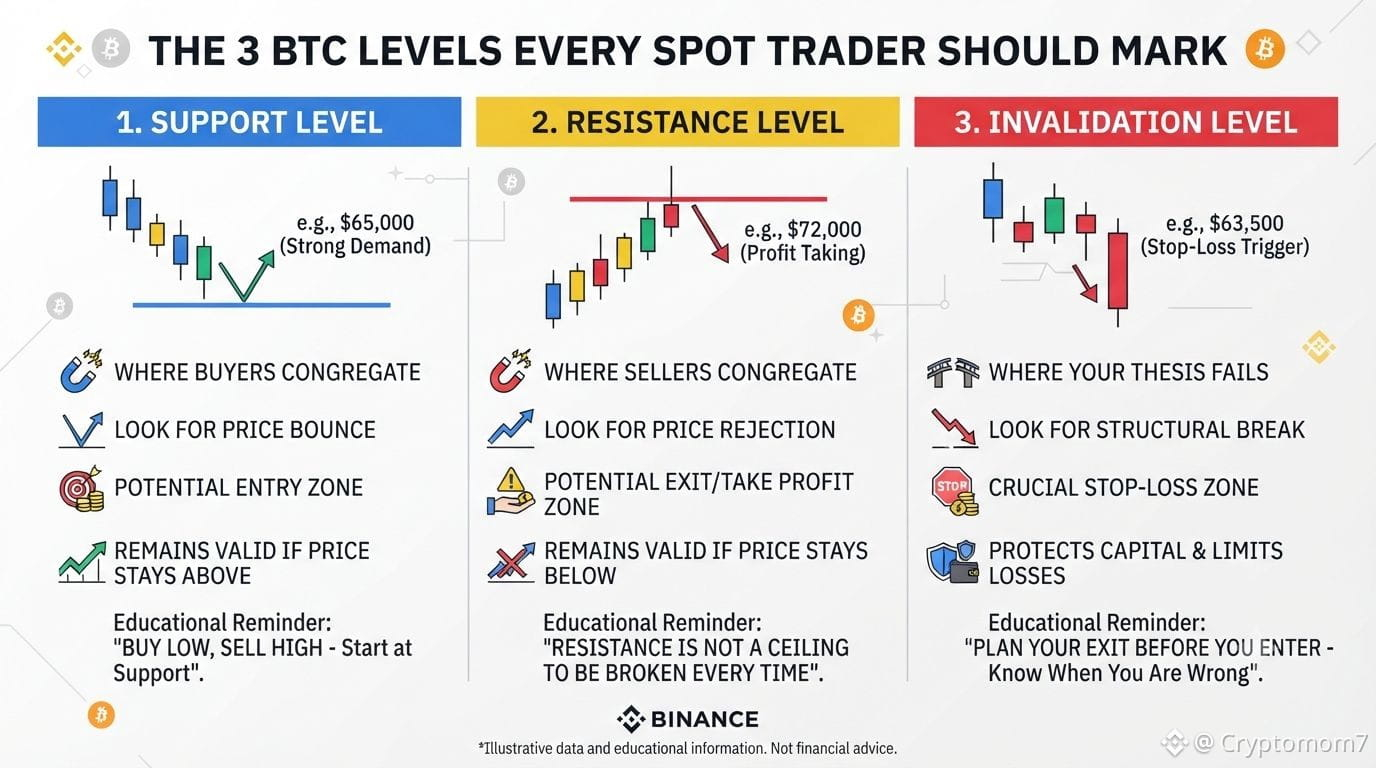
📊 DIE 3 BTC-NIVEAUS, DIE JEDER SPOT-TRADER MARKIEREN SOLLTE
Bevor du einen Bitcoin-Trade eingeht, schau nicht auf den Chart und stell dir einfach diese Frage:
„Wird BTC steigen?“
Markiere stattdessen zuerst drei wichtige Niveaus.
🟢 1. SUPPORT (UNTERSTÜTZUNG)
Wo hat BTC zuvor kaufendes Interesse gefunden?
Das ist ein Bereich, in dem sich der Kurs möglicherweise stabilisieren oder abprallen kann. Er kann Tradern helfen, potenzielle Einstiege zu erkennen — aber Support ist nie garantiert.
🔴 2. RESISTANCE (WIDERSTAND)
Wo hat BTC zuvor Verkaufsdruck gespürt?
Wenn BTC nach einem starken Run an den Widerstand herankommt, kann das „Hinterherlaufen“ dem Kurs das Risiko erhöhen. Ein Ausbruch ist aussagekräftiger, wenn der Kurs über dem Level halten kann — statt nur kurz durchzuwicken.
🟡 3. INVALIDATION LEVEL (INVALIDIERUNG)
Bei welchem Preis würde deine Trade-Idee keinen Sinn mehr ergeben?
Das wird oft vergessen. Entscheide vor dem Einstieg, wo du akzeptierst, dass deine Setups falsch liegen.
💡 Eine einfache BTC-Checkliste:
Support = Wo könnten Käufer auftauchen?
Resistance = Wo könnten Verkäufer auftauchen?
Invalidation = Wann sollte ich aussteigen, statt zu hoffen?
Für Spot-Trader kann dieses simple Framework dabei helfen, aus einem Chart eine strukturierte Planung zu machen — statt nur eine Sammlung von Kerzen.
Und denk daran:
📌 Steig nicht einfach ein, nur weil BTC sich bewegt.
Kenne deine Niveaus, BEVOR du kaufst.
Kapital schützen gehört zum Trading — nicht zu dem, woran man erst denkt, nachdem der Trade gegen einen läuft.
#Bitcoin #BTC #SpotTrading #CryptoTrading #Binance #BitcoinInvesting #TradingTips #CryptoEducation
📊 DIE 3 BTC-NIVEAUS, DIE JEDER SPOT-TRADER MARKIEREN SOLLTE
Bevor du einen Bitcoin-Trade eingeht, schau nicht auf den Chart und stell dir einfach diese Frage:
„Wird BTC steigen?“
Markiere stattdessen zuerst drei wichtige Niveaus.
🟢 1. SUPPORT (UNTERSTÜTZUNG)
Wo hat BTC zuvor kaufendes Interesse gefunden?
Das ist ein Bereich, in dem sich der Kurs möglicherweise stabilisieren oder abprallen kann. Er kann Tradern helfen, potenzielle Einstiege zu erkennen — aber Support ist nie garantiert.
🔴 2. RESISTANCE (WIDERSTAND)
Wo hat BTC zuvor Verkaufsdruck gespürt?
Wenn BTC nach einem starken Run an den Widerstand herankommt, kann das „Hinterherlaufen“ dem Kurs das Risiko erhöhen. Ein Ausbruch ist aussagekräftiger, wenn der Kurs über dem Level halten kann — statt nur kurz durchzuwicken.
🟡 3. INVALIDATION LEVEL (INVALIDIERUNG)
Bei welchem Preis würde deine Trade-Idee keinen Sinn mehr ergeben?
Das wird oft vergessen. Entscheide vor dem Einstieg, wo du akzeptierst, dass deine Setups falsch liegen.
💡 Eine einfache BTC-Checkliste:
Support = Wo könnten Käufer auftauchen?
Resistance = Wo könnten Verkäufer auftauchen?
Invalidation = Wann sollte ich aussteigen, statt zu hoffen?
Für Spot-Trader kann dieses simple Framework dabei helfen, aus einem Chart eine strukturierte Planung zu machen — statt nur eine Sammlung von Kerzen.
Und denk daran:
📌 Steig nicht einfach ein, nur weil BTC sich bewegt.
Kenne deine Niveaus, BEVOR du kaufst.
Kapital schützen gehört zum Trading — nicht zu dem, woran man erst denkt, nachdem der Trade gegen einen läuft.
#Bitcoin #BTC #SpotTrading #CryptoTrading #Binance #BitcoinInvesting #TradingTips #CryptoEducation
Bevor du einen Bitcoin-Trade eingeht, schau nicht auf den Chart und stell dir einfach diese Frage:
„Wird BTC steigen?“
Markiere stattdessen zuerst drei wichtige Niveaus.
🟢 1. SUPPORT (UNTERSTÜTZUNG)
Wo hat BTC zuvor kaufendes Interesse gefunden?
Das ist ein Bereich, in dem sich der Kurs möglicherweise stabilisieren oder abprallen kann. Er kann Tradern helfen, potenzielle Einstiege zu erkennen — aber Support ist nie garantiert.
🔴 2. RESISTANCE (WIDERSTAND)
Wo hat BTC zuvor Verkaufsdruck gespürt?
Wenn BTC nach einem starken Run an den Widerstand herankommt, kann das „Hinterherlaufen“ dem Kurs das Risiko erhöhen. Ein Ausbruch ist aussagekräftiger, wenn der Kurs über dem Level halten kann — statt nur kurz durchzuwicken.
🟡 3. INVALIDATION LEVEL (INVALIDIERUNG)
Bei welchem Preis würde deine Trade-Idee keinen Sinn mehr ergeben?
Das wird oft vergessen. Entscheide vor dem Einstieg, wo du akzeptierst, dass deine Setups falsch liegen.
💡 Eine einfache BTC-Checkliste:
Support = Wo könnten Käufer auftauchen?
Resistance = Wo könnten Verkäufer auftauchen?
Invalidation = Wann sollte ich aussteigen, statt zu hoffen?
Für Spot-Trader kann dieses simple Framework dabei helfen, aus einem Chart eine strukturierte Planung zu machen — statt nur eine Sammlung von Kerzen.
Und denk daran:
📌 Steig nicht einfach ein, nur weil BTC sich bewegt.
Kenne deine Niveaus, BEVOR du kaufst.
Kapital schützen gehört zum Trading — nicht zu dem, woran man erst denkt, nachdem der Trade gegen einen läuft.
#Bitcoin #BTC #SpotTrading #CryptoTrading #Binance #BitcoinInvesting #TradingTips #CryptoEducation
45
·
--
Übersetzung ansehen
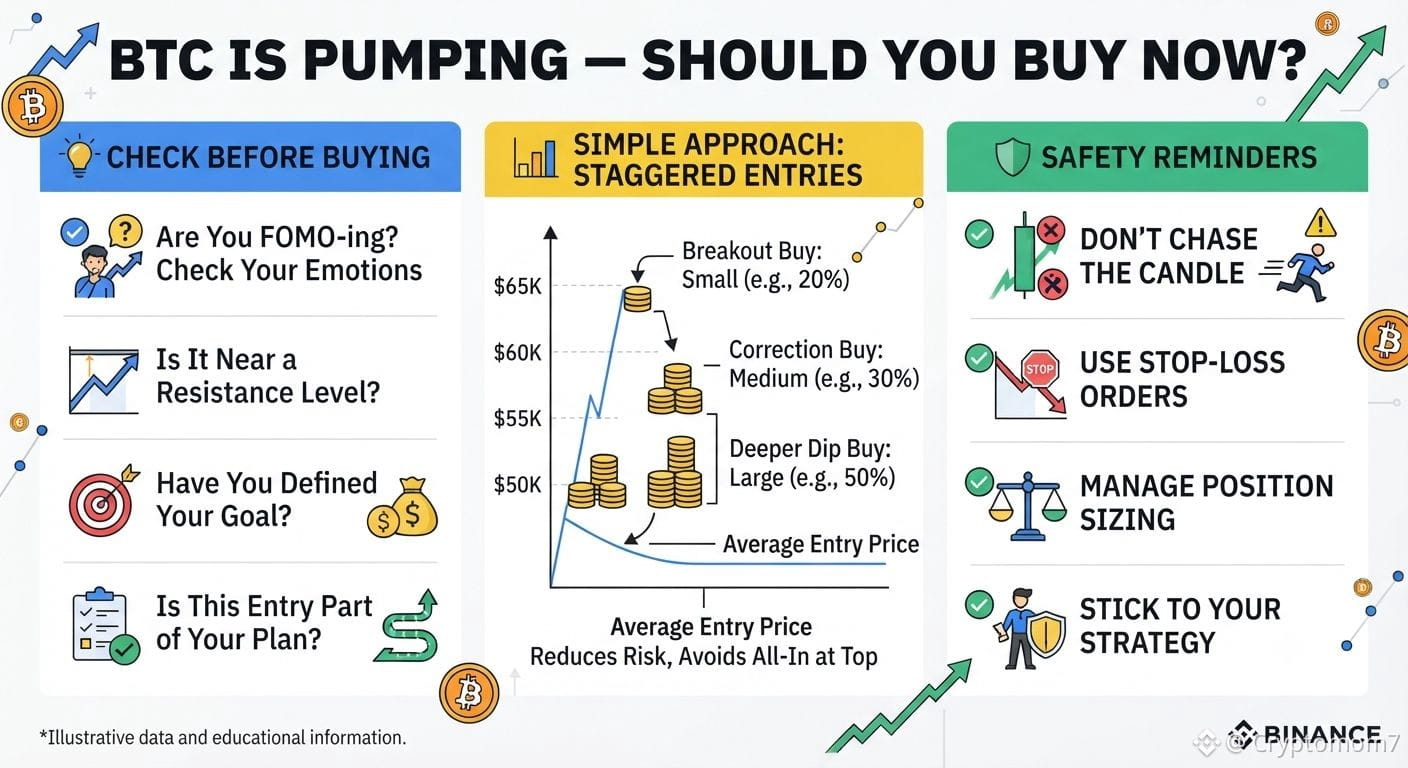
🚨 BTC IS PUMPING — SHOULD YOU BUY NOW?
Seeing Bitcoin suddenly move higher can create one strong emotion: FOMO.
You see BTC breaking upward, everyone is talking about the rally, and the temptation is to enter immediately.
But disciplined spot traders ask a different question:
👉 “Is this a good entry, or am I chasing the move?”
Before buying a fast-moving BTC candle, check:
🔹 Is price close to a major resistance level?
🔹 Has the move been supported by strong volume?
🔹 Did BTC actually close above resistance, or only wick above it?
🔹 Is there a possible retest before the next move?
🔹 How much of your available capital are you putting at risk?
💡 A simple approach:
Instead of putting your entire amount into a sudden breakout, consider staggering entries.
For example, divide your planned capital into smaller portions and keep some available in case BTC pulls back.
Remember:
📈 A rising BTC price doesn't mean every entry is a good entry.
Sometimes the safest trade is waiting for confirmation.
Don't chase the candle.
Don't trade because everyone else is excited.
Have your entry, risk level and exit plan ready before you buy.
The goal isn't to catch every Bitcoin move.
The goal is to stay in the market long enough to benefit from the opportunities that fit your strategy. 🟠
#Bitcoin #BTC #SpotTrading #CryptoTrading #BitcoinInvesting #Binance #CryptoEducation #TradingTips
🚨 BTC IS PUMPING — SHOULD YOU BUY NOW?
Seeing Bitcoin suddenly move higher can create one strong emotion: FOMO.
You see BTC breaking upward, everyone is talking about the rally, and the temptation is to enter immediately.
But disciplined spot traders ask a different question:
👉 “Is this a good entry, or am I chasing the move?”
Before buying a fast-moving BTC candle, check:
🔹 Is price close to a major resistance level?
🔹 Has the move been supported by strong volume?
🔹 Did BTC actually close above resistance, or only wick above it?
🔹 Is there a possible retest before the next move?
🔹 How much of your available capital are you putting at risk?
💡 A simple approach:
Instead of putting your entire amount into a sudden breakout, consider staggering entries.
For example, divide your planned capital into smaller portions and keep some available in case BTC pulls back.
Remember:
📈 A rising BTC price doesn't mean every entry is a good entry.
Sometimes the safest trade is waiting for confirmation.
Don't chase the candle.
Don't trade because everyone else is excited.
Have your entry, risk level and exit plan ready before you buy.
The goal isn't to catch every Bitcoin move.
The goal is to stay in the market long enough to benefit from the opportunities that fit your strategy. 🟠
#Bitcoin #BTC #SpotTrading #CryptoTrading #BitcoinInvesting #Binance #CryptoEducation #TradingTips
Seeing Bitcoin suddenly move higher can create one strong emotion: FOMO.
You see BTC breaking upward, everyone is talking about the rally, and the temptation is to enter immediately.
But disciplined spot traders ask a different question:
👉 “Is this a good entry, or am I chasing the move?”
Before buying a fast-moving BTC candle, check:
🔹 Is price close to a major resistance level?
🔹 Has the move been supported by strong volume?
🔹 Did BTC actually close above resistance, or only wick above it?
🔹 Is there a possible retest before the next move?
🔹 How much of your available capital are you putting at risk?
💡 A simple approach:
Instead of putting your entire amount into a sudden breakout, consider staggering entries.
For example, divide your planned capital into smaller portions and keep some available in case BTC pulls back.
Remember:
📈 A rising BTC price doesn't mean every entry is a good entry.
Sometimes the safest trade is waiting for confirmation.
Don't chase the candle.
Don't trade because everyone else is excited.
Have your entry, risk level and exit plan ready before you buy.
The goal isn't to catch every Bitcoin move.
The goal is to stay in the market long enough to benefit from the opportunities that fit your strategy. 🟠
#Bitcoin #BTC #SpotTrading #CryptoTrading #BitcoinInvesting #Binance #CryptoEducation #TradingTips
51
·
--
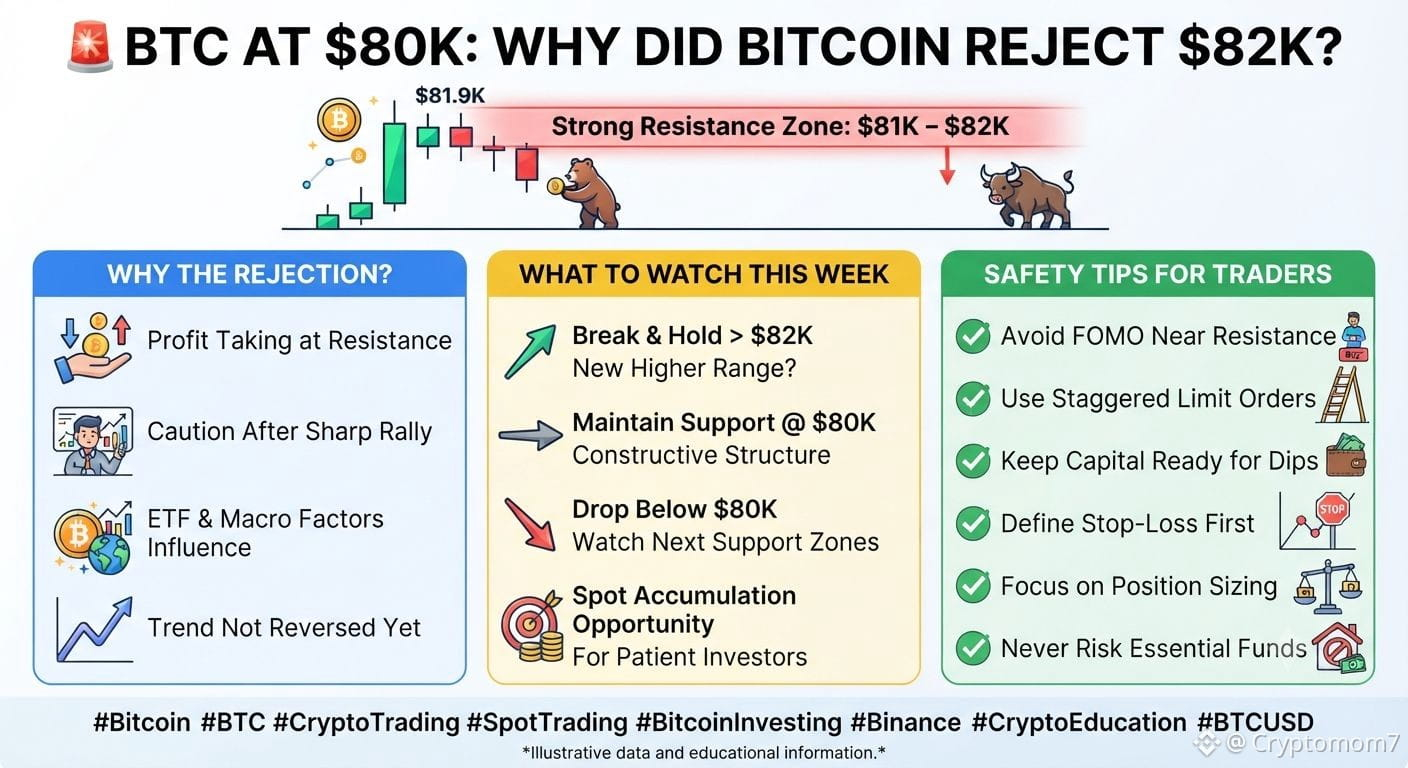
🚨 BTC BEI 80.000 $: WARUM HAT BITCOIN $82K ABGEWIESEN?
Bitcoin ist nach einem jüngsten Anstieg über 81.000 $ und in die Nähe von 82.000 $ wieder rund um die 80.000-$-Marke zurück – aber Verkäufer griffen ein und drückten den Kurs nach unten.
Warum?
🔹 Die Spanne von 81K–82K erweist sich als starke Widerstandszone, in der Trader Gewinne mitnehmen.
🔹 Nach einem starken impulsiven Anstieg können kurzfristige Käufer vorsichtiger werden, was zu vorübergehendem Verkaufsdruck führt.
🔹 ETF-Flows und die breiteren Makrobedingungen bleiben wichtige Auslöser für BTC.
🔹 Eine Abweisung nahe dem Widerstand bedeutet NICHT automatisch, dass der Trend bereits gedreht hat.
📊 DAS DIESEN WOCHE ZU BEOBACHTEN IST
➡️ Über 82K mit starkem Volumen: BTC könnte versuchen, eine höhere Range aufzubauen.
➡️ 80K halten: lässt die aktuelle Struktur konstruktiv.
➡️ 80K verlieren: beobachte die nächsten Unterstützungszonen, statt einem fallenden Candle hinterherzulaufen.
➡️ Ein tieferer Rücksetzer kann bessere Einstiegsmöglichkeiten für geduldige Spot-Investoren schaffen.
🛡️ SICHERHEITSTIPPS FÜR INVESTOREN & SPOT-TRADER
✅ Nicht FOMO-mäßig nahe dem Widerstand kaufen.
✅ Ziehe gestaffelte Limit-Orders statt eines großen Einstiegs in Betracht.
✅ Halte etwas Kapital für Rücksetzer bereit.
✅ Für Trader: Lege deinen Stop-Loss fest, BEVOR du einsteigst.
✅ Für langfristige Investoren: Fokus auf Positionsgröße und Aufbau statt darauf, jede Kerze vorherzusagen.
✅ Verwende niemals Geld, das du für notwendige Ausgaben brauchst.
Die zentrale Frage diese Woche ist nicht nur „Wird BTC steigen?“
Sondern ob Bitcoin über 80K halten kann und die Widerstandszone 81K–82K irgendwann in Unterstützung umwandelt.
Beobachte die Levels. Manage das Risiko. Lass den Markt den Move bestätigen. 📈
#Bitcoin #BTC #CryptoTrading #SpotTrading #BitcoinInvesting #Binance #CryptoEducation #BTCUSD
🚨 BTC BEI 80.000 $: WARUM HAT BITCOIN $82K ABGEWIESEN?
Bitcoin ist nach einem jüngsten Anstieg über 81.000 $ und in die Nähe von 82.000 $ wieder rund um die 80.000-$-Marke zurück – aber Verkäufer griffen ein und drückten den Kurs nach unten.
Warum?
🔹 Die Spanne von 81K–82K erweist sich als starke Widerstandszone, in der Trader Gewinne mitnehmen.
🔹 Nach einem starken impulsiven Anstieg können kurzfristige Käufer vorsichtiger werden, was zu vorübergehendem Verkaufsdruck führt.
🔹 ETF-Flows und die breiteren Makrobedingungen bleiben wichtige Auslöser für BTC.
🔹 Eine Abweisung nahe dem Widerstand bedeutet NICHT automatisch, dass der Trend bereits gedreht hat.
📊 DAS DIESEN WOCHE ZU BEOBACHTEN IST
➡️ Über 82K mit starkem Volumen: BTC könnte versuchen, eine höhere Range aufzubauen.
➡️ 80K halten: lässt die aktuelle Struktur konstruktiv.
➡️ 80K verlieren: beobachte die nächsten Unterstützungszonen, statt einem fallenden Candle hinterherzulaufen.
➡️ Ein tieferer Rücksetzer kann bessere Einstiegsmöglichkeiten für geduldige Spot-Investoren schaffen.
🛡️ SICHERHEITSTIPPS FÜR INVESTOREN & SPOT-TRADER
✅ Nicht FOMO-mäßig nahe dem Widerstand kaufen.
✅ Ziehe gestaffelte Limit-Orders statt eines großen Einstiegs in Betracht.
✅ Halte etwas Kapital für Rücksetzer bereit.
✅ Für Trader: Lege deinen Stop-Loss fest, BEVOR du einsteigst.
✅ Für langfristige Investoren: Fokus auf Positionsgröße und Aufbau statt darauf, jede Kerze vorherzusagen.
✅ Verwende niemals Geld, das du für notwendige Ausgaben brauchst.
Die zentrale Frage diese Woche ist nicht nur „Wird BTC steigen?“
Sondern ob Bitcoin über 80K halten kann und die Widerstandszone 81K–82K irgendwann in Unterstützung umwandelt.
Beobachte die Levels. Manage das Risiko. Lass den Markt den Move bestätigen. 📈
#Bitcoin #BTC #CryptoTrading #SpotTrading #BitcoinInvesting #Binance #CryptoEducation #BTCUSD
Bitcoin ist nach einem jüngsten Anstieg über 81.000 $ und in die Nähe von 82.000 $ wieder rund um die 80.000-$-Marke zurück – aber Verkäufer griffen ein und drückten den Kurs nach unten.
Warum?
🔹 Die Spanne von 81K–82K erweist sich als starke Widerstandszone, in der Trader Gewinne mitnehmen.
🔹 Nach einem starken impulsiven Anstieg können kurzfristige Käufer vorsichtiger werden, was zu vorübergehendem Verkaufsdruck führt.
🔹 ETF-Flows und die breiteren Makrobedingungen bleiben wichtige Auslöser für BTC.
🔹 Eine Abweisung nahe dem Widerstand bedeutet NICHT automatisch, dass der Trend bereits gedreht hat.
📊 DAS DIESEN WOCHE ZU BEOBACHTEN IST
➡️ Über 82K mit starkem Volumen: BTC könnte versuchen, eine höhere Range aufzubauen.
➡️ 80K halten: lässt die aktuelle Struktur konstruktiv.
➡️ 80K verlieren: beobachte die nächsten Unterstützungszonen, statt einem fallenden Candle hinterherzulaufen.
➡️ Ein tieferer Rücksetzer kann bessere Einstiegsmöglichkeiten für geduldige Spot-Investoren schaffen.
🛡️ SICHERHEITSTIPPS FÜR INVESTOREN & SPOT-TRADER
✅ Nicht FOMO-mäßig nahe dem Widerstand kaufen.
✅ Ziehe gestaffelte Limit-Orders statt eines großen Einstiegs in Betracht.
✅ Halte etwas Kapital für Rücksetzer bereit.
✅ Für Trader: Lege deinen Stop-Loss fest, BEVOR du einsteigst.
✅ Für langfristige Investoren: Fokus auf Positionsgröße und Aufbau statt darauf, jede Kerze vorherzusagen.
✅ Verwende niemals Geld, das du für notwendige Ausgaben brauchst.
Die zentrale Frage diese Woche ist nicht nur „Wird BTC steigen?“
Sondern ob Bitcoin über 80K halten kann und die Widerstandszone 81K–82K irgendwann in Unterstützung umwandelt.
Beobachte die Levels. Manage das Risiko. Lass den Markt den Move bestätigen. 📈
#Bitcoin #BTC #CryptoTrading #SpotTrading #BitcoinInvesting #Binance #CryptoEducation #BTCUSD
82
·
--
Artikel
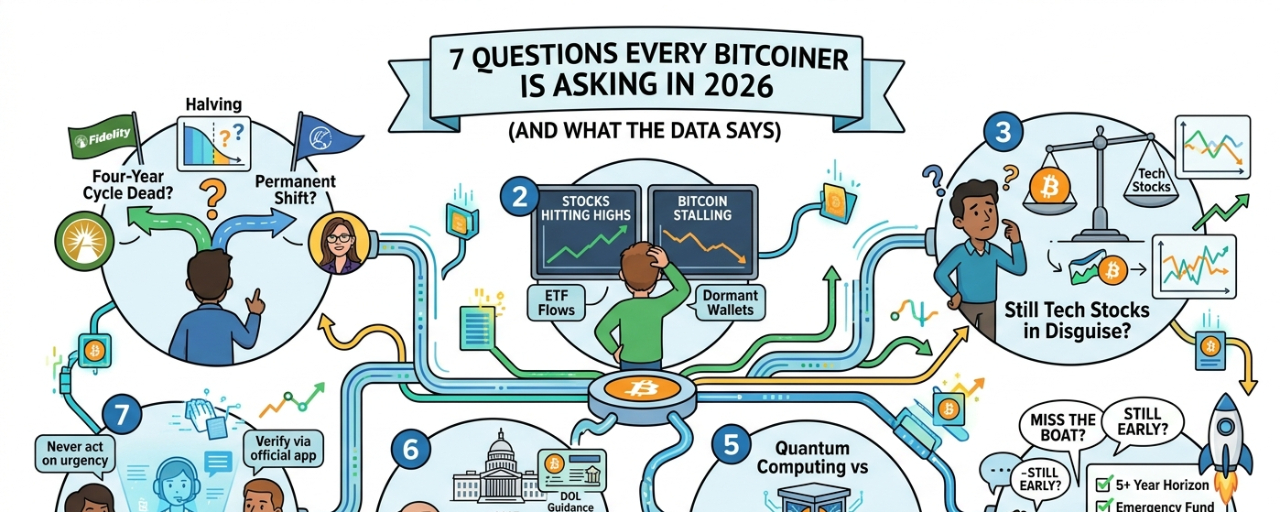
7 Fragen, die sich jeder Bitcoiner im Jahr 2026 stellt (und was die Daten tatsächlich sagen)7 Fragen, die sich jeder Bitcoiner im Jahr 2026 stellt (und was die Daten tatsächlich sagen)
Bitcoin verhält sich im Jahr 2026 nicht mehr wie der Vermögenswert, für den die meisten Menschen die Regeln gelernt haben. Institutionen sind dabei, der Preis spielt aber nicht mit dem alten Drehbuch — und eine Welle aus technischen und regulatorischen Wildcards lässt viele Halter ernsthaft unsicher sein, was sie glauben sollen. Unten sind die Fragen, die immer wieder auftauchen — so ehrlich beantwortet, wie es die aktuellen Daten zulassen.
Inhaltsverzeichnis
Ist der Vierjahres-Bitcoin-Zyklus wirklich tot?
Die Aktien knallen weiter nach oben — warum nicht Bitcoin?
7 Fragen, die sich jeder Bitcoiner im Jahr 2026 stellt (und was die Daten tatsächlich sagen)
7 Fragen, die sich jeder Bitcoiner im Jahr 2026 stellt (und was die Daten tatsächlich sagen)
Bitcoin verhält sich im Jahr 2026 nicht mehr wie der Vermögenswert, für den die meisten Menschen die Regeln gelernt haben. Institutionen sind dabei, der Preis spielt aber nicht mit dem alten Drehbuch — und eine Welle aus technischen und regulatorischen Wildcards lässt viele Halter ernsthaft unsicher sein, was sie glauben sollen. Unten sind die Fragen, die immer wieder auftauchen — so ehrlich beantwortet, wie es die aktuellen Daten zulassen.
Inhaltsverzeichnis
Ist der Vierjahres-Bitcoin-Zyklus wirklich tot?
Die Aktien knallen weiter nach oben — warum nicht Bitcoin?
Bitcoin verhält sich im Jahr 2026 nicht mehr wie der Vermögenswert, für den die meisten Menschen die Regeln gelernt haben. Institutionen sind dabei, der Preis spielt aber nicht mit dem alten Drehbuch — und eine Welle aus technischen und regulatorischen Wildcards lässt viele Halter ernsthaft unsicher sein, was sie glauben sollen. Unten sind die Fragen, die immer wieder auftauchen — so ehrlich beantwortet, wie es die aktuellen Daten zulassen.
Inhaltsverzeichnis
Ist der Vierjahres-Bitcoin-Zyklus wirklich tot?
Die Aktien knallen weiter nach oben — warum nicht Bitcoin?
81
·
--
Artikel
Übersetzung ansehen
What Bitcoin Holders Really Want in 2026 (And How Binance Is Answering)What Bitcoin Holders Really Want in 2026 (And How Binance Is Answering)
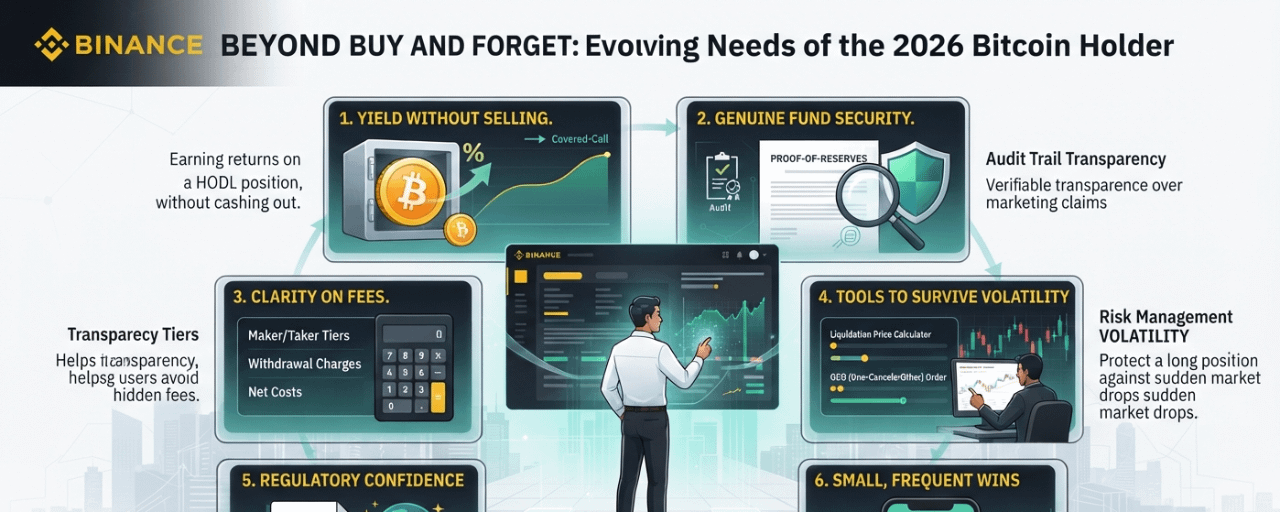
Bitcoin isn't behaving like a "buy and forget" asset for most holders anymore — it's behaving like a portfolio they actively manage. That shift shows up clearly in what people are asking exchanges to deliver in 2026: not just a place to buy BTC, but a place to protect it, grow it quietly, and trade it without getting blindsided.
Here's what that audience wants — and where Binance fits into each demand.
Table of Contents
Yield Without Selling the BitcoinGenuine Fund Security, Not Just Marketing CopyClarity on Fees That Actually Add UpTools to Survive Volatility, Not Just Watch ItRegulatory Confidence in a Still-Shifting LandscapeSmall, Frequent Wins Alongside the Big TradeThe Bottom Line
1. Yield Without Selling the Bitcoin
The single biggest behavioral shift this year: holders are refusing to sell, even when tempted. On-chain data shows long-term holder wallets — those untouched for 155 days or more — now control close to 79% of Bitcoin's circulating supply as of September 2026, a record high. That's not passive indifference; it's a deliberate hold strategy, and it comes with a new demand — "let me earn on this coin without cashing it out."
Binance's response has been to build products specifically for that mindset. Its BTC Yield product, a covered-call income strategy, was built exclusively for people who already hold Bitcoin — letting long-term holders generate a return on their sitting position instead of choosing between HODL and cash flow. For a reader-first article, this is worth flagging honestly: covered-call yield caps some of your upside if BTC spikes hard, so it suits holders prioritizing steady income over full upside exposure, not aggressive bulls expecting a breakout.
2. Genuine Fund Security, Not Just Marketing Copy
Every serious guide to choosing an exchange keeps circling back to the same non-negotiable: cold storage, two-factor authentication, and infrastructure that isn't sitting on a handful of vulnerable servers. Investors have grown numb to security claims, so what actually reassures them now is verifiable proof — proof-of-reserves data, audit trails, insurance funds — over adjectives like "bank-grade."
This is where an honest article should nudge readers to check for themselves rather than take any exchange's word: look up an exchange's proof-of-reserves page, confirm withdrawal history isn't restricted during volatile periods, and treat any platform that resists transparency as a red flag regardless of its fee structure.
3. Clarity on Fees That Actually Add Up
Fee sensitivity hasn't gone away — if anything, active traders are more fee-literate than ever, comparing maker/taker tiers, withdrawal charges, and volume-based discounts before committing capital. Tiered pricing that rewards higher-volume traders remains the norm across major platforms, but the fine print (withdrawal limits, inactivity charges) is where holders get caught off guard.
The practical advice worth giving readers: run their actual trading pattern — not the platform's headline rate — through a fee calculator before assuming "low fees" applies to their size and frequency of trades.
4. Tools to Survive Volatility, Not Just Watch It
September's price action has been a live lesson in why leverage without a plan is dangerous. Open interest and long-side positioning have stayed elevated, and that concentration cuts both ways — Binance alone was recently reported carrying roughly $3.00 billion in long liquidation leverage sitting below the price, against $1.80 billion in short leverage above it, meaning a modest downside move could trigger a cascade of forced liquidations.
What holders actually want from this environment isn't a prediction — it's risk-management tooling: liquidation-price calculators, OCO (one-cancels-other) orders, and clear margin-ratio alerts before a position gets force-closed rather than after. Any exchange piece worth reading should point people toward using these tools proactively, not toward chasing the leverage that created the risk in the first place.
5. Regulatory Confidence in a Still-Shifting Landscape
Institutional money hasn't stopped arriving, but it's arriving cautiously, watching how regulatory frameworks (like ongoing developments around the CLARITY Act) settle before committing further. Retail holders are picking up on that same caution — wanting to know an exchange's compliance posture, licensing footprint, and how it handles regional regulatory changes, rather than assuming "big platform" automatically means "safe platform."
6. Small, Frequent Wins Alongside the Big Trade
Not every demand is about yield curves and liquidation maps — plenty of holders also want low-stakes ways to stay engaged. Binance's Red Packet feature, adapted from the tradition of hóngbōo digital gifting, lets KYC-verified users redeem small daily reward codes for free crypto with no deposit or trade required. It's a minor perk in the scheme of a portfolio, but it reflects a real appetite: holders like feeling rewarded for showing up, not just for placing trades.
7. The Bottom Line
Line them up, and the pattern is clear: today's Bitcoin holder wants an exchange that protects the coin, quietly grows it, charges fees they can actually predict, and gives them the tools to not get liquidated in a sharp move — with regulatory footing solid enough that none of it evaporates overnight. Binance's current lineup — BTC Yield, tiered fees, OCO/margin tools, and transparency pushes — maps closely to that list. But the honest takeaway for readers is the same one that should anchor any crypto content: match the tool to your own risk tolerance and time horizon, verify claims yourself, and never treat yield or convenience features as a substitute for understanding what you're holding.
This is market commentary, not financial advice. Crypto markets are volatile — do your own research before acting on anything here.
What Bitcoin Holders Really Want in 2026 (And How Binance Is Answering)
What Bitcoin Holders Really Want in 2026 (And How Binance Is Answering)
Bitcoin isn't behaving like a "buy and forget" asset for most holders anymore — it's behaving like a portfolio they actively manage. That shift shows up clearly in what people are asking exchanges to deliver in 2026: not just a place to buy BTC, but a place to protect it, grow it quietly, and trade it without getting blindsided.
Here's what that audience wants — and where Binance fits into each demand.
Table of Contents
Yield Without Selling the BitcoinGenuine Fund Security, Not Just Marketing CopyClarity on Fees That Actually Add UpTools to Survive Volatility, Not Just Watch ItRegulatory Confidence in a Still-Shifting LandscapeSmall, Frequent Wins Alongside the Big TradeThe Bottom Line
1. Yield Without Selling the Bitcoin
The single biggest behavioral shift this year: holders are refusing to sell, even when tempted. On-chain data shows long-term holder wallets — those untouched for 155 days or more — now control close to 79% of Bitcoin's circulating supply as of September 2026, a record high. That's not passive indifference; it's a deliberate hold strategy, and it comes with a new demand — "let me earn on this coin without cashing it out."
Binance's response has been to build products specifically for that mindset. Its BTC Yield product, a covered-call income strategy, was built exclusively for people who already hold Bitcoin — letting long-term holders generate a return on their sitting position instead of choosing between HODL and cash flow. For a reader-first article, this is worth flagging honestly: covered-call yield caps some of your upside if BTC spikes hard, so it suits holders prioritizing steady income over full upside exposure, not aggressive bulls expecting a breakout.
2. Genuine Fund Security, Not Just Marketing Copy
Every serious guide to choosing an exchange keeps circling back to the same non-negotiable: cold storage, two-factor authentication, and infrastructure that isn't sitting on a handful of vulnerable servers. Investors have grown numb to security claims, so what actually reassures them now is verifiable proof — proof-of-reserves data, audit trails, insurance funds — over adjectives like "bank-grade."
This is where an honest article should nudge readers to check for themselves rather than take any exchange's word: look up an exchange's proof-of-reserves page, confirm withdrawal history isn't restricted during volatile periods, and treat any platform that resists transparency as a red flag regardless of its fee structure.
3. Clarity on Fees That Actually Add Up
Fee sensitivity hasn't gone away — if anything, active traders are more fee-literate than ever, comparing maker/taker tiers, withdrawal charges, and volume-based discounts before committing capital. Tiered pricing that rewards higher-volume traders remains the norm across major platforms, but the fine print (withdrawal limits, inactivity charges) is where holders get caught off guard.
The practical advice worth giving readers: run their actual trading pattern — not the platform's headline rate — through a fee calculator before assuming "low fees" applies to their size and frequency of trades.
4. Tools to Survive Volatility, Not Just Watch It
September's price action has been a live lesson in why leverage without a plan is dangerous. Open interest and long-side positioning have stayed elevated, and that concentration cuts both ways — Binance alone was recently reported carrying roughly $3.00 billion in long liquidation leverage sitting below the price, against $1.80 billion in short leverage above it, meaning a modest downside move could trigger a cascade of forced liquidations.
What holders actually want from this environment isn't a prediction — it's risk-management tooling: liquidation-price calculators, OCO (one-cancels-other) orders, and clear margin-ratio alerts before a position gets force-closed rather than after. Any exchange piece worth reading should point people toward using these tools proactively, not toward chasing the leverage that created the risk in the first place.
5. Regulatory Confidence in a Still-Shifting Landscape
Institutional money hasn't stopped arriving, but it's arriving cautiously, watching how regulatory frameworks (like ongoing developments around the CLARITY Act) settle before committing further. Retail holders are picking up on that same caution — wanting to know an exchange's compliance posture, licensing footprint, and how it handles regional regulatory changes, rather than assuming "big platform" automatically means "safe platform."
6. Small, Frequent Wins Alongside the Big Trade
Not every demand is about yield curves and liquidation maps — plenty of holders also want low-stakes ways to stay engaged. Binance's Red Packet feature, adapted from the tradition of hóngbōo digital gifting, lets KYC-verified users redeem small daily reward codes for free crypto with no deposit or trade required. It's a minor perk in the scheme of a portfolio, but it reflects a real appetite: holders like feeling rewarded for showing up, not just for placing trades.
7. The Bottom Line
Line them up, and the pattern is clear: today's Bitcoin holder wants an exchange that protects the coin, quietly grows it, charges fees they can actually predict, and gives them the tools to not get liquidated in a sharp move — with regulatory footing solid enough that none of it evaporates overnight. Binance's current lineup — BTC Yield, tiered fees, OCO/margin tools, and transparency pushes — maps closely to that list. But the honest takeaway for readers is the same one that should anchor any crypto content: match the tool to your own risk tolerance and time horizon, verify claims yourself, and never treat yield or convenience features as a substitute for understanding what you're holding.
This is market commentary, not financial advice. Crypto markets are volatile — do your own research before acting on anything here.
Bitcoin isn't behaving like a "buy and forget" asset for most holders anymore — it's behaving like a portfolio they actively manage. That shift shows up clearly in what people are asking exchanges to deliver in 2026: not just a place to buy BTC, but a place to protect it, grow it quietly, and trade it without getting blindsided.
Here's what that audience wants — and where Binance fits into each demand.
Table of Contents
Yield Without Selling the BitcoinGenuine Fund Security, Not Just Marketing CopyClarity on Fees That Actually Add UpTools to Survive Volatility, Not Just Watch ItRegulatory Confidence in a Still-Shifting LandscapeSmall, Frequent Wins Alongside the Big TradeThe Bottom Line
1. Yield Without Selling the Bitcoin
The single biggest behavioral shift this year: holders are refusing to sell, even when tempted. On-chain data shows long-term holder wallets — those untouched for 155 days or more — now control close to 79% of Bitcoin's circulating supply as of September 2026, a record high. That's not passive indifference; it's a deliberate hold strategy, and it comes with a new demand — "let me earn on this coin without cashing it out."
Binance's response has been to build products specifically for that mindset. Its BTC Yield product, a covered-call income strategy, was built exclusively for people who already hold Bitcoin — letting long-term holders generate a return on their sitting position instead of choosing between HODL and cash flow. For a reader-first article, this is worth flagging honestly: covered-call yield caps some of your upside if BTC spikes hard, so it suits holders prioritizing steady income over full upside exposure, not aggressive bulls expecting a breakout.
2. Genuine Fund Security, Not Just Marketing Copy
Every serious guide to choosing an exchange keeps circling back to the same non-negotiable: cold storage, two-factor authentication, and infrastructure that isn't sitting on a handful of vulnerable servers. Investors have grown numb to security claims, so what actually reassures them now is verifiable proof — proof-of-reserves data, audit trails, insurance funds — over adjectives like "bank-grade."
This is where an honest article should nudge readers to check for themselves rather than take any exchange's word: look up an exchange's proof-of-reserves page, confirm withdrawal history isn't restricted during volatile periods, and treat any platform that resists transparency as a red flag regardless of its fee structure.
3. Clarity on Fees That Actually Add Up
Fee sensitivity hasn't gone away — if anything, active traders are more fee-literate than ever, comparing maker/taker tiers, withdrawal charges, and volume-based discounts before committing capital. Tiered pricing that rewards higher-volume traders remains the norm across major platforms, but the fine print (withdrawal limits, inactivity charges) is where holders get caught off guard.
The practical advice worth giving readers: run their actual trading pattern — not the platform's headline rate — through a fee calculator before assuming "low fees" applies to their size and frequency of trades.
4. Tools to Survive Volatility, Not Just Watch It
September's price action has been a live lesson in why leverage without a plan is dangerous. Open interest and long-side positioning have stayed elevated, and that concentration cuts both ways — Binance alone was recently reported carrying roughly $3.00 billion in long liquidation leverage sitting below the price, against $1.80 billion in short leverage above it, meaning a modest downside move could trigger a cascade of forced liquidations.
What holders actually want from this environment isn't a prediction — it's risk-management tooling: liquidation-price calculators, OCO (one-cancels-other) orders, and clear margin-ratio alerts before a position gets force-closed rather than after. Any exchange piece worth reading should point people toward using these tools proactively, not toward chasing the leverage that created the risk in the first place.
5. Regulatory Confidence in a Still-Shifting Landscape
Institutional money hasn't stopped arriving, but it's arriving cautiously, watching how regulatory frameworks (like ongoing developments around the CLARITY Act) settle before committing further. Retail holders are picking up on that same caution — wanting to know an exchange's compliance posture, licensing footprint, and how it handles regional regulatory changes, rather than assuming "big platform" automatically means "safe platform."
6. Small, Frequent Wins Alongside the Big Trade
Not every demand is about yield curves and liquidation maps — plenty of holders also want low-stakes ways to stay engaged. Binance's Red Packet feature, adapted from the tradition of hóngbōo digital gifting, lets KYC-verified users redeem small daily reward codes for free crypto with no deposit or trade required. It's a minor perk in the scheme of a portfolio, but it reflects a real appetite: holders like feeling rewarded for showing up, not just for placing trades.
7. The Bottom Line
Line them up, and the pattern is clear: today's Bitcoin holder wants an exchange that protects the coin, quietly grows it, charges fees they can actually predict, and gives them the tools to not get liquidated in a sharp move — with regulatory footing solid enough that none of it evaporates overnight. Binance's current lineup — BTC Yield, tiered fees, OCO/margin tools, and transparency pushes — maps closely to that list. But the honest takeaway for readers is the same one that should anchor any crypto content: match the tool to your own risk tolerance and time horizon, verify claims yourself, and never treat yield or convenience features as a substitute for understanding what you're holding.
This is market commentary, not financial advice. Crypto markets are volatile — do your own research before acting on anything here.
65
·
--
So liest du eine ETF-Abflusswoche (ohne in Panik zu geraten)
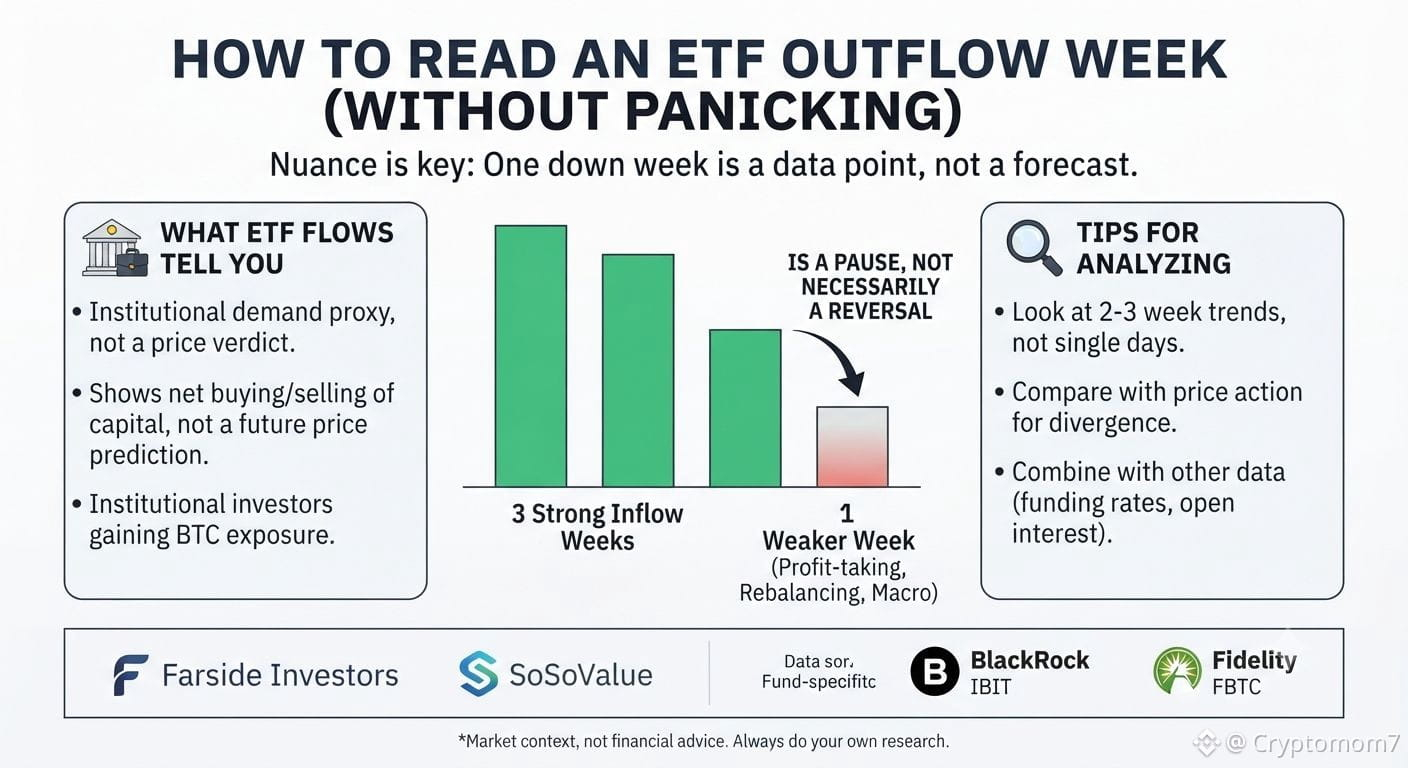
Spot-BTC-ETFs haben gerade eine schwächere Zuflusswoche nach drei aufeinanderfolgenden starken Wochen gemeldet. Schlagzeilen werden das als Warnsignal interpretieren – aber ETF-Flow-Daten sind differenzierter als „Geld rein = bullisch, Geld raus = bearish“. So kannst du es tatsächlich einordnen.
Was ETF-Flows dir sagen
Spot-Bitcoin-ETFs ermöglichen Institutionen und traditionellen Anlegern den Zugang zu BTC-Exposure über reguläre Brokerage-Konten. Die täglichen Inflow-/Outflow-Daten zeigen, ob dieser Kapitalpool an einem bestimmten Tag netto kauft oder netto verkauft – das ist ein Proxy für die institutionelle Nachfrage, kein Urteil über den zukünftigen Bitcoin-Preis.
Warum eine schwächere Woche nicht automatisch bearish ist
Eine einzelne schwächere Woche kann Gewinnmitnahmen nach einem Kursanstieg widerspiegeln, ein Portfolio-Rebalancing, makroökonomische Vorsicht (Zinsentscheidungen, Inflationsdaten) oder einfach ein niedrigeres Handelsvolumen – keine Änderung der langfristigen Überzeugung. Drei starke Wochen, gefolgt von einer schwächeren, ist eine Pause – keine Umkehr – bis der Trend es tatsächlich bestätigt.
Wo du die Daten selbst prüfen kannst
• Farside Investors – kostenloser täglicher Net-Flow-Tracker für alle U.S.-Spot-BTC-ETFs
• SoSoValue – Flow-Daten plus historische Charts
• Websites einzelner Emittenten (BlackRocks IBIT, Fidelitys FBTC usw.) für fondspezifische Zahlen
Ein paar praktische Tipps
• Betrachte Flow-Trends über 2–3 Wochen, nicht nur über einzelne Tage
• Vergleiche Flows mit der Kursentwicklung – Abweichungen (Divergenzen) sind aussagekräftiger als beides allein
• Kombiniere Flow-Daten mit anderen Signalen (Finanzierungsraten, Open Interest), statt dich nur darauf zu verlassen
Eine Abflusswoche ist ein Datenpunkt, keine Prognose. Kontext und Trend sind wichtiger als irgendeine einzelne Zahl.
Das ist Markt-Kontext, keine Finanzberatung. Mach immer deine eigene Recherche.
So liest du eine ETF-Abflusswoche (ohne in Panik zu geraten)
Spot-BTC-ETFs haben gerade eine schwächere Zuflusswoche nach drei aufeinanderfolgenden starken Wochen gemeldet. Schlagzeilen werden das als Warnsignal interpretieren – aber ETF-Flow-Daten sind differenzierter als „Geld rein = bullisch, Geld raus = bearish“. So kannst du es tatsächlich einordnen.
Was ETF-Flows dir sagen
Spot-Bitcoin-ETFs ermöglichen Institutionen und traditionellen Anlegern den Zugang zu BTC-Exposure über reguläre Brokerage-Konten. Die täglichen Inflow-/Outflow-Daten zeigen, ob dieser Kapitalpool an einem bestimmten Tag netto kauft oder netto verkauft – das ist ein Proxy für die institutionelle Nachfrage, kein Urteil über den zukünftigen Bitcoin-Preis.
Warum eine schwächere Woche nicht automatisch bearish ist
Eine einzelne schwächere Woche kann Gewinnmitnahmen nach einem Kursanstieg widerspiegeln, ein Portfolio-Rebalancing, makroökonomische Vorsicht (Zinsentscheidungen, Inflationsdaten) oder einfach ein niedrigeres Handelsvolumen – keine Änderung der langfristigen Überzeugung. Drei starke Wochen, gefolgt von einer schwächeren, ist eine Pause – keine Umkehr – bis der Trend es tatsächlich bestätigt.
Wo du die Daten selbst prüfen kannst
• Farside Investors – kostenloser täglicher Net-Flow-Tracker für alle U.S.-Spot-BTC-ETFs
• SoSoValue – Flow-Daten plus historische Charts
• Websites einzelner Emittenten (BlackRocks IBIT, Fidelitys FBTC usw.) für fondspezifische Zahlen
Ein paar praktische Tipps
• Betrachte Flow-Trends über 2–3 Wochen, nicht nur über einzelne Tage
• Vergleiche Flows mit der Kursentwicklung – Abweichungen (Divergenzen) sind aussagekräftiger als beides allein
• Kombiniere Flow-Daten mit anderen Signalen (Finanzierungsraten, Open Interest), statt dich nur darauf zu verlassen
Eine Abflusswoche ist ein Datenpunkt, keine Prognose. Kontext und Trend sind wichtiger als irgendeine einzelne Zahl.
Das ist Markt-Kontext, keine Finanzberatung. Mach immer deine eigene Recherche.
Spot-BTC-ETFs haben gerade eine schwächere Zuflusswoche nach drei aufeinanderfolgenden starken Wochen gemeldet. Schlagzeilen werden das als Warnsignal interpretieren – aber ETF-Flow-Daten sind differenzierter als „Geld rein = bullisch, Geld raus = bearish“. So kannst du es tatsächlich einordnen.
Was ETF-Flows dir sagen
Spot-Bitcoin-ETFs ermöglichen Institutionen und traditionellen Anlegern den Zugang zu BTC-Exposure über reguläre Brokerage-Konten. Die täglichen Inflow-/Outflow-Daten zeigen, ob dieser Kapitalpool an einem bestimmten Tag netto kauft oder netto verkauft – das ist ein Proxy für die institutionelle Nachfrage, kein Urteil über den zukünftigen Bitcoin-Preis.
Warum eine schwächere Woche nicht automatisch bearish ist
Eine einzelne schwächere Woche kann Gewinnmitnahmen nach einem Kursanstieg widerspiegeln, ein Portfolio-Rebalancing, makroökonomische Vorsicht (Zinsentscheidungen, Inflationsdaten) oder einfach ein niedrigeres Handelsvolumen – keine Änderung der langfristigen Überzeugung. Drei starke Wochen, gefolgt von einer schwächeren, ist eine Pause – keine Umkehr – bis der Trend es tatsächlich bestätigt.
Wo du die Daten selbst prüfen kannst
• Farside Investors – kostenloser täglicher Net-Flow-Tracker für alle U.S.-Spot-BTC-ETFs
• SoSoValue – Flow-Daten plus historische Charts
• Websites einzelner Emittenten (BlackRocks IBIT, Fidelitys FBTC usw.) für fondspezifische Zahlen
Ein paar praktische Tipps
• Betrachte Flow-Trends über 2–3 Wochen, nicht nur über einzelne Tage
• Vergleiche Flows mit der Kursentwicklung – Abweichungen (Divergenzen) sind aussagekräftiger als beides allein
• Kombiniere Flow-Daten mit anderen Signalen (Finanzierungsraten, Open Interest), statt dich nur darauf zu verlassen
Eine Abflusswoche ist ein Datenpunkt, keine Prognose. Kontext und Trend sind wichtiger als irgendeine einzelne Zahl.
Das ist Markt-Kontext, keine Finanzberatung. Mach immer deine eigene Recherche.
63
·
--
Warum BTC gerade sein September-Tief erreicht hat — und was der Bereich von 75.000 bis 80.000 US-Dollar bedeutet
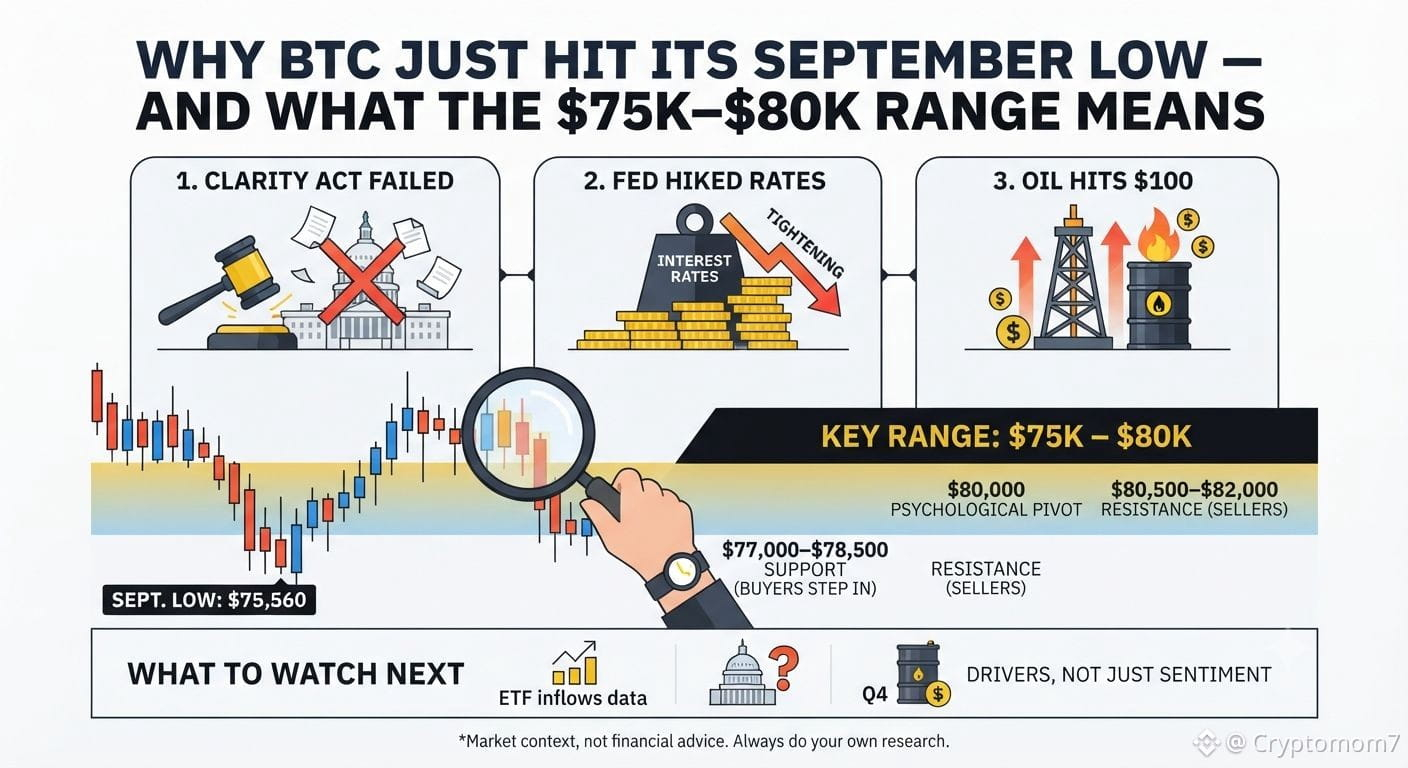
Bitcoin ist diese Woche auf 75.560 US-Dollar gefallen, den niedrigsten Stand in diesem Monat — und es lohnt sich zu verstehen, warum, statt zu raten, was als Nächstes kommt.
Drei Belastungen trafen gleichzeitig ein. Erstens: Der CLARITY Act scheiterte an einer entscheidenden Abstimmung im US-Senat, wodurch sich die regulatorische Klarheit verzögerte, auf die die Märkte bereits eingepreist hatten. Zweitens: Die Federal Reserve erhöhte zum ersten Mal seit drei Jahren die Zinsen und zog damit die Bedingungen für riskante Assets weiter an. Drittens: Öl, das nahe an 100 US-Dollar pro Barrel drückt, hat die Inflationssorgen wieder angefacht — zusätzlich zu den beiden anderen Faktoren.
Allein genommen dürfte keiner dieser Punkte BTC so stark bewegen. Zusammen erklären sie den Rücksetzer.
Das ist der Bereich, der aktuell wichtig ist:
• 77.000–78.500 US-Dollar — Support, wo Käufer zuvor bereits eingestiegen sind
• 80.000 US-Dollar — der zentrale psychologische Wendepunkt
• 80.500–82.000 US-Dollar — Widerstand, wo Verkäufer wiederholt aufgetaucht sind
Ein dauerhaftes Schlusskursniveau oberhalb von 82.000 US-Dollar würde echtes Momentum signalisieren, das wieder nach oben dreht. Wenn 75.500 US-Dollar verloren gehen, rückt ein erneuter Test des September-Tiefs wieder in den Fokus.
Worauf als Nächstes achten: Daten zum Spot-BTC-ETF-Flow (zufließende Mittel hatten vor diesem Rücksetzer drei Wochen in Folge stark zugelegt), mögliche weitere Entwicklungen zum CLARITY Act und wo sich der Ölpreis Richtung Q4 einpendelt. Diese drei Faktoren — nicht nur das Sentiment — treiben tatsächlich genau diesen Bereich.
Dies ist Markt-Kontext, keine Finanzberatung. Mach immer deine eigene Recherche.
Soll ich das noch genauer zuspitzen, den Ton anpassen (lockerer vs. eher analytisch) oder eine kürzere Version dafür vorbereiten, für X/Twitter?
Warum BTC gerade sein September-Tief erreicht hat — und was der Bereich von 75.000 bis 80.000 US-Dollar bedeutet
Bitcoin ist diese Woche auf 75.560 US-Dollar gefallen, den niedrigsten Stand in diesem Monat — und es lohnt sich zu verstehen, warum, statt zu raten, was als Nächstes kommt.
Drei Belastungen trafen gleichzeitig ein. Erstens: Der CLARITY Act scheiterte an einer entscheidenden Abstimmung im US-Senat, wodurch sich die regulatorische Klarheit verzögerte, auf die die Märkte bereits eingepreist hatten. Zweitens: Die Federal Reserve erhöhte zum ersten Mal seit drei Jahren die Zinsen und zog damit die Bedingungen für riskante Assets weiter an. Drittens: Öl, das nahe an 100 US-Dollar pro Barrel drückt, hat die Inflationssorgen wieder angefacht — zusätzlich zu den beiden anderen Faktoren.
Allein genommen dürfte keiner dieser Punkte BTC so stark bewegen. Zusammen erklären sie den Rücksetzer.
Das ist der Bereich, der aktuell wichtig ist:
• 77.000–78.500 US-Dollar — Support, wo Käufer zuvor bereits eingestiegen sind
• 80.000 US-Dollar — der zentrale psychologische Wendepunkt
• 80.500–82.000 US-Dollar — Widerstand, wo Verkäufer wiederholt aufgetaucht sind
Ein dauerhaftes Schlusskursniveau oberhalb von 82.000 US-Dollar würde echtes Momentum signalisieren, das wieder nach oben dreht. Wenn 75.500 US-Dollar verloren gehen, rückt ein erneuter Test des September-Tiefs wieder in den Fokus.
Worauf als Nächstes achten: Daten zum Spot-BTC-ETF-Flow (zufließende Mittel hatten vor diesem Rücksetzer drei Wochen in Folge stark zugelegt), mögliche weitere Entwicklungen zum CLARITY Act und wo sich der Ölpreis Richtung Q4 einpendelt. Diese drei Faktoren — nicht nur das Sentiment — treiben tatsächlich genau diesen Bereich.
Dies ist Markt-Kontext, keine Finanzberatung. Mach immer deine eigene Recherche.
Soll ich das noch genauer zuspitzen, den Ton anpassen (lockerer vs. eher analytisch) oder eine kürzere Version dafür vorbereiten, für X/Twitter?
Bitcoin ist diese Woche auf 75.560 US-Dollar gefallen, den niedrigsten Stand in diesem Monat — und es lohnt sich zu verstehen, warum, statt zu raten, was als Nächstes kommt.
Drei Belastungen trafen gleichzeitig ein. Erstens: Der CLARITY Act scheiterte an einer entscheidenden Abstimmung im US-Senat, wodurch sich die regulatorische Klarheit verzögerte, auf die die Märkte bereits eingepreist hatten. Zweitens: Die Federal Reserve erhöhte zum ersten Mal seit drei Jahren die Zinsen und zog damit die Bedingungen für riskante Assets weiter an. Drittens: Öl, das nahe an 100 US-Dollar pro Barrel drückt, hat die Inflationssorgen wieder angefacht — zusätzlich zu den beiden anderen Faktoren.
Allein genommen dürfte keiner dieser Punkte BTC so stark bewegen. Zusammen erklären sie den Rücksetzer.
Das ist der Bereich, der aktuell wichtig ist:
• 77.000–78.500 US-Dollar — Support, wo Käufer zuvor bereits eingestiegen sind
• 80.000 US-Dollar — der zentrale psychologische Wendepunkt
• 80.500–82.000 US-Dollar — Widerstand, wo Verkäufer wiederholt aufgetaucht sind
Ein dauerhaftes Schlusskursniveau oberhalb von 82.000 US-Dollar würde echtes Momentum signalisieren, das wieder nach oben dreht. Wenn 75.500 US-Dollar verloren gehen, rückt ein erneuter Test des September-Tiefs wieder in den Fokus.
Worauf als Nächstes achten: Daten zum Spot-BTC-ETF-Flow (zufließende Mittel hatten vor diesem Rücksetzer drei Wochen in Folge stark zugelegt), mögliche weitere Entwicklungen zum CLARITY Act und wo sich der Ölpreis Richtung Q4 einpendelt. Diese drei Faktoren — nicht nur das Sentiment — treiben tatsächlich genau diesen Bereich.
Dies ist Markt-Kontext, keine Finanzberatung. Mach immer deine eigene Recherche.
Soll ich das noch genauer zuspitzen, den Ton anpassen (lockerer vs. eher analytisch) oder eine kürzere Version dafür vorbereiten, für X/Twitter?
84
·
--
Artikel
Übersetzung ansehen
Bitcoin's $77K Battle: Correction, Accumulation or the Start of Another Rally?Bitcoin's $77K Battle: Correction, Accumulation or the Start of Another Rally?
#Bitcoin #BTC #FedRateWatch
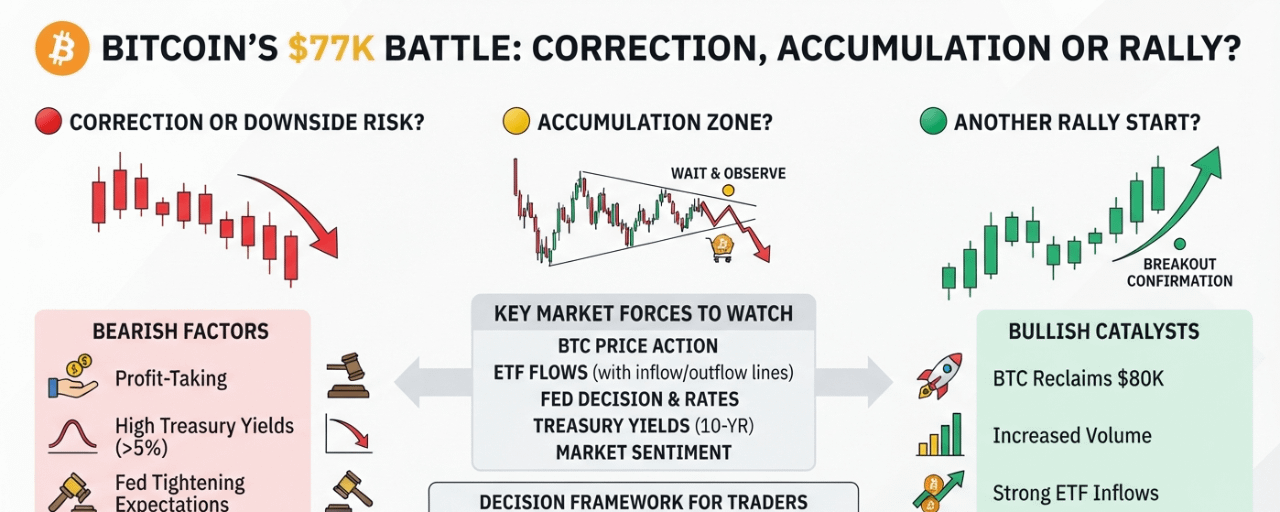
Bitcoin is fighting for an important level.
After reaching above $80K earlier this month, BTC has pulled back toward the $77K area, leaving investors with a very important question:
Is this simply a healthy correction, an accumulation opportunity, or the beginning of another rally after the Fed decision?
The answer isn't visible from the price alone.
We need to look at ETF flows, interest rates, Treasury yields, market sentiment, trading volume and how BTC behaves around support and resistance.
Table of Contents
Why is $77K important?Is this a normal Bitcoin correction?Could $77K become an accumulation zone?What would confirm another rally?ETF flows: the missing pieceThe Fed and Treasury-yield factorBullish vs. bearish scenariosWhat should spot traders watch?What should long-term investors do?The bigger Bitcoin picture
1. Why Is $77K Important?
Bitcoin's recent price action has created an interesting range.
BTC pushed above $80K and reached roughly $82K earlier in September, but failed to hold the higher levels. It subsequently returned toward $77K.
That makes $77K more than just a round number.
It is becoming a market decision zone.
If buyers continue defending this area, Bitcoin could attempt another move toward $80K.
If sellers gain control and BTC loses important support, traders could begin watching the low-$70Ks.
So the question isn't simply:
“Will Bitcoin go up or down?”
It is:
“Who is gaining control around $77K — buyers or sellers?”
2. Is This a Normal Bitcoin Correction?
Possibly.
Bitcoin rarely moves upward in a straight line.
After a strong rally, investors may take profits, short-term traders may exit, and leveraged positions can be liquidated.
That can create a correction even when the longer-term market structure hasn't completely changed.
BTC's recent retreat also comes as investors wait for the Federal Reserve's decision, with the 10-year Treasury yield around 5% and markets pricing a high probability of a rate hike.
That combination creates additional short-term uncertainty.
A correction becomes more interesting when we ask:
Are investors selling because the Bitcoin thesis has changed — or simply because the market has become nervous?
Those are two very different situations.
3. Could $77K Become an Accumulation Zone?
This is where long-term investors need to think differently from short-term traders.
A falling price doesn't automatically mean a buying opportunity.
But a correction can become an accumulation phase if:
• Selling pressure gradually decreases
• Spot demand returns
• ETF flows improve
• BTC continues defending major support
• Volume confirms renewed buying
• Macro pressure begins to ease
Recent ETF data demonstrate why this matters.
U.S. spot Bitcoin ETFs had strong inflows earlier in September, but flows subsequently became more volatile. Bitcoin ETF outflows and macro concerns have coincided with the recent weakness around $77K.
Therefore, I would not call $77K an accumulation zone simply because the price has fallen.
The market has to prove that buyers are actually accumulating.
4. What Would Confirm Another Rally?
Suppose Bitcoin holds $77K.
What would make the next move more convincing?
I would watch for several signals appearing together:
🟢 1. BTC reclaims $80K
A move above resistance would improve short-term momentum.
🟢 2. Volume increases
A breakout supported by stronger volume is generally more meaningful than a low-volume price spike.
🟢 3. ETF inflows return
Sustained inflows would provide evidence of renewed institutional demand.
🟢 4. Treasury yields stabilize
Lower or stable yields could reduce some of the pressure on risk assets.
🟢 5. BTC holds the breakout
This is critical.
A quick move above $80K followed by an immediate rejection isn't the same as establishing support above it.
Reclaim + hold is more interesting than simply touching the level.
5. ETF Flows: The Missing Piece
Bitcoin ETF flows have become one of the most useful indicators for understanding institutional demand.
Recent data show why investors should watch the trend, rather than one day's number.
U.S. spot Bitcoin ETFs recorded approximately $159.9 million of net inflows on September 14, even while BTC remained under pressure.
That is interesting.
It suggests that ETF investors can continue adding exposure even when short-term price momentum is weak.
But ETF flows have also experienced significant outflow periods recently.
Therefore:
Positive ETF flows + weak BTC price
could indicate that buyers are absorbing selling.
While:
Negative ETF flows + weakening BTC price
could indicate that institutional demand is not providing enough support.
This is why ETF data should be viewed alongside the price rather than in isolation.
6. The Fed and Treasury-Yield Factor
The Fed is another major piece of the $77K puzzle.
Markets are expecting a 25-basis-point rate hike, with expectations around 90% or higher immediately before the decision. The 10-year Treasury yield has been hovering around 5%.
Why does that matter?
Higher yields can make traditional fixed-income investments more attractive and can tighten financial conditions.
For Bitcoin, that can mean greater short-term pressure.
But there is an important twist:
If the hike is already priced into Bitcoin, the actual announcement may not create the biggest move.
The market may instead focus on the Fed's guidance about what comes next.
A less-hawkish message could support risk assets.
A more-hawkish message could create another wave of selling.
So the $77K battle is partly a Fed communication battle.
7. Bullish vs. Bearish Scenarios
🟢 Bullish Scenario: Accumulation → Rally
The bullish setup could look like this:
$77K holds
↓
ETF demand improves
↓
Treasury yields stabilize
↓
BTC reclaims $80K
↓
Buying momentum increases
↓
Bitcoin retests recent highs
This would suggest the correction was absorbed rather than the beginning of a deeper decline.
🔴 Bearish Scenario: Support Breaks
The bearish setup would be different:
$77K breaks
↓
Selling volume increases
↓
ETF outflows continue
↓
Yields remain elevated
↓
Risk appetite weakens
↓
BTC searches for lower support
In that environment, the low-$70Ks could become an area traders watch closely.
But again:
A support level is not a guaranteed bottom.
The market has to show buyers are willing to defend it.
8. What Should Spot Traders Watch?
This is where the $77K battle becomes practical.
Instead of trying to predict the next candle, spot traders can watch:
📌 Support: Does BTC hold $77K?
📌 Resistance: Can BTC reclaim $80K?
📌 Volume: Is the move supported by real activity?
📌 ETF flows: Are institutional investors adding or reducing exposure?
📌 Treasury yields: Are financial conditions tightening or easing?
📌 BTC reaction: Does Bitcoin recover quickly after negative news?
One particularly useful observation is how BTC behaves when the news is bad.
If negative macro news arrives and BTC barely falls, buyers may be absorbing the selling.
If positive news arrives and BTC cannot rally, demand may be weaker than expected.
Price reaction is information.
9. What Should Long-Term Investors Do?
Long-term investors don't necessarily need to answer the $77K question with an all-in or all-out decision.
A more disciplined approach is to consider staggered entries.
For example:
Some capital now + some reserved for a deeper correction + some reserved for confirmation of a breakout.
This approach reduces dependence on correctly predicting one exact price.
It also addresses one of Bitcoin's biggest challenges:
Nobody knows where the exact bottom or top will be in advance.
For investors building BTC exposure over time, risk management can therefore be more valuable than perfect timing.
10. The Bigger Bitcoin Picture
Bitcoin's $77K battle isn't really about $77,000.
It is about demand versus macro pressure.
On one side:
🟢 Institutional ETF demand
🟢 Long-term Bitcoin adoption
🟢 Potential liquidity improvements
🟢 Buyers looking for corrections
On the other:
🔴 Higher Treasury yields
🔴 Fed tightening expectations
🔴 ETF outflows on some sessions
🔴 Profit-taking
🔴 Risk-off sentiment
That's why three outcomes remain possible.
Correction
BTC continues to consolidate while the market waits for clearer macro signals.
Accumulation
Buyers absorb the selling around support and gradually rebuild momentum.
Another Rally
BTC reclaims $80K, attracts renewed demand and begins challenging the recent highs again.
My view is that $77K should be treated as a level to observe, not a level to blindly buy.
The more important signal will be what Bitcoin does next.
If buyers defend the area despite macro pressure, that tells us something.
If sellers push BTC decisively below it, that tells us something else.
And if BTC reclaims $80K and holds it, the market narrative could change again.
Bitcoin doesn't need us to predict its next move.
It needs us to watch the evidence.
For investors, that means patience.
For spot traders, that means confirmation.
And for everyone watching #FedRateWatch:
The Fed may set the macro environment — but Bitcoin's buyers and sellers still decide the next candle. ₿
#Bitcoin #BTC #FedRateWatch #BitcoinETF #CryptoMarket #BitcoinInvesting #SpotTrading #BTCUSD #CryptoTrading #BitcoinPrice
Bitcoin's $77K Battle: Correction, Accumulation or the Start of Another Rally?
Bitcoin's $77K Battle: Correction, Accumulation or the Start of Another Rally?
#Bitcoin #BTC #FedRateWatch
Bitcoin is fighting for an important level.
After reaching above $80K earlier this month, BTC has pulled back toward the $77K area, leaving investors with a very important question:
Is this simply a healthy correction, an accumulation opportunity, or the beginning of another rally after the Fed decision?
The answer isn't visible from the price alone.
We need to look at ETF flows, interest rates, Treasury yields, market sentiment, trading volume and how BTC behaves around support and resistance.
Table of Contents
Why is $77K important?Is this a normal Bitcoin correction?Could $77K become an accumulation zone?What would confirm another rally?ETF flows: the missing pieceThe Fed and Treasury-yield factorBullish vs. bearish scenariosWhat should spot traders watch?What should long-term investors do?The bigger Bitcoin picture
1. Why Is $77K Important?
Bitcoin's recent price action has created an interesting range.
BTC pushed above $80K and reached roughly $82K earlier in September, but failed to hold the higher levels. It subsequently returned toward $77K.
That makes $77K more than just a round number.
It is becoming a market decision zone.
If buyers continue defending this area, Bitcoin could attempt another move toward $80K.
If sellers gain control and BTC loses important support, traders could begin watching the low-$70Ks.
So the question isn't simply:
“Will Bitcoin go up or down?”
It is:
“Who is gaining control around $77K — buyers or sellers?”
2. Is This a Normal Bitcoin Correction?
Possibly.
Bitcoin rarely moves upward in a straight line.
After a strong rally, investors may take profits, short-term traders may exit, and leveraged positions can be liquidated.
That can create a correction even when the longer-term market structure hasn't completely changed.
BTC's recent retreat also comes as investors wait for the Federal Reserve's decision, with the 10-year Treasury yield around 5% and markets pricing a high probability of a rate hike.
That combination creates additional short-term uncertainty.
A correction becomes more interesting when we ask:
Are investors selling because the Bitcoin thesis has changed — or simply because the market has become nervous?
Those are two very different situations.
3. Could $77K Become an Accumulation Zone?
This is where long-term investors need to think differently from short-term traders.
A falling price doesn't automatically mean a buying opportunity.
But a correction can become an accumulation phase if:
• Selling pressure gradually decreases
• Spot demand returns
• ETF flows improve
• BTC continues defending major support
• Volume confirms renewed buying
• Macro pressure begins to ease
Recent ETF data demonstrate why this matters.
U.S. spot Bitcoin ETFs had strong inflows earlier in September, but flows subsequently became more volatile. Bitcoin ETF outflows and macro concerns have coincided with the recent weakness around $77K.
Therefore, I would not call $77K an accumulation zone simply because the price has fallen.
The market has to prove that buyers are actually accumulating.
4. What Would Confirm Another Rally?
Suppose Bitcoin holds $77K.
What would make the next move more convincing?
I would watch for several signals appearing together:
🟢 1. BTC reclaims $80K
A move above resistance would improve short-term momentum.
🟢 2. Volume increases
A breakout supported by stronger volume is generally more meaningful than a low-volume price spike.
🟢 3. ETF inflows return
Sustained inflows would provide evidence of renewed institutional demand.
🟢 4. Treasury yields stabilize
Lower or stable yields could reduce some of the pressure on risk assets.
🟢 5. BTC holds the breakout
This is critical.
A quick move above $80K followed by an immediate rejection isn't the same as establishing support above it.
Reclaim + hold is more interesting than simply touching the level.
5. ETF Flows: The Missing Piece
Bitcoin ETF flows have become one of the most useful indicators for understanding institutional demand.
Recent data show why investors should watch the trend, rather than one day's number.
U.S. spot Bitcoin ETFs recorded approximately $159.9 million of net inflows on September 14, even while BTC remained under pressure.
That is interesting.
It suggests that ETF investors can continue adding exposure even when short-term price momentum is weak.
But ETF flows have also experienced significant outflow periods recently.
Therefore:
Positive ETF flows + weak BTC price
could indicate that buyers are absorbing selling.
While:
Negative ETF flows + weakening BTC price
could indicate that institutional demand is not providing enough support.
This is why ETF data should be viewed alongside the price rather than in isolation.
6. The Fed and Treasury-Yield Factor
The Fed is another major piece of the $77K puzzle.
Markets are expecting a 25-basis-point rate hike, with expectations around 90% or higher immediately before the decision. The 10-year Treasury yield has been hovering around 5%.
Why does that matter?
Higher yields can make traditional fixed-income investments more attractive and can tighten financial conditions.
For Bitcoin, that can mean greater short-term pressure.
But there is an important twist:
If the hike is already priced into Bitcoin, the actual announcement may not create the biggest move.
The market may instead focus on the Fed's guidance about what comes next.
A less-hawkish message could support risk assets.
A more-hawkish message could create another wave of selling.
So the $77K battle is partly a Fed communication battle.
7. Bullish vs. Bearish Scenarios
🟢 Bullish Scenario: Accumulation → Rally
The bullish setup could look like this:
$77K holds
↓
ETF demand improves
↓
Treasury yields stabilize
↓
BTC reclaims $80K
↓
Buying momentum increases
↓
Bitcoin retests recent highs
This would suggest the correction was absorbed rather than the beginning of a deeper decline.
🔴 Bearish Scenario: Support Breaks
The bearish setup would be different:
$77K breaks
↓
Selling volume increases
↓
ETF outflows continue
↓
Yields remain elevated
↓
Risk appetite weakens
↓
BTC searches for lower support
In that environment, the low-$70Ks could become an area traders watch closely.
But again:
A support level is not a guaranteed bottom.
The market has to show buyers are willing to defend it.
8. What Should Spot Traders Watch?
This is where the $77K battle becomes practical.
Instead of trying to predict the next candle, spot traders can watch:
📌 Support: Does BTC hold $77K?
📌 Resistance: Can BTC reclaim $80K?
📌 Volume: Is the move supported by real activity?
📌 ETF flows: Are institutional investors adding or reducing exposure?
📌 Treasury yields: Are financial conditions tightening or easing?
📌 BTC reaction: Does Bitcoin recover quickly after negative news?
One particularly useful observation is how BTC behaves when the news is bad.
If negative macro news arrives and BTC barely falls, buyers may be absorbing the selling.
If positive news arrives and BTC cannot rally, demand may be weaker than expected.
Price reaction is information.
9. What Should Long-Term Investors Do?
Long-term investors don't necessarily need to answer the $77K question with an all-in or all-out decision.
A more disciplined approach is to consider staggered entries.
For example:
Some capital now + some reserved for a deeper correction + some reserved for confirmation of a breakout.
This approach reduces dependence on correctly predicting one exact price.
It also addresses one of Bitcoin's biggest challenges:
Nobody knows where the exact bottom or top will be in advance.
For investors building BTC exposure over time, risk management can therefore be more valuable than perfect timing.
10. The Bigger Bitcoin Picture
Bitcoin's $77K battle isn't really about $77,000.
It is about demand versus macro pressure.
On one side:
🟢 Institutional ETF demand
🟢 Long-term Bitcoin adoption
🟢 Potential liquidity improvements
🟢 Buyers looking for corrections
On the other:
🔴 Higher Treasury yields
🔴 Fed tightening expectations
🔴 ETF outflows on some sessions
🔴 Profit-taking
🔴 Risk-off sentiment
That's why three outcomes remain possible.
Correction
BTC continues to consolidate while the market waits for clearer macro signals.
Accumulation
Buyers absorb the selling around support and gradually rebuild momentum.
Another Rally
BTC reclaims $80K, attracts renewed demand and begins challenging the recent highs again.
My view is that $77K should be treated as a level to observe, not a level to blindly buy.
The more important signal will be what Bitcoin does next.
If buyers defend the area despite macro pressure, that tells us something.
If sellers push BTC decisively below it, that tells us something else.
And if BTC reclaims $80K and holds it, the market narrative could change again.
Bitcoin doesn't need us to predict its next move.
It needs us to watch the evidence.
For investors, that means patience.
For spot traders, that means confirmation.
And for everyone watching #FedRateWatch:
The Fed may set the macro environment — but Bitcoin's buyers and sellers still decide the next candle. ₿
#Bitcoin #BTC #FedRateWatch #BitcoinETF #CryptoMarket #BitcoinInvesting #SpotTrading #BTCUSD #CryptoTrading #BitcoinPrice
#Bitcoin #BTC #FedRateWatch
Bitcoin is fighting for an important level.
After reaching above $80K earlier this month, BTC has pulled back toward the $77K area, leaving investors with a very important question:
Is this simply a healthy correction, an accumulation opportunity, or the beginning of another rally after the Fed decision?
The answer isn't visible from the price alone.
We need to look at ETF flows, interest rates, Treasury yields, market sentiment, trading volume and how BTC behaves around support and resistance.
Table of Contents
Why is $77K important?Is this a normal Bitcoin correction?Could $77K become an accumulation zone?What would confirm another rally?ETF flows: the missing pieceThe Fed and Treasury-yield factorBullish vs. bearish scenariosWhat should spot traders watch?What should long-term investors do?The bigger Bitcoin picture
1. Why Is $77K Important?
Bitcoin's recent price action has created an interesting range.
BTC pushed above $80K and reached roughly $82K earlier in September, but failed to hold the higher levels. It subsequently returned toward $77K.
That makes $77K more than just a round number.
It is becoming a market decision zone.
If buyers continue defending this area, Bitcoin could attempt another move toward $80K.
If sellers gain control and BTC loses important support, traders could begin watching the low-$70Ks.
So the question isn't simply:
“Will Bitcoin go up or down?”
It is:
“Who is gaining control around $77K — buyers or sellers?”
2. Is This a Normal Bitcoin Correction?
Possibly.
Bitcoin rarely moves upward in a straight line.
After a strong rally, investors may take profits, short-term traders may exit, and leveraged positions can be liquidated.
That can create a correction even when the longer-term market structure hasn't completely changed.
BTC's recent retreat also comes as investors wait for the Federal Reserve's decision, with the 10-year Treasury yield around 5% and markets pricing a high probability of a rate hike.
That combination creates additional short-term uncertainty.
A correction becomes more interesting when we ask:
Are investors selling because the Bitcoin thesis has changed — or simply because the market has become nervous?
Those are two very different situations.
3. Could $77K Become an Accumulation Zone?
This is where long-term investors need to think differently from short-term traders.
A falling price doesn't automatically mean a buying opportunity.
But a correction can become an accumulation phase if:
• Selling pressure gradually decreases
• Spot demand returns
• ETF flows improve
• BTC continues defending major support
• Volume confirms renewed buying
• Macro pressure begins to ease
Recent ETF data demonstrate why this matters.
U.S. spot Bitcoin ETFs had strong inflows earlier in September, but flows subsequently became more volatile. Bitcoin ETF outflows and macro concerns have coincided with the recent weakness around $77K.
Therefore, I would not call $77K an accumulation zone simply because the price has fallen.
The market has to prove that buyers are actually accumulating.
4. What Would Confirm Another Rally?
Suppose Bitcoin holds $77K.
What would make the next move more convincing?
I would watch for several signals appearing together:
🟢 1. BTC reclaims $80K
A move above resistance would improve short-term momentum.
🟢 2. Volume increases
A breakout supported by stronger volume is generally more meaningful than a low-volume price spike.
🟢 3. ETF inflows return
Sustained inflows would provide evidence of renewed institutional demand.
🟢 4. Treasury yields stabilize
Lower or stable yields could reduce some of the pressure on risk assets.
🟢 5. BTC holds the breakout
This is critical.
A quick move above $80K followed by an immediate rejection isn't the same as establishing support above it.
Reclaim + hold is more interesting than simply touching the level.
5. ETF Flows: The Missing Piece
Bitcoin ETF flows have become one of the most useful indicators for understanding institutional demand.
Recent data show why investors should watch the trend, rather than one day's number.
U.S. spot Bitcoin ETFs recorded approximately $159.9 million of net inflows on September 14, even while BTC remained under pressure.
That is interesting.
It suggests that ETF investors can continue adding exposure even when short-term price momentum is weak.
But ETF flows have also experienced significant outflow periods recently.
Therefore:
Positive ETF flows + weak BTC price
could indicate that buyers are absorbing selling.
While:
Negative ETF flows + weakening BTC price
could indicate that institutional demand is not providing enough support.
This is why ETF data should be viewed alongside the price rather than in isolation.
6. The Fed and Treasury-Yield Factor
The Fed is another major piece of the $77K puzzle.
Markets are expecting a 25-basis-point rate hike, with expectations around 90% or higher immediately before the decision. The 10-year Treasury yield has been hovering around 5%.
Why does that matter?
Higher yields can make traditional fixed-income investments more attractive and can tighten financial conditions.
For Bitcoin, that can mean greater short-term pressure.
But there is an important twist:
If the hike is already priced into Bitcoin, the actual announcement may not create the biggest move.
The market may instead focus on the Fed's guidance about what comes next.
A less-hawkish message could support risk assets.
A more-hawkish message could create another wave of selling.
So the $77K battle is partly a Fed communication battle.
7. Bullish vs. Bearish Scenarios
🟢 Bullish Scenario: Accumulation → Rally
The bullish setup could look like this:
$77K holds
↓
ETF demand improves
↓
Treasury yields stabilize
↓
BTC reclaims $80K
↓
Buying momentum increases
↓
Bitcoin retests recent highs
This would suggest the correction was absorbed rather than the beginning of a deeper decline.
🔴 Bearish Scenario: Support Breaks
The bearish setup would be different:
$77K breaks
↓
Selling volume increases
↓
ETF outflows continue
↓
Yields remain elevated
↓
Risk appetite weakens
↓
BTC searches for lower support
In that environment, the low-$70Ks could become an area traders watch closely.
But again:
A support level is not a guaranteed bottom.
The market has to show buyers are willing to defend it.
8. What Should Spot Traders Watch?
This is where the $77K battle becomes practical.
Instead of trying to predict the next candle, spot traders can watch:
📌 Support: Does BTC hold $77K?
📌 Resistance: Can BTC reclaim $80K?
📌 Volume: Is the move supported by real activity?
📌 ETF flows: Are institutional investors adding or reducing exposure?
📌 Treasury yields: Are financial conditions tightening or easing?
📌 BTC reaction: Does Bitcoin recover quickly after negative news?
One particularly useful observation is how BTC behaves when the news is bad.
If negative macro news arrives and BTC barely falls, buyers may be absorbing the selling.
If positive news arrives and BTC cannot rally, demand may be weaker than expected.
Price reaction is information.
9. What Should Long-Term Investors Do?
Long-term investors don't necessarily need to answer the $77K question with an all-in or all-out decision.
A more disciplined approach is to consider staggered entries.
For example:
Some capital now + some reserved for a deeper correction + some reserved for confirmation of a breakout.
This approach reduces dependence on correctly predicting one exact price.
It also addresses one of Bitcoin's biggest challenges:
Nobody knows where the exact bottom or top will be in advance.
For investors building BTC exposure over time, risk management can therefore be more valuable than perfect timing.
10. The Bigger Bitcoin Picture
Bitcoin's $77K battle isn't really about $77,000.
It is about demand versus macro pressure.
On one side:
🟢 Institutional ETF demand
🟢 Long-term Bitcoin adoption
🟢 Potential liquidity improvements
🟢 Buyers looking for corrections
On the other:
🔴 Higher Treasury yields
🔴 Fed tightening expectations
🔴 ETF outflows on some sessions
🔴 Profit-taking
🔴 Risk-off sentiment
That's why three outcomes remain possible.
Correction
BTC continues to consolidate while the market waits for clearer macro signals.
Accumulation
Buyers absorb the selling around support and gradually rebuild momentum.
Another Rally
BTC reclaims $80K, attracts renewed demand and begins challenging the recent highs again.
My view is that $77K should be treated as a level to observe, not a level to blindly buy.
The more important signal will be what Bitcoin does next.
If buyers defend the area despite macro pressure, that tells us something.
If sellers push BTC decisively below it, that tells us something else.
And if BTC reclaims $80K and holds it, the market narrative could change again.
Bitcoin doesn't need us to predict its next move.
It needs us to watch the evidence.
For investors, that means patience.
For spot traders, that means confirmation.
And for everyone watching #FedRateWatch:
The Fed may set the macro environment — but Bitcoin's buyers and sellers still decide the next candle. ₿
#Bitcoin #BTC #FedRateWatch #BitcoinETF #CryptoMarket #BitcoinInvesting #SpotTrading #BTCUSD #CryptoTrading #BitcoinPrice
10
·
--
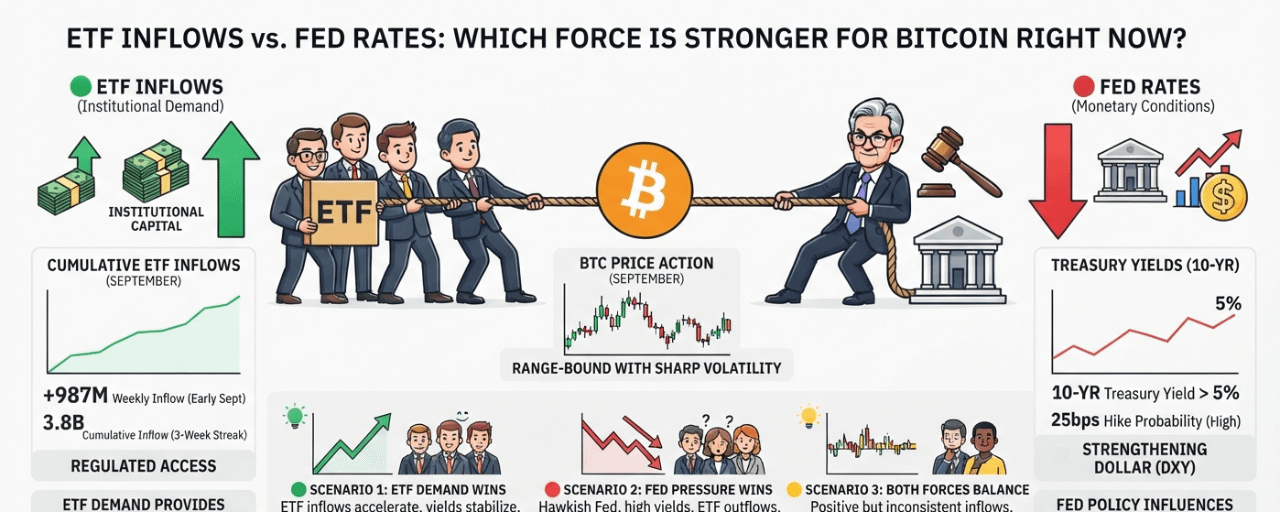
Artikel
ETF-Zuflüsse vs. Fed-Raten: Welche Kraft ist für Bitcoin gerade stärker?ETF-Zuflüsse vs. Fed-Raten: Welche Kraft ist für Bitcoin gerade stärker?
#FedRateWatch | Bitcoin-Marktanalyse
Bitcoin hat ein neues Tauziehen.
Auf der einen Seite stehen Bitcoin-ETF-Zuflüsse — Milliarden US-Dollar reguliertes Kapital, das nach Exposition gegenüber BTC sucht.
Auf der anderen Seite steht die US-Notenbank (Federal Reserve) — sie beeinflusst die Kosten des Geldes, die Renditen von US-Staatsanleihen, den US-Dollar und die globale Risikobereitschaft.
Welche Kraft ist also gerade für Bitcoin wichtiger?
Die Antwort ist nicht so einfach wie die Wahl einer einzigen Kraft.
ETF-Zuflüsse können direkte Nachfrage nach Bitcoin-Exposition erzeugen, während die Fed-Politik das größere finanzielle Umfeld verändern kann, in dem diese Nachfrage wirkt.
ETF-Zuflüsse vs. Fed-Raten: Welche Kraft ist für Bitcoin gerade stärker?
ETF-Zuflüsse vs. Fed-Raten: Welche Kraft ist für Bitcoin gerade stärker?
#FedRateWatch | Bitcoin-Marktanalyse
Bitcoin hat ein neues Tauziehen.
Auf der einen Seite stehen Bitcoin-ETF-Zuflüsse — Milliarden US-Dollar reguliertes Kapital, das nach Exposition gegenüber BTC sucht.
Auf der anderen Seite steht die US-Notenbank (Federal Reserve) — sie beeinflusst die Kosten des Geldes, die Renditen von US-Staatsanleihen, den US-Dollar und die globale Risikobereitschaft.
Welche Kraft ist also gerade für Bitcoin wichtiger?
Die Antwort ist nicht so einfach wie die Wahl einer einzigen Kraft.
ETF-Zuflüsse können direkte Nachfrage nach Bitcoin-Exposition erzeugen, während die Fed-Politik das größere finanzielle Umfeld verändern kann, in dem diese Nachfrage wirkt.
#FedRateWatch | Bitcoin-Marktanalyse
Bitcoin hat ein neues Tauziehen.
Auf der einen Seite stehen Bitcoin-ETF-Zuflüsse — Milliarden US-Dollar reguliertes Kapital, das nach Exposition gegenüber BTC sucht.
Auf der anderen Seite steht die US-Notenbank (Federal Reserve) — sie beeinflusst die Kosten des Geldes, die Renditen von US-Staatsanleihen, den US-Dollar und die globale Risikobereitschaft.
Welche Kraft ist also gerade für Bitcoin wichtiger?
Die Antwort ist nicht so einfach wie die Wahl einer einzigen Kraft.
ETF-Zuflüsse können direkte Nachfrage nach Bitcoin-Exposition erzeugen, während die Fed-Politik das größere finanzielle Umfeld verändern kann, in dem diese Nachfrage wirkt.
30
·
--
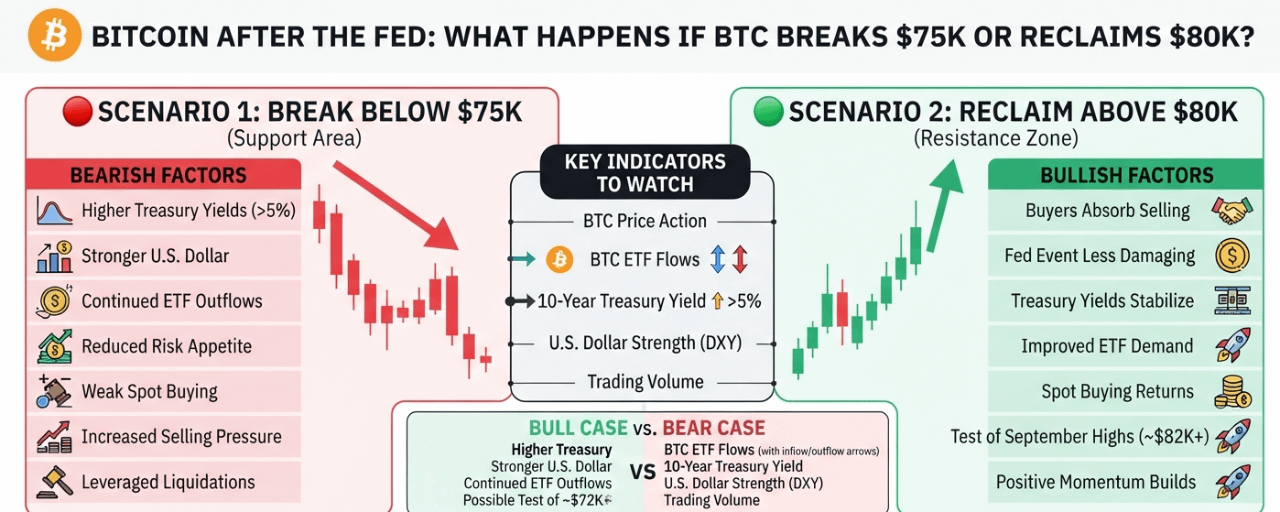
Artikel
Übersetzung ansehen
Bitcoin After the Fed: What Happens If BTC Breaks $75K — or Reclaims $80K?#FedRateWatch | Bitcoin Market Analysis
The Fed decision has arrived at a critical moment for Bitcoin.
In our previous #FedRateWatch article, we examined whether a 25-basis-point hike could be a one-off adjustment or the beginning of a longer tightening cycle.
Now the question moves from “What will the Fed do?” to:
“What will Bitcoin do next?”
BTC has recently fallen below the $75K area after failing to sustain its recovery toward $80K. At the same time, U.S. Treasury yields have moved near 5%, while ETF flows and broader risk sentiment remain important pieces of the puzzle.
That leaves us with two fascinating levels:
🔴 $75K — Can Bitcoin defend it?
🟢 $80K — Can Bitcoin reclaim it?
Let's examine both scenarios.
Table of Contents
Why $75K and $80K matterScenario 1: BTC breaks below $75KScenario 2: BTC reclaims $80KWhat ETF flows are telling usWhy Treasury yields matterThe $72K possibilityBull case vs. Bear caseWhat should investors and spot traders do?The bigger Bitcoin question
1. Why Do $75K and $80K Matter?
Bitcoin's recent price action has created a clearly defined range for traders to watch.
The market had previously pushed BTC above $80K and briefly above $82K earlier in September. It subsequently retreated toward the mid-$70Ks.
Today, market commentary is identifying roughly $75K–$76K as an important support area, while $79.5K–$80.4K is an important resistance zone. A deeper downside level around $71.7K–$72K is also being watched.
This gives traders a simple framework:
Below $75K → downside risk increases.
Above $80K → recovery momentum could strengthen.
But price levels alone don't tell the whole story.
We need to know why BTC is moving.
2. Scenario 1: What If BTC Breaks Below $75K?
A break below support doesn't automatically mean Bitcoin is entering a major bear market.
But it could signal that buyers are temporarily losing control.
🔴 Bearish factors
A sustained move below $75K could be accompanied by:
• Higher Treasury yields
• A stronger U.S. dollar
• Continued ETF outflows
• Reduced risk appetite
• Weak spot buying
• Increased selling from short-term holders
• More leveraged liquidations
The current environment already contains several of these pressures.
The U.S. 10-year Treasury yield has moved above 5%, while Bitcoin has also been affected by uncertainty surrounding broader financial conditions.
If BTC breaks $75K and fails to reclaim it, traders may begin watching the low-$72K region.
That is particularly interesting because $72K has also appeared in market prediction discussions.
But remember:
A prediction is not a support level.
Price must actually demonstrate buying demand there.
3. Scenario 2: What If BTC Reclaims $80K?
Now let's turn the chart around.
A move back above $80K could change the short-term market structure.
🟢 Bullish factors
A successful reclaim could indicate:
• Buyers are absorbing selling pressure
• The Fed event was less damaging than feared
• Treasury yields stabilize
• ETF demand improves
• Spot buying returns
• Traders begin positioning for another test of the September highs
Bitcoin previously traded above $82K earlier this month, demonstrating that the market can move through the $80K area when momentum is strong.
But I would not consider simply touching $80K a confirmed breakout.
For traders, the interesting question is:
Can BTC stay above $80K?
A quick move above resistance followed by a rejection is very different from a sustained breakout.
4. What Are Bitcoin ETF Flows Telling Us?
This is one of the most important pieces of the puzzle.
Earlier in September, U.S. spot Bitcoin ETFs recorded strong inflows. One report noted approximately $987 million of weekly inflows, extending positive flows for a third consecutive week at that point.
But the picture subsequently became more mixed.
Market data cited on September 16 showed several consecutive days of ETF outflows before a $159.9 million inflow on September 14.
That tells us something important:
Institutional demand is not moving in a straight line.
If ETF inflows strengthen while BTC holds $75K, that could provide an important demand signal.
If outflows continue while BTC loses support, the downside scenario becomes more relevant.
For me, ETF flows are therefore one of the indicators worth watching alongside the price chart.
5. Why Do Treasury Yields Matter?
This is where the Fed story becomes a Bitcoin story.
The U.S. 10-year Treasury yield has recently moved above 5%, creating pressure across several risk-sensitive markets.
Why does this matter to BTC?
When government bonds offer higher yields, investors can reassess how much risk they want to take.
Higher yields can therefore create a tougher environment for assets such as technology stocks and cryptocurrencies.
But there is another side.
If the market eventually believes that inflation is being controlled and the Fed is approaching the end of its tightening path, yields could stabilize.
That could remove one source of pressure from risk assets.
So the key isn't simply:
“Are rates high?”
It is:
“Where are yields going next?”
6. Could Bitcoin Fall Toward $72K?
This is the scenario many traders are watching.
A sustained breakdown below the $75K–$76K support area could expose the low-$72K region, according to current market analysis.
But I would treat $72K as a potential support zone, not a guaranteed destination.
If BTC reaches $72K, what matters is the reaction.
🟢 Bullish reaction
BTC reaches the zone → buyers step in → volume increases → price reclaims broken support.
That could turn a correction into an accumulation opportunity.
🔴 Bearish reaction
BTC reaches $72K → buyers remain weak → price continues making lower lows.
That would suggest the market has not yet found a durable bottom.
The price reaction is more informative than the number itself.
7. Bull Case vs. Bear Case
🟢 Bitcoin Bull Case
The bullish scenario would involve:
$75K holds → ETF demand improves → Treasury yields stabilize → BTC reclaims $80K → momentum strengthens.
A sustained move above $80K could put the September highs back into focus.
🔴 Bitcoin Bear Case
The bearish scenario would be:
$75K breaks → selling accelerates → ETF outflows continue → yields remain elevated → BTC tests $72K.
That could create another period of volatility before the market establishes a new direction.
Neither scenario is guaranteed.
That is exactly why traders should prepare for both.
8. What Should Investors and Spot Traders Do?
For long-term investors
Don't let one Fed announcement determine your entire Bitcoin strategy.
Consider staggered buying rather than putting all available capital into one price.
If BTC falls, having cash available can be valuable.
If BTC rises, you still participate with the BTC already accumulated.
For spot traders
This is a market where patience can matter more than prediction.
Instead of chasing the first green candle after the Fed announcement:
📌 Wait for support confirmation.
📌 Watch volume.
📌 Look for BTC to reclaim broken levels.
📌 Account for trading fees.
📌 Avoid oversized positions.
📌 Don't confuse a temporary price spike with a confirmed breakout.
And most importantly:
Don't chase BTC simply because it moves quickly.
9. The Bigger Bitcoin Question
The next Bitcoin move may not be decided by the Fed alone.
It could be the result of several forces colliding:
Fed policy + Treasury yields + ETF flows + dollar strength + oil + crypto-specific regulation + spot demand.
That's why $75K and $80K are interesting.
They represent two different market stories.
Below $75K:
The market is asking:
“How deep can this correction go?”
Above $80K:
The market starts asking:
“Is Bitcoin ready to challenge the highs again?”
My approach would be to avoid trying to predict the exact candle.
Instead, I would prepare for both scenarios.
$72K could become an accumulation zone if buyers defend it.
$80K could become a momentum zone if Bitcoin reclaims it convincingly.
The most important signal may therefore not be the Fed's 25 bp decision itself.
It may be how Bitcoin behaves after the decision.
Because markets can surprise us.
And Bitcoin has a long history of doing exactly that. ₿
#FedRateWatch #Bitcoin #BTC #BitcoinPrice #CryptoMarket #BitcoinETF #FederalReserve #BTCUSD #SpotTrading #CryptoInvesting
Bitcoin After the Fed: What Happens If BTC Breaks $75K — or Reclaims $80K?
#FedRateWatch | Bitcoin Market Analysis
The Fed decision has arrived at a critical moment for Bitcoin.
In our previous #FedRateWatch article, we examined whether a 25-basis-point hike could be a one-off adjustment or the beginning of a longer tightening cycle.
Now the question moves from “What will the Fed do?” to:
“What will Bitcoin do next?”
BTC has recently fallen below the $75K area after failing to sustain its recovery toward $80K. At the same time, U.S. Treasury yields have moved near 5%, while ETF flows and broader risk sentiment remain important pieces of the puzzle.
That leaves us with two fascinating levels:
🔴 $75K — Can Bitcoin defend it?
🟢 $80K — Can Bitcoin reclaim it?
Let's examine both scenarios.
Table of Contents
Why $75K and $80K matterScenario 1: BTC breaks below $75KScenario 2: BTC reclaims $80KWhat ETF flows are telling usWhy Treasury yields matterThe $72K possibilityBull case vs. Bear caseWhat should investors and spot traders do?The bigger Bitcoin question
1. Why Do $75K and $80K Matter?
Bitcoin's recent price action has created a clearly defined range for traders to watch.
The market had previously pushed BTC above $80K and briefly above $82K earlier in September. It subsequently retreated toward the mid-$70Ks.
Today, market commentary is identifying roughly $75K–$76K as an important support area, while $79.5K–$80.4K is an important resistance zone. A deeper downside level around $71.7K–$72K is also being watched.
This gives traders a simple framework:
Below $75K → downside risk increases.
Above $80K → recovery momentum could strengthen.
But price levels alone don't tell the whole story.
We need to know why BTC is moving.
2. Scenario 1: What If BTC Breaks Below $75K?
A break below support doesn't automatically mean Bitcoin is entering a major bear market.
But it could signal that buyers are temporarily losing control.
🔴 Bearish factors
A sustained move below $75K could be accompanied by:
• Higher Treasury yields
• A stronger U.S. dollar
• Continued ETF outflows
• Reduced risk appetite
• Weak spot buying
• Increased selling from short-term holders
• More leveraged liquidations
The current environment already contains several of these pressures.
The U.S. 10-year Treasury yield has moved above 5%, while Bitcoin has also been affected by uncertainty surrounding broader financial conditions.
If BTC breaks $75K and fails to reclaim it, traders may begin watching the low-$72K region.
That is particularly interesting because $72K has also appeared in market prediction discussions.
But remember:
A prediction is not a support level.
Price must actually demonstrate buying demand there.
3. Scenario 2: What If BTC Reclaims $80K?
Now let's turn the chart around.
A move back above $80K could change the short-term market structure.
🟢 Bullish factors
A successful reclaim could indicate:
• Buyers are absorbing selling pressure
• The Fed event was less damaging than feared
• Treasury yields stabilize
• ETF demand improves
• Spot buying returns
• Traders begin positioning for another test of the September highs
Bitcoin previously traded above $82K earlier this month, demonstrating that the market can move through the $80K area when momentum is strong.
But I would not consider simply touching $80K a confirmed breakout.
For traders, the interesting question is:
Can BTC stay above $80K?
A quick move above resistance followed by a rejection is very different from a sustained breakout.
4. What Are Bitcoin ETF Flows Telling Us?
This is one of the most important pieces of the puzzle.
Earlier in September, U.S. spot Bitcoin ETFs recorded strong inflows. One report noted approximately $987 million of weekly inflows, extending positive flows for a third consecutive week at that point.
But the picture subsequently became more mixed.
Market data cited on September 16 showed several consecutive days of ETF outflows before a $159.9 million inflow on September 14.
That tells us something important:
Institutional demand is not moving in a straight line.
If ETF inflows strengthen while BTC holds $75K, that could provide an important demand signal.
If outflows continue while BTC loses support, the downside scenario becomes more relevant.
For me, ETF flows are therefore one of the indicators worth watching alongside the price chart.
5. Why Do Treasury Yields Matter?
This is where the Fed story becomes a Bitcoin story.
The U.S. 10-year Treasury yield has recently moved above 5%, creating pressure across several risk-sensitive markets.
Why does this matter to BTC?
When government bonds offer higher yields, investors can reassess how much risk they want to take.
Higher yields can therefore create a tougher environment for assets such as technology stocks and cryptocurrencies.
But there is another side.
If the market eventually believes that inflation is being controlled and the Fed is approaching the end of its tightening path, yields could stabilize.
That could remove one source of pressure from risk assets.
So the key isn't simply:
“Are rates high?”
It is:
“Where are yields going next?”
6. Could Bitcoin Fall Toward $72K?
This is the scenario many traders are watching.
A sustained breakdown below the $75K–$76K support area could expose the low-$72K region, according to current market analysis.
But I would treat $72K as a potential support zone, not a guaranteed destination.
If BTC reaches $72K, what matters is the reaction.
🟢 Bullish reaction
BTC reaches the zone → buyers step in → volume increases → price reclaims broken support.
That could turn a correction into an accumulation opportunity.
🔴 Bearish reaction
BTC reaches $72K → buyers remain weak → price continues making lower lows.
That would suggest the market has not yet found a durable bottom.
The price reaction is more informative than the number itself.
7. Bull Case vs. Bear Case
🟢 Bitcoin Bull Case
The bullish scenario would involve:
$75K holds → ETF demand improves → Treasury yields stabilize → BTC reclaims $80K → momentum strengthens.
A sustained move above $80K could put the September highs back into focus.
🔴 Bitcoin Bear Case
The bearish scenario would be:
$75K breaks → selling accelerates → ETF outflows continue → yields remain elevated → BTC tests $72K.
That could create another period of volatility before the market establishes a new direction.
Neither scenario is guaranteed.
That is exactly why traders should prepare for both.
8. What Should Investors and Spot Traders Do?
For long-term investors
Don't let one Fed announcement determine your entire Bitcoin strategy.
Consider staggered buying rather than putting all available capital into one price.
If BTC falls, having cash available can be valuable.
If BTC rises, you still participate with the BTC already accumulated.
For spot traders
This is a market where patience can matter more than prediction.
Instead of chasing the first green candle after the Fed announcement:
📌 Wait for support confirmation.
📌 Watch volume.
📌 Look for BTC to reclaim broken levels.
📌 Account for trading fees.
📌 Avoid oversized positions.
📌 Don't confuse a temporary price spike with a confirmed breakout.
And most importantly:
Don't chase BTC simply because it moves quickly.
9. The Bigger Bitcoin Question
The next Bitcoin move may not be decided by the Fed alone.
It could be the result of several forces colliding:
Fed policy + Treasury yields + ETF flows + dollar strength + oil + crypto-specific regulation + spot demand.
That's why $75K and $80K are interesting.
They represent two different market stories.
Below $75K:
The market is asking:
“How deep can this correction go?”
Above $80K:
The market starts asking:
“Is Bitcoin ready to challenge the highs again?”
My approach would be to avoid trying to predict the exact candle.
Instead, I would prepare for both scenarios.
$72K could become an accumulation zone if buyers defend it.
$80K could become a momentum zone if Bitcoin reclaims it convincingly.
The most important signal may therefore not be the Fed's 25 bp decision itself.
It may be how Bitcoin behaves after the decision.
Because markets can surprise us.
And Bitcoin has a long history of doing exactly that. ₿
#FedRateWatch #Bitcoin #BTC #BitcoinPrice #CryptoMarket #BitcoinETF #FederalReserve #BTCUSD #SpotTrading #CryptoInvesting
The Fed decision has arrived at a critical moment for Bitcoin.
In our previous #FedRateWatch article, we examined whether a 25-basis-point hike could be a one-off adjustment or the beginning of a longer tightening cycle.
Now the question moves from “What will the Fed do?” to:
“What will Bitcoin do next?”
BTC has recently fallen below the $75K area after failing to sustain its recovery toward $80K. At the same time, U.S. Treasury yields have moved near 5%, while ETF flows and broader risk sentiment remain important pieces of the puzzle.
That leaves us with two fascinating levels:
🔴 $75K — Can Bitcoin defend it?
🟢 $80K — Can Bitcoin reclaim it?
Let's examine both scenarios.
Table of Contents
Why $75K and $80K matterScenario 1: BTC breaks below $75KScenario 2: BTC reclaims $80KWhat ETF flows are telling usWhy Treasury yields matterThe $72K possibilityBull case vs. Bear caseWhat should investors and spot traders do?The bigger Bitcoin question
1. Why Do $75K and $80K Matter?
Bitcoin's recent price action has created a clearly defined range for traders to watch.
The market had previously pushed BTC above $80K and briefly above $82K earlier in September. It subsequently retreated toward the mid-$70Ks.
Today, market commentary is identifying roughly $75K–$76K as an important support area, while $79.5K–$80.4K is an important resistance zone. A deeper downside level around $71.7K–$72K is also being watched.
This gives traders a simple framework:
Below $75K → downside risk increases.
Above $80K → recovery momentum could strengthen.
But price levels alone don't tell the whole story.
We need to know why BTC is moving.
2. Scenario 1: What If BTC Breaks Below $75K?
A break below support doesn't automatically mean Bitcoin is entering a major bear market.
But it could signal that buyers are temporarily losing control.
🔴 Bearish factors
A sustained move below $75K could be accompanied by:
• Higher Treasury yields
• A stronger U.S. dollar
• Continued ETF outflows
• Reduced risk appetite
• Weak spot buying
• Increased selling from short-term holders
• More leveraged liquidations
The current environment already contains several of these pressures.
The U.S. 10-year Treasury yield has moved above 5%, while Bitcoin has also been affected by uncertainty surrounding broader financial conditions.
If BTC breaks $75K and fails to reclaim it, traders may begin watching the low-$72K region.
That is particularly interesting because $72K has also appeared in market prediction discussions.
But remember:
A prediction is not a support level.
Price must actually demonstrate buying demand there.
3. Scenario 2: What If BTC Reclaims $80K?
Now let's turn the chart around.
A move back above $80K could change the short-term market structure.
🟢 Bullish factors
A successful reclaim could indicate:
• Buyers are absorbing selling pressure
• The Fed event was less damaging than feared
• Treasury yields stabilize
• ETF demand improves
• Spot buying returns
• Traders begin positioning for another test of the September highs
Bitcoin previously traded above $82K earlier this month, demonstrating that the market can move through the $80K area when momentum is strong.
But I would not consider simply touching $80K a confirmed breakout.
For traders, the interesting question is:
Can BTC stay above $80K?
A quick move above resistance followed by a rejection is very different from a sustained breakout.
4. What Are Bitcoin ETF Flows Telling Us?
This is one of the most important pieces of the puzzle.
Earlier in September, U.S. spot Bitcoin ETFs recorded strong inflows. One report noted approximately $987 million of weekly inflows, extending positive flows for a third consecutive week at that point.
But the picture subsequently became more mixed.
Market data cited on September 16 showed several consecutive days of ETF outflows before a $159.9 million inflow on September 14.
That tells us something important:
Institutional demand is not moving in a straight line.
If ETF inflows strengthen while BTC holds $75K, that could provide an important demand signal.
If outflows continue while BTC loses support, the downside scenario becomes more relevant.
For me, ETF flows are therefore one of the indicators worth watching alongside the price chart.
5. Why Do Treasury Yields Matter?
This is where the Fed story becomes a Bitcoin story.
The U.S. 10-year Treasury yield has recently moved above 5%, creating pressure across several risk-sensitive markets.
Why does this matter to BTC?
When government bonds offer higher yields, investors can reassess how much risk they want to take.
Higher yields can therefore create a tougher environment for assets such as technology stocks and cryptocurrencies.
But there is another side.
If the market eventually believes that inflation is being controlled and the Fed is approaching the end of its tightening path, yields could stabilize.
That could remove one source of pressure from risk assets.
So the key isn't simply:
“Are rates high?”
It is:
“Where are yields going next?”
6. Could Bitcoin Fall Toward $72K?
This is the scenario many traders are watching.
A sustained breakdown below the $75K–$76K support area could expose the low-$72K region, according to current market analysis.
But I would treat $72K as a potential support zone, not a guaranteed destination.
If BTC reaches $72K, what matters is the reaction.
🟢 Bullish reaction
BTC reaches the zone → buyers step in → volume increases → price reclaims broken support.
That could turn a correction into an accumulation opportunity.
🔴 Bearish reaction
BTC reaches $72K → buyers remain weak → price continues making lower lows.
That would suggest the market has not yet found a durable bottom.
The price reaction is more informative than the number itself.
7. Bull Case vs. Bear Case
🟢 Bitcoin Bull Case
The bullish scenario would involve:
$75K holds → ETF demand improves → Treasury yields stabilize → BTC reclaims $80K → momentum strengthens.
A sustained move above $80K could put the September highs back into focus.
🔴 Bitcoin Bear Case
The bearish scenario would be:
$75K breaks → selling accelerates → ETF outflows continue → yields remain elevated → BTC tests $72K.
That could create another period of volatility before the market establishes a new direction.
Neither scenario is guaranteed.
That is exactly why traders should prepare for both.
8. What Should Investors and Spot Traders Do?
For long-term investors
Don't let one Fed announcement determine your entire Bitcoin strategy.
Consider staggered buying rather than putting all available capital into one price.
If BTC falls, having cash available can be valuable.
If BTC rises, you still participate with the BTC already accumulated.
For spot traders
This is a market where patience can matter more than prediction.
Instead of chasing the first green candle after the Fed announcement:
📌 Wait for support confirmation.
📌 Watch volume.
📌 Look for BTC to reclaim broken levels.
📌 Account for trading fees.
📌 Avoid oversized positions.
📌 Don't confuse a temporary price spike with a confirmed breakout.
And most importantly:
Don't chase BTC simply because it moves quickly.
9. The Bigger Bitcoin Question
The next Bitcoin move may not be decided by the Fed alone.
It could be the result of several forces colliding:
Fed policy + Treasury yields + ETF flows + dollar strength + oil + crypto-specific regulation + spot demand.
That's why $75K and $80K are interesting.
They represent two different market stories.
Below $75K:
The market is asking:
“How deep can this correction go?”
Above $80K:
The market starts asking:
“Is Bitcoin ready to challenge the highs again?”
My approach would be to avoid trying to predict the exact candle.
Instead, I would prepare for both scenarios.
$72K could become an accumulation zone if buyers defend it.
$80K could become a momentum zone if Bitcoin reclaims it convincingly.
The most important signal may therefore not be the Fed's 25 bp decision itself.
It may be how Bitcoin behaves after the decision.
Because markets can surprise us.
And Bitcoin has a long history of doing exactly that. ₿
#FedRateWatch #Bitcoin #BTC #BitcoinPrice #CryptoMarket #BitcoinETF #FederalReserve #BTCUSD #SpotTrading #CryptoInvesting
31
·
--
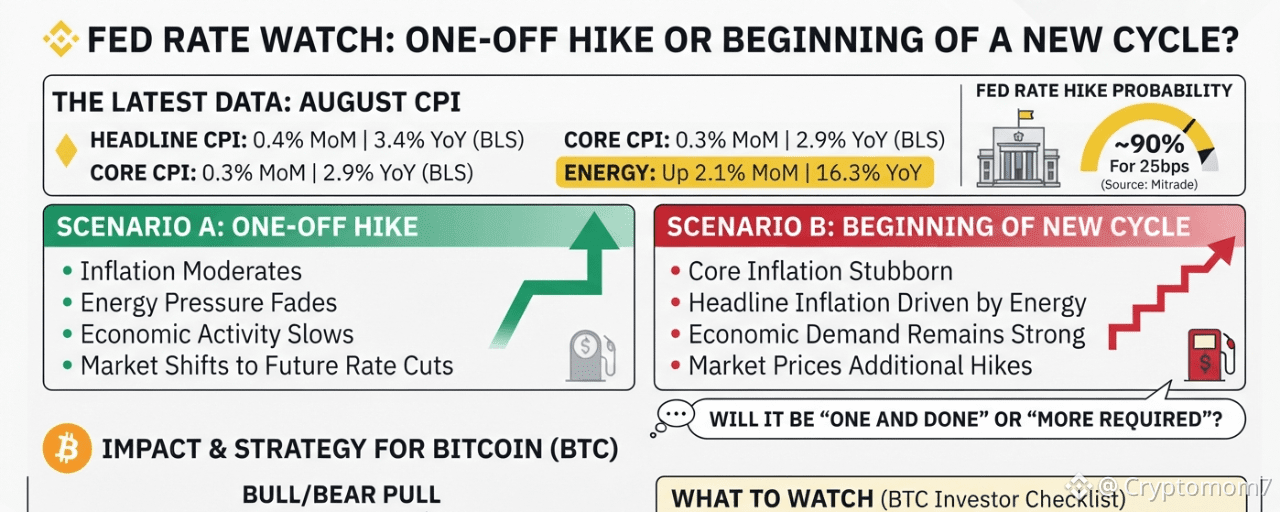
Artikel
Fed Rate Watch: Ist eine Zinserhöhung um 25bp einmalig oder der Beginn eines neuen Zinserhöhungszyklus?#Fedratewatch Eine wichtige aktualisierte Tatsache: Der offizielle August-VPI-Bericht zeigt, dass die Gesamtinflation (Headline CPI) im Monatsvergleich um 0,4% und im Jahresvergleich um 3,4% gestiegen ist, während der Kern-VPI (Core CPI) im Monatsvergleich um 0,3% und im Jahresvergleich um 2,9% zulegte. Energie war ein wesentlicher Treiber: Der Energieindex stieg im August um 2,1% und über das Jahr hinweg um 16,3%. Die aktuelle Markteinschätzung bringt zuletzt eine Wahrscheinlichkeit von rund 90% für eine Zinserhöhung um 25 bp.
Da eine Fed-Entscheidung ein reales politisches Ergebnis ist, habe ich den Prognose-Teil des Artikels als Szenarioanalyse beibehalten, statt eine persönliche politische-/politische Vorhersage als Tatsache darzustellen.
Fed Rate Watch: Ist eine Zinserhöhung um 25bp einmalig oder der Beginn eines neuen Zinserhöhungszyklus?
#Fedratewatch Eine wichtige aktualisierte Tatsache: Der offizielle August-VPI-Bericht zeigt, dass die Gesamtinflation (Headline CPI) im Monatsvergleich um 0,4% und im Jahresvergleich um 3,4% gestiegen ist, während der Kern-VPI (Core CPI) im Monatsvergleich um 0,3% und im Jahresvergleich um 2,9% zulegte. Energie war ein wesentlicher Treiber: Der Energieindex stieg im August um 2,1% und über das Jahr hinweg um 16,3%. Die aktuelle Markteinschätzung bringt zuletzt eine Wahrscheinlichkeit von rund 90% für eine Zinserhöhung um 25 bp.
Da eine Fed-Entscheidung ein reales politisches Ergebnis ist, habe ich den Prognose-Teil des Artikels als Szenarioanalyse beibehalten, statt eine persönliche politische-/politische Vorhersage als Tatsache darzustellen.
Da eine Fed-Entscheidung ein reales politisches Ergebnis ist, habe ich den Prognose-Teil des Artikels als Szenarioanalyse beibehalten, statt eine persönliche politische-/politische Vorhersage als Tatsache darzustellen.
61
·
--
Übersetzung ansehen
🚨 BTC at $77K: Could $72K Be the Next Stop?
Bitcoin is holding around the $77K zone, but the market is anything but predictable. A $72K level is showing up in this week's BTC prediction — and that makes it an interesting level to watch, not a guaranteed destination.
Why could BTC revisit $72K?
📉 Profit-taking after the recent recovery
💵 A stronger dollar and higher Treasury yields can pressure risk assets
🏦 Fed-rate expectations may reduce appetite for volatile assets
⚠️ Regulatory developments and macro headlines can trigger sudden moves
📊 A rejection near $80K could encourage short-term sellers
But here's the other side: renewed ETF/institutional demand and stronger buying on dips could help BTC defend the $70K–$72K area. Recent market reports show both institutional demand and macroeconomic risks influencing the current setup.
🎯 My preferred BTC price?
I'd rather see BTC build a strong base around $72K–$75K than chase a sudden move above $80K. A controlled correction could give long-term investors and spot traders a better accumulation opportunity.
💡 Investor tips:
• Don't buy because of a prediction.
• Keep some cash for deeper dips.
• Use DCA instead of trying to catch the exact bottom.
• Spot traders: wait for support + confirmation rather than chasing green candles.
• Protect capital first; profits come second.
$72K isn't a prediction I would blindly follow. It's a level I'd WATCH.
What matters most isn't guessing the exact price — it's having a plan for both $72K and $80K. 🚀📉
#Bitcoin #BTC #BitcoinPrediction #CryptoMarket #BTCUSD #SpotTrading #CryptoInvesting #Binance
🚨 BTC at $77K: Could $72K Be the Next Stop?
Bitcoin is holding around the $77K zone, but the market is anything but predictable. A $72K level is showing up in this week's BTC prediction — and that makes it an interesting level to watch, not a guaranteed destination.
Why could BTC revisit $72K?
📉 Profit-taking after the recent recovery
💵 A stronger dollar and higher Treasury yields can pressure risk assets
🏦 Fed-rate expectations may reduce appetite for volatile assets
⚠️ Regulatory developments and macro headlines can trigger sudden moves
📊 A rejection near $80K could encourage short-term sellers
But here's the other side: renewed ETF/institutional demand and stronger buying on dips could help BTC defend the $70K–$72K area. Recent market reports show both institutional demand and macroeconomic risks influencing the current setup.
🎯 My preferred BTC price?
I'd rather see BTC build a strong base around $72K–$75K than chase a sudden move above $80K. A controlled correction could give long-term investors and spot traders a better accumulation opportunity.
💡 Investor tips:
• Don't buy because of a prediction.
• Keep some cash for deeper dips.
• Use DCA instead of trying to catch the exact bottom.
• Spot traders: wait for support + confirmation rather than chasing green candles.
• Protect capital first; profits come second.
$72K isn't a prediction I would blindly follow. It's a level I'd WATCH.
What matters most isn't guessing the exact price — it's having a plan for both $72K and $80K. 🚀📉
#Bitcoin #BTC #BitcoinPrediction #CryptoMarket #BTCUSD #SpotTrading #CryptoInvesting #Binance
Bitcoin is holding around the $77K zone, but the market is anything but predictable. A $72K level is showing up in this week's BTC prediction — and that makes it an interesting level to watch, not a guaranteed destination.
Why could BTC revisit $72K?
📉 Profit-taking after the recent recovery
💵 A stronger dollar and higher Treasury yields can pressure risk assets
🏦 Fed-rate expectations may reduce appetite for volatile assets
⚠️ Regulatory developments and macro headlines can trigger sudden moves
📊 A rejection near $80K could encourage short-term sellers
But here's the other side: renewed ETF/institutional demand and stronger buying on dips could help BTC defend the $70K–$72K area. Recent market reports show both institutional demand and macroeconomic risks influencing the current setup.
🎯 My preferred BTC price?
I'd rather see BTC build a strong base around $72K–$75K than chase a sudden move above $80K. A controlled correction could give long-term investors and spot traders a better accumulation opportunity.
💡 Investor tips:
• Don't buy because of a prediction.
• Keep some cash for deeper dips.
• Use DCA instead of trying to catch the exact bottom.
• Spot traders: wait for support + confirmation rather than chasing green candles.
• Protect capital first; profits come second.
$72K isn't a prediction I would blindly follow. It's a level I'd WATCH.
What matters most isn't guessing the exact price — it's having a plan for both $72K and $80K. 🚀📉
#Bitcoin #BTC #BitcoinPrediction #CryptoMarket #BTCUSD #SpotTrading #CryptoInvesting #Binance
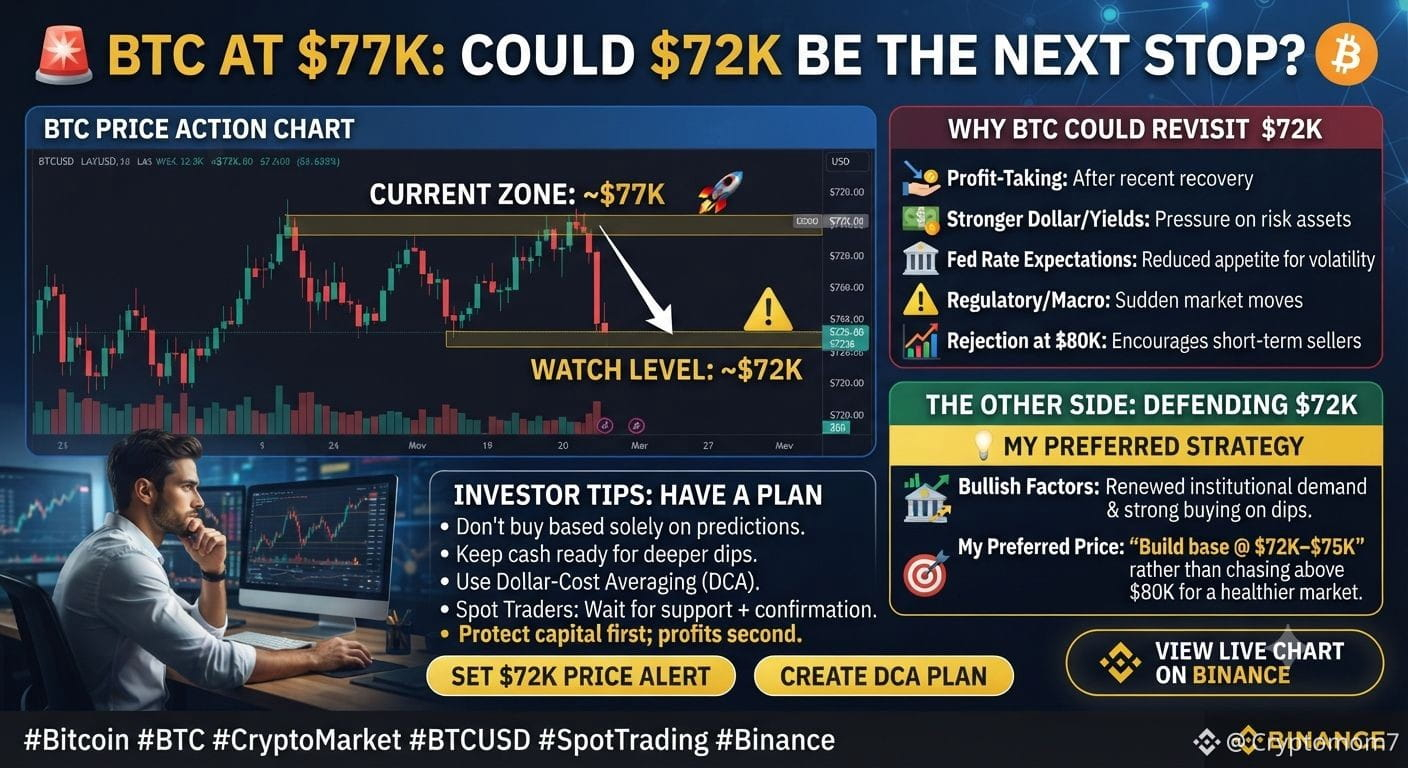
78
·
--
₿ BITCOIN HEUTE: 77K$ — WAS PASSIERT ALS NÄCHSTES?
Bitcoin wird heute rund um 77.000$ gehandelt, wobei BTC unter Druck steht, nachdem es die höheren Niveaus über 80.000$ nicht halten konnte.
Der Markt ist vorsichtig, aber das ist nicht zwangsläufig ein Grund zur Panik.
📊 DIE FAKTEN HEUTE
• BTC ist nahe an seinem jüngsten Tief der letzten 30 Tage.
• BTC ist in der heutigen Session zuletzt um etwa 2% gefallen.
• U.S.-Spot-Bitcoin-ETFs verzeichneten am 14. September ungefähr 9,7M$ an Nettozuflüssen.
• Der Markt beobachtet die Entscheidung der US-Notenbank (Federal Reserve) am Mittwoch.
• Die Abstimmung zum U.S.-CLARITY Act ist ein weiterer wichtiger Katalysator für das Krypto-Sentiment.
• Steigende Renditen für US-Staatsanleihen und ein stärkerer Dollar üben derzeit Druck auf risikoreiche Assets aus.
🎯 MEINE BTC-KURS-VORHERSAGE FÜR HEUTE
Basisszenario: 76K$–78,5K$
Bullisches Szenario: Wenn Käufer 78K$ zurückerobern und das Niveau halten, könnte BTC 79K$–80K$ testen.
Bärisches Szenario: Ein nachhaltiger Bruch unter 76K$ könnte den Weg für einen weiteren Abwärtsimpuls öffnen.
Ich würde BTC NICHT einfach verfolgen, nur weil es schnell nach oben geht.
Für Spot-Trader kann Geduld ein Vorteil sein:
✅ Beobachte den Support, bevor du einsteigst.
✅ Ziehe in Erwägung, schrittweise in Positionen zu investieren, statt das gesamte Kapital auf einmal einzusetzen.
✅ Achte auf Bestätigung durch Kursbewegung und Volumen.
✅ Halte etwas Cash für einen tieferen Dip bereit.
✅ Lege dein Ziel und dein Risikolevel fest, bevor du den Trade platzierst.
✅ Berechne Gebühren immer, bevor du einen Trade als profitabel einstufts.
Für Anleger kann die Schwäche heute auch anders betrachtet werden.
Bitcoin hat sich bereits deutlich von dem Bereich um ~60K$ erholt, der Ende August zu sehen war, aber es bleibt weit unter seinem Oktober-2025-Hoch oberhalb von 126K$. Das langfristige Bild bleibt daher volatil, nicht risikofrei.
📌 DIE HEUTIGE LEKTION:
Du musst nicht das exakte Tief vorhersagen.
Du brauchst einen Plan für die Kursniveaus.
Mein Blick heute: vorsichtig neutral—mit 76K$ als Support und 80K$ als Widerstand, die den unmittelbaren BTC-Kampf bestimmen.
Wenn BTC den Support hält, könnten Käufer eine weitere Chance bekommen.
Wenn der Support versagt, wird Geduld zum Trade.
Schütze zuerst dein Kapital. Chancen kommen wieder. ₿
#Bitcoin #BTC #Binance #Crypto #BitcoinTrading #SpotTrading #BTCPrice #CryptoInvesting
₿ BITCOIN HEUTE: 77K$ — WAS PASSIERT ALS NÄCHSTES?
Bitcoin wird heute rund um 77.000$ gehandelt, wobei BTC unter Druck steht, nachdem es die höheren Niveaus über 80.000$ nicht halten konnte.
Der Markt ist vorsichtig, aber das ist nicht zwangsläufig ein Grund zur Panik.
📊 DIE FAKTEN HEUTE
• BTC ist nahe an seinem jüngsten Tief der letzten 30 Tage.
• BTC ist in der heutigen Session zuletzt um etwa 2% gefallen.
• U.S.-Spot-Bitcoin-ETFs verzeichneten am 14. September ungefähr 9,7M$ an Nettozuflüssen.
• Der Markt beobachtet die Entscheidung der US-Notenbank (Federal Reserve) am Mittwoch.
• Die Abstimmung zum U.S.-CLARITY Act ist ein weiterer wichtiger Katalysator für das Krypto-Sentiment.
• Steigende Renditen für US-Staatsanleihen und ein stärkerer Dollar üben derzeit Druck auf risikoreiche Assets aus.
🎯 MEINE BTC-KURS-VORHERSAGE FÜR HEUTE
Basisszenario: 76K$–78,5K$
Bullisches Szenario: Wenn Käufer 78K$ zurückerobern und das Niveau halten, könnte BTC 79K$–80K$ testen.
Bärisches Szenario: Ein nachhaltiger Bruch unter 76K$ könnte den Weg für einen weiteren Abwärtsimpuls öffnen.
Ich würde BTC NICHT einfach verfolgen, nur weil es schnell nach oben geht.
Für Spot-Trader kann Geduld ein Vorteil sein:
✅ Beobachte den Support, bevor du einsteigst.
✅ Ziehe in Erwägung, schrittweise in Positionen zu investieren, statt das gesamte Kapital auf einmal einzusetzen.
✅ Achte auf Bestätigung durch Kursbewegung und Volumen.
✅ Halte etwas Cash für einen tieferen Dip bereit.
✅ Lege dein Ziel und dein Risikolevel fest, bevor du den Trade platzierst.
✅ Berechne Gebühren immer, bevor du einen Trade als profitabel einstufts.
Für Anleger kann die Schwäche heute auch anders betrachtet werden.
Bitcoin hat sich bereits deutlich von dem Bereich um ~60K$ erholt, der Ende August zu sehen war, aber es bleibt weit unter seinem Oktober-2025-Hoch oberhalb von 126K$. Das langfristige Bild bleibt daher volatil, nicht risikofrei.
📌 DIE HEUTIGE LEKTION:
Du musst nicht das exakte Tief vorhersagen.
Du brauchst einen Plan für die Kursniveaus.
Mein Blick heute: vorsichtig neutral—mit 76K$ als Support und 80K$ als Widerstand, die den unmittelbaren BTC-Kampf bestimmen.
Wenn BTC den Support hält, könnten Käufer eine weitere Chance bekommen.
Wenn der Support versagt, wird Geduld zum Trade.
Schütze zuerst dein Kapital. Chancen kommen wieder. ₿
#Bitcoin #BTC #Binance #Crypto #BitcoinTrading #SpotTrading #BTCPrice #CryptoInvesting
Bitcoin wird heute rund um 77.000$ gehandelt, wobei BTC unter Druck steht, nachdem es die höheren Niveaus über 80.000$ nicht halten konnte.
Der Markt ist vorsichtig, aber das ist nicht zwangsläufig ein Grund zur Panik.
📊 DIE FAKTEN HEUTE
• BTC ist nahe an seinem jüngsten Tief der letzten 30 Tage.
• BTC ist in der heutigen Session zuletzt um etwa 2% gefallen.
• U.S.-Spot-Bitcoin-ETFs verzeichneten am 14. September ungefähr 9,7M$ an Nettozuflüssen.
• Der Markt beobachtet die Entscheidung der US-Notenbank (Federal Reserve) am Mittwoch.
• Die Abstimmung zum U.S.-CLARITY Act ist ein weiterer wichtiger Katalysator für das Krypto-Sentiment.
• Steigende Renditen für US-Staatsanleihen und ein stärkerer Dollar üben derzeit Druck auf risikoreiche Assets aus.
🎯 MEINE BTC-KURS-VORHERSAGE FÜR HEUTE
Basisszenario: 76K$–78,5K$
Bullisches Szenario: Wenn Käufer 78K$ zurückerobern und das Niveau halten, könnte BTC 79K$–80K$ testen.
Bärisches Szenario: Ein nachhaltiger Bruch unter 76K$ könnte den Weg für einen weiteren Abwärtsimpuls öffnen.
Ich würde BTC NICHT einfach verfolgen, nur weil es schnell nach oben geht.
Für Spot-Trader kann Geduld ein Vorteil sein:
✅ Beobachte den Support, bevor du einsteigst.
✅ Ziehe in Erwägung, schrittweise in Positionen zu investieren, statt das gesamte Kapital auf einmal einzusetzen.
✅ Achte auf Bestätigung durch Kursbewegung und Volumen.
✅ Halte etwas Cash für einen tieferen Dip bereit.
✅ Lege dein Ziel und dein Risikolevel fest, bevor du den Trade platzierst.
✅ Berechne Gebühren immer, bevor du einen Trade als profitabel einstufts.
Für Anleger kann die Schwäche heute auch anders betrachtet werden.
Bitcoin hat sich bereits deutlich von dem Bereich um ~60K$ erholt, der Ende August zu sehen war, aber es bleibt weit unter seinem Oktober-2025-Hoch oberhalb von 126K$. Das langfristige Bild bleibt daher volatil, nicht risikofrei.
📌 DIE HEUTIGE LEKTION:
Du musst nicht das exakte Tief vorhersagen.
Du brauchst einen Plan für die Kursniveaus.
Mein Blick heute: vorsichtig neutral—mit 76K$ als Support und 80K$ als Widerstand, die den unmittelbaren BTC-Kampf bestimmen.
Wenn BTC den Support hält, könnten Käufer eine weitere Chance bekommen.
Wenn der Support versagt, wird Geduld zum Trade.
Schütze zuerst dein Kapital. Chancen kommen wieder. ₿
#Bitcoin #BTC #Binance #Crypto #BitcoinTrading #SpotTrading #BTCPrice #CryptoInvesting
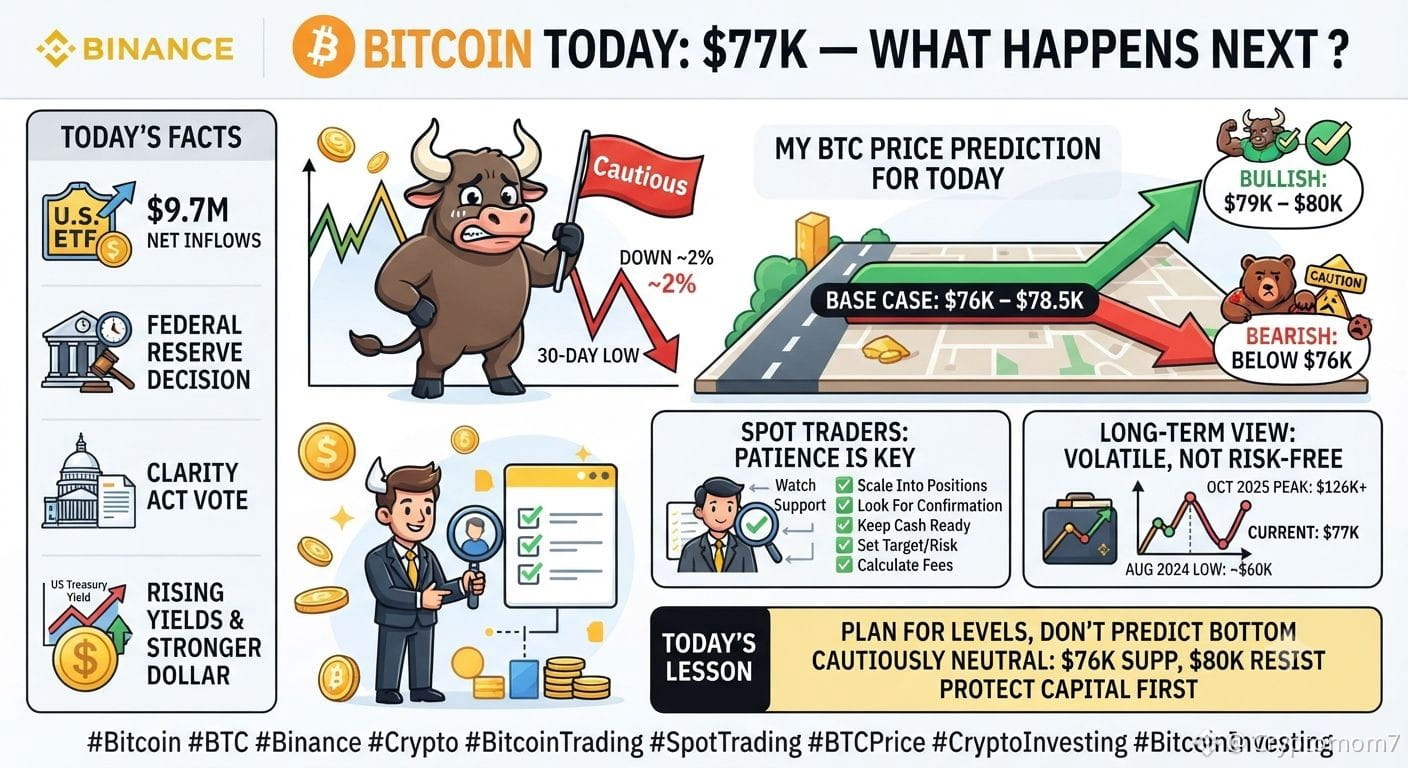
954
·
--
₿ BITCOIN HEUTE: 76,9 TSD. $ — BULLEN BRAUCHEN BESTÄTIGUNG
Bitcoin handelt heute bei rund 76,9 Tsd. $, nachdem es sich von der jüngsten Zone um 80 Tsd. $+ zurückgezogen hat. Der Markt ist weiterhin aktiv, aber das ist nicht der Zeitpunkt, um blind grünen Kerzen hinterherzulaufen.
Die wichtigste Frage für Anleger und Spot-Trader ist ganz einfach:
👉 Bereitet sich BTC auf den nächsten Anstieg vor, oder ist das eine Konsolidierung vor einem weiteren Rücksetzer?
📊 BTC-KARTE FÜR HEUTE
• Widerstand: 77 Tsd. $–80 Tsd. $
• Wichtige Ausbruchszone: 80 Tsd. $+
• Erster Support: um 75 Tsd. $
• Bedeutender Abwärts-Support: um 72,8 Tsd. $–73 Tsd. $
Einige aktuelle Markteinschätzungen bleiben vorsichtig: 75 Tsd. $ ist eine wichtige kurzfristige Marke. Ein nachhaltiger Rücklauf über 77 Tsd. $ könnte den Momentum verbessern, während ein Bruch unter 75 Tsd. $ die Wahrscheinlichkeit erhöhen würde, dass niedrigere Supports getestet werden.
🔎 WAS KÖNNTE BTC DIESE WOCHE BEWEGEN?
Bitcoin geht in eine besonders wichtige Makro-Woche. Die Märkte beobachten die Zinsentscheidung der Federal Reserve, die US-Inflation/Zins-Erwartungen sowie Entwicklungen rund um den US CLARITY Act.
Höhere Zinsen und ein stärkerer Dollar können BTC und andere riskante Assets unter Druck setzen. Gleichzeitig könnten eine erneute Nachfrage nach Bitcoin-ETFs und regulatorische Fortschritte den bullischen Fall stützen.
🎯 FÜR SPOT-TRADER
Mache nicht den Fehler zu denken:
„BTC steigt also, also muss ich JETZT kaufen.“
Stattdessen:
1️⃣ Auf Support warten.
2️⃣ Auf eine Bestätigung der Trendwende achten.
3️⃣ Erwäge, Positionen schrittweise aufzubauen, statt alles auf einmal zu nutzen
4️⃣ Einen Teil deines Kapitals für eine tiefergehende Korrektur verfügbar halten.
5️⃣ Deine Ausstiegsspanne festlegen, BEVOR du einsteigst.
6️⃣ Trading-Gebühren einrechnen, wenn du deinen realen Gewinn berechnest.
Wenn BTC auf Widerstand trifft, geh nicht davon aus, dass es zwangsläufig durchbricht.
Wenn BTC auf Support fällt, geh nicht davon aus, dass es zwangsläufig weiter fallen muss.
📌 Lass die Kursbewegung den nächsten Schritt bestätigen.
💡 FÜR LANGFRISTIGE ANLEGER
Eine volatile Woche ändert nicht zwingend die langfristige Investment-These von Bitcoin.
Anstatt zu versuchen, den exakten Boden vorherzusagen, können disziplinierte Anleger eine schrittweise Akkumulation, eine passende Positionsgröße und genügend Cash für zukünftige Chancen einplanen.
₿ BITCOIN HEUTE: 76,9 TSD. $ — BULLEN BRAUCHEN BESTÄTIGUNG
Bitcoin handelt heute bei rund 76,9 Tsd. $, nachdem es sich von der jüngsten Zone um 80 Tsd. $+ zurückgezogen hat. Der Markt ist weiterhin aktiv, aber das ist nicht der Zeitpunkt, um blind grünen Kerzen hinterherzulaufen.
Die wichtigste Frage für Anleger und Spot-Trader ist ganz einfach:
👉 Bereitet sich BTC auf den nächsten Anstieg vor, oder ist das eine Konsolidierung vor einem weiteren Rücksetzer?
📊 BTC-KARTE FÜR HEUTE
• Widerstand: 77 Tsd. $–80 Tsd. $
• Wichtige Ausbruchszone: 80 Tsd. $+
• Erster Support: um 75 Tsd. $
• Bedeutender Abwärts-Support: um 72,8 Tsd. $–73 Tsd. $
Einige aktuelle Markteinschätzungen bleiben vorsichtig: 75 Tsd. $ ist eine wichtige kurzfristige Marke. Ein nachhaltiger Rücklauf über 77 Tsd. $ könnte den Momentum verbessern, während ein Bruch unter 75 Tsd. $ die Wahrscheinlichkeit erhöhen würde, dass niedrigere Supports getestet werden.
🔎 WAS KÖNNTE BTC DIESE WOCHE BEWEGEN?
Bitcoin geht in eine besonders wichtige Makro-Woche. Die Märkte beobachten die Zinsentscheidung der Federal Reserve, die US-Inflation/Zins-Erwartungen sowie Entwicklungen rund um den US CLARITY Act.
Höhere Zinsen und ein stärkerer Dollar können BTC und andere riskante Assets unter Druck setzen. Gleichzeitig könnten eine erneute Nachfrage nach Bitcoin-ETFs und regulatorische Fortschritte den bullischen Fall stützen.
🎯 FÜR SPOT-TRADER
Mache nicht den Fehler zu denken:
„BTC steigt also, also muss ich JETZT kaufen.“
Stattdessen:
1️⃣ Auf Support warten.
2️⃣ Auf eine Bestätigung der Trendwende achten.
3️⃣ Erwäge, Positionen schrittweise aufzubauen, statt alles auf einmal zu nutzen
4️⃣ Einen Teil deines Kapitals für eine tiefergehende Korrektur verfügbar halten.
5️⃣ Deine Ausstiegsspanne festlegen, BEVOR du einsteigst.
6️⃣ Trading-Gebühren einrechnen, wenn du deinen realen Gewinn berechnest.
Wenn BTC auf Widerstand trifft, geh nicht davon aus, dass es zwangsläufig durchbricht.
Wenn BTC auf Support fällt, geh nicht davon aus, dass es zwangsläufig weiter fallen muss.
📌 Lass die Kursbewegung den nächsten Schritt bestätigen.
💡 FÜR LANGFRISTIGE ANLEGER
Eine volatile Woche ändert nicht zwingend die langfristige Investment-These von Bitcoin.
Anstatt zu versuchen, den exakten Boden vorherzusagen, können disziplinierte Anleger eine schrittweise Akkumulation, eine passende Positionsgröße und genügend Cash für zukünftige Chancen einplanen.
Bitcoin handelt heute bei rund 76,9 Tsd. $, nachdem es sich von der jüngsten Zone um 80 Tsd. $+ zurückgezogen hat. Der Markt ist weiterhin aktiv, aber das ist nicht der Zeitpunkt, um blind grünen Kerzen hinterherzulaufen.
Die wichtigste Frage für Anleger und Spot-Trader ist ganz einfach:
👉 Bereitet sich BTC auf den nächsten Anstieg vor, oder ist das eine Konsolidierung vor einem weiteren Rücksetzer?
📊 BTC-KARTE FÜR HEUTE
• Widerstand: 77 Tsd. $–80 Tsd. $
• Wichtige Ausbruchszone: 80 Tsd. $+
• Erster Support: um 75 Tsd. $
• Bedeutender Abwärts-Support: um 72,8 Tsd. $–73 Tsd. $
Einige aktuelle Markteinschätzungen bleiben vorsichtig: 75 Tsd. $ ist eine wichtige kurzfristige Marke. Ein nachhaltiger Rücklauf über 77 Tsd. $ könnte den Momentum verbessern, während ein Bruch unter 75 Tsd. $ die Wahrscheinlichkeit erhöhen würde, dass niedrigere Supports getestet werden.
🔎 WAS KÖNNTE BTC DIESE WOCHE BEWEGEN?
Bitcoin geht in eine besonders wichtige Makro-Woche. Die Märkte beobachten die Zinsentscheidung der Federal Reserve, die US-Inflation/Zins-Erwartungen sowie Entwicklungen rund um den US CLARITY Act.
Höhere Zinsen und ein stärkerer Dollar können BTC und andere riskante Assets unter Druck setzen. Gleichzeitig könnten eine erneute Nachfrage nach Bitcoin-ETFs und regulatorische Fortschritte den bullischen Fall stützen.
🎯 FÜR SPOT-TRADER
Mache nicht den Fehler zu denken:
„BTC steigt also, also muss ich JETZT kaufen.“
Stattdessen:
1️⃣ Auf Support warten.
2️⃣ Auf eine Bestätigung der Trendwende achten.
3️⃣ Erwäge, Positionen schrittweise aufzubauen, statt alles auf einmal zu nutzen
4️⃣ Einen Teil deines Kapitals für eine tiefergehende Korrektur verfügbar halten.
5️⃣ Deine Ausstiegsspanne festlegen, BEVOR du einsteigst.
6️⃣ Trading-Gebühren einrechnen, wenn du deinen realen Gewinn berechnest.
Wenn BTC auf Widerstand trifft, geh nicht davon aus, dass es zwangsläufig durchbricht.
Wenn BTC auf Support fällt, geh nicht davon aus, dass es zwangsläufig weiter fallen muss.
📌 Lass die Kursbewegung den nächsten Schritt bestätigen.
💡 FÜR LANGFRISTIGE ANLEGER
Eine volatile Woche ändert nicht zwingend die langfristige Investment-These von Bitcoin.
Anstatt zu versuchen, den exakten Boden vorherzusagen, können disziplinierte Anleger eine schrittweise Akkumulation, eine passende Positionsgröße und genügend Cash für zukünftige Chancen einplanen.
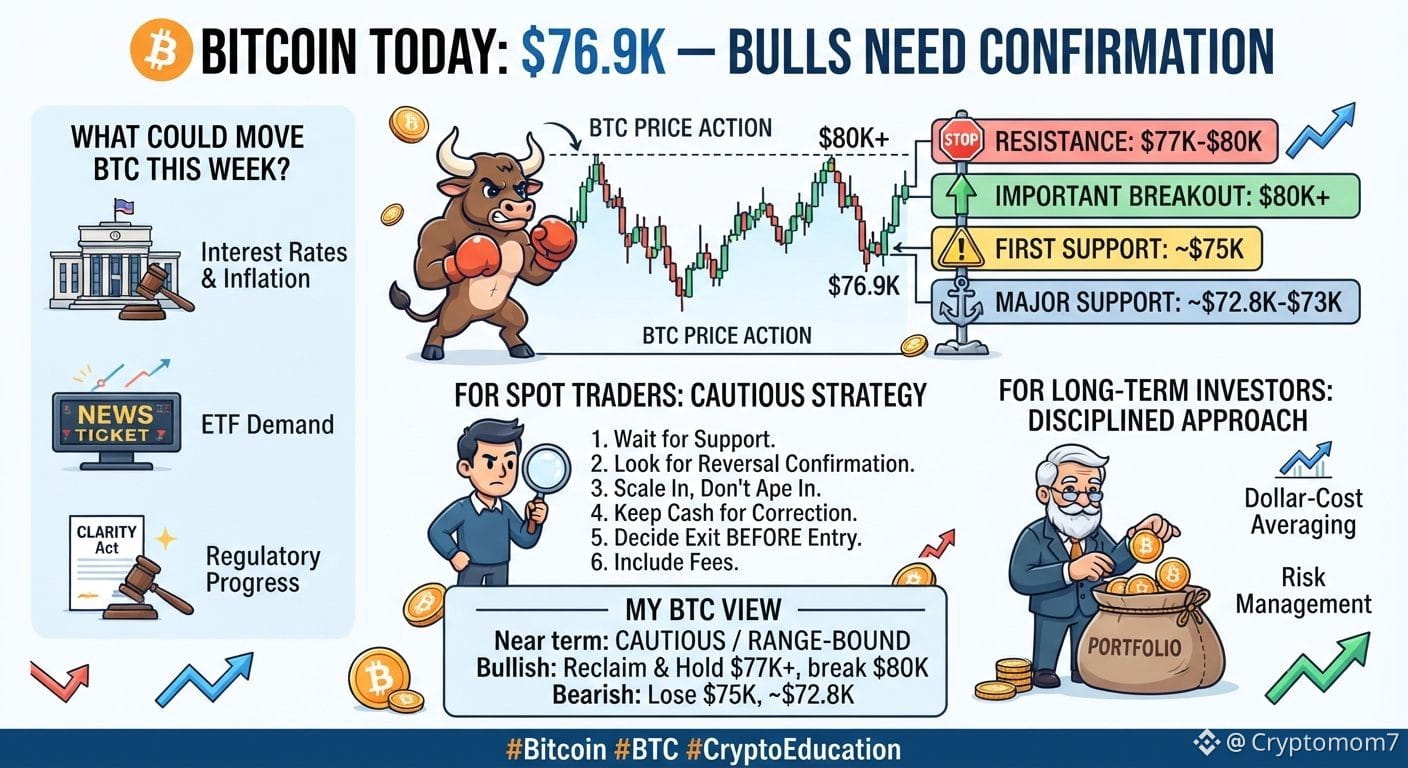
433
·
--
Übersetzung ansehen
Bitcoin at $77K: The Real Battle Has Begun ₿
Bitcoin is back around the $77,000 zone.
But the interesting question isn't simply:
“Will BTC go up or down?”
The better question is:
“What is Bitcoin telling us about this week's market?”
After climbing above $82,000, Bitcoin has pulled back and entered a more cautious phase.
And that pullback is important.
It tells us that the market is currently caught between two forces.
🟢 The Bulls
Bitcoin has regained significant momentum after its summer weakness.
This week, BTC also flashed a golden cross — a technical pattern where the 50-day moving average moves above the 200-day moving average.
That doesn't guarantee a rally.
But it does tell us that the longer-term trend is becoming more interesting.
🔴 The Macro Pressure
Bitcoin isn't trading in isolation.
Investors are watching U.S. inflation data, Treasury yields and the Federal Reserve's upcoming interest-rate decision.
Higher yields and a stronger dollar can make risk assets less attractive.
That means Bitcoin may continue to experience sharp moves even while the broader structure improves.
So where are we now?
Think of Bitcoin as standing at a crossroads.
$82K showed us what the bulls can attempt.
$77K–$78K is showing us how much support the market can maintain.
And the next major move may depend less on headlines and more on whether buyers continue stepping in during these pullbacks.
This is why chasing a green candle isn't necessarily the smartest strategy.
A disciplined Bitcoin investor watches:
• Support
• Resistance
• Volume
• Market structure
• Macro events
• And, most importantly, risk
My Bitcoin takeaway this week
I don't see $77K as simply “Bitcoin falling.”
I see it as a market testing its strength.
If buyers successfully defend lower levels and momentum returns, the $80K+ area could become important again.
#Bitcoin #BTC #BitcoinAnalysis #CryptoMarket #Binance #BTCUSD #CryptoInvesting #BitcoinTrading #CryptoEducation #Bitcoin2026
Bitcoin at $77K: The Real Battle Has Begun ₿
Bitcoin is back around the $77,000 zone.
But the interesting question isn't simply:
“Will BTC go up or down?”
The better question is:
“What is Bitcoin telling us about this week's market?”
After climbing above $82,000, Bitcoin has pulled back and entered a more cautious phase.
And that pullback is important.
It tells us that the market is currently caught between two forces.
🟢 The Bulls
Bitcoin has regained significant momentum after its summer weakness.
This week, BTC also flashed a golden cross — a technical pattern where the 50-day moving average moves above the 200-day moving average.
That doesn't guarantee a rally.
But it does tell us that the longer-term trend is becoming more interesting.
🔴 The Macro Pressure
Bitcoin isn't trading in isolation.
Investors are watching U.S. inflation data, Treasury yields and the Federal Reserve's upcoming interest-rate decision.
Higher yields and a stronger dollar can make risk assets less attractive.
That means Bitcoin may continue to experience sharp moves even while the broader structure improves.
So where are we now?
Think of Bitcoin as standing at a crossroads.
$82K showed us what the bulls can attempt.
$77K–$78K is showing us how much support the market can maintain.
And the next major move may depend less on headlines and more on whether buyers continue stepping in during these pullbacks.
This is why chasing a green candle isn't necessarily the smartest strategy.
A disciplined Bitcoin investor watches:
• Support
• Resistance
• Volume
• Market structure
• Macro events
• And, most importantly, risk
My Bitcoin takeaway this week
I don't see $77K as simply “Bitcoin falling.”
I see it as a market testing its strength.
If buyers successfully defend lower levels and momentum returns, the $80K+ area could become important again.
#Bitcoin #BTC #BitcoinAnalysis #CryptoMarket #Binance #BTCUSD #CryptoInvesting #BitcoinTrading #CryptoEducation #Bitcoin2026
Bitcoin is back around the $77,000 zone.
But the interesting question isn't simply:
“Will BTC go up or down?”
The better question is:
“What is Bitcoin telling us about this week's market?”
After climbing above $82,000, Bitcoin has pulled back and entered a more cautious phase.
And that pullback is important.
It tells us that the market is currently caught between two forces.
🟢 The Bulls
Bitcoin has regained significant momentum after its summer weakness.
This week, BTC also flashed a golden cross — a technical pattern where the 50-day moving average moves above the 200-day moving average.
That doesn't guarantee a rally.
But it does tell us that the longer-term trend is becoming more interesting.
🔴 The Macro Pressure
Bitcoin isn't trading in isolation.
Investors are watching U.S. inflation data, Treasury yields and the Federal Reserve's upcoming interest-rate decision.
Higher yields and a stronger dollar can make risk assets less attractive.
That means Bitcoin may continue to experience sharp moves even while the broader structure improves.
So where are we now?
Think of Bitcoin as standing at a crossroads.
$82K showed us what the bulls can attempt.
$77K–$78K is showing us how much support the market can maintain.
And the next major move may depend less on headlines and more on whether buyers continue stepping in during these pullbacks.
This is why chasing a green candle isn't necessarily the smartest strategy.
A disciplined Bitcoin investor watches:
• Support
• Resistance
• Volume
• Market structure
• Macro events
• And, most importantly, risk
My Bitcoin takeaway this week
I don't see $77K as simply “Bitcoin falling.”
I see it as a market testing its strength.
If buyers successfully defend lower levels and momentum returns, the $80K+ area could become important again.
#Bitcoin #BTC #BitcoinAnalysis #CryptoMarket #Binance #BTCUSD #CryptoInvesting #BitcoinTrading #CryptoEducation #Bitcoin2026
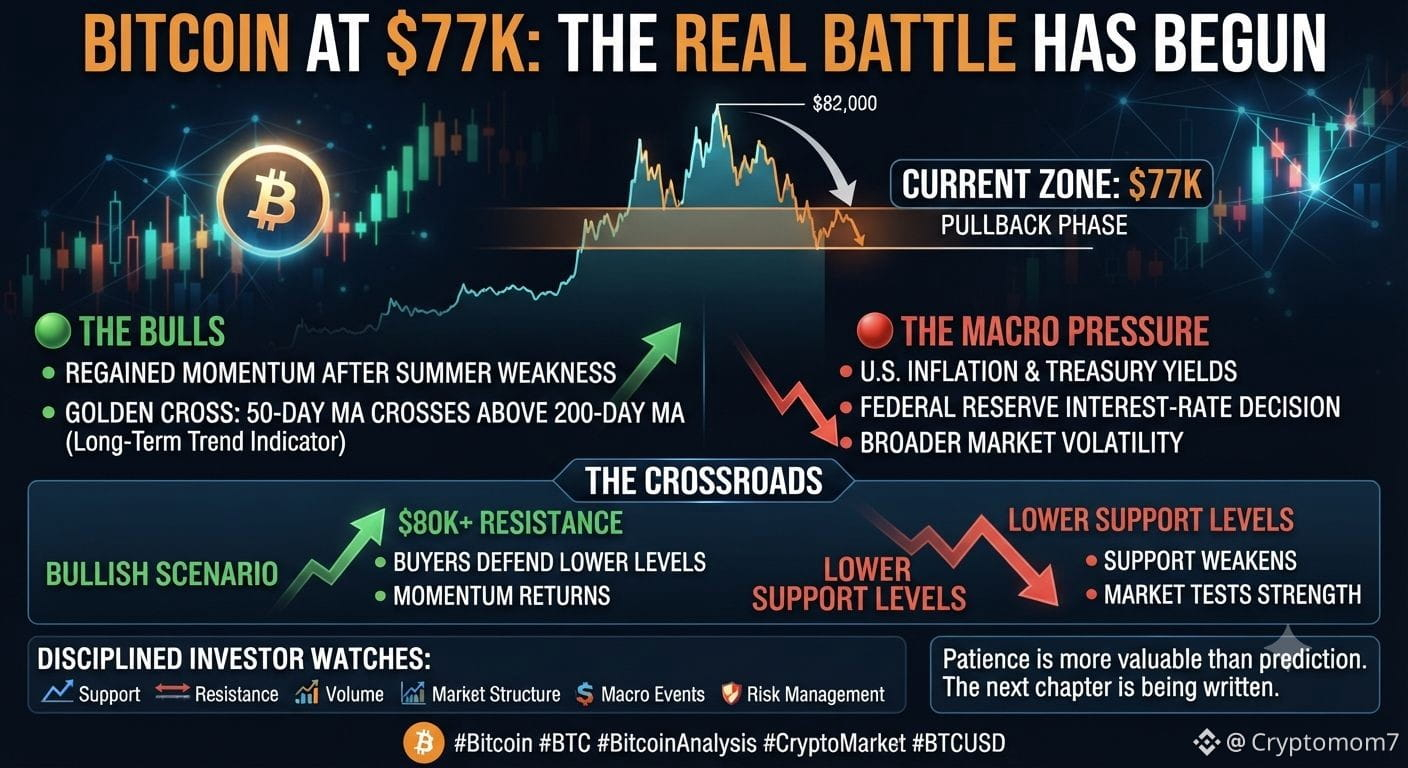
55
·
--
📊 Bitcoin-Wochenupdate: Bullen vs. Bären — Wer hat die Nase vorn?
Bitcoin startete die Woche nahe $80K nach einer starken Erholung, doch der Markt ist mittlerweile in eine Konsolidierungsphase übergegangen. BTC testete kurz den Bereich um $82K, bevor es in Richtung $78K–$79K zurückfiel.
🐂 Bullen: Das größere Bild bleibt konstruktiv. BTC hält sich weiterhin gut über der wichtigen Unterstützungszone bei $75K–$76K, und das kürzlich aufgetretene Golden-Cross-Signal hat die bullische Story gestärkt. Auch der breitere Kryptomarkt bleibt gesund: Die gesamte Marktkapitalisierung liegt bei rund $2,7Billionen und die BTC-Dominanz bei etwa 59%.
🐻 Bären: Verkäufer verteidigen weiterhin die Region $80K–$82K. Gewinnmitnahmen und makroökonomische Unsicherheit schaffen Widerstand. Steigende Renditen der US-Treasuries und die Erwartungen rund um die Federal Reserve halten Trader vorsichtig.
💡 Was können Anleger daraus lernen?
Eine starke Rally bedeutet nicht, dass jeder Rücksetzer eine Kaufgelegenheit ist. Geduld ist entscheidend. Beobachte Unterstützung, Widerstand und Volumen statt grünen Kerzen hinterherzulaufen.
🔎 Worauf als Nächstes achten?
Die entscheidenden Levels liegen ungefähr bei $82K als Widerstand und $75K–$76K als Unterstützung. Ein nachhaltiger Ausbruch über $82K könnte den Weg in Richtung $90K öffnen, während das Unterschreiten von $75K das Risiko für eine stärkere Korrektur erhöhen könnte.
🎯 BTC-Prognose: Meine vorsichtige Einschätzung ist: Seitwärtsrange bis leicht bullisch. Wenn BTC über $75K hält und $82K zurückerobert, wird die bullische Struktur gestärkt. Eine Abweisung nahe $80K–$82K könnte BTC jedoch weiter in der Konsolidierung halten, bevor der nächste entscheidende Schritt folgt.
Keine Finanzberatung. Informiere dich selbst (DYOR).
#Bitcoin #BTC #Crypto #Binance #BitcoinAnalysis
📊 Bitcoin-Wochenupdate: Bullen vs. Bären — Wer hat die Nase vorn?
Bitcoin startete die Woche nahe $80K nach einer starken Erholung, doch der Markt ist mittlerweile in eine Konsolidierungsphase übergegangen. BTC testete kurz den Bereich um $82K, bevor es in Richtung $78K–$79K zurückfiel.
🐂 Bullen: Das größere Bild bleibt konstruktiv. BTC hält sich weiterhin gut über der wichtigen Unterstützungszone bei $75K–$76K, und das kürzlich aufgetretene Golden-Cross-Signal hat die bullische Story gestärkt. Auch der breitere Kryptomarkt bleibt gesund: Die gesamte Marktkapitalisierung liegt bei rund $2,7Billionen und die BTC-Dominanz bei etwa 59%.
🐻 Bären: Verkäufer verteidigen weiterhin die Region $80K–$82K. Gewinnmitnahmen und makroökonomische Unsicherheit schaffen Widerstand. Steigende Renditen der US-Treasuries und die Erwartungen rund um die Federal Reserve halten Trader vorsichtig.
💡 Was können Anleger daraus lernen?
Eine starke Rally bedeutet nicht, dass jeder Rücksetzer eine Kaufgelegenheit ist. Geduld ist entscheidend. Beobachte Unterstützung, Widerstand und Volumen statt grünen Kerzen hinterherzulaufen.
🔎 Worauf als Nächstes achten?
Die entscheidenden Levels liegen ungefähr bei $82K als Widerstand und $75K–$76K als Unterstützung. Ein nachhaltiger Ausbruch über $82K könnte den Weg in Richtung $90K öffnen, während das Unterschreiten von $75K das Risiko für eine stärkere Korrektur erhöhen könnte.
🎯 BTC-Prognose: Meine vorsichtige Einschätzung ist: Seitwärtsrange bis leicht bullisch. Wenn BTC über $75K hält und $82K zurückerobert, wird die bullische Struktur gestärkt. Eine Abweisung nahe $80K–$82K könnte BTC jedoch weiter in der Konsolidierung halten, bevor der nächste entscheidende Schritt folgt.
Keine Finanzberatung. Informiere dich selbst (DYOR).
#Bitcoin #BTC #Crypto #Binance #BitcoinAnalysis
Bitcoin startete die Woche nahe $80K nach einer starken Erholung, doch der Markt ist mittlerweile in eine Konsolidierungsphase übergegangen. BTC testete kurz den Bereich um $82K, bevor es in Richtung $78K–$79K zurückfiel.
🐂 Bullen: Das größere Bild bleibt konstruktiv. BTC hält sich weiterhin gut über der wichtigen Unterstützungszone bei $75K–$76K, und das kürzlich aufgetretene Golden-Cross-Signal hat die bullische Story gestärkt. Auch der breitere Kryptomarkt bleibt gesund: Die gesamte Marktkapitalisierung liegt bei rund $2,7Billionen und die BTC-Dominanz bei etwa 59%.
🐻 Bären: Verkäufer verteidigen weiterhin die Region $80K–$82K. Gewinnmitnahmen und makroökonomische Unsicherheit schaffen Widerstand. Steigende Renditen der US-Treasuries und die Erwartungen rund um die Federal Reserve halten Trader vorsichtig.
💡 Was können Anleger daraus lernen?
Eine starke Rally bedeutet nicht, dass jeder Rücksetzer eine Kaufgelegenheit ist. Geduld ist entscheidend. Beobachte Unterstützung, Widerstand und Volumen statt grünen Kerzen hinterherzulaufen.
🔎 Worauf als Nächstes achten?
Die entscheidenden Levels liegen ungefähr bei $82K als Widerstand und $75K–$76K als Unterstützung. Ein nachhaltiger Ausbruch über $82K könnte den Weg in Richtung $90K öffnen, während das Unterschreiten von $75K das Risiko für eine stärkere Korrektur erhöhen könnte.
🎯 BTC-Prognose: Meine vorsichtige Einschätzung ist: Seitwärtsrange bis leicht bullisch. Wenn BTC über $75K hält und $82K zurückerobert, wird die bullische Struktur gestärkt. Eine Abweisung nahe $80K–$82K könnte BTC jedoch weiter in der Konsolidierung halten, bevor der nächste entscheidende Schritt folgt.
Keine Finanzberatung. Informiere dich selbst (DYOR).
#Bitcoin #BTC #Crypto #Binance #BitcoinAnalysis
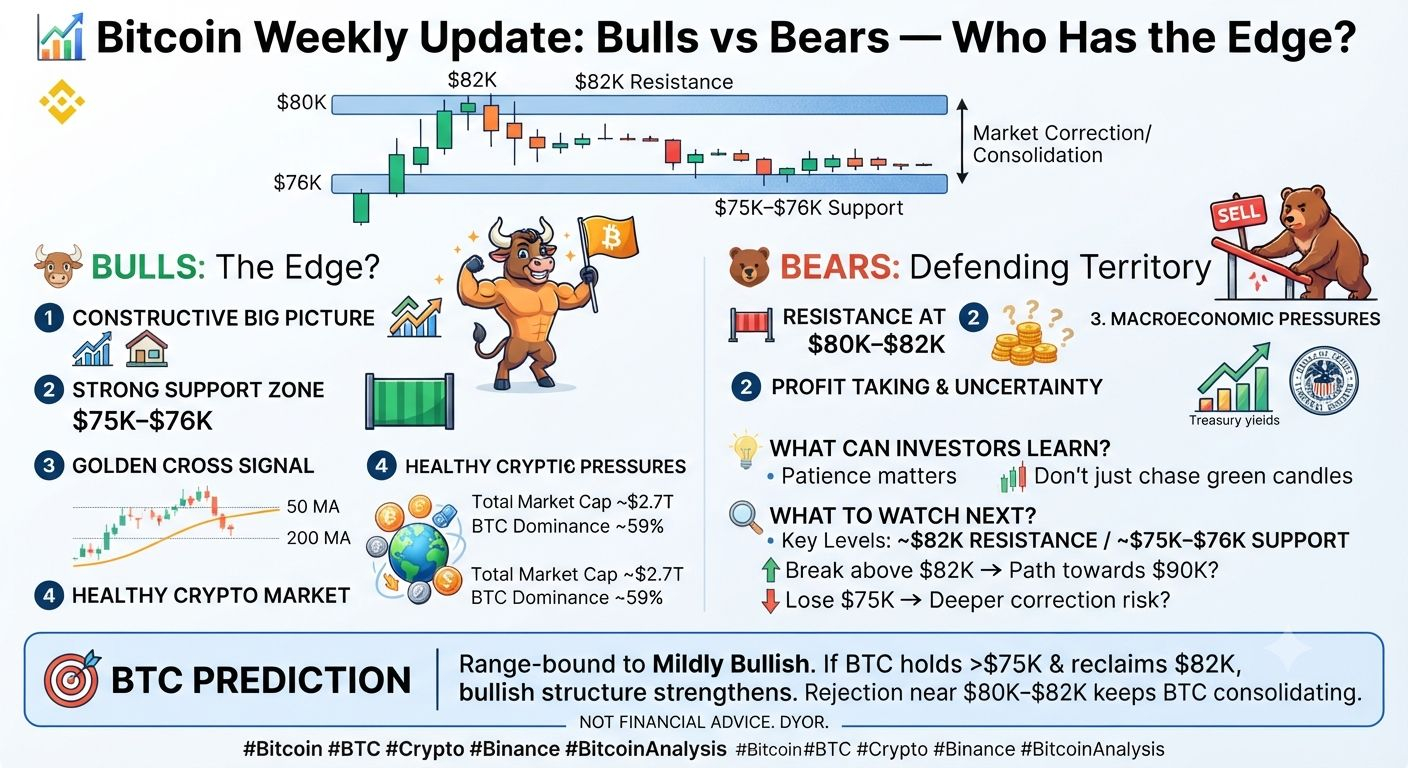
68
·
--
🇭🇰 Bitcoin Asien 2026 — Tag 2: Das größere Ganze
Wenn Tag 1 uns gezeigt hat, wie weit Bitcoin gekommen ist, dann hat Tag 2 gezeigt, wohin Bitcoin als Nächstes führen könnte.
Beim zweiten Tag von Bitcoin Asia 2026 wurde eine Botschaft immer deutlicher:
Bitcoin ist nicht mehr nur eine Technologie, eine Geldanlage oder ein finanzielles Experiment. Es wird Teil einer viel größeren globalen Debatte über Geld, Kapital, Eigentum und finanzielle Freiheit.
Hier sind einige unserer wichtigsten Erkenntnisse:
🔹 Die institutionelle Akzeptanz entwickelt sich. Gespräche über Bitcoin-ETFs, Unternehmensschatzämter und Strategien zur Werterzeugung aus Bitcoin-Beständen zeigten, wie Institutionen lernen, Bitcoin in traditionelle Finanzstrukturen zu integrieren.
🔹 Asien gewinnt zunehmend an Bedeutung. Sessions dazu, Hongkong zu einer Bitcoin-Stadt zu machen, Bitcoin-Adoption in ganz Asien sowie der „Erste Asiatische Zyklus“ hoben die wachsende Rolle der Region im nächsten Kapitel von Bitcoins hervor.
🔹 Regulierung ist entscheidend. Die Diskussion über globale Regulierungen machte deutlich, dass Bitcoins Zukunft nicht nur von der Akzeptanz abhängt, sondern auch davon, wie Regierungen und Finanzinstitutionen auf ein grenzenloses digitales Asset reagieren.
🔹 Bitcoin geht über den Preis hinaus. Von persönlicher Finanzplanung und Self-Custody über Mining, Zahlungen, Skalierung und Open-Source-Entwicklung: Tag 2 hat uns daran erinnert, dass das Bitcoin-Ökosystem aus vielen unterschiedlichen Schichten aufgebaut wird.
🔹 Die langfristige Vision ist enorm. Gespräche über Netzwerkstaaten, Bitcoin-Communities und neue Formen von Kapital forderten uns heraus, über das heutige Finanzsystem hinauszudenken.
Was haben wir gelernt?
Die wichtigste Erkenntnis aus diesen zwei Tagen ist vielleicht diese:
Betrachte Bitcoin nicht nur als Preischart. Schau dir die Infrastruktur, Institutionen, Communities und Finanzsysteme an, die darum herum aufgebaut werden.
Bitcoin Asia 2026 war bedeutend, weil es diese Gespräche an einem Ort zusammengebracht hat—mitten im Herzen Asiens.
Für Bitcoin-Educators, Investoren und ganz alltägliche Nutzer ist die Botschaft ganz einfach:
Weiterlernen. Weiter hinterfragen. Und unterschätze nicht, wie früh wir vielleicht noch immer sind. 🟠
#BitcoinAsia202
🇭🇰 Bitcoin Asien 2026 — Tag 2: Das größere Ganze
Wenn Tag 1 uns gezeigt hat, wie weit Bitcoin gekommen ist, dann hat Tag 2 gezeigt, wohin Bitcoin als Nächstes führen könnte.
Beim zweiten Tag von Bitcoin Asia 2026 wurde eine Botschaft immer deutlicher:
Bitcoin ist nicht mehr nur eine Technologie, eine Geldanlage oder ein finanzielles Experiment. Es wird Teil einer viel größeren globalen Debatte über Geld, Kapital, Eigentum und finanzielle Freiheit.
Hier sind einige unserer wichtigsten Erkenntnisse:
🔹 Die institutionelle Akzeptanz entwickelt sich. Gespräche über Bitcoin-ETFs, Unternehmensschatzämter und Strategien zur Werterzeugung aus Bitcoin-Beständen zeigten, wie Institutionen lernen, Bitcoin in traditionelle Finanzstrukturen zu integrieren.
🔹 Asien gewinnt zunehmend an Bedeutung. Sessions dazu, Hongkong zu einer Bitcoin-Stadt zu machen, Bitcoin-Adoption in ganz Asien sowie der „Erste Asiatische Zyklus“ hoben die wachsende Rolle der Region im nächsten Kapitel von Bitcoins hervor.
🔹 Regulierung ist entscheidend. Die Diskussion über globale Regulierungen machte deutlich, dass Bitcoins Zukunft nicht nur von der Akzeptanz abhängt, sondern auch davon, wie Regierungen und Finanzinstitutionen auf ein grenzenloses digitales Asset reagieren.
🔹 Bitcoin geht über den Preis hinaus. Von persönlicher Finanzplanung und Self-Custody über Mining, Zahlungen, Skalierung und Open-Source-Entwicklung: Tag 2 hat uns daran erinnert, dass das Bitcoin-Ökosystem aus vielen unterschiedlichen Schichten aufgebaut wird.
🔹 Die langfristige Vision ist enorm. Gespräche über Netzwerkstaaten, Bitcoin-Communities und neue Formen von Kapital forderten uns heraus, über das heutige Finanzsystem hinauszudenken.
Was haben wir gelernt?
Die wichtigste Erkenntnis aus diesen zwei Tagen ist vielleicht diese:
Betrachte Bitcoin nicht nur als Preischart. Schau dir die Infrastruktur, Institutionen, Communities und Finanzsysteme an, die darum herum aufgebaut werden.
Bitcoin Asia 2026 war bedeutend, weil es diese Gespräche an einem Ort zusammengebracht hat—mitten im Herzen Asiens.
Für Bitcoin-Educators, Investoren und ganz alltägliche Nutzer ist die Botschaft ganz einfach:
Weiterlernen. Weiter hinterfragen. Und unterschätze nicht, wie früh wir vielleicht noch immer sind. 🟠
#BitcoinAsia202
Wenn Tag 1 uns gezeigt hat, wie weit Bitcoin gekommen ist, dann hat Tag 2 gezeigt, wohin Bitcoin als Nächstes führen könnte.
Beim zweiten Tag von Bitcoin Asia 2026 wurde eine Botschaft immer deutlicher:
Bitcoin ist nicht mehr nur eine Technologie, eine Geldanlage oder ein finanzielles Experiment. Es wird Teil einer viel größeren globalen Debatte über Geld, Kapital, Eigentum und finanzielle Freiheit.
Hier sind einige unserer wichtigsten Erkenntnisse:
🔹 Die institutionelle Akzeptanz entwickelt sich. Gespräche über Bitcoin-ETFs, Unternehmensschatzämter und Strategien zur Werterzeugung aus Bitcoin-Beständen zeigten, wie Institutionen lernen, Bitcoin in traditionelle Finanzstrukturen zu integrieren.
🔹 Asien gewinnt zunehmend an Bedeutung. Sessions dazu, Hongkong zu einer Bitcoin-Stadt zu machen, Bitcoin-Adoption in ganz Asien sowie der „Erste Asiatische Zyklus“ hoben die wachsende Rolle der Region im nächsten Kapitel von Bitcoins hervor.
🔹 Regulierung ist entscheidend. Die Diskussion über globale Regulierungen machte deutlich, dass Bitcoins Zukunft nicht nur von der Akzeptanz abhängt, sondern auch davon, wie Regierungen und Finanzinstitutionen auf ein grenzenloses digitales Asset reagieren.
🔹 Bitcoin geht über den Preis hinaus. Von persönlicher Finanzplanung und Self-Custody über Mining, Zahlungen, Skalierung und Open-Source-Entwicklung: Tag 2 hat uns daran erinnert, dass das Bitcoin-Ökosystem aus vielen unterschiedlichen Schichten aufgebaut wird.
🔹 Die langfristige Vision ist enorm. Gespräche über Netzwerkstaaten, Bitcoin-Communities und neue Formen von Kapital forderten uns heraus, über das heutige Finanzsystem hinauszudenken.
Was haben wir gelernt?
Die wichtigste Erkenntnis aus diesen zwei Tagen ist vielleicht diese:
Betrachte Bitcoin nicht nur als Preischart. Schau dir die Infrastruktur, Institutionen, Communities und Finanzsysteme an, die darum herum aufgebaut werden.
Bitcoin Asia 2026 war bedeutend, weil es diese Gespräche an einem Ort zusammengebracht hat—mitten im Herzen Asiens.
Für Bitcoin-Educators, Investoren und ganz alltägliche Nutzer ist die Botschaft ganz einfach:
Weiterlernen. Weiter hinterfragen. Und unterschätze nicht, wie früh wir vielleicht noch immer sind. 🟠
#BitcoinAsia202

67
·
--
🇭🇰 Bitcoin Asia 2026 — Tag 1: Was wir gelernt haben
Tag 1 von Bitcoin Asia 2026 in Hongkong war mehr als nur eine weitere Bitcoin-Konferenz. Es war ein eindrucksvoller Einblick in die Entwicklung, wie Bitcoin sich von einer Technik- und Investment-Erzählung hin zu einem deutlich breiteren finanziellen und institutionellen Gespräch bewegt.
Der Livestream brachte wichtige Stimmen aus dem gesamten Bitcoin-Ökosystem zusammen — darunter CZ, Gracy Chen, Justin Sun und weitere globale Bitcoin-Führungspersönlichkeiten.
Was hat uns besonders aufgefallen?
🔹 Bitcoin wird zunehmend als strategischer Vermögenswert diskutiert — nicht nur als spekulatives Asset.
🔹 Asien ist wichtig. Hongkong, Japan und das breitere asiatische Finanz-Ökosystem gewinnen für die Bitcoin-Adoption, Kapitalströme und die Beteiligung von Institutionen zunehmend an Bedeutung.
🔹 Die institutionelle Adoption verändert die Gesprächsgrundlage. Diskussionen über Bitcoin-Reserven, Unternehmens-Treasuries und globales Kapital deuten darauf hin, dass sich die Frage immer stärker dahin verschiebt, wie Bitcoin in das Finanzsystem passt — statt nur darum, ob es dort hingehört.
🔹 Bitcoin-Bildung bleibt entscheidend. Wenn die Adoption wächst, wird das Verständnis von Self-Custody, Sicherheit, Marktstruktur und den grundlegenden Prinzipien von Bitcoin genauso wichtig wie das Beobachten des Preises.
Und vielleicht die wichtigste Erkenntnis aus Tag 1:
Die Geschichte von Bitcoin wird größer als der Preis von Bitcoin.
Die Bedeutung von Bitcoin Asia 2026 liegt darin, dass es Investoren, Builder, politische Entscheidungsträger, Educators und Unternehmer aus Ost und West zusammenbringt — zu einer Zeit, in der sich das globale Finanzsystem rasant weiterentwickelt.
Für uns hat die Veranstaltung eine wichtige Idee bekräftigt:
Das nächste Kapitel von Bitcoin könnte sich genauso stark von Asien formen lassen wie von jedem anderen Teil der Welt.
Tag 1 war erst der Anfang. 🚀
#Bitcoin #BitcoinAsia2026 #BTC #Binance #BitcoinAdoption #Crypto #DigitalAssets #BitcoinEducation #HongKong #Asia
🇭🇰 Bitcoin Asia 2026 — Tag 1: Was wir gelernt haben
Tag 1 von Bitcoin Asia 2026 in Hongkong war mehr als nur eine weitere Bitcoin-Konferenz. Es war ein eindrucksvoller Einblick in die Entwicklung, wie Bitcoin sich von einer Technik- und Investment-Erzählung hin zu einem deutlich breiteren finanziellen und institutionellen Gespräch bewegt.
Der Livestream brachte wichtige Stimmen aus dem gesamten Bitcoin-Ökosystem zusammen — darunter CZ, Gracy Chen, Justin Sun und weitere globale Bitcoin-Führungspersönlichkeiten.
Was hat uns besonders aufgefallen?
🔹 Bitcoin wird zunehmend als strategischer Vermögenswert diskutiert — nicht nur als spekulatives Asset.
🔹 Asien ist wichtig. Hongkong, Japan und das breitere asiatische Finanz-Ökosystem gewinnen für die Bitcoin-Adoption, Kapitalströme und die Beteiligung von Institutionen zunehmend an Bedeutung.
🔹 Die institutionelle Adoption verändert die Gesprächsgrundlage. Diskussionen über Bitcoin-Reserven, Unternehmens-Treasuries und globales Kapital deuten darauf hin, dass sich die Frage immer stärker dahin verschiebt, wie Bitcoin in das Finanzsystem passt — statt nur darum, ob es dort hingehört.
🔹 Bitcoin-Bildung bleibt entscheidend. Wenn die Adoption wächst, wird das Verständnis von Self-Custody, Sicherheit, Marktstruktur und den grundlegenden Prinzipien von Bitcoin genauso wichtig wie das Beobachten des Preises.
Und vielleicht die wichtigste Erkenntnis aus Tag 1:
Die Geschichte von Bitcoin wird größer als der Preis von Bitcoin.
Die Bedeutung von Bitcoin Asia 2026 liegt darin, dass es Investoren, Builder, politische Entscheidungsträger, Educators und Unternehmer aus Ost und West zusammenbringt — zu einer Zeit, in der sich das globale Finanzsystem rasant weiterentwickelt.
Für uns hat die Veranstaltung eine wichtige Idee bekräftigt:
Das nächste Kapitel von Bitcoin könnte sich genauso stark von Asien formen lassen wie von jedem anderen Teil der Welt.
Tag 1 war erst der Anfang. 🚀
#Bitcoin #BitcoinAsia2026 #BTC #Binance #BitcoinAdoption #Crypto #DigitalAssets #BitcoinEducation #HongKong #Asia
Tag 1 von Bitcoin Asia 2026 in Hongkong war mehr als nur eine weitere Bitcoin-Konferenz. Es war ein eindrucksvoller Einblick in die Entwicklung, wie Bitcoin sich von einer Technik- und Investment-Erzählung hin zu einem deutlich breiteren finanziellen und institutionellen Gespräch bewegt.
Der Livestream brachte wichtige Stimmen aus dem gesamten Bitcoin-Ökosystem zusammen — darunter CZ, Gracy Chen, Justin Sun und weitere globale Bitcoin-Führungspersönlichkeiten.
Was hat uns besonders aufgefallen?
🔹 Bitcoin wird zunehmend als strategischer Vermögenswert diskutiert — nicht nur als spekulatives Asset.
🔹 Asien ist wichtig. Hongkong, Japan und das breitere asiatische Finanz-Ökosystem gewinnen für die Bitcoin-Adoption, Kapitalströme und die Beteiligung von Institutionen zunehmend an Bedeutung.
🔹 Die institutionelle Adoption verändert die Gesprächsgrundlage. Diskussionen über Bitcoin-Reserven, Unternehmens-Treasuries und globales Kapital deuten darauf hin, dass sich die Frage immer stärker dahin verschiebt, wie Bitcoin in das Finanzsystem passt — statt nur darum, ob es dort hingehört.
🔹 Bitcoin-Bildung bleibt entscheidend. Wenn die Adoption wächst, wird das Verständnis von Self-Custody, Sicherheit, Marktstruktur und den grundlegenden Prinzipien von Bitcoin genauso wichtig wie das Beobachten des Preises.
Und vielleicht die wichtigste Erkenntnis aus Tag 1:
Die Geschichte von Bitcoin wird größer als der Preis von Bitcoin.
Die Bedeutung von Bitcoin Asia 2026 liegt darin, dass es Investoren, Builder, politische Entscheidungsträger, Educators und Unternehmer aus Ost und West zusammenbringt — zu einer Zeit, in der sich das globale Finanzsystem rasant weiterentwickelt.
Für uns hat die Veranstaltung eine wichtige Idee bekräftigt:
Das nächste Kapitel von Bitcoin könnte sich genauso stark von Asien formen lassen wie von jedem anderen Teil der Welt.
Tag 1 war erst der Anfang. 🚀
#Bitcoin #BitcoinAsia2026 #BTC #Binance #BitcoinAdoption #Crypto #DigitalAssets #BitcoinEducation #HongKong #Asia


75
·
--
Übersetzung ansehen
Bitcoin is being built for more than the next bull run. ₿
Here’s an important Bitcoin development update that deserves attention.
The Human Rights Foundation (HRF) has announced more than 500 million satoshis in grants to 16 projects across Africa, Asia and Latin America through its Bitcoin Development Fund.
What are these grants supporting?
🔹 Bitcoin payments — including mobile-money-to-Bitcoin bridges for faster and cheaper cross-border payments.
🔹 Offline Bitcoin payments — including work using Bluetooth, NFC and ecash to keep payments functioning when internet access is disrupted.
🔹 Self-custody & wallet security — tools that help users verify transactions themselves and reduce dependence on centralized services.
🔹 Privacy & communication — Nostr-based messaging and alert systems designed to make communication more resistant to censorship.
🔹 Decentralized mining — open-source mining hardware and software aimed at reducing dependence on a small group of manufacturers.
🔹 Bitcoin education — My First Bitcoin is expanding its educator network, which already operates in more than 40 countries, including India.
🇮🇳 And there's a particularly interesting India connection:
HODL: Hands On Design Lab is receiving support to train early-career designers in India to improve Bitcoin's usability, especially around self-custody, privacy and security.
Why is this important for Bitcoin users?
When we talk about Bitcoin, we often focus on:
📈 Price
💰 Returns
📊 Trading
₿ Adoption
But underneath all of that, developers are building the infrastructure that could determine how useful Bitcoin becomes in the real world.
Payments.
Privacy.
Self-custody.
Education.
Decentralized communication.
Mining.
That's a much bigger story than the daily BTC chart.
The price tells us what Bitcoin is worth today.
The infrastructure being built tells us what Bitcoin could become tomorrow.
What do you think matters most for Bitcoin's future?
Payments, privacy, self-custody, education or decentralization? 👇
#Bitcoin #BTC #Binance #BitcoinEducation
Bitcoin is being built for more than the next bull run. ₿
Here’s an important Bitcoin development update that deserves attention.
The Human Rights Foundation (HRF) has announced more than 500 million satoshis in grants to 16 projects across Africa, Asia and Latin America through its Bitcoin Development Fund.
What are these grants supporting?
🔹 Bitcoin payments — including mobile-money-to-Bitcoin bridges for faster and cheaper cross-border payments.
🔹 Offline Bitcoin payments — including work using Bluetooth, NFC and ecash to keep payments functioning when internet access is disrupted.
🔹 Self-custody & wallet security — tools that help users verify transactions themselves and reduce dependence on centralized services.
🔹 Privacy & communication — Nostr-based messaging and alert systems designed to make communication more resistant to censorship.
🔹 Decentralized mining — open-source mining hardware and software aimed at reducing dependence on a small group of manufacturers.
🔹 Bitcoin education — My First Bitcoin is expanding its educator network, which already operates in more than 40 countries, including India.
🇮🇳 And there's a particularly interesting India connection:
HODL: Hands On Design Lab is receiving support to train early-career designers in India to improve Bitcoin's usability, especially around self-custody, privacy and security.
Why is this important for Bitcoin users?
When we talk about Bitcoin, we often focus on:
📈 Price
💰 Returns
📊 Trading
₿ Adoption
But underneath all of that, developers are building the infrastructure that could determine how useful Bitcoin becomes in the real world.
Payments.
Privacy.
Self-custody.
Education.
Decentralized communication.
Mining.
That's a much bigger story than the daily BTC chart.
The price tells us what Bitcoin is worth today.
The infrastructure being built tells us what Bitcoin could become tomorrow.
What do you think matters most for Bitcoin's future?
Payments, privacy, self-custody, education or decentralization? 👇
#Bitcoin #BTC #Binance #BitcoinEducation
Here’s an important Bitcoin development update that deserves attention.
The Human Rights Foundation (HRF) has announced more than 500 million satoshis in grants to 16 projects across Africa, Asia and Latin America through its Bitcoin Development Fund.
What are these grants supporting?
🔹 Bitcoin payments — including mobile-money-to-Bitcoin bridges for faster and cheaper cross-border payments.
🔹 Offline Bitcoin payments — including work using Bluetooth, NFC and ecash to keep payments functioning when internet access is disrupted.
🔹 Self-custody & wallet security — tools that help users verify transactions themselves and reduce dependence on centralized services.
🔹 Privacy & communication — Nostr-based messaging and alert systems designed to make communication more resistant to censorship.
🔹 Decentralized mining — open-source mining hardware and software aimed at reducing dependence on a small group of manufacturers.
🔹 Bitcoin education — My First Bitcoin is expanding its educator network, which already operates in more than 40 countries, including India.
🇮🇳 And there's a particularly interesting India connection:
HODL: Hands On Design Lab is receiving support to train early-career designers in India to improve Bitcoin's usability, especially around self-custody, privacy and security.
Why is this important for Bitcoin users?
When we talk about Bitcoin, we often focus on:
📈 Price
💰 Returns
📊 Trading
₿ Adoption
But underneath all of that, developers are building the infrastructure that could determine how useful Bitcoin becomes in the real world.
Payments.
Privacy.
Self-custody.
Education.
Decentralized communication.
Mining.
That's a much bigger story than the daily BTC chart.
The price tells us what Bitcoin is worth today.
The infrastructure being built tells us what Bitcoin could become tomorrow.
What do you think matters most for Bitcoin's future?
Payments, privacy, self-custody, education or decentralization? 👇
#Bitcoin #BTC #Binance #BitcoinEducation
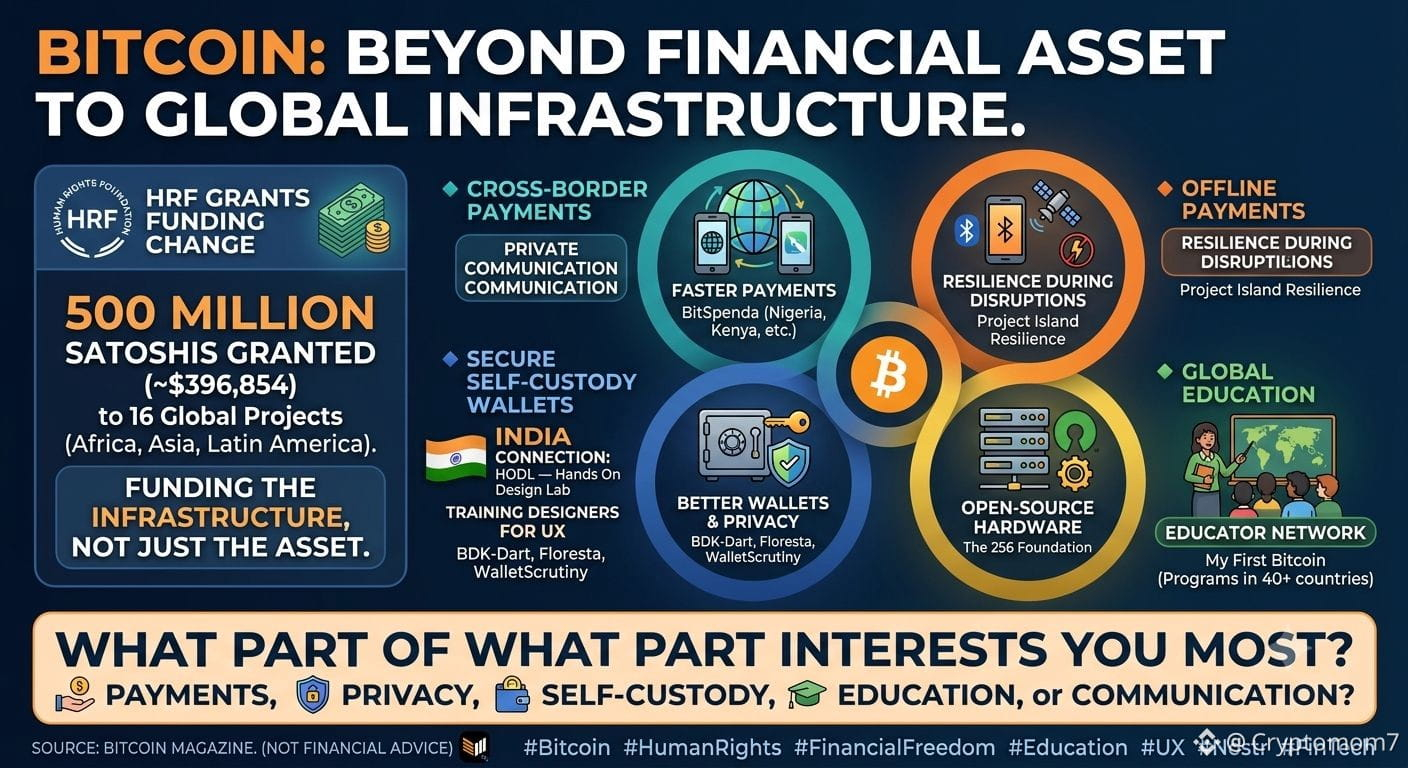
76
·
--
Übersetzung ansehen
BTC Momentum Explodes 🚀
Bitcoin has delivered a powerful comeback this week, breaking above $80,000 for the first time since May and reaching around $81,000 before pulling back toward $79K. BTC is up roughly 25% this month, while the latest five-day surge has been about 24%.
🔎 What are analysts saying?
• Katie Stockton (Fairlead Strategies) sees Bitcoin having more room to run than gold, suggesting the current technical momentum remains constructive.
• Joel Kruger views the breakout as potentially marking a cycle low, with the next technical target around $83,000.
• Naeem Aslam (Zaye Capital Markets) says improved liquidity expectations, Treasury buying and regulatory optimism are supporting risk appetite.
• Citi's Alex Saunders highlights Bitcoin ETF flows as critical: nearly $2B flowed into spot BTC ETFs over five consecutive days, a key signal for whether this rally can become sustainable.
📈 Why the sudden momentum?
The U.S. Treasury's plan to increase long-term bond buybacks has weakened the dollar and boosted expectations for easier liquidity. Meanwhile, optimism around the CLARITY Act, strong ETF demand and a massive short squeeze—nearly $3B in crypto liquidations—have accelerated the move.
⚠️ The key level now: $80K–$82K is major resistance. A sustained breakout could open the door toward $83K and potentially higher, but profit-taking and macro data remain risks.
Bottom line: BTC momentum is strongly bullish, but after such a rapid move, volatility and pullbacks should be expected. This is a market to watch—not chase blindly. 📊
BTC Momentum Explodes 🚀
Bitcoin has delivered a powerful comeback this week, breaking above $80,000 for the first time since May and reaching around $81,000 before pulling back toward $79K. BTC is up roughly 25% this month, while the latest five-day surge has been about 24%.
🔎 What are analysts saying?
• Katie Stockton (Fairlead Strategies) sees Bitcoin having more room to run than gold, suggesting the current technical momentum remains constructive.
• Joel Kruger views the breakout as potentially marking a cycle low, with the next technical target around $83,000.
• Naeem Aslam (Zaye Capital Markets) says improved liquidity expectations, Treasury buying and regulatory optimism are supporting risk appetite.
• Citi's Alex Saunders highlights Bitcoin ETF flows as critical: nearly $2B flowed into spot BTC ETFs over five consecutive days, a key signal for whether this rally can become sustainable.
📈 Why the sudden momentum?
The U.S. Treasury's plan to increase long-term bond buybacks has weakened the dollar and boosted expectations for easier liquidity. Meanwhile, optimism around the CLARITY Act, strong ETF demand and a massive short squeeze—nearly $3B in crypto liquidations—have accelerated the move.
⚠️ The key level now: $80K–$82K is major resistance. A sustained breakout could open the door toward $83K and potentially higher, but profit-taking and macro data remain risks.
Bottom line: BTC momentum is strongly bullish, but after such a rapid move, volatility and pullbacks should be expected. This is a market to watch—not chase blindly. 📊
Bitcoin has delivered a powerful comeback this week, breaking above $80,000 for the first time since May and reaching around $81,000 before pulling back toward $79K. BTC is up roughly 25% this month, while the latest five-day surge has been about 24%.
🔎 What are analysts saying?
• Katie Stockton (Fairlead Strategies) sees Bitcoin having more room to run than gold, suggesting the current technical momentum remains constructive.
• Joel Kruger views the breakout as potentially marking a cycle low, with the next technical target around $83,000.
• Naeem Aslam (Zaye Capital Markets) says improved liquidity expectations, Treasury buying and regulatory optimism are supporting risk appetite.
• Citi's Alex Saunders highlights Bitcoin ETF flows as critical: nearly $2B flowed into spot BTC ETFs over five consecutive days, a key signal for whether this rally can become sustainable.
📈 Why the sudden momentum?
The U.S. Treasury's plan to increase long-term bond buybacks has weakened the dollar and boosted expectations for easier liquidity. Meanwhile, optimism around the CLARITY Act, strong ETF demand and a massive short squeeze—nearly $3B in crypto liquidations—have accelerated the move.
⚠️ The key level now: $80K–$82K is major resistance. A sustained breakout could open the door toward $83K and potentially higher, but profit-taking and macro data remain risks.
Bottom line: BTC momentum is strongly bullish, but after such a rapid move, volatility and pullbacks should be expected. This is a market to watch—not chase blindly. 📊
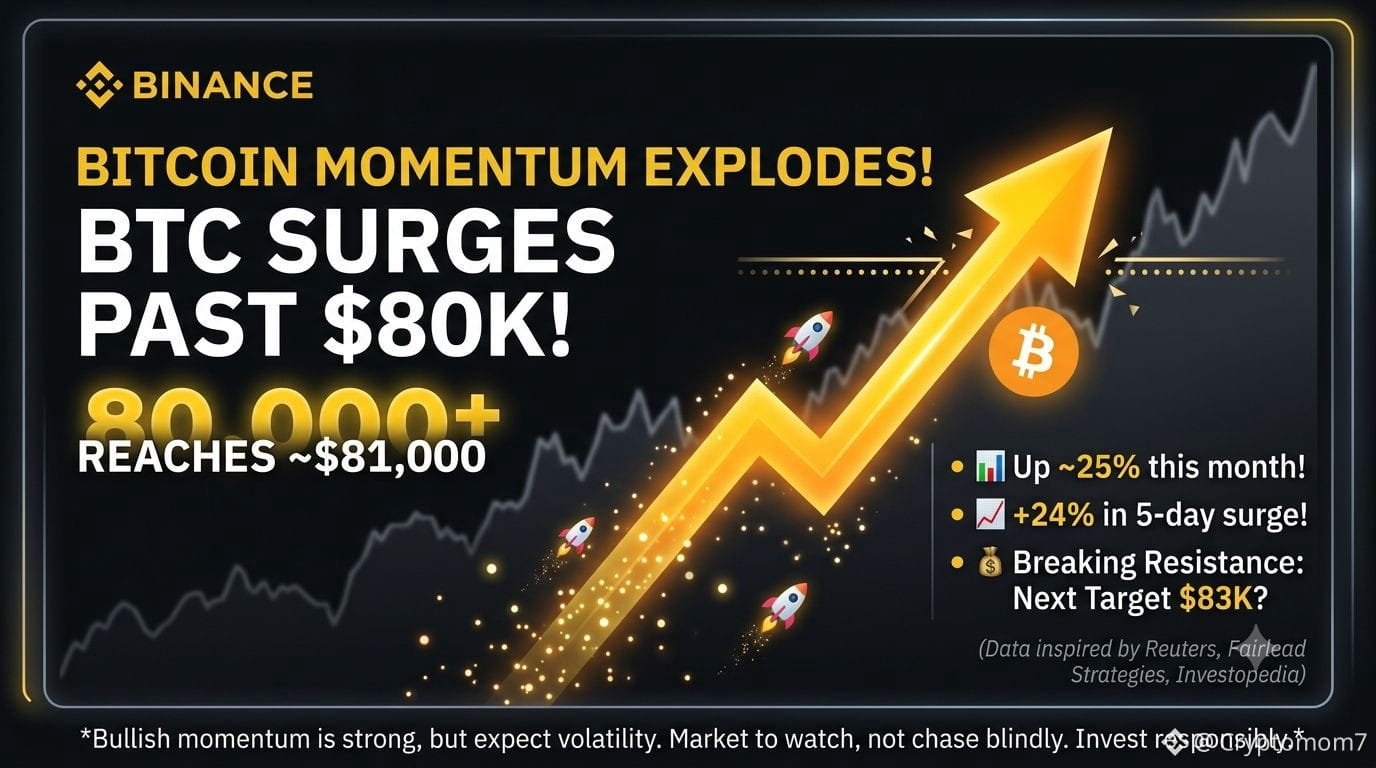
74
Anmelden und weiter Inhalte entdecken
Krypto-Nutzer weltweit auf Binance Square kennenlernen
⚡️ Bleib in Sachen Krypto stets am Puls.
💬 Die weltgrößte Kryptobörse vertraut darauf.
👍 Erhalte verlässliche Einblicke von verifizierten Creators.
E-Mail-Adresse/Telefonnummer
Trendthemen
SaylorHintsStrategyBitcoinBuy
2.2M Aufrufe
11,781 Kommentare
#SaylorHintsStrategyBitcoinBuy
Michael Saylor sendet erneut positive Signale zur Bitcoin-Strategie.
Doch neueste Daten zeigen, dass die Strategie in den letzten Wochen noch keinen Bitcoin gekauft hat. Per 13. September 2026 hält das Unternehmen weiterhin 845.050 BTC sowie rund 6,4 Mrd. USD in USD-basierten Vermögenswerten.
Statt BTC zu kaufen, allokiert die Strategie etwa 139 Mio. USD, um bevorzugte Aktien der STRC zurückzukaufen.
Was bedeutet das für den Markt?
🔹 Strategy hält weiterhin an seinem langfristigen Vertrauen in Bitcoin fest
🔹 Die USD-Reserven bieten Spielraum für den nächsten BTC-Kauf
🔹 Neue Käufe können ein bullischer Katalysator für die institutionelle Stimmung sein
🔹 Doch ein Hinweis ist nicht dasselbe wie ein bestätigter Kauf
Für den Moment muss der Markt zwischen Gerüchten über Akkumulation und offiziellen Einreichungen unterscheiden.
Warten Sie auf die Bestätigung – kaufen Sie nicht nur wegen einer Schlagzeile.
#Bitcoin #BTC #Strategy #MichaelSaylor
$BTC
XaliCoin
·1 Likes
·220 Aufrufe
BOJRaisesRatesTo31YearHigh
199,466 Aufrufe
2,903 Kommentare
BuffettStepsDownAsBerkshireChairman
96,821 Aufrufe
1,531 Kommentare