

#FedRateWatch | Bitcoin Market Analysis
The Fed decision has arrived at a critical moment for Bitcoin.
In our previous #FedRateWatch article, we examined whether a 25-basis-point hike could be a one-off adjustment or the beginning of a longer tightening cycle.
Now the question moves from “What will the Fed do?” to:
“What will Bitcoin do next?”
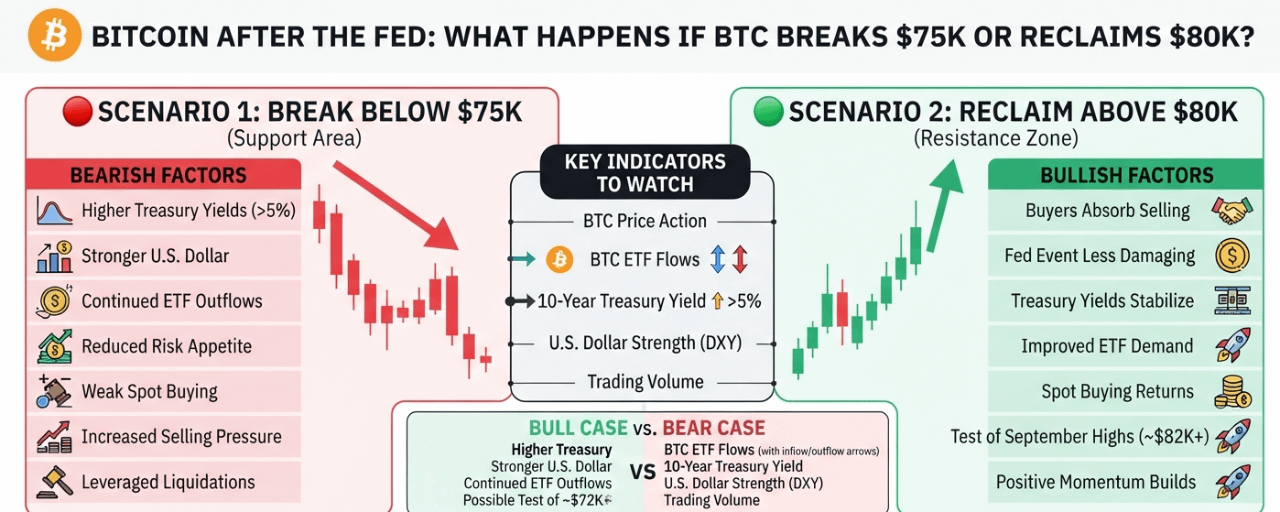
BTC has recently fallen below the $75K area after failing to sustain its recovery toward $80K. At the same time, U.S. Treasury yields have moved near 5%, while ETF flows and broader risk sentiment remain important pieces of the puzzle.
That leaves us with two fascinating levels:
🔴 $75K — Can Bitcoin defend it?
🟢 $80K — Can Bitcoin reclaim it?
Let's examine both scenarios.
Table of Contents
Why $75K and $80K matter
Scenario 1: BTC breaks below $75K
Scenario 2: BTC reclaims $80K
What ETF flows are telling us
Why Treasury yields matter
The $72K possibility
Bull case vs. Bear case
What should investors and spot traders do?
The bigger Bitcoin question
1. Why Do $75K and $80K Matter?
Bitcoin's recent price action has created a clearly defined range for traders to watch.
The market had previously pushed BTC above $80K and briefly above $82K earlier in September. It subsequently retreated toward the mid-$70Ks.
Today, market commentary is identifying roughly $75K–$76K as an important support area, while $79.5K–$80.4K is an important resistance zone. A deeper downside level around $71.7K–$72K is also being watched.
This gives traders a simple framework:
Below $75K → downside risk increases.
Above $80K → recovery momentum could strengthen.
But price levels alone don't tell the whole story.
We need to know why BTC is moving.
2. Scenario 1: What If BTC Breaks Below $75K?
A break below support doesn't automatically mean Bitcoin is entering a major bear market.
But it could signal that buyers are temporarily losing control.
🔴 Bearish factors
A sustained move below $75K could be accompanied by:
• Higher Treasury yields
• A stronger U.S. dollar
• Continued ETF outflows
• Reduced risk appetite
• Weak spot buying
• Increased selling from short-term holders
• More leveraged liquidations
The current environment already contains several of these pressures.
The U.S. 10-year Treasury yield has moved above 5%, while Bitcoin has also been affected by uncertainty surrounding broader financial conditions.
If BTC breaks $75K and fails to reclaim it, traders may begin watching the low-$72K region.
That is particularly interesting because $72K has also appeared in market prediction discussions.
But remember:
A prediction is not a support level.
Price must actually demonstrate buying demand there.
3. Scenario 2: What If BTC Reclaims $80K?
Now let's turn the chart around.
A move back above $80K could change the short-term market structure.
🟢 Bullish factors
A successful reclaim could indicate:
• Buyers are absorbing selling pressure
• The Fed event was less damaging than feared
• Treasury yields stabilize
• ETF demand improves
• Spot buying returns
• Traders begin positioning for another test of the September highs
Bitcoin previously traded above $82K earlier this month, demonstrating that the market can move through the $80K area when momentum is strong.
But I would not consider simply touching $80K a confirmed breakout.
For traders, the interesting question is:
Can BTC stay above $80K?
A quick move above resistance followed by a rejection is very different from a sustained breakout.
4. What Are Bitcoin ETF Flows Telling Us?
This is one of the most important pieces of the puzzle.
Earlier in September, U.S. spot Bitcoin ETFs recorded strong inflows. One report noted approximately $987 million of weekly inflows, extending positive flows for a third consecutive week at that point.
But the picture subsequently became more mixed.
Market data cited on September 16 showed several consecutive days of ETF outflows before a $159.9 million inflow on September 14.
That tells us something important:
Institutional demand is not moving in a straight line.
If ETF inflows strengthen while BTC holds $75K, that could provide an important demand signal.
If outflows continue while BTC loses support, the downside scenario becomes more relevant.
For me, ETF flows are therefore one of the indicators worth watching alongside the price chart.
5. Why Do Treasury Yields Matter?
This is where the Fed story becomes a Bitcoin story.
The U.S. 10-year Treasury yield has recently moved above 5%, creating pressure across several risk-sensitive markets.
Why does this matter to BTC?
When government bonds offer higher yields, investors can reassess how much risk they want to take.
Higher yields can therefore create a tougher environment for assets such as technology stocks and cryptocurrencies.
But there is another side.
If the market eventually believes that inflation is being controlled and the Fed is approaching the end of its tightening path, yields could stabilize.
That could remove one source of pressure from risk assets.
So the key isn't simply:
“Are rates high?”
It is:
“Where are yields going next?”
6. Could Bitcoin Fall Toward $72K?
This is the scenario many traders are watching.
A sustained breakdown below the $75K–$76K support area could expose the low-$72K region, according to current market analysis.
But I would treat $72K as a potential support zone, not a guaranteed destination.
If BTC reaches $72K, what matters is the reaction.
🟢 Bullish reaction
BTC reaches the zone → buyers step in → volume increases → price reclaims broken support.
That could turn a correction into an accumulation opportunity.
🔴 Bearish reaction
BTC reaches $72K → buyers remain weak → price continues making lower lows.
That would suggest the market has not yet found a durable bottom.
The price reaction is more informative than the number itself.
7. Bull Case vs. Bear Case
🟢 Bitcoin Bull Case
The bullish scenario would involve:
$75K holds → ETF demand improves → Treasury yields stabilize → BTC reclaims $80K → momentum strengthens.
A sustained move above $80K could put the September highs back into focus.
🔴 Bitcoin Bear Case
The bearish scenario would be:
$75K breaks → selling accelerates → ETF outflows continue → yields remain elevated → BTC tests $72K.
That could create another period of volatility before the market establishes a new direction.
Neither scenario is guaranteed.
That is exactly why traders should prepare for both.
8. What Should Investors and Spot Traders Do?
For long-term investors
Don't let one Fed announcement determine your entire Bitcoin strategy.
Consider staggered buying rather than putting all available capital into one price.
If BTC falls, having cash available can be valuable.
If BTC rises, you still participate with the BTC already accumulated.
For spot traders
This is a market where patience can matter more than prediction.
Instead of chasing the first green candle after the Fed announcement:
📌 Wait for support confirmation.
📌 Watch volume.
📌 Look for BTC to reclaim broken levels.
📌 Account for trading fees.
📌 Avoid oversized positions.
📌 Don't confuse a temporary price spike with a confirmed breakout.
And most importantly:
Don't chase BTC simply because it moves quickly.
9. The Bigger Bitcoin Question
The next Bitcoin move may not be decided by the Fed alone.
It could be the result of several forces colliding:
Fed policy + Treasury yields + ETF flows + dollar strength + oil + crypto-specific regulation + spot demand.
That's why $75K and $80K are interesting.
They represent two different market stories.
Below $75K:
The market is asking:
“How deep can this correction go?”
Above $80K:
The market starts asking:
“Is Bitcoin ready to challenge the highs again?”
My approach would be to avoid trying to predict the exact candle.
Instead, I would prepare for both scenarios.
$72K could become an accumulation zone if buyers defend it.
$80K could become a momentum zone if Bitcoin reclaims it convincingly.
The most important signal may therefore not be the Fed's 25 bp decision itself.
It may be how Bitcoin behaves after the decision.
Because markets can surprise us.
And Bitcoin has a long history of doing exactly that. ₿
#FedRateWatch #Bitcoin #BTC #BitcoinPrice #CryptoMarket #BitcoinETF #FederalReserve #BTCUSD #SpotTrading #CryptoInvesting