

beer_ford
5.9k Beiträge

beer_ford
Melden
Nutzer blockieren
Trading Master
Trade eröffnen

SOL Halter
Regelmäßiger Trader
3.6 Jahre
352 Following
18.4K+ Follower
11.6K+ Like gegeben
Beiträge
Portfolio
Alle
Zitierungen
Live
·
--
Bullisch
Spot $SHIB 27.6 USDT
Übersetzung ansehen
🚨 SHIB Holder's Big Dilemma: Should I Hold or Sell? 📉💔
Friends, sometimes the crypto market hits you with losses that truly break your heart! I invested around $130 in Shiba Inu ($SHIB ), but looking at the market conditions, my portfolio has shrunk down to just $27.
I am already facing a heavy loss of over $100 on this trade (sitting around -67.87% down)!
Now I'm completely stuck and confused about what my next step should be:
1️⃣ Should I sell it right now to salvage the remaining $27 and try to recover elsewhere?
2️⃣ Or should I hold on to it and wait for a potential comeback in the next bull run? Does SHIB still have what it takes?
I really need advice from the senior traders and friends in this community. What is the smartest move in this situation, and has anyone else been through a similar drop? Please share your thoughts and suggestions in the comments below!
#SHİB #CryptoLoss #BinanceSquare #CryptoAdvice #TradingCommunity

1
46
·
--
Übersetzung ansehen
🚀 Strategic Dip Entry on Solana ($SOL )! Ready for the Next Big Move? 🔥
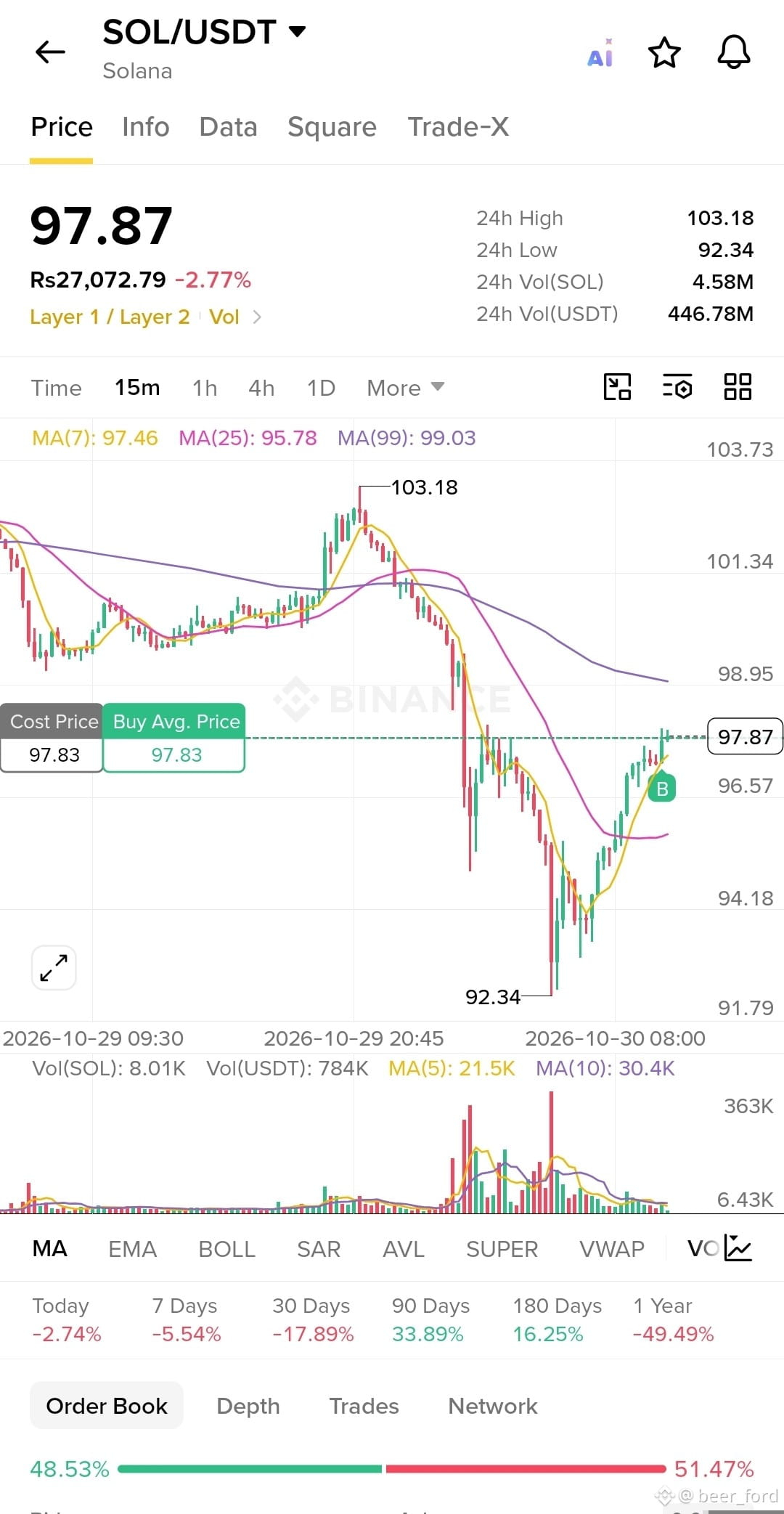
Market volatility always hides the best opportunities. I’ve just taken a fresh long entry on SOL/USDT at an average buy price of 97.83!
Looking at the chart, prices are currently showing strong signs of recovery from a key support zone. After testing a 24-hour low of 92.34, Solana is steadily climbing back up. Could this be the ignition for a major bullish rally?
💡 Trade Setup Snapshot:
* Current Price: 97.87
* Buy Average: 97.83
* 24h High: 103.18
* 24h Low: 92.34
Solana’s high-speed infrastructure and robust ecosystem continue to command major market attention. What are your thoughts? Is this level a solid entry for a long position, or are you waiting for a deeper discount? Let me know in the comments below! 👇
#solana #BinanceSquareTalks #CryptoTradingInsights #Web3 #LongTermValue
1
75
·
--
Übersetzung ansehen
$COTI
COTI works on payments infrastructure and privacy-focused technology, aiming at faster, cheaper transactions. Payments is a crowded field, so differentiation matters. Partnerships and real transaction volume deserve verification from current sources before any conclusion about momentum.
$COTI
COTI works on payments infrastructure and privacy-focused technology, aiming at faster, cheaper transactions. Payments is a crowded field, so differentiation matters. Partnerships and real transaction volume deserve verification from current sources before any conclusion about momentum.
COTI works on payments infrastructure and privacy-focused technology, aiming at faster, cheaper transactions. Payments is a crowded field, so differentiation matters. Partnerships and real transaction volume deserve verification from current sources before any conclusion about momentum.
217
·
--
Übersetzung ansehen
$GLM
Golem rents out spare computing power through a decentralized marketplace, an idea that predates the current AI-compute wave. Timing may now help. Still, demand has to come from paying users, and competition from established cloud providers and newer compute networks is intense.
$GLM
Golem rents out spare computing power through a decentralized marketplace, an idea that predates the current AI-compute wave. Timing may now help. Still, demand has to come from paying users, and competition from established cloud providers and newer compute networks is intense.
Golem rents out spare computing power through a decentralized marketplace, an idea that predates the current AI-compute wave. Timing may now help. Still, demand has to come from paying users, and competition from established cloud providers and newer compute networks is intense.
40
·
--
Übersetzung ansehen
$ZIL
Zilliqa was an early sharding project that later shifted toward EVM compatibility, a pragmatic change. Compatibility helps attract developers, but it also puts the chain in direct competition with far larger ecosystems. Differentiation is the key puzzle.
$ZIL
Zilliqa was an early sharding project that later shifted toward EVM compatibility, a pragmatic change. Compatibility helps attract developers, but it also puts the chain in direct competition with far larger ecosystems. Differentiation is the key puzzle.
Zilliqa was an early sharding project that later shifted toward EVM compatibility, a pragmatic change. Compatibility helps attract developers, but it also puts the chain in direct competition with far larger ecosystems. Differentiation is the key puzzle.
110
·
--
Übersetzung ansehen
$ONT
Ontology focuses on decentralized identity and data, a theme with long-term logic and slow commercial traction. Identity infrastructure needs adoption by institutions and apps to matter. Developer activity and live integrations deserve more attention than roadmap announcements.
$ONT
Ontology focuses on decentralized identity and data, a theme with long-term logic and slow commercial traction. Identity infrastructure needs adoption by institutions and apps to matter. Developer activity and live integrations deserve more attention than roadmap announcements.
Ontology focuses on decentralized identity and data, a theme with long-term logic and slow commercial traction. Identity infrastructure needs adoption by institutions and apps to matter. Developer activity and live integrations deserve more attention than roadmap announcements.
45
·
--
Übersetzung ansehen
$LPT
Livepeer offers decentralized video transcoding, a practical, compute-heavy service. Demand comes from real workloads, which makes it more concrete than many narratives. Competing with centralized cloud pricing remains the difficulty, so fee revenue versus token inflation is the metric to follow.
Livepeer offers decentralized video transcoding, a practical, compute-heavy service. Demand comes from real workloads, which makes it more concrete than many narratives. Competing with centralized cloud pricing remains the difficulty, so fee revenue versus token inflation is the metric to follow.
63
·
--
Übersetzung ansehen
$RPL
Rocket Pool lets people stake ETH without running a full validator, lowering the entry barrier to decentralized staking. Its node-operator model is a genuine design strength. The pressure comes from larger liquid staking rivals, so growth depends on whether decentralization alone is enough to win users.
Rocket Pool lets people stake ETH without running a full validator, lowering the entry barrier to decentralized staking. Its node-operator model is a genuine design strength. The pressure comes from larger liquid staking rivals, so growth depends on whether decentralization alone is enough to win users.
51
·
--
Übersetzung ansehen
$CFX
Conflux has positioned itself as a China-linked public chain operating within regulatory boundaries, which is an unusual strategic path. That could be an advantage or a ceiling. Watch real application usage and cross-border developer interest rather than relying on the regulatory-compliance narrative alone.
Conflux has positioned itself as a China-linked public chain operating within regulatory boundaries, which is an unusual strategic path. That could be an advantage or a ceiling. Watch real application usage and cross-border developer interest rather than relying on the regulatory-compliance narrative alone.
106
·
--
Übersetzung ansehen
$QTUM
Qtum blends Bitcoin's UTXO model with smart contract capability, an old idea from an earlier cycle. Its challenge is simple: newer chains have attracted most of the builders. Without visible application growth, technical hybrids tend to fade from conversation, whatever their design merits.
$QTUM
Qtum blends Bitcoin's UTXO model with smart contract capability, an old idea from an earlier cycle. Its challenge is simple: newer chains have attracted most of the builders. Without visible application growth, technical hybrids tend to fade from conversation, whatever their design merits.
Qtum blends Bitcoin's UTXO model with smart contract capability, an old idea from an earlier cycle. Its challenge is simple: newer chains have attracted most of the builders. Without visible application growth, technical hybrids tend to fade from conversation, whatever their design merits.
45
·
--
Übersetzung ansehen
$KSM
{future}(KSMUSDT)
Kusama serves as Polkadot's experimental sibling, where teams test ideas with real economic stakes before moving to the main network. That role is useful but depends on Polkadot's own momentum. If developer attention shifts elsewhere, a testing ground can quickly lose its audience.
$KSM
Kusama serves as Polkadot's experimental sibling, where teams test ideas with real economic stakes before moving to the main network. That role is useful but depends on Polkadot's own momentum. If developer attention shifts elsewhere, a testing ground can quickly lose its audience.
Kusama serves as Polkadot's experimental sibling, where teams test ideas with real economic stakes before moving to the main network. That role is useful but depends on Polkadot's own momentum. If developer attention shifts elsewhere, a testing ground can quickly lose its audience.
62
·
--
Übersetzung ansehen
$MASK
Mask Network brings crypto features into social platforms, letting users interact with Web3 tools inside familiar apps. Social integration is a hard distribution problem, because platform policies can change. User numbers worth checking from current sources would say more than the concept does.
Mask Network brings crypto features into social platforms, letting users interact with Web3 tools inside familiar apps. Social integration is a hard distribution problem, because platform policies can change. User numbers worth checking from current sources would say more than the concept does.
1
77
·
--
Übersetzung ansehen
$GAS
Neo’s dual-token structure separates network utility from governance-related functions, making its ecosystem economics worth examining. GAS demand is connected to network operations and application activity. The key question is whether real usage expands enough to support consistent utility beyond temporary market speculation.
Neo’s dual-token structure separates network utility from governance-related functions, making its ecosystem economics worth examining. GAS demand is connected to network operations and application activity. The key question is whether real usage expands enough to support consistent utility beyond temporary market speculation.
48
·
--
Übersetzung ansehen
$RVN
Tokenizing real-world assets requires more than issuing digital representations. Ravencoin focuses on asset creation and transfer, but practical adoption depends on user experience, market access, and trusted processes. Its long-term potential rests on whether individuals and businesses find the network useful for actual asset-related activity.
Tokenizing real-world assets requires more than issuing digital representations. Ravencoin focuses on asset creation and transfer, but practical adoption depends on user experience, market access, and trusted processes. Its long-term potential rests on whether individuals and businesses find the network useful for actual asset-related activity.
1
224
·
--
Übersetzung ansehen
$ONT
Digital identity is becoming increasingly important across online services, but privacy and interoperability remain difficult challenges. Ontology’s approach needs practical integrations that let users verify information without unnecessary exposure. Developer adoption and repeat usage will provide stronger evidence of progress than broad identity-sector predictions.
Digital identity is becoming increasingly important across online services, but privacy and interoperability remain difficult challenges. Ontology’s approach needs practical integrations that let users verify information without unnecessary exposure. Developer adoption and repeat usage will provide stronger evidence of progress than broad identity-sector predictions.
66
·
--
Übersetzung ansehen
$SC
{spot}(SCUSDT)
Decentralized storage competes on reliability, retrieval speed, and cost—not just available capacity. Siacoin’s ecosystem must demonstrate that distributed storage can serve practical customer needs consistently. Paying demand, storage-provider participation, and dependable retrieval are important indicators when assessing whether the model can compete with centralized alternatives.
$SC
Decentralized storage competes on reliability, retrieval speed, and cost—not just available capacity. Siacoin’s ecosystem must demonstrate that distributed storage can serve practical customer needs consistently. Paying demand, storage-provider participation, and dependable retrieval are important indicators when assessing whether the model can compete with centralized alternatives.
Decentralized storage competes on reliability, retrieval speed, and cost—not just available capacity. Siacoin’s ecosystem must demonstrate that distributed storage can serve practical customer needs consistently. Paying demand, storage-provider participation, and dependable retrieval are important indicators when assessing whether the model can compete with centralized alternatives.
67
·
--
Übersetzung ansehen
$DUSK
{future}(DUSKUSDT)
Financial institutions exploring blockchain infrastructure need privacy, compliance, and efficient settlement to work together. Dusk focuses on this intersection, but real adoption requires more than a promising technical design. Regulatory clarity, production deployments, ecosystem partnerships, and practical transaction demand will determine whether its approach gains traction.
$DUSK
Financial institutions exploring blockchain infrastructure need privacy, compliance, and efficient settlement to work together. Dusk focuses on this intersection, but real adoption requires more than a promising technical design. Regulatory clarity, production deployments, ecosystem partnerships, and practical transaction demand will determine whether its approach gains traction.
Financial institutions exploring blockchain infrastructure need privacy, compliance, and efficient settlement to work together. Dusk focuses on this intersection, but real adoption requires more than a promising technical design. Regulatory clarity, production deployments, ecosystem partnerships, and practical transaction demand will determine whether its approach gains traction.
160
·
--
Übersetzung ansehen
$CVX
{future}(CVXUSDT)
Convex sits on top of Curve, helping users earn boosted rewards without locking CRV themselves. Its fortunes are therefore tied to Curve's relevance. Derivative layers can thrive when the base protocol does, and weaken together when incentive-driven liquidity moves elsewhere.
$CVX
Convex sits on top of Curve, helping users earn boosted rewards without locking CRV themselves. Its fortunes are therefore tied to Curve's relevance. Derivative layers can thrive when the base protocol does, and weaken together when incentive-driven liquidity moves elsewhere.
Convex sits on top of Curve, helping users earn boosted rewards without locking CRV themselves. Its fortunes are therefore tied to Curve's relevance. Derivative layers can thrive when the base protocol does, and weaken together when incentive-driven liquidity moves elsewhere.
46
·
--
$SKL
{future}(SKLUSDT)
SKALE bietet Ethereum-kompatible Chains ohne Gasgebühren für Endnutzer, da Entwickler die Kosten über das Token-Modell abdecken. Das ist für Spiele und Anwendungen mit hoher Nutzungsfrequenz attraktiv. Offen bleibt, ob sich genügend Anwendungen dafür entscheiden, um eine stetige Nachfrage nach dem Token des Netzwerks zu erzeugen.
$SKL
SKALE bietet Ethereum-kompatible Chains ohne Gasgebühren für Endnutzer, da Entwickler die Kosten über das Token-Modell abdecken. Das ist für Spiele und Anwendungen mit hoher Nutzungsfrequenz attraktiv. Offen bleibt, ob sich genügend Anwendungen dafür entscheiden, um eine stetige Nachfrage nach dem Token des Netzwerks zu erzeugen.
SKALE bietet Ethereum-kompatible Chains ohne Gasgebühren für Endnutzer, da Entwickler die Kosten über das Token-Modell abdecken. Das ist für Spiele und Anwendungen mit hoher Nutzungsfrequenz attraktiv. Offen bleibt, ob sich genügend Anwendungen dafür entscheiden, um eine stetige Nachfrage nach dem Token des Netzwerks zu erzeugen.
124
·
--
$YFI
{future}(YFIUSDT)
Yearn automatisiert Renditestrategien, sodass Nutzer nicht selbst nach Erträgen suchen müssen. Das Projekt ist ein DeFi-Veteran mit einem bekanntermaßen geringen Angebot und einem Ruf für Disziplin. Doch die Renditeaggregation ist eine reife, wettbewerbsintensive Nische, und das Wachstum hängt davon ab, ob neue Nutzer diese Abstraktion weiterhin benötigen.
$YFI
Yearn automatisiert Renditestrategien, sodass Nutzer nicht selbst nach Erträgen suchen müssen. Das Projekt ist ein DeFi-Veteran mit einem bekanntermaßen geringen Angebot und einem Ruf für Disziplin. Doch die Renditeaggregation ist eine reife, wettbewerbsintensive Nische, und das Wachstum hängt davon ab, ob neue Nutzer diese Abstraktion weiterhin benötigen.
Yearn automatisiert Renditestrategien, sodass Nutzer nicht selbst nach Erträgen suchen müssen. Das Projekt ist ein DeFi-Veteran mit einem bekanntermaßen geringen Angebot und einem Ruf für Disziplin. Doch die Renditeaggregation ist eine reife, wettbewerbsintensive Nische, und das Wachstum hängt davon ab, ob neue Nutzer diese Abstraktion weiterhin benötigen.
224
Anmelden und weiter Inhalte entdecken
Krypto-Nutzer weltweit auf Binance Square kennenlernen
⚡️ Bleib in Sachen Krypto stets am Puls.
💬 Die weltgrößte Kryptobörse vertraut darauf.
👍 Erhalte verlässliche Einblicke von verifizierten Creators.
E-Mail-Adresse/Telefonnummer
Trendthemen
$1.5BInLeveragedCryptoBetsLiquidated
398 Aufrufe
21 Kommentare
Tokenisierung von Immobilien: Der nächste große Schritt ist mehr Zugänglichkeit
Chasity Cybulski fHrS
·1 Likes
·24 Aufrufe
KOSPIFalls3.53%BackBelow6000
1,812 Aufrufe
81 Kommentare
USMidtermElections
101,948 Aufrufe
1,309 Kommentare