
QubicNews
384 Beiträge

QubicNews
Melden
Nutzer blockieren
🚀 Qubic redefines blockchain with uPoW, turning computing power into AI training. Enjoy feeless txs, sub-second finality, & bare-metal smart contracts.
Trade eröffnen
Gelegenheitstrader
6.9 Jahre
546 Following
164 Follower
196 Like gegeben
Beiträge
Portfolio
Alle
Zitierungen
Videos
PINNED
·
--
Artikel
Übersetzung ansehen
Who Designs the Brain? Neural Architecture Search in Game of Life, ARC-AGI-3 and Neuraxon 3.0What Is Neural Architecture Search (NAS)?
In every neural network we need to distinguish two levels of design. One is what it learns, the strength of its connections. The other is how it is built, which means how many units it has, how they connect and by what rules they change. Neural architecture search, known by its acronym #NAS (Neural Architecture Search), automates that second level.
Think of a high-quality restaurant. The chef learns recipes through practice, and this resembles the training of a network. The chef keeps adjusting millions of nuances until the result comes out right. But before anything was cooked, someone had to design the kitchen. How many burners, where the oven goes, how much space there is between the fridge and the plating table, how many tables, how supplies arrive, at what temperature to freeze which foods. That design is not learned by cooking, but it influences which dishes can be made and how fast. In a neural network, the kitchen is, so to speak, the architecture.
The Three Components of Neural Architecture Search
NAS is the set of methods that search for that architecture automatically. Any method of this kind has three components (Elsken, 2019).
The first is the search space. It is the catalogue of possible designs, for example how many layers, which operations or which connections are allowed.
The second is the search strategy, that is, how that catalogue is explored.
The third is performance estimation. How do we decide whether a design is good without having to train it fully? That is what takes the most time.
Figure 1. Every neural architecture search method has the same three parts: a search space of possible designs, a search strategy that picks candidates from it, and a performance estimate that tells the strategy how good each candidate is. Image: Neural Architecture Search: A Survey, Figure 1, by Thomas Elsken, Jan Hendrik Metzen and Frank Hutter, Journal of Machine Learning Research (CC BY 4.0)
Four Neural Architecture Search Strategies
The best-known strategies are four.
The simplest is to try designs at random, an idea that seems naive but turns out to be surprisingly hard to beat (Bergstra & Bengio, 2012).The evolutionary strategy treats each design as a genome, keeps the best, mutates them and repeats; it has a long tradition in neuroevolution (Stanley & Miikkulainen, 2002) and produced the first evolved image classifier to outperform hand-designed ones (Real et al., 2019).The reinforcement learning strategy trains a second network to propose architectures and rewards it when they succeed (Zoph & Le, 2017).The differentiable strategy turns the choice between options into a continuous mixture that can be optimised with gradients, just like the weights themselves (Liu, Simonyan & Yang, 2019).
Neural Architecture Search vs Hyperparameter Optimization
NAS should not be confused with hyperparameter tuning.
Adjusting the learning rate of an already designed network is fine-tuning. Deciding what kind of network it is, and by what internal rules it operates, is searching for its architecture. In fact, one of the most useful conclusions in the field is that NAS behaves as a particular case of hyperparameter optimization, and that it should therefore always be compared with a random search carried out on the same budget (Li & Talwalkar, 2020).
Where Is Neural Architecture Search Needed in Everyday Life?
The closest case is the mobile phone.
When the phone camera recognizes that we are photographing a plate of food or a document, and adjusts the image without connecting to the internet, a neural network is running on a small processor, with little battery and no room to wait. MobileNetV3, one of the most widely used network families in phones, was obtained through an architecture search that took into account the actual response time on a phone processor. The result was more accurate and 15% faster than its hand-designed predecessor (Howard et al., 2019).
That is the general pattern. NAS becomes necessary when the same task has to be solved under very different conditions, and designing a network by hand for each condition is unfeasible. Think of a hearing aid that has to separate the voice of the person talking to us from the noise of a bar. The task is similar to that of a voice assistant, but the hearing aid has a tiny battery and only a few milliseconds before the delay becomes noticeable. Or of a watch that monitors heart rate for days without recharging. Or of a car's emergency braking system, which has to decide before the obstacle is upon it. Or of a robot vacuum with a cheap chip that must recognise a cable on the floor. In all these cases the question is not only which network is most accurate, but which network is accurate enough within limits of energy, memory and time. With dozens of devices and combined limits, the number of possible designs grows quickly.
There is a second kind of situation, closer to our own work. Sometimes we do not know what architecture a problem needs because the problem is new. No one has ever designed a network to play games whose rules are discovered by playing. In that case NAS is not a way of saving engineering work. It is a way of asking the problem what structure suits it.
How Evolution Solved Architecture Search, and What Large Language Models Do
The brain also has two levels of design, and it keeps them clearly separate.
What we learn throughout life changes the strength of synapses.
But the architecture on which that learning takes place, which regions exist, how they connect to one another, what types of neurons there are and by what rules they change, has been searched for by evolution over hundreds of millions of years. Evolution is, in this sense, the longest architecture search we know of.
Zador (2019) pointed out that the genome lacks the capacity to specify every connection in the brain because it falls several orders of magnitude short in information. What it transmits is not a wiring diagram, but rules for building one. Zador called this limitation the genomic bottleneck and proposed that it is not a defect but an advantage, since it forces evolution to select compact architectures that generalise well and learn quickly. That is why many animals are born knowing how to do complex things, and why they learn others in just a few attempts.
Hinton and Nowlan (1987) added the other half of the idea, in what became the classic demonstration of the Baldwin effect. In a simulation they showed that learning during life guides evolution, since an organism capable of learning survives even if its initial design is not perfect, and that gives natural selection something to work on. The consequence is important for any bio-inspired NAS. What evolution selects is not just good built-in behaviour, but a good capacity to learn.
Figure 2. When instinct and learning end at the same level of performance, the strongly innate strategy wins (a). Learning pays off when it lets a species climb higher than instinct alone (b), the trade-off behind evolution selecting a good capacity to learn. Image: A critique of pure learning and what artificial neural networks can learn from animal brains, Figure 2, by Anthony M. Zador, Nature Communications (CC BY 4.0)
Large language models follow a different path. Their architecture, the Transformer, was designed by hand and has changed relatively little in its essentials since 2017. There have been automated searches over it (So, 2019), but the bulk of progress has come from increasing size, data and compute, not from searching for new structures. And, once trained, the model does not change while it is used. It has an architecture and it has weights, but it lacks what evolution selected in animals: an architecture chosen precisely to keep learning.
What Can Go Wrong? Three Traps in Neural Architecture Search
NAS has three well-known traps, and all three have affected us.
The first is the winner's curse.
When thousands of designs are tested and the best one is chosen, part of its advantage is luck. For example, it happened to get a favourable game, a lucky random seed. When it is tested under new conditions, that part disappears and performance drops. It is the same problem that in psychometrics leads us not to validate a test with the sample used to build it. In machine learning it is well documented. It is the bias of selecting with the same data that are later used for reporting, which can be as large as the differences between methods (Cawley & Talbot, 2010). The solution is always to separate the data used for selection from the data used for reporting.
The second is the lack of a baseline.
A NAS result means nothing unless it is compared with what a random search would have achieved on the same budget, and with what a brainless agent acting at random achieves. Li and Talwalkar (2020) showed that well-executed random searches matched methods published as advances, and that almost no work in the field could be reproduced exactly because the seeds were not reported.
The third is optimising what does not matter.
The search finds exactly what the evaluation function rewards. If that function measures something different from what we want, the search will exploit it efficiently. It is Goodhart's law (1984) applied to the design of brains.
NAS in the Game of Life: Evolutionary Neural Architecture Search
Neuraxon's Game of Life is an artificial world in which hundreds of agents, each with a #Neuraxon brain organised into functional spheres, look for food, reproduce and die. Each agent inherits from its parents the parameters with which its brain is built: how long a neuron takes to fire again, what threshold it needs to become active, how its synapses change. Those parameters are its genome, and reproduction with mutation is an evolutionary neural architecture search that runs non-stop, around the clock. It is the version of NAS closest to what biological evolution did.
Figure 3. A round of Neuraxon’s Game of Life: each agent on the globe carries its own Neuraxon brain, built from parameters it inherits from its parents, and the population evolves as agents find food, reproduce and die. Image: Neuraxon Game of Life 4.0 by David Vivancos and Jose Sánchez, GitHub (MIT License)
The first lesson was about what gets selected.
For several versions, selective pressure came from ecological success: food found, territory explored, offspring left behind. When heritability was measured using almost thirty thousand parent-offspring pairs, the correlation of ecological success across generations turned out to be practically zero, at 0.02.
Success depended on where food appeared and on who arrived first, and luck is not inherited. By contrast, a set of internal criteria for brain function that we had defined on the basis of neuroscience, such as maintaining a balance between excitation and inhibition or activity close to the critical regime, showed a correlation of 0.56 across generations, stable across five different populations. When we selected for those criteria, the population changed within days. Selection can only act on what is inherited, and a world that is too noisy turns any search into a random walk.
The second lesson was about the search space.
Of the nineteen parameters that evolution could modify, only two had a noticeable effect: the refractory period and the activation threshold of excitatory neurons. The remaining seventeen, including all the plasticity parameters, showed correlations with the outcome below 0.05. A large search space is not a rich search space. Much of it was noise that the search had to cross without gaining anything.
The third lesson is the most uncomfortable. Selecting brains that meet our criteria for good functioning does not show that those brains learn from the world. To know that, behaviour has to be measured, that is, whether the agent approaches food because it perceives it, and whether it changes what it does after making a mistake. That direct measure of learning is the piece we are still missing in the Game of Life, and without it we will not consider anything about learning to be demonstrated. Part of this work has been presented at the 17th International Conference on Artificial Evolution (Nice, 27 to 29 October 2026).
NAS in ARC-AGI-3: Breeding Brains for Games Without Instructions
#ARC -#AGI -3 is a set of interactive games in which no one explains the rules. The player sees a grid of colours, presses a key or clicks, observes what changes and has to work out what is being asked. The score rewards clearing levels with few actions, compared with what a person needs. There are 25 public games for development and 55 hidden ones used for evaluation at the end of the competition.
Our agent is a Neuraxon brain that receives the grid as numbers, chooses an action and learns during the game thanks to its plasticity.
What NAS decides is how that brain is built before it starts playing: which part of the screen it attends to, how it translates colours into inputs, how much it explores versus how much it repeats what worked, what range of clicks it considers. The process has three phases. First, brains are bred by evolution on a specific game. Then, thousands of them sit a short exam with few games and few seeds, that is, variants of the same game with a different initial layout. Finally, the best ones sit a long exam with all 25 games and seeds that were not used to select them. In total we have tested more than 110 search configurations and millions of evolved brains, on a cluster of about 500 processor cores and without a single GPU, and the best score on the offline Kaggle version has reached 0.38.
Studying the public games, watching human playthroughs and reading analyses in order to decide which search space and which selection criterion to use is legitimate. It is what evolution does with a species, in which the design of the brain incorporates regularities of the environment in which its ancestors lived. What would not be legitimate is giving that information to the agent while it plays. NAS may know things about the genre of the games, but the brain that plays must know nothing about the specific game.
The results have taught us the three traps we discussed.
The winner's curse appeared clearly. There was a group of brains that cleared a game on every seed used to select them and did not clear it on any of the new seeds. Successes were concentrated in a few games and almost always at the first level, which forces a comparison with an agent that presses keys at random with the same number of actions, in order to distinguish generalisation from the mere ease of a game. And what cleared a level was not always learning the rules. In simple games, a fixed policy and some exploration can be enough, like a bird pecking until it finds something. From this we drew three rules for everything ahead, which are to select with some seeds and report with others, to set aside public games that the search never touches, and always to subtract the random baseline.
The underlying lesson is the same as in the Game of Life, seen from the opposite side. There we knew how the brain worked inside, but not what it did in the world. Here we see what it does in the game, but NAS selects the final result and does not tell us whether there is learning inside. The teams that have performed best in the preliminary phases of the competition agree in that they predict what will change on the screen before acting and learn from their errors. That is the direction we are taking.
NAS in Neuraxon 3.0: Searching for Brain-Inspired Learning Mechanisms
Neuraxon 3.0 is the architectural response to what ARC-AGI-3 showed us. Our brains explore and adapt within a game, but they do not set themselves goals or chain actions together to reach them. The new version, still in design, adds biologically grounded mechanisms that operate on different timescales. These are a plasticity that depends on the order of spikes, synaptic tags that wait for a neuromodulatory signal for seconds before consolidating, a behavioural-timescale plasticity inspired by the hippocampus, astrocytic domains that decide how much a group of synapses can change, and a multi-scale homeostasis that keeps the network stable without freezing it.
In this context NAS changes its role. It no longer looks for a network that wins a game, but answers a scientific question: which mechanisms and which time constants are necessary to learn in new environments.
The two previous lessons shape that search. From the Game of Life we take that a search space with many inert parameters only adds noise. That is why the search in 3.0 is set over mechanisms, each with a range of values bounded by physiology, and each mechanism can be switched off to measure what it contributes. From ARC-AGI-3 we take that the selection criterion has to measure learning and not just outcome. The proposal is to reward how quickly the brain reduces its prediction error per action in games it has not seen. A brain that succeeds by luck has no advantage under that criterion; one that learns does.
The experimental design is fixed before looking at the data. The architecture selection is sealed, recorded with a digital fingerprint (a cryptographic hash), before the test set is generated, so that it cannot be adjusted after the fact. Every search is compared with a random search on the same budget. Comparisons use paired seeds, are corrected for multiple comparisons and have a minimum effect size declared in advance, without stopping experiments when the result looks favourable.
Neuraxon 3.0 is today an architecture in design with preliminary tests, and the architecture search protocol is a protocol, not a result. We will publish it when the full experiments are done, whatever their conclusion.
Why Neural Architecture Search Matters for Qubic: Decentralized AI and Blockchain Security
NAS is usually presented as an engineering tool for saving human work, and it is one. In our case it is also something more: the evolutionary part of a system that aims to resemble an organism. An organism does not come into the world as a blank slate. It arrives with an architecture that millions of generations tuned so that learning would be easy, and with it, it learns what its particular life demands of it.
What we have learned in the Game of Life and in ARC-AGI-3 can be summed up in an idea from Hinton and Nowlan (1987): architecture search and learning do not compete, they need each other. That is why this form of NAS fits with #Qubic . An evolutionary search is a massively parallel process, in which each processor evaluates its own candidates without needing the others. With the evolutionary component already deployed on the network's own compute, that search can be distributed across thousands of nodes that no one controls exclusively. The same Byzantine fault-tolerant quorum that provides Qubic's blockchain security can verify each result. We do not yet know what architectures it will find. We know what questions it has to answer and how to check honestly whether it has answered them.
References
Bergstra, J., & Bengio, Y. (2012). Random search for hyper-parameter optimization. Journal of Machine Learning Research, 13, 281-305. https://www.jmlr.org/papers/v13/bergstra12a.htmlCawley, G. C., & Talbot, N. L. C. (2010). On over-fitting in model selection and subsequent selection bias in performance evaluation. Journal of Machine Learning Research, 11, 2079-2107. https://www.jmlr.org/papers/v11/cawley10a.htmlElsken, T., Metzen, J. H., & Hutter, F. (2019). Neural architecture search: A survey. Journal of Machine Learning Research, 20(55), 1-21. https://www.jmlr.org/papers/v20/18-598.htmlGoodhart, C. A. E. (1984). Problems of monetary management: The UK experience. In Monetary theory and practice (pp. 91-121). Macmillan. https://doi.org/10.1007/978-1-349-17295-5_4Hinton, G. E., & Nowlan, S. J. (1987). How learning can guide evolution. Complex Systems, 1(3), 495-502. https://www.complex-systems.com/abstracts/v01_i03_a06/Howard, A., Sandler, M., Chu, G., Chen, L.-C., Chen, B., Tan, M., Wang, W., Zhu, Y., Pang, R., Vasudevan, V., Le, Q. V., & Adam, H. (2019). Searching for MobileNetV3. In Proceedings of the IEEE/CVF International Conference on Computer Vision (pp. 1314-1324). https://doi.org/10.1109/ICCV.2019.00140Li, L., & Talwalkar, A. (2020). Random search and reproducibility for neural architecture search. In Proceedings of the 35th Uncertainty in Artificial Intelligence Conference (PMLR 115, pp. 367-377). https://proceedings.mlr.press/v115/li20c.htmlLiu, H., Simonyan, K., & Yang, Y. (2019). DARTS: Differentiable architecture search. In International Conference on Learning Representations. https://doi.org/10.48550/arXiv.1806.09055Real, E., Aggarwal, A., Huang, Y., & Le, Q. V. (2019). Regularized evolution for image classifier architecture search. Proceedings of the AAAI Conference on Artificial Intelligence, 33(01), 4780-4789. https://doi.org/10.1609/aaai.v33i01.33014780So, D. R., Liang, C., & Le, Q. V. (2019). The evolved transformer. In Proceedings of the 36th International Conference on Machine Learning (PMLR 97, pp. 5877-5886). https://proceedings.mlr.press/v97/so19a.htmlStanley, K. O., & Miikkulainen, R. (2002). Evolving neural networks through augmenting topologies. Evolutionary Computation, 10(2), 99-127. https://doi.org/10.1162/106365602320169811Zador, A. M. (2019). A critique of pure learning and what artificial neural networks can learn from animal brains. Nature Communications, 10, 3770. https://doi.org/10.1038/s41467-019-11786-6Zoph, B., & Le, Q. V. (2017). Neural architecture search with reinforcement learning. In International Conference on Learning Representations. https://doi.org/10.48550/arXiv.1611.01578
Explore the Neuraxon Intelligence Academy Series
The Neuraxon Intelligence Academy (NIA) is Qubic's ongoing research series on brain-inspired, decentralized artificial general intelligence. Catch up on the previous thirteen volumes:
[NIA Volume 1](https://www.binance.com/en/square/post/295315343732018): Why Intelligence Is Not Computed in Steps, but in Time — Explores why biological intelligence operates in continuous time rather than discrete computational steps like traditional LLMs.[NIA Volume 2](https://www.binance.com/en/square/post/295304276561778): Ternary Dynamics as a Model of Living Intelligence — Explains ternary dynamics and why three-state logic (excitatory, neutral, inhibitory) matters for modeling living systems.[NIA Volume 3](https://www.binance.com/en/square/post/295306656801506): Neuromodulation and Brain-Inspired AI — Covers neuromodulation and how the brain's chemical signaling (dopamine, serotonin, acetylcholine, norepinephrine) inspires Neuraxon's architecture.[NIA Volume 4](https://www.binance.com/en/square/post/295302152913618): Neural Networks in AI and Neuroscience — A deep comparison of biological neural networks, artificial neural networks, and Neuraxon's third-path approach.[NIA Volume 5](https://www.binance.com/en/square/post/302913958960674): Astrocytes and Brain-Inspired AI — How astrocytic gating transforms neural network plasticity through the AGMP framework in Neuraxon.[NIA Volume 6](https://www.binance.com/en/square/post/310198879866145): Conscious Machines vs Intelligent Organisms: AI Consciousness Explained — Explores AI consciousness through the lens of Global Workspace Theory, Integrated Information Theory, and predictive coding.[NIA Volume 7](https://www.binance.com/en/square/post/321350661453970): Conway's Game of Life, Artificial Life, and Digital Ecosystems — The science behind Qubic, Aigarth, and Neuraxon's emergent complexity and self-organized criticality.[NIA Volume 8](https://www.binance.com/en/square/post/322900066069841): Brain Criticality and the Branching Ratio in Neural and Artificial Networks — Why a branching ratio near 1 and self-organized criticality are bioinspired design principles in Neuraxon.[NIA Volume 9](https://www.binance.com/en/square/post/328379422341521): The Origins of the g Factor: From Education and Neuroscience to Artificial Intelligence — Explores the origins of the g factor across education, neuroscience, and AI.[NIA Volume 10](https://www.binance.com/en/square/post/332806106415490): How Do We Measure the Intelligence of a Machine? The g Factor, ARC-AGI, and the Future of AI Evaluation — The g factor, François Chollet's ARC-AGI benchmark, data contamination in LLM evaluation, and why skill-acquisition efficiency is the real test of intelligence.[NIA Volume 11](https://www.binance.com/en/square/post/342567558192178): What Is AGI? The Limits, Visions & Definitions of Artificial General IntelligenceNIA Vol. 12: [How Does the Brain Handle Time: Distributed Clocks & AI Limits](https://www.binance.com/en/square/post/367122949308226)NIA Vol. 13: OpenAI Says "AGI Is Here": What GPT-6 Astra Actually Proves
You are reading NIA Vol. 14: Who Designs the Brain? Neural Architecture Search in Game of Life, ARC-AGI-3 and Neuraxon 3.0.
Further Reading: Authoritative External Sources
Neural Architecture Search: A Survey, Elsken, Metzen and Hutter (JMLR): the survey that sets out the three components of NAS used in this volume.A Critique of Pure Learning, Anthony Zador (Nature Communications): the genomic bottleneck and what artificial neural networks can learn from animal brains.ARC-AGI-3: A New Challenge for Frontier Agentic Intelligence, ARC Prize Foundation (arXiv): how the benchmark's games are built and scored against human action efficiency.Attention Is All You Need, Vaswani et al. (arXiv): the 2017 paper that introduced the Transformer architecture.Synaptic Modifications in Cultured Hippocampal Neurons, Bi and Poo (Journal of Neuroscience): the classic study showing that plasticity depends on the order of spikes.Synaptic Tagging and Long-Term Potentiation, Frey and Morris (Nature): the original study of synaptic tags that wait for a later signal before consolidating.Behavioral Time Scale Synaptic Plasticity Underlies CA1 Place Fields, Bittner et al. (Science): hippocampal plasticity that links events seconds apart.Useful Proof of Work (UPoW) and AI, Qubic Docs: how Qubic directs mining power toward training neural networks.Quorum Consensus Explained: How Qubic Makes Blockchain Decisions Without a Central Authority, Qubic: how 451 of 676 Computors keep the network safe even if up to 225 of them fail or act maliciously.Quantum Proof Crypto: Threats, Standards and Qubic Security, Qubic: how quantum computing could threaten crypto security, and what protects Qubic today.Hash Functions, NIST Computer Security Resource Center: the standards behind the cryptographic hashes used to seal data and secure blockchains.Neuraxon at AMLDS Osaka and AGI-26 San Francisco: Trinary Neurons, Criticality, and Brain-Inspired AGI, Qubic: Qubic's companion piece on Multi-Neuraxon, an architecture found by evolutionary search.
Who Designs the Brain? Neural Architecture Search in Game of Life, ARC-AGI-3 and Neuraxon 3.0
What Is Neural Architecture Search (NAS)?
In every neural network we need to distinguish two levels of design. One is what it learns, the strength of its connections. The other is how it is built, which means how many units it has, how they connect and by what rules they change. Neural architecture search, known by its acronym #NAS (Neural Architecture Search), automates that second level.
Think of a high-quality restaurant. The chef learns recipes through practice, and this resembles the training of a network. The chef keeps adjusting millions of nuances until the result comes out right. But before anything was cooked, someone had to design the kitchen. How many burners, where the oven goes, how much space there is between the fridge and the plating table, how many tables, how supplies arrive, at what temperature to freeze which foods. That design is not learned by cooking, but it influences which dishes can be made and how fast. In a neural network, the kitchen is, so to speak, the architecture.
The Three Components of Neural Architecture Search
NAS is the set of methods that search for that architecture automatically. Any method of this kind has three components (Elsken, 2019).
The first is the search space. It is the catalogue of possible designs, for example how many layers, which operations or which connections are allowed.
The second is the search strategy, that is, how that catalogue is explored.
The third is performance estimation. How do we decide whether a design is good without having to train it fully? That is what takes the most time.
Figure 1. Every neural architecture search method has the same three parts: a search space of possible designs, a search strategy that picks candidates from it, and a performance estimate that tells the strategy how good each candidate is. Image: Neural Architecture Search: A Survey, Figure 1, by Thomas Elsken, Jan Hendrik Metzen and Frank Hutter, Journal of Machine Learning Research (CC BY 4.0)
Four Neural Architecture Search Strategies
The best-known strategies are four.
The simplest is to try designs at random, an idea that seems naive but turns out to be surprisingly hard to beat (Bergstra & Bengio, 2012).The evolutionary strategy treats each design as a genome, keeps the best, mutates them and repeats; it has a long tradition in neuroevolution (Stanley & Miikkulainen, 2002) and produced the first evolved image classifier to outperform hand-designed ones (Real et al., 2019).The reinforcement learning strategy trains a second network to propose architectures and rewards it when they succeed (Zoph & Le, 2017).The differentiable strategy turns the choice between options into a continuous mixture that can be optimised with gradients, just like the weights themselves (Liu, Simonyan & Yang, 2019).
Neural Architecture Search vs Hyperparameter Optimization
NAS should not be confused with hyperparameter tuning.
Adjusting the learning rate of an already designed network is fine-tuning. Deciding what kind of network it is, and by what internal rules it operates, is searching for its architecture. In fact, one of the most useful conclusions in the field is that NAS behaves as a particular case of hyperparameter optimization, and that it should therefore always be compared with a random search carried out on the same budget (Li & Talwalkar, 2020).
Where Is Neural Architecture Search Needed in Everyday Life?
The closest case is the mobile phone.
When the phone camera recognizes that we are photographing a plate of food or a document, and adjusts the image without connecting to the internet, a neural network is running on a small processor, with little battery and no room to wait. MobileNetV3, one of the most widely used network families in phones, was obtained through an architecture search that took into account the actual response time on a phone processor. The result was more accurate and 15% faster than its hand-designed predecessor (Howard et al., 2019).
That is the general pattern. NAS becomes necessary when the same task has to be solved under very different conditions, and designing a network by hand for each condition is unfeasible. Think of a hearing aid that has to separate the voice of the person talking to us from the noise of a bar. The task is similar to that of a voice assistant, but the hearing aid has a tiny battery and only a few milliseconds before the delay becomes noticeable. Or of a watch that monitors heart rate for days without recharging. Or of a car's emergency braking system, which has to decide before the obstacle is upon it. Or of a robot vacuum with a cheap chip that must recognise a cable on the floor. In all these cases the question is not only which network is most accurate, but which network is accurate enough within limits of energy, memory and time. With dozens of devices and combined limits, the number of possible designs grows quickly.
There is a second kind of situation, closer to our own work. Sometimes we do not know what architecture a problem needs because the problem is new. No one has ever designed a network to play games whose rules are discovered by playing. In that case NAS is not a way of saving engineering work. It is a way of asking the problem what structure suits it.
How Evolution Solved Architecture Search, and What Large Language Models Do
The brain also has two levels of design, and it keeps them clearly separate.
What we learn throughout life changes the strength of synapses.
But the architecture on which that learning takes place, which regions exist, how they connect to one another, what types of neurons there are and by what rules they change, has been searched for by evolution over hundreds of millions of years. Evolution is, in this sense, the longest architecture search we know of.
Zador (2019) pointed out that the genome lacks the capacity to specify every connection in the brain because it falls several orders of magnitude short in information. What it transmits is not a wiring diagram, but rules for building one. Zador called this limitation the genomic bottleneck and proposed that it is not a defect but an advantage, since it forces evolution to select compact architectures that generalise well and learn quickly. That is why many animals are born knowing how to do complex things, and why they learn others in just a few attempts.
Hinton and Nowlan (1987) added the other half of the idea, in what became the classic demonstration of the Baldwin effect. In a simulation they showed that learning during life guides evolution, since an organism capable of learning survives even if its initial design is not perfect, and that gives natural selection something to work on. The consequence is important for any bio-inspired NAS. What evolution selects is not just good built-in behaviour, but a good capacity to learn.
Figure 2. When instinct and learning end at the same level of performance, the strongly innate strategy wins (a). Learning pays off when it lets a species climb higher than instinct alone (b), the trade-off behind evolution selecting a good capacity to learn. Image: A critique of pure learning and what artificial neural networks can learn from animal brains, Figure 2, by Anthony M. Zador, Nature Communications (CC BY 4.0)
Large language models follow a different path. Their architecture, the Transformer, was designed by hand and has changed relatively little in its essentials since 2017. There have been automated searches over it (So, 2019), but the bulk of progress has come from increasing size, data and compute, not from searching for new structures. And, once trained, the model does not change while it is used. It has an architecture and it has weights, but it lacks what evolution selected in animals: an architecture chosen precisely to keep learning.
What Can Go Wrong? Three Traps in Neural Architecture Search
NAS has three well-known traps, and all three have affected us.
The first is the winner's curse.
When thousands of designs are tested and the best one is chosen, part of its advantage is luck. For example, it happened to get a favourable game, a lucky random seed. When it is tested under new conditions, that part disappears and performance drops. It is the same problem that in psychometrics leads us not to validate a test with the sample used to build it. In machine learning it is well documented. It is the bias of selecting with the same data that are later used for reporting, which can be as large as the differences between methods (Cawley & Talbot, 2010). The solution is always to separate the data used for selection from the data used for reporting.
The second is the lack of a baseline.
A NAS result means nothing unless it is compared with what a random search would have achieved on the same budget, and with what a brainless agent acting at random achieves. Li and Talwalkar (2020) showed that well-executed random searches matched methods published as advances, and that almost no work in the field could be reproduced exactly because the seeds were not reported.
The third is optimising what does not matter.
The search finds exactly what the evaluation function rewards. If that function measures something different from what we want, the search will exploit it efficiently. It is Goodhart's law (1984) applied to the design of brains.
NAS in the Game of Life: Evolutionary Neural Architecture Search
Neuraxon's Game of Life is an artificial world in which hundreds of agents, each with a #Neuraxon brain organised into functional spheres, look for food, reproduce and die. Each agent inherits from its parents the parameters with which its brain is built: how long a neuron takes to fire again, what threshold it needs to become active, how its synapses change. Those parameters are its genome, and reproduction with mutation is an evolutionary neural architecture search that runs non-stop, around the clock. It is the version of NAS closest to what biological evolution did.
Figure 3. A round of Neuraxon’s Game of Life: each agent on the globe carries its own Neuraxon brain, built from parameters it inherits from its parents, and the population evolves as agents find food, reproduce and die. Image: Neuraxon Game of Life 4.0 by David Vivancos and Jose Sánchez, GitHub (MIT License)
The first lesson was about what gets selected.
For several versions, selective pressure came from ecological success: food found, territory explored, offspring left behind. When heritability was measured using almost thirty thousand parent-offspring pairs, the correlation of ecological success across generations turned out to be practically zero, at 0.02.
Success depended on where food appeared and on who arrived first, and luck is not inherited. By contrast, a set of internal criteria for brain function that we had defined on the basis of neuroscience, such as maintaining a balance between excitation and inhibition or activity close to the critical regime, showed a correlation of 0.56 across generations, stable across five different populations. When we selected for those criteria, the population changed within days. Selection can only act on what is inherited, and a world that is too noisy turns any search into a random walk.
The second lesson was about the search space.
Of the nineteen parameters that evolution could modify, only two had a noticeable effect: the refractory period and the activation threshold of excitatory neurons. The remaining seventeen, including all the plasticity parameters, showed correlations with the outcome below 0.05. A large search space is not a rich search space. Much of it was noise that the search had to cross without gaining anything.
The third lesson is the most uncomfortable. Selecting brains that meet our criteria for good functioning does not show that those brains learn from the world. To know that, behaviour has to be measured, that is, whether the agent approaches food because it perceives it, and whether it changes what it does after making a mistake. That direct measure of learning is the piece we are still missing in the Game of Life, and without it we will not consider anything about learning to be demonstrated. Part of this work has been presented at the 17th International Conference on Artificial Evolution (Nice, 27 to 29 October 2026).
NAS in ARC-AGI-3: Breeding Brains for Games Without Instructions
#ARC -#AGI -3 is a set of interactive games in which no one explains the rules. The player sees a grid of colours, presses a key or clicks, observes what changes and has to work out what is being asked. The score rewards clearing levels with few actions, compared with what a person needs. There are 25 public games for development and 55 hidden ones used for evaluation at the end of the competition.
Our agent is a Neuraxon brain that receives the grid as numbers, chooses an action and learns during the game thanks to its plasticity.
What NAS decides is how that brain is built before it starts playing: which part of the screen it attends to, how it translates colours into inputs, how much it explores versus how much it repeats what worked, what range of clicks it considers. The process has three phases. First, brains are bred by evolution on a specific game. Then, thousands of them sit a short exam with few games and few seeds, that is, variants of the same game with a different initial layout. Finally, the best ones sit a long exam with all 25 games and seeds that were not used to select them. In total we have tested more than 110 search configurations and millions of evolved brains, on a cluster of about 500 processor cores and without a single GPU, and the best score on the offline Kaggle version has reached 0.38.
Studying the public games, watching human playthroughs and reading analyses in order to decide which search space and which selection criterion to use is legitimate. It is what evolution does with a species, in which the design of the brain incorporates regularities of the environment in which its ancestors lived. What would not be legitimate is giving that information to the agent while it plays. NAS may know things about the genre of the games, but the brain that plays must know nothing about the specific game.
The results have taught us the three traps we discussed.
The winner's curse appeared clearly. There was a group of brains that cleared a game on every seed used to select them and did not clear it on any of the new seeds. Successes were concentrated in a few games and almost always at the first level, which forces a comparison with an agent that presses keys at random with the same number of actions, in order to distinguish generalisation from the mere ease of a game. And what cleared a level was not always learning the rules. In simple games, a fixed policy and some exploration can be enough, like a bird pecking until it finds something. From this we drew three rules for everything ahead, which are to select with some seeds and report with others, to set aside public games that the search never touches, and always to subtract the random baseline.
The underlying lesson is the same as in the Game of Life, seen from the opposite side. There we knew how the brain worked inside, but not what it did in the world. Here we see what it does in the game, but NAS selects the final result and does not tell us whether there is learning inside. The teams that have performed best in the preliminary phases of the competition agree in that they predict what will change on the screen before acting and learn from their errors. That is the direction we are taking.
NAS in Neuraxon 3.0: Searching for Brain-Inspired Learning Mechanisms
Neuraxon 3.0 is the architectural response to what ARC-AGI-3 showed us. Our brains explore and adapt within a game, but they do not set themselves goals or chain actions together to reach them. The new version, still in design, adds biologically grounded mechanisms that operate on different timescales. These are a plasticity that depends on the order of spikes, synaptic tags that wait for a neuromodulatory signal for seconds before consolidating, a behavioural-timescale plasticity inspired by the hippocampus, astrocytic domains that decide how much a group of synapses can change, and a multi-scale homeostasis that keeps the network stable without freezing it.
In this context NAS changes its role. It no longer looks for a network that wins a game, but answers a scientific question: which mechanisms and which time constants are necessary to learn in new environments.
The two previous lessons shape that search. From the Game of Life we take that a search space with many inert parameters only adds noise. That is why the search in 3.0 is set over mechanisms, each with a range of values bounded by physiology, and each mechanism can be switched off to measure what it contributes. From ARC-AGI-3 we take that the selection criterion has to measure learning and not just outcome. The proposal is to reward how quickly the brain reduces its prediction error per action in games it has not seen. A brain that succeeds by luck has no advantage under that criterion; one that learns does.
The experimental design is fixed before looking at the data. The architecture selection is sealed, recorded with a digital fingerprint (a cryptographic hash), before the test set is generated, so that it cannot be adjusted after the fact. Every search is compared with a random search on the same budget. Comparisons use paired seeds, are corrected for multiple comparisons and have a minimum effect size declared in advance, without stopping experiments when the result looks favourable.
Neuraxon 3.0 is today an architecture in design with preliminary tests, and the architecture search protocol is a protocol, not a result. We will publish it when the full experiments are done, whatever their conclusion.
Why Neural Architecture Search Matters for Qubic: Decentralized AI and Blockchain Security
NAS is usually presented as an engineering tool for saving human work, and it is one. In our case it is also something more: the evolutionary part of a system that aims to resemble an organism. An organism does not come into the world as a blank slate. It arrives with an architecture that millions of generations tuned so that learning would be easy, and with it, it learns what its particular life demands of it.
What we have learned in the Game of Life and in ARC-AGI-3 can be summed up in an idea from Hinton and Nowlan (1987): architecture search and learning do not compete, they need each other. That is why this form of NAS fits with #Qubic . An evolutionary search is a massively parallel process, in which each processor evaluates its own candidates without needing the others. With the evolutionary component already deployed on the network's own compute, that search can be distributed across thousands of nodes that no one controls exclusively. The same Byzantine fault-tolerant quorum that provides Qubic's blockchain security can verify each result. We do not yet know what architectures it will find. We know what questions it has to answer and how to check honestly whether it has answered them.
References
Bergstra, J., & Bengio, Y. (2012). Random search for hyper-parameter optimization. Journal of Machine Learning Research, 13, 281-305. https://www.jmlr.org/papers/v13/bergstra12a.htmlCawley, G. C., & Talbot, N. L. C. (2010). On over-fitting in model selection and subsequent selection bias in performance evaluation. Journal of Machine Learning Research, 11, 2079-2107. https://www.jmlr.org/papers/v11/cawley10a.htmlElsken, T., Metzen, J. H., & Hutter, F. (2019). Neural architecture search: A survey. Journal of Machine Learning Research, 20(55), 1-21. https://www.jmlr.org/papers/v20/18-598.htmlGoodhart, C. A. E. (1984). Problems of monetary management: The UK experience. In Monetary theory and practice (pp. 91-121). Macmillan. https://doi.org/10.1007/978-1-349-17295-5_4Hinton, G. E., & Nowlan, S. J. (1987). How learning can guide evolution. Complex Systems, 1(3), 495-502. https://www.complex-systems.com/abstracts/v01_i03_a06/Howard, A., Sandler, M., Chu, G., Chen, L.-C., Chen, B., Tan, M., Wang, W., Zhu, Y., Pang, R., Vasudevan, V., Le, Q. V., & Adam, H. (2019). Searching for MobileNetV3. In Proceedings of the IEEE/CVF International Conference on Computer Vision (pp. 1314-1324). https://doi.org/10.1109/ICCV.2019.00140Li, L., & Talwalkar, A. (2020). Random search and reproducibility for neural architecture search. In Proceedings of the 35th Uncertainty in Artificial Intelligence Conference (PMLR 115, pp. 367-377). https://proceedings.mlr.press/v115/li20c.htmlLiu, H., Simonyan, K., & Yang, Y. (2019). DARTS: Differentiable architecture search. In International Conference on Learning Representations. https://doi.org/10.48550/arXiv.1806.09055Real, E., Aggarwal, A., Huang, Y., & Le, Q. V. (2019). Regularized evolution for image classifier architecture search. Proceedings of the AAAI Conference on Artificial Intelligence, 33(01), 4780-4789. https://doi.org/10.1609/aaai.v33i01.33014780So, D. R., Liang, C., & Le, Q. V. (2019). The evolved transformer. In Proceedings of the 36th International Conference on Machine Learning (PMLR 97, pp. 5877-5886). https://proceedings.mlr.press/v97/so19a.htmlStanley, K. O., & Miikkulainen, R. (2002). Evolving neural networks through augmenting topologies. Evolutionary Computation, 10(2), 99-127. https://doi.org/10.1162/106365602320169811Zador, A. M. (2019). A critique of pure learning and what artificial neural networks can learn from animal brains. Nature Communications, 10, 3770. https://doi.org/10.1038/s41467-019-11786-6Zoph, B., & Le, Q. V. (2017). Neural architecture search with reinforcement learning. In International Conference on Learning Representations. https://doi.org/10.48550/arXiv.1611.01578
Explore the Neuraxon Intelligence Academy Series
The Neuraxon Intelligence Academy (NIA) is Qubic's ongoing research series on brain-inspired, decentralized artificial general intelligence. Catch up on the previous thirteen volumes:
NIA Volume 1: Why Intelligence Is Not Computed in Steps, but in Time — Explores why biological intelligence operates in continuous time rather than discrete computational steps like traditional LLMs.NIA Volume 2: Ternary Dynamics as a Model of Living Intelligence — Explains ternary dynamics and why three-state logic (excitatory, neutral, inhibitory) matters for modeling living systems.NIA Volume 3: Neuromodulation and Brain-Inspired AI — Covers neuromodulation and how the brain's chemical signaling (dopamine, serotonin, acetylcholine, norepinephrine) inspires Neuraxon's architecture.NIA Volume 4: Neural Networks in AI and Neuroscience — A deep comparison of biological neural networks, artificial neural networks, and Neuraxon's third-path approach.NIA Volume 5: Astrocytes and Brain-Inspired AI — How astrocytic gating transforms neural network plasticity through the AGMP framework in Neuraxon.NIA Volume 6: Conscious Machines vs Intelligent Organisms: AI Consciousness Explained — Explores AI consciousness through the lens of Global Workspace Theory, Integrated Information Theory, and predictive coding.NIA Volume 7: Conway's Game of Life, Artificial Life, and Digital Ecosystems — The science behind Qubic, Aigarth, and Neuraxon's emergent complexity and self-organized criticality.NIA Volume 8: Brain Criticality and the Branching Ratio in Neural and Artificial Networks — Why a branching ratio near 1 and self-organized criticality are bioinspired design principles in Neuraxon.NIA Volume 9: The Origins of the g Factor: From Education and Neuroscience to Artificial Intelligence — Explores the origins of the g factor across education, neuroscience, and AI.NIA Volume 10: How Do We Measure the Intelligence of a Machine? The g Factor, ARC-AGI, and the Future of AI Evaluation — The g factor, François Chollet's ARC-AGI benchmark, data contamination in LLM evaluation, and why skill-acquisition efficiency is the real test of intelligence.NIA Volume 11: What Is AGI? The Limits, Visions & Definitions of Artificial General IntelligenceNIA Vol. 12: How Does the Brain Handle Time: Distributed Clocks & AI LimitsNIA Vol. 13: OpenAI Says "AGI Is Here": What GPT-6 Astra Actually Proves
You are reading NIA Vol. 14: Who Designs the Brain? Neural Architecture Search in Game of Life, ARC-AGI-3 and Neuraxon 3.0.
Further Reading: Authoritative External Sources
Neural Architecture Search: A Survey, Elsken, Metzen and Hutter (JMLR): the survey that sets out the three components of NAS used in this volume.A Critique of Pure Learning, Anthony Zador (Nature Communications): the genomic bottleneck and what artificial neural networks can learn from animal brains.ARC-AGI-3: A New Challenge for Frontier Agentic Intelligence, ARC Prize Foundation (arXiv): how the benchmark's games are built and scored against human action efficiency.Attention Is All You Need, Vaswani et al. (arXiv): the 2017 paper that introduced the Transformer architecture.Synaptic Modifications in Cultured Hippocampal Neurons, Bi and Poo (Journal of Neuroscience): the classic study showing that plasticity depends on the order of spikes.Synaptic Tagging and Long-Term Potentiation, Frey and Morris (Nature): the original study of synaptic tags that wait for a later signal before consolidating.Behavioral Time Scale Synaptic Plasticity Underlies CA1 Place Fields, Bittner et al. (Science): hippocampal plasticity that links events seconds apart.Useful Proof of Work (UPoW) and AI, Qubic Docs: how Qubic directs mining power toward training neural networks.Quorum Consensus Explained: How Qubic Makes Blockchain Decisions Without a Central Authority, Qubic: how 451 of 676 Computors keep the network safe even if up to 225 of them fail or act maliciously.Quantum Proof Crypto: Threats, Standards and Qubic Security, Qubic: how quantum computing could threaten crypto security, and what protects Qubic today.Hash Functions, NIST Computer Security Resource Center: the standards behind the cryptographic hashes used to seal data and secure blockchains.Neuraxon at AMLDS Osaka and AGI-26 San Francisco: Trinary Neurons, Criticality, and Brain-Inspired AGI, Qubic: Qubic's companion piece on Multi-Neuraxon, an architecture found by evolutionary search.
1
3
PINNED
·
--
Artikel
Wie geht das Gehirn mit Zeit um: Verteilte Uhren & KI-GrenzenNeuraxon Intelligence Academy · Band 12 · Von dem Qubic Scientific Team
Das Gehirn hat keine zentrale Uhr. Es besitzt viele Uhren, die im Gewebe verteilt sind und auf Zeitskalen abgestimmt sind, die von der Mikrosekunde bis zu den Jahreszeiten reichen.
Wir wissen, dass [intelligence is not computed in steps but in time](https://www.binance.com/en/square/post/295315343732018), in der das Neuron als dynamisches System wirkt: ein Zustand, der sich kontinuierlich verändert und nie zurückgesetzt wird. Doch es reicht nicht aus, dass jede einzelne Einheit nur in kontinuierlicher Zeit lebt. Ein Organismus muss Intervalle messen, das Kommende antizipieren, aus Ursachen lernen, die vor Sekunden passiert sind, und gleichzeitig über Jahre hinweg stabil bleiben. Das sind unterschiedliche zeitliche Probleme, und das Gehirn löst sie nicht mit demselben Mechanismus.
Wie geht das Gehirn mit Zeit um: Verteilte Uhren & KI-Grenzen
Neuraxon Intelligence Academy · Band 12 · Von dem Qubic Scientific Team
Das Gehirn hat keine zentrale Uhr. Es besitzt viele Uhren, die im Gewebe verteilt sind und auf Zeitskalen abgestimmt sind, die von der Mikrosekunde bis zu den Jahreszeiten reichen.
Wir wissen, dass intelligence is not computed in steps but in time, in der das Neuron als dynamisches System wirkt: ein Zustand, der sich kontinuierlich verändert und nie zurückgesetzt wird. Doch es reicht nicht aus, dass jede einzelne Einheit nur in kontinuierlicher Zeit lebt. Ein Organismus muss Intervalle messen, das Kommende antizipieren, aus Ursachen lernen, die vor Sekunden passiert sind, und gleichzeitig über Jahre hinweg stabil bleiben. Das sind unterschiedliche zeitliche Probleme, und das Gehirn löst sie nicht mit demselben Mechanismus.
1
212
·
--
Artikel
Qubic Ant Colony Mining ist live: Das Ende von wegwerfbarem Proof of WorkQubic Ant Colony Mining ist live: Das Ende von wegwerfbarem Proof of Work
Seit Epoche 228 baut das Mining auf Qubic auf sich selbst auf. Kein Miner beginnt mehr bei Null.
Das ist die ganze Änderung. Sie ist größer, als ein einzelner Satz vermuten lässt.
Was Ant Colony Mining ersetzt: Eine Lotterie ohne Gedächtnis
Mining auf Bitcoin und auf fast allem, was danach gebaut wurde, ist eine Lotterie ohne Gedächtnis.
Ihre Maschine rät. Sie rät erneut. Sie rät Billionen von Malen. Ein Tipp gewinnt, und jeder andere Tipp auf der Welt wird in den Müll geworfen. Nicht gespeichert, nicht wiederverwendet, für den Nächsten, der es versucht, nichts wert. Und wenn mehr Miner dazukommen, wird das Rätsel einfach schwerer, um das Tempo gleich zu halten. Am Ende ist niemand weiter vorne.
Qubic Ant Colony Mining ist live: Das Ende von wegwerfbarem Proof of Work
Qubic Ant Colony Mining ist live: Das Ende von wegwerfbarem Proof of Work
Seit Epoche 228 baut das Mining auf Qubic auf sich selbst auf. Kein Miner beginnt mehr bei Null.
Das ist die ganze Änderung. Sie ist größer, als ein einzelner Satz vermuten lässt.
Was Ant Colony Mining ersetzt: Eine Lotterie ohne Gedächtnis
Mining auf Bitcoin und auf fast allem, was danach gebaut wurde, ist eine Lotterie ohne Gedächtnis.
Ihre Maschine rät. Sie rät erneut. Sie rät Billionen von Malen. Ein Tipp gewinnt, und jeder andere Tipp auf der Welt wird in den Müll geworfen. Nicht gespeichert, nicht wiederverwendet, für den Nächsten, der es versucht, nichts wert. Und wenn mehr Miner dazukommen, wird das Rätsel einfach schwerer, um das Tempo gleich zu halten. Am Ende ist niemand weiter vorne.
1
188
·
--
Artikel
Neuraxon auf der AMLDS Osaka und AGI-26 San FranciscoSpringer-Tagungsband für Artificial General Intelligence, 19. Internationale Konferenz AGI 2026, San Francisco — dort wurde das Multi-Neuraxon-Paper von Qubic veröffentlicht
Die AGI-2026-(AGI-26)-Tagungsbände von Springer. Das Multi-Neuraxon-Paper von Qubic wurde in das begutachtete Verzeichnis der 19. Internationalen Konferenz für Artificial General Intelligence aufgenommen.
Zwei Konferenzen, Zwei Neuraxon-Papers
Zunächst einmal besonderer Dank an CfB und an alle Qubic-Mitglieder für ihre Unterstützung.
Wir hatten die Gelegenheit, die Neuraxon-Papers auf zwei Konferenzen vorzustellen.
Neuraxon auf der AMLDS Osaka und AGI-26 San Francisco
Springer-Tagungsband für Artificial General Intelligence, 19. Internationale Konferenz AGI 2026, San Francisco — dort wurde das Multi-Neuraxon-Paper von Qubic veröffentlicht
Die AGI-2026-(AGI-26)-Tagungsbände von Springer. Das Multi-Neuraxon-Paper von Qubic wurde in das begutachtete Verzeichnis der 19. Internationalen Konferenz für Artificial General Intelligence aufgenommen.
Zwei Konferenzen, Zwei Neuraxon-Papers
Zunächst einmal besonderer Dank an CfB und an alle Qubic-Mitglieder für ihre Unterstützung.
Wir hatten die Gelegenheit, die Neuraxon-Papers auf zwei Konferenzen vorzustellen.
2
161
·
--
$Qubic-Smart-Contracts erhalten eine neue Bedeutung: Events direkt aus anderen Blockchains auszulesen.
Zwei neue Oracle-Machine-Services befinden sich in Prüfung: readEVMLog und readQubicLog.
Beide sind bereits auf dem Dev-Testnet bewiesen.
Hier ist, was sie tun.
Mit readEVMLog kann jeder #Qubic #SmartContracts jede Event-Log von einer #evm -Chain lesen.
#Ethereum , #BSC , Polygon, Base, Arbitrum und mehr.
Kein vertrauenswürdiger Vermittler.
Kein einzelner Oracle-Operator.
Jede Antwort wird unabhängig abgerufen und von dem Computor-Netzwerk byte-verifiziert.
Mit readQubicLog kann ein Contract oder ein Cross-Chain-Relayer jedes Event aus der eigenen Historie von Qubic auf dieselbe Weise lesen.
Damit sind Qubic-Events für die Außenwelt über einen Zero-Knowledge-Proof nachweisbar.
Der eine liest ein.
Der andere beweist aus.
Was das ermöglicht:
Das Verfolgen von Geld, das auf anderen Chains bewegt wurde – die zentrale Grundfunktion für eine Cross-Chain-Bridge.
Preisfeeds, die direkt aus On-Chain-Quellen wie Chainlink-Aggregatoren gelesen werden.
Zugriff auf On-Chain-Fakten wie Credentials, Allowlists, Proof-of-Humanity und NFT-Ownership.
Beide Services sind vollständig generisch.
Sie tragen keine Anwendungslogik.
Sie liefern rohe Event-Bytes, und jeder Contract dekodiert seine eigene Bedeutung.
Das Hinzufügen eines neuen Use Cases erfordert keinerlei Oracle-Codeänderung.
Beide wurden im Dev-Testnet mit vollständigen dezentralen Commit-Reveal-Runden bewiesen.
Die Pull Requests sind jetzt offen: [init files for evm/qubic log service](https://github.com/qubic/oracle-machine/pull/15)
$Qubic-Smart-Contracts erhalten eine neue Bedeutung: Events direkt aus anderen Blockchains auszulesen.
Zwei neue Oracle-Machine-Services befinden sich in Prüfung: readEVMLog und readQubicLog.
Beide sind bereits auf dem Dev-Testnet bewiesen.
Hier ist, was sie tun.
Mit readEVMLog kann jeder #Qubic #SmartContracts jede Event-Log von einer #evm -Chain lesen.
#Ethereum , #BSC , Polygon, Base, Arbitrum und mehr.
Kein vertrauenswürdiger Vermittler.
Kein einzelner Oracle-Operator.
Jede Antwort wird unabhängig abgerufen und von dem Computor-Netzwerk byte-verifiziert.
Mit readQubicLog kann ein Contract oder ein Cross-Chain-Relayer jedes Event aus der eigenen Historie von Qubic auf dieselbe Weise lesen.
Damit sind Qubic-Events für die Außenwelt über einen Zero-Knowledge-Proof nachweisbar.
Der eine liest ein.
Der andere beweist aus.
Was das ermöglicht:
Das Verfolgen von Geld, das auf anderen Chains bewegt wurde – die zentrale Grundfunktion für eine Cross-Chain-Bridge.
Preisfeeds, die direkt aus On-Chain-Quellen wie Chainlink-Aggregatoren gelesen werden.
Zugriff auf On-Chain-Fakten wie Credentials, Allowlists, Proof-of-Humanity und NFT-Ownership.
Beide Services sind vollständig generisch.
Sie tragen keine Anwendungslogik.
Sie liefern rohe Event-Bytes, und jeder Contract dekodiert seine eigene Bedeutung.
Das Hinzufügen eines neuen Use Cases erfordert keinerlei Oracle-Codeänderung.
Beide wurden im Dev-Testnet mit vollständigen dezentralen Commit-Reveal-Runden bewiesen.
Die Pull Requests sind jetzt offen: init files for evm/qubic log service

2
142
·
--

Artikel
QUBIC Quorum Governance-Vorschläge in Epoch 227: Upgrade des Qraffle Smart Contract🚀 Kerne Zielen
Aktualisiere den bestehenden Qraffle Smart Contract auf $Qubic auf die neueste geprüfte Implementierung. - Füge überprüfbare On-Chain-Zufälligkeit hinzu und verfeinere die Asset-Raffle-Funktionen. - Baue auf der zuvor genehmigten Asset-Raffle-Veröffentlichung auf, nicht auf einer Ersteinrichtung.
⚙️ Technische Umsetzung
Integriere den RANDOM Smart Contract, um bei jeder ENDEPOCH unabhängige Entropie (Collateral Tier 0, 256 Bits) für die Gewinnerauswahl zu erwerben. - Der Entropie-Kauf ist additiv und ausfallsicher: Falls der RANDOM-Pool leer ist oder der Kauf fehlschlägt, erfolgt die Abwicklung nur mit dem Digest-Only-Seed und die Gebühr wird vollständig erstattet. - Entferne Einschränkungen, die verhindern, dass QRAFFLE-SC-Anteile und der QXMR-Token als Asset-Bundle-Raffle-Preise verwendet werden können. - Senke den Standardwert des QuRaffle-Pools/der Teilnahme von 10.000.000 Qu auf 1.000.000 Qu. - Füge Tests für die RANDOM-Integration hinzu, einschließlich erfolgreichem Kauf, reibungslosem Fallback und Szenarien mit nicht finanzierter Reserve.
QUBIC Quorum Governance-Vorschläge in Epoch 227: Upgrade des Qraffle Smart Contract
🚀 Kerne Zielen
Aktualisiere den bestehenden Qraffle Smart Contract auf $Qubic auf die neueste geprüfte Implementierung. - Füge überprüfbare On-Chain-Zufälligkeit hinzu und verfeinere die Asset-Raffle-Funktionen. - Baue auf der zuvor genehmigten Asset-Raffle-Veröffentlichung auf, nicht auf einer Ersteinrichtung.
⚙️ Technische Umsetzung
Integriere den RANDOM Smart Contract, um bei jeder ENDEPOCH unabhängige Entropie (Collateral Tier 0, 256 Bits) für die Gewinnerauswahl zu erwerben. - Der Entropie-Kauf ist additiv und ausfallsicher: Falls der RANDOM-Pool leer ist oder der Kauf fehlschlägt, erfolgt die Abwicklung nur mit dem Digest-Only-Seed und die Gebühr wird vollständig erstattet. - Entferne Einschränkungen, die verhindern, dass QRAFFLE-SC-Anteile und der QXMR-Token als Asset-Bundle-Raffle-Preise verwendet werden können. - Senke den Standardwert des QuRaffle-Pools/der Teilnahme von 10.000.000 Qu auf 1.000.000 Qu. - Füge Tests für die RANDOM-Integration hinzu, einschließlich erfolgreichem Kauf, reibungslosem Fallback und Szenarien mit nicht finanzierter Reserve.
101
·
--

Artikel
QUBIC Quorum-Governance-Vorschläge im Epoch 227: Vorschlag für faire Trennung und gleichberechtigten Zugang bei Qubic🚀 Kernelemente
Zwingende Trennung zwischen privaten kommerziellen Interessen (Mining-Pools, Unternehmen) und der offiziellen $Qubic-Autorität (Moderation, Governance, technische Entscheidungen). - Entfernen Sie den Status „offiziell“ aus privat betriebenen Diensten; nur Qubic-eigene, transparent gesteuerte Dienste dürfen den Begriff verwenden. - Sicherstellen, dass alle Projektzugänge und technischen Informationen für alle Teilnehmenden gleich sind, unabhängig von Zugehörigkeiten.
⚙️ Technische Umsetzung
Konfliktbehaftete Personen müssen sich innerhalb von 14 Tagen zwischen kommerziellen und offiziellen Rollen entscheiden; bis dahin Aussetzung von privilegierten Entscheidungen. - Veröffentlichen Sie alle betroffenen offiziellen Rollen und kommerziellen Zugehörigkeiten innerhalb von 7 Tagen nach der Genehmigung. - Veröffentlichen Sie Protokoll-Updates, APIs und Mining-Spezifikationen gleichzeitig für alle qualifizierten Teilnehmenden; Sicherheitsinformationen nur für aktive Schwachstellen privat.
QUBIC Quorum-Governance-Vorschläge im Epoch 227: Vorschlag für faire Trennung und gleichberechtigten Zugang bei Qubic
🚀 Kernelemente
Zwingende Trennung zwischen privaten kommerziellen Interessen (Mining-Pools, Unternehmen) und der offiziellen $Qubic-Autorität (Moderation, Governance, technische Entscheidungen). - Entfernen Sie den Status „offiziell“ aus privat betriebenen Diensten; nur Qubic-eigene, transparent gesteuerte Dienste dürfen den Begriff verwenden. - Sicherstellen, dass alle Projektzugänge und technischen Informationen für alle Teilnehmenden gleich sind, unabhängig von Zugehörigkeiten.
⚙️ Technische Umsetzung
Konfliktbehaftete Personen müssen sich innerhalb von 14 Tagen zwischen kommerziellen und offiziellen Rollen entscheiden; bis dahin Aussetzung von privilegierten Entscheidungen. - Veröffentlichen Sie alle betroffenen offiziellen Rollen und kommerziellen Zugehörigkeiten innerhalb von 7 Tagen nach der Genehmigung. - Veröffentlichen Sie Protokoll-Updates, APIs und Mining-Spezifikationen gleichzeitig für alle qualifizierten Teilnehmenden; Sicherheitsinformationen nur für aktive Schwachstellen privat.
98
·
--

Artikel
QUBIC Quorum Governance-Vorschläge - Epoche 227$QUBIC MARKETING VORSCHLAG — Qubic Marketing Team
🚀Kernziele
- Finanziere das Qubic Marketing Team für August–Oktober 2026 und konzentriere dich dabei auf organisches Marketing und SEO, nachdem das Budget für bezahlte Medien entfernt wurde. - Entwickle den Content in Richtung eines Corporate-Stils weiter und überprüfe die Zielgruppen neu, um die Interaktion über Investoren hinaus auf alle Teilnehmer des Ökosystems auszudehnen. - Stelle in einer Übergangsphase einen konsistenten Marketingbetrieb sicher, wobei Herr Rose nur als Schatzmeister fungiert, nicht als Leiter des Marketings.
⚙️Technische Umsetzung
QUBIC Quorum Governance-Vorschläge - Epoche 227
$QUBIC MARKETING VORSCHLAG — Qubic Marketing Team
🚀Kernziele
- Finanziere das Qubic Marketing Team für August–Oktober 2026 und konzentriere dich dabei auf organisches Marketing und SEO, nachdem das Budget für bezahlte Medien entfernt wurde. - Entwickle den Content in Richtung eines Corporate-Stils weiter und überprüfe die Zielgruppen neu, um die Interaktion über Investoren hinaus auf alle Teilnehmer des Ökosystems auszudehnen. - Stelle in einer Übergangsphase einen konsistenten Marketingbetrieb sicher, wobei Herr Rose nur als Schatzmeister fungiert, nicht als Leiter des Marketings.
⚙️Technische Umsetzung
136
·
--
Verifiziert

Artikel
Qubic ist jetzt live auf AEON Pay bei über 50 Millionen HändlernDie meisten Tokens leben und sterben in derselben kleinen Schleife. Du kaufst sie an einer Börse, du schaust dir einen Chart an, und du verkaufst sie an einer Börse. Die Blockchain darunter mag etwas wirklich Nützliches tun, aber der Token selbst verlässt nie das Finanzsystem, in dem er geboren wurde.
#Qubic hat sich mit #AEON zusammengetan, um das für $QUBIC zu ändern. Über #AEONPay kannst du jetzt mit $QUBIC bei echten Händlern in #Asianmarket bezahlen – in Lateinamerika und Afrika. Nicht als Neuheit in einer Handvoll kryptofreundlicher Cafés, sondern über dieselben nationalen Zahlungssysteme, die bereits Hunderte Millionen Menschen nutzen, um sich ihr Mittagessen zu kaufen.
Qubic ist jetzt live auf AEON Pay bei über 50 Millionen Händlern
Die meisten Tokens leben und sterben in derselben kleinen Schleife. Du kaufst sie an einer Börse, du schaust dir einen Chart an, und du verkaufst sie an einer Börse. Die Blockchain darunter mag etwas wirklich Nützliches tun, aber der Token selbst verlässt nie das Finanzsystem, in dem er geboren wurde.
#Qubic hat sich mit #AEON zusammengetan, um das für $QUBIC zu ändern. Über #AEONPay kannst du jetzt mit $QUBIC bei echten Händlern in #Asianmarket bezahlen – in Lateinamerika und Afrika. Nicht als Neuheit in einer Handvoll kryptofreundlicher Cafés, sondern über dieselben nationalen Zahlungssysteme, die bereits Hunderte Millionen Menschen nutzen, um sich ihr Mittagessen zu kaufen.
#Qubic hat sich mit #AEON zusammengetan, um das für $QUBIC zu ändern. Über #AEONPay kannst du jetzt mit $QUBIC bei echten Händlern in #Asianmarket bezahlen – in Lateinamerika und Afrika. Nicht als Neuheit in einer Handvoll kryptofreundlicher Cafés, sondern über dieselben nationalen Zahlungssysteme, die bereits Hunderte Millionen Menschen nutzen, um sich ihr Mittagessen zu kaufen.
3
7
1k
·
--

Artikel
Die Psychologie des Reichtums: Warum reines Halten aktives Trading bei High-Tech-Assets wie Qubic übertrifftIn der hochexplosiven Welt der Kryptowährungen sind Marktteilnehmer ständig zwischen zwei grundlegenden Philosophien gespalten: aktives Trading (Timing der Ausschläge, um günstig zu kaufen und teuer zu verkaufen) und reines Halten (Ansammeln und Halten für die langfristige technologische Einführung).
Für revolutionäre, technikgetriebene Ökosysteme wie $Qubic — die neuartige Quorum-basierte Architekturen sowie den nützlichen Proof-of-Work (uPoW) für Künstliche Intelligenz vorantreiben — ist die Versuchung groß, kurzfristige Preisschwankungen zu traden. Doch sowohl historische Marktdaten als auch Erkenntnisse der Verhaltensfinanzierung weisen auf eine unumstößliche Tatsache hin: Reine Anleger erzielen nahezu universell überlegene langfristige Renditen im Vergleich zu aktiven Tradern.
Die Psychologie des Reichtums: Warum reines Halten aktives Trading bei High-Tech-Assets wie Qubic übertrifft
In der hochexplosiven Welt der Kryptowährungen sind Marktteilnehmer ständig zwischen zwei grundlegenden Philosophien gespalten: aktives Trading (Timing der Ausschläge, um günstig zu kaufen und teuer zu verkaufen) und reines Halten (Ansammeln und Halten für die langfristige technologische Einführung).
Für revolutionäre, technikgetriebene Ökosysteme wie $Qubic — die neuartige Quorum-basierte Architekturen sowie den nützlichen Proof-of-Work (uPoW) für Künstliche Intelligenz vorantreiben — ist die Versuchung groß, kurzfristige Preisschwankungen zu traden. Doch sowohl historische Marktdaten als auch Erkenntnisse der Verhaltensfinanzierung weisen auf eine unumstößliche Tatsache hin: Reine Anleger erzielen nahezu universell überlegene langfristige Renditen im Vergleich zu aktiven Tradern.
Für revolutionäre, technikgetriebene Ökosysteme wie $Qubic — die neuartige Quorum-basierte Architekturen sowie den nützlichen Proof-of-Work (uPoW) für Künstliche Intelligenz vorantreiben — ist die Versuchung groß, kurzfristige Preisschwankungen zu traden. Doch sowohl historische Marktdaten als auch Erkenntnisse der Verhaltensfinanzierung weisen auf eine unumstößliche Tatsache hin: Reine Anleger erzielen nahezu universell überlegene langfristige Renditen im Vergleich zu aktiven Tradern.
215
·
--
Teilweise korrekt
Artikel
So kaufst du QUBIC mit einer Karte: Qubic ist in 173 Ländern bei Alchemy Pay liveFür die meiste Zeit bedeutete der Kauf von QUBIC den langen Weg. Du hast zuerst eine andere Kryptowährung gekauft, sie zu einer Börse transferiert, die QUBIC gelistet hat, den Handel durchgeführt und dann alles in eine Wallet zurückgezogen. Vier Schritte, drei Gebührenarten und eine anständige Chance, irgendwo auf dem Weg den Faden zu verlieren, wenn es dein erstes Mal war.
Dieser Pfad ist nun optional. Qubic ist mit Alchemy Pay integriert, einem Fiat-zu-Crypto-Zahlungsanbieter, der in 173 Ländern tätig ist. Das bedeutet, dass du QUBIC direkt mit einer Debitkarte, einer Kreditkarte oder einer lokalen Banküberweisung kaufen kannst. Kein Exchange-Konto. Keine Brücken. Kein Zwischentoken.
So kaufst du QUBIC mit einer Karte: Qubic ist in 173 Ländern bei Alchemy Pay live
Für die meiste Zeit bedeutete der Kauf von QUBIC den langen Weg. Du hast zuerst eine andere Kryptowährung gekauft, sie zu einer Börse transferiert, die QUBIC gelistet hat, den Handel durchgeführt und dann alles in eine Wallet zurückgezogen. Vier Schritte, drei Gebührenarten und eine anständige Chance, irgendwo auf dem Weg den Faden zu verlieren, wenn es dein erstes Mal war.
Dieser Pfad ist nun optional. Qubic ist mit Alchemy Pay integriert, einem Fiat-zu-Crypto-Zahlungsanbieter, der in 173 Ländern tätig ist. Das bedeutet, dass du QUBIC direkt mit einer Debitkarte, einer Kreditkarte oder einer lokalen Banküberweisung kaufen kannst. Kein Exchange-Konto. Keine Brücken. Kein Zwischentoken.
Dieser Pfad ist nun optional. Qubic ist mit Alchemy Pay integriert, einem Fiat-zu-Crypto-Zahlungsanbieter, der in 173 Ländern tätig ist. Das bedeutet, dass du QUBIC direkt mit einer Debitkarte, einer Kreditkarte oder einer lokalen Banküberweisung kaufen kannst. Kein Exchange-Konto. Keine Brücken. Kein Zwischentoken.
2
2
173
·
--
Verifiziert
Artikel
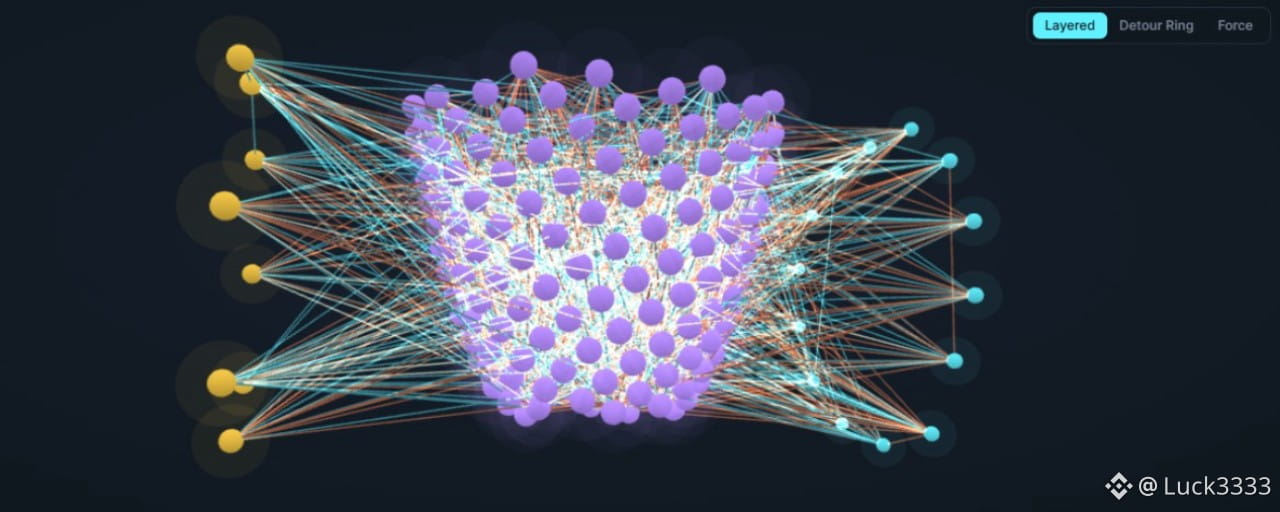
Das Qubic-Ökosystem enthüllt: UPoW, Jetski Pool, & der revolutionäre ANN ExplorerDie Schnittstelle zwischen Künstlicher Intelligenz (KI) und Blockchain ist im Krypto-Markt gerade die heißeste Story. Aber während die meisten Projekte einfach „KI“ auf Standard-Technologie aufkleben, schreibt Qubic ($QUBIC) die Regeln des verteilten Rechnens grundsätzlich neu.
Wenn du es leid bist, dass bei traditionellem Proof-of-Work (PoW) massive Energie verschwendet wird und dass große Tech-Konzerne die KI zentralisieren, ist es an der Zeit, tief in das Layer-1-Ökosystem von Qubic einzutauchen: die entscheidende Rolle des Jetski Pool und wie der kommende ANN Explorer das größte Transparenzproblem in KI-Crypto löst. 👇
Das Qubic-Ökosystem enthüllt: UPoW, Jetski Pool, & der revolutionäre ANN Explorer
Die Schnittstelle zwischen Künstlicher Intelligenz (KI) und Blockchain ist im Krypto-Markt gerade die heißeste Story. Aber während die meisten Projekte einfach „KI“ auf Standard-Technologie aufkleben, schreibt Qubic ($QUBIC) die Regeln des verteilten Rechnens grundsätzlich neu.
Wenn du es leid bist, dass bei traditionellem Proof-of-Work (PoW) massive Energie verschwendet wird und dass große Tech-Konzerne die KI zentralisieren, ist es an der Zeit, tief in das Layer-1-Ökosystem von Qubic einzutauchen: die entscheidende Rolle des Jetski Pool und wie der kommende ANN Explorer das größte Transparenzproblem in KI-Crypto löst. 👇
Wenn du es leid bist, dass bei traditionellem Proof-of-Work (PoW) massive Energie verschwendet wird und dass große Tech-Konzerne die KI zentralisieren, ist es an der Zeit, tief in das Layer-1-Ökosystem von Qubic einzutauchen: die entscheidende Rolle des Jetski Pool und wie der kommende ANN Explorer das größte Transparenzproblem in KI-Crypto löst. 👇
248
·
--
Qubic "All Hands" AMA👉 https://x.com/i/broadcasts/1YxNrrkWeoQxw
Qubic "All Hands" AMA👉 https://x.com/i/broadcasts/1YxNrrkWeoQxw
92
·
--
Artikel
Was ist AGI? Die Grenzen, Visionen und Definitionen Künstlicher Allgemeiner IntelligenzNeuraxon Intelligence Academy — Band 11
Von dem #Qubic -Wissenschaftsteam
Kurz gesagt: Es gibt kaum einen Ausdruck, der so oft wiederholt und dabei so wenig definiert wird wie „künstliche allgemeine Intelligenz“. Dieser Band untersucht, warum jede angebotene #AGI -Definition etwas anderes sagt, warum die eng gefasste #AI -Art, die Menschen übertrifft, sich nie wie allgemeine Intelligenz angefühlt hat, und warum der nützlichste Hinweis, den wir haben, lautet: Intelligenz ist keine Punktzahl, sondern ein tragfähiges System von Systemen — das Prinzip, das unsere Arbeit an #Neuraxon und #aigarth leitet.
Was ist AGI? Die Grenzen, Visionen und Definitionen Künstlicher Allgemeiner Intelligenz
Neuraxon Intelligence Academy — Band 11
Von dem #Qubic -Wissenschaftsteam
Kurz gesagt: Es gibt kaum einen Ausdruck, der so oft wiederholt und dabei so wenig definiert wird wie „künstliche allgemeine Intelligenz“. Dieser Band untersucht, warum jede angebotene #AGI -Definition etwas anderes sagt, warum die eng gefasste #AI -Art, die Menschen übertrifft, sich nie wie allgemeine Intelligenz angefühlt hat, und warum der nützlichste Hinweis, den wir haben, lautet: Intelligenz ist keine Punktzahl, sondern ein tragfähiges System von Systemen — das Prinzip, das unsere Arbeit an #Neuraxon und #aigarth leitet.
3
176
·
--
Qubic wird nächste Woche auf zwei der größten KI-Events in Europa vertreten sein – beide in Paris.
⭐
MACHINA am 7. Juli im Station F.
RAISE Summit am 8.–9. Juli im Carrousel du Louvre.
Die Teilnahme war durch großzügige Spenden von Community-Mitgliedern möglich, die sehen wollten, dass Qubic dort vertreten ist, wo es zählt.
MACHINA ist Europas führender physischer KI-Gipfel. Robotik, humanoide Systeme, verkörperte Intelligenz.
Der Raum umfasst Gründer von Boston Dynamics, NEURA Robotics und der Robotik-Sparte von NVIDIA.
Hier kommen die Menschen zusammen, die Maschinen bauen, die sich in der realen Welt bewegen und handeln – und entscheiden, was als Nächstes kommt.
Der Schnittpunkt von KI und physischer Infrastruktur ist genau dort, wo die Compute-Layer von Qubic in der Diskussion hingehört.
👉 https://www.machinasummit.com/
⭐⭐
Der RAISE Summit ist das größte bereichsübergreifende Treffen von KI-Führungskräften in Europa.
Über 9.000 Teilnehmende, 350+ Speaker, darunter Yann LeCun, Eric Schmidt und Jim Fan.
80% des Publikums sind C-Level oder Gründer-Level.
Die Gespräche, die hier stattfinden, werden mit darüber entscheiden, wohin sich KI-Infrastruktur, Compute-Eigentum und die Einführung in Unternehmen in den nächsten zehn Jahren entwickeln.
Dass die Qubic-Community in diesem Raum vertreten ist, ist entscheidend.
👉https://www.raisesummit.com/
Diese Präsenz wurde von Grund auf durch Qubic France organisiert – eine communitygetriebene Gruppe, die das Projekt aus Überzeugung repräsentiert.
Sie suchen weiterhin Unterstützung, um Reisekosten und Medienveröffentlichungen zu decken.
Events auf diesem Niveau verursachen echte Kosten, und jeder Beitrag stärkt, wie das Projekt sichtbar wird.
Je mehr die Community es unterstützt, desto größer ist die Wirkung.
Wenn du beitragen möchtest, melde dich bei IrisNova_AI
#Qubic #RAISE #AI #AGI

NVDAUS+3,92%
1
180
·
--
Wir haben keine Maßeinheit für Intelligenz.
Weder für Menschen. Noch für Maschinen.
Darüber diskutieren wir seit über einem Jahrhundert.
Bis zu 45% der Benchmarks, die wir zur Bewertung von LLMs verwenden, enthalten geleakte Trainingsdaten.
ARC-AGI-3 wurde entwickelt, um das zu beheben.
Menschen lösen 100% davon.
Frontier AI erzielt weniger als 1%.
NIA Volume 10 analysiert den g Faktor, Chollets Rahmenwerk, Benchmark-Kontamination und was tatsächlich benötigt wird, um Maschinenintelligenz zu messen.
Vollständige Lektüre
👇
[Measuring Machine Intelligence: The g Factor vs. ARC-AGI Benchmark](https://www.binance.com/en/square/post/332806106415490)
@BiBi
#AI #AGI #Qubic #TechTrends #Neuraxon
Wir haben keine Maßeinheit für Intelligenz.
Weder für Menschen. Noch für Maschinen.
Darüber diskutieren wir seit über einem Jahrhundert.
Bis zu 45% der Benchmarks, die wir zur Bewertung von LLMs verwenden, enthalten geleakte Trainingsdaten.
ARC-AGI-3 wurde entwickelt, um das zu beheben.
Menschen lösen 100% davon.
Frontier AI erzielt weniger als 1%.
NIA Volume 10 analysiert den g Faktor, Chollets Rahmenwerk, Benchmark-Kontamination und was tatsächlich benötigt wird, um Maschinenintelligenz zu messen.
Vollständige Lektüre
👇
Measuring Machine Intelligence: The g Factor vs. ARC-AGI Benchmark
@Binance BiBi
#AI #AGI #Qubic #TechTrends #Neuraxon
204
·
--
Artikel
Maschinenintelligenz messen: Der g Faktor vs. ARC-AGI Benchmark#Neuraxon Intelligence Academy — Volume 10
Vom Qubic Scientific Team
ARC-AGI-3: Der erste interaktive Benchmark, der misst, ob KI wirklich lernen kann, nicht nur wiedergeben. Quelle: ARC Prize Foundation.
Wenn wir ein künstliches System bauen und wissen wollen, ob es intelligent ist, was messen wir dann genau? Wir glauben zu wissen, wenn wir hören, dass ChatGPT-5 verkündet, es habe DeepSeek geschlagen und dann dass Claude Gemini sweeped.
Aber die Frage bleibt weiterhin bestehen. Künstliche Intelligenz zu messen ist nicht dasselbe wie Geschwindigkeit oder Temperatur zu messen. Wir haben keine Maßeinheit, so seltsam es auch erscheinen mag.
Maschinenintelligenz messen: Der g Faktor vs. ARC-AGI Benchmark
#Neuraxon Intelligence Academy — Volume 10
Vom Qubic Scientific Team
ARC-AGI-3: Der erste interaktive Benchmark, der misst, ob KI wirklich lernen kann, nicht nur wiedergeben. Quelle: ARC Prize Foundation.
Wenn wir ein künstliches System bauen und wissen wollen, ob es intelligent ist, was messen wir dann genau? Wir glauben zu wissen, wenn wir hören, dass ChatGPT-5 verkündet, es habe DeepSeek geschlagen und dann dass Claude Gemini sweeped.
Aber die Frage bleibt weiterhin bestehen. Künstliche Intelligenz zu messen ist nicht dasselbe wie Geschwindigkeit oder Temperatur zu messen. Wir haben keine Maßeinheit, so seltsam es auch erscheinen mag.
206
·
--

Artikel
Qubic Ausgelagerte Berechnung Erklärt: Wie Smart Contracts Cross-Chain gehenQubics AMA "Tech on Deck" am 3. Juni drehte sich um eine Entwicklung, die die Interaktion des Protokolls mit der Außenwelt revolutionieren wird: Ausgelagerte Berechnung. Die Kernentwickler FNordSpace und Raika traten dem Moderator Joetom bei, um die Architektur aufzuschlüsseln, das Autorisierungsmodell zu erklären und einen Fahrplan zu präsentieren, der auf ein Go-Live-Datum am 29. Juli abzielt. Die Sitzung bot auch einen Blick auf die Realitäten des Aufbaus auf Qubics unkonventioneller Codebasis, die über 3.500 Live-Zuschauer anzog.
Wie es ist, auf Qubics Bare Metal Architektur aufzubauen
Qubic Ausgelagerte Berechnung Erklärt: Wie Smart Contracts Cross-Chain gehen
Qubics AMA "Tech on Deck" am 3. Juni drehte sich um eine Entwicklung, die die Interaktion des Protokolls mit der Außenwelt revolutionieren wird: Ausgelagerte Berechnung. Die Kernentwickler FNordSpace und Raika traten dem Moderator Joetom bei, um die Architektur aufzuschlüsseln, das Autorisierungsmodell zu erklären und einen Fahrplan zu präsentieren, der auf ein Go-Live-Datum am 29. Juli abzielt. Die Sitzung bot auch einen Blick auf die Realitäten des Aufbaus auf Qubics unkonventioneller Codebasis, die über 3.500 Live-Zuschauer anzog.
Wie es ist, auf Qubics Bare Metal Architektur aufzubauen
Wie es ist, auf Qubics Bare Metal Architektur aufzubauen
1
240
·
--
Der g Faktor: Qubics radikaler Ansatz zur AGI
Während die KI-Branche um die Skalierung massiver Sprachmodelle kämpft, schlägt Qubics Neuraxon-Forschung einen völlig anderen Weg zur Künstlichen Allgemeinintelligenz (AGI) vor.
Ihre These ist einfach:
Mehr Text schafft keine echte Intelligenz.
Inspiriert von Charles Spearmans „g Faktor“-Theorie aus dem Jahr 1904, argumentiert Qubic, dass echte Intelligenz nicht darin besteht, das nächste Wort vorherzusagen, sondern über übertragbare kognitive Fähigkeiten zu verfügen – sich an neue Situationen anzupassen, unbekannte Probleme zu lösen, aus Fehlern zu lernen und Wissen über verschiedene Bereiche hinweg zu koordinieren.
Aktuelle LLMs glänzen bei der statistischen Sprachvorhersage, haben jedoch Schwierigkeiten, wenn sich der Kontext oder die Formulierung unerwartet ändern. Sie imitieren Intelligenz, aber es fehlt ihnen an einer beständigen und verallgemeinerten kognitiven Struktur.
Das Projekt Neuraxon schlägt eine bio-inspirierte Richtung ein durch eine künstliche Lebenssimulation namens „Multi-Neuraxon Game of Life Lite 5.0“, in der künstliche Organismen unter Umweltdruck evolvieren.
Anstatt mit endlosen Textdatensätzen zu trainieren, versucht Neuraxon, die Intelligenz selbst zu entwickeln.
Wichtige Konzepte umfassen:
• Evolutionäre Selektion, die Anpassungsfähigkeit belohnt
• Modulare, hirnähnliche Architekturen, inspiriert von menschlicher Kognition
• Entstehende Intelligenz durch Interaktion und Selbstorganisation
• Kontinuierliches Lernen über Zeit statt statischer Inferenz
All dies läuft über Qubics dezentrales Useful-Compute-Netzwerk, das Mining-Hardware in eine großangelegte AGI-Forschungsinfrastruktur verwandelt, anstatt Energie für bedeutungsloses Hashing zu verschwenden.
Ob dies ein Durchbruch wird oder nicht, Qubic erforscht eines der unkonventionellsten und ehrgeizigsten AGI-Experimente im Crypto-Bereich heute.
#crypto #AI #Qubic #AGI #artificialintelligence
QubicNews
·
--
Der g Faktor im künstlichen Leben: Vom Klassenzimmer Spearmans 1904 zu entwickelten künstlichen Gehirnen
Neuraxon Intelligence Academy, Volumen 9 · Vom Qubic Scientific Team
Kurz gesagt: Allgemeine Intelligenz, der g Faktor, den Psychologen seit über einem Jahrhundert messen, ist die fehlende Zutat in den heutigen Sprachmodellen, und das Neuraxon-Projekt von Qubic wählt ihn jetzt direkt in einer künstlichen Lebenssimulation aus.
Charles Spearman (1863–1945), der den g Faktor der allgemeinen Intelligenz erstmals identifizierte, während er 1904 die Noten englischer Schulkinder untersuchte.
Der g Faktor: Vom Klassenzimmer 1904 zu künstlichen Gehirnen

274
·
--
Teilweise korrekt
Artikel
Der g Faktor im künstlichen Leben: Vom Klassenzimmer Spearmans 1904 zu entwickelten künstlichen GehirnenNeuraxon Intelligence Academy, Volumen 9 · Vom Qubic Scientific Team
Kurz gesagt: Allgemeine Intelligenz, der g Faktor, den Psychologen seit über einem Jahrhundert messen, ist die fehlende Zutat in den heutigen Sprachmodellen, und das Neuraxon-Projekt von Qubic wählt ihn jetzt direkt in einer künstlichen Lebenssimulation aus.
Charles Spearman (1863–1945), der den g Faktor der allgemeinen Intelligenz erstmals identifizierte, während er 1904 die Noten englischer Schulkinder untersuchte.
Der g Faktor: Vom Klassenzimmer 1904 zu künstlichen Gehirnen
Der g Faktor im künstlichen Leben: Vom Klassenzimmer Spearmans 1904 zu entwickelten künstlichen Gehirnen
Neuraxon Intelligence Academy, Volumen 9 · Vom Qubic Scientific Team
Kurz gesagt: Allgemeine Intelligenz, der g Faktor, den Psychologen seit über einem Jahrhundert messen, ist die fehlende Zutat in den heutigen Sprachmodellen, und das Neuraxon-Projekt von Qubic wählt ihn jetzt direkt in einer künstlichen Lebenssimulation aus.
Charles Spearman (1863–1945), der den g Faktor der allgemeinen Intelligenz erstmals identifizierte, während er 1904 die Noten englischer Schulkinder untersuchte.
Der g Faktor: Vom Klassenzimmer 1904 zu künstlichen Gehirnen
Kurz gesagt: Allgemeine Intelligenz, der g Faktor, den Psychologen seit über einem Jahrhundert messen, ist die fehlende Zutat in den heutigen Sprachmodellen, und das Neuraxon-Projekt von Qubic wählt ihn jetzt direkt in einer künstlichen Lebenssimulation aus.
Charles Spearman (1863–1945), der den g Faktor der allgemeinen Intelligenz erstmals identifizierte, während er 1904 die Noten englischer Schulkinder untersuchte.
Der g Faktor: Vom Klassenzimmer 1904 zu künstlichen Gehirnen
1
1
499
Anmelden und weiter Inhalte entdecken
Krypto-Nutzer weltweit auf Binance Square kennenlernen
⚡️ Bleib in Sachen Krypto stets am Puls.
💬 Die weltgrößte Kryptobörse vertraut darauf.
👍 Erhalte verlässliche Einblicke von verifizierten Creators.
E-Mail-Adresse/Telefonnummer
Trendthemen
BitcoinRebounds$75KAsChipsLead
10,780 Aufrufe
152 Kommentare
Marktüberblick | Bitcoin erholt sich nach Rückgang unter 75.000 $ auf 75.600 $, während Chip-Aktien nach überraschend starken Arbeitsmarktdaten die Rally anführen
Binance News
·17 Likes
·5.2k Aufrufe
JobsReportRaisesHikeOdds
143,178 Aufrufe
1,246 Kommentare
US Data Center Rules May Constrain AI Expansion
21,327 Aufrufe
116 Kommentare