

Patel5600
25 Beiträge

Patel5600
Melden
Nutzer blockieren
Markets. Data. Conviction. Quietly doing the work.
Regelmäßiger Trader
2.5 Jahre
6 Following
19 Follower
19 Like gegeben
Beiträge
Alle
Zitierungen
PINNED
·
--
Artikel
Übersetzung ansehen
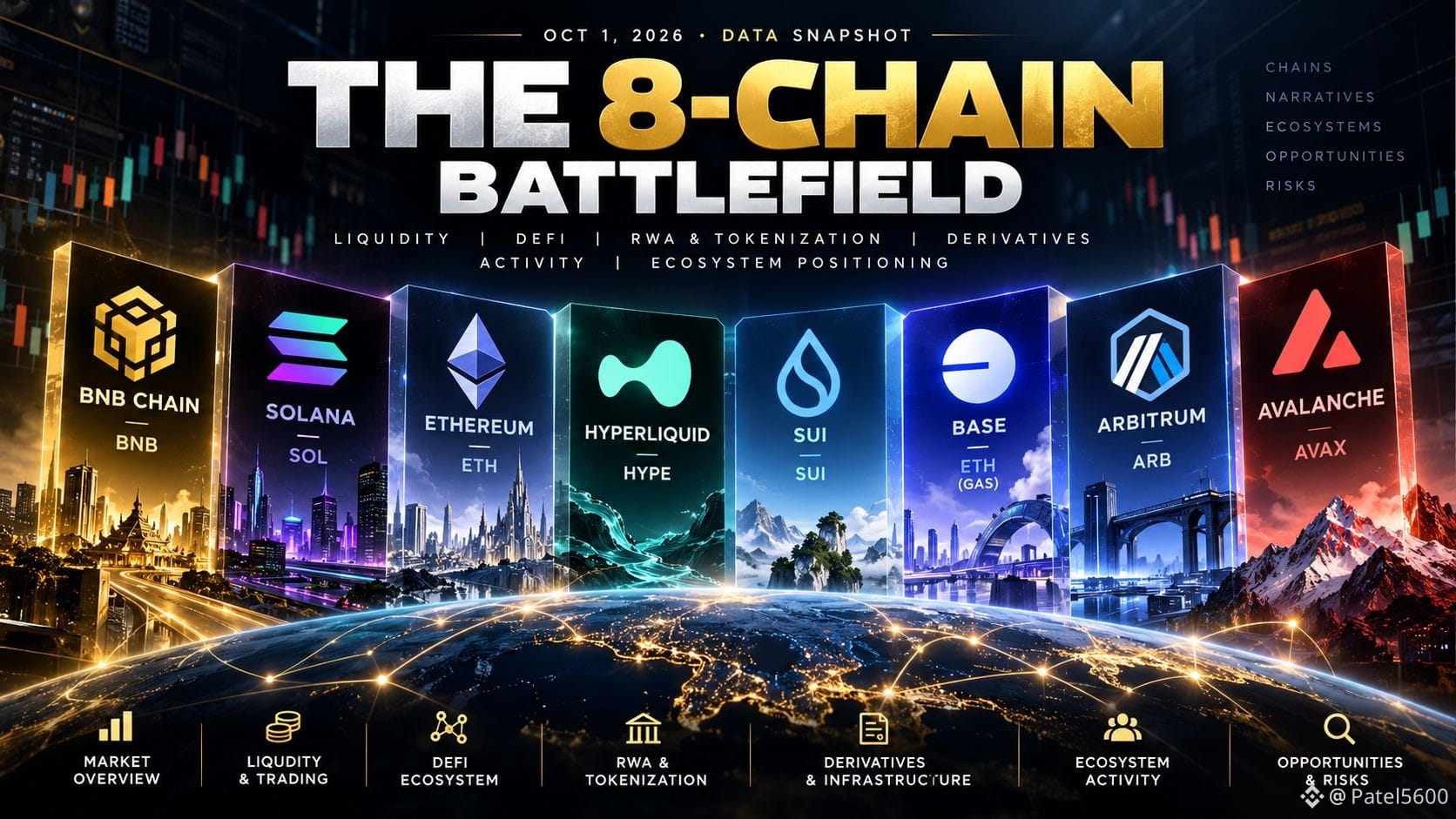
The 8-Chain Battlefield: Where Crypto Liquidity, RWA and Trading Are Moving — October 1, 2026THE 8-CHAIN BATTLEFIELD
October 1, 2026 — Deep market and infrastructure snapshot
Eight ecosystems. Eight different bets on where onchain finance goes next.
The old chain race was simple: faster blocks, cheaper gas, more transactions.
That game is changing.
Today the real competition is for liquidity, stablecoins, tokenized assets, derivatives, applications, institutional settlement and actual users.
This report tracks eight ecosystems that matter in that race: BNB Chain, Solana, Ethereum, Hyperliquid, Sui, Base, Arbitrum and Avalanche.
All market and DeFi figures below are snapshots for October 1, 2026 and can move continuously. TVL, RWA and volume methodologies differ by provider, so cross-chain figures should be treated as comparable indicators—not perfectly interchangeable accounting numbers.
━━━━━━━━━━━━━━━━━━
01 — BNB CHAIN | BNB
━━━━━━━━━━━━━━━━━━
THE CORE THESIS
BNB Chain is increasingly positioning itself as a high-throughput financial distribution layer: Binance-linked liquidity, stablecoins, DeFi, tokenization and institutional infrastructure.
LIVE SNAPSHOT
• BNB: ~$764.69
• DeFi TVL: ~$5.70B
• Stablecoin market cap: ~$13.29B
• RWA active AUM: ~$4.86B on DefiLlama
• DEX volume: ~$1.38B / 24h
• Active addresses: ~2.47M / 24h
• Transactions: ~18.03M / 24h
The RWA figure deserves context. BNB Chain's own RWA page currently advertises $3.4B of RWA TVL, while DefiLlama reports $4.86B of RWA active AUM. Those figures use different methodologies, so the correct takeaway is the direction: tokenized assets have become a major part of the BNB ecosystem rather than a side narrative.
WHAT CHANGED
BNB Chain recently appointed Thomas Chen as Chief Business Officer, with an explicit mandate around institutional partnerships, capital markets, stablecoins, trading/liquidity and ecosystem distribution.
At the infrastructure level, the Pasteur hard fork introduced BEP-675 and a new block-building architecture. BNB Chain reports roughly 98% of blocks using the new path in its latest three-day window and says BidBlock V2 is averaging 28% more gas per block than Bid V1 under live mainnet traffic. Validators are also raising the gas-limit target toward 70M.
BNB Chain is simultaneously pushing tokenized-stock development: its September tokenized-stocks hackathon runs through October 11, with a $20,000 prize pool.
MARKET READ
BNB is not merely competing on transaction cost. The bigger bet is distribution: can exchange liquidity, stablecoins, RWA issuance and DeFi reinforce one another strongly enough to keep more financial activity on BNB Chain?
RISK
The Binance connection is an advantage for distribution but also creates concentration and regulatory exposure. RWA numbers are methodology-sensitive, and ecosystem growth still has to translate into durable liquidity and fees.
━━━━━━━━━━━━━━━━━━
02 — SOLANA | SOL
━━━━━━━━━━━━━━━━━━
THE CORE THESIS
Solana remains one of the deepest high-throughput venues for trading, DeFi and consumer applications, while increasingly moving into payments and institutional tokenization.
LIVE SNAPSHOT
• SOL: ~$118.12
• DeFi TVL: ~$6.56B
• Stablecoin market cap: ~$16.10B
• RWA active AUM: ~$2.42B
• DEX volume: ~$2.29B / 24h
• Perps volume: ~$1.54B / 24h
• Active addresses: ~3.02M / 24h
• Transactions: ~114.94M / 24h
The numbers show where Solana's current strength sits: activity and market liquidity. Its DEX volume is materially larger than BNB Chain's in this snapshot, while perps activity is also significant.
WHAT CHANGED
Solana's September 28 infrastructure update says the network is now producing slots with a 250ms target, down from 400ms. That is a concrete example of the chain continuing to optimize latency rather than resting on its throughput reputation.
Institutional tokenization is another major thread. Solana announced Project Harmonia, connecting Allfunds—described by Solana as having about €1.9T under administration—to tokenized funds on Solana.
MARKET READ
Solana's competitive moat is increasingly about liquidity density and application depth. The question is not whether Solana can process transactions; it is whether trading, payments, consumer apps and tokenized financial products continue to compound on the same liquidity base.
RISK
High activity can be reflexive. DEX volume can surge without creating equally durable economic value, and competition for liquidity from Base, BNB Chain and specialized trading networks is intense.
━━━━━━━━━━━━━━━━━━
03 — ETHEREUM | ETH
━━━━━━━━━━━━━━━━━━
THE CORE THESIS
Ethereum remains the settlement and liquidity heavyweight. Its advantage is not raw transaction count; it is the scale of capital, stablecoins, DeFi, liquid staking, institutional assets and the L2 ecosystem anchored to Ethereum.
LIVE SNAPSHOT
• ETH: ~$2,695
• DeFi TVL: ~$53.33B
• Stablecoin market cap: ~$146.26B
• RWA active AUM: ~$13.90B
• DEX volume: ~$1.33B / 24h
• Perps volume: ~$441M / 24h
• Active addresses: ~590K / 24h
Ethereum's TVL is an order of magnitude larger than any of the other ecosystems in this eight-chain set. That does not automatically make it the fastest-growing venue, but it shows the scale of capital already anchored to the network.
WHAT CHANGED
The Ethereum Foundation announced the Glamsterdam testnet schedule. Sepolia activation is planned for October 6, 2026. The upgrade combines Amsterdam execution-layer work with Gloas consensus-layer work, including enshrined proposer-builder separation and block-level access lists. Mainnet activation has not yet been decided.
MARKET READ
Ethereum's strategic role is evolving from “the chain that does everything” toward “the settlement layer underneath a large family of specialized execution environments.” Base and Arbitrum are important parts of that model.
RISK
The trade-off is obvious: Ethereum has enormous capital depth, but much of user activity is increasingly distributed across L2s. The key question is how effectively value and liquidity accrue back to ETH and the Ethereum settlement layer.
━━━━━━━━━━━━━━━━━━
04 — HYPERLIQUID | HYPE
━━━━━━━━━━━━━━━━━━
THE CORE THESIS
Hyperliquid is the specialist in this group: it is building a chain around trading infrastructure, especially perpetuals, rather than trying to become a generic everything-chain first.
LIVE SNAPSHOT
• HYPE: ~$89
• Combined TVL: ~$7.33B
• 24h perp volume: ~$4.70B
• 7d perp volume: ~$45.42B
• Open interest: ~$8.21B
• 30d protocol fees: ~$72.18M
• 30d protocol revenue: ~$55.89M
• 24h HYPE volume: ~$1.20B
These figures are the reason Hyperliquid belongs in the same strategic conversation as much larger chains. Its perp market is a serious onchain trading venue, and its economics are directly tied to activity.
The latest DefiLlama snapshot puts HYPE around $89, with a market capitalization near $19.8B. HYPE remains below its September 23 all-time high of $97.96.
MARKET READ
Hyperliquid represents a different architecture of competition: instead of winning by becoming the biggest general-purpose chain, it can win by becoming the place traders prefer to trade.
That is a powerful thesis if onchain derivatives continue taking market share.
RISK
Perpetual trading is highly cyclical and leverage-sensitive. Open interest and volume can expand rapidly and reverse just as rapidly. A strong trading business is not the same thing as stable long-term application demand.
━━━━━━━━━━━━━━━━━━
05 — SUI | SUI
━━━━━━━━━━━━━━━━━━
THE CORE THESIS
Sui is pushing a high-performance L1 strategy centered on trading infrastructure, payments, programmable assets and fast settlement.
LIVE SNAPSHOT
• SUI: ~$1.18
• DeFi TVL: ~$554.5M
• Stablecoin market cap: ~$474M
• RWA active AUM: ~$36M
• DEX volume: ~$65.5M / 24h
• Active addresses: ~82K / 24h
• Transactions: ~37.5M / 24h
• 7d DEX volume: ~$497M
Sui is smaller than BNB, Solana or Ethereum in capital scale, but its recent development activity is unusually concentrated around financial-market infrastructure.
WHAT CHANGED
DeepBook App launched on September 24. Sui says the shared order book behind the app has processed more than $20B in trading volume, with more than 150,000 traders on the waitlist before launch. The app combines spot trading with a prediction product.
Sui also announced gasless stablecoin transfers and continued work around Bitcoin access, institutional settlement and agentic commerce. Its developer stack is moving toward real-time GraphQL subscriptions, and the Sui Foundation says JSON-RPC is being deprecated in favor of gRPC and GraphQL.
MARKET READ
Sui is attempting something strategically important: making market infrastructure a native part of the chain experience instead of leaving every application to rebuild liquidity from scratch.
RISK
The ecosystem is still much smaller than the leading chains, and TVL/volume can be sensitive to incentives and market cycles. SUI also has a large fully diluted valuation relative to current DeFi scale, making token supply and valuation important variables.
━━━━━━━━━━━━━━━━━━
06 — BASE | ETH GAS
━━━━━━━━━━━━━━━━━━
THE CORE THESIS
Base is the Ethereum L2 in this group, and importantly it does NOT have a separate native gas token. ETH is the gas asset.
LIVE SNAPSHOT
• Gas asset: ETH
• DeFi TVL: ~$6.30B
• Stablecoin market cap: ~$5.12B
• RWA active AUM: ~$165M
• DEX volume: ~$1.51B / 24h
• Perps volume: ~$205M / 24h
• Active addresses: ~396K / 24h
• Transactions: ~10.55M / 24h
Base's numbers make it one of the most relevant Ethereum scaling environments in the current market. Its DEX volume is above $1.5B/day in the latest snapshot, and stablecoin liquidity is above $5B.
WHAT CHANGED
Base's current developer environment shows the network continuing to push performance and programmable assets. The Base chain snapshot was updated September 30, while the Base status history records the Cobalt upgrade as completed.
Tokenized equities are another major strategic direction. Base announced in September that tokenized stocks issued by Coinbase were live on Base for eligible non-US users, positioning programmable equities as a new application category.
MARKET READ
Base is not trying to compete by issuing another speculative L2 token. Its model is distribution through Ethereum and Coinbase, combined with trading, payments and consumer applications.
RISK
Base's lack of a separate token changes the investment narrative around the ecosystem. Activity can grow substantially without creating direct token demand for a Base asset. The value-accrual question therefore sits largely around ETH, Coinbase's ecosystem and application-level assets.
━━━━━━━━━━━━━━━━━━
07 — ARBITRUM | ARB
━━━━━━━━━━━━━━━━━━
THE CORE THESIS
Arbitrum remains a major Ethereum L2 with a particularly strong position in DeFi and onchain derivatives.
LIVE SNAPSHOT
• ARB: ~$0.20
• DeFi TVL: ~$1.44B
• Stablecoin market cap: ~$3.73B
• RWA active AUM: ~$853M
• DEX volume: ~$149M / 24h
• Perps volume: ~$3.65B / 24h
• Active addresses: ~136K / 24h
• Transactions: ~1.71M / 24h
The standout metric is derivatives: roughly $3.65B in 24-hour perps volume in the latest DefiLlama snapshot, with a 7-day figure above $20B.
WHAT CHANGED
Arbitrum's ArbOS Elara upgrade went live in August, bringing compliance filtering and customizable priority fees to dedicated chains, plus base-fee efficiency improvements on Arbitrum One. Arbitrum is also advancing ZK settlement infrastructure.
MARKET READ
Arbitrum's competitive position is increasingly specialized: deep Ethereum liquidity, mature DeFi infrastructure and a strong derivatives footprint.
RISK
Its TVL is far below Ethereum and Base, and DEX volume has been weaker on the latest weekly window. Arbitrum therefore needs continued application growth and liquidity retention while Base and other L2s compete for Ethereum activity.
━━━━━━━━━━━━━━━━━━
08 — AVALANCHE | AVAX
━━━━━━━━━━━━━━━━━━
THE CORE THESIS
Avalanche is taking a more modular, institution-facing route, with customizable chains, payments, RWA infrastructure and validator economics as major themes.
LIVE SNAPSHOT
• AVAX: ~$11.10
• DeFi TVL: ~$640.8M
• Stablecoin market cap: ~$1.39B
• RWA active AUM: ~$994M
• DEX volume: ~$197M / 24h
• Active addresses: ~36.6K / 24h
• Transactions: ~290K / 24h
The most striking number is RWA active AUM: close to $1B in the latest DefiLlama snapshot, with BUIDL accounting for a substantial share.
WHAT CHANGED
Avalanche's Helicon upgrade went live on September 22. It introduced Continuous Execution on the C-Chain, auto-renewed staking, a higher validator uptime requirement, shorter minimum staking durations, dynamic minimum gas pricing and changes to staking economics.
Avalanche is also continuing to push customized L1s. Recent ecosystem work includes a telco deployment described as reaching more than 169M users through an Avalanche L1 partnership.
MARKET READ
Avalanche is increasingly interesting as infrastructure for specialized financial networks rather than only as another general-purpose L1.
RISK
Its current DeFi TVL remains much smaller than Ethereum, Solana, BNB or Base. Institutional/RWA announcements must ultimately translate into sustained onchain liquidity, users and revenue.
━━━━━━━━━━━━━━━━━━
THE CROSS-CHAIN BATTLE
━━━━━━━━━━━━━━━━━━
The eight ecosystems are not actually fighting the same war.
BNB Chain is fighting for Binance-linked liquidity, stablecoins, RWAs and high-throughput DeFi.
Solana is fighting for trading, consumer applications, payments and institutional tokenization.
Ethereum is fighting to remain the deepest settlement and collateral layer.
Hyperliquid is fighting for the derivatives trader.
Sui is fighting to make high-performance financial primitives native to the chain.
Base is fighting to bring Ethereum liquidity and Coinbase distribution into a consumer-facing onchain economy.
Arbitrum is fighting to retain deep Ethereum DeFi and derivatives activity.
Avalanche is fighting for specialized networks and institutional/RWA deployments.
The battlefield is therefore fragmenting by use case.
━━━━━━━━━━━━━━━━━━
THE NUMBERS THAT MATTER
━━━━━━━━━━━━━━━━━━
Ethereum remains the capital heavyweight with ~$53.3B DeFi TVL and ~$146B in stablecoins.
Solana is the high-activity heavyweight among these L1s, with ~$2.29B in daily DEX volume and more than 3M active addresses in the latest snapshot.
BNB Chain combines ~$5.7B TVL with ~$13.3B in stablecoins and ~$4.9B RWA active AUM according to DefiLlama.
Base is already at roughly $6.3B TVL and ~$1.5B daily DEX volume despite being an L2 without its own gas token.
Hyperliquid is the outlier in derivatives: ~$4.7B daily perp volume and ~$8.2B open interest.
Arbitrum is another derivatives-heavy ecosystem, with roughly $3.65B daily perps volume.
Avalanche's RWA figure is approaching $1B, while Sui is building specialized market infrastructure around a smaller but rapidly developing liquidity base.
━━━━━━━━━━━━━━━━━━
WHAT COULD DEFINE THE NEXT PHASE
━━━━━━━━━━━━━━━━━━
1. TOKENIZED EQUITIES & RWA
This is moving from narrative to infrastructure. BNB Chain, Base, Solana, Ethereum, Avalanche and Sui are all building or hosting pieces of the tokenized-asset stack.
The next question is not “can a stock be tokenized?” It is whether tokenized assets can achieve deep secondary liquidity, reliable pricing, compliance, composability and real demand.
2. DERIVATIVES
Hyperliquid and Arbitrum demonstrate that derivatives can become an ecosystem's economic center. Solana and BNB Chain also have meaningful derivatives activity through their application layers.
3. STABLECOINS
Stablecoin liquidity is becoming the base layer of onchain markets. Ethereum remains dominant in absolute scale, while BNB, Solana and Base are building meaningful secondary liquidity pools.
4. DISTRIBUTION
Technology alone does not distribute liquidity. Binance, Coinbase and established wallets/exchanges can change the speed at which an ecosystem acquires users.
5. VALUE ACCRUAL
This may become the most important investor question. A chain can have enormous activity without that activity translating proportionally into demand for its native token.
Base is the clearest example: it has no separate network token and uses ETH for gas. Hyperliquid, BNB, Solana, Sui, Arbitrum and Avalanche have different relationships between network usage and token economics.
━━━━━━━━━━━━━━━━━━
FINAL MARKET MAP
━━━━━━━━━━━━━━━━━━
The next chain cycle is unlikely to be a simple winner-takes-all race.
It looks more like a specialization race.
ETH owns enormous settlement and collateral depth.
SOL owns major high-frequency application and trading activity.
BNB owns powerful exchange-linked distribution and an increasingly serious RWA push.
HYPE owns a rapidly expanding derivatives economy.
SUI is building native market infrastructure and fast settlement.
BASE is turning Ethereum + Coinbase distribution into an onchain consumer/financial platform.
ARB remains a major DeFi and derivatives L2.
AVAX is pushing specialized chains and institutional/RWA infrastructure.
The real signal is where capital keeps returning after incentives fade.
Watch TVL.
Watch stablecoins.
Watch DEX and perp volume.
Watch active users.
Watch fees and revenue.
Watch RWA liquidity—not just announced issuance.
And most importantly: watch whether usage becomes durable.
DATA NOTE
All numerical figures in this article are dated October 1, 2026 snapshots, primarily from DefiLlama and CoinGecko. Chain-specific development claims are sourced from official ecosystem documentation and blogs. Metrics can change continuously, and methodologies differ across providers. This is research, not financial advice.
SOURCES
DefiLlama chain dashboards; CoinGecko market data; BNB Chain official blog and RWA documentation; Solana official news; Ethereum Foundation; Sui official blog/docs; Base official blog/status; Arbitrum official blog/status; Avalanche Builder Hub; Hyperliquid data via DefiLlama.
The 8-Chain Battlefield: Where Crypto Liquidity, RWA and Trading Are Moving — October 1, 2026
THE 8-CHAIN BATTLEFIELD
October 1, 2026 — Deep market and infrastructure snapshot
Eight ecosystems. Eight different bets on where onchain finance goes next.
The old chain race was simple: faster blocks, cheaper gas, more transactions.
That game is changing.
Today the real competition is for liquidity, stablecoins, tokenized assets, derivatives, applications, institutional settlement and actual users.
This report tracks eight ecosystems that matter in that race: BNB Chain, Solana, Ethereum, Hyperliquid, Sui, Base, Arbitrum and Avalanche.
All market and DeFi figures below are snapshots for October 1, 2026 and can move continuously. TVL, RWA and volume methodologies differ by provider, so cross-chain figures should be treated as comparable indicators—not perfectly interchangeable accounting numbers.
━━━━━━━━━━━━━━━━━━
01 — BNB CHAIN | BNB
━━━━━━━━━━━━━━━━━━
THE CORE THESIS
BNB Chain is increasingly positioning itself as a high-throughput financial distribution layer: Binance-linked liquidity, stablecoins, DeFi, tokenization and institutional infrastructure.
LIVE SNAPSHOT
• BNB: ~$764.69
• DeFi TVL: ~$5.70B
• Stablecoin market cap: ~$13.29B
• RWA active AUM: ~$4.86B on DefiLlama
• DEX volume: ~$1.38B / 24h
• Active addresses: ~2.47M / 24h
• Transactions: ~18.03M / 24h
The RWA figure deserves context. BNB Chain's own RWA page currently advertises $3.4B of RWA TVL, while DefiLlama reports $4.86B of RWA active AUM. Those figures use different methodologies, so the correct takeaway is the direction: tokenized assets have become a major part of the BNB ecosystem rather than a side narrative.
WHAT CHANGED
BNB Chain recently appointed Thomas Chen as Chief Business Officer, with an explicit mandate around institutional partnerships, capital markets, stablecoins, trading/liquidity and ecosystem distribution.
At the infrastructure level, the Pasteur hard fork introduced BEP-675 and a new block-building architecture. BNB Chain reports roughly 98% of blocks using the new path in its latest three-day window and says BidBlock V2 is averaging 28% more gas per block than Bid V1 under live mainnet traffic. Validators are also raising the gas-limit target toward 70M.
BNB Chain is simultaneously pushing tokenized-stock development: its September tokenized-stocks hackathon runs through October 11, with a $20,000 prize pool.
MARKET READ
BNB is not merely competing on transaction cost. The bigger bet is distribution: can exchange liquidity, stablecoins, RWA issuance and DeFi reinforce one another strongly enough to keep more financial activity on BNB Chain?
RISK
The Binance connection is an advantage for distribution but also creates concentration and regulatory exposure. RWA numbers are methodology-sensitive, and ecosystem growth still has to translate into durable liquidity and fees.
━━━━━━━━━━━━━━━━━━
02 — SOLANA | SOL
━━━━━━━━━━━━━━━━━━
THE CORE THESIS
Solana remains one of the deepest high-throughput venues for trading, DeFi and consumer applications, while increasingly moving into payments and institutional tokenization.
LIVE SNAPSHOT
• SOL: ~$118.12
• DeFi TVL: ~$6.56B
• Stablecoin market cap: ~$16.10B
• RWA active AUM: ~$2.42B
• DEX volume: ~$2.29B / 24h
• Perps volume: ~$1.54B / 24h
• Active addresses: ~3.02M / 24h
• Transactions: ~114.94M / 24h
The numbers show where Solana's current strength sits: activity and market liquidity. Its DEX volume is materially larger than BNB Chain's in this snapshot, while perps activity is also significant.
WHAT CHANGED
Solana's September 28 infrastructure update says the network is now producing slots with a 250ms target, down from 400ms. That is a concrete example of the chain continuing to optimize latency rather than resting on its throughput reputation.
Institutional tokenization is another major thread. Solana announced Project Harmonia, connecting Allfunds—described by Solana as having about €1.9T under administration—to tokenized funds on Solana.
MARKET READ
Solana's competitive moat is increasingly about liquidity density and application depth. The question is not whether Solana can process transactions; it is whether trading, payments, consumer apps and tokenized financial products continue to compound on the same liquidity base.
RISK
High activity can be reflexive. DEX volume can surge without creating equally durable economic value, and competition for liquidity from Base, BNB Chain and specialized trading networks is intense.
━━━━━━━━━━━━━━━━━━
03 — ETHEREUM | ETH
━━━━━━━━━━━━━━━━━━
THE CORE THESIS
Ethereum remains the settlement and liquidity heavyweight. Its advantage is not raw transaction count; it is the scale of capital, stablecoins, DeFi, liquid staking, institutional assets and the L2 ecosystem anchored to Ethereum.
LIVE SNAPSHOT
• ETH: ~$2,695
• DeFi TVL: ~$53.33B
• Stablecoin market cap: ~$146.26B
• RWA active AUM: ~$13.90B
• DEX volume: ~$1.33B / 24h
• Perps volume: ~$441M / 24h
• Active addresses: ~590K / 24h
Ethereum's TVL is an order of magnitude larger than any of the other ecosystems in this eight-chain set. That does not automatically make it the fastest-growing venue, but it shows the scale of capital already anchored to the network.
WHAT CHANGED
The Ethereum Foundation announced the Glamsterdam testnet schedule. Sepolia activation is planned for October 6, 2026. The upgrade combines Amsterdam execution-layer work with Gloas consensus-layer work, including enshrined proposer-builder separation and block-level access lists. Mainnet activation has not yet been decided.
MARKET READ
Ethereum's strategic role is evolving from “the chain that does everything” toward “the settlement layer underneath a large family of specialized execution environments.” Base and Arbitrum are important parts of that model.
RISK
The trade-off is obvious: Ethereum has enormous capital depth, but much of user activity is increasingly distributed across L2s. The key question is how effectively value and liquidity accrue back to ETH and the Ethereum settlement layer.
━━━━━━━━━━━━━━━━━━
04 — HYPERLIQUID | HYPE
━━━━━━━━━━━━━━━━━━
THE CORE THESIS
Hyperliquid is the specialist in this group: it is building a chain around trading infrastructure, especially perpetuals, rather than trying to become a generic everything-chain first.
LIVE SNAPSHOT
• HYPE: ~$89
• Combined TVL: ~$7.33B
• 24h perp volume: ~$4.70B
• 7d perp volume: ~$45.42B
• Open interest: ~$8.21B
• 30d protocol fees: ~$72.18M
• 30d protocol revenue: ~$55.89M
• 24h HYPE volume: ~$1.20B
These figures are the reason Hyperliquid belongs in the same strategic conversation as much larger chains. Its perp market is a serious onchain trading venue, and its economics are directly tied to activity.
The latest DefiLlama snapshot puts HYPE around $89, with a market capitalization near $19.8B. HYPE remains below its September 23 all-time high of $97.96.
MARKET READ
Hyperliquid represents a different architecture of competition: instead of winning by becoming the biggest general-purpose chain, it can win by becoming the place traders prefer to trade.
That is a powerful thesis if onchain derivatives continue taking market share.
RISK
Perpetual trading is highly cyclical and leverage-sensitive. Open interest and volume can expand rapidly and reverse just as rapidly. A strong trading business is not the same thing as stable long-term application demand.
━━━━━━━━━━━━━━━━━━
05 — SUI | SUI
━━━━━━━━━━━━━━━━━━
THE CORE THESIS
Sui is pushing a high-performance L1 strategy centered on trading infrastructure, payments, programmable assets and fast settlement.
LIVE SNAPSHOT
• SUI: ~$1.18
• DeFi TVL: ~$554.5M
• Stablecoin market cap: ~$474M
• RWA active AUM: ~$36M
• DEX volume: ~$65.5M / 24h
• Active addresses: ~82K / 24h
• Transactions: ~37.5M / 24h
• 7d DEX volume: ~$497M
Sui is smaller than BNB, Solana or Ethereum in capital scale, but its recent development activity is unusually concentrated around financial-market infrastructure.
WHAT CHANGED
DeepBook App launched on September 24. Sui says the shared order book behind the app has processed more than $20B in trading volume, with more than 150,000 traders on the waitlist before launch. The app combines spot trading with a prediction product.
Sui also announced gasless stablecoin transfers and continued work around Bitcoin access, institutional settlement and agentic commerce. Its developer stack is moving toward real-time GraphQL subscriptions, and the Sui Foundation says JSON-RPC is being deprecated in favor of gRPC and GraphQL.
MARKET READ
Sui is attempting something strategically important: making market infrastructure a native part of the chain experience instead of leaving every application to rebuild liquidity from scratch.
RISK
The ecosystem is still much smaller than the leading chains, and TVL/volume can be sensitive to incentives and market cycles. SUI also has a large fully diluted valuation relative to current DeFi scale, making token supply and valuation important variables.
━━━━━━━━━━━━━━━━━━
06 — BASE | ETH GAS
━━━━━━━━━━━━━━━━━━
THE CORE THESIS
Base is the Ethereum L2 in this group, and importantly it does NOT have a separate native gas token. ETH is the gas asset.
LIVE SNAPSHOT
• Gas asset: ETH
• DeFi TVL: ~$6.30B
• Stablecoin market cap: ~$5.12B
• RWA active AUM: ~$165M
• DEX volume: ~$1.51B / 24h
• Perps volume: ~$205M / 24h
• Active addresses: ~396K / 24h
• Transactions: ~10.55M / 24h
Base's numbers make it one of the most relevant Ethereum scaling environments in the current market. Its DEX volume is above $1.5B/day in the latest snapshot, and stablecoin liquidity is above $5B.
WHAT CHANGED
Base's current developer environment shows the network continuing to push performance and programmable assets. The Base chain snapshot was updated September 30, while the Base status history records the Cobalt upgrade as completed.
Tokenized equities are another major strategic direction. Base announced in September that tokenized stocks issued by Coinbase were live on Base for eligible non-US users, positioning programmable equities as a new application category.
MARKET READ
Base is not trying to compete by issuing another speculative L2 token. Its model is distribution through Ethereum and Coinbase, combined with trading, payments and consumer applications.
RISK
Base's lack of a separate token changes the investment narrative around the ecosystem. Activity can grow substantially without creating direct token demand for a Base asset. The value-accrual question therefore sits largely around ETH, Coinbase's ecosystem and application-level assets.
━━━━━━━━━━━━━━━━━━
07 — ARBITRUM | ARB
━━━━━━━━━━━━━━━━━━
THE CORE THESIS
Arbitrum remains a major Ethereum L2 with a particularly strong position in DeFi and onchain derivatives.
LIVE SNAPSHOT
• ARB: ~$0.20
• DeFi TVL: ~$1.44B
• Stablecoin market cap: ~$3.73B
• RWA active AUM: ~$853M
• DEX volume: ~$149M / 24h
• Perps volume: ~$3.65B / 24h
• Active addresses: ~136K / 24h
• Transactions: ~1.71M / 24h
The standout metric is derivatives: roughly $3.65B in 24-hour perps volume in the latest DefiLlama snapshot, with a 7-day figure above $20B.
WHAT CHANGED
Arbitrum's ArbOS Elara upgrade went live in August, bringing compliance filtering and customizable priority fees to dedicated chains, plus base-fee efficiency improvements on Arbitrum One. Arbitrum is also advancing ZK settlement infrastructure.
MARKET READ
Arbitrum's competitive position is increasingly specialized: deep Ethereum liquidity, mature DeFi infrastructure and a strong derivatives footprint.
RISK
Its TVL is far below Ethereum and Base, and DEX volume has been weaker on the latest weekly window. Arbitrum therefore needs continued application growth and liquidity retention while Base and other L2s compete for Ethereum activity.
━━━━━━━━━━━━━━━━━━
08 — AVALANCHE | AVAX
━━━━━━━━━━━━━━━━━━
THE CORE THESIS
Avalanche is taking a more modular, institution-facing route, with customizable chains, payments, RWA infrastructure and validator economics as major themes.
LIVE SNAPSHOT
• AVAX: ~$11.10
• DeFi TVL: ~$640.8M
• Stablecoin market cap: ~$1.39B
• RWA active AUM: ~$994M
• DEX volume: ~$197M / 24h
• Active addresses: ~36.6K / 24h
• Transactions: ~290K / 24h
The most striking number is RWA active AUM: close to $1B in the latest DefiLlama snapshot, with BUIDL accounting for a substantial share.
WHAT CHANGED
Avalanche's Helicon upgrade went live on September 22. It introduced Continuous Execution on the C-Chain, auto-renewed staking, a higher validator uptime requirement, shorter minimum staking durations, dynamic minimum gas pricing and changes to staking economics.
Avalanche is also continuing to push customized L1s. Recent ecosystem work includes a telco deployment described as reaching more than 169M users through an Avalanche L1 partnership.
MARKET READ
Avalanche is increasingly interesting as infrastructure for specialized financial networks rather than only as another general-purpose L1.
RISK
Its current DeFi TVL remains much smaller than Ethereum, Solana, BNB or Base. Institutional/RWA announcements must ultimately translate into sustained onchain liquidity, users and revenue.
━━━━━━━━━━━━━━━━━━
THE CROSS-CHAIN BATTLE
━━━━━━━━━━━━━━━━━━
The eight ecosystems are not actually fighting the same war.
BNB Chain is fighting for Binance-linked liquidity, stablecoins, RWAs and high-throughput DeFi.
Solana is fighting for trading, consumer applications, payments and institutional tokenization.
Ethereum is fighting to remain the deepest settlement and collateral layer.
Hyperliquid is fighting for the derivatives trader.
Sui is fighting to make high-performance financial primitives native to the chain.
Base is fighting to bring Ethereum liquidity and Coinbase distribution into a consumer-facing onchain economy.
Arbitrum is fighting to retain deep Ethereum DeFi and derivatives activity.
Avalanche is fighting for specialized networks and institutional/RWA deployments.
The battlefield is therefore fragmenting by use case.
━━━━━━━━━━━━━━━━━━
THE NUMBERS THAT MATTER
━━━━━━━━━━━━━━━━━━
Ethereum remains the capital heavyweight with ~$53.3B DeFi TVL and ~$146B in stablecoins.
Solana is the high-activity heavyweight among these L1s, with ~$2.29B in daily DEX volume and more than 3M active addresses in the latest snapshot.
BNB Chain combines ~$5.7B TVL with ~$13.3B in stablecoins and ~$4.9B RWA active AUM according to DefiLlama.
Base is already at roughly $6.3B TVL and ~$1.5B daily DEX volume despite being an L2 without its own gas token.
Hyperliquid is the outlier in derivatives: ~$4.7B daily perp volume and ~$8.2B open interest.
Arbitrum is another derivatives-heavy ecosystem, with roughly $3.65B daily perps volume.
Avalanche's RWA figure is approaching $1B, while Sui is building specialized market infrastructure around a smaller but rapidly developing liquidity base.
━━━━━━━━━━━━━━━━━━
WHAT COULD DEFINE THE NEXT PHASE
━━━━━━━━━━━━━━━━━━
1. TOKENIZED EQUITIES & RWA
This is moving from narrative to infrastructure. BNB Chain, Base, Solana, Ethereum, Avalanche and Sui are all building or hosting pieces of the tokenized-asset stack.
The next question is not “can a stock be tokenized?” It is whether tokenized assets can achieve deep secondary liquidity, reliable pricing, compliance, composability and real demand.
2. DERIVATIVES
Hyperliquid and Arbitrum demonstrate that derivatives can become an ecosystem's economic center. Solana and BNB Chain also have meaningful derivatives activity through their application layers.
3. STABLECOINS
Stablecoin liquidity is becoming the base layer of onchain markets. Ethereum remains dominant in absolute scale, while BNB, Solana and Base are building meaningful secondary liquidity pools.
4. DISTRIBUTION
Technology alone does not distribute liquidity. Binance, Coinbase and established wallets/exchanges can change the speed at which an ecosystem acquires users.
5. VALUE ACCRUAL
This may become the most important investor question. A chain can have enormous activity without that activity translating proportionally into demand for its native token.
Base is the clearest example: it has no separate network token and uses ETH for gas. Hyperliquid, BNB, Solana, Sui, Arbitrum and Avalanche have different relationships between network usage and token economics.
━━━━━━━━━━━━━━━━━━
FINAL MARKET MAP
━━━━━━━━━━━━━━━━━━
The next chain cycle is unlikely to be a simple winner-takes-all race.
It looks more like a specialization race.
ETH owns enormous settlement and collateral depth.
SOL owns major high-frequency application and trading activity.
BNB owns powerful exchange-linked distribution and an increasingly serious RWA push.
HYPE owns a rapidly expanding derivatives economy.
SUI is building native market infrastructure and fast settlement.
BASE is turning Ethereum + Coinbase distribution into an onchain consumer/financial platform.
ARB remains a major DeFi and derivatives L2.
AVAX is pushing specialized chains and institutional/RWA infrastructure.
The real signal is where capital keeps returning after incentives fade.
Watch TVL.
Watch stablecoins.
Watch DEX and perp volume.
Watch active users.
Watch fees and revenue.
Watch RWA liquidity—not just announced issuance.
And most importantly: watch whether usage becomes durable.
DATA NOTE
All numerical figures in this article are dated October 1, 2026 snapshots, primarily from DefiLlama and CoinGecko. Chain-specific development claims are sourced from official ecosystem documentation and blogs. Metrics can change continuously, and methodologies differ across providers. This is research, not financial advice.
SOURCES
DefiLlama chain dashboards; CoinGecko market data; BNB Chain official blog and RWA documentation; Solana official news; Ethereum Foundation; Sui official blog/docs; Base official blog/status; Arbitrum official blog/status; Avalanche Builder Hub; Hyperliquid data via DefiLlama.
October 1, 2026 — Deep market and infrastructure snapshot
Eight ecosystems. Eight different bets on where onchain finance goes next.
The old chain race was simple: faster blocks, cheaper gas, more transactions.
That game is changing.
Today the real competition is for liquidity, stablecoins, tokenized assets, derivatives, applications, institutional settlement and actual users.
This report tracks eight ecosystems that matter in that race: BNB Chain, Solana, Ethereum, Hyperliquid, Sui, Base, Arbitrum and Avalanche.
All market and DeFi figures below are snapshots for October 1, 2026 and can move continuously. TVL, RWA and volume methodologies differ by provider, so cross-chain figures should be treated as comparable indicators—not perfectly interchangeable accounting numbers.
━━━━━━━━━━━━━━━━━━
01 — BNB CHAIN | BNB
━━━━━━━━━━━━━━━━━━
THE CORE THESIS
BNB Chain is increasingly positioning itself as a high-throughput financial distribution layer: Binance-linked liquidity, stablecoins, DeFi, tokenization and institutional infrastructure.
LIVE SNAPSHOT
• BNB: ~$764.69
• DeFi TVL: ~$5.70B
• Stablecoin market cap: ~$13.29B
• RWA active AUM: ~$4.86B on DefiLlama
• DEX volume: ~$1.38B / 24h
• Active addresses: ~2.47M / 24h
• Transactions: ~18.03M / 24h
The RWA figure deserves context. BNB Chain's own RWA page currently advertises $3.4B of RWA TVL, while DefiLlama reports $4.86B of RWA active AUM. Those figures use different methodologies, so the correct takeaway is the direction: tokenized assets have become a major part of the BNB ecosystem rather than a side narrative.
WHAT CHANGED
BNB Chain recently appointed Thomas Chen as Chief Business Officer, with an explicit mandate around institutional partnerships, capital markets, stablecoins, trading/liquidity and ecosystem distribution.
At the infrastructure level, the Pasteur hard fork introduced BEP-675 and a new block-building architecture. BNB Chain reports roughly 98% of blocks using the new path in its latest three-day window and says BidBlock V2 is averaging 28% more gas per block than Bid V1 under live mainnet traffic. Validators are also raising the gas-limit target toward 70M.
BNB Chain is simultaneously pushing tokenized-stock development: its September tokenized-stocks hackathon runs through October 11, with a $20,000 prize pool.
MARKET READ
BNB is not merely competing on transaction cost. The bigger bet is distribution: can exchange liquidity, stablecoins, RWA issuance and DeFi reinforce one another strongly enough to keep more financial activity on BNB Chain?
RISK
The Binance connection is an advantage for distribution but also creates concentration and regulatory exposure. RWA numbers are methodology-sensitive, and ecosystem growth still has to translate into durable liquidity and fees.
━━━━━━━━━━━━━━━━━━
02 — SOLANA | SOL
━━━━━━━━━━━━━━━━━━
THE CORE THESIS
Solana remains one of the deepest high-throughput venues for trading, DeFi and consumer applications, while increasingly moving into payments and institutional tokenization.
LIVE SNAPSHOT
• SOL: ~$118.12
• DeFi TVL: ~$6.56B
• Stablecoin market cap: ~$16.10B
• RWA active AUM: ~$2.42B
• DEX volume: ~$2.29B / 24h
• Perps volume: ~$1.54B / 24h
• Active addresses: ~3.02M / 24h
• Transactions: ~114.94M / 24h
The numbers show where Solana's current strength sits: activity and market liquidity. Its DEX volume is materially larger than BNB Chain's in this snapshot, while perps activity is also significant.
WHAT CHANGED
Solana's September 28 infrastructure update says the network is now producing slots with a 250ms target, down from 400ms. That is a concrete example of the chain continuing to optimize latency rather than resting on its throughput reputation.
Institutional tokenization is another major thread. Solana announced Project Harmonia, connecting Allfunds—described by Solana as having about €1.9T under administration—to tokenized funds on Solana.
MARKET READ
Solana's competitive moat is increasingly about liquidity density and application depth. The question is not whether Solana can process transactions; it is whether trading, payments, consumer apps and tokenized financial products continue to compound on the same liquidity base.
RISK
High activity can be reflexive. DEX volume can surge without creating equally durable economic value, and competition for liquidity from Base, BNB Chain and specialized trading networks is intense.
━━━━━━━━━━━━━━━━━━
03 — ETHEREUM | ETH
━━━━━━━━━━━━━━━━━━
THE CORE THESIS
Ethereum remains the settlement and liquidity heavyweight. Its advantage is not raw transaction count; it is the scale of capital, stablecoins, DeFi, liquid staking, institutional assets and the L2 ecosystem anchored to Ethereum.
LIVE SNAPSHOT
• ETH: ~$2,695
• DeFi TVL: ~$53.33B
• Stablecoin market cap: ~$146.26B
• RWA active AUM: ~$13.90B
• DEX volume: ~$1.33B / 24h
• Perps volume: ~$441M / 24h
• Active addresses: ~590K / 24h
Ethereum's TVL is an order of magnitude larger than any of the other ecosystems in this eight-chain set. That does not automatically make it the fastest-growing venue, but it shows the scale of capital already anchored to the network.
WHAT CHANGED
The Ethereum Foundation announced the Glamsterdam testnet schedule. Sepolia activation is planned for October 6, 2026. The upgrade combines Amsterdam execution-layer work with Gloas consensus-layer work, including enshrined proposer-builder separation and block-level access lists. Mainnet activation has not yet been decided.
MARKET READ
Ethereum's strategic role is evolving from “the chain that does everything” toward “the settlement layer underneath a large family of specialized execution environments.” Base and Arbitrum are important parts of that model.
RISK
The trade-off is obvious: Ethereum has enormous capital depth, but much of user activity is increasingly distributed across L2s. The key question is how effectively value and liquidity accrue back to ETH and the Ethereum settlement layer.
━━━━━━━━━━━━━━━━━━
04 — HYPERLIQUID | HYPE
━━━━━━━━━━━━━━━━━━
THE CORE THESIS
Hyperliquid is the specialist in this group: it is building a chain around trading infrastructure, especially perpetuals, rather than trying to become a generic everything-chain first.
LIVE SNAPSHOT
• HYPE: ~$89
• Combined TVL: ~$7.33B
• 24h perp volume: ~$4.70B
• 7d perp volume: ~$45.42B
• Open interest: ~$8.21B
• 30d protocol fees: ~$72.18M
• 30d protocol revenue: ~$55.89M
• 24h HYPE volume: ~$1.20B
These figures are the reason Hyperliquid belongs in the same strategic conversation as much larger chains. Its perp market is a serious onchain trading venue, and its economics are directly tied to activity.
The latest DefiLlama snapshot puts HYPE around $89, with a market capitalization near $19.8B. HYPE remains below its September 23 all-time high of $97.96.
MARKET READ
Hyperliquid represents a different architecture of competition: instead of winning by becoming the biggest general-purpose chain, it can win by becoming the place traders prefer to trade.
That is a powerful thesis if onchain derivatives continue taking market share.
RISK
Perpetual trading is highly cyclical and leverage-sensitive. Open interest and volume can expand rapidly and reverse just as rapidly. A strong trading business is not the same thing as stable long-term application demand.
━━━━━━━━━━━━━━━━━━
05 — SUI | SUI
━━━━━━━━━━━━━━━━━━
THE CORE THESIS
Sui is pushing a high-performance L1 strategy centered on trading infrastructure, payments, programmable assets and fast settlement.
LIVE SNAPSHOT
• SUI: ~$1.18
• DeFi TVL: ~$554.5M
• Stablecoin market cap: ~$474M
• RWA active AUM: ~$36M
• DEX volume: ~$65.5M / 24h
• Active addresses: ~82K / 24h
• Transactions: ~37.5M / 24h
• 7d DEX volume: ~$497M
Sui is smaller than BNB, Solana or Ethereum in capital scale, but its recent development activity is unusually concentrated around financial-market infrastructure.
WHAT CHANGED
DeepBook App launched on September 24. Sui says the shared order book behind the app has processed more than $20B in trading volume, with more than 150,000 traders on the waitlist before launch. The app combines spot trading with a prediction product.
Sui also announced gasless stablecoin transfers and continued work around Bitcoin access, institutional settlement and agentic commerce. Its developer stack is moving toward real-time GraphQL subscriptions, and the Sui Foundation says JSON-RPC is being deprecated in favor of gRPC and GraphQL.
MARKET READ
Sui is attempting something strategically important: making market infrastructure a native part of the chain experience instead of leaving every application to rebuild liquidity from scratch.
RISK
The ecosystem is still much smaller than the leading chains, and TVL/volume can be sensitive to incentives and market cycles. SUI also has a large fully diluted valuation relative to current DeFi scale, making token supply and valuation important variables.
━━━━━━━━━━━━━━━━━━
06 — BASE | ETH GAS
━━━━━━━━━━━━━━━━━━
THE CORE THESIS
Base is the Ethereum L2 in this group, and importantly it does NOT have a separate native gas token. ETH is the gas asset.
LIVE SNAPSHOT
• Gas asset: ETH
• DeFi TVL: ~$6.30B
• Stablecoin market cap: ~$5.12B
• RWA active AUM: ~$165M
• DEX volume: ~$1.51B / 24h
• Perps volume: ~$205M / 24h
• Active addresses: ~396K / 24h
• Transactions: ~10.55M / 24h
Base's numbers make it one of the most relevant Ethereum scaling environments in the current market. Its DEX volume is above $1.5B/day in the latest snapshot, and stablecoin liquidity is above $5B.
WHAT CHANGED
Base's current developer environment shows the network continuing to push performance and programmable assets. The Base chain snapshot was updated September 30, while the Base status history records the Cobalt upgrade as completed.
Tokenized equities are another major strategic direction. Base announced in September that tokenized stocks issued by Coinbase were live on Base for eligible non-US users, positioning programmable equities as a new application category.
MARKET READ
Base is not trying to compete by issuing another speculative L2 token. Its model is distribution through Ethereum and Coinbase, combined with trading, payments and consumer applications.
RISK
Base's lack of a separate token changes the investment narrative around the ecosystem. Activity can grow substantially without creating direct token demand for a Base asset. The value-accrual question therefore sits largely around ETH, Coinbase's ecosystem and application-level assets.
━━━━━━━━━━━━━━━━━━
07 — ARBITRUM | ARB
━━━━━━━━━━━━━━━━━━
THE CORE THESIS
Arbitrum remains a major Ethereum L2 with a particularly strong position in DeFi and onchain derivatives.
LIVE SNAPSHOT
• ARB: ~$0.20
• DeFi TVL: ~$1.44B
• Stablecoin market cap: ~$3.73B
• RWA active AUM: ~$853M
• DEX volume: ~$149M / 24h
• Perps volume: ~$3.65B / 24h
• Active addresses: ~136K / 24h
• Transactions: ~1.71M / 24h
The standout metric is derivatives: roughly $3.65B in 24-hour perps volume in the latest DefiLlama snapshot, with a 7-day figure above $20B.
WHAT CHANGED
Arbitrum's ArbOS Elara upgrade went live in August, bringing compliance filtering and customizable priority fees to dedicated chains, plus base-fee efficiency improvements on Arbitrum One. Arbitrum is also advancing ZK settlement infrastructure.
MARKET READ
Arbitrum's competitive position is increasingly specialized: deep Ethereum liquidity, mature DeFi infrastructure and a strong derivatives footprint.
RISK
Its TVL is far below Ethereum and Base, and DEX volume has been weaker on the latest weekly window. Arbitrum therefore needs continued application growth and liquidity retention while Base and other L2s compete for Ethereum activity.
━━━━━━━━━━━━━━━━━━
08 — AVALANCHE | AVAX
━━━━━━━━━━━━━━━━━━
THE CORE THESIS
Avalanche is taking a more modular, institution-facing route, with customizable chains, payments, RWA infrastructure and validator economics as major themes.
LIVE SNAPSHOT
• AVAX: ~$11.10
• DeFi TVL: ~$640.8M
• Stablecoin market cap: ~$1.39B
• RWA active AUM: ~$994M
• DEX volume: ~$197M / 24h
• Active addresses: ~36.6K / 24h
• Transactions: ~290K / 24h
The most striking number is RWA active AUM: close to $1B in the latest DefiLlama snapshot, with BUIDL accounting for a substantial share.
WHAT CHANGED
Avalanche's Helicon upgrade went live on September 22. It introduced Continuous Execution on the C-Chain, auto-renewed staking, a higher validator uptime requirement, shorter minimum staking durations, dynamic minimum gas pricing and changes to staking economics.
Avalanche is also continuing to push customized L1s. Recent ecosystem work includes a telco deployment described as reaching more than 169M users through an Avalanche L1 partnership.
MARKET READ
Avalanche is increasingly interesting as infrastructure for specialized financial networks rather than only as another general-purpose L1.
RISK
Its current DeFi TVL remains much smaller than Ethereum, Solana, BNB or Base. Institutional/RWA announcements must ultimately translate into sustained onchain liquidity, users and revenue.
━━━━━━━━━━━━━━━━━━
THE CROSS-CHAIN BATTLE
━━━━━━━━━━━━━━━━━━
The eight ecosystems are not actually fighting the same war.
BNB Chain is fighting for Binance-linked liquidity, stablecoins, RWAs and high-throughput DeFi.
Solana is fighting for trading, consumer applications, payments and institutional tokenization.
Ethereum is fighting to remain the deepest settlement and collateral layer.
Hyperliquid is fighting for the derivatives trader.
Sui is fighting to make high-performance financial primitives native to the chain.
Base is fighting to bring Ethereum liquidity and Coinbase distribution into a consumer-facing onchain economy.
Arbitrum is fighting to retain deep Ethereum DeFi and derivatives activity.
Avalanche is fighting for specialized networks and institutional/RWA deployments.
The battlefield is therefore fragmenting by use case.
━━━━━━━━━━━━━━━━━━
THE NUMBERS THAT MATTER
━━━━━━━━━━━━━━━━━━
Ethereum remains the capital heavyweight with ~$53.3B DeFi TVL and ~$146B in stablecoins.
Solana is the high-activity heavyweight among these L1s, with ~$2.29B in daily DEX volume and more than 3M active addresses in the latest snapshot.
BNB Chain combines ~$5.7B TVL with ~$13.3B in stablecoins and ~$4.9B RWA active AUM according to DefiLlama.
Base is already at roughly $6.3B TVL and ~$1.5B daily DEX volume despite being an L2 without its own gas token.
Hyperliquid is the outlier in derivatives: ~$4.7B daily perp volume and ~$8.2B open interest.
Arbitrum is another derivatives-heavy ecosystem, with roughly $3.65B daily perps volume.
Avalanche's RWA figure is approaching $1B, while Sui is building specialized market infrastructure around a smaller but rapidly developing liquidity base.
━━━━━━━━━━━━━━━━━━
WHAT COULD DEFINE THE NEXT PHASE
━━━━━━━━━━━━━━━━━━
1. TOKENIZED EQUITIES & RWA
This is moving from narrative to infrastructure. BNB Chain, Base, Solana, Ethereum, Avalanche and Sui are all building or hosting pieces of the tokenized-asset stack.
The next question is not “can a stock be tokenized?” It is whether tokenized assets can achieve deep secondary liquidity, reliable pricing, compliance, composability and real demand.
2. DERIVATIVES
Hyperliquid and Arbitrum demonstrate that derivatives can become an ecosystem's economic center. Solana and BNB Chain also have meaningful derivatives activity through their application layers.
3. STABLECOINS
Stablecoin liquidity is becoming the base layer of onchain markets. Ethereum remains dominant in absolute scale, while BNB, Solana and Base are building meaningful secondary liquidity pools.
4. DISTRIBUTION
Technology alone does not distribute liquidity. Binance, Coinbase and established wallets/exchanges can change the speed at which an ecosystem acquires users.
5. VALUE ACCRUAL
This may become the most important investor question. A chain can have enormous activity without that activity translating proportionally into demand for its native token.
Base is the clearest example: it has no separate network token and uses ETH for gas. Hyperliquid, BNB, Solana, Sui, Arbitrum and Avalanche have different relationships between network usage and token economics.
━━━━━━━━━━━━━━━━━━
FINAL MARKET MAP
━━━━━━━━━━━━━━━━━━
The next chain cycle is unlikely to be a simple winner-takes-all race.
It looks more like a specialization race.
ETH owns enormous settlement and collateral depth.
SOL owns major high-frequency application and trading activity.
BNB owns powerful exchange-linked distribution and an increasingly serious RWA push.
HYPE owns a rapidly expanding derivatives economy.
SUI is building native market infrastructure and fast settlement.
BASE is turning Ethereum + Coinbase distribution into an onchain consumer/financial platform.
ARB remains a major DeFi and derivatives L2.
AVAX is pushing specialized chains and institutional/RWA infrastructure.
The real signal is where capital keeps returning after incentives fade.
Watch TVL.
Watch stablecoins.
Watch DEX and perp volume.
Watch active users.
Watch fees and revenue.
Watch RWA liquidity—not just announced issuance.
And most importantly: watch whether usage becomes durable.
DATA NOTE
All numerical figures in this article are dated October 1, 2026 snapshots, primarily from DefiLlama and CoinGecko. Chain-specific development claims are sourced from official ecosystem documentation and blogs. Metrics can change continuously, and methodologies differ across providers. This is research, not financial advice.
SOURCES
DefiLlama chain dashboards; CoinGecko market data; BNB Chain official blog and RWA documentation; Solana official news; Ethereum Foundation; Sui official blog/docs; Base official blog/status; Arbitrum official blog/status; Avalanche Builder Hub; Hyperliquid data via DefiLlama.
1
131
·
--
🚨 BINANCE SQUARE SPRICHT ÜBER NEAR — UND DER SICHERHEITSASPEKT IST WICHTIGER ALS DER PREIS.
Eines der meistdiskutierten Live-Themen auf Binance Square heute ist der NEAR-Intents-Vorfall: Der Dienst wurde nach einem Angriff wiederhergestellt, der auf ungefähr **3,8 Mio. USD** geschätzt wurde. Berichten zufolge beinhaltete der Exploit die Interaktion zwischen Omnis Ein- und Auszahlungsinfrastruktur und NEAR Intents, wobei die Auswirkungen auf USDT auf BSC begrenzt waren. Das Kernprotokoll von NEAR und der NEAR-Token sollen nicht als kompromittiert gemeldet worden sein, und betroffene Nutzer sollen entschädigt werden.
MEIN STANDPUNKT:
Das Interessante ist nicht einfach, dass $NEAR dropped ist.
Sondern: Cross-Chain-Infrastruktur wird zu einer der wichtigsten – und zugleich fragilsten – Schichten in Web3.
Nutzer interessiert nicht, welche Bridge, welcher Router oder welche Interoperabilitäts-Schicht ausgefallen ist. Sie kümmern sich darum, ob Gelder sicher ankommen.
Das bedeutet: Der nächste Wettbewerbsvorteil für Intent- und Interoperabilitätsprotokolle könnte weniger in Transaktionsgeschwindigkeit liegen, sondern mehr in **Sicherheitsarchitektur, Fehlerisolierung und Wiederherstellungs-Garantien**.
FAKT: Der Dienst wurde wiederhergestellt.
FAKT: Der gemeldete Verlust betrug ~3,8 Mio. USD.
FAKT: Die gemeldete Auswirkung war auf USDT auf BSC begrenzt.
MEINUNG: Sicherheitsvorfälle wie dieser sind eine Erinnerung daran, dass „Chain Abstraction“ nur dann im großen Maßstab wertvoll wird, wenn auch die Abstraktionsschicht selbst resilient ist.
Beobachte die Infrastruktur – nicht nur den Token-Chart.
2. OKT 2026 | BINANCE SQUARE VIRAL TAKE
#NEAR #Crypto #Web3
🚨 BINANCE SQUARE SPRICHT ÜBER NEAR — UND DER SICHERHEITSASPEKT IST WICHTIGER ALS DER PREIS.
Eines der meistdiskutierten Live-Themen auf Binance Square heute ist der NEAR-Intents-Vorfall: Der Dienst wurde nach einem Angriff wiederhergestellt, der auf ungefähr **3,8 Mio. USD** geschätzt wurde. Berichten zufolge beinhaltete der Exploit die Interaktion zwischen Omnis Ein- und Auszahlungsinfrastruktur und NEAR Intents, wobei die Auswirkungen auf USDT auf BSC begrenzt waren. Das Kernprotokoll von NEAR und der NEAR-Token sollen nicht als kompromittiert gemeldet worden sein, und betroffene Nutzer sollen entschädigt werden.
MEIN STANDPUNKT:
Das Interessante ist nicht einfach, dass $NEAR dropped ist.
Sondern: Cross-Chain-Infrastruktur wird zu einer der wichtigsten – und zugleich fragilsten – Schichten in Web3.
Nutzer interessiert nicht, welche Bridge, welcher Router oder welche Interoperabilitäts-Schicht ausgefallen ist. Sie kümmern sich darum, ob Gelder sicher ankommen.
Das bedeutet: Der nächste Wettbewerbsvorteil für Intent- und Interoperabilitätsprotokolle könnte weniger in Transaktionsgeschwindigkeit liegen, sondern mehr in **Sicherheitsarchitektur, Fehlerisolierung und Wiederherstellungs-Garantien**.
FAKT: Der Dienst wurde wiederhergestellt.
FAKT: Der gemeldete Verlust betrug ~3,8 Mio. USD.
FAKT: Die gemeldete Auswirkung war auf USDT auf BSC begrenzt.
MEINUNG: Sicherheitsvorfälle wie dieser sind eine Erinnerung daran, dass „Chain Abstraction“ nur dann im großen Maßstab wertvoll wird, wenn auch die Abstraktionsschicht selbst resilient ist.
Beobachte die Infrastruktur – nicht nur den Token-Chart.
2. OKT 2026 | BINANCE SQUARE VIRAL TAKE
#NEAR #Crypto #Web3
Eines der meistdiskutierten Live-Themen auf Binance Square heute ist der NEAR-Intents-Vorfall: Der Dienst wurde nach einem Angriff wiederhergestellt, der auf ungefähr **3,8 Mio. USD** geschätzt wurde. Berichten zufolge beinhaltete der Exploit die Interaktion zwischen Omnis Ein- und Auszahlungsinfrastruktur und NEAR Intents, wobei die Auswirkungen auf USDT auf BSC begrenzt waren. Das Kernprotokoll von NEAR und der NEAR-Token sollen nicht als kompromittiert gemeldet worden sein, und betroffene Nutzer sollen entschädigt werden.
MEIN STANDPUNKT:
Das Interessante ist nicht einfach, dass $NEAR dropped ist.
Sondern: Cross-Chain-Infrastruktur wird zu einer der wichtigsten – und zugleich fragilsten – Schichten in Web3.
Nutzer interessiert nicht, welche Bridge, welcher Router oder welche Interoperabilitäts-Schicht ausgefallen ist. Sie kümmern sich darum, ob Gelder sicher ankommen.
Das bedeutet: Der nächste Wettbewerbsvorteil für Intent- und Interoperabilitätsprotokolle könnte weniger in Transaktionsgeschwindigkeit liegen, sondern mehr in **Sicherheitsarchitektur, Fehlerisolierung und Wiederherstellungs-Garantien**.
FAKT: Der Dienst wurde wiederhergestellt.
FAKT: Der gemeldete Verlust betrug ~3,8 Mio. USD.
FAKT: Die gemeldete Auswirkung war auf USDT auf BSC begrenzt.
MEINUNG: Sicherheitsvorfälle wie dieser sind eine Erinnerung daran, dass „Chain Abstraction“ nur dann im großen Maßstab wertvoll wird, wenn auch die Abstraktionsschicht selbst resilient ist.
Beobachte die Infrastruktur – nicht nur den Token-Chart.
2. OKT 2026 | BINANCE SQUARE VIRAL TAKE
#NEAR #Crypto #Web3
90
·
--
🇰🇷 SÜDKOREA BRINGT TOKENISIERTE WERTPAPIERE IN DEN MAINSTREAM
Südkorea bereitet einen regulierten Rahmen für tokenisierte **Aktien, Anleihen und Fonds** vor, wobei das System auf **Februar 2027** ausgerichtet ist.
FAKTEN
• Der Rahmen für tokenisierte Wertpapiere umfasst Aktien, Anleihen und Fonds.
• Die öffentliche Konsultation läuft bis zum 11. Nov. 2026.
• Retail-OTC-Käufe würden einem jährlichen Limit pro Börse unterliegen.
• Der Rahmen ist auf regulierte Emission und Handelsinfrastruktur ausgelegt.
ANALYSE
Das ist eine bedeutsame RWA-Entwicklung, weil der Fokus vom bloßen Auf-die-Chain-Bringen von Vermögenswerten hin zum Aufbau regulierter Marktinfrastruktur um diese herum verschoben wird.
Die nächste Frage ist die Liquidität: Können tokenisierte Wertpapiere tiefe Sekundärmärkte entwickeln und sich schließlich mit Stablecoins und breiterem On-Chain-Finanzwesen verbinden?
RISIKO
Ein regulatorischer Rahmen garantiert keine Einführung. Emission, aktive Investoren, das Volumen auf Sekundärmärkten und die Abwicklung werden wichtiger sein als Schlagzeilen zu Tokenisierungszahlen.
2. OKT 2026 | WEB3 / RWA
#RWA #Tokenization #Web3
🇰🇷 SÜDKOREA BRINGT TOKENISIERTE WERTPAPIERE IN DEN MAINSTREAM
Südkorea bereitet einen regulierten Rahmen für tokenisierte **Aktien, Anleihen und Fonds** vor, wobei das System auf **Februar 2027** ausgerichtet ist.
FAKTEN
• Der Rahmen für tokenisierte Wertpapiere umfasst Aktien, Anleihen und Fonds.
• Die öffentliche Konsultation läuft bis zum 11. Nov. 2026.
• Retail-OTC-Käufe würden einem jährlichen Limit pro Börse unterliegen.
• Der Rahmen ist auf regulierte Emission und Handelsinfrastruktur ausgelegt.
ANALYSE
Das ist eine bedeutsame RWA-Entwicklung, weil der Fokus vom bloßen Auf-die-Chain-Bringen von Vermögenswerten hin zum Aufbau regulierter Marktinfrastruktur um diese herum verschoben wird.
Die nächste Frage ist die Liquidität: Können tokenisierte Wertpapiere tiefe Sekundärmärkte entwickeln und sich schließlich mit Stablecoins und breiterem On-Chain-Finanzwesen verbinden?
RISIKO
Ein regulatorischer Rahmen garantiert keine Einführung. Emission, aktive Investoren, das Volumen auf Sekundärmärkten und die Abwicklung werden wichtiger sein als Schlagzeilen zu Tokenisierungszahlen.
2. OKT 2026 | WEB3 / RWA
#RWA #Tokenization #Web3
Südkorea bereitet einen regulierten Rahmen für tokenisierte **Aktien, Anleihen und Fonds** vor, wobei das System auf **Februar 2027** ausgerichtet ist.
FAKTEN
• Der Rahmen für tokenisierte Wertpapiere umfasst Aktien, Anleihen und Fonds.
• Die öffentliche Konsultation läuft bis zum 11. Nov. 2026.
• Retail-OTC-Käufe würden einem jährlichen Limit pro Börse unterliegen.
• Der Rahmen ist auf regulierte Emission und Handelsinfrastruktur ausgelegt.
ANALYSE
Das ist eine bedeutsame RWA-Entwicklung, weil der Fokus vom bloßen Auf-die-Chain-Bringen von Vermögenswerten hin zum Aufbau regulierter Marktinfrastruktur um diese herum verschoben wird.
Die nächste Frage ist die Liquidität: Können tokenisierte Wertpapiere tiefe Sekundärmärkte entwickeln und sich schließlich mit Stablecoins und breiterem On-Chain-Finanzwesen verbinden?
RISIKO
Ein regulatorischer Rahmen garantiert keine Einführung. Emission, aktive Investoren, das Volumen auf Sekundärmärkten und die Abwicklung werden wichtiger sein als Schlagzeilen zu Tokenisierungszahlen.
2. OKT 2026 | WEB3 / RWA
#RWA #Tokenization #Web3

55
·
--
🚨 DIE KREDITKOSTEN IN DEN USA SCHIESSEN NACH OBEN
Der US-Anleihenmarkt hat gerade einen großen Belastungspunkt erreicht.
• Hypothekenzinsen (30 Jahre): **7,6%**, der höchste Stand seit Ende 2023, laut Mortgage News Daily.
• Rendite 10-jähriger US-Staatsanleihen: **5,342%**, das höchste Niveau seit Anfang 2002.
• Rendite 30-jähriger US-Staatsanleihen: **über 5,65%**, ebenfalls Höchststände auf dem Niveau von Anfang 2002.
• Die Rendite 10 Jahre ist im **3. Quartal um 87,1 Basispunkte** gestiegen – der stärkste quartalsweise Anstieg seit 1994.
WARUM DAS WICHTIG IST
Höhere Renditen für Staatsanleihen erhöhen die Kapitalkosten in der gesamten Wirtschaft – Hypotheken, Unternehmenskredite und die Finanzierung durch den Staat spüren den Druck.
Für die Märkte ist das größer als nur der Immobilienbereich. Die 10-jährige US-Staatsanleihe ist ein globaler Maßstab für die Preisgestaltung von Risiko. Daher können anhaltende Renditen oberhalb von 5% die finanziellen Bedingungen über Aktien, Kreditmärkte und Krypto hinweg verschärfen.
FAKT: Die Renditen von US-Staatsanleihen befinden sich auf Hochs über Jahrzehnte hinweg.
ANALYSE: Die entscheidende Variable für Krypto ist, ob höhere langfristige Renditen weiterhin Liquidität und Risikobereitschaft abziehen – oder ob sie irgendwann eine ausreichend attraktive Renditealternative schaffen, die die Kapitalallokation verändert.
RISIKO: Steigende Renditen können fortbestehen, auch wenn sich die kurzfristigen Zinsen anders entwickeln. Beobachte das „lange Ende“ der Treasury-Kurve.
1. OKT 2026 | MAKRO / MÄRKTE
#Macro #Bitcoin #Crypto #TreasuryYields
🚨 DIE KREDITKOSTEN IN DEN USA SCHIESSEN NACH OBEN
Der US-Anleihenmarkt hat gerade einen großen Belastungspunkt erreicht.
• Hypothekenzinsen (30 Jahre): **7,6%**, der höchste Stand seit Ende 2023, laut Mortgage News Daily.
• Rendite 10-jähriger US-Staatsanleihen: **5,342%**, das höchste Niveau seit Anfang 2002.
• Rendite 30-jähriger US-Staatsanleihen: **über 5,65%**, ebenfalls Höchststände auf dem Niveau von Anfang 2002.
• Die Rendite 10 Jahre ist im **3. Quartal um 87,1 Basispunkte** gestiegen – der stärkste quartalsweise Anstieg seit 1994.
WARUM DAS WICHTIG IST
Höhere Renditen für Staatsanleihen erhöhen die Kapitalkosten in der gesamten Wirtschaft – Hypotheken, Unternehmenskredite und die Finanzierung durch den Staat spüren den Druck.
Für die Märkte ist das größer als nur der Immobilienbereich. Die 10-jährige US-Staatsanleihe ist ein globaler Maßstab für die Preisgestaltung von Risiko. Daher können anhaltende Renditen oberhalb von 5% die finanziellen Bedingungen über Aktien, Kreditmärkte und Krypto hinweg verschärfen.
FAKT: Die Renditen von US-Staatsanleihen befinden sich auf Hochs über Jahrzehnte hinweg.
ANALYSE: Die entscheidende Variable für Krypto ist, ob höhere langfristige Renditen weiterhin Liquidität und Risikobereitschaft abziehen – oder ob sie irgendwann eine ausreichend attraktive Renditealternative schaffen, die die Kapitalallokation verändert.
RISIKO: Steigende Renditen können fortbestehen, auch wenn sich die kurzfristigen Zinsen anders entwickeln. Beobachte das „lange Ende“ der Treasury-Kurve.
1. OKT 2026 | MAKRO / MÄRKTE
#Macro #Bitcoin #Crypto #TreasuryYields
Der US-Anleihenmarkt hat gerade einen großen Belastungspunkt erreicht.
• Hypothekenzinsen (30 Jahre): **7,6%**, der höchste Stand seit Ende 2023, laut Mortgage News Daily.
• Rendite 10-jähriger US-Staatsanleihen: **5,342%**, das höchste Niveau seit Anfang 2002.
• Rendite 30-jähriger US-Staatsanleihen: **über 5,65%**, ebenfalls Höchststände auf dem Niveau von Anfang 2002.
• Die Rendite 10 Jahre ist im **3. Quartal um 87,1 Basispunkte** gestiegen – der stärkste quartalsweise Anstieg seit 1994.
WARUM DAS WICHTIG IST
Höhere Renditen für Staatsanleihen erhöhen die Kapitalkosten in der gesamten Wirtschaft – Hypotheken, Unternehmenskredite und die Finanzierung durch den Staat spüren den Druck.
Für die Märkte ist das größer als nur der Immobilienbereich. Die 10-jährige US-Staatsanleihe ist ein globaler Maßstab für die Preisgestaltung von Risiko. Daher können anhaltende Renditen oberhalb von 5% die finanziellen Bedingungen über Aktien, Kreditmärkte und Krypto hinweg verschärfen.
FAKT: Die Renditen von US-Staatsanleihen befinden sich auf Hochs über Jahrzehnte hinweg.
ANALYSE: Die entscheidende Variable für Krypto ist, ob höhere langfristige Renditen weiterhin Liquidität und Risikobereitschaft abziehen – oder ob sie irgendwann eine ausreichend attraktive Renditealternative schaffen, die die Kapitalallokation verändert.
RISIKO: Steigende Renditen können fortbestehen, auch wenn sich die kurzfristigen Zinsen anders entwickeln. Beobachte das „lange Ende“ der Treasury-Kurve.
1. OKT 2026 | MAKRO / MÄRKTE
#Macro #Bitcoin #Crypto #TreasuryYields
·
--
Übersetzung ansehen
🚨 JUST IN: Illinois is delaying its crypto tax — but the legal fight is still alive.
Illinois and crypto industry representatives agreed to postpone the state’s 0.2% digital-asset tax from Jan. 1, 2027 to July 1, 2027, subject to court approval.
The tax applies to covered digital-asset activity by businesses meeting the law’s revenue threshold. It is not simply a tax on an individual trader’s profit or loss.
WHY IT MATTERS
The delay gives both sides more time for the court battle over the law’s constitutionality and enforceability. Illinois has also published draft rules and is accepting public comments through Oct. 30.
FACT: 0.2% tax.
FACT: Proposed implementation delay to July 1, 2027.
FACT: Court approval is still required.
ANALYSIS: The bigger signal is regulatory precedent. If this survives, other states could examine similar transaction-based digital-asset taxes. If it does not, the ruling could influence how states approach crypto taxation.
RISK: The delay is not a repeal. The underlying law remains part of the legal dispute.
OCT 1, 2026 | U.S. CRYPTO REGULATION
#Crypto #Illinois #DigitalAssets
🚨 JUST IN: Illinois is delaying its crypto tax — but the legal fight is still alive.
Illinois and crypto industry representatives agreed to postpone the state’s 0.2% digital-asset tax from Jan. 1, 2027 to July 1, 2027, subject to court approval.
The tax applies to covered digital-asset activity by businesses meeting the law’s revenue threshold. It is not simply a tax on an individual trader’s profit or loss.
WHY IT MATTERS
The delay gives both sides more time for the court battle over the law’s constitutionality and enforceability. Illinois has also published draft rules and is accepting public comments through Oct. 30.
FACT: 0.2% tax.
FACT: Proposed implementation delay to July 1, 2027.
FACT: Court approval is still required.
ANALYSIS: The bigger signal is regulatory precedent. If this survives, other states could examine similar transaction-based digital-asset taxes. If it does not, the ruling could influence how states approach crypto taxation.
RISK: The delay is not a repeal. The underlying law remains part of the legal dispute.
OCT 1, 2026 | U.S. CRYPTO REGULATION
#Crypto #Illinois #DigitalAssets
Illinois and crypto industry representatives agreed to postpone the state’s 0.2% digital-asset tax from Jan. 1, 2027 to July 1, 2027, subject to court approval.
The tax applies to covered digital-asset activity by businesses meeting the law’s revenue threshold. It is not simply a tax on an individual trader’s profit or loss.
WHY IT MATTERS
The delay gives both sides more time for the court battle over the law’s constitutionality and enforceability. Illinois has also published draft rules and is accepting public comments through Oct. 30.
FACT: 0.2% tax.
FACT: Proposed implementation delay to July 1, 2027.
FACT: Court approval is still required.
ANALYSIS: The bigger signal is regulatory precedent. If this survives, other states could examine similar transaction-based digital-asset taxes. If it does not, the ruling could influence how states approach crypto taxation.
RISK: The delay is not a repeal. The underlying law remains part of the legal dispute.
OCT 1, 2026 | U.S. CRYPTO REGULATION
#Crypto #Illinois #DigitalAssets

·
--
Übersetzung ansehen
🇯🇵 Crypto just moved closer to everyday payments in Japan.
Binance Pay has expanded into PayPay-supported merchant payments through HIVEX, allowing eligible international visitors to pay with supported crypto while merchants receive JPY.
FACT
• Binance Pay → PayPay-supported merchants
• Crypto is converted to JPY for merchants via HIVEX
• Available to eligible overseas visitors; Japanese residents are not eligible
ANALYSIS
This is more important than another crypto-payment headline. The key test is whether crypto can plug into an existing consumer payment network without forcing merchants to manage crypto directly.
For $BNB and the wider Binance ecosystem, real-world payment utility is a different growth vector from trading activity or DeFi.
RISK
Availability, merchant coverage, eligibility and local regulation still matter. Adoption should be measured by actual payment volume—not launch headlines.
OCT 1, 2026 | WEB3 / PAYMENTS
🇯🇵 Crypto just moved closer to everyday payments in Japan.
Binance Pay has expanded into PayPay-supported merchant payments through HIVEX, allowing eligible international visitors to pay with supported crypto while merchants receive JPY.
FACT
• Binance Pay → PayPay-supported merchants
• Crypto is converted to JPY for merchants via HIVEX
• Available to eligible overseas visitors; Japanese residents are not eligible
ANALYSIS
This is more important than another crypto-payment headline. The key test is whether crypto can plug into an existing consumer payment network without forcing merchants to manage crypto directly.
For $BNB and the wider Binance ecosystem, real-world payment utility is a different growth vector from trading activity or DeFi.
RISK
Availability, merchant coverage, eligibility and local regulation still matter. Adoption should be measured by actual payment volume—not launch headlines.
OCT 1, 2026 | WEB3 / PAYMENTS
Binance Pay has expanded into PayPay-supported merchant payments through HIVEX, allowing eligible international visitors to pay with supported crypto while merchants receive JPY.
FACT
• Binance Pay → PayPay-supported merchants
• Crypto is converted to JPY for merchants via HIVEX
• Available to eligible overseas visitors; Japanese residents are not eligible
ANALYSIS
This is more important than another crypto-payment headline. The key test is whether crypto can plug into an existing consumer payment network without forcing merchants to manage crypto directly.
For $BNB and the wider Binance ecosystem, real-world payment utility is a different growth vector from trading activity or DeFi.
RISK
Availability, merchant coverage, eligibility and local regulation still matter. Adoption should be measured by actual payment volume—not launch headlines.
OCT 1, 2026 | WEB3 / PAYMENTS

·
--
Übersetzung ansehen
Chain rotation is getting more interesting.
The market is no longer just BNB vs SOL. Three ecosystems are standing out for different reasons:
• BNB — Binance distribution + RWA/tokenization + deep exchange-linked liquidity
• Solana — large spot/DEX liquidity and a mature consumer/DeFi stack
• Hyperliquid — on-chain derivatives becoming a serious liquidity venue
• SUI — strong recent momentum, but with a major token unlock to watch
MARKET SIGNAL
HYPE is around $89.05, +3.26% 24h, with ~$1.2B 24h volume. SUI is around $1.16 and has gained strongly over the last month, but October 1 brings a reported ~$180M SUI unlock.
Binance also listed HYPE on Sept. 24 with HYPE/USDT, HYPE/USDC and HYPE/TRY, adding a Seed Tag. That gives Hyperliquid materially more centralized-exchange visibility.
FACT: liquidity and product activity are spreading across specialized ecosystems.
ANALYSIS: The competitive map is shifting from “fastest chain” toward who captures derivatives, RWAs, stablecoins, DEX liquidity and real users.
RISK: Token unlocks, leverage and social momentum can reverse quickly. High volume does not automatically mean sustainable adoption.
Watch the flows, not the slogans.
Chain rotation is getting more interesting.
The market is no longer just BNB vs SOL. Three ecosystems are standing out for different reasons:
• BNB — Binance distribution + RWA/tokenization + deep exchange-linked liquidity
• Solana — large spot/DEX liquidity and a mature consumer/DeFi stack
• Hyperliquid — on-chain derivatives becoming a serious liquidity venue
• SUI — strong recent momentum, but with a major token unlock to watch
MARKET SIGNAL
HYPE is around $89.05, +3.26% 24h, with ~$1.2B 24h volume. SUI is around $1.16 and has gained strongly over the last month, but October 1 brings a reported ~$180M SUI unlock.
Binance also listed HYPE on Sept. 24 with HYPE/USDT, HYPE/USDC and HYPE/TRY, adding a Seed Tag. That gives Hyperliquid materially more centralized-exchange visibility.
FACT: liquidity and product activity are spreading across specialized ecosystems.
ANALYSIS: The competitive map is shifting from “fastest chain” toward who captures derivatives, RWAs, stablecoins, DEX liquidity and real users.
RISK: Token unlocks, leverage and social momentum can reverse quickly. High volume does not automatically mean sustainable adoption.
Watch the flows, not the slogans.
The market is no longer just BNB vs SOL. Three ecosystems are standing out for different reasons:
• BNB — Binance distribution + RWA/tokenization + deep exchange-linked liquidity
• Solana — large spot/DEX liquidity and a mature consumer/DeFi stack
• Hyperliquid — on-chain derivatives becoming a serious liquidity venue
• SUI — strong recent momentum, but with a major token unlock to watch
MARKET SIGNAL
HYPE is around $89.05, +3.26% 24h, with ~$1.2B 24h volume. SUI is around $1.16 and has gained strongly over the last month, but October 1 brings a reported ~$180M SUI unlock.
Binance also listed HYPE on Sept. 24 with HYPE/USDT, HYPE/USDC and HYPE/TRY, adding a Seed Tag. That gives Hyperliquid materially more centralized-exchange visibility.
FACT: liquidity and product activity are spreading across specialized ecosystems.
ANALYSIS: The competitive map is shifting from “fastest chain” toward who captures derivatives, RWAs, stablecoins, DEX liquidity and real users.
RISK: Token unlocks, leverage and social momentum can reverse quickly. High volume does not automatically mean sustainable adoption.
Watch the flows, not the slogans.
180
·
--
Übersetzung ansehen
Crypto Trend Map: BTC Recovers, Binance Pushes TokenizationCrypto trend map: risk appetite is improving, but the breakout is still unconfirmed.
MARKET
• BTC: $83.44K | +0.12% 24h
• BNB: $763.85 | +0.57% 24h
• BTC high: $85.65K
• BNB high: $779.42
• Sentiment: Greed, not Extreme Greed
WHAT'S TRENDING
1. BTC is consolidating after the softer-PCE move.
2. BNB remains relatively firm, but $779 is still the key upside reference.
3. Binance is expanding tokenized-equity infrastructure and margin support.
4. RWA/tokenization is becoming a broader crypto-market theme.
5. Binance continues expanding derivatives products.
MACRO
Softer inflation is supporting risk appetite, but Treasury yields remain a counterweight. BTC's move above $85K has not yet become a confirmed breakout.
BINANCE / BNB
The stronger current narrative is product and infrastructure expansion—not another speculative CZ headline. Binance's tokenized-equity push gives the BNB ecosystem a more substantive RWA narrative to watch.
RISK
EU regulatory scrutiny of Binance remains a live issue. X sentiment is also noisy, with no verified fresh CZ catalyst strong enough to price into BNB.
FACT: BTC and BNB remain positive over 24h.
ANALYSIS: The market is constructive, but confirmation still needs to come from price and sustained liquidity—not social hype.
Crypto Trend Map: BTC Recovers, Binance Pushes Tokenization
Crypto trend map: risk appetite is improving, but the breakout is still unconfirmed.
MARKET
• BTC: $83.44K | +0.12% 24h
• BNB: $763.85 | +0.57% 24h
• BTC high: $85.65K
• BNB high: $779.42
• Sentiment: Greed, not Extreme Greed
WHAT'S TRENDING
1. BTC is consolidating after the softer-PCE move.
2. BNB remains relatively firm, but $779 is still the key upside reference.
3. Binance is expanding tokenized-equity infrastructure and margin support.
4. RWA/tokenization is becoming a broader crypto-market theme.
5. Binance continues expanding derivatives products.
MACRO
Softer inflation is supporting risk appetite, but Treasury yields remain a counterweight. BTC's move above $85K has not yet become a confirmed breakout.
BINANCE / BNB
The stronger current narrative is product and infrastructure expansion—not another speculative CZ headline. Binance's tokenized-equity push gives the BNB ecosystem a more substantive RWA narrative to watch.
RISK
EU regulatory scrutiny of Binance remains a live issue. X sentiment is also noisy, with no verified fresh CZ catalyst strong enough to price into BNB.
FACT: BTC and BNB remain positive over 24h.
ANALYSIS: The market is constructive, but confirmation still needs to come from price and sustained liquidity—not social hype.
MARKET
• BTC: $83.44K | +0.12% 24h
• BNB: $763.85 | +0.57% 24h
• BTC high: $85.65K
• BNB high: $779.42
• Sentiment: Greed, not Extreme Greed
WHAT'S TRENDING
1. BTC is consolidating after the softer-PCE move.
2. BNB remains relatively firm, but $779 is still the key upside reference.
3. Binance is expanding tokenized-equity infrastructure and margin support.
4. RWA/tokenization is becoming a broader crypto-market theme.
5. Binance continues expanding derivatives products.
MACRO
Softer inflation is supporting risk appetite, but Treasury yields remain a counterweight. BTC's move above $85K has not yet become a confirmed breakout.
BINANCE / BNB
The stronger current narrative is product and infrastructure expansion—not another speculative CZ headline. Binance's tokenized-equity push gives the BNB ecosystem a more substantive RWA narrative to watch.
RISK
EU regulatory scrutiny of Binance remains a live issue. X sentiment is also noisy, with no verified fresh CZ catalyst strong enough to price into BNB.
FACT: BTC and BNB remain positive over 24h.
ANALYSIS: The market is constructive, but confirmation still needs to come from price and sustained liquidity—not social hype.
58
·
--
Übersetzung ansehen
Q4 Crypto Setup: Risk-On, But Breakout Still UnconfirmedQ4 starts risk-on — but the breakout still needs confirmation.
MARKET
• BTC: $84.18K | +1.43% 24h
• BNB: $771.48 | +1.93% 24h
• ETH: $2.716K | +2.16% 24h
• Fear & Greed: 67 — Greed
BTC remains below ~$85.65K, while BNB is holding near $771 after testing ~$779.42. Short-term momentum is positive, but neither has confirmed a clean breakout.
BINANCE / ECOSYSTEM
The stronger fundamental narrative is tokenization and product expansion—not social speculation around an unannounced CZ catalyst.
Binance has expanded bStocks functionality, including use of selected tokenized equities as margin collateral, while continuing to add futures products.
RWA activity is also becoming a broader industry theme, with tokenized equities gaining meaningful DEX share.
MACRO
Softer U.S. PCE has improved risk appetite, but elevated Treasury yields remain a counterweight.
TRADER READ
BTC → $85.65K = key upside reference
BNB → $779.42 = immediate resistance
FACT: Market momentum and sentiment have improved.
ANALYSIS: The setup is constructive, but price confirmation matters more than social narratives.
RISK: High yields, macro inflation pressure and ongoing Binance regulatory scrutiny in Europe remain relevant risks.
No hype. Watch the levels.
Q4 Crypto Setup: Risk-On, But Breakout Still Unconfirmed
Q4 starts risk-on — but the breakout still needs confirmation.
MARKET
• BTC: $84.18K | +1.43% 24h
• BNB: $771.48 | +1.93% 24h
• ETH: $2.716K | +2.16% 24h
• Fear & Greed: 67 — Greed
BTC remains below ~$85.65K, while BNB is holding near $771 after testing ~$779.42. Short-term momentum is positive, but neither has confirmed a clean breakout.
BINANCE / ECOSYSTEM
The stronger fundamental narrative is tokenization and product expansion—not social speculation around an unannounced CZ catalyst.
Binance has expanded bStocks functionality, including use of selected tokenized equities as margin collateral, while continuing to add futures products.
RWA activity is also becoming a broader industry theme, with tokenized equities gaining meaningful DEX share.
MACRO
Softer U.S. PCE has improved risk appetite, but elevated Treasury yields remain a counterweight.
TRADER READ
BTC → $85.65K = key upside reference
BNB → $779.42 = immediate resistance
FACT: Market momentum and sentiment have improved.
ANALYSIS: The setup is constructive, but price confirmation matters more than social narratives.
RISK: High yields, macro inflation pressure and ongoing Binance regulatory scrutiny in Europe remain relevant risks.
No hype. Watch the levels.
MARKET
• BTC: $84.18K | +1.43% 24h
• BNB: $771.48 | +1.93% 24h
• ETH: $2.716K | +2.16% 24h
• Fear & Greed: 67 — Greed
BTC remains below ~$85.65K, while BNB is holding near $771 after testing ~$779.42. Short-term momentum is positive, but neither has confirmed a clean breakout.
BINANCE / ECOSYSTEM
The stronger fundamental narrative is tokenization and product expansion—not social speculation around an unannounced CZ catalyst.
Binance has expanded bStocks functionality, including use of selected tokenized equities as margin collateral, while continuing to add futures products.
RWA activity is also becoming a broader industry theme, with tokenized equities gaining meaningful DEX share.
MACRO
Softer U.S. PCE has improved risk appetite, but elevated Treasury yields remain a counterweight.
TRADER READ
BTC → $85.65K = key upside reference
BNB → $779.42 = immediate resistance
FACT: Market momentum and sentiment have improved.
ANALYSIS: The setup is constructive, but price confirmation matters more than social narratives.
RISK: High yields, macro inflation pressure and ongoing Binance regulatory scrutiny in Europe remain relevant risks.
No hype. Watch the levels.
76
·
--
Übersetzung ansehen
Morning Crypto Setup: BTC Consolidates, BNB Holds Firm☀️ MORNING CRYPTO SETUP
BTC is consolidating after yesterday’s move toward $85.65K, while BNB is holding relatively firm near $768.
MARKET DATA
• BTC: $83,484 | +0.13% 24h
• BTC range: $82,956–$85,650
• BNB: $768.46 | +0.80% 24h
• BNB range: $756.17–$779.42
KEY LEVELS
BTC → $85.65K resistance | $82.96K recent support
BNB → $779.42 resistance | ~$756 support
X / NARRATIVE
Overnight X discussion remains noisy. No fresh, well-supported CZ/BNB announcement was found that justifies treating speculation as news. The recurring themes are Binance ecosystem activity, BNB strength and broader market recovery.
TRADER READ
The cleaner setup is BTC consolidation + BNB relative strength, not a headline-driven trade. BNB is holding above its recent range floor but still needs a break above $779.42 for stronger price confirmation.
RISK
Without a verified catalyst, chasing social speculation adds unnecessary risk. Price confirmation matters more this morning.
FACT: BTC is consolidating; BNB is +0.80% over 24h.
ANALYSIS: BNB is showing relative strength, but the breakout is not confirmed.
Morning Crypto Setup: BTC Consolidates, BNB Holds Firm
☀️ MORNING CRYPTO SETUP
BTC is consolidating after yesterday’s move toward $85.65K, while BNB is holding relatively firm near $768.
MARKET DATA
• BTC: $83,484 | +0.13% 24h
• BTC range: $82,956–$85,650
• BNB: $768.46 | +0.80% 24h
• BNB range: $756.17–$779.42
KEY LEVELS
BTC → $85.65K resistance | $82.96K recent support
BNB → $779.42 resistance | ~$756 support
X / NARRATIVE
Overnight X discussion remains noisy. No fresh, well-supported CZ/BNB announcement was found that justifies treating speculation as news. The recurring themes are Binance ecosystem activity, BNB strength and broader market recovery.
TRADER READ
The cleaner setup is BTC consolidation + BNB relative strength, not a headline-driven trade. BNB is holding above its recent range floor but still needs a break above $779.42 for stronger price confirmation.
RISK
Without a verified catalyst, chasing social speculation adds unnecessary risk. Price confirmation matters more this morning.
FACT: BTC is consolidating; BNB is +0.80% over 24h.
ANALYSIS: BNB is showing relative strength, but the breakout is not confirmed.
BTC is consolidating after yesterday’s move toward $85.65K, while BNB is holding relatively firm near $768.
MARKET DATA
• BTC: $83,484 | +0.13% 24h
• BTC range: $82,956–$85,650
• BNB: $768.46 | +0.80% 24h
• BNB range: $756.17–$779.42
KEY LEVELS
BTC → $85.65K resistance | $82.96K recent support
BNB → $779.42 resistance | ~$756 support
X / NARRATIVE
Overnight X discussion remains noisy. No fresh, well-supported CZ/BNB announcement was found that justifies treating speculation as news. The recurring themes are Binance ecosystem activity, BNB strength and broader market recovery.
TRADER READ
The cleaner setup is BTC consolidation + BNB relative strength, not a headline-driven trade. BNB is holding above its recent range floor but still needs a break above $779.42 for stronger price confirmation.
RISK
Without a verified catalyst, chasing social speculation adds unnecessary risk. Price confirmation matters more this morning.
FACT: BTC is consolidating; BNB is +0.80% over 24h.
ANALYSIS: BNB is showing relative strength, but the breakout is not confirmed.
80
·
--
BNB vs SOL: Der echte Wettbewerb ist Liquidität, Apps und Distribution.
BNB hält aktuell ~768 US-Dollar, nachdem es heute $779.42 getestet hat. SOL liegt bei ~118.42 US-Dollar. Kurzfristig spricht die Kursentwicklung derzeit eher für BNB, aber der große Ökosystem-Wettlauf ist spannender.
DATEN
• BNB: $767.74 | +1,51% 24h
• BNB/USDT Binance-Volumen: ~96,4 Mio. | ~598K Trades
• SOL: $118.42 | -0,87% 24h
• SOL/USDT Binance-Volumen: ~318,4 Mio. | ~976K Trades
WARUM DAS WICHTIG IST
Der Vorteil von BNB Chain hängt eng mit der Distribution, Liquidität und der Nutzerbasis von Binance zusammen.
Solanas Wettbewerbssituation wird stärker von Anwendungen und Liquidität getrieben – mit einer starken Positionierung im Handel mit hoher Durchsatzrate sowie bei Consumer-Apps.
Das nächste Schlachtfeld ist breiter als BNB vs SOL: DEX-Liquidität, Stablecoins, RWAs, Tokenisierung und die nächste Welle von On-Chain-Anwendungen.
FAKT
BNB schneidet im neuesten 24-Stunden-Zeitraum besser ab als SOL, während SOL/USDT ein deutlich höheres Binance-Spot-Volumen und eine höhere Anzahl an Trades aufweist.
ANALYSE
Kursstärke allein entscheidet den Ökosystem-Wettlauf nicht. Distribution, Liquidität und anhaltende Nachfrage nach Anwendungen sind über Zeit hinweg entscheidender.
RISIKO
Betrachte Social-Media-Vergleiche von Chains nicht als Beleg für die Dominanz des Ökosystems. Viele umlaufende TVL-, Volumen- und RWA-Zahlen sind nicht zugeordnet oder veraltet.
Noch kein klarer BNB-Breakout: $779.42 bleibt die unmittelbare Kurs-Referenz.
BNB vs SOL: Der echte Wettbewerb ist Liquidität, Apps und Distribution.
BNB hält aktuell ~768 US-Dollar, nachdem es heute $779.42 getestet hat. SOL liegt bei ~118.42 US-Dollar. Kurzfristig spricht die Kursentwicklung derzeit eher für BNB, aber der große Ökosystem-Wettlauf ist spannender.
DATEN
• BNB: $767.74 | +1,51% 24h
• BNB/USDT Binance-Volumen: ~96,4 Mio. | ~598K Trades
• SOL: $118.42 | -0,87% 24h
• SOL/USDT Binance-Volumen: ~318,4 Mio. | ~976K Trades
WARUM DAS WICHTIG IST
Der Vorteil von BNB Chain hängt eng mit der Distribution, Liquidität und der Nutzerbasis von Binance zusammen.
Solanas Wettbewerbssituation wird stärker von Anwendungen und Liquidität getrieben – mit einer starken Positionierung im Handel mit hoher Durchsatzrate sowie bei Consumer-Apps.
Das nächste Schlachtfeld ist breiter als BNB vs SOL: DEX-Liquidität, Stablecoins, RWAs, Tokenisierung und die nächste Welle von On-Chain-Anwendungen.
FAKT
BNB schneidet im neuesten 24-Stunden-Zeitraum besser ab als SOL, während SOL/USDT ein deutlich höheres Binance-Spot-Volumen und eine höhere Anzahl an Trades aufweist.
ANALYSE
Kursstärke allein entscheidet den Ökosystem-Wettlauf nicht. Distribution, Liquidität und anhaltende Nachfrage nach Anwendungen sind über Zeit hinweg entscheidender.
RISIKO
Betrachte Social-Media-Vergleiche von Chains nicht als Beleg für die Dominanz des Ökosystems. Viele umlaufende TVL-, Volumen- und RWA-Zahlen sind nicht zugeordnet oder veraltet.
Noch kein klarer BNB-Breakout: $779.42 bleibt die unmittelbare Kurs-Referenz.
BNB hält aktuell ~768 US-Dollar, nachdem es heute $779.42 getestet hat. SOL liegt bei ~118.42 US-Dollar. Kurzfristig spricht die Kursentwicklung derzeit eher für BNB, aber der große Ökosystem-Wettlauf ist spannender.
DATEN
• BNB: $767.74 | +1,51% 24h
• BNB/USDT Binance-Volumen: ~96,4 Mio. | ~598K Trades
• SOL: $118.42 | -0,87% 24h
• SOL/USDT Binance-Volumen: ~318,4 Mio. | ~976K Trades
WARUM DAS WICHTIG IST
Der Vorteil von BNB Chain hängt eng mit der Distribution, Liquidität und der Nutzerbasis von Binance zusammen.
Solanas Wettbewerbssituation wird stärker von Anwendungen und Liquidität getrieben – mit einer starken Positionierung im Handel mit hoher Durchsatzrate sowie bei Consumer-Apps.
Das nächste Schlachtfeld ist breiter als BNB vs SOL: DEX-Liquidität, Stablecoins, RWAs, Tokenisierung und die nächste Welle von On-Chain-Anwendungen.
FAKT
BNB schneidet im neuesten 24-Stunden-Zeitraum besser ab als SOL, während SOL/USDT ein deutlich höheres Binance-Spot-Volumen und eine höhere Anzahl an Trades aufweist.
ANALYSE
Kursstärke allein entscheidet den Ökosystem-Wettlauf nicht. Distribution, Liquidität und anhaltende Nachfrage nach Anwendungen sind über Zeit hinweg entscheidender.
RISIKO
Betrachte Social-Media-Vergleiche von Chains nicht als Beleg für die Dominanz des Ökosystems. Viele umlaufende TVL-, Volumen- und RWA-Zahlen sind nicht zugeordnet oder veraltet.
Noch kein klarer BNB-Breakout: $779.42 bleibt die unmittelbare Kurs-Referenz.
83
·
--
Übersetzung ansehen
BNB: CZ speculation meets a real RWA narrativeBNB is trading near $768 after testing $779.42 — while the CZ/BNB Chain conversation is shifting toward tokenization.
MARKET DATA
• BNB/USDT: $767.77
• 24h: +1.69%
• 24h high / low: $779.42 / $753.67
• 24h volume: 127,280 BNB (~$97.5M)
• 24h trades: ~604K
X / COMMUNITY SIGNAL
The latest BNB-focused X discussion is clustering around three themes: CZ’s tokenization thesis, BNB Chain’s RWA activity, and speculation about what comes next for the Binance ecosystem.
Important: the retrieved X data does NOT verify a new CZ announcement. Posts interpreting “Soon” or other CZ activity as a coming BNB catalyst remain speculation.
CONTEXT
A recurring community narrative is tokenized equities/RWAs. Several posts cite BNB Chain exposure to tokenized stocks, but those community figures are not treated here as verified market statistics without an independent primary source.
MARKET IMPLICATIONS
The price structure is constructive but not confirmed: BNB remains below today’s $779.42 high after recovering from the $753.67 low. A clean break and hold above the intraday high would provide stronger price confirmation; rejection keeps the current move inside a defined range.
FACT vs ANALYSIS
FACT: BNB is +1.69% on 24h and trading near $768; X discussion is heavily focused on BNB Chain/RWA and CZ-related narratives.
ANALYSIS: The RWA narrative is more substantive than meme-driven speculation, but social attention alone is not confirmation of a coming catalyst.
RISK
Do not price an unannounced CZ/BNB catalyst as fact. The key invalidation is simple: no announcement + failure to hold the recent breakout area can unwind the narrative premium quickly.
BNB: CZ speculation meets a real RWA narrative
BNB is trading near $768 after testing $779.42 — while the CZ/BNB Chain conversation is shifting toward tokenization.
MARKET DATA
• BNB/USDT: $767.77
• 24h: +1.69%
• 24h high / low: $779.42 / $753.67
• 24h volume: 127,280 BNB (~$97.5M)
• 24h trades: ~604K
X / COMMUNITY SIGNAL
The latest BNB-focused X discussion is clustering around three themes: CZ’s tokenization thesis, BNB Chain’s RWA activity, and speculation about what comes next for the Binance ecosystem.
Important: the retrieved X data does NOT verify a new CZ announcement. Posts interpreting “Soon” or other CZ activity as a coming BNB catalyst remain speculation.
CONTEXT
A recurring community narrative is tokenized equities/RWAs. Several posts cite BNB Chain exposure to tokenized stocks, but those community figures are not treated here as verified market statistics without an independent primary source.
MARKET IMPLICATIONS
The price structure is constructive but not confirmed: BNB remains below today’s $779.42 high after recovering from the $753.67 low. A clean break and hold above the intraday high would provide stronger price confirmation; rejection keeps the current move inside a defined range.
FACT vs ANALYSIS
FACT: BNB is +1.69% on 24h and trading near $768; X discussion is heavily focused on BNB Chain/RWA and CZ-related narratives.
ANALYSIS: The RWA narrative is more substantive than meme-driven speculation, but social attention alone is not confirmation of a coming catalyst.
RISK
Do not price an unannounced CZ/BNB catalyst as fact. The key invalidation is simple: no announcement + failure to hold the recent breakout area can unwind the narrative premium quickly.
MARKET DATA
• BNB/USDT: $767.77
• 24h: +1.69%
• 24h high / low: $779.42 / $753.67
• 24h volume: 127,280 BNB (~$97.5M)
• 24h trades: ~604K
X / COMMUNITY SIGNAL
The latest BNB-focused X discussion is clustering around three themes: CZ’s tokenization thesis, BNB Chain’s RWA activity, and speculation about what comes next for the Binance ecosystem.
Important: the retrieved X data does NOT verify a new CZ announcement. Posts interpreting “Soon” or other CZ activity as a coming BNB catalyst remain speculation.
CONTEXT
A recurring community narrative is tokenized equities/RWAs. Several posts cite BNB Chain exposure to tokenized stocks, but those community figures are not treated here as verified market statistics without an independent primary source.
MARKET IMPLICATIONS
The price structure is constructive but not confirmed: BNB remains below today’s $779.42 high after recovering from the $753.67 low. A clean break and hold above the intraday high would provide stronger price confirmation; rejection keeps the current move inside a defined range.
FACT vs ANALYSIS
FACT: BNB is +1.69% on 24h and trading near $768; X discussion is heavily focused on BNB Chain/RWA and CZ-related narratives.
ANALYSIS: The RWA narrative is more substantive than meme-driven speculation, but social attention alone is not confirmation of a coming catalyst.
RISK
Do not price an unannounced CZ/BNB catalyst as fact. The key invalidation is simple: no announcement + failure to hold the recent breakout area can unwind the narrative premium quickly.
65
·
--
Verifiziert
Übersetzung ansehen
BTC reacts to softer PCE — but the move needs confirmationBTC: softer inflation, but the breakout still needs confirmation.
DATA
• August U.S. PCE: 3.4% YoY vs 3.7% expected
• Core PCE: 3.0% YoY vs 3.3% expected
• BTC spiked above $85.6K after the release
• Latest Binance BTC/USDT: ~$83.9K, +0.5% on 24h
• Today’s Binance range: ~$82.96K–$85.65K
CONTEXT
The softer inflation print reduced near-term pressure for another Fed hike. Reuters reports markets cut October tightening expectations, while noting strong consumer spending and still-elevated inflation keep further tightening on the table.
MARKET IMPLICATIONS
The initial BTC reaction was clearly positive, but the pullback from the intraday high matters. A sustained reclaim of the $85.6K area would show buyers can hold the post-PCE move; failure to do so leaves the market vulnerable to another range test.
RISK / UNCERTAINTY
One cooler inflation report is not a new trend. The PCE methodology revisions also lowered prior inflation readings, while strong spending and elevated yields remain potential headwinds.
FACT: PCE cooled and BTC reacted higher.
ANALYSIS: The macro impulse is supportive, but price confirmation is still missing.
BTC reacts to softer PCE — but the move needs confirmation
BTC: softer inflation, but the breakout still needs confirmation.
DATA
• August U.S. PCE: 3.4% YoY vs 3.7% expected
• Core PCE: 3.0% YoY vs 3.3% expected
• BTC spiked above $85.6K after the release
• Latest Binance BTC/USDT: ~$83.9K, +0.5% on 24h
• Today’s Binance range: ~$82.96K–$85.65K
CONTEXT
The softer inflation print reduced near-term pressure for another Fed hike. Reuters reports markets cut October tightening expectations, while noting strong consumer spending and still-elevated inflation keep further tightening on the table.
MARKET IMPLICATIONS
The initial BTC reaction was clearly positive, but the pullback from the intraday high matters. A sustained reclaim of the $85.6K area would show buyers can hold the post-PCE move; failure to do so leaves the market vulnerable to another range test.
RISK / UNCERTAINTY
One cooler inflation report is not a new trend. The PCE methodology revisions also lowered prior inflation readings, while strong spending and elevated yields remain potential headwinds.
FACT: PCE cooled and BTC reacted higher.
ANALYSIS: The macro impulse is supportive, but price confirmation is still missing.
DATA
• August U.S. PCE: 3.4% YoY vs 3.7% expected
• Core PCE: 3.0% YoY vs 3.3% expected
• BTC spiked above $85.6K after the release
• Latest Binance BTC/USDT: ~$83.9K, +0.5% on 24h
• Today’s Binance range: ~$82.96K–$85.65K
CONTEXT
The softer inflation print reduced near-term pressure for another Fed hike. Reuters reports markets cut October tightening expectations, while noting strong consumer spending and still-elevated inflation keep further tightening on the table.
MARKET IMPLICATIONS
The initial BTC reaction was clearly positive, but the pullback from the intraday high matters. A sustained reclaim of the $85.6K area would show buyers can hold the post-PCE move; failure to do so leaves the market vulnerable to another range test.
RISK / UNCERTAINTY
One cooler inflation report is not a new trend. The PCE methodology revisions also lowered prior inflation readings, while strong spending and elevated yields remain potential headwinds.
FACT: PCE cooled and BTC reacted higher.
ANALYSIS: The macro impulse is supportive, but price confirmation is still missing.
82
·
--

Artikel
$NIGHT und die Zukunft vertraulicher Blockchain-SystemeMidnight Network entwickelt sich zu einer entscheidenden Innovation im Web3-Bereich, indem es ein grundlegendes Manko traditioneller Blockchains adressiert: den Mangel an Privatsphäre. Die meisten bestehenden Netzwerke basieren auf vollständiger Transparenz, was zwar das Vertrauen stärkt, aber ernsthafte Herausforderungen im Umgang mit sensiblen Daten schafft. @MidnightNetwork geht dieses Problem anders an, indem es eine Datenschutz-zuerst-Infrastruktur einführt, die vertrauliche Smart Contracts und kontrollierte Datenfreigabe ermöglicht.
Im Kern dieses Ökosystems steht $NIGHT , ein Token, der nicht nur für Transaktionen gedacht ist, sondern auch um die Datenschutzmechanismen des Netzwerks, die Governance und sichere Interaktionen zu unterstützen. Im Gegensatz zu vielen Tokens, die rein auf Spekulation basieren, spielt $NIGHT eine funktionale Rolle bei der Aufrechterhaltung des Gleichgewichts zwischen Dezentralisierung und Vertraulichkeit. Das macht das Netzwerk besser abgestimmt auf reale Anwendungsfälle, bei denen Privatsphäre unerlässlich ist.
$NIGHT und die Zukunft vertraulicher Blockchain-Systeme
Midnight Network entwickelt sich zu einer entscheidenden Innovation im Web3-Bereich, indem es ein grundlegendes Manko traditioneller Blockchains adressiert: den Mangel an Privatsphäre. Die meisten bestehenden Netzwerke basieren auf vollständiger Transparenz, was zwar das Vertrauen stärkt, aber ernsthafte Herausforderungen im Umgang mit sensiblen Daten schafft. @MidnightNetwork geht dieses Problem anders an, indem es eine Datenschutz-zuerst-Infrastruktur einführt, die vertrauliche Smart Contracts und kontrollierte Datenfreigabe ermöglicht.
Im Kern dieses Ökosystems steht $NIGHT , ein Token, der nicht nur für Transaktionen gedacht ist, sondern auch um die Datenschutzmechanismen des Netzwerks, die Governance und sichere Interaktionen zu unterstützen. Im Gegensatz zu vielen Tokens, die rein auf Spekulation basieren, spielt $NIGHT eine funktionale Rolle bei der Aufrechterhaltung des Gleichgewichts zwischen Dezentralisierung und Vertraulichkeit. Das macht das Netzwerk besser abgestimmt auf reale Anwendungsfälle, bei denen Privatsphäre unerlässlich ist.
Im Kern dieses Ökosystems steht $NIGHT , ein Token, der nicht nur für Transaktionen gedacht ist, sondern auch um die Datenschutzmechanismen des Netzwerks, die Governance und sichere Interaktionen zu unterstützen. Im Gegensatz zu vielen Tokens, die rein auf Spekulation basieren, spielt $NIGHT eine funktionale Rolle bei der Aufrechterhaltung des Gleichgewichts zwischen Dezentralisierung und Vertraulichkeit. Das macht das Netzwerk besser abgestimmt auf reale Anwendungsfälle, bei denen Privatsphäre unerlässlich ist.
13
·
--
Bullisch
Midnight Network bekämpft eines der größten Einschränkungen in Web3 heute, den Mangel an echter Privatsphäre in dezentralen Systemen. Durch die Ermöglichung von vertraulichen Smart Contracts und selektiver Offenlegung ermöglicht @MidnightNetwork Benutzern und Institutionen, sicher zu interagieren, ohne sensible Daten onchain offenzulegen.
Mit $NIGHT , die das Ökosystem antreiben, schafft das Netzwerk ein Gleichgewicht zwischen Transparenz und Vertraulichkeit, was es weitaus praktischer für die reale Welt macht. Es geht hier nicht nur um Privatsphäre für Einzelpersonen, sondern um die Freisetzung von Unternehmensanwendungsfällen, in denen Datenschutz entscheidend ist.
Während sich Web3 weiterentwickelt, könnte eine Infrastruktur, die zuerst auf Privatsphäre setzt, wie Midnight Network, unerlässlich werden, nicht optional.
#night
Midnight Network bekämpft eines der größten Einschränkungen in Web3 heute, den Mangel an echter Privatsphäre in dezentralen Systemen. Durch die Ermöglichung von vertraulichen Smart Contracts und selektiver Offenlegung ermöglicht @MidnightNetwork Benutzern und Institutionen, sicher zu interagieren, ohne sensible Daten onchain offenzulegen.
Mit $NIGHT , die das Ökosystem antreiben, schafft das Netzwerk ein Gleichgewicht zwischen Transparenz und Vertraulichkeit, was es weitaus praktischer für die reale Welt macht. Es geht hier nicht nur um Privatsphäre für Einzelpersonen, sondern um die Freisetzung von Unternehmensanwendungsfällen, in denen Datenschutz entscheidend ist.
Während sich Web3 weiterentwickelt, könnte eine Infrastruktur, die zuerst auf Privatsphäre setzt, wie Midnight Network, unerlässlich werden, nicht optional.
#night
Mit $NIGHT , die das Ökosystem antreiben, schafft das Netzwerk ein Gleichgewicht zwischen Transparenz und Vertraulichkeit, was es weitaus praktischer für die reale Welt macht. Es geht hier nicht nur um Privatsphäre für Einzelpersonen, sondern um die Freisetzung von Unternehmensanwendungsfällen, in denen Datenschutz entscheidend ist.
Während sich Web3 weiterentwickelt, könnte eine Infrastruktur, die zuerst auf Privatsphäre setzt, wie Midnight Network, unerlässlich werden, nicht optional.
#night

47
·
--
Die Entscheidung der MLB, Polymarket als ihre offizielle Vorhersagemarktplattform zu benennen, signalisiert einen breiteren Wandel hin zur Integration von blockchain-basierten Vorhersagen in die Mainstream-Sportökosysteme. Durch den Abschluss eines Memorandum of Understanding mit der CFTC versucht die Liga, Vorhersagemärkte durch regulatorische Abstimmung und Datenfreigabemechanismen zu legitimieren, die darauf abzielen, die Marktintegrität zu wahren.
Diese Bewegung offenbart jedoch einen tieferliegenden strukturellen Konflikt in der US-Regulierung. Vorhersagemärkte befinden sich in einer Grauzone zwischen Finanzinstrumenten und Glücksspielprodukten. Während die CFTC sie durch die Brille von Derivaten und Rohstoffen betrachtet, argumentiert die American Gaming Association, dass sie unter staatlich kontrollierte Sportwettenrahmen fallen. Dieser jurisdiktionale Konflikt schafft anhaltende Unsicherheit, die sich direkt auf die operationale Zukunft von Polymarket auswirken könnte.
Die Aufnahme einer Kündigungsklausel in die Vereinbarung zeigt, wie fragil diese Partnerschaft ist. Wenn Gerichte entscheiden, dass Vorhersagemärkte gegen staatliche Glücksspielgesetze verstoßen, könnte die MLB gezwungen sein, sich zurückzuziehen, was effektiv den Schwung in Richtung institutioneller Adoption zum Stillstand bringen würde. Das ist nicht nur eine rechtliche Formalität, es ist ein Testfall dafür, ob dezentrale Vorhersagemärkte mit traditionellen Regulierungssystemen koexistieren können.
Wenn Polymarket erfolgreich durch diese Landschaft navigiert, könnte es neu definieren, wie Informationen, Wahrscheinlichkeiten und Marktsentiment in Echtzeit bewertet werden. Aber wenn der regulatorische Druck ansteigt, könnte es die bestehenden Barrieren verstärken, die die Skalierung von Vorhersagemärkten in den USA bisher verhindert haben.
Die Entscheidung der MLB, Polymarket als ihre offizielle Vorhersagemarktplattform zu benennen, signalisiert einen breiteren Wandel hin zur Integration von blockchain-basierten Vorhersagen in die Mainstream-Sportökosysteme. Durch den Abschluss eines Memorandum of Understanding mit der CFTC versucht die Liga, Vorhersagemärkte durch regulatorische Abstimmung und Datenfreigabemechanismen zu legitimieren, die darauf abzielen, die Marktintegrität zu wahren.
Diese Bewegung offenbart jedoch einen tieferliegenden strukturellen Konflikt in der US-Regulierung. Vorhersagemärkte befinden sich in einer Grauzone zwischen Finanzinstrumenten und Glücksspielprodukten. Während die CFTC sie durch die Brille von Derivaten und Rohstoffen betrachtet, argumentiert die American Gaming Association, dass sie unter staatlich kontrollierte Sportwettenrahmen fallen. Dieser jurisdiktionale Konflikt schafft anhaltende Unsicherheit, die sich direkt auf die operationale Zukunft von Polymarket auswirken könnte.
Die Aufnahme einer Kündigungsklausel in die Vereinbarung zeigt, wie fragil diese Partnerschaft ist. Wenn Gerichte entscheiden, dass Vorhersagemärkte gegen staatliche Glücksspielgesetze verstoßen, könnte die MLB gezwungen sein, sich zurückzuziehen, was effektiv den Schwung in Richtung institutioneller Adoption zum Stillstand bringen würde. Das ist nicht nur eine rechtliche Formalität, es ist ein Testfall dafür, ob dezentrale Vorhersagemärkte mit traditionellen Regulierungssystemen koexistieren können.
Wenn Polymarket erfolgreich durch diese Landschaft navigiert, könnte es neu definieren, wie Informationen, Wahrscheinlichkeiten und Marktsentiment in Echtzeit bewertet werden. Aber wenn der regulatorische Druck ansteigt, könnte es die bestehenden Barrieren verstärken, die die Skalierung von Vorhersagemärkten in den USA bisher verhindert haben.
Diese Bewegung offenbart jedoch einen tieferliegenden strukturellen Konflikt in der US-Regulierung. Vorhersagemärkte befinden sich in einer Grauzone zwischen Finanzinstrumenten und Glücksspielprodukten. Während die CFTC sie durch die Brille von Derivaten und Rohstoffen betrachtet, argumentiert die American Gaming Association, dass sie unter staatlich kontrollierte Sportwettenrahmen fallen. Dieser jurisdiktionale Konflikt schafft anhaltende Unsicherheit, die sich direkt auf die operationale Zukunft von Polymarket auswirken könnte.
Die Aufnahme einer Kündigungsklausel in die Vereinbarung zeigt, wie fragil diese Partnerschaft ist. Wenn Gerichte entscheiden, dass Vorhersagemärkte gegen staatliche Glücksspielgesetze verstoßen, könnte die MLB gezwungen sein, sich zurückzuziehen, was effektiv den Schwung in Richtung institutioneller Adoption zum Stillstand bringen würde. Das ist nicht nur eine rechtliche Formalität, es ist ein Testfall dafür, ob dezentrale Vorhersagemärkte mit traditionellen Regulierungssystemen koexistieren können.
Wenn Polymarket erfolgreich durch diese Landschaft navigiert, könnte es neu definieren, wie Informationen, Wahrscheinlichkeiten und Marktsentiment in Echtzeit bewertet werden. Aber wenn der regulatorische Druck ansteigt, könnte es die bestehenden Barrieren verstärken, die die Skalierung von Vorhersagemärkten in den USA bisher verhindert haben.


20
·
--

Artikel
Midnight Network: Die fehlende Datenschicht von Web3Das Midnight Network stellt einen signifikanten Wandel dar, wie die Blockchain-Infrastruktur Ansätze für Privatsphäre, Sicherheit und Benutzerfreundlichkeit in der realen Welt gestaltet. Während die meisten bestehenden Netzwerke Transparenz als Kernprinzip priorisieren, führt dies oft zu Einschränkungen beim Umgang mit sensiblen Daten.
ist darauf ausgelegt, diese Herausforderung zu überwinden, indem es eine Datenschutz-vor-Ort-Architektur einführt, die vertrauliche Smart Contracts und selektive Datenfreigabe ermöglicht, ohne die Dezentralisierung zu opfern.
Im Herzen dieses Ökosystems steht $NIGHT , das die Netzwerkoperationen antreibt, die Governance unterstützt und sichere Interaktionen über Anwendungen hinweg ermöglicht. Anders als viele Tokens, die hauptsächlich für Spekulation existieren, ist $NIGHT in die Funktionalität des Netzwerks integriert, was sicherstellt, dass datenschutzfreundliche Mechanismen effizient im großen Maßstab arbeiten können. Dies schafft ein System, in dem Benutzer und Entwickler mit der Blockchain-Technologie interagieren können, ohne kritische Informationen an die Öffentlichkeit preiszugeben.
Midnight Network: Die fehlende Datenschicht von Web3
Das Midnight Network stellt einen signifikanten Wandel dar, wie die Blockchain-Infrastruktur Ansätze für Privatsphäre, Sicherheit und Benutzerfreundlichkeit in der realen Welt gestaltet. Während die meisten bestehenden Netzwerke Transparenz als Kernprinzip priorisieren, führt dies oft zu Einschränkungen beim Umgang mit sensiblen Daten.
ist darauf ausgelegt, diese Herausforderung zu überwinden, indem es eine Datenschutz-vor-Ort-Architektur einführt, die vertrauliche Smart Contracts und selektive Datenfreigabe ermöglicht, ohne die Dezentralisierung zu opfern.
Im Herzen dieses Ökosystems steht $NIGHT , das die Netzwerkoperationen antreibt, die Governance unterstützt und sichere Interaktionen über Anwendungen hinweg ermöglicht. Anders als viele Tokens, die hauptsächlich für Spekulation existieren, ist $NIGHT in die Funktionalität des Netzwerks integriert, was sicherstellt, dass datenschutzfreundliche Mechanismen effizient im großen Maßstab arbeiten können. Dies schafft ein System, in dem Benutzer und Entwickler mit der Blockchain-Technologie interagieren können, ohne kritische Informationen an die Öffentlichkeit preiszugeben.
ist darauf ausgelegt, diese Herausforderung zu überwinden, indem es eine Datenschutz-vor-Ort-Architektur einführt, die vertrauliche Smart Contracts und selektive Datenfreigabe ermöglicht, ohne die Dezentralisierung zu opfern.
Im Herzen dieses Ökosystems steht $NIGHT , das die Netzwerkoperationen antreibt, die Governance unterstützt und sichere Interaktionen über Anwendungen hinweg ermöglicht. Anders als viele Tokens, die hauptsächlich für Spekulation existieren, ist $NIGHT in die Funktionalität des Netzwerks integriert, was sicherstellt, dass datenschutzfreundliche Mechanismen effizient im großen Maßstab arbeiten können. Dies schafft ein System, in dem Benutzer und Entwickler mit der Blockchain-Technologie interagieren können, ohne kritische Informationen an die Öffentlichkeit preiszugeben.
45
·
--
Bullisch
Das Midnight Network entwickelt sich zu einer kritischen Schicht in der Evolution von Web3, indem es eine der größten Lücken in der Blockchain heute anspricht: Privatsphäre. Während die meisten öffentlichen Blockchains Transparenz priorisieren, versäumen sie oft, Mechanismen zum Schutz sensibler Daten bereitzustellen. @MidnightNetwork ist so konzipiert, dass es dies löst, indem es vertrauliche Smart Contracts und selektive Datenoffenlegung ermöglicht, sodass Benutzer und Institutionen onchain interagieren können, ohne alles öffentlich zu machen.
Im Zentrum dieses Ökosystems steht $NIGHT , das eine Schlüsselrolle bei der Sicherung des Netzwerks, der Abwicklung von Transaktionen und der Unterstützung von Governance spielt. Noch wichtiger ist, dass es ein System antreibt, in dem Privatsphäre und Compliance koexistieren können, was für die reale Adoption unerlässlich ist. Anstatt einen Kompromiss zwischen Dezentralisierung und Regulierung zu erzwingen, baut das Midnight Network eine Infrastruktur auf, die beides in Einklang bringt.
Dies eröffnet ernste Möglichkeiten in verschiedenen Branchen. Von Finanzdienstleistungen, die vertrauliche Transaktionen erfordern, bis hin zu Unternehmensanwendungen, die sensible Benutzerdaten verarbeiten, schafft das Midnight Network einen Rahmen, in dem Blockchain endlich genutzt werden kann, ohne die Privatsphäre zu gefährden. Entwickler können Anwendungen erstellen, die Benutzerinformationen schützen, während sie dennoch die Vorteile der Dezentralisierung nutzen.
Mit der Reifung von Web3 wird die Nachfrage nach Lösungen, die die Privatsphäre wahren, nur zunehmen. @MidnightNetwork , mit $NIGHT im Kern, positioniert sich als grundlegende Schicht für diese nächste Phase, in der sichere, konforme und skalierbare dezentrale Systeme der Standard und nicht die Ausnahme werden. #night
#night $NIGHT
Das Midnight Network entwickelt sich zu einer kritischen Schicht in der Evolution von Web3, indem es eine der größten Lücken in der Blockchain heute anspricht: Privatsphäre. Während die meisten öffentlichen Blockchains Transparenz priorisieren, versäumen sie oft, Mechanismen zum Schutz sensibler Daten bereitzustellen. @MidnightNetwork ist so konzipiert, dass es dies löst, indem es vertrauliche Smart Contracts und selektive Datenoffenlegung ermöglicht, sodass Benutzer und Institutionen onchain interagieren können, ohne alles öffentlich zu machen.
Im Zentrum dieses Ökosystems steht $NIGHT , das eine Schlüsselrolle bei der Sicherung des Netzwerks, der Abwicklung von Transaktionen und der Unterstützung von Governance spielt. Noch wichtiger ist, dass es ein System antreibt, in dem Privatsphäre und Compliance koexistieren können, was für die reale Adoption unerlässlich ist. Anstatt einen Kompromiss zwischen Dezentralisierung und Regulierung zu erzwingen, baut das Midnight Network eine Infrastruktur auf, die beides in Einklang bringt.
Dies eröffnet ernste Möglichkeiten in verschiedenen Branchen. Von Finanzdienstleistungen, die vertrauliche Transaktionen erfordern, bis hin zu Unternehmensanwendungen, die sensible Benutzerdaten verarbeiten, schafft das Midnight Network einen Rahmen, in dem Blockchain endlich genutzt werden kann, ohne die Privatsphäre zu gefährden. Entwickler können Anwendungen erstellen, die Benutzerinformationen schützen, während sie dennoch die Vorteile der Dezentralisierung nutzen.
Mit der Reifung von Web3 wird die Nachfrage nach Lösungen, die die Privatsphäre wahren, nur zunehmen. @MidnightNetwork , mit $NIGHT im Kern, positioniert sich als grundlegende Schicht für diese nächste Phase, in der sichere, konforme und skalierbare dezentrale Systeme der Standard und nicht die Ausnahme werden. #night
#night $NIGHT
Im Zentrum dieses Ökosystems steht $NIGHT , das eine Schlüsselrolle bei der Sicherung des Netzwerks, der Abwicklung von Transaktionen und der Unterstützung von Governance spielt. Noch wichtiger ist, dass es ein System antreibt, in dem Privatsphäre und Compliance koexistieren können, was für die reale Adoption unerlässlich ist. Anstatt einen Kompromiss zwischen Dezentralisierung und Regulierung zu erzwingen, baut das Midnight Network eine Infrastruktur auf, die beides in Einklang bringt.
Dies eröffnet ernste Möglichkeiten in verschiedenen Branchen. Von Finanzdienstleistungen, die vertrauliche Transaktionen erfordern, bis hin zu Unternehmensanwendungen, die sensible Benutzerdaten verarbeiten, schafft das Midnight Network einen Rahmen, in dem Blockchain endlich genutzt werden kann, ohne die Privatsphäre zu gefährden. Entwickler können Anwendungen erstellen, die Benutzerinformationen schützen, während sie dennoch die Vorteile der Dezentralisierung nutzen.
Mit der Reifung von Web3 wird die Nachfrage nach Lösungen, die die Privatsphäre wahren, nur zunehmen. @MidnightNetwork , mit $NIGHT im Kern, positioniert sich als grundlegende Schicht für diese nächste Phase, in der sichere, konforme und skalierbare dezentrale Systeme der Standard und nicht die Ausnahme werden. #night
#night $NIGHT

1
·
--
Artikel
Fabric Foundation: Aufbau der AI-Web3-SchichtDie Fabric Foundation positioniert sich an der Schnittstelle zweier der transformativsten Technologien heute: künstliche Intelligenz und dezentrale Infrastruktur. Während die meisten Web3-Projekte immer noch innerhalb der Grenzen statischer Smart Contracts und nutzergetriebener Interaktionen arbeiten,
drängt darauf hin zu einem Modell, in dem autonome Agenten erste Klasse Teilnehmer im Ökosystem werden. Das ist nicht nur ein Upgrade der Werkzeuge, es ist ein struktureller Wandel, wie Blockchain-Netzwerke funktionieren.
Im Kern dieses Systems liegt eine Koordinationsschicht für maschinengetriebene Ökonomien. Statt nur ein weiteres spekulatives Token zu sein, $ROBO ermöglicht es Identität, Ausführung und Wertetransfer zwischen intelligenten Agenten, die onchain agieren. Dies schafft ein Framework, in dem KI-Systeme transagieren, zusammenarbeiten und sogar in dezentralen Umgebungen ohne ständige menschliche Aufsicht konkurrieren können. Einfach ausgedrückt, es bewegt Web3 von „Nutzer nutzen Apps“ zu „Systeme interagieren mit Systemen.“
Fabric Foundation: Aufbau der AI-Web3-Schicht
Die Fabric Foundation positioniert sich an der Schnittstelle zweier der transformativsten Technologien heute: künstliche Intelligenz und dezentrale Infrastruktur. Während die meisten Web3-Projekte immer noch innerhalb der Grenzen statischer Smart Contracts und nutzergetriebener Interaktionen arbeiten,
drängt darauf hin zu einem Modell, in dem autonome Agenten erste Klasse Teilnehmer im Ökosystem werden. Das ist nicht nur ein Upgrade der Werkzeuge, es ist ein struktureller Wandel, wie Blockchain-Netzwerke funktionieren.
Im Kern dieses Systems liegt eine Koordinationsschicht für maschinengetriebene Ökonomien. Statt nur ein weiteres spekulatives Token zu sein, $ROBO ermöglicht es Identität, Ausführung und Wertetransfer zwischen intelligenten Agenten, die onchain agieren. Dies schafft ein Framework, in dem KI-Systeme transagieren, zusammenarbeiten und sogar in dezentralen Umgebungen ohne ständige menschliche Aufsicht konkurrieren können. Einfach ausgedrückt, es bewegt Web3 von „Nutzer nutzen Apps“ zu „Systeme interagieren mit Systemen.“
drängt darauf hin zu einem Modell, in dem autonome Agenten erste Klasse Teilnehmer im Ökosystem werden. Das ist nicht nur ein Upgrade der Werkzeuge, es ist ein struktureller Wandel, wie Blockchain-Netzwerke funktionieren.
Im Kern dieses Systems liegt eine Koordinationsschicht für maschinengetriebene Ökonomien. Statt nur ein weiteres spekulatives Token zu sein, $ROBO ermöglicht es Identität, Ausführung und Wertetransfer zwischen intelligenten Agenten, die onchain agieren. Dies schafft ein Framework, in dem KI-Systeme transagieren, zusammenarbeiten und sogar in dezentralen Umgebungen ohne ständige menschliche Aufsicht konkurrieren können. Einfach ausgedrückt, es bewegt Web3 von „Nutzer nutzen Apps“ zu „Systeme interagieren mit Systemen.“
14
·
--
Fabric Foundation erweitert die Grenzen von Web3, indem es KI-gesteuerte Systeme mit dezentraler Infrastruktur integriert. $ROBO steht für mehr als ein Token, es ist ein Schritt in Richtung autonomer digitaler Wirtschaften, die von Innovationen angetrieben werden. Es ist spannend zu beobachten, wie @FabricFND die Zukunft gestaltet. #ROBO #robo $ROBO
Fabric Foundation erweitert die Grenzen von Web3, indem es KI-gesteuerte Systeme mit dezentraler Infrastruktur integriert. $ROBO steht für mehr als ein Token, es ist ein Schritt in Richtung autonomer digitaler Wirtschaften, die von Innovationen angetrieben werden. Es ist spannend zu beobachten, wie @Fabric Foundation die Zukunft gestaltet. #ROBO #robo $ROBO
11
Anmelden und weiter Inhalte entdecken
Krypto-Nutzer weltweit auf Binance Square kennenlernen
⚡️ Bleib in Sachen Krypto stets am Puls.
💬 Die weltgrößte Kryptobörse vertraut darauf.
👍 Erhalte verlässliche Einblicke von verifizierten Creators.
E-Mail-Adresse/Telefonnummer
Trendthemen
NFPWatch
10.5M Aufrufe
17,503 Kommentare
Krypto-News | Bitcoin nähert sich der Marke von 85.000 US-Dollar, während die Renditen von US-Staatsanleihen vor dem Bericht zu den NFP zurückgehen
Binance News
·25 Likes
·32.6k Aufrufe
BitcoinFundingRateTriplesTo10%
0 Aufrufe
0 Kommentare
BitcoinSurpasses$86KUp2.99%
69 Aufrufe
10 Kommentare