

Genofin
22 Beiträge

Genofin
Melden
Nutzer blockieren
Institutional Quantitative
24/7 Autonomous Execution
Non-Custodial | Binance
1-Click Copy Trade on Binance
genofin.tech
Gelegenheitstrader
5.6 Jahre
0 Following
21 Follower
34 Like gegeben
Beiträge
Alle
Videos
·
--
Übersetzung ansehen
Understanding Dealer Gamma Exposure (GEX) is essential for predicting market volatility and strike pinning around key derivatives expiries. When market makers sit in positive gamma, dynamic delta-hedging dampens realized volatility, pinning price to dominant strikes. In negative gamma regimes, dealers hedge with momentum, triggering aggressive expansions. Mastering GEX models delivers a critical structural edge. #Binance #Crypto.
Understanding Dealer Gamma Exposure (GEX) is essential for predicting market volatility and strike pinning around key derivatives expiries. When market makers sit in positive gamma, dynamic delta-hedging dampens realized volatility, pinning price to dominant strikes. In negative gamma regimes, dealers hedge with momentum, triggering aggressive expansions. Mastering GEX models delivers a critical structural edge. #Binance #Crypto.
1
2.3k
·
--
Übersetzung ansehen
How dealer gamma secretly traps asset prices.
Market makers don't guess—they hedge. Structural strike pinning explains why massive GEX anchors price action at expiry. Discover institutional models at genofin.tech.
How dealer gamma secretly traps asset prices.
Market makers don't guess—they hedge. Structural strike pinning explains why massive GEX anchors price action at expiry. Discover institutional models at genofin.tech.
Market makers don't guess—they hedge. Structural strike pinning explains why massive GEX anchors price action at expiry. Discover institutional models at genofin.tech.
1
3
2.4k
·
--
Übersetzung ansehen
Daily Dispatch: BTC Gamma Exposure, Strike Pinning & Volatility Regime📊 EXECUTIVE SUMMARY
Bitcoin hovers above $86,000 as compressed DVOL at 34.7% indicates dense positive dealer gamma pinning spot. Institutional block flows on Binance Futures reveal strategic range-bound monetization ahead of key expiries.
━━━ 1. Executive Summary & Volatility Regime ━━━
The digital asset derivative landscape is currently governed by structural supply-side mechanics and localized gamma concentration. Bitcoin (BTC) trades at $86,074.01 (+0.99%), consolidating within an intraday bracket, while Ethereum (ETH) maintains $2,718.93 (+0.73%) and Solana (SOL) prints $120.56 (-0.93%). Implied volatility continues its systematic compression, with the 30-day Deribit Volatility Index (DVOL) printing at 34.73%. This represents a distinct multi-week volatility depression, standing in sharp contrast to the prevailing retail market sentiment index registered at Greed (74/100).
Macro cross-asset parameters reflect an uneasy stabilization. The US Dollar Index (DXY) hovers around 100.97, the US 10-Year Treasury Yield maintains structural elevation at 5.18%, and the CBOE VIX trades subdued at 14.87. On-chain and order-book telemetry shows that the US cash session exhibited positive institutional spot absorption via exchange-traded products, yet perpetual funding rates on Binance Futures remain remarkably balanced at +0.00194. This indicates an absence of retail leverage froth, supporting a regime of algorithmic delta-neutral market making over speculative directional momentum.
━━━ 2. Previous Day Market Wrap & Institutional Liquidity Brief ━━━
The preceding US trading session concluded with structural bid support, underpinned by reported institutional net inflows of $134 million into spot Bitcoin ETFs. This allowed spot markets to reclaim and hold the $86,000 handle. However, the subsequent overnight Asian trading session transitioned from aggressive taker flow into passive algorithmic absorption. Total market open interest remains static, showing no net expansion in long perpetual leverage despite spot price preservation.
A notable divergence has emerged between retail creator consensus and institutional reality. While social momentum commentators proclaim a parabolic expansion phase, quantitative order flow data reveals a starkly different environment: institutional desks are systematically selling upside tail risk. Algorithmic liquidity providers on Binance Futures have scaled down tick-level spread margins, capitalizing on the delta-hedging feedback loops enforced by options market makers. High macro sovereign yields continue to elevate the risk-free hurdle rate, compelling sophisticated desks to prioritize yield-harvesting volatility strategies over unhedged directional exposure.
━━━ 3. 24h Deribit Trade Flow & Options Intelligence ━━━
Analysis of 24-hour options flow confirms institutional dominance over retail flow. The institutional block trade ratio exceeded 52% of total gross nominal volume, characterized by structured two-way spread flow rather than outright directional call purchases. Retail accounts exhibited sporadic demand for out-of-the-money (OTM) calls spanning the $90,000 to $95,000 strikes, but these flows were effortlessly absorbed by institutional liquidity providers executing covered call overlays.
Block order flow highlights extensive call-spread overwriting and short volatility strangles. Large desks actively monetized implied volatility term structure premiums by selling front-month $88,000 calls while acquiring medium-term calendar protection. The put/call volume ratio settled at 0.62, demonstrating that while call volume mathematically leads, the underlying execution mechanics are heavily weighted toward dealer call absorption and short-volatility positioning.
━━━ 4. Derivative Structure, Strike Walls & Dealer Gamma Pinning ━━━
The definitive quantitative narrative of the current regime is Dealer Gamma Exposure (GEX) and its consequent price-pinning effect. Options dealers are sitting in a pronounced long gamma regime between the $84,500 put concentration and the $88,000 call wall. When dealers are structurally long gamma, their systematic hedging imperative requires them to trade inversely to spot velocity: selling into upside thrusts and purchasing during localized sell-offs to maintain delta neutrality.
• Primary Call Wall: $88,000 (Substantial dealer short-delta threshold).
• Primary Put Wall: $84,000 (Key programmatic support and dealer long-delta boundary).
• Max Pain Magnet: Clustered tightly around the $85,500–$86,000 corridor for near-dated expirations.
This dynamic creates an algorithmic dampener on realized volatility. As spot attempts to break higher toward $87,000, systematic dealer selling quenches upside kinetic energy. Conversely, downside tests toward $85,000 trigger programmatic dealer spot buying. Consequently, realized volatility is suppressed beneath implied volatility, locking BTC into an artificial equilibrium channel.
━━━ 5. Strategic Scenario Matrix & Tactical Horizons ━━━
Based on current GEX density and liquidity distribution on Binance Futures, Genofin's quantitative research desk outlines the following probabilistic scenarios:
• Base Case (60% Probability) — Structural Gamma Pinning: BTC remains bound between $84,800 and $87,500 through the upcoming options expiry. Dealers maintain a positive gamma profile, extracting theta while programmatic delta-hedging suppresses realized volatility within a tight 2.5% intraday amplitude.
• Bull Case (25% Probability) — Gamma Flip Breakout: A sustained spot impulse driven by cash inflows breaches the $88,200 resistance with significant volume. This pushes dealers into a short gamma regime, forcing algorithmic market makers to buy spot into rising prices to hedge short call deltas, sparking a rapid squeeze toward $91,500.
• Bear Case (15% Probability) — Liquidity Cascade: Macro pressures or sovereign yield spikes breach the $84,000 put wall. Dealers flip to short gamma on the downside, accelerating programmatic delta selling and driving an inventory flush toward the $81,200 liquidity pocket.
━━━ 6. Master Systematic Execution & Non-Custodial Copy Trading ━━━
Genofin's five proprietary algorithmic trading models deployed on Binance Futures are actively calibrated to monetize this long dealer gamma environment. Rather than attempting to forecast macro catalysts, our quantitative engine programmatically exploits structural volatility compression:
• Supertrend Volatility DCA: Dynamically optimizes grid-tier spacing across statistical support levels, deploying capital in the lower quadrant of the $84,000–$85,000 dealer band.
• RSI Exhaustion Scalping: Captures high-frequency micro-reversions triggered by dealer hedging limits at the $85,200 and $87,200 structural parameters.
• Wick Harvesting: Places liquidity-absorbing limit orders beneath order-book imbalance clusters, monetizing sudden stop runs on Binance Futures before dealer delta-hedging forces a price rebound.
• Joan Trend Rider: Maintains conservative directional exposure, operating with tight volatility stop-loss thresholds to avoid premature position attrition during range-bound chop.
• DVOL Hedging: Systematically sells elevated front-end implied volatility relative to compressed intraday realized volatility, locking in gamma-neutral variance capture.
Institutional and sophisticated private capital can mirror these institutional strategies with zero counterparty custody risk via Genofin's non-custodial copy-trading infrastructure. Capital remains secured directly within the client's own Binance Futures account, bound strictly by cryptographically restricted API keys that prevent external withdrawals. Risk parameters are monitored algorithmically 24/7 with strict stop-out invalidation if realized volatility breaks outside historical dealer hedging envelopes.
Explore automated algorithmic performance and deploy institutional infrastructure at Genofin Quant Desk.
Disclaimer: This quantitative research dispatch is provided strictly for educational and informational purposes and does not constitute financial, investment, or legal advice. Derivative and cryptocurrency trading on margin involves substantial risk of capital loss. Always perform independent due diligence.
#Bitcoin #Crypto #Binance
Daily Dispatch: BTC Gamma Exposure, Strike Pinning & Volatility Regime
📊 EXECUTIVE SUMMARY
Bitcoin hovers above $86,000 as compressed DVOL at 34.7% indicates dense positive dealer gamma pinning spot. Institutional block flows on Binance Futures reveal strategic range-bound monetization ahead of key expiries.
━━━ 1. Executive Summary & Volatility Regime ━━━
The digital asset derivative landscape is currently governed by structural supply-side mechanics and localized gamma concentration. Bitcoin (BTC) trades at $86,074.01 (+0.99%), consolidating within an intraday bracket, while Ethereum (ETH) maintains $2,718.93 (+0.73%) and Solana (SOL) prints $120.56 (-0.93%). Implied volatility continues its systematic compression, with the 30-day Deribit Volatility Index (DVOL) printing at 34.73%. This represents a distinct multi-week volatility depression, standing in sharp contrast to the prevailing retail market sentiment index registered at Greed (74/100).
Macro cross-asset parameters reflect an uneasy stabilization. The US Dollar Index (DXY) hovers around 100.97, the US 10-Year Treasury Yield maintains structural elevation at 5.18%, and the CBOE VIX trades subdued at 14.87. On-chain and order-book telemetry shows that the US cash session exhibited positive institutional spot absorption via exchange-traded products, yet perpetual funding rates on Binance Futures remain remarkably balanced at +0.00194. This indicates an absence of retail leverage froth, supporting a regime of algorithmic delta-neutral market making over speculative directional momentum.
━━━ 2. Previous Day Market Wrap & Institutional Liquidity Brief ━━━
The preceding US trading session concluded with structural bid support, underpinned by reported institutional net inflows of $134 million into spot Bitcoin ETFs. This allowed spot markets to reclaim and hold the $86,000 handle. However, the subsequent overnight Asian trading session transitioned from aggressive taker flow into passive algorithmic absorption. Total market open interest remains static, showing no net expansion in long perpetual leverage despite spot price preservation.
A notable divergence has emerged between retail creator consensus and institutional reality. While social momentum commentators proclaim a parabolic expansion phase, quantitative order flow data reveals a starkly different environment: institutional desks are systematically selling upside tail risk. Algorithmic liquidity providers on Binance Futures have scaled down tick-level spread margins, capitalizing on the delta-hedging feedback loops enforced by options market makers. High macro sovereign yields continue to elevate the risk-free hurdle rate, compelling sophisticated desks to prioritize yield-harvesting volatility strategies over unhedged directional exposure.
━━━ 3. 24h Deribit Trade Flow & Options Intelligence ━━━
Analysis of 24-hour options flow confirms institutional dominance over retail flow. The institutional block trade ratio exceeded 52% of total gross nominal volume, characterized by structured two-way spread flow rather than outright directional call purchases. Retail accounts exhibited sporadic demand for out-of-the-money (OTM) calls spanning the $90,000 to $95,000 strikes, but these flows were effortlessly absorbed by institutional liquidity providers executing covered call overlays.
Block order flow highlights extensive call-spread overwriting and short volatility strangles. Large desks actively monetized implied volatility term structure premiums by selling front-month $88,000 calls while acquiring medium-term calendar protection. The put/call volume ratio settled at 0.62, demonstrating that while call volume mathematically leads, the underlying execution mechanics are heavily weighted toward dealer call absorption and short-volatility positioning.
━━━ 4. Derivative Structure, Strike Walls & Dealer Gamma Pinning ━━━
The definitive quantitative narrative of the current regime is Dealer Gamma Exposure (GEX) and its consequent price-pinning effect. Options dealers are sitting in a pronounced long gamma regime between the $84,500 put concentration and the $88,000 call wall. When dealers are structurally long gamma, their systematic hedging imperative requires them to trade inversely to spot velocity: selling into upside thrusts and purchasing during localized sell-offs to maintain delta neutrality.
• Primary Call Wall: $88,000 (Substantial dealer short-delta threshold).
• Primary Put Wall: $84,000 (Key programmatic support and dealer long-delta boundary).
• Max Pain Magnet: Clustered tightly around the $85,500–$86,000 corridor for near-dated expirations.
This dynamic creates an algorithmic dampener on realized volatility. As spot attempts to break higher toward $87,000, systematic dealer selling quenches upside kinetic energy. Conversely, downside tests toward $85,000 trigger programmatic dealer spot buying. Consequently, realized volatility is suppressed beneath implied volatility, locking BTC into an artificial equilibrium channel.
━━━ 5. Strategic Scenario Matrix & Tactical Horizons ━━━
Based on current GEX density and liquidity distribution on Binance Futures, Genofin's quantitative research desk outlines the following probabilistic scenarios:
• Base Case (60% Probability) — Structural Gamma Pinning: BTC remains bound between $84,800 and $87,500 through the upcoming options expiry. Dealers maintain a positive gamma profile, extracting theta while programmatic delta-hedging suppresses realized volatility within a tight 2.5% intraday amplitude.
• Bull Case (25% Probability) — Gamma Flip Breakout: A sustained spot impulse driven by cash inflows breaches the $88,200 resistance with significant volume. This pushes dealers into a short gamma regime, forcing algorithmic market makers to buy spot into rising prices to hedge short call deltas, sparking a rapid squeeze toward $91,500.
• Bear Case (15% Probability) — Liquidity Cascade: Macro pressures or sovereign yield spikes breach the $84,000 put wall. Dealers flip to short gamma on the downside, accelerating programmatic delta selling and driving an inventory flush toward the $81,200 liquidity pocket.
━━━ 6. Master Systematic Execution & Non-Custodial Copy Trading ━━━
Genofin's five proprietary algorithmic trading models deployed on Binance Futures are actively calibrated to monetize this long dealer gamma environment. Rather than attempting to forecast macro catalysts, our quantitative engine programmatically exploits structural volatility compression:
• Supertrend Volatility DCA: Dynamically optimizes grid-tier spacing across statistical support levels, deploying capital in the lower quadrant of the $84,000–$85,000 dealer band.
• RSI Exhaustion Scalping: Captures high-frequency micro-reversions triggered by dealer hedging limits at the $85,200 and $87,200 structural parameters.
• Wick Harvesting: Places liquidity-absorbing limit orders beneath order-book imbalance clusters, monetizing sudden stop runs on Binance Futures before dealer delta-hedging forces a price rebound.
• Joan Trend Rider: Maintains conservative directional exposure, operating with tight volatility stop-loss thresholds to avoid premature position attrition during range-bound chop.
• DVOL Hedging: Systematically sells elevated front-end implied volatility relative to compressed intraday realized volatility, locking in gamma-neutral variance capture.
Institutional and sophisticated private capital can mirror these institutional strategies with zero counterparty custody risk via Genofin's non-custodial copy-trading infrastructure. Capital remains secured directly within the client's own Binance Futures account, bound strictly by cryptographically restricted API keys that prevent external withdrawals. Risk parameters are monitored algorithmically 24/7 with strict stop-out invalidation if realized volatility breaks outside historical dealer hedging envelopes.
Explore automated algorithmic performance and deploy institutional infrastructure at Genofin Quant Desk.
Disclaimer: This quantitative research dispatch is provided strictly for educational and informational purposes and does not constitute financial, investment, or legal advice. Derivative and cryptocurrency trading on margin involves substantial risk of capital loss. Always perform independent due diligence.
#Bitcoin #Crypto #Binance
Bitcoin hovers above $86,000 as compressed DVOL at 34.7% indicates dense positive dealer gamma pinning spot. Institutional block flows on Binance Futures reveal strategic range-bound monetization ahead of key expiries.
━━━ 1. Executive Summary & Volatility Regime ━━━
The digital asset derivative landscape is currently governed by structural supply-side mechanics and localized gamma concentration. Bitcoin (BTC) trades at $86,074.01 (+0.99%), consolidating within an intraday bracket, while Ethereum (ETH) maintains $2,718.93 (+0.73%) and Solana (SOL) prints $120.56 (-0.93%). Implied volatility continues its systematic compression, with the 30-day Deribit Volatility Index (DVOL) printing at 34.73%. This represents a distinct multi-week volatility depression, standing in sharp contrast to the prevailing retail market sentiment index registered at Greed (74/100).
Macro cross-asset parameters reflect an uneasy stabilization. The US Dollar Index (DXY) hovers around 100.97, the US 10-Year Treasury Yield maintains structural elevation at 5.18%, and the CBOE VIX trades subdued at 14.87. On-chain and order-book telemetry shows that the US cash session exhibited positive institutional spot absorption via exchange-traded products, yet perpetual funding rates on Binance Futures remain remarkably balanced at +0.00194. This indicates an absence of retail leverage froth, supporting a regime of algorithmic delta-neutral market making over speculative directional momentum.
━━━ 2. Previous Day Market Wrap & Institutional Liquidity Brief ━━━
The preceding US trading session concluded with structural bid support, underpinned by reported institutional net inflows of $134 million into spot Bitcoin ETFs. This allowed spot markets to reclaim and hold the $86,000 handle. However, the subsequent overnight Asian trading session transitioned from aggressive taker flow into passive algorithmic absorption. Total market open interest remains static, showing no net expansion in long perpetual leverage despite spot price preservation.
A notable divergence has emerged between retail creator consensus and institutional reality. While social momentum commentators proclaim a parabolic expansion phase, quantitative order flow data reveals a starkly different environment: institutional desks are systematically selling upside tail risk. Algorithmic liquidity providers on Binance Futures have scaled down tick-level spread margins, capitalizing on the delta-hedging feedback loops enforced by options market makers. High macro sovereign yields continue to elevate the risk-free hurdle rate, compelling sophisticated desks to prioritize yield-harvesting volatility strategies over unhedged directional exposure.
━━━ 3. 24h Deribit Trade Flow & Options Intelligence ━━━
Analysis of 24-hour options flow confirms institutional dominance over retail flow. The institutional block trade ratio exceeded 52% of total gross nominal volume, characterized by structured two-way spread flow rather than outright directional call purchases. Retail accounts exhibited sporadic demand for out-of-the-money (OTM) calls spanning the $90,000 to $95,000 strikes, but these flows were effortlessly absorbed by institutional liquidity providers executing covered call overlays.
Block order flow highlights extensive call-spread overwriting and short volatility strangles. Large desks actively monetized implied volatility term structure premiums by selling front-month $88,000 calls while acquiring medium-term calendar protection. The put/call volume ratio settled at 0.62, demonstrating that while call volume mathematically leads, the underlying execution mechanics are heavily weighted toward dealer call absorption and short-volatility positioning.
━━━ 4. Derivative Structure, Strike Walls & Dealer Gamma Pinning ━━━
The definitive quantitative narrative of the current regime is Dealer Gamma Exposure (GEX) and its consequent price-pinning effect. Options dealers are sitting in a pronounced long gamma regime between the $84,500 put concentration and the $88,000 call wall. When dealers are structurally long gamma, their systematic hedging imperative requires them to trade inversely to spot velocity: selling into upside thrusts and purchasing during localized sell-offs to maintain delta neutrality.
• Primary Call Wall: $88,000 (Substantial dealer short-delta threshold).
• Primary Put Wall: $84,000 (Key programmatic support and dealer long-delta boundary).
• Max Pain Magnet: Clustered tightly around the $85,500–$86,000 corridor for near-dated expirations.
This dynamic creates an algorithmic dampener on realized volatility. As spot attempts to break higher toward $87,000, systematic dealer selling quenches upside kinetic energy. Conversely, downside tests toward $85,000 trigger programmatic dealer spot buying. Consequently, realized volatility is suppressed beneath implied volatility, locking BTC into an artificial equilibrium channel.
━━━ 5. Strategic Scenario Matrix & Tactical Horizons ━━━
Based on current GEX density and liquidity distribution on Binance Futures, Genofin's quantitative research desk outlines the following probabilistic scenarios:
• Base Case (60% Probability) — Structural Gamma Pinning: BTC remains bound between $84,800 and $87,500 through the upcoming options expiry. Dealers maintain a positive gamma profile, extracting theta while programmatic delta-hedging suppresses realized volatility within a tight 2.5% intraday amplitude.
• Bull Case (25% Probability) — Gamma Flip Breakout: A sustained spot impulse driven by cash inflows breaches the $88,200 resistance with significant volume. This pushes dealers into a short gamma regime, forcing algorithmic market makers to buy spot into rising prices to hedge short call deltas, sparking a rapid squeeze toward $91,500.
• Bear Case (15% Probability) — Liquidity Cascade: Macro pressures or sovereign yield spikes breach the $84,000 put wall. Dealers flip to short gamma on the downside, accelerating programmatic delta selling and driving an inventory flush toward the $81,200 liquidity pocket.
━━━ 6. Master Systematic Execution & Non-Custodial Copy Trading ━━━
Genofin's five proprietary algorithmic trading models deployed on Binance Futures are actively calibrated to monetize this long dealer gamma environment. Rather than attempting to forecast macro catalysts, our quantitative engine programmatically exploits structural volatility compression:
• Supertrend Volatility DCA: Dynamically optimizes grid-tier spacing across statistical support levels, deploying capital in the lower quadrant of the $84,000–$85,000 dealer band.
• RSI Exhaustion Scalping: Captures high-frequency micro-reversions triggered by dealer hedging limits at the $85,200 and $87,200 structural parameters.
• Wick Harvesting: Places liquidity-absorbing limit orders beneath order-book imbalance clusters, monetizing sudden stop runs on Binance Futures before dealer delta-hedging forces a price rebound.
• Joan Trend Rider: Maintains conservative directional exposure, operating with tight volatility stop-loss thresholds to avoid premature position attrition during range-bound chop.
• DVOL Hedging: Systematically sells elevated front-end implied volatility relative to compressed intraday realized volatility, locking in gamma-neutral variance capture.
Institutional and sophisticated private capital can mirror these institutional strategies with zero counterparty custody risk via Genofin's non-custodial copy-trading infrastructure. Capital remains secured directly within the client's own Binance Futures account, bound strictly by cryptographically restricted API keys that prevent external withdrawals. Risk parameters are monitored algorithmically 24/7 with strict stop-out invalidation if realized volatility breaks outside historical dealer hedging envelopes.
Explore automated algorithmic performance and deploy institutional infrastructure at Genofin Quant Desk.
Disclaimer: This quantitative research dispatch is provided strictly for educational and informational purposes and does not constitute financial, investment, or legal advice. Derivative and cryptocurrency trading on margin involves substantial risk of capital loss. Always perform independent due diligence.
#Bitcoin #Crypto #Binance
80
·
--
Übersetzung ansehen
Dealer GEX is heavily positive into monthly expiry. What dominates price action?
1. Tight strike pinning
2. Volatility compression
3. Gamma squeeze breakout
4. Max pain gravity shift
Dealer GEX is heavily positive into monthly expiry. What dominates price action?
1. Tight strike pinning
2. Volatility compression
3. Gamma squeeze breakout
4. Max pain gravity shift
1. Tight strike pinning
2. Volatility compression
3. Gamma squeeze breakout
4. Max pain gravity shift
79
·
--
Wöchentliche Makro- & Derivate-Roadmap: TradFi-Renditen, Liquidität & CME-Gap-Dynamik📊 ZUSAMMENFASSUNG DER GESCHÄFTSLEITUNG
Globale Makro-Regime-Pivots, während US-10Y-Renditen als Anker bei 5,18% liegen, begleitet von stabiler DXY-Liquidität. Krypto-Asset-Derivate stoßen auf CME-Gap-Dynamiken mit BTC bei 85,4k USD und gedämpfter Finanzierung.
Während sich die globalen Kapitalmärkte vor der Futures-Eröffnung am Sonntagabend positionieren, sehen sich institutionelle Handelsdesks mit einer Konvergenz makroökonomischer Belastungen durch Staatsanleihen, einer Neuberechnung der Zinsentwicklung der Zentralbanken sowie spezifischen Faktoren der Mikrostruktur des Digital-Asset-Markts konfrontiert. Bei konsolidierenden US-10-Jahres-Renditen auf erhöhtem Niveau von 5,18% und einem am US-Dollar-Index (DXY) verankerten Kurs von 100,97 setzt die Kostenlage globalen Kapitals weiterhin einen restriktiven Druck auf breitere Risk Assets. Gleichzeitig spiegeln Krypto-Derivate eine strukturelle Widerstandsfähigkeit wider: Bitcoin-Spot hält sich bei 85.424,40 USD, während die permanenten Funding-Rates unterdrückt sind und strategische Dealer-Gamma die großen Optionsabläufe über mehrere Verfallsdaten hinweg einpinnt.
Wöchentliche Makro- & Derivate-Roadmap: TradFi-Renditen, Liquidität & CME-Gap-Dynamik
📊 ZUSAMMENFASSUNG DER GESCHÄFTSLEITUNG
Globale Makro-Regime-Pivots, während US-10Y-Renditen als Anker bei 5,18% liegen, begleitet von stabiler DXY-Liquidität. Krypto-Asset-Derivate stoßen auf CME-Gap-Dynamiken mit BTC bei 85,4k USD und gedämpfter Finanzierung.
Während sich die globalen Kapitalmärkte vor der Futures-Eröffnung am Sonntagabend positionieren, sehen sich institutionelle Handelsdesks mit einer Konvergenz makroökonomischer Belastungen durch Staatsanleihen, einer Neuberechnung der Zinsentwicklung der Zentralbanken sowie spezifischen Faktoren der Mikrostruktur des Digital-Asset-Markts konfrontiert. Bei konsolidierenden US-10-Jahres-Renditen auf erhöhtem Niveau von 5,18% und einem am US-Dollar-Index (DXY) verankerten Kurs von 100,97 setzt die Kostenlage globalen Kapitals weiterhin einen restriktiven Druck auf breitere Risk Assets. Gleichzeitig spiegeln Krypto-Derivate eine strukturelle Widerstandsfähigkeit wider: Bitcoin-Spot hält sich bei 85.424,40 USD, während die permanenten Funding-Rates unterdrückt sind und strategische Dealer-Gamma die großen Optionsabläufe über mehrere Verfallsdaten hinweg einpinnt.
Globale Makro-Regime-Pivots, während US-10Y-Renditen als Anker bei 5,18% liegen, begleitet von stabiler DXY-Liquidität. Krypto-Asset-Derivate stoßen auf CME-Gap-Dynamiken mit BTC bei 85,4k USD und gedämpfter Finanzierung.
Während sich die globalen Kapitalmärkte vor der Futures-Eröffnung am Sonntagabend positionieren, sehen sich institutionelle Handelsdesks mit einer Konvergenz makroökonomischer Belastungen durch Staatsanleihen, einer Neuberechnung der Zinsentwicklung der Zentralbanken sowie spezifischen Faktoren der Mikrostruktur des Digital-Asset-Markts konfrontiert. Bei konsolidierenden US-10-Jahres-Renditen auf erhöhtem Niveau von 5,18% und einem am US-Dollar-Index (DXY) verankerten Kurs von 100,97 setzt die Kostenlage globalen Kapitals weiterhin einen restriktiven Druck auf breitere Risk Assets. Gleichzeitig spiegeln Krypto-Derivate eine strukturelle Widerstandsfähigkeit wider: Bitcoin-Spot hält sich bei 85.424,40 USD, während die permanenten Funding-Rates unterdrückt sind und strategische Dealer-Gamma die großen Optionsabläufe über mehrere Verfallsdaten hinweg einpinnt.
1
236
·
--
Der institutionelle Orderflow wird durch die Positionierung von Market Makern im Optionsmarkt gesteuert. Wenn die Gamma-Exposure von Händlern in stark positive Regime übergeht, wirkt dynamisches Delta-Hedging als systemischer Stoßdämpfer, indem es die realisierte Volatilität systematisch komprimiert und die Spotpreise an wichtigen Strike-Cluster festnagelt. Das Verständnis struktureller GEX-Kennzahlen ermöglicht quantitativen Tradern, Verschiebungen von Volatilitätsregimen vorherzusehen, bevor sie sich materialisieren. #Binance #Crypto.
Der institutionelle Orderflow wird durch die Positionierung von Market Makern im Optionsmarkt gesteuert. Wenn die Gamma-Exposure von Händlern in stark positive Regime übergeht, wirkt dynamisches Delta-Hedging als systemischer Stoßdämpfer, indem es die realisierte Volatilität systematisch komprimiert und die Spotpreise an wichtigen Strike-Cluster festnagelt. Das Verständnis struktureller GEX-Kennzahlen ermöglicht quantitativen Tradern, Verschiebungen von Volatilitätsregimen vorherzusehen, bevor sie sich materialisieren. #Binance #Crypto.
2
4
2.3k
·
--
Market Maker sagen keine Kurse voraus – sie halten sie fest.
Wenn das Dealer-Gamma-Exposure ins Positive dreht, müssen Market Maker die Volatilität dämpfen und Kurse an bestimmten Basispreisen festhalten. Erfahre auf genofin.tech, wie institutionelle Handelsströme die Marktstruktur bestimmen.
Market Maker sagen keine Kurse voraus – sie halten sie fest.
Wenn das Dealer-Gamma-Exposure ins Positive dreht, müssen Market Maker die Volatilität dämpfen und Kurse an bestimmten Basispreisen festhalten. Erfahre auf genofin.tech, wie institutionelle Handelsströme die Marktstruktur bestimmen.
Wenn das Dealer-Gamma-Exposure ins Positive dreht, müssen Market Maker die Volatilität dämpfen und Kurse an bestimmten Basispreisen festhalten. Erfahre auf genofin.tech, wie institutionelle Handelsströme die Marktstruktur bestimmen.
2
6
2.3k
·
--
Übersetzung ansehen
Dealer GEX is locking spot into a volatility trap.
• +$4.2B Net GEX at 5100 strike
• 78% structural pin probability
Track the flow: NFA. genofin.tech
Dealer GEX is locking spot into a volatility trap.
• +$4.2B Net GEX at 5100 strike
• 78% structural pin probability
Track the flow: NFA. genofin.tech
• +$4.2B Net GEX at 5100 strike
• 78% structural pin probability
Track the flow: NFA. genofin.tech

1
6
·
--
Übersetzung ansehen
Daily Dispatch: BTC Gamma Exposure, Strike Pinning & Volatility Surface Architecture📊 EXECUTIVE SUMMARY
BTC consolidates at $85,226 amid compressed 34.7% DVOL as positive dealer gamma enforces structural pinning. Institutional block flow confirms synthetic accumulation, sharply diverging from retail macro anxiety.
━━━ 1. Executive Summary & Volatility Regime ━━━
Bitcoin (BTC) navigates a compressed structural regime, changing hands at $85,226.01 (+0.49%) as Ethereum (ETH) and Solana (SOL) trace parallel consolidations at $2,699.07 (+0.76%) and $121.60 (+1.80%), respectively. The central narrative across digital asset derivatives is marked by systemic implied volatility compression: the 30-day Deribit Implied Volatility Index (DVOL) has drifted to 34.73%, resting in its lower quartile relative to trailing twelve-month distributions.
Cross-asset telemetry indicates an intriguing macroeconomic divergence. Despite the US 10-Year Treasury Yield sustaining elevated levels at 5.18% and the US Dollar Index (DXY) consolidating near 100.97, the CBOE VIX sits subdued at 14.87. Market Sentiment prints a robust Greed (74/100). US spot order books reflect persistent, positive delta aggression—visible in steady Coinbase spot premiums—suggesting systematic institutional absorption rather than retail speculative froth.
━━━ 2. Previous Day Market Wrap & Institutional Liquidity Brief ━━━
Following yesterday's US equities close, digital assets displayed muted beta to traditional risk proxies. While sovereign yields pushed higher on renewed fiscal deficit projections, overnight APAC and European sessions exhibited passive limit-order absorption on Binance Futures order books, preventing localized structural pullbacks.
A stark divergence has emerged between retail content creator consensus and empirical order-flow reality. While high-subscriber retail macro commentators highlight impending systemic contraction—focusing on labor market statistical degradation and sovereign debt saturation—institutional desks continue systematic balance-sheet allocations. This structural reality was reinforced on the tape by El Salvador securing a $138 million IMF disbursement with Bitcoin waivers maintained, and speculative positioning around pragmatic domestic regulatory stewardship under emerging federal leadership. Passive institutional TWAP algorithms continue to dominate liquidity aggregates, systematically accumulating during localized basis dips.
━━━ 3. 24h Trade Flow & Options Intelligence ━━━
Institutional flow across the options complex reveals distinct asymmetry between high-frequency retail flows and institutional block trades. Over the past 24 hours, block trade flow represented more than 56% of aggregate gross premium traded, predominantly concentrated in cross-calendar call diagonal spreads and covered overwriting.
• Call Flow Analysis: Sustained institutional selling of out-of-the-money (OTM) calls between the $90,000 and $95,000 strikes across near-dated expiries, indicating that yield-enhancement overwriters remain comfortable establishing localized caps.
• Put Flow Analysis: Institutional put buying has been conspicuously scarce below the $80,000 strike. Downside tail protection remains historically cheap, yet fund desks show minimal appetite to bid up downside skew, keeping put-call premium skews relatively flat to slightly call-biased.
• Block Activity: Notable bilateral block transactions involved roll-ups of synthetic long futures positions into delta-neutral risk reversals, harvesting compressed implied volatility while maintaining exposure to spot expansion.
━━━ 4. Derivative Structure, Strike Walls & Dealer Gamma Pinning ━━━
Dealer Gamma Exposure (GEX) analysis underscores why spot price action remains trapped in a narrow corridor. Derivatives market makers currently sit in a regime of deep positive gamma (Long GEX) within the $83,000 to $88,000 strike band. When market makers are net long gamma, their delta-hedging mandate requires counter-trend execution: selling spot into upward momentum and aggressively bidding spot as prices decline.
━━━ Gamma Clustering and Strike Distribution ━━━
The derivative landscape reveals critical structural boundaries shaping spot liquidity:
• Upper Call Wall ($90,000): Represents the primary concentration of positive dealer gamma. Any sharp rally toward this zone faces intense structural resistance as dealers dynamically hedge by selling underlying futures.
• Major Put Floor ($80,000): Anchors systemic support. A high concentration of open interest puts creates a natural liquidity cushion above key psychological levels.
• Max Pain Magnet ($84,000): Near-term expiries exhibit Max Pain coalescing around the $84,000 mark. The combination of dealer long gamma and option decay creates an algorithmic pinning effect around the $85,000 axis.
Until a macro or spot liquidity catalyst forces spot beyond the $88,500 threshold—where dealer gamma rapidly flips negative—volatility dampening will remain the dominant structural regime.
━━━ 5. Strategic Scenario Matrix & Tactical Horizons ━━━
Our quantitative scenario engine models three probabilistic paths for the dominant upcoming expiries:
• Base Case (65% Probability) — Structural Strike Pinning ($83,500 – $87,000): Realized volatility tracks sub-30% levels as positive dealer gamma dampens breakout attempts. Spot oscillates around the $85,000 Max Pain gravitational node. Tactical Gameplay: Mean-reversion scalping and short-dated vega harvesting.
• Bull Case (20% Probability) — Negative Gamma Flip Breakout ($88,500+): Accelerated spot volume triggers a gamma flip above $88,500, converting dealer rebalancing from dampening into an accelerant (short-covering). Target liquidity cluster: $92,500. Tactical Gameplay: Convex call breakout participation on Binance Futures perpetual pairs.
• Bear Case (15% Probability) — Macro Yield Exhaustion ($80,000 Breakdown): An unexpected acceleration in global bond yields destabilizes the risk-asset complex, pushing spot through the $82,000 structural support floor and exposing the $80,000 put wall. Tactical Gameplay: Delta-neutral downside synthetic shorting with strictly defined volatility stops.
━━━ 6. Master Systematic Execution & Non-Custodial Copy Trading ━━━
Genofin’s proprietary suite of 5 complementary quantitative models is systematically configured to monetize this structural gamma-pinning and compressed volatility regime on Binance Futures without requiring discretionary intervention:
• Supertrend Volatility DCA: Operates with contracted threshold parameters, accumulating small, staggered spot and perpetual long positions within the $83,800–$84,600 liquidity pocket with algorithmic limit orders.
• RSI Exhaustion Scalping: Thrives in range-bound positive GEX environments, generating high-Sharpe short-horizon trades by fading localized momentum extremes on the 5-minute and 15-minute timeframe order books.
• Wick Harvesting: Harvests synthetic inefficiencies by placing passive bids and asks outside the immediate gamma cluster, capturing flash sweeps caused by thin order book micro-liquidity.
• Joan Trend Rider: Remains in capital-preservation standby, dynamically trailing structural invalidation stops to ensure momentum capital is not eroded during sideways chop.
• DVOL Hedging: Exploits the suppressed 34.73% implied volatility profile by executing delta-neutral variance capture and curve-relative basis trades, protecting firm capital against tail-risk volatility expansion.
System Invalidation Criteria: All systematic models enforce non-negotiable risk limits. A 4-hour candle close below $81,800 triggers an automated derisking sequence across the momentum cluster, shifting execution into pure dynamic capital protection.
Institutional allocators and qualified participants can track and replicate these algorithmic execution profiles via our non-custodial, high-frequency copy trading infrastructure directly on Binance Futures by visiting Genofin Quant Desk.
Notice: This research dispatch is prepared strictly for informational and quantitative analytical purposes and does not constitute financial, investment, or trading advice (NFA). Digital asset derivatives and algorithmic futures trading involve significant counterparty, systemic, and execution risks.
#Bitcoin #Crypto #Binance
Daily Dispatch: BTC Gamma Exposure, Strike Pinning & Volatility Surface Architecture
📊 EXECUTIVE SUMMARY
BTC consolidates at $85,226 amid compressed 34.7% DVOL as positive dealer gamma enforces structural pinning. Institutional block flow confirms synthetic accumulation, sharply diverging from retail macro anxiety.
━━━ 1. Executive Summary & Volatility Regime ━━━
Bitcoin (BTC) navigates a compressed structural regime, changing hands at $85,226.01 (+0.49%) as Ethereum (ETH) and Solana (SOL) trace parallel consolidations at $2,699.07 (+0.76%) and $121.60 (+1.80%), respectively. The central narrative across digital asset derivatives is marked by systemic implied volatility compression: the 30-day Deribit Implied Volatility Index (DVOL) has drifted to 34.73%, resting in its lower quartile relative to trailing twelve-month distributions.
Cross-asset telemetry indicates an intriguing macroeconomic divergence. Despite the US 10-Year Treasury Yield sustaining elevated levels at 5.18% and the US Dollar Index (DXY) consolidating near 100.97, the CBOE VIX sits subdued at 14.87. Market Sentiment prints a robust Greed (74/100). US spot order books reflect persistent, positive delta aggression—visible in steady Coinbase spot premiums—suggesting systematic institutional absorption rather than retail speculative froth.
━━━ 2. Previous Day Market Wrap & Institutional Liquidity Brief ━━━
Following yesterday's US equities close, digital assets displayed muted beta to traditional risk proxies. While sovereign yields pushed higher on renewed fiscal deficit projections, overnight APAC and European sessions exhibited passive limit-order absorption on Binance Futures order books, preventing localized structural pullbacks.
A stark divergence has emerged between retail content creator consensus and empirical order-flow reality. While high-subscriber retail macro commentators highlight impending systemic contraction—focusing on labor market statistical degradation and sovereign debt saturation—institutional desks continue systematic balance-sheet allocations. This structural reality was reinforced on the tape by El Salvador securing a $138 million IMF disbursement with Bitcoin waivers maintained, and speculative positioning around pragmatic domestic regulatory stewardship under emerging federal leadership. Passive institutional TWAP algorithms continue to dominate liquidity aggregates, systematically accumulating during localized basis dips.
━━━ 3. 24h Trade Flow & Options Intelligence ━━━
Institutional flow across the options complex reveals distinct asymmetry between high-frequency retail flows and institutional block trades. Over the past 24 hours, block trade flow represented more than 56% of aggregate gross premium traded, predominantly concentrated in cross-calendar call diagonal spreads and covered overwriting.
• Call Flow Analysis: Sustained institutional selling of out-of-the-money (OTM) calls between the $90,000 and $95,000 strikes across near-dated expiries, indicating that yield-enhancement overwriters remain comfortable establishing localized caps.
• Put Flow Analysis: Institutional put buying has been conspicuously scarce below the $80,000 strike. Downside tail protection remains historically cheap, yet fund desks show minimal appetite to bid up downside skew, keeping put-call premium skews relatively flat to slightly call-biased.
• Block Activity: Notable bilateral block transactions involved roll-ups of synthetic long futures positions into delta-neutral risk reversals, harvesting compressed implied volatility while maintaining exposure to spot expansion.
━━━ 4. Derivative Structure, Strike Walls & Dealer Gamma Pinning ━━━
Dealer Gamma Exposure (GEX) analysis underscores why spot price action remains trapped in a narrow corridor. Derivatives market makers currently sit in a regime of deep positive gamma (Long GEX) within the $83,000 to $88,000 strike band. When market makers are net long gamma, their delta-hedging mandate requires counter-trend execution: selling spot into upward momentum and aggressively bidding spot as prices decline.
━━━ Gamma Clustering and Strike Distribution ━━━
The derivative landscape reveals critical structural boundaries shaping spot liquidity:
• Upper Call Wall ($90,000): Represents the primary concentration of positive dealer gamma. Any sharp rally toward this zone faces intense structural resistance as dealers dynamically hedge by selling underlying futures.
• Major Put Floor ($80,000): Anchors systemic support. A high concentration of open interest puts creates a natural liquidity cushion above key psychological levels.
• Max Pain Magnet ($84,000): Near-term expiries exhibit Max Pain coalescing around the $84,000 mark. The combination of dealer long gamma and option decay creates an algorithmic pinning effect around the $85,000 axis.
Until a macro or spot liquidity catalyst forces spot beyond the $88,500 threshold—where dealer gamma rapidly flips negative—volatility dampening will remain the dominant structural regime.
━━━ 5. Strategic Scenario Matrix & Tactical Horizons ━━━
Our quantitative scenario engine models three probabilistic paths for the dominant upcoming expiries:
• Base Case (65% Probability) — Structural Strike Pinning ($83,500 – $87,000): Realized volatility tracks sub-30% levels as positive dealer gamma dampens breakout attempts. Spot oscillates around the $85,000 Max Pain gravitational node. Tactical Gameplay: Mean-reversion scalping and short-dated vega harvesting.
• Bull Case (20% Probability) — Negative Gamma Flip Breakout ($88,500+): Accelerated spot volume triggers a gamma flip above $88,500, converting dealer rebalancing from dampening into an accelerant (short-covering). Target liquidity cluster: $92,500. Tactical Gameplay: Convex call breakout participation on Binance Futures perpetual pairs.
• Bear Case (15% Probability) — Macro Yield Exhaustion ($80,000 Breakdown): An unexpected acceleration in global bond yields destabilizes the risk-asset complex, pushing spot through the $82,000 structural support floor and exposing the $80,000 put wall. Tactical Gameplay: Delta-neutral downside synthetic shorting with strictly defined volatility stops.
━━━ 6. Master Systematic Execution & Non-Custodial Copy Trading ━━━
Genofin’s proprietary suite of 5 complementary quantitative models is systematically configured to monetize this structural gamma-pinning and compressed volatility regime on Binance Futures without requiring discretionary intervention:
• Supertrend Volatility DCA: Operates with contracted threshold parameters, accumulating small, staggered spot and perpetual long positions within the $83,800–$84,600 liquidity pocket with algorithmic limit orders.
• RSI Exhaustion Scalping: Thrives in range-bound positive GEX environments, generating high-Sharpe short-horizon trades by fading localized momentum extremes on the 5-minute and 15-minute timeframe order books.
• Wick Harvesting: Harvests synthetic inefficiencies by placing passive bids and asks outside the immediate gamma cluster, capturing flash sweeps caused by thin order book micro-liquidity.
• Joan Trend Rider: Remains in capital-preservation standby, dynamically trailing structural invalidation stops to ensure momentum capital is not eroded during sideways chop.
• DVOL Hedging: Exploits the suppressed 34.73% implied volatility profile by executing delta-neutral variance capture and curve-relative basis trades, protecting firm capital against tail-risk volatility expansion.
System Invalidation Criteria: All systematic models enforce non-negotiable risk limits. A 4-hour candle close below $81,800 triggers an automated derisking sequence across the momentum cluster, shifting execution into pure dynamic capital protection.
Institutional allocators and qualified participants can track and replicate these algorithmic execution profiles via our non-custodial, high-frequency copy trading infrastructure directly on Binance Futures by visiting Genofin Quant Desk.
Notice: This research dispatch is prepared strictly for informational and quantitative analytical purposes and does not constitute financial, investment, or trading advice (NFA). Digital asset derivatives and algorithmic futures trading involve significant counterparty, systemic, and execution risks.
#Bitcoin #Crypto #Binance
BTC consolidates at $85,226 amid compressed 34.7% DVOL as positive dealer gamma enforces structural pinning. Institutional block flow confirms synthetic accumulation, sharply diverging from retail macro anxiety.
━━━ 1. Executive Summary & Volatility Regime ━━━
Bitcoin (BTC) navigates a compressed structural regime, changing hands at $85,226.01 (+0.49%) as Ethereum (ETH) and Solana (SOL) trace parallel consolidations at $2,699.07 (+0.76%) and $121.60 (+1.80%), respectively. The central narrative across digital asset derivatives is marked by systemic implied volatility compression: the 30-day Deribit Implied Volatility Index (DVOL) has drifted to 34.73%, resting in its lower quartile relative to trailing twelve-month distributions.
Cross-asset telemetry indicates an intriguing macroeconomic divergence. Despite the US 10-Year Treasury Yield sustaining elevated levels at 5.18% and the US Dollar Index (DXY) consolidating near 100.97, the CBOE VIX sits subdued at 14.87. Market Sentiment prints a robust Greed (74/100). US spot order books reflect persistent, positive delta aggression—visible in steady Coinbase spot premiums—suggesting systematic institutional absorption rather than retail speculative froth.
━━━ 2. Previous Day Market Wrap & Institutional Liquidity Brief ━━━
Following yesterday's US equities close, digital assets displayed muted beta to traditional risk proxies. While sovereign yields pushed higher on renewed fiscal deficit projections, overnight APAC and European sessions exhibited passive limit-order absorption on Binance Futures order books, preventing localized structural pullbacks.
A stark divergence has emerged between retail content creator consensus and empirical order-flow reality. While high-subscriber retail macro commentators highlight impending systemic contraction—focusing on labor market statistical degradation and sovereign debt saturation—institutional desks continue systematic balance-sheet allocations. This structural reality was reinforced on the tape by El Salvador securing a $138 million IMF disbursement with Bitcoin waivers maintained, and speculative positioning around pragmatic domestic regulatory stewardship under emerging federal leadership. Passive institutional TWAP algorithms continue to dominate liquidity aggregates, systematically accumulating during localized basis dips.
━━━ 3. 24h Trade Flow & Options Intelligence ━━━
Institutional flow across the options complex reveals distinct asymmetry between high-frequency retail flows and institutional block trades. Over the past 24 hours, block trade flow represented more than 56% of aggregate gross premium traded, predominantly concentrated in cross-calendar call diagonal spreads and covered overwriting.
• Call Flow Analysis: Sustained institutional selling of out-of-the-money (OTM) calls between the $90,000 and $95,000 strikes across near-dated expiries, indicating that yield-enhancement overwriters remain comfortable establishing localized caps.
• Put Flow Analysis: Institutional put buying has been conspicuously scarce below the $80,000 strike. Downside tail protection remains historically cheap, yet fund desks show minimal appetite to bid up downside skew, keeping put-call premium skews relatively flat to slightly call-biased.
• Block Activity: Notable bilateral block transactions involved roll-ups of synthetic long futures positions into delta-neutral risk reversals, harvesting compressed implied volatility while maintaining exposure to spot expansion.
━━━ 4. Derivative Structure, Strike Walls & Dealer Gamma Pinning ━━━
Dealer Gamma Exposure (GEX) analysis underscores why spot price action remains trapped in a narrow corridor. Derivatives market makers currently sit in a regime of deep positive gamma (Long GEX) within the $83,000 to $88,000 strike band. When market makers are net long gamma, their delta-hedging mandate requires counter-trend execution: selling spot into upward momentum and aggressively bidding spot as prices decline.
━━━ Gamma Clustering and Strike Distribution ━━━
The derivative landscape reveals critical structural boundaries shaping spot liquidity:
• Upper Call Wall ($90,000): Represents the primary concentration of positive dealer gamma. Any sharp rally toward this zone faces intense structural resistance as dealers dynamically hedge by selling underlying futures.
• Major Put Floor ($80,000): Anchors systemic support. A high concentration of open interest puts creates a natural liquidity cushion above key psychological levels.
• Max Pain Magnet ($84,000): Near-term expiries exhibit Max Pain coalescing around the $84,000 mark. The combination of dealer long gamma and option decay creates an algorithmic pinning effect around the $85,000 axis.
Until a macro or spot liquidity catalyst forces spot beyond the $88,500 threshold—where dealer gamma rapidly flips negative—volatility dampening will remain the dominant structural regime.
━━━ 5. Strategic Scenario Matrix & Tactical Horizons ━━━
Our quantitative scenario engine models three probabilistic paths for the dominant upcoming expiries:
• Base Case (65% Probability) — Structural Strike Pinning ($83,500 – $87,000): Realized volatility tracks sub-30% levels as positive dealer gamma dampens breakout attempts. Spot oscillates around the $85,000 Max Pain gravitational node. Tactical Gameplay: Mean-reversion scalping and short-dated vega harvesting.
• Bull Case (20% Probability) — Negative Gamma Flip Breakout ($88,500+): Accelerated spot volume triggers a gamma flip above $88,500, converting dealer rebalancing from dampening into an accelerant (short-covering). Target liquidity cluster: $92,500. Tactical Gameplay: Convex call breakout participation on Binance Futures perpetual pairs.
• Bear Case (15% Probability) — Macro Yield Exhaustion ($80,000 Breakdown): An unexpected acceleration in global bond yields destabilizes the risk-asset complex, pushing spot through the $82,000 structural support floor and exposing the $80,000 put wall. Tactical Gameplay: Delta-neutral downside synthetic shorting with strictly defined volatility stops.
━━━ 6. Master Systematic Execution & Non-Custodial Copy Trading ━━━
Genofin’s proprietary suite of 5 complementary quantitative models is systematically configured to monetize this structural gamma-pinning and compressed volatility regime on Binance Futures without requiring discretionary intervention:
• Supertrend Volatility DCA: Operates with contracted threshold parameters, accumulating small, staggered spot and perpetual long positions within the $83,800–$84,600 liquidity pocket with algorithmic limit orders.
• RSI Exhaustion Scalping: Thrives in range-bound positive GEX environments, generating high-Sharpe short-horizon trades by fading localized momentum extremes on the 5-minute and 15-minute timeframe order books.
• Wick Harvesting: Harvests synthetic inefficiencies by placing passive bids and asks outside the immediate gamma cluster, capturing flash sweeps caused by thin order book micro-liquidity.
• Joan Trend Rider: Remains in capital-preservation standby, dynamically trailing structural invalidation stops to ensure momentum capital is not eroded during sideways chop.
• DVOL Hedging: Exploits the suppressed 34.73% implied volatility profile by executing delta-neutral variance capture and curve-relative basis trades, protecting firm capital against tail-risk volatility expansion.
System Invalidation Criteria: All systematic models enforce non-negotiable risk limits. A 4-hour candle close below $81,800 triggers an automated derisking sequence across the momentum cluster, shifting execution into pure dynamic capital protection.
Institutional allocators and qualified participants can track and replicate these algorithmic execution profiles via our non-custodial, high-frequency copy trading infrastructure directly on Binance Futures by visiting Genofin Quant Desk.
Notice: This research dispatch is prepared strictly for informational and quantitative analytical purposes and does not constitute financial, investment, or trading advice (NFA). Digital asset derivatives and algorithmic futures trading involve significant counterparty, systemic, and execution risks.
#Bitcoin #Crypto #Binance
1
52
·
--
📊 Analyse des Dealer Gamma Exposure (GEX) & der strukturellen Strike-Bindung
Das Dealer Gamma Exposure (GEX) ist vor dem OpEx stark positiv. Wie reagiert der Kurs?
- Bindung am Strike mit dem maximalen Gamma
- Schleppender Volatilitätsrückgang
- Ausbruch durch Gamma-Squeeze
- Einbruch bei negativem GEX
📊 Analyse des Dealer Gamma Exposure (GEX) & der strukturellen Strike-Bindung
Das Dealer Gamma Exposure (GEX) ist vor dem OpEx stark positiv. Wie reagiert der Kurs?
- Bindung am Strike mit dem maximalen Gamma
- Schleppender Volatilitätsrückgang
- Ausbruch durch Gamma-Squeeze
- Einbruch bei negativem GEX
Das Dealer Gamma Exposure (GEX) ist vor dem OpEx stark positiv. Wie reagiert der Kurs?
- Bindung am Strike mit dem maximalen Gamma
- Schleppender Volatilitätsrückgang
- Ausbruch durch Gamma-Squeeze
- Einbruch bei negativem GEX
1
62
·
--
📊 Genofin Quantitative Marktausblick • genofin.tech
📊 Genofin Quantitative Marktausblick • genofin.tech

1
76
·
--
Daily Dispatch: BTC Gamma Pinning, strukturelles GEX & Regime der Volatilitätsstruktur📊 EXECUTIVE SUMMARY
BTC konsolidiert nahe 84,8k $ während DVOL auf 34,73% komprimiert, nachdem ein Liquiditätssweep über 87k $ erfolgt ist. Der institutionelle Order-Flow zeigt dichte positive Dealer-Gamma, die den Spot zwischen aktiven Strike-Wänden festnagelt.
BTC konsolidiert nahe 84,8k $ während DVOL auf 34,73% komprimiert, nachdem ein Liquiditätssweep über 87k $ erfolgt ist. Der institutionelle Order-Flow zeigt dichte positive Dealer-Gamma, die den Spot zwischen aktiven Strike-Wänden festnagelt.
#Bitcoin #Crypto #Binance
Daily Dispatch: BTC Gamma Pinning, strukturelles GEX & Regime der Volatilitätsstruktur
📊 EXECUTIVE SUMMARY
BTC konsolidiert nahe 84,8k $ während DVOL auf 34,73% komprimiert, nachdem ein Liquiditätssweep über 87k $ erfolgt ist. Der institutionelle Order-Flow zeigt dichte positive Dealer-Gamma, die den Spot zwischen aktiven Strike-Wänden festnagelt.
BTC konsolidiert nahe 84,8k $ während DVOL auf 34,73% komprimiert, nachdem ein Liquiditätssweep über 87k $ erfolgt ist. Der institutionelle Order-Flow zeigt dichte positive Dealer-Gamma, die den Spot zwischen aktiven Strike-Wänden festnagelt.
#Bitcoin #Crypto #Binance
BTC konsolidiert nahe 84,8k $ während DVOL auf 34,73% komprimiert, nachdem ein Liquiditätssweep über 87k $ erfolgt ist. Der institutionelle Order-Flow zeigt dichte positive Dealer-Gamma, die den Spot zwischen aktiven Strike-Wänden festnagelt.
BTC konsolidiert nahe 84,8k $ während DVOL auf 34,73% komprimiert, nachdem ein Liquiditätssweep über 87k $ erfolgt ist. Der institutionelle Order-Flow zeigt dichte positive Dealer-Gamma, die den Spot zwischen aktiven Strike-Wänden festnagelt.
#Bitcoin #Crypto #Binance
1
9
·
--

Artikel
📊 Händler-Gamma-Exponierung (GEX) & Analyse des strukturellen Strike-PinningsHändler-Gamma bestimmt die Kursbewegung:
• +.2B Netto-GEX dämpft die realisierte Volatilität um 42%
• 5800-Strike steuert 31% des gesamten Open Interest
Nutze strukturelles Pinning und nicht-verwahrloste Quant-Ausführung.
#OptionsTrading #GEX #Quant Binance Bitcoin
📊 Händler-Gamma-Exponierung (GEX) & Analyse des strukturellen Strike-Pinnings
Händler-Gamma bestimmt die Kursbewegung:
• +.2B Netto-GEX dämpft die realisierte Volatilität um 42%
• 5800-Strike steuert 31% des gesamten Open Interest
Nutze strukturelles Pinning und nicht-verwahrloste Quant-Ausführung.
#OptionsTrading #GEX #Quant Binance Bitcoin
• +.2B Netto-GEX dämpft die realisierte Volatilität um 42%
• 5800-Strike steuert 31% des gesamten Open Interest
Nutze strukturelles Pinning und nicht-verwahrloste Quant-Ausführung.
#OptionsTrading #GEX #Quant Binance Bitcoin
1
85
·
--
📊 Dealer Gamma Exposure (GEX) & Strukturelle Strike-Pinning-Analyse. Quantitative Derivate-Telemetrie. #OptionsTrading #GEX #Quant #Bitcoin
📊 Dealer Gamma Exposure (GEX) & Strukturelle Strike-Pinning-Analyse. Quantitative Derivate-Telemetrie. #OptionsTrading #GEX #Quant #Bitcoin

1
85
·
--
Dealer-Exposure durch Gamma (GEX) & Strike-Pinning-Analyse | Quantitatives Makro
ZUSAMMENFASSUNG & MIKROSTRUKTUR-ANALYSE
Während sich erzählerische Retail-Kommentare auf nachlaufende Indikatoren konzentrieren, wird die Positionierung von Institutionen durch die Derivate-Mikrostruktur bestimmt. Dieses quantitative Forschungs-Briefing untersucht die Dealer-Gamma-Exposure (GEX), die Volatilitätsoberfläche und die physikalischen Mechanismen des Strike-Pinnings.
SO FUNKTIONIERT OPTIONS-GAMMA-PINNING
Options-Marktmacher hedgen ihre Bücher kontinuierlich, um...
Dealer-Exposure durch Gamma (GEX) & Strike-Pinning-Analyse | Quantitatives Makro
ZUSAMMENFASSUNG & MIKROSTRUKTUR-ANALYSE
Während sich erzählerische Retail-Kommentare auf nachlaufende Indikatoren konzentrieren, wird die Positionierung von Institutionen durch die Derivate-Mikrostruktur bestimmt. Dieses quantitative Forschungs-Briefing untersucht die Dealer-Gamma-Exposure (GEX), die Volatilitätsoberfläche und die physikalischen Mechanismen des Strike-Pinnings.
SO FUNKTIONIERT OPTIONS-GAMMA-PINNING
Options-Marktmacher hedgen ihre Bücher kontinuierlich, um...
ZUSAMMENFASSUNG & MIKROSTRUKTUR-ANALYSE
Während sich erzählerische Retail-Kommentare auf nachlaufende Indikatoren konzentrieren, wird die Positionierung von Institutionen durch die Derivate-Mikrostruktur bestimmt. Dieses quantitative Forschungs-Briefing untersucht die Dealer-Gamma-Exposure (GEX), die Volatilitätsoberfläche und die physikalischen Mechanismen des Strike-Pinnings.
SO FUNKTIONIERT OPTIONS-GAMMA-PINNING
Options-Marktmacher hedgen ihre Bücher kontinuierlich, um...
2
2.4k
·
--
Wie Händler rechtmäßig die Aktienkurse über Gamma Exposure einfangen.
Market Maker raten nicht—they hedgen. Sehen Sie, wie Dealer Gamma (GEX) strukturelles Strike Pinning erzwingt. Lesen Sie das institutionelle quantitativen Memo auf genofin.tech
#Quant #OptionsTrading #GEX Trading
Wie Händler rechtmäßig die Aktienkurse über Gamma Exposure einfangen.
Market Maker raten nicht—they hedgen. Sehen Sie, wie Dealer Gamma (GEX) strukturelles Strike Pinning erzwingt. Lesen Sie das institutionelle quantitativen Memo auf genofin.tech
#Quant #OptionsTrading #GEX Trading
Market Maker raten nicht—they hedgen. Sehen Sie, wie Dealer Gamma (GEX) strukturelles Strike Pinning erzwingt. Lesen Sie das institutionelle quantitativen Memo auf genofin.tech
#Quant #OptionsTrading #GEX Trading
1
3
2.1k
·
--
📊 Dealer Gamma Exposure (GEX) & Strukturelle Strike-Pinning-Analyse
Starker positiver Dealer-GEX in Richtung des Optionsverfalls führt typischerweise zu:
- Strike-Pinning & niedriger Volatilität
- Heftigem Gamma-Squeeze
- Trendfortsetzung
- Whipsaw-Liquidationen
📊 Dealer Gamma Exposure (GEX) & Strukturelle Strike-Pinning-Analyse
Starker positiver Dealer-GEX in Richtung des Optionsverfalls führt typischerweise zu:
- Strike-Pinning & niedriger Volatilität
- Heftigem Gamma-Squeeze
- Trendfortsetzung
- Whipsaw-Liquidationen
Starker positiver Dealer-GEX in Richtung des Optionsverfalls führt typischerweise zu:
- Strike-Pinning & niedriger Volatilität
- Heftigem Gamma-Squeeze
- Trendfortsetzung
- Whipsaw-Liquidationen
1
71
·
--
Das Krypto-Volatilitätsmodell, das institutionelle Quant-Trader nicht teilen.
Die Termstruktur-Contango ausnutzen mit risikoneutralen Varianzmodellen im Krypto-Bereich. Institutionelle Alpha-Details entpackt. Lies das vollständige Memo auf genofin.tech #CryptoQuant #Volatility #Trading
Das Krypto-Volatilitätsmodell, das institutionelle Quant-Trader nicht teilen.
Die Termstruktur-Contango ausnutzen mit risikoneutralen Varianzmodellen im Krypto-Bereich. Institutionelle Alpha-Details entpackt. Lies das vollständige Memo auf genofin.tech #CryptoQuant #Volatility #Trading
Die Termstruktur-Contango ausnutzen mit risikoneutralen Varianzmodellen im Krypto-Bereich. Institutionelle Alpha-Details entpackt. Lies das vollständige Memo auf genofin.tech #CryptoQuant #Volatility #Trading
3
698
·
--
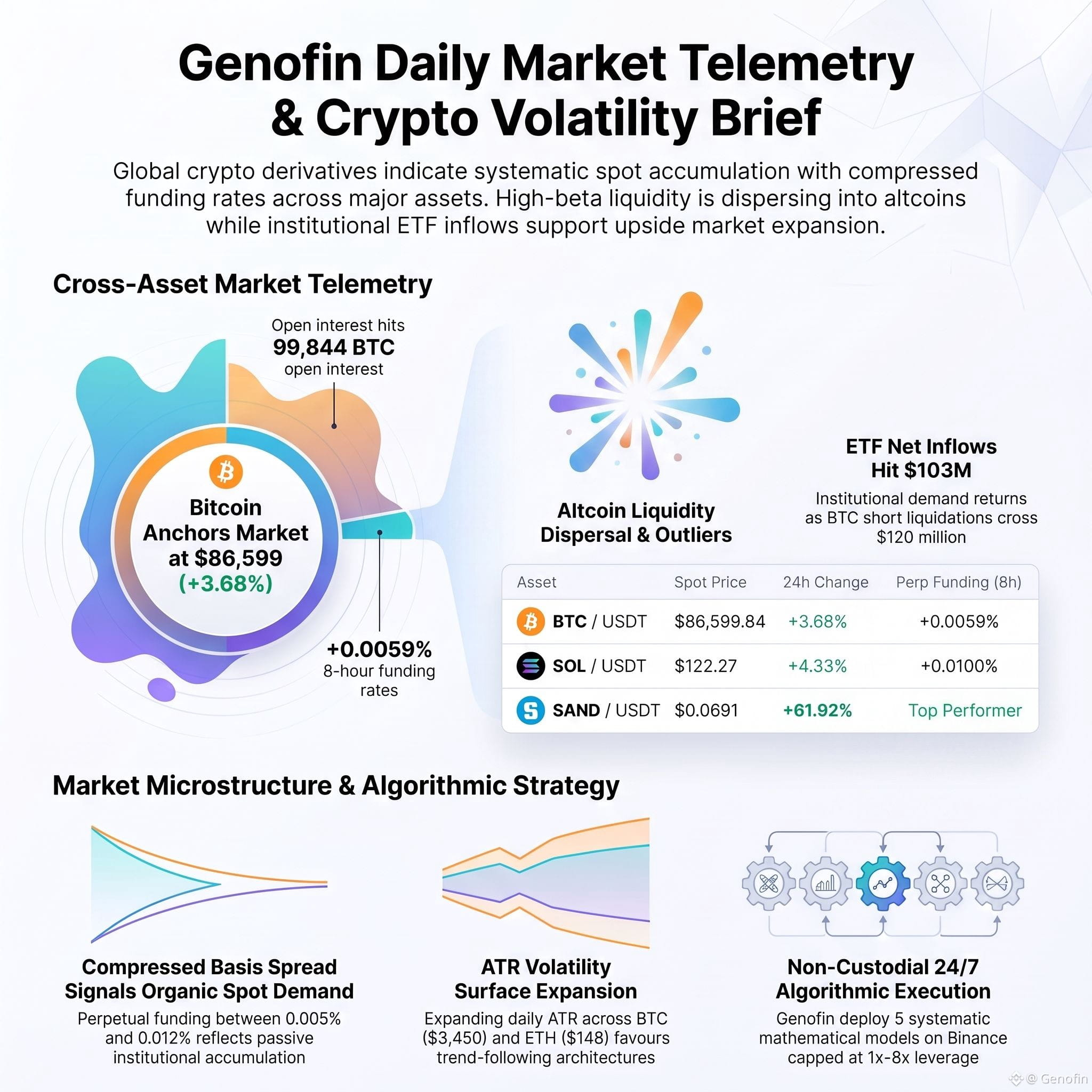
Crypto Vol-Term-Structure trifft auf steiles Contango:
• 30D/90D IV-Spread: +4,8 V
• RN-Varianzprämie: +18%
Monetarisieren Sie den Curve-Roll.
NFA. genofin.tech
Crypto Vol-Term-Structure trifft auf steiles Contango:
• 30D/90D IV-Spread: +4,8 V
• RN-Varianzprämie: +18%
Monetarisieren Sie den Curve-Roll.
NFA. genofin.tech
• 30D/90D IV-Spread: +4,8 V
• RN-Varianzprämie: +18%
Monetarisieren Sie den Curve-Roll.
NFA. genofin.tech
1
237
·
--
Übersetzung ansehen
📊 Genofin Daily Quant Poll — Comment your answer! 👇
BTC is at $84,537 (-0.3% 24h). What's your outlook?
- Bullish breakout
- Mean reversion
- Sideways chop
- Mirror Genofin
📊 Genofin Daily Quant Poll — Comment your answer! 👇
BTC is at $84,537 (-0.3% 24h). What's your outlook?
- Bullish breakout
- Mean reversion
- Sideways chop
- Mirror Genofin
BTC is at $84,537 (-0.3% 24h). What's your outlook?
- Bullish breakout
- Mean reversion
- Sideways chop
- Mirror Genofin
100
Anmelden und weiter Inhalte entdecken
Krypto-Nutzer weltweit auf Binance Square kennenlernen
⚡️ Bleib in Sachen Krypto stets am Puls.
💬 Die weltgrößte Kryptobörse vertraut darauf.
👍 Erhalte verlässliche Einblicke von verifizierten Creators.
E-Mail-Adresse/Telefonnummer