
ALFA BNB
8.1k Beiträge

ALFA BNB
Melden
Nutzer blockieren
CONTEN CREATER
276 Following
12.7K+ Follower
5.1K+ Like gegeben
Beiträge
Alle
Zitierungen
·
--
Übersetzung ansehen
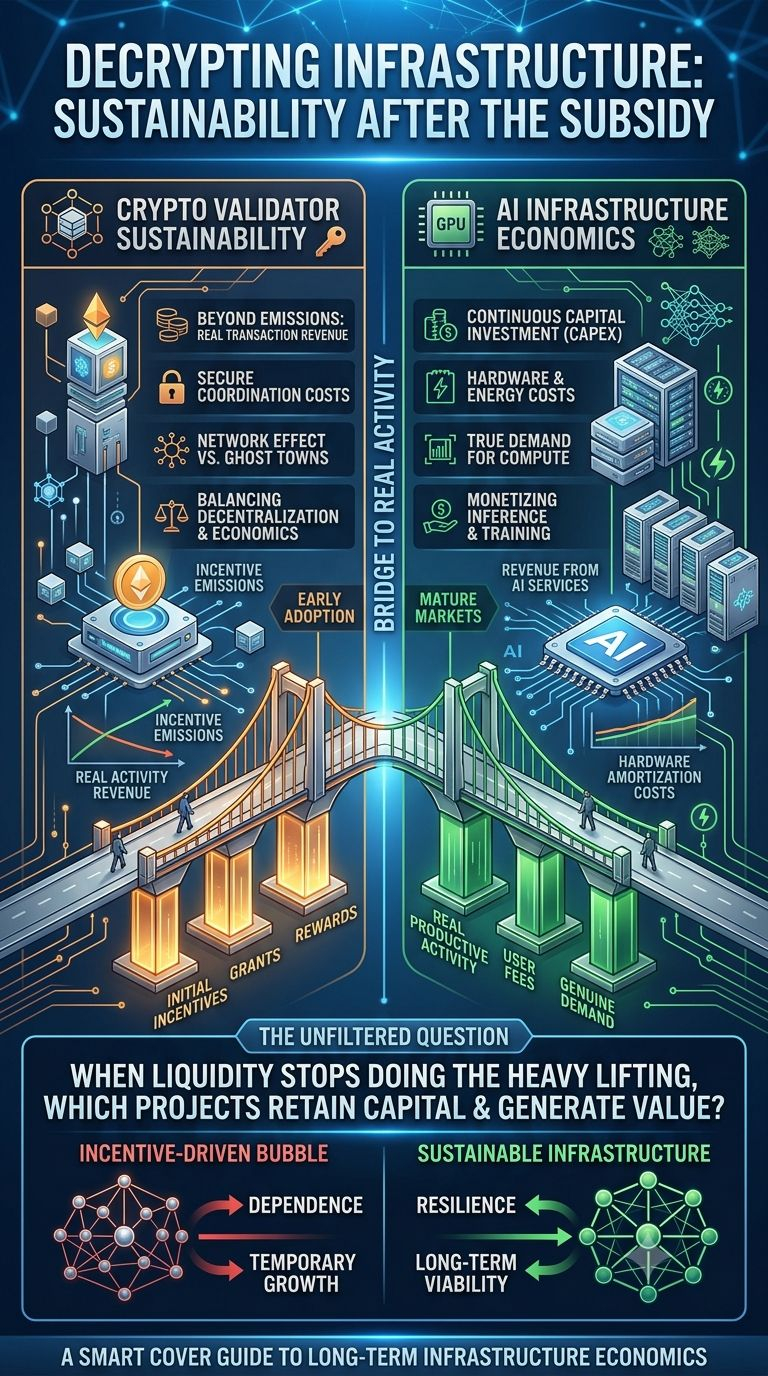
CPI may be getting most of the attention today, but I think the bigger question is what changing financial conditions mean for the infrastructure being built underneath crypto and AI.
These sectors are usually discussed around technology, speed, and adoption. I’m more interested in the economics that keep them running.
Validators need sustainable rewards. AI infrastructure requires continuous capital, energy, and hardware investment. Networks need enough real activity to justify the cost of coordination and security.
The overlooked issue is how dependent early infrastructure can become on incentives.
Subsidies, emissions, grants, and rewards can attract participants quickly, but they don’t necessarily prove that genuine demand exists. Eventually, users and productive activity have to carry more of the economic burden.
That creates a difficult long-term balance:
Aggressive incentives can help a network reach critical mass, but cutting them too quickly can hurt participation. Keep them too long, and they may hide whether the underlying model is actually sustainable.
So I’m less interested in whether today’s CPI creates a short-term move in crypto.
I’m more interested in what happens when liquidity stops doing the heavy lifting.
Which crypto and AI infrastructure projects can still attract capital, retain participants, and generate real activity when incentives become less generous?
$LAB
{future}(LABUSDT)
$RAYSOL
{future}(RAYSOLUSDT)
#CPIWatch
CPI may be getting most of the attention today, but I think the bigger question is what changing financial conditions mean for the infrastructure being built underneath crypto and AI.
These sectors are usually discussed around technology, speed, and adoption. I’m more interested in the economics that keep them running.
Validators need sustainable rewards. AI infrastructure requires continuous capital, energy, and hardware investment. Networks need enough real activity to justify the cost of coordination and security.
The overlooked issue is how dependent early infrastructure can become on incentives.
Subsidies, emissions, grants, and rewards can attract participants quickly, but they don’t necessarily prove that genuine demand exists. Eventually, users and productive activity have to carry more of the economic burden.
That creates a difficult long-term balance:
Aggressive incentives can help a network reach critical mass, but cutting them too quickly can hurt participation. Keep them too long, and they may hide whether the underlying model is actually sustainable.
So I’m less interested in whether today’s CPI creates a short-term move in crypto.
I’m more interested in what happens when liquidity stops doing the heavy lifting.
Which crypto and AI infrastructure projects can still attract capital, retain participants, and generate real activity when incentives become less generous?
$LAB
$RAYSOL
#CPIWatch
These sectors are usually discussed around technology, speed, and adoption. I’m more interested in the economics that keep them running.
Validators need sustainable rewards. AI infrastructure requires continuous capital, energy, and hardware investment. Networks need enough real activity to justify the cost of coordination and security.
The overlooked issue is how dependent early infrastructure can become on incentives.
Subsidies, emissions, grants, and rewards can attract participants quickly, but they don’t necessarily prove that genuine demand exists. Eventually, users and productive activity have to carry more of the economic burden.
That creates a difficult long-term balance:
Aggressive incentives can help a network reach critical mass, but cutting them too quickly can hurt participation. Keep them too long, and they may hide whether the underlying model is actually sustainable.
So I’m less interested in whether today’s CPI creates a short-term move in crypto.
I’m more interested in what happens when liquidity stops doing the heavy lifting.
Which crypto and AI infrastructure projects can still attract capital, retain participants, and generate real activity when incentives become less generous?
$LAB
$RAYSOL
#CPIWatch
79
·
--
Übersetzung ansehen
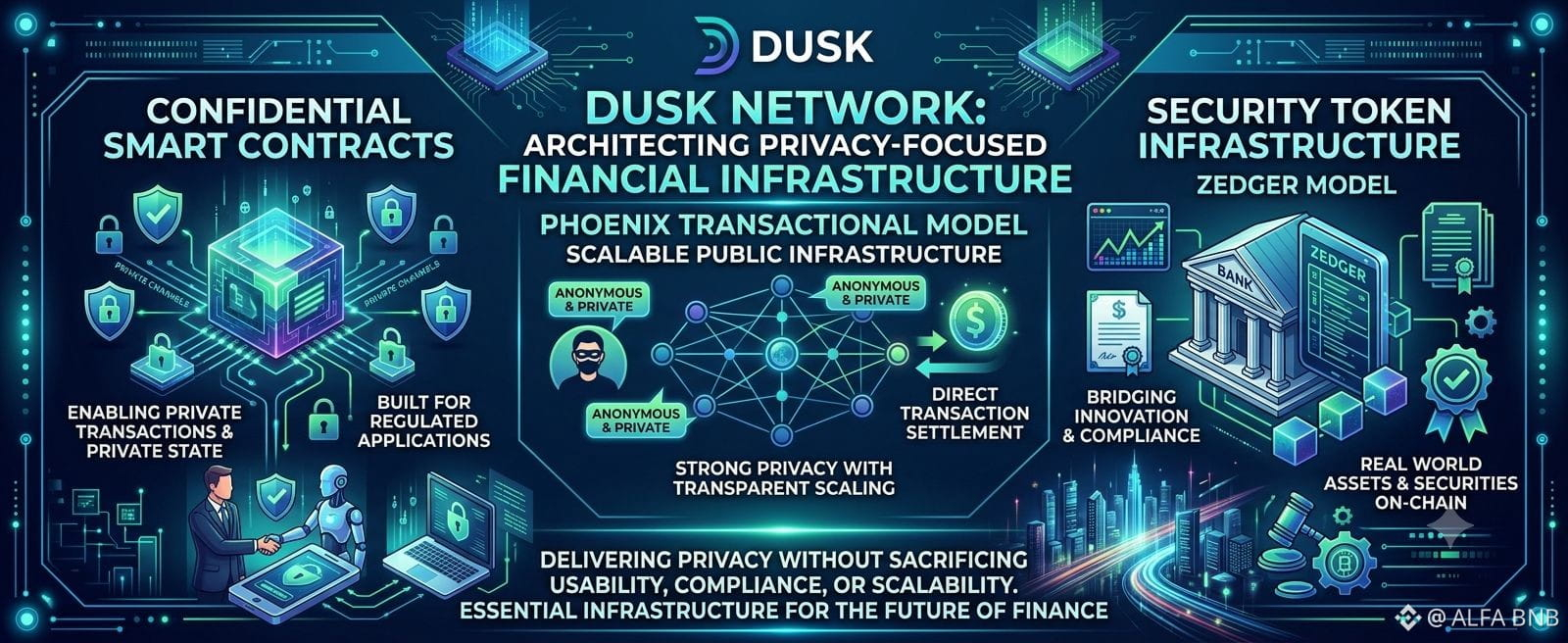
I've been looking into Dusk Network, and I think its approach to privacy-focused financial infrastructure is worth paying attention to. I’ve seen many blockchain projects promise privacy, but Dusk is taking a more specific approach by designing its layer-1 network around the practical requirements of financial markets.
What stands out to me is the combination of confidential smart contracts, scalable public infrastructure, and direct transaction settlement. Through its Phoenix transactional model, Dusk aims to provide stronger privacy and anonymity for both transactions and smart contracts without losing the ability to build regulated financial applications.
I’ve also seen growing interest in security token infrastructure, which makes Dusk’s Zedger model particularly interesting. By combining privacy-preserving technology with tools designed specifically for security tokens, Dusk could help bridge the gap between blockchain innovation and traditional financial requirements.
In my view, the real opportunity lies in whether Dusk can deliver privacy without sacrificing usability, compliance, or scalability. If adoption continues to grow, privacy could become an essential infrastructure layer rather than simply an optional feature. I’ve seen the market increasingly recognize that institutional and financial use cases require more than transparency alone, and Dusk is positioning itself directly within that opportunity.
#dusk @Dusk_Foundation $DUSK
{spot}(DUSKUSDT)
$JCT
{future}(JCTUSDT)
$ACE
{spot}(ACEUSDT)
I've been looking into Dusk Network, and I think its approach to privacy-focused financial infrastructure is worth paying attention to. I’ve seen many blockchain projects promise privacy, but Dusk is taking a more specific approach by designing its layer-1 network around the practical requirements of financial markets.
What stands out to me is the combination of confidential smart contracts, scalable public infrastructure, and direct transaction settlement. Through its Phoenix transactional model, Dusk aims to provide stronger privacy and anonymity for both transactions and smart contracts without losing the ability to build regulated financial applications.
I’ve also seen growing interest in security token infrastructure, which makes Dusk’s Zedger model particularly interesting. By combining privacy-preserving technology with tools designed specifically for security tokens, Dusk could help bridge the gap between blockchain innovation and traditional financial requirements.
In my view, the real opportunity lies in whether Dusk can deliver privacy without sacrificing usability, compliance, or scalability. If adoption continues to grow, privacy could become an essential infrastructure layer rather than simply an optional feature. I’ve seen the market increasingly recognize that institutional and financial use cases require more than transparency alone, and Dusk is positioning itself directly within that opportunity.
#dusk @Dusk $DUSK
$JCT
$ACE
What stands out to me is the combination of confidential smart contracts, scalable public infrastructure, and direct transaction settlement. Through its Phoenix transactional model, Dusk aims to provide stronger privacy and anonymity for both transactions and smart contracts without losing the ability to build regulated financial applications.
I’ve also seen growing interest in security token infrastructure, which makes Dusk’s Zedger model particularly interesting. By combining privacy-preserving technology with tools designed specifically for security tokens, Dusk could help bridge the gap between blockchain innovation and traditional financial requirements.
In my view, the real opportunity lies in whether Dusk can deliver privacy without sacrificing usability, compliance, or scalability. If adoption continues to grow, privacy could become an essential infrastructure layer rather than simply an optional feature. I’ve seen the market increasingly recognize that institutional and financial use cases require more than transparency alone, and Dusk is positioning itself directly within that opportunity.
#dusk @Dusk $DUSK
$JCT
$ACE
1
80
·
--
Übersetzung ansehen
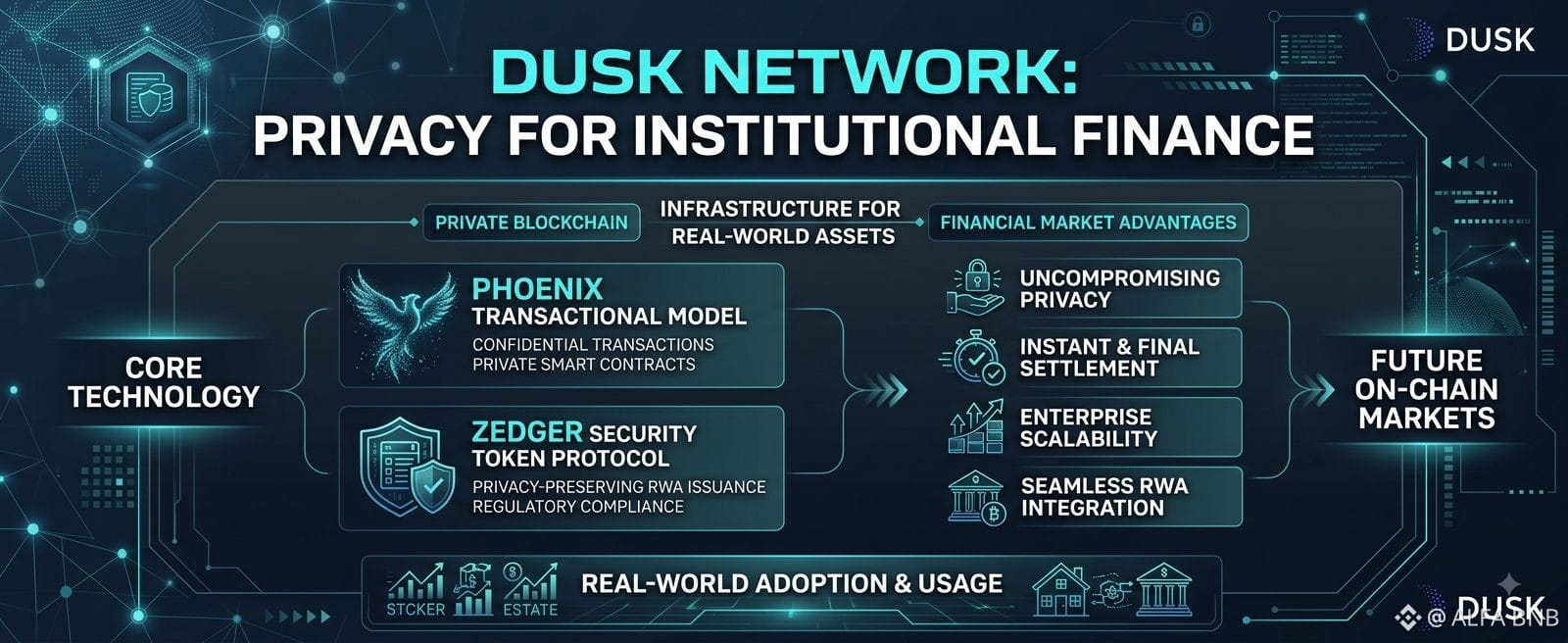
I've seen Dusk Network taking a different approach to blockchain by focusing directly on the needs of financial markets. What caught my attention is its emphasis on privacy, scalability, and fast settlement rather than simply chasing general-purpose blockchain adoption.
I've seen how Dusk uses the Phoenix transactional model to support private transactions and confidential smart contracts. For financial applications, this could be important because institutions often need to protect sensitive transaction data while still benefiting from blockchain infrastructure.
I've also seen Zedger stand out as another interesting part of the ecosystem. Built on Phoenix, it is designed to provide privacy-preserving functionality for security tokens, which gives Dusk a clear connection to tokenized financial assets and real-world markets.
In my view, the strongest part of the Dusk thesis is its focus on combining blockchain transparency with the confidentiality that financial institutions actually require. If the network can deliver scalable infrastructure, reliable settlement, and strong privacy while attracting real users and financial applications, it could have a meaningful role in the future of on-chain finance.
Of course, adoption and execution will matter most. I've seen plenty of promising blockchain concepts fail to gain traction, so Dusk's real-world usage will be the key metric I continue watching.
#dusk @Dusk_Foundation $DUSK
{spot}(DUSKUSDT)
$ACE
{spot}(ACEUSDT)
$AIO
{future}(AIOUSDT)
I've seen Dusk Network taking a different approach to blockchain by focusing directly on the needs of financial markets. What caught my attention is its emphasis on privacy, scalability, and fast settlement rather than simply chasing general-purpose blockchain adoption.
I've seen how Dusk uses the Phoenix transactional model to support private transactions and confidential smart contracts. For financial applications, this could be important because institutions often need to protect sensitive transaction data while still benefiting from blockchain infrastructure.
I've also seen Zedger stand out as another interesting part of the ecosystem. Built on Phoenix, it is designed to provide privacy-preserving functionality for security tokens, which gives Dusk a clear connection to tokenized financial assets and real-world markets.
In my view, the strongest part of the Dusk thesis is its focus on combining blockchain transparency with the confidentiality that financial institutions actually require. If the network can deliver scalable infrastructure, reliable settlement, and strong privacy while attracting real users and financial applications, it could have a meaningful role in the future of on-chain finance.
Of course, adoption and execution will matter most. I've seen plenty of promising blockchain concepts fail to gain traction, so Dusk's real-world usage will be the key metric I continue watching.
#dusk @Dusk $DUSK
$ACE
$AIO
I've seen how Dusk uses the Phoenix transactional model to support private transactions and confidential smart contracts. For financial applications, this could be important because institutions often need to protect sensitive transaction data while still benefiting from blockchain infrastructure.
I've also seen Zedger stand out as another interesting part of the ecosystem. Built on Phoenix, it is designed to provide privacy-preserving functionality for security tokens, which gives Dusk a clear connection to tokenized financial assets and real-world markets.
In my view, the strongest part of the Dusk thesis is its focus on combining blockchain transparency with the confidentiality that financial institutions actually require. If the network can deliver scalable infrastructure, reliable settlement, and strong privacy while attracting real users and financial applications, it could have a meaningful role in the future of on-chain finance.
Of course, adoption and execution will matter most. I've seen plenty of promising blockchain concepts fail to gain traction, so Dusk's real-world usage will be the key metric I continue watching.
#dusk @Dusk $DUSK
$ACE
$AIO
5
1
277
·
--
Übersetzung ansehen
Dusk Network: Privacy Meets Financial Infrastructure
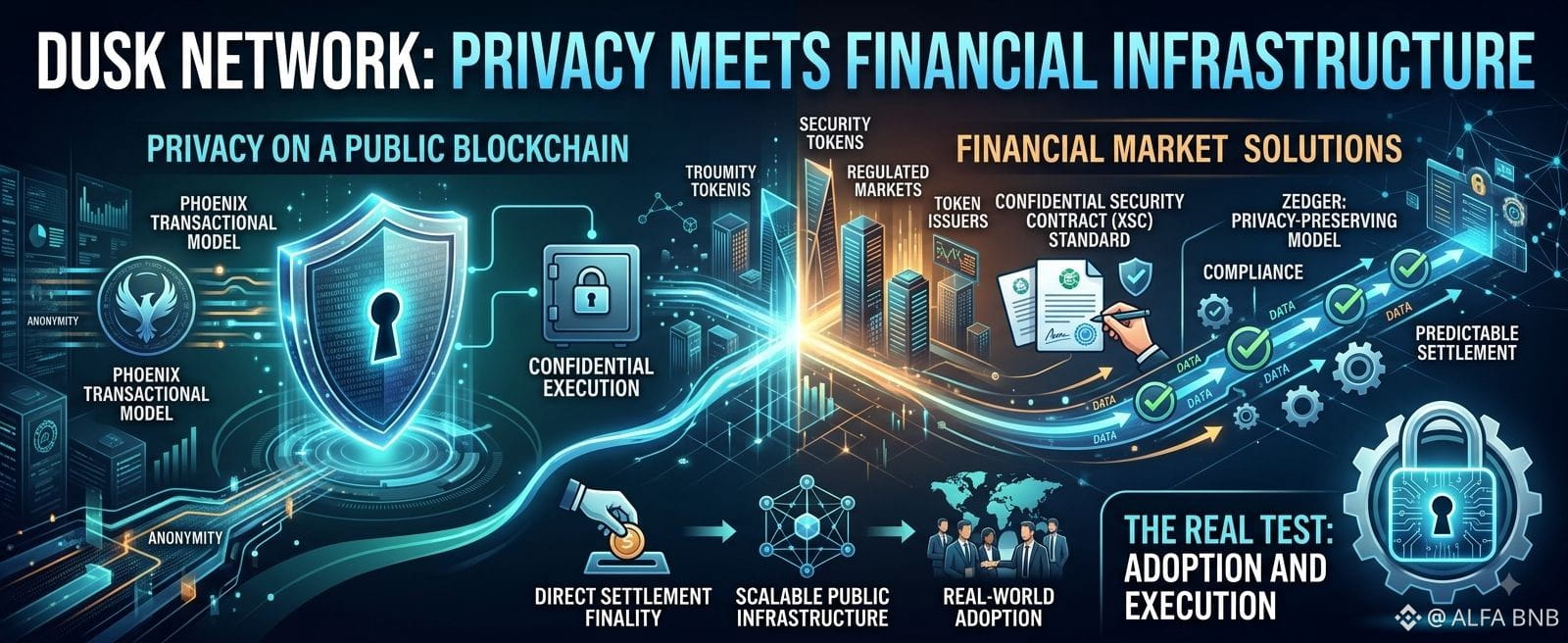
I’ve seen a lot of Layer-1 projects focus heavily on speed, scalability, or smart contracts, but Dusk Network is taking a different direction by targeting the specific needs of financial markets.
What stands out to me is its focus on privacy without giving up the benefits of a public blockchain. Dusk uses its Phoenix transactional model to support privacy and anonymity for transactions and smart contracts, while its Confidential Security Contract (XSC) standard is designed for financial applications.
I’ve also seen Dusk highlight Zedger, a privacy-preserving model built on Phoenix and designed specifically for security tokens. This could be important because financial markets require more than just fast transactions—they also need confidentiality, compliance, predictable settlement, and secure infrastructure.
What I find interesting is the combination of direct settlement finality, scalable public infrastructure, and confidential execution. If Dusk can translate these technical capabilities into real-world adoption by financial institutions, token issuers, and other regulated markets, it could have a strong long-term position.
For me, Dusk is worth watching not because of short-term hype, but because it is trying to solve a real problem: bringing blockchain efficiency to financial markets while maintaining the privacy that traditional finance requires.
The real test will be adoption and execution. 🔐
#dusk @Dusk_Foundation $DUSK
{spot}(DUSKUSDT)
$GPS
{spot}(GPSUSDT)
$VELVET
{future}(VELVETUSDT)
#ChinaJulyOutputRetailInvestmentAllMiss
#CMESeptemberHikeOddsFallTo30.6%
#IsraelStrikesLebanonKillsHezbollahCommander
#CardanoSplitsDijkstraUpgradeIntoTwoPhases
Dusk Network: Privacy Meets Financial Infrastructure
I’ve seen a lot of Layer-1 projects focus heavily on speed, scalability, or smart contracts, but Dusk Network is taking a different direction by targeting the specific needs of financial markets.
What stands out to me is its focus on privacy without giving up the benefits of a public blockchain. Dusk uses its Phoenix transactional model to support privacy and anonymity for transactions and smart contracts, while its Confidential Security Contract (XSC) standard is designed for financial applications.
I’ve also seen Dusk highlight Zedger, a privacy-preserving model built on Phoenix and designed specifically for security tokens. This could be important because financial markets require more than just fast transactions—they also need confidentiality, compliance, predictable settlement, and secure infrastructure.
What I find interesting is the combination of direct settlement finality, scalable public infrastructure, and confidential execution. If Dusk can translate these technical capabilities into real-world adoption by financial institutions, token issuers, and other regulated markets, it could have a strong long-term position.
For me, Dusk is worth watching not because of short-term hype, but because it is trying to solve a real problem: bringing blockchain efficiency to financial markets while maintaining the privacy that traditional finance requires.
The real test will be adoption and execution. 🔐
#dusk @Dusk $DUSK
$GPS
$VELVET
#ChinaJulyOutputRetailInvestmentAllMiss
#CMESeptemberHikeOddsFallTo30.6%
#IsraelStrikesLebanonKillsHezbollahCommander
#CardanoSplitsDijkstraUpgradeIntoTwoPhases
I’ve seen a lot of Layer-1 projects focus heavily on speed, scalability, or smart contracts, but Dusk Network is taking a different direction by targeting the specific needs of financial markets.
What stands out to me is its focus on privacy without giving up the benefits of a public blockchain. Dusk uses its Phoenix transactional model to support privacy and anonymity for transactions and smart contracts, while its Confidential Security Contract (XSC) standard is designed for financial applications.
I’ve also seen Dusk highlight Zedger, a privacy-preserving model built on Phoenix and designed specifically for security tokens. This could be important because financial markets require more than just fast transactions—they also need confidentiality, compliance, predictable settlement, and secure infrastructure.
What I find interesting is the combination of direct settlement finality, scalable public infrastructure, and confidential execution. If Dusk can translate these technical capabilities into real-world adoption by financial institutions, token issuers, and other regulated markets, it could have a strong long-term position.
For me, Dusk is worth watching not because of short-term hype, but because it is trying to solve a real problem: bringing blockchain efficiency to financial markets while maintaining the privacy that traditional finance requires.
The real test will be adoption and execution. 🔐
#dusk @Dusk $DUSK
$GPS
$VELVET
#ChinaJulyOutputRetailInvestmentAllMiss
#CMESeptemberHikeOddsFallTo30.6%
#IsraelStrikesLebanonKillsHezbollahCommander
#CardanoSplitsDijkstraUpgradeIntoTwoPhases
3
2
136
·
--
Übersetzung ansehen
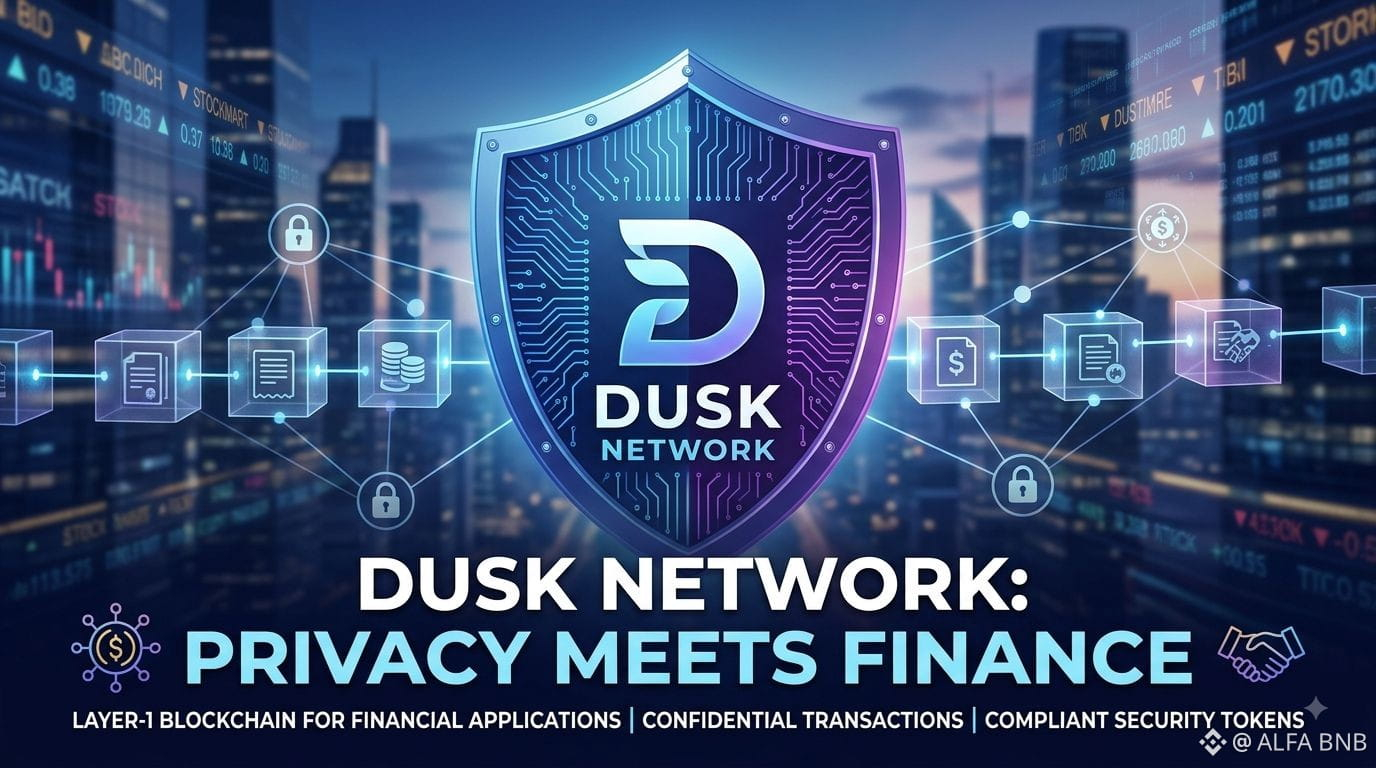
Dusk Network: Privacy Meets Finance
I've seen Dusk Network positioning itself as a privacy-focused Layer-1 built specifically for financial applications, and I think the approach is worth watching.
What stands out to me is the focus on combining privacy, scalability, and direct settlement finality. Through its Phoenix transactional model, Dusk aims to bring confidentiality to transactions and smart contracts, while Zedger provides a privacy-preserving framework for security tokens.
I've seen many blockchain projects focus heavily on speed or decentralization, but financial markets require something more: sensitive data needs to remain protected while transactions still settle efficiently.
That's where Dusk's thesis becomes interesting. If institutions are going to move securities and other financial assets on-chain, privacy and regulatory requirements will likely be just as important as performance.
Of course, technology alone isn't enough. I've seen plenty of promising blockchain infrastructure struggle to gain real adoption. Dusk will ultimately need strong developer activity, liquidity, institutional use cases, and a growing ecosystem to prove its model.
Still, I believe the combination of privacy + compliant financial infrastructure + fast settlement gives Dusk an interesting position as blockchain-based finance continues to evolve.
#dusk @Dusk_Foundation $DUSK
{spot}(DUSKUSDT)
$PORTAL
{spot}(PORTALUSDT)
$CYS
{future}(CYSUSDT)
#SECReviewsSix3xLeveragedCommodityETFs
#USToPressNationsToPickUSOrChinaAICoalition
#SP500TopsRecord7800
#LMECopperStocksFall42DaysLongestSince2014
Dusk Network: Privacy Meets Finance
I've seen Dusk Network positioning itself as a privacy-focused Layer-1 built specifically for financial applications, and I think the approach is worth watching.
What stands out to me is the focus on combining privacy, scalability, and direct settlement finality. Through its Phoenix transactional model, Dusk aims to bring confidentiality to transactions and smart contracts, while Zedger provides a privacy-preserving framework for security tokens.
I've seen many blockchain projects focus heavily on speed or decentralization, but financial markets require something more: sensitive data needs to remain protected while transactions still settle efficiently.
That's where Dusk's thesis becomes interesting. If institutions are going to move securities and other financial assets on-chain, privacy and regulatory requirements will likely be just as important as performance.
Of course, technology alone isn't enough. I've seen plenty of promising blockchain infrastructure struggle to gain real adoption. Dusk will ultimately need strong developer activity, liquidity, institutional use cases, and a growing ecosystem to prove its model.
Still, I believe the combination of privacy + compliant financial infrastructure + fast settlement gives Dusk an interesting position as blockchain-based finance continues to evolve.
#dusk @Dusk $DUSK
$PORTAL
$CYS
#SECReviewsSix3xLeveragedCommodityETFs
#USToPressNationsToPickUSOrChinaAICoalition
#SP500TopsRecord7800
#LMECopperStocksFall42DaysLongestSince2014
I've seen Dusk Network positioning itself as a privacy-focused Layer-1 built specifically for financial applications, and I think the approach is worth watching.
What stands out to me is the focus on combining privacy, scalability, and direct settlement finality. Through its Phoenix transactional model, Dusk aims to bring confidentiality to transactions and smart contracts, while Zedger provides a privacy-preserving framework for security tokens.
I've seen many blockchain projects focus heavily on speed or decentralization, but financial markets require something more: sensitive data needs to remain protected while transactions still settle efficiently.
That's where Dusk's thesis becomes interesting. If institutions are going to move securities and other financial assets on-chain, privacy and regulatory requirements will likely be just as important as performance.
Of course, technology alone isn't enough. I've seen plenty of promising blockchain infrastructure struggle to gain real adoption. Dusk will ultimately need strong developer activity, liquidity, institutional use cases, and a growing ecosystem to prove its model.
Still, I believe the combination of privacy + compliant financial infrastructure + fast settlement gives Dusk an interesting position as blockchain-based finance continues to evolve.
#dusk @Dusk $DUSK
$PORTAL
$CYS
#SECReviewsSix3xLeveragedCommodityETFs
#USToPressNationsToPickUSOrChinaAICoalition
#SP500TopsRecord7800
#LMECopperStocksFall42DaysLongestSince2014
4
87
·
--
Übersetzung ansehen
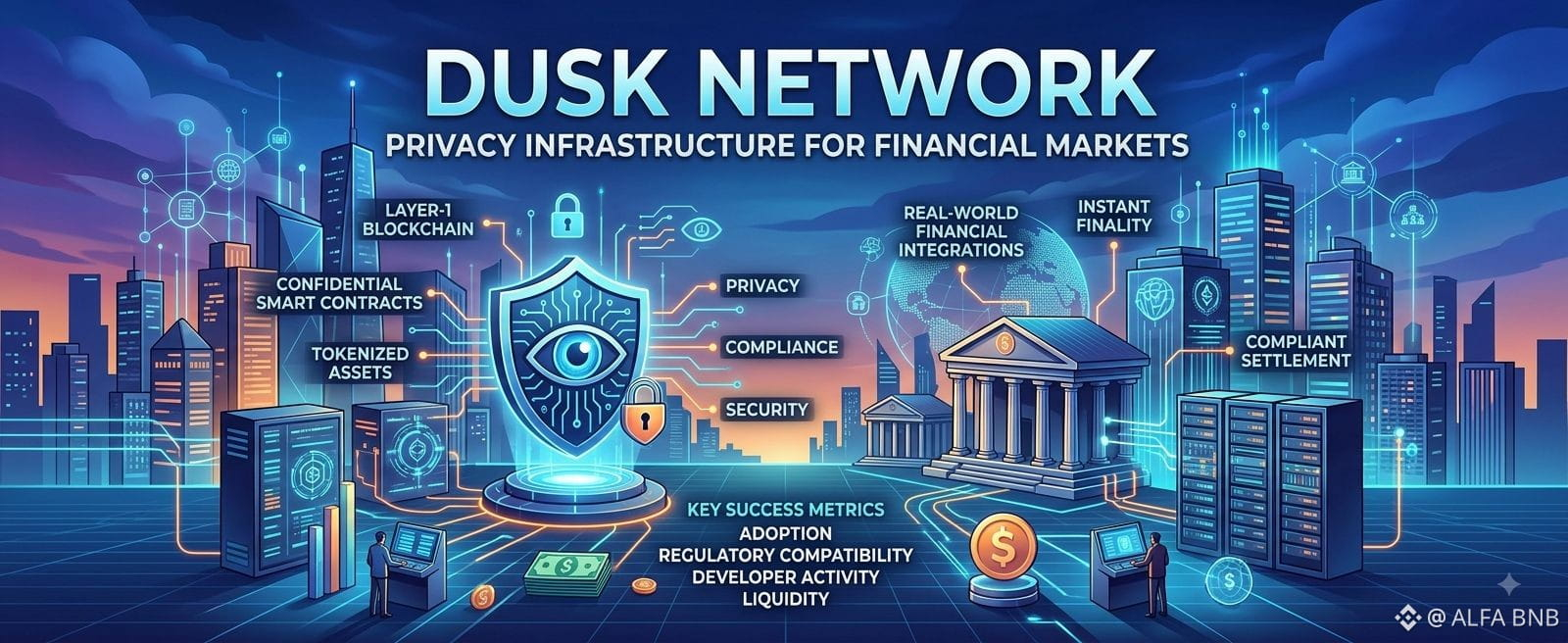
Dusk Network: Privacy Infrastructure for Financial Markets
Dusk Network stands out by focusing on a problem that many blockchain projects still struggle to solve: bringing privacy and compliance closer together without sacrificing the benefits of public blockchain infrastructure.
As a Layer-1, Dusk is designed specifically for financial applications, with confidential smart contracts, direct transaction finality, and privacy-focused transaction processing at its core. Its Phoenix transactional model aims to provide stronger privacy and anonymity, while Zedger extends this approach toward tokenized assets and security-focused use cases.
The interesting part of the Dusk thesis is its focus on real financial infrastructure rather than simply building another general-purpose blockchain. Traditional financial markets require confidentiality, predictable settlement, and scalable infrastructure, and these are areas where Dusk is positioning itself.
However, technology alone will not determine success. Adoption, regulatory compatibility, developer activity, liquidity, and real-world financial integrations will be the key metrics to watch.
If Dusk can turn its privacy architecture into practical infrastructure for tokenized securities and regulated financial markets, it could occupy a valuable niche in the blockchain ecosystem.
For me, Dusk is a project worth watching—not because of hype, but because privacy and compliant settlement could become increasingly important as blockchain moves deeper into traditional finance.
#dusk @Dusk_Foundation $DUSK
{spot}(DUSKUSDT)
$COW
{spot}(COWUSDT)
$APR
{future}(APRUSDT)
Dusk Network: Privacy Infrastructure for Financial Markets
Dusk Network stands out by focusing on a problem that many blockchain projects still struggle to solve: bringing privacy and compliance closer together without sacrificing the benefits of public blockchain infrastructure.
As a Layer-1, Dusk is designed specifically for financial applications, with confidential smart contracts, direct transaction finality, and privacy-focused transaction processing at its core. Its Phoenix transactional model aims to provide stronger privacy and anonymity, while Zedger extends this approach toward tokenized assets and security-focused use cases.
The interesting part of the Dusk thesis is its focus on real financial infrastructure rather than simply building another general-purpose blockchain. Traditional financial markets require confidentiality, predictable settlement, and scalable infrastructure, and these are areas where Dusk is positioning itself.
However, technology alone will not determine success. Adoption, regulatory compatibility, developer activity, liquidity, and real-world financial integrations will be the key metrics to watch.
If Dusk can turn its privacy architecture into practical infrastructure for tokenized securities and regulated financial markets, it could occupy a valuable niche in the blockchain ecosystem.
For me, Dusk is a project worth watching—not because of hype, but because privacy and compliant settlement could become increasingly important as blockchain moves deeper into traditional finance.
#dusk @Dusk $DUSK
$COW
$APR
Dusk Network stands out by focusing on a problem that many blockchain projects still struggle to solve: bringing privacy and compliance closer together without sacrificing the benefits of public blockchain infrastructure.
As a Layer-1, Dusk is designed specifically for financial applications, with confidential smart contracts, direct transaction finality, and privacy-focused transaction processing at its core. Its Phoenix transactional model aims to provide stronger privacy and anonymity, while Zedger extends this approach toward tokenized assets and security-focused use cases.
The interesting part of the Dusk thesis is its focus on real financial infrastructure rather than simply building another general-purpose blockchain. Traditional financial markets require confidentiality, predictable settlement, and scalable infrastructure, and these are areas where Dusk is positioning itself.
However, technology alone will not determine success. Adoption, regulatory compatibility, developer activity, liquidity, and real-world financial integrations will be the key metrics to watch.
If Dusk can turn its privacy architecture into practical infrastructure for tokenized securities and regulated financial markets, it could occupy a valuable niche in the blockchain ecosystem.
For me, Dusk is a project worth watching—not because of hype, but because privacy and compliant settlement could become increasingly important as blockchain moves deeper into traditional finance.
#dusk @Dusk $DUSK
$COW
$APR
1
94
·
--
Übersetzung ansehen
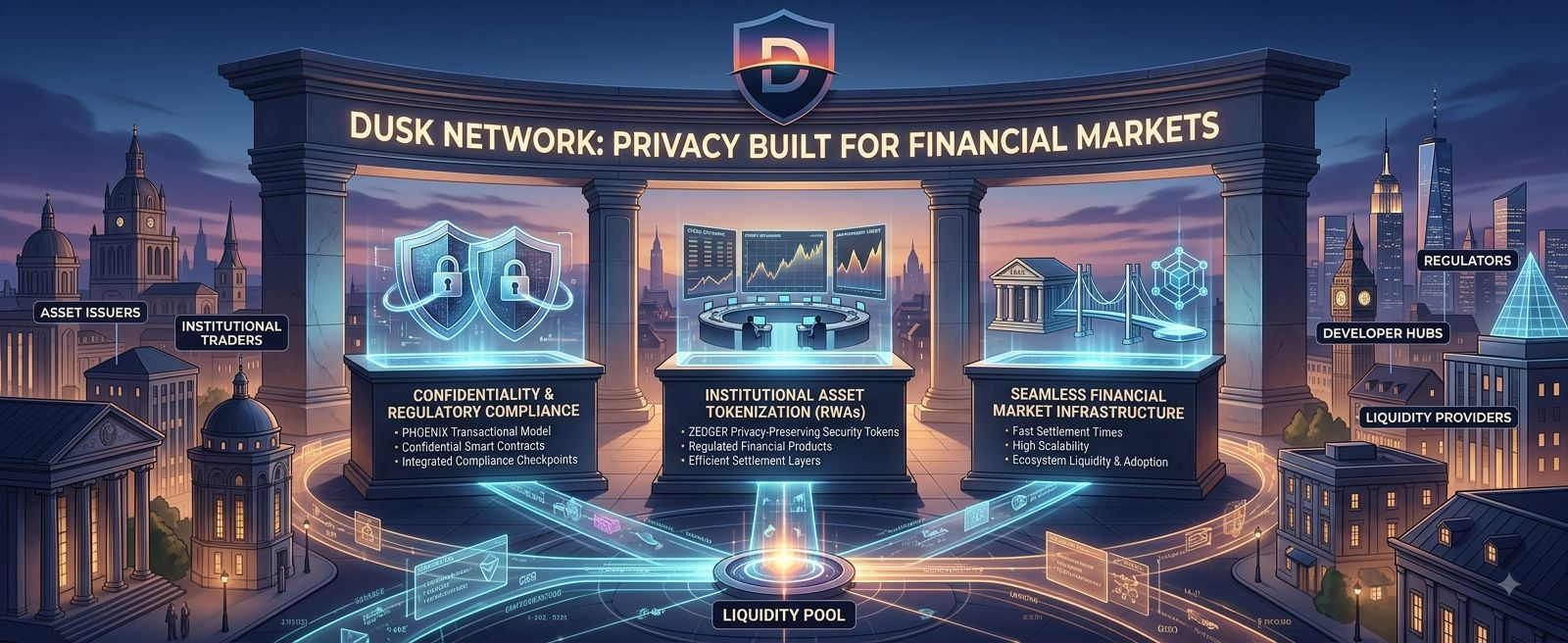
Dusk Network: Privacy Built for Financial Markets
I’ve seen Dusk Network positioning itself as a privacy-focused Layer-1 built specifically for financial applications, and I think its approach is worth watching.
The project focuses on combining privacy, scalability, compliance, and fast settlement in one public blockchain. Its Phoenix transactional model is designed to provide confidential transactions and smart-contract functionality, while Zedger supports privacy-preserving security tokens.
What caught my attention is Dusk’s focus on real financial markets rather than simply chasing short-term DeFi trends. Financial institutions need blockchain infrastructure where sensitive information can remain protected while assets can still move and settle efficiently.
I’ve seen the growing interest around tokenized securities and real-world assets, and this is where Dusk could have an interesting opportunity. If institutions increasingly bring regulated assets on-chain, privacy and compliance could become critical infrastructure requirements.
Of course, technology alone is not enough. I’ll be watching real adoption, developer activity, ecosystem growth, liquidity, and DUSK token utility closely.
For me, the thesis is straightforward: if Dusk can turn its privacy-focused architecture into real institutional usage, it could become an important piece of the next generation of blockchain-based financial markets.
#dusk @Dusk_Foundation $DUSK
{spot}(DUSKUSDT)
Dusk Network: Privacy Built for Financial Markets
I’ve seen Dusk Network positioning itself as a privacy-focused Layer-1 built specifically for financial applications, and I think its approach is worth watching.
The project focuses on combining privacy, scalability, compliance, and fast settlement in one public blockchain. Its Phoenix transactional model is designed to provide confidential transactions and smart-contract functionality, while Zedger supports privacy-preserving security tokens.
What caught my attention is Dusk’s focus on real financial markets rather than simply chasing short-term DeFi trends. Financial institutions need blockchain infrastructure where sensitive information can remain protected while assets can still move and settle efficiently.
I’ve seen the growing interest around tokenized securities and real-world assets, and this is where Dusk could have an interesting opportunity. If institutions increasingly bring regulated assets on-chain, privacy and compliance could become critical infrastructure requirements.
Of course, technology alone is not enough. I’ll be watching real adoption, developer activity, ecosystem growth, liquidity, and DUSK token utility closely.
For me, the thesis is straightforward: if Dusk can turn its privacy-focused architecture into real institutional usage, it could become an important piece of the next generation of blockchain-based financial markets.
#dusk @Dusk $DUSK
I’ve seen Dusk Network positioning itself as a privacy-focused Layer-1 built specifically for financial applications, and I think its approach is worth watching.
The project focuses on combining privacy, scalability, compliance, and fast settlement in one public blockchain. Its Phoenix transactional model is designed to provide confidential transactions and smart-contract functionality, while Zedger supports privacy-preserving security tokens.
What caught my attention is Dusk’s focus on real financial markets rather than simply chasing short-term DeFi trends. Financial institutions need blockchain infrastructure where sensitive information can remain protected while assets can still move and settle efficiently.
I’ve seen the growing interest around tokenized securities and real-world assets, and this is where Dusk could have an interesting opportunity. If institutions increasingly bring regulated assets on-chain, privacy and compliance could become critical infrastructure requirements.
Of course, technology alone is not enough. I’ll be watching real adoption, developer activity, ecosystem growth, liquidity, and DUSK token utility closely.
For me, the thesis is straightforward: if Dusk can turn its privacy-focused architecture into real institutional usage, it could become an important piece of the next generation of blockchain-based financial markets.
#dusk @Dusk $DUSK
4
1
102
·
--
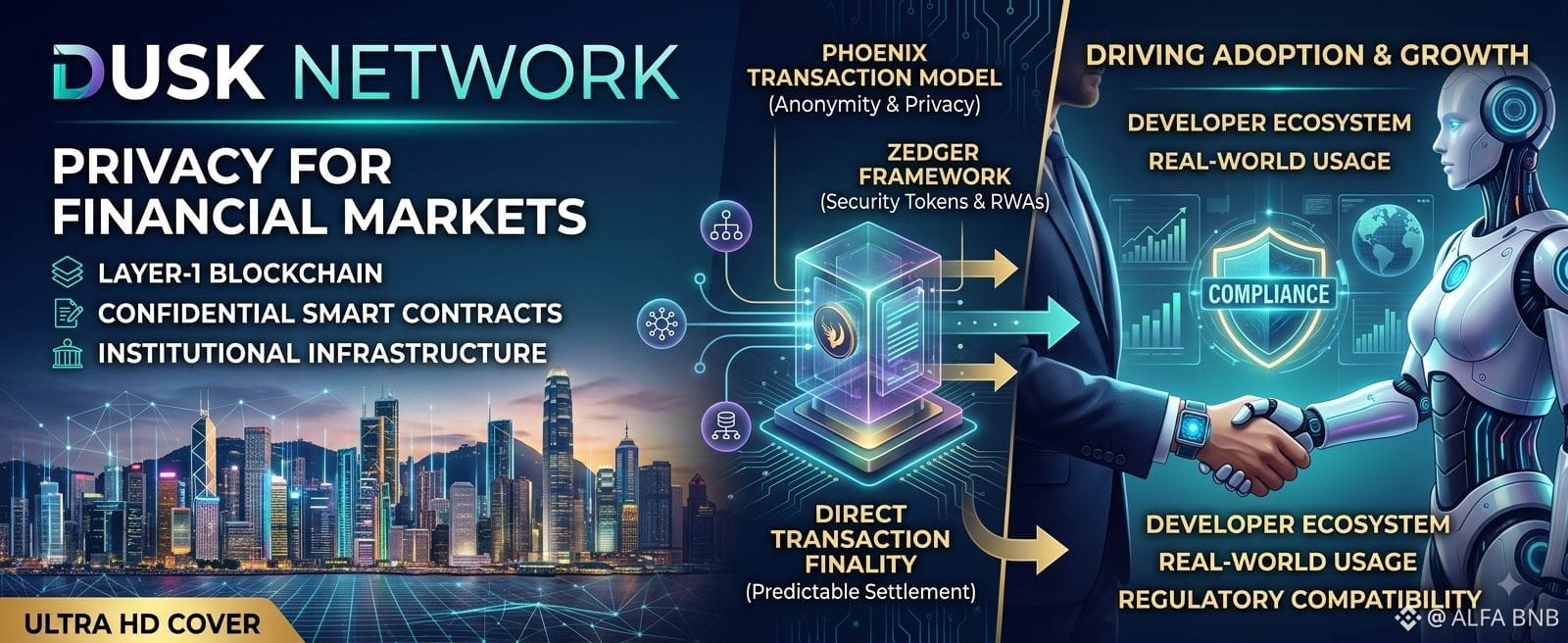
Dusk Network — Datenschutz für Finanzmärkte
Ich habe gesehen, wie sich Dusk Network auf eine ganz konkrete Herausforderung in der Blockchain konzentriert: Datenschutz, Skalierbarkeit und zuverlässige Abwicklung für Finanzmärkte.
Als Layer-1-Blockchain ist Dusk darauf ausgelegt, vertrauliche Smart Contracts zu unterstützen und gleichzeitig eine Infrastruktur bereitzustellen, die für regulierte Finanzanwendungen geeignet ist. Was für mich besonders hervorsticht, ist sein Phoenix-Transaktionsmodell, das Datenschutz und Anonymität für Transaktionen und Smart Contracts ermöglichen möchte, ohne sich dabei auf eine private Blockchain zu verlassen.
Außerdem habe ich Dusk’s Zedger-Framework hervorgehoben für Security Tokens und datenschutzfreundliche Finanzwerte gesehen. Das könnte besonders relevant werden, wenn Tokenisierung und Real-World Assets weiter wachsen.
Ein weiterer Aspekt, den ich interessant finde, ist Dusk’s Fokus auf direkte Transaktionsfinalität. Finanzmärkte benötigen eine vorhersehbare Abwicklung, und die Kombination aus Finalität und Datenschutz könnte Blockchain-Infrastruktur für Institutionen praktikabler machen.
Natürlich denke ich, dass die Technologie nur ein Teil der Geschichte ist. Langfristiger Erfolg wird davon abhängen, wie stark die Technologie in der Praxis übernommen wird, wie aktiv Entwickler sind, wie stark das Ökosystem wächst, wie gut die regulatorische Kompatibilität ist und wie viele Finanzanwendungen tatsächlich das Netzwerk nutzen.
Insgesamt sehe ich Dusk als ein spannendes Projekt, weil es nicht einfach nur eine allgemeine Blockchain-Akzeptanz verfolgt. Es zielt auf einen bestimmten Markt ab, in dem Datenschutz und Compliance entscheidend sind.
Wenn Dusk diese Technologie in echte finanzielle Nutzung umwandeln kann, glaube ich, dass seine Rolle in der institutionellen Blockchain-Infrastruktur zunehmend wichtiger werden könnte.
#dusk @Dusk_Foundation $DUSK
{spot}(DUSKUSDT)
Dusk Network — Datenschutz für Finanzmärkte
Ich habe gesehen, wie sich Dusk Network auf eine ganz konkrete Herausforderung in der Blockchain konzentriert: Datenschutz, Skalierbarkeit und zuverlässige Abwicklung für Finanzmärkte.
Als Layer-1-Blockchain ist Dusk darauf ausgelegt, vertrauliche Smart Contracts zu unterstützen und gleichzeitig eine Infrastruktur bereitzustellen, die für regulierte Finanzanwendungen geeignet ist. Was für mich besonders hervorsticht, ist sein Phoenix-Transaktionsmodell, das Datenschutz und Anonymität für Transaktionen und Smart Contracts ermöglichen möchte, ohne sich dabei auf eine private Blockchain zu verlassen.
Außerdem habe ich Dusk’s Zedger-Framework hervorgehoben für Security Tokens und datenschutzfreundliche Finanzwerte gesehen. Das könnte besonders relevant werden, wenn Tokenisierung und Real-World Assets weiter wachsen.
Ein weiterer Aspekt, den ich interessant finde, ist Dusk’s Fokus auf direkte Transaktionsfinalität. Finanzmärkte benötigen eine vorhersehbare Abwicklung, und die Kombination aus Finalität und Datenschutz könnte Blockchain-Infrastruktur für Institutionen praktikabler machen.
Natürlich denke ich, dass die Technologie nur ein Teil der Geschichte ist. Langfristiger Erfolg wird davon abhängen, wie stark die Technologie in der Praxis übernommen wird, wie aktiv Entwickler sind, wie stark das Ökosystem wächst, wie gut die regulatorische Kompatibilität ist und wie viele Finanzanwendungen tatsächlich das Netzwerk nutzen.
Insgesamt sehe ich Dusk als ein spannendes Projekt, weil es nicht einfach nur eine allgemeine Blockchain-Akzeptanz verfolgt. Es zielt auf einen bestimmten Markt ab, in dem Datenschutz und Compliance entscheidend sind.
Wenn Dusk diese Technologie in echte finanzielle Nutzung umwandeln kann, glaube ich, dass seine Rolle in der institutionellen Blockchain-Infrastruktur zunehmend wichtiger werden könnte.
#dusk @Dusk $DUSK
Ich habe gesehen, wie sich Dusk Network auf eine ganz konkrete Herausforderung in der Blockchain konzentriert: Datenschutz, Skalierbarkeit und zuverlässige Abwicklung für Finanzmärkte.
Als Layer-1-Blockchain ist Dusk darauf ausgelegt, vertrauliche Smart Contracts zu unterstützen und gleichzeitig eine Infrastruktur bereitzustellen, die für regulierte Finanzanwendungen geeignet ist. Was für mich besonders hervorsticht, ist sein Phoenix-Transaktionsmodell, das Datenschutz und Anonymität für Transaktionen und Smart Contracts ermöglichen möchte, ohne sich dabei auf eine private Blockchain zu verlassen.
Außerdem habe ich Dusk’s Zedger-Framework hervorgehoben für Security Tokens und datenschutzfreundliche Finanzwerte gesehen. Das könnte besonders relevant werden, wenn Tokenisierung und Real-World Assets weiter wachsen.
Ein weiterer Aspekt, den ich interessant finde, ist Dusk’s Fokus auf direkte Transaktionsfinalität. Finanzmärkte benötigen eine vorhersehbare Abwicklung, und die Kombination aus Finalität und Datenschutz könnte Blockchain-Infrastruktur für Institutionen praktikabler machen.
Natürlich denke ich, dass die Technologie nur ein Teil der Geschichte ist. Langfristiger Erfolg wird davon abhängen, wie stark die Technologie in der Praxis übernommen wird, wie aktiv Entwickler sind, wie stark das Ökosystem wächst, wie gut die regulatorische Kompatibilität ist und wie viele Finanzanwendungen tatsächlich das Netzwerk nutzen.
Insgesamt sehe ich Dusk als ein spannendes Projekt, weil es nicht einfach nur eine allgemeine Blockchain-Akzeptanz verfolgt. Es zielt auf einen bestimmten Markt ab, in dem Datenschutz und Compliance entscheidend sind.
Wenn Dusk diese Technologie in echte finanzielle Nutzung umwandeln kann, glaube ich, dass seine Rolle in der institutionellen Blockchain-Infrastruktur zunehmend wichtiger werden könnte.
#dusk @Dusk $DUSK
3
2
131
·
--
🚀 $TUT ist absolut am Abheben! 🔥
TUT/USDT wird bei etwa 0,18393 $ gehandelt und ist in 24 Std. um satte +257,70% gestiegen! 📈
🎯 24H-Hoch: 0,30563 $
📉 24H-Tief: 0,05089 $
💰 24H-Volumen: 204,67 Mio. USDT
⚡ TUT-Volumen: 1,78 Mrd.
📊 Heute: +129,18%
🔥 7T: +936,57%
🚀 30T: +1.591,61%
Von 0,06592 $ bis zu einem Ausbruch über 0,30 $ – die Volatilität ist unglaublich! 👀
TUT ist offiziell auf dem Radar. 🚨🔥
$TUT
{spot}(TUTUSDT)
🚀 $TUT ist absolut am Abheben! 🔥
TUT/USDT wird bei etwa 0,18393 $ gehandelt und ist in 24 Std. um satte +257,70% gestiegen! 📈
🎯 24H-Hoch: 0,30563 $
📉 24H-Tief: 0,05089 $
💰 24H-Volumen: 204,67 Mio. USDT
⚡ TUT-Volumen: 1,78 Mrd.
📊 Heute: +129,18%
🔥 7T: +936,57%
🚀 30T: +1.591,61%
Von 0,06592 $ bis zu einem Ausbruch über 0,30 $ – die Volatilität ist unglaublich! 👀
TUT ist offiziell auf dem Radar. 🚨🔥
$TUT
TUT/USDT wird bei etwa 0,18393 $ gehandelt und ist in 24 Std. um satte +257,70% gestiegen! 📈
🎯 24H-Hoch: 0,30563 $
📉 24H-Tief: 0,05089 $
💰 24H-Volumen: 204,67 Mio. USDT
⚡ TUT-Volumen: 1,78 Mrd.
📊 Heute: +129,18%
🔥 7T: +936,57%
🚀 30T: +1.591,61%
Von 0,06592 $ bis zu einem Ausbruch über 0,30 $ – die Volatilität ist unglaublich! 👀
TUT ist offiziell auf dem Radar. 🚨🔥
$TUT
🟢 Bullish — $0.30+ retest
72%
🔵 Consolidation — sideways
8%
🟡 Pullback healthy correction
8%
🔴 Dump — too overheated
12%
25 Stimmen • Abstimmung beendet
1.7k
·
--
Bullisch
Übersetzung ansehen
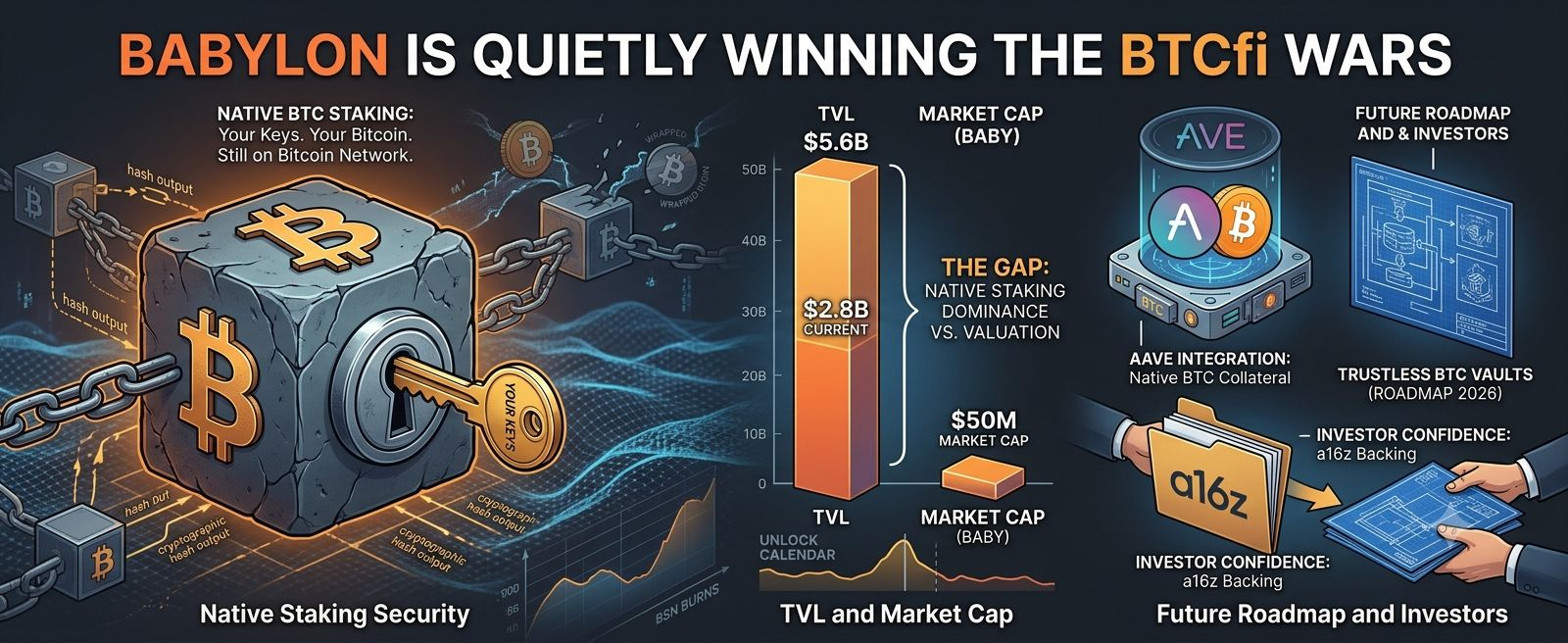
Babylon Is Quietly Winning the BTCfi Wars
I keep coming back to one number: Babylon holds more Bitcoin in native staking than nearly every wrapped-BTC protocol combined, yet its market cap sits around $50M against TVL that's swung as high as $5.6B. That gap is the whole thesis.
I'm not interested in BABY because it's another staking token. I'm interested because Babylon solved the actual problem BTCfi has danced around for years: how do you make Bitcoin productive without wrapping it, bridging it, or trusting a custodian. Babylon's answer is native staking, full stop. Your keys, your Bitcoin, still on the Bitcoin network.
What convinces me this isn't hype: the Aave integration bringing native BTC collateral into real lending markets, the Trustless Bitcoin Vaults roadmap for 2026, and a16z writing a check when plenty of BTCfi projects were getting written off.
What keeps me cautious: 66% of supply is still with insiders, unlocks run through 2028, and staking rewards create steady sell pressure. The team's answer, BSN burns and inflation cuts from 8% to 5.5%, is the right direction but still unproven at scale.
I'm watching the unlock calendar as closely as the TVL chart.
#baby @babylonlabs_io $BABY
Babylon Is Quietly Winning the BTCfi Wars
I keep coming back to one number: Babylon holds more Bitcoin in native staking than nearly every wrapped-BTC protocol combined, yet its market cap sits around $50M against TVL that's swung as high as $5.6B. That gap is the whole thesis.
I'm not interested in BABY because it's another staking token. I'm interested because Babylon solved the actual problem BTCfi has danced around for years: how do you make Bitcoin productive without wrapping it, bridging it, or trusting a custodian. Babylon's answer is native staking, full stop. Your keys, your Bitcoin, still on the Bitcoin network.
What convinces me this isn't hype: the Aave integration bringing native BTC collateral into real lending markets, the Trustless Bitcoin Vaults roadmap for 2026, and a16z writing a check when plenty of BTCfi projects were getting written off.
What keeps me cautious: 66% of supply is still with insiders, unlocks run through 2028, and staking rewards create steady sell pressure. The team's answer, BSN burns and inflation cuts from 8% to 5.5%, is the right direction but still unproven at scale.
I'm watching the unlock calendar as closely as the TVL chart.
#baby @BabylonLabs_io $BABY
I keep coming back to one number: Babylon holds more Bitcoin in native staking than nearly every wrapped-BTC protocol combined, yet its market cap sits around $50M against TVL that's swung as high as $5.6B. That gap is the whole thesis.
I'm not interested in BABY because it's another staking token. I'm interested because Babylon solved the actual problem BTCfi has danced around for years: how do you make Bitcoin productive without wrapping it, bridging it, or trusting a custodian. Babylon's answer is native staking, full stop. Your keys, your Bitcoin, still on the Bitcoin network.
What convinces me this isn't hype: the Aave integration bringing native BTC collateral into real lending markets, the Trustless Bitcoin Vaults roadmap for 2026, and a16z writing a check when plenty of BTCfi projects were getting written off.
What keeps me cautious: 66% of supply is still with insiders, unlocks run through 2028, and staking rewards create steady sell pressure. The team's answer, BSN burns and inflation cuts from 8% to 5.5%, is the right direction but still unproven at scale.
I'm watching the unlock calendar as closely as the TVL chart.
#baby @BabylonLabs_io $BABY
4
2
106
·
--
Bullisch
Übersetzung ansehen
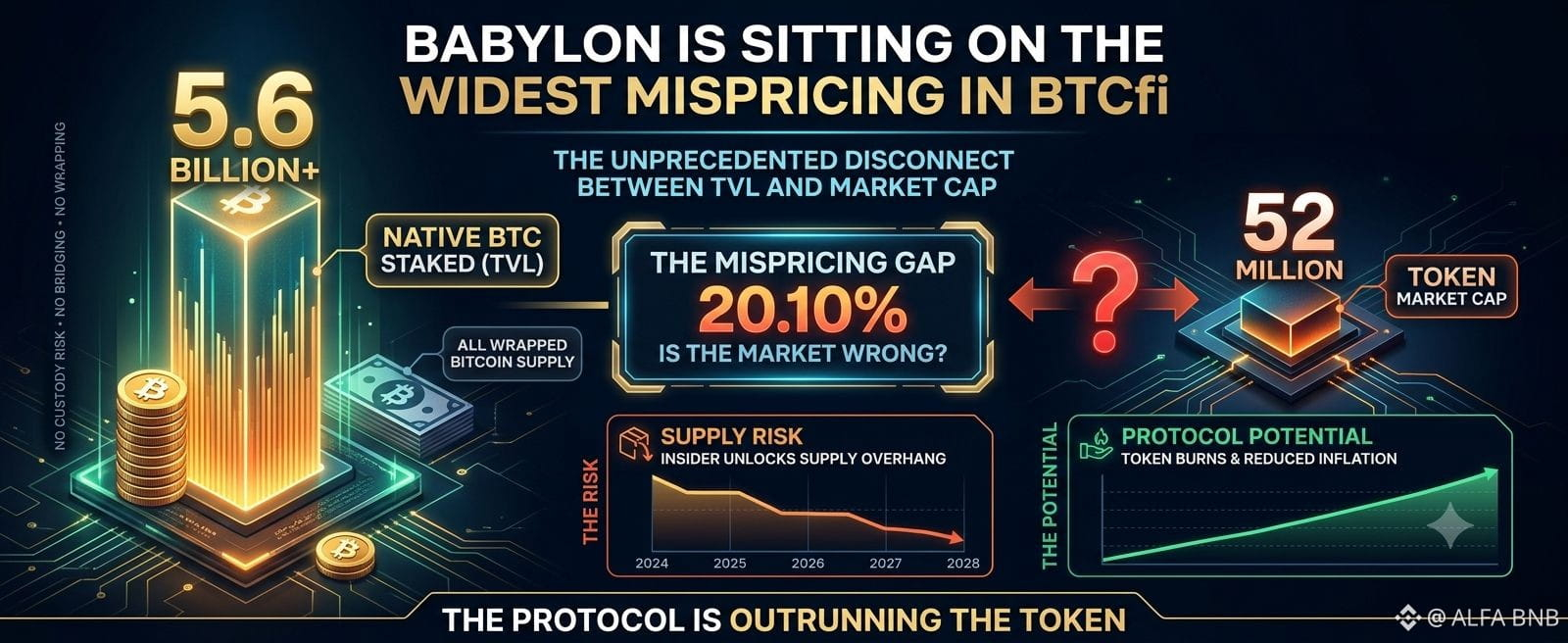
Babylon Is Sitting on the Widest Mispricing in BTCfi
I've seen a lot of "Bitcoin DeFi" projects promise security without custody risk. Most fail the moment you check the fine print. Babylon is different — I stake native BTC directly, no wrapping, no bridging, no multisig I'm forced to trust.
The scale is what stopped me. Babylon has held over $5.6B in BTC staking vaults, more than a third of all wrapped Bitcoin supply combined, moved into native, self-custodial staking instead. That's not a testnet number. That's real capital voting with its feet.
Then I looked at the token, and the gap floored me. Market cap sits near $52M against billions in TVL. I've seen TVL-to-market-cap ratios before, but rarely one this stretched. Either the market is wrong, or I'm missing something.
The risk is real too. I've watched insider unlocks roll out steadily through 2028, and that supply overhang is the honest counterweight to the bull case. Burns and reduced inflation are the lever pulling the other way.
I think the protocol is outrunning the token right now. Whether the price catches up is the only question worth asking.
#baby
@babylonlabs_io
$BABY
Babylon Is Sitting on the Widest Mispricing in BTCfi
I've seen a lot of "Bitcoin DeFi" projects promise security without custody risk. Most fail the moment you check the fine print. Babylon is different — I stake native BTC directly, no wrapping, no bridging, no multisig I'm forced to trust.
The scale is what stopped me. Babylon has held over $5.6B in BTC staking vaults, more than a third of all wrapped Bitcoin supply combined, moved into native, self-custodial staking instead. That's not a testnet number. That's real capital voting with its feet.
Then I looked at the token, and the gap floored me. Market cap sits near $52M against billions in TVL. I've seen TVL-to-market-cap ratios before, but rarely one this stretched. Either the market is wrong, or I'm missing something.
The risk is real too. I've watched insider unlocks roll out steadily through 2028, and that supply overhang is the honest counterweight to the bull case. Burns and reduced inflation are the lever pulling the other way.
I think the protocol is outrunning the token right now. Whether the price catches up is the only question worth asking.
#baby
@BabylonLabs_io
$BABY
I've seen a lot of "Bitcoin DeFi" projects promise security without custody risk. Most fail the moment you check the fine print. Babylon is different — I stake native BTC directly, no wrapping, no bridging, no multisig I'm forced to trust.
The scale is what stopped me. Babylon has held over $5.6B in BTC staking vaults, more than a third of all wrapped Bitcoin supply combined, moved into native, self-custodial staking instead. That's not a testnet number. That's real capital voting with its feet.
Then I looked at the token, and the gap floored me. Market cap sits near $52M against billions in TVL. I've seen TVL-to-market-cap ratios before, but rarely one this stretched. Either the market is wrong, or I'm missing something.
The risk is real too. I've watched insider unlocks roll out steadily through 2028, and that supply overhang is the honest counterweight to the bull case. Burns and reduced inflation are the lever pulling the other way.
I think the protocol is outrunning the token right now. Whether the price catches up is the only question worth asking.
#baby
@BabylonLabs_io
$BABY
5
3
137
·
--
Bullisch
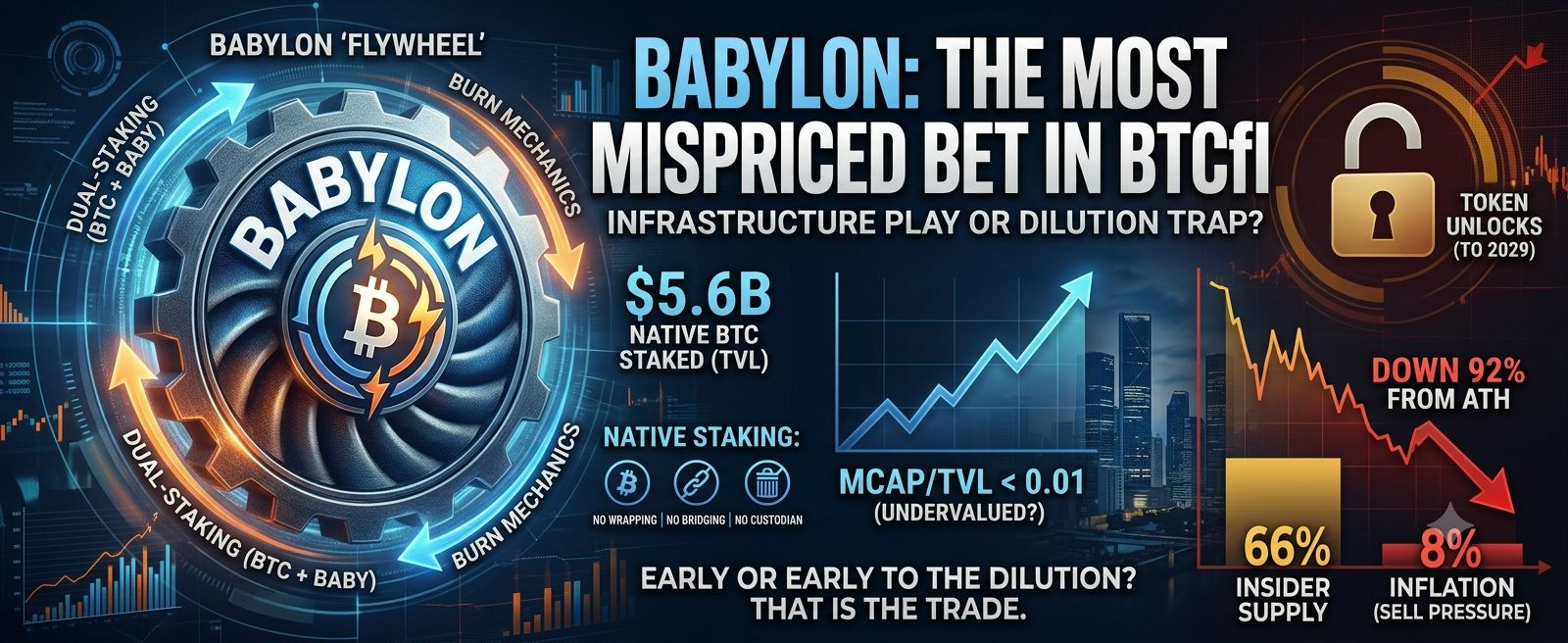
Babylon: Die am stärksten falsch bepreiste Wette in BTCfi
Ich komme immer wieder auf eine Zahl zurück: 5,6 Mrd. USD in nativen BTC, die gestaked sind—während ein Token gehandelt wird, der ungefähr eine Marktkapitalisierung von 50 Mio. USD hat. Diese Lücke ist entweder der Markt, der schläft, oder die Preisbildung für etwas, das ich respektieren muss.
Das gefällt mir. Babylon ermöglicht es mir, Bitcoin direkt von L1 zu staken — ohne Wrapping, ohne Bridging, ohne dass ein Custodian meine Keys hält. Das ist kein kleines technisches Detail, das ist die gesamte These. Ich verleihe das Vertrauen in BTC an PoS-Chains, ohne das Eigentum an dem Asset aufzugeben.
Das mcap/TVL-Verhältnis nahe 0,01 ist genau die Art von Zahl, die mich dazu bringt, tiefer zu graben, statt wegzusehen. Ergänze Dual-Staking (BTC + BABY) und Burn-Mechaniken, die gegen eine Inflation von etwa 8 % wirken, und ich sehe einen Flywheel, der noch früh ist—nicht kaputt.
Aber ich werde nicht so tun, als sei das Risiko nicht real. 66 % des Angebots liegt bei Insidern, und die Freigaben laufen bis 2029 durch. Jeden Monat trifft mehr Verkaufsdruck auf einen Token, der bereits 92 % unter seinem ATH liegt.
Also hier ist mein ehrlicher Eindruck: Babylon sieht nach Infrastruktur aus, die der Markt noch nicht bewertet hat. Egal, ob ich zu früh dran bin oder nur früh genug, um die Verwässerung abzufangen — das ist die Wette, die ich tatsächlich eingehe.
#baby
@babylonlabs_io
$BABY
Babylon: Die am stärksten falsch bepreiste Wette in BTCfi
Ich komme immer wieder auf eine Zahl zurück: 5,6 Mrd. USD in nativen BTC, die gestaked sind—während ein Token gehandelt wird, der ungefähr eine Marktkapitalisierung von 50 Mio. USD hat. Diese Lücke ist entweder der Markt, der schläft, oder die Preisbildung für etwas, das ich respektieren muss.
Das gefällt mir. Babylon ermöglicht es mir, Bitcoin direkt von L1 zu staken — ohne Wrapping, ohne Bridging, ohne dass ein Custodian meine Keys hält. Das ist kein kleines technisches Detail, das ist die gesamte These. Ich verleihe das Vertrauen in BTC an PoS-Chains, ohne das Eigentum an dem Asset aufzugeben.
Das mcap/TVL-Verhältnis nahe 0,01 ist genau die Art von Zahl, die mich dazu bringt, tiefer zu graben, statt wegzusehen. Ergänze Dual-Staking (BTC + BABY) und Burn-Mechaniken, die gegen eine Inflation von etwa 8 % wirken, und ich sehe einen Flywheel, der noch früh ist—nicht kaputt.
Aber ich werde nicht so tun, als sei das Risiko nicht real. 66 % des Angebots liegt bei Insidern, und die Freigaben laufen bis 2029 durch. Jeden Monat trifft mehr Verkaufsdruck auf einen Token, der bereits 92 % unter seinem ATH liegt.
Also hier ist mein ehrlicher Eindruck: Babylon sieht nach Infrastruktur aus, die der Markt noch nicht bewertet hat. Egal, ob ich zu früh dran bin oder nur früh genug, um die Verwässerung abzufangen — das ist die Wette, die ich tatsächlich eingehe.
#baby
@BabylonLabs_io
$BABY
Ich komme immer wieder auf eine Zahl zurück: 5,6 Mrd. USD in nativen BTC, die gestaked sind—während ein Token gehandelt wird, der ungefähr eine Marktkapitalisierung von 50 Mio. USD hat. Diese Lücke ist entweder der Markt, der schläft, oder die Preisbildung für etwas, das ich respektieren muss.
Das gefällt mir. Babylon ermöglicht es mir, Bitcoin direkt von L1 zu staken — ohne Wrapping, ohne Bridging, ohne dass ein Custodian meine Keys hält. Das ist kein kleines technisches Detail, das ist die gesamte These. Ich verleihe das Vertrauen in BTC an PoS-Chains, ohne das Eigentum an dem Asset aufzugeben.
Das mcap/TVL-Verhältnis nahe 0,01 ist genau die Art von Zahl, die mich dazu bringt, tiefer zu graben, statt wegzusehen. Ergänze Dual-Staking (BTC + BABY) und Burn-Mechaniken, die gegen eine Inflation von etwa 8 % wirken, und ich sehe einen Flywheel, der noch früh ist—nicht kaputt.
Aber ich werde nicht so tun, als sei das Risiko nicht real. 66 % des Angebots liegt bei Insidern, und die Freigaben laufen bis 2029 durch. Jeden Monat trifft mehr Verkaufsdruck auf einen Token, der bereits 92 % unter seinem ATH liegt.
Also hier ist mein ehrlicher Eindruck: Babylon sieht nach Infrastruktur aus, die der Markt noch nicht bewertet hat. Egal, ob ich zu früh dran bin oder nur früh genug, um die Verwässerung abzufangen — das ist die Wette, die ich tatsächlich eingehe.
#baby
@BabylonLabs_io
$BABY
13
5
213
·
--
Bullisch
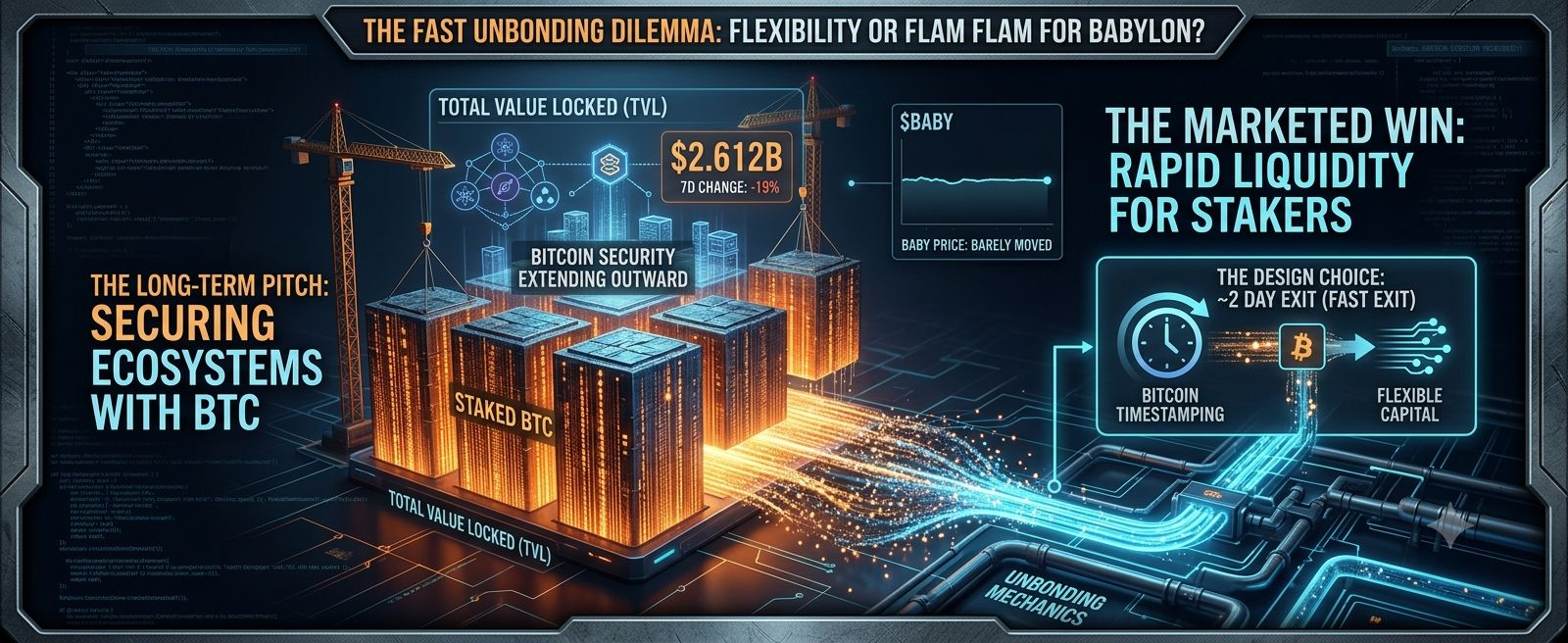
Ich habe heute Babylons Dashboard gescrollt und musste kurz stoppen. TVL in 7 Tagen um 19% gesunken. 2,612 Mrd. USD in gestaktem BTC – weit weg von dem Wert von vor einer Woche. Der Preis von $BABY? Kaum bewegt.
Diese Lücke ist es, die bei mir hängen geblieben ist.
Der Pitch ist: Bitcoins Sicherheit wirkt nach außen – „shared“, dauerhaft wirkend, strukturell anders als ein Yield-Vault mit Wrapped-BTC. Aber wenn man tiefer in die Entsperr-Mechanik geht, zeigt sich die eigentliche Designentscheidung: Ausstiege sind klar innerhalb von ~2 Tagen möglich, dank Bitcoin-Timestamping – nicht der üblichen 21-Tage-PoS-Abkühlphase.
Als UX-Gewinn vermarktet. Fairerweise: Ja. Aber das bedeutet auch, dass alles, was diese Ketten „absichert“, fast genauso schnell wieder verschwinden kann, wie es angekommen ist – eine Flexibilität, die die meisten BTC-Yield-Wrapper nicht einmal bieten.
Ein Fünftel des gesperrten BTC, das sich in einer einzigen Woche bewegt: kein Hack, kein Drama. Es ist einfach Kapital, das macht, wozu ein schneller Ausstieg es eben bringt.
Ich denke noch darüber nach: Ist „fast-unbond“ der eigentliche Unterschied, der wirklich zählt – oder ist es das Feature, das die TVL-Zahl weniger vertrauenswürdig macht, als sie aussieht?
#baby
@babylonlabs_io
$BABY
Ich habe heute Babylons Dashboard gescrollt und musste kurz stoppen. TVL in 7 Tagen um 19% gesunken. 2,612 Mrd. USD in gestaktem BTC – weit weg von dem Wert von vor einer Woche. Der Preis von $BABY ? Kaum bewegt.
Diese Lücke ist es, die bei mir hängen geblieben ist.
Der Pitch ist: Bitcoins Sicherheit wirkt nach außen – „shared“, dauerhaft wirkend, strukturell anders als ein Yield-Vault mit Wrapped-BTC. Aber wenn man tiefer in die Entsperr-Mechanik geht, zeigt sich die eigentliche Designentscheidung: Ausstiege sind klar innerhalb von ~2 Tagen möglich, dank Bitcoin-Timestamping – nicht der üblichen 21-Tage-PoS-Abkühlphase.
Als UX-Gewinn vermarktet. Fairerweise: Ja. Aber das bedeutet auch, dass alles, was diese Ketten „absichert“, fast genauso schnell wieder verschwinden kann, wie es angekommen ist – eine Flexibilität, die die meisten BTC-Yield-Wrapper nicht einmal bieten.
Ein Fünftel des gesperrten BTC, das sich in einer einzigen Woche bewegt: kein Hack, kein Drama. Es ist einfach Kapital, das macht, wozu ein schneller Ausstieg es eben bringt.
Ich denke noch darüber nach: Ist „fast-unbond“ der eigentliche Unterschied, der wirklich zählt – oder ist es das Feature, das die TVL-Zahl weniger vertrauenswürdig macht, als sie aussieht?
#baby
@BabylonLabs_io
$BABY
Diese Lücke ist es, die bei mir hängen geblieben ist.
Der Pitch ist: Bitcoins Sicherheit wirkt nach außen – „shared“, dauerhaft wirkend, strukturell anders als ein Yield-Vault mit Wrapped-BTC. Aber wenn man tiefer in die Entsperr-Mechanik geht, zeigt sich die eigentliche Designentscheidung: Ausstiege sind klar innerhalb von ~2 Tagen möglich, dank Bitcoin-Timestamping – nicht der üblichen 21-Tage-PoS-Abkühlphase.
Als UX-Gewinn vermarktet. Fairerweise: Ja. Aber das bedeutet auch, dass alles, was diese Ketten „absichert“, fast genauso schnell wieder verschwinden kann, wie es angekommen ist – eine Flexibilität, die die meisten BTC-Yield-Wrapper nicht einmal bieten.
Ein Fünftel des gesperrten BTC, das sich in einer einzigen Woche bewegt: kein Hack, kein Drama. Es ist einfach Kapital, das macht, wozu ein schneller Ausstieg es eben bringt.
Ich denke noch darüber nach: Ist „fast-unbond“ der eigentliche Unterschied, der wirklich zählt – oder ist es das Feature, das die TVL-Zahl weniger vertrauenswürdig macht, als sie aussieht?
#baby
@BabylonLabs_io
$BABY
18
6
145
·
--
Bullisch
Teilweise korrekt
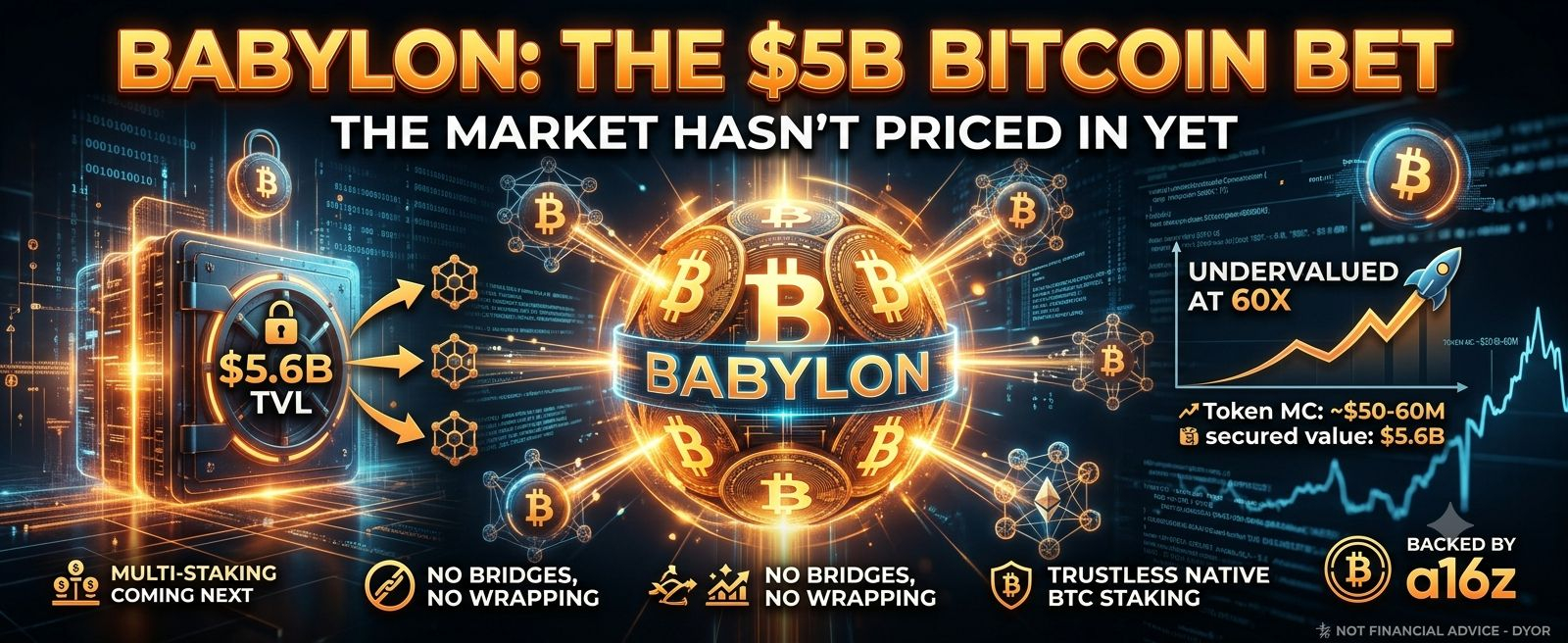
Babylon: Die 5B-Dollar-Bitcoin-Wette, die der Markt noch nicht eingepreist hat
Ich habe in Babylon (BABY) gegraben, und die Diskrepanz hier ist unglaublich.
Das Problem, das es löst, ist real: Billionen in BTC liegen ungenutzt herum, weil es bisher keinen trustless Weg gab, sie zu staken. Babylon behebt das — ich stake nativen BTC direkt, ohne Bridges, ohne Wrapping, ohne Custodians. Es bleibt die ganze Zeit auf der Bitcoin-Blockchain.
Was mir besonders aufgefallen ist, ist das Ausmaß. Das ist inzwischen kein Whitepaper mehr — Babylon hat in seinen Staking-Vaults über 56.000 BTC gehalten, im Wert von ungefähr 5,6 Mrd. US-Dollar, und ist damit das größte Bitcoin-Staking-Protokoll, das es gibt. Das sind mehr BTC als ein Drittel von allen WBTC.
Hier ist der Trade, zu dem ich immer wieder zurückkomme: Die Marktkapitalisierung des Tokens (~50–60 Mio. US-Dollar) spiegelt kaum den TVL dahinter wider. Ein DeFi-Analyst nannte es unterbewertet um 60x im Vergleich zu seinem gesicherten Wert. Multi-Staking kommt als Nächstes: Damit kann derselbe BTC gleichzeitig mehrere Chains sichern, und a16z hat die nächste Phase gerade erst unterstützt.
Das Risiko, das ich nicht ignorieren kann: unbegrenztes Angebot, monatliche Investor-Unlocks bis 2029 und echte Volatilität (im März fiel es nahe $0,0107).
Ich behalte das genau im Blick. Keine Finanzberatung — DYOR.
#baby
@babylonlabs_io
$BABY
Babylon: Die 5B-Dollar-Bitcoin-Wette, die der Markt noch nicht eingepreist hat
Ich habe in Babylon (BABY) gegraben, und die Diskrepanz hier ist unglaublich.
Das Problem, das es löst, ist real: Billionen in BTC liegen ungenutzt herum, weil es bisher keinen trustless Weg gab, sie zu staken. Babylon behebt das — ich stake nativen BTC direkt, ohne Bridges, ohne Wrapping, ohne Custodians. Es bleibt die ganze Zeit auf der Bitcoin-Blockchain.
Was mir besonders aufgefallen ist, ist das Ausmaß. Das ist inzwischen kein Whitepaper mehr — Babylon hat in seinen Staking-Vaults über 56.000 BTC gehalten, im Wert von ungefähr 5,6 Mrd. US-Dollar, und ist damit das größte Bitcoin-Staking-Protokoll, das es gibt. Das sind mehr BTC als ein Drittel von allen WBTC.
Hier ist der Trade, zu dem ich immer wieder zurückkomme: Die Marktkapitalisierung des Tokens (~50–60 Mio. US-Dollar) spiegelt kaum den TVL dahinter wider. Ein DeFi-Analyst nannte es unterbewertet um 60x im Vergleich zu seinem gesicherten Wert. Multi-Staking kommt als Nächstes: Damit kann derselbe BTC gleichzeitig mehrere Chains sichern, und a16z hat die nächste Phase gerade erst unterstützt.
Das Risiko, das ich nicht ignorieren kann: unbegrenztes Angebot, monatliche Investor-Unlocks bis 2029 und echte Volatilität (im März fiel es nahe $0,0107).
Ich behalte das genau im Blick. Keine Finanzberatung — DYOR.
#baby
@BabylonLabs_io
$BABY
Ich habe in Babylon (BABY) gegraben, und die Diskrepanz hier ist unglaublich.
Das Problem, das es löst, ist real: Billionen in BTC liegen ungenutzt herum, weil es bisher keinen trustless Weg gab, sie zu staken. Babylon behebt das — ich stake nativen BTC direkt, ohne Bridges, ohne Wrapping, ohne Custodians. Es bleibt die ganze Zeit auf der Bitcoin-Blockchain.
Was mir besonders aufgefallen ist, ist das Ausmaß. Das ist inzwischen kein Whitepaper mehr — Babylon hat in seinen Staking-Vaults über 56.000 BTC gehalten, im Wert von ungefähr 5,6 Mrd. US-Dollar, und ist damit das größte Bitcoin-Staking-Protokoll, das es gibt. Das sind mehr BTC als ein Drittel von allen WBTC.
Hier ist der Trade, zu dem ich immer wieder zurückkomme: Die Marktkapitalisierung des Tokens (~50–60 Mio. US-Dollar) spiegelt kaum den TVL dahinter wider. Ein DeFi-Analyst nannte es unterbewertet um 60x im Vergleich zu seinem gesicherten Wert. Multi-Staking kommt als Nächstes: Damit kann derselbe BTC gleichzeitig mehrere Chains sichern, und a16z hat die nächste Phase gerade erst unterstützt.
Das Risiko, das ich nicht ignorieren kann: unbegrenztes Angebot, monatliche Investor-Unlocks bis 2029 und echte Volatilität (im März fiel es nahe $0,0107).
Ich behalte das genau im Blick. Keine Finanzberatung — DYOR.
#baby
@BabylonLabs_io
$BABY
30
10
474
·
--
Bullisch
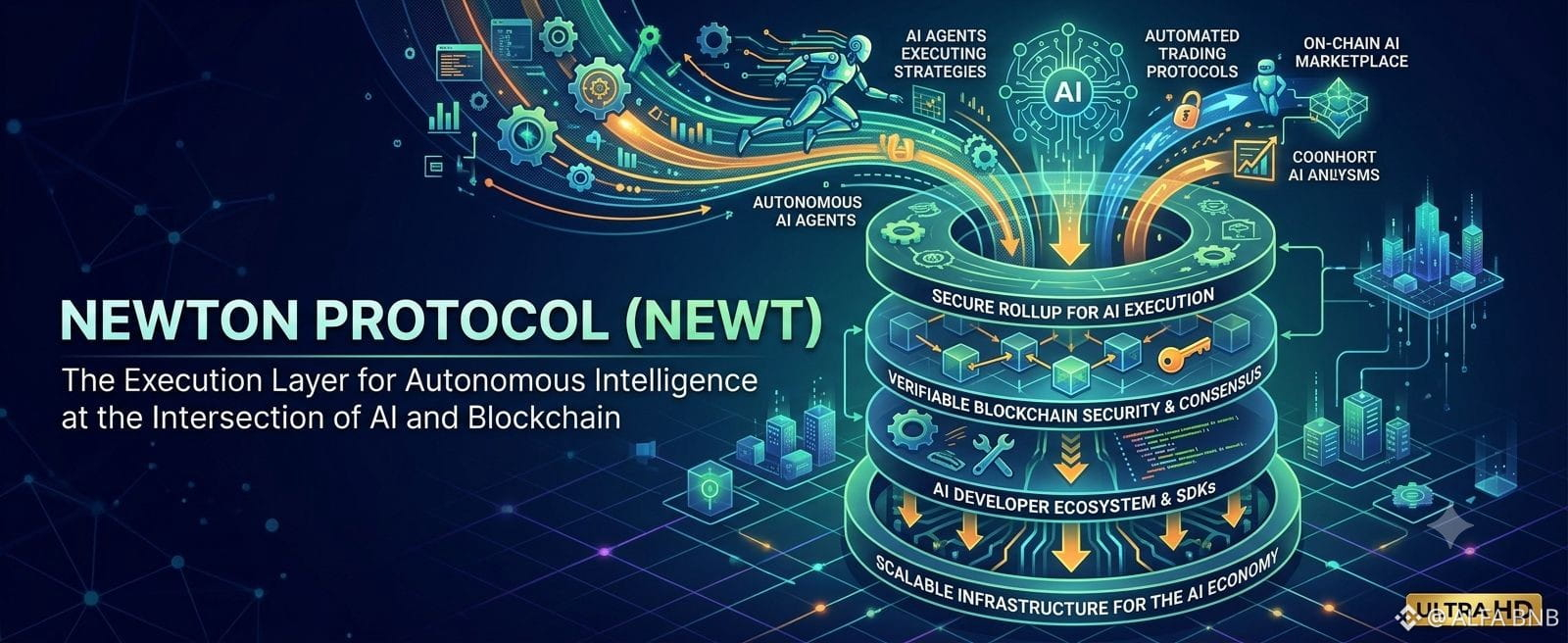
Nachdem ich Zeit damit verbracht habe, das Newton Protocol (NEWT) zu recherchieren, bin ich wirklich davon überzeugt, dass es sich um eines der faszinierendsten Projekte handelt, die an der Schnittstelle von KI und Blockchain-Infrastruktur entstehen.
Was mich sofort aufgefallen ist, war nicht nur die KI-Erzählung, sondern das konkrete Problem, das Newton Protocol zu lösen versucht. Während KI-Agenten immer leistungsfähiger werden und komplexe Aufgaben ausführen, automatisierte Strategien verwalten und mit Finanzsystemen interagieren, wird die Notwendigkeit einer sicheren, verifizierbaren und skalierbaren Ausführungsebene zunehmend wichtiger. Genau hier sticht meiner Meinung nach die Vision von Newton Protocol hervor.
Aus meiner Sicht ist der Aufbau eines sicheren Rollups für KI-gesteuerte Strategien, automatisierten Handel und einen Marktplatz für KI-Entwickler nicht einfach das Verfolgen eines Trends – sondern das Angehen einer Herausforderung, die die nächste Generation dezentraler Intelligenz prägen könnte.
Ich finde den Ansatz besonders überzeugend, weil er mehrere starke Bereiche zusammenführt: KI-Agenten, Automatisierung, Blockchain-Sicherheit und Entwickler-Ökosysteme. Wenn die Zukunft autonome KI-Systeme umfasst, die Kapital verwalten, Strategien ausführen und wirtschaftlichen Mehrwert schaffen, dann wird die Infrastruktur, die diese Systeme unterstützt, von entscheidender Bedeutung.
Ich glaube, dass sich Newton Protocol (NEWT) so positioniert, dass es mehr wird als nur ein weiteres Krypto-Projekt – es versucht, grundlegende Infrastruktur für die entstehende KI-Ökonomie aufzubauen. Das ist definitiv ein Projekt, das ich weiterhin sehr genau beobachten werde.
#Newt @NewtonProtocol $NEWT
Nachdem ich Zeit damit verbracht habe, das Newton Protocol (NEWT) zu recherchieren, bin ich wirklich davon überzeugt, dass es sich um eines der faszinierendsten Projekte handelt, die an der Schnittstelle von KI und Blockchain-Infrastruktur entstehen.
Was mich sofort aufgefallen ist, war nicht nur die KI-Erzählung, sondern das konkrete Problem, das Newton Protocol zu lösen versucht. Während KI-Agenten immer leistungsfähiger werden und komplexe Aufgaben ausführen, automatisierte Strategien verwalten und mit Finanzsystemen interagieren, wird die Notwendigkeit einer sicheren, verifizierbaren und skalierbaren Ausführungsebene zunehmend wichtiger. Genau hier sticht meiner Meinung nach die Vision von Newton Protocol hervor.
Aus meiner Sicht ist der Aufbau eines sicheren Rollups für KI-gesteuerte Strategien, automatisierten Handel und einen Marktplatz für KI-Entwickler nicht einfach das Verfolgen eines Trends – sondern das Angehen einer Herausforderung, die die nächste Generation dezentraler Intelligenz prägen könnte.
Ich finde den Ansatz besonders überzeugend, weil er mehrere starke Bereiche zusammenführt: KI-Agenten, Automatisierung, Blockchain-Sicherheit und Entwickler-Ökosysteme. Wenn die Zukunft autonome KI-Systeme umfasst, die Kapital verwalten, Strategien ausführen und wirtschaftlichen Mehrwert schaffen, dann wird die Infrastruktur, die diese Systeme unterstützt, von entscheidender Bedeutung.
Ich glaube, dass sich Newton Protocol (NEWT) so positioniert, dass es mehr wird als nur ein weiteres Krypto-Projekt – es versucht, grundlegende Infrastruktur für die entstehende KI-Ökonomie aufzubauen. Das ist definitiv ein Projekt, das ich weiterhin sehr genau beobachten werde.
#Newt @NewtonProtocol $NEWT
Was mich sofort aufgefallen ist, war nicht nur die KI-Erzählung, sondern das konkrete Problem, das Newton Protocol zu lösen versucht. Während KI-Agenten immer leistungsfähiger werden und komplexe Aufgaben ausführen, automatisierte Strategien verwalten und mit Finanzsystemen interagieren, wird die Notwendigkeit einer sicheren, verifizierbaren und skalierbaren Ausführungsebene zunehmend wichtiger. Genau hier sticht meiner Meinung nach die Vision von Newton Protocol hervor.
Aus meiner Sicht ist der Aufbau eines sicheren Rollups für KI-gesteuerte Strategien, automatisierten Handel und einen Marktplatz für KI-Entwickler nicht einfach das Verfolgen eines Trends – sondern das Angehen einer Herausforderung, die die nächste Generation dezentraler Intelligenz prägen könnte.
Ich finde den Ansatz besonders überzeugend, weil er mehrere starke Bereiche zusammenführt: KI-Agenten, Automatisierung, Blockchain-Sicherheit und Entwickler-Ökosysteme. Wenn die Zukunft autonome KI-Systeme umfasst, die Kapital verwalten, Strategien ausführen und wirtschaftlichen Mehrwert schaffen, dann wird die Infrastruktur, die diese Systeme unterstützt, von entscheidender Bedeutung.
Ich glaube, dass sich Newton Protocol (NEWT) so positioniert, dass es mehr wird als nur ein weiteres Krypto-Projekt – es versucht, grundlegende Infrastruktur für die entstehende KI-Ökonomie aufzubauen. Das ist definitiv ein Projekt, das ich weiterhin sehr genau beobachten werde.
#Newt @NewtonProtocol $NEWT
10
8
94
·
--
Artikel
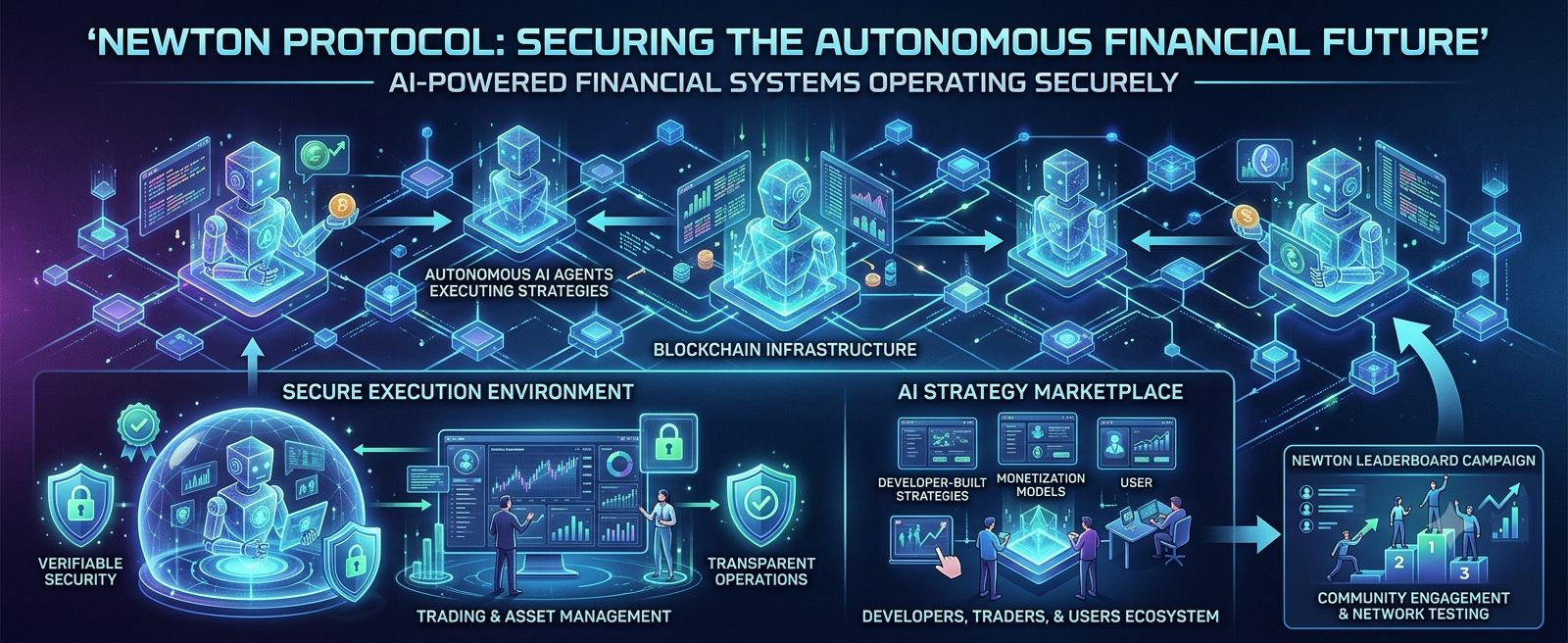
Newton Protocol baut eine Zukunft, in der KI Finanzsysteme sicher und autonom betreiben kannWährend ich weiterhin die sich schnell entwickelnde Schnittstelle zwischen Künstlicher Intelligenz und Blockchain-Technologie erforsche, bin ich auf viele Projekte gestoßen, die versprechen, neu zu definieren, wie digitale Systeme funktionieren. Allerdings hat mich das Newton-Protocol aus einem anderen Grund besonders in den Bann gezogen. Anstatt sich ausschließlich auf Trends oder kurzfristige Markt-Narrative zu konzentrieren, scheint das Projekt grundlegende Infrastruktur aufzubauen – für eine Zukunft, in der KI-Agenten komplexe Finanzstrategien sicher ausführen, Entscheidungsprozesse automatisieren und mit dezentralen Systemen interagieren können, mit minimalem menschlichem Eingriff.
Newton Protocol baut eine Zukunft, in der KI Finanzsysteme sicher und autonom betreiben kann
Während ich weiterhin die sich schnell entwickelnde Schnittstelle zwischen Künstlicher Intelligenz und Blockchain-Technologie erforsche, bin ich auf viele Projekte gestoßen, die versprechen, neu zu definieren, wie digitale Systeme funktionieren. Allerdings hat mich das Newton-Protocol aus einem anderen Grund besonders in den Bann gezogen. Anstatt sich ausschließlich auf Trends oder kurzfristige Markt-Narrative zu konzentrieren, scheint das Projekt grundlegende Infrastruktur aufzubauen – für eine Zukunft, in der KI-Agenten komplexe Finanzstrategien sicher ausführen, Entscheidungsprozesse automatisieren und mit dezentralen Systemen interagieren können, mit minimalem menschlichem Eingriff.
25
23
226
·
--
Bullisch
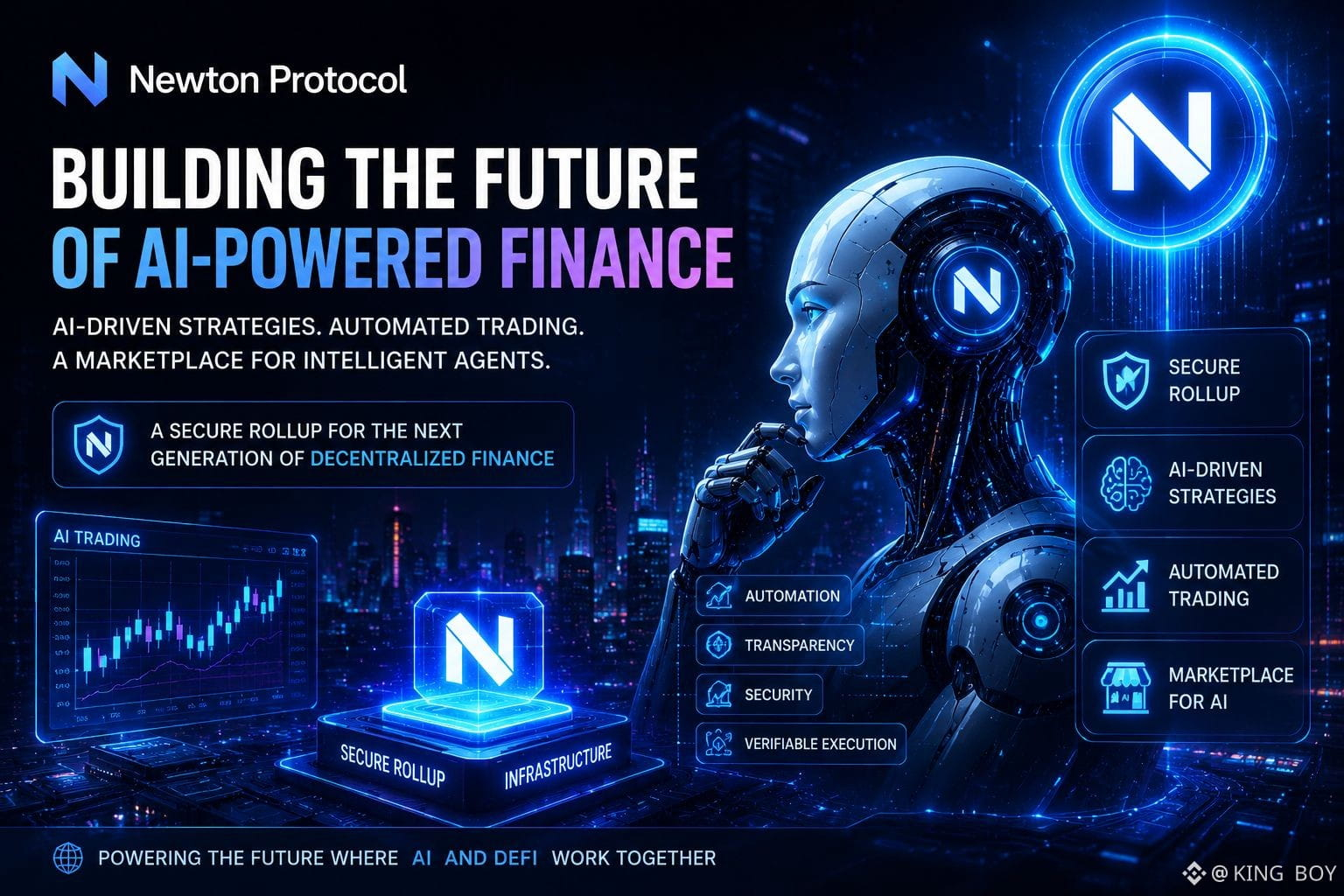
Ich habe das Newton Protocol genau beobachtet, und je mehr ich über seine Vision lerne, desto mehr glaube ich, dass es etwas aufbaut, das weit größer ist als eine typische Leaderboard-Kampagne. Sein Fokus auf sichere Rollups, KI-gesteuerte Strategien, automatisierten Handel und einen KI-Marktplatz deutet auf einen langfristigen Ansatz für die Zukunft des dezentralen Finanzwesens und intelligenter Automatisierung hin. Besonders interessiert bin ich daran, wie sich das Newton Protocol an der Schnittstelle zwischen KI und Blockchain positioniert – einem Bereich, der in den kommenden Jahren zunehmend wichtig werden könnte.
#Newt @NewtonProtocol $NEWT
{spot}(NEWTUSDT)
Ich habe das Newton Protocol genau beobachtet, und je mehr ich über seine Vision lerne, desto mehr glaube ich, dass es etwas aufbaut, das weit größer ist als eine typische Leaderboard-Kampagne. Sein Fokus auf sichere Rollups, KI-gesteuerte Strategien, automatisierten Handel und einen KI-Marktplatz deutet auf einen langfristigen Ansatz für die Zukunft des dezentralen Finanzwesens und intelligenter Automatisierung hin. Besonders interessiert bin ich daran, wie sich das Newton Protocol an der Schnittstelle zwischen KI und Blockchain positioniert – einem Bereich, der in den kommenden Jahren zunehmend wichtig werden könnte.
#Newt @NewtonProtocol $NEWT
#Newt @NewtonProtocol $NEWT
6
6
234
·
--
Artikel
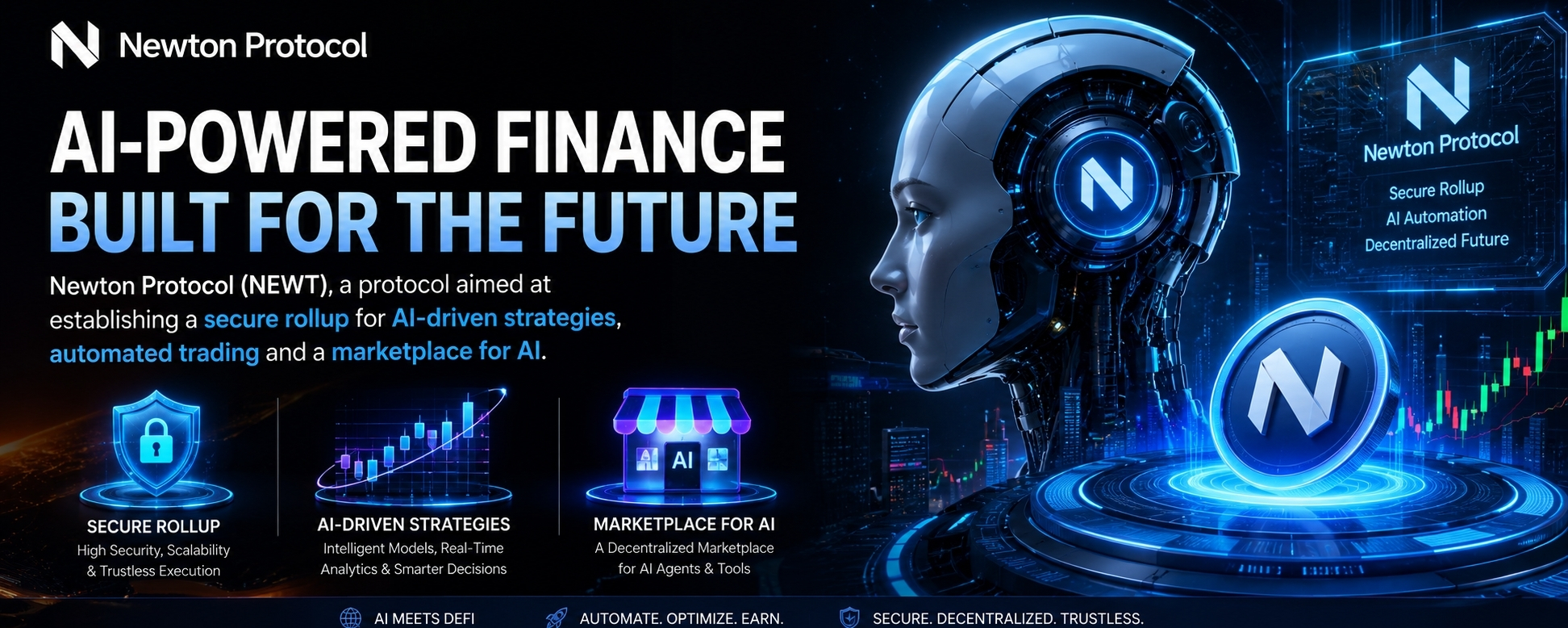
Newton Protocol baut still etwas viel Größeres auf, als die meisten Menschen es begreifenIch verfolge die Entwicklung des Newton Protocol schon seit einiger Zeit, und je mehr ich seinem Fortschritt folge, desto stärker finde ich mich dabei, auf das größere Gesamtbild zu achten, statt nur auf die laufende Leaderboard Campaign. Ich schaue über die täglichen Aktivitäten und die Einbindung der Community hinaus, weil mich am meisten die langfristige Richtung interessiert, die das Projekt offenbar einschlägt. Meiner Ansicht nach versucht das Newton Protocol nicht, sich nur als weiteres Blockchain-Ökosystem oder als weiteres KI-Narrativprojekt zu positionieren. Stattdessen scheint es Infrastruktur aufzubauen, die für eine Zukunft ausgelegt ist, in der künstliche Intelligenz und dezentrale Finanzen durch Automatisierung, Sicherheit und verifizierbare Ausführung tief miteinander verflochten sind.
Newton Protocol baut still etwas viel Größeres auf, als die meisten Menschen es begreifen
Ich verfolge die Entwicklung des Newton Protocol schon seit einiger Zeit, und je mehr ich seinem Fortschritt folge, desto stärker finde ich mich dabei, auf das größere Gesamtbild zu achten, statt nur auf die laufende Leaderboard Campaign. Ich schaue über die täglichen Aktivitäten und die Einbindung der Community hinaus, weil mich am meisten die langfristige Richtung interessiert, die das Projekt offenbar einschlägt. Meiner Ansicht nach versucht das Newton Protocol nicht, sich nur als weiteres Blockchain-Ökosystem oder als weiteres KI-Narrativprojekt zu positionieren. Stattdessen scheint es Infrastruktur aufzubauen, die für eine Zukunft ausgelegt ist, in der künstliche Intelligenz und dezentrale Finanzen durch Automatisierung, Sicherheit und verifizierbare Ausführung tief miteinander verflochten sind.
4
2
318
·
--
Artikel
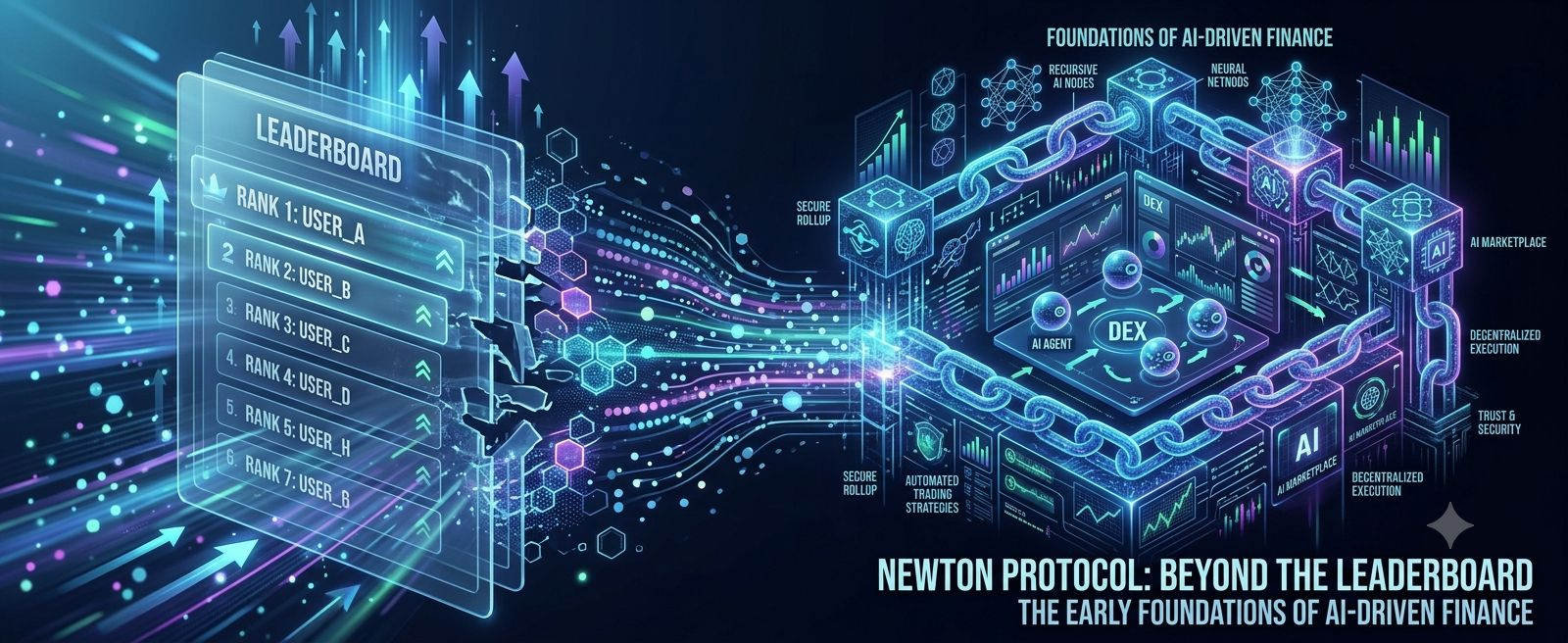
Wenn ich mir Newton Protocol ansehe, sehe ich nicht nur ein Leaderboard Ich sehe die frühen Grundlagen von KI-DJe mehr Zeit ich damit verbringe, entstehende Projekte an der Schnittstelle von Künstlicher Intelligenz und Blockchain-Technologie zu erkunden, desto mehr erkenne ich, dass einige Initiativen versuchen, Probleme anzugehen, die in den nächsten zehn Jahren möglicherweise unglaublich wichtig werden. Newton Protocol war für mich eines dieser Projekte. Während viele Menschen die Newton-Leaderboard-Kampagne derzeit vielleicht als ein weiteres Community-Event betrachten, das darauf ausgelegt ist, die Beteiligung und das Engagement zu steigern, sehe ich sie persönlich als etwas viel Bedeutenderes. Für mich fühlt es sich an wie ein aktives Experiment, bei dem sich Technologie, Community-Beteiligung und der Aufbau von Infrastruktur gleichzeitig weiterentwickeln. Je tiefer ich in die Vision des Projekts eingetaucht bin, desto mehr begann ich, das Ausmaß dessen zu schätzen, was Newton Protocol zu erschaffen versucht.
Wenn ich mir Newton Protocol ansehe, sehe ich nicht nur ein Leaderboard Ich sehe die frühen Grundlagen von KI-D
Je mehr Zeit ich damit verbringe, entstehende Projekte an der Schnittstelle von Künstlicher Intelligenz und Blockchain-Technologie zu erkunden, desto mehr erkenne ich, dass einige Initiativen versuchen, Probleme anzugehen, die in den nächsten zehn Jahren möglicherweise unglaublich wichtig werden. Newton Protocol war für mich eines dieser Projekte. Während viele Menschen die Newton-Leaderboard-Kampagne derzeit vielleicht als ein weiteres Community-Event betrachten, das darauf ausgelegt ist, die Beteiligung und das Engagement zu steigern, sehe ich sie persönlich als etwas viel Bedeutenderes. Für mich fühlt es sich an wie ein aktives Experiment, bei dem sich Technologie, Community-Beteiligung und der Aufbau von Infrastruktur gleichzeitig weiterentwickeln. Je tiefer ich in die Vision des Projekts eingetaucht bin, desto mehr begann ich, das Ausmaß dessen zu schätzen, was Newton Protocol zu erschaffen versucht.
36
19
98
·
--
Bullisch
OpenGradient ist in letzter Zeit eines der interessantesten Projekte, die ich erkundet habe, und je mehr ich über seine Vision lerne, desto mehr glaube ich, dass es versucht, Herausforderungen anzugehen, die in der KI-Branche zunehmend an Bedeutung gewinnen werden. Während viele Menschen die Leaderboard-Kampagne vielleicht nur als eine weitere Community-Wettbewerbsform betrachten, sehe ich darin etwas viel Größeres – ein Echtzeit-Experiment, das darauf ausgelegt ist, dezentrale KI-Infrastruktur durch aktive Beteiligung zu testen, zu validieren und zu stärken.
Was sofort meine Aufmerksamkeit geweckt hat, war OpenGradients Anspruch, ein Netzwerk aufzubauen, das in der Lage ist, KI-Modelle in großem Maßstab zu hosten, auszuführen (Inference) und zu verifizieren. In meinen Augen ist die Verifikationsschicht besonders überzeugend, weil Vertrauen und Transparenz wahrscheinlich zu bestimmenden Faktoren der nächsten Generation von KI-Systemen werden. Dezentrale Infrastruktur aufzubauen ist bereits eine komplexe Herausforderung, aber ein System zu schaffen, in dem KI-Ausgaben unabhängig überprüft werden können, bringt eine völlig andere Ebene an Innovation und Nutzen mit sich.
Während ich der OpenGradient Leaderboard-Kampagne weiterhin folge, sehe ich nicht nur, wie Nutzer um Positionen in einer Rangliste konkurrieren. Ich sehe ein wachsendes Ökosystem, in dem die Beteiligung der Community direkt dazu beiträgt, die Infrastruktur selbst zu testen. Dadurch entsteht eine starke Dynamik, in der sich Engagement und Netzwerkentwicklung gemeinsam weiterentwickeln. Ob dezentrale KI zum dominierenden Paradigma wird oder eine wichtige Alternative zu zentralisierten Systemen bleibt – ich glaube, dass Projekte wie OpenGradient dazu beitragen, wichtige Gespräche über die Zukunft von offener Intelligenz, Transparenz und KI-Zugänglichkeit zu gestalten. Genau deshalb denke ich, dass OpenGradient viel mehr Aufmerksamkeit verdient, als es derzeit bekommt?
#OPG @OpenGradient $OPG
{spot}(OPGUSDT)
OpenGradient ist in letzter Zeit eines der interessantesten Projekte, die ich erkundet habe, und je mehr ich über seine Vision lerne, desto mehr glaube ich, dass es versucht, Herausforderungen anzugehen, die in der KI-Branche zunehmend an Bedeutung gewinnen werden. Während viele Menschen die Leaderboard-Kampagne vielleicht nur als eine weitere Community-Wettbewerbsform betrachten, sehe ich darin etwas viel Größeres – ein Echtzeit-Experiment, das darauf ausgelegt ist, dezentrale KI-Infrastruktur durch aktive Beteiligung zu testen, zu validieren und zu stärken.
Was sofort meine Aufmerksamkeit geweckt hat, war OpenGradients Anspruch, ein Netzwerk aufzubauen, das in der Lage ist, KI-Modelle in großem Maßstab zu hosten, auszuführen (Inference) und zu verifizieren. In meinen Augen ist die Verifikationsschicht besonders überzeugend, weil Vertrauen und Transparenz wahrscheinlich zu bestimmenden Faktoren der nächsten Generation von KI-Systemen werden. Dezentrale Infrastruktur aufzubauen ist bereits eine komplexe Herausforderung, aber ein System zu schaffen, in dem KI-Ausgaben unabhängig überprüft werden können, bringt eine völlig andere Ebene an Innovation und Nutzen mit sich.
Während ich der OpenGradient Leaderboard-Kampagne weiterhin folge, sehe ich nicht nur, wie Nutzer um Positionen in einer Rangliste konkurrieren. Ich sehe ein wachsendes Ökosystem, in dem die Beteiligung der Community direkt dazu beiträgt, die Infrastruktur selbst zu testen. Dadurch entsteht eine starke Dynamik, in der sich Engagement und Netzwerkentwicklung gemeinsam weiterentwickeln. Ob dezentrale KI zum dominierenden Paradigma wird oder eine wichtige Alternative zu zentralisierten Systemen bleibt – ich glaube, dass Projekte wie OpenGradient dazu beitragen, wichtige Gespräche über die Zukunft von offener Intelligenz, Transparenz und KI-Zugänglichkeit zu gestalten. Genau deshalb denke ich, dass OpenGradient viel mehr Aufmerksamkeit verdient, als es derzeit bekommt?
#OPG @OpenGradient $OPG
Was sofort meine Aufmerksamkeit geweckt hat, war OpenGradients Anspruch, ein Netzwerk aufzubauen, das in der Lage ist, KI-Modelle in großem Maßstab zu hosten, auszuführen (Inference) und zu verifizieren. In meinen Augen ist die Verifikationsschicht besonders überzeugend, weil Vertrauen und Transparenz wahrscheinlich zu bestimmenden Faktoren der nächsten Generation von KI-Systemen werden. Dezentrale Infrastruktur aufzubauen ist bereits eine komplexe Herausforderung, aber ein System zu schaffen, in dem KI-Ausgaben unabhängig überprüft werden können, bringt eine völlig andere Ebene an Innovation und Nutzen mit sich.
Während ich der OpenGradient Leaderboard-Kampagne weiterhin folge, sehe ich nicht nur, wie Nutzer um Positionen in einer Rangliste konkurrieren. Ich sehe ein wachsendes Ökosystem, in dem die Beteiligung der Community direkt dazu beiträgt, die Infrastruktur selbst zu testen. Dadurch entsteht eine starke Dynamik, in der sich Engagement und Netzwerkentwicklung gemeinsam weiterentwickeln. Ob dezentrale KI zum dominierenden Paradigma wird oder eine wichtige Alternative zu zentralisierten Systemen bleibt – ich glaube, dass Projekte wie OpenGradient dazu beitragen, wichtige Gespräche über die Zukunft von offener Intelligenz, Transparenz und KI-Zugänglichkeit zu gestalten. Genau deshalb denke ich, dass OpenGradient viel mehr Aufmerksamkeit verdient, als es derzeit bekommt?
#OPG @OpenGradient $OPG
BULLISH ✅
100%
Bearish ♦️
0%
6 Stimmen • Abstimmung beendet
51
27
508
Anmelden und weiter Inhalte entdecken
Krypto-Nutzer weltweit auf Binance Square kennenlernen
⚡️ Bleib in Sachen Krypto stets am Puls.
💬 Die weltgrößte Kryptobörse vertraut darauf.
👍 Erhalte verlässliche Einblicke von verifizierten Creators.
E-Mail-Adresse/Telefonnummer
Trendthemen
ClarityActFacesProceduralVoteSept15
17,821 Aufrufe
324 Kommentare
#clarityactfacesproceduralvotesept15
🚨 CLARITY-Gesetz steht vor einer Verfahrensabstimmung am 15. September 🚨
Der Senatssaal ist still, aber der Kryptomarkt beobachtet bereits die Uhr. Am 15. September könnte eine einzige Verfahrensabstimmung darüber entscheiden, ob ein wichtiges US-Gesetz zur Marktstruktur für Krypto überhaupt die Chance bekommt, weiter voranzukommen.
Das CLARITY-Gesetz steht an diesem Tag nicht vor der finalen Verabschiedung. Es wird erwartet, dass die Senatoren über einen Antrag auf „Proceed“ abstimmen – ein entscheidender Verfahrensschritt, für den 60 Stimmen erforderlich sind, um die Hürde im Senat zu überspringen.
Diese Unterscheidung ist wichtig. Eine erfolgreiche Abstimmung würde das Gesetz nicht unmittelbar zum Recht machen, aber sie würde den Weg für weitere Beratungen und Verhandlungen im Senat öffnen.
Die Einsätze sind hoch, weil die Gesetzgebung darauf abzielt, klarere Regeln rund um digitale Assets festzulegen und zu bestimmen, wie die Zuständigkeiten zwischen US-Regulierungsbehörden aufgeteilt werden.
Die aktuelle Überarbeitung mit 630 Seiten fügt zudem Bestimmungen hinzu, die sich mit bestimmten nicht dezentralen Handelsprotokollen befassen, während mehrere politische und regulatorische Streitpunkte weiterhin ungelöst sind.
Mein Fazit: Der 15. September sollte weniger als Tag eines Siegs oder einer Niederlage betrachtet werden, sondern als Glaubwürdigkeits-Check. Das Beseitigen der Verfahrenshürde könnte das Vertrauen stärken, dass die US-Krypto-Gesetzgebung auf einen klareren Rahmen zusteuert. Ein Scheitern könnte die Unsicherheit verlängern.
Für Kromomärkte kann regulatorische Klarheit die Beteiligung institutioneller Akteure, Geschäftsentscheidungen und die Art beeinflussen, wie Investoren die US-Exposure bewerten. Doch Erwartungen können sich schneller bewegen als die Gesetzgebung selbst.
Das eigentliche Signal ist nicht, ob Krypto über Nacht Klarheit erhält, sondern ob Gesetzgeber endlich genug Konsens aufbauen können, um den Prozess weiterzubringen.
Wird die Abstimmung am 15. September zum Wendepunkt für die Regulierung von US-Krypto, oder zu einer weiteren Verzögerung?
Haftungsausschluss: Dieser Artikel dient nur zu Bildungszwecken und stellt keine Finanzberatung dar. Führen Sie Ihre eigenen Recherchen durch und gehen Sie mit Risiken sorgfältig um.
#CryptoRegulation #Bitcoin #GrowWithSAC $SUI $NEAR $BNB
#ClarityActFacesProceduralVoteSept15
Sienna Leo-你真棒-带我走
·3 Likes
·2.8k Aufrufe
US2YearYieldRisesTo4.61%
19,980 Aufrufe
404 Kommentare
US10YearTreasuryYieldNears5%
10,355 Aufrufe
237 Kommentare