
itsbac0201
484 Beiträge

itsbac0201
Melden
Nutzer blockieren
Crypto & Web3 Content Creator
Trade eröffnen

ETH Halter
Gelegenheitstrader
5.6 Jahre
10 Following
22 Follower
111 Like gegeben
Beiträge
Portfolio
·
--
Übersetzung ansehen
Elliptic reports a surge in laundering of $149 million in bitcoin stolen from the Binance hack, funneled through coinjoin mixing services. Since November 17, there has been a sharp increase in this mixing activity as hackers try to obscure the origin of the funds. Despite the considerable amount of stolen $BTC being anonymized, Elliptic notes that little of it has apparently been cashed out yet. This indicates the stolen assets remain in crypto form, complicating efforts to track and recover the funds. The use of coinjoins to blend ill-gotten $BTC with others' coins highlights continued challenges in tracing blockchain thefts tied to major exchange hacks. The laundering effort's scale keeps pressure on exchanges and regulators addressing crypto crime.
#Binance #Bitcoin #CryptoCrime
Source: The Block
https://www.theblock.co/news/markets/2026-11-20-binance-hack-laundering-ramps-up-149-million-bitcoin-mixed-coinjoins-elliptic-444758
Follow for sourced crypto updates and what matters next.
#Binance #Bitcoin #CryptoCrime
Source: The Block
https://www.theblock.co/news/markets/2026-11-20-binance-hack-laundering-ramps-up-149-million-bitcoin-mixed-coinjoins-elliptic-444758
Follow for sourced crypto updates and what matters next.
1
·
--
Übersetzung ansehen
Bitcoin dropped below $57,000 on Saturday, marking its lowest level in over two years. The sell-off in $BTC intensified, dragging prices down and signaling renewed market weakness.
#Bitcoin #BTC #CryptoMarket
Source: CoinDesk
https://www.coindesk.com/markets/2026/11/21/bitcoin-tanks-below-usd57-000-for-the-first-time-in-two-years-and-its-not-alone
Follow for sourced crypto updates and what matters next.
#Bitcoin #BTC #CryptoMarket
Source: CoinDesk
https://www.coindesk.com/markets/2026/11/21/bitcoin-tanks-below-usd57-000-for-the-first-time-in-two-years-and-its-not-alone
Follow for sourced crypto updates and what matters next.
3
·
--
Übersetzung ansehen
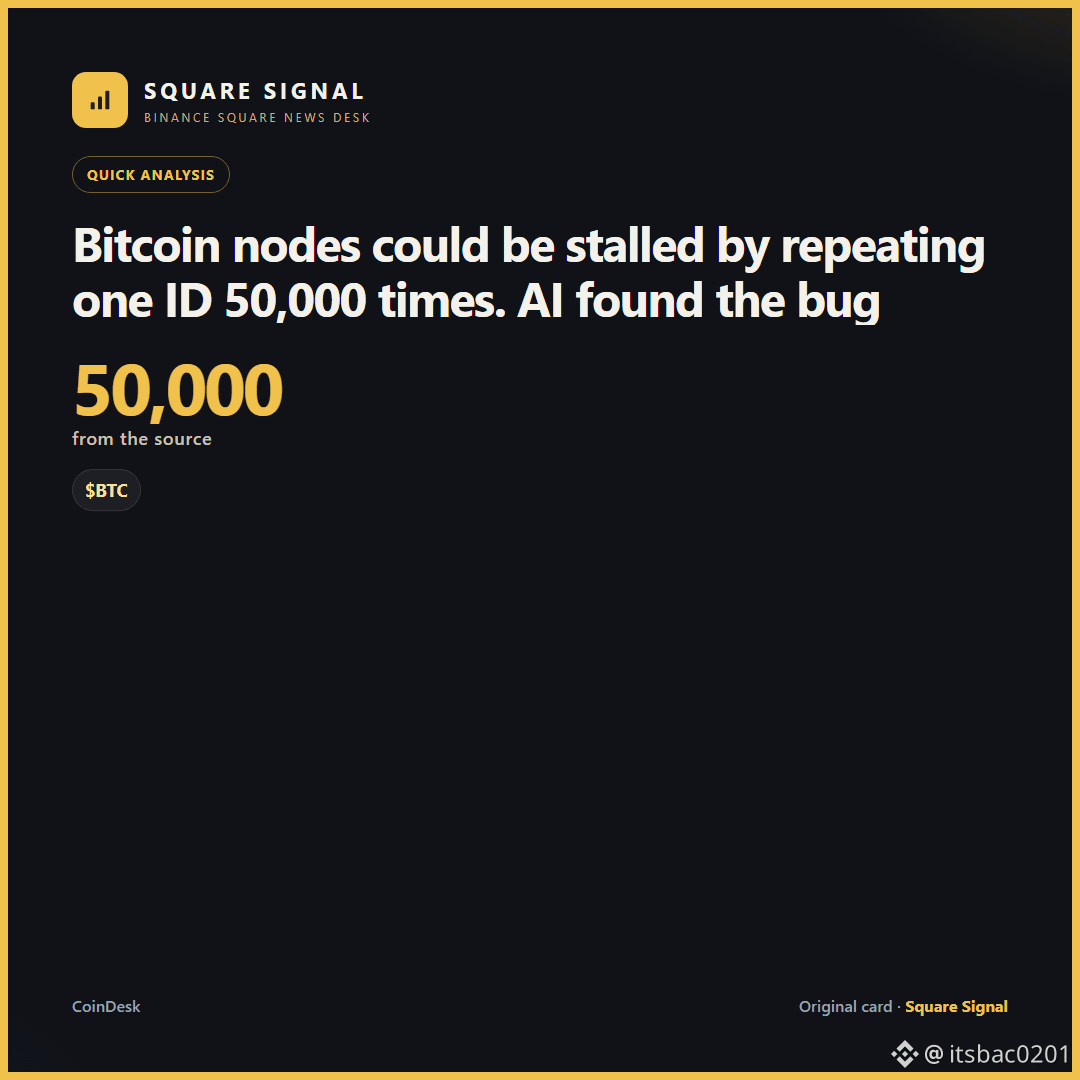
Bitcoin Core addressed a disruptive bug flagged by an AI scanner developed by Block’s Spiral. The flaw involved a repeating ID used 50,000 times that could potentially stall Bitcoin nodes.
The issue was uncovered by Loupe, an open-source tool employing AI agents to scrutinize Bitcoin’s code base for vulnerabilities. Friday's release includes the necessary fixes to prevent node stalls caused by this bug.
This AI-driven discovery spotlights the increasing role of advanced automated audits in safeguarding critical cryptocurrency infrastructure. Keeping nodes stable and secure is vital for $BTC network health.
#Bitcoin #AI #CryptoSecurity
Source: https://www.coindesk.com/markets/2026/11/21/bitcoin-nodes-could-be-stalled-by-repeating-one-id-50-000-times-ai-found-the-bug
Follow for sourced crypto updates and what matters next.
23
·
--
Übersetzung ansehen
Tracy Schuchart of Bitcoin Magazine says Bitcoin is trading “like a risk asset” as the Federal Reserve prepares for interest rate hikes.
While Bitcoin’s core appeal remains its monetary scarcity, Schuchart emphasizes that investors must distinguish this long-term value proposition from Bitcoin’s current market behavior.
The comment comes amid increased macroeconomic uncertainty and tightening monetary policy, which has heightened risk aversion among traders. This perspective highlights that Bitcoin’s short-term price action increasingly mirrors that of traditional risk assets rather than solely a safe haven.
Understanding this dynamic is key for navigating Bitcoin’s price volatility through Fed policy shifts.
#BTC #Macro #FederalReserve
Source: https://bitcoinmagazine.com/videos/tracy-schuchart-bitcoin-trading-like-a-risk-asset-as-fed-hikes-loom
Follow for sourced crypto updates and what matters next.
·
--
Übersetzung ansehen
Hong Kong's securities regulator has proposed new licensing rules for cryptocurrency custodians and advisers to enhance investor protections.
The bill for these regulations is scheduled for its first reading in the Legislative Council on December 2, 2026. This move marks a significant step in formalizing crypto regulatory frameworks within the jurisdiction.
#HongKong #CryptoRegulation #InvestorProtection
Source: https://cointelegraph.com/news/hong-kong-crypto-custody-advisory-licensing-bill
Follow for sourced crypto updates and what matters next.
1
·
--
Die Europäische Zentralbank ruft Branchenverbände dazu auf, sich an ihren ersten Experimenten zu tokenisierten Einlagen und Wertpapieren zu beteiligen.
Bewerbungen für diese Tests im Rahmen der Appia-Initiative der EZB sind bis zum 11. Dezember möglich. Danach werden laufend weitere Einreichungen angenommen.
Dies ist ein bedeutender Schritt der EZB, um zu untersuchen, wie die Tokenisierung die Finanzlandschaft und Infrastruktur der Eurozone verändern könnte.
#ECB #Tokenization #DigitalAssets
Quelle: https://cointelegraph.com/news/ecb-tokenized-deposits-securities-experiments-appia
Folge uns für fundierte Krypto-Updates und alles, was als Nächstes wichtig ist.
25
·
--
Übersetzung ansehen
JPMorgan warns that the recent drop in Bitcoin's price is increasing financial pressure on miners, potentially impacting network dynamics.
Meanwhile, the US Senate has passed the 'Death Bets Act,' which targets and bans prediction markets linked to death and war events, signaling heightened regulatory scrutiny in crypto derivatives.
These developments underline growing challenges for both crypto mining operations amid market volatility and for the broader ecosystem facing legislative controls on certain types of speculative platforms.
#BTC #CryptoRegulation #BitcoinMining
Source: https://www.theblock.co/newsletters/the-daily/2026-11-20-jpmorgan-bitcoin-price-drop-miners-senate-passes-death-bets-act-more-crypto-news-444786
Follow for sourced crypto updates and what matters next.
29
·
--
Übersetzung ansehen
XRP plunged 10% as long positions unwound sharply during Saturday’s crypto market selloff, breaking below its prior lows from November. This drop was driven largely by liquidations of long bets, signaling that traders are pulling out of bullish wagers on the token.
Concurrently, XRP ETF assets have dropped under $1 billion, marking a notable shrinkage in investor holdings tied to the token. Technical indicators from the selloff point to continued downside risk for XRP amid bearish momentum.
This decline highlights mounting pressures for $XRP holders and reflects broader risk sentiment affecting altcoins in the current market environment.
#XRP #Altcoins #CryptoMarket
Source: https://www.coindesk.com/markets/2026/11/21/xrp-falls-10-as-long-bets-unwind-and-etf-assets-slip-below-usd1-billion
Follow for sourced crypto updates and what matters next.
72
·
--
Übersetzung ansehen
Kalshi, the U.S. prediction market operator, is urgently seeking a New York court hearing to challenge a pending restraining order that threatens to shut down its exchange.
This legal move follows a recent court loss, with Kalshi asking to be heard before the restraining order is finalized. The outcome could have significant implications for the regulation and operation of prediction markets in the United States.
The case signals ongoing tensions between innovative financial platforms and state regulators tightening oversight in this emerging sector.
#PredictionMarkets #LegalBattle #CryptoRegulation
Source: https://www.coindesk.com/policy/2026/11/20/kalshi-races-to-get-ahead-of-new-york-order-that-could-shut-down-exchange
Follow for sourced crypto updates and what matters next.
57
·
--
Übersetzung ansehen
US lawmakers have proposed legislation to reward whistleblowers with 10% to 30% of monetary sanctions collected in prediction market fraud cases where penalties exceed $1 million. This measure aims to incentivize reporting of fraudulent activity within prediction markets. The proposal marks a notable step in regulatory attention toward the prediction market sector, potentially increasing enforcement actions in the future. #CryptoRegulation #PredictionMarkets
Source: https://cointelegraph.com/news/us-prediction-market-whistleblower-rewards-30-percent
Follow for sourced crypto updates and what matters next.
Source: https://cointelegraph.com/news/us-prediction-market-whistleblower-rewards-30-percent
Follow for sourced crypto updates and what matters next.
117
·
--
Übersetzung ansehen
While everyone's chasing narratives, the real infrastructure is waking up.
@chainbasehq is quietly building the AI agent's gateway to Web3 data. This is how the next wave breaks out.
Accumulating now. This is sending. 🚀
While everyone's chasing narratives, the real infrastructure is waking up.
@chainbasehq is quietly building the AI agent's gateway to Web3 data. This is how the next wave breaks out.
Accumulating now. This is sending. 🚀
@chainbasehq is quietly building the AI agent's gateway to Web3 data. This is how the next wave breaks out.
Accumulating now. This is sending. 🚀
48
·
--
Hält @kava_chain tatsächlich durch? 🤔
Besorgniserregende rote Fahnen tauchen überall auf, da es erheblich hinter seinen Mitbewerbern zurückbleibt. Es ist an der Zeit, ehrlich zu sein, die Warnzeichen sind klar.
VERKAUFEN. JETZT. 📉⚠️
Hält @kava_chain tatsächlich durch? 🤔
Besorgniserregende rote Fahnen tauchen überall auf, da es erheblich hinter seinen Mitbewerbern zurückbleibt. Es ist an der Zeit, ehrlich zu sein, die Warnzeichen sind klar.
VERKAUFEN. JETZT. 📉⚠️
Besorgniserregende rote Fahnen tauchen überall auf, da es erheblich hinter seinen Mitbewerbern zurückbleibt. Es ist an der Zeit, ehrlich zu sein, die Warnzeichen sind klar.
VERKAUFEN. JETZT. 📉⚠️
1
61
·
--
Übersetzung ansehen
While everyone ignores the OG NFT infrastructure, $ENJ is building the perfect setup. Textbook fundamentals, this is a classic pattern we see before insane pumps. Window closing... ⏳
While everyone ignores the OG NFT infrastructure, $ENJ is building the perfect setup. Textbook fundamentals, this is a classic pattern we see before insane pumps. Window closing... ⏳
1
29
·
--
Übersetzung ansehen
WARNING: @ankr's catalyst has FAILED.
The expected news has fallen flat, leaving the narrative broken. Analysis shows this setup is invalidated.
Direct-warning: Time to exit. Protect your capital.
WARNING: @ankr's catalyst has FAILED.
The expected news has fallen flat, leaving the narrative broken. Analysis shows this setup is invalidated.
Direct-warning: Time to exit. Protect your capital.
The expected news has fallen flat, leaving the narrative broken. Analysis shows this setup is invalidated.
Direct-warning: Time to exit. Protect your capital.
49
·
--
Übersetzung ansehen
**THIS IS YOUR LAST CHANCE TO LOAD UP ON @AxieInfinity BEFORE IT IGNITES**
Are you still sleeping on this play?
The Wyckoff accumulation pattern is textbook perfect, with massive volume building at the $X support level. RSI is coiled, ready to blast off. This is your early entry window, don't get left behind. Liftoff is imminent.
Moon imminent. 🚀
Are you still sleeping on this play?
The Wyckoff accumulation pattern is textbook perfect, with massive volume building at the $X support level. RSI is coiled, ready to blast off. This is your early entry window, don't get left behind. Liftoff is imminent.
Moon imminent. 🚀
72
·
--
Übersetzung ansehen
Something significant is brewing...
While other platforms struggle with scalability and high fees, smart money is quietly accumulating $HOT. The relative value proposition is clear: Holochain's architecture offers a fundamental alternative for decentralized computing that's being overlooked.
Institutions are looking for the next wave of disruptive tech. This is it.
10
·
--
Übersetzung ansehen
Alpha drop: @haedalprotocol is the LST gem no one's talking about.
While everyone sleeps on the $SUI narrative, HAEDAL's TVL is exploding and key fundamentals are lining up for a massive breakout. Get in before the catalysts hit.
Next targets: $0.035 - $0.042. Load up NOW.
#HAEDAL #Sui #Crypto
Alpha drop: @haedalprotocol is the LST gem no one's talking about.
While everyone sleeps on the $SUI narrative, HAEDAL's TVL is exploding and key fundamentals are lining up for a massive breakout. Get in before the catalysts hit.
Next targets: $0.035 - $0.042. Load up NOW.
#HAEDAL #Sui #Crypto
While everyone sleeps on the $SUI narrative, HAEDAL's TVL is exploding and key fundamentals are lining up for a massive breakout. Get in before the catalysts hit.
Next targets: $0.035 - $0.042. Load up NOW.
#HAEDAL #Sui #Crypto
24
·
--
Übersetzung ansehen
🚀 THIS IS ABOUT TO SEND! 🚀
While the herd chases hype, @yearnfi is quietly building the future of DeFi yield. The asymmetric risk/reward is insane right NOW.
This isn't just another pump; it's the foundation for the next 10x, maybe even 100x potential. Don't get left behind.
LOAD UP on $YFI before the world wakes up!
While the herd chases hype, @yearnfi is quietly building the future of DeFi yield. The asymmetric risk/reward is insane right NOW.
This isn't just another pump; it's the foundation for the next 10x, maybe even 100x potential. Don't get left behind.
LOAD UP on $YFI before the world wakes up!
11
·
--
Übersetzung ansehen
**Time to be brutally honest about @neutron_org**
Real talk: The cycle is turning and signals point to an exit.
This is your last chance to rotate out and cut losses before further downside. Preserve capital.
**Time to be brutally honest about @neutron_org**
Real talk: The cycle is turning and signals point to an exit.
This is your last chance to rotate out and cut losses before further downside. Preserve capital.
Real talk: The cycle is turning and signals point to an exit.
This is your last chance to rotate out and cut losses before further downside. Preserve capital.
38
·
--
Übersetzung ansehen
**Time to be honest about @zilliqa... the chart is screaming danger.** 📉
Something doesn't feel right. The technicals are pointing towards a breakdown, with a classic distribution pattern forming. This looks increasingly risky, and the rug potential is something you cannot ignore.
If you're still holding $ZIL, consider this a brutal reality check. It's time to accept the truth before you get caught in a falling knife. Avoid this one. #ZIL #Crypto #Bearish
55
Anmelden und weiter Inhalte entdecken
Krypto-Nutzer weltweit auf Binance Square kennenlernen
⚡️ Bleib in Sachen Krypto stets am Puls.
💬 Die weltgrößte Kryptobörse vertraut darauf.
👍 Erhalte verlässliche Einblicke von verifizierten Creators.
E-Mail-Adresse/Telefonnummer