
BNB-HUNTER
1.1k Beiträge

BNB-HUNTER
Melden
Nutzer blockieren
🎯 Profits Hunter 🎯 Precision Price Action & Liquidity Sweeps.Fading emotional retail. Hunting high-probability setups.📈 Spot & Futures Alpha
265 Following
1.6K+ Follower
2.5K+ Like gegeben
Beiträge
Alle
Zitierungen
Videos
Live
PINNED
·
--

Artikel
🛡️ Portfolio-Architektur: Professionelles Positions- & RisikomanagementKapitalerhalt ist das ultimative Luxusgut beim Trading. Ohne ein striktes, mathematisches Rahmenwerk für das Positions- und Größenmanagement wird die Ausführung ununterscheidbar von Glücksspiel. Die Entry-Hunter-Strategie basiert vollständig auf berechneter Präzision, um Vermögen zu schützen und konsistenten Marktwert auszuschöpfen—ohne Emotionen.
Hier ist der strukturelle Bauplan für professionelles Risikomanagement:
1. Die 1%-bis-2%-Regel (Absolute Risikoquote)
Riskiere niemals mehr als 1% bis 2% deines gesamten Portfolio-Eigenkapitals für ein einzelnes Setup. Dabei geht es strikt um das verlorene Kapital, wenn deine Ungültigkeitsmarke (Stop-Loss) ausgelöst wird—nicht um die für den Trade bereitgestellte Margin. Dieser mathematische Puffer sorgt dafür, dass selbst eine Abfolge ungültiger Setups deinen Nettovermögenswert nicht bedeutend schmälern kann.
🛡️ Portfolio-Architektur: Professionelles Positions- & Risikomanagement
Kapitalerhalt ist das ultimative Luxusgut beim Trading. Ohne ein striktes, mathematisches Rahmenwerk für das Positions- und Größenmanagement wird die Ausführung ununterscheidbar von Glücksspiel. Die Entry-Hunter-Strategie basiert vollständig auf berechneter Präzision, um Vermögen zu schützen und konsistenten Marktwert auszuschöpfen—ohne Emotionen.
Hier ist der strukturelle Bauplan für professionelles Risikomanagement:
1. Die 1%-bis-2%-Regel (Absolute Risikoquote)
Riskiere niemals mehr als 1% bis 2% deines gesamten Portfolio-Eigenkapitals für ein einzelnes Setup. Dabei geht es strikt um das verlorene Kapital, wenn deine Ungültigkeitsmarke (Stop-Loss) ausgelöst wird—nicht um die für den Trade bereitgestellte Margin. Dieser mathematische Puffer sorgt dafür, dass selbst eine Abfolge ungültiger Setups deinen Nettovermögenswert nicht bedeutend schmälern kann.
Hier ist der strukturelle Bauplan für professionelles Risikomanagement:
1. Die 1%-bis-2%-Regel (Absolute Risikoquote)
Riskiere niemals mehr als 1% bis 2% deines gesamten Portfolio-Eigenkapitals für ein einzelnes Setup. Dabei geht es strikt um das verlorene Kapital, wenn deine Ungültigkeitsmarke (Stop-Loss) ausgelöst wird—nicht um die für den Trade bereitgestellte Margin. Dieser mathematische Puffer sorgt dafür, dass selbst eine Abfolge ungültiger Setups deinen Nettovermögenswert nicht bedeutend schmälern kann.
1
10
430
PINNED
·
--
Artikel
Übersetzung ansehen
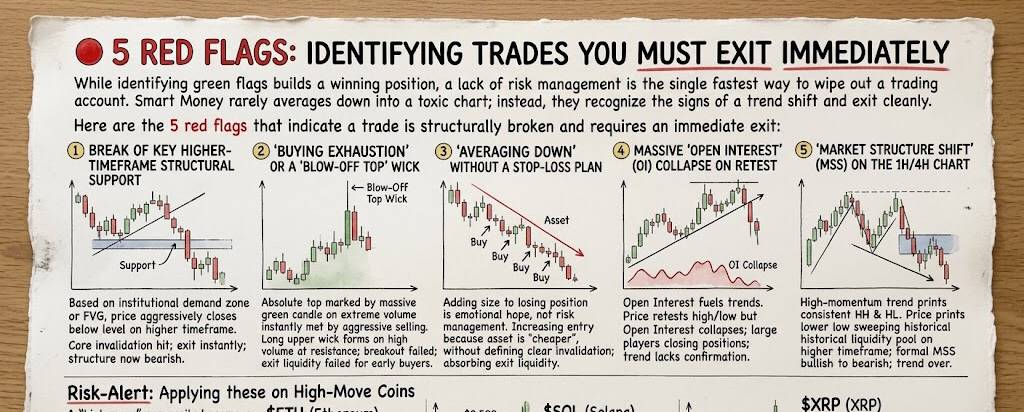
🔴 5 Red Flags: Identifying Trades You Must Exit ImmediatelyWhile identifying green flags helps you build a winning position, a lack of risk management is the single fastest way to wipe out a trading account. Smart Money rarely averages down into a toxic chart; instead, they recognize the signs of a trend shift and exit cleanly.
Here are the 5 red flags that indicate a trade is structurally broken and requires an immediate exit:
1. Break of Key Higher-Timeframe Structural Support
When a trade is based on an institutional demand zone or a Fair Value Gap (FVG), and price aggressively closes below that level on a higher timeframe, the trade’s core invalidation has been hit. Exit instantly; the structure is now bearish.
2. 'Buying Exhaustion' or a 'Blow-Off Top' wick
The absolute top is often marked by a final, massive green impulse candle on extreme volume that is instantly met by aggressive selling. If you see a long upper wick (2x to 3x the body) forming on high volume at a resistance level, the breakout has failed, and it is exit liquidity for early buyers.
3. 'Averaging Down' Without a Stop-Loss Plan
Adding more size to a losing position is not risk management; it is emotional hope. If you find yourself increasing your entry size strictly because the asset is 'cheaper' than before, without defining a clear invalidation, you are absorbing someone else's exit liquidity.
4. Massive 'Open Interest' (OI) Collapse on Retest
Open Interest tells you if fresh capital is fueling a trend. If price is retesting a key high/low but Open Interest is actively collapsing, it signals that large players are closing their positions rather than opening new ones. The trend lacks confirmation.
5. 'Market Structure Shift' (MSS) on the 1H/4H Chart
A high-momentum trend must print consistent higher highs and higher lows. When price prints a lower low that sweeps a key historical liquidity pool on the higher timeframe, it marks a formal Market Structure Shift from bullish to bearish. The trend is over.
Risk-Alert: Applying these on High-Move Coins
A "high move" can easily become a "sharp sweep" if you are not tracking these red flags. Look at these three major assets from the last 24H and consider how you would define your structural invalidation today:
$ONT (Ethereum): Strong volume inflow (+6.73%) pushing $2,500. A red flag would be a failure to hold acceptance above this newly reclaimed level.$SOL (Solana): +5.37% gain to $93.27. Tracking higher lows is critical here, as a collapse on high-range wicks would signal distribution.$XRP (XRP): Intraday volatile leader with +11.81% gains to $1.42. High derivatives volume means sharp sweeps can hit. A red flag would be an aggressive re-entry inside the range it just broke out of.
🔔 Follow for the next post: Mastering The Entry Hunter Execution Strategy!
#writetoearn #cryptotrading #priceaction #TradingSetups #TechnicalAnalysis #BinanceSquare
🔴 5 Red Flags: Identifying Trades You Must Exit Immediately
While identifying green flags helps you build a winning position, a lack of risk management is the single fastest way to wipe out a trading account. Smart Money rarely averages down into a toxic chart; instead, they recognize the signs of a trend shift and exit cleanly.
Here are the 5 red flags that indicate a trade is structurally broken and requires an immediate exit:
1. Break of Key Higher-Timeframe Structural Support
When a trade is based on an institutional demand zone or a Fair Value Gap (FVG), and price aggressively closes below that level on a higher timeframe, the trade’s core invalidation has been hit. Exit instantly; the structure is now bearish.
2. 'Buying Exhaustion' or a 'Blow-Off Top' wick
The absolute top is often marked by a final, massive green impulse candle on extreme volume that is instantly met by aggressive selling. If you see a long upper wick (2x to 3x the body) forming on high volume at a resistance level, the breakout has failed, and it is exit liquidity for early buyers.
3. 'Averaging Down' Without a Stop-Loss Plan
Adding more size to a losing position is not risk management; it is emotional hope. If you find yourself increasing your entry size strictly because the asset is 'cheaper' than before, without defining a clear invalidation, you are absorbing someone else's exit liquidity.
4. Massive 'Open Interest' (OI) Collapse on Retest
Open Interest tells you if fresh capital is fueling a trend. If price is retesting a key high/low but Open Interest is actively collapsing, it signals that large players are closing their positions rather than opening new ones. The trend lacks confirmation.
5. 'Market Structure Shift' (MSS) on the 1H/4H Chart
A high-momentum trend must print consistent higher highs and higher lows. When price prints a lower low that sweeps a key historical liquidity pool on the higher timeframe, it marks a formal Market Structure Shift from bullish to bearish. The trend is over.
Risk-Alert: Applying these on High-Move Coins
A "high move" can easily become a "sharp sweep" if you are not tracking these red flags. Look at these three major assets from the last 24H and consider how you would define your structural invalidation today:
$ONT (Ethereum): Strong volume inflow (+6.73%) pushing $2,500. A red flag would be a failure to hold acceptance above this newly reclaimed level.$SOL (Solana): +5.37% gain to $93.27. Tracking higher lows is critical here, as a collapse on high-range wicks would signal distribution.$XRP (XRP): Intraday volatile leader with +11.81% gains to $1.42. High derivatives volume means sharp sweeps can hit. A red flag would be an aggressive re-entry inside the range it just broke out of.
🔔 Follow for the next post: Mastering The Entry Hunter Execution Strategy!
#writetoearn #cryptotrading #priceaction #TradingSetups #TechnicalAnalysis #BinanceSquare
Here are the 5 red flags that indicate a trade is structurally broken and requires an immediate exit:
1. Break of Key Higher-Timeframe Structural Support
When a trade is based on an institutional demand zone or a Fair Value Gap (FVG), and price aggressively closes below that level on a higher timeframe, the trade’s core invalidation has been hit. Exit instantly; the structure is now bearish.
2. 'Buying Exhaustion' or a 'Blow-Off Top' wick
The absolute top is often marked by a final, massive green impulse candle on extreme volume that is instantly met by aggressive selling. If you see a long upper wick (2x to 3x the body) forming on high volume at a resistance level, the breakout has failed, and it is exit liquidity for early buyers.
3. 'Averaging Down' Without a Stop-Loss Plan
Adding more size to a losing position is not risk management; it is emotional hope. If you find yourself increasing your entry size strictly because the asset is 'cheaper' than before, without defining a clear invalidation, you are absorbing someone else's exit liquidity.
4. Massive 'Open Interest' (OI) Collapse on Retest
Open Interest tells you if fresh capital is fueling a trend. If price is retesting a key high/low but Open Interest is actively collapsing, it signals that large players are closing their positions rather than opening new ones. The trend lacks confirmation.
5. 'Market Structure Shift' (MSS) on the 1H/4H Chart
A high-momentum trend must print consistent higher highs and higher lows. When price prints a lower low that sweeps a key historical liquidity pool on the higher timeframe, it marks a formal Market Structure Shift from bullish to bearish. The trend is over.
Risk-Alert: Applying these on High-Move Coins
A "high move" can easily become a "sharp sweep" if you are not tracking these red flags. Look at these three major assets from the last 24H and consider how you would define your structural invalidation today:
$ONT (Ethereum): Strong volume inflow (+6.73%) pushing $2,500. A red flag would be a failure to hold acceptance above this newly reclaimed level.$SOL (Solana): +5.37% gain to $93.27. Tracking higher lows is critical here, as a collapse on high-range wicks would signal distribution.$XRP (XRP): Intraday volatile leader with +11.81% gains to $1.42. High derivatives volume means sharp sweeps can hit. A red flag would be an aggressive re-entry inside the range it just broke out of.
🔔 Follow for the next post: Mastering The Entry Hunter Execution Strategy!
#writetoearn #cryptotrading #priceaction #TradingSetups #TechnicalAnalysis #BinanceSquare
14
236

·
--
Bärisch
30D-Trade $ZEC 10.7K USDT
$ZEC immer zuerst Risikomanagement: ganz egal, jeden Tag erzielen wir gute Gewinne – nicht durch kurz- oder langfristige Strategien, sondern durch Dior und Risikomanagement. Lies diesen Artikel, er wird dir dabei helfen, sehr viel zurückzugewinnen 🤯
$ZEC immer zuerst Risikomanagement: ganz egal, jeden Tag erzielen wir gute Gewinne – nicht durch kurz- oder langfristige Strategien, sondern durch Dior und Risikomanagement. Lies diesen Artikel, er wird dir dabei helfen, sehr viel zurückzugewinnen 🤯
BNB-HUNTER
·
--
🛡️ Portfolio-Architektur: Professionelles Positions- & Risikomanagement
Kapitalerhalt ist das ultimative Luxusgut beim Trading. Ohne ein striktes, mathematisches Rahmenwerk für das Positions- und Größenmanagement wird die Ausführung ununterscheidbar von Glücksspiel. Die Entry-Hunter-Strategie basiert vollständig auf berechneter Präzision, um Vermögen zu schützen und konsistenten Marktwert auszuschöpfen—ohne Emotionen.
Hier ist der strukturelle Bauplan für professionelles Risikomanagement:
1. Die 1%-bis-2%-Regel (Absolute Risikoquote)
Riskiere niemals mehr als 1% bis 2% deines gesamten Portfolio-Eigenkapitals für ein einzelnes Setup. Dabei geht es strikt um das verlorene Kapital, wenn deine Ungültigkeitsmarke (Stop-Loss) ausgelöst wird—nicht um die für den Trade bereitgestellte Margin. Dieser mathematische Puffer sorgt dafür, dass selbst eine Abfolge ungültiger Setups deinen Nettovermögenswert nicht bedeutend schmälern kann.
Hier ist der strukturelle Bauplan für professionelles Risikomanagement:
1. Die 1%-bis-2%-Regel (Absolute Risikoquote)
Riskiere niemals mehr als 1% bis 2% deines gesamten Portfolio-Eigenkapitals für ein einzelnes Setup. Dabei geht es strikt um das verlorene Kapital, wenn deine Ungültigkeitsmarke (Stop-Loss) ausgelöst wird—nicht um die für den Trade bereitgestellte Margin. Dieser mathematische Puffer sorgt dafür, dass selbst eine Abfolge ungültiger Setups deinen Nettovermögenswert nicht bedeutend schmälern kann.

3
274
·
--
Bärisch
Eth wie Tanz 💃$XRP $ZEC $SOL SHORTs in Profite 🦠
Eth wie Tanz 💃$XRP $ZEC $SOL SHORTs in Profite 🦠
2
3
42
·
--
Bärisch
Short $ETH 191.3 USDT
Die Setups, die ich geteilt habe, basierten auf geleakten privaten Nachrichten zwischen Krypto-Hackern 🤝$ETH $ZEC $SOL
{future}(SOLUSDT)
Die Setups, die ich geteilt habe, basierten auf geleakten privaten Nachrichten zwischen Krypto-Hackern 🤝$ETH $ZEC $SOL
BNB-HUNTER
·
--
BärischEth big dca wieder los geht’s
#eth # # ##writetoearn
$ZEC $SOL
#eth # # ##writetoearn
$ZEC $SOL
3
273
·
--
Bärisch
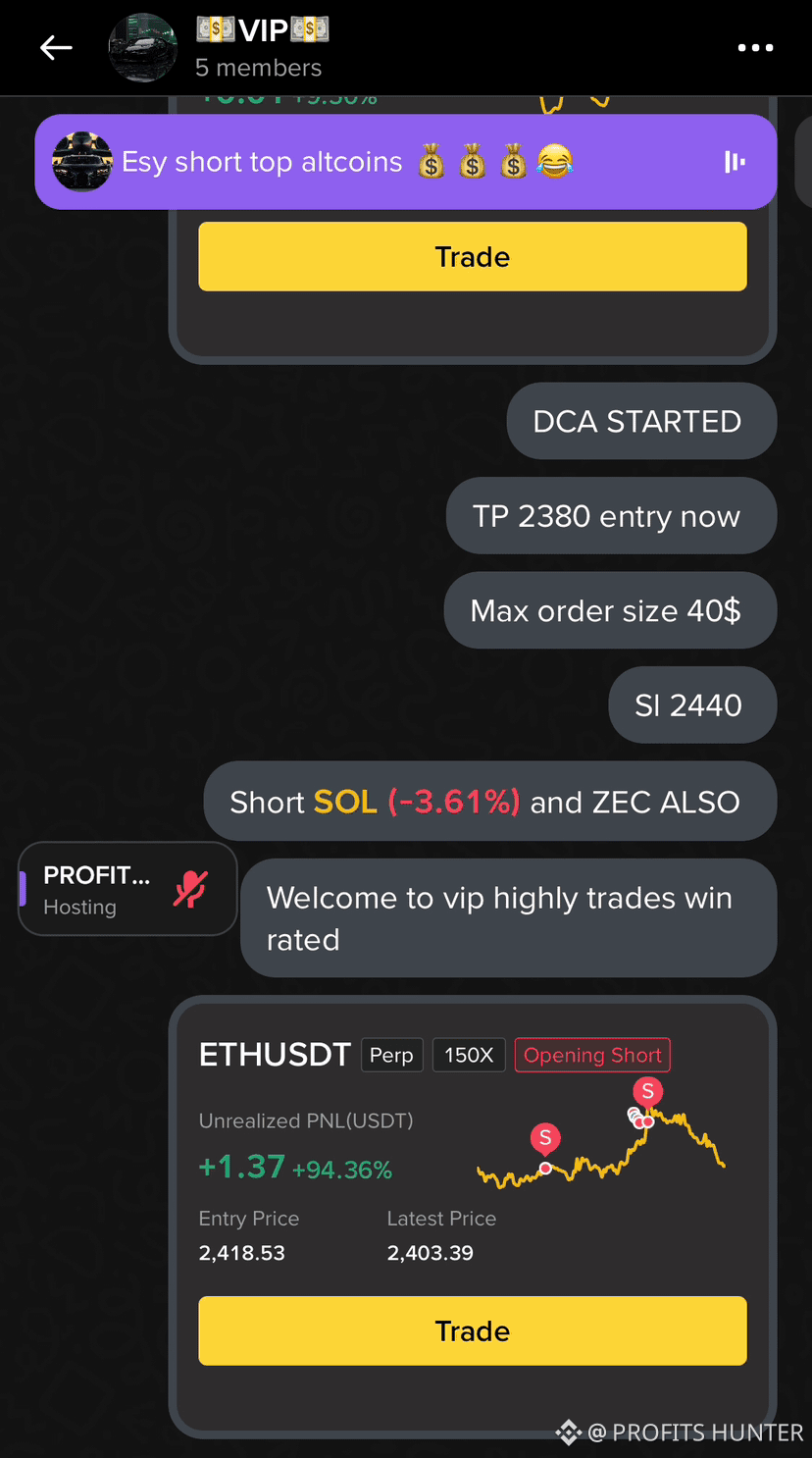
Möchten Sie eine Echtzeit-Ausführung von Trades und präzise Marktaktualisierungen?
Treten Sie unserem 100% kostenlosen VIP-Chatroom mit echtem Mehrwert bei – ohne Abonnementgebühren.
Im VIP-Raum:
• Live-Audio-Streams & Marktstruktur-Calls
• Exakte Entry-, TP- und SL-Level ($ETH, $SOL,$ZEC)
• Strenges Risikomanagement & Hinweise zur Positionsgröße
Verbessern Sie Ihre Strategie. Tippen Sie im Chatroom auf meinem Profil, um jetzt beizutreten. 🥂
$ETH $SOL $ZEC
#Write2Earn #BinanceSquare #crypto #Trading
Möchten Sie eine Echtzeit-Ausführung von Trades und präzise Marktaktualisierungen?
Treten Sie unserem 100% kostenlosen VIP-Chatroom mit echtem Mehrwert bei – ohne Abonnementgebühren.
Im VIP-Raum:
• Live-Audio-Streams & Marktstruktur-Calls
• Exakte Entry-, TP- und SL-Level ($ETH , $SOL ,$ZEC )
• Strenges Risikomanagement & Hinweise zur Positionsgröße
Verbessern Sie Ihre Strategie. Tippen Sie im Chatroom auf meinem Profil, um jetzt beizutreten. 🥂
$ETH $SOL $ZEC
#Write2Earn #BinanceSquare #crypto #Trading
Treten Sie unserem 100% kostenlosen VIP-Chatroom mit echtem Mehrwert bei – ohne Abonnementgebühren.
Im VIP-Raum:
• Live-Audio-Streams & Marktstruktur-Calls
• Exakte Entry-, TP- und SL-Level ($ETH , $SOL ,$ZEC )
• Strenges Risikomanagement & Hinweise zur Positionsgröße
Verbessern Sie Ihre Strategie. Tippen Sie im Chatroom auf meinem Profil, um jetzt beizutreten. 🥂
$ETH $SOL $ZEC
#Write2Earn #BinanceSquare #crypto #Trading
1
4
263
·
--
Bärisch
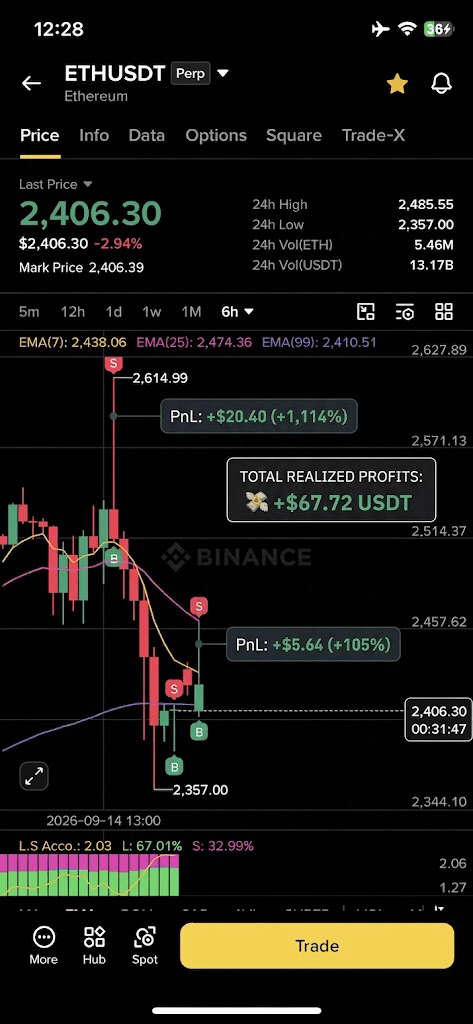
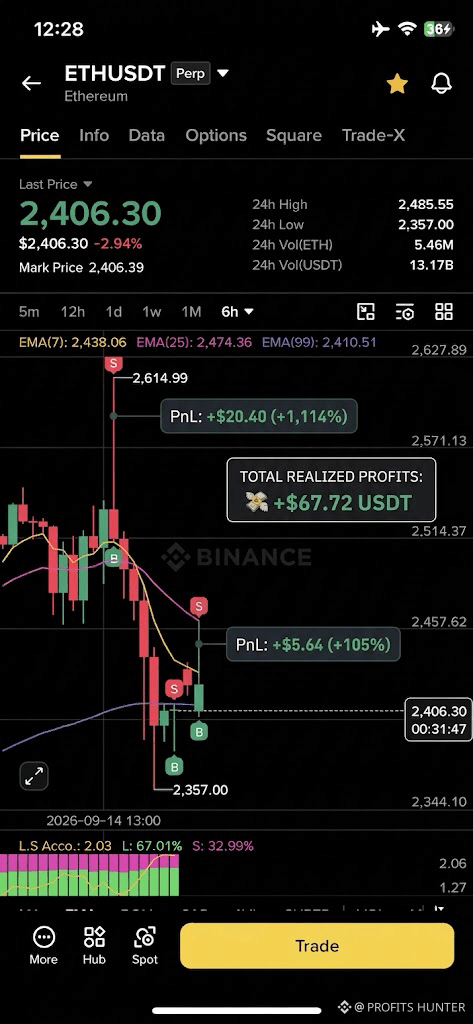
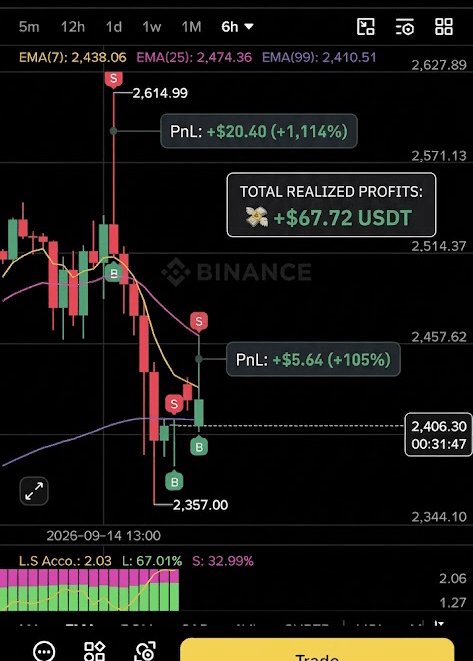
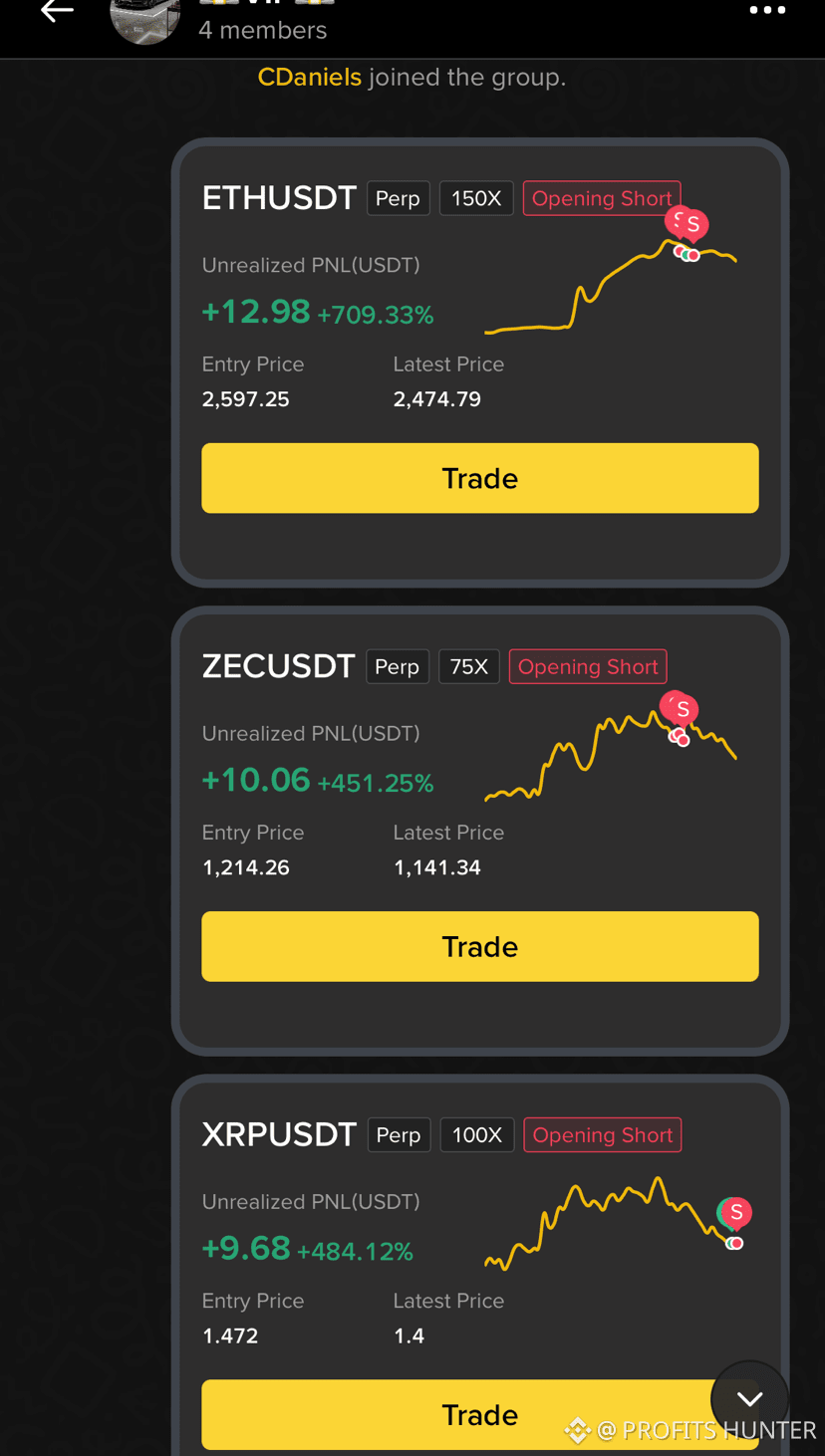
ETH Candle Execution Mapping 📉
📍 Kerze 1 (vor 2 Tagen — Top-Ablehnung)
• Einstieg: $2.597,25 | Peak-Wick: $2.614,99
• Ausstieg: $2.474,79
• PnL: +$20,40 (+1.114% ROE)
📍 Kerze 2 (vor 18 Std. — Breakdown-Drive)
• Einstieg: $2.443,75
• Ausstieg: $2.357,00 (lokales Tief)
• PnL: +$5,64 (+105% ROE)
📍 Kerze 3 (vor 37 Min. — Aktives DCA)
• Einstieg: $2.406,30 [Short Open]
ETH Candle Execution Mapping 📉
📍 Kerze 1 (vor 2 Tagen — Top-Ablehnung)
• Einstieg: $2.597,25 | Peak-Wick: $2.614,99
• Ausstieg: $2.474,79
• PnL: +$20,40 (+1.114% ROE)
📍 Kerze 2 (vor 18 Std. — Breakdown-Drive)
• Einstieg: $2.443,75
• Ausstieg: $2.357,00 (lokales Tief)
• PnL: +$5,64 (+105% ROE)
📍 Kerze 3 (vor 37 Min. — Aktives DCA)
• Einstieg: $2.406,30 [Short Open]
📍 Kerze 1 (vor 2 Tagen — Top-Ablehnung)
• Einstieg: $2.597,25 | Peak-Wick: $2.614,99
• Ausstieg: $2.474,79
• PnL: +$20,40 (+1.114% ROE)
📍 Kerze 2 (vor 18 Std. — Breakdown-Drive)
• Einstieg: $2.443,75
• Ausstieg: $2.357,00 (lokales Tief)
• PnL: +$5,64 (+105% ROE)
📍 Kerze 3 (vor 37 Min. — Aktives DCA)
• Einstieg: $2.406,30 [Short Open]
1
63
·
--
Bärisch
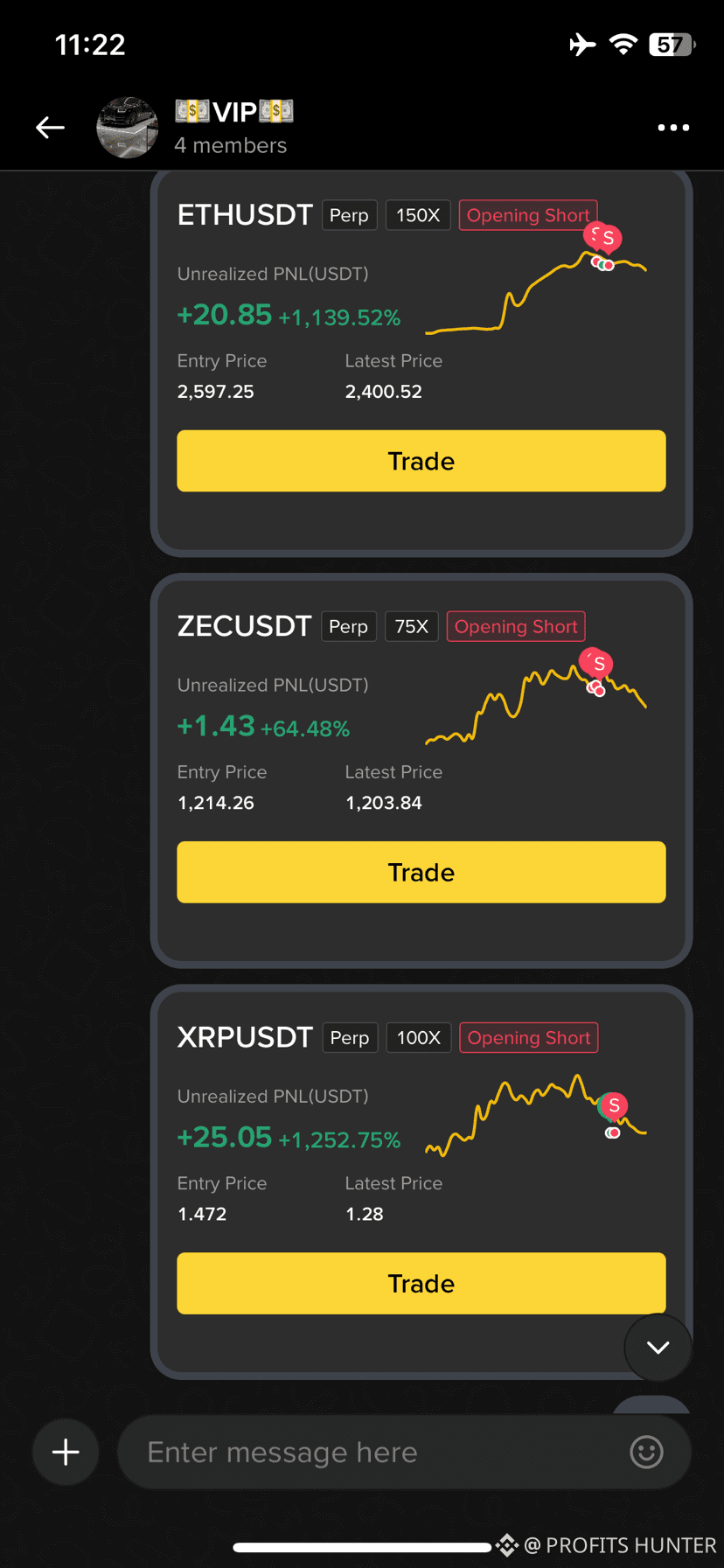
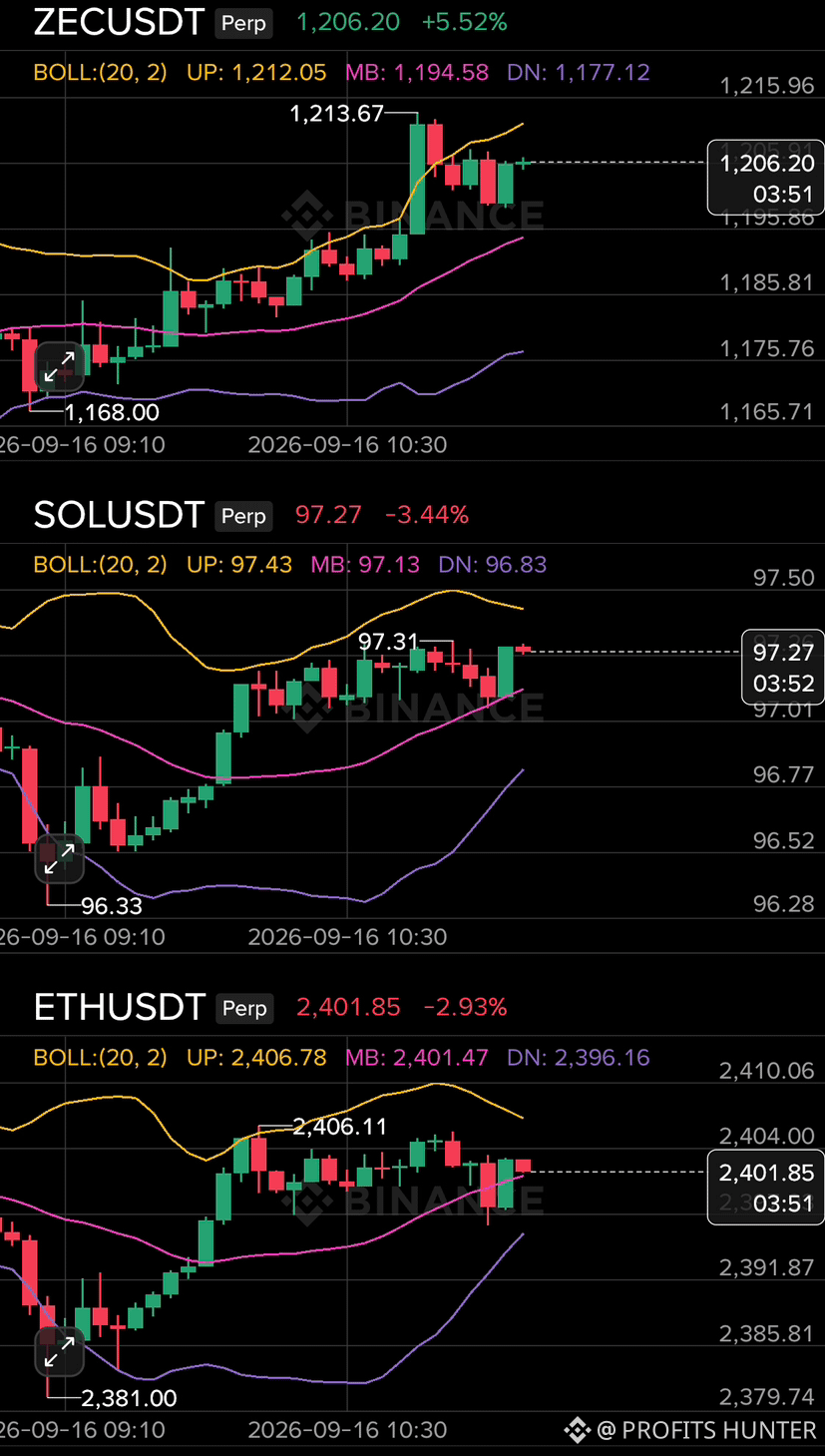
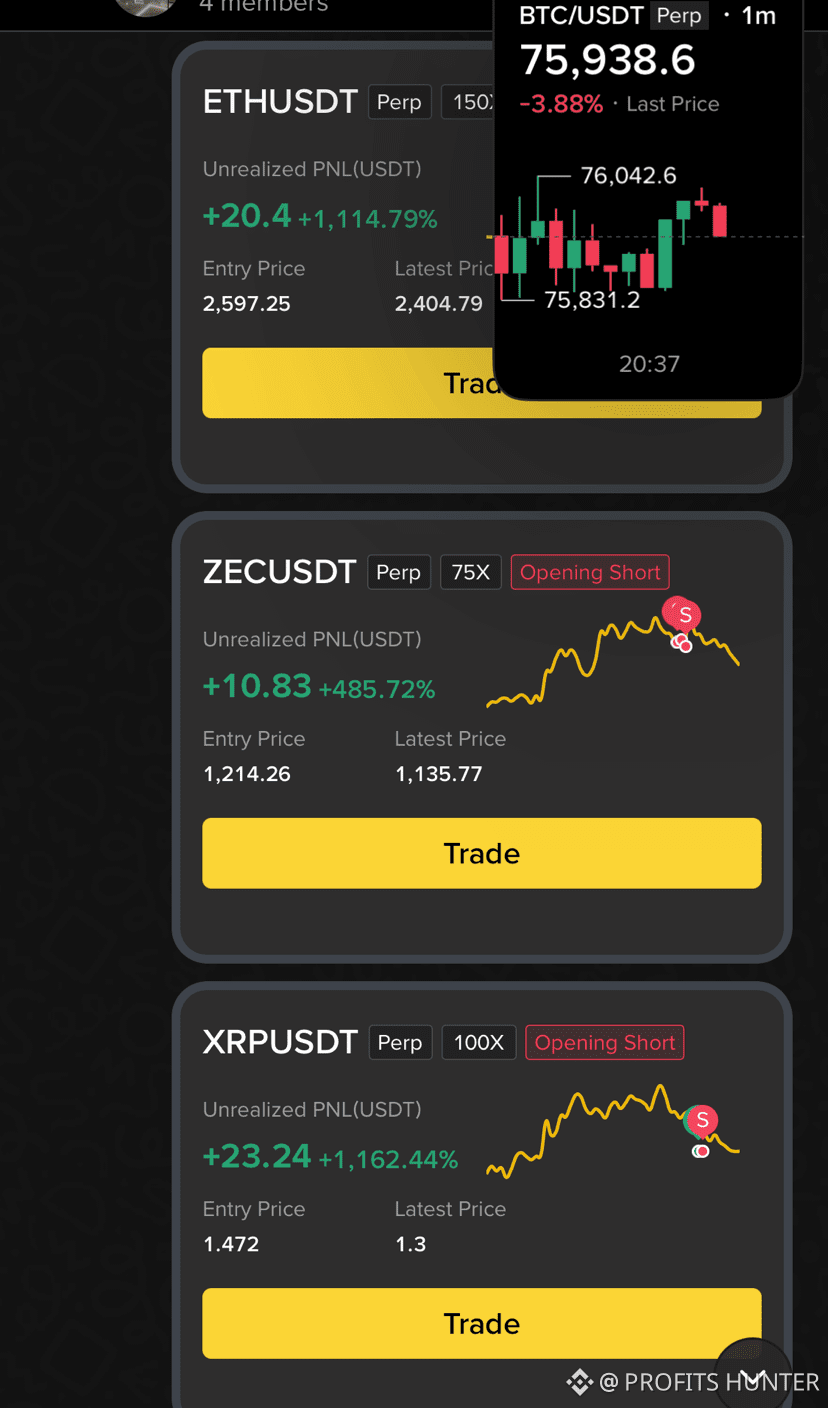
Dreifache kurze Ausführung 🚀📉
Abklingende Ablehnungen an der oberen Bollinger-Band-Spitze über lokale Zeitrahmen hinweg, während das Aufwärts-Momentum erschöpft.
• $ZEC : Liquiditätssweep & Ablehnung bei $1,213
• $SOL : Lower High gekappt unter $97,40
• $ETH : Angebotsabsorption bestätigt bei $2,406
Mean-Reversion-Spiel in Richtung Unterstützung am unteren Band. Strikte Stop-Losses sind gesetzt.
Die Tops abverkaufen oder auf einen Bounce warten? 👇
#Write2Earn #BinanceSquare #ETH #sol #ZEC
Dreifache kurze Ausführung 🚀📉
Abklingende Ablehnungen an der oberen Bollinger-Band-Spitze über lokale Zeitrahmen hinweg, während das Aufwärts-Momentum erschöpft.
• $ZEC : Liquiditätssweep & Ablehnung bei $1,213
• $SOL : Lower High gekappt unter $97,40
• $ETH : Angebotsabsorption bestätigt bei $2,406
Mean-Reversion-Spiel in Richtung Unterstützung am unteren Band. Strikte Stop-Losses sind gesetzt.
Die Tops abverkaufen oder auf einen Bounce warten? 👇
#Write2Earn #BinanceSquare #ETH #sol #ZEC
Abklingende Ablehnungen an der oberen Bollinger-Band-Spitze über lokale Zeitrahmen hinweg, während das Aufwärts-Momentum erschöpft.
• $ZEC : Liquiditätssweep & Ablehnung bei $1,213
• $SOL : Lower High gekappt unter $97,40
• $ETH : Angebotsabsorption bestätigt bei $2,406
Mean-Reversion-Spiel in Richtung Unterstützung am unteren Band. Strikte Stop-Losses sind gesetzt.
Die Tops abverkaufen oder auf einen Bounce warten? 👇
#Write2Earn #BinanceSquare #ETH #sol #ZEC
1
339
·
--
Bärisch
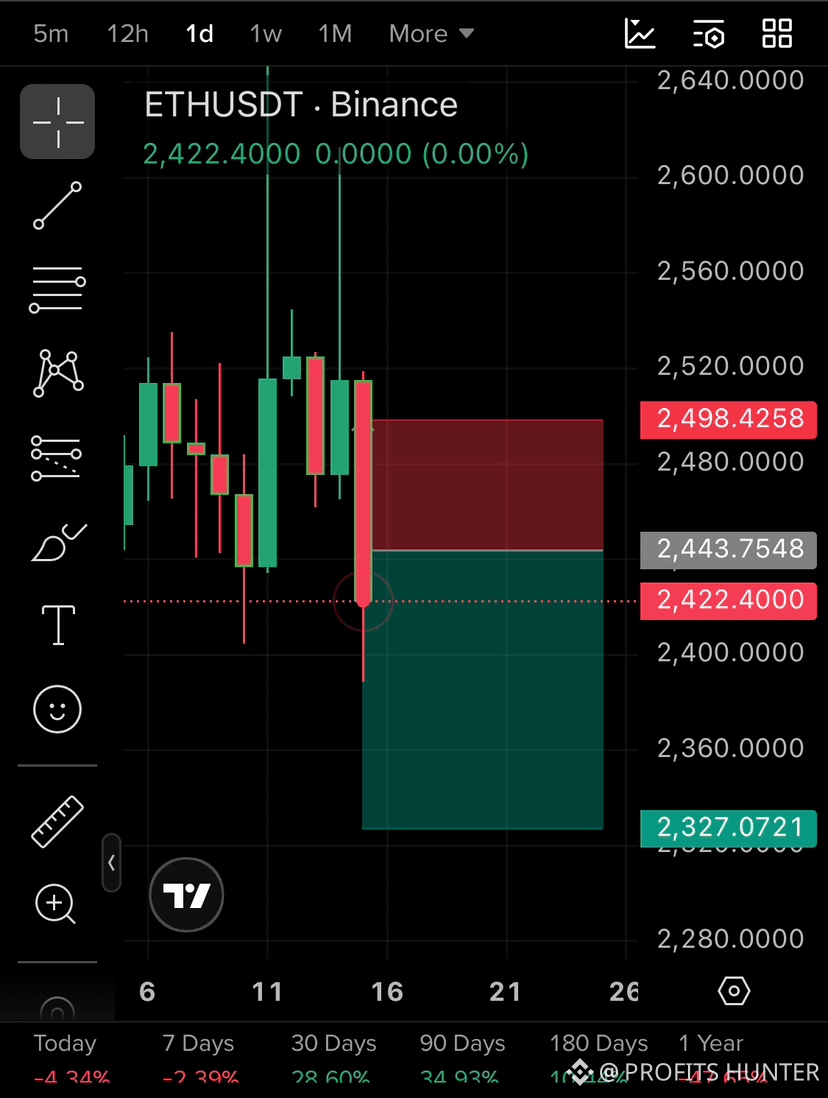
ETH/ USDT Short Setup 📉
Tägliche Ablehnung bestätigt in der $2.498-Resistance-Zone. Bärischer Momentum übernimmt, da der Preis die entscheidende lokale Struktur durchbricht.
• Paar: ETH/ USDT
• Einstieg: 2.443,75
• Ziel: 2.327,07
• Stop-Loss: 2.498,42
Mit strikter Disziplin beim Risikoparameter ausführen.
Willst du hier niedrigere Supports auf Ethereum anpeilen? 👇
#Write2Earn #ETH #BinanceSquare #Crypto $BTC $ZEC $XRP
ETH/ USDT Short Setup 📉
Tägliche Ablehnung bestätigt in der $2.498-Resistance-Zone. Bärischer Momentum übernimmt, da der Preis die entscheidende lokale Struktur durchbricht.
• Paar: ETH/ USDT
• Einstieg: 2.443,75
• Ziel: 2.327,07
• Stop-Loss: 2.498,42
Mit strikter Disziplin beim Risikoparameter ausführen.
Willst du hier niedrigere Supports auf Ethereum anpeilen? 👇
#Write2Earn #ETH #BinanceSquare #Crypto $BTC $ZEC $XRP
Tägliche Ablehnung bestätigt in der $2.498-Resistance-Zone. Bärischer Momentum übernimmt, da der Preis die entscheidende lokale Struktur durchbricht.
• Paar: ETH/ USDT
• Einstieg: 2.443,75
• Ziel: 2.327,07
• Stop-Loss: 2.498,42
Mit strikter Disziplin beim Risikoparameter ausführen.
Willst du hier niedrigere Supports auf Ethereum anpeilen? 👇
#Write2Earn #ETH #BinanceSquare #Crypto $BTC $ZEC $XRP
2
40
·
--
Bärisch
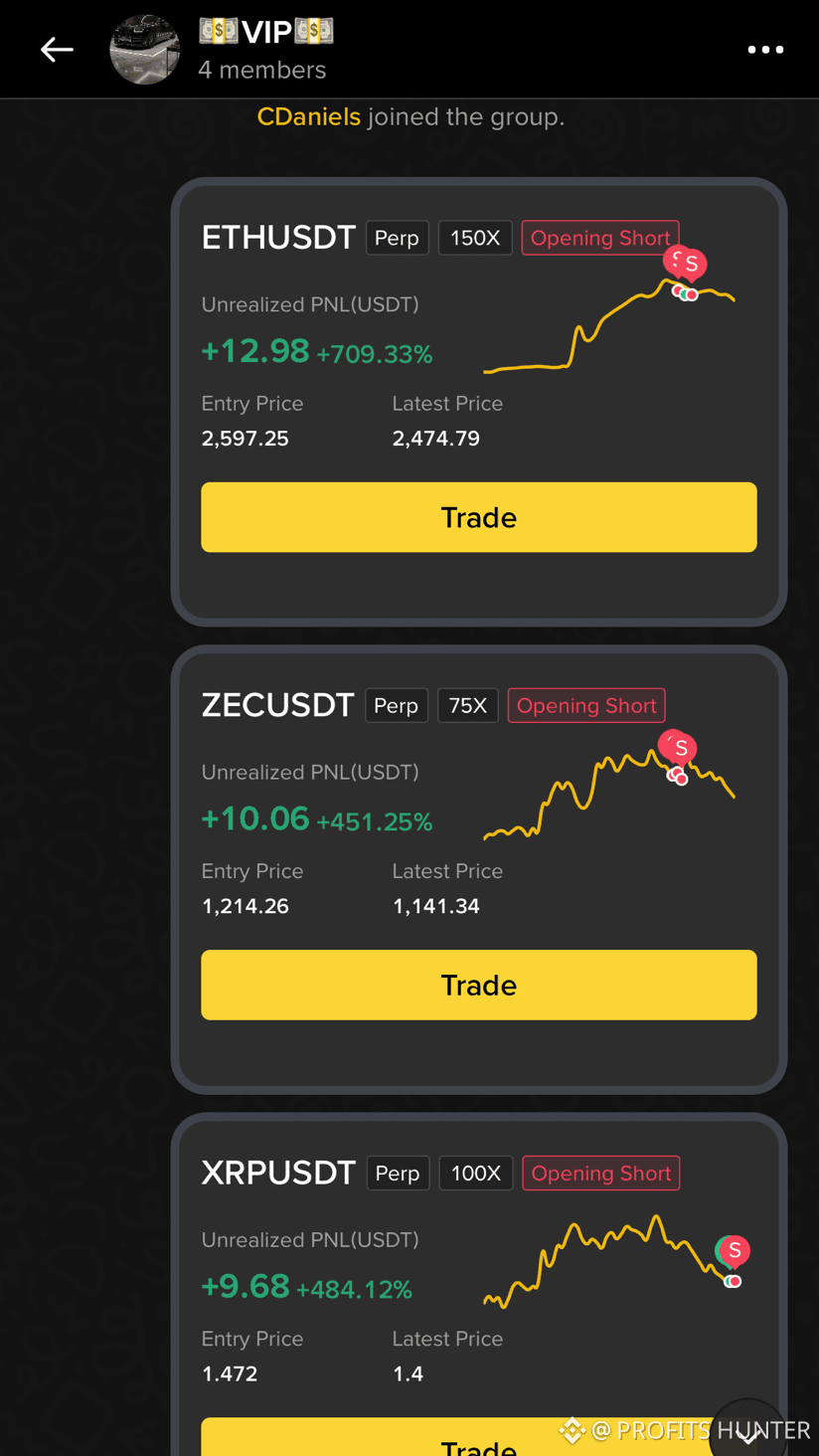
Warum fälschen Altcoins Ausbrüche? 📉
• Liquiditätsauslösungen: Der Kurs wird über wichtigen Widerstand gedrückt, um Stop-Losses abzugreifen & Retail zu täuschen.
• Derivate-Ermüdung: OI-Spikes bei hohem Leverage (75x–150x) mit schwachem Spot-Volumen.
• Angebotsablehnung: Wale nehmen gefangene Longs auf höheren Zeitebenen auf.
Short-Einstiege gesperrt über $ETH ,$ZEC C, $XRP & $FIL. Ausführung statt Emotion.
Blendest du den Top- Bereich ab oder kaufst Ausbrüche? 👇
#Write2Earn #Write2Earn #crypto #Trading
Warum fälschen Altcoins Ausbrüche? 📉
• Liquiditätsauslösungen: Der Kurs wird über wichtigen Widerstand gedrückt, um Stop-Losses abzugreifen & Retail zu täuschen.
• Derivate-Ermüdung: OI-Spikes bei hohem Leverage (75x–150x) mit schwachem Spot-Volumen.
• Angebotsablehnung: Wale nehmen gefangene Longs auf höheren Zeitebenen auf.
Short-Einstiege gesperrt über $ETH ,$ZEC C, $XRP & $FIL. Ausführung statt Emotion.
Blendest du den Top- Bereich ab oder kaufst Ausbrüche? 👇
#Write2Earn #Write2Earn #crypto #Trading
• Liquiditätsauslösungen: Der Kurs wird über wichtigen Widerstand gedrückt, um Stop-Losses abzugreifen & Retail zu täuschen.
• Derivate-Ermüdung: OI-Spikes bei hohem Leverage (75x–150x) mit schwachem Spot-Volumen.
• Angebotsablehnung: Wale nehmen gefangene Longs auf höheren Zeitebenen auf.
Short-Einstiege gesperrt über $ETH ,$ZEC C, $XRP & $FIL. Ausführung statt Emotion.
Blendest du den Top- Bereich ab oder kaufst Ausbrüche? 👇
#Write2Earn #Write2Earn #crypto #Trading
2
163
·
--
Bärisch
Ich suche einen neuen Einstieg im DCA für BTC
Ich suche einen neuen Einstieg im DCA für BTC
2
42
·
--
Bärisch
Schließen oder füge etwas ZEC-DCA hinzu, kurz
Schließen oder füge etwas ZEC-DCA hinzu, kurz
2
87
Anmelden und weiter Inhalte entdecken
Krypto-Nutzer weltweit auf Binance Square kennenlernen
⚡️ Bleib in Sachen Krypto stets am Puls.
💬 Die weltgrößte Kryptobörse vertraut darauf.
👍 Erhalte verlässliche Einblicke von verifizierten Creators.
E-Mail-Adresse/Telefonnummer
Trendthemen
AIStocksWhatNext
672,313 Aufrufe
5,016 Kommentare
Teile & gewinne Traffic-Rewards in unserer angesagten Hashtag-Kampagne
✨Thema: Welche anderen Investitionsmöglichkeiten gibt es noch, während KI-Aktien weiter steigen?
👉So machst du mit:
Veröffentliche einen kurzen Beitrag oder Artikel mit dem Hashtag #AIStocksWhatNext
Teile, ob du bullisch oder bärisch bist, und poste deine KI-Aktienbestände oder Trades – die Nutzung des Trade-Widgets kann deine Berechtigung verbessern.
Du kannst deinen Beitrag auch stärken, indem du Daten oder Diagramme teilst und KI-generierte Bilder vermeidest.
✍️Erstelle Inhalte basierend auf den folgenden Blickwinkeln:
- Nvidia sagt, dass sich der Chip-Umsatz im nächsten Jahr verdoppeln wird, und die führenden KI-Unternehmen erreichen weiterhin Rekordumsätze – der Rechenaufwand dahinter ist ebenso beeindruckend. Verläuft die Nachfrage nach KI wirklich gerade erst so richtig, oder geht es nur noch eine Weile weiter? KI-Aktien steigen derzeit branchenweit. Ist das ein echter Ausbruch oder nur ein kurzfristiger Rückprall?
- Branchenführer fordern dazu auf, die Entwicklung von KI zu verlangsamen, während Trump plant, eine „AI Force“ aufzubauen, und behauptet, KI könne in der Zukunft 25% des US-BIP ausmachen. Auf welcher Seite stehst du? Wird staatliche Unterstützung ein langfristiger Gewinn für KI-Aktien sein?
- Kaufst du KI-Aktien? Teile deinen KI-bezogenen Trade/deine Bestände mit unserem Trade-Sharing-Widget.
⏰Kampagnenzeitraum:
- 2026-09-22 7:00 - 2026-09-24 4:00 UTC
🎁Belohnung:
- Qualifizierte Beiträge, die die oben genannten Richtlinien einhalten und mehr als 100 Wörter enthalten, werden überprüft und können möglicherweise einen zufälligen Traffic-Boost von 500 bis 3.000 Views erhalten. Du erhältst eine Benachrichtigung von deiner Feed-Sekretärin, wenn dein Beitrag ausgewählt wurde.
- Erhalte die Chance, dass dein Artikel auf Binance Square Official vorgestellt wird
Brauchst du Ideen für deinen Beitrag? Besuche die Thema-Seite #AIStocksWhatNext oder die Square Guide on How to Post for Better Reach.
Binance Square Official
·492 Likes
·1.3M Aufrufe
21SharesLaunchesEuropesFirstZcashETP
14,097 Aufrufe
495 Kommentare
CardanoJoinsX402PaymentStandard
10,166 Aufrufe
377 Kommentare