Binance Square
137Labs Global
66 Beiträge

137Labs Global

137Labs identifies real market needs to help users seize Web3 opportunities. We research promising projects and provide clear insights. @137labscn
Trade eröffnen
6.3 Monate
3 Following
44 Follower
85 Like gegeben
Beiträge
Portfolio
·
--
Artikel
Übersetzung ansehen
Robinhood Chain Sends Shockwaves Through Crypto: Why Did dYdX Plunge 40% in One Day?In July 2026, Robinhood unveiled one of the most ambitious product expansions in its history at its "The World is Flat" event in London. The company officially launched Robinhood Chain, its Layer 2 blockchain built on Arbitrum Orbit, alongside a suite of new products including tokenized stocks, decentralized lending, AI-powered trading agents, perpetual futures, and an accelerated global expansion strategy. At first glance, it may seem like another financial platform launching its own blockchain. But looking deeper, Robinhood is attempting something much larger: transforming itself from an online brokerage into the infrastructure layer for the next generation of global finance. Rather than simply adding crypto features, Robinhood is building an ecosystem where traditional assets, decentralized finance (DeFi), artificial intelligence, and blockchain infrastructure converge under one platform. I.What Did Robinhood Announce? Robinhood Chain Goes Live The centerpiece of the announcement is Robinhood Chain, a Layer 2 network built using the Arbitrum Orbit stack. According to Robinhood, the network is designed specifically for institutional-grade applications, real-world assets (RWAs), and AI-native financial services. It provides developers with built-in DeFi primitives while allowing Robinhood's millions of users to interact seamlessly with onchain applications. Unlike many newly launched chains that spend years building an ecosystem, Robinhood Chain debuted with an impressive lineup of partners, including Uniswap, Chainlink, Alchemy, BitGo, Morpho, 1inch, Pleiades, and several other leading protocols spanning liquidity, infrastructure, custody, lending, and developer tooling. This signals that Robinhood is not merely participating in Web3—it is building its own financial operating system on-chain. Tokenized Stocks Become Onchain Assets Perhaps the most transformative product unveiled is Robinhood's Stock Tokens. Available through Robinhood Wallet across more than 120 countries and regions (subject to local regulations), eligible users can trade tokenized equities around the clock via decentralized exchanges such as Uniswap, 1inch, Rialto, Lighter, and Arcus. More importantly, these tokenized stocks are designed to become composable financial assets. Instead of simply representing stock exposure, they can potentially be: · used as collateral in lending protocols; · deposited into liquidity pools; · integrated into broader DeFi applications; · utilized across various onchain financial services. Robinhood notes that these Stock Tokens are tokenized debt securities providing economic exposure to the underlying equities rather than legal ownership, meaning holders do not receive shareholder rights such as voting or dividends. Nevertheless, this represents another significant step toward bringing traditional financial assets onto public blockchain infrastructure. Robinhood Earn Brings DeFi to Mainstream Users Robinhood also introduced Robinhood Earn, the company's first decentralized lending product integrated directly into its main application. Eligible U.S. customers can lend USDG, Robinhood's dollar-backed stablecoin, through self-custodied wallets using lending infrastructure powered by Morpho. Expected annual yields are around 7%, with insurance coverage provided through Lloyd's of London and RELM to mitigate smart contract and cybersecurity risks. From the user's perspective, the complexity of DeFi largely disappears. Robinhood handles the interface while blockchain protocols operate behind the scenes, dramatically lowering the barrier for mainstream participation. AI Agents Become Personal Traders Artificial intelligence also plays a central role in Robinhood's new strategy. The company announced Agentic Trading, allowing users to connect large language models to Robinhood's trading APIs and market data. After defining risk parameters and capital limits, AI agents can continuously monitor markets, analyze news and execute trading strategies automatically. Historically, sophisticated algorithmic trading has largely remained the domain of institutional investors. Robinhood now aims to democratize those capabilities through AI. Global Expansion Accelerates Robinhood also outlined aggressive international expansion plans. The company is expanding crypto services into Canada, preparing to launch crypto trading in the UK, growing its perpetual futures offerings across Europe, and strengthening its presence in Singapore following regulatory approvals. Today, Robinhood serves nearly 28 million funded accounts across dozens of countries, and its ambitions are increasingly global rather than U.S.-centric.   II.Why Is Robinhood Making This Move Now? Robinhood's strategic shift is driven by several converging trends. The Rise of Real-World Assets Tokenization has become one of the fastest-growing sectors within digital assets. Asset managers, banks, and financial institutions are increasingly moving money market funds, bonds, equities, and other financial instruments onto blockchain networks. Robinhood's existing retail user base positions it uniquely to bridge traditional securities with decentralized financial infrastructure. Regulatory Clarity Is Improving The regulatory environment has become significantly more favorable than it was only a few years ago. Clearer frameworks surrounding stablecoins and tokenized assets provide companies like Robinhood with greater confidence to expand blockchain-based financial products while remaining compliant. For a publicly traded fintech company, regulatory certainty is arguably just as important as technological innovation. Crypto Growth Has Slowed Robinhood's crypto business has experienced slowing momentum, with declining crypto revenue and trading volume reported in recent quarters. Launching Robinhood Chain represents more than product diversification—it represents a transition from earning revenue primarily through trading activity toward owning core financial infrastructure. Infrastructure businesses often generate stronger network effects and more durable long-term competitive advantages than transaction-based businesses.   III.Robinhood's Real Strategy Looking at each announcement individually may miss the bigger picture. Robinhood is not simply launching another blockchain. It is assembling an integrated onchain financial ecosystem. Within that ecosystem: · Robinhood App becomes the customer interface. · Robinhood Wallet becomes the user's financial identity. · Robinhood Chain becomes the settlement and execution layer. · Stock Tokens become programmable financial assets. · Robinhood Earn provides decentralized yield generation. · AI Agents automate portfolio management and trading. · DeFi protocols provide liquidity and financial services. Instead of participating in isolated sectors such as brokerage, crypto trading, or wallets, Robinhood is attempting to control multiple layers of the value chain simultaneously. Its long-term ambition increasingly resembles a blockchain-native financial operating system rather than a traditional brokerage.   IV.Why Did DYDX Collapse? While Robinhood dominated headlines, another story emerged unexpectedly. dYdX announced Arcus, a brand-new decentralized exchange developed by the team behind dYdX. However, instead of launching on dYdX Chain, Arcus chose Robinhood Chain as its underlying infrastructure. That decision immediately triggered backlash within the dYdX community. Many investors questioned whether: · engineering resources would shift toward Arcus; · liquidity would migrate away from dYdX Chain; · future token incentives would dilute the value of DYDX; · Arcus could eventually replace the original dYdX ecosystem. Founder Antonio Juliano explained that Robinhood's nearly 28 million funded accounts provide immediate access to users and liquidity that would otherwise take years to build independently. He also emphasized that Robinhood Crypto had become a strategic investor in Arcus. Although both the dYdX Foundation and Juliano reiterated their long-term commitment to dYdX governance and community incentives, investor concerns remained. The market reaction was swift, with DYDX experiencing a sharp decline following the announcement. More broadly, the incident illustrates a growing reality within crypto: infrastructure platforms that control users, liquidity, and distribution are becoming increasingly powerful.   V.What Does This Actually Mean? Robinhood Chain is significant not because another Layer 2 has entered the market. Its importance lies in what it represents. For years, traditional finance and decentralized finance have largely existed in parallel worlds. Traditional assets remained inside centralized financial systems, while DeFi revolved primarily around crypto-native assets. Robinhood is attempting to bridge those ecosystems. Stocks become programmable. Tokenized assets become collateral. Collateral powers lending. Lending supports broader financial applications. Artificial intelligence automates participation. If equities are only the beginning, future tokenization could extend to bonds, ETFs, private equity, real estate, and other financial instruments. In that future, blockchain would no longer serve only cryptocurrencies—it would become the infrastructure layer for global capital markets. Robinhood is positioning itself at the center of that transformation.   VI. Conclusion A decade ago, Robinhood transformed how millions of retail investors accessed stock markets. Today, it is attempting something far more ambitious: redefining how global finance itself operates. Robinhood Chain, tokenized stocks, decentralized lending, AI-powered trading, and international expansion are not isolated product launches. Together, they form a coherent strategy aimed at building a unified onchain financial ecosystem. Whether Robinhood succeeds will depend on its ability to attract developers, liquidity, institutional adoption, and regulatory support. Competition from both crypto-native protocols and traditional financial institutions will remain intense. However, one message from this launch is already clear. The next phase of financial innovation will likely not be defined solely by brokerages, exchanges, or blockchain networks competing independently. Instead, the winners may be those capable of integrating traditional finance, decentralized finance, artificial intelligence, and global distribution into a single platform. Robinhood has made its move. The race to become the operating system for onchain finance has officially begun.

Robinhood Chain Sends Shockwaves Through Crypto: Why Did dYdX Plunge 40% in One Day?

In July 2026, Robinhood unveiled one of the most ambitious product expansions in its history at its "The World is Flat" event in London. The company officially launched Robinhood Chain, its Layer 2 blockchain built on Arbitrum Orbit, alongside a suite of new products including tokenized stocks, decentralized lending, AI-powered trading agents, perpetual futures, and an accelerated global expansion strategy.
At first glance, it may seem like another financial platform launching its own blockchain. But looking deeper, Robinhood is attempting something much larger: transforming itself from an online brokerage into the infrastructure layer for the next generation of global finance.
Rather than simply adding crypto features, Robinhood is building an ecosystem where traditional assets, decentralized finance (DeFi), artificial intelligence, and blockchain infrastructure converge under one platform.
I.What Did Robinhood Announce?
Robinhood Chain Goes Live
The centerpiece of the announcement is Robinhood Chain, a Layer 2 network built using the Arbitrum Orbit stack.
According to Robinhood, the network is designed specifically for institutional-grade applications, real-world assets (RWAs), and AI-native financial services. It provides developers with built-in DeFi primitives while allowing Robinhood's millions of users to interact seamlessly with onchain applications.
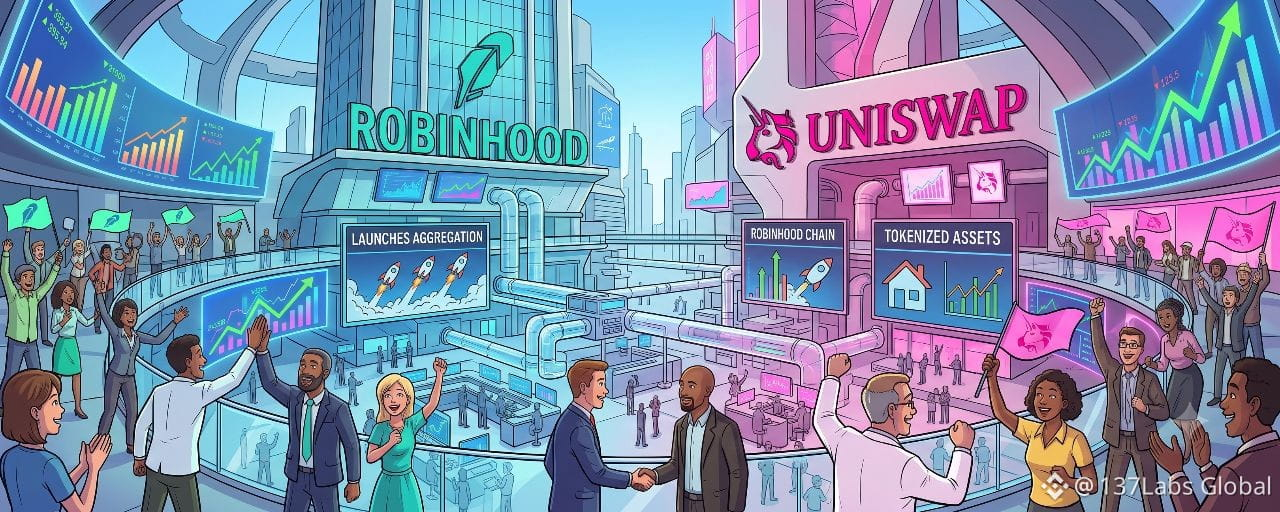
Unlike many newly launched chains that spend years building an ecosystem, Robinhood Chain debuted with an impressive lineup of partners, including Uniswap, Chainlink, Alchemy, BitGo, Morpho, 1inch, Pleiades, and several other leading protocols spanning liquidity, infrastructure, custody, lending, and developer tooling.
This signals that Robinhood is not merely participating in Web3—it is building its own financial operating system on-chain.
Tokenized Stocks Become Onchain Assets
Perhaps the most transformative product unveiled is Robinhood's Stock Tokens.
Available through Robinhood Wallet across more than 120 countries and regions (subject to local regulations), eligible users can trade tokenized equities around the clock via decentralized exchanges such as Uniswap, 1inch, Rialto, Lighter, and Arcus.
More importantly, these tokenized stocks are designed to become composable financial assets.
Instead of simply representing stock exposure, they can potentially be:
· used as collateral in lending protocols;
· deposited into liquidity pools;
· integrated into broader DeFi applications;
· utilized across various onchain financial services.
Robinhood notes that these Stock Tokens are tokenized debt securities providing economic exposure to the underlying equities rather than legal ownership, meaning holders do not receive shareholder rights such as voting or dividends.
Nevertheless, this represents another significant step toward bringing traditional financial assets onto public blockchain infrastructure.
Robinhood Earn Brings DeFi to Mainstream Users
Robinhood also introduced Robinhood Earn, the company's first decentralized lending product integrated directly into its main application.
Eligible U.S. customers can lend USDG, Robinhood's dollar-backed stablecoin, through self-custodied wallets using lending infrastructure powered by Morpho. Expected annual yields are around 7%, with insurance coverage provided through Lloyd's of London and RELM to mitigate smart contract and cybersecurity risks.
From the user's perspective, the complexity of DeFi largely disappears.
Robinhood handles the interface while blockchain protocols operate behind the scenes, dramatically lowering the barrier for mainstream participation.
AI Agents Become Personal Traders
Artificial intelligence also plays a central role in Robinhood's new strategy.
The company announced Agentic Trading, allowing users to connect large language models to Robinhood's trading APIs and market data.
After defining risk parameters and capital limits, AI agents can continuously monitor markets, analyze news and execute trading strategies automatically.
Historically, sophisticated algorithmic trading has largely remained the domain of institutional investors. Robinhood now aims to democratize those capabilities through AI.
Global Expansion Accelerates
Robinhood also outlined aggressive international expansion plans.
The company is expanding crypto services into Canada, preparing to launch crypto trading in the UK, growing its perpetual futures offerings across Europe, and strengthening its presence in Singapore following regulatory approvals.
Today, Robinhood serves nearly 28 million funded accounts across dozens of countries, and its ambitions are increasingly global rather than U.S.-centric.

II.Why Is Robinhood Making This Move Now?
Robinhood's strategic shift is driven by several converging trends.
The Rise of Real-World Assets
Tokenization has become one of the fastest-growing sectors within digital assets.
Asset managers, banks, and financial institutions are increasingly moving money market funds, bonds, equities, and other financial instruments onto blockchain networks.
Robinhood's existing retail user base positions it uniquely to bridge traditional securities with decentralized financial infrastructure.
Regulatory Clarity Is Improving
The regulatory environment has become significantly more favorable than it was only a few years ago.
Clearer frameworks surrounding stablecoins and tokenized assets provide companies like Robinhood with greater confidence to expand blockchain-based financial products while remaining compliant.
For a publicly traded fintech company, regulatory certainty is arguably just as important as technological innovation.
Crypto Growth Has Slowed
Robinhood's crypto business has experienced slowing momentum, with declining crypto revenue and trading volume reported in recent quarters.
Launching Robinhood Chain represents more than product diversification—it represents a transition from earning revenue primarily through trading activity toward owning core financial infrastructure.
Infrastructure businesses often generate stronger network effects and more durable long-term competitive advantages than transaction-based businesses.

III.Robinhood's Real Strategy
Looking at each announcement individually may miss the bigger picture.
Robinhood is not simply launching another blockchain.
It is assembling an integrated onchain financial ecosystem.
Within that ecosystem:
· Robinhood App becomes the customer interface.
· Robinhood Wallet becomes the user's financial identity.
· Robinhood Chain becomes the settlement and execution layer.
· Stock Tokens become programmable financial assets.
· Robinhood Earn provides decentralized yield generation.
· AI Agents automate portfolio management and trading.
· DeFi protocols provide liquidity and financial services.
Instead of participating in isolated sectors such as brokerage, crypto trading, or wallets, Robinhood is attempting to control multiple layers of the value chain simultaneously.
Its long-term ambition increasingly resembles a blockchain-native financial operating system rather than a traditional brokerage.

IV.Why Did DYDX Collapse?
While Robinhood dominated headlines, another story emerged unexpectedly.
dYdX announced Arcus, a brand-new decentralized exchange developed by the team behind dYdX.
However, instead of launching on dYdX Chain, Arcus chose Robinhood Chain as its underlying infrastructure.
That decision immediately triggered backlash within the dYdX community.
Many investors questioned whether:
· engineering resources would shift toward Arcus;
· liquidity would migrate away from dYdX Chain;
· future token incentives would dilute the value of DYDX;
· Arcus could eventually replace the original dYdX ecosystem.
Founder Antonio Juliano explained that Robinhood's nearly 28 million funded accounts provide immediate access to users and liquidity that would otherwise take years to build independently.
He also emphasized that Robinhood Crypto had become a strategic investor in Arcus.
Although both the dYdX Foundation and Juliano reiterated their long-term commitment to dYdX governance and community incentives, investor concerns remained.
The market reaction was swift, with DYDX experiencing a sharp decline following the announcement.
More broadly, the incident illustrates a growing reality within crypto: infrastructure platforms that control users, liquidity, and distribution are becoming increasingly powerful.

V.What Does This Actually Mean?
Robinhood Chain is significant not because another Layer 2 has entered the market.
Its importance lies in what it represents.
For years, traditional finance and decentralized finance have largely existed in parallel worlds.
Traditional assets remained inside centralized financial systems, while DeFi revolved primarily around crypto-native assets.
Robinhood is attempting to bridge those ecosystems.
Stocks become programmable.
Tokenized assets become collateral.
Collateral powers lending.
Lending supports broader financial applications.
Artificial intelligence automates participation.
If equities are only the beginning, future tokenization could extend to bonds, ETFs, private equity, real estate, and other financial instruments.
In that future, blockchain would no longer serve only cryptocurrencies—it would become the infrastructure layer for global capital markets.
Robinhood is positioning itself at the center of that transformation.

VI. Conclusion
A decade ago, Robinhood transformed how millions of retail investors accessed stock markets.
Today, it is attempting something far more ambitious: redefining how global finance itself operates.
Robinhood Chain, tokenized stocks, decentralized lending, AI-powered trading, and international expansion are not isolated product launches. Together, they form a coherent strategy aimed at building a unified onchain financial ecosystem.
Whether Robinhood succeeds will depend on its ability to attract developers, liquidity, institutional adoption, and regulatory support. Competition from both crypto-native protocols and traditional financial institutions will remain intense.
However, one message from this launch is already clear.
The next phase of financial innovation will likely not be defined solely by brokerages, exchanges, or blockchain networks competing independently. Instead, the winners may be those capable of integrating traditional finance, decentralized finance, artificial intelligence, and global distribution into a single platform.
Robinhood has made its move.
The race to become the operating system for onchain finance has officially begun.
DYDX-3,02%
HOODonAlpha
HOODUS+3,88%
Artikel
Übersetzung ansehen
Has Meta’s Decision to Sell AI Compute Marked the Beginning of AI’s Second Half?Introduction In early July, reports that Meta was building a cloud computing business and preparing to sell AI compute capacity to external customers triggered an unusually sharp reaction across the AI infrastructure sector. The market response was strikingly asymmetric: Meta's shares surged, while AI compute rental companies such as CoreWeave and Nebius suffered significant losses. At the same time, nearly the entire AI hardware ecosystem—including AMD, Micron, SanDisk, ASML, TSMC, Samsung Electronics, and SK hynix—came under broad selling pressure. On the surface, this appeared to be nothing more than another technology company expanding into a new line of business. In reality, however, what the market was pricing was not whether Meta intended to commercialize its GPU resources, but whether one of the fundamental assumptions that has underpinned the AI industry over the past two years was beginning to change. For the past two years, investors have largely embraced a single narrative: compute has been the primary bottleneck of the AI era. The companies capable of securing the most GPUs, building the largest data centers, and committing the highest levels of capital expenditure were widely regarded as the future winners. As this narrative became increasingly entrenched, valuations across the AI ecosystem came to reflect the same underlying assumption—that AI compute would remain structurally scarce, hyperscalers would continue expanding capital expenditure at an unprecedented pace, and upstream suppliers of GPUs, high-bandwidth memory (HBM), enterprise SSDs, servers, power infrastructure, and networking equipment would all enjoy sustained secular growth. Meta's latest move, however, introduces an entirely different question. If data centers are no longer built solely for internal consumption, but can also be commercialized as external infrastructure, is the industry beginning to shift its focus from continuously expanding capacity toward maximizing asset utilization? If that transition is indeed underway, then the defining competitive advantage of the AI industry may no longer be the ability to build infrastructure, but the ability to operate it efficiently.   I. Why Does Meta Need a Second Commercial Path for Its AI Investments? Viewed in isolation, the news could easily be interpreted as Meta making a late entry into the cloud computing market. In reality, however, cloud computing itself is not the primary driver behind this strategic shift. Rather, the underlying catalyst is the unprecedented scale of capital expenditure required by the AI era. Over the past several years, Meta has become one of the most aggressive investors in AI infrastructure globally. From continuously expanding hyperscale data centers and purchasing tens of thousands of high-end GPUs to repeatedly raising its annual capital expenditure guidance, the company has committed virtually every available resource to AI. Unlike Microsoft, which owns Azure, Amazon, which operates AWS, or Google, which has Google Cloud, Meta has never possessed a large-scale enterprise cloud business capable of directly monetizing infrastructure. Its data centers have historically served internal workloads, including advertising recommendation systems, social media platforms, content distribution, and the training of Llama models. In other words, these assets have functioned primarily as internal production infrastructure rather than commercially monetizable products. As capital expenditure has grown from tens of billions of dollars to well over one hundred billion dollars annually, Meta has found itself facing not only technological challenges but also increasing pressure from capital markets to demonstrate an acceptable return on investment. AI undoubtedly continues to improve the efficiency of Meta's advertising business, but whether incremental gains in advertising performance alone can justify such extraordinary levels of fixed-asset investment has remained an open question for investors. Against this backdrop, Meta's decision to commercialize AI compute should not be interpreted as a sudden ambition to become another cloud provider. Rather, it represents an effort to establish a second monetization pathway for AI-era capital expenditure. Once an asset that was previously dedicated solely to internal operations acquires the ability to generate independent cash flow, its role within the company's financial profile fundamentally changes—from a cost center into a revenue-generating asset. Viewed from this perspective, what Meta is ultimately commercializing is not its GPUs themselves, but the enormous capital investment that those GPUs represent. II. What Is Meta Really Selling? Many initial market interpretations reduced this development to a simple conclusion: Meta is beginning to rent out its GPUs. In reality, however, GPU rental is likely to be only one component of a much broader strategy. Based on the information currently available, Meta appears to be building a comprehensive AI infrastructure offering rather than simply providing raw compute capacity. This ecosystem would likely include GPU computing resources for developers and enterprise customers, fully managed large language model inference services, enterprise-grade model hosting, model fine-tuning capabilities, and, over time, an integrated runtime environment designed to support AI agents. From a business model perspective, Meta's positioning appears to fall somewhere between AWS Bedrock, Azure AI, and AI-native cloud providers such as CoreWeave, rather than representing a straightforward attempt to replicate a traditional public cloud platform. This distinction is important because it suggests that Meta's competitive advantage does not lie in enterprise IT infrastructure or decades of accumulated cloud services expertise. Instead, its strength comes from the hyperscale AI infrastructure it has already built for its own products. Over the past several years, Meta has invested heavily in optimizing AI training, recommendation systems, and inference deployment across Facebook, Instagram, WhatsApp, and the Llama ecosystem. These engineering capabilities, once developed exclusively for internal use, now have the potential to become commercial products available to enterprise customers. Put differently, Meta is not merely selling GPU capacity—it is commercializing a mature AI infrastructure platform that has already been tested and validated at internet scale. If this model ultimately succeeds, Meta's data centers will no longer function solely as the company's internal backend infrastructure. Instead, they could gradually evolve into infrastructure assets capable of generating recurring revenue in their own right.   III. Why Is the Market So Sensitive to This Move? The most significant implication of Meta's announcement is not whether the company can become the next AWS. Rather, it is that Meta has, for the first time, openly framed AI infrastructure as a commercial asset that can be operated—not merely built. Over the past two years, the valuation framework for the AI industry has rested on a relatively straightforward assumption: demand will continue to expand at such an extraordinary pace that building more infrastructure is inherently the right strategy. More GPUs were always viewed as better. Larger data centers were always considered an advantage. Higher capital expenditure was interpreted as a signal of future growth because investors believed that ever-increasing training and inference demand would eventually absorb all available computing resources. Meta's willingness to discuss selling excess AI compute introduces a fundamentally different possibility. The industry's most important question may no longer be whether companies possess enough GPUs, but whether those GPUs can maintain sufficiently high utilization over time. These represent two very different economic models. In the construction phase, success is measured by capital deployment. In the operational phase, success is measured by asset returns. During the construction phase, companies compete on procurement capability. During the operational phase, they compete on utilization efficiency. During the construction phase, investors ask how many GPUs a company owns. During the operational phase, they ask how much revenue each GPU can generate over the course of a year. This shift should not be interpreted as evidence that AI demand has peaked, nor does it imply that GPUs have become oversupplied. Instead, it reflects a natural evolution of the industry. As AI infrastructure reaches unprecedented scale, capital markets are beginning to demand proof that these increasingly expensive assets can produce sustainable cash flow, rather than relying indefinitely on the assumption that future demand alone will justify continued investment. From this perspective, Meta's decision to commercialize AI compute may ultimately be remembered less as a cloud computing initiative than as a symbolic milestone marking the AI industry's transition from an era of infrastructure expansion to one of infrastructure operation. IV. Why Did the Entire Market Sell Off? To understand the broad sell-off that followed Meta's announcement, it is essential to distinguish between direct and indirect impacts. The companies most directly affected were AI-native cloud providers such as CoreWeave and Nebius. Over the past several years, their competitive advantage has largely been built around a straightforward business model: acquiring large quantities of GPUs, building specialized AI infrastructure, and renting compute capacity to AI companies at a premium. Meta, however, possesses data center capacity on a comparable scale, significantly stronger financial resources, and, perhaps more importantly, substantially lower procurement costs. Once one of the world's largest buyers of AI infrastructure begins positioning itself as a potential supplier of AI compute, the core investment thesis behind the Neocloud model inevitably comes under scrutiny. As a result, companies operating within this segment became the most heavily impacted names following the announcement. By contrast, the declines seen across GPU manufacturers, HBM suppliers, and the broader semiconductor sector were driven less by immediate changes in business fundamentals than by a reassessment of future expectations. Investors began to question whether hyperscalers might eventually shift their focus from continuously expanding data center capacity toward maximizing the utilization of infrastructure they had already built. If that were to happen, future GPU procurement, HBM demand growth, and overall AI infrastructure capital expenditure could all prove less aggressive than the market's most optimistic assumptions had previously implied. Such concerns are unlikely to affect NVIDIA's, AMD's, TSMC's, or Micron's order books overnight. What they affect first is valuation, particularly for companies whose multiples have been built upon expectations of sustained hyper-growth. The storage industry deserves separate consideration. Over the past year, HBM has been one of the biggest beneficiaries of the AI training boom, leading many investors to group all memory and storage companies under a single AI investment narrative. In reality, however, the hardware requirements of AI training and AI inference differ in important ways. During the training phase, the primary bottlenecks are computational throughput and memory bandwidth, making GPUs and HBM indispensable components. During the inference phase, by contrast, technologies such as retrieval-augmented generation (RAG), AI agents, long-context models, vector databases, and KV cache management require vast amounts of data to be accessed continuously, efficiently, and at extremely low latency. Under these workloads, high-performance enterprise SSDs become increasingly important. From this perspective, the inference era should not necessarily be viewed as one in which storage demand declines. Instead, it is more accurately understood as a period in which the composition of storage demand evolves. Consequently, the simultaneous sell-off in companies such as Micron, SanDisk, Samsung Electronics, and SK hynix reflected not only the broader correction across AI-related equities, but also the possibility that investors were applying a training-era investment framework to an industry that is gradually transitioning toward inference. Whether these companies ultimately prove to be fundamentally weaker or merely become victims of indiscriminate selling will depend largely on how rapidly inference workloads continue to expand and whether enterprise SSD demand materializes at the scale many industry observers now anticipate.   V. Why Operational Excellence Will Become the Next Competitive Advantage The greatest significance of Meta's decision to commercialize AI compute does not lie in the addition of another revenue stream. Rather, it lies in the fact that the company has prompted the market to recognize, perhaps for the first time, that AI infrastructure is beginning to transition from an era of capital deployment to one of operational management. Over the past several years, investors have focused overwhelmingly on metrics such as GPU counts, data center capacity, capital expenditure, and model size because the industry has remained firmly in its infrastructure build-out phase. As that infrastructure matures and an increasing number of large-scale data centers become operational, however, the factors that determine competitive advantage are beginning to change. In the years ahead, technology companies are likely to compete less on their ability to acquire additional GPUs and more on their ability to maximize GPU utilization, reduce unit computing costs, generate sustainable cash flow, and build long-term commercial ecosystems around their infrastructure assets. This transition also implies that the valuation framework for the AI industry is evolving. During the construction phase, capital markets tended to reward companies willing to invest aggressively because higher capital expenditure was viewed as a direct indicator of future growth. As the industry moves into a more mature stage, investors are likely to place greater emphasis on measures such as return on capital, asset utilization, inference revenue, enterprise customer adoption, and the efficiency with which infrastructure is monetized. Ultimately, operational excellence—not simply the scale of investment—will determine whether these extraordinarily expensive assets can generate durable long-term value. Meta's latest move is unlikely to reshape the cloud computing landscape overnight, nor is it likely to challenge the positions of AWS or Azure in the foreseeable future. What it does signal, however, is a meaningful shift in the competitive dynamics of the AI industry. Competition is gradually moving away from a race to accumulate the greatest amount of infrastructure toward a race to generate the greatest economic value from that infrastructure. If the past two years represented the first half of the AI infrastructure cycle—a period defined primarily by construction and expansion—then the years ahead may well represent its second half, one defined by operation, monetization, and capital efficiency. Meta may simply be the first major technology company to take that step.   VI. Conclusion In the short term, Meta's decision to sell AI compute should be viewed primarily as a catalyst for market repricing. It has reshaped investor expectations surrounding the competitive landscape for Neocloud providers while prompting a broader reassessment of AI infrastructure demand, capital expenditure trajectories, and long-term growth assumptions across the hardware supply chain. Yet viewed through a longer-term lens, the more important question is not whether Meta can become another AWS, but what this decision reveals about the future economics of AI infrastructure. As capital expenditure reaches unprecedented levels, simply owning more GPUs or building larger data centers is no longer sufficient to justify premium valuations. Investors are increasingly demanding evidence that these capital-intensive assets can generate sustainable cash flows and attractive long-term returns. In the years ahead, market attention is likely to shift away from GPU counts, data center scale, and model parameters toward metrics such as infrastructure utilization, inference-driven revenue growth, enterprise adoption, and return on invested capital. From competing on investment to competing on operations, and from competing on construction to competing on returns, Meta's decision to commercialize AI compute may ultimately prove to be more than a strategic business expansion. It may instead mark a defining moment in the evolution of the AI industry—one in which AI infrastructure begins to be valued not simply for its scale, but for its ability to generate enduring economic value.  

Has Meta’s Decision to Sell AI Compute Marked the Beginning of AI’s Second Half?

Introduction
In early July, reports that Meta was building a cloud computing business and preparing to sell AI compute capacity to external customers triggered an unusually sharp reaction across the AI infrastructure sector. The market response was strikingly asymmetric: Meta's shares surged, while AI compute rental companies such as CoreWeave and Nebius suffered significant losses. At the same time, nearly the entire AI hardware ecosystem—including AMD, Micron, SanDisk, ASML, TSMC, Samsung Electronics, and SK hynix—came under broad selling pressure. On the surface, this appeared to be nothing more than another technology company expanding into a new line of business. In reality, however, what the market was pricing was not whether Meta intended to commercialize its GPU resources, but whether one of the fundamental assumptions that has underpinned the AI industry over the past two years was beginning to change.
For the past two years, investors have largely embraced a single narrative: compute has been the primary bottleneck of the AI era. The companies capable of securing the most GPUs, building the largest data centers, and committing the highest levels of capital expenditure were widely regarded as the future winners. As this narrative became increasingly entrenched, valuations across the AI ecosystem came to reflect the same underlying assumption—that AI compute would remain structurally scarce, hyperscalers would continue expanding capital expenditure at an unprecedented pace, and upstream suppliers of GPUs, high-bandwidth memory (HBM), enterprise SSDs, servers, power infrastructure, and networking equipment would all enjoy sustained secular growth. Meta's latest move, however, introduces an entirely different question. If data centers are no longer built solely for internal consumption, but can also be commercialized as external infrastructure, is the industry beginning to shift its focus from continuously expanding capacity toward maximizing asset utilization? If that transition is indeed underway, then the defining competitive advantage of the AI industry may no longer be the ability to build infrastructure, but the ability to operate it efficiently.

I. Why Does Meta Need a Second Commercial Path for Its AI Investments?
Viewed in isolation, the news could easily be interpreted as Meta making a late entry into the cloud computing market. In reality, however, cloud computing itself is not the primary driver behind this strategic shift. Rather, the underlying catalyst is the unprecedented scale of capital expenditure required by the AI era.
Over the past several years, Meta has become one of the most aggressive investors in AI infrastructure globally. From continuously expanding hyperscale data centers and purchasing tens of thousands of high-end GPUs to repeatedly raising its annual capital expenditure guidance, the company has committed virtually every available resource to AI. Unlike Microsoft, which owns Azure, Amazon, which operates AWS, or Google, which has Google Cloud, Meta has never possessed a large-scale enterprise cloud business capable of directly monetizing infrastructure. Its data centers have historically served internal workloads, including advertising recommendation systems, social media platforms, content distribution, and the training of Llama models. In other words, these assets have functioned primarily as internal production infrastructure rather than commercially monetizable products.
As capital expenditure has grown from tens of billions of dollars to well over one hundred billion dollars annually, Meta has found itself facing not only technological challenges but also increasing pressure from capital markets to demonstrate an acceptable return on investment. AI undoubtedly continues to improve the efficiency of Meta's advertising business, but whether incremental gains in advertising performance alone can justify such extraordinary levels of fixed-asset investment has remained an open question for investors. Against this backdrop, Meta's decision to commercialize AI compute should not be interpreted as a sudden ambition to become another cloud provider. Rather, it represents an effort to establish a second monetization pathway for AI-era capital expenditure. Once an asset that was previously dedicated solely to internal operations acquires the ability to generate independent cash flow, its role within the company's financial profile fundamentally changes—from a cost center into a revenue-generating asset.
Viewed from this perspective, what Meta is ultimately commercializing is not its GPUs themselves, but the enormous capital investment that those GPUs represent.
II. What Is Meta Really Selling?
Many initial market interpretations reduced this development to a simple conclusion: Meta is beginning to rent out its GPUs. In reality, however, GPU rental is likely to be only one component of a much broader strategy.
Based on the information currently available, Meta appears to be building a comprehensive AI infrastructure offering rather than simply providing raw compute capacity. This ecosystem would likely include GPU computing resources for developers and enterprise customers, fully managed large language model inference services, enterprise-grade model hosting, model fine-tuning capabilities, and, over time, an integrated runtime environment designed to support AI agents. From a business model perspective, Meta's positioning appears to fall somewhere between AWS Bedrock, Azure AI, and AI-native cloud providers such as CoreWeave, rather than representing a straightforward attempt to replicate a traditional public cloud platform.
This distinction is important because it suggests that Meta's competitive advantage does not lie in enterprise IT infrastructure or decades of accumulated cloud services expertise. Instead, its strength comes from the hyperscale AI infrastructure it has already built for its own products. Over the past several years, Meta has invested heavily in optimizing AI training, recommendation systems, and inference deployment across Facebook, Instagram, WhatsApp, and the Llama ecosystem. These engineering capabilities, once developed exclusively for internal use, now have the potential to become commercial products available to enterprise customers. Put differently, Meta is not merely selling GPU capacity—it is commercializing a mature AI infrastructure platform that has already been tested and validated at internet scale.
If this model ultimately succeeds, Meta's data centers will no longer function solely as the company's internal backend infrastructure. Instead, they could gradually evolve into infrastructure assets capable of generating recurring revenue in their own right.

III. Why Is the Market So Sensitive to This Move?
The most significant implication of Meta's announcement is not whether the company can become the next AWS. Rather, it is that Meta has, for the first time, openly framed AI infrastructure as a commercial asset that can be operated—not merely built.
Over the past two years, the valuation framework for the AI industry has rested on a relatively straightforward assumption: demand will continue to expand at such an extraordinary pace that building more infrastructure is inherently the right strategy. More GPUs were always viewed as better. Larger data centers were always considered an advantage. Higher capital expenditure was interpreted as a signal of future growth because investors believed that ever-increasing training and inference demand would eventually absorb all available computing resources.
Meta's willingness to discuss selling excess AI compute introduces a fundamentally different possibility. The industry's most important question may no longer be whether companies possess enough GPUs, but whether those GPUs can maintain sufficiently high utilization over time.
These represent two very different economic models.
In the construction phase, success is measured by capital deployment.
In the operational phase, success is measured by asset returns.
During the construction phase, companies compete on procurement capability.
During the operational phase, they compete on utilization efficiency.
During the construction phase, investors ask how many GPUs a company owns.
During the operational phase, they ask how much revenue each GPU can generate over the course of a year.
This shift should not be interpreted as evidence that AI demand has peaked, nor does it imply that GPUs have become oversupplied. Instead, it reflects a natural evolution of the industry. As AI infrastructure reaches unprecedented scale, capital markets are beginning to demand proof that these increasingly expensive assets can produce sustainable cash flow, rather than relying indefinitely on the assumption that future demand alone will justify continued investment.
From this perspective, Meta's decision to commercialize AI compute may ultimately be remembered less as a cloud computing initiative than as a symbolic milestone marking the AI industry's transition from an era of infrastructure expansion to one of infrastructure operation.
IV. Why Did the Entire Market Sell Off?
To understand the broad sell-off that followed Meta's announcement, it is essential to distinguish between direct and indirect impacts.
The companies most directly affected were AI-native cloud providers such as CoreWeave and Nebius. Over the past several years, their competitive advantage has largely been built around a straightforward business model: acquiring large quantities of GPUs, building specialized AI infrastructure, and renting compute capacity to AI companies at a premium. Meta, however, possesses data center capacity on a comparable scale, significantly stronger financial resources, and, perhaps more importantly, substantially lower procurement costs. Once one of the world's largest buyers of AI infrastructure begins positioning itself as a potential supplier of AI compute, the core investment thesis behind the Neocloud model inevitably comes under scrutiny. As a result, companies operating within this segment became the most heavily impacted names following the announcement.
By contrast, the declines seen across GPU manufacturers, HBM suppliers, and the broader semiconductor sector were driven less by immediate changes in business fundamentals than by a reassessment of future expectations. Investors began to question whether hyperscalers might eventually shift their focus from continuously expanding data center capacity toward maximizing the utilization of infrastructure they had already built. If that were to happen, future GPU procurement, HBM demand growth, and overall AI infrastructure capital expenditure could all prove less aggressive than the market's most optimistic assumptions had previously implied. Such concerns are unlikely to affect NVIDIA's, AMD's, TSMC's, or Micron's order books overnight. What they affect first is valuation, particularly for companies whose multiples have been built upon expectations of sustained hyper-growth.
The storage industry deserves separate consideration.
Over the past year, HBM has been one of the biggest beneficiaries of the AI training boom, leading many investors to group all memory and storage companies under a single AI investment narrative. In reality, however, the hardware requirements of AI training and AI inference differ in important ways. During the training phase, the primary bottlenecks are computational throughput and memory bandwidth, making GPUs and HBM indispensable components. During the inference phase, by contrast, technologies such as retrieval-augmented generation (RAG), AI agents, long-context models, vector databases, and KV cache management require vast amounts of data to be accessed continuously, efficiently, and at extremely low latency. Under these workloads, high-performance enterprise SSDs become increasingly important.
From this perspective, the inference era should not necessarily be viewed as one in which storage demand declines. Instead, it is more accurately understood as a period in which the composition of storage demand evolves.
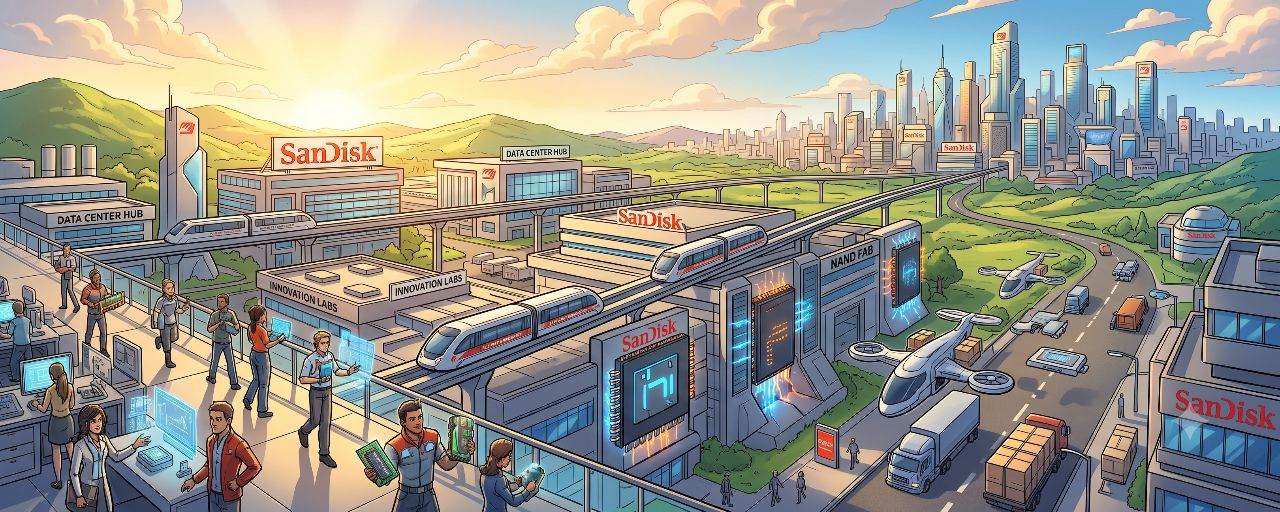
Consequently, the simultaneous sell-off in companies such as Micron, SanDisk, Samsung Electronics, and SK hynix reflected not only the broader correction across AI-related equities, but also the possibility that investors were applying a training-era investment framework to an industry that is gradually transitioning toward inference. Whether these companies ultimately prove to be fundamentally weaker or merely become victims of indiscriminate selling will depend largely on how rapidly inference workloads continue to expand and whether enterprise SSD demand materializes at the scale many industry observers now anticipate.

V. Why Operational Excellence Will Become the Next Competitive Advantage
The greatest significance of Meta's decision to commercialize AI compute does not lie in the addition of another revenue stream. Rather, it lies in the fact that the company has prompted the market to recognize, perhaps for the first time, that AI infrastructure is beginning to transition from an era of capital deployment to one of operational management.
Over the past several years, investors have focused overwhelmingly on metrics such as GPU counts, data center capacity, capital expenditure, and model size because the industry has remained firmly in its infrastructure build-out phase. As that infrastructure matures and an increasing number of large-scale data centers become operational, however, the factors that determine competitive advantage are beginning to change. In the years ahead, technology companies are likely to compete less on their ability to acquire additional GPUs and more on their ability to maximize GPU utilization, reduce unit computing costs, generate sustainable cash flow, and build long-term commercial ecosystems around their infrastructure assets.
This transition also implies that the valuation framework for the AI industry is evolving. During the construction phase, capital markets tended to reward companies willing to invest aggressively because higher capital expenditure was viewed as a direct indicator of future growth. As the industry moves into a more mature stage, investors are likely to place greater emphasis on measures such as return on capital, asset utilization, inference revenue, enterprise customer adoption, and the efficiency with which infrastructure is monetized. Ultimately, operational excellence—not simply the scale of investment—will determine whether these extraordinarily expensive assets can generate durable long-term value.
Meta's latest move is unlikely to reshape the cloud computing landscape overnight, nor is it likely to challenge the positions of AWS or Azure in the foreseeable future. What it does signal, however, is a meaningful shift in the competitive dynamics of the AI industry. Competition is gradually moving away from a race to accumulate the greatest amount of infrastructure toward a race to generate the greatest economic value from that infrastructure.
If the past two years represented the first half of the AI infrastructure cycle—a period defined primarily by construction and expansion—then the years ahead may well represent its second half, one defined by operation, monetization, and capital efficiency. Meta may simply be the first major technology company to take that step.

VI. Conclusion
In the short term, Meta's decision to sell AI compute should be viewed primarily as a catalyst for market repricing. It has reshaped investor expectations surrounding the competitive landscape for Neocloud providers while prompting a broader reassessment of AI infrastructure demand, capital expenditure trajectories, and long-term growth assumptions across the hardware supply chain. Yet viewed through a longer-term lens, the more important question is not whether Meta can become another AWS, but what this decision reveals about the future economics of AI infrastructure. As capital expenditure reaches unprecedented levels, simply owning more GPUs or building larger data centers is no longer sufficient to justify premium valuations. Investors are increasingly demanding evidence that these capital-intensive assets can generate sustainable cash flows and attractive long-term returns. In the years ahead, market attention is likely to shift away from GPU counts, data center scale, and model parameters toward metrics such as infrastructure utilization, inference-driven revenue growth, enterprise adoption, and return on invested capital. From competing on investment to competing on operations, and from competing on construction to competing on returns, Meta's decision to commercialize AI compute may ultimately prove to be more than a strategic business expansion. It may instead mark a defining moment in the evolution of the AI industry—one in which AI infrastructure begins to be valued not simply for its scale, but for its ability to generate enduring economic value.
Artikel
Übersetzung ansehen
Payment Giants Are Launching Stablecoins Together. Can CRCL Still Defend Its Moat?Yesterday, a new stablecoin announcement quickly dominated discussions across the crypto community and U.S. equity investors. More than 140 companies and institutions jointly introduced Open USD (OUSD), while Circle (CRCL) shares immediately fell by approximately 17.5%. At the same time, the latest Russell index rebalancing triggered additional selling pressure from passive funds. This event goes beyond the launch of a single product. It marks the accelerating integration of stablecoins from crypto-native tools into mainstream financial payment infrastructure, while prompting the market to reassess the real competitive impact of traditional financial giants entering the space. Below is a comprehensive breakdown of the event, OUSD, and its implications from multiple perspectives. Complete Timeline of the Event On June 30, the Open Standard Alliance officially published its introduction to OUSD. The alliance consists of more than 140 members, including traditional banks, payment networks, asset managers, technology companies, and crypto projects. OUSD is positioned as a U.S. dollar stablecoin designed for the internet economy. It features zero minting and redemption fees, reserve yield sharing, and a partner-governed model. The stablecoin is scheduled to launch on chains including Solana and Base in the second half of 2026. At nearly the same time, FTSE Russell removed Circle (CRCL) from five major Russell Growth Indexes during its latest annual index reconstitution, including the Russell 1000 Growth, Russell 3000 Growth, and Russell Midcap Growth indexes. These indexes serve as key benchmarks for passive investment globally and are closely tracked by numerous index funds and ETFs. Any constituent adjustment automatically triggers mechanical buying or selling by passive funds, directly affecting stock liquidity. The combination of the OUSD announcement and the index removal led to an approximately 17.5% decline in CRCL's share price in a single trading session, wiping out roughly $3.6 billion in market value. Circle founder Jeremy Allaire responded by emphasizing USDC's existing scale and adoption, while Tether expressed an open attitude toward additional competition. The event sparked extensive discussion across social media and trading platforms, leading investors to reassess the competitive landscape of the stablecoin industry. OUSD: Background, Reserve Structure, and Key Participants Open Standard is an open infrastructure alliance jointly established by enterprises with the goal of building a stablecoin system better suited for commercial and internet use. The alliance brings together participants from traditional finance, payment technology, and crypto, representing a practical step toward integrating mainstream finance with blockchain technology. Its core members include major financial institutions and technology companies such as BlackRock, Visa, Mastercard, BNY, Standard Chartered, Stripe, Google, Samsung Electronics, IBM, and Shopify, alongside crypto and Web3 participants including Coinbase, OKX, Bybit, Bitget Wallet, Ripple, Crypto.com, Fireblocks, Gemini, MetaMask, Aave, Solana, and Base. At present, OUSD's official documentation has not disclosed detailed information regarding its reserve composition. Based on the alliance's overall design philosophy, reserves are expected to primarily consist of highly liquid, low-risk assets such as U.S. dollars and short-term U.S. Treasury securities, likely managed by professional institutions including BlackRock. This approach is similar to USDC's transparent reserve model, while placing additional emphasis on reserve yield sharing. More details regarding reserve composition and audit arrangements are expected after the official launch. Key Features and Advantages of OUSD OUSD's design focuses heavily on practicality. The first feature is zero minting and redemption fees, which significantly reduce transaction costs for institutions and high-volume users. The second is reserve yield sharing. Partners receive a portion of the reserve interest income, strengthening incentives for ecosystem participation and encouraging broader institutional adoption through aligned economic interests. The third is its extensive ecosystem support. Payment infrastructure from Visa and Mastercard, asset management capabilities from BlackRock, merchant integration through Stripe, and liquidity support from crypto platforms including Coinbase, OKX, Bybit, and Bitget Wallet provide OUSD with strong credibility and circulation potential from day one. Its alliance-based governance model also makes it attractive to developers and enterprises seeking an open architecture. These features make OUSD particularly appealing for cross-border payments, corporate settlement, and internet commerce, especially for institutions looking to reduce costs while sharing reserve-generated returns. The Practical Challenges Facing OUSD Any new project ultimately requires execution to prove itself. Decision-making across a large alliance requires coordination among many stakeholders, which may slow execution compared to a single-company structure. Balancing the interests of numerous participants will also require continuous coordination. Meanwhile, USDC and USDT have already established strong network effects. To gain meaningful market share, OUSD must rapidly build real-world use cases and liquidity. As the project remains in its early preparation stage, the effectiveness of its post-launch execution will become one of the market's primary areas of focus. How OUSD Could Impact CRCL Increased Short-Term Competitive Pressure OUSD's zero-fee model and reserve yield sharing directly challenge USDC's reserve interest revenue model. Investors have become increasingly concerned about Circle's future profitability. Combined with passive selling resulting from Russell index removal, these factors contributed to the sharp decline in CRCL's stock price. Market Expansion Driven by Institutional Participation The participation of traditional giants such as Visa, Mastercard, and BlackRock could significantly accelerate stablecoin adoption across mainstream payments and institutional finance, expanding the industry's total addressable market. As a publicly listed and regulated stablecoin issuer, Circle could ultimately benefit from participating in a much larger market. Valuation and Trading Characteristics Short-term sentiment has increased CRCL's volatility while also bringing valuations back toward more rational levels. If Circle continues expanding its payment network, blockchain infrastructure, and enterprise services, its Q2 earnings could become an important catalyst for recovery. Long-Term Moat Under Review The alliance model behind OUSD tests Circle's pace of innovation and ecosystem stickiness. However, USDC's existing circulation of tens of billions of dollars, mature application ecosystem, and regulatory advantages remain significant competitive buffers. Overall, OUSD presents a combination of short-term headwinds for CRCL and long-term positives for the stablecoin industry. The ultimate outcome will largely depend on Circle's execution capabilities and continued demand growth for regulated stablecoins. A Broader Look at the Stablecoin Industry Stablecoins are gradually becoming one of the most important bridges connecting traditional finance with blockchain technology. The emergence of OUSD further accelerates this transition as banks and payment institutions begin actively participating in industry standards and infrastructure development. From a business model perspective, zero fees combined with reserve yield sharing introduce a new incentive structure. This model encourages broader ecosystem participation, lowers service costs, and supports wider adoption. Regulatory and macroeconomic conditions continue to shape the industry. Regulatory frameworks are creating clearer paths for compliant stablecoins, while increased competition is encouraging greater transparency and stronger risk management. U.S. dollar liquidity, interest rates, and global payment demand remain the key underlying macro drivers. The participation of crypto platforms such as Coinbase, OKX, Bybit, and Bitget Wallet demonstrates that institutions increasingly prefer multi-platform strategies. The broad involvement of traditional banks and technology companies further reinforces the trend of stablecoins evolving into mainstream payment infrastructure. Rather than simply redistributing existing market share, the industry's overall market size is likely to expand as more high-quality participants enter the ecosystem. Final Thoughts The launch of OUSD, combined with the latest index rebalancing, highlights the beginning of a new phase in stablecoin competition. While short-term volatility has created adjustment pressure, it also reflects the normal evolution of a maturing industry. Circle and every other participant will ultimately need to respond through execution rather than narratives. Over the coming months, the progress of OUSD's launch, Circle's financial results, and changes in stablecoin circulation and adoption will serve as important indicators for evaluating the competitive strengths of each player. The stablecoin story is far from over. It is evolving from a crypto-native utility into a critical component of global payments and financial infrastructure. Beyond price movements, investors should pay closer attention to real business adoption and ecosystem partnerships. Disclaimer: This article is for informational purposes only and does not constitute investment advice. The cryptocurrency market is highly volatile and involves substantial risk. Please conduct your own research and make independent investment decisions.

Payment Giants Are Launching Stablecoins Together. Can CRCL Still Defend Its Moat?

Yesterday, a new stablecoin announcement quickly dominated discussions across the crypto community and U.S. equity investors. More than 140 companies and institutions jointly introduced Open USD (OUSD), while Circle (CRCL) shares immediately fell by approximately 17.5%. At the same time, the latest Russell index rebalancing triggered additional selling pressure from passive funds. This event goes beyond the launch of a single product. It marks the accelerating integration of stablecoins from crypto-native tools into mainstream financial payment infrastructure, while prompting the market to reassess the real competitive impact of traditional financial giants entering the space. Below is a comprehensive breakdown of the event, OUSD, and its implications from multiple perspectives.
Complete Timeline of the Event
On June 30, the Open Standard Alliance officially published its introduction to OUSD. The alliance consists of more than 140 members, including traditional banks, payment networks, asset managers, technology companies, and crypto projects. OUSD is positioned as a U.S. dollar stablecoin designed for the internet economy. It features zero minting and redemption fees, reserve yield sharing, and a partner-governed model. The stablecoin is scheduled to launch on chains including Solana and Base in the second half of 2026.
At nearly the same time, FTSE Russell removed Circle (CRCL) from five major Russell Growth Indexes during its latest annual index reconstitution, including the Russell 1000 Growth, Russell 3000 Growth, and Russell Midcap Growth indexes. These indexes serve as key benchmarks for passive investment globally and are closely tracked by numerous index funds and ETFs. Any constituent adjustment automatically triggers mechanical buying or selling by passive funds, directly affecting stock liquidity.
The combination of the OUSD announcement and the index removal led to an approximately 17.5% decline in CRCL's share price in a single trading session, wiping out roughly $3.6 billion in market value. Circle founder Jeremy Allaire responded by emphasizing USDC's existing scale and adoption, while Tether expressed an open attitude toward additional competition. The event sparked extensive discussion across social media and trading platforms, leading investors to reassess the competitive landscape of the stablecoin industry.
OUSD: Background, Reserve Structure, and Key Participants
Open Standard is an open infrastructure alliance jointly established by enterprises with the goal of building a stablecoin system better suited for commercial and internet use. The alliance brings together participants from traditional finance, payment technology, and crypto, representing a practical step toward integrating mainstream finance with blockchain technology.
Its core members include major financial institutions and technology companies such as BlackRock, Visa, Mastercard, BNY, Standard Chartered, Stripe, Google, Samsung Electronics, IBM, and Shopify, alongside crypto and Web3 participants including Coinbase, OKX, Bybit, Bitget Wallet, Ripple, Crypto.com, Fireblocks, Gemini, MetaMask, Aave, Solana, and Base.
At present, OUSD's official documentation has not disclosed detailed information regarding its reserve composition. Based on the alliance's overall design philosophy, reserves are expected to primarily consist of highly liquid, low-risk assets such as U.S. dollars and short-term U.S. Treasury securities, likely managed by professional institutions including BlackRock. This approach is similar to USDC's transparent reserve model, while placing additional emphasis on reserve yield sharing. More details regarding reserve composition and audit arrangements are expected after the official launch.
Key Features and Advantages of OUSD
OUSD's design focuses heavily on practicality.
The first feature is zero minting and redemption fees, which significantly reduce transaction costs for institutions and high-volume users.
The second is reserve yield sharing. Partners receive a portion of the reserve interest income, strengthening incentives for ecosystem participation and encouraging broader institutional adoption through aligned economic interests.
The third is its extensive ecosystem support. Payment infrastructure from Visa and Mastercard, asset management capabilities from BlackRock, merchant integration through Stripe, and liquidity support from crypto platforms including Coinbase, OKX, Bybit, and Bitget Wallet provide OUSD with strong credibility and circulation potential from day one. Its alliance-based governance model also makes it attractive to developers and enterprises seeking an open architecture.
These features make OUSD particularly appealing for cross-border payments, corporate settlement, and internet commerce, especially for institutions looking to reduce costs while sharing reserve-generated returns.
The Practical Challenges Facing OUSD
Any new project ultimately requires execution to prove itself.
Decision-making across a large alliance requires coordination among many stakeholders, which may slow execution compared to a single-company structure. Balancing the interests of numerous participants will also require continuous coordination.
Meanwhile, USDC and USDT have already established strong network effects. To gain meaningful market share, OUSD must rapidly build real-world use cases and liquidity. As the project remains in its early preparation stage, the effectiveness of its post-launch execution will become one of the market's primary areas of focus.
How OUSD Could Impact CRCL
Increased Short-Term Competitive Pressure
OUSD's zero-fee model and reserve yield sharing directly challenge USDC's reserve interest revenue model. Investors have become increasingly concerned about Circle's future profitability. Combined with passive selling resulting from Russell index removal, these factors contributed to the sharp decline in CRCL's stock price.
Market Expansion Driven by Institutional Participation
The participation of traditional giants such as Visa, Mastercard, and BlackRock could significantly accelerate stablecoin adoption across mainstream payments and institutional finance, expanding the industry's total addressable market. As a publicly listed and regulated stablecoin issuer, Circle could ultimately benefit from participating in a much larger market.
Valuation and Trading Characteristics
Short-term sentiment has increased CRCL's volatility while also bringing valuations back toward more rational levels. If Circle continues expanding its payment network, blockchain infrastructure, and enterprise services, its Q2 earnings could become an important catalyst for recovery.
Long-Term Moat Under Review
The alliance model behind OUSD tests Circle's pace of innovation and ecosystem stickiness. However, USDC's existing circulation of tens of billions of dollars, mature application ecosystem, and regulatory advantages remain significant competitive buffers.
Overall, OUSD presents a combination of short-term headwinds for CRCL and long-term positives for the stablecoin industry. The ultimate outcome will largely depend on Circle's execution capabilities and continued demand growth for regulated stablecoins.
A Broader Look at the Stablecoin Industry
Stablecoins are gradually becoming one of the most important bridges connecting traditional finance with blockchain technology. The emergence of OUSD further accelerates this transition as banks and payment institutions begin actively participating in industry standards and infrastructure development.
From a business model perspective, zero fees combined with reserve yield sharing introduce a new incentive structure. This model encourages broader ecosystem participation, lowers service costs, and supports wider adoption.
Regulatory and macroeconomic conditions continue to shape the industry. Regulatory frameworks are creating clearer paths for compliant stablecoins, while increased competition is encouraging greater transparency and stronger risk management. U.S. dollar liquidity, interest rates, and global payment demand remain the key underlying macro drivers.
The participation of crypto platforms such as Coinbase, OKX, Bybit, and Bitget Wallet demonstrates that institutions increasingly prefer multi-platform strategies. The broad involvement of traditional banks and technology companies further reinforces the trend of stablecoins evolving into mainstream payment infrastructure. Rather than simply redistributing existing market share, the industry's overall market size is likely to expand as more high-quality participants enter the ecosystem.
Final Thoughts
The launch of OUSD, combined with the latest index rebalancing, highlights the beginning of a new phase in stablecoin competition. While short-term volatility has created adjustment pressure, it also reflects the normal evolution of a maturing industry.
Circle and every other participant will ultimately need to respond through execution rather than narratives.
Over the coming months, the progress of OUSD's launch, Circle's financial results, and changes in stablecoin circulation and adoption will serve as important indicators for evaluating the competitive strengths of each player. The stablecoin story is far from over. It is evolving from a crypto-native utility into a critical component of global payments and financial infrastructure. Beyond price movements, investors should pay closer attention to real business adoption and ecosystem partnerships.
Disclaimer: This article is for informational purposes only and does not constitute investment advice. The cryptocurrency market is highly volatile and involves substantial risk. Please conduct your own research and make independent investment decisions.
Artikel
Übersetzung ansehen
Grayscale’s Latest Research: What Will Power Solana’s Next Growth Engine?I.Why Has Grayscale Turned Its Attention Back to Solana? Over the past few years, two words have almost always defined Solana: performance and memecoins. As one of the leading Layer 1 blockchains from the previous market cycle, Solana rose to prominence thanks to its high throughput, low transaction costs, and near-instant finality. At the same time, ecosystem projects such as BONK, dogwifhat (WIF), and Pump.fun turned Solana into the epicenter of the memecoin boom. Yet this perception has also overshadowed a deeper transformation taking place across the network. Recently, digital asset manager Grayscale published its latest report, "Solana: Crypto's Financial Bazaar," offering a comprehensive reassessment of Solana's investment thesis. Perhaps the report's most important takeaway is not another discussion of transaction speed or technical performance. Instead, Grayscale argues that Solana is evolving from a high-performance blockchain into a platform capable of supporting large-scale economic activity. Rather than describing Solana as simply the "fastest blockchain," Grayscale introduces a new concept: Crypto's Financial Bazaar. A bazaar, in this context, is not merely a financial marketplace. It represents a vibrant digital economy where developers continuously build applications, users trade, borrow, lend, invest and make payments, while capital, information and value circulate freely across the network. This framing signals a fundamental shift in how institutional investors evaluate Solana. During the previous bull market, investors debated whether Solana's throughput could outperform competing blockchains. Today, the focus has shifted toward a different question: Can Solana continuously attract developers, retain users, and build lasting network effects? The report suggests that this is not only a reassessment of Solana itself, but also a broader change in how the market values blockchain networks.   II.Blockchain Competition Has Entered a New Era Looking back at the evolution of Layer 1 blockchains, it is clear that the competitive landscape has fundamentally changed. In 2021, performance was everything. Ethereum emphasized decentralization and security. Solana differentiated itself through speed and scalability. BNB Chain attracted users with lower transaction costs. Later, networks such as Aptos, Sui and Base entered the race, with TPS, gas fees and block production speeds becoming the primary benchmarks for evaluating public blockchains. Today, however, infrastructure has become increasingly commoditized. Many modern blockchains already offer near-instant settlement and extremely low transaction costs. As a result, technical performance alone is no longer enough to establish a sustainable competitive advantage. Grayscale argues that what ultimately determines the long-term value of a blockchain is not its infrastructure, but the economic activity taking place on top of it. Institutional investors are asking a different set of questions: · How many real users are active every day? · How much genuine economic activity occurs on-chain? · How much revenue does the ecosystem generate? · Can the application ecosystem sustain long-term growth? This mirrors the evolution of the Internet. In its early years, Internet companies competed through server capacity, bandwidth and page loading speed. As the industry matured, investors shifted their attention toward user growth, transaction volume, revenue generation and ecosystem strength. Blockchain networks are now undergoing a similar transition. TPS defines a network's theoretical capacity. Economic activity defines its actual value. From this perspective, Solana's strengths have also evolved. According to Grayscale, Solana now supports more than 1,000 decentralized applications, processes over 100 million daily transactions, and serves approximately 4.3 million daily active users, while ecosystem applications continue generating meaningful transaction fees and revenue. These metrics suggest that Solana's competitive advantage is gradually shifting from technical performance toward application-driven growth. For institutional investors, a network capable of continuously attracting developers, users and capital represents a far more compelling long-term investment than one that simply boasts higher throughput. This explains why Grayscale devoted the majority of its report to applications rather than protocol-level innovations.   III. Three Applications That Define Solana's Next Growth Flywheel Instead of highlighting a long list of successful projects, Grayscale focuses on three representative applications: Jupiter, Pump.fun and Helium (along with the broader DePIN sector). Although these projects belong to very different categories—DeFi, consumer applications and decentralized physical infrastructure—they collectively illustrate Solana's evolving growth model. Jupiter: Building the Financial Infrastructure Many users first encountered Jupiter as a DEX aggregator. Grayscale, however, argues that Jupiter has evolved far beyond this role. In traditional financial markets, exchanges, brokers, market makers and clearing houses collectively provide market liquidity. Within blockchain ecosystems, DEX aggregators perform a similar function by connecting fragmented liquidity sources and routing transactions through the most efficient trading paths. As more DeFi protocols continue launching on Solana, Jupiter has become one of the ecosystem's most important liquidity hubs. Moreover, its product suite has expanded beyond token swaps into perpetual futures, launchpad services and cross-chain trading, positioning Jupiter as a comprehensive on-chain financial platform rather than merely a trading interface. Its evolution demonstrates that Solana is increasingly capable of supporting sophisticated financial activity at scale.   Pump.fun: More Than a Memecoin Platform Among the three applications, Pump.fun is perhaps the most controversial. Over the past year, it has become synonymous with Solana's memecoin economy and is frequently criticized as a symbol of speculative excess. Nevertheless, Grayscale intentionally includes Pump.fun among Solana's flagship applications. The reason is straightforward. Pump.fun demonstrates something that relatively few blockchain applications have achieved: the ability to consistently attract mainstream users while generating meaningful revenue. According to Grayscale, Pump.fun has approximately 2 million monthly active users and generates around $1.2 million in daily revenue, making it one of the highest-grossing applications across the crypto industry. For institutional investors, these business fundamentals matter far more than its association with memecoins. From an Internet perspective, successful consumer platforms are defined by sustained user engagement, network effects and recurring revenue. Pump.fun therefore serves as proof that Solana is capable not only of supporting financial infrastructure but also consumer-scale Internet applications. More importantly, it stress-tested the network under periods of extraordinary activity, demonstrating Solana's ability to process massive volumes of transactions while maintaining usability.   Helium and DePIN: Extending Blockchain Into the Physical World The third pillar highlighted by Grayscale is Decentralized Physical Infrastructure Networks (DePIN). Unlike DeFi or memecoins, DePIN focuses on coordinating real-world infrastructure through blockchain technology. Helium represents one of the most prominent examples, enabling communities to build decentralized wireless communication networks through distributed hotspot deployment. Meanwhile, projects such as Geodnet provide high-precision positioning services that support autonomous vehicles, drones, robotics and other emerging industries. Although these projects receive far less attention than speculative crypto assets, they represent an important long-term opportunity. They illustrate how Solana's ecosystem is expanding beyond purely digital assets into real-world infrastructure. From Grayscale's perspective, these applications broaden Solana's addressable market by connecting blockchain technology with telecommunications, artificial intelligence, the Internet of Things and other real-world industries. Taken together, Jupiter, Pump.fun and Helium outline a clear growth framework: Financial infrastructure attracts liquidity. Consumer applications attract users. Physical infrastructure creates long-term economic demand. As these three pillars reinforce one another, Solana's value proposition gradually shifts away from pure technical performance toward a sustainable, application-driven digital economy.   IV. From Memecoins to AI — Solana's Strategic Shift If Grayscale's report explains what Solana is today, recent developments from the Solana Foundation reveal where the network is heading next. Over the past several months, the Foundation's messaging has changed significantly. Instead of emphasizing throughput, NFTs or memecoins, official communications increasingly focus on AI agents, stablecoins, payments, real-world assets (RWAs), tokenization and DePIN. This is far more than a marketing adjustment. It reflects Solana's ambition to position itself as infrastructure for the next generation of digital finance. At several recent industry conferences, Solana Foundation President Lily Liu argued that blockchain's next major opportunity lies not only in serving human users, but also autonomous AI agents. As AI systems begin purchasing data, renting computing resources and making machine-to-machine payments autonomously, blockchain networks capable of supporting high-frequency, low-cost transactions could become critical financial infrastructure. Solana aims to become precisely that settlement layer.   V. Why Institutions Are Paying Attention Again Grayscale is not alone. Over the past year, asset managers, investment banks and research firms have increasingly revisited Solana's long-term investment potential. Three factors explain this renewed interest. First, Solana's application ecosystem has matured. Projects like Jupiter, Pump.fun and Helium demonstrate that the network now supports multiple sustainable business models beyond speculative trading. Second, stablecoins and payments have become strategic priorities. As tokenized assets and digital payments continue expanding globally, Solana's efficiency and low transaction costs provide a compelling foundation for financial infrastructure. Third, developer activity remains robust. A healthy ecosystem depends on continuous innovation, and Solana continues attracting builders across DeFi, wallets, AI, payments and decentralized infrastructure. Nevertheless, challenges remain. Questions surrounding value capture, ecosystem sustainability, decentralization and long-term institutional adoption will continue shaping Solana's future trajectory.   VI.  Grayscale Is Revaluing More Than Solana Perhaps the most important insight from Grayscale's report is that it is not merely revaluing Solana—it is redefining how public blockchains should be evaluated. During the previous market cycle, investors compared TPS, gas fees and consensus mechanisms. Today, the more relevant questions are: · Which network attracts the most users? · Which ecosystem generates sustainable economic activity? · Which blockchain supports real-world financial applications? · Which platform can power AI, payments and tokenized assets? The competitive landscape has fundamentally changed. Blockchains are no longer competing solely as infrastructure. They are competing as digital economies. TPS still matters, but it increasingly resembles the maximum speed limit of a highway. The true measure of a city's prosperity is not how wide its roads are, but how many people live, work, build businesses and create value there every day. If Solana's previous narrative centered on performance, its next chapter will be defined by economic activity. That, ultimately, is the central message of Grayscale's latest research.

Grayscale’s Latest Research: What Will Power Solana’s Next Growth Engine?

I.Why Has Grayscale Turned Its Attention Back to Solana?
Over the past few years, two words have almost always defined Solana: performance and memecoins.
As one of the leading Layer 1 blockchains from the previous market cycle, Solana rose to prominence thanks to its high throughput, low transaction costs, and near-instant finality. At the same time, ecosystem projects such as BONK, dogwifhat (WIF), and Pump.fun turned Solana into the epicenter of the memecoin boom. Yet this perception has also overshadowed a deeper transformation taking place across the network.
Recently, digital asset manager Grayscale published its latest report, "Solana: Crypto's Financial Bazaar," offering a comprehensive reassessment of Solana's investment thesis.
Perhaps the report's most important takeaway is not another discussion of transaction speed or technical performance. Instead, Grayscale argues that Solana is evolving from a high-performance blockchain into a platform capable of supporting large-scale economic activity.
Rather than describing Solana as simply the "fastest blockchain," Grayscale introduces a new concept: Crypto's Financial Bazaar.
A bazaar, in this context, is not merely a financial marketplace. It represents a vibrant digital economy where developers continuously build applications, users trade, borrow, lend, invest and make payments, while capital, information and value circulate freely across the network.
This framing signals a fundamental shift in how institutional investors evaluate Solana.
During the previous bull market, investors debated whether Solana's throughput could outperform competing blockchains. Today, the focus has shifted toward a different question: Can Solana continuously attract developers, retain users, and build lasting network effects?
The report suggests that this is not only a reassessment of Solana itself, but also a broader change in how the market values blockchain networks.

II.Blockchain Competition Has Entered a New Era
Looking back at the evolution of Layer 1 blockchains, it is clear that the competitive landscape has fundamentally changed.
In 2021, performance was everything.
Ethereum emphasized decentralization and security. Solana differentiated itself through speed and scalability. BNB Chain attracted users with lower transaction costs. Later, networks such as Aptos, Sui and Base entered the race, with TPS, gas fees and block production speeds becoming the primary benchmarks for evaluating public blockchains.
Today, however, infrastructure has become increasingly commoditized.
Many modern blockchains already offer near-instant settlement and extremely low transaction costs. As a result, technical performance alone is no longer enough to establish a sustainable competitive advantage.
Grayscale argues that what ultimately determines the long-term value of a blockchain is not its infrastructure, but the economic activity taking place on top of it.
Institutional investors are asking a different set of questions:
· How many real users are active every day?
· How much genuine economic activity occurs on-chain?
· How much revenue does the ecosystem generate?
· Can the application ecosystem sustain long-term growth?
This mirrors the evolution of the Internet.
In its early years, Internet companies competed through server capacity, bandwidth and page loading speed. As the industry matured, investors shifted their attention toward user growth, transaction volume, revenue generation and ecosystem strength.
Blockchain networks are now undergoing a similar transition.
TPS defines a network's theoretical capacity. Economic activity defines its actual value.
From this perspective, Solana's strengths have also evolved.
According to Grayscale, Solana now supports more than 1,000 decentralized applications, processes over 100 million daily transactions, and serves approximately 4.3 million daily active users, while ecosystem applications continue generating meaningful transaction fees and revenue.
These metrics suggest that Solana's competitive advantage is gradually shifting from technical performance toward application-driven growth.
For institutional investors, a network capable of continuously attracting developers, users and capital represents a far more compelling long-term investment than one that simply boasts higher throughput.
This explains why Grayscale devoted the majority of its report to applications rather than protocol-level innovations.

III. Three Applications That Define Solana's Next Growth Flywheel
Instead of highlighting a long list of successful projects, Grayscale focuses on three representative applications: Jupiter, Pump.fun and Helium (along with the broader DePIN sector).
Although these projects belong to very different categories—DeFi, consumer applications and decentralized physical infrastructure—they collectively illustrate Solana's evolving growth model.
Jupiter: Building the Financial Infrastructure
Many users first encountered Jupiter as a DEX aggregator.
Grayscale, however, argues that Jupiter has evolved far beyond this role.
In traditional financial markets, exchanges, brokers, market makers and clearing houses collectively provide market liquidity. Within blockchain ecosystems, DEX aggregators perform a similar function by connecting fragmented liquidity sources and routing transactions through the most efficient trading paths.
As more DeFi protocols continue launching on Solana, Jupiter has become one of the ecosystem's most important liquidity hubs.
Moreover, its product suite has expanded beyond token swaps into perpetual futures, launchpad services and cross-chain trading, positioning Jupiter as a comprehensive on-chain financial platform rather than merely a trading interface.
Its evolution demonstrates that Solana is increasingly capable of supporting sophisticated financial activity at scale.

Pump.fun: More Than a Memecoin Platform
Among the three applications, Pump.fun is perhaps the most controversial.
Over the past year, it has become synonymous with Solana's memecoin economy and is frequently criticized as a symbol of speculative excess.
Nevertheless, Grayscale intentionally includes Pump.fun among Solana's flagship applications.
The reason is straightforward.
Pump.fun demonstrates something that relatively few blockchain applications have achieved: the ability to consistently attract mainstream users while generating meaningful revenue.
According to Grayscale, Pump.fun has approximately 2 million monthly active users and generates around $1.2 million in daily revenue, making it one of the highest-grossing applications across the crypto industry.
For institutional investors, these business fundamentals matter far more than its association with memecoins.
From an Internet perspective, successful consumer platforms are defined by sustained user engagement, network effects and recurring revenue.
Pump.fun therefore serves as proof that Solana is capable not only of supporting financial infrastructure but also consumer-scale Internet applications.
More importantly, it stress-tested the network under periods of extraordinary activity, demonstrating Solana's ability to process massive volumes of transactions while maintaining usability.

Helium and DePIN: Extending Blockchain Into the Physical World
The third pillar highlighted by Grayscale is Decentralized Physical Infrastructure Networks (DePIN).
Unlike DeFi or memecoins, DePIN focuses on coordinating real-world infrastructure through blockchain technology.
Helium represents one of the most prominent examples, enabling communities to build decentralized wireless communication networks through distributed hotspot deployment.
Meanwhile, projects such as Geodnet provide high-precision positioning services that support autonomous vehicles, drones, robotics and other emerging industries.
Although these projects receive far less attention than speculative crypto assets, they represent an important long-term opportunity.
They illustrate how Solana's ecosystem is expanding beyond purely digital assets into real-world infrastructure.
From Grayscale's perspective, these applications broaden Solana's addressable market by connecting blockchain technology with telecommunications, artificial intelligence, the Internet of Things and other real-world industries.
Taken together, Jupiter, Pump.fun and Helium outline a clear growth framework:
Financial infrastructure attracts liquidity.
Consumer applications attract users.
Physical infrastructure creates long-term economic demand.
As these three pillars reinforce one another, Solana's value proposition gradually shifts away from pure technical performance toward a sustainable, application-driven digital economy.

IV. From Memecoins to AI — Solana's Strategic Shift
If Grayscale's report explains what Solana is today, recent developments from the Solana Foundation reveal where the network is heading next.
Over the past several months, the Foundation's messaging has changed significantly.
Instead of emphasizing throughput, NFTs or memecoins, official communications increasingly focus on AI agents, stablecoins, payments, real-world assets (RWAs), tokenization and DePIN.
This is far more than a marketing adjustment.
It reflects Solana's ambition to position itself as infrastructure for the next generation of digital finance.
At several recent industry conferences, Solana Foundation President Lily Liu argued that blockchain's next major opportunity lies not only in serving human users, but also autonomous AI agents.
As AI systems begin purchasing data, renting computing resources and making machine-to-machine payments autonomously, blockchain networks capable of supporting high-frequency, low-cost transactions could become critical financial infrastructure.
Solana aims to become precisely that settlement layer.

V. Why Institutions Are Paying Attention Again
Grayscale is not alone.
Over the past year, asset managers, investment banks and research firms have increasingly revisited Solana's long-term investment potential.
Three factors explain this renewed interest.
First, Solana's application ecosystem has matured.
Projects like Jupiter, Pump.fun and Helium demonstrate that the network now supports multiple sustainable business models beyond speculative trading.
Second, stablecoins and payments have become strategic priorities.
As tokenized assets and digital payments continue expanding globally, Solana's efficiency and low transaction costs provide a compelling foundation for financial infrastructure.
Third, developer activity remains robust.
A healthy ecosystem depends on continuous innovation, and Solana continues attracting builders across DeFi, wallets, AI, payments and decentralized infrastructure.
Nevertheless, challenges remain.
Questions surrounding value capture, ecosystem sustainability, decentralization and long-term institutional adoption will continue shaping Solana's future trajectory.

VI. Grayscale Is Revaluing More Than Solana
Perhaps the most important insight from Grayscale's report is that it is not merely revaluing Solana—it is redefining how public blockchains should be evaluated.
During the previous market cycle, investors compared TPS, gas fees and consensus mechanisms.
Today, the more relevant questions are:
· Which network attracts the most users?
· Which ecosystem generates sustainable economic activity?
· Which blockchain supports real-world financial applications?
· Which platform can power AI, payments and tokenized assets?
The competitive landscape has fundamentally changed.
Blockchains are no longer competing solely as infrastructure.
They are competing as digital economies.
TPS still matters, but it increasingly resembles the maximum speed limit of a highway.
The true measure of a city's prosperity is not how wide its roads are, but how many people live, work, build businesses and create value there every day.
If Solana's previous narrative centered on performance, its next chapter will be defined by economic activity.
That, ultimately, is the central message of Grayscale's latest research.
Artikel
Vom Address Clustering zu Beweisstandards: Warum Chainalysis die Blockchain-Tracking-Methodik neu definiert?Ende Juni 2026 stellte Chainalysis ein neues Framework namens Blockchain Tracing Ontology vor. Damit soll ein standardisierterer und transparenterer Weg geschaffen werden, um Blockchain-Intelligenz zu beschreiben. Anstatt ein weiteres Analyseprodukt oder ein Ermittlungs-Tool auf den Markt zu bringen, versucht das Unternehmen etwas weitaus Grundlegenderes: Es möchte neu definieren, wie Blockchain-Tracking-Daten strukturiert, interpretiert und kommuniziert werden. Obwohl das Framework sich noch in der Entwurfsphase befindet, hat es bereits eine wichtige Diskussion in der gesamten Branche der digitalen Vermögenswerte ausgelöst. Im Kern steht eine einfache, aber weitreichende Frage: Benötigt Blockchain-Intelligenz eine gemeinsame Sprache?

Vom Address Clustering zu Beweisstandards: Warum Chainalysis die Blockchain-Tracking-Methodik neu definiert?

Ende Juni 2026 stellte Chainalysis ein neues Framework namens Blockchain Tracing Ontology vor. Damit soll ein standardisierterer und transparenterer Weg geschaffen werden, um Blockchain-Intelligenz zu beschreiben. Anstatt ein weiteres Analyseprodukt oder ein Ermittlungs-Tool auf den Markt zu bringen, versucht das Unternehmen etwas weitaus Grundlegenderes: Es möchte neu definieren, wie Blockchain-Tracking-Daten strukturiert, interpretiert und kommuniziert werden.
Obwohl das Framework sich noch in der Entwurfsphase befindet, hat es bereits eine wichtige Diskussion in der gesamten Branche der digitalen Vermögenswerte ausgelöst. Im Kern steht eine einfache, aber weitreichende Frage: Benötigt Blockchain-Intelligenz eine gemeinsame Sprache?
Artikel
Übersetzung ansehen
GPT-5.6 Has Arrived: How Sol, Terra, and Luna Mark a New Era for AI ProductsOn June 26, 2026, OpenAI officially introduced the GPT-5.6 family, unveiling three distinct models: Sol, Terra, and Luna. Unlike previous releases centered around a single flagship model, GPT-5.6 represents a significant shift in OpenAI's product strategy. Instead of delivering one "best" model, the company now offers a complete model portfolio designed to address three different priorities: maximum intelligence, balanced performance, and high-throughput cost efficiency. According to OpenAI, the GPT-5.6 series significantly improves capabilities in software engineering, computer operation, professional knowledge work, scientific research, and cybersecurity. At launch, the models are available only through a limited preview via the API and Codex to a small group of trusted partners, with broader ChatGPT availability expected at a later stage.   From a Single Model to an Entire Family Over the past several years, OpenAI's model evolution has largely revolved around a single flagship architecture. Even when lightweight or turbo variants were introduced, they remained extensions of one central model. GPT-5.6 changes that philosophy completely. Instead of optimizing a single model for every scenario, OpenAI designed three specialized models from the ground up. Sol serves as the flagship model, targeting complex reasoning, advanced programming, scientific research, cybersecurity, and long-horizon AI agents. It represents the highest level of reasoning capability and is intended for situations where accuracy is critical and mistakes carry significant costs. Terra occupies the middle tier, balancing intelligence, stability, and operating costs. It is positioned as the ideal enterprise workhorse, handling knowledge management, document processing, coding assistance, office productivity, and internal AI assistants. Luna, on the other hand, prioritizes speed and affordability. It is optimized for high-concurrency applications such as customer service, large-scale summarization, real-time conversations, content moderation, and lightweight automation. This architecture suggests that OpenAI is evolving from a model developer into an AI infrastructure provider. Rather than simply claiming to have the most powerful model, the company is beginning to answer the questions enterprises actually care about: Which model should be used for which workload? How can performance and cost be optimized simultaneously?   Why Sol, Terra, and Luna? The naming strategy itself deserves attention. Unlike technical labels such as GPT-4o or o4-mini, Sol, Terra, and Luna are immediately recognizable and intuitive. · Sol (the Sun) symbolizes peak intelligence and computational power. · Terra (the Earth) represents stability, reliability, and broad applicability. · Luna (the Moon) reflects agility, efficiency, and low-cost deployment. The shift in naming reflects a broader transformation in AI itself. Large language models are no longer products designed exclusively for AI researchers and engineers. They have become commercial products purchased by enterprises, deployed by developers, and increasingly understood by mainstream users. Previously, the question was: "Which model is the smartest?" Going forward, the more practical question becomes: "Which model is the right one for this specific task?" This resembles the evolution of cloud computing. Organizations no longer purchase the most powerful server for every workload; instead, they choose GPU instances, CPU instances, memory-optimized machines, or edge nodes depending on the application's needs. AI models are entering a similar era of intelligent workload allocation.   AI Products Are Entering the Era of Model Segmentation OpenAI's three-model strategy is not an isolated move. It reflects a broader industry trend. Anthropic now offers Claude Opus, Sonnet, and Haiku. Google has Gemini Ultra, Pro, and Flash. With Sol, Terra, and Luna, OpenAI has completed its own layered product lineup. This signals that the AI industry has moved beyond competing solely on benchmark scores and raw model capabilities. Instead, competition is increasingly centered on engineering maturity and real-world deployment. Early model comparisons focused on context length, reasoning ability, coding benchmarks, and multimodal performance. Today, enterprise customers evaluate entirely different criteria: · Inference cost · Latency · Reliability · Throughput · Security controls · Compliance · Tool integration · Caching mechanisms · Operational scalability The strongest AI company of the next generation may not simply be the one with the highest benchmark score, but the one capable of delivering a comprehensive platform that combines flagship intelligence with cost efficiency and production-grade reliability. GPT-5.6 embodies precisely this transition.   AI Agents Become the Centerpiece Perhaps the most important aspect of GPT-5.6 is its continued investment in AI agents. Traditional language models function primarily as conversational systems: users ask questions, and the model produces answers. AI agents fundamentally change that relationship. Instead of merely responding, agents can plan tasks, invoke external tools, operate software, verify results, recover from failures, and execute multi-step workflows autonomously. According to OpenAI, GPT-5.6 introduces significant improvements in software engineering, computer operation, and professional knowledge work—all foundational capabilities for practical AI agents. This changes the role of AI entirely. Instead of asking AI to write an email, users may ask it to gather context, analyze documents, draft responses, verify tone, and send the message after approval. Developers may ask AI to inspect an entire repository, identify bugs, implement fixes, execute tests, explain modifications, and submit pull requests. Security analysts may rely on AI to review vulnerabilities, propose mitigations, validate patches, and generate detailed security reports. These workflows require substantially stronger planning abilities, better long-context understanding, more reliable tool usage, and significantly lower cumulative error rates than traditional chatbot interactions. GPT-5.6 therefore represents a transition from models that simply answer questions toward systems capable of sustained autonomous work.   Reasoning Continues to Advance Over the past several years, progress in AI has shifted from fluent text generation toward increasingly sophisticated reasoning. GPT-5.6 is explicitly positioned for software engineering, scientific research, professional knowledge work, and cybersecurity—all domains characterized by multi-step reasoning rather than simple question answering. For software development, this means understanding large codebases, identifying dependencies, locating bugs, proposing modifications, and minimizing unintended side effects. Scientific research requires reading technical literature, comparing evidence, evaluating competing hypotheses, designing experiments, and assisting with data analysis. Cybersecurity presents an even greater challenge. Models must become increasingly capable of assisting defenders without enabling offensive misuse. According to OpenAI's safety evaluations, GPT-5.6 demonstrates strong cybersecurity performance, making safety controls and deployment restrictions a central part of its release strategy. This illustrates a broader reality: As frontier models become more capable, their deployment inevitably becomes more complex. Earlier generations primarily raised concerns around hallucinations, misinformation, and content moderation. Future generations increasingly interact with real-world software systems, infrastructure, and automated workflows, transforming AI deployment into a matter of security governance rather than product engineering alone.   Cost Becomes a Strategic Competitive Advantage Another defining feature of GPT-5.6 is its pricing strategy. OpenAI now offers three pricing tiers, allowing organizations to match model capability with business requirements instead of defaulting to the most powerful—and most expensive—option. For large-scale enterprise deployments, inference costs rapidly become one of the largest operational expenses. An AI application that performs well during a prototype stage may generate millions of API calls per day after deployment. Running every request through the flagship model is simply not economically sustainable. The three-model architecture enables intelligent workload distribution. Mission-critical reasoning tasks can be routed to Sol. General enterprise productivity can rely on Terra. High-frequency, latency-sensitive workloads can leverage Luna. Combined with OpenAI's improved prompt caching mechanism, organizations can further reduce repeated inference costs by caching system prompts, knowledge bases, and long contextual inputs. This represents a significant step toward making enterprise AI economically scalable.   Why Isn't GPT-5.6 Available to Everyone Yet? Unlike previous releases, GPT-5.6 launched as a limited preview rather than a general public rollout. According to OpenAI, access is currently restricted to selected API and Codex partners, with broader availability expected after additional evaluation. Multiple media reports indicate that the restricted release is closely related to increasing government oversight of frontier AI systems, particularly concerning cybersecurity capabilities and potential misuse. This reflects an important shift within the AI industry. The release of frontier models is no longer purely a product decision. It increasingly intersects with national security, public policy, and AI governance. OpenAI itself appears to acknowledge this tension. While the company recognizes the need for careful deployment of highly capable models, it has also expressed concern that extensive governmental approval processes should not become the long-term norm, as excessive restrictions could slow innovation and limit access for developers and defensive security researchers. The industry now faces a fundamental dilemma: Move too quickly, and advanced capabilities may introduce new risks. Move too cautiously, and innovation may suffer. GPT-5.6 may become an important case study for how future frontier AI systems are introduced to the public.   From Model Competition to Platform Competition Ultimately, GPT-5.6 is about much more than stronger intelligence. It signals a broader transformation in OpenAI's long-term strategy. The next stage of AI competition will not be determined solely by benchmark performance or parameter counts. Instead, success will increasingly depend on: · Building comprehensive model portfolios · Delivering production-ready AI agents · Offering secure and cost-effective enterprise solutions · Supporting vibrant developer ecosystems · Providing reliable infrastructure at global scale With Sol, Terra, and Luna, OpenAI is no longer simply launching another frontier model. It is building a layered AI platform capable of serving researchers, developers, enterprises, and consumers simultaneously. If GPT-4 represented the era of emergent intelligence, and GPT-4o brought multimodal interaction into the mainstream, GPT-5.6 may ultimately be remembered as the beginning of platform-oriented AI infrastructure. In the years ahead, users may no longer interact with a single AI model. Instead, they will engage with an intelligent orchestration layer capable of dynamically selecting the optimal model, allocating computing resources, managing long-term memory, invoking external tools, and coordinating autonomous agents behind the scenes. That is the true significance of GPT-5.6. It is not merely another model upgrade—it is a decisive step toward AI becoming the foundational infrastructure of the digital economy.  

GPT-5.6 Has Arrived: How Sol, Terra, and Luna Mark a New Era for AI Products

On June 26, 2026, OpenAI officially introduced the GPT-5.6 family, unveiling three distinct models: Sol, Terra, and Luna. Unlike previous releases centered around a single flagship model, GPT-5.6 represents a significant shift in OpenAI's product strategy. Instead of delivering one "best" model, the company now offers a complete model portfolio designed to address three different priorities: maximum intelligence, balanced performance, and high-throughput cost efficiency.
According to OpenAI, the GPT-5.6 series significantly improves capabilities in software engineering, computer operation, professional knowledge work, scientific research, and cybersecurity. At launch, the models are available only through a limited preview via the API and Codex to a small group of trusted partners, with broader ChatGPT availability expected at a later stage.

From a Single Model to an Entire Family
Over the past several years, OpenAI's model evolution has largely revolved around a single flagship architecture. Even when lightweight or turbo variants were introduced, they remained extensions of one central model.
GPT-5.6 changes that philosophy completely.
Instead of optimizing a single model for every scenario, OpenAI designed three specialized models from the ground up.
Sol serves as the flagship model, targeting complex reasoning, advanced programming, scientific research, cybersecurity, and long-horizon AI agents. It represents the highest level of reasoning capability and is intended for situations where accuracy is critical and mistakes carry significant costs.
Terra occupies the middle tier, balancing intelligence, stability, and operating costs. It is positioned as the ideal enterprise workhorse, handling knowledge management, document processing, coding assistance, office productivity, and internal AI assistants.
Luna, on the other hand, prioritizes speed and affordability. It is optimized for high-concurrency applications such as customer service, large-scale summarization, real-time conversations, content moderation, and lightweight automation.
This architecture suggests that OpenAI is evolving from a model developer into an AI infrastructure provider. Rather than simply claiming to have the most powerful model, the company is beginning to answer the questions enterprises actually care about: Which model should be used for which workload? How can performance and cost be optimized simultaneously?

Why Sol, Terra, and Luna?
The naming strategy itself deserves attention.
Unlike technical labels such as GPT-4o or o4-mini, Sol, Terra, and Luna are immediately recognizable and intuitive.
· Sol (the Sun) symbolizes peak intelligence and computational power.
· Terra (the Earth) represents stability, reliability, and broad applicability.
· Luna (the Moon) reflects agility, efficiency, and low-cost deployment.
The shift in naming reflects a broader transformation in AI itself.
Large language models are no longer products designed exclusively for AI researchers and engineers. They have become commercial products purchased by enterprises, deployed by developers, and increasingly understood by mainstream users.
Previously, the question was:
"Which model is the smartest?"
Going forward, the more practical question becomes:
"Which model is the right one for this specific task?"
This resembles the evolution of cloud computing. Organizations no longer purchase the most powerful server for every workload; instead, they choose GPU instances, CPU instances, memory-optimized machines, or edge nodes depending on the application's needs.
AI models are entering a similar era of intelligent workload allocation.

AI Products Are Entering the Era of Model Segmentation
OpenAI's three-model strategy is not an isolated move. It reflects a broader industry trend.
Anthropic now offers Claude Opus, Sonnet, and Haiku.
Google has Gemini Ultra, Pro, and Flash.
With Sol, Terra, and Luna, OpenAI has completed its own layered product lineup.
This signals that the AI industry has moved beyond competing solely on benchmark scores and raw model capabilities. Instead, competition is increasingly centered on engineering maturity and real-world deployment.
Early model comparisons focused on context length, reasoning ability, coding benchmarks, and multimodal performance.
Today, enterprise customers evaluate entirely different criteria:
· Inference cost
· Latency
· Reliability
· Throughput
· Security controls
· Compliance
· Tool integration
· Caching mechanisms
· Operational scalability
The strongest AI company of the next generation may not simply be the one with the highest benchmark score, but the one capable of delivering a comprehensive platform that combines flagship intelligence with cost efficiency and production-grade reliability.
GPT-5.6 embodies precisely this transition.

AI Agents Become the Centerpiece
Perhaps the most important aspect of GPT-5.6 is its continued investment in AI agents.
Traditional language models function primarily as conversational systems: users ask questions, and the model produces answers.
AI agents fundamentally change that relationship.
Instead of merely responding, agents can plan tasks, invoke external tools, operate software, verify results, recover from failures, and execute multi-step workflows autonomously.
According to OpenAI, GPT-5.6 introduces significant improvements in software engineering, computer operation, and professional knowledge work—all foundational capabilities for practical AI agents.
This changes the role of AI entirely.
Instead of asking AI to write an email, users may ask it to gather context, analyze documents, draft responses, verify tone, and send the message after approval.
Developers may ask AI to inspect an entire repository, identify bugs, implement fixes, execute tests, explain modifications, and submit pull requests.
Security analysts may rely on AI to review vulnerabilities, propose mitigations, validate patches, and generate detailed security reports.
These workflows require substantially stronger planning abilities, better long-context understanding, more reliable tool usage, and significantly lower cumulative error rates than traditional chatbot interactions.
GPT-5.6 therefore represents a transition from models that simply answer questions toward systems capable of sustained autonomous work.

Reasoning Continues to Advance
Over the past several years, progress in AI has shifted from fluent text generation toward increasingly sophisticated reasoning.
GPT-5.6 is explicitly positioned for software engineering, scientific research, professional knowledge work, and cybersecurity—all domains characterized by multi-step reasoning rather than simple question answering.
For software development, this means understanding large codebases, identifying dependencies, locating bugs, proposing modifications, and minimizing unintended side effects.
Scientific research requires reading technical literature, comparing evidence, evaluating competing hypotheses, designing experiments, and assisting with data analysis.
Cybersecurity presents an even greater challenge. Models must become increasingly capable of assisting defenders without enabling offensive misuse.
According to OpenAI's safety evaluations, GPT-5.6 demonstrates strong cybersecurity performance, making safety controls and deployment restrictions a central part of its release strategy.
This illustrates a broader reality:
As frontier models become more capable, their deployment inevitably becomes more complex.
Earlier generations primarily raised concerns around hallucinations, misinformation, and content moderation.
Future generations increasingly interact with real-world software systems, infrastructure, and automated workflows, transforming AI deployment into a matter of security governance rather than product engineering alone.

Cost Becomes a Strategic Competitive Advantage
Another defining feature of GPT-5.6 is its pricing strategy.
OpenAI now offers three pricing tiers, allowing organizations to match model capability with business requirements instead of defaulting to the most powerful—and most expensive—option.
For large-scale enterprise deployments, inference costs rapidly become one of the largest operational expenses.
An AI application that performs well during a prototype stage may generate millions of API calls per day after deployment.
Running every request through the flagship model is simply not economically sustainable.
The three-model architecture enables intelligent workload distribution.
Mission-critical reasoning tasks can be routed to Sol.
General enterprise productivity can rely on Terra.
High-frequency, latency-sensitive workloads can leverage Luna.
Combined with OpenAI's improved prompt caching mechanism, organizations can further reduce repeated inference costs by caching system prompts, knowledge bases, and long contextual inputs.
This represents a significant step toward making enterprise AI economically scalable.

Why Isn't GPT-5.6 Available to Everyone Yet?
Unlike previous releases, GPT-5.6 launched as a limited preview rather than a general public rollout.
According to OpenAI, access is currently restricted to selected API and Codex partners, with broader availability expected after additional evaluation.
Multiple media reports indicate that the restricted release is closely related to increasing government oversight of frontier AI systems, particularly concerning cybersecurity capabilities and potential misuse.
This reflects an important shift within the AI industry.
The release of frontier models is no longer purely a product decision.
It increasingly intersects with national security, public policy, and AI governance.
OpenAI itself appears to acknowledge this tension.
While the company recognizes the need for careful deployment of highly capable models, it has also expressed concern that extensive governmental approval processes should not become the long-term norm, as excessive restrictions could slow innovation and limit access for developers and defensive security researchers.
The industry now faces a fundamental dilemma:
Move too quickly, and advanced capabilities may introduce new risks.
Move too cautiously, and innovation may suffer.
GPT-5.6 may become an important case study for how future frontier AI systems are introduced to the public.

From Model Competition to Platform Competition
Ultimately, GPT-5.6 is about much more than stronger intelligence.
It signals a broader transformation in OpenAI's long-term strategy.
The next stage of AI competition will not be determined solely by benchmark performance or parameter counts.
Instead, success will increasingly depend on:
· Building comprehensive model portfolios
· Delivering production-ready AI agents
· Offering secure and cost-effective enterprise solutions
· Supporting vibrant developer ecosystems
· Providing reliable infrastructure at global scale
With Sol, Terra, and Luna, OpenAI is no longer simply launching another frontier model.
It is building a layered AI platform capable of serving researchers, developers, enterprises, and consumers simultaneously.
If GPT-4 represented the era of emergent intelligence, and GPT-4o brought multimodal interaction into the mainstream, GPT-5.6 may ultimately be remembered as the beginning of platform-oriented AI infrastructure.
In the years ahead, users may no longer interact with a single AI model. Instead, they will engage with an intelligent orchestration layer capable of dynamically selecting the optimal model, allocating computing resources, managing long-term memory, invoking external tools, and coordinating autonomous agents behind the scenes.
That is the true significance of GPT-5.6.
It is not merely another model upgrade—it is a decisive step toward AI becoming the foundational infrastructure of the digital economy.
Artikel
Marvell tritt dem S&P 500 bei: Ein Meilenstein im KI-Zeitalter oder der Beginn eines neuen Tests?Am 22. Juni 2026 hat trade.xyz den ZHIPU-USDC-Perpetual-Contract offiziell im Hyperliquid-HIP-3-Markt gestartet. Der Contract bietet einen Hebel von bis zu 10x und ermöglicht 24/7-Handel. Dies ist das zweite, an der Börse in Hongkong gelistete Asset, das von trade.xyz aufgeführt wird. Das erste war MINIMAX (Xi Yu Technology / MiniMax Group, HK:0100), das am 18. Juni 2026 live ging. Kurzer Überblick Dieser Artikel beginnt mit dem Unternehmensprofil von ZHIPU und dem technologischen Durchbruch von GLM-5.2. Anschließend werden die Mechanik des trade.xyz-Contracts und die frühen Performance-Entwicklungen erläutert, mit MINIMAX verglichen, mehrere treibende Faktoren analysiert, das Hyperliquid HIP-3-Ökosystem erkundet und schließlich einen Blick auf das langfristige Potenzial der On-Chain-Kursbildung für vielfältige Assets geworfen.

Marvell tritt dem S&P 500 bei: Ein Meilenstein im KI-Zeitalter oder der Beginn eines neuen Tests?

Am 22. Juni 2026 hat trade.xyz den ZHIPU-USDC-Perpetual-Contract offiziell im Hyperliquid-HIP-3-Markt gestartet. Der Contract bietet einen Hebel von bis zu 10x und ermöglicht 24/7-Handel.
Dies ist das zweite, an der Börse in Hongkong gelistete Asset, das von trade.xyz aufgeführt wird. Das erste war MINIMAX (Xi Yu Technology / MiniMax Group, HK:0100), das am 18. Juni 2026 live ging.
Kurzer Überblick
Dieser Artikel beginnt mit dem Unternehmensprofil von ZHIPU und dem technologischen Durchbruch von GLM-5.2. Anschließend werden die Mechanik des trade.xyz-Contracts und die frühen Performance-Entwicklungen erläutert, mit MINIMAX verglichen, mehrere treibende Faktoren analysiert, das Hyperliquid HIP-3-Ökosystem erkundet und schließlich einen Blick auf das langfristige Potenzial der On-Chain-Kursbildung für vielfältige Assets geworfen.
Artikel
Marvell tritt dem S&P 500 bei: Ein Meilenstein im AI-Zeitalter oder der Beginn eines neuen Tests?Am 22. Juni 2026 wurde Marvell Technology offiziell ein Bestandteil des S&P 500 Index. Auf den ersten Blick mag dies wie ein routinemäßiges Rebalancing des Index erscheinen. Wenn man jedoch den breiteren Kontext des Investitionszyklus in die AI-Infrastruktur, die Neubewertung der US-Halbleiterindustrie und den wachsenden Einfluss passiver Kapitalströme betrachtet, stellt die Aufnahme von Marvell etwas weit Bedeutenderes dar. Es ist eine formelle Anerkennung der erfolgreichen Transformation des Unternehmens von einem traditionellen Anbieter von Kommunikationshalbleitern zu einem entscheidenden Akteur im AI-Infrastruktur-Ökosystem. Für Marvell bedeutet der Eintritt in den S&P 500 nicht nur, dass es den Status eines Blue-Chip-Unternehmens in den Augen globaler Investoren erhält, sondern auch, dass die Erwartungen in Bezug auf Wachstum, Rentabilität und langfristige Umsetzung steigen. Somit ist dieser Meilenstein sowohl ein Erfolg als auch der Beginn einer anspruchsvolleren Phase seiner Unternehmensreise.

Marvell tritt dem S&P 500 bei: Ein Meilenstein im AI-Zeitalter oder der Beginn eines neuen Tests?

Am 22. Juni 2026 wurde Marvell Technology offiziell ein Bestandteil des S&P 500 Index. Auf den ersten Blick mag dies wie ein routinemäßiges Rebalancing des Index erscheinen. Wenn man jedoch den breiteren Kontext des Investitionszyklus in die AI-Infrastruktur, die Neubewertung der US-Halbleiterindustrie und den wachsenden Einfluss passiver Kapitalströme betrachtet, stellt die Aufnahme von Marvell etwas weit Bedeutenderes dar. Es ist eine formelle Anerkennung der erfolgreichen Transformation des Unternehmens von einem traditionellen Anbieter von Kommunikationshalbleitern zu einem entscheidenden Akteur im AI-Infrastruktur-Ökosystem. Für Marvell bedeutet der Eintritt in den S&P 500 nicht nur, dass es den Status eines Blue-Chip-Unternehmens in den Augen globaler Investoren erhält, sondern auch, dass die Erwartungen in Bezug auf Wachstum, Rentabilität und langfristige Umsetzung steigen. Somit ist dieser Meilenstein sowohl ein Erfolg als auch der Beginn einer anspruchsvolleren Phase seiner Unternehmensreise.
137 · Markt Pulse ✨ 22. Juni 24H Markt-Highlights 1、Die Marktstimmung hat nach dem Bericht, dass die neuesten US-Iran-Gespräche in der Schweiz gescheitert sind, nachgelassen, was geopolitische Spannungen verstärkt und Druck auf risikobehaftete Assets ausübt. 2、Die ERC20 Vault von Taiko erlitt einen Exploit, was zu Verlusten von über 1 Million Dollar führte. 3、Der japanische Government Pension Investment Fund (GPIF) erkundet Berichten zufolge Investitionsmöglichkeiten in Bitcoin und andere digitale Assets, was einen bedeutenden Wandel für einen der größten Pensionsfonds der Welt darstellen könnte. 4、Polymarket steht aufgrund eines Berichts des Wall Street Journal in der Kontroversen, der behauptet, dass die Plattform Ersteller bezahlt hat, um gefälschte "Gewinnwetten" auf betrügerischen Websites zu inszenieren, um das Engagement zu fördern. 5、Bitcoin fiel unter 64.000 Dollar, während ein Wal seine ETH-Short-Position auf 50.000 ETH erhöhte, mit nicht realisierten Gewinnen von über 1,43 Millionen Dollar. 6、USDT macht derzeit etwa 59% der gesamten Marktkapitalisierung der Stablecoins aus und behält seine dominante Position. 7、Solana erfasst jetzt 97% des Handelsvolumens mit tokenisierten Aktien, aber es gibt erhebliche rechtliche Unterschiede zwischen den Angeboten von Backpack, Ondo, xStocks und PreStocks. Besonders auffällig ist, dass PreStocks um 40% eingebrochen ist, nachdem Bedenken bezüglich der Gültigkeit der Übertragungsrechte aufgekommen sind. Die Debatte hat sich intensiviert, was Inhaber tatsächlich besitzen, wenn sie tokenisierte Aktien kaufen. 8、Inception Labs' Mercury 2 KI übertraf Googles DiffusionGemma und hebt den wachsenden Wettbewerb in der nächsten Generation von KI-Argumentation und diffusionsbasierten Modellen hervor.
137 · Markt Pulse ✨ 22. Juni

24H Markt-Highlights

1、Die Marktstimmung hat nach dem Bericht, dass die neuesten US-Iran-Gespräche in der Schweiz gescheitert sind, nachgelassen, was geopolitische Spannungen verstärkt und Druck auf risikobehaftete Assets ausübt.

2、Die ERC20 Vault von Taiko erlitt einen Exploit, was zu Verlusten von über 1 Million Dollar führte.

3、Der japanische Government Pension Investment Fund (GPIF) erkundet Berichten zufolge Investitionsmöglichkeiten in Bitcoin und andere digitale Assets, was einen bedeutenden Wandel für einen der größten Pensionsfonds der Welt darstellen könnte.

4、Polymarket steht aufgrund eines Berichts des Wall Street Journal in der Kontroversen, der behauptet, dass die Plattform Ersteller bezahlt hat, um gefälschte "Gewinnwetten" auf betrügerischen Websites zu inszenieren, um das Engagement zu fördern.

5、Bitcoin fiel unter 64.000 Dollar, während ein Wal seine ETH-Short-Position auf 50.000 ETH erhöhte, mit nicht realisierten Gewinnen von über 1,43 Millionen Dollar.

6、USDT macht derzeit etwa 59% der gesamten Marktkapitalisierung der Stablecoins aus und behält seine dominante Position.

7、Solana erfasst jetzt 97% des Handelsvolumens mit tokenisierten Aktien, aber es gibt erhebliche rechtliche Unterschiede zwischen den Angeboten von Backpack, Ondo, xStocks und PreStocks. Besonders auffällig ist, dass PreStocks um 40% eingebrochen ist, nachdem Bedenken bezüglich der Gültigkeit der Übertragungsrechte aufgekommen sind. Die Debatte hat sich intensiviert, was Inhaber tatsächlich besitzen, wenn sie tokenisierte Aktien kaufen.

8、Inception Labs' Mercury 2 KI übertraf Googles DiffusionGemma und hebt den wachsenden Wettbewerb in der nächsten Generation von KI-Argumentation und diffusionsbasierten Modellen hervor.
Artikel
Zinsen Unverändert War Nur die Headline: Das Echte Signal aus Warshs Erstem Fed-MeetingAuf den ersten Blick schien das Juni 2026-Policy-Meeting der Federal Reserve ereignislos zu sein. Das Federal Open Market Committee (FOMC) entschied, den Leitzins unverändert bei 3,50%–3,75% zu belassen, eine Entscheidung, die von den Märkten weitgehend erwartet und im Vorfeld der Ankündigung eingepreist wurde. Jedoch besteht die Gefahr, dass man sich beim Fokus auf die Zinsentscheidung auf das Wesentliche vorbeischaut. Während die Fed sich diesmal entschloss, die Zinsen nicht zu erhöhen, sendeten ihre aktualisierten Wirtschaftsausblicke, Änderungen im Dot Plot, überarbeitete Sprachregelungen und das Debüt des neuen Fed-Vorsitzenden Kevin Warsh zusammen ein viel bedeutenderes Signal: Die Diskussion in der Geldpolitik hat sich von "Wann beginnen die Zinssenkungen?" hin zu "Könnten weitere Zinserhöhungen noch notwendig sein, um die Inflation zu kontrollieren?" verschoben.

Zinsen Unverändert War Nur die Headline: Das Echte Signal aus Warshs Erstem Fed-Meeting

Auf den ersten Blick schien das Juni 2026-Policy-Meeting der Federal Reserve ereignislos zu sein. Das Federal Open Market Committee (FOMC) entschied, den Leitzins unverändert bei 3,50%–3,75% zu belassen, eine Entscheidung, die von den Märkten weitgehend erwartet und im Vorfeld der Ankündigung eingepreist wurde.
Jedoch besteht die Gefahr, dass man sich beim Fokus auf die Zinsentscheidung auf das Wesentliche vorbeischaut. Während die Fed sich diesmal entschloss, die Zinsen nicht zu erhöhen, sendeten ihre aktualisierten Wirtschaftsausblicke, Änderungen im Dot Plot, überarbeitete Sprachregelungen und das Debüt des neuen Fed-Vorsitzenden Kevin Warsh zusammen ein viel bedeutenderes Signal: Die Diskussion in der Geldpolitik hat sich von "Wann beginnen die Zinssenkungen?" hin zu "Könnten weitere Zinserhöhungen noch notwendig sein, um die Inflation zu kontrollieren?" verschoben.
Artikel
Notion Wachstumsanalyse: Wie eine Notiz-App 100 Millionen Nutzer erreichteEinführung In den letzten zehn Jahren ist Notion zu einem der interessantesten Unternehmen geworden, die man im globalen SaaS-Bereich studieren kann. Es wurde nicht durch ein einziges bahnbrechendes Feature, einen kurzfristigen Growth Hack oder eine aggressive Unternehmensvertriebsmaschine aufgebaut. Stattdessen wuchs Notion durch ein komplexes, aber hochgradig organisches Wachstumssystem und entwickelte sich von einem Nischen-Produktivitätstool zu einer globalen Plattform für Wissensmanagement, Team-Kollaboration und Workflow-Design. Viele Produkte gewinnen frühe Nutzer durch Neuheit, aber wenn das Interesse der Nutzer nachlässt, multiplizieren sich die Alternativen und die Akquisitionskosten steigen, stoßen sie schnell an ihre Wachstumsgrenze. Was Notion anders macht, ist, dass ihr Wachstum nie auf einem einzigen Kanal basierte. Es verband Produkterfahrung, Template-Ökosysteme, Nutzer-Communities, Inhaltsverteilung und die Bedürfnisse der Team-Kollaboration zu einem sich gegenseitig verstärkenden Netzwerk.

Notion Wachstumsanalyse: Wie eine Notiz-App 100 Millionen Nutzer erreichte

Einführung
In den letzten zehn Jahren ist Notion zu einem der interessantesten Unternehmen geworden, die man im globalen SaaS-Bereich studieren kann. Es wurde nicht durch ein einziges bahnbrechendes Feature, einen kurzfristigen Growth Hack oder eine aggressive Unternehmensvertriebsmaschine aufgebaut. Stattdessen wuchs Notion durch ein komplexes, aber hochgradig organisches Wachstumssystem und entwickelte sich von einem Nischen-Produktivitätstool zu einer globalen Plattform für Wissensmanagement, Team-Kollaboration und Workflow-Design. Viele Produkte gewinnen frühe Nutzer durch Neuheit, aber wenn das Interesse der Nutzer nachlässt, multiplizieren sich die Alternativen und die Akquisitionskosten steigen, stoßen sie schnell an ihre Wachstumsgrenze. Was Notion anders macht, ist, dass ihr Wachstum nie auf einem einzigen Kanal basierte. Es verband Produkterfahrung, Template-Ökosysteme, Nutzer-Communities, Inhaltsverteilung und die Bedürfnisse der Team-Kollaboration zu einem sich gegenseitig verstärkenden Netzwerk.
Artikel
Warum ist die Welt nervös wegen der Zinserhöhungen Japans?Einführung Im Juni 2026 hat die Bank von Japan ihren Leitzins auf 1% angehoben, was das erste Mal seit 1995 ist, dass der Referenzzinssatz Japans dieses Niveau erreicht hat. In absoluten Zahlen ist ein Leitzins von 1% unter den großen Volkswirtschaften kaum bemerkenswert. Der US-Federal-Funds-Zins liegt weiterhin über 4%, und die Leitzinsen in weiten Teilen Europas sind immer noch deutlich höher als in Japan. Betrachtet man die Zahlen allein, scheint die Zinserhöhung Japans nicht signifikant genug zu sein, um so viel globales Interesse zu wecken. Dennoch konzentrieren sich die Finanzmärkte selten nur auf das Niveau der Zinssätze; sie achten darauf, was diese Sätze über die geldpolitische Richtung und den breiteren wirtschaftlichen Zyklus signalisieren. Für eine Wirtschaft, die Jahrzehnte in einer Nullzins- und sogar Negativzinsumgebung verbracht hat, stellt der Übergang von Negativzinsen zu 1% einen tiefgreifenden Wandel im monetären Rahmen dar, der die japanische Wirtschaft seit fast dreißig Jahren unterstützt.

Warum ist die Welt nervös wegen der Zinserhöhungen Japans?

Einführung
Im Juni 2026 hat die Bank von Japan ihren Leitzins auf 1% angehoben, was das erste Mal seit 1995 ist, dass der Referenzzinssatz Japans dieses Niveau erreicht hat. In absoluten Zahlen ist ein Leitzins von 1% unter den großen Volkswirtschaften kaum bemerkenswert. Der US-Federal-Funds-Zins liegt weiterhin über 4%, und die Leitzinsen in weiten Teilen Europas sind immer noch deutlich höher als in Japan. Betrachtet man die Zahlen allein, scheint die Zinserhöhung Japans nicht signifikant genug zu sein, um so viel globales Interesse zu wecken. Dennoch konzentrieren sich die Finanzmärkte selten nur auf das Niveau der Zinssätze; sie achten darauf, was diese Sätze über die geldpolitische Richtung und den breiteren wirtschaftlichen Zyklus signalisieren. Für eine Wirtschaft, die Jahrzehnte in einer Nullzins- und sogar Negativzinsumgebung verbracht hat, stellt der Übergang von Negativzinsen zu 1% einen tiefgreifenden Wandel im monetären Rahmen dar, der die japanische Wirtschaft seit fast dreißig Jahren unterstützt.
137 · Markt-Puls ✨ 16. Juni 24H Markt-Highlights 1、Gestützt durch Optimismus rund um das Friedensabkommen zwischen den USA und dem Iran, hielt BTC fest über $67.000, während ETH in den letzten 24 Stunden um mehr als 10% auf $1.841 stieg und eine Marktkapitalisierung von etwa $221,99 Milliarden erreichte. 2、Die Spannungen im Nahen Osten haben weiter nachgelassen, wobei das US-Iran Memorandum of Understanding Berichten zufolge am Freitag unterzeichnet werden soll. 3、US-Aktienmärkte sind stark gestiegen: SpaceX sprang an einem einzigen Tag um fast 20%, was die Bewertung auf über $2,5 Billionen trieb. 4、Der Spot $HYPE ETF verzeichnete einen starken ersten Monat mit fast $900 Millionen Handelsvolumen und $153 Millionen Nettomittelzuflüssen. 5、Michael Saylor erklärte, dass Bitcoin langfristig zwischen $700.000 und $7 Millionen erreichen könnte. 6、Standard Chartered prognostizierte, dass UNI um das 40-fache auf $100 bis 2030 steigen könnte. 7、Das Handelsvolumen der unbefristeten Verträge von Binance für SpaceX überstieg $9 Milliarden. 8、Amazon kündigte eine mehrmilliardenschwere Investition an, um neue Rechenzentren in Missouri zu errichten. 9、Die Welt überschritt eine Marktkapitalisierung von $3 Milliarden und trat in ihre dritte Wachstumsphase ein. Vom Iris-Scannen bis zu realen Anwendungen positioniert sich das Projekt als Netzwerk zur Identitätsprüfung für das AI-Zeitalter.
137 · Markt-Puls ✨ 16. Juni

24H Markt-Highlights

1、Gestützt durch Optimismus rund um das Friedensabkommen zwischen den USA und dem Iran, hielt BTC fest über $67.000, während ETH in den letzten 24 Stunden um mehr als 10% auf $1.841 stieg und eine Marktkapitalisierung von etwa $221,99 Milliarden erreichte.

2、Die Spannungen im Nahen Osten haben weiter nachgelassen, wobei das US-Iran Memorandum of Understanding Berichten zufolge am Freitag unterzeichnet werden soll.

3、US-Aktienmärkte sind stark gestiegen: SpaceX sprang an einem einzigen Tag um fast 20%, was die Bewertung auf über $2,5 Billionen trieb.

4、Der Spot $HYPE ETF verzeichnete einen starken ersten Monat mit fast $900 Millionen Handelsvolumen und $153 Millionen Nettomittelzuflüssen.

5、Michael Saylor erklärte, dass Bitcoin langfristig zwischen $700.000 und $7 Millionen erreichen könnte.

6、Standard Chartered prognostizierte, dass UNI um das 40-fache auf $100 bis 2030 steigen könnte.

7、Das Handelsvolumen der unbefristeten Verträge von Binance für SpaceX überstieg $9 Milliarden.

8、Amazon kündigte eine mehrmilliardenschwere Investition an, um neue Rechenzentren in Missouri zu errichten.

9、Die Welt überschritt eine Marktkapitalisierung von $3 Milliarden und trat in ihre dritte Wachstumsphase ein. Vom Iris-Scannen bis zu realen Anwendungen positioniert sich das Projekt als Netzwerk zur Identitätsprüfung für das AI-Zeitalter.
Artikel
Der Größte IPO der Geschichte: SPCX’s $2,1 Billionen WahnsinnswochenendeAm Freitagmorgen hielten die globalen Kapitalmärkte den Atem an, als die Nasdaq-Eröffnungsglocke läutete. SpaceX vollendete den größten IPO der Geschichte mit einem festen Angebotspreis von $135 pro Aktie und sammelte einen Rekord von $75 Milliarden. Die Aktie eröffnete bei $150, schoss auf ein Intraday-Hoch von $176,52 und schloss bei etwa $161, was einen Gewinn von 19,22 % am ersten Handelstag brachte. Ihre Marktkapitalisierung überstieg sofort $2,1 Billionen und katapultierte Elon Musk in die Ränge der Billionäre. Dieses „Raketen-Niveau“ Debüt hat nicht nur historische Rekorde gebrochen, sondern auch die Marktstimmung von extremer Euphorie zu tiefen Überlegungen am Wochenende verschoben.

Der Größte IPO der Geschichte: SPCX’s $2,1 Billionen Wahnsinnswochenende

Am Freitagmorgen hielten die globalen Kapitalmärkte den Atem an, als die Nasdaq-Eröffnungsglocke läutete. SpaceX vollendete den größten IPO der Geschichte mit einem festen Angebotspreis von $135 pro Aktie und sammelte einen Rekord von $75 Milliarden. Die Aktie eröffnete bei $150, schoss auf ein Intraday-Hoch von $176,52 und schloss bei etwa $161, was einen Gewinn von 19,22 % am ersten Handelstag brachte. Ihre Marktkapitalisierung überstieg sofort $2,1 Billionen und katapultierte Elon Musk in die Ränge der Billionäre.
Dieses „Raketen-Niveau“ Debüt hat nicht nur historische Rekorde gebrochen, sondern auch die Marktstimmung von extremer Euphorie zu tiefen Überlegungen am Wochenende verschoben.
Artikel
Daxiao Robotics: Nachdem Hunderte Millionen eingesammelt wurden und vier globale Rankings angeführt wurden, könnte es das werdenIm vergangenen Jahr hat sich verkörperte KI als einer der am genauesten beobachteten Sektoren in der globalen Technologie herauskristallisiert. Von Figure AI und Physical Intelligence in den Vereinigten Staaten bis zu AgiBot und Galbot in China verfolgen Investoren, Forscher und Branchenführer alle die gleiche Frage: Wer wird die Intelligenzschicht entwickeln, die die nächste Generation von Robotern antreibt? Seit Jahrzehnten operieren Roboter weitgehend durch vordefinierte Regeln, sorgfältig konzipierte Workflows und stark strukturierte Umgebungen. Die Vision von wirklich intelligenten Maschinen – Roboter, die in der Lage sind, ihre Umgebung zu verstehen, sich an unbekannte Situationen anzupassen, Ergebnisse vorherzusagen und autonome Entscheidungen zu treffen – bleibt jedoch schwer fassbar. Heute bringen Fortschritte in Grundlagenmodellen und verkörperter Intelligenz diese Vision näher an die Realität.

Daxiao Robotics: Nachdem Hunderte Millionen eingesammelt wurden und vier globale Rankings angeführt wurden, könnte es das werden

Im vergangenen Jahr hat sich verkörperte KI als einer der am genauesten beobachteten Sektoren in der globalen Technologie herauskristallisiert. Von Figure AI und Physical Intelligence in den Vereinigten Staaten bis zu AgiBot und Galbot in China verfolgen Investoren, Forscher und Branchenführer alle die gleiche Frage: Wer wird die Intelligenzschicht entwickeln, die die nächste Generation von Robotern antreibt?
Seit Jahrzehnten operieren Roboter weitgehend durch vordefinierte Regeln, sorgfältig konzipierte Workflows und stark strukturierte Umgebungen. Die Vision von wirklich intelligenten Maschinen – Roboter, die in der Lage sind, ihre Umgebung zu verstehen, sich an unbekannte Situationen anzupassen, Ergebnisse vorherzusagen und autonome Entscheidungen zu treffen – bleibt jedoch schwer fassbar. Heute bringen Fortschritte in Grundlagenmodellen und verkörperter Intelligenz diese Vision näher an die Realität.
137 · Markt-Puls 6-15 24H Highlights — Marktübersicht 1、Ein formelles Friedensabkommen zwischen den USA und Iran wurde erreicht, die Straße von Hormuz wird wieder geöffnet; 2、Marktreaktion: #BiTC schoss über $65,000, aktuell bei etwa $65,642 (+2,48%); Ethereum stieg über $1,700, aktuell bei $1,723.88 (+3,65%); Spotgold durchbrach $4,300/oz (+1,96%); Spot Silber überstieg $70/oz (+3%); WTI-Rohöl fiel um 4–5%; S&P 500-Futures gewannen 0,7%; Die Krypto-Märkte erlebten innerhalb von vier Stunden ca. $184M an Short-Liquidationen; 3、CME FedWatch-Daten zeigen eine Wahrscheinlichkeit von 98,5%, dass die Federal Reserve die Zinsen im Juni unverändert lässt; 4、Anthropic sucht Erleichterung von Exportbeschränkungen für KI-Modelle; 5、Aerodrome wird im Juli seinen Predictive Allocation-Mechanismus starten; 6、Die UFC erwägt Berichten zufolge die Verwendung des USD1-Stablecoins für Bonuszahlungen; 7、USDC Treasury prägte zusätzlich 250M USDC im Solana-Netzwerk.
137 · Markt-Puls 6-15

24H Highlights — Marktübersicht

1、Ein formelles Friedensabkommen zwischen den USA und Iran wurde erreicht, die Straße von Hormuz wird wieder geöffnet;

2、Marktreaktion: #BiTC schoss über $65,000, aktuell bei etwa $65,642 (+2,48%);
Ethereum stieg über $1,700, aktuell bei $1,723.88 (+3,65%);
Spotgold durchbrach $4,300/oz (+1,96%);
Spot Silber überstieg $70/oz (+3%);
WTI-Rohöl fiel um 4–5%;
S&P 500-Futures gewannen 0,7%;
Die Krypto-Märkte erlebten innerhalb von vier Stunden ca. $184M an Short-Liquidationen;

3、CME FedWatch-Daten zeigen eine Wahrscheinlichkeit von 98,5%, dass die Federal Reserve die Zinsen im Juni unverändert lässt;

4、Anthropic sucht Erleichterung von Exportbeschränkungen für KI-Modelle;

5、Aerodrome wird im Juli seinen Predictive Allocation-Mechanismus starten;

6、Die UFC erwägt Berichten zufolge die Verwendung des USD1-Stablecoins für Bonuszahlungen;

7、USDC Treasury prägte zusätzlich 250M USDC im Solana-Netzwerk.
Artikel
Fortunes erste Crypto 100: Wer gestaltet die nächste globale Finanzordnung?Von Branchenranking zu einer Karte der finanziellen Macht Im Juni 2026 hat Fortune seine erste Crypto 100 vorgestellt, ein umfassendes Ranking, das darauf abzielt, die einflussreichsten Unternehmen, Protokolle und Institutionen im digitalen Vermögensökosystem zu identifizieren. Im Gegensatz zu traditionellen Rankings, die sich ausschließlich auf Umsatz, Marktkapitalisierung oder Handelsvolumen stützen, versucht die Crypto 100 etwas viel Ambitionierteres: Sie will die Organisationen kartieren, die die Infrastruktur der nächsten finanziellen Ära aufbauen. Das Ranking teilt die Branche in zehn Kategorien auf – Zentralisierte Finanzen (CeFi), Traditionelle Finanzen (TradFi), Fintech, Dezentralisierte Finanzen (DeFi), Risikokapital, Stablecoins, Krypto-Dienste, Digitale Vermögenswerte & ETFs, Mining und Blockchain-Protokolle. Dadurch bietet es einen der klarsten Einblicke, wie sich die Landschaft der digitalen Vermögenswerte entwickelt.

Fortunes erste Crypto 100: Wer gestaltet die nächste globale Finanzordnung?

Von Branchenranking zu einer Karte der finanziellen Macht
Im Juni 2026 hat Fortune seine erste Crypto 100 vorgestellt, ein umfassendes Ranking, das darauf abzielt, die einflussreichsten Unternehmen, Protokolle und Institutionen im digitalen Vermögensökosystem zu identifizieren. Im Gegensatz zu traditionellen Rankings, die sich ausschließlich auf Umsatz, Marktkapitalisierung oder Handelsvolumen stützen, versucht die Crypto 100 etwas viel Ambitionierteres: Sie will die Organisationen kartieren, die die Infrastruktur der nächsten finanziellen Ära aufbauen.
Das Ranking teilt die Branche in zehn Kategorien auf – Zentralisierte Finanzen (CeFi), Traditionelle Finanzen (TradFi), Fintech, Dezentralisierte Finanzen (DeFi), Risikokapital, Stablecoins, Krypto-Dienste, Digitale Vermögenswerte & ETFs, Mining und Blockchain-Protokolle. Dadurch bietet es einen der klarsten Einblicke, wie sich die Landschaft der digitalen Vermögenswerte entwickelt.
Artikel
Oracle setzt 638 Milliarden Dollar auf KI: Die unerzählte Geschichte eines Rekordquartals, das alles verändert hatIm Juni 2026 hat Oracle möglicherweise den folgenschwersten Earnings-Report seiner Geschichte geliefert. Der Umsatz im Quartal erreichte 19,2 Milliarden Dollar, was einem Anstieg von 21 % im Vergleich zum Vorjahr entspricht, während der Umsatz für das gesamte Jahr auf einen Rekord von 67,4 Milliarden Dollar kletterte. Besonders auffällig war jedoch die verbleibenden Leistungsverpflichtungen (RPO) des Unternehmens, die auf erstaunliche 638 Milliarden Dollar anstiegen, was einem Anstieg von 363 % im Vergleich zum Vorjahr entspricht. Diese Zahl bedeutet effektiv, dass Oracle einen zukünftigen Umsatzrückstand von fast zehn Jahren seines aktuellen Jahresumsatzes angesammelt hat.

Oracle setzt 638 Milliarden Dollar auf KI: Die unerzählte Geschichte eines Rekordquartals, das alles verändert hat

Im Juni 2026 hat Oracle möglicherweise den folgenschwersten Earnings-Report seiner Geschichte geliefert. Der Umsatz im Quartal erreichte 19,2 Milliarden Dollar, was einem Anstieg von 21 % im Vergleich zum Vorjahr entspricht, während der Umsatz für das gesamte Jahr auf einen Rekord von 67,4 Milliarden Dollar kletterte. Besonders auffällig war jedoch die verbleibenden Leistungsverpflichtungen (RPO) des Unternehmens, die auf erstaunliche 638 Milliarden Dollar anstiegen, was einem Anstieg von 363 % im Vergleich zum Vorjahr entspricht. Diese Zahl bedeutet effektiv, dass Oracle einen zukünftigen Umsatzrückstand von fast zehn Jahren seines aktuellen Jahresumsatzes angesammelt hat.
Artikel
US-Repräsentantenhaus genehmigt Finanzierungsgesetz knappTeilweiser Regierungsstillstand endet, aber ein größerer politischer Kampf steht bevor Am 3. Februar 2026 genehmigte das US-Repräsentantenhaus knapp ein umfassendes Paket zur Finanzierung der Regierung mit 217–214 Stimmen, was das Ende eines kurzlebigen Teilschlusses der Bundesregierung bedeutete. Das Gesetz, das insgesamt etwa 1,2 Billionen Dollar beträgt, wurde schnell von Präsident Donald Trump unterzeichnet, wodurch die meisten Bundesbehörden ihre normalen Abläufe wieder aufnehmen konnten. Doch die Vereinbarung blieb weit hinter einer vollständigen Lösung zurück. Während die Gesetzgebung die meisten Regierungsabteilungen bis zum Ende des Haushaltsjahres am 30. September finanziert, bietet sie nur eine zweiwöchige vorübergehende Verlängerung für das Ministerium für nationale Sicherheit (DHS). Diese Entscheidung verschob effektiv den umstrittensten Streit an der Wurzel des Stillstands: wie weit der Kongress gehen sollte, um Beschränkungen für die Durchsetzung der bundesstaatlichen Einwanderungsgesetze zu setzen.

US-Repräsentantenhaus genehmigt Finanzierungsgesetz knapp

Teilweiser Regierungsstillstand endet, aber ein größerer politischer Kampf steht bevor
Am 3. Februar 2026 genehmigte das US-Repräsentantenhaus knapp ein umfassendes Paket zur Finanzierung der Regierung mit 217–214 Stimmen, was das Ende eines kurzlebigen Teilschlusses der Bundesregierung bedeutete. Das Gesetz, das insgesamt etwa 1,2 Billionen Dollar beträgt, wurde schnell von Präsident Donald Trump unterzeichnet, wodurch die meisten Bundesbehörden ihre normalen Abläufe wieder aufnehmen konnten.
Doch die Vereinbarung blieb weit hinter einer vollständigen Lösung zurück. Während die Gesetzgebung die meisten Regierungsabteilungen bis zum Ende des Haushaltsjahres am 30. September finanziert, bietet sie nur eine zweiwöchige vorübergehende Verlängerung für das Ministerium für nationale Sicherheit (DHS). Diese Entscheidung verschob effektiv den umstrittensten Streit an der Wurzel des Stillstands: wie weit der Kongress gehen sollte, um Beschränkungen für die Durchsetzung der bundesstaatlichen Einwanderungsgesetze zu setzen.
Artikel
Von der Straße zum Hauptbuch: Polymarket tritt in eine neue PhaseWenn Sie kürzlich durch New York City spaziert sind und einen Pop-up-Lebensmittelmarkt gesehen haben, der Lebensmittel kostenlos abgibt, besteht eine gute Chance, dass Sie bereits in der Erzählung der Prognosemärkte waren – ohne es zu merken. Anfang 2026 starteten Polymarket und sein Hauptkonkurrent Kalshi nahezu zeitgleich „kostenlose Lebensmittel“-Aktivierungen in New York. Keine Spendenboxen, keine Krypto-Brieftaschen, keine Einführungstutorials. Nur eine Schlange, eine Tüte Lebensmittel und eine stille Markenpräsenz. Das war keine Wohltätigkeit. Und es war kein Gimmick.

Von der Straße zum Hauptbuch: Polymarket tritt in eine neue Phase

Wenn Sie kürzlich durch New York City spaziert sind und einen Pop-up-Lebensmittelmarkt gesehen haben, der Lebensmittel kostenlos abgibt, besteht eine gute Chance, dass Sie bereits in der Erzählung der Prognosemärkte waren – ohne es zu merken.
Anfang 2026 starteten Polymarket und sein Hauptkonkurrent Kalshi nahezu zeitgleich „kostenlose Lebensmittel“-Aktivierungen in New York. Keine Spendenboxen, keine Krypto-Brieftaschen, keine Einführungstutorials. Nur eine Schlange, eine Tüte Lebensmittel und eine stille Markenpräsenz.
Das war keine Wohltätigkeit. Und es war kein Gimmick.
Anmelden und weiter Inhalte entdecken
Krypto-Nutzer weltweit auf Binance Square kennenlernen
⚡️ Bleib in Sachen Krypto stets am Puls.
💬 Die weltgrößte Kryptobörse vertraut darauf.
👍 Erhalte verlässliche Einblicke von verifizierten Creators.
E-Mail-Adresse/Telefonnummer
Sitemap
Cookie-Präferenzen
Nutzungsbedingungen der Plattform