
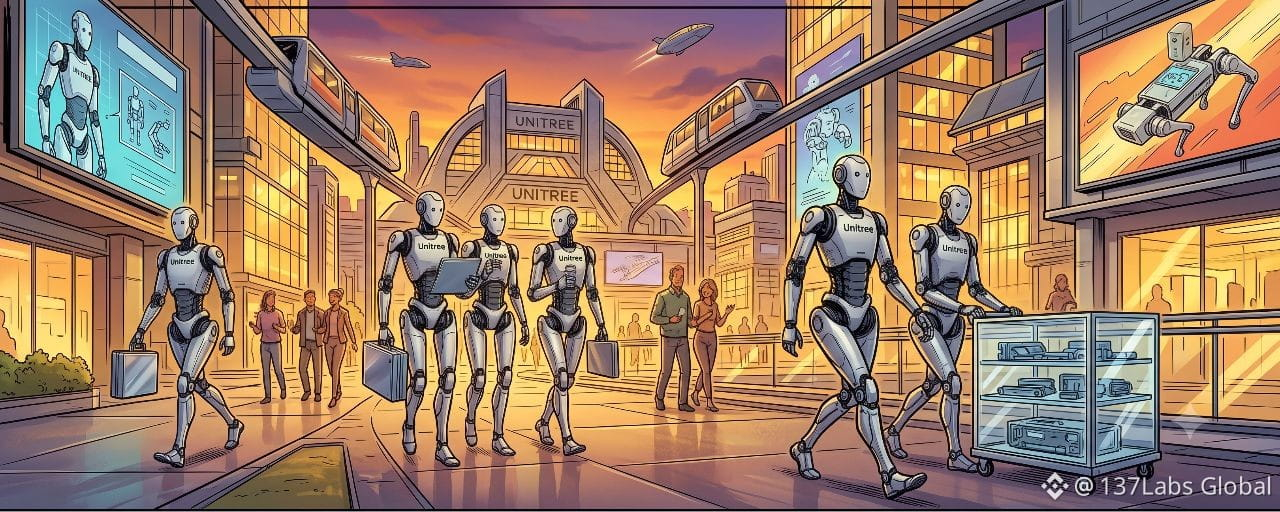
Am Abend des 6. August setzte Unitree Technology den Ausgabepreis für sein IPO im STAR Market auf 150,80 Yuan pro Aktie fest und sicherte damit eine Post-IPO-Marktkapitalisierung von ungefähr 61 Milliarden Yuan ab.
Innerhalb von Stunden stieg der $UNITREE-Perpetual-Kontrakt auf Hyperliquid über 80 US-Dollar, wobei die implizierten Bewertungen bei 30–36 Milliarden US-Dollar lagen — ein voller vierfacher Wert.
Derselbe Anbieter. Zwei Märkte. Völlig unterschiedliche Preise in einer einzigen Nacht.
Der A-Share-Markt lieferte den offiziellen Anker. Der Kryptomarkt lief dem Narrativ vom „ersten reinen humanoiden Robotik-Aktie“ voran.
Dies könnte das bedeutendste Ereignis zur Preiserkennung im Bereich der eingebetteten Intelligenz (Embodied Intelligence) im Jahr 2026 sein.
Grundlagen: Ein Hardware-Unternehmen, das bereits skalierte Profitabilität erreicht hat
Im Jahr 2025 erzielte Unitree einen Umsatz von etwa 1,708 Milliarden Yuan, was einem Plus von 335% gegenüber dem Vorjahr entspricht. Der nicht nach GAAP ausgewiesene den Anteilseignern der Muttergesellschaft zurechenbaren Nettoertrag lag bei rund 600 Millionen Yuan, während die Bruttomargen bei etwa 60% blieben. Diese Kennzahlen sind in der aktuellen Humanoid-Robotik-Branche weiterhin selten. Das Unternehmen lieferte 2025 mehr als 5.500 reine Humanoidroboter aus und hat kumulierte Quadroped-Verkäufe von über 30.000 Einheiten; damit hält es einen langfristigen Vorsprung bei globalen Marktanteilen. Die Umsatzstruktur verschob sich entscheidend: Humanoidroboter machten erstmals über 50% des Umsatzes aus und wurden zum größten Beitragsleister.
Die Produktstrategie ist klar. Der G1 startet bei rund 99.000 Yuan, während der R1 weiter auf den Bereich von 29.900–39.900 Yuan reduziert wurde. Durch vollständig integrierte, selbst entwickelte Joint-Module und Motion-Control-Algorithmen senkt das Unternehmen weiterhin die Kosten. Die Anwendungsszenarien werden weiterhin vor allem von Forschung und Bildung dominiert, während sich gleichzeitig kommerzielle und industrielle Aufträge parallel ausweiten. Für die erste Hälfte 2026 erwartet das Unternehmen einen Umsatz von 1,052–1,128 Milliarden Yuan, der weiterhin um 35–45% im Jahresvergleich wächst. Das Wachstum hat sich verlangsamt, während F&E- und Markeninvestitionen gestiegen sind — eine natürliche Phase des Skalierens und eine zentrale Variable dafür, ob die aktuellen Bewertungen aufrechterhalten werden können.
Sektor-Narrativwechsel: Von Hardware-Performance zu eingebetteten Modellen — Von Demos zur realen Bereitstellung
Das zentrale Narrativ im Robotiksektor hat sich 2026 eindeutig verschoben. In den Vorjahren wurde die Branchenhitze vor allem von Hardware-Anbietern angetrieben, die auf Bewegungsperformance, Balance-Fähigkeiten und Demonstrationsbühnen konkurrierten. Mit dem Einstieg in 2026 hat sich der Wettbewerbsfokus rasant auf eingebettete Large Models verlagert — World Models, Szenengeneralisierung, autonomes Entscheidungswesen und Reinforcement Learning. Kapital fließt weiterhin in modelbezogene Unternehmen; die Finanzierungsvolumina liegen bereits deutlich über den gesamten Jahreswerten der Vorjahre.
Der Branchenkonsens wird zunehmend klarer: Hardware löst zunächst „kann sich bewegen, kann verkaufen, kann skalieren“, während Modelle „können Umgebungen verstehen und komplexe Aufgaben autonom erledigen“ lösen. Gleichzeitig hat sich das Narrativ von der Laborvalidierung hin zum realen Einsatz verlagert. Offizielle Aussagen des Ministeriums für Industrie und Informationstechnologie deuten darauf hin, dass Chinas Produktion humanoider Roboter im Gesamtjahr 2026 voraussichtlich über 100.000 Einheiten liegen wird. Chinesische Unternehmen stellen mehr als 80% der weltweiten Lieferungen und bilden damit ein führendes Muster, das durch Unitree und AgiBot repräsentiert wird. Die Preise rutschen weiter in den Zehntausender-Yuan-Bereich, während die Reife der Lieferkette und der Kapazitätsaufbau zu hochfrequenten Schlagworten geworden sind. Die Gesamt-Einschätzung lautet: 2026 ist das erste Jahr der kleinserienfähigen kommerziellen Nutzung, während eine größere Massenproduktion voraussichtlich um 2028 herum erwartet wird.
Gründer Wang Xingxing: Ein Jahrzehnte langer Weg als technologiegetriebener Entwickler der 1990er
Wang Xingxing wurde 1990 in Yuyao, Ningbo, in der Provinz Zhejiang geboren. Er studierte Mechatronik an der Zhejiang Sci-Tech University für seinen Bachelor und Maschinenbau an der Shanghai University für seinen Master. Während des Studiums begann er, Roboter mit einem 200-Yuan-Mikrocontroller zu bauen; im Aufbaustudium entwickelte er selbst den Quadruped-Roboter XDog, der im Ausland Aufmerksamkeit erregte. Nach seinem Abschluss im Jahr 2016 arbeitete er kurzzeitig bei DJI, verließ das Unternehmen jedoch nach wenigen Monaten und gründete Unitree mit rund 2 Millionen Yuan an Angel-Finanzierung. In den Anfangstagen bestand das Unternehmen fast nur aus ihm selbst; als das Geld knapp wurde, zahlte er Gehälter der Mitarbeiter aus eigener Tasche.
Er bleibt weiterhin sowohl CEO als auch CTO, hält einen sehr flachen Führungsstil aufrecht, verfolgt den Fortschritt in der F&E direkt und beteiligt sich persönlich an Produktdefinition und Rekrutierung. Durch Dual-Class-Aktien mit besonderen Stimmrechten wird er auch nach dem IPO weiterhin über 65% der Stimmrechtsmacht kontrollieren. Beim aktuellen Ausgabepreis wird sein Anteil auf rund 20 Milliarden Yuan bewertet. Diese starke, gründungsvorstand-getriebene Prägung sowie das technologieorientierte DNA bilden die klare Abgrenzung von Unitree zu rein kapitalgetriebenen Unternehmen.
Kernpunkte vom Online-Roadshow-Termin am 7. August
Am Nachmittag des 7. August hielt Unitree sein Online-Investorenaustauschtreffen zur IPO im STAR Market ab. Wang Xingxing und das Managementteam beantworteten die Fragen der Investoren direkt. Die wichtigsten Punkte beinhalteten:
Leistungsüberblick: Das Unternehmen konzentriert sich auf hochperformante, allgemeine Humanoidroboter, Quadruped-Roboter, Komponenten und Modelle der eingebetteten Intelligenz (Embodied Intelligence). Im Jahr 2025 wuchs der nicht nach GAAP ausgewiesene Nettoertrag zwar sehr schnell, doch das Unternehmen erreichte zudem das weltweit höchste Versandvolumen humanoider Roboter. Seit der Massenproduktion des H1 im Jahr 2023 stieg der Umsatz humanoider Roboter von weniger als 3 Millionen Yuan auf 868 Millionen Yuan; der Anteil am Kerngeschäft wuchs von 1,88% auf 51,78%.
Branchenpositionierung: Die aktuellen Erfolge sind nur der Ausgangspunkt. Die Branche der eingebetteten Intelligenz insgesamt befindet sich weiterhin in einer frühen Entwicklungsphase — ähnlich wie in den Anfangstagen der Heimcomputer. Die Generalisierungsfähigkeit von Geräten in unbekannten Umgebungen erfordert weiterhin eine gemeinsame Weiterentwicklung in der gesamten Branche.
Zukünftige Ausrichtung: Das Unternehmen wird weiterhin wichtige Soft- und Hard-Technologien angehen, darunter eingebettete Large Models, Datenerfassung und -analyse von Szenen, Reinforcement Learning, Modelle für den „embodied body“, selbst entwickelte Kernkomponenten und hochleistungsfähige Aktuatoren. Es wird aktiv mehr Produktformen wie Humanoide, Quadrupeds und Mechas erforschen und Roboter dazu befähigen, hochintensive und risikoreiche körperliche Arbeit zu übernehmen.
Botschaft an Investoren: Das Unternehmen hofft, dass Investoren, die seine Aktien kaufen, dies tun, weil sie den langfristigen Wert erkennen — nicht wegen kurzfristiger Spekulation.
Der Gesamtton der Roadshow war pragmatisch — es wurden vorhandene Ergebnisse der Kommerzialisierung präsentiert, gleichzeitig wurde klar dargelegt, dass die Branche sich weiterhin in einer frühen Phase befindet.
Auslieferungen von Humanoidrobotern und Anwendungsszenarien
Die weltweiten Auslieferungen von Humanoidrobotern erreichten 2025 etwa 13.000–18.000 Einheiten, wobei China 80–90% ausmachte. Unitree lieferte mehr als 5.500 Einheiten, AgiBot folgte dicht dahinter; die beiden Unternehmen zusammen halten einen bedeutenden Anteil. Für das Gesamtjahr 2026 wird erwartet, dass Chinas Produktion über 100.000 Einheiten liegt, und Unitree hat als Ziel mindestens eine Verdopplung auf den Bereich von 10.000–20.000 Einheiten.
Die aktuellen wichtigsten Anwendungsszenarien bleiben stark konzentriert: Forschung und Bildung stellen den größten Anteil (40–70% bei einigen Unternehmen). Sie werden von Universitäten und Forschungsinstituten für Algorithmus-Validierung, Datensammlung und Lehre genutzt; interaktive Service- und Datenerfassungsszenarien liegen als Nächstes. Unterhaltungsshows und Ausstellungen machen einen gewissen Anteil aus. Industrielle Logistik, Produktionslinienbetrieb und Inspektion beschleunigen zwar, stellen aber insgesamt noch einen relativ geringen Anteil dar. Ein wirklich großflächiger Einstieg in Fabriken und Haushalte erfordert jedoch weitere Kostensenkungen und verbesserte Generalisierungsfähigkeiten der Modelle.
Preiserkennung und Beobachtungspunkte über Märkte hinweg
Die Bewertung des A-Share-Markts von 61 Milliarden Yuan entspricht einem nicht nach GAAP bereinigten KGV von etwa 219x. Institutionen haben das vollständig akzeptiert — mit Off-line-Abonnementmultiplikatoren von über 2.600x. Der Hyperliquid-Kontrakt lieferte hingegen ungefähr einen vierfachen Aufschlag und preiste die Knappheit der „weltweit ersten gelisteten Gesellschaft, deren Kerngeschäft Humanoidroboter sind“ zusammen mit den Vorteilen der chinesischen Lieferketten- und Skalierungskapazitäten. Die Bewertungsdifferenz zwischen den beiden Märkten spiegelt Unterschiede bei Zeithorizont und Risikopräferenz wider.
Rund um das Abonnementdatum um den 10. August sind drei Datensätze besonders genau zu beobachten: die Konzentration der Bestände und große Limit-Kaufaufträge für $UNITREE auf Hyperliquid; die finalen Online- und Offline-Zuteilungsquoten zusätzlich zu den Vereinbarungen für strategische Platzierungen und deren Lock-up; sowie der Eröffnungsaufschlag und die Handelsvolumenstruktur am ersten Handelstag der Notierung.
Mit der Notierung hat Unitree die „eingebettete Intelligenz“ offiziell aus Labors und Demonstrationsvideos in die Phase überführt, in der sie als handelbare, benchmarkfähige Assets betrachtet werden kann. Der A-Share-Markt lieferte den offiziellen Anker von 61 Milliarden Yuan, während Hyperliquid der Branchenfantasie mit einer höheren implizierten Bewertung vorauslief. Der Preiswettbewerb zwischen beiden Märkten selbst stellt einen der bemerkenswertesten Prozesse zur Preiserkennung im Jahr 2026 dar.
Haftungsausschluss: Dieser Artikel dient nur zu Informationszwecken und stellt keine Anlageberatung dar. Der Kryptomarkt ist äußerst volatil; Investitionen sind mit Risiken verbunden. Bitte führen Sie Ihre eigene Recherche durch und tragen Sie die Konsequenzen unabhängig.