

Pump.fun has spent hundreds of millions of dollars buying back its own token.
And unlike many crypto projects that talk about future revenue sharing, the purchases are already happening.
But after looking at PUMP's supply numbers, I found something worth paying attention to.
The burn program is removing billions of tokens. A substantial amount of PUMP is also sitting in treasury and distribution wallets.
Both sides matter.
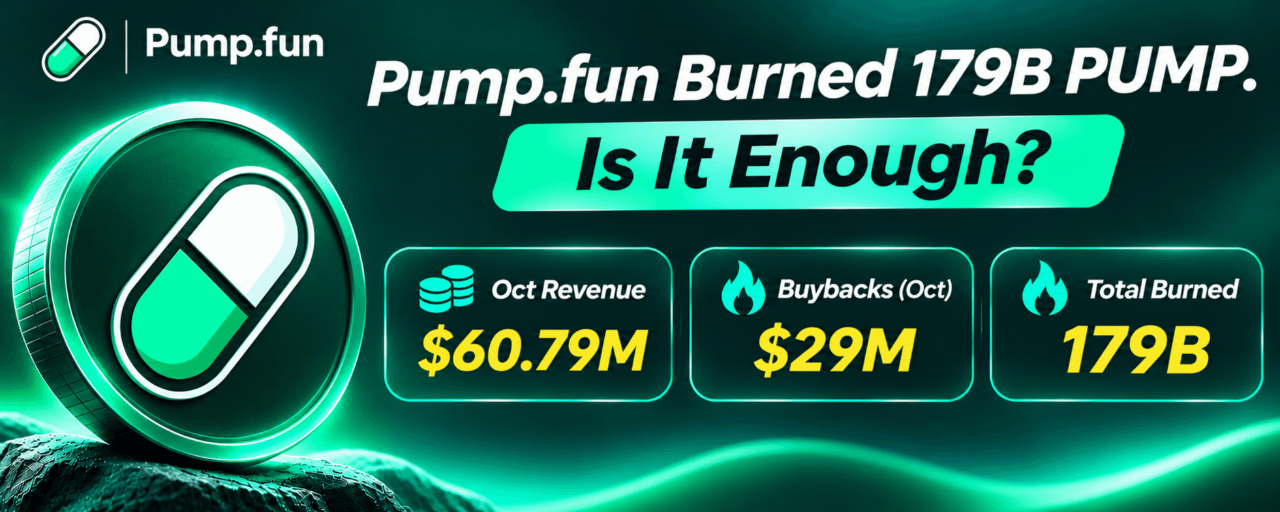
According to BlockPinned's November 23 research, pump.fun generated approximately $60.79 million in protocol revenue during October 2026.
Around $29 million went toward PUMP buybacks that month.
Those purchases helped remove roughly 5.76 billion PUMP from the total supply.
That's a meaningful amount of money for a platform built around launching and trading memecoins.
The business model is fairly straightforward.
Someone creates a token on pump.fun. Traders buy and sell it through the platform's bonding curve. Tokens that meet the required conditions can move to PumpSwap, where trading continues.
Pump.fun collects fees from that activity, along with revenue from other trading products.
Under its current program, the platform targets roughly half of its revenue for purchasing PUMP on the open market.
The tokens are then burned.
So when trading activity generates more revenue, the platform can direct more money toward reducing PUMP supply.
That's the part I find interesting.
But there's a catch.
Memecoin trading doesn't produce predictable revenue.
A viral token can bring thousands of traders into the market. When attention moves elsewhere, activity can disappear surprisingly quickly.
Pump.fun benefits when people trade frequently, whether the tokens themselves become successful projects or not.
That makes its revenue sensitive to speculation.
Look at the recent numbers.
BlockPinned recorded approximately $29 million in buybacks during October. But from November 1 through November 22, the figure was only about $12.4 million.
November wasn't finished at that point, so the two periods aren't directly comparable.
Still, the daily buyback pace had fallen considerably.
That tells us how quickly the amount available for token purchases can change.
And there's another issue.
PUMP launched with an initial supply of 1 trillion tokens.
By November 23, on-chain tracking indicated that approximately 179 billion had been burned.
But more than 516 billion PUMP remained in treasury and distribution wallets, with additional tokens held in lockup contracts.
Those aren't all immediately circulating tokens.
Transfers from those wallets also don't automatically mean sales.
But I wouldn't ignore their potential impact.
Between September 13 and November 23, approximately 11.59 billion PUMP moved outside the tracked treasury, distribution, and lockup addresses.
During the same period, around 13.32 billion PUMP was burned.
The reduction from burns slightly exceeded those outward movements.
That's useful information, although it doesn't tell us how much PUMP recipients actually sold.
There's one more detail that matters when evaluating this model.
The 50% buyback allocation isn't permanently guaranteed.
BlockPinned's examination of the on-chain configuration found that a three-of-four multisig can change the buyback ratio without a waiting period.
PUMP holders also don't receive direct cash distributions from protocol revenue.
Their potential benefit comes from the reduction in token supply.
So I wouldn't value PUMP as though it were a company stock paying dividends.
I'd rather examine the monthly buyback amount, how much PUMP leaves treasury-controlled wallets, and whether trading revenue remains strong when the memecoin market cools.
Pump.fun has already shown it can turn speculative activity into substantial revenue.
What interests me now is whether that business can keep generating enough cash to reduce PUMP supply faster than additional tokens become available to the market.