


A Beginner's Guide to Two Different Blockchain Ecosystems
Bitcoin and Ethereum are two of the most widely recognized blockchain networks. Both use decentralized infrastructure, digital assets, and cryptographic systems, but they were designed with different goals.
Bitcoin is primarily known as a decentralized monetary network. Ethereum is a programmable blockchain that supports smart contracts and a broad ecosystem of decentralized applications.
Understanding these differences is important because Bitcoin and Ethereum should not be evaluated using exactly the same assumptions.
1. Bitcoin: A Decentralized Monetary Network
Bitcoin was introduced as a peer-to-peer electronic cash system. Its network allows participants to transfer bitcoin without relying on a central payment operator.
Some important characteristics include:
Decentralized operation: Independent participants help maintain and validate the network according to its consensus rules.
Limited supply: Bitcoin's protocol sets a maximum supply of 21 million BTC.
Proof of Work: Miners use computational resources to compete to add blocks and secure the network.
Monetary focus: Bitcoin is primarily designed around the transfer and ownership of its native asset, BTC.
Bitcoin is often discussed as a potential store of value, but its market price can be volatile. Its monetary design does not remove market, technology, custody, or regulatory risks.
2. Ethereum: A Programmable Blockchain
Ethereum has a different central purpose. It provides a programmable blockchain where developers can deploy smart contracts—software that runs according to rules recorded on the network.
Its ecosystem supports a wide range of applications, including:
Decentralized finance (DeFi).
Digital collectibles and NFTs.
Token creation and management.
Decentralized applications (dApps).
On-chain governance and other programmable systems.
Ethereum's native asset is ETH. It is used in the network's economic and technical operation, including paying transaction fees known as gas fees and participating in proof-of-stake validation.
Ethereum uses Proof of Stake. Validators help propose and attest to blocks, with ETH staking involved in the network's security model.
Its flexibility creates opportunities for developers, but applications and smart contracts can also introduce additional technical and operational risks.
3. Different Network Activities
Bitcoin and Ethereum have different types of activity because their networks support different use cases.
Bitcoin activity commonly includes:
BTC transfers between addresses.
Payments and settlement.
Wallet and custody activity.
Transactions involving Bitcoin-related protocols and services.
Ethereum activity commonly includes:
ETH transfers.
Smart-contract interactions.
Token transfers.
DeFi activity.
NFT transactions.
Interactions with decentralized applications.
A simple transaction count may not tell the full story. One Ethereum transaction, for example, can interact with a smart contract and trigger several operations.
Likewise, Bitcoin network activity should be interpreted in the context of its own transaction design and ecosystem.
Comparing network activity requires understanding what is being measured, how it is measured, and which activities are included.
4. Different Application Designs
Bitcoin prioritizes a relatively narrow and conservative base-layer design focused on monetary transactions and network security.
Ethereum provides a more general-purpose execution environment where developers can create applications and programmable financial systems.
These different designs create different trade-offs.
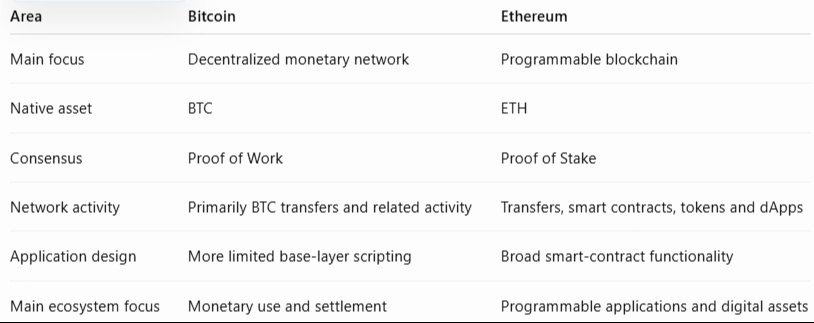
Neither design is automatically better for every purpose. The appropriate comparison depends on the use case.
5. Different Risks to Understand
Both networks have risks, but their risk profiles are not identical.
Bitcoin-related risks may include:
Market-price volatility.
Wallet and private-key security.
Custody and exchange risks.
Mining and network-related considerations.
Regulatory and adoption uncertainty.
Ethereum-related risks may include:
Market-price volatility.
Smart-contract vulnerabilities.
Application and protocol risks.
Wallet, bridge, and third-party service risks.
Network fees and congestion.
Staking, validator, and infrastructure considerations.
Users should also remember that a decentralized base network does not make every application built around it decentralized, secure, or trustworthy.
6. Why BTC and ETH Should Not Be Evaluated Identically
A common mistake is to compare Bitcoin and Ethereum using only price performance, market capitalization, or transaction volume.
These measurements can provide useful information, but they do not explain everything.
A more balanced evaluation considers:
Purpose: What problem is the network designed to address?
Technology: How does its architecture and consensus mechanism work?
Activity: What are users actually doing on the network?
Ecosystem: What applications, services, and infrastructure are developing around it?
Risks: What technical, economic, custody, and regulatory risks exist?
Limitations: What can the network do, and what does it not aim to do?
Bitcoin's monetary focus and Ethereum's programmable ecosystem make them different types of blockchain infrastructure.
Their native assets also have different roles within their respective networks.
7. A Beginner's Comparison Checklist
Before comparing BTC and ETH, ask yourself:
Do I understand the main purpose of each network?
Can I explain the difference between Proof of Work and Proof of Stake?
Do I know what BTC and ETH are used for within their networks?
Am I comparing similar types of network activity?
Have I considered application, custody, and technical risks?
Am I relying on one metric to judge two different ecosystems?
These questions can help build a more complete understanding of both networks.
Conclusion: Different Networks, Different Purposes
Bitcoin and Ethereum are important blockchain ecosystems, but they are not designed to do exactly the same thing.
Bitcoin focuses on a decentralized monetary network, while Ethereum provides a programmable environment for smart contracts and decentralized applications.
Understanding their purposes, network activity, application designs, and risks is more useful than assuming they should be judged by identical standards.
The key lesson for beginners is simple: compare blockchain networks according to what they are designed to do—not just by their names, prices, or market rankings.
🔎 Continue Learning with Crypto With Ali
Which ecosystem would you like us to explain in more detail: Bitcoin's monetary design or Ethereum's smart-contract ecosystem?
Follow Crypto With Ali for educational insights into Bitcoin, Ethereum, blockchain infrastructure, and Web3.
Educational content only. Not financial advice.