
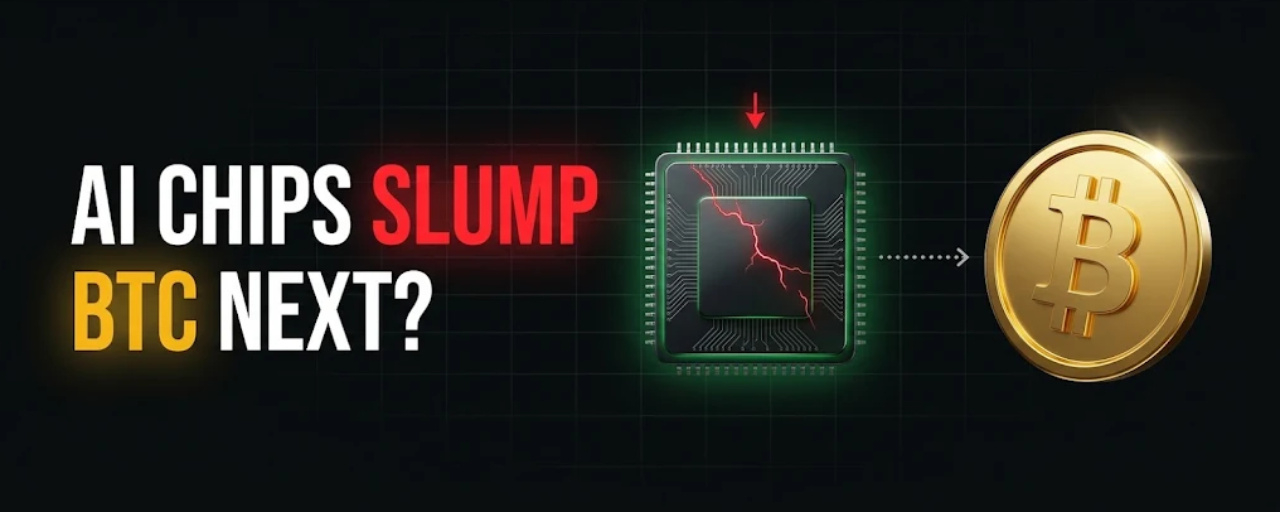

The Nasdaq 100 sank 6.4% in a day and chip stocks had their worst session since 2020. Here's what the AI sell-off shows and how it links to Bitcoin.
🚨 Thursday was one of those days you remember. The AI trade, which had carried the market for months, cracked in a single session.
📊 What actually happened
The Nasdaq 100 was down over 4% by Thursday morning, and it kept sliding. It closed down 6.36%, the Nasdaq Composite fell 5.52%, and the S&P 500 dropped 4.35%. The Nasdaq 100 lost about $2.3 trillion in value. Chips took the worst of it. The iShares Semiconductor ETF dropped 12%, its worst day since March 2020. The Nasdaq Composite also slid into correction territory, more than 10% below last month's peak.
🤔 What spooked investors
There wasn't a single trigger. Investors worried that Democratic policymakers could block US data center projects, the buildout that AI chipmakers depend on. Company news piled on too: Qualcomm fell after its chip sales missed estimates.
AMD shows how jittery the market was. It reported on Nov. 3 and first gained more than 6% after hours, then fell with the wider AI selloff despite results that showed strong demand. A good report wasn't enough to stop the slide.
📈 Then came the bounce
Chip stocks clawed background the next day, with AMD up 8% and Intel and Nvidia up 5%. Nvidia's story added noise. It fell 9.26% on Thursday to $181.60 before bouncing 2.78% on Friday, and it tumbled again at Monday's open after the company announced a probe into its CEO.
₿ Where Bitcoin fits
Here's the uncomfortable part. $BTC didn't dodge the sell-off. It slipped to near $75,880, down about 6% in two days after the chip rout began on Nov. 5, and it dropped under $74K ahead of today's inflation report. When stocks bounced, Bitcoin didn't join them. That's the question mark hanging over the market right now.
🧠 Why the link exists
Crypto and tech stocks are both treated as risk assets, so a shock to AI sentiment can ripple into $BTC through lower risk appetite and forced selling. But the link isn't automatic. Bitcoin has its own pressures right now, including ETF outflows and rate worries, so it may be lagging stocks for its own reasons, not just following them.
✅ What this means for you
If you're holding: don't assume a stock rebound will lift $BTC automatically. Bitcoin is dealing with its own supply and flow issues.
If you're trading: watch whether $BTC reacts to stocks in the next few sessions. If it keeps ignoring equity bounces, the correlation may be weaker than the headlines suggest.
If you're building a bigger picture: a correction is a 10% fall from a peak. That is not the same as a bear market, and one rebound day doesn't prove a bottom.
🟢 Bullish scenario
The chip rebound holds, today's CPI comes in soft, and $BTC catches up with equities as risk appetite returns.
🔴 Risk scenario
The bounce fades, data center politics tighten, or CPI runs hot. Another leg down in chips would likely drag crypto lower with it.
👀 Three things I'm watching
1️⃣ The chip rebound
Does the Nasdaq hold its gains after the CPI report?
2️⃣ Data center politics
Does the policy outlook for AI infrastructure get clearer, or murkier?
3️⃣ $BTC vs. stocks
CPI lands at 8:30 a.m. New York time today. Does Bitcoin follow equities higher if the data is soft, or keep lagging?
💡 The takeaway
The AI sell-off showed how fast a crowded trade can unwind, and Bitcoin felt it. But Bitcoin's weakness has more than one cause, so don't assume it simply follows stocks.
A rebound is a first step, not a recovery. The better signal is whether $BTC starts to move with equities again.
This post is for informational and educational purposes only and is not financial advice. Crypto markets are volatile. Always conduct your own research before making financial decisions.
#BinanceSquare #Bitcoin #BTC #Nasdaq #AIStocks
