



For years, Bitcoin has carried a familiar label: too risky, too unpredictable, and too volatile for traditional investors. But new research from Grayscale is challenging that perception with a number worth paying attention to.$BTC
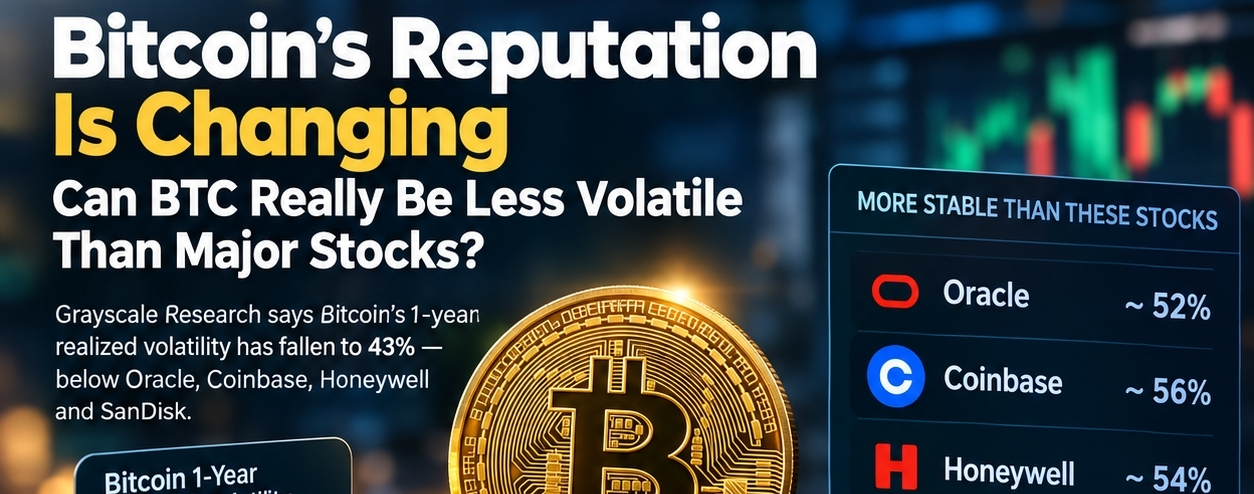
According to its October 14, 2026 report, Putting Bitcoin’s Volatility in Context, Bitcoin’s one-year realized volatility has fallen to 43%. That is down from 81% five years ago and below its reported 10-year average of 64%.
Even more interesting, Grayscale’s comparison shows that Bitcoin has recently experienced smaller price fluctuations than several well-known stocks, including Oracle, Coinbase, Honeywell and SanDisk.
The bigger story isn’t simply that Bitcoin has become calmer. It’s how investors may need to rethink the way they measure its risk.
📊 What Does the 43% Figure Actually Mean?
Realized volatility measures how much an asset’s price has moved historically. A lower reading generally indicates smaller price fluctuations over the measured period.
Bitcoin’s decline from 81% to 43% suggests a meaningful reduction in its historical price swings. Growing market liquidity, broader institutional participation and improved trading infrastructure may all help explain this longer-term trend.
However, volatility is only one part of the investment equation. Bitcoin can still experience sharp corrections, and a quieter period does not guarantee that future price movements will remain small.
🏦 Why the Stock Comparison Matters
Many investors automatically assume that established company shares are safer than cryptocurrencies. But individual stocks can face earnings surprises, changing business conditions and sudden shifts in investor sentiment.
Grayscale’s findings show why comparing assets by reputation alone can be misleading. During the measured period, Bitcoin’s volatility was below that of several major companies.
That does not make BTC safer than every stock, nor does it mean Bitcoin has become a low-risk asset. The comparison simply adds context to the debate.
🔍 What Could This Mean for Bitcoin’s Future?
If Bitcoin continues to attract deeper liquidity and wider participation, its volatility profile could evolve further. That may make the asset easier for some traditional investors to evaluate alongside other investments.
Still, three things deserve attention:
- Market volatility: Will Bitcoin maintain its lower realized volatility?
- Institutional demand: Will broader participation support more stable market conditions?
- Downside risk: How will BTC respond when liquidity weakens or unexpected news hits?
These questions matter more than any single headline percentage.
⚠️ The Detail Investors Should Not Ignore
Lower volatility does not automatically mean higher returns, and it certainly does not eliminate the possibility of significant losses. Realized volatility looks backward; it is not a prediction of tomorrow’s price.
Investors should also distinguish between Bitcoin’s volatility and the risks associated with their own trading decisions. Excessive leverage, poor position sizing and emotional entries can turn even a relatively calm market into a difficult trading environment.
💭 My Take
Bitcoin may be moving beyond its old reputation as an asset defined entirely by extreme price swings. Grayscale’s 43% reading offers evidence that its recent volatility has declined considerably.
But I would treat this as a change in perspective, not a guarantee of future stability. The real test will be whether Bitcoin can maintain this trend through the next period of market stress.
What do you think? Is Bitcoin gradually becoming a more mature asset, or could its volatility return when market conditions change?
Share your view below.
Risk management is essential. This is not financial advice; do your own research.
#Bitcoin #BTC #CryptoMarket #Grayscale #cryptocurrency $BTC
