


Featuring insights from Acurast & TokenLockr
Practically the entire internet today runs on top of infrastructure controlled by a handful of companies. AWS, Google Cloud, and Microsoft Azure hold, inside their data centers, the actual right to decide who gets access to the cloud, on what terms, and with what level of privacy.
Tech critics have long compared this model to feudalism: users and developers are forced to trust the "Cloud Lords," with no way to verify what happens to their data inside someone else's infrastructure.
Cloud Feudalism
In 2012, cryptography expert Bruce Schneier put it plainly: trust in the digital age stopped being a choice and became a forced necessity. Users don't know what security methods their "Cloud Lords" use or how those methods are configured, but they are obligated to trust them, because there simply is no alternative.
Cloud centralization creates risks for privacy and systemic fragility. The same set of companies decides whose data will be protected, whose applications stay online, and whose computations get censored or blocked based on geography.
For infrastructure that the entire digital economy rests on, this kind of dependence on a few players looks like a structural problem. The way forward lies through decentralizing it at a fundamental level. A cloud built on open-source principles.
Billions of Idle Phones
That kind of decentralization needs a resource capable of competing with data centers on scale. That resource already exists, and it's sitting in the pockets of billions of people.
Roughly 1.39 billion smartphones are sold every year, and the average device replacement cycle is 2.75 years. This is the most widespread, most frequently refreshed computing hardware on the planet, and most of the time it just sits idle.
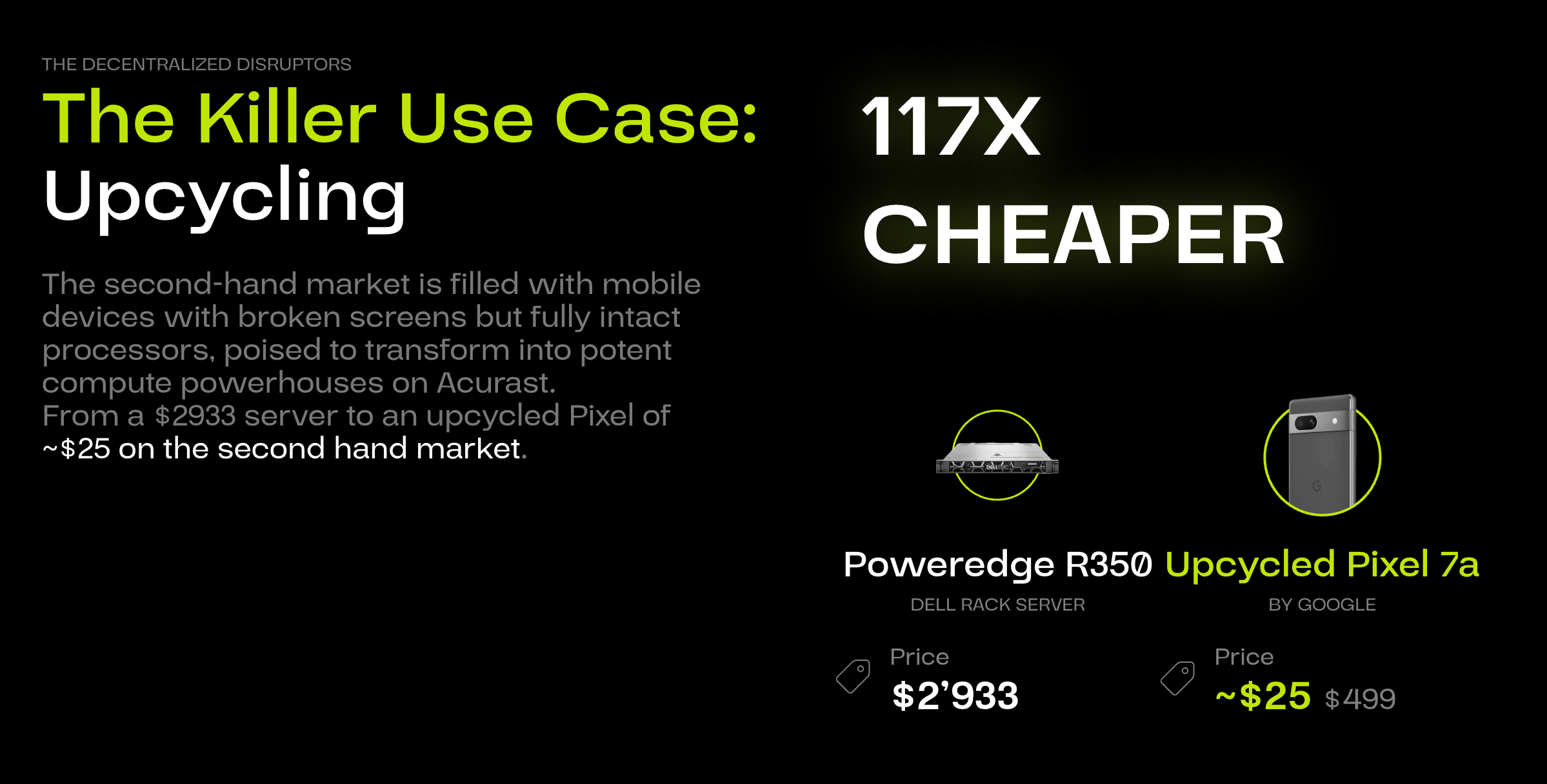
A telling example: a used Google Pixel 7a with a cracked screen can be found on the secondhand market for around $25, and its processor is in no way inferior to a Dell PowerEdge R350 server costing $2,933. That's a 117-fold price difference for comparable computing power.
Instead of building new physical infrastructure, buying server racks, and paying for data center electricity, this model activates hardware that already exists: old smartphones, devices with cracked screens, gadgets that would otherwise simply be thrown away.
This is at once a question of compute accessibility and a question of ecology. It gives devices a second life instead of turning them into electronic waste.
Security Already Paid For
Mass decentralization through ordinary consumer hardware has an obvious objection. How do you trust computation happening on some random person's phone, if the device's own owner could theoretically interfere with the process? The answer lies in architecture that's already built into modern smartphones.
Flagship devices come equipped with a Trusted Execution Environment (TEE) and a Hardware Security Module (HSM) at a level data centers still have to build from scratch.
This is concrete, physically isolated hardware, already built into billions of devices:
Google Titan M2 in Pixel devices: a separate coprocessor with its own flash memory and a minimal OS (microkernel), never compromised in its entire time in use.
Qualcomm Secure Execution Environment (QSEE) in Snapdragon chips: an isolated execution environment on most Android devices outside the Google ecosystem.
ARM TrustZone: a hardware split between a "trusted" and a "normal" world right at the processor level, used as the baseline protection layer in almost every modern mobile SoC.
None of these components share memory or cache with the device's main processor, which means compromising the main operating system isn't enough to reach the computation happening inside the enclave.
Technically, this is built smarter than just an isolated sandbox. A key pair tied to the executable code works only with that specific code. Change the code by even a single bit, and access to the private key is lost for good.
This cryptographically ties the result of a computation to the exact set of instructions that produced it, all the way back to the hardware manufacturer, the device owner included.
What DePIN Doesn't Prove
Most existing DePIN networks solve the problem of hardware coordination. They pool distributed storage, bandwidth, or data center compute into a single network and reward participants with tokens.
But coordinating hardware and verifying what's actually happening on that hardware are two different problems, and the vast majority of these networks simply don't solve the second one.
The cost of this blind spot is clearly visible in the case of cross-chain bridges. According to analytics firm Chainalysis, roughly $2 billion was stolen across 13 different bridge hacks, accounting for 69% of all funds stolen across the crypto industry in 2022.
Bridges and sequencers are often positioned as decentralized infrastructure, but in practice they frequently run on the same centralized cloud providers whose trust requirement the industry is supposedly trying to eliminate.
The result is a paradox: a network can be physically distributed (thousands of independent nodes around the world), while the auxiliary systems that serve that network remain centralized and vulnerable.
The verifiability of computation, meaning cryptographic proof that code executed exactly as intended, on genuine hardware, without outside interference. That's a separate and far rarer property than mere distribution.
The Blockchain Quadrilemma
The classic blockchain trilemma describes the tradeoff between decentralization, security, and scalability. Improving one parameter almost always comes at the expense of another. But this model has a blind spot that becomes critical specifically for compute infrastructure.
An extended version, the quadrilemma, adds two more dimensions: computational effectiveness (the ability to run complex decentralized computations at an affordable cost) and confidentiality (the ability to process sensitive data without exposing it publicly). Classic blockchain consensus requires every participating node to duplicate the computation, which makes complex computations expensive or outright impossible.
At the same time, blockchain transparency, usually considered one of its strengths, turns into a problem the moment a computation requires confidentiality.
It is exactly at the intersection of these five requirements, decentralization, security, scalability, effectiveness, and confidentiality, that the problem Acurast is trying to solve sits.
Acurast's Serverless Cloud
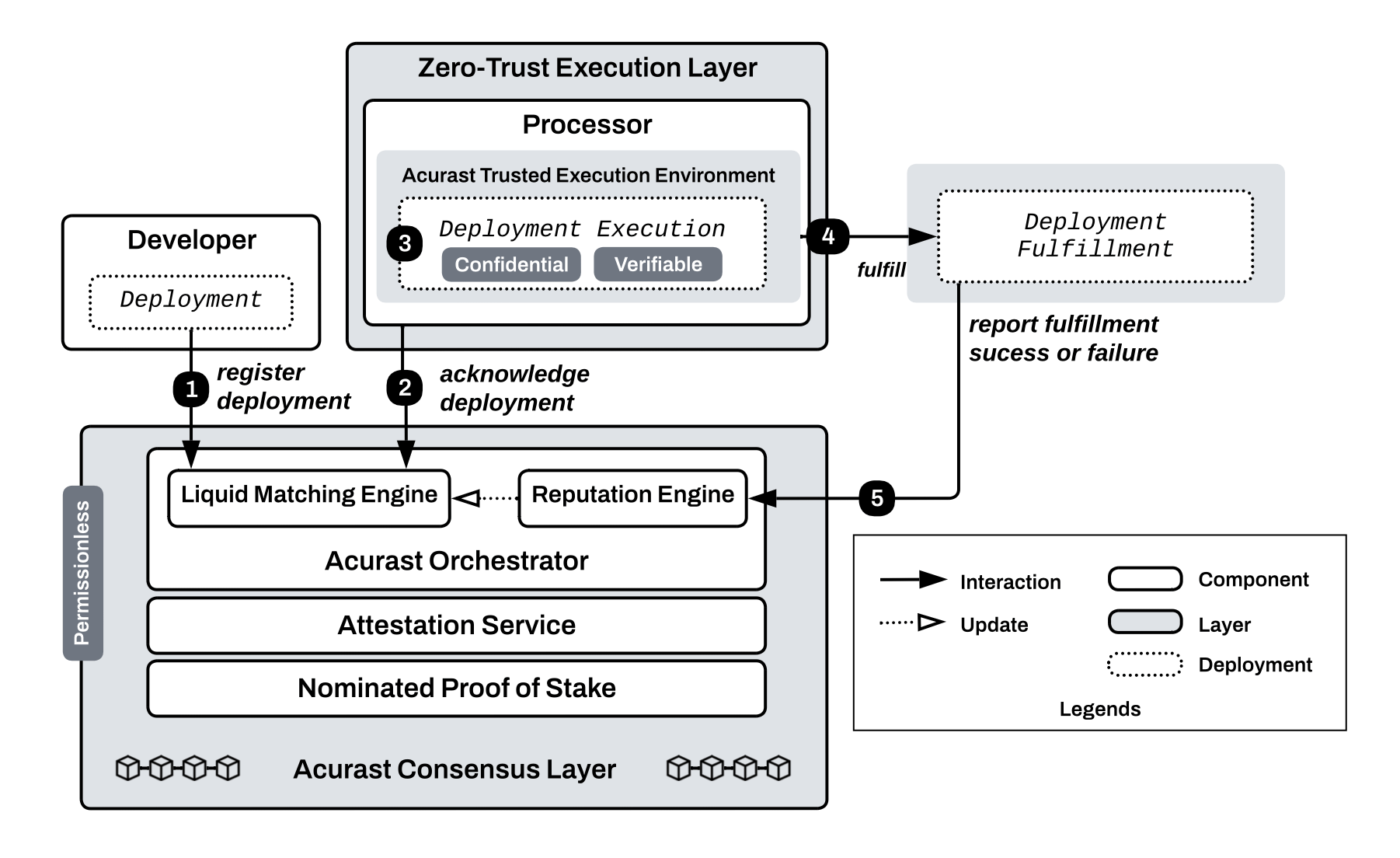
Acurast splits its architecture into three layers: consensus, execution, and application. The consensus layer is built on a modification of Nominated Proof-of-Stake and includes an orchestrator that matches developers' compute tasks to available processors, a reputation engine that tracks the reliability of each device, and an attestation service responsible for cryptographically verifying the hardware's authenticity.
The execution layer, the Acurast Trusted Execution Environment, is where the computation actually happens. Confidentially, inside the phone's isolated hardware enclave, and verifiably, with cryptographic proof that the code executed without interference.
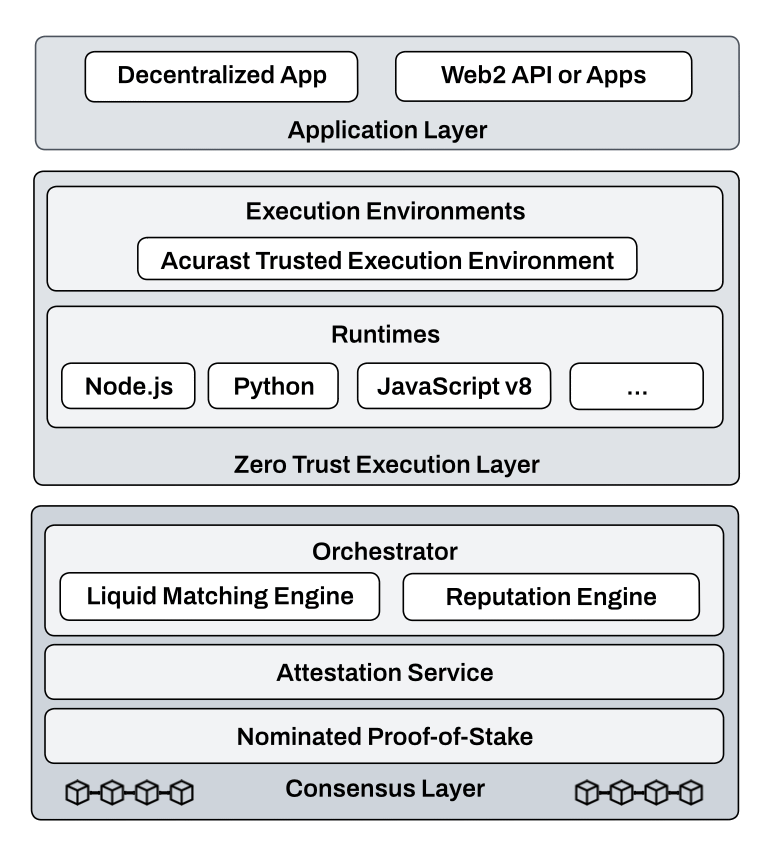
The network supports several runtimes, including Node.js, JavaScript v8, and Python, and keeps adding new ones.
According to the network's current data, more than 308,000 phones are already connected to Acurast across 175+ countries, more than 1 billion transactions have been processed, and more than 646,000 applications have been deployed. The network already secures more than $200 million in digital assets across Bitcoin, Ethereum, Tezos, Polkadot, peaq, and other networks.
The range of real-world use cases is wider than one might expect:
Confidential LLM inference, where the model runs without the cloud provider getting access to the data itself.
Decentralized web scraping and market intelligence: in 2022, bots accounted for 47.4% of all internet traffic, and ordinary companies doing competitive analysis need infrastructure that doesn't expose the IP or intent of the requesting party.
Decentralized price oracles and on-chain automation for DeFi protocols.
Incorruptible transaction sequencer, resistant to MEV attacks like frontrunning and sandwich attacks.
The reward model is built on a fixed emission of the $ACU token: 70% of inflation is distributed to the Staked Compute Pool among processors participating in staking, 15% goes to the on-chain treasury, 10% makes up base benchmark rewards regardless of staking, and 5% goes to the collators producing blocks.
At the same time, the cost of executing each deployment is burned after successful execution, creating deflationary pressure on the token's supply.
Connecting to the network is already possible: the Acurast Processor Lite app is available on the App Store and Google Play, and the phone starts providing compute in the background with no special equipment. A more dedicated mode, Acurast Core, is set up by scanning a QR code in about three minutes.
Plans for the network, labeled Codename Cray, call for combining hundreds of phones into a single cluster capable of running inference for the largest existing LLMs, which should remove the model's main structural limitation: the vertical power ceiling of a single smartphone.
Insights from Acurast
The Acurast team has been building in the DePIN space since well before it had that name, and their approach reflects that: more emphasis on the mechanics that make a distributed compute network actually hold together under real-world conditions.
We caught up with them to hear how they think about reliability, what's coming next for the network, and how they see the whole system balancing itself out as it grows.
Q: What happens to an already-placed deployment if the processor's battery dies or it loses connection mid-execution?
If the deployment ran with a replica set of bigger than 1, the single replica will fail while the other continue, the deployer is refunded for the failed replica. Acurast ensures verifiability and confidentiality of the compute by leveraging the TEE, but liveliness is covered with staked compute: through staked compute the protocol creates an economic incentive for liveliness. If a compute provider is not providing the compute it said it would to the network, that provider will get slashed.
Q: Codename Cray clusters hundreds of phones for large LLMs. How do you sync execution across devices with different performance and connectivity?
Codename Cray shards LLMs on Acurast device clusters. These are typically interconnected via OTG/USB 4.2 and offer a stable, low latency interconnection. This allows for such sharding to happen effectively. In business terms, this allows Acurast compute to run the largest LLMs that would otherwise not fit on a single device's memory.
Q: How do you balance growth in the number of processors against real developer demand for compute?
Similar to how Bitcoin works, the protocol has a fixed inflation which is distributed to the participating compute providers. If only a few provide compute, those receive individually a larger share of the inflation. Compute demand, on the other hand, consumes tokens: big demand means big token consumption and burn. So the protocol is self-regulating demand and supply of token and compute with those two mechanisms.
Taken together, the answers describe a system with two separate feedback loops doing the work: staking and slashing keep individual phones honest and online, while token issuance and burn keep the size of the compute fleet roughly in step with how much of it developers are actually using.
TokenLockr: Growth, Beyond the Tech
One detail shows how networks like this grow not just through technology, but through community work as well. In the summer of 2026, Acurast launched a joint campaign with TokenLockr, a platform that turns creators' content and activity into real rewards from projects.

TokenLockr's model is built on three principles: transparency, reputation, and real rewards. Every creator has a public profile with a rating, a current tier, and a history of completed tasks. The platform itself pre-vets every creator through AI and on-chain data before they're admitted to a project's campaigns.
The mechanics are built to pay only for real results:
Rewards are tied to specific metrics, KPIs, and measurable results.
Part of the rewards is structured through token locks and linear vesting, to keep creators engaged over the long term.
Unlocking part of the rewards can be tied to specific events, whether that's token price, trading volume, or another KPI.
Bonuses are only paid out once a project actually hits its target metrics.
In Acurast's case, this ran as two campaign types:
Activity on X with fixed and KPI-based payouts.
Short-video campaign with fixed payouts.
Out of a total pool of 500,000 $ACU, only 10% was allocated to the fixed portion, while 90% depended on hitting the token's target price milestones: $0.078, $0.100, $0.128, $0.155, and $0.183. The campaign ran for two months, from July 14 to September 14.
In the end, 4 out of 5 stated price KPIs were hit, more than 45 creators took part in the campaign and put out more than 200 pieces of content. All participants received the rewards they were owed.
Campaigns like this show the other side of how DePIN projects grow: turning organic and incentivized content into an additional visibility channel for the network.
Notes from Founder of TokenLockr
We also spoke with Maxim Moris, founder of TokenLockr, about where the platform is headed next and how it holds the line between genuine project storytelling and pure price-shilling.
Q: What's next for TokenLockr, what new campaign formats are you planning?
We're planning to add creator analysis using LLMs soon. We'll check creators' connections so we can ban, or at least warn projects about, farmed and connected accounts that interact with and repost each other, essentially inflated accounts.
We want to fight that, because this platform is built for people who genuinely want to support a project. A project has its own community, its own followers, people who like the project, and the project should use TokenLockr to additionally incentivize that community.
The community should know they can keep supporting the project, more strongly and at greater scale, and that they'll be rewarded for it if the project is doing well. We want to build a system where, if the project is doing well, the community is doing well too, and the people supporting it are doing well. And we want that to be fair, and impossible to game.
Q: Doesn't the KPI system create an incentive for creators to promote the price rather than the product?
You can't directly shill tokens on Twitter, Twitter itself fights that, so yes, we also make sure creators are actually talking about the project: about the team, about what the project is building. The job is to get the story of how the project is developing out to a wide audience.
If a project has nothing to talk about, it's unlikely anyone can just be bought with price alone, I doubt it, though of course I can't rule it out completely, because this is still an open platform, and there's no mechanism where you can foresee everything. There will always be someone trying to create something interesting, and someone trying to game it. We deal with that as it comes.
Q: What advice would you give a project just starting to work with creators?
I think TokenLockr right now is a unique platform that every project needs, especially any project going into a TGE, because it's a win-win situation. Projects incentivize the community to talk about the project, and the community gets extra rewards for that if the project is doing well, if the price is growing. I think this is the optimal format for any project right now, and there's nothing else like it on the market.
What comes through is a platform trying to police itself as it scales: catching farmed engagement before it reaches a project, while betting that a project with nothing real to say won't get far on price talk alone.
Conclusion
The idea of a decentralized cloud isn't new, but most attempts to build one have stumbled either on a lack of scale or on the impossibility of verifying what's actually happening on distributed hardware.
Smartphones solve much of this: they already exist in the numbers needed, and they already come with hardware security comparable to that of corporate data centers.
Acurast's example shows that the shift from concept to a working network with hundreds of thousands of connected devices and a billion processed transactions is happening right now.
The question of confidentiality and computational verifiability, which the classic blockchain trilemma left out of the picture, gets a concrete technical answer here: hardware trust that billions of people are already carrying in their pockets.
Read more: Inside Robotics and Physical AI