



Featuring insights from Axis Robotics
In 2026, the artificial intelligence industry learned to solve the compute problem. GPUs are becoming more accessible, models are cheaper to run inference on, cloud infrastructure keeps growing. But the next wave of AI, robotics and Physical AI, has a completely different problem. It all comes down to data that simply does not exist in the volume needed.
No Internet for Robots
LLMs grew out of a foundation that already existed. Decades of text on the internet, trillions of tokens spanning almost every domain of human knowledge. With that corpus already in place, progress came down to scaling compute and improving architectures.
Robotics has no such foundation. The physical world has no search index, and there is no “internet of robotic interactions” to train a model on.
The entire volume of data available today for training robots is a tiny fraction of the text corpora that modern language models are trained on. This creates a shortage of foundational data at every level.
Robotics' Missing GPT-1 Moment
The trajectory of language models is instructive, because each step removed a new constraint. GPT-2 trained on roughly 10 billion tokens, about 500,000 hours of reading at a human pace.
That was when emergent model behavior appeared for the first time. GPT-3 trained on roughly 300 billion tokens, about 15 million hours, and without that volume there would be no ChatGPT, and none of what followed.
Robotics has not had that moment yet. Model architectures are converging, algorithms are maturing, but the data itself remains unsettled. Which pre-training distribution is the right one, what the ratio of simulation, real world, and ego-centric data should be. There is simply no consensus on data structure.
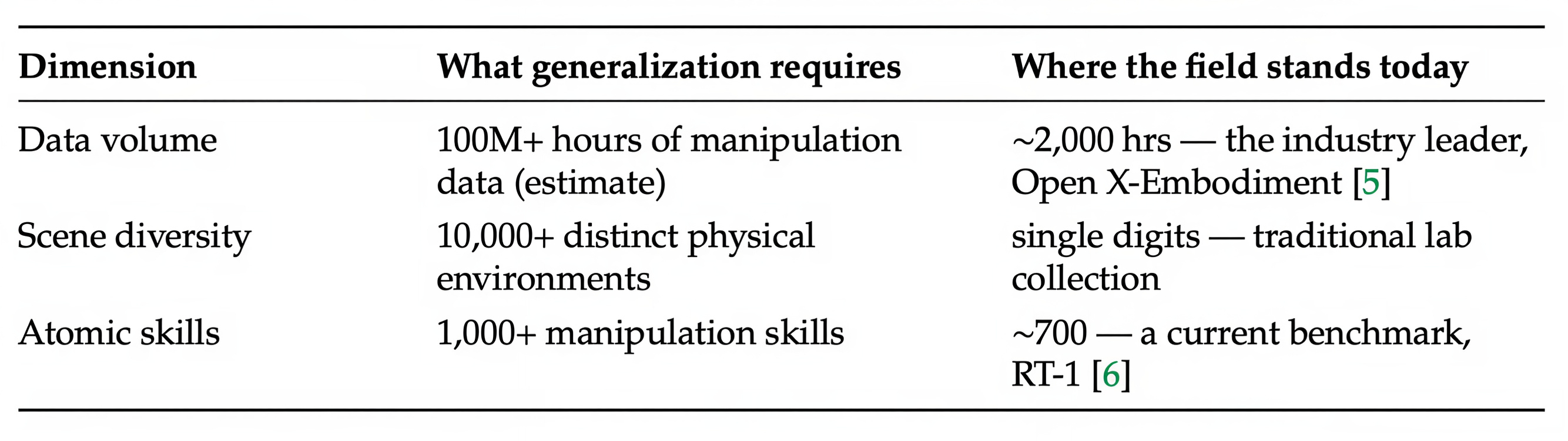
If 15 million hours of text produced GPT-3, a truly general-purpose model of physical intelligence may require on the order of 100 million hours of data on human manipulation of objects.
Today, the industry has roughly 2,000 hours, the best public dataset, Open X-Embodiment. A similar gap exists in scene diversity and in the number of mastered atomic skills.
Why Collection Doesn't Scale
Compute, hardware, and algorithms for physical intelligence are already ready. What is genuinely missing is data, and there are three structural reasons for that.
Real-world collection is bottlenecked by hardware. Specialized rigs, safety systems, and one trained operator per robot. This limits both volume and coverage, and makes foundation-model scale structurally unreachable.
Manual collection cannot produce the diversity that's needed. Generalization requires compounding diversity across objects, scenes, robot embodiments, and camera angles, which hand-collected datasets are simply unable to provide.
Models trained only on expert demonstrations are blind to their own mistakes. The policy only sees the states the expert visited, which means that exactly where it is weakest, there is the least training data. Errors accumulate across the entire task horizon.
Each of these constraints points in the same direction. What's needed is not a more advanced model, but a fundamentally different regime for producing data.
Humanoids Run on Data
2026 became the peak of investment interest in humanoid robots. Billions of dollars poured into hardware, into models, into the production capacity of the industry's major players. But all of that capital runs into the same bottleneck. Money solves the question of hardware and compute, but where to get millions of hours of data on real-world manipulation of objects.

This makes the data problem the very thing that's holding back an industry with multi-billion dollar investment right now. The faster the ambitions to deploy humanoids in real-world conditions grow, the faster the data shortage itself grows too. Every new robot embodiment, new environment, and new skill requires its own share of training data.
Axis Robotics: Compounding Data Engine
Most robotics data pipelines are one-directional. Collect the data, train the model, ship it, start over. Axis is built as a closed loop, in which every contribution improves the next policy, and every improved policy determines what data to collect next. Data stops being a one-time cost and becomes an asset that appreciates.
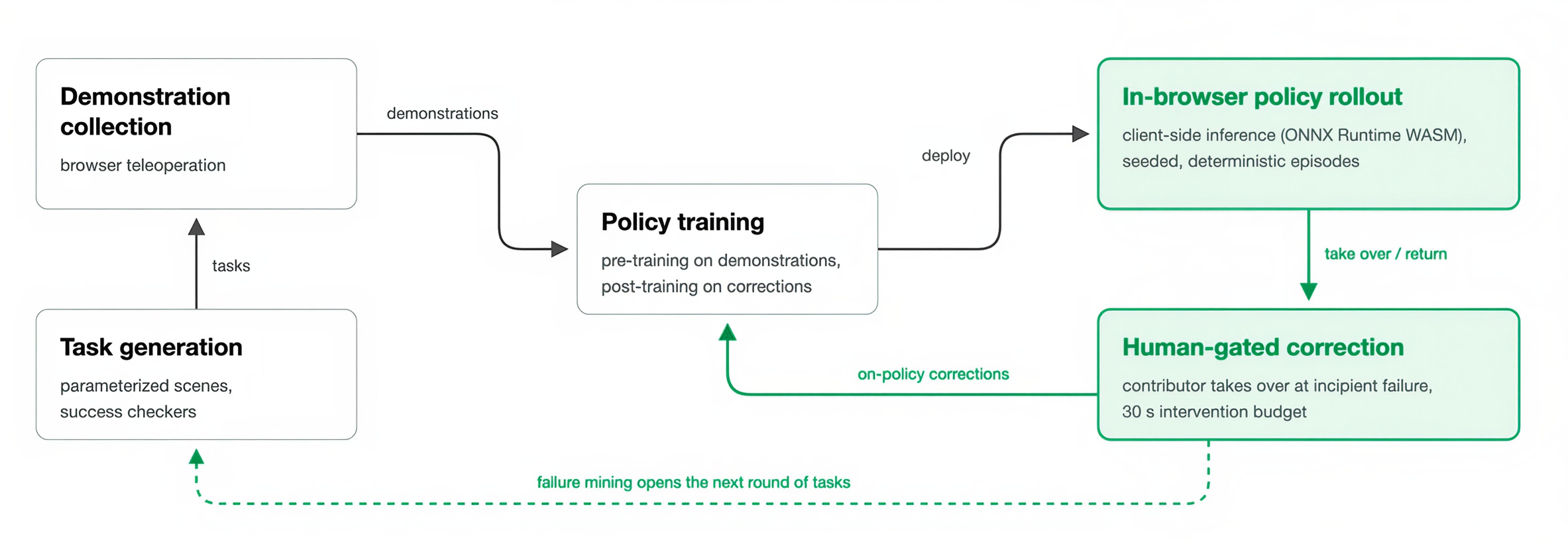
The cycle consists of five steps: generating the task and scene, collecting behavior through teleoperation in simulation and capturing real-world interactions, processing and cleaning trajectories, training and deploying the policy on real and simulated fleets.
At the end, collecting signals about exactly where the policy is still making mistakes. These signals determine which tasks open up in the next round, and the cycle repeats on harder and more valuable data.
Three platform products cover the entire cycle:
Web Simulation Data Platform: a browser-based simulation with no installation and no hardware requirements, where participants control the robot through teleoperation and generate demonstrations, as well as correct the behavior of an already trained model. Throughput already reaches 10,000 valid trajectories per hour today;
Mobile Ego-Centric App: a mobile app for capturing first-person data through hand-pose tracking, with no specialized equipment. Launching in September 2026 with a target of 10,000+ valid hours of data per month;
Data-to-Model Pipeline: a unified processing pipeline that cleans, augments through domain randomization, and annotates raw trajectories, turning them into data ready for model training.
The key empirical result is that continued pretraining of Physical Intelligence's π0.5 model on the Axis dataset raised the success rate on the LIBERO-Plus benchmark from 83.9% to 88.8%, and beat the result of a volume-matched control group from RoboCasa365 by 31.3 percentage points. The gain scales with the volume of Axis data, which points to the coherence of the signal coming from crowdsourcing, rather than random noise.
As of late August 2026, the platform has surpassed 150,000 global contributors and collected over 3.7 million trajectories across 4,000+ published tasks.
Among Axis's partners: robotics hardware makers AgiBot, Booster Robotics, Unitree, and Deep Robotics, foundation-model labs such as Manycore Tech, and industrial customers Geely Auto and Lotus Cars, who use the platform to train automation for sorting and other production tasks.
Crypto as Infrastructure
Opening a system like this to a global, permissionless-by-default community of contributors raises a question the data engine itself cannot answer. How do you turn contributions that are noisy, in places suboptimal, and potentially bad-faith, into a reliable training dataset, while keeping an accurate record of who exactly produced what.
Axis answers this with a two-tier evaluation system. The Scoring System evaluates each individual trajectory, while the Point System aggregates a contributor's reputation over time based on volume, task difficulty, quality, and diversity of contribution.
Every accepted trajectory is signed on-chain on the Base Network with a unique Data ID, which binds the contributor's wallet, a timestamp, the quality score, and a task reference into a permanent, tamper-proof record. Crypto here is infrastructure for provenance, transparency, and coordination in the production of Physical AI.
Besides Base, the project also has integrations with BitRobot Network in the Solana ecosystem and with Pi Network, while the provenance architecture itself stays the same regardless of which network is used.
Insights from Axis Robotics
We asked the Axis Robotics team about the mechanics behind scaling a crowdsourced data engine: how quality holds up as the platform grows, how they decide what to collect next, and what "foundation-model scale" would actually mean for them.
Q: How do you maintain data quality as the contributor base keeps growing this fast?
From day one, we built a complete three-layer quality inspection and control system, together with a matching automated data processing pipeline. As a result, our quality control is not meaningfully strained as the contributor base grows.
Specifically, the three layers of quality inspection are:
Layer 1: Real-time validation at submission. When a user submits data, the system uses a success checker to immediately verify whether the task was genuinely completed and whether the resulting state is consistent, and filters out obviously anomalous submissions such as unnatural motions, operational errors, or corrupted files.
Layer 2: Backend trajectory replay. The backend replays the full trajectory, using a cross-simulator replay mechanism to verify whether scripting, cheating tools, or other non-human intervention were involved in completing the task, while further checking the data quality and stability of the trajectory itself.
Layer 3: Batch-level policy validation. Every batch of data is used to quickly train a lightweight policy, and the policy's performance is used to validate the effectiveness and learnability of that batch.
Once all three layers of validation are complete, the system retains the valid data and assigns a quality score. Users can then register the corresponding data trajectory on-chain, ensuring that every piece of valid data carries a long-term, traceable, and verifiable record of provenance.
Q: How do you decide which robot embodiments and scenarios to prioritize adding to the task generation engine?
We determine priority along three main dimensions: generality, diversity, and the specific needs of our partners.
First, sufficiently high generality. We prioritize the robot embodiments and scenarios with the broadest coverage and the most widespread use across the industry. On the embodiment side, for example, we prioritize typical single-arm forms such as the Franka Arm, as well as dual-arm forms such as Open Arm. The platform currently supports more than ten mainstream robot assets, spanning single-arm, dual-arm, wheeled dual-arm, and other types. On the scenario side, we have systematically covered everything from household to industrial settings, ensuring that all mainstream top-level scenarios are supported.
Second, sufficiently rich diversity. We continuously track frontier academic research and industry demand to identify which scenarios, object types, and atomic skills are most urgently missing from current model training, and then expand and fill those gaps quickly. Our goal is for Axis to become the data platform with a clear advantage on both diversity and coverage, creating differentiated value especially in long-tail tasks, edge-case scenarios, and complex interaction capabilities.
Third, the specific needs of our partners. We also prioritize embodiments and scenarios based on partners' real-world needs. For partners such as Booster Robotics, Feagine Robotics, and other hardware and embodiment collaborators, we prioritize adapting to their robot embodiments and design customized data collection and tasks around their visual inputs, action spaces, and model training objectives.
It is worth emphasizing that thanks to the nature of simulation itself, along with the large-scale asset library we have built in-house, we can extend to new robot embodiments, object assets, scene environments, and atomic skills very efficiently. This gives Axis strong flexibility and scalability in data production, allowing us to respond quickly to both shared industry needs and customer-specific requirements.
Q: What would actually convince you that the data engine has reached foundation-model scale?
Judging whether a data engine has truly reached foundation-model scale is not only about accumulating raw data volume, though volume itself still matters a great deal.
On the ego data side, for example, you first need a reserve of at least 1M hours of OTS data spanning hundreds of sub-categories; on the simulation data side, you need millions of validated, effective trajectories. This is the baseline scale required for foundation model training.But on top of that foundation, the more critical question is whether the platform as a whole can keep evolving: whether it can continuously iterate, expand, and self-reinforce as the boundaries of model capability, research directions, and industry needs shift.
A true foundation-model-scale data engine should be proactive research infrastructure, not a passive data production system that merely responds to incoming orders. It can rapidly and automatically translate research or commercial objectives into structured tasks, and generate data at scale across many robot embodiments, scenarios, and task platforms. At the same time, it must use model training results to validate the effectiveness and value of that data in reverse, forming a continuous closed loop of data production, model training, capability evaluation, and task iteration.
Ultimately, a data engine at foundation-model scale should be able to demonstrate that it can continuously deliver high-quality, highly diverse, broadly covering data at low marginal cost, driving models and robot embodiments to steadily improve their level of intelligence and to show stronger robustness and generalization in real, unscripted environments.
What comes through across all three answers is that Axis treats scale itself as an engineering problem, not just a target number: quality is enforced through layered, automated checks rather than manual review, and the bar for "foundation-model scale" is a self-reinforcing loop.
Notes from CEO of Cicada Market Maker
We went back to Cicada's CEO and co-founder, Maxim Moris, for his read on Physical AI specifically: whether the narrative holds up, and where he thinks a token actually belongs in it.
Q: What puts Physical AI and robotics data on Cicada's radar?
Honestly, first and foremost, it's the next narrative that listings and volume will follow, and we work with liquidity, not robots. There's a real problem underneath it: language models have trillions of tokens, robotics has thousands of hours of physical interaction, and that data can't be scraped, it has to be produced by hand.
Then comes the question that interests me more than the narrative itself: data collection is a normal business, but why does it need its own token? Right now the honest answer from most projects is "so there's a token."
Q: Whether this is a durable narrative or the same hype cycle?
Demand for data is durable, tokens built on that demand aren't, and those are two different stories. The buyer here is a lab that needs clean rights, provenance, and reproducible quality; it pays fiat under a contract and isn't going to hold someone's ticker on its balance sheet.
The DePIN mechanics also break down here because a robot is a capital asset with an operator, not an idle Wi-Fi router, and paying out emissions for volume produces spam, not data, which poisons the dataset, hi Helium. So the narrative will outlive the cycle, and 90% of the tokens riding on it won't.
Q: What happens to the category a year from now?
Physical AI will stay a word for pitch decks and sector indices, while what actually gets traded are the subsegments: VLA models, data collection, simulation, hardware, fleet operations.
Crypto objectively has a place in one narrow layer of that list, machine payments and identity, once there are enough robots that they start paying each other; that's not happening in 2027, and it doesn't require a separate token for every dataset.
Everything else is ordinary companies that need a token as a funding and marketing channel, not as part of the product. I'm not against that, I just prefer to call things what they are.
Maxim's answers draw a clear line: the demand behind Physical AI data is real, but in his view that's an argument for it to stay an ordinary business.
Conclusion
Physical AI is retracing the path language models have already walked. The difference is that for language models, that scale already existed in the form of text on the internet, while for robotics, it still has to be collected.
Projects like Axis Robotics are betting that this process will follow the same path internet text once did. Data for robots will be collected in a distributed way, by many people around the world, rather than by a single lab with a limited fleet of robots.
The result on LIBERO-Plus and the platform's contributor count growing into six figures, together with a growing list of partners among hardware makers, labs, and industrial customers, is early confirmation that this model of data production actually works.
Read more: GPU Shortage and the Birth of AI DePIN