
Leverage Changes the Risk Structure, Not the Quality of a Trade
One thing I’ve noticed in crypto trading discussions is that leverage is often treated as an edge.
I see it differently.
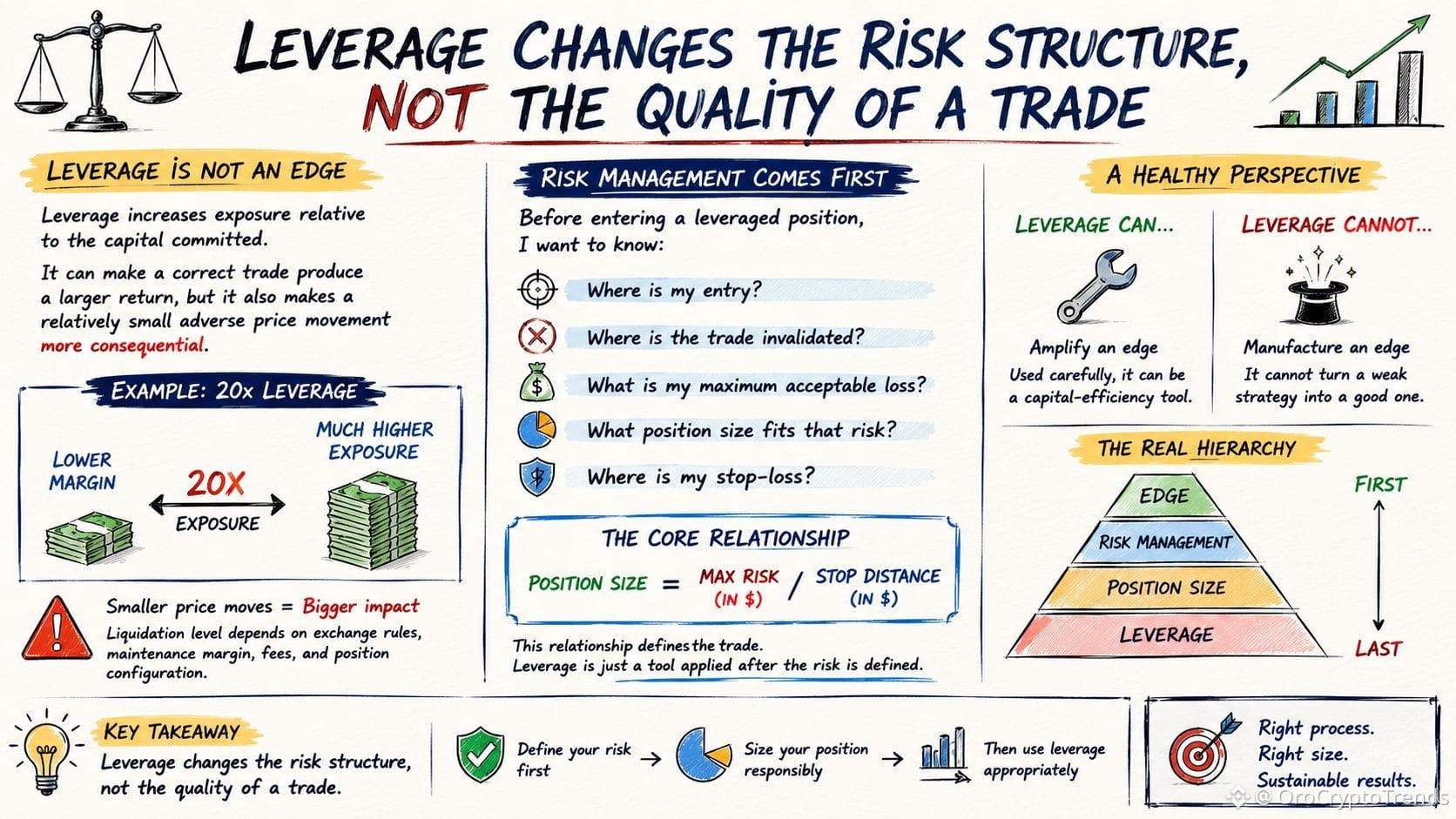
Leverage increases exposure relative to the capital committed. It can make a correct trade produce a larger return, but it also makes a relatively small adverse price movement more consequential.
That distinction matters.
Consider a trader using 20x leverage. The position has much greater exposure than the margin supporting it, so the distance between the entry and a potentially damaging move becomes much more important. The exact liquidation level will depend on the exchange, maintenance margin, fees, and position configuration.
That’s why I think risk management should come before leverage selection.
Before entering a leveraged position, I want to know:
• Where is my entry?
• Where is the trade invalidated?
• What is my maximum acceptable loss?
• What position size fits that risk?
• Where is my stop-loss?
The important relationship is between position size, stop distance, and maximum loss. Leverage should be considered within that framework—not used to determine how much risk to take.
There is also a counterpoint: leverage itself isn’t inherently bad. Used carefully, it can be a capital-efficiency tool. The problem begins when higher leverage is mistaken for higher conviction or a better strategy.
Leverage can amplify an edge.
It cannot manufacture one.
Educational content only. Not financial advice.
#RiskManagement #cryptoeducation #BTC
One thing I’ve noticed in crypto trading discussions is that leverage is often treated as an edge.
I see it differently.
Leverage increases exposure relative to the capital committed. It can make a correct trade produce a larger return, but it also makes a relatively small adverse price movement more consequential.
That distinction matters.
Consider a trader using 20x leverage. The position has much greater exposure than the margin supporting it, so the distance between the entry and a potentially damaging move becomes much more important. The exact liquidation level will depend on the exchange, maintenance margin, fees, and position configuration.
That’s why I think risk management should come before leverage selection.
Before entering a leveraged position, I want to know:
• Where is my entry?
• Where is the trade invalidated?
• What is my maximum acceptable loss?
• What position size fits that risk?
• Where is my stop-loss?
The important relationship is between position size, stop distance, and maximum loss. Leverage should be considered within that framework—not used to determine how much risk to take.
There is also a counterpoint: leverage itself isn’t inherently bad. Used carefully, it can be a capital-efficiency tool. The problem begins when higher leverage is mistaken for higher conviction or a better strategy.
Leverage can amplify an edge.
It cannot manufacture one.
Educational content only. Not financial advice.
#RiskManagement #cryptoeducation #BTC