
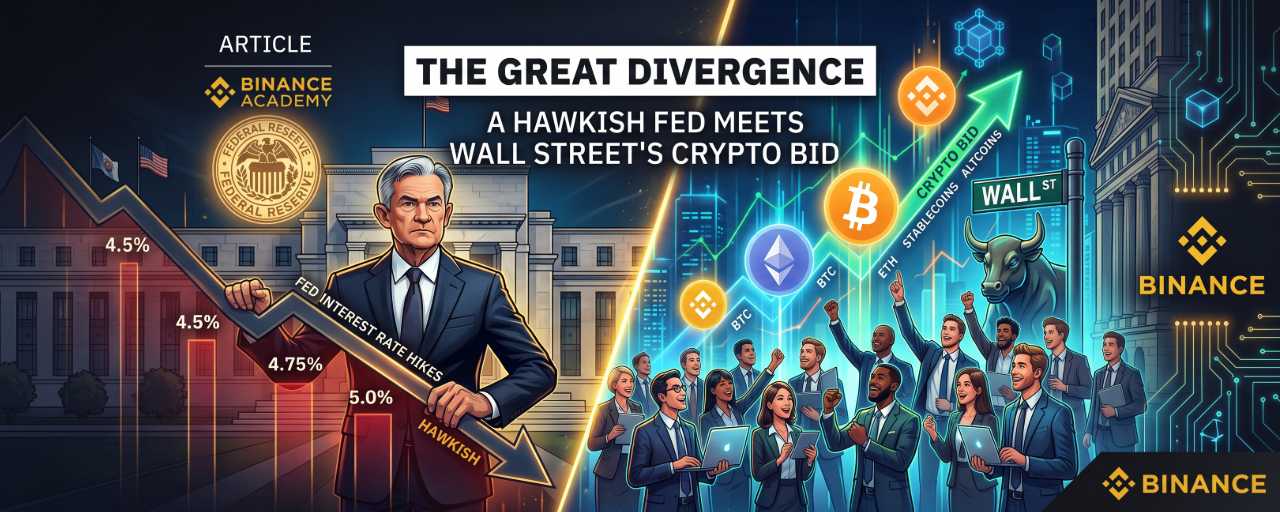

Markets are pulling in two directions at once. Here's what the latest news flow is really telling us.
If you only watched the price ticker this week, you'd think crypto was on the back foot. If you only watched the flows, you'd think institutions couldn't buy fast enough. Both are true — and the gap between them is the single most important story in the market right now.
On one side: a newly hawkish Federal Reserve, rising rate-hike odds, and a broad risk-off mood dragging Bitcoin and Ether lower. On the other: record ETF inflows, major brokerages expanding their crypto menus, and Wall Street names quietly building positions. Let's unpack the split.
The Macro Squeeze: Warsh Says "We Have Work to Do"
The pressure is coming straight from the top. Fed Chair Kevin Warsh used his first Jackson Hole keynote to plant inflation firmly at the center of the Fed's near-term agenda, telling the Kansas City Fed's symposium that the responsibility for the last several months "is ours." The tone was more hawkish than markets expected — PCE running at 4.1% on a six-month basis, financial conditions described as "not restrictive," and a flat-out rejection of forward guidance.
The reaction was immediate. Odds of a September rate hike jumped to roughly 57%, and Wall Street's three major indexes closed lower on the Friday, with semiconductor names like Nvidia and Intel dragging the Nasdaq down. A U.S. crypto-linked equity index fell more than 8% on the week. Rising real yields — climbing faster than nominal and breakeven rates — suggest bond markets actually believe the Fed's inflation resolve, which is the opposite of what risk assets want to hear.
The wildcard is jobs. Bloomberg Chief Economist Anna Wong flagged that next week's non-farm payrolls could come in weak — even negative — and noted there's no modern precedent for the Fed hiking after two negative payroll prints. In other words, the September decision may hinge on a single data release. Layer on the IMF nudging its 2026 global inflation forecast up to 4.7% as the Iran–Israel conflict disrupts energy supply, and the macro picture is genuinely tense.
But the Flows Tell a Different Story — and They're Rotating
Here's where it gets interesting. Even as prices softened, capital didn't leave crypto. It rotated.
Bitcoin ETFs cooled. U.S. spot Bitcoin ETFs snapped a nine-day inflow streak with a net outflow of about $201.9 million, according to Farside data — a pause, not a stampede for the exits.
Ether ETFs kept grinding higher. Spot Ethereum ETFs went the other way, pulling in roughly $102.1 million for a 12th straight day of inflows — quiet, persistent accumulation.
XRP stole the show. Spot XRP ETFs drew about $110.49 million for the week ending August 28 — their strongest weekly haul of 2026 and more than double the prior record, with volume hitting around $363 million, per BeInCrypto.
When one asset sees outflows while two others set records in the same week, that's not fear — that's money reshuffling between narratives while staying firmly on the table.
Institutions Aren't Waiting for a Bottom
The clearest signal that this is a "buy the infrastructure" moment rather than a retreat is who's showing up.
Charles Schwab plans to expand its direct crypto trading beyond Bitcoin and Ether to include Solana, Avalanche, and Chainlink — a mainstream brokerage widening retail access at the exact moment sentiment is shaky. Meanwhile, 13F filings revealed that Goldman Sachs is the largest known holder of spot Solana ETF exposure, at around $88.1 million. When a hawkish Fed is spooking traders and a bulge-bracket bank is still the biggest name on a Solana ETF cap table, the long-term conviction thesis speaks for itself.
That conviction has a macro rationale, too. Grayscale's research team argues the so-called "debasement trade" is benefiting Bitcoin, with research head Zach Pandl pointing to unchecked government debt growth weakening confidence in fiat currencies. It's the same logic pushing COMEX gold net-long positions to an 11-month high. In a world of sticky inflation and ballooning deficits, hard-capped assets get a second look.
Under the Hood: Quantum, RWAs, and the Usual Risks
A few structural stories worth keeping on your radar:
Quantum-resistance is moving from theory to testnet. Ripple confirmed a four-stage quantum-resistant migration plan for the XRP Ledger, aiming to finish before quantum computers become a real threat. Separately, Starkware said an anti-quantum Bitcoin transaction was mined on mainnet on August 26 without any soft fork, hard fork, or consensus change — an early sign the industry is taking the long-tail risk seriously.
Real-world assets keep building, unevenly. Stellar-based tokenized RWAs topped $3 billion in July, though the network's own TVL lagged at around $213 million — a reminder that "RWA value" and on-chain DeFi depth don't always move together.
And the risks are as loud as ever. A Solana meme coin called GOLD crashed more than 90% in minutes, with one buyer reportedly losing over $62,000 in seven minutes. Afghanistan's Taliban government has reportedly banned Bitcoin and crypto trading nationwide. And Coinglass data shows Ether sitting on a knife's edge — roughly $988 million in short liquidations would trigger if ETH breaks above $2,555, with heavy long liquidations lurking below $2,320. Volatility cuts both ways.
The Bottom Line: What to Actually Watch
Strip away the noise and the setup is clean. The macro is the near-term risk — a hawkish Warsh Fed and next week's payrolls print could set the tone for September and beyond. The flows and institutions are the longer-term signal — ETF demand is rotating rather than fleeing, and serious money keeps building access and exposure.
The three things worth watching over the next two weeks:
Payrolls, then the Fed. A weak jobs number could flip the hike narrative fast, per Anna Wong's read.
ETF flow direction. Does Bitcoin's outflow become a trend, or do the ETH and XRP inflow streaks pull it back?
Key levels. Traders are eyeing a Bitcoin pullback zone near $75,500 as a potential opportunity, while ETH's $2,320–$2,555 band is a liquidation battleground.
Fear and conviction rarely sit this close together. When they do, discipline beats prediction — position for volatility, and let the data lead.
This article is a market-news summary for informational and educational purposes only and is not financial, investment, or trading advice. It reflects reporting and data circulating on Binance Square and cited outlets as of late August 2026; figures and conditions change quickly. Cryptocurrency is highly volatile and you may lose your entire investment. Always do your own research (DYOR) and consider consulting a licensed professional before making decisions.