

One thing about @Hertzflow_xyz caught my attention before mainnet.
It wasn’t the leverage.
It wasn’t the liquidity.
It wasn’t the referral system.
It was the language.
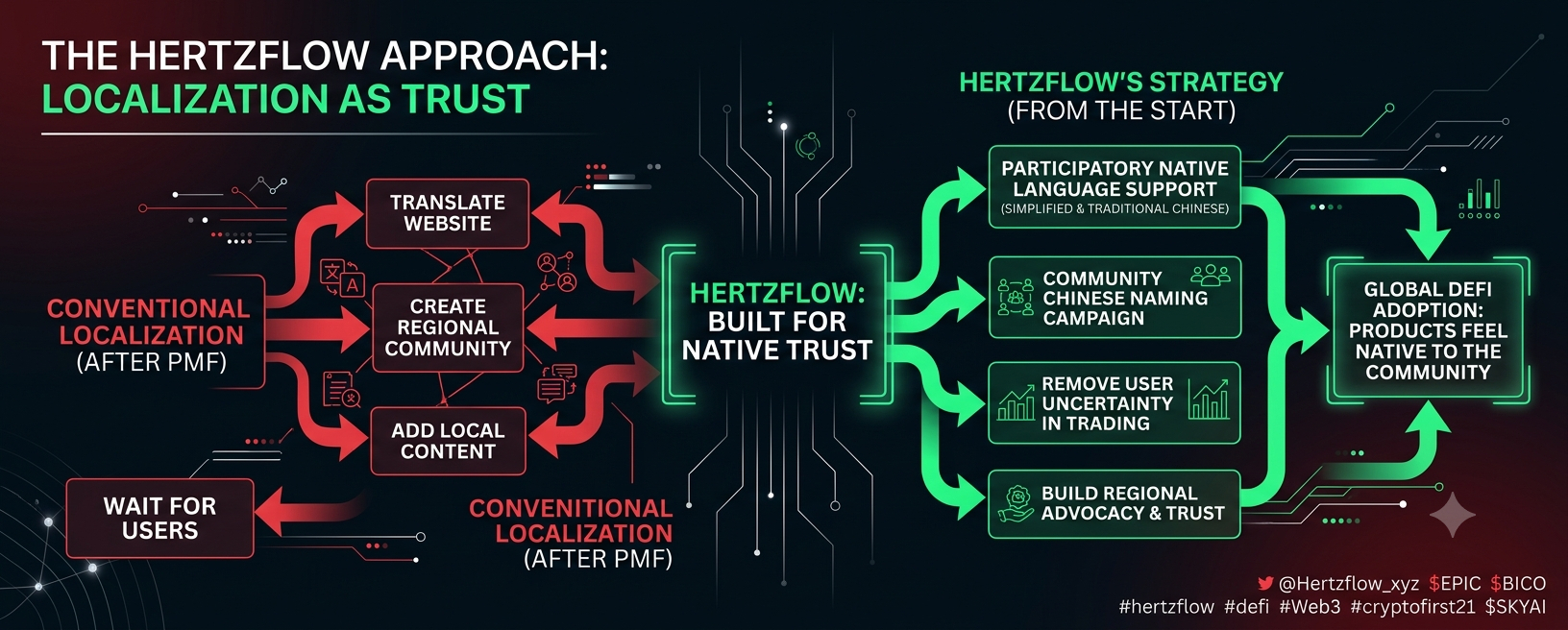
Hertzflow introduced both Simplified and Traditional Chinese support before mainnet, working alongside co-founder Vincent Shang, a well-known Chinese-speaking voice in crypto.
At first, I looked at that as simple localization.
The more I thought about it, the more I saw it differently.
Chinese-speaking traders are a major part of the global crypto derivatives market, yet many on-chain platforms still treat localization as something that comes after product-market fit.
Translate the website.
Create a regional community.
Add some localized content.
Then wait for users.
Hertzflow seems to be approaching it from the opposite direction.
Build for the community from the beginning.
That matters because trading interfaces aren't just websites people browse.
When users are putting self-custodied capital into a leveraged trading environment, every detail matters. A confusing sentence, unfamiliar terminology, or unclear interface can create hesitation at exactly the wrong moment.
So I don't think localization is simply about reaching more people.
It's also about removing uncertainty.
And there's another part I find interesting: the Chinese naming campaign.
Instead of simply translating the brand, Hertzflow is giving the community a chance to influence how the protocol is represented in another language.
That makes localization feel less like marketing and more like participation.
People may use a product because they understand it.
But they are more likely to advocate for something when they feel they had a role in shaping it.
I don't know yet whether this becomes a real advantage for Hertzflow. That will ultimately depend on the product, execution, and how users respond once the protocol is live.
But the approach is worth watching.
Crypto doesn't become global simply because a website supports more languages.
It becomes global when products start feeling native to the communities they're built for.
Most protocols translate interfaces.
The interesting ones try to translate trust.
What Chinese name do you think best captures Hertzflow's vision of self-custodial, permissionless trading?