

Most crypto projects treat a mainnet launch like a marketing event. The focus is often on countdowns, teasers, and generating as much attention as possible.
But I've noticed that some of the strongest signals come from something much quieter. It's the moment a team stops talking about what's coming next and starts preparing for what happens after launch.
That's why @Hertzflow_xyz's recent testnet reset stood out to me.
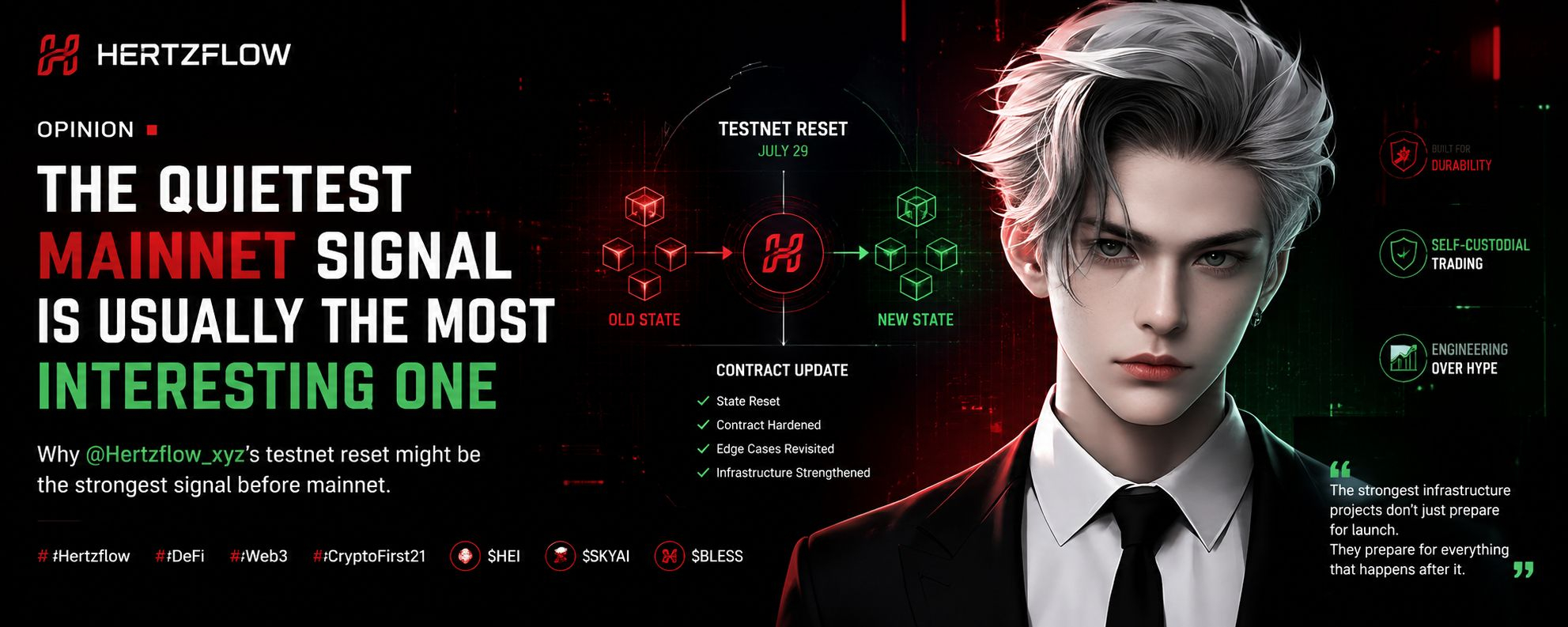
On July 29, the team reset the entire testnet alongside a contract update, clearing previous user data and asking participants to begin again. At first glance, it looked like routine maintenance. I think it represents something more meaningful.
A testnet exists to expose weaknesses. A mainnet exists to withstand them.
Those are completely different goals.
During testing, breaking things is expected. Once real users and real capital are involved, every assumption becomes a potential risk. Resetting state, improving contracts, and revisiting edge cases may not create excitement, but they're exactly the kind of work that helps build reliable infrastructure.
That matters even more for a protocol focused on self-custodial leveraged trading.
When users control their own assets and real positions are at stake, stability becomes far more important than hype. A successful launch isn't defined by how much attention it receives. It's defined by how smoothly it performs once people begin using it.
I also think this highlights the difference between building software and building financial infrastructure.
Software can evolve after release. Financial infrastructure needs to earn trust before release.
That's why I pay close attention to engineering decisions that rarely make headlines. They often reveal far more about a team's priorities than another promotional campaign ever could.
Of course, a testnet reset doesn't guarantee a successful mainnet. Strong execution is still what matters most.
Still, I'd rather evaluate the quiet engineering work happening behind the scenes than another countdown post on social media.
Sometimes the market spends too much time listening to what teams say and not enough time watching what they quietly choose to improve.
To me, the most interesting part of Hertzflow's recent update wasn't the announcement itself. It was the team's apparent focus on strengthening the protocol before asking users to trust it with real capital.
The strongest infrastructure projects don't just prepare for launch.
They prepare for everything that comes after it.
What matters more to you before a mainnet launch—marketing or the engineering decisions happening behind the scenes?