
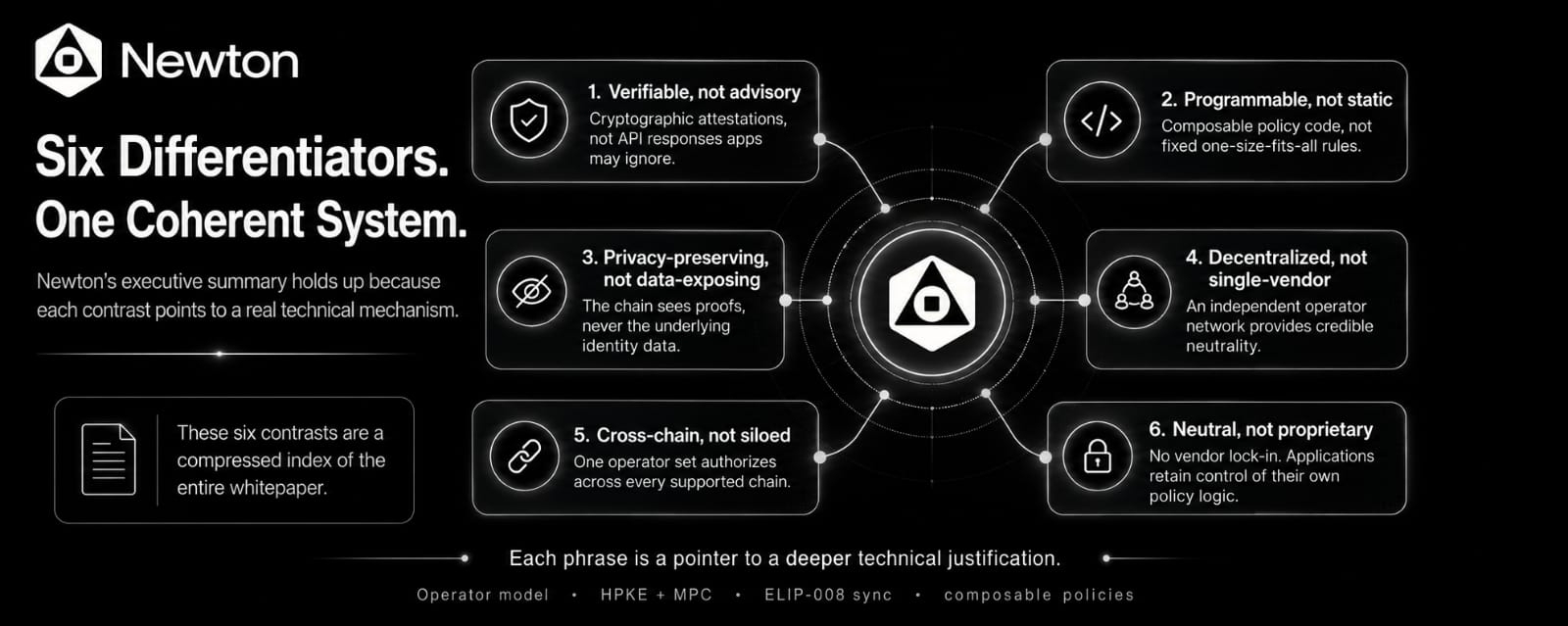
Went back to Newton's Executive Summary today to look at the six key differentiators as a complete set, since Ive covered most of the individual facts behind them separately across earlier posts but never the framing that ties them together.
Verifiable, not advisory. Attestations are cryptographic proof, not API responses applications may ignore. Programmable, not static. Policies are composable code, not fixed rules. Privacy-preserving, not data-exposing. The chain sees proofs, never underlying identity data. Decentralized, not single-vendor. An independent operator network provides credible neutrality. Cross-chain, not siloed. One operator set authorizes across every supported chain. Neutral, not proprietary. No vendor lock-in, applications retain control of their own policy logic.
What stands out looking at all six together is the consistent rhetorical structure, each one names what Newton is against, not just what it is. That structure only works if each contrast is actually substantiated somewhere in the document, and having read through most of the whitepaper at this point, I think each one genuinely is, decentralization is backed by the operator and quorum model, privacy is backed by the HPKE and MPC layers, cross-chain is backed by the ELIP-008 compliant sync mechanism.
What I find most useful about this framing, now having gone through the whole document, is that these six differentiators function as a compressed index of everything else the whitepaper argues in detail elsewhere. Each phrase is really a pointer to a much longer technical justification found in a later section.
Closing thought rather then an open question this time, having spent this many days on one document, what strikes me most is how rarely a single summary paragraph this early in a whitepaper actually holds up against the full technical detail that follows it. Usually a gap opens up somewhere. Here, mostly, it didnt.