

Infrastructure layers don't emerge because someone thought of a good idea.
They emerge when the conditions that make them necessary converge at the same time.
@NewtonProtocol isn't arguing that an authorization layer for onchain finance would be nice to have.
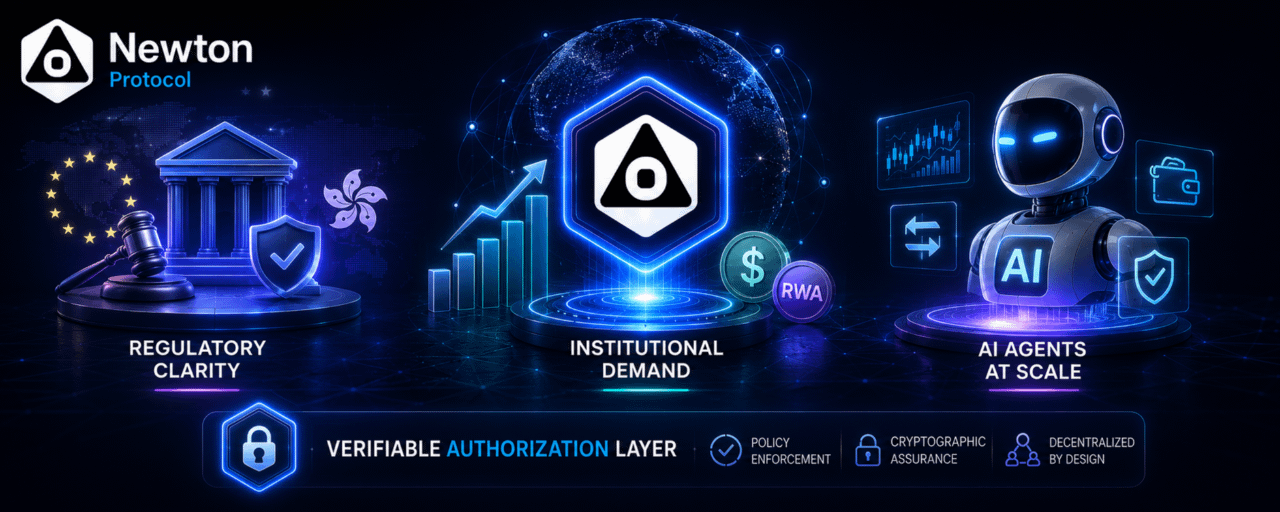
It's arguing that three forces are converging right now — and that without this layer, the next phase of onchain finance simply doesn't happen at scale.
The first force is regulatory crystallization.
For years, digital asset compliance existed in a zone of ambiguity. Guidance was vague, frameworks were provisional, and the enforcement posture was inconsistent enough that institutions could reasonably defer participation.
That ambiguity is closing.
The GENIUS Act was signed into law in July 2025. Hong Kong's Stablecoin Ordinance went into effect August 2025. MiCA is live across the EU. FATF Travel Rule implementation is advancing with specific stablecoin and DeFi provisions.
These frameworks share a common architecture: they require enforceable controls at the transaction level, not just onboarding-time checks. They expect cryptographic audit evidence that policies were applied, not compliance program documentation claiming they were.
For the first time, regulated institutions know exactly what they need to satisfy their regulators to participate in onchain markets. The missing piece is infrastructure that actually delivers it.
The second force is institutional demand at an inflection point.
Stablecoins have crossed $298 billion in circulating supply with monthly transfer volume over $700 billion. Tokenized real-world assets have exceeded $21 billion. Major banks, asset managers, and payment providers are not asking whether to participate in onchain finance — they're asking how to do so with infrastructure their compliance teams and regulators will accept.
The question has shifted from whether to how.
The infrastructure that answers how doesn't yet exist in a decentralized, verifiable form. That's the gap Newton fills.
The third force is AI agents entering finance.
Autonomous agents can execute hundreds of transactions per hour without a human approving each one — interacting with DeFi protocols, moving funds across chains, executing trades at speeds no manual compliance process can match.
The authorization guardrails for this environment can't be human approval queues. They have to be programmatic, pre-execution, and cryptographically enforced — exactly what Newton's policy evaluation architecture provides.
These three forces are arriving simultaneously, not sequentially.
Institutions need compliant onchain infrastructure at the moment regulation finally defines what compliant means and at the moment AI agents are creating new transaction categories regulators haven't written rules for yet.
Newton's technical foundations are assembled from components that are already mature.
EigenLayer provides a proven restaking framework for economic security. Rego and OPA are enterprise-grade policy languages already running cloud-native infrastructure worldwide. BLS signature aggregation is an established cryptographic primitive. ZK virtual machines that can prove arbitrary computation are production-capable. NATS provides sub-millisecond messaging for streaming consensus.
The design commitment that holds the assembly together is credible neutrality.
A regulated European bank and a permissionless DeFi protocol can both use Newton, each with policies appropriate to their own context, neither constrained by the other's requirements.
Newton's case is that onchain finance needs the equivalent of what TCP/IP did for the internet: neutral, shared infrastructure that any application can build on, any policy author can extend, any operator can join, and any challenger can verify.
The conditions are in place. The components are ready. The regulatory frameworks are written.
The authorization layer for onchain finance isn't a concept anymore.
It's live.