
A landlord I rented from years ago had a security deposit policy that seemed unusual at the time. If a tenant damaged something, the deposit didn't just vanish into his general account, it went specifically toward fixing whatever that tenant broke, and if there was money left over it came back. Most landlords I'd dealt with before just kept the whole deposit regardless of the actual damage, treating it as a flat penalty rather than a repair fund. The difference sounds small until you're the tenant who caused twenty dollars of damage and would have lost a full month's deposit under the old system. Where a penalty goes changes what the penalty is actually for.
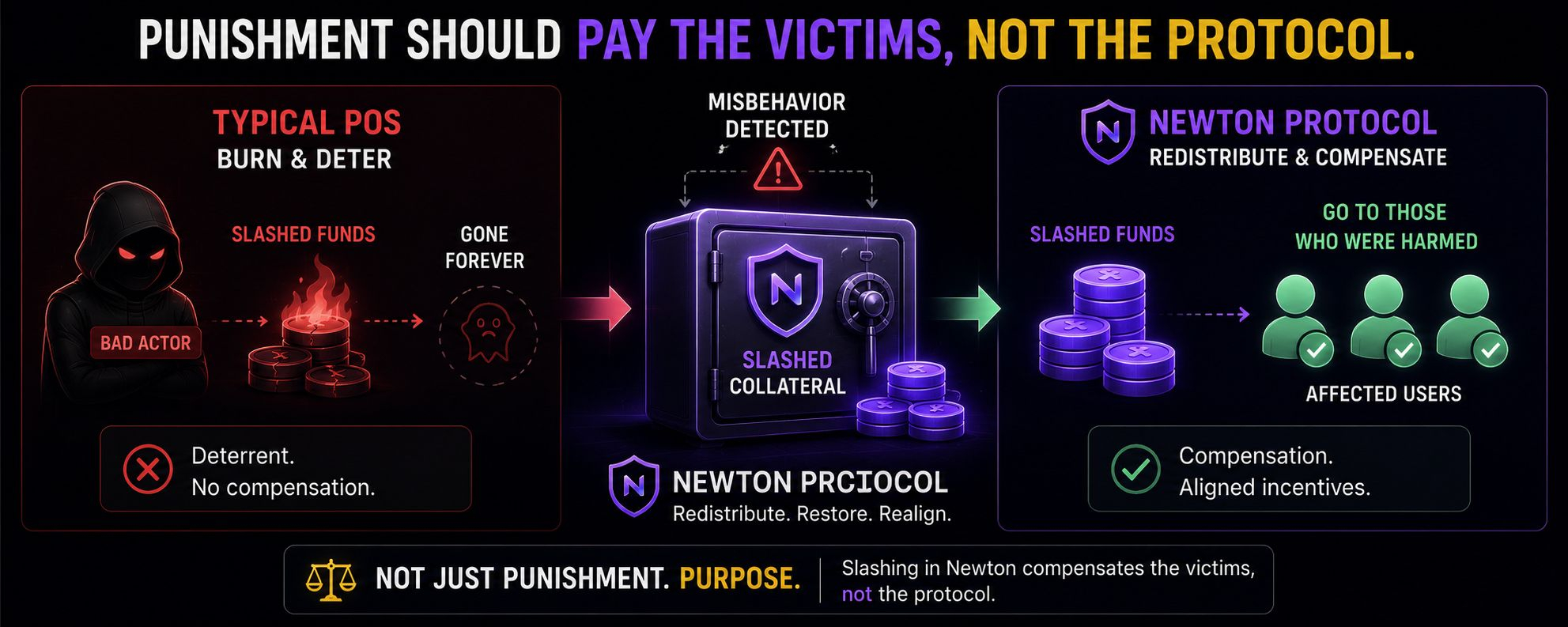
That same design question, where does the punishment money actually go, is worth asking about Newton's slashing mechanism instead of assuming it's a solved, boring detail. When an agent operator misbehaves badly enough to trigger slashing, or a validator acts maliciously in a way that gets caught, the collateral they staked doesn't just get burned into the void or absorbed as generic protocol revenue. It gets redistributed specifically to the users affected by that misbehavior. That single design choice, redirect rather than burn, quietly reframes what slashing is for.
A lot of proof-of-stake systems treat slashing purely as a deterrent, burn the offender's stake, reduce total supply slightly, send a message to everyone watching that bad behavior costs money. That works fine as a deterrent mechanism, but it does nothing for the specific person who actually lost money because of the misbehavior in the first place. Newton's redistribution model treats slashing as something closer to a compensation fund automatically triggered by the misconduct that caused the harm, rather than an abstract punishment disconnected from who actually got hurt.
Walking through the mechanics helps make this concrete. First, there are two distinct staking roles that can face slashing, validators who secure the Keystore rollup and verify agent execution, and agent operators who stake NEWT as collateral specifically to run agent models for users. Second, operators earn fees from users for running those models, meaning the collateral they put up is functioning as a performance bond tied directly to the service they're being paid for, not a separate, disconnected requirement. Third, the redistribution mechanism requires the protocol to actually identify which users were harmed by a specific instance of misbehavior, which is a nontrivial technical and procedural problem, not just a wallet transfer, since it has to trace the misbehavior back to its actual victims rather than distributing funds arbitrarily. Fourth, this compensation only covers the collateral actually staked by the offending party, which means the redistribution is capped by how much that specific operator or validator had at risk, not by the full scope of damage a bad actor could theoretically cause if their position size exceeded their stake. Fifth, the entire mechanism depends on the TEE attestation and zero-knowledge proof systems working correctly to detect misbehavior in the first place, since slashing can only redistribute funds for violations the protocol can actually prove happened.
That last point is where the design gets genuinely interesting rather than just feel-good. A compensation mechanism is only as good as the detection system feeding it. If TEE attestation or zk verification misses a violation, or takes too long to catch one relative to how fast damage compounds, the redistribution promise doesn't help the user who already lost money before detection caught up. The 14-day unstaking cooldown discussed elsewhere in Newton's design exists partly to give this detection process room to work before an offending party's stake can walk out the door. Slashing redistribution and the unbonding period are not separate features, they're two parts of the same compensation pipeline, one guarantees the money stays put long enough to be clawed back, the other decides where it goes once it is.
The honest limitation is that this system compensates after the fact, it doesn't prevent the initial loss from happening, and the size of that compensation is bounded by collateral size, not by actual damages, which means a large enough violation from an undercollateralized operator could still leave affected users only partially made whole even when the mechanism works exactly as designed.
Newton isn't treating slashed collateral as a punishment that disappears into the protocol's coffers, it built a compensation pathway that traces harm back to the people who experienced it. That's a meaningfully different design decision than the burn-and-deter model most staking systems default to, closer in spirit to my old landlord's damage-specific deposit than a flat penalty, even if that compensation still has real limits worth knowing about before assuming it covers every possible loss a user could face.
@NewtonProtocol $NEWT #Newt $LAB $VELVET
