
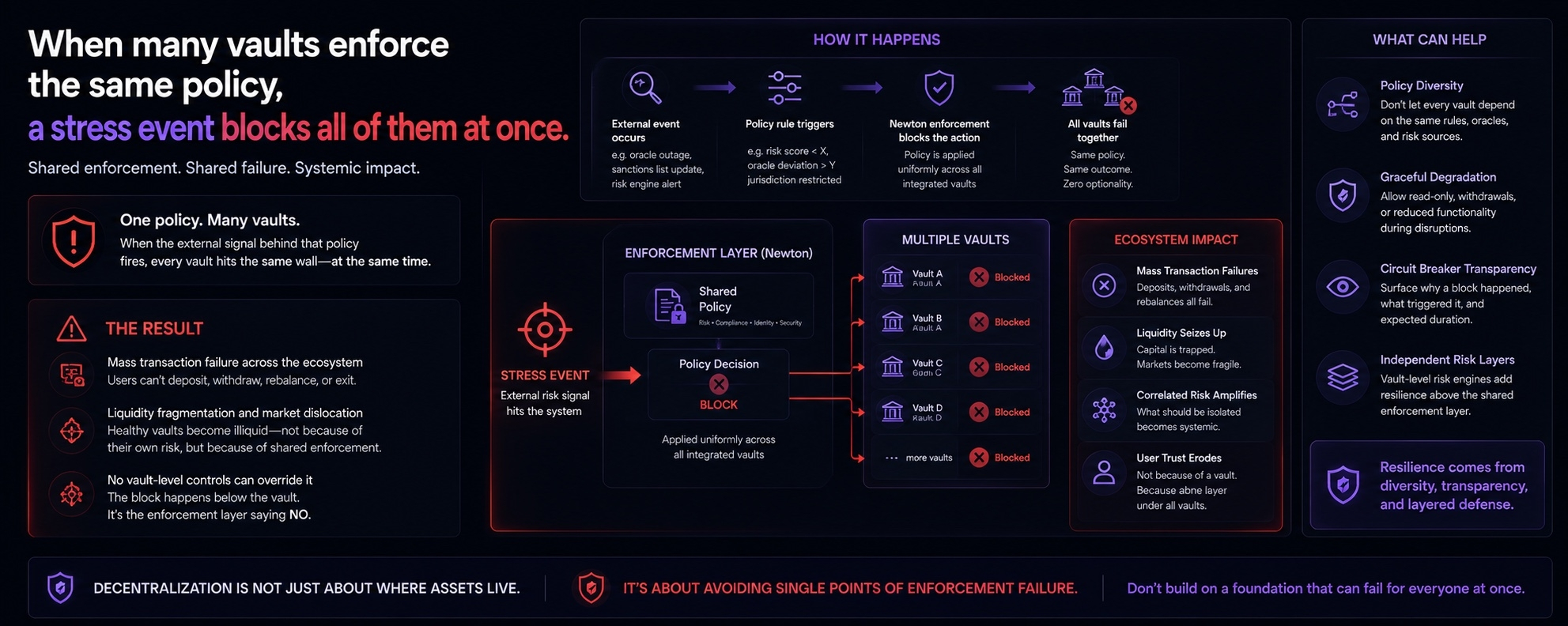
I have been thinking about this through the lens of what actually happened during the March 2020 DeFi liquidity crisis and the Terra collapse in May 2022. In both events, the cascade dynamic was not driven by individual protocol failures but by the correlation structure of the ecosystem. Many protocols had made similar assumptions about collateral quality, similar liquidity assumptions, and similar oracle dependency structures. When one assumption was violated, it was violated across all of them at once because they all shared it. The cascade was correlated. Newton's Internet of Policies creates a structural precondition for a new form of correlated behavior that could amplify rather than dampen the next stress event.
Here is the specific mechanism I want to model. A popular policy in Newton's marketplace enforces counterparty health check via Credora above a certain threshold and oracle health via RedStone above a certain threshold. That policy is well-reviewed, has a strong track record in normal conditions, and is used by thirty institutional vaults managing a collective few billion dollars in TVL. A market stress event begins: a large lending protocol faces liquidity pressure, its token collateral falls 30% in four hours, several counterparties that were Credora-healthy yesterday are now flagged as distressed, and oracle feeds for assets correlated to that lending protocol show health degradation. Newton's Risk domain across all thirty vaults, running the same shared policy with the same Credora and RedStone thresholds, begins simultaneously blocking transactions.
Thirty vaults simultaneously unable to execute their strategies means thirty sets of yield harvesting halted, thirty sets of rebalancing blocked, thirty sets of liquidity provision frozen. The institutional capital in those vaults cannot respond to market conditions the way it would without enforcement. Positions cannot be reduced at the moment the operators most want to reduce them. In a stress scenario where rapid position adjustment might contain contagion, simultaneous enforcement blocks across correlated vaults extend rather than limit exposure. Newton's enforcement does not cause the stress event. But the correlated structure of enforcement across many vaults using shared policy creates a mechanism through which Newton enforcement amplifies stress impact rather than being neutral to it.
The irony here is structural and worth sitting with. The more successful Newton's Internet of Policies marketplace becomes at raising baseline enforcement quality across the ecosystem, the more correlated enforcement behavior becomes across vaults, and the larger the potential simultaneous enforcement action in a stress event. Newton's success creates the precondition for the amplification risk. This is not a reason to abandon shared policy or to conclude Newton's design is flawed. It is a reason to think carefully about policy diversity as an explicit design goal alongside policy quality.
Policy diversity in this context means ensuring that vaults using the Newton ecosystem do not all end up with substantially identical enforcement thresholds even when drawing from shared policy building blocks. There are a few mechanisms that could promote this. First, Newton could publish a Policy Correlation Index that shows vault operators how similar their enforcement configuration is to the aggregate of other Newton-enforced vaults, allowing operators who want to reduce correlated exposure to differentiate their configuration deliberately. Second, Newton could design the Internet of Policies marketplace to surface policy diversity as a quality signal alongside policy track record, rather than allowing popularity to be the dominant ranking signal which would naturally push vaults toward convergent configuration. Third, Newton's Risk domain could incorporate ecosystem-level correlation data as an input to enforcement decision at the margin, meaning a transaction that would individually pass might receive a modified signal when the same transaction type is being blocked simultaneously across many other vaults.
None of these mechanisms are currently described in Newton's architecture documentation. I do not think Newton team has missed this problem, and I suspect Vaults.fyi as a partner has data about how correlated vault behavior plays out in stress conditions that is directly relevant. The question is whether policy diversity and systemic enforcement correlation are being designed into Newton's roadmap explicitly or whether they are being treated as emergent properties to be addressed after the marketplace has scaled. The answer matters because the correction is easier before correlated positions have accumulated than after a stress event has demonstrated the amplification mechanism at cost.
Magic Labs building Newton with EigenLayer at the security layer and Succinct for proof verification reflects a team thinking carefully about technical decentralization of enforcement computation. The correlated enforcement amplification problem is the equivalent question at the economic and strategic layer, and it deserves the same level of explicit design attention. Good enforcement at individual vault level, without attention to systemic correlation across vaults, is a half-solution for institutional DeFi risk management.
As Newton's Internet of Policies marketplace grows and many institutional vaults converge on similar high-quality enforcement configurations that share the same Credora and RedStone thresholds, does Newton have a plan to monitor and publish ecosystem-level enforcement correlation metrics so that vault operators can make informed decisions about policy differentiation, and if correlated enforcement blocks across many vaults during a stress event amplify market impact rather than contain it, does Newton consider that an enforcement design problem to address at protocol level or a market structure problem outside its scope?