
A friend of mine hired a freelance bookkeeper years ago who insisted she did not need to send receipts, she would just tell him at the end of each month what she had spent and categorized. He trusted her for almost a year before an audit forced him to actually verify her numbers against bank statements, and the two did not match in several places, nothing criminal, just sloppy self-reporting that nobody had ever independently checked. What struck him afterward was not that she had lied exactly, it was that the entire arrangement had rested on trusting her own account of her own work, with no independent record standing between her claim and his belief in it.
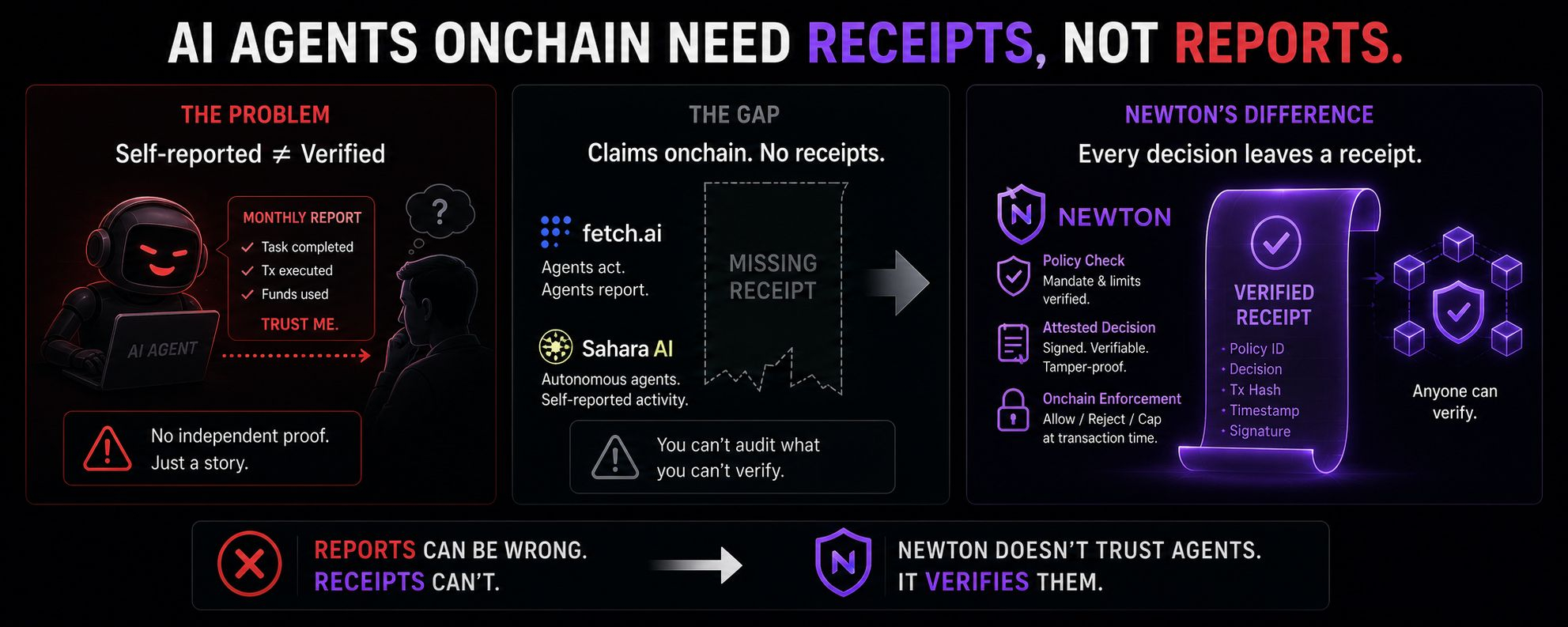
That same structural gap sits underneath a lot of projects currently using "AI agents onchain" as a headline phrase, and it is worth pulling apart carefully rather than treating the phrase as one undifferentiated category. Fetch.ai's autonomous economic agents are built to act independently, negotiating and executing tasks on a user's behalf across its network. The system relies substantially on an agent's own reporting of what it did, with no built-in proof tying the agent's offchain reasoning process to the specific onchain execution that followed from it. Sahara AI markets similar language around autonomous agents participating in a decentralized AI economy, again without a standard mechanism proving that a given onchain action actually matched the reasoning or authorization behind it, rather than simply being reported as having done so.
Newton's approach targets that exact gap, though only for a narrower slice of what "agent behavior" can mean. Its transaction-layer attestations back every allow, reject, or cap decision with a signed record tied to the specific policy check that ran, verifiable by anyone without requiring them to trust the agent's own account of what it did. Newton's AI agent policies specifically enforce mandate scope and spending caps at the moment a transaction is attempted, meaning an agent acting outside its authorized job gets blocked structurally, not because it chose to self-report accurately. That is a real, checkable difference from a system that simply asks an agent to log its own actions honestly and hopes the log matches reality.
The honest caveat is that this closes a narrower gap than the phrase "verifiable AI agents" implies when read quickly. Newton's attestation proves a transaction stayed within its authorized mandate and spending limits at the moment it settled, it does not prove the agent's underlying reasoning was sound, was not manipulated upstream by a prompt injection before the transaction was even attempted, or that the model producing the decision was working correctly in any deeper sense. Fetch.ai's agents can do things Newton's current attestation model was never built to verify either, complex multi-step negotiations, service discovery, and coordination across a broader agent marketplace than Newton's narrower transaction-authorization scope currently covers. Comparing the two directly risks implying they compete head to head on the same feature set, when in practice they are solving overlapping but genuinely different slices of the same broad "AI agents onchain" narrative.
So does Newton actually close the receipt gap that projects like Fetch.ai and Sahara AI structurally leave open. Partly, and specifically for the piece of agent behavior it was built to police, whether a transaction stayed inside its authorized bounds. It does not close the upstream half of the problem, whether the agent's reasoning itself was sound before that transaction was ever attempted, a harder and largely unsolved question sitting one layer further back in the pipeline. The bookkeeper's receipts would have caught a miscategorized expense, they would not have caught a decision to spend money on the wrong thing entirely if she was authorized to make that call in the first place. Newton's attestations play a similar role, a real and useful check on one specific failure mode, not a complete answer to the much larger question of whether an autonomous agent should be trusted at all.
@NewtonProtocol #Newt $NEWT $LAB $EVAA
