@Pixels $PIXEL #pixel
I used to think guilds in game economies were mostly containers.
Useful containers, maybe.
Socially important sometimes.
But still containers.
A place to gather people.
Share information.
Put a tag next to a name.
Nothing deeper than that.
Pixels makes that frame feel weaker.
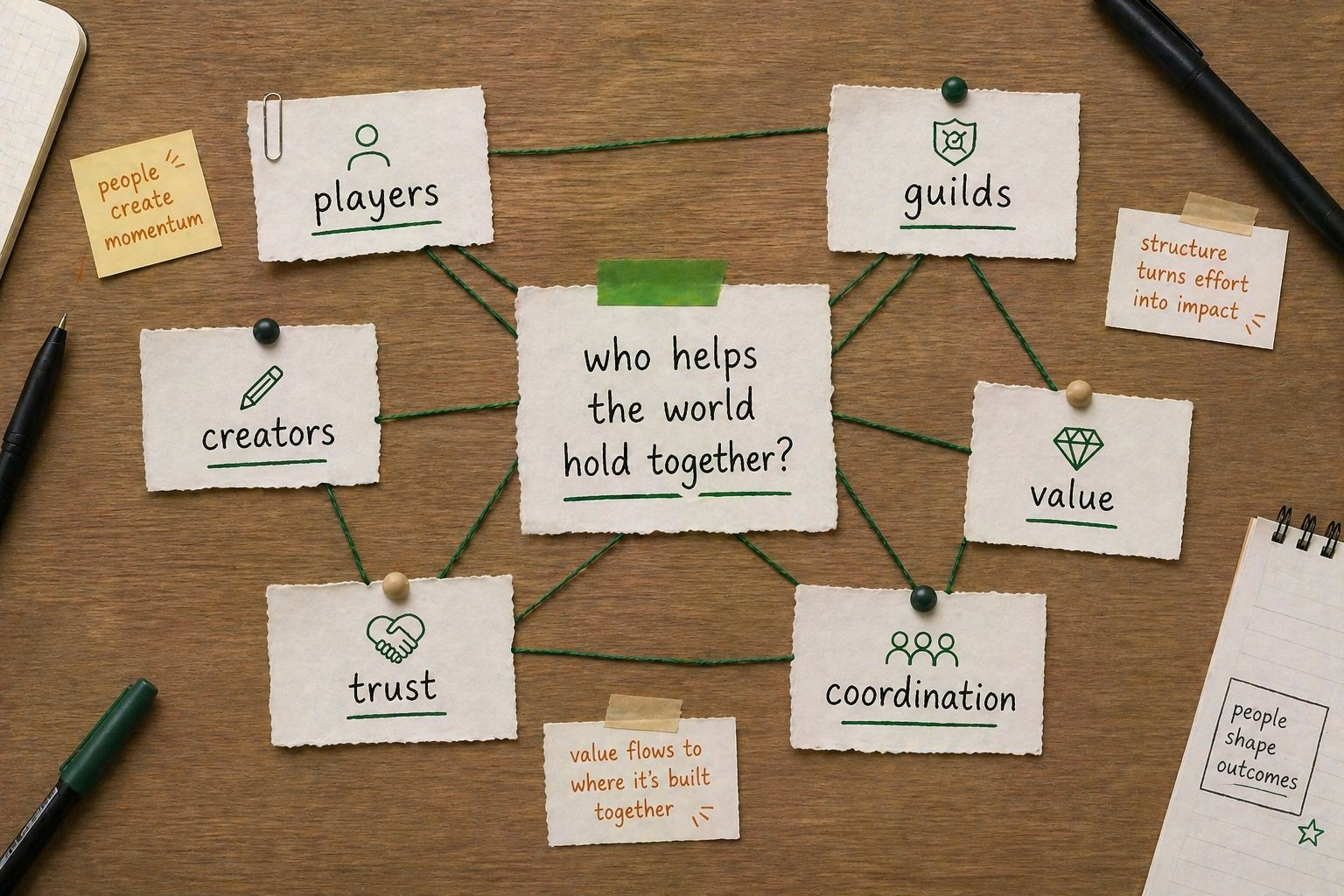
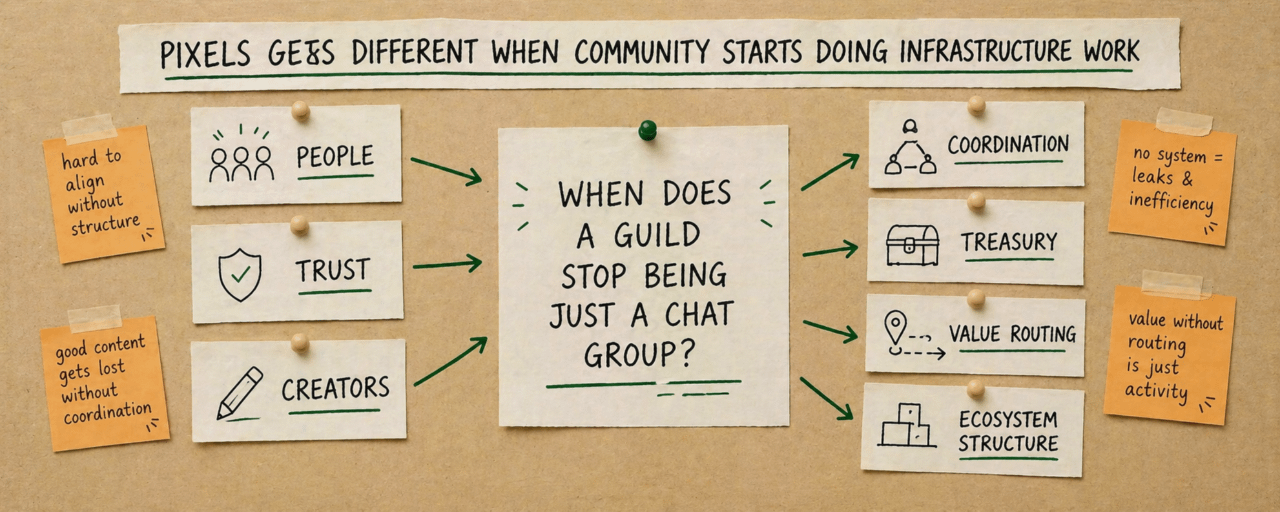
Because one of the more interesting things here is that the community layer does not seem satisfied being decorative. The moment a guild can start holding trust, coordinating behavior, routing value, and organizing how people move through the world, it stops looking like a chat wrapper and starts looking more like infrastructure.
That is a different role entirely.
A lot of games have groups.
That part is not special.
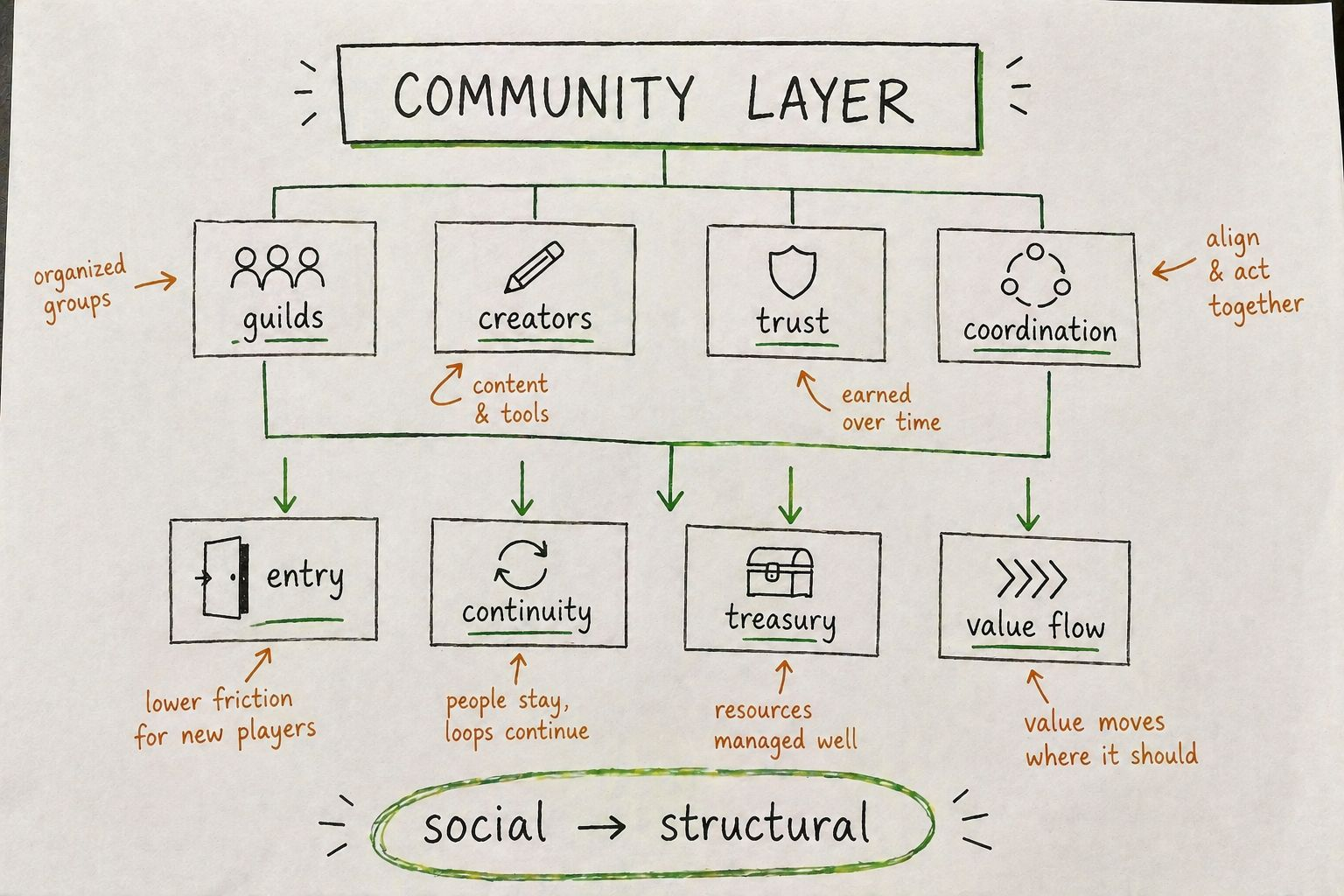
What matters is whether those groups stay purely social, or whether they slowly begin doing work that affects how the ecosystem actually functions.
That is the line I keep thinking about in Pixels.
Because once a guild can influence how confidently people enter the game, how they learn the system, where they coordinate, what they trust, and how value gets routed back, the word “community” starts sounding too soft for what is actually happening.
At that point, the guild is not just collecting people.
It is helping organize the world.
And organization matters more than most people admit.
A messy game economy can survive weak vibes.
It struggles to survive weak structure.
That is why this layer keeps looking more serious to me than it first did.
A creator can help someone understand the system.
A guild can help them stay inside it.
A trusted group can reduce hesitation, reduce random behavior, reduce bad early decisions, and make the ecosystem easier to move through with purpose.
That is no longer just social activity.
That is operational work.
And Pixels already shows signs of treating it that way.
The creator-code layer is one obvious clue. If purchases made with a creator code can route value back toward the creator or a guild treasury, then the system is already doing more than rewarding abstract attention. It is giving community-linked structures a real place in the flow of value. Guild creation and management are also not treated like totally disposable features, which pushes the whole thing further away from “just a Discord around a game” and closer to a more formal internal layer.
That changes how I read the whole ecosystem.
Because a lot of projects talk about community while still treating it like a marketing wrapper.
Pixels may be doing something harder.
It may be letting the community layer become part of the actual machine.
That does not mean every guild matters.
It does not mean every creator is useful.
It definitely does not mean every organized group deserves value by default.
But it does mean the project starts looking different once useful community structures can shape real outcomes.
A good guild is not only a social room.
It creates continuity.
It holds trust.
It makes people less random.
It gives the system somewhere stable to attach behavior.
That is a stronger role than “player chat.”
And once those structures matter economically, the social layer stops feeling secondary.
It becomes part of how the world holds itself together.
That is why I think Pixels gets more interesting when I stop asking whether the community is active and start asking a more serious question:
how much of the ecosystem now depends on community structures to function cleanly?
That is the better question.
Because noisy communities are easy to fake.
Real structure is harder.
If Pixels keeps moving toward a world where creators, guilds, trust, and coordination increasingly shape where value lands, then the social layer is no longer cosmetic.
It becomes part of the engine.
And that is a much bigger story than “the game has a strong community.”