


The part that stayed with me was not the usual staking language. It was the quiet implication underneath it.I have read a lot of token systems that promise “alignment,” and most of them collapse into the same simple pattern: lock token, earn yield, hope the number goes up. Pixels seems to be trying something stranger. Here, staking is not only about supporting a network in the abstract. It starts to look like backing a specific game, almost the way a publisher backs a title it thinks can win attention, retain users, and turn incentives into durable activity.#pixel @Pixels $PIXEL
That is where my curiosity started, but also where the practical friction showed up.Because once you say the validator is the game, you are asking users to do more than passively stake. You are asking them to judge. Which game deserves support? Which team can actually convert incentives into real engagement instead of short-term farming? Which pool represents a product with staying power, not just a temporary spike in rewards? That is a much heavier decision than most staking systems ask from ordinary users.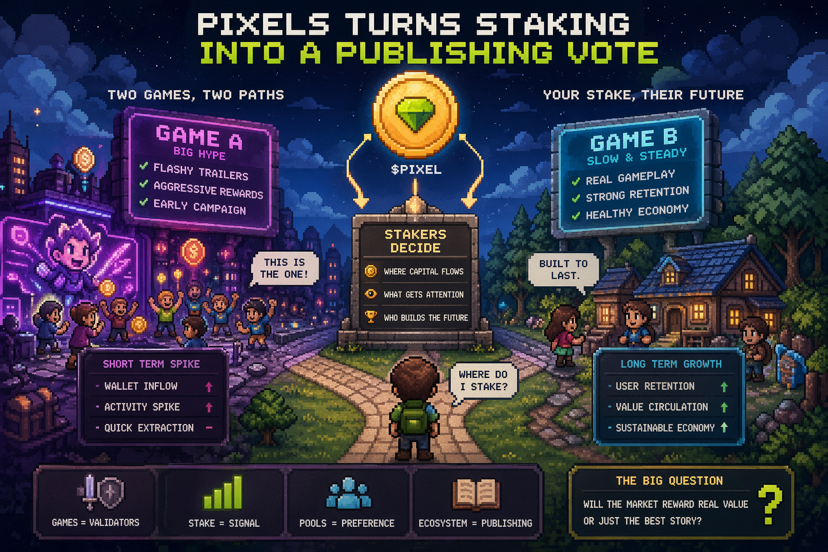
My read is that Pixels is quietly redesigning staking into a publishing decision.In a traditional blockchain model, validators are infrastructure. They secure blocks, maintain uptime, and follow protocol rules. In the Pixels framing, the role shifts. The whitepaper language around “one token, many validators” and the idea that “the validator is the game” changes what is being validated. The user is no longer only backing technical security. The user is backing a game’s future position inside the ecosystem. Stake starts behaving less like a security deposit and more like capital assigned to a title.
That changes everything.The mechanism matters here. Games replace traditional validators as the units competing for support. Stakers do not simply lock $PIXEL into one generic pool. They support specific game pools. Those pools then become signals. A pool with more support is not just a pool with more capital sitting inside it. It becomes a visible sign of ecosystem preference. Over time, that preference can shape where incentives flow, where attention concentrates, and which games gain stronger economic momentum.
So the stake is doing two jobs at once. It is allocating capital, and it is broadcasting belief.
That is why I think the publishing comparison fits so well. In normal gaming, publishers make selective bets. They decide which projects get funding, distribution, and strategic support. Pixels seems to be pushing part of that selection function outward, toward token holders and stakers. Instead of a centralized publishing desk deciding which game gets backed, the ecosystem itself begins to express a preference through stake distribution. At least in theory, that is a more open system.
But open systems are not always simple systems.
Imagine two games inside the Pixels ecosystem.
The first one arrives with all the usual signs of momentum: polished trailers, aggressive token rewards, and the kind of early campaign that makes people think it is already winning.Its numbers rise fast. Wallets enter. Activity spikes. But a lot of that activity is shallow. Players come for rewards, extract what they can, and leave when the loop weakens.
The second grows more slowly. Fewer headlines. Less noise. But its users stay longer, spend more carefully, and actually circulate value back into the game instead of immediately draining it. Its economy looks less exciting on day one, but healthier by month three.In the old model, both might just be content products competing for players. In the Pixels model, they are also competing for stake. And that means they are competing for confidence. The question is no longer just “Which game is fun?” It becomes “Which game deserves capital support from the ecosystem?”
That is a very different kind of competition.Why does this matter? Because it potentially aligns staking with game performance in a more economically honest way. If support flows toward games that create better retention, better spend quality, and stronger in-game loops, then staking stops being passive yield theater. It becomes a way of steering the ecosystem toward better operators. That could decentralize publishing decisions. It could also force games to compete on more than marketing. A studio may need to prove that it can turn incentives into durable economic behavior, not just temporary traffic.
That is the optimistic case.The harder case is that many users may not want this job.Most stakers are not full-time analysts of game economies. They may not have the time, information, or confidence to judge which pool deserves backing. In practice, many people will still follow social momentum, familiar brands, or headline narratives. If that happens, staking may not decentralize publishing as much as it appears to. It may simply recreate familiar popularity contests with token mechanics wrapped around them.
There is also the bootstrap problem. A weaker or newer game may struggle to attract support even if its design is genuinely promising. Strong pools can become stronger because they already look safer. That creates concentration risk. A few successful games could absorb most of the ecosystem’s confidence, while smaller titles remain underfunded and invisible. In theory the system is open. In practice, openness does not guarantee equal starting conditions.
That is the tradeoff I keep coming back to.Pixels may be building a more interesting staking design than the average game token project. It asks whether stake can function as productive ecosystem preference instead of idle collateral. I think that is a serious idea. But it also transfers responsibility onto users. The system works best if stakers behave like thoughtful allocators. I am not fully convinced most users came here wanting to become miniature publishing committees.
What I am watching next is simple. Do game pools end up reflecting real economic quality, or just narrative strength? Do weaker but well-designed games get a fair chance to earn support? And when pressure builds, will staking reward the games that create lasting value, or just the ones that tell the best story first?
That is where this design becomes real. Not in the slogan that games are validators, but in whether the market can actually tell the difference between a good game and a good pitch.#pixel @Pixels $PIXEL
