

For a long time, Web3 gaming chased a simple idea… let players earn. Sounds obvious, right? But somewhere along the way, that idea got twisted. Games stopped being games, and started feeling like… dashboards with buttons to click for rewards. It worked for a moment -- then it didn’t.
What most projects underestimated wasn’t the tech. Putting assets on-chain is actually the easy part. The real challenge, the one that quietly breaks everything, is incentive alignment. Who gets rewarded, for what, and why? Get that wrong, and the whole system leaks value.
@Pixels has been sitting in that problem for a while now.
At first, it looked like just another farming game. Simple loops, pixel graphics, nothing too complicated. But behind that calm surface, there’s been a lot of iteration going on. Not loud updates, not flashy pivots… just constant tuning of how players interact with the game and how rewards flow through it.
And over time, something started to shift.
Instead of forcing a play-to-earn model, Pixels began reshaping it. Slowing it down. Making it a bit less obvious, a bit more intentional. Rewards weren’t just handed out anymore -- they started to feel connected to actual behavior. Not perfectly, not always clearly… but enough to notice the difference.
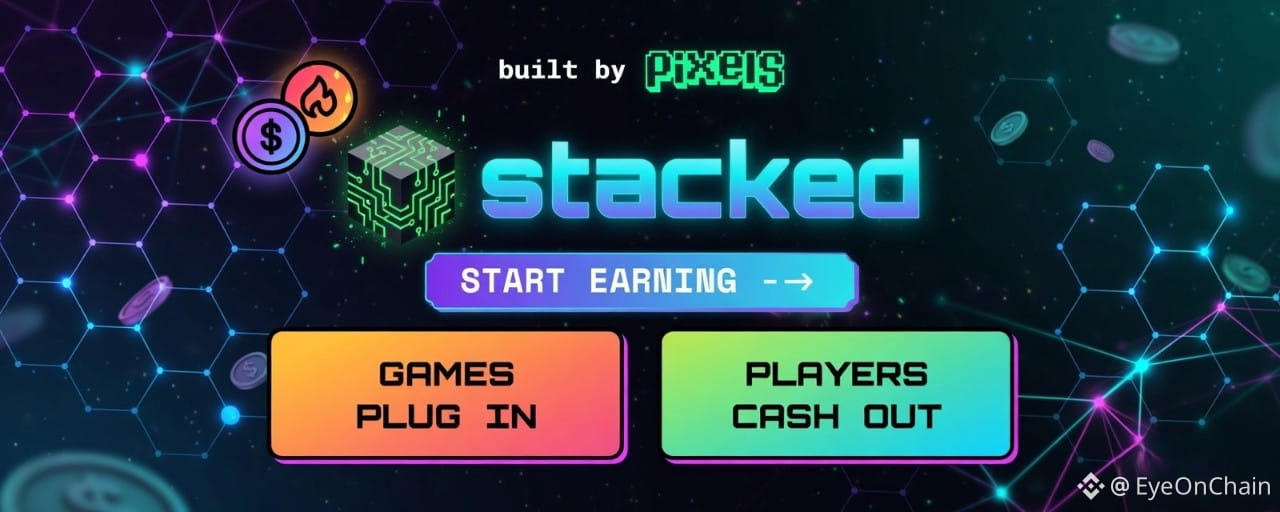
That process eventually led to something bigger. Something that goes beyond a single game. That’s where Stacked comes in.
It’s easy to describe it as a rewards app, but that doesn’t fully capture what it’s doing. From a player’s perspective, it feels simple, you play games, complete tasks, build streaks, and collect rewards in one place. Nothing overwhelming, nothing too technical. Just a smoother way to engage across different experiences.
But underneath… it’s doing a lot more.
Stacked is essentially the system that decides how rewards should work. It looks at how players behave, what they engage with, what actually keeps them coming back , and then adjusts incentives accordingly. Not every player gets the same tasks. Not every action is valued equally. And that’s kind of the point.
Because real economies aren’t flat. They’re dynamic, sometimes messy, always adjusting.
There’s also a level of restraint here that feels… intentional. The rollout is slow, mostly focused on the Pixels ecosystem for now -- games like Pixel Dungeons, Sleepagotchi, and a few early additions. It’s less about scaling fast and more about getting the system right before expanding outward.
On the studio side, the shift is even more noticeable. Stacked acts like a LiveOps engine — a layer that helps developers decide who to reward, when to reward them, and what kind of reward actually makes sense. It tracks behavior, measures outcomes, and feeds that back into the system. Over time, it becomes less about guesswork and more about informed decisions.
And then there’s the AI layer… which, to be fair, sounds like a buzzword at first. But in practice, it’s more grounded than that. It’s designed to help teams understand patterns — what loyal players do differently, where engagement drops, which reward strategies actually improve retention. It’s not replacing decision-making, just… sharpening it.
All of this feeds back into the broader ecosystem, including the role of $PIXEL .
The token itself is evolving alongside the system. Instead of being purely tied to in-game earning, it’s gradually finding a stronger position in staking and ecosystem-level incentives. At the same time, the reward layer is opening up -- introducing other forms of value, including points systems and even stablecoin rewards in certain contexts.
It’s a subtle shift, but an important one.
Because relying on a single token loop has proven fragile in the past. Expanding that loop, diversifying it, and connecting it across multiple experiences… that’s where things start to feel more sustainable.
None of this is finished. You can still see the edges. Moments where things feel experimental, slightly unpolished, maybe even uncertain. But that’s also what makes it interesting. It doesn’t feel like a final product , it feels like a system being shaped in real time.
#pixel started as a game. That’s how most people still see it.
But now, it’s becoming something closer to an ecosystem… with Stacked acting as the layer that ties everything together.
And if it works -- not perfectly, but well enough, it might finally answer the question that’s been hanging over Web3 gaming for years:
How do you make play-to-earn actually… work?
