

The Risks and Challenges of Investing in Cryptocurrencies: Key Considerations for Investors:-
Cryptocurrency usage is increasing rapidly across the world, although it is still a relatively small base compared to traditional currencies and payment methods.
There is evidence to suggest that cryptocurrencies are on the cusp of a hyper-adoption phase, similar to the growth experienced by the internet during the mid-to-late 1990s. This could lead to a significant increase in the use and value of cryptocurrencies in the coming years.
Overall, while cryptocurrencies are still a relatively new and evolving technology, their potential for growth and adoption in the global economy cannot be ignored. As with any investment or financial decision, it is important to carefully consider the risks and benefits before making a decision.
The Importance of Conducting Due Diligence When Investing in Cryptocurrencies:-
In recent months, we have focused on cryptocurrencies and the innovative technologies that support them. However, we want to address a common misconception about their future as investment opportunities. Some investors believe it's too early to invest, while others believe it may be too late. We firmly believe that cryptocurrencies are currently viable investment options, but we acknowledge that the investment landscape is still developing.
Therefore, we recommend professionally managed private placements for now, as the market is still in its early stages. We recognize that there is still a lot of uncertainty and volatility in the cryptocurrency space, but we believe that with careful management, investors can benefit from this new asset class.
In the words of Theodore Roosevelt, "Envy and arrogance are the two opposite sides of the same black crystal." We urge investors to remain humble and cautious in their investment decisions, while also avoiding the temptation to be envious of those who have profited from cryptocurrencies in the past. Instead, we should focus on learning more about the market and the technology behind cryptocurrencies to make informed decisions.
Cryptocurrencies Are Becoming More Mainstream:-
Over the past decade, cryptocurrencies have delivered impressive returns, outperforming many other major asset classes. As a result, some new investors are concerned that they may have missed the opportunity to invest. For example, Bitcoin's price has compounded at an annual rate of 216% since its first recorded transaction in 2010, while the S&P 500 Index has compounded at a rate of 16% over the same period (Chart 1).
The exceptional gains made in cryptocurrencies have garnered widespread media attention and resulted in enviable stories of newfound wealth. In fact, a select few individuals who have held cryptocurrency since its earliest days have even become billionaires. To put this into perspective, 12 of the 2,755 individuals listed on the Forbes 2021 World's Billionaires List derived their wealth from the world of crypto.
However, it's important to note that cryptocurrencies are still a relatively new asset class and are subject to high volatility, regulatory uncertainty, and cybersecurity risks. As such, investors should exercise caution and seek professional guidance when considering investing in cryptocurrencies. While the potential for high returns may be appealing, investors should carefully weigh the potential risks and rewards of this emerging asset class.
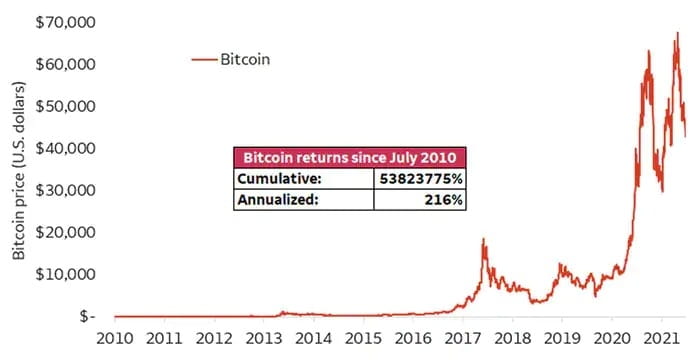
While we acknowledge the "too late to invest" argument, we do not agree with it. Focusing solely on past performance, particularly with cryptocurrencies, can be misleading for new investors. Firstly, performance figures can be skewed due to the fact that most cryptocurrencies began from a very low base. The early years were characterized by high speculation, with many cryptocurrencies launched at prices less than $1. As an example, Bitcoin's first real-world transaction only occurred in May 2010, 16 months after its creation, and valued one Bitcoin at roughly $0.004. It did not cross the $1 mark until February 2011.
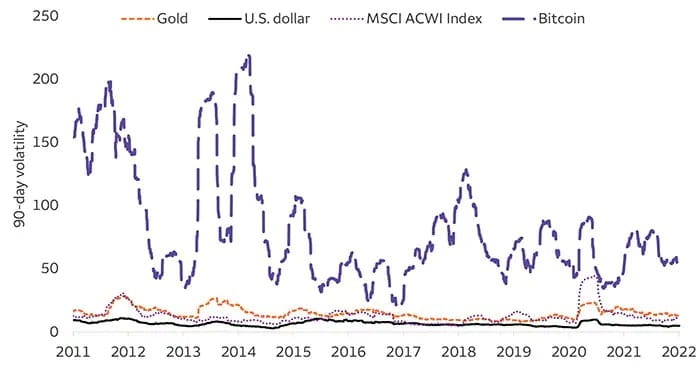
Secondly, cryptocurrencies are still a relatively young investment space, with the vast majority being less than five years old. Even the oldest cryptocurrencies have much maturing to do. For instance, while Bitcoin is the oldest and arguably one of the least volatile cryptocurrencies, it is still roughly four times more volatile than gold (as shown in Chart 2, dashed orange line) and a basket of global equities (as shown in Chart 2, dotted purple line).
Lastly, cryptocurrencies represent a different type of investment, which makes them difficult to understand and invest in. This complexity is partly due to the nature of the technology. Additionally, cryptocurrencies originate outside the traditional financial system, which makes it challenging to attract investment flows and research coverage. In the traditional financial system, companies spend their early development years in the hands of private investors, with the ultimate aim of attracting public investors too. If successful, the company often receives broad research coverage and access to large pools of investors. However, cryptocurrencies have not followed this path, as they launch from personal computers with limited management structure, if any.
Why We Believe It Is Early, But Not Too Early:-
We believe that cryptocurrencies are currently in the investment stage that can be described as "early, but not too early," which is why we have been prioritizing investor education. Our perspective is informed by the rapid acceleration of global cryptocurrency adoption rates, which have increased significantly from a low base. This adoption pattern resembles the typical trajectory of other new advanced technologies, such as the internet.
In the following section, we will delve into the conventional adoption patterns of advanced technologies and explain why we believe that cryptocurrencies are on the cusp of an adoption inflection point, similar to the internet in the mid-to-late 1990s.
Early Technology Adoption: Patterns and Trends:-
The widespread adoption of new advanced technologies by consumers often takes several years. Chart 3 illustrates the adoption paths of several technologies that were considered new at the time, based on the percentage of US households using them. The lines on the chart indicate a growing percentage of households using these technologies, with adoption typically starting slowly, hitting an inflection point, and then steeply accelerating. It is worth noting that in some cases, decades passed between the invention of these technologies and surging adoption rates.

For instance, the internet was invented in 1983, but by 1995, only 14% of Americans (and less than 1% of the world) were using it. This adoption pattern is similar to what we are currently observing with cryptocurrencies. According to a recent survey by the University of Chicago, 13% of Americans purchased or traded cryptocurrencies in the past 12 months (Chart 3, blue star), while Crypto.com reports that roughly 3% of the world uses cryptocurrencies (Chart 4).
In the early adoption years, user experiences with new technologies have often been frustrating and clunky as the ecosystem and infrastructure slowly matured. In the case of the internet, accessing it before the first web browser was introduced in 1993 required typing at a prompt on a green screen, which was not user-friendly.
Another common feature of the early adoption years is that consumers need time to understand what the technology is, what it can do, and how it can benefit them. Our conversations throughout 2021 revealed that many investors and consumers who are new to the cryptocurrency space view cryptocurrencies as being in this early adoption stage, as they find the technology daunting, and the use cases are not yet clear.
Cryptocurrency Adoption: Akin to the 1990s Internet Era:-
Despite the complexity of cryptocurrency technology and the challenges of visualizing use cases for new investors, data suggests that the adoption of cryptocurrencies is rapidly increasing worldwide. Crypto.com reported that the number of global cryptocurrency users reached 221 million in June 2021, which represents approximately 3% of the world's population. This figure doubled in just four months, increasing from 100 million to 200 million users.
The adoption of cryptocurrencies appears to be following the same trajectory as other advanced technologies, particularly the internet. Cryptocurrencies could be approaching an inflection point of hyper-adoption, as seen in Chart 3, similar to the internet in the mid-to-late 1990s. After a slow start in the early 1990s, internet use surged from 77 million in 1996 to 412 million in 2000, and continued to grow to 1.98 billion by 2010 and 4.9 billion today.
Other digital inventions, such as smartphones and WiFi, have experienced accelerated adoption rates due to their dependence on existing digital infrastructure. It is expected that cryptocurrencies will follow a similar path of accelerated adoption.
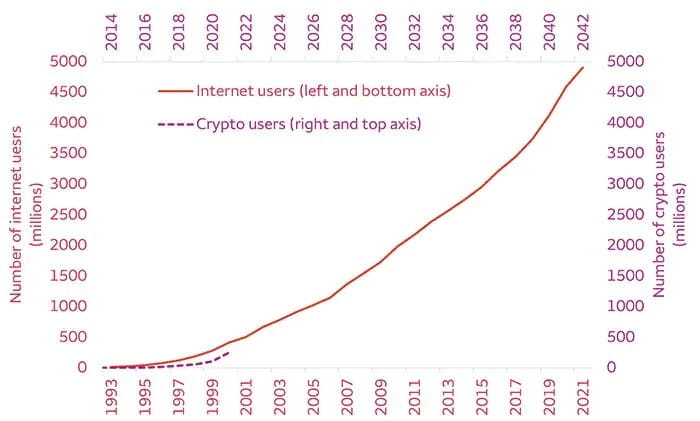
Chart 4 further supports the belief that cryptocurrencies may have reached an adoption inflection point similar to the mid-to-late 1990s internet era. This chart compares the growth of global users between the internet and cryptocurrency since 1993 and 2014, respectively. Based on this comparison, it appears that cryptocurrency adoption may even be ahead of where the internet was in the mid-to-late 1990s. Therefore, it is evident that global cryptocurrency adoption is rising and could soon reach a hyper-inflection point.
Recent regulatory developments are another key factor supporting the acceleration of cryptocurrency adoption. As we have previously noted, cryptocurrencies have reached a level of maturity where legal and regulatory frameworks are being established to solidify their status as investable assets. This is an important step forward, as a lack of regulatory structure was cited as the primary reason why high net worth investors were reluctant to invest in cryptocurrencies in a 2020 Bloomberg survey. By providing a clear regulatory framework, governments and regulatory bodies can offer greater protection to investors and improve the credibility of the cryptocurrency market, which could encourage more widespread adoption.
Investor Considerations for Cryptocurrency Opportunities:-
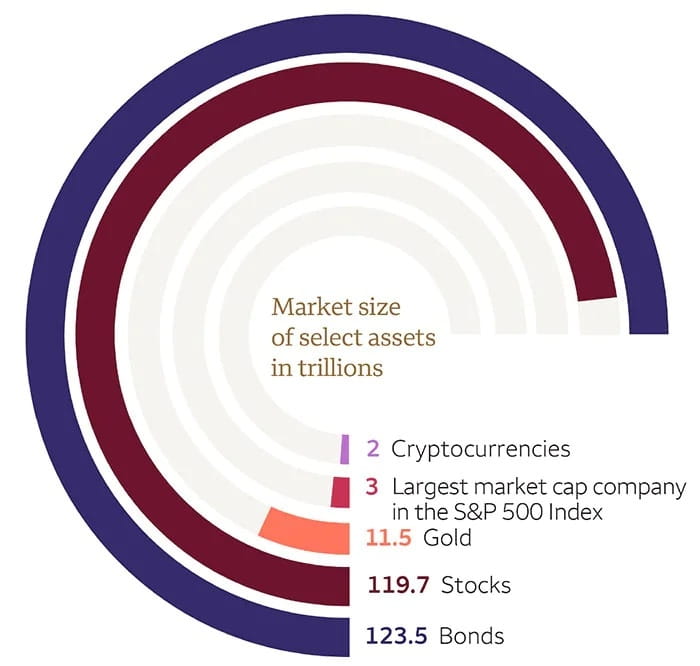
Be patient:- There is no urgency to act hastily, as the potential for cryptocurrencies is still largely untapped. As shown in the graphic on the next page, the total market capitalization of all cryptocurrencies combined is currently lower than that of Apple Inc., a single technology company.
Be prudent:- While adoption rates of cryptocurrencies are increasing, investment options in the space are still maturing. Currently, there are three main ways to gain exposure: 1) purchasing cryptocurrencies directly from an exchange, 2) investing in mutual funds, exchange-traded funds (ETFs) and grantor trusts, and 3) participating in private placements. We advise against option 1 as the technology is complex and speculative investment risks are high. Option 2 is also not recommended as current U.S. mutual funds and ETFs are backed by futures, not the actual digital assets, and grantor trusts often have high fees and volatile net asset values. We are optimistic that regulators may approve mutual funds and ETFs backed by digital assets themselves, potentially as early as 2022. Until then, we suggest that qualified investors opt for Option 3 and seek professional management through a private placement.
Be careful:- Some investors may feel frustrated by the limited investment options available for cryptocurrencies. While we understand this sentiment, it is important to keep in mind that the current investment product landscape for cryptocurrencies is not yet fully developed. For those who are eager to invest and are considering Option 1 (buying directly from an exchange), we advise caution and urge them to remember the lessons of the dot-com era in the 1990s. Early-stage investments often experience volatile boom and bust cycles, and the history of cryptocurrencies suggests that many of the current 16,000+ offerings will fail to scale or survive.
Furthermore, choosing long-term technology winners is a challenging endeavor that requires ongoing evaluation of current winners and losers as well as anticipating future trends. As an example, the most popular websites of 1996-1997 did not remain relevant for long, and today's largest company in the S&P 500 Index was struggling and near bankruptcy in 1997. Therefore, investors should approach the cryptocurrency market with a long-term perspective and a willingness to tolerate volatility.
We also note that current U.S. investment options for cryptocurrencies (Option 2) are limited and often backed by futures rather than the digital assets themselves. Grantor trusts, which are another option, may be subject to high fees and volatile net asset values. We anticipate that regulators may approve mutual funds and ETFs backed by digital assets themselves in the future, but until then, we recommend qualified investors consider professional management through a private placement (Option 3).
Summary with Key Points:-
Cryptocurrencies are at a hyper-adoption stage similar to the mid-to-late 1990s technology boom.
Investment options for cryptocurrencies are still maturing, and patience is advised.
Only professionally managed private placements are recommended for now, and other investment options such as mutual funds and ETFs are not advised.
Regulatory clarity in 2022 may bring higher quality investment options.
In conclusion, if you find the content provided by this individual to be valuable and informative, feel free to show your support by liking, sharing, and following them.
By doing so, you can help them reach a wider audience and continue providing educational insights that can benefit others.
Remember, even a small gesture of support can go a long way in encouraging someone to keep sharing their knowledge and expertise.
Thank you for taking the time to read and consider this message.
#Binance #cryptoregulation #cryptocurrency #adoption #bitcoin