
#usstocksmarket
usstocksmarket
6,504 Aufrufe
29 Kommentare
Hot
Zuletzt

Artikel
Übersetzung ansehen
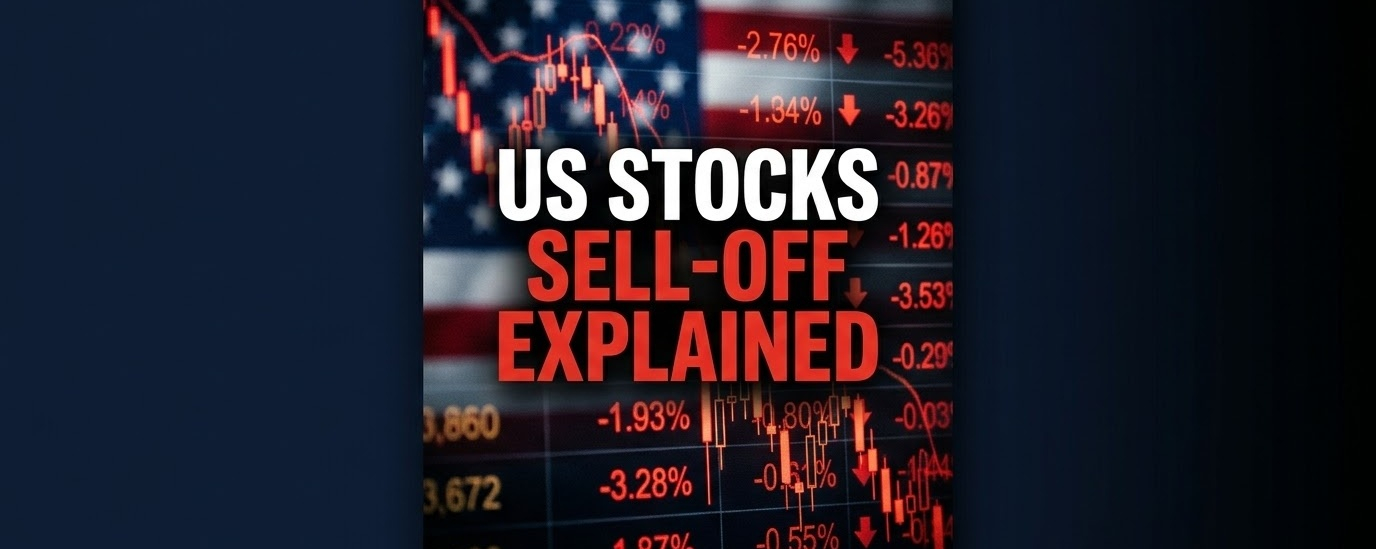
Why US Stocks Can Suddenly Get “Hammered”When people say US stocks are getting “hammered,” they usually mean prices are falling sharply across major indices, individual stocks, or both. The most important first question is: is this a broad market decline, or are only a few large sectors falling?
I’m unable to confirm the latest live index moves in this response, so this article explains the mechanics behind a sharp US equity selloff rather than attributing it to a specific headline. The most recent completed US trading session should be used as the reference point, since pre-market, after-hours, and intraday moves can look very different.
1. What a Stock-Market Selloff Actually Means
A selloff happens when more investors want to reduce exposure than add it at current prices. Sellers accept lower prices to find buyers, and that process can accelerate quickly.
This does not necessarily mean every company has suddenly become weaker. Stock prices reflect expectations about future profits, interest rates, economic conditions, and investor risk appetite. When those expectations change, prices can reset before company fundamentals visibly change.
A sharp decline can show up in several ways:
Major indices fall together, suggesting broad risk aversion.Growth stocks decline more than defensive sectors, often reflecting higher-rate or valuation concerns.Small-cap stocks fall more than mega-cap companies, which can signal worries about financing conditions or economic growth.A handful of very large technology stocks fall, pulling index levels lower because of their heavy index weight.Volatility rises as investors pay more for downside protection and reduce leveraged positions.
2. Interest Rates: Often the Biggest Immediate Pressure Point
For equities, interest rates matter because they affect both company finances and how investors value future earnings.
When bond yields rise, borrowing can become more expensive for companies and consumers. Higher rates may slow spending, reduce housing activity, raise refinancing costs, and pressure profit margins. They also make safer assets such as government bonds relatively more attractive compared with stocks.
Rates are especially important for growth-oriented companies. Their valuations often rely more heavily on profits expected several years into the future. When investors use a higher discount rate to value those future profits, the present value of those earnings falls.
That is why a rise in yields can sometimes cause technology, software, semiconductor, and other high-growth shares to fall more sharply than slower-growing sectors.
3. Inflation Can Change the Entire Market Narrative
Inflation data can trigger a selloff when it suggests price pressures are not easing as expected.
If inflation is hotter than markets anticipated, investors may conclude that central banks will keep rates higher for longer. In some cases, they may also reduce expectations for future rate cuts. That can lead to a rapid repricing across stocks, bonds, currencies, and crypto markets.
The chain reaction often looks like this:
Inflation data surprises upward.Bond yields rise as markets adjust rate expectations.Equity valuations come under pressure.Rate-sensitive sectors fall more sharply.Volatility increases as traders reduce risk.
The reverse can also happen when inflation cools: yields may fall, and rate-sensitive assets may recover. Neither outcome is guaranteed, because markets also consider growth, earnings, and positioning.
4. Earnings Matter More Than Headlines Over Time
A company’s stock price ultimately depends heavily on what investors expect it can earn in the future.
A disappointing earnings report can hurt a stock even if the company remains profitable. Markets often react most strongly to forward guidance: projected revenue growth, margins, demand conditions, capital expenditure, and management commentary.
A stock can decline when:
Revenue growth slows.Profit margins narrow.Management lowers future guidance.Costs rise faster than sales.Demand weakens in a key product category.Capital spending rises without a clear near-term payoff.Expectations had become too optimistic before the report.
This is why “good earnings” do not always produce a higher stock price. If investors expected exceptional results and received merely solid results, the share price can still fall.
5. Valuation Pressure: Great Companies Can Still Decline
A business can be high quality and still see its share price fall sharply if investors decide the valuation had become too expensive.
Valuation is essentially the price investors are willing to pay for a stream of future earnings. During optimistic periods, investors may pay a premium for companies with strong growth stories. If sentiment shifts, that premium can shrink quickly.
This is particularly visible in companies with:
High price-to-earnings multiples.High price-to-sales multiples.Aggressive future-growth assumptions.Heavy dependence on low interest rates.Large exposure to a fashionable theme, such as artificial intelligence or a fast-growing new technology cycle.
A valuation reset does not automatically mean the underlying business is failing. It means the market is reassessing how much it is willing to pay today for future potential.
6. Economic-Growth Fears Can Spread Across the Market
Stocks can fall if investors become concerned that economic growth will slow materially.
Slower growth can reduce consumer spending, business investment, advertising budgets, travel demand, industrial activity, and corporate profits. Companies with cyclical revenue—such as manufacturers, banks, retailers, transport firms, and commodity-linked businesses—can be particularly sensitive.
Markets often respond before official economic data confirms a slowdown. Investors watch forward-looking indicators such as:
New orders and manufacturing surveys.Consumer confidence.Hiring trends and unemployment claims.Retail-sales trends.Housing activity.Credit conditions.Corporate guidance.
A difficult part of market interpretation is that the same data can point in two directions. Weak economic data may raise recession concerns, but it may also increase hopes for lower interest rates. Which force dominates depends on the broader market backdrop.
7. Sector Concentration Can Make Index Declines Look Worse
US stock indices are not equally weighted collections of companies. Large companies can have an outsized influence on index performance.
If a small group of mega-cap technology or semiconductor companies falls sharply, an index can decline even when many smaller stocks are holding up relatively well. Conversely, an index can appear resilient even if a large number of companies are declining beneath the surface.
This is why market breadth matters.
Useful breadth questions include:
Are most stocks declining, or only the largest names?Are defensive sectors outperforming?Are small-cap stocks weaker than large-cap stocks?Are banks, industrials, and consumer stocks also falling?Are new 52-week lows expanding?Is volatility rising alongside the decline?
Broad weakness suggests a more widespread reduction in risk appetite. Narrow weakness may point more toward a sector-specific earnings, valuation, or positioning issue.
8. Positioning and Leverage Can Turn a Decline Into a Faster Drop
Markets do not move only because of new information. They also move because of where investors are already positioned.
When many traders have similar bullish positions, a negative surprise can lead to rapid selling. Leveraged investors may need to reduce positions if prices fall, which adds further downward pressure. Options hedging can also amplify moves in either direction.
This is often described as a “risk-off” move. It can involve:
Investors taking profits after a strong rally.Funds reducing exposure ahead of major data releases.Leveraged positions being cut.Option dealers hedging changing market exposure.Systematic strategies reducing equity exposure as volatility rises.Investors shifting toward cash, bonds, or defensive sectors.
Positioning can explain why a seemingly modest headline produces an outsized market move. The headline may be the trigger, but crowded positioning can be the amplifier.
9. Geopolitical and Policy Shocks Can Raise Uncertainty
Markets dislike uncertainty because it makes future cash flows harder to estimate.
Trade restrictions, tariff announcements, geopolitical escalation, election-policy uncertainty, fiscal disputes, regulatory changes, or sudden changes in government policy can all affect stocks. The impact varies by sector.
For example:
Trade disruptions can pressure manufacturers, exporters, retailers, and semiconductor supply chains.Higher tariffs can raise costs and potentially increase inflation pressure.Energy-market disruptions can affect transport, industrial, and consumer sectors.Regulatory shifts can have an outsized effect on banks, healthcare companies, technology platforms, or defense-related industries.
The key is to separate a confirmed policy action from speculation about possible policy changes. Markets may react to both, but the certainty level is very different.
10. Why a Selloff Can Feel More Violent Than the Numbers Suggest
Sharp red screens create a strong emotional impression. Investors tend to notice falling prices more intensely than rising prices, especially when large, familiar companies are moving quickly.
Several factors make declines feel especially severe:
News coverage focuses on the largest percentage moves.Social media amplifies dramatic narratives.Large individual-stock declines can overshadow mixed index performance.Intraday reversals can create stress even if the closing decline is smaller.Leveraged products and options can move much more than the underlying index.Investors may focus on portfolio losses rather than the longer market context.
That does not mean the risk is imaginary. It means that price action should be interpreted using breadth, volume, volatility, rates, earnings expectations, and economic data—not only headlines or a single trading session.
11. How to Read the Selloff Without Overreacting
A practical way to understand a sharp decline is to ask five questions:
First: How broad is the weakness?
Check whether major indices, small caps, sector ETFs, and most individual stocks are all declining.
Second: What are bond yields doing?
Rising yields often point toward rate and valuation pressure. Falling yields alongside falling stocks can point more toward growth or recession concerns.
Third: Is there a confirmed catalyst?
Look for dated economic releases, central-bank developments, earnings reports, policy announcements, or clearly identified geopolitical events.
Fourth: Are earnings expectations changing?
A short-term selloff can become more significant if analysts begin cutting revenue or profit forecasts.
Fifth: Is volatility rising?
Higher volatility can indicate that investors are paying more to protect portfolios and that market conditions are becoming less stable.
12. What Would Strengthen or Weaken the “Broad Risk-Off” Explanation
The broad risk-off interpretation becomes more convincing if several signals occur together:
Major US indices decline at the same time.Small-cap shares weaken alongside large caps.High-valuation growth shares underperform.Volatility rises.Credit-sensitive sectors such as banks weaken.Market breadth deteriorates.Investors move toward safer assets.
That interpretation becomes less convincing if the weakness is narrowly concentrated in one industry, one earnings theme, or a few heavily weighted companies while the broader market remains relatively stable.
The above is market analysis and does not constitute investment advice.
#USStocks #UsStocksMarket
Why US Stocks Can Suddenly Get “Hammered”
When people say US stocks are getting “hammered,” they usually mean prices are falling sharply across major indices, individual stocks, or both. The most important first question is: is this a broad market decline, or are only a few large sectors falling?
I’m unable to confirm the latest live index moves in this response, so this article explains the mechanics behind a sharp US equity selloff rather than attributing it to a specific headline. The most recent completed US trading session should be used as the reference point, since pre-market, after-hours, and intraday moves can look very different.
1. What a Stock-Market Selloff Actually Means
A selloff happens when more investors want to reduce exposure than add it at current prices. Sellers accept lower prices to find buyers, and that process can accelerate quickly.
This does not necessarily mean every company has suddenly become weaker. Stock prices reflect expectations about future profits, interest rates, economic conditions, and investor risk appetite. When those expectations change, prices can reset before company fundamentals visibly change.
A sharp decline can show up in several ways:
Major indices fall together, suggesting broad risk aversion.Growth stocks decline more than defensive sectors, often reflecting higher-rate or valuation concerns.Small-cap stocks fall more than mega-cap companies, which can signal worries about financing conditions or economic growth.A handful of very large technology stocks fall, pulling index levels lower because of their heavy index weight.Volatility rises as investors pay more for downside protection and reduce leveraged positions.
2. Interest Rates: Often the Biggest Immediate Pressure Point
For equities, interest rates matter because they affect both company finances and how investors value future earnings.
When bond yields rise, borrowing can become more expensive for companies and consumers. Higher rates may slow spending, reduce housing activity, raise refinancing costs, and pressure profit margins. They also make safer assets such as government bonds relatively more attractive compared with stocks.
Rates are especially important for growth-oriented companies. Their valuations often rely more heavily on profits expected several years into the future. When investors use a higher discount rate to value those future profits, the present value of those earnings falls.
That is why a rise in yields can sometimes cause technology, software, semiconductor, and other high-growth shares to fall more sharply than slower-growing sectors.
3. Inflation Can Change the Entire Market Narrative
Inflation data can trigger a selloff when it suggests price pressures are not easing as expected.
If inflation is hotter than markets anticipated, investors may conclude that central banks will keep rates higher for longer. In some cases, they may also reduce expectations for future rate cuts. That can lead to a rapid repricing across stocks, bonds, currencies, and crypto markets.
The chain reaction often looks like this:
Inflation data surprises upward.Bond yields rise as markets adjust rate expectations.Equity valuations come under pressure.Rate-sensitive sectors fall more sharply.Volatility increases as traders reduce risk.
The reverse can also happen when inflation cools: yields may fall, and rate-sensitive assets may recover. Neither outcome is guaranteed, because markets also consider growth, earnings, and positioning.
4. Earnings Matter More Than Headlines Over Time
A company’s stock price ultimately depends heavily on what investors expect it can earn in the future.
A disappointing earnings report can hurt a stock even if the company remains profitable. Markets often react most strongly to forward guidance: projected revenue growth, margins, demand conditions, capital expenditure, and management commentary.
A stock can decline when:
Revenue growth slows.Profit margins narrow.Management lowers future guidance.Costs rise faster than sales.Demand weakens in a key product category.Capital spending rises without a clear near-term payoff.Expectations had become too optimistic before the report.
This is why “good earnings” do not always produce a higher stock price. If investors expected exceptional results and received merely solid results, the share price can still fall.
5. Valuation Pressure: Great Companies Can Still Decline
A business can be high quality and still see its share price fall sharply if investors decide the valuation had become too expensive.
Valuation is essentially the price investors are willing to pay for a stream of future earnings. During optimistic periods, investors may pay a premium for companies with strong growth stories. If sentiment shifts, that premium can shrink quickly.
This is particularly visible in companies with:
High price-to-earnings multiples.High price-to-sales multiples.Aggressive future-growth assumptions.Heavy dependence on low interest rates.Large exposure to a fashionable theme, such as artificial intelligence or a fast-growing new technology cycle.
A valuation reset does not automatically mean the underlying business is failing. It means the market is reassessing how much it is willing to pay today for future potential.
6. Economic-Growth Fears Can Spread Across the Market
Stocks can fall if investors become concerned that economic growth will slow materially.
Slower growth can reduce consumer spending, business investment, advertising budgets, travel demand, industrial activity, and corporate profits. Companies with cyclical revenue—such as manufacturers, banks, retailers, transport firms, and commodity-linked businesses—can be particularly sensitive.
Markets often respond before official economic data confirms a slowdown. Investors watch forward-looking indicators such as:
New orders and manufacturing surveys.Consumer confidence.Hiring trends and unemployment claims.Retail-sales trends.Housing activity.Credit conditions.Corporate guidance.
A difficult part of market interpretation is that the same data can point in two directions. Weak economic data may raise recession concerns, but it may also increase hopes for lower interest rates. Which force dominates depends on the broader market backdrop.
7. Sector Concentration Can Make Index Declines Look Worse
US stock indices are not equally weighted collections of companies. Large companies can have an outsized influence on index performance.
If a small group of mega-cap technology or semiconductor companies falls sharply, an index can decline even when many smaller stocks are holding up relatively well. Conversely, an index can appear resilient even if a large number of companies are declining beneath the surface.
This is why market breadth matters.
Useful breadth questions include:
Are most stocks declining, or only the largest names?Are defensive sectors outperforming?Are small-cap stocks weaker than large-cap stocks?Are banks, industrials, and consumer stocks also falling?Are new 52-week lows expanding?Is volatility rising alongside the decline?
Broad weakness suggests a more widespread reduction in risk appetite. Narrow weakness may point more toward a sector-specific earnings, valuation, or positioning issue.
8. Positioning and Leverage Can Turn a Decline Into a Faster Drop
Markets do not move only because of new information. They also move because of where investors are already positioned.
When many traders have similar bullish positions, a negative surprise can lead to rapid selling. Leveraged investors may need to reduce positions if prices fall, which adds further downward pressure. Options hedging can also amplify moves in either direction.
This is often described as a “risk-off” move. It can involve:
Investors taking profits after a strong rally.Funds reducing exposure ahead of major data releases.Leveraged positions being cut.Option dealers hedging changing market exposure.Systematic strategies reducing equity exposure as volatility rises.Investors shifting toward cash, bonds, or defensive sectors.
Positioning can explain why a seemingly modest headline produces an outsized market move. The headline may be the trigger, but crowded positioning can be the amplifier.
9. Geopolitical and Policy Shocks Can Raise Uncertainty
Markets dislike uncertainty because it makes future cash flows harder to estimate.
Trade restrictions, tariff announcements, geopolitical escalation, election-policy uncertainty, fiscal disputes, regulatory changes, or sudden changes in government policy can all affect stocks. The impact varies by sector.
For example:
Trade disruptions can pressure manufacturers, exporters, retailers, and semiconductor supply chains.Higher tariffs can raise costs and potentially increase inflation pressure.Energy-market disruptions can affect transport, industrial, and consumer sectors.Regulatory shifts can have an outsized effect on banks, healthcare companies, technology platforms, or defense-related industries.
The key is to separate a confirmed policy action from speculation about possible policy changes. Markets may react to both, but the certainty level is very different.
10. Why a Selloff Can Feel More Violent Than the Numbers Suggest
Sharp red screens create a strong emotional impression. Investors tend to notice falling prices more intensely than rising prices, especially when large, familiar companies are moving quickly.
Several factors make declines feel especially severe:
News coverage focuses on the largest percentage moves.Social media amplifies dramatic narratives.Large individual-stock declines can overshadow mixed index performance.Intraday reversals can create stress even if the closing decline is smaller.Leveraged products and options can move much more than the underlying index.Investors may focus on portfolio losses rather than the longer market context.
That does not mean the risk is imaginary. It means that price action should be interpreted using breadth, volume, volatility, rates, earnings expectations, and economic data—not only headlines or a single trading session.
11. How to Read the Selloff Without Overreacting
A practical way to understand a sharp decline is to ask five questions:
First: How broad is the weakness?
Check whether major indices, small caps, sector ETFs, and most individual stocks are all declining.
Second: What are bond yields doing?
Rising yields often point toward rate and valuation pressure. Falling yields alongside falling stocks can point more toward growth or recession concerns.
Third: Is there a confirmed catalyst?
Look for dated economic releases, central-bank developments, earnings reports, policy announcements, or clearly identified geopolitical events.
Fourth: Are earnings expectations changing?
A short-term selloff can become more significant if analysts begin cutting revenue or profit forecasts.
Fifth: Is volatility rising?
Higher volatility can indicate that investors are paying more to protect portfolios and that market conditions are becoming less stable.
12. What Would Strengthen or Weaken the “Broad Risk-Off” Explanation
The broad risk-off interpretation becomes more convincing if several signals occur together:
Major US indices decline at the same time.Small-cap shares weaken alongside large caps.High-valuation growth shares underperform.Volatility rises.Credit-sensitive sectors such as banks weaken.Market breadth deteriorates.Investors move toward safer assets.
That interpretation becomes less convincing if the weakness is narrowly concentrated in one industry, one earnings theme, or a few heavily weighted companies while the broader market remains relatively stable.
The above is market analysis and does not constitute investment advice.
#USStocks #UsStocksMarket
64

·
--
Bullisch
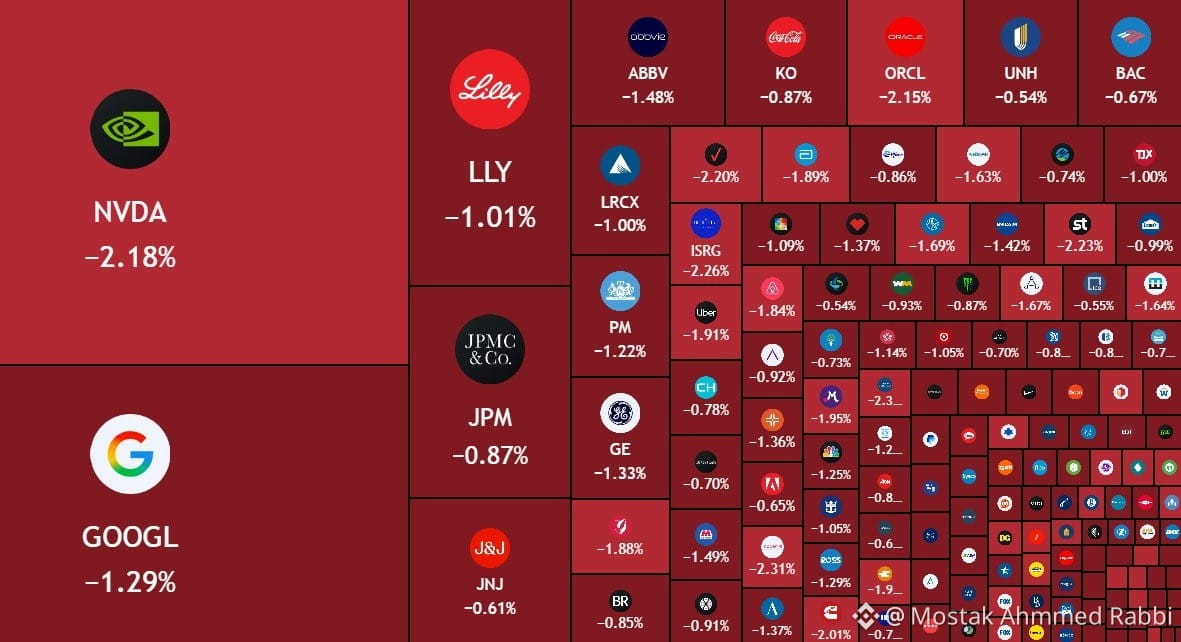
🔴 Wall Street blutete zum 3. Tag am 18. August 2026! Hohe Renditen und Öl bei $91+ zerquetschten die Indizes: S&P 500 -0.69%, DJI -0.22%, Russell 2000 -1.33%. Nasdaq wurde am stärksten getroffen und fiel um -1.33%!
Plot Twist: Gestern noch Tech-Helden, heute Nullen. Die KI-/Memory-Chip-Party endete mit einem massiven Kater. Coherent (COHR) stürzte um -12%, SanDisk (SNDK) krachte um -9% ab, und Micron (MU) fiel -7%.
Asienmärkte und #KOSPI wachen nach den Feiertagen auf zu einem kompletten Chaos. Erwarte, dass Asien tief im Minus eröffnet. Der KOSPI wird anfangs wahrscheinlich abstürzen wegen des globalen Tech-Verkaufs, aber schau nach einem möglichen Comeback am späten Tag, wenn lokale Käufer das Tief ansteuern.
Händler-Regel: Keine fallenden Messer fangen! Schütze dein Kapital oder kauf stattdessen Lebensmittel ein.
⚠️ Keine finanzielle Beratung. Handel lieber Krypto über Binance statt? Nutze meinen Code VINHTOCDO oder Link: [https://www.binance.com/register?ref=VINHTOCDO](https://www.binance.com/register?ref=VINHTOCDO)
#UsStocksMarket #WallStreetNews #NASDAQ #VINHTOCDO
$SKHYNIX
{future}(SKHYNIXUSDT)
$SKHYB
{spot}(SKHYBUSDT)
$SAMSUNG
{future}(SAMSUNGUSDT)
🔴 Wall Street blutete zum 3. Tag am 18. August 2026! Hohe Renditen und Öl bei $91+ zerquetschten die Indizes: S&P 500 -0.69%, DJI -0.22%, Russell 2000 -1.33%. Nasdaq wurde am stärksten getroffen und fiel um -1.33%!
Plot Twist: Gestern noch Tech-Helden, heute Nullen. Die KI-/Memory-Chip-Party endete mit einem massiven Kater. Coherent (COHR) stürzte um -12%, SanDisk (SNDK) krachte um -9% ab, und Micron (MU) fiel -7%.
Asienmärkte und #KOSPI wachen nach den Feiertagen auf zu einem kompletten Chaos. Erwarte, dass Asien tief im Minus eröffnet. Der KOSPI wird anfangs wahrscheinlich abstürzen wegen des globalen Tech-Verkaufs, aber schau nach einem möglichen Comeback am späten Tag, wenn lokale Käufer das Tief ansteuern.
Händler-Regel: Keine fallenden Messer fangen! Schütze dein Kapital oder kauf stattdessen Lebensmittel ein.
⚠️ Keine finanzielle Beratung. Handel lieber Krypto über Binance statt? Nutze meinen Code VINHTOCDO oder Link: https://www.binance.com/register?ref=VINHTOCDO
#UsStocksMarket #WallStreetNews #NASDAQ #VINHTOCDO
$SKHYNIX
$SKHYB
$SAMSUNG

1
246

·
--
So starten Sie mit US-Aktien: Einsteigerleitfaden
Der US-Aktienmarkt ist einer der größten und spannendsten Finanzmärkte der Welt und bietet zahlreiche Möglichkeiten für Anleger. Besonders für diejenigen, die ihre Investitionsreise vom Krypto-Bereich aus erweitern möchten, sind US-Aktien eine hervorragende Alternative.
1. Was ist der Unterschied zwischen US-Aktien und Krypto?
Im Vergleich zur hohen Volatilität und den schnellen Preisbewegungen von Krypto stellen US-Aktien eine Beteiligung an reiferen und stabileren Unternehmen dar (wie Apple, Microsoft, Tesla usw.). Dennoch bringen beide ihre eigenen einzigartigen Chancen und Risiken mit.
2. Wichtige Schritte für Einsteiger
Lernen: Recherchieren Sie gründlich die finanzielle Gesundheit eines Unternehmens, seine Geschäftsabläufe und die Marktbedingungen.
Risiken steuern: Diversifizieren Sie Ihr Portfolio, statt Ihr gesamtes Kapital in einen einzigen Vermögenswert zu stecken.
Langfristige Perspektive: Aktieninvestitionen sind im Allgemeinen erfolgreicher, wenn der Fokus auf langfristigem Wachstum liegt, statt auf schnellen Gewinnen über Nacht.
Starten Sie noch heute Ihre Investitionsreise mit Binance Stocks/BIStocks!
#UsStocksMarket
#bistocks
#CryptoToStocks
#InvestingForBeginners
92


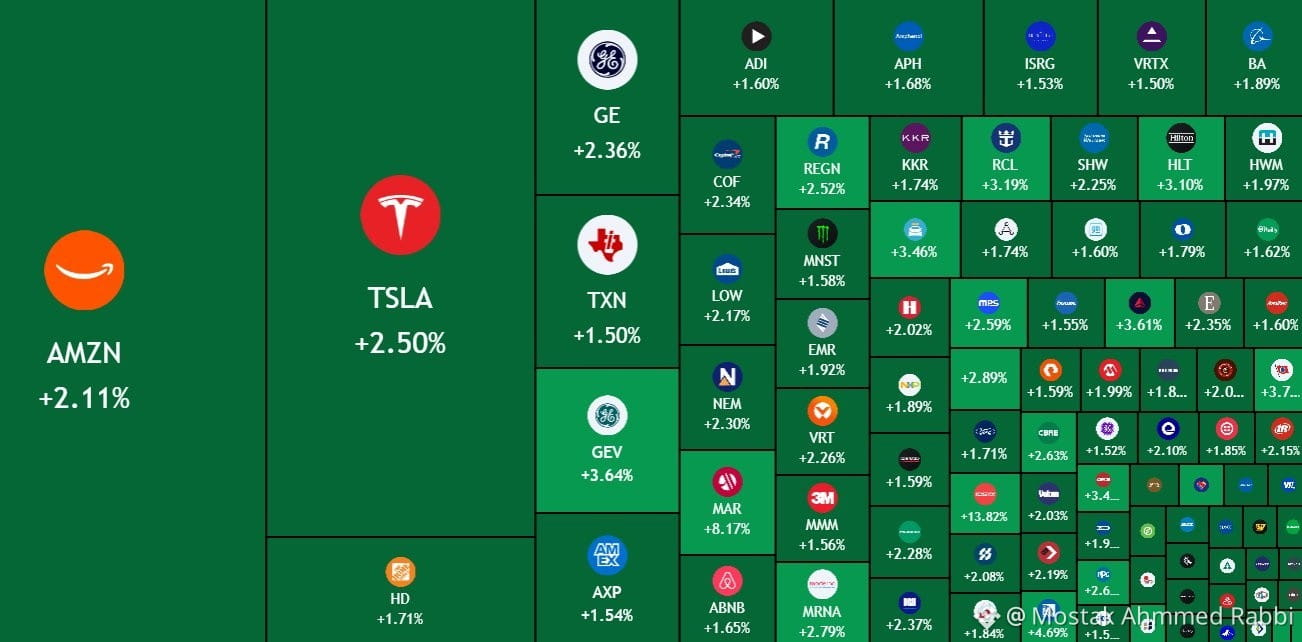
Bei Börsenöffnung kamen dem US-Aktienmarkt fast 400.000.000.000 US-Dollar hinzu.
$TSLAB
#UsStocksMarket
Bei Börsenöffnung kamen dem US-Aktienmarkt fast 400.000.000.000 US-Dollar hinzu.
$TSLAB
#UsStocksMarket
$TSLAB
#UsStocksMarket
147

·
--
🚀 CHIP-AKTIEN ERHOLEN SICH! KANN KI DEN US-MARKT ANKURBELN? 🇺🇸
🔸 🔥 Halbleiteraktien stehen wieder im Rampenlicht! Die Erholung des Chipsektors sorgt für neuen Optimismus an den US-Aktienmärkten, während KI den Bedarf an leistungsstarker Technologie und Rechenleistung weiter antreibt.
🔸 💡 WARUM IST DAS WICHTIG?
Chips sind das Herzstück der KI-Revolution. Unternehmen wie NVIDIA, AMD, Intel und Micron könnten vom wachsenden Bedarf an KI-Infrastruktur profitieren.
🔸 📈 DIE GROSSE FRAGE: Ist das der Beginn einer neuen Rally oder nur eine vorübergehende Erholung?
Wenn das KI-Wachstum weiterhin von starken Umsätzen gestützt wird, könnten Chipaktien die Marktstimmung erneut beflügeln. Volatilität und das Risiko einer Korrektur sollten jedoch weiterhin nicht unterschätzt werden.
🔸 🔥 KI gestaltet die Zukunft. Können Chipaktien die nächste Marktrally antreiben?
👇 Was meinst du?
🚀 OPTIMISTISCH — Die Chip-Rally geht weiter!
🐻 PESSIMISTISCH — Eine Korrektur steht noch bevor!
#ChipStocksReboundLiftingUSShares #NVIDIA #Semiconductors #UsStocksMarket #BinanceSquareFamily
🔸 Keine Anlageberatung. Recherchiere immer selbst, bevor du investierst!

3
171

🚨NEU:
Warren Buffett warnt, dass der US-Aktienmarkt nie mehr Glücksspielverhalten gesehen hat als jetzt, und verweist auf die Explosion von eintägigen Optionen als Beweis.
"Das bedeutet nicht, dass Investieren schrecklich ist. Es bedeutet, dass die Preise für eine Menge Sachen sehr lächerlich aussehen werden."
#WarrenBuffett #UsStocksMarket #Warning
{spot}(BTCUSDT)
{spot}(ETHUSDT)
🚨NEU:
Warren Buffett warnt, dass der US-Aktienmarkt nie mehr Glücksspielverhalten gesehen hat als jetzt, und verweist auf die Explosion von eintägigen Optionen als Beweis.
"Das bedeutet nicht, dass Investieren schrecklich ist. Es bedeutet, dass die Preise für eine Menge Sachen sehr lächerlich aussehen werden."
#WarrenBuffett #UsStocksMarket #Warning


1
200

🚨HEILIGE KÜHE: Die Margin-Schulden in den USA sind gerade auf ein neues Rekordhoch explodiert.
Die Margin-Schulden in den USA sind im April um 83 Milliarden Dollar gestiegen und erreichen etwa 1,3 Billionen Dollar – ein Allzeithoch. Im vergangenen Jahr ist das gehebelte Ausleihen um rund 453 Milliarden Dollar (+53%) gestiegen.
Die Margin-Schulden machen jetzt etwa 5,2 % des BIP der USA aus, ebenfalls ein Rekord – und übertreffen frühere Blasenhöhen, einschließlich der Meme-Aktien-Ära von 2021.
Fazit: So viel Leverage gab es noch nie im Aktienmarkt.
#UsStocksMarket
#MarketUpdate
#CryptoUpdate
{spot}(BTCUSDT)
{spot}(XRPUSDT)
{future}(XAUTUSDT)
👉Du kannst meiner ID folgen.
🚨HEILIGE KÜHE: Die Margin-Schulden in den USA sind gerade auf ein neues Rekordhoch explodiert.
Die Margin-Schulden in den USA sind im April um 83 Milliarden Dollar gestiegen und erreichen etwa 1,3 Billionen Dollar – ein Allzeithoch. Im vergangenen Jahr ist das gehebelte Ausleihen um rund 453 Milliarden Dollar (+53%) gestiegen.
Die Margin-Schulden machen jetzt etwa 5,2 % des BIP der USA aus, ebenfalls ein Rekord – und übertreffen frühere Blasenhöhen, einschließlich der Meme-Aktien-Ära von 2021.
Fazit: So viel Leverage gab es noch nie im Aktienmarkt.
#UsStocksMarket
#MarketUpdate
#CryptoUpdate
👉Du kannst meiner ID folgen.
Yes
50%
No
50%
Already follow
0%
2 Stimmen • Abstimmung beendet
1
1
87
Anmelden und weiter Inhalte entdecken
Krypto-Nutzer weltweit auf Binance Square kennenlernen
⚡️ Bleib in Sachen Krypto stets am Puls.
💬 Die weltgrößte Kryptobörse vertraut darauf.
👍 Erhalte verlässliche Einblicke von verifizierten Creators.
E-Mail-Adresse/Telefonnummer
Trendthemen
1
#BitcoinRebounds$75KAsChipsLead
4,494 Aufrufe
96 Kommentare
2
#JobsReportRaisesHikeOdds
78,578 Aufrufe
829 Kommentare
3
#US Data Center Rules May Constrain AI Expansion
9,461 Aufrufe
91 Kommentare
4
#$2TWipedOutHedgeFundsFaceLiquidation
11,022 Aufrufe
95 Kommentare
5
#WillAnthropicListOnTime
9,084 Aufrufe
220 Kommentare
6
#USNovemberMichiganExpectationsIndexPrelimAt50.9
17,553 Aufrufe
326 Kommentare
7
#OilPlungesBelow$100
18,452 Aufrufe
37 Kommentare
8
#TradFiForBeginners
10,716 Aufrufe
205 Kommentare
9
#USMidtermsCouldShakeUpUS-IranTies
36,500 Aufrufe
496 Kommentare
10
#RussianCentralBankNamesBTCETHUSDTForNonQualifiedInvestors
713 Aufrufe
11 Kommentare