

CryptoGlow
713 Paylaşımlar

CryptoGlow
Şikayət et
İstifadəçini blokla
Open trade || Binance Kol || Web 3.0 || Charts and Setups
Daimi treyder
1.9 il
126 İzlənilir
1.0K+ İzləyicilər
248 Bəyəndi
Postlar
Hamısı
Sitatlar
Canlı
·
--
Tərcüməyə bax
#dusk $DUSK @Dusk_Foundation
$DUSK Privacy Isn’t Just About Hiding Data
The more I look at Dusk, the more I think the interesting part isn’t simply that transactions can be private.
It’s what happens when privacy becomes something institutions actually have to work with.
A public blockchain makes transparency the default. That’s useful, but it can also expose transaction details that businesses may not want sitting in plain sight.
Dusk takes a different approach with its privacy-focused architecture, where users can have more control over what transaction information is revealed.
But that creates a more interesting question:
How much privacy is actually useful for an institution?
Too little privacy creates unnecessary exposure. Too much privacy can make auditing and compliance harder.
That balance is where Dusk becomes interesting to me.
The real test probably won’t be whether the technology can hide transaction data.
It will be whether institutions can use privacy without losing the ability to prove what actually happened.
That’s a much harder problem than simply saying “private blockchain.”
And if Dusk can get that balance right, the bigger story may not be privacy itself.
It may be making privacy usable at institutional scale.
Would institutions prefer maximum privacy, or controllable transparency?
#dusk $DUSK @Dusk
$DUSK Privacy Isn’t Just About Hiding Data
The more I look at Dusk, the more I think the interesting part isn’t simply that transactions can be private.
It’s what happens when privacy becomes something institutions actually have to work with.
A public blockchain makes transparency the default. That’s useful, but it can also expose transaction details that businesses may not want sitting in plain sight.
Dusk takes a different approach with its privacy-focused architecture, where users can have more control over what transaction information is revealed.
But that creates a more interesting question:
How much privacy is actually useful for an institution?
Too little privacy creates unnecessary exposure. Too much privacy can make auditing and compliance harder.
That balance is where Dusk becomes interesting to me.
The real test probably won’t be whether the technology can hide transaction data.
It will be whether institutions can use privacy without losing the ability to prove what actually happened.
That’s a much harder problem than simply saying “private blockchain.”
And if Dusk can get that balance right, the bigger story may not be privacy itself.
It may be making privacy usable at institutional scale.
Would institutions prefer maximum privacy, or controllable transparency?
$DUSK Privacy Isn’t Just About Hiding Data
The more I look at Dusk, the more I think the interesting part isn’t simply that transactions can be private.
It’s what happens when privacy becomes something institutions actually have to work with.
A public blockchain makes transparency the default. That’s useful, but it can also expose transaction details that businesses may not want sitting in plain sight.
Dusk takes a different approach with its privacy-focused architecture, where users can have more control over what transaction information is revealed.
But that creates a more interesting question:
How much privacy is actually useful for an institution?
Too little privacy creates unnecessary exposure. Too much privacy can make auditing and compliance harder.
That balance is where Dusk becomes interesting to me.
The real test probably won’t be whether the technology can hide transaction data.
It will be whether institutions can use privacy without losing the ability to prove what actually happened.
That’s a much harder problem than simply saying “private blockchain.”
And if Dusk can get that balance right, the bigger story may not be privacy itself.
It may be making privacy usable at institutional scale.
Would institutions prefer maximum privacy, or controllable transparency?
81
·
--
#dusk $DUSK @Dusk_Foundation
Əvvəllər real dünya aktivlərini zəncir üzərinə gətirməyin əsasən texniki problem olduğunu düşünürdüm. Əgər istiqraz, fond və ya digər maliyyə aktivini token kimi təmsil etmək və səmərəli şəkildə köçürmək olarsa, hesab edirdim ki, çətin işlərin çoxu artıq həll olunub.
Dusk-a daha çox nəzər saldıqca, həmin fərziyyənin o qədər də tam olmadığını hiss etməyə başladım.
Maliyyə aktivinin istifadəsi sadəcə tokeni olduğu üçün asanlaşmır. Həmin aktivə kimlərin girişinin mümkün olduğunu müəyyən etmək, mülkiyyətin necə ötürüləcəyini, müxtəlif iştirakçıların hansı məlumatları görə bilməli olduğunu və uyğunluğun (compliance) prosesə necə inteqrasiya olunduğunu təmin edən bir mexanizm hələ də lazımdır.
Məni Dusk-ın yanaşması məhz bununla maraqlandırır.
Onun tənzimlənən rəqəmsal aktivlərə fokuslanması məxfilik, uyğunluq və əməliyyat nəzarətini ayrı-ayrı problemlər kimi deyil, bir-biri ilə bağlı məsələ kimi birləşdirir. Seçmə açıqlama (selective disclosure) bütün əsas detalları ictimai etmədən müvafiq məlumatların yoxlanılmasına imkan verə bilər; bu da tənzimlənən maliyyənin real işləmə tərzinə daha yaxındır.
Mənim xüsusilə vacib hesab etdiyim budur: bu, RWA (real dünya aktivləri) qəbuluna dair fərqli bir sual yaradır.
Çətinlik, aktivləri blokçeynə yerləşdirməkdə olmaya bilər. Daha çətin hissə, müxtəlif iştirakçıların fərqli hüquqları, məsuliyyətləri və məlumat tələbləri olduğu halda, həmin aktivlərin bütün həyat dövrünün (lifecycle) sorunsuz işləməsini təmin etmək ola bilər.
Həm də düşünürəm ki, Dusk-in hələ sübut etməli olduğu şey budur. Yaxşı dizayn edilmiş arxitektura avtomatik olaraq institutların onu miqyasda istifadə edəcəyini demək deyil.
Mənim üçün maraqlı ölçü (metric) budur: Dusk bu məxfilik və uyğunluq anlayışlarını insanların həqiqətən etibar etdiyi, real maliyyə iş axınlarına (workflows) çevirə biləcəkmi.
Şəbəkə inkişaf etdikcə mən məhz bunu izləyəcəyəm.
#dusk $DUSK @Dusk
Əvvəllər real dünya aktivlərini zəncir üzərinə gətirməyin əsasən texniki problem olduğunu düşünürdüm. Əgər istiqraz, fond və ya digər maliyyə aktivini token kimi təmsil etmək və səmərəli şəkildə köçürmək olarsa, hesab edirdim ki, çətin işlərin çoxu artıq həll olunub.
Dusk-a daha çox nəzər saldıqca, həmin fərziyyənin o qədər də tam olmadığını hiss etməyə başladım.
Maliyyə aktivinin istifadəsi sadəcə tokeni olduğu üçün asanlaşmır. Həmin aktivə kimlərin girişinin mümkün olduğunu müəyyən etmək, mülkiyyətin necə ötürüləcəyini, müxtəlif iştirakçıların hansı məlumatları görə bilməli olduğunu və uyğunluğun (compliance) prosesə necə inteqrasiya olunduğunu təmin edən bir mexanizm hələ də lazımdır.
Məni Dusk-ın yanaşması məhz bununla maraqlandırır.
Onun tənzimlənən rəqəmsal aktivlərə fokuslanması məxfilik, uyğunluq və əməliyyat nəzarətini ayrı-ayrı problemlər kimi deyil, bir-biri ilə bağlı məsələ kimi birləşdirir. Seçmə açıqlama (selective disclosure) bütün əsas detalları ictimai etmədən müvafiq məlumatların yoxlanılmasına imkan verə bilər; bu da tənzimlənən maliyyənin real işləmə tərzinə daha yaxındır.
Mənim xüsusilə vacib hesab etdiyim budur: bu, RWA (real dünya aktivləri) qəbuluna dair fərqli bir sual yaradır.
Çətinlik, aktivləri blokçeynə yerləşdirməkdə olmaya bilər. Daha çətin hissə, müxtəlif iştirakçıların fərqli hüquqları, məsuliyyətləri və məlumat tələbləri olduğu halda, həmin aktivlərin bütün həyat dövrünün (lifecycle) sorunsuz işləməsini təmin etmək ola bilər.
Həm də düşünürəm ki, Dusk-in hələ sübut etməli olduğu şey budur. Yaxşı dizayn edilmiş arxitektura avtomatik olaraq institutların onu miqyasda istifadə edəcəyini demək deyil.
Mənim üçün maraqlı ölçü (metric) budur: Dusk bu məxfilik və uyğunluq anlayışlarını insanların həqiqətən etibar etdiyi, real maliyyə iş axınlarına (workflows) çevirə biləcəkmi.
Şəbəkə inkişaf etdikcə mən məhz bunu izləyəcəyəm.
Əvvəllər real dünya aktivlərini zəncir üzərinə gətirməyin əsasən texniki problem olduğunu düşünürdüm. Əgər istiqraz, fond və ya digər maliyyə aktivini token kimi təmsil etmək və səmərəli şəkildə köçürmək olarsa, hesab edirdim ki, çətin işlərin çoxu artıq həll olunub.
Dusk-a daha çox nəzər saldıqca, həmin fərziyyənin o qədər də tam olmadığını hiss etməyə başladım.
Maliyyə aktivinin istifadəsi sadəcə tokeni olduğu üçün asanlaşmır. Həmin aktivə kimlərin girişinin mümkün olduğunu müəyyən etmək, mülkiyyətin necə ötürüləcəyini, müxtəlif iştirakçıların hansı məlumatları görə bilməli olduğunu və uyğunluğun (compliance) prosesə necə inteqrasiya olunduğunu təmin edən bir mexanizm hələ də lazımdır.
Məni Dusk-ın yanaşması məhz bununla maraqlandırır.
Onun tənzimlənən rəqəmsal aktivlərə fokuslanması məxfilik, uyğunluq və əməliyyat nəzarətini ayrı-ayrı problemlər kimi deyil, bir-biri ilə bağlı məsələ kimi birləşdirir. Seçmə açıqlama (selective disclosure) bütün əsas detalları ictimai etmədən müvafiq məlumatların yoxlanılmasına imkan verə bilər; bu da tənzimlənən maliyyənin real işləmə tərzinə daha yaxındır.
Mənim xüsusilə vacib hesab etdiyim budur: bu, RWA (real dünya aktivləri) qəbuluna dair fərqli bir sual yaradır.
Çətinlik, aktivləri blokçeynə yerləşdirməkdə olmaya bilər. Daha çətin hissə, müxtəlif iştirakçıların fərqli hüquqları, məsuliyyətləri və məlumat tələbləri olduğu halda, həmin aktivlərin bütün həyat dövrünün (lifecycle) sorunsuz işləməsini təmin etmək ola bilər.
Həm də düşünürəm ki, Dusk-in hələ sübut etməli olduğu şey budur. Yaxşı dizayn edilmiş arxitektura avtomatik olaraq institutların onu miqyasda istifadə edəcəyini demək deyil.
Mənim üçün maraqlı ölçü (metric) budur: Dusk bu məxfilik və uyğunluq anlayışlarını insanların həqiqətən etibar etdiyi, real maliyyə iş axınlarına (workflows) çevirə biləcəkmi.
Şəbəkə inkişaf etdikcə mən məhz bunu izləyəcəyəm.
65
·
--
@Dusk_Foundation #dusk $DUSK
Mən “Dusk”a baxarkən gizlilik hekayəsinin əsas diqqətçəkən məqam olacağını düşünürdüm. Amma öz-özümə yenə də başqa bir sualın ətrafına qayıdırdım: gizlilik nə vaxt həqiqətən tənzimlənən maliyyə bazarlarının içində işləməlidir?
“Dusk” məxfi maliyyə üçün Layer-1 kimi təqdim olunur; sıfır-bilik texnologiyası, seçmə açıqlama və tənzimlənən rəqəmsal aktivlərə yönəlik infrastrukturla.
Kağız üzərində bu kombinasiyanın məntiqi var. İnstitutlar əməliyyatın arxasında olan bütün məlumatları mütləq üzə çıxarmadan uyğunluq, mülkiyyət və uyğunluğa dair tələblər kimi şeyləri yoxlamağa ehtiyac duyur.
Amma maraqlı olan hissə dizaynla real istifadə arasındakı məsələdir.
Arxitekturanı nə qədər çox araşdırıramsa, gizliliyi sadəcə tranzaksiya məlumatlarını gizlətmək kimi düşündükcə bir o qədər də az inanıram. Ən çətin problem məhz budur: hansı məlumatların məxfi qalmalı, hansının isə başqa bir tərəfə sübut edilə bilməsi lazımdır.
Bu fərq önəmlidir.
Bankın tərəf müqabil haqqında hər şeyi görməsinə mütləq ehtiyac olmaya bilər. Bəlkə də yalnız müəyyən şərtlərin yerinə yetirildiyinə dair etibarlı sübut lazımdır. Əgər blokçeyn bu sübutu verə bilirsə, eyni zamanda əlaqəsiz məlumatları məxfi saxlayırsa, istifadə ssenarisi sadəcə maliyyə aktivlərini şəffaf registrə yerləşdirməkdən qat-qat daha praktik olur.
Elə buna görə “DuskEVM” də diqqətimi çəkdi. Əgər ekosistem bu tip infrastrukturun tərtibatçılar üçün daha asan qurulmasına imkan yarada bilsə, gizlilik narrativi zamanla tətbiqlər və real tranzaksiyalar vasitəsilə ölçülə bilən hala gəlməlidir.
Buna görə də mən indi “Dusk”ın hazırkı gizlilik təqdimatı olub-olmaması ilə o qədər də maraqlanmıram.
Mənim daha çox marağım budur: proqramlaşdırıla bilən gizliyin faydalı olduğunu sonda hansı real maliyyə iş axınları sübut edəcək.
Qəbul prosesi inkişaf etdikcə, məhz bunu izləyəcəyəm.
@Dusk #dusk $DUSK
Mən “Dusk”a baxarkən gizlilik hekayəsinin əsas diqqətçəkən məqam olacağını düşünürdüm. Amma öz-özümə yenə də başqa bir sualın ətrafına qayıdırdım: gizlilik nə vaxt həqiqətən tənzimlənən maliyyə bazarlarının içində işləməlidir?
“Dusk” məxfi maliyyə üçün Layer-1 kimi təqdim olunur; sıfır-bilik texnologiyası, seçmə açıqlama və tənzimlənən rəqəmsal aktivlərə yönəlik infrastrukturla.
Kağız üzərində bu kombinasiyanın məntiqi var. İnstitutlar əməliyyatın arxasında olan bütün məlumatları mütləq üzə çıxarmadan uyğunluq, mülkiyyət və uyğunluğa dair tələblər kimi şeyləri yoxlamağa ehtiyac duyur.
Amma maraqlı olan hissə dizaynla real istifadə arasındakı məsələdir.
Arxitekturanı nə qədər çox araşdırıramsa, gizliliyi sadəcə tranzaksiya məlumatlarını gizlətmək kimi düşündükcə bir o qədər də az inanıram. Ən çətin problem məhz budur: hansı məlumatların məxfi qalmalı, hansının isə başqa bir tərəfə sübut edilə bilməsi lazımdır.
Bu fərq önəmlidir.
Bankın tərəf müqabil haqqında hər şeyi görməsinə mütləq ehtiyac olmaya bilər. Bəlkə də yalnız müəyyən şərtlərin yerinə yetirildiyinə dair etibarlı sübut lazımdır. Əgər blokçeyn bu sübutu verə bilirsə, eyni zamanda əlaqəsiz məlumatları məxfi saxlayırsa, istifadə ssenarisi sadəcə maliyyə aktivlərini şəffaf registrə yerləşdirməkdən qat-qat daha praktik olur.
Elə buna görə “DuskEVM” də diqqətimi çəkdi. Əgər ekosistem bu tip infrastrukturun tərtibatçılar üçün daha asan qurulmasına imkan yarada bilsə, gizlilik narrativi zamanla tətbiqlər və real tranzaksiyalar vasitəsilə ölçülə bilən hala gəlməlidir.
Buna görə də mən indi “Dusk”ın hazırkı gizlilik təqdimatı olub-olmaması ilə o qədər də maraqlanmıram.
Mənim daha çox marağım budur: proqramlaşdırıla bilən gizliyin faydalı olduğunu sonda hansı real maliyyə iş axınları sübut edəcək.
Qəbul prosesi inkişaf etdikcə, məhz bunu izləyəcəyəm.
Mən “Dusk”a baxarkən gizlilik hekayəsinin əsas diqqətçəkən məqam olacağını düşünürdüm. Amma öz-özümə yenə də başqa bir sualın ətrafına qayıdırdım: gizlilik nə vaxt həqiqətən tənzimlənən maliyyə bazarlarının içində işləməlidir?
“Dusk” məxfi maliyyə üçün Layer-1 kimi təqdim olunur; sıfır-bilik texnologiyası, seçmə açıqlama və tənzimlənən rəqəmsal aktivlərə yönəlik infrastrukturla.
Kağız üzərində bu kombinasiyanın məntiqi var. İnstitutlar əməliyyatın arxasında olan bütün məlumatları mütləq üzə çıxarmadan uyğunluq, mülkiyyət və uyğunluğa dair tələblər kimi şeyləri yoxlamağa ehtiyac duyur.
Amma maraqlı olan hissə dizaynla real istifadə arasındakı məsələdir.
Arxitekturanı nə qədər çox araşdırıramsa, gizliliyi sadəcə tranzaksiya məlumatlarını gizlətmək kimi düşündükcə bir o qədər də az inanıram. Ən çətin problem məhz budur: hansı məlumatların məxfi qalmalı, hansının isə başqa bir tərəfə sübut edilə bilməsi lazımdır.
Bu fərq önəmlidir.
Bankın tərəf müqabil haqqında hər şeyi görməsinə mütləq ehtiyac olmaya bilər. Bəlkə də yalnız müəyyən şərtlərin yerinə yetirildiyinə dair etibarlı sübut lazımdır. Əgər blokçeyn bu sübutu verə bilirsə, eyni zamanda əlaqəsiz məlumatları məxfi saxlayırsa, istifadə ssenarisi sadəcə maliyyə aktivlərini şəffaf registrə yerləşdirməkdən qat-qat daha praktik olur.
Elə buna görə “DuskEVM” də diqqətimi çəkdi. Əgər ekosistem bu tip infrastrukturun tərtibatçılar üçün daha asan qurulmasına imkan yarada bilsə, gizlilik narrativi zamanla tətbiqlər və real tranzaksiyalar vasitəsilə ölçülə bilən hala gəlməlidir.
Buna görə də mən indi “Dusk”ın hazırkı gizlilik təqdimatı olub-olmaması ilə o qədər də maraqlanmıram.
Mənim daha çox marağım budur: proqramlaşdırıla bilən gizliyin faydalı olduğunu sonda hansı real maliyyə iş axınları sübut edəcək.
Qəbul prosesi inkişaf etdikcə, məhz bunu izləyəcəyəm.
76
·
--
@Dusk_Foundation blokçeyn əsaslı maliyyənin gələcəyinə maraqlı bir yanaşma göstərir. Mənim üçün diqqətçəkən məqam real maliyyə aktivlərini zəncir üzərinə gətirərkən məxfilik, uyğunluq, identiklik və proqnozlaşdırıla bilən hesablaşma kimi çətinlikləri həll etməyə yönəlməsidir.
Tokenizasiya sadəcə bir aktivin rəqəmsal versiyasını yaratmaq demək deyil. Həqiqi maliyyə bazarları təhlükəsiz mülkiyyət, investor uyğunluğu, nəzarətli köçürmələr, şəffaf hesablaşma və həssas məlumatlar üçün məxfiliyi tələb edir. Dusk bu praktik tələbləri nəzərə alaraq infrastruktur qurur.
Məxfilik xüsusilə vacibdir. Hər maliyyə detalı hamı üçün görünməməlidir, eyni zamanda tənzimləyicilər və səlahiyyətli iştirakçılar hələ də müəyyən məlumatlara çıxışa ehtiyac duya bilərlər. Dusk-un məxfiliyi qoruyan texnologiyası və seçici açıqlama yanaşması məxfiliklə uyğunluq arasında daha yaxşı balans yaratmağa kömək edə bilər.
Mənim maraqlı hesab etdiyim başqa bir sahə deterministik hesablaşmadır. Maliyyə bazarları, xüsusilə aktivlər və ödənişlər bir-biri ilə əlaqəli olduqda, proqnozlaşdırıla bilən yekunluq və etibarlı əməliyyat emalı tələb edir. Bu, blokçeyn infrastrukturunu tənzimlənən rəqəmsal qiymətli kağızlar və real dünya aktivləri üçün daha uyğun edə bilər.
Dusk həm də EVM-uyğun mühit təqdim edir, bu da tərtibatçılara tanış alətlər verir və eyni zamanda onlara şəbəkənin imkanlarını araşdırmağa şərait yaradır. Eyni zamanda,$DUSK şəbəkə haqları və staking vasitəsilə ekosistem daxilində faydalılığa malikdir.
Mənim üçün daha böyük fürsət sadəcə daha çox aktivin zəncir üzərinə yerləşdirilməsi deyil. Əslində real dünya maliyyəsinin mürəkkəbliyini dəstəkləyə bilən infrastruktur qurmaqdır.
Əgər blokçeyn qəbulu spekulyasiyadan kənara çıxıb əsas maliyyə bazarlarına keçəcəksə, məxfilik, uyğunluq, hesablaşma və istifadəyə yararlılıq hamısı önəmli olacaq.
Məhz buna görə Dusk tokenizasiya sektoru inkişaf etdikcə diqqətdə saxladığım bir layihədir. #dusk
@Dusk blokçeyn əsaslı maliyyənin gələcəyinə maraqlı bir yanaşma göstərir. Mənim üçün diqqətçəkən məqam real maliyyə aktivlərini zəncir üzərinə gətirərkən məxfilik, uyğunluq, identiklik və proqnozlaşdırıla bilən hesablaşma kimi çətinlikləri həll etməyə yönəlməsidir.
Tokenizasiya sadəcə bir aktivin rəqəmsal versiyasını yaratmaq demək deyil. Həqiqi maliyyə bazarları təhlükəsiz mülkiyyət, investor uyğunluğu, nəzarətli köçürmələr, şəffaf hesablaşma və həssas məlumatlar üçün məxfiliyi tələb edir. Dusk bu praktik tələbləri nəzərə alaraq infrastruktur qurur.
Məxfilik xüsusilə vacibdir. Hər maliyyə detalı hamı üçün görünməməlidir, eyni zamanda tənzimləyicilər və səlahiyyətli iştirakçılar hələ də müəyyən məlumatlara çıxışa ehtiyac duya bilərlər. Dusk-un məxfiliyi qoruyan texnologiyası və seçici açıqlama yanaşması məxfiliklə uyğunluq arasında daha yaxşı balans yaratmağa kömək edə bilər.
Mənim maraqlı hesab etdiyim başqa bir sahə deterministik hesablaşmadır. Maliyyə bazarları, xüsusilə aktivlər və ödənişlər bir-biri ilə əlaqəli olduqda, proqnozlaşdırıla bilən yekunluq və etibarlı əməliyyat emalı tələb edir. Bu, blokçeyn infrastrukturunu tənzimlənən rəqəmsal qiymətli kağızlar və real dünya aktivləri üçün daha uyğun edə bilər.
Dusk həm də EVM-uyğun mühit təqdim edir, bu da tərtibatçılara tanış alətlər verir və eyni zamanda onlara şəbəkənin imkanlarını araşdırmağa şərait yaradır. Eyni zamanda,$DUSK şəbəkə haqları və staking vasitəsilə ekosistem daxilində faydalılığa malikdir.
Mənim üçün daha böyük fürsət sadəcə daha çox aktivin zəncir üzərinə yerləşdirilməsi deyil. Əslində real dünya maliyyəsinin mürəkkəbliyini dəstəkləyə bilən infrastruktur qurmaqdır.
Əgər blokçeyn qəbulu spekulyasiyadan kənara çıxıb əsas maliyyə bazarlarına keçəcəksə, məxfilik, uyğunluq, hesablaşma və istifadəyə yararlılıq hamısı önəmli olacaq.
Məhz buna görə Dusk tokenizasiya sektoru inkişaf etdikcə diqqətdə saxladığım bir layihədir. #dusk
Tokenizasiya sadəcə bir aktivin rəqəmsal versiyasını yaratmaq demək deyil. Həqiqi maliyyə bazarları təhlükəsiz mülkiyyət, investor uyğunluğu, nəzarətli köçürmələr, şəffaf hesablaşma və həssas məlumatlar üçün məxfiliyi tələb edir. Dusk bu praktik tələbləri nəzərə alaraq infrastruktur qurur.
Məxfilik xüsusilə vacibdir. Hər maliyyə detalı hamı üçün görünməməlidir, eyni zamanda tənzimləyicilər və səlahiyyətli iştirakçılar hələ də müəyyən məlumatlara çıxışa ehtiyac duya bilərlər. Dusk-un məxfiliyi qoruyan texnologiyası və seçici açıqlama yanaşması məxfiliklə uyğunluq arasında daha yaxşı balans yaratmağa kömək edə bilər.
Mənim maraqlı hesab etdiyim başqa bir sahə deterministik hesablaşmadır. Maliyyə bazarları, xüsusilə aktivlər və ödənişlər bir-biri ilə əlaqəli olduqda, proqnozlaşdırıla bilən yekunluq və etibarlı əməliyyat emalı tələb edir. Bu, blokçeyn infrastrukturunu tənzimlənən rəqəmsal qiymətli kağızlar və real dünya aktivləri üçün daha uyğun edə bilər.
Dusk həm də EVM-uyğun mühit təqdim edir, bu da tərtibatçılara tanış alətlər verir və eyni zamanda onlara şəbəkənin imkanlarını araşdırmağa şərait yaradır. Eyni zamanda,$DUSK şəbəkə haqları və staking vasitəsilə ekosistem daxilində faydalılığa malikdir.
Mənim üçün daha böyük fürsət sadəcə daha çox aktivin zəncir üzərinə yerləşdirilməsi deyil. Əslində real dünya maliyyəsinin mürəkkəbliyini dəstəkləyə bilən infrastruktur qurmaqdır.
Əgər blokçeyn qəbulu spekulyasiyadan kənara çıxıb əsas maliyyə bazarlarına keçəcəksə, məxfilik, uyğunluq, hesablaşma və istifadəyə yararlılıq hamısı önəmli olacaq.
Məhz buna görə Dusk tokenizasiya sektoru inkişaf etdikcə diqqətdə saxladığım bir layihədir. #dusk
2
1
66
·
--
Tərcüməyə bax
@Dusk_Foundation is building blockchain infrastructure with a strong focus on privacy, compliance, and real-world financial applications. What makes Dusk interesting is its attempt to solve a key challenge for blockchain adoption: how can sensitive financial information remain private while businesses and institutions still meet regulatory requirements?
Dusk is designed around confidential transactions and regulated digital assets, creating a potential bridge between traditional finance and blockchain technology. This approach could be especially valuable as more financial markets explore tokenization and on-chain settlement.
The $DUSK ecosystem is focused on making blockchain more practical for businesses that need both transparency where required and privacy where necessary. Rather than focusing only on short-term market hype, Dusk is working toward infrastructure that can support real financial use cases.
I believe privacy will become increasingly important as blockchain adoption expands. Institutions cannot always put sensitive financial data into fully transparent systems, which makes privacy-preserving technology an important part of the future.
Dusk’s focus on regulated finance, confidential transactions, and institutional use cases makes the project worth watching. If blockchain technology is going to become a larger part of global finance, solutions that combine privacy, compliance, and efficiency could have a major role to play.
For me, that is one of the most interesting parts of the Dusk ecosystem. It is not just about building another blockchain; it is about creating infrastructure for financial applications where privacy and regulation both matter.
$DUSK #dusk
@Dusk is building blockchain infrastructure with a strong focus on privacy, compliance, and real-world financial applications. What makes Dusk interesting is its attempt to solve a key challenge for blockchain adoption: how can sensitive financial information remain private while businesses and institutions still meet regulatory requirements?
Dusk is designed around confidential transactions and regulated digital assets, creating a potential bridge between traditional finance and blockchain technology. This approach could be especially valuable as more financial markets explore tokenization and on-chain settlement.
The $DUSK ecosystem is focused on making blockchain more practical for businesses that need both transparency where required and privacy where necessary. Rather than focusing only on short-term market hype, Dusk is working toward infrastructure that can support real financial use cases.
I believe privacy will become increasingly important as blockchain adoption expands. Institutions cannot always put sensitive financial data into fully transparent systems, which makes privacy-preserving technology an important part of the future.
Dusk’s focus on regulated finance, confidential transactions, and institutional use cases makes the project worth watching. If blockchain technology is going to become a larger part of global finance, solutions that combine privacy, compliance, and efficiency could have a major role to play.
For me, that is one of the most interesting parts of the Dusk ecosystem. It is not just about building another blockchain; it is about creating infrastructure for financial applications where privacy and regulation both matter.
$DUSK #dusk
Dusk is designed around confidential transactions and regulated digital assets, creating a potential bridge between traditional finance and blockchain technology. This approach could be especially valuable as more financial markets explore tokenization and on-chain settlement.
The $DUSK ecosystem is focused on making blockchain more practical for businesses that need both transparency where required and privacy where necessary. Rather than focusing only on short-term market hype, Dusk is working toward infrastructure that can support real financial use cases.
I believe privacy will become increasingly important as blockchain adoption expands. Institutions cannot always put sensitive financial data into fully transparent systems, which makes privacy-preserving technology an important part of the future.
Dusk’s focus on regulated finance, confidential transactions, and institutional use cases makes the project worth watching. If blockchain technology is going to become a larger part of global finance, solutions that combine privacy, compliance, and efficiency could have a major role to play.
For me, that is one of the most interesting parts of the Dusk ecosystem. It is not just about building another blockchain; it is about creating infrastructure for financial applications where privacy and regulation both matter.
$DUSK #dusk
51
·
--
Tərcüməyə bax
Dusk: Building Privacy-Preserving Infrastructure for Regulated FinanceThe next phase of blockchain adoption may not be about speculation alone. It could be about bringing real financial markets on-chain in a way that institutions can actually use. This is where @Dusk_Foundation and $DUSK stand out.
Dusk is building blockchain infrastructure for regulated digital assets and financial applications, with a strong focus on three important areas: privacy, compliance, and real-world assets (RWAs).
Why Privacy Matters for Financial Markets
Public blockchains are powerful because transactions can be transparent and independently verified. But complete transparency can also become a problem for financial institutions.
Imagine an institution moving a large position or settling a trade while competitors can see sensitive balances, counterparties, or transaction details on a public ledger. That level of exposure may not be practical for regulated financial markets.
Dusk takes a different approach.
Its infrastructure is designed to support confidential transactions while still allowing authorized parties to obtain the information required for compliance and auditing. Dusk uses zero-knowledge technology and selective disclosure so privacy does not have to mean sacrificing accountability.
This combination is important because institutional adoption requires more than simply hiding transactions. Financial markets need privacy, identity controls, compliance rules, and reliable settlement to work together.
Bringing Real-World Assets On-Chain
Another major focus for Dusk is the growing real-world asset market.
Real-world assets can include securities, real estate, commodities, intellectual property and other traditional assets. Putting these assets on-chain can potentially improve accessibility, programmability and settlement efficiency, but regulated assets require much more than simply creating a token.
The asset lifecycle also needs to consider ownership, eligibility, transfers, reporting, compliance and settlement.
Dusk is designed around these requirements. Its infrastructure supports regulated asset workflows where access controls, disclosure requirements and settlement rules can be incorporated into the on-chain process.
This is why Dusk's approach to RWA infrastructure is particularly interesting: the goal is not just to represent traditional assets digitally, but to build infrastructure that can support the financial processes surrounding those assets.
Compliance as a Core Feature
For blockchain to move deeper into traditional finance, compliance cannot be treated as an afterthought.
Dusk is designed with regulated markets in mind, including workflows involving eligibility, transfer restrictions, disclosure and settlement. Its architecture aims to give institutions the tools needed to operate financial assets on-chain while maintaining appropriate controls.
That creates a different vision for blockchain adoption.
Instead of choosing between decentralization and regulation, Dusk is working toward infrastructure where regulated financial activity can operate on a public blockchain while preserving privacy and controlled disclosure.
The Role of $DUSK
The $DUSK token is part of the Dusk network's ecosystem and is used within the network for activities such as transactions and execution.
As the infrastructure develops around regulated on-chain finance, the underlying network becomes increasingly important. A blockchain designed for financial applications needs reliable settlement, secure infrastructure, developer tooling and an environment where privacy and compliance can work together.
Dusk is building toward that broader infrastructure layer.
Why Dusk Is Worth Watching
The RWA narrative continues to attract attention, but the difficult part is not simply putting an asset on a blockchain. The bigger challenge is creating infrastructure that can support the entire lifecycle of regulated assets.
This is where Dusk's focus becomes interesting.
Privacy protects sensitive financial information. Compliance creates the framework institutions need. Deterministic settlement helps financial transactions complete reliably. Smart-contract infrastructure makes financial workflows programmable.
Together, these pieces create a foundation for bringing more of traditional finance on-chain.
For me, the most interesting part of Dusk is that it is not treating privacy and compliance as obstacles to blockchain adoption. Instead, it is making them part of the infrastructure itself.
If blockchain is going to become a serious layer for global financial markets, solutions that combine privacy, compliance, RWAs and efficient settlement could become increasingly important.
That is the direction Dusk is building toward, and it makes $DUSK a project worth keeping on the radar.
#dusk
Dusk: Building Privacy-Preserving Infrastructure for Regulated Finance
The next phase of blockchain adoption may not be about speculation alone. It could be about bringing real financial markets on-chain in a way that institutions can actually use. This is where @Dusk and $DUSK stand out.
Dusk is building blockchain infrastructure for regulated digital assets and financial applications, with a strong focus on three important areas: privacy, compliance, and real-world assets (RWAs).
Why Privacy Matters for Financial Markets
Public blockchains are powerful because transactions can be transparent and independently verified. But complete transparency can also become a problem for financial institutions.
Imagine an institution moving a large position or settling a trade while competitors can see sensitive balances, counterparties, or transaction details on a public ledger. That level of exposure may not be practical for regulated financial markets.
Dusk takes a different approach.
Its infrastructure is designed to support confidential transactions while still allowing authorized parties to obtain the information required for compliance and auditing. Dusk uses zero-knowledge technology and selective disclosure so privacy does not have to mean sacrificing accountability.
This combination is important because institutional adoption requires more than simply hiding transactions. Financial markets need privacy, identity controls, compliance rules, and reliable settlement to work together.
Bringing Real-World Assets On-Chain
Another major focus for Dusk is the growing real-world asset market.
Real-world assets can include securities, real estate, commodities, intellectual property and other traditional assets. Putting these assets on-chain can potentially improve accessibility, programmability and settlement efficiency, but regulated assets require much more than simply creating a token.
The asset lifecycle also needs to consider ownership, eligibility, transfers, reporting, compliance and settlement.
Dusk is designed around these requirements. Its infrastructure supports regulated asset workflows where access controls, disclosure requirements and settlement rules can be incorporated into the on-chain process.
This is why Dusk's approach to RWA infrastructure is particularly interesting: the goal is not just to represent traditional assets digitally, but to build infrastructure that can support the financial processes surrounding those assets.
Compliance as a Core Feature
For blockchain to move deeper into traditional finance, compliance cannot be treated as an afterthought.
Dusk is designed with regulated markets in mind, including workflows involving eligibility, transfer restrictions, disclosure and settlement. Its architecture aims to give institutions the tools needed to operate financial assets on-chain while maintaining appropriate controls.
That creates a different vision for blockchain adoption.
Instead of choosing between decentralization and regulation, Dusk is working toward infrastructure where regulated financial activity can operate on a public blockchain while preserving privacy and controlled disclosure.
The Role of $DUSK
The $DUSK token is part of the Dusk network's ecosystem and is used within the network for activities such as transactions and execution.
As the infrastructure develops around regulated on-chain finance, the underlying network becomes increasingly important. A blockchain designed for financial applications needs reliable settlement, secure infrastructure, developer tooling and an environment where privacy and compliance can work together.
Dusk is building toward that broader infrastructure layer.
Why Dusk Is Worth Watching
The RWA narrative continues to attract attention, but the difficult part is not simply putting an asset on a blockchain. The bigger challenge is creating infrastructure that can support the entire lifecycle of regulated assets.
This is where Dusk's focus becomes interesting.
Privacy protects sensitive financial information. Compliance creates the framework institutions need. Deterministic settlement helps financial transactions complete reliably. Smart-contract infrastructure makes financial workflows programmable.
Together, these pieces create a foundation for bringing more of traditional finance on-chain.
For me, the most interesting part of Dusk is that it is not treating privacy and compliance as obstacles to blockchain adoption. Instead, it is making them part of the infrastructure itself.
If blockchain is going to become a serious layer for global financial markets, solutions that combine privacy, compliance, RWAs and efficient settlement could become increasingly important.
That is the direction Dusk is building toward, and it makes $DUSK a project worth keeping on the radar.
#dusk
Dusk is building blockchain infrastructure for regulated digital assets and financial applications, with a strong focus on three important areas: privacy, compliance, and real-world assets (RWAs).
Why Privacy Matters for Financial Markets
Public blockchains are powerful because transactions can be transparent and independently verified. But complete transparency can also become a problem for financial institutions.
Imagine an institution moving a large position or settling a trade while competitors can see sensitive balances, counterparties, or transaction details on a public ledger. That level of exposure may not be practical for regulated financial markets.
Dusk takes a different approach.
Its infrastructure is designed to support confidential transactions while still allowing authorized parties to obtain the information required for compliance and auditing. Dusk uses zero-knowledge technology and selective disclosure so privacy does not have to mean sacrificing accountability.
This combination is important because institutional adoption requires more than simply hiding transactions. Financial markets need privacy, identity controls, compliance rules, and reliable settlement to work together.
Bringing Real-World Assets On-Chain
Another major focus for Dusk is the growing real-world asset market.
Real-world assets can include securities, real estate, commodities, intellectual property and other traditional assets. Putting these assets on-chain can potentially improve accessibility, programmability and settlement efficiency, but regulated assets require much more than simply creating a token.
The asset lifecycle also needs to consider ownership, eligibility, transfers, reporting, compliance and settlement.
Dusk is designed around these requirements. Its infrastructure supports regulated asset workflows where access controls, disclosure requirements and settlement rules can be incorporated into the on-chain process.
This is why Dusk's approach to RWA infrastructure is particularly interesting: the goal is not just to represent traditional assets digitally, but to build infrastructure that can support the financial processes surrounding those assets.
Compliance as a Core Feature
For blockchain to move deeper into traditional finance, compliance cannot be treated as an afterthought.
Dusk is designed with regulated markets in mind, including workflows involving eligibility, transfer restrictions, disclosure and settlement. Its architecture aims to give institutions the tools needed to operate financial assets on-chain while maintaining appropriate controls.
That creates a different vision for blockchain adoption.
Instead of choosing between decentralization and regulation, Dusk is working toward infrastructure where regulated financial activity can operate on a public blockchain while preserving privacy and controlled disclosure.
The Role of $DUSK
The $DUSK token is part of the Dusk network's ecosystem and is used within the network for activities such as transactions and execution.
As the infrastructure develops around regulated on-chain finance, the underlying network becomes increasingly important. A blockchain designed for financial applications needs reliable settlement, secure infrastructure, developer tooling and an environment where privacy and compliance can work together.
Dusk is building toward that broader infrastructure layer.
Why Dusk Is Worth Watching
The RWA narrative continues to attract attention, but the difficult part is not simply putting an asset on a blockchain. The bigger challenge is creating infrastructure that can support the entire lifecycle of regulated assets.
This is where Dusk's focus becomes interesting.
Privacy protects sensitive financial information. Compliance creates the framework institutions need. Deterministic settlement helps financial transactions complete reliably. Smart-contract infrastructure makes financial workflows programmable.
Together, these pieces create a foundation for bringing more of traditional finance on-chain.
For me, the most interesting part of Dusk is that it is not treating privacy and compliance as obstacles to blockchain adoption. Instead, it is making them part of the infrastructure itself.
If blockchain is going to become a serious layer for global financial markets, solutions that combine privacy, compliance, RWAs and efficient settlement could become increasingly important.
That is the direction Dusk is building toward, and it makes $DUSK a project worth keeping on the radar.
#dusk
69
·
--
Tərcüməyə bax
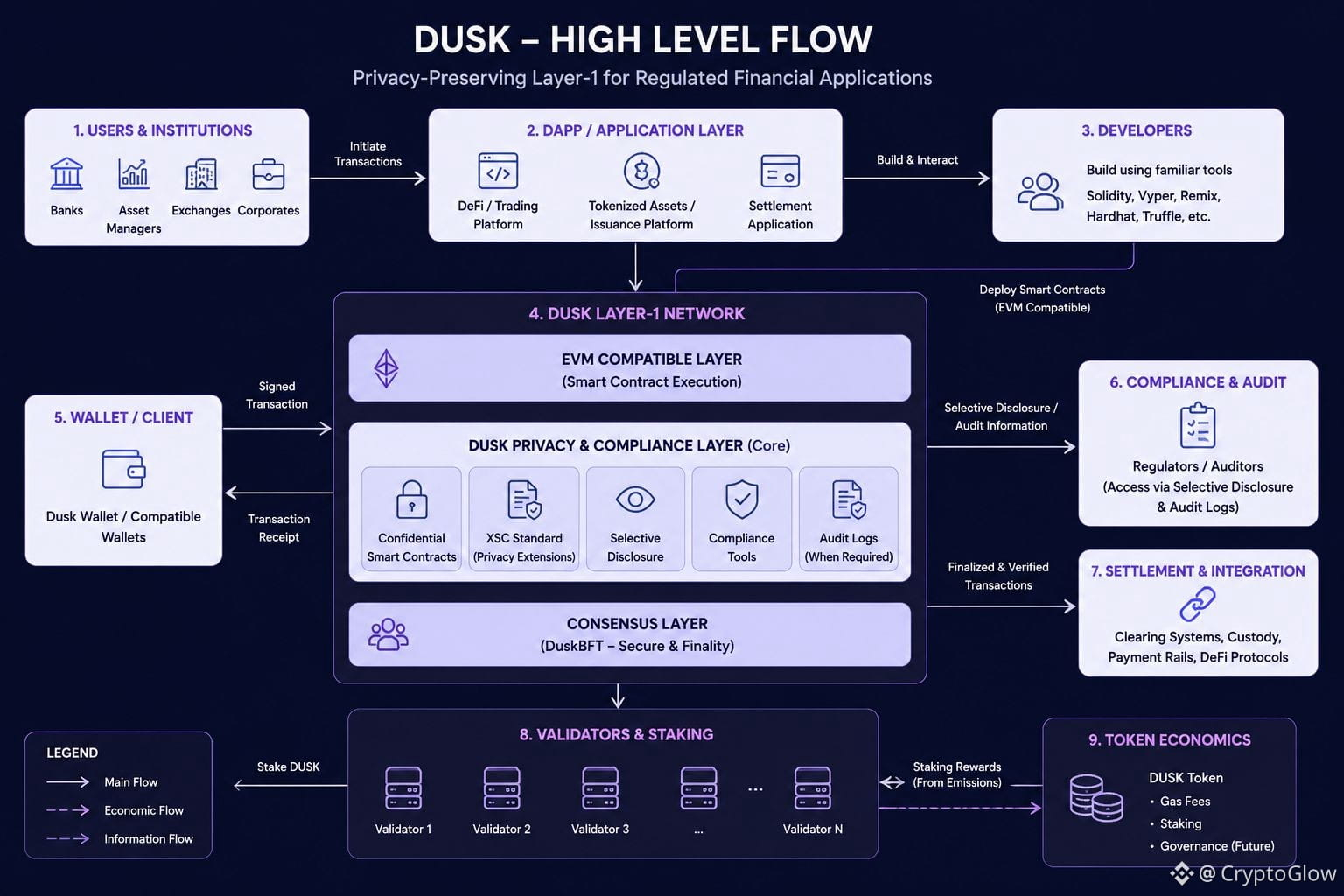
While checking Dusk activity, I treated a private transfer like a confirmed transaction: once it looked settled, I assumed the job was finished. That changed when I traced the flow.
I kept returning to Dusk’s XSC standard and private contracts. The key detail was not simply hiding data. The network still needs evidence to verify state without exposing all details.
That made me separate privacy and completion. A transfer can pass consensus while send, accept, and settle still create coordination.
The trade-off interests me. Confidentiality reduces exposure, but authorization and acknowledgement can add friction. I’m not sure where that becomes uncomfortable.
I would watch settlement timing, acceptance behavior, contract usage, failed transitions, and operator activity. I’d track recurring confidential activity to see whether it helps.
My takeaway is unresolved: Dusk is trying to keep financial information private while preserving verifiable execution. I’m wondering whether users will experience that as protection, or added coordination.
@Dusk_Foundation #dusk $DUSK
{spot}(DUSKUSDT)
While checking Dusk activity, I treated a private transfer like a confirmed transaction: once it looked settled, I assumed the job was finished. That changed when I traced the flow.
I kept returning to Dusk’s XSC standard and private contracts. The key detail was not simply hiding data. The network still needs evidence to verify state without exposing all details.
That made me separate privacy and completion. A transfer can pass consensus while send, accept, and settle still create coordination.
The trade-off interests me. Confidentiality reduces exposure, but authorization and acknowledgement can add friction. I’m not sure where that becomes uncomfortable.
I would watch settlement timing, acceptance behavior, contract usage, failed transitions, and operator activity. I’d track recurring confidential activity to see whether it helps.
My takeaway is unresolved: Dusk is trying to keep financial information private while preserving verifiable execution. I’m wondering whether users will experience that as protection, or added coordination.
@Dusk #dusk $DUSK
I kept returning to Dusk’s XSC standard and private contracts. The key detail was not simply hiding data. The network still needs evidence to verify state without exposing all details.
That made me separate privacy and completion. A transfer can pass consensus while send, accept, and settle still create coordination.
The trade-off interests me. Confidentiality reduces exposure, but authorization and acknowledgement can add friction. I’m not sure where that becomes uncomfortable.
I would watch settlement timing, acceptance behavior, contract usage, failed transitions, and operator activity. I’d track recurring confidential activity to see whether it helps.
My takeaway is unresolved: Dusk is trying to keep financial information private while preserving verifiable execution. I’m wondering whether users will experience that as protection, or added coordination.
@Dusk #dusk $DUSK
1
75
·
--
Tərcüməyə bax
I noticed something while scrolling through recent rounds on the @Dusk_Foundation Dusk explorer that I initially dismissed as random. The same provisioner address would appear as a block proposer in one round, then show up only as a validator two rounds later, doing nothing but confirming someone else's work. I assumed this was just noise in how the interface displayed activity.
Digging further, I realized it wasn't noise at all. Selection genuinely rotates responsibility — proposing, validating, and ratifying are separate duties assigned per round, not fixed roles tied to a provisioner's identity. What looked like inconsistency was actually the protocol deliberately preventing any single participant from both creating and approving the same block.
That distinction reframed something I had been treating as one idea. "Creating a block" and "finalizing a block" are not the same authority, and conflating them hides a subtler effect: as Dusk layers in EVM compatibility, proposal traffic from generic contracts can rise quickly, while the validators checking that traffic still carry the same fixed responsibility regardless of how complex the underlying logic is.
That leaves me uncertain about one thing. Confidential XSC contracts likely demand more careful scrutiny than plain EVM calls, yet if reward structures treat a validation round uniformly, does incentive alignment quietly erode as generic activity scales faster than confidential activity does.
I'll be watching the ratio of XSC to standard EVM transactions per block, whether the same provisioner addresses keep reappearing across epochs, and how ratification timing shifts as proposal volume grows. Consistency there would tell me more than raw transaction counts ever could.
I'm left wondering whether growth in developer activity strengthens this rotation model, or just adds weight to one side of it.#dusk $DUSK
I noticed something while scrolling through recent rounds on the @Dusk Dusk explorer that I initially dismissed as random. The same provisioner address would appear as a block proposer in one round, then show up only as a validator two rounds later, doing nothing but confirming someone else's work. I assumed this was just noise in how the interface displayed activity.
Digging further, I realized it wasn't noise at all. Selection genuinely rotates responsibility — proposing, validating, and ratifying are separate duties assigned per round, not fixed roles tied to a provisioner's identity. What looked like inconsistency was actually the protocol deliberately preventing any single participant from both creating and approving the same block.
That distinction reframed something I had been treating as one idea. "Creating a block" and "finalizing a block" are not the same authority, and conflating them hides a subtler effect: as Dusk layers in EVM compatibility, proposal traffic from generic contracts can rise quickly, while the validators checking that traffic still carry the same fixed responsibility regardless of how complex the underlying logic is.
That leaves me uncertain about one thing. Confidential XSC contracts likely demand more careful scrutiny than plain EVM calls, yet if reward structures treat a validation round uniformly, does incentive alignment quietly erode as generic activity scales faster than confidential activity does.
I'll be watching the ratio of XSC to standard EVM transactions per block, whether the same provisioner addresses keep reappearing across epochs, and how ratification timing shifts as proposal volume grows. Consistency there would tell me more than raw transaction counts ever could.
I'm left wondering whether growth in developer activity strengthens this rotation model, or just adds weight to one side of it.#dusk $DUSK
Digging further, I realized it wasn't noise at all. Selection genuinely rotates responsibility — proposing, validating, and ratifying are separate duties assigned per round, not fixed roles tied to a provisioner's identity. What looked like inconsistency was actually the protocol deliberately preventing any single participant from both creating and approving the same block.
That distinction reframed something I had been treating as one idea. "Creating a block" and "finalizing a block" are not the same authority, and conflating them hides a subtler effect: as Dusk layers in EVM compatibility, proposal traffic from generic contracts can rise quickly, while the validators checking that traffic still carry the same fixed responsibility regardless of how complex the underlying logic is.
That leaves me uncertain about one thing. Confidential XSC contracts likely demand more careful scrutiny than plain EVM calls, yet if reward structures treat a validation round uniformly, does incentive alignment quietly erode as generic activity scales faster than confidential activity does.
I'll be watching the ratio of XSC to standard EVM transactions per block, whether the same provisioner addresses keep reappearing across epochs, and how ratification timing shifts as proposal volume grows. Consistency there would tell me more than raw transaction counts ever could.
I'm left wondering whether growth in developer activity strengthens this rotation model, or just adds weight to one side of it.#dusk $DUSK
88
·
--
Tərcüməyə bax
I have seeing odd while tracing a batch of transfer attempts on @Dusk_Foundation Trade last week: several submissions kept failing at what looked like the same checkpoint. My first assumption was network congestion, something ordinary, nothing worth a second look.
Digging further, I saw the failures weren't random at all. They clustered around eligibility verification, the step where a wallet's permission to hold a specific security gets confirmed before any transfer executes. That's when I actually understood how central this authorization layer is. It isn't a formality sitting beside the transaction, it's a gate the transaction has to pass through every single time.
This reframed how I think about activity here. Most people treat "transfer" and "authorization" as the same event, but they're not. A transfer is intent. Authorization is permission. When permission fails silently or lags, volume numbers hide friction that never shows up in a block explorer.
$DUSK
What I can't resolve yet is where that verification logic actually lives day to day. If it leans heavily on off-chain compliance decisions feeding on-chain outcomes, then network-level metrics only tell half the story, and I don't know how much of the process stays genuinely decentralized versus operationally centralized.
Going forward I want to track failed-versus-successful authorization ratios over time, not just raw transfer counts, alongside how often the same wallets get re-verified for new instruments.
I'm left wondering whether repeated authorization checks become their own form of demand, separate from the transfers they gate. #dusk
I have seeing odd while tracing a batch of transfer attempts on @Dusk Trade last week: several submissions kept failing at what looked like the same checkpoint. My first assumption was network congestion, something ordinary, nothing worth a second look.
Digging further, I saw the failures weren't random at all. They clustered around eligibility verification, the step where a wallet's permission to hold a specific security gets confirmed before any transfer executes. That's when I actually understood how central this authorization layer is. It isn't a formality sitting beside the transaction, it's a gate the transaction has to pass through every single time.
This reframed how I think about activity here. Most people treat "transfer" and "authorization" as the same event, but they're not. A transfer is intent. Authorization is permission. When permission fails silently or lags, volume numbers hide friction that never shows up in a block explorer.
$DUSK
What I can't resolve yet is where that verification logic actually lives day to day. If it leans heavily on off-chain compliance decisions feeding on-chain outcomes, then network-level metrics only tell half the story, and I don't know how much of the process stays genuinely decentralized versus operationally centralized.
Going forward I want to track failed-versus-successful authorization ratios over time, not just raw transfer counts, alongside how often the same wallets get re-verified for new instruments.
I'm left wondering whether repeated authorization checks become their own form of demand, separate from the transfers they gate. #dusk
Digging further, I saw the failures weren't random at all. They clustered around eligibility verification, the step where a wallet's permission to hold a specific security gets confirmed before any transfer executes. That's when I actually understood how central this authorization layer is. It isn't a formality sitting beside the transaction, it's a gate the transaction has to pass through every single time.
This reframed how I think about activity here. Most people treat "transfer" and "authorization" as the same event, but they're not. A transfer is intent. Authorization is permission. When permission fails silently or lags, volume numbers hide friction that never shows up in a block explorer.
$DUSK
What I can't resolve yet is where that verification logic actually lives day to day. If it leans heavily on off-chain compliance decisions feeding on-chain outcomes, then network-level metrics only tell half the story, and I don't know how much of the process stays genuinely decentralized versus operationally centralized.
Going forward I want to track failed-versus-successful authorization ratios over time, not just raw transfer counts, alongside how often the same wallets get re-verified for new instruments.
I'm left wondering whether repeated authorization checks become their own form of demand, separate from the transfers they gate. #dusk
1
87
·
--
Tərcüməyə bax
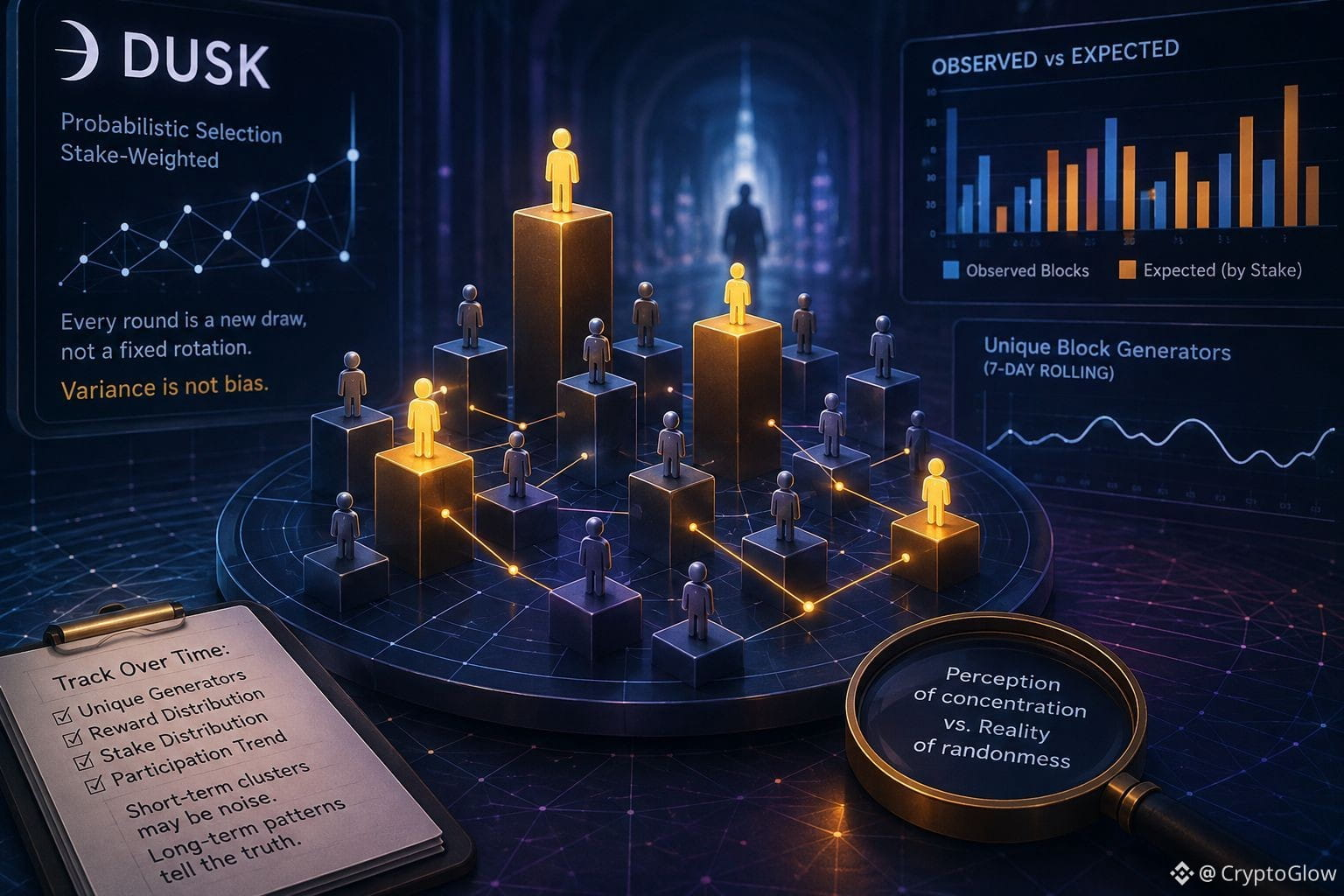
#dusk $DUSK I noticed something while scrolling through recent block producers on the @Dusk_Foundation explorer. A handful of provisioner addresses kept showing up far more often than others over a short window, and I assumed it was just latency or an uneven peer connection skewing the sample I happened to catch.
Widening the window changed that read. Dusk selects its block generator and voting committee each round through a probabilistic process weighted by stake, not a fixed rotation schedule. Larger stakes get selected more often on average, but "on average" is doing real work there. Over any short stretch, selection can cluster hard around a few addresses purely from the math of the draw, not from any advantage being exploited.
That distinction rewired how I was thinking about it. I'd been treating stake weight and actual visibility as the same thing, like proportional stake guarantees proportional appearance. It doesn't, not in small samples. A provisioner can hold a modest stake and still vanish from block production for stretches, while a mid-sized one runs hot for a while. The gap between statistical entitlement and observed participation is where perception of concentration quietly forms.
What I haven't settled is whether that variance actually discourages smaller provisioners from staying active, or whether they understand it's noise and hold steady. If uneven short-term rewards push smaller stakers toward pooling or exiting, the committee composition drifts even though the underlying selection math stayed neutral.
I'm going to track unique block generator counts across rolling weekly windows, not just single snapshots, alongside how reward distribution compares to stake distribution over the same periods. That tells me whether clustering evens out or compounds.
Still unclear to me whether what I'm seeing is just the natural texture of probabilistic selection or an early signal of something structural pulling participation toward fewer hands.
#dusk $DUSK I noticed something while scrolling through recent block producers on the @Dusk explorer. A handful of provisioner addresses kept showing up far more often than others over a short window, and I assumed it was just latency or an uneven peer connection skewing the sample I happened to catch.
Widening the window changed that read. Dusk selects its block generator and voting committee each round through a probabilistic process weighted by stake, not a fixed rotation schedule. Larger stakes get selected more often on average, but "on average" is doing real work there. Over any short stretch, selection can cluster hard around a few addresses purely from the math of the draw, not from any advantage being exploited.
That distinction rewired how I was thinking about it. I'd been treating stake weight and actual visibility as the same thing, like proportional stake guarantees proportional appearance. It doesn't, not in small samples. A provisioner can hold a modest stake and still vanish from block production for stretches, while a mid-sized one runs hot for a while. The gap between statistical entitlement and observed participation is where perception of concentration quietly forms.
What I haven't settled is whether that variance actually discourages smaller provisioners from staying active, or whether they understand it's noise and hold steady. If uneven short-term rewards push smaller stakers toward pooling or exiting, the committee composition drifts even though the underlying selection math stayed neutral.
I'm going to track unique block generator counts across rolling weekly windows, not just single snapshots, alongside how reward distribution compares to stake distribution over the same periods. That tells me whether clustering evens out or compounds.
Still unclear to me whether what I'm seeing is just the natural texture of probabilistic selection or an early signal of something structural pulling participation toward fewer hands.
Widening the window changed that read. Dusk selects its block generator and voting committee each round through a probabilistic process weighted by stake, not a fixed rotation schedule. Larger stakes get selected more often on average, but "on average" is doing real work there. Over any short stretch, selection can cluster hard around a few addresses purely from the math of the draw, not from any advantage being exploited.
That distinction rewired how I was thinking about it. I'd been treating stake weight and actual visibility as the same thing, like proportional stake guarantees proportional appearance. It doesn't, not in small samples. A provisioner can hold a modest stake and still vanish from block production for stretches, while a mid-sized one runs hot for a while. The gap between statistical entitlement and observed participation is where perception of concentration quietly forms.
What I haven't settled is whether that variance actually discourages smaller provisioners from staying active, or whether they understand it's noise and hold steady. If uneven short-term rewards push smaller stakers toward pooling or exiting, the committee composition drifts even though the underlying selection math stayed neutral.
I'm going to track unique block generator counts across rolling weekly windows, not just single snapshots, alongside how reward distribution compares to stake distribution over the same periods. That tells me whether clustering evens out or compounds.
Still unclear to me whether what I'm seeing is just the natural texture of probabilistic selection or an early signal of something structural pulling participation toward fewer hands.
1
57
·
--
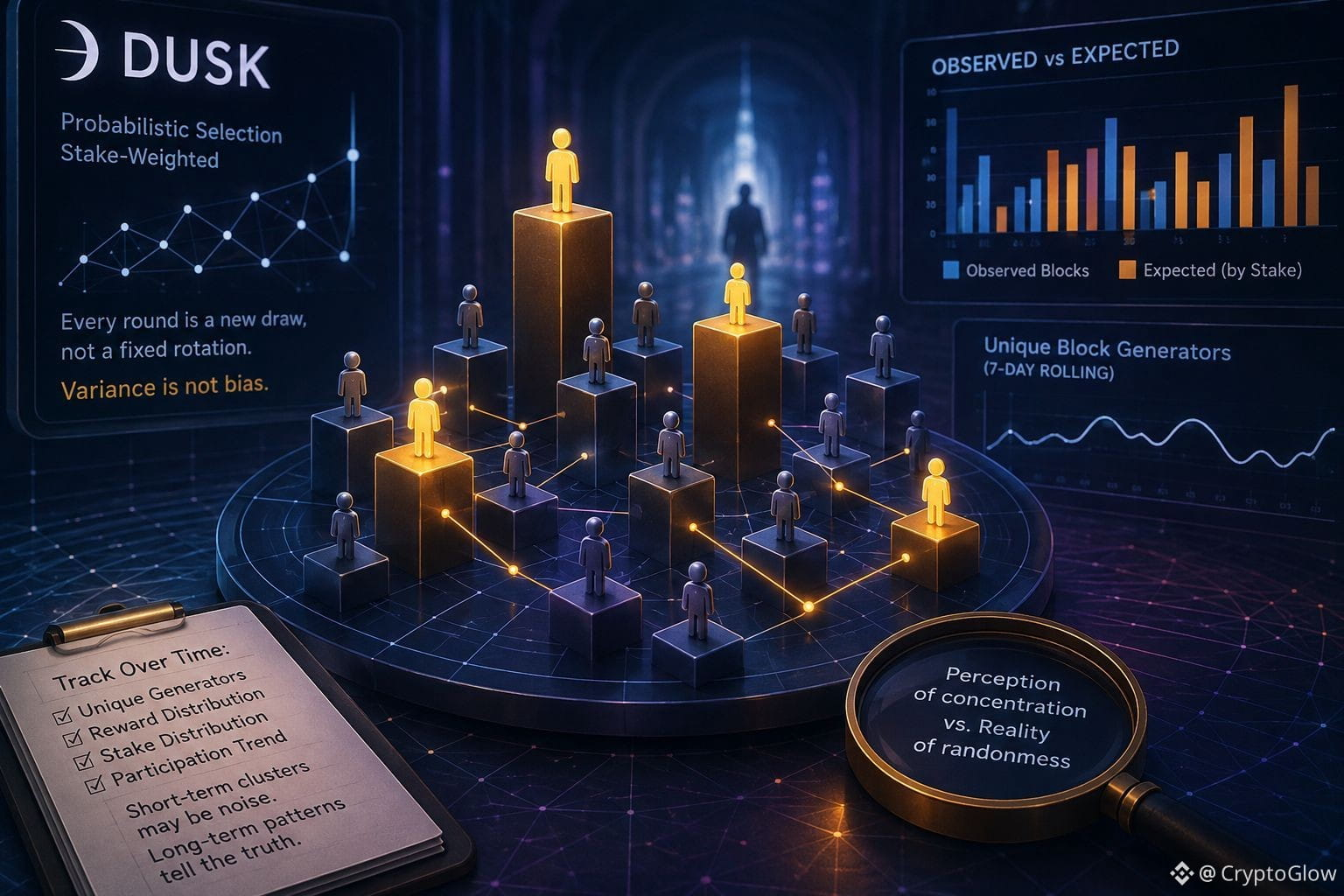
@Dusk explorer-də yaxınlarda block prodüserlərini vərəqləyərkən nəsə diqqətimi çəkdi. Bir neçə provisioner ünvanı qısa bir pəncərədə başqalarından xeyli daha tez-tez görünürdü və mən sadəcə gecikmə (latency) və ya qeyri-bərabər peer bağlantısının təsadüfi olaraq seçdiyim nümunəni əyərək bu mənzərəni yaratdığını düşündüm.
Pəncərəni genişləndirdikdə bu oxunuş dəyişdi. $DUSK hər dövr generatoru və səsvermə komitəsini paydanın çəkisi ilə mərhələli şəkildə (stake-ə əsasən) ehtimallı proses vasitəsilə seçir, sabit rotasiya cədvəli ilə yox. Daha böyük stake-lər orta hesabla daha tez-tez seçilir, amma “orta hesabla” burda həqiqətən iş görür. Hər hansı qısa müddətdə seçim yalnız püşkün riyaziyyatından irəli gələrək bir neçə ünvan ətrafında güclü şəkildə yığıla bilər; istismar olunan hər hansı üstünlükdən deyil.
Bu fərq barədə düşüncə tərzim tamamilə dəyişdi. Mən stake çəkisini və faktiki görünürlüğü eyni şey kimi qəbul edirdim—mütənasib stake mütləq mütənasib görünmə yaradır kimi. Amma bu, kiçik nümunələrdə belə deyil. Bir provisioner azacıq stake-ə sahib olub uzun müddət block istehsalından tam yox ola bilər, halbuki daha orta ölçülü birisi bir müddət “isti” keçirə bilər. Statistik “tələb”lə müşahidə edilən iştirak arasındakı boşluq—diqqətlə—konsentrasiya qavrayışını səssizcə formalaşdırır.
Hələ həll etmədiyim məsələ budur: bu dəyişkənlik (variance) həqiqətən də daha kiçik provisionerləri aktiv qalmaqdan çəkindirir, yoxsa onlar bunun səs-küy (noise) olduğunu anlayıb sabit qalırlar. Əgər qeyri-bərabər qısa müddətli mükafatlar kiçik stake sahiblərini hovuzda birləşməyə və ya çıxmağa sövq edirsə, komitənin tərkibi dəyişir—amma əsas seçim riyaziyyatı neytral qalır.
Mən yuvarlanan həftəlik pəncərələr üzrə unikal block generator saylarını izləyəcəyəm—təkcə bir anlıq görüntünü yox. Eyni dövrlərdə mükafat paylanmasının stake paylanması ilə necə müqayisə olunduğunu da yoxlayacağam. Bu, yığılmanın (clustering) bərabərləşib-bərabərləşmədiyini, yoxsa artıb-artmadığını göstərəcək.#dusk
Mənim üçün hələ də tam aydın deyil ki, gördüklərim sadəcə ehtimallı seçimin təbii “toxumasıdır”, yoxsa iştirakın daha az sayda əl arasında cəmlənməsinə səbəb olan struktur xarakterli nəyinsə erkən siqnalıdır.
@Dusk explorer-də yaxınlarda block prodüserlərini vərəqləyərkən nəsə diqqətimi çəkdi. Bir neçə provisioner ünvanı qısa bir pəncərədə başqalarından xeyli daha tez-tez görünürdü və mən sadəcə gecikmə (latency) və ya qeyri-bərabər peer bağlantısının təsadüfi olaraq seçdiyim nümunəni əyərək bu mənzərəni yaratdığını düşündüm.
Pəncərəni genişləndirdikdə bu oxunuş dəyişdi. $DUSK hər dövr generatoru və səsvermə komitəsini paydanın çəkisi ilə mərhələli şəkildə (stake-ə əsasən) ehtimallı proses vasitəsilə seçir, sabit rotasiya cədvəli ilə yox. Daha böyük stake-lər orta hesabla daha tez-tez seçilir, amma “orta hesabla” burda həqiqətən iş görür. Hər hansı qısa müddətdə seçim yalnız püşkün riyaziyyatından irəli gələrək bir neçə ünvan ətrafında güclü şəkildə yığıla bilər; istismar olunan hər hansı üstünlükdən deyil.
Bu fərq barədə düşüncə tərzim tamamilə dəyişdi. Mən stake çəkisini və faktiki görünürlüğü eyni şey kimi qəbul edirdim—mütənasib stake mütləq mütənasib görünmə yaradır kimi. Amma bu, kiçik nümunələrdə belə deyil. Bir provisioner azacıq stake-ə sahib olub uzun müddət block istehsalından tam yox ola bilər, halbuki daha orta ölçülü birisi bir müddət “isti” keçirə bilər. Statistik “tələb”lə müşahidə edilən iştirak arasındakı boşluq—diqqətlə—konsentrasiya qavrayışını səssizcə formalaşdırır.
Hələ həll etmədiyim məsələ budur: bu dəyişkənlik (variance) həqiqətən də daha kiçik provisionerləri aktiv qalmaqdan çəkindirir, yoxsa onlar bunun səs-küy (noise) olduğunu anlayıb sabit qalırlar. Əgər qeyri-bərabər qısa müddətli mükafatlar kiçik stake sahiblərini hovuzda birləşməyə və ya çıxmağa sövq edirsə, komitənin tərkibi dəyişir—amma əsas seçim riyaziyyatı neytral qalır.
Mən yuvarlanan həftəlik pəncərələr üzrə unikal block generator saylarını izləyəcəyəm—təkcə bir anlıq görüntünü yox. Eyni dövrlərdə mükafat paylanmasının stake paylanması ilə necə müqayisə olunduğunu da yoxlayacağam. Bu, yığılmanın (clustering) bərabərləşib-bərabərləşmədiyini, yoxsa artıb-artmadığını göstərəcək.#dusk
Mənim üçün hələ də tam aydın deyil ki, gördüklərim sadəcə ehtimallı seçimin təbii “toxumasıdır”, yoxsa iştirakın daha az sayda əl arasında cəmlənməsinə səbəb olan struktur xarakterli nəyinsə erkən siqnalıdır.
Pəncərəni genişləndirdikdə bu oxunuş dəyişdi. $DUSK hər dövr generatoru və səsvermə komitəsini paydanın çəkisi ilə mərhələli şəkildə (stake-ə əsasən) ehtimallı proses vasitəsilə seçir, sabit rotasiya cədvəli ilə yox. Daha böyük stake-lər orta hesabla daha tez-tez seçilir, amma “orta hesabla” burda həqiqətən iş görür. Hər hansı qısa müddətdə seçim yalnız püşkün riyaziyyatından irəli gələrək bir neçə ünvan ətrafında güclü şəkildə yığıla bilər; istismar olunan hər hansı üstünlükdən deyil.
Bu fərq barədə düşüncə tərzim tamamilə dəyişdi. Mən stake çəkisini və faktiki görünürlüğü eyni şey kimi qəbul edirdim—mütənasib stake mütləq mütənasib görünmə yaradır kimi. Amma bu, kiçik nümunələrdə belə deyil. Bir provisioner azacıq stake-ə sahib olub uzun müddət block istehsalından tam yox ola bilər, halbuki daha orta ölçülü birisi bir müddət “isti” keçirə bilər. Statistik “tələb”lə müşahidə edilən iştirak arasındakı boşluq—diqqətlə—konsentrasiya qavrayışını səssizcə formalaşdırır.
Hələ həll etmədiyim məsələ budur: bu dəyişkənlik (variance) həqiqətən də daha kiçik provisionerləri aktiv qalmaqdan çəkindirir, yoxsa onlar bunun səs-küy (noise) olduğunu anlayıb sabit qalırlar. Əgər qeyri-bərabər qısa müddətli mükafatlar kiçik stake sahiblərini hovuzda birləşməyə və ya çıxmağa sövq edirsə, komitənin tərkibi dəyişir—amma əsas seçim riyaziyyatı neytral qalır.
Mən yuvarlanan həftəlik pəncərələr üzrə unikal block generator saylarını izləyəcəyəm—təkcə bir anlıq görüntünü yox. Eyni dövrlərdə mükafat paylanmasının stake paylanması ilə necə müqayisə olunduğunu da yoxlayacağam. Bu, yığılmanın (clustering) bərabərləşib-bərabərləşmədiyini, yoxsa artıb-artmadığını göstərəcək.#dusk
Mənim üçün hələ də tam aydın deyil ki, gördüklərim sadəcə ehtimallı seçimin təbii “toxumasıdır”, yoxsa iştirakın daha az sayda əl arasında cəmlənməsinə səbəb olan struktur xarakterli nəyinsə erkən siqnalıdır.
1
77
·
--
Ticarət bacarıqlarımı artırmağa çalışıram. Əgər təcrübəli treyderlər ardıcıl şəkildə gəlirli olmağa kömək edən bir dərsi bölüşsələr, bunu çox yüksək qiymətləndirərdim.
Ticarət bacarıqlarımı artırmağa çalışıram. Əgər təcrübəli treyderlər ardıcıl şəkildə gəlirli olmağa kömək edən bir dərsi bölüşsələr, bunu çox yüksək qiymətləndirərdim.
71
·
--
Sadəcə bazarı yoxlayıram və səbirli qalmağa çalışıram. 👀
Bəzən ən yaxşı ticarət heç bir ticarət etmeməkdir.
Bugün $BTC -ü diqqətlə izləyirəm.
#Bitcoin #Crypto #BinanceSquare
Sadəcə bazarı yoxlayıram və səbirli qalmağa çalışıram. 👀
Bəzən ən yaxşı ticarət heç bir ticarət etmeməkdir.
Bugün $BTC -ü diqqətlə izləyirəm.
#Bitcoin #Crypto #BinanceSquare
Bəzən ən yaxşı ticarət heç bir ticarət etmeməkdir.
Bugün $BTC -ü diqqətlə izləyirəm.
#Bitcoin #Crypto #BinanceSquare
106
·
--
Bu gün heç bir şeyə tələsmirəm... sadəcə, girişdən əvvəl təmiz təsdiq gözləyirəm. Əvvəllər çox ticarət edirdim, amma indi öyrəndim ki, bu oyunda səbr hər şeydir.
$BTC hələ də əsas diqqət mərkəzidir, amma altkoinlər də izlənməyə dəyər kiçik hərəkətlər göstərir.
Gəlin bazarın növbəti saatlarda necə reaksiya verəcəyini görək 🚀
#BinanceSquare #Crypto #BTC #TradingView #WriteToEarn
Bu gün heç bir şeyə tələsmirəm... sadəcə, girişdən əvvəl təmiz təsdiq gözləyirəm. Əvvəllər çox ticarət edirdim, amma indi öyrəndim ki, bu oyunda səbr hər şeydir.
$BTC hələ də əsas diqqət mərkəzidir, amma altkoinlər də izlənməyə dəyər kiçik hərəkətlər göstərir.
Gəlin bazarın növbəti saatlarda necə reaksiya verəcəyini görək 🚀
#BinanceSquare #Crypto #BTC #TradingView #WriteToEarn
$BTC hələ də əsas diqqət mərkəzidir, amma altkoinlər də izlənməyə dəyər kiçik hərəkətlər göstərir.
Gəlin bazarın növbəti saatlarda necə reaksiya verəcəyini görək 🚀
#BinanceSquare #Crypto #BTC #TradingView #WriteToEarn
58
·
--
Bu gün velasları analiz etdikdən sonra yenə bir mövqe əlavə etdim. 📊
Bazar maraqlı siqnallar göstərir, amma risk idarəetməsi hər zaman ön plandadır. Heç bir ticarət zəmanətli deyil, ona görə də planıma sadiq qalır və emosional qərarlardan qaçıram.
Hal-hazırda $BTC , $ETH və bir neçə altcoin-in potensial hərəkətlərinə diqqət yetirirəm. 👀
Bu gün nəyi izləyirsiniz? 🚀
#Crypto #Trading #BinanceSquare #BTC #ETH
Bu gün velasları analiz etdikdən sonra yenə bir mövqe əlavə etdim. 📊
Bazar maraqlı siqnallar göstərir, amma risk idarəetməsi hər zaman ön plandadır. Heç bir ticarət zəmanətli deyil, ona görə də planıma sadiq qalır və emosional qərarlardan qaçıram.
Hal-hazırda $BTC , $ETH və bir neçə altcoin-in potensial hərəkətlərinə diqqət yetirirəm. 👀
Bu gün nəyi izləyirsiniz? 🚀
#Crypto #Trading #BinanceSquare #BTC #ETH
Bazar maraqlı siqnallar göstərir, amma risk idarəetməsi hər zaman ön plandadır. Heç bir ticarət zəmanətli deyil, ona görə də planıma sadiq qalır və emosional qərarlardan qaçıram.
Hal-hazırda $BTC , $ETH və bir neçə altcoin-in potensial hərəkətlərinə diqqət yetirirəm. 👀
Bu gün nəyi izləyirsiniz? 🚀
#Crypto #Trading #BinanceSquare #BTC #ETH
66
·
--
🔥 Bu Günün Bazarı Yoxlama
$BTC bazar hərəkatını idarə edir. Ticarətçilər növbəti partlayış səviyyəsini izləyirlər.
📊 Diqqət yetirin: • $BTC • $ETH • $BNB
Bu gün üçün proqnozunuz nədir? Bullish 🐂 yoxsa Bearish 🐻?
#Bitcoin #CryptoTrading #BinanceSquare
🔥 Bu Günün Bazarı Yoxlama
$BTC bazar hərəkatını idarə edir. Ticarətçilər növbəti partlayış səviyyəsini izləyirlər.
📊 Diqqət yetirin: • $BTC • $ETH • $BNB
Bu gün üçün proqnozunuz nədir? Bullish 🐂 yoxsa Bearish 🐻?
#Bitcoin #CryptoTrading #BinanceSquare
$BTC bazar hərəkatını idarə edir. Ticarətçilər növbəti partlayış səviyyəsini izləyirlər.
📊 Diqqət yetirin: • $BTC • $ETH • $BNB
Bu gün üçün proqnozunuz nədir? Bullish 🐂 yoxsa Bearish 🐻?
#Bitcoin #CryptoTrading #BinanceSquare
97
·
--
🚀 $BTC Yeniləmə
Bitcoin bu gün güclü momentum göstərir! 📈
✅ Cari Trend: Bullish 🎯 Növbəti Müqavimət: $110,000 ⚠️ Giriş etməzdən əvvəl volatilliyi izləyin.
Bu həftə $BTC üzrə bullish yoxsa bearishsınız? 👇
#BTC #Bitcoin #Crypto #BinanceSquare
🚀 $BTC Yeniləmə
Bitcoin bu gün güclü momentum göstərir! 📈
✅ Cari Trend: Bullish 🎯 Növbəti Müqavimət: $110,000 ⚠️ Giriş etməzdən əvvəl volatilliyi izləyin.
Bu həftə $BTC üzrə bullish yoxsa bearishsınız? 👇
#BTC #Bitcoin #Crypto #BinanceSquare
Bitcoin bu gün güclü momentum göstərir! 📈
✅ Cari Trend: Bullish 🎯 Növbəti Müqavimət: $110,000 ⚠️ Giriş etməzdən əvvəl volatilliyi izləyin.
Bu həftə $BTC üzrə bullish yoxsa bearishsınız? 👇
#BTC #Bitcoin #Crypto #BinanceSquare
99
·
--
🚀 BTC Yeniləmə!
Bitcoin yenidən güclü hərəkət edir, amma bazar hələ də qeyri-müəyyəndir.
Bəzi treyderlər "bull run başlayır" deyir 📈
amma digərləri düzəliş gözləyir 📉
İndi əsas sual belədir:
👉 BTC-ni burada alırsan, yoxsa düşüşü gözləyirsən?
Fikirlərini aşağıda paylaş 💬
Gəlin, əksəriyyət nə düşünür baxaq 👇
#Bitcoin #BTC #Crypto #Treyderlik #BinanceSquare #WriteToEarn
🚀 BTC Yeniləmə!
Bitcoin yenidən güclü hərəkət edir, amma bazar hələ də qeyri-müəyyəndir.
Bəzi treyderlər "bull run başlayır" deyir 📈
amma digərləri düzəliş gözləyir 📉
İndi əsas sual belədir:
👉 BTC-ni burada alırsan, yoxsa düşüşü gözləyirsən?
Fikirlərini aşağıda paylaş 💬
Gəlin, əksəriyyət nə düşünür baxaq 👇
#Bitcoin #BTC #Crypto #Treyderlik #BinanceSquare #WriteToEarn
Bitcoin yenidən güclü hərəkət edir, amma bazar hələ də qeyri-müəyyəndir.
Bəzi treyderlər "bull run başlayır" deyir 📈
amma digərləri düzəliş gözləyir 📉
İndi əsas sual belədir:
👉 BTC-ni burada alırsan, yoxsa düşüşü gözləyirsən?
Fikirlərini aşağıda paylaş 💬
Gəlin, əksəriyyət nə düşünür baxaq 👇
#Bitcoin #BTC #Crypto #Treyderlik #BinanceSquare #WriteToEarn
72
Daha çox kontent araşdırmaq üçün daxil olun
Binance Square-də qlobal kriptovalyuta istifadəçilərinə qoşulun
⚡️ Kriptovalyuta haqqında ən son və faydalı məlumatları əldə edin.
💬 Dünyanın ən böyük kriptovalyuta birjası tərəfindən etibar edilir.
👍 Doğrulanmış yaradıcılardan gələn real məlumatları kəşf edin.
E-poçt/Telefon nömrəsi
Trenddə olan mövzular
PolymarketBankFailureBetsDrawFDICConcern
3,156 baxış
Müzakirə edir: 157
#polymarketbankfailurebetsdrawfdicconcern
🚨 Bazar Xəbərdarlığı: Polymarketdə Bank Çöküşü Üzərinə Bahis FDIC Narahatlığı Yaratdı
Vəziyyət: Maliyyə dünyası Polymarketdə—xüsusilə iri bankların çöküş ehtimalına mərc edən—yüksək mərcli proqnoz bazarının diqqəti və narahatlığı cəlb etməsi ilə guruldayır. Bu proses FDIC daxil olmaqla tənzimləyicilər tərəfindən ciddi izlənilmə mövzusu olub. Nəticədə bazar əhvalı birbaşa tənzimləyici nəzarəti artıran və ya gücləndirən qeyri-sabit rəy (feedback) döngüsü yaranıb; bu da sektorda kütləvi həcm və yüksək volatillik doğurur.
Bunun Treyderlər üçün mənası: Maliyyə çətinliyi ilə bağlı proqnoz bazarları bu qədər güclü diqqət qazananda bu, həddindən artıq bazar gərginliyi və yüksəlmiş sistemik risk siqnalı verir. Treyderlər bank sektorunda yoluxma (contagion) riskini yaxından izləyir; bu isə risk idarəçiliyi və sektor rotasiyası üçün kritik məqamdır.
Diqqət yetiriləsi izlənilə bilən treyd edilə bilən sikkələr:
$BTC (Bitcoin): Ən önəmli makro hedcinq. Fiat bankçılıq sabitliyi ilə bağlı narahatlıqlar artdıqca treyderlər tez-tez qeyri-mərkəzləşmiş, suveren olmayan dəyər saxlayıcısı kimi Bitcoinə kapital yönləndirir.
$ETH (Ethereum): Qeyri-mərkəzləşdirilmiş maliyyə (DeFi) ekosisteminin lideri. Ənənəvi bank sektoru təzyiq altında qalarsa, diqqətin artması çox vaxt Ethereum üzərində qurulmuş onçeyn (on-chain) maliyyə və kreditləşmə protokollarına yönəlir.
$BNB (Binance Coin): Birja sağlamlığı və daha geniş bazar əhvalı üçün proxy kimi. Böyük birja tokenlərinin qəfil maliyyə xəbərlərinə necə reaksiya verdiyini izləmək ümumi bazar likvidliyi və treyder etimadı barədə fikir verir.
Sistemik riskə qarşı hedcinq edirsiniz, yoxsa kənardan izləyirsiniz? Gəlin aşağıdakı şərhlərdə strategiyanızı müzakirə edək! 👇
#Polymarket #FDIC #BankingSector #PredictionMarkets
Axiom AlphA
·0 bəyənmə
·2.5k baxış
BlackRockBuildsTokenizedPortfoliosForOndo
1,892 baxış
Müzakirə edir: 100
BitwiseFilesToListNEARETFOnNYSEArca
3,363 baxış
Müzakirə edir: 135