

DAEMONWHISPERER
10 منشورات

DAEMONWHISPERER
إبلاغ
حظر المُستخدم
simple breakdowns from a guy who doesn't quit
25 تتابع
22 المتابعون
18 إعجاب
منشورات
#CanMicrosoftDeliverOnAI
أستخدم أدوات الذكاء الاصطناعي يوميًا في عملي، لذا لا أسأل إن كان الذكاء الاصطناعي حقيقيًا. بل أسأل إن كان إنفاق مايكروسوفت عليه يحقق عائدًا.
ستعلن الشركة نتائجها الليلة، وأكثر رقم يهمني هو نمو Azure. وكانت توقعاتها تشير إلى نحو 45%. فعلى Azure أن تحقق عائدًا من معظم تكاليف الذكاء الاصطناعي، وهذه التكاليف هائلة. وقد أبلغت مايكروسوفت المستثمرين بأن عليهم توقع إنفاق يتجاوز 50 مليار دولار في هذا الربع وحده، يذهب معظمه إلى مراكز البيانات.
أما Copilot فهو النصف الآخر من المعادلة. فقد تجاوز عدد المقاعد المدفوعة 30 مليونًا في الربع الماضي، وهذا رقم كبير، لكن عدد المقاعد لا يوضح ما إذا كانت الشركات تحقق قيمة حقيقية أم أنها تجرّبه فحسب ضمن ميزانية هذا العام.
بالنسبة إليّ، يعني الوفاء بوعود الذكاء الاصطناعي أن يتحول كل هذا الإنفاق إلى إيرادات بوتيرة أسرع من تأثيره السلبي على هوامش الربح. فقد تراجعت هوامش أرباح الحوسبة السحابية بالفعل إلى 65% في الربع الماضي. إذا جاء أداء Azure دون التوقعات بينما يواصل الإنفاق ارتفاعه، فتوقعوا أن تنتشر منشورات «فقاعة الذكاء الاصطناعي» في كل مكان بحلول الصباح.
ما توقعكم لليلة: نتائج أفضل أم أسوأ من المتوقع؟
ليست نصيحة مالية
80
مقالة
عرض الترجمة
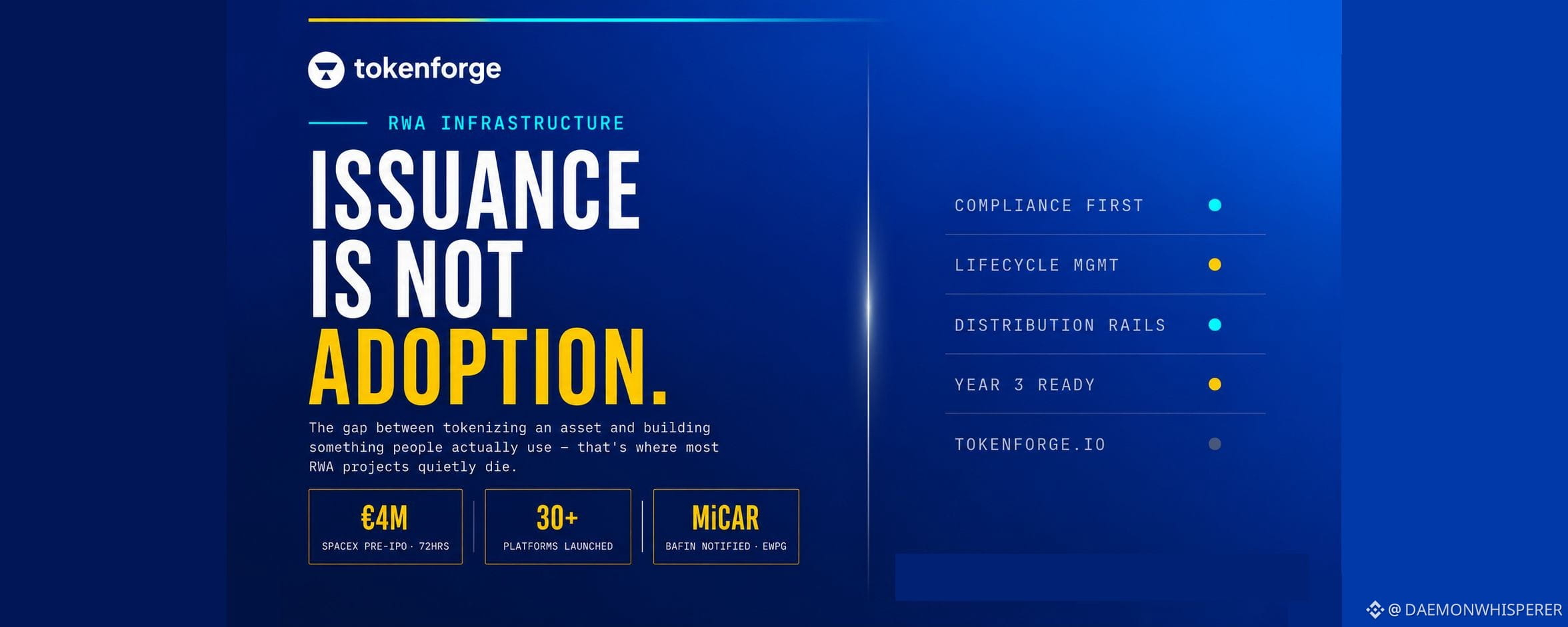
The Part Nobody Wants to Talk About: Infrastructure Is Not AdoptionEveryone is counting the TVL.
Nobody is asking what happens after the token gets issued.
That gap between issuance and adoption is where most RWA projects quietly die. And understanding it is the only way to know which infrastructure actually matters.
What "Tokenization" Actually Means
When people say a real-world asset has been "tokenized," they usually mean one of two things:
A legal claim on a real asset has been represented on a blockchain.
That representation is now being used by someone, traded by someone, or held by someone outside the original circle.
These are not the same thing. Not even close.
The first is an issuance event. The second is adoption. The industry has spent five years optimizing for the first and hoping the second follows automatically. It mostly doesn't.
A bond issued on-chain is still a bond. Its liquidity, its distribution, its settlement efficiency none of that changes just because the ISIN now has a token address attached. The token is a container. What matters is what you build around it.
The Infrastructure Problem
Issuing a tokenized asset in a compliant way is genuinely hard. You need:
→ Smart contract architecture that maps correctly to the legal instrument
→ KYC/AML-integrated investor onboarding
→ A cap table or register that satisfies local securities law
→ Hooks for corporate actions interest payments, voting, dividends
→ Distribution rails that can actually reach qualified buyers
→ Ongoing lifecycle management post-issuance
Most issuers underestimate steps 4 through 6. They treat issuance as the finish line. It's the starting gun.
This is why whitelabel infrastructure plays like TokenSuite from @tokenforge exist. Not to take credit for the asset itself, but to handle everything that comes after "we decided to tokenize this."
@tokenforge is a German-regulated entity operating under MiCAR, MiFID II, and eWpG the German Electronic Securities Act. That last one matters specifically because eWpG enables crypto securities without a physical certificate requirement, which means the token is the security under German law. Not a representation of it. The security itself.
That distinction changes everything about what you can do downstream.
What Real Adoption Looks Like
The SpaceX Pre-IPO deal @tokenforge closed €4M fully subscribed in 72 hours gets cited often. It should be. That's a clean proof of concept.
But the more interesting signal isn't the speed. It's the structure.
A Pre-IPO token is one of the hardest instruments to tokenize properly. You're dealing with secondary market restrictions, investor accreditation requirements, complex cap table dynamics, and an underlying asset that isn't publicly priced. The fact that it closed in 72 hours tells you two things:
1. The distribution network existed before the deal launched.
2. The legal structure was pre
cleared.
Neither of those things happens by accident. They're infrastructure decisions made months earlier.
That's what most people miss when they see a "successful tokenization." The visible part the raise, the close, the announcement is downstream of a thousand boring decisions about compliance architecture, investor flow, and settlement mechanics.
The MiCAR Angle
MiCAR went into force in June 2024. Full application across EU member states by December 2024.
The crypto industry largely treated it as a compliance headache. The smart operators treated it as a moat.
Here's why: MiCAR creates a licensing framework that most crypto-native operators cannot meet quickly. It requires a whitepaper filed under Article 6(3), specific disclosures, investor withdrawal rights under Article 13, safeguarding arrangements for funds, and ongoing obligations for any public token offering.
@tokenforge 's $TKFG whitepaper is BaFin-notified. That means it went through German financial regulatory review not just a lawyer's opinion, but an actual notification to the federal financial supervisory authority.
For institutional buyers evaluating RWA platforms in Europe, that's the difference between "interesting project" and "we can actually allocate here."
Compliance isn't a feature. It's the table stakes. And most of the space hasn't paid those stakes yet.
What Tokenization of “What” Actually Means
The other framing error is treating all tokenized assets the same. Tokenized equities, tokenized bonds, tokenized private credit, tokenized real estate, tokenized commodities these are not variations of the same product. They're different instruments with different legal structures, different investor profiles, different liquidity requirements, and different regulatory treatments.
A tokenized government bond and a tokenized real estate fund share almost nothing except the word "tokenized."
One settles in T+0, the other has quarterly liquidity windows. One has a credit rating, the other depends on property valuation. One targets institutional fixed income desks, the other targets accredited retail.
Infrastructure that works for one may not work for the other. The platforms that get this that build modular tooling for different instrument types rather than a single generic tokenization wrapper are the ones that will still be operating in five years. Modular, API-first design isn't a technical preference. It's a market requirement.
The Question Worth Asking
Before you evaluate any RWA project, ask this:
What happens to this token in year three?
Not at launch. Not at fundraising. In year one excitement. In year two attention drift. In year three, when the narrative has faded, when the team has moved on, when market cycles have rotated more than once.
Does the instrument still legally exist in a way regulators recognize?
Is there infrastructure handling corporate actions without manual intervention?
Is there a functioning secondary market where exits are actually possible?
And most importantly, is there anyone still accountable for its lifecycle beyond issuance?
Most tokenized assets fail here.
Not because the idea was wrong or the technology didn’t work. But because everything around the token was built for creation, not continuation. Not because the technology breaks. But because nothing was built for life after issuance. The projects worth watching are not the ones that launch fastest. They are the ones that still function when nobody
is watching. That’s the real game.
The Part Nobody Wants to Talk About: Infrastructure Is Not Adoption
Everyone is counting the TVL.
Nobody is asking what happens after the token gets issued.
That gap between issuance and adoption is where most RWA projects quietly die. And understanding it is the only way to know which infrastructure actually matters.
What "Tokenization" Actually Means
When people say a real-world asset has been "tokenized," they usually mean one of two things:
A legal claim on a real asset has been represented on a blockchain.
That representation is now being used by someone, traded by someone, or held by someone outside the original circle.
These are not the same thing. Not even close.
The first is an issuance event. The second is adoption. The industry has spent five years optimizing for the first and hoping the second follows automatically. It mostly doesn't.
A bond issued on-chain is still a bond. Its liquidity, its distribution, its settlement efficiency none of that changes just because the ISIN now has a token address attached. The token is a container. What matters is what you build around it.
The Infrastructure Problem
Issuing a tokenized asset in a compliant way is genuinely hard. You need:
→ Smart contract architecture that maps correctly to the legal instrument
→ KYC/AML-integrated investor onboarding
→ A cap table or register that satisfies local securities law
→ Hooks for corporate actions interest payments, voting, dividends
→ Distribution rails that can actually reach qualified buyers
→ Ongoing lifecycle management post-issuance
Most issuers underestimate steps 4 through 6. They treat issuance as the finish line. It's the starting gun.
This is why whitelabel infrastructure plays like TokenSuite from @tokenforge exist. Not to take credit for the asset itself, but to handle everything that comes after "we decided to tokenize this."
@tokenforge is a German-regulated entity operating under MiCAR, MiFID II, and eWpG the German Electronic Securities Act. That last one matters specifically because eWpG enables crypto securities without a physical certificate requirement, which means the token is the security under German law. Not a representation of it. The security itself.
That distinction changes everything about what you can do downstream.
What Real Adoption Looks Like
The SpaceX Pre-IPO deal @tokenforge closed €4M fully subscribed in 72 hours gets cited often. It should be. That's a clean proof of concept.
But the more interesting signal isn't the speed. It's the structure.
A Pre-IPO token is one of the hardest instruments to tokenize properly. You're dealing with secondary market restrictions, investor accreditation requirements, complex cap table dynamics, and an underlying asset that isn't publicly priced. The fact that it closed in 72 hours tells you two things:
1. The distribution network existed before the deal launched.
2. The legal structure was pre
cleared.
Neither of those things happens by accident. They're infrastructure decisions made months earlier.
That's what most people miss when they see a "successful tokenization." The visible part the raise, the close, the announcement is downstream of a thousand boring decisions about compliance architecture, investor flow, and settlement mechanics.
The MiCAR Angle
MiCAR went into force in June 2024. Full application across EU member states by December 2024.
The crypto industry largely treated it as a compliance headache. The smart operators treated it as a moat.
Here's why: MiCAR creates a licensing framework that most crypto-native operators cannot meet quickly. It requires a whitepaper filed under Article 6(3), specific disclosures, investor withdrawal rights under Article 13, safeguarding arrangements for funds, and ongoing obligations for any public token offering.
@tokenforge 's $TKFG whitepaper is BaFin-notified. That means it went through German financial regulatory review not just a lawyer's opinion, but an actual notification to the federal financial supervisory authority.
For institutional buyers evaluating RWA platforms in Europe, that's the difference between "interesting project" and "we can actually allocate here."
Compliance isn't a feature. It's the table stakes. And most of the space hasn't paid those stakes yet.
What Tokenization of “What” Actually Means
The other framing error is treating all tokenized assets the same. Tokenized equities, tokenized bonds, tokenized private credit, tokenized real estate, tokenized commodities these are not variations of the same product. They're different instruments with different legal structures, different investor profiles, different liquidity requirements, and different regulatory treatments.
A tokenized government bond and a tokenized real estate fund share almost nothing except the word "tokenized."
One settles in T+0, the other has quarterly liquidity windows. One has a credit rating, the other depends on property valuation. One targets institutional fixed income desks, the other targets accredited retail.
Infrastructure that works for one may not work for the other. The platforms that get this that build modular tooling for different instrument types rather than a single generic tokenization wrapper are the ones that will still be operating in five years. Modular, API-first design isn't a technical preference. It's a market requirement.
The Question Worth Asking
Before you evaluate any RWA project, ask this:
What happens to this token in year three?
Not at launch. Not at fundraising. In year one excitement. In year two attention drift. In year three, when the narrative has faded, when the team has moved on, when market cycles have rotated more than once.
Does the instrument still legally exist in a way regulators recognize?
Is there infrastructure handling corporate actions without manual intervention?
Is there a functioning secondary market where exits are actually possible?
And most importantly, is there anyone still accountable for its lifecycle beyond issuance?
Most tokenized assets fail here.
Not because the idea was wrong or the technology didn’t work. But because everything around the token was built for creation, not continuation. Not because the technology breaks. But because nothing was built for life after issuance. The projects worth watching are not the ones that launch fastest. They are the ones that still function when nobody
is watching. That’s the real game.
71
عرض الترجمة
The future is built by communities, not corporations.
That’s why KernelDao isn’t just another DAO — it’s a movement.
🌱 Curating builders.
🧠 Sharing wisdom.
🚀 Funding what matters.
If you're here to build with purpose, you’re in the right place.
Let’s reprogram the internet, together. #KernelDAO #Web3 #DAO #FutureOfWork
That’s why KernelDao isn’t just another DAO — it’s a movement.
🌱 Curating builders.
🧠 Sharing wisdom.
🚀 Funding what matters.
If you're here to build with purpose, you’re in the right place.
Let’s reprogram the internet, together. #KernelDAO #Web3 #DAO #FutureOfWork
4
عرض الترجمة
can Hamster hit back at 0.01
can Hamster hit back at 0.01
YES
0%
NO
0%
0 الأصوات • تمّ إغلاق التصويت
57
عرض الترجمة
#writetoearn
About Nigeria and Binance... Recently, there have been reports that Nigeria's financial regulatory body, the Securities and Exchange Commission (SEC), has ordered the closure of Binance's operations in the country. This decision was made due to concerns about the lack of regulation and investor protection in the cryptocurrency space.
This will make binance lose loss f customers In Nigeria. However Nigerians will keep accessing Binance And going traders transactions
Now that Binance is out, Who 'll r government blame?🇳🇬💼🔒
8
15
سجّل الدخول لاستكشاف المزيد من المُحتوى
انضم إلى مُستخدمي العملات الرقمية حول العالم على Binance Square
⚡️ احصل على أحدث المعلومات المفيدة عن العملات الرقمية.
💬 موثوقة من قبل أكبر منصّة لتداول العملات الرقمية في العالم.
👍 اكتشف الرؤى الحقيقية من صنّاع المُحتوى الموثوقين.
البريد الإلكتروني / رقم الهاتف
المواضيع الرائجة
CanMicrosoftDeliverOnAI
385,154 مشاهدات
2,998 يقومون بالنقاش
جلسة موسم الأرباح 3: هل ستتجاوز نتائج Google وMicrosoft توقعات الأرباح؟
Binance Square Official
·142 إعجاب
·73k مشاهدات
CanGoogleDefindItsCore
233,160 مشاهدات
2,129 يقومون بالنقاش
EarningsSeason
5.9M مشاهدات
29,071 يقومون بالنقاش