

Coincamps
509 منشورات

Coincamps
إبلاغ
حظر المُستخدم
🔍 Where Crypto & AI Minds Gather,Signal for Crypto & AI Builders
https://coincamps.ai
فتح تداول
مُتداول عرضي
2.4 سنوات
5 تتابع
1.3K+ المتابعون
51 إعجاب
منشورات
الحافظة الاستثمارية
·
--

مقالة
تُطلق Solana اليوم أكبر ترقية لها حتى الآن، Alpenglow: ما مشاريع المنظومة التي ستستفيد من تأكيد المعاملات خلال 150 مللي ثانية؟في وقت لاحق من اليوم، ستفعّل شبكة Solana الرئيسية رسميًا أكبر ترقية وأكثرها جوهرية لآلية الإجماع منذ إطلاقها عام 2020: Alpenglow.
كما تعلن القنوات الرسمية لـ Solana على وسائل التواصل الاجتماعي عن هذه الترقية، مثيرةً ضجةً من خلال تغيير صور الملفات الشخصية.
في سوق العملات المشفرة المشبع بالمشاعر قصيرة الأجل والضوضاء، غالبًا ما تُغفل ترقيات البنية التحتية الأساسية. وبينما فقد المجتمع منذ زمن طويل انبهاره بمعدل المعاملات في الثانية (TPS) وآليات الإجماع والتطورات التقنية، تمثل ترقية Alpenglow هذه تحولًا نوعيًا مهمًا يؤثر مباشرةً في تجربة التفاعل على السلسلة لجميع المشاركين، ويعيد بهدوء تشكيل الأسس الاقتصادية لعملة SOL.
تُطلق Solana اليوم أكبر ترقية لها حتى الآن، Alpenglow: ما مشاريع المنظومة التي ستستفيد من تأكيد المعاملات خلال 150 مللي ثانية؟
في وقت لاحق من اليوم، ستفعّل شبكة Solana الرئيسية رسميًا أكبر ترقية وأكثرها جوهرية لآلية الإجماع منذ إطلاقها عام 2020: Alpenglow.
كما تعلن القنوات الرسمية لـ Solana على وسائل التواصل الاجتماعي عن هذه الترقية، مثيرةً ضجةً من خلال تغيير صور الملفات الشخصية.
في سوق العملات المشفرة المشبع بالمشاعر قصيرة الأجل والضوضاء، غالبًا ما تُغفل ترقيات البنية التحتية الأساسية. وبينما فقد المجتمع منذ زمن طويل انبهاره بمعدل المعاملات في الثانية (TPS) وآليات الإجماع والتطورات التقنية، تمثل ترقية Alpenglow هذه تحولًا نوعيًا مهمًا يؤثر مباشرةً في تجربة التفاعل على السلسلة لجميع المشاركين، ويعيد بهدوء تشكيل الأسس الاقتصادية لعملة SOL.
11
·
--
مقالة
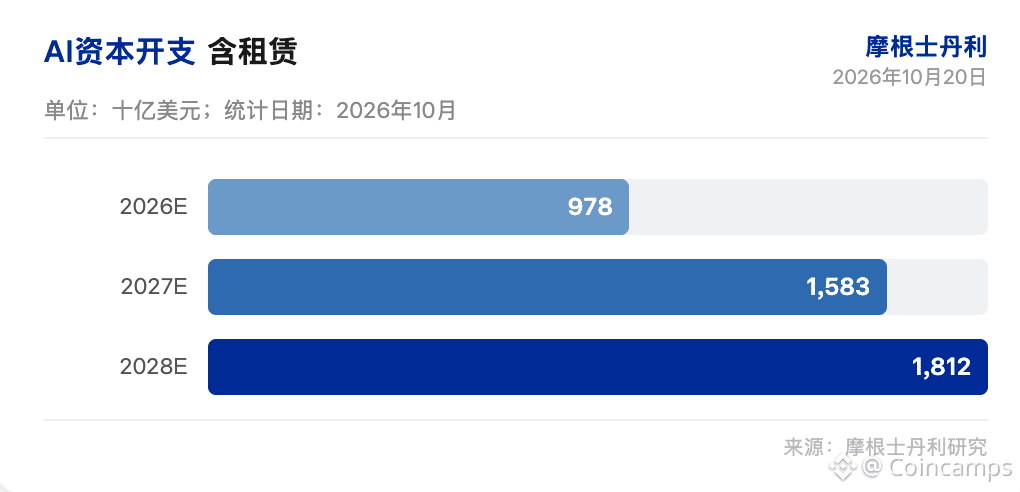
تحليل أبحاث مورغان ستانلي: إنفاق رأسمالي على الذكاء الاصطناعي بقيمة 1.6 تريليون دولار، والذكاء الاصطناعي مسؤول عن ربع نمو S&P 500إن الإنفاق الرأسمالي البالغ 1.6 تريليون دولار يعادل نحو 5% من إيرادات S&P 500 و25% من نمو الإيرادات. وفي تقريرها الصادر في 20 أكتوبر 2026، جمعت مورغان ستانلي نفقات النقد والإيجار لدى شركات الحوسبة السحابية فائقة النطاق ومزودي الخدمات السحابية الناشئين، وقدّرتها بـ1.58 تريليون دولار لعام 2027 و1.81 تريليون دولار لعام 2028. ويتوقع التقرير أن يتباطأ نمو الإنفاق الرأسمالي على الذكاء الاصطناعي من نحو 100% في 2026 إلى قرابة 60% في 2027 ونحو 14% في 2028.
يشعر السوق بالقلق إزاء التباطؤ في 2028. وتُظهر حسابات مورغان ستانلي أن نمو إيرادات S&P 500 سيبلغ 8.6% في 2027، ويظل عند 6.6% بعد استبعاد الإيرادات المباشرة من الذكاء الاصطناعي. ويتتبع التقرير نحو 65% من الإنفاق الرأسمالي لعام 2027، متوقعًا أن يذهب إلى شركات S&P 500، وتُعد NVIDIA أكبر المستفيدين.
تحليل أبحاث مورغان ستانلي: إنفاق رأسمالي على الذكاء الاصطناعي بقيمة 1.6 تريليون دولار، والذكاء الاصطناعي مسؤول عن ربع نمو S&P 500
إن الإنفاق الرأسمالي البالغ 1.6 تريليون دولار يعادل نحو 5% من إيرادات S&P 500 و25% من نمو الإيرادات. وفي تقريرها الصادر في 20 أكتوبر 2026، جمعت مورغان ستانلي نفقات النقد والإيجار لدى شركات الحوسبة السحابية فائقة النطاق ومزودي الخدمات السحابية الناشئين، وقدّرتها بـ1.58 تريليون دولار لعام 2027 و1.81 تريليون دولار لعام 2028. ويتوقع التقرير أن يتباطأ نمو الإنفاق الرأسمالي على الذكاء الاصطناعي من نحو 100% في 2026 إلى قرابة 60% في 2027 ونحو 14% في 2028.
يشعر السوق بالقلق إزاء التباطؤ في 2028. وتُظهر حسابات مورغان ستانلي أن نمو إيرادات S&P 500 سيبلغ 8.6% في 2027، ويظل عند 6.6% بعد استبعاد الإيرادات المباشرة من الذكاء الاصطناعي. ويتتبع التقرير نحو 65% من الإنفاق الرأسمالي لعام 2027، متوقعًا أن يذهب إلى شركات S&P 500، وتُعد NVIDIA أكبر المستفيدين.
يشعر السوق بالقلق إزاء التباطؤ في 2028. وتُظهر حسابات مورغان ستانلي أن نمو إيرادات S&P 500 سيبلغ 8.6% في 2027، ويظل عند 6.6% بعد استبعاد الإيرادات المباشرة من الذكاء الاصطناعي. ويتتبع التقرير نحو 65% من الإنفاق الرأسمالي لعام 2027، متوقعًا أن يذهب إلى شركات S&P 500، وتُعد NVIDIA أكبر المستفيدين.
321
·
--

مقالة
لماذا لا تتيح Papertrade تداول الرموز؟ تفكيك الثغرة القاتلة المتمثلة في المراهنة على هبوط كازينوهاتهاتحرير TechFlow: يوم الاثنين، أوضح الفريق القائم على منصة تداول العقود الدائمة هذه، التي توفر رافعة مالية فائقة الارتفاع تصل إلى 1000 ضعف ضمن منظومة Hyperliquid، أنه لا توجد خطط على المدى القريب للسماح لـ PAPER بالخروج من عقود التخزين: «في هذه المرحلة، لا نخطط للسماح بنقل الرموز وتداولها بحرية خارج العقد».
يمثل هذا تراجعًا كاملًا عن خارطة الطريق التي وُعد بها المجتمع في البداية. ففي وقت سابق من هذا الشهر، عندما استعرضنا إطلاق Papertrade، نصت الخطط الرسمية بوضوح على أنه سيُسمح في نهاية المطاف بنقل PAPER بحرية؛ كما أعلن الفريق رسميًا وبحزم في 1 أكتوبر أن ميزة نقل الرموز ستُفعّل رسميًا «بعد مرور وقت كافٍ».
لماذا لا تتيح Papertrade تداول الرموز؟ تفكيك الثغرة القاتلة المتمثلة في المراهنة على هبوط كازينوهاتها
تحرير TechFlow: يوم الاثنين، أوضح الفريق القائم على منصة تداول العقود الدائمة هذه، التي توفر رافعة مالية فائقة الارتفاع تصل إلى 1000 ضعف ضمن منظومة Hyperliquid، أنه لا توجد خطط على المدى القريب للسماح لـ PAPER بالخروج من عقود التخزين: «في هذه المرحلة، لا نخطط للسماح بنقل الرموز وتداولها بحرية خارج العقد».
يمثل هذا تراجعًا كاملًا عن خارطة الطريق التي وُعد بها المجتمع في البداية. ففي وقت سابق من هذا الشهر، عندما استعرضنا إطلاق Papertrade، نصت الخطط الرسمية بوضوح على أنه سيُسمح في نهاية المطاف بنقل PAPER بحرية؛ كما أعلن الفريق رسميًا وبحزم في 1 أكتوبر أن ميزة نقل الرموز ستُفعّل رسميًا «بعد مرور وقت كافٍ».
يمثل هذا تراجعًا كاملًا عن خارطة الطريق التي وُعد بها المجتمع في البداية. ففي وقت سابق من هذا الشهر، عندما استعرضنا إطلاق Papertrade، نصت الخطط الرسمية بوضوح على أنه سيُسمح في نهاية المطاف بنقل PAPER بحرية؛ كما أعلن الفريق رسميًا وبحزم في 1 أكتوبر أن ميزة نقل الرموز ستُفعّل رسميًا «بعد مرور وقت كافٍ».
1
·
--
عرض الترجمة
Polymarket founder faces controversy over misuse of funds, Dragonfly's Haseeb speaks out to clarifyOn October 21, 2026, according to a public statement released by Dragonfly Managing Partner Haseeb Qureshi, the allegations regarding prediction market leader Polymarket founder and CEO Shayne Coplan allegedly misappropriating company funds to pay for personal expenses such as a private jet are entirely baseless smears.
As one of the earliest core lead investors of the platform, Dragonfly has rarely publicly disclosed the true financial details and difficult uphill climb during Polymarket's early startup phase, comprehensively countering the continuously fermenting malicious speech on social networks.
Startup in the Bathroom: From Zero-Salary Survival to a Valuation Miracle
This public opinion storm originated from an anonymous leak tweet circulated on social media accounts, which accused Shayne of using investor funds as a personal wallet to pay for luxury charters, apartment rent, and haute couture clothing, and even stated that a major backer ordered a full refund.
In response to these sensational accusations, Haseeb restored the little-known full picture of the early startup days. When Shayne founded the platform at age 21, he took absolutely no salary and lived extremely frugally, using his apartment bathroom as a makeshift office desk, and even propping up his computer with a basket of miscellaneous items to write code.
According to Dragonfly's official portfolio records, the institution was the first backer to issue a term sheet to him, having grown so concerned about his basic livelihood that they proactively offered to provide a personal bridge loan.
Engineer-Level Annual Salary Travel: Proactive Accounting and Refunds Instead of Breach of Trust
Haseeb further pointed out that throughout the turbulence of the global pandemic and the heavy pressure of strict regulatory rectification orders from the US CFTC, the vast majority of startups in the industry have experienced extremely chaotic management phases.
But in terms of financial records, Shayne proactively disclosed every business expense to the board. After conversion, the total annualized expenditure was merely equivalent to the annual salary of an ordinary junior software engineer, including travel flights that were all standard business trips, with absolutely no private vacation charters.
The core fact is that the relevant accounting reconciliation and refund procedures were initiated and fully settled with the company by Shayne himself, rather than being caught by external auditors. He has since taken a regular salary according to standard employee compensation, and the essence of this incident belongs to early-stage accounting standardization processes rather than moral flaws.
Countering Baseless Panic: Management Transforms Rapidly Alongside the Platform
Facing the recent baseless negative noise stemming from the explosive growth of the prediction market, Haseeb emphasized that Polymarket has transformed from a precarious, day-to-day exploratory venture of the past into a fast-growing, highly culturally penetrating consumer-grade flagship standard across the United States.
Investment institutions have witnessed the synchronous evolution and management maturity of the young founder throughout its entire growth cycle. Dragonfly has explicitly stated its absolute confidence in his long-term leadership and solemnly called on the industry to stop maliciously manufacturing panic and taking statements out of context.
Join the official Coincamps community:
X: https://x.com/coincamps
Telegram: https://t.me/coin_camps
Polymarket founder faces controversy over misuse of funds, Dragonfly's Haseeb speaks out to clarify
On October 21, 2026, according to a public statement released by Dragonfly Managing Partner Haseeb Qureshi, the allegations regarding prediction market leader Polymarket founder and CEO Shayne Coplan allegedly misappropriating company funds to pay for personal expenses such as a private jet are entirely baseless smears.
As one of the earliest core lead investors of the platform, Dragonfly has rarely publicly disclosed the true financial details and difficult uphill climb during Polymarket's early startup phase, comprehensively countering the continuously fermenting malicious speech on social networks.
Startup in the Bathroom: From Zero-Salary Survival to a Valuation Miracle
This public opinion storm originated from an anonymous leak tweet circulated on social media accounts, which accused Shayne of using investor funds as a personal wallet to pay for luxury charters, apartment rent, and haute couture clothing, and even stated that a major backer ordered a full refund.
In response to these sensational accusations, Haseeb restored the little-known full picture of the early startup days. When Shayne founded the platform at age 21, he took absolutely no salary and lived extremely frugally, using his apartment bathroom as a makeshift office desk, and even propping up his computer with a basket of miscellaneous items to write code.
According to Dragonfly's official portfolio records, the institution was the first backer to issue a term sheet to him, having grown so concerned about his basic livelihood that they proactively offered to provide a personal bridge loan.
Engineer-Level Annual Salary Travel: Proactive Accounting and Refunds Instead of Breach of Trust
Haseeb further pointed out that throughout the turbulence of the global pandemic and the heavy pressure of strict regulatory rectification orders from the US CFTC, the vast majority of startups in the industry have experienced extremely chaotic management phases.
But in terms of financial records, Shayne proactively disclosed every business expense to the board. After conversion, the total annualized expenditure was merely equivalent to the annual salary of an ordinary junior software engineer, including travel flights that were all standard business trips, with absolutely no private vacation charters.
The core fact is that the relevant accounting reconciliation and refund procedures were initiated and fully settled with the company by Shayne himself, rather than being caught by external auditors. He has since taken a regular salary according to standard employee compensation, and the essence of this incident belongs to early-stage accounting standardization processes rather than moral flaws.
Countering Baseless Panic: Management Transforms Rapidly Alongside the Platform
Facing the recent baseless negative noise stemming from the explosive growth of the prediction market, Haseeb emphasized that Polymarket has transformed from a precarious, day-to-day exploratory venture of the past into a fast-growing, highly culturally penetrating consumer-grade flagship standard across the United States.
Investment institutions have witnessed the synchronous evolution and management maturity of the young founder throughout its entire growth cycle. Dragonfly has explicitly stated its absolute confidence in his long-term leadership and solemnly called on the industry to stop maliciously manufacturing panic and taking statements out of context.
Join the official Coincamps community:
X: https://x.com/coincamps
Telegram: https://t.me/coin_camps
·
--
مقالة
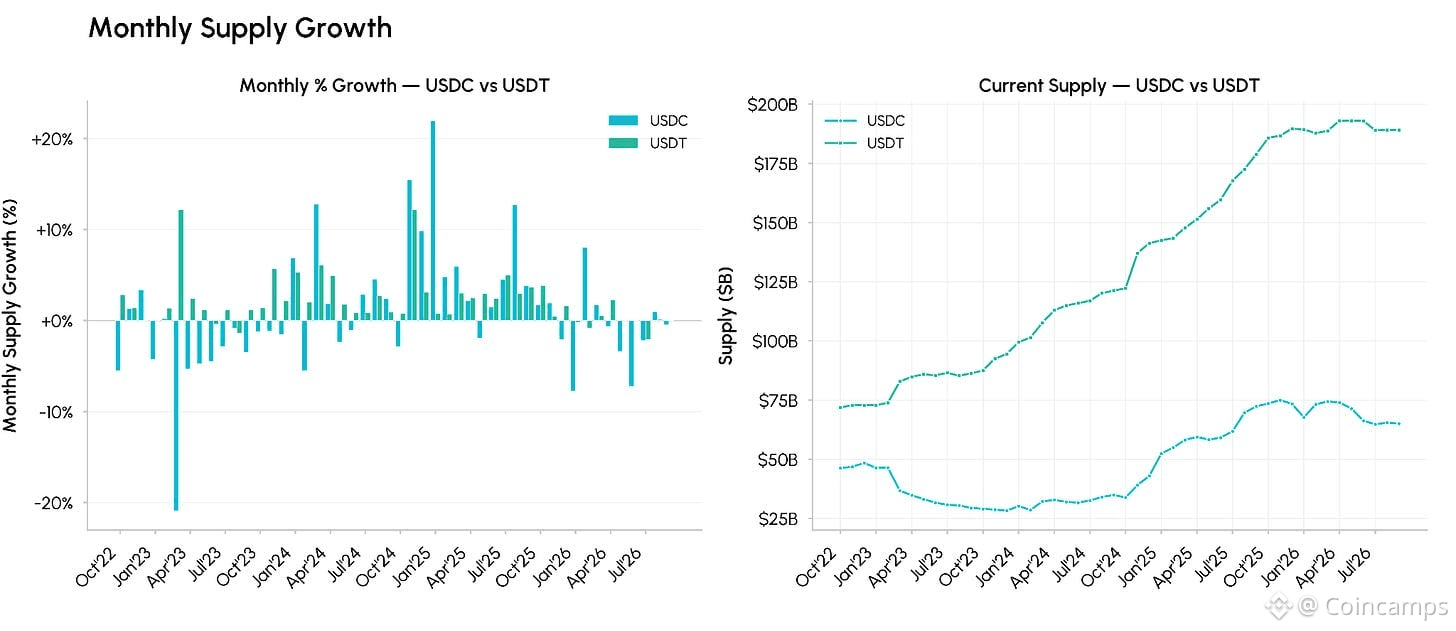
ما العوامل المحركة لنمو المعروض من العملات المستقرة؟ معدلات التمويل وفوارق عوائد سندات الخزانة الأمريكية تقدمان الإجابةتحرير TechFlow
أهم الخلاصات
• تُظهر معدلات التمويل والقيمة السوقية قدرة تفسيرية قوية: يُبيّن تحليل الانحدار متعدد المتغيرات ذي القيم المتأخرة أن معدلات التمويل لعقود التداول الدائم في المنصات المركزية، والتغيرات في إجمالي القيمة السوقية للعملات المشفرة، تفسّر إحصائيًا جزءًا كبيرًا من التباين في نمو المعروض الأسبوعي من USDC وUSDT.
• يعزز فارق العائد المحمول تموضع USDC كأصل على السلسلة: عند إدراج فارق العائد المحمول (الفرق بين معدلات الإقراض على السلسلة وعوائد سندات الخزانة الأمريكية التقليدية الخالية من المخاطر) في النموذج، إلى جانب مقارنة العوائد على السلسلة وخارجها، يتضح أن اتساع الفارق يقترن بزيادة صافي إصدار USDC في السوق بالمتوسط. ويؤكد ذلك كميًا الدور الفريد لـUSDC ضمن منظومة العملات المستقرة، بوصفه عملة مستقرة محورية مندمجة بعمق في التمويل اللامركزي (DeFi) وتوليد العوائد على السلسلة.
ما العوامل المحركة لنمو المعروض من العملات المستقرة؟ معدلات التمويل وفوارق عوائد سندات الخزانة الأمريكية تقدمان الإجابة
تحرير TechFlow
أهم الخلاصات
• تُظهر معدلات التمويل والقيمة السوقية قدرة تفسيرية قوية: يُبيّن تحليل الانحدار متعدد المتغيرات ذي القيم المتأخرة أن معدلات التمويل لعقود التداول الدائم في المنصات المركزية، والتغيرات في إجمالي القيمة السوقية للعملات المشفرة، تفسّر إحصائيًا جزءًا كبيرًا من التباين في نمو المعروض الأسبوعي من USDC وUSDT.
• يعزز فارق العائد المحمول تموضع USDC كأصل على السلسلة: عند إدراج فارق العائد المحمول (الفرق بين معدلات الإقراض على السلسلة وعوائد سندات الخزانة الأمريكية التقليدية الخالية من المخاطر) في النموذج، إلى جانب مقارنة العوائد على السلسلة وخارجها، يتضح أن اتساع الفارق يقترن بزيادة صافي إصدار USDC في السوق بالمتوسط. ويؤكد ذلك كميًا الدور الفريد لـUSDC ضمن منظومة العملات المستقرة، بوصفه عملة مستقرة محورية مندمجة بعمق في التمويل اللامركزي (DeFi) وتوليد العوائد على السلسلة.
12
·
--
عرض الترجمة
Morgan Stanley: What Can the U.S. Midterm Elections Really Change? AI and Fiscal Policy Take Center StageAs the U.S. midterm elections approach in November, Wall Street is beginning to reassess the potential impact of the election results on financial markets. If Democrats regain control of Congress, will the Trump administration's economic policies shift? How long can U.S. fiscal stimulus be sustained? And will the rapidly expanding AI data center investment slow down due to political pressure?
Morgan Stanley noted in its latest analysis that this midterm election could change the power structure of Congress, but may not necessarily change the fundamental direction of U.S. economic policy. Rather than the election results themselves, investors should focus more on the continuity of fiscal policy and the increasing regulatory constraints surrounding artificial intelligence and data center construction.
Ariana Salvatore, Head of U.S. Public Policy Research at Morgan Stanley, believes that the midterm elections are unlikely to change the Trump administration's core policy agenda, which is dominated by executive power. Even if Democrats win the House, or even control both the House and Senate, policies on tariffs, trade, immigration, and deregulation may still continue to advance through the executive branch and federal agencies.
But an unchanged policy direction does not mean markets will be unaffected. Morgan Stanley believes that post-election fiscal negotiations may become more complex, and AI infrastructure investment may also face more restrictions from state and local governments.
What can the midterm elections change? Congressional control and policy direction may not move in sync
The most direct impact of the midterm elections is determining the political landscape of the U.S. Congress for the next two years. However, Morgan Stanley points out that even if congressional control changes, it does not mean the Trump administration's existing policies will be overturned.
First, divided government will make major legislation more difficult.
If Democrats win the House, or control both the House and Senate, the Trump administration will face greater resistance in pushing new large-scale fiscal bills. The budget reconciliation process previously used to advance major fiscal legislation will also be difficult to use when congressional power is fragmented.
At the same time, even if Democrats control both chambers of Congress, the president still holds veto power over legislation. This means Democrats will likewise find it difficult to unilaterally push through large-scale policy changes opposite to the current administration's direction.
Second, many of the Trump administration's core policies do not entirely depend on congressional legislation in the first place.
Morgan Stanley points out that tariffs and trade, deregulation, immigration, and some geopolitical policies are mainly implemented through the executive branch and federal agencies. Therefore, even if congressional control changes, these policies may still continue.
However, the election results may still change the political environment for policy implementation.
If a divided government takes shape, congressional oversight of the president and the executive branch may intensify, and the executive branch's role in policy implementation will become more prominent.
In other words, what the midterm elections are most likely to change is the difficulty of passing new policies, the intensity of congressional oversight, and the way the executive and legislative branches contend with each other—not an immediate rewrite of U.S. economic policy.
Fiscal Policy in Focus: Stimulus Hard to Expand, Debt Disputes May Heat Up
On economic policy, fiscal matters are one of the most closely watched areas in the midterm elections.
Morgan Stanley believes that although fiscal policy is more susceptible to changes in congressional control, the election results are unlikely to lead to a fundamental adjustment in the direction of U.S. fiscal policy.
The reason is that both parties lack strong incentives to push for large-scale cuts in government spending or tax increases. Therefore, even if the congressional political landscape changes, the existing U.S. fiscal policy framework is likely to continue.
However, a divided government may make it harder for new fiscal support measures to pass.
Without the support of the budget reconciliation process, advancing large-scale fiscal stimulus bills in Congress will become more difficult. At the same time, issues such as government funding, the debt ceiling, and the defense budget may trigger more intense partisan negotiations.
This issue is particularly prominent against the backdrop of the continued expansion of U.S. debt.
According to the Morgan Stanley article, U.S. federal debt exceeded $40 trillion for the first time in August 2026. As the debt burden increases, uncertainty surrounding government financing arrangements and fiscal policy may rise further.
However, Morgan Stanley believes that political disputes over the budget and the debt ceiling may be more significant than actual fiscal policy adjustments.
From a financial market perspective, tariffs, taxes, and deregulation will remain important drivers.
The Morgan Stanley research team noted that since January 2025, rising U.S. policy uncertainty and related market volatility have mainly come from the executive branch rather than congressional legislative action. This means that even if the midterm elections change the congressional landscape, investors still need to focus on the actual policies of the White House and federal agencies.
Historical market performance also provides a reference.
Research from the Morgan Stanley Wealth Management Global Investment Office shows that under a Republican president with Congress split between the parties, the S&P 500 rose an average of 23% in the year after the midterm elections; under a Republican president with Democrats controlling Congress, the average gain was 15%.
But Morgan Stanley cautions that a divided government cannot simply be equated with stock market gains. The current U.S. economy and financial markets are significantly affected by fiscal stimulus, tax and regulatory policies, and if these policies undergo substantive changes, they could also alter the previous trend of stock market gains spreading to more sectors.
Therefore, for investors, what truly matters is not which party controls Congress, but whether fiscal policy can continue to support U.S. economic growth, and whether political brinkmanship will affect policy implementation.
AI Becomes a Bipartisan Focus: Data Center Construction May Face More Restrictions
Beyond fiscal policy, AI infrastructure construction is becoming an important policy issue in the midterm elections.
Morgan Stanley believes that, unlike traditional economic policies such as tariffs and taxes, the political pressure facing AI data center construction has a distinctly local character. Even if the policy direction in Washington remains unchanged, state and local governments may still exert substantive influence on AI investment through energy management, project approvals, and community protection measures.
Currently, disputes surrounding data centers have crossed party lines. States governed by both Democrats and Republicans have begun to focus on the potential electricity cost increases, infrastructure burdens, and community interest issues that large-scale data centers may bring.
The state governments of New York, Virginia, and Texas have already adopted executive orders, policy frameworks, or review measures to reassess the impact of data center development.
Morgan Stanley summarizes this trend as "conditional buildout." This does not mean that the United States will stop investing in AI infrastructure, but rather that whether future data center projects can materialize will increasingly depend on whether developers can meet the requirements set by local governments.
Specifically, local governments may require data center operators to bear more of the added electricity costs, participate in infrastructure construction such as power grids, accept new tax or utility arrangements, and take measures to mitigate the impact of projects on local communities.
These conditions may increase project development costs and may also change the distribution of AI investment across different regions.
Nevertheless, Morgan Stanley still expects AI infrastructure investment to remain at a large scale. Its research team forecasts that capital expenditure by hyperscale cloud computing companies will reach $1.5 trillion in 2027.
At the same time, power supply has become an important factor constraining U.S. data center expansion. Morgan Stanley previously forecast that by 2028, the power supply gap facing U.S. data center developers could exceed 30%.
Policy debates surrounding AI infrastructure have thus produced two forces: local governments want to control energy costs, infrastructure burdens, and community impact; while supporters of continued AI infrastructure expansion emphasize national security and U.S.-China tech competition, arguing that excessive restrictions on data center construction could weaken America's long-term competitiveness.
Morgan Stanley believes that federal-level AI legislation may advance slowly, and a nationwide moratorium on data center construction is unlikely. By contrast, state and local governments will continue to play an important role in the implementation of specific projects.
This means the impact of the midterm elections on the AI industry may not manifest as a sudden shift in federal policy, but rather as differences in construction conditions, development costs, and investment progress across different regions.
What should the market watch after the midterm elections?
Morgan Stanley believes investors should not simply view divided government as a bullish signal for stocks, nor should they judge long-term trends solely based on short-term market reactions after the elections.
Jim Caron, Chief Investment Officer at Morgan Stanley Investment Management, noted that the current U.S. market is significantly influenced by fiscal policy, tax policy, and the regulatory environment. If relevant policies reverse, the market's previous broadening rally could also be affected.
Monica Guerra, Head of Policy and Geopolitical Strategy at Morgan Stanley Wealth Management's Investment Office, believes that congressional political gridlock and legislative stagnation can sometimes bring policy stability. Rather than short-term volatility triggered by political news, investors should focus more on the actual policy actions taken by the government.
For companies, a divided Congress does not mean the policy environment remains static. Josh Wilsusen, Head of Government Relations at Morgan Stanley, cautioned that companies still need to navigate changes in congressional oversight intensity, continued enforcement of existing policies by federal agencies, and the growing influence of state and local governments over AI infrastructure construction.
Based on Morgan Stanley's analysis, the impact of the 2026 U.S. midterm elections on financial markets is mainly concentrated in two aspects.
First, whether fiscal policy can maintain continuity. Even if congressional control changes, existing tax, tariff, and fiscal policies may continue, but new fiscal stimulus measures may be harder to introduce, and government funding and debt ceiling negotiations could also increase market uncertainty.
Second, what new constraints AI investment will face. Tech giants' capital expenditure plans remain massive, but data center construction is being affected by factors such as energy supply, local regulation, and community costs. A divergence may emerge between future investment scale and the actual pace of project implementation.
Therefore, Morgan Stanley's core judgment is: the midterm elections may change the political landscape of the U.S. Congress, but may not necessarily change the fundamental direction of economic policy. The continuity of fiscal policy, as well as the process of AI infrastructure investment transitioning from large-scale expansion to conditional construction, are the market variables worth continuous attention after the elections.
Join the official Coincamps community:
X: https://x.com/coincamps
Telegram: https://t.me/coin_camps
Morgan Stanley: What Can the U.S. Midterm Elections Really Change? AI and Fiscal Policy Take Center Stage
As the U.S. midterm elections approach in November, Wall Street is beginning to reassess the potential impact of the election results on financial markets. If Democrats regain control of Congress, will the Trump administration's economic policies shift? How long can U.S. fiscal stimulus be sustained? And will the rapidly expanding AI data center investment slow down due to political pressure?
Morgan Stanley noted in its latest analysis that this midterm election could change the power structure of Congress, but may not necessarily change the fundamental direction of U.S. economic policy. Rather than the election results themselves, investors should focus more on the continuity of fiscal policy and the increasing regulatory constraints surrounding artificial intelligence and data center construction.
Ariana Salvatore, Head of U.S. Public Policy Research at Morgan Stanley, believes that the midterm elections are unlikely to change the Trump administration's core policy agenda, which is dominated by executive power. Even if Democrats win the House, or even control both the House and Senate, policies on tariffs, trade, immigration, and deregulation may still continue to advance through the executive branch and federal agencies.
But an unchanged policy direction does not mean markets will be unaffected. Morgan Stanley believes that post-election fiscal negotiations may become more complex, and AI infrastructure investment may also face more restrictions from state and local governments.
What can the midterm elections change? Congressional control and policy direction may not move in sync
The most direct impact of the midterm elections is determining the political landscape of the U.S. Congress for the next two years. However, Morgan Stanley points out that even if congressional control changes, it does not mean the Trump administration's existing policies will be overturned.
First, divided government will make major legislation more difficult.
If Democrats win the House, or control both the House and Senate, the Trump administration will face greater resistance in pushing new large-scale fiscal bills. The budget reconciliation process previously used to advance major fiscal legislation will also be difficult to use when congressional power is fragmented.
At the same time, even if Democrats control both chambers of Congress, the president still holds veto power over legislation. This means Democrats will likewise find it difficult to unilaterally push through large-scale policy changes opposite to the current administration's direction.
Second, many of the Trump administration's core policies do not entirely depend on congressional legislation in the first place.
Morgan Stanley points out that tariffs and trade, deregulation, immigration, and some geopolitical policies are mainly implemented through the executive branch and federal agencies. Therefore, even if congressional control changes, these policies may still continue.
However, the election results may still change the political environment for policy implementation.
If a divided government takes shape, congressional oversight of the president and the executive branch may intensify, and the executive branch's role in policy implementation will become more prominent.
In other words, what the midterm elections are most likely to change is the difficulty of passing new policies, the intensity of congressional oversight, and the way the executive and legislative branches contend with each other—not an immediate rewrite of U.S. economic policy.
Fiscal Policy in Focus: Stimulus Hard to Expand, Debt Disputes May Heat Up
On economic policy, fiscal matters are one of the most closely watched areas in the midterm elections.
Morgan Stanley believes that although fiscal policy is more susceptible to changes in congressional control, the election results are unlikely to lead to a fundamental adjustment in the direction of U.S. fiscal policy.
The reason is that both parties lack strong incentives to push for large-scale cuts in government spending or tax increases. Therefore, even if the congressional political landscape changes, the existing U.S. fiscal policy framework is likely to continue.
However, a divided government may make it harder for new fiscal support measures to pass.
Without the support of the budget reconciliation process, advancing large-scale fiscal stimulus bills in Congress will become more difficult. At the same time, issues such as government funding, the debt ceiling, and the defense budget may trigger more intense partisan negotiations.
This issue is particularly prominent against the backdrop of the continued expansion of U.S. debt.
According to the Morgan Stanley article, U.S. federal debt exceeded $40 trillion for the first time in August 2026. As the debt burden increases, uncertainty surrounding government financing arrangements and fiscal policy may rise further.
However, Morgan Stanley believes that political disputes over the budget and the debt ceiling may be more significant than actual fiscal policy adjustments.
From a financial market perspective, tariffs, taxes, and deregulation will remain important drivers.
The Morgan Stanley research team noted that since January 2025, rising U.S. policy uncertainty and related market volatility have mainly come from the executive branch rather than congressional legislative action. This means that even if the midterm elections change the congressional landscape, investors still need to focus on the actual policies of the White House and federal agencies.
Historical market performance also provides a reference.
Research from the Morgan Stanley Wealth Management Global Investment Office shows that under a Republican president with Congress split between the parties, the S&P 500 rose an average of 23% in the year after the midterm elections; under a Republican president with Democrats controlling Congress, the average gain was 15%.
But Morgan Stanley cautions that a divided government cannot simply be equated with stock market gains. The current U.S. economy and financial markets are significantly affected by fiscal stimulus, tax and regulatory policies, and if these policies undergo substantive changes, they could also alter the previous trend of stock market gains spreading to more sectors.
Therefore, for investors, what truly matters is not which party controls Congress, but whether fiscal policy can continue to support U.S. economic growth, and whether political brinkmanship will affect policy implementation.
AI Becomes a Bipartisan Focus: Data Center Construction May Face More Restrictions
Beyond fiscal policy, AI infrastructure construction is becoming an important policy issue in the midterm elections.
Morgan Stanley believes that, unlike traditional economic policies such as tariffs and taxes, the political pressure facing AI data center construction has a distinctly local character. Even if the policy direction in Washington remains unchanged, state and local governments may still exert substantive influence on AI investment through energy management, project approvals, and community protection measures.
Currently, disputes surrounding data centers have crossed party lines. States governed by both Democrats and Republicans have begun to focus on the potential electricity cost increases, infrastructure burdens, and community interest issues that large-scale data centers may bring.
The state governments of New York, Virginia, and Texas have already adopted executive orders, policy frameworks, or review measures to reassess the impact of data center development.
Morgan Stanley summarizes this trend as "conditional buildout." This does not mean that the United States will stop investing in AI infrastructure, but rather that whether future data center projects can materialize will increasingly depend on whether developers can meet the requirements set by local governments.
Specifically, local governments may require data center operators to bear more of the added electricity costs, participate in infrastructure construction such as power grids, accept new tax or utility arrangements, and take measures to mitigate the impact of projects on local communities.
These conditions may increase project development costs and may also change the distribution of AI investment across different regions.
Nevertheless, Morgan Stanley still expects AI infrastructure investment to remain at a large scale. Its research team forecasts that capital expenditure by hyperscale cloud computing companies will reach $1.5 trillion in 2027.
At the same time, power supply has become an important factor constraining U.S. data center expansion. Morgan Stanley previously forecast that by 2028, the power supply gap facing U.S. data center developers could exceed 30%.
Policy debates surrounding AI infrastructure have thus produced two forces: local governments want to control energy costs, infrastructure burdens, and community impact; while supporters of continued AI infrastructure expansion emphasize national security and U.S.-China tech competition, arguing that excessive restrictions on data center construction could weaken America's long-term competitiveness.
Morgan Stanley believes that federal-level AI legislation may advance slowly, and a nationwide moratorium on data center construction is unlikely. By contrast, state and local governments will continue to play an important role in the implementation of specific projects.
This means the impact of the midterm elections on the AI industry may not manifest as a sudden shift in federal policy, but rather as differences in construction conditions, development costs, and investment progress across different regions.
What should the market watch after the midterm elections?
Morgan Stanley believes investors should not simply view divided government as a bullish signal for stocks, nor should they judge long-term trends solely based on short-term market reactions after the elections.
Jim Caron, Chief Investment Officer at Morgan Stanley Investment Management, noted that the current U.S. market is significantly influenced by fiscal policy, tax policy, and the regulatory environment. If relevant policies reverse, the market's previous broadening rally could also be affected.
Monica Guerra, Head of Policy and Geopolitical Strategy at Morgan Stanley Wealth Management's Investment Office, believes that congressional political gridlock and legislative stagnation can sometimes bring policy stability. Rather than short-term volatility triggered by political news, investors should focus more on the actual policy actions taken by the government.
For companies, a divided Congress does not mean the policy environment remains static. Josh Wilsusen, Head of Government Relations at Morgan Stanley, cautioned that companies still need to navigate changes in congressional oversight intensity, continued enforcement of existing policies by federal agencies, and the growing influence of state and local governments over AI infrastructure construction.
Based on Morgan Stanley's analysis, the impact of the 2026 U.S. midterm elections on financial markets is mainly concentrated in two aspects.
First, whether fiscal policy can maintain continuity. Even if congressional control changes, existing tax, tariff, and fiscal policies may continue, but new fiscal stimulus measures may be harder to introduce, and government funding and debt ceiling negotiations could also increase market uncertainty.
Second, what new constraints AI investment will face. Tech giants' capital expenditure plans remain massive, but data center construction is being affected by factors such as energy supply, local regulation, and community costs. A divergence may emerge between future investment scale and the actual pace of project implementation.
Therefore, Morgan Stanley's core judgment is: the midterm elections may change the political landscape of the U.S. Congress, but may not necessarily change the fundamental direction of economic policy. The continuity of fiscal policy, as well as the process of AI infrastructure investment transitioning from large-scale expansion to conditional construction, are the market variables worth continuous attention after the elections.
Join the official Coincamps community:
X: https://x.com/coincamps
Telegram: https://t.me/coin_camps
·
--
عرض الترجمة
Mastercard Agent Pay for Machines: How x402 Agent Payments SettleMastercard Agent Pay for Machines is now open to developers: on Tuesday, 20 October 2026, Mastercard opened Early Access to the service, which lets AI agents pay for digital services on a business's behalf inside a pre-approved budget, and showed it running live at Cloudflare Connect, according to Mastercard's announcement.
The service builds on x402, the open protocol that lets a website or API answer a request with "402 Payment Required". In the demo, Coinbase Developer Platform funded the agent's wallet, Base provided onchain settlement, and BVNK settled both sides in fiat or stablecoins through Mastercard's Global Money Platform, per Mastercard. Decrypt, The Block and PYMNTS reported the launch on Tuesday evening, Central European time.
Below: what Mastercard actually opened, how a voucher payment moves from an HTTP 402 response to a stablecoin settlement, how the model differs from plain x402, and what is still missing before a business can run it in production.
Key Takeaways
Mastercard opened Agent Pay for Machines Early Access on 20 October 2026, with buyer and seller APIs, a toolkit, a sandbox and documentation (Mastercard).
Agents pay with digitally signed vouchers inside a business-set budget; vouchers are checked offchain and can be combined and redeemed later (Decrypt).
The demo used Coinbase Developer Platform wallets, Base for onchain settlement and BVNK to settle in fiat or stablecoins (CoinMarketCap).
Cloudflare's Monetization Gateway, the seller side in the demo, settles x402 payments on Base in USDC (Cloudflare).
Pricing, supported stablecoins, dispute rules and a general availability date are not in the announcement (Mastercard).
🔎What Mastercard has not disclosed: fees for buyers or sellers, which stablecoins and chains settle in production beyond the Base demo, how often vouchers are redeemed and settled, who carries the loss if a voucher is never honoured, dispute and chargeback rules, which countries Early Access covers, and when the service becomes generally available. Where this article discusses those points, it says so.
What Mastercard opened on 20 October
Mastercard first launched Agent Pay for Machines on 10 June 2026 with more than 30 named supporters, including Adyen, BVNK, Checkout.com, Cloudflare, Coinbase, Stripe and Tempo, per its June release. Tuesday's step moves it from a partner programme to something outside developers can build against. The confirmed facts:
Access: Agent Pay for Machines Early Access, with the first version of the buyer-side and seller-side APIs, a toolkit, a sandbox and developer documentation (Mastercard).
Pilots completed first: end-to-end pilots with Cloudflare, Ant International, AIsa, Base, BVNK, Coinbase and Hype (Mastercard).
Protocol: builds on x402, with Mastercard positioned as a common trust layer across agent platforms, wallets, payment providers and merchants (Mastercard).
Venue: demonstrated at Cloudflare Connect by Mastercard chief product officer Jorn Lambert (Decrypt).
Status: still early access. Mastercard says the roadmap will be shaped by customer and partner feedback (Mastercard).
One reporting difference is worth flagging. Decrypt lists the pilot partners as Cloudflare, Ant International, AWS, BVNK and Coinbase. Mastercard's own announcement names AIsa, Base and Hype instead of AWS and mentions Amazon Bedrock AgentCore only as an example agent platform. This article follows Mastercard's list.
How a Mastercard Agent Pay for Machines payment works
Mastercard sums up the model as "Authorize once. Transact many times. Guarantee payment now. Settle later." The flow from the announcement, step by step:
StepWhat happensOnchain?
1. MandateA business gives an agent a task and a spending limit (Mastercard)No
2. DiscoveryThe agent finds registered Agent Pay for Machines providers and proposes a plan; the business approves the fundingNo
3. 402 responseA paid service answers with "402 Payment Required", the x402 signal that payment is needed (x402)No
4. VoucherThe agent signs a payment voucher, a promise to pay within its approved limit; the seller verifies it and deliversNo, offchain at machine speed
5. RedemptionSellers combine vouchers and redeem them laterSettlement leg
6. SettlementIn the demo, Base carried onchain settlement and BVNK settled both sides in fiat or stablecoins (CoinMarketCap)Yes, on Base in the demo
The demo made the model concrete. Marketing agency Hype gave an agent a budget to plan a protein bar campaign; the agent bought social media research from AIsa and eight campaign images through Cloudflare AI Gateway. That came to nine payments to two independent merchants under one approved budget, with no separate accounts, API keys or invoices, per Mastercard. AIsa is the pay-per-call API marketplace that Tether Capital backed this month, covered in our Tether AIsa analysis.
Where the stablecoins sit
Mastercard's announcement uses the word stablecoin once, but the plumbing behind the demo is stablecoin plumbing. Coinbase Developer Platform supplied the wallet that funded the agent, Base provided the settlement network, and BVNK acted as the agent wallet, using the Global Money Platform to handle payment and settlement "in fiat or stablecoins" so sellers get paid in their preferred currency, token or rail (Mastercard).
The seller side is more specific. Cloudflare's Monetization Gateway, which returned the 402 responses in the demo, handles verification and settlement through Coinbase's x402 facilitator, and its payments settle on Base in USDC, per Cloudflare's beta announcement from 30 September. The gateway uses x402 version 2 with PAYMENT-REQUIRED and PAYMENT-SIGNATURE headers, per Cloudflare's developer docs, and is a closed beta for eligible US-based sellers and buyers. We covered the gateway when Cloudflare opened its waitlist in July.
Mastercard has not said which stablecoin settled the demo payments, so the USDC detail is Cloudflare's general product rule, not a Mastercard disclosure. What the structure shows is the division of labour: x402 and a USDC wallet on the buyer side, Mastercard's voucher and guarantee in the middle, and BVNK converting to whatever the seller wants to receive. Our guide to the Mastercard Global Money Platform explains that conversion layer.
Agent Pay for Machines vs plain x402
Plain x402 was designed for direct, per-request payment: an agent pays a service from its own wallet, and a facilitator verifies and settles each payment onchain, per Coinbase's x402 documentation. Mastercard keeps the 402 handshake but changes what happens after it. Ledger Insights describes the result as batch settlement with Mastercard inserted into the flow, adding a credential registry and a guarantee, per its analysis.
Plain x402Mastercard Agent Pay for Machines
Payment signalHTTP 402 with payment requirements (x402)Same 402 signal (Mastercard)
What the agent sendsA signed payment authorization, settled per requestA signed voucher, a promise to pay within an approved limit
Settlement timingPer request, onchainVouchers combined and redeemed later, in batches
Payment guaranteeFinality comes from the onchain settlement itselfMastercard says payment is guaranteed now and settled later
Funding sourceThe agent's own stablecoin walletWallet funding via Coinbase in the demo; fiat or stablecoins through BVNK
What the seller receivesThe asset named in the 402 response, often USDCPreferred currency, token or rail
Who sits in the middleA facilitator such as Coinbase'sMastercard as trust layer, plus BVNK and the facilitator
The trade-off is clear. Plain x402 is open and settles each payment as it happens, but every seller must accept a specific token on a specific chain. Mastercard's version adds an intermediary and a delay, in return for spending limits, a promise of payment and a way for a business that funds agents from a bank account to pay sellers who want stablecoins, or the reverse. Our x402 vs AP2 vs ACK-Pay comparison covers the other agent payment protocols Mastercard is competing with.
Why machine payments lean on stablecoins
The economics explain why Mastercard built on a crypto protocol at all. More than 138 million x402 transactions had taken place on Base by mid-2026, and over 87% of x402 payments fell between a hundredth of a cent and ten cents, per Chainalysis. Payments that small rarely make sense on card rails, where fixed per-transaction costs can exceed the payment.
Circle described the split to Chainalysis as card rails for consumer-prompted agent payments and stablecoin rails for machine-to-machine settlements too small for card economics, per the same Chainalysis report. Agent Pay for Machines is Mastercard's attempt to sit across that line: it already supports settlement across cards, accounts and stablecoins, per the June release, and batching vouchers is one way to make tiny payments cheap enough to settle.
🧭Our take: Agent Pay for Machines is less a new payment rail than a control layer on top of x402. The useful part for businesses is the mandate: a budget, permissions and a guarantee that a finance team can approve once. The cost is that the open, per-request settlement x402 was built for becomes a Mastercard-mediated batch. For sellers already on Cloudflare or Coinbase rails, USDC on Base is still doing the settling underneath. Test it in the sandbox now, but wait for published fees and dispute rules before routing real spend through it.
Named downsides
No pricing. Neither buyer nor seller fees have been published, so cost against plain x402 cannot be compared.
Settlement opacity. Redemption frequency, chains and stablecoins beyond the Base demo are unstated.
Counterparty in the middle. Batching means sellers deliver on a promise and wait for settlement, which plain x402 avoids.
Early access only. A sandbox and first-version APIs are not a production service level.
Geography unclear. Cloudflare's gateway is limited to eligible US-based sellers and buyers during its beta.
Vendor concentration. Mastercard, its BVNK unit and the Global Money Platform would sit on both sides of the payment.
Who should test it now, and who should wait
Test now: API and data sellers already behind Cloudflare's Monetization Gateway, agent platforms whose business customers want a hard spending cap per task, and payment providers in the BVNK or Coinbase orbit that want to accept agent payments without asking every buyer to hold USDC.
Wait: crypto-native agents that already pay per request in USDC and gain little from a guarantee, and any business outside the United States until Mastercard says where Early Access applies. For the risk side, Mastercard's separate Stablecoin Security screening service, launched a day earlier, shows how the company plans to wrap stablecoin payments in its fraud and sanctions tooling.
FAQ
What is Mastercard Agent Pay for Machines?
A Mastercard service that lets AI agents pay for digital services such as AI models, data, computing power and APIs on behalf of businesses, within approved budgets and permissions. It builds on the x402 protocol (Mastercard).
Is Agent Pay for Machines live?
It is in Early Access as of 20 October 2026. Developers can use first-version buyer and seller APIs, a toolkit, a sandbox and documentation; Mastercard has not given a general availability date (Mastercard).
Does Agent Pay for Machines use stablecoins?
It can. In the demo, Base provided onchain settlement and BVNK settled in fiat or stablecoins (Mastercard). Cloudflare's Monetization Gateway, the seller side in the demo, settles x402 payments in USDC on Base (Cloudflare).
How is it different from plain x402?
Plain x402 settles each payment per request through a facilitator (Coinbase). Mastercard's version uses signed vouchers that sellers combine and redeem later, with Mastercard acting as a trust layer that guarantees payment (Ledger Insights).
How much does Agent Pay for Machines cost?
Mastercard has not published pricing for buyers or sellers; the Early Access announcement lists APIs, a toolkit, a sandbox and documentation but no fees (Mastercard).
What to watch next: published fees, a list of settlement chains and stablecoins beyond Base, dispute and chargeback rules for vouchers, and the first sellers outside the pilot group. Background on the protocol layer is in our agent payment protocol comparison.
This content is provided for informational and educational purposes only and does not constitute financial, investment, legal, or tax advice; it is not financial advice, and no material herein should be interpreted as a recommendation, endorsement, or solicitation to buy or sell any asset or token. Product scope, partners and availability are as described by Mastercard on 20 October 2026 and can change; check Mastercard's developer documentation and take legal advice before letting software spend on a business's behalf. Nothing here is a solicitation to buy or sell.
Join the official Coincamps community:
X: https://x.com/coincamps
Telegram: https://t.me/coin_camps
Mastercard Agent Pay for Machines: How x402 Agent Payments Settle
Mastercard Agent Pay for Machines is now open to developers: on Tuesday, 20 October 2026, Mastercard opened Early Access to the service, which lets AI agents pay for digital services on a business's behalf inside a pre-approved budget, and showed it running live at Cloudflare Connect, according to Mastercard's announcement.
The service builds on x402, the open protocol that lets a website or API answer a request with "402 Payment Required". In the demo, Coinbase Developer Platform funded the agent's wallet, Base provided onchain settlement, and BVNK settled both sides in fiat or stablecoins through Mastercard's Global Money Platform, per Mastercard. Decrypt, The Block and PYMNTS reported the launch on Tuesday evening, Central European time.
Below: what Mastercard actually opened, how a voucher payment moves from an HTTP 402 response to a stablecoin settlement, how the model differs from plain x402, and what is still missing before a business can run it in production.
Key Takeaways
Mastercard opened Agent Pay for Machines Early Access on 20 October 2026, with buyer and seller APIs, a toolkit, a sandbox and documentation (Mastercard).
Agents pay with digitally signed vouchers inside a business-set budget; vouchers are checked offchain and can be combined and redeemed later (Decrypt).
The demo used Coinbase Developer Platform wallets, Base for onchain settlement and BVNK to settle in fiat or stablecoins (CoinMarketCap).
Cloudflare's Monetization Gateway, the seller side in the demo, settles x402 payments on Base in USDC (Cloudflare).
Pricing, supported stablecoins, dispute rules and a general availability date are not in the announcement (Mastercard).
🔎What Mastercard has not disclosed: fees for buyers or sellers, which stablecoins and chains settle in production beyond the Base demo, how often vouchers are redeemed and settled, who carries the loss if a voucher is never honoured, dispute and chargeback rules, which countries Early Access covers, and when the service becomes generally available. Where this article discusses those points, it says so.
What Mastercard opened on 20 October
Mastercard first launched Agent Pay for Machines on 10 June 2026 with more than 30 named supporters, including Adyen, BVNK, Checkout.com, Cloudflare, Coinbase, Stripe and Tempo, per its June release. Tuesday's step moves it from a partner programme to something outside developers can build against. The confirmed facts:
Access: Agent Pay for Machines Early Access, with the first version of the buyer-side and seller-side APIs, a toolkit, a sandbox and developer documentation (Mastercard).
Pilots completed first: end-to-end pilots with Cloudflare, Ant International, AIsa, Base, BVNK, Coinbase and Hype (Mastercard).
Protocol: builds on x402, with Mastercard positioned as a common trust layer across agent platforms, wallets, payment providers and merchants (Mastercard).
Venue: demonstrated at Cloudflare Connect by Mastercard chief product officer Jorn Lambert (Decrypt).
Status: still early access. Mastercard says the roadmap will be shaped by customer and partner feedback (Mastercard).
One reporting difference is worth flagging. Decrypt lists the pilot partners as Cloudflare, Ant International, AWS, BVNK and Coinbase. Mastercard's own announcement names AIsa, Base and Hype instead of AWS and mentions Amazon Bedrock AgentCore only as an example agent platform. This article follows Mastercard's list.
How a Mastercard Agent Pay for Machines payment works
Mastercard sums up the model as "Authorize once. Transact many times. Guarantee payment now. Settle later." The flow from the announcement, step by step:
StepWhat happensOnchain?
1. MandateA business gives an agent a task and a spending limit (Mastercard)No
2. DiscoveryThe agent finds registered Agent Pay for Machines providers and proposes a plan; the business approves the fundingNo
3. 402 responseA paid service answers with "402 Payment Required", the x402 signal that payment is needed (x402)No
4. VoucherThe agent signs a payment voucher, a promise to pay within its approved limit; the seller verifies it and deliversNo, offchain at machine speed
5. RedemptionSellers combine vouchers and redeem them laterSettlement leg
6. SettlementIn the demo, Base carried onchain settlement and BVNK settled both sides in fiat or stablecoins (CoinMarketCap)Yes, on Base in the demo
The demo made the model concrete. Marketing agency Hype gave an agent a budget to plan a protein bar campaign; the agent bought social media research from AIsa and eight campaign images through Cloudflare AI Gateway. That came to nine payments to two independent merchants under one approved budget, with no separate accounts, API keys or invoices, per Mastercard. AIsa is the pay-per-call API marketplace that Tether Capital backed this month, covered in our Tether AIsa analysis.
Where the stablecoins sit
Mastercard's announcement uses the word stablecoin once, but the plumbing behind the demo is stablecoin plumbing. Coinbase Developer Platform supplied the wallet that funded the agent, Base provided the settlement network, and BVNK acted as the agent wallet, using the Global Money Platform to handle payment and settlement "in fiat or stablecoins" so sellers get paid in their preferred currency, token or rail (Mastercard).
The seller side is more specific. Cloudflare's Monetization Gateway, which returned the 402 responses in the demo, handles verification and settlement through Coinbase's x402 facilitator, and its payments settle on Base in USDC, per Cloudflare's beta announcement from 30 September. The gateway uses x402 version 2 with PAYMENT-REQUIRED and PAYMENT-SIGNATURE headers, per Cloudflare's developer docs, and is a closed beta for eligible US-based sellers and buyers. We covered the gateway when Cloudflare opened its waitlist in July.
Mastercard has not said which stablecoin settled the demo payments, so the USDC detail is Cloudflare's general product rule, not a Mastercard disclosure. What the structure shows is the division of labour: x402 and a USDC wallet on the buyer side, Mastercard's voucher and guarantee in the middle, and BVNK converting to whatever the seller wants to receive. Our guide to the Mastercard Global Money Platform explains that conversion layer.
Agent Pay for Machines vs plain x402
Plain x402 was designed for direct, per-request payment: an agent pays a service from its own wallet, and a facilitator verifies and settles each payment onchain, per Coinbase's x402 documentation. Mastercard keeps the 402 handshake but changes what happens after it. Ledger Insights describes the result as batch settlement with Mastercard inserted into the flow, adding a credential registry and a guarantee, per its analysis.
Plain x402Mastercard Agent Pay for Machines
Payment signalHTTP 402 with payment requirements (x402)Same 402 signal (Mastercard)
What the agent sendsA signed payment authorization, settled per requestA signed voucher, a promise to pay within an approved limit
Settlement timingPer request, onchainVouchers combined and redeemed later, in batches
Payment guaranteeFinality comes from the onchain settlement itselfMastercard says payment is guaranteed now and settled later
Funding sourceThe agent's own stablecoin walletWallet funding via Coinbase in the demo; fiat or stablecoins through BVNK
What the seller receivesThe asset named in the 402 response, often USDCPreferred currency, token or rail
Who sits in the middleA facilitator such as Coinbase'sMastercard as trust layer, plus BVNK and the facilitator
The trade-off is clear. Plain x402 is open and settles each payment as it happens, but every seller must accept a specific token on a specific chain. Mastercard's version adds an intermediary and a delay, in return for spending limits, a promise of payment and a way for a business that funds agents from a bank account to pay sellers who want stablecoins, or the reverse. Our x402 vs AP2 vs ACK-Pay comparison covers the other agent payment protocols Mastercard is competing with.
Why machine payments lean on stablecoins
The economics explain why Mastercard built on a crypto protocol at all. More than 138 million x402 transactions had taken place on Base by mid-2026, and over 87% of x402 payments fell between a hundredth of a cent and ten cents, per Chainalysis. Payments that small rarely make sense on card rails, where fixed per-transaction costs can exceed the payment.
Circle described the split to Chainalysis as card rails for consumer-prompted agent payments and stablecoin rails for machine-to-machine settlements too small for card economics, per the same Chainalysis report. Agent Pay for Machines is Mastercard's attempt to sit across that line: it already supports settlement across cards, accounts and stablecoins, per the June release, and batching vouchers is one way to make tiny payments cheap enough to settle.
🧭Our take: Agent Pay for Machines is less a new payment rail than a control layer on top of x402. The useful part for businesses is the mandate: a budget, permissions and a guarantee that a finance team can approve once. The cost is that the open, per-request settlement x402 was built for becomes a Mastercard-mediated batch. For sellers already on Cloudflare or Coinbase rails, USDC on Base is still doing the settling underneath. Test it in the sandbox now, but wait for published fees and dispute rules before routing real spend through it.
Named downsides
No pricing. Neither buyer nor seller fees have been published, so cost against plain x402 cannot be compared.
Settlement opacity. Redemption frequency, chains and stablecoins beyond the Base demo are unstated.
Counterparty in the middle. Batching means sellers deliver on a promise and wait for settlement, which plain x402 avoids.
Early access only. A sandbox and first-version APIs are not a production service level.
Geography unclear. Cloudflare's gateway is limited to eligible US-based sellers and buyers during its beta.
Vendor concentration. Mastercard, its BVNK unit and the Global Money Platform would sit on both sides of the payment.
Who should test it now, and who should wait
Test now: API and data sellers already behind Cloudflare's Monetization Gateway, agent platforms whose business customers want a hard spending cap per task, and payment providers in the BVNK or Coinbase orbit that want to accept agent payments without asking every buyer to hold USDC.
Wait: crypto-native agents that already pay per request in USDC and gain little from a guarantee, and any business outside the United States until Mastercard says where Early Access applies. For the risk side, Mastercard's separate Stablecoin Security screening service, launched a day earlier, shows how the company plans to wrap stablecoin payments in its fraud and sanctions tooling.
FAQ
What is Mastercard Agent Pay for Machines?
A Mastercard service that lets AI agents pay for digital services such as AI models, data, computing power and APIs on behalf of businesses, within approved budgets and permissions. It builds on the x402 protocol (Mastercard).
Is Agent Pay for Machines live?
It is in Early Access as of 20 October 2026. Developers can use first-version buyer and seller APIs, a toolkit, a sandbox and documentation; Mastercard has not given a general availability date (Mastercard).
Does Agent Pay for Machines use stablecoins?
It can. In the demo, Base provided onchain settlement and BVNK settled in fiat or stablecoins (Mastercard). Cloudflare's Monetization Gateway, the seller side in the demo, settles x402 payments in USDC on Base (Cloudflare).
How is it different from plain x402?
Plain x402 settles each payment per request through a facilitator (Coinbase). Mastercard's version uses signed vouchers that sellers combine and redeem later, with Mastercard acting as a trust layer that guarantees payment (Ledger Insights).
How much does Agent Pay for Machines cost?
Mastercard has not published pricing for buyers or sellers; the Early Access announcement lists APIs, a toolkit, a sandbox and documentation but no fees (Mastercard).
What to watch next: published fees, a list of settlement chains and stablecoins beyond Base, dispute and chargeback rules for vouchers, and the first sellers outside the pilot group. Background on the protocol layer is in our agent payment protocol comparison.
This content is provided for informational and educational purposes only and does not constitute financial, investment, legal, or tax advice; it is not financial advice, and no material herein should be interpreted as a recommendation, endorsement, or solicitation to buy or sell any asset or token. Product scope, partners and availability are as described by Mastercard on 20 October 2026 and can change; check Mastercard's developer documentation and take legal advice before letting software spend on a business's behalf. Nothing here is a solicitation to buy or sell.
Join the official Coincamps community:
X: https://x.com/coincamps
Telegram: https://t.me/coin_camps
·
--

مقالة
عرض الترجمة
Gate Releases Latest Reserve Report: Total Reserves Rise to $8.688 Billion, Overall Reserve Ratio Reaches 118.49%According to an official announcement, Gate has published its latest reserve report. As of October 18, 2026, Gate's total reserves have risen to $8.688 billion, up 5.7% from the previous period; customer net assets reached $7.332 billion, with the overall reserve coverage ratio rising from 117.26% in the previous period to 118.49%.
In terms of core asset reserves, BTC user assets grew from 21,116 to 21,156 BTC, while platform reserves grew from 25,466 to 25,727 BTC, lifting the reserve coverage ratio from 120.32% to 121.60%; ETH user assets grew from 350,840 to 362,785 ETH, while platform reserves grew from 433,589 to 449,042 ETH, lifting the reserve coverage ratio from 123.59% to 123.78%.
In terms of stablecoin reserves, combined user assets in USDT, USD1, GUSD and USDC totaled approximately $1.497 billion, against corresponding platform reserves of approximately $1.746 billion, for a combined reserve ratio of 116.59%. In addition, this proof of reserves covers 500 assets in total, with major assets such as DOGE, GT and SOL also maintaining ample reserves that remain above the 100% industry safety benchmark, at 106.76%, 129.00% and 102.51% respectively.
Gate continues to refine its reserve verification mechanism, from being among the industry's earliest to introduce a 100% reserve commitment and the first to adopt zero-knowledge proof (ZKP) technology, to establishing a self-verifiable reserve transparency mechanism that integrates technical measures such as cold and hot wallet ownership verification, Merkle tree structures and user balance snapshots, enhancing the authenticity and verifiability of reserve data and providing a safeguard for the platform's long-term stable operations.
Currently, Gate serves more than 62 million users worldwide, supports over 5,400 crypto assets and over 12,800 stock assets, and offers trading in TradFi assets such as metals, indices, forex and commodities. Building on this diverse asset base, Gate continues to integrate digital asset and traditional financial services, creating Gate Money, a globally integrated financial services application that connects digital assets, fiat currencies, stocks, ETFs, gold, bank accounts, payments and asset management services into a single account, further expanding the platform's financial services boundaries.
Going forward, Gate will continue to deepen its reserve transparency efforts, improve its security infrastructure and risk management systems, and accelerate the building of a safer, more transparent and more efficient one-stop financial services ecosystem.
About Gate
Founded in 2013, with Dr. Han as its founder and CEO, Gate is one of the world's leading cryptocurrency and comprehensive financial services platforms, with businesses covering asset management, trading, payments and other financial and lifestyle scenarios. The platform has more than 62 million users, supports trading in 5,400+ crypto assets and 12,800+ stock assets, and also offers TradFi assets such as metals, indices, forex and commodities, meeting users' full-spectrum needs from asset holding and trading to everyday use. As an industry benchmark, Gate was the first to achieve 100% proof of reserves, and continues to build a diversified range of products and ecosystems including Gate Money, Gate Wallet, Gate Ventures and Gate for AI Agent.
To learn more, please visit: Website | X | Telegram | LinkedIn | Instagram | YouTube
Disclaimer:
This content does not constitute any invitation, solicitation or recommendation. You should always seek independent professional advice before making any investment decision. Please note that Gate may restrict or prohibit all or part of its services from restricted regions. Please read the User Agreement for more information.
Join the official Coincamps community:
X: https://x.com/coincamps
Telegram: https://t.me/coin_camps
Gate Releases Latest Reserve Report: Total Reserves Rise to $8.688 Billion, Overall Reserve Ratio Reaches 118.49%
According to an official announcement, Gate has published its latest reserve report. As of October 18, 2026, Gate's total reserves have risen to $8.688 billion, up 5.7% from the previous period; customer net assets reached $7.332 billion, with the overall reserve coverage ratio rising from 117.26% in the previous period to 118.49%.
In terms of core asset reserves, BTC user assets grew from 21,116 to 21,156 BTC, while platform reserves grew from 25,466 to 25,727 BTC, lifting the reserve coverage ratio from 120.32% to 121.60%; ETH user assets grew from 350,840 to 362,785 ETH, while platform reserves grew from 433,589 to 449,042 ETH, lifting the reserve coverage ratio from 123.59% to 123.78%.
In terms of stablecoin reserves, combined user assets in USDT, USD1, GUSD and USDC totaled approximately $1.497 billion, against corresponding platform reserves of approximately $1.746 billion, for a combined reserve ratio of 116.59%. In addition, this proof of reserves covers 500 assets in total, with major assets such as DOGE, GT and SOL also maintaining ample reserves that remain above the 100% industry safety benchmark, at 106.76%, 129.00% and 102.51% respectively.
Gate continues to refine its reserve verification mechanism, from being among the industry's earliest to introduce a 100% reserve commitment and the first to adopt zero-knowledge proof (ZKP) technology, to establishing a self-verifiable reserve transparency mechanism that integrates technical measures such as cold and hot wallet ownership verification, Merkle tree structures and user balance snapshots, enhancing the authenticity and verifiability of reserve data and providing a safeguard for the platform's long-term stable operations.
Currently, Gate serves more than 62 million users worldwide, supports over 5,400 crypto assets and over 12,800 stock assets, and offers trading in TradFi assets such as metals, indices, forex and commodities. Building on this diverse asset base, Gate continues to integrate digital asset and traditional financial services, creating Gate Money, a globally integrated financial services application that connects digital assets, fiat currencies, stocks, ETFs, gold, bank accounts, payments and asset management services into a single account, further expanding the platform's financial services boundaries.
Going forward, Gate will continue to deepen its reserve transparency efforts, improve its security infrastructure and risk management systems, and accelerate the building of a safer, more transparent and more efficient one-stop financial services ecosystem.
About Gate
Founded in 2013, with Dr. Han as its founder and CEO, Gate is one of the world's leading cryptocurrency and comprehensive financial services platforms, with businesses covering asset management, trading, payments and other financial and lifestyle scenarios. The platform has more than 62 million users, supports trading in 5,400+ crypto assets and 12,800+ stock assets, and also offers TradFi assets such as metals, indices, forex and commodities, meeting users' full-spectrum needs from asset holding and trading to everyday use. As an industry benchmark, Gate was the first to achieve 100% proof of reserves, and continues to build a diversified range of products and ecosystems including Gate Money, Gate Wallet, Gate Ventures and Gate for AI Agent.
To learn more, please visit: Website | X | Telegram | LinkedIn | Instagram | YouTube
Disclaimer:
This content does not constitute any invitation, solicitation or recommendation. You should always seek independent professional advice before making any investment decision. Please note that Gate may restrict or prohibit all or part of its services from restricted regions. Please read the User Agreement for more information.
Join the official Coincamps community:
X: https://x.com/coincamps
Telegram: https://t.me/coin_camps
·
--
مقالة
عرض الترجمة
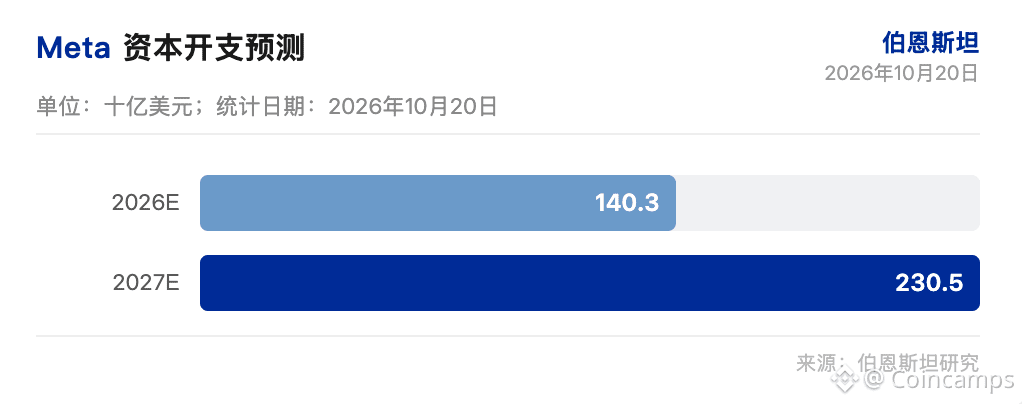
Bernstein Research Analysis: Meta Near-Term Expectations Run High, Muse Unlocks Path to AI ReturnsThe market views Muse as just another chat application, while Bernstein sees it in its October 20, 2026 report as Meta’s AI operating system. Launched on September 8, Muse topped the US App Store download charts within 10 days, accumulating approximately 2.5 million daily active users (DAU) in the US. Bernstein sets a price target of $800 for Meta, compared to its current price of $705.44, representing 13% upside.
The report maintains a long-term bullish stance but remains cautious in the near term. Muse provides Meta with its first consumer-facing AI product, demonstrating a return on AI investments and yielding a positive return on invested capital (ROIC). Valuations and expectations have already elevated, while Q3 2026 earnings before interest and taxes (EBIT) are weighed down by a $10 billion legal settlement.
Positioned at the center of the Meta ecosystem, hardware serves as the carrier while Muse is the product. The long-term narrative holds, though near-term earnings benchmarks have been set tighter.
Muse's Chart-Topping Rise Changes the Narrative
Launched on September 8, Muse reached number one on the US App Store download charts within 10 days, surpassing ChatGPT on September 17 and maintaining that position. Citing Sensor Tower data, Bernstein notes that Muse's post-launch download trajectory outpaces both ChatGPT's May 2023 launch and Meta's own AI app.
American DAU stands at approximately 2.5 million, with an average daily usage time of 16 minutes compared to ChatGPT's 19 minutes. Muse's retention curve outperforms ChatGPT's. Bernstein cautions that while early downloads and retention are strong, the initial buzz in the total addressable market (TAM) cannot be directly extrapolated, pointing to precedents like Facebook Shops and the Metaverse.
Muse has expanded from a chatbot to include real-time voice, customizable personas, avatars, email, and PC control integrations with Shopify, Walmart, Best Buy, Sephora, Ulta, Wayfair, Gap, Expedia, Instacart, Notion, GitHub, and Box. The hardware strategy revolves around "using Muse in any way," positioning glasses, virtual reality (VR) headsets, and pendants as endpoints.
Valuation Now Par with Google and Amazon
Following Muse's launch, Meta's stock has undergone repricing, aligning closely with the one-year forward P/E multiples of Google and Amazon. Bernstein's charts show all three trading around 20x. Muse has reignited discussions on the "iPhone moment" for consumer AI and revived debates surrounding agentic commerce and search displacement pressures.
Bernstein posits that Muse could evolve from a discovery platform into a decision-making layer, positioning itself closer to where purchase intent forms in the consumer funnel. Amazon is excluded from Muse's partner network, as it pursues its own agentic commerce initiatives. Meanwhile, Google faces concerns over AI accelerating the replacement of traditional search.
Higher valuations bring higher expectations. Bernstein maintains an Outperform rating with an $800 price target, utilizing a blended valuation model of 50% 2027 enterprise value-to-sales (EV/Sales) at 6.7x and 50% discounted cash flow (DCF), with a weighted average cost of capital (WACC) of 10% and terminal growth of 3.5%. At the current price of $705.44, this implies 13% upside.
Near-Term Expectations Outpace Fundamentals
For Q3 2026, Bernstein forecasts revenue at $64.058 billion against consensus of $63.312 billion. EBIT is projected at $11.338 billion versus consensus of $19.016 billion, including $10 billion in legal costs related to the minor media usage settlement. EPS is estimated at $3.95 against consensus of $3.56. Revenue beat estimates, while EBIT was suppressed by one-time charges.
Capex is forecast at $140.3 billion for 2026 and $230.5 billion for 2027, exceeding consensus of $201.6 billion. For 2027, Bernstein projects EBIT at $97.89 billion against consensus of $103.94 billion, and EPS at $33.21 versus consensus of $33.87. Bernstein has lowered 2027 EBIT and EPS forecasts to account for Muse investments, third-party cloud deals, and marketing expenditures.
Pressure on free cash flow (FCF) is even more pronounced. Bernstein forecasts 2027 FCF at -$59.684 billion versus consensus of -$33.418 billion, a divergence of $26.266 billion. Q3 2026 FCF is projected at -$13.756 billion against consensus of -$8.953 billion. 2027 capex is 14.3% above consensus, marketing spending rises due to Muse promotion, and third-party cloud transactions increase operating costs. These factors weigh on near-term profits and cash flows, though top-line strength remains intact.
Other revenue surpassed the $1 billion quarterly mark for the first time in Q2 2026, growing 73% year over year. Bernstein raised its other revenue forecast to reflect monetization from business messaging, commercial agents, subscriptions, and Muse. While early-stage monetization of Muse does not yet factor into baseline expectations, it could contribute visibly to other revenue growth in 2027. Muse's monetization hinges on four key metrics: subscription count, gross merchandise value (GMV), downloads, and engagement levels. An uplift in any single area would shift the gap between near-term expectations and fundamentals.
Muse turns Meta's AI investments from a mere narrative into a trackable consumer product, with near-term expectations already running ahead of realization.
Disclaimer
This article compiles and interprets a third-party broker research report (Bernstein, October 20, 2026) through TechFlow Research, alongside publicly available market information. All cited ratings, price targets, earnings forecasts, and related judgments represent the views of the broker's analysts, reflecting solely their institution's stance rather than those of TechFlow Research, and do not constitute investment advice.
Markets involve risks; decisions should be made independently. This article should not serve as a basis for buying or selling any securities.
Join the official Coincamps community:
X: https://x.com/coincamps
Telegram: https://t.me/coin_camps
Bernstein Research Analysis: Meta Near-Term Expectations Run High, Muse Unlocks Path to AI Returns
The market views Muse as just another chat application, while Bernstein sees it in its October 20, 2026 report as Meta’s AI operating system. Launched on September 8, Muse topped the US App Store download charts within 10 days, accumulating approximately 2.5 million daily active users (DAU) in the US. Bernstein sets a price target of $800 for Meta, compared to its current price of $705.44, representing 13% upside.
The report maintains a long-term bullish stance but remains cautious in the near term. Muse provides Meta with its first consumer-facing AI product, demonstrating a return on AI investments and yielding a positive return on invested capital (ROIC). Valuations and expectations have already elevated, while Q3 2026 earnings before interest and taxes (EBIT) are weighed down by a $10 billion legal settlement.
Positioned at the center of the Meta ecosystem, hardware serves as the carrier while Muse is the product. The long-term narrative holds, though near-term earnings benchmarks have been set tighter.
Muse's Chart-Topping Rise Changes the Narrative
Launched on September 8, Muse reached number one on the US App Store download charts within 10 days, surpassing ChatGPT on September 17 and maintaining that position. Citing Sensor Tower data, Bernstein notes that Muse's post-launch download trajectory outpaces both ChatGPT's May 2023 launch and Meta's own AI app.
American DAU stands at approximately 2.5 million, with an average daily usage time of 16 minutes compared to ChatGPT's 19 minutes. Muse's retention curve outperforms ChatGPT's. Bernstein cautions that while early downloads and retention are strong, the initial buzz in the total addressable market (TAM) cannot be directly extrapolated, pointing to precedents like Facebook Shops and the Metaverse.
Muse has expanded from a chatbot to include real-time voice, customizable personas, avatars, email, and PC control integrations with Shopify, Walmart, Best Buy, Sephora, Ulta, Wayfair, Gap, Expedia, Instacart, Notion, GitHub, and Box. The hardware strategy revolves around "using Muse in any way," positioning glasses, virtual reality (VR) headsets, and pendants as endpoints.
Valuation Now Par with Google and Amazon
Following Muse's launch, Meta's stock has undergone repricing, aligning closely with the one-year forward P/E multiples of Google and Amazon. Bernstein's charts show all three trading around 20x. Muse has reignited discussions on the "iPhone moment" for consumer AI and revived debates surrounding agentic commerce and search displacement pressures.
Bernstein posits that Muse could evolve from a discovery platform into a decision-making layer, positioning itself closer to where purchase intent forms in the consumer funnel. Amazon is excluded from Muse's partner network, as it pursues its own agentic commerce initiatives. Meanwhile, Google faces concerns over AI accelerating the replacement of traditional search.
Higher valuations bring higher expectations. Bernstein maintains an Outperform rating with an $800 price target, utilizing a blended valuation model of 50% 2027 enterprise value-to-sales (EV/Sales) at 6.7x and 50% discounted cash flow (DCF), with a weighted average cost of capital (WACC) of 10% and terminal growth of 3.5%. At the current price of $705.44, this implies 13% upside.
Near-Term Expectations Outpace Fundamentals
For Q3 2026, Bernstein forecasts revenue at $64.058 billion against consensus of $63.312 billion. EBIT is projected at $11.338 billion versus consensus of $19.016 billion, including $10 billion in legal costs related to the minor media usage settlement. EPS is estimated at $3.95 against consensus of $3.56. Revenue beat estimates, while EBIT was suppressed by one-time charges.
Capex is forecast at $140.3 billion for 2026 and $230.5 billion for 2027, exceeding consensus of $201.6 billion. For 2027, Bernstein projects EBIT at $97.89 billion against consensus of $103.94 billion, and EPS at $33.21 versus consensus of $33.87. Bernstein has lowered 2027 EBIT and EPS forecasts to account for Muse investments, third-party cloud deals, and marketing expenditures.
Pressure on free cash flow (FCF) is even more pronounced. Bernstein forecasts 2027 FCF at -$59.684 billion versus consensus of -$33.418 billion, a divergence of $26.266 billion. Q3 2026 FCF is projected at -$13.756 billion against consensus of -$8.953 billion. 2027 capex is 14.3% above consensus, marketing spending rises due to Muse promotion, and third-party cloud transactions increase operating costs. These factors weigh on near-term profits and cash flows, though top-line strength remains intact.
Other revenue surpassed the $1 billion quarterly mark for the first time in Q2 2026, growing 73% year over year. Bernstein raised its other revenue forecast to reflect monetization from business messaging, commercial agents, subscriptions, and Muse. While early-stage monetization of Muse does not yet factor into baseline expectations, it could contribute visibly to other revenue growth in 2027. Muse's monetization hinges on four key metrics: subscription count, gross merchandise value (GMV), downloads, and engagement levels. An uplift in any single area would shift the gap between near-term expectations and fundamentals.
Muse turns Meta's AI investments from a mere narrative into a trackable consumer product, with near-term expectations already running ahead of realization.
Disclaimer
This article compiles and interprets a third-party broker research report (Bernstein, October 20, 2026) through TechFlow Research, alongside publicly available market information. All cited ratings, price targets, earnings forecasts, and related judgments represent the views of the broker's analysts, reflecting solely their institution's stance rather than those of TechFlow Research, and do not constitute investment advice.
Markets involve risks; decisions should be made independently. This article should not serve as a basis for buying or selling any securities.
Join the official Coincamps community:
X: https://x.com/coincamps
Telegram: https://t.me/coin_camps
·
--
استرداد 5.6 مليون جنيه إسترليني من شريك في قضية غسل أموال تشيان تشيمين، فيما لا تزال ملكية 61,000 BTC (3.8 مليار جنيه إسترليني) موضع نزاعفي 21 أكتوبر 2026، ووفقًا لتقرير تحقيق قضائي حصري نشرته صحيفة ديلي ميل البريطانية، أعاد شريك رئيسي ساعد تشيان تشيمين، العقل المدبر لمخطط بونزي عابر للحدود وواسع النطاق، في غسل الأموال، مبلغ 5.6 مليون جنيه إسترليني كاملًا إلى الحكومة البريطانية رسميًا.
حُكم على الماليزي هوك سينغ لينغ، البالغ من العمر 48 عامًا، والذي عمل سابقًا خادمًا شخصيًا لتشيان تشيمين، بالسجن لمدة 4 سنوات و11 شهرًا في نوفمبر الماضي، في محكمة ساوثوارك كراون بلندن، بتهمة التآمر لغسل الأموال. وأصدرت المحكمة لاحقًا أمرًا بمصادرة أمواله.
استرداد 5.6 مليون جنيه إسترليني من شريك في قضية غسل أموال تشيان تشيمين، فيما لا تزال ملكية 61,000 BTC (3.8 مليار جنيه إسترليني) موضع نزاع
في 21 أكتوبر 2026، ووفقًا لتقرير تحقيق قضائي حصري نشرته صحيفة ديلي ميل البريطانية، أعاد شريك رئيسي ساعد تشيان تشيمين، العقل المدبر لمخطط بونزي عابر للحدود وواسع النطاق، في غسل الأموال، مبلغ 5.6 مليون جنيه إسترليني كاملًا إلى الحكومة البريطانية رسميًا.
حُكم على الماليزي هوك سينغ لينغ، البالغ من العمر 48 عامًا، والذي عمل سابقًا خادمًا شخصيًا لتشيان تشيمين، بالسجن لمدة 4 سنوات و11 شهرًا في نوفمبر الماضي، في محكمة ساوثوارك كراون بلندن، بتهمة التآمر لغسل الأموال. وأصدرت المحكمة لاحقًا أمرًا بمصادرة أمواله.
حُكم على الماليزي هوك سينغ لينغ، البالغ من العمر 48 عامًا، والذي عمل سابقًا خادمًا شخصيًا لتشيان تشيمين، بالسجن لمدة 4 سنوات و11 شهرًا في نوفمبر الماضي، في محكمة ساوثوارك كراون بلندن، بتهمة التآمر لغسل الأموال. وأصدرت المحكمة لاحقًا أمرًا بمصادرة أمواله.
1
·
--
مقالة
عرض الترجمة
Hyperliquid accounts for 58% of on-chain perpetual contract open interest, yet trading volume only represents 38.6%.TechFlow Guide:In the decentralized perpetual contract sector, trading volume has always been regarded as the primary indicator of platform activity; however, in Q3 2026, the on-chain derivatives landscape exhibited a highly disruptive divergence. According to the latest authoritative review report published by Alea Research, Hyperliquid captured 58.0% of the total network Open Interest (OI), while accounting for only 38.6% of total trading volume.
This anomaly of "open interest significantly surpassing trading volume" completely breaks the old model where derivative DEXs relied on short-term high-frequency volume spoofing to create a false sense of prosperity. Data shows that Hyperliquid traders' average holding period ranks first among the top ten mainstream exchanges across the entire network. A large number of professional institutions and quantitative hedge funds have selected it as their primary venue for executing cash-and-carry arbitrage and funding rate arbitrage (Carry Trade), accumulating an extremely large pool of sticky institutional capital.
This article provides an in-depth analysis of the competitive dynamics among the 121 perpetual contract venues across the network in Q3, examines the explosive growth logic behind the HIP-3 native ecosystem, the stunning data performance of trade.xyz, and how Hyperliquid's Assistance Fund establishes a powerful value loop by allocating nearly 90% of fees toward repurchasing HYPE tokens.
Tide Recedes in Market Trends: Network-Wide Perpetual Contract Volume Halved Amidst Counter-Cyclical Expansion
In Q3 2026, the on-chain perpetual contract market as a whole fell into a period of sluggish adjustment. Among the 121 tracked decentralized perpetual contract venues across the network, total trading volume contracted by half compared to the highs at the end of 2025, with the network-wide Q3 quarter-over-quarter decline reaching 2.5%.
However, amidst the network-wide winter, Hyperliquid demonstrated incredible counter-cyclical vitality. Its Q3 matched trading volume reached $688.7 billion, increasing by 9.2% quarter-over-quarter against the trend; this propelled its network-wide trading volume market share to achieve substantial jumps for three consecutive quarters, firmly locking in its position as the industry leader at 38.6%.
What is even more staggering is the battle for open interest (OI). Out of all newly added open contracts industry-wide, Hyperliquid alone captured 77%, maintaining a quarterly daily average OI of over $2.1 billion, with single-day peak values even surpassing a shocking monopoly ratio of 65% across the entire network.
Figure 1: Market share trend of Hyperliquid in the 30-day rolling trading volume of network-wide on-chain perpetual contracts. Steadily climbing to 38.6% for three consecutive quarters.
Anomaly in Position Structure: Why Is the Position Share Far Higher Than the Trading Volume Share?
In traditional derivatives understanding, an exchange's open contract share often closely aligns with its trading volume share; if the volume share is only 38.6%, logically its open interest should also hover around 40%. So why did Hyperliquid's open interest share surge to 58.0%?
Alea Research provided the core answer through long-term tracking of on-chain position addresses: Hyperliquid users hold positions for significantly longer periods than other top ten competitors. This is mainly attributed to the following two points:
• Zero gas fees and full-memory matching mechanism: The underlying high-performance L1 architecture built specifically for finance provides sub-second matching experiences and transparent liquidation comparable to centralized exchanges (CEX), attracting numerous professional hedge funds to use it as their primary position for large-scale basis arbitrage;
• Real liquidity without fabricated volume boosting: Many competing DEXs are flooded with fake wash trading (Wash Trading) aimed at earning points, resulting in artificially inflated volumes but extremely poor fund retention; whereas Hyperliquid's liquidity is entirely settled through organic trading and arbitrage market-making, resulting in extremely solid capital retention.
Figure 2: Hyperliquid's market share in total network-wide open interest (OI). Q3 average reached 58.0%, demonstrating deep accumulation of institutional-grade long-term capital.
HIP-3 Innovation Boom: trade.xyz Captures 98% of Native Ecosystem Fees
The most critical technological milestone achieved by the Hyperliquid ecosystem in Q3 was the launch of HIP-3 native spot and custom derivative markets. Anyone can establish an independent, exclusive derivative market on the Hyperliquid L1 through permissionless staking.
Among the two brand-new DEXs launched under the HIP-3 framework, trade.xyz displayed astonishing dominance. Within just one quarter of Q3, trade.xyz generated cumulative trading volume as high as $251.3 billion, directly surpassing the full-quarter performance of the independent legacy platform Aster ($160.3 billion).
At the level of ecosystem capture, trade.xyz contributed 97.9% of the fee revenue within the HIP-3 segmented market, delivering a continuous stream of genuine earnings to Hyperliquid's entire underlying public chain.
7% Fee Repurchase & Burn: Assistance Fund Forges a Sturdy Token Moat
Facing massive fee inflows, Hyperliquid established an exceptionally pure value capture loop. The report discloses that during Q3, the platform's total perpetual contract fee revenue grew 2.9% quarter-over-quarter to reach $165.5 million.
Its officially established Assistance Fund allocates up to 88.7% of the received fees directly toward continuously buying HYPE tokens on the open market; additionally, the revenue generated from its underlying hundreds-of-billions-USDC reserve pool contributed an extra $17.7 million in steady cash flow to the Assistance Fund in Q3.
Substantial real-capital buybacks enabled the HYPE token to exhibit strong price resilience amid the harsh macroeconomic environment of Q3, constructing a positive and healthy economic flywheel of "user trading -> position accumulation -> fee extraction -> strong buy-side support".
Join the official Coincamps community:
X: https://x.com/coincamps
Telegram: https://t.me/coin_camps
Hyperliquid accounts for 58% of on-chain perpetual contract open interest, yet trading volume only represents 38.6%.
TechFlow Guide:In the decentralized perpetual contract sector, trading volume has always been regarded as the primary indicator of platform activity; however, in Q3 2026, the on-chain derivatives landscape exhibited a highly disruptive divergence. According to the latest authoritative review report published by Alea Research, Hyperliquid captured 58.0% of the total network Open Interest (OI), while accounting for only 38.6% of total trading volume.
This anomaly of "open interest significantly surpassing trading volume" completely breaks the old model where derivative DEXs relied on short-term high-frequency volume spoofing to create a false sense of prosperity. Data shows that Hyperliquid traders' average holding period ranks first among the top ten mainstream exchanges across the entire network. A large number of professional institutions and quantitative hedge funds have selected it as their primary venue for executing cash-and-carry arbitrage and funding rate arbitrage (Carry Trade), accumulating an extremely large pool of sticky institutional capital.
This article provides an in-depth analysis of the competitive dynamics among the 121 perpetual contract venues across the network in Q3, examines the explosive growth logic behind the HIP-3 native ecosystem, the stunning data performance of trade.xyz, and how Hyperliquid's Assistance Fund establishes a powerful value loop by allocating nearly 90% of fees toward repurchasing HYPE tokens.
Tide Recedes in Market Trends: Network-Wide Perpetual Contract Volume Halved Amidst Counter-Cyclical Expansion
In Q3 2026, the on-chain perpetual contract market as a whole fell into a period of sluggish adjustment. Among the 121 tracked decentralized perpetual contract venues across the network, total trading volume contracted by half compared to the highs at the end of 2025, with the network-wide Q3 quarter-over-quarter decline reaching 2.5%.
However, amidst the network-wide winter, Hyperliquid demonstrated incredible counter-cyclical vitality. Its Q3 matched trading volume reached $688.7 billion, increasing by 9.2% quarter-over-quarter against the trend; this propelled its network-wide trading volume market share to achieve substantial jumps for three consecutive quarters, firmly locking in its position as the industry leader at 38.6%.
What is even more staggering is the battle for open interest (OI). Out of all newly added open contracts industry-wide, Hyperliquid alone captured 77%, maintaining a quarterly daily average OI of over $2.1 billion, with single-day peak values even surpassing a shocking monopoly ratio of 65% across the entire network.
Figure 1: Market share trend of Hyperliquid in the 30-day rolling trading volume of network-wide on-chain perpetual contracts. Steadily climbing to 38.6% for three consecutive quarters.
Anomaly in Position Structure: Why Is the Position Share Far Higher Than the Trading Volume Share?
In traditional derivatives understanding, an exchange's open contract share often closely aligns with its trading volume share; if the volume share is only 38.6%, logically its open interest should also hover around 40%. So why did Hyperliquid's open interest share surge to 58.0%?
Alea Research provided the core answer through long-term tracking of on-chain position addresses: Hyperliquid users hold positions for significantly longer periods than other top ten competitors. This is mainly attributed to the following two points:
• Zero gas fees and full-memory matching mechanism: The underlying high-performance L1 architecture built specifically for finance provides sub-second matching experiences and transparent liquidation comparable to centralized exchanges (CEX), attracting numerous professional hedge funds to use it as their primary position for large-scale basis arbitrage;
• Real liquidity without fabricated volume boosting: Many competing DEXs are flooded with fake wash trading (Wash Trading) aimed at earning points, resulting in artificially inflated volumes but extremely poor fund retention; whereas Hyperliquid's liquidity is entirely settled through organic trading and arbitrage market-making, resulting in extremely solid capital retention.
Figure 2: Hyperliquid's market share in total network-wide open interest (OI). Q3 average reached 58.0%, demonstrating deep accumulation of institutional-grade long-term capital.
HIP-3 Innovation Boom: trade.xyz Captures 98% of Native Ecosystem Fees
The most critical technological milestone achieved by the Hyperliquid ecosystem in Q3 was the launch of HIP-3 native spot and custom derivative markets. Anyone can establish an independent, exclusive derivative market on the Hyperliquid L1 through permissionless staking.
Among the two brand-new DEXs launched under the HIP-3 framework, trade.xyz displayed astonishing dominance. Within just one quarter of Q3, trade.xyz generated cumulative trading volume as high as $251.3 billion, directly surpassing the full-quarter performance of the independent legacy platform Aster ($160.3 billion).
At the level of ecosystem capture, trade.xyz contributed 97.9% of the fee revenue within the HIP-3 segmented market, delivering a continuous stream of genuine earnings to Hyperliquid's entire underlying public chain.
7% Fee Repurchase & Burn: Assistance Fund Forges a Sturdy Token Moat
Facing massive fee inflows, Hyperliquid established an exceptionally pure value capture loop. The report discloses that during Q3, the platform's total perpetual contract fee revenue grew 2.9% quarter-over-quarter to reach $165.5 million.
Its officially established Assistance Fund allocates up to 88.7% of the received fees directly toward continuously buying HYPE tokens on the open market; additionally, the revenue generated from its underlying hundreds-of-billions-USDC reserve pool contributed an extra $17.7 million in steady cash flow to the Assistance Fund in Q3.
Substantial real-capital buybacks enabled the HYPE token to exhibit strong price resilience amid the harsh macroeconomic environment of Q3, constructing a positive and healthy economic flywheel of "user trading -> position accumulation -> fee extraction -> strong buy-side support".
Join the official Coincamps community:
X: https://x.com/coincamps
Telegram: https://t.me/coin_camps
·
--
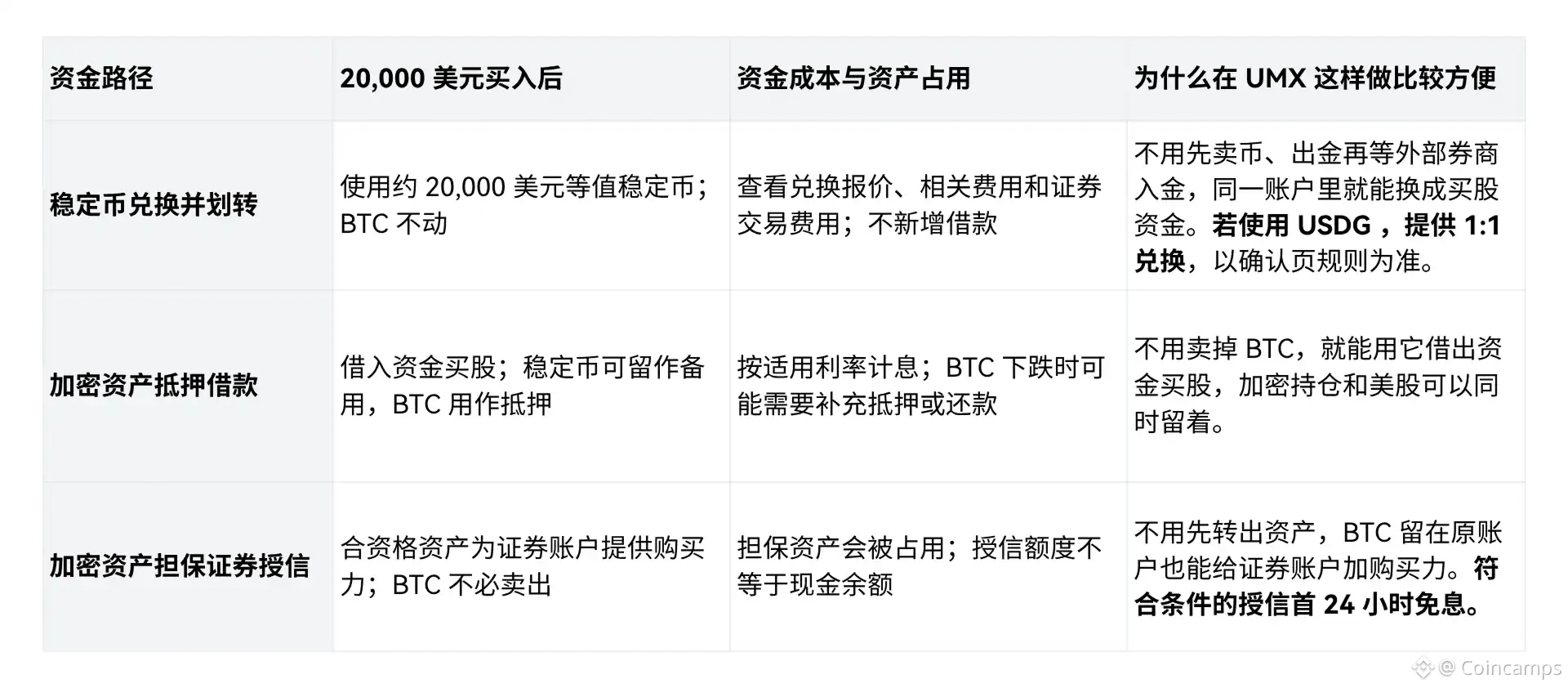
مقالة
عرض الترجمة
Holding BTC and want to buy US stocks? Check out UMX's three funding arrangements.Don't want to sell crypto just yet, but need to fund a stock purchase?
If you hold BTC and have your eye on a U.S. stock ETF, your first thought might be: do I have to sell my BTC first to buy stocks? The usual approach involves moving funds across crypto platforms, banks, and brokerages, possibly with currency conversion and waiting for settlement.
UMX puts crypto assets and securities trading on the same platform and offers several ways to arrange stock-buying funds: stablecoin conversion and transfer, borrowing against crypto collateral, or applying for securities credit using eligible crypto assets.
According to UMX, the product design was also inspired by founder Li Lin and his family office's experience managing their own assets, as well as client demand for cross-asset fund allocation. For investors, all three approaches address the question of how to arrange funds, but they differ in funding source, cost, and asset commitment. Below, we walk through the same stock-buying scenario one by one.
Buying $20,000 in U.S. stocks: how to choose among three funding arrangements?
Assume the account holds $100,000 equivalent in stablecoins and 1 BTC, and you plan to buy $20,000 of a U.S. stock ETF but don't want to sell BTC for now. The following is only a simulated scenario and does not represent BTC's current market price or actual available credit. Whether and how much you can use depends on account eligibility, collateral asset valuation, and the platform's risk parameters at the time.
Option 1 | Convert stablecoins to USD and buy directly
If you already planned to use some stablecoins to buy U.S. stocks, converting and transferring is a relatively straightforward arrangement. Once USD enters the securities account, it can be used to buy stocks; BTC is unaffected and no new borrowing is created.
Before proceeding, check the exchange rate, spread, fees, and estimated received amount on the conversion page, then add securities trading fees. If using USDG and the account page offers a 1:1 conversion option, the rules shown on the confirmation page prevail.
This path suits those willing to use existing stablecoins and who want to avoid borrowing and collateral arrangements. After buying stocks, the stablecoin balance available for other transactions will decrease accordingly.
Figure 1 | Unified account asset overview: view crypto assets, securities positions, and available buying power in the securities account.
Figure 2 | USDT conversion and transfer confirmation page: view the reference exchange rate, estimated arrival amount, quote validity period, and account changes after the transfer.
Option Two | Borrow against BTC, keep stablecoins as a reserve
If you want to keep your stablecoins, you can check whether your account supports using eligible assets such as BTC and ETH as collateral to borrow and buy stocks. Which assets are supported and how much you can borrow are subject to what is displayed on the account page.
This path keeps the stablecoins in your hands, but BTC will be used as collateral, and the loan will accrue interest. If the collateral asset declines in value or risk parameters change, you may need to add collateral, repay the loan, or have your assets handled according to the platform's rules.
Before proceeding, review the interest rate, repayment requirements, and risk disclosures, and consider whether you can withstand price volatility in the collateral asset.
Figure 3 | Crypto asset collateral loan confirmation page: verify the loan amount, interest rate, estimated arrival amount, and the collateral requirements and risk disclosures displayed on the page.
Option Three | Use BTC as collateral for securities credit to increase stock-buying power
Credit financing uses eligible crypto assets to provide collateral support for a securities account, increasing the purchasing power available for buying stocks. It differs from a collateral loan in the funding path: the former uses collateral assets to support the securities account limit, while the latter involves borrowing funds and then arranging them to buy stocks.
Convenience aside, remember: collateral assets will be locked up, and the credit limit does not equal cash in the account. Before confirming, verify the estimated increase in purchasing power, the collateral assets occupied, the applicable interest rate, and whether the limit will change with asset prices or account risk.
If the account meets the "first 24 hours interest-free" conditions, interest is subsequently calculated at the VIP0 USD financing annual interest rate of 5.74%. Taking $20,000 used for 7 days as an example, no interest is charged during the interest-free period, and interest is then calculated according to the page rules. Under this set of example conditions, compared with interest charged for the full 7 days, the interest is approximately 14.3% less. The actual interest rate, interest-free eligibility, and interest calculation period are subject to the account page, and other fees are charged separately.
Figure 4 | Securities Credit Confirmation Page: Verify the estimated increase in securities purchasing power, collateral asset occupation, as well as account changes and risk disclosures before and after credit extension.
Compare capital efficiency, and also consider capital cost
The difference among the three methods lies not only in whether stocks can be purchased, but also in how many stablecoins remain after purchase, whether BTC is occupied, and whether interest needs to be paid.
If you want something simple and direct, consider exchanging existing stablecoins; if you want to retain stablecoins, you can compare collateralized borrowing and securities credit. The former depends on interest rates, repayment, and collateral requirements, while the latter depends on collateral asset occupation and credit rules.
This simulated purchase of $20,000 can be compared across three cost items:
● Exchange cost: Verify the stablecoin exchange quote, exchange rate, and related fees.
● Financing cost: Estimate based on the loan amount, applicable annualized interest rate, and actual usage time.
● Asset occupation cost: Confirm whether the BTC used for collateral or credit can still be freely deployed.
Cross-market accounts can reduce some external transfers and waiting, but the actual savings must be compared item by item using quotes and fees at the same time and for the same amount.
Beyond U.S. stocks, Hong Kong stocks can also use these funding arrangements
UMX has also opened grayscale experience for Hong Kong stocks and ETFs. Eligible users can check whether they can obtain purchasing power through stablecoin transfers, crypto asset collateral financing, or securities credit arrangements; if the securities account already has USD, they can also check the option of exchanging to HKD before buying. Whether specific markets, underlying assets, and features apply to your account is subject to what is displayed on the page.
Before buying, first see whether the account can withstand volatility
The three methods suit different funding arrangements: stablecoin exchange is direct but uses up existing stablecoins; collateralized borrowing can retain stablecoins but requires interest payments and bears collateral risk; securities credit may increase stock purchasing power but occupies collateral assets and must comply with credit and risk control rules.
When comparing, first ask yourself three things: How much cash will you still need to put up when buying stocks? Which assets will be tied up as a result? If the price of the collateral assets or securities falls, is there still any buffer in the account?
The purchasing power displayed on the page is only part of the funding arrangement. Before use, you should also confirm account eligibility, supported assets, conversion quotes, interest rates, fees, conversion ratios, credit limits, as well as top-up, repayment, and liquidation rules.
Join the official Coincamps community:
X: https://x.com/coincamps
Telegram: https://t.me/coin_camps
Holding BTC and want to buy US stocks? Check out UMX's three funding arrangements.
Don't want to sell crypto just yet, but need to fund a stock purchase?
If you hold BTC and have your eye on a U.S. stock ETF, your first thought might be: do I have to sell my BTC first to buy stocks? The usual approach involves moving funds across crypto platforms, banks, and brokerages, possibly with currency conversion and waiting for settlement.
UMX puts crypto assets and securities trading on the same platform and offers several ways to arrange stock-buying funds: stablecoin conversion and transfer, borrowing against crypto collateral, or applying for securities credit using eligible crypto assets.
According to UMX, the product design was also inspired by founder Li Lin and his family office's experience managing their own assets, as well as client demand for cross-asset fund allocation. For investors, all three approaches address the question of how to arrange funds, but they differ in funding source, cost, and asset commitment. Below, we walk through the same stock-buying scenario one by one.
Buying $20,000 in U.S. stocks: how to choose among three funding arrangements?
Assume the account holds $100,000 equivalent in stablecoins and 1 BTC, and you plan to buy $20,000 of a U.S. stock ETF but don't want to sell BTC for now. The following is only a simulated scenario and does not represent BTC's current market price or actual available credit. Whether and how much you can use depends on account eligibility, collateral asset valuation, and the platform's risk parameters at the time.
Option 1 | Convert stablecoins to USD and buy directly
If you already planned to use some stablecoins to buy U.S. stocks, converting and transferring is a relatively straightforward arrangement. Once USD enters the securities account, it can be used to buy stocks; BTC is unaffected and no new borrowing is created.
Before proceeding, check the exchange rate, spread, fees, and estimated received amount on the conversion page, then add securities trading fees. If using USDG and the account page offers a 1:1 conversion option, the rules shown on the confirmation page prevail.
This path suits those willing to use existing stablecoins and who want to avoid borrowing and collateral arrangements. After buying stocks, the stablecoin balance available for other transactions will decrease accordingly.
Figure 1 | Unified account asset overview: view crypto assets, securities positions, and available buying power in the securities account.
Figure 2 | USDT conversion and transfer confirmation page: view the reference exchange rate, estimated arrival amount, quote validity period, and account changes after the transfer.
Option Two | Borrow against BTC, keep stablecoins as a reserve
If you want to keep your stablecoins, you can check whether your account supports using eligible assets such as BTC and ETH as collateral to borrow and buy stocks. Which assets are supported and how much you can borrow are subject to what is displayed on the account page.
This path keeps the stablecoins in your hands, but BTC will be used as collateral, and the loan will accrue interest. If the collateral asset declines in value or risk parameters change, you may need to add collateral, repay the loan, or have your assets handled according to the platform's rules.
Before proceeding, review the interest rate, repayment requirements, and risk disclosures, and consider whether you can withstand price volatility in the collateral asset.
Figure 3 | Crypto asset collateral loan confirmation page: verify the loan amount, interest rate, estimated arrival amount, and the collateral requirements and risk disclosures displayed on the page.
Option Three | Use BTC as collateral for securities credit to increase stock-buying power
Credit financing uses eligible crypto assets to provide collateral support for a securities account, increasing the purchasing power available for buying stocks. It differs from a collateral loan in the funding path: the former uses collateral assets to support the securities account limit, while the latter involves borrowing funds and then arranging them to buy stocks.
Convenience aside, remember: collateral assets will be locked up, and the credit limit does not equal cash in the account. Before confirming, verify the estimated increase in purchasing power, the collateral assets occupied, the applicable interest rate, and whether the limit will change with asset prices or account risk.
If the account meets the "first 24 hours interest-free" conditions, interest is subsequently calculated at the VIP0 USD financing annual interest rate of 5.74%. Taking $20,000 used for 7 days as an example, no interest is charged during the interest-free period, and interest is then calculated according to the page rules. Under this set of example conditions, compared with interest charged for the full 7 days, the interest is approximately 14.3% less. The actual interest rate, interest-free eligibility, and interest calculation period are subject to the account page, and other fees are charged separately.
Figure 4 | Securities Credit Confirmation Page: Verify the estimated increase in securities purchasing power, collateral asset occupation, as well as account changes and risk disclosures before and after credit extension.
Compare capital efficiency, and also consider capital cost
The difference among the three methods lies not only in whether stocks can be purchased, but also in how many stablecoins remain after purchase, whether BTC is occupied, and whether interest needs to be paid.
If you want something simple and direct, consider exchanging existing stablecoins; if you want to retain stablecoins, you can compare collateralized borrowing and securities credit. The former depends on interest rates, repayment, and collateral requirements, while the latter depends on collateral asset occupation and credit rules.
This simulated purchase of $20,000 can be compared across three cost items:
● Exchange cost: Verify the stablecoin exchange quote, exchange rate, and related fees.
● Financing cost: Estimate based on the loan amount, applicable annualized interest rate, and actual usage time.
● Asset occupation cost: Confirm whether the BTC used for collateral or credit can still be freely deployed.
Cross-market accounts can reduce some external transfers and waiting, but the actual savings must be compared item by item using quotes and fees at the same time and for the same amount.
Beyond U.S. stocks, Hong Kong stocks can also use these funding arrangements
UMX has also opened grayscale experience for Hong Kong stocks and ETFs. Eligible users can check whether they can obtain purchasing power through stablecoin transfers, crypto asset collateral financing, or securities credit arrangements; if the securities account already has USD, they can also check the option of exchanging to HKD before buying. Whether specific markets, underlying assets, and features apply to your account is subject to what is displayed on the page.
Before buying, first see whether the account can withstand volatility
The three methods suit different funding arrangements: stablecoin exchange is direct but uses up existing stablecoins; collateralized borrowing can retain stablecoins but requires interest payments and bears collateral risk; securities credit may increase stock purchasing power but occupies collateral assets and must comply with credit and risk control rules.
When comparing, first ask yourself three things: How much cash will you still need to put up when buying stocks? Which assets will be tied up as a result? If the price of the collateral assets or securities falls, is there still any buffer in the account?
The purchasing power displayed on the page is only part of the funding arrangement. Before use, you should also confirm account eligibility, supported assets, conversion quotes, interest rates, fees, conversion ratios, credit limits, as well as top-up, repayment, and liquidation rules.
Join the official Coincamps community:
X: https://x.com/coincamps
Telegram: https://t.me/coin_camps
2
·
--

مقالة
عرض الترجمة
Speculation has been the defining trend of this decade: Don't bet on the games, buy the casino operators.Overview: Looking ahead to the next decade, the most powerful macro narrative in global capital markets is not merely technological breakthroughs, but an all-encompassing wave of financial speculation. Macro-level asset inflation, currency over-issuance, and wealth inequality drive the masses to crave class mobility through high-volatility bets; meanwhile, the rapid iteration of mobile internet and on-chain settlement technologies has lowered speculative barriers to the millisecond level, weaving sports betting, prediction markets, and meme coins into a seamless, round-the-clock global gambling web.
The heavyweight long-form research report released by Delphi Digital, "The House Always Wins," strikes at the essence of this generation's financial wave: speculation is ignited by a dual engine of macro forces and technological infrastructure, but gamblers' win rates infinitely approach zero over long cycles. The true logic of profiting across cycles is never attempting to predict every meme coin that will surge 100x, but rather holding and investing in foundational platforms that monopolize traffic, aggregate liquidity, and extract stable fees—essentially, "buying the house operators."
This article deeply analyzes the evolutionary logic of the speculation super-cycle, the fundamental backlash against speculative asset valuations, and how to lock in deterministic excess returns using a "house mindset" in this global gambling frenzy.
The Speculation Super-Cycle Driven by Macro and Technology Dual Engines
Financial speculation has always relied on two core engines: one is the liquidity environment and social sentiment of the macroeconomy, and the other is the technological infrastructure supporting asset settlement. For a long time, these two engines have often taken turns driving growth; however, at this historical juncture, both engines are resonating at full speed for the first time, powered by the same underlying internet and blockchain infrastructure.
At the macro level, the expansion of global sovereign debt and the dilution of fiat purchasing power have become irreversible trends. The traditional path for younger generations to buy homes through steady savings and ensure a stable retirement has been shattered by reality, turning high-odds financial derivatives into "self-defense tools" against soaring living costs. From retail zero days to expiration options (0DTE) to prediction market Polymarket, and the tens of thousands of meme coins born daily on Solana, public craving for volatility has reached unprecedented heights.
On the technology side, the widespread adoption of smartphones and high-performance public chains have completely erased physical friction in financial trading. Transactions that once required visits to brick-and-mortar casinos or cumbersome broker approvals can now be completed globally in peer-to-peer actual money settlements with a simple finger tap within two seconds. Financial entertainment has evolved from an edge subculture into the world's largest digital consumer market.
The Gambler's Dilemma: An Inevitable Fate Under Zero-Sum Games
Any individual participating in high-leverage and meme asset speculation tends psychologically to misjudge short-term luck as a cognitive premium. However, at the mathematical probability level, speculative games lacking intrinsic cash flow support strictly obey the law of negative-sum games.
According to on-chain data monitoring, in mainstream meme coin issuance platforms and high-leverage derivative protocols, over 98.7% of unique addresses show cumulative negative returns after a 90-day horizon. Fee drag from high-frequency trading, slippage losses, MEV sandwich attacks, and toxic liquidity driven by information asymmetry will irrepressibly devour retail principal like an industrial pump.
Betting on whether a single token will 100x is essentially putting all eggs in a roulette wheel bin that may well zero out. Even when occasionally hitting a 100x return, the speculator's deep-seated addiction mechanism often drives them to go all-in on the next bet, ultimately yielding all profits back.
Figure 1: Trends in global speculation scale and the allocation ratio of high-risk assets among younger generations. The penetration rates of digital assets, sports betting, and retail option derivatives are rising geometrically.
Buying the House Operators: Asymmetric Barriers of the House Business Model
Since the speculation boom is irreversible and retail investors are destined to become fuel, the most definitive long-term investment paradigm speaks for itself: become a shareholder of this infrastructure and buy the house operators.
House operators possess three asymmetric moats difficult to reach by traditional businesses:
• Volume equals profit, completely immune to bull and bear cycles: Whether the market soars or crashes, as long as there is volatility, there is volume, and matching platforms collect precise fees every second;
• Zero marginal cost expansion: On-chain exchanges and token factory platforms operate via smart contracts, where scaling user base from 10,000 to 10 million incurs nearly zero marginal operational costs for the underlying system;
• Massive float and network effects in liquidity: Liquidity attracts liquidity, and the extreme depth constructed by top-tier matching venues and market makers forms the most solid liquidity moat.
In the crypto world, this logic materializes as top-tier perpetual contract DEXs, token launch platforms, on-chain market-making clearing layers, and stablecoin underlying issuers that hold continuous protocol revenue share and token buyback/burn mechanisms.
The Endgame of Asset Allocation Over the Next Decade: Transitioning from Speculative Participant to Liquidity Owner
Investors must clearly distinguish between "consumption behavior" and "capital allocation." Occasionally participating in meme coins or high-odds options can be viewed as a form of digital consumption buying emotional value; but true wealth accumulation must rely on high-quality equities or tokens with strong cash flow capture capabilities.
Over the next decade, as AI agents fully take over high-frequency automated trading, micro-trades and arbitrage games generated on-chain per second will expand thousands of times over. Machine intelligence does not tire, and speculative frequency will evolve from human "per minute" to code "per millisecond."
In such an era, rather than exhausting energy predicting which gamble will fill up, it is better to securely hold the land, licenses, and cash registers of the entire casino. Letting speculators worldwide work for you is the ultimate winning strategy to traverse cycles.
Figure 2: Comparison of annualized cash flow income between major exchanges and asset issuance protocols. Platform-type "houses" exhibit asymmetric profitability curves completely unaffected by bear market shocks.
Join the official Coincamps community:
X: https://x.com/coincamps
Telegram: https://t.me/coin_camps
Speculation has been the defining trend of this decade: Don't bet on the games, buy the casino operators.
Overview: Looking ahead to the next decade, the most powerful macro narrative in global capital markets is not merely technological breakthroughs, but an all-encompassing wave of financial speculation. Macro-level asset inflation, currency over-issuance, and wealth inequality drive the masses to crave class mobility through high-volatility bets; meanwhile, the rapid iteration of mobile internet and on-chain settlement technologies has lowered speculative barriers to the millisecond level, weaving sports betting, prediction markets, and meme coins into a seamless, round-the-clock global gambling web.
The heavyweight long-form research report released by Delphi Digital, "The House Always Wins," strikes at the essence of this generation's financial wave: speculation is ignited by a dual engine of macro forces and technological infrastructure, but gamblers' win rates infinitely approach zero over long cycles. The true logic of profiting across cycles is never attempting to predict every meme coin that will surge 100x, but rather holding and investing in foundational platforms that monopolize traffic, aggregate liquidity, and extract stable fees—essentially, "buying the house operators."
This article deeply analyzes the evolutionary logic of the speculation super-cycle, the fundamental backlash against speculative asset valuations, and how to lock in deterministic excess returns using a "house mindset" in this global gambling frenzy.
The Speculation Super-Cycle Driven by Macro and Technology Dual Engines
Financial speculation has always relied on two core engines: one is the liquidity environment and social sentiment of the macroeconomy, and the other is the technological infrastructure supporting asset settlement. For a long time, these two engines have often taken turns driving growth; however, at this historical juncture, both engines are resonating at full speed for the first time, powered by the same underlying internet and blockchain infrastructure.
At the macro level, the expansion of global sovereign debt and the dilution of fiat purchasing power have become irreversible trends. The traditional path for younger generations to buy homes through steady savings and ensure a stable retirement has been shattered by reality, turning high-odds financial derivatives into "self-defense tools" against soaring living costs. From retail zero days to expiration options (0DTE) to prediction market Polymarket, and the tens of thousands of meme coins born daily on Solana, public craving for volatility has reached unprecedented heights.
On the technology side, the widespread adoption of smartphones and high-performance public chains have completely erased physical friction in financial trading. Transactions that once required visits to brick-and-mortar casinos or cumbersome broker approvals can now be completed globally in peer-to-peer actual money settlements with a simple finger tap within two seconds. Financial entertainment has evolved from an edge subculture into the world's largest digital consumer market.
The Gambler's Dilemma: An Inevitable Fate Under Zero-Sum Games
Any individual participating in high-leverage and meme asset speculation tends psychologically to misjudge short-term luck as a cognitive premium. However, at the mathematical probability level, speculative games lacking intrinsic cash flow support strictly obey the law of negative-sum games.
According to on-chain data monitoring, in mainstream meme coin issuance platforms and high-leverage derivative protocols, over 98.7% of unique addresses show cumulative negative returns after a 90-day horizon. Fee drag from high-frequency trading, slippage losses, MEV sandwich attacks, and toxic liquidity driven by information asymmetry will irrepressibly devour retail principal like an industrial pump.
Betting on whether a single token will 100x is essentially putting all eggs in a roulette wheel bin that may well zero out. Even when occasionally hitting a 100x return, the speculator's deep-seated addiction mechanism often drives them to go all-in on the next bet, ultimately yielding all profits back.
Figure 1: Trends in global speculation scale and the allocation ratio of high-risk assets among younger generations. The penetration rates of digital assets, sports betting, and retail option derivatives are rising geometrically.
Buying the House Operators: Asymmetric Barriers of the House Business Model
Since the speculation boom is irreversible and retail investors are destined to become fuel, the most definitive long-term investment paradigm speaks for itself: become a shareholder of this infrastructure and buy the house operators.
House operators possess three asymmetric moats difficult to reach by traditional businesses:
• Volume equals profit, completely immune to bull and bear cycles: Whether the market soars or crashes, as long as there is volatility, there is volume, and matching platforms collect precise fees every second;
• Zero marginal cost expansion: On-chain exchanges and token factory platforms operate via smart contracts, where scaling user base from 10,000 to 10 million incurs nearly zero marginal operational costs for the underlying system;
• Massive float and network effects in liquidity: Liquidity attracts liquidity, and the extreme depth constructed by top-tier matching venues and market makers forms the most solid liquidity moat.
In the crypto world, this logic materializes as top-tier perpetual contract DEXs, token launch platforms, on-chain market-making clearing layers, and stablecoin underlying issuers that hold continuous protocol revenue share and token buyback/burn mechanisms.
The Endgame of Asset Allocation Over the Next Decade: Transitioning from Speculative Participant to Liquidity Owner
Investors must clearly distinguish between "consumption behavior" and "capital allocation." Occasionally participating in meme coins or high-odds options can be viewed as a form of digital consumption buying emotional value; but true wealth accumulation must rely on high-quality equities or tokens with strong cash flow capture capabilities.
Over the next decade, as AI agents fully take over high-frequency automated trading, micro-trades and arbitrage games generated on-chain per second will expand thousands of times over. Machine intelligence does not tire, and speculative frequency will evolve from human "per minute" to code "per millisecond."
In such an era, rather than exhausting energy predicting which gamble will fill up, it is better to securely hold the land, licenses, and cash registers of the entire casino. Letting speculators worldwide work for you is the ultimate winning strategy to traverse cycles.
Figure 2: Comparison of annualized cash flow income between major exchanges and asset issuance protocols. Platform-type "houses" exhibit asymmetric profitability curves completely unaffected by bear market shocks.
Join the official Coincamps community:
X: https://x.com/coincamps
Telegram: https://t.me/coin_camps
·
--

مقالة
عرض الترجمة
Speculation is the main theme of this decade: don't bet on the games themselves, buy the casino owners.Overview: Looking ahead to the next decade, the most powerful macro narrative in global capital markets is not merely technological breakthroughs, but an all-encompassing wave of financial speculation. Macro-level asset inflation, currency over-issuance, and wealth inequality drive the masses to crave class mobility through high-volatility bets; meanwhile, the rapid iteration of mobile internet and on-chain settlement technologies has lowered speculative barriers to the millisecond level, weaving sports betting, prediction markets, and meme coins into a seamless, round-the-clock global gambling web.
The heavyweight long-form research report released by Delphi Digital, "The House Always Wins," strikes at the essence of this generation's financial wave: speculation is ignited by a dual engine of macro forces and technological infrastructure, but gamblers' win rates infinitely approach zero over long cycles. The true logic of profiting across cycles is never attempting to predict every meme coin that will surge 100x, but rather holding and investing in foundational platforms that monopolize traffic, aggregate liquidity, and extract stable fees—essentially, "buying the house operators."
This article deeply analyzes the evolutionary logic of the speculation super-cycle, the fundamental backlash against speculative asset valuations, and how to lock in deterministic excess returns using a "house mindset" in this global gambling frenzy.
The Speculation Super-Cycle Driven by Macro and Technology Dual Engines
Financial speculation has always relied on two core engines: one is the liquidity environment and social sentiment of the macroeconomy, and the other is the technological infrastructure supporting asset settlement. For a long time, these two engines have often taken turns driving growth; however, at this historical juncture, both engines are resonating at full speed for the first time, powered by the same underlying internet and blockchain infrastructure.
At the macro level, the expansion of global sovereign debt and the dilution of fiat purchasing power have become irreversible trends. The traditional path for younger generations to buy homes through steady savings and ensure a stable retirement has been shattered by reality, turning high-odds financial derivatives into "self-defense tools" against soaring living costs. From retail zero days to expiration options (0DTE) to prediction market Polymarket, and the tens of thousands of meme coins born daily on Solana, public craving for volatility has reached unprecedented heights.
On the technology side, the widespread adoption of smartphones and high-performance public chains have completely erased physical friction in financial trading. Transactions that once required visits to brick-and-mortar casinos or cumbersome broker approvals can now be completed globally in peer-to-peer actual money settlements with a simple finger tap within two seconds. Financial entertainment has evolved from an edge subculture into the world's largest digital consumer market.
The Gambler's Dilemma: An Inevitable Fate Under Zero-Sum Games
Any individual participating in high-leverage and meme asset speculation tends psychologically to misjudge short-term luck as a cognitive premium. However, at the mathematical probability level, speculative games lacking intrinsic cash flow support strictly obey the law of negative-sum games.
According to on-chain data monitoring, in mainstream meme coin issuance platforms and high-leverage derivative protocols, over 98.7% of unique addresses show cumulative negative returns after a 90-day horizon. Fee drag from high-frequency trading, slippage losses, MEV sandwich attacks, and toxic liquidity driven by information asymmetry will irrepressibly devour retail principal like an industrial pump.
Betting on whether a single token will 100x is essentially putting all eggs in a roulette wheel bin that may well zero out. Even when occasionally hitting a 100x return, the speculator's deep-seated addiction mechanism often drives them to go all-in on the next bet, ultimately yielding all profits back.
Figure 1: Trends in global speculation scale and the allocation ratio of high-risk assets among younger generations. The penetration rates of digital assets, sports betting, and retail option derivatives are rising geometrically.
Buying the House Operators: Asymmetric Barriers of the House Business Model
Since the speculation boom is irreversible and retail investors are destined to become fuel, the most definitive long-term investment paradigm speaks for itself: become a shareholder of this infrastructure and buy the house operators.
House operators possess three asymmetric moats difficult to reach by traditional businesses:
• Volume equals profit, completely immune to bull and bear cycles: Whether the market soars or crashes, as long as there is volatility, there is volume, and matching platforms collect precise fees every second;
• Zero marginal cost expansion: On-chain exchanges and token factory platforms operate via smart contracts, where scaling user base from 10,000 to 10 million incurs nearly zero marginal operational costs for the underlying system;
• Massive float and network effects in liquidity: Liquidity attracts liquidity, and the extreme depth constructed by top-tier matching venues and market makers forms the most solid liquidity moat.
In the crypto world, this logic materializes as top-tier perpetual contract DEXs, token launch platforms, on-chain market-making clearing layers, and stablecoin underlying issuers that hold continuous protocol revenue share and token buyback/burn mechanisms.
The Endgame of Asset Allocation Over the Next Decade: Transitioning from Speculative Participant to Liquidity Owner
Investors must clearly distinguish between "consumption behavior" and "capital allocation." Occasionally participating in meme coins or high-odds options can be viewed as a form of digital consumption buying emotional value; but true wealth accumulation must rely on high-quality equities or tokens with strong cash flow capture capabilities.
Over the next decade, as AI agents fully take over high-frequency automated trading, micro-trades and arbitrage games generated on-chain per second will expand thousands of times over. Machine intelligence does not tire, and speculative frequency will evolve from human "per minute" to code "per millisecond."
In such an era, rather than exhausting energy predicting which gamble will fill up, it is better to securely hold the land, licenses, and cash registers of the entire casino. Letting speculators worldwide work for you is the ultimate winning strategy to traverse cycles.
Figure 2: Comparison of annualized cash flow income between major exchanges and asset issuance protocols. Platform-type "houses" exhibit asymmetric profitability curves completely unaffected by bear market shocks.
Join the official Coincamps community:
X: https://x.com/coincamps
Telegram: https://t.me/coin_camps
Speculation is the main theme of this decade: don't bet on the games themselves, buy the casino owners.
Overview: Looking ahead to the next decade, the most powerful macro narrative in global capital markets is not merely technological breakthroughs, but an all-encompassing wave of financial speculation. Macro-level asset inflation, currency over-issuance, and wealth inequality drive the masses to crave class mobility through high-volatility bets; meanwhile, the rapid iteration of mobile internet and on-chain settlement technologies has lowered speculative barriers to the millisecond level, weaving sports betting, prediction markets, and meme coins into a seamless, round-the-clock global gambling web.
The heavyweight long-form research report released by Delphi Digital, "The House Always Wins," strikes at the essence of this generation's financial wave: speculation is ignited by a dual engine of macro forces and technological infrastructure, but gamblers' win rates infinitely approach zero over long cycles. The true logic of profiting across cycles is never attempting to predict every meme coin that will surge 100x, but rather holding and investing in foundational platforms that monopolize traffic, aggregate liquidity, and extract stable fees—essentially, "buying the house operators."
This article deeply analyzes the evolutionary logic of the speculation super-cycle, the fundamental backlash against speculative asset valuations, and how to lock in deterministic excess returns using a "house mindset" in this global gambling frenzy.
The Speculation Super-Cycle Driven by Macro and Technology Dual Engines
Financial speculation has always relied on two core engines: one is the liquidity environment and social sentiment of the macroeconomy, and the other is the technological infrastructure supporting asset settlement. For a long time, these two engines have often taken turns driving growth; however, at this historical juncture, both engines are resonating at full speed for the first time, powered by the same underlying internet and blockchain infrastructure.
At the macro level, the expansion of global sovereign debt and the dilution of fiat purchasing power have become irreversible trends. The traditional path for younger generations to buy homes through steady savings and ensure a stable retirement has been shattered by reality, turning high-odds financial derivatives into "self-defense tools" against soaring living costs. From retail zero days to expiration options (0DTE) to prediction market Polymarket, and the tens of thousands of meme coins born daily on Solana, public craving for volatility has reached unprecedented heights.
On the technology side, the widespread adoption of smartphones and high-performance public chains have completely erased physical friction in financial trading. Transactions that once required visits to brick-and-mortar casinos or cumbersome broker approvals can now be completed globally in peer-to-peer actual money settlements with a simple finger tap within two seconds. Financial entertainment has evolved from an edge subculture into the world's largest digital consumer market.
The Gambler's Dilemma: An Inevitable Fate Under Zero-Sum Games
Any individual participating in high-leverage and meme asset speculation tends psychologically to misjudge short-term luck as a cognitive premium. However, at the mathematical probability level, speculative games lacking intrinsic cash flow support strictly obey the law of negative-sum games.
According to on-chain data monitoring, in mainstream meme coin issuance platforms and high-leverage derivative protocols, over 98.7% of unique addresses show cumulative negative returns after a 90-day horizon. Fee drag from high-frequency trading, slippage losses, MEV sandwich attacks, and toxic liquidity driven by information asymmetry will irrepressibly devour retail principal like an industrial pump.
Betting on whether a single token will 100x is essentially putting all eggs in a roulette wheel bin that may well zero out. Even when occasionally hitting a 100x return, the speculator's deep-seated addiction mechanism often drives them to go all-in on the next bet, ultimately yielding all profits back.
Figure 1: Trends in global speculation scale and the allocation ratio of high-risk assets among younger generations. The penetration rates of digital assets, sports betting, and retail option derivatives are rising geometrically.
Buying the House Operators: Asymmetric Barriers of the House Business Model
Since the speculation boom is irreversible and retail investors are destined to become fuel, the most definitive long-term investment paradigm speaks for itself: become a shareholder of this infrastructure and buy the house operators.
House operators possess three asymmetric moats difficult to reach by traditional businesses:
• Volume equals profit, completely immune to bull and bear cycles: Whether the market soars or crashes, as long as there is volatility, there is volume, and matching platforms collect precise fees every second;
• Zero marginal cost expansion: On-chain exchanges and token factory platforms operate via smart contracts, where scaling user base from 10,000 to 10 million incurs nearly zero marginal operational costs for the underlying system;
• Massive float and network effects in liquidity: Liquidity attracts liquidity, and the extreme depth constructed by top-tier matching venues and market makers forms the most solid liquidity moat.
In the crypto world, this logic materializes as top-tier perpetual contract DEXs, token launch platforms, on-chain market-making clearing layers, and stablecoin underlying issuers that hold continuous protocol revenue share and token buyback/burn mechanisms.
The Endgame of Asset Allocation Over the Next Decade: Transitioning from Speculative Participant to Liquidity Owner
Investors must clearly distinguish between "consumption behavior" and "capital allocation." Occasionally participating in meme coins or high-odds options can be viewed as a form of digital consumption buying emotional value; but true wealth accumulation must rely on high-quality equities or tokens with strong cash flow capture capabilities.
Over the next decade, as AI agents fully take over high-frequency automated trading, micro-trades and arbitrage games generated on-chain per second will expand thousands of times over. Machine intelligence does not tire, and speculative frequency will evolve from human "per minute" to code "per millisecond."
In such an era, rather than exhausting energy predicting which gamble will fill up, it is better to securely hold the land, licenses, and cash registers of the entire casino. Letting speculators worldwide work for you is the ultimate winning strategy to traverse cycles.
Figure 2: Comparison of annualized cash flow income between major exchanges and asset issuance protocols. Platform-type "houses" exhibit asymmetric profitability curves completely unaffected by bear market shocks.
Join the official Coincamps community:
X: https://x.com/coincamps
Telegram: https://t.me/coin_camps
The heavyweight long-form research report released by Delphi Digital, "The House Always Wins," strikes at the essence of this generation's financial wave: speculation is ignited by a dual engine of macro forces and technological infrastructure, but gamblers' win rates infinitely approach zero over long cycles. The true logic of profiting across cycles is never attempting to predict every meme coin that will surge 100x, but rather holding and investing in foundational platforms that monopolize traffic, aggregate liquidity, and extract stable fees—essentially, "buying the house operators."
This article deeply analyzes the evolutionary logic of the speculation super-cycle, the fundamental backlash against speculative asset valuations, and how to lock in deterministic excess returns using a "house mindset" in this global gambling frenzy.
The Speculation Super-Cycle Driven by Macro and Technology Dual Engines
Financial speculation has always relied on two core engines: one is the liquidity environment and social sentiment of the macroeconomy, and the other is the technological infrastructure supporting asset settlement. For a long time, these two engines have often taken turns driving growth; however, at this historical juncture, both engines are resonating at full speed for the first time, powered by the same underlying internet and blockchain infrastructure.
At the macro level, the expansion of global sovereign debt and the dilution of fiat purchasing power have become irreversible trends. The traditional path for younger generations to buy homes through steady savings and ensure a stable retirement has been shattered by reality, turning high-odds financial derivatives into "self-defense tools" against soaring living costs. From retail zero days to expiration options (0DTE) to prediction market Polymarket, and the tens of thousands of meme coins born daily on Solana, public craving for volatility has reached unprecedented heights.
On the technology side, the widespread adoption of smartphones and high-performance public chains have completely erased physical friction in financial trading. Transactions that once required visits to brick-and-mortar casinos or cumbersome broker approvals can now be completed globally in peer-to-peer actual money settlements with a simple finger tap within two seconds. Financial entertainment has evolved from an edge subculture into the world's largest digital consumer market.
The Gambler's Dilemma: An Inevitable Fate Under Zero-Sum Games
Any individual participating in high-leverage and meme asset speculation tends psychologically to misjudge short-term luck as a cognitive premium. However, at the mathematical probability level, speculative games lacking intrinsic cash flow support strictly obey the law of negative-sum games.
According to on-chain data monitoring, in mainstream meme coin issuance platforms and high-leverage derivative protocols, over 98.7% of unique addresses show cumulative negative returns after a 90-day horizon. Fee drag from high-frequency trading, slippage losses, MEV sandwich attacks, and toxic liquidity driven by information asymmetry will irrepressibly devour retail principal like an industrial pump.
Betting on whether a single token will 100x is essentially putting all eggs in a roulette wheel bin that may well zero out. Even when occasionally hitting a 100x return, the speculator's deep-seated addiction mechanism often drives them to go all-in on the next bet, ultimately yielding all profits back.
Figure 1: Trends in global speculation scale and the allocation ratio of high-risk assets among younger generations. The penetration rates of digital assets, sports betting, and retail option derivatives are rising geometrically.
Buying the House Operators: Asymmetric Barriers of the House Business Model
Since the speculation boom is irreversible and retail investors are destined to become fuel, the most definitive long-term investment paradigm speaks for itself: become a shareholder of this infrastructure and buy the house operators.
House operators possess three asymmetric moats difficult to reach by traditional businesses:
• Volume equals profit, completely immune to bull and bear cycles: Whether the market soars or crashes, as long as there is volatility, there is volume, and matching platforms collect precise fees every second;
• Zero marginal cost expansion: On-chain exchanges and token factory platforms operate via smart contracts, where scaling user base from 10,000 to 10 million incurs nearly zero marginal operational costs for the underlying system;
• Massive float and network effects in liquidity: Liquidity attracts liquidity, and the extreme depth constructed by top-tier matching venues and market makers forms the most solid liquidity moat.
In the crypto world, this logic materializes as top-tier perpetual contract DEXs, token launch platforms, on-chain market-making clearing layers, and stablecoin underlying issuers that hold continuous protocol revenue share and token buyback/burn mechanisms.
The Endgame of Asset Allocation Over the Next Decade: Transitioning from Speculative Participant to Liquidity Owner
Investors must clearly distinguish between "consumption behavior" and "capital allocation." Occasionally participating in meme coins or high-odds options can be viewed as a form of digital consumption buying emotional value; but true wealth accumulation must rely on high-quality equities or tokens with strong cash flow capture capabilities.
Over the next decade, as AI agents fully take over high-frequency automated trading, micro-trades and arbitrage games generated on-chain per second will expand thousands of times over. Machine intelligence does not tire, and speculative frequency will evolve from human "per minute" to code "per millisecond."
In such an era, rather than exhausting energy predicting which gamble will fill up, it is better to securely hold the land, licenses, and cash registers of the entire casino. Letting speculators worldwide work for you is the ultimate winning strategy to traverse cycles.
Figure 2: Comparison of annualized cash flow income between major exchanges and asset issuance protocols. Platform-type "houses" exhibit asymmetric profitability curves completely unaffected by bear market shocks.
Join the official Coincamps community:
X: https://x.com/coincamps
Telegram: https://t.me/coin_camps
1
·
--
مقالة
عرض الترجمة
Hyperliquid holds 58% of on-chain perpetual open interest, yet trading volume accounts for only 38.6%.TechFlow Guide:In the decentralized perpetual contract sector, trading volume has always been regarded as the primary indicator of platform activity; however, in Q3 2026, the on-chain derivatives landscape exhibited a highly disruptive divergence. According to the latest authoritative review report published by Alea Research, Hyperliquid captured 58.0% of the total network Open Interest (OI), while accounting for only 38.6% of total trading volume.
This anomaly of "open interest significantly surpassing trading volume" completely breaks the old model where derivative DEXs relied on short-term high-frequency volume spoofing to create a false sense of prosperity. Data shows that Hyperliquid traders' average holding period ranks first among the top ten mainstream exchanges across the entire network. A large number of professional institutions and quantitative hedge funds have selected it as their primary venue for executing cash-and-carry arbitrage and funding rate arbitrage (Carry Trade), accumulating an extremely large pool of sticky institutional capital.
This article provides an in-depth analysis of the competitive dynamics among the 121 perpetual contract venues across the network in Q3, examines the explosive growth logic behind the HIP-3 native ecosystem, the stunning data performance of trade.xyz, and how Hyperliquid's Assistance Fund establishes a powerful value loop by allocating nearly 90% of fees toward repurchasing HYPE tokens.
Tide Recedes in Market Trends: Network-Wide Perpetual Contract Volume Halved Amidst Counter-Cyclical Expansion
In Q3 2026, the on-chain perpetual contract market as a whole fell into a period of sluggish adjustment. Among the 121 tracked decentralized perpetual contract venues across the network, total trading volume contracted by half compared to the highs at the end of 2025, with the network-wide Q3 quarter-over-quarter decline reaching 2.5%.
However, amidst the network-wide winter, Hyperliquid demonstrated incredible counter-cyclical vitality. Its Q3 matched trading volume reached $688.7 billion, increasing by 9.2% quarter-over-quarter against the trend; this propelled its network-wide trading volume market share to achieve substantial jumps for three consecutive quarters, firmly locking in its position as the industry leader at 38.6%.
What is even more staggering is the battle for open interest (OI). Out of all newly added open contracts industry-wide, Hyperliquid alone captured 77%, maintaining a quarterly daily average OI of over $2.1 billion, with single-day peak values even surpassing a shocking monopoly ratio of 65% across the entire network.
Figure 1: Market share trend of Hyperliquid in the 30-day rolling trading volume of network-wide on-chain perpetual contracts. Steadily climbing to 38.6% for three consecutive quarters.
Anomaly in Position Structure: Why Is the Position Share Far Higher Than the Trading Volume Share?
In traditional derivatives understanding, an exchange's open contract share often closely aligns with its trading volume share; if the volume share is only 38.6%, logically its open interest should also hover around 40%. So why did Hyperliquid's open interest share surge to 58.0%?
Alea Research provided the core answer through long-term tracking of on-chain position addresses: Hyperliquid users hold positions for significantly longer periods than other top ten competitors. This is mainly attributed to the following two points:
• Zero gas fees and full-memory matching mechanism: The underlying high-performance L1 architecture built specifically for finance provides sub-second matching experiences and transparent liquidation comparable to centralized exchanges (CEX), attracting numerous professional hedge funds to use it as their primary position for large-scale basis arbitrage;
• Real liquidity without fabricated volume boosting: Many competing DEXs are flooded with fake wash trading (Wash Trading) aimed at earning points, resulting in artificially inflated volumes but extremely poor fund retention; whereas Hyperliquid's liquidity is entirely settled through organic trading and arbitrage market-making, resulting in extremely solid capital retention.
Figure 2: Hyperliquid's market share in total network-wide open interest (OI). Q3 average reached 58.0%, demonstrating deep accumulation of institutional-grade long-term capital.
HIP-3 Innovation Boom: trade.xyz Captures 98% of Native Ecosystem Fees
The most critical technological milestone achieved by the Hyperliquid ecosystem in Q3 was the launch of HIP-3 native spot and custom derivative markets. Anyone can establish an independent, exclusive derivative market on the Hyperliquid L1 through permissionless staking.
Among the two brand-new DEXs launched under the HIP-3 framework, trade.xyz displayed astonishing dominance. Within just one quarter of Q3, trade.xyz generated cumulative trading volume as high as $251.3 billion, directly surpassing the full-quarter performance of the independent legacy platform Aster ($160.3 billion).
At the level of ecosystem capture, trade.xyz contributed 97.9% of the fee revenue within the HIP-3 segmented market, delivering a continuous stream of genuine earnings to Hyperliquid's entire underlying public chain.
7% Fee Repurchase & Burn: Assistance Fund Forges a Sturdy Token Moat
Facing massive fee inflows, Hyperliquid established an exceptionally pure value capture loop. The report discloses that during Q3, the platform's total perpetual contract fee revenue grew 2.9% quarter-over-quarter to reach $165.5 million.
Its officially established Assistance Fund allocates up to 88.7% of the received fees directly toward continuously buying HYPE tokens on the open market; additionally, the revenue generated from its underlying hundreds-of-billions-USDC reserve pool contributed an extra $17.7 million in steady cash flow to the Assistance Fund in Q3.
Substantial real-capital buybacks enabled the HYPE token to exhibit strong price resilience amid the harsh macroeconomic environment of Q3, constructing a positive and healthy economic flywheel of "user trading -> position accumulation -> fee extraction -> strong buy-side support".
Join the official Coincamps community:
X: https://x.com/coincamps
Telegram: https://t.me/coin_camps
Hyperliquid holds 58% of on-chain perpetual open interest, yet trading volume accounts for only 38.6%.
TechFlow Guide:In the decentralized perpetual contract sector, trading volume has always been regarded as the primary indicator of platform activity; however, in Q3 2026, the on-chain derivatives landscape exhibited a highly disruptive divergence. According to the latest authoritative review report published by Alea Research, Hyperliquid captured 58.0% of the total network Open Interest (OI), while accounting for only 38.6% of total trading volume.
This anomaly of "open interest significantly surpassing trading volume" completely breaks the old model where derivative DEXs relied on short-term high-frequency volume spoofing to create a false sense of prosperity. Data shows that Hyperliquid traders' average holding period ranks first among the top ten mainstream exchanges across the entire network. A large number of professional institutions and quantitative hedge funds have selected it as their primary venue for executing cash-and-carry arbitrage and funding rate arbitrage (Carry Trade), accumulating an extremely large pool of sticky institutional capital.
This article provides an in-depth analysis of the competitive dynamics among the 121 perpetual contract venues across the network in Q3, examines the explosive growth logic behind the HIP-3 native ecosystem, the stunning data performance of trade.xyz, and how Hyperliquid's Assistance Fund establishes a powerful value loop by allocating nearly 90% of fees toward repurchasing HYPE tokens.
Tide Recedes in Market Trends: Network-Wide Perpetual Contract Volume Halved Amidst Counter-Cyclical Expansion
In Q3 2026, the on-chain perpetual contract market as a whole fell into a period of sluggish adjustment. Among the 121 tracked decentralized perpetual contract venues across the network, total trading volume contracted by half compared to the highs at the end of 2025, with the network-wide Q3 quarter-over-quarter decline reaching 2.5%.
However, amidst the network-wide winter, Hyperliquid demonstrated incredible counter-cyclical vitality. Its Q3 matched trading volume reached $688.7 billion, increasing by 9.2% quarter-over-quarter against the trend; this propelled its network-wide trading volume market share to achieve substantial jumps for three consecutive quarters, firmly locking in its position as the industry leader at 38.6%.
What is even more staggering is the battle for open interest (OI). Out of all newly added open contracts industry-wide, Hyperliquid alone captured 77%, maintaining a quarterly daily average OI of over $2.1 billion, with single-day peak values even surpassing a shocking monopoly ratio of 65% across the entire network.
Figure 1: Market share trend of Hyperliquid in the 30-day rolling trading volume of network-wide on-chain perpetual contracts. Steadily climbing to 38.6% for three consecutive quarters.
Anomaly in Position Structure: Why Is the Position Share Far Higher Than the Trading Volume Share?
In traditional derivatives understanding, an exchange's open contract share often closely aligns with its trading volume share; if the volume share is only 38.6%, logically its open interest should also hover around 40%. So why did Hyperliquid's open interest share surge to 58.0%?
Alea Research provided the core answer through long-term tracking of on-chain position addresses: Hyperliquid users hold positions for significantly longer periods than other top ten competitors. This is mainly attributed to the following two points:
• Zero gas fees and full-memory matching mechanism: The underlying high-performance L1 architecture built specifically for finance provides sub-second matching experiences and transparent liquidation comparable to centralized exchanges (CEX), attracting numerous professional hedge funds to use it as their primary position for large-scale basis arbitrage;
• Real liquidity without fabricated volume boosting: Many competing DEXs are flooded with fake wash trading (Wash Trading) aimed at earning points, resulting in artificially inflated volumes but extremely poor fund retention; whereas Hyperliquid's liquidity is entirely settled through organic trading and arbitrage market-making, resulting in extremely solid capital retention.
Figure 2: Hyperliquid's market share in total network-wide open interest (OI). Q3 average reached 58.0%, demonstrating deep accumulation of institutional-grade long-term capital.
HIP-3 Innovation Boom: trade.xyz Captures 98% of Native Ecosystem Fees
The most critical technological milestone achieved by the Hyperliquid ecosystem in Q3 was the launch of HIP-3 native spot and custom derivative markets. Anyone can establish an independent, exclusive derivative market on the Hyperliquid L1 through permissionless staking.
Among the two brand-new DEXs launched under the HIP-3 framework, trade.xyz displayed astonishing dominance. Within just one quarter of Q3, trade.xyz generated cumulative trading volume as high as $251.3 billion, directly surpassing the full-quarter performance of the independent legacy platform Aster ($160.3 billion).
At the level of ecosystem capture, trade.xyz contributed 97.9% of the fee revenue within the HIP-3 segmented market, delivering a continuous stream of genuine earnings to Hyperliquid's entire underlying public chain.
7% Fee Repurchase & Burn: Assistance Fund Forges a Sturdy Token Moat
Facing massive fee inflows, Hyperliquid established an exceptionally pure value capture loop. The report discloses that during Q3, the platform's total perpetual contract fee revenue grew 2.9% quarter-over-quarter to reach $165.5 million.
Its officially established Assistance Fund allocates up to 88.7% of the received fees directly toward continuously buying HYPE tokens on the open market; additionally, the revenue generated from its underlying hundreds-of-billions-USDC reserve pool contributed an extra $17.7 million in steady cash flow to the Assistance Fund in Q3.
Substantial real-capital buybacks enabled the HYPE token to exhibit strong price resilience amid the harsh macroeconomic environment of Q3, constructing a positive and healthy economic flywheel of "user trading -> position accumulation -> fee extraction -> strong buy-side support".
Join the official Coincamps community:
X: https://x.com/coincamps
Telegram: https://t.me/coin_camps
This anomaly of "open interest significantly surpassing trading volume" completely breaks the old model where derivative DEXs relied on short-term high-frequency volume spoofing to create a false sense of prosperity. Data shows that Hyperliquid traders' average holding period ranks first among the top ten mainstream exchanges across the entire network. A large number of professional institutions and quantitative hedge funds have selected it as their primary venue for executing cash-and-carry arbitrage and funding rate arbitrage (Carry Trade), accumulating an extremely large pool of sticky institutional capital.
This article provides an in-depth analysis of the competitive dynamics among the 121 perpetual contract venues across the network in Q3, examines the explosive growth logic behind the HIP-3 native ecosystem, the stunning data performance of trade.xyz, and how Hyperliquid's Assistance Fund establishes a powerful value loop by allocating nearly 90% of fees toward repurchasing HYPE tokens.
Tide Recedes in Market Trends: Network-Wide Perpetual Contract Volume Halved Amidst Counter-Cyclical Expansion
In Q3 2026, the on-chain perpetual contract market as a whole fell into a period of sluggish adjustment. Among the 121 tracked decentralized perpetual contract venues across the network, total trading volume contracted by half compared to the highs at the end of 2025, with the network-wide Q3 quarter-over-quarter decline reaching 2.5%.
However, amidst the network-wide winter, Hyperliquid demonstrated incredible counter-cyclical vitality. Its Q3 matched trading volume reached $688.7 billion, increasing by 9.2% quarter-over-quarter against the trend; this propelled its network-wide trading volume market share to achieve substantial jumps for three consecutive quarters, firmly locking in its position as the industry leader at 38.6%.
What is even more staggering is the battle for open interest (OI). Out of all newly added open contracts industry-wide, Hyperliquid alone captured 77%, maintaining a quarterly daily average OI of over $2.1 billion, with single-day peak values even surpassing a shocking monopoly ratio of 65% across the entire network.
Figure 1: Market share trend of Hyperliquid in the 30-day rolling trading volume of network-wide on-chain perpetual contracts. Steadily climbing to 38.6% for three consecutive quarters.
Anomaly in Position Structure: Why Is the Position Share Far Higher Than the Trading Volume Share?
In traditional derivatives understanding, an exchange's open contract share often closely aligns with its trading volume share; if the volume share is only 38.6%, logically its open interest should also hover around 40%. So why did Hyperliquid's open interest share surge to 58.0%?
Alea Research provided the core answer through long-term tracking of on-chain position addresses: Hyperliquid users hold positions for significantly longer periods than other top ten competitors. This is mainly attributed to the following two points:
• Zero gas fees and full-memory matching mechanism: The underlying high-performance L1 architecture built specifically for finance provides sub-second matching experiences and transparent liquidation comparable to centralized exchanges (CEX), attracting numerous professional hedge funds to use it as their primary position for large-scale basis arbitrage;
• Real liquidity without fabricated volume boosting: Many competing DEXs are flooded with fake wash trading (Wash Trading) aimed at earning points, resulting in artificially inflated volumes but extremely poor fund retention; whereas Hyperliquid's liquidity is entirely settled through organic trading and arbitrage market-making, resulting in extremely solid capital retention.
Figure 2: Hyperliquid's market share in total network-wide open interest (OI). Q3 average reached 58.0%, demonstrating deep accumulation of institutional-grade long-term capital.
HIP-3 Innovation Boom: trade.xyz Captures 98% of Native Ecosystem Fees
The most critical technological milestone achieved by the Hyperliquid ecosystem in Q3 was the launch of HIP-3 native spot and custom derivative markets. Anyone can establish an independent, exclusive derivative market on the Hyperliquid L1 through permissionless staking.
Among the two brand-new DEXs launched under the HIP-3 framework, trade.xyz displayed astonishing dominance. Within just one quarter of Q3, trade.xyz generated cumulative trading volume as high as $251.3 billion, directly surpassing the full-quarter performance of the independent legacy platform Aster ($160.3 billion).
At the level of ecosystem capture, trade.xyz contributed 97.9% of the fee revenue within the HIP-3 segmented market, delivering a continuous stream of genuine earnings to Hyperliquid's entire underlying public chain.
7% Fee Repurchase & Burn: Assistance Fund Forges a Sturdy Token Moat
Facing massive fee inflows, Hyperliquid established an exceptionally pure value capture loop. The report discloses that during Q3, the platform's total perpetual contract fee revenue grew 2.9% quarter-over-quarter to reach $165.5 million.
Its officially established Assistance Fund allocates up to 88.7% of the received fees directly toward continuously buying HYPE tokens on the open market; additionally, the revenue generated from its underlying hundreds-of-billions-USDC reserve pool contributed an extra $17.7 million in steady cash flow to the Assistance Fund in Q3.
Substantial real-capital buybacks enabled the HYPE token to exhibit strong price resilience amid the harsh macroeconomic environment of Q3, constructing a positive and healthy economic flywheel of "user trading -> position accumulation -> fee extraction -> strong buy-side support".
Join the official Coincamps community:
X: https://x.com/coincamps
Telegram: https://t.me/coin_camps
·
--

مقالة
وضع الطفولة على طاولة التداول: قد تكون بطاقات التداول أقرب ما يحصل عليه شباب اليوم إلى الثراء السريعفي صفحة المنتجات على Courtyard، تُعرض أمام هواة الجمع عدة خيارات: فتح حزمة عشوائية، أو ترك البطاقة التي حصلوا عليها في الخزنة، أو طلب شحنها إلى المنزل، أو قبول عرض المنصة وبيعها فورًا لاسترداد أموالهم.
وهكذا، يمكن أن تسلك بطاقة بوكيمون مختومة داخل علبة صلبة شفافة وجهات مختلفة. فبالنسبة إلى شخص، تصبح وسيلة لاسترداد رأس المال بعد إخفاقه في الحصول على البطاقة المستهدفة؛ أما بالنسبة إلى شخص آخر، فقد تكون النسخة التي طالما افتقدها في ملف مجموعته. وعندما تتم صفقة، تبقى البطاقة المادية في مكانها — ما يتغير هو ملكيتها، ومن يرغب في دفع ثمنها.
وضع الطفولة على طاولة التداول: قد تكون بطاقات التداول أقرب ما يحصل عليه شباب اليوم إلى الثراء السريع
في صفحة المنتجات على Courtyard، تُعرض أمام هواة الجمع عدة خيارات: فتح حزمة عشوائية، أو ترك البطاقة التي حصلوا عليها في الخزنة، أو طلب شحنها إلى المنزل، أو قبول عرض المنصة وبيعها فورًا لاسترداد أموالهم.
وهكذا، يمكن أن تسلك بطاقة بوكيمون مختومة داخل علبة صلبة شفافة وجهات مختلفة. فبالنسبة إلى شخص، تصبح وسيلة لاسترداد رأس المال بعد إخفاقه في الحصول على البطاقة المستهدفة؛ أما بالنسبة إلى شخص آخر، فقد تكون النسخة التي طالما افتقدها في ملف مجموعته. وعندما تتم صفقة، تبقى البطاقة المادية في مكانها — ما يتغير هو ملكيتها، ومن يرغب في دفع ثمنها.
وهكذا، يمكن أن تسلك بطاقة بوكيمون مختومة داخل علبة صلبة شفافة وجهات مختلفة. فبالنسبة إلى شخص، تصبح وسيلة لاسترداد رأس المال بعد إخفاقه في الحصول على البطاقة المستهدفة؛ أما بالنسبة إلى شخص آخر، فقد تكون النسخة التي طالما افتقدها في ملف مجموعته. وعندما تتم صفقة، تبقى البطاقة المادية في مكانها — ما يتغير هو ملكيتها، ومن يرغب في دفع ثمنها.
2
·
--

مقالة
عرض الترجمة
The narrative must be sellable to the next round to avoid anxiety.Two things in the primary market have clearly inflated. One is called narrative, and the other is called outlier.
For a long time, after chatting with investors and entrepreneurs, we often have a slight sense of恍惚. People spend less and less time discussing product details and user retention, and more and more time discussing "narratives." It seems that as long as a company still applies the latest narrative that has become the "consensus" in the circle, it is as if they went out without clothes on, and it is absolutely impossible to push it to IC.
Along with narratives, the pricing of a set of casting aesthetics popular in Silicon Valley and domestic VC circles has also risen. The weirder the outlier, the more sought after.
In the context of many investors, conventional excellence is no longer sexy enough. It seems that as long as a person is sufficiently out of line and controversial enough, even if they tread on the edge of rules and morality, even if they maliciously poison and obstruct colleagues from training models, in the mouths of some VCs, it can still be described as "having a certain drive."
What is more subtle is the reaction around the card table. When an institution heavily bets on some out-of-line weirdo, it often wins applause from some onlookers, who think this is the courage to go against consensus.
There is actually a secretly swapped causality here. The quirks left by those great entrepreneurs were originally just shadows they dragged on the ground after accomplishing things; now, some capital has begun to pick people according to the shape of the shadow. As for whether the person standing under the shadow is a genius or a bastard, and whether there is anything real at all, fewer people ask.
It is also understandable. If the purpose of an investment is no longer to accompany a company through to producing a product that truly has user buy-in, but merely to sell the stake to the next round of buyers at double the valuation six months later, then whether the product actually works is indeed not so important. As long as the narrative can be sold to the next round, it does not burn.
Even the core operating numbers on the books are just a matter of the founder saying a sentence offhand.
Roy Lee, founder of AI startup Cluely, did exactly that. In July 2025, he told the media that the company's ARR had doubled to $7 million within a week.
This number ran for a full eight months in tech media headlines and in the benchmarking tables of countless peer financings. How many startups used it as a multiple reference, and how many investors used it at investment committee meetings to prove how explosive AI application growth was.
It wasn't until March 2026 that Roy Lee casually admitted on X that the numbers were made up. He said that on that day, he happened to receive a call from a strange woman asking about business data, and he just made something up on the spot. TechCrunch later pointed out that the interview was proactively arranged by Cluely's PR team, and the "strange woman" on the other end of the line was a TechCrunch reporter.
Why could a fake number blurted out on the spot spread unimpeded for over half a year and even become a reference for others' valuations? Because on this assembly line, the people who fabricate stories, spread stories, and pay for stories had long since become one and the same.
Just a few months earlier, a16z, which had invested in Cluely, laid out this logic openly in an article. In November 2025, this veteran fund founded in 2009 set up a new media team and published a long piece titled "What Is New Media," whose opening line stated that from its very first day, what this fund wanted to be was "the CAA of tech."
CAA is one of Hollywood's largest talent agencies, whose daily business is negotiating salaries for stars and managing their public personas. And in a16z's new media service menu, one offering is literally called "Win the Internet for a Day," promising to equip founders with everything they need to win the online narrative war—from legitimacy to momentum, dominating social media timelines on demand. That same year, a16z directly acquired Turpentine, the podcast network founded by Erik Torenberg, and Erik Torenberg pivoted to become a GP at the fund.
When a top-tier venture capital firm decides to step into the arena as a talent agency itself—running both the money printer and the TV station—narrative is no longer narrative.
In his 2023 book "The Crisis of Narration," Byung-Chul Han used the term storyselling. Once a story is used only to sell, it is no longer accountable to the real world—it only needs to serve the people paying for the next round.
Launch Tower
Following the logic of "VC media-ization" downward, the hottest infrastructure in the tech world in recent years, aside from compute clusters, is probably the content hub.
In the past, entrepreneurs and investors telling stories had to go through traditional tech media; now everyone finds the middlemen too slow and not obedient enough.
In April 2026, OpenAI spent hundreds of millions of dollars to directly acquire the tech podcast TBPN. The acquisition terms were interesting: editorial independence of the show was preserved, but the existing advertising business was shut down, and the team's new reporting line shifted to Chris Lehane, an executive who in his early years worked in the White House under Clinton, specifically handling scandals for the president.
Investment firms themselves started writing in-depth profile pieces even earlier. In September 2022, Sequoia specifically commissioned a freelance writer to produce a 13,000-word long-form profile, prominently displayed on Sequoia's official website, with a title styled like a religious gospel: "Sam Bankman-Fried Has a Savior Complex—and Maybe You Should Too."
Less than two months later, FTX filed for bankruptcy, and the article was urgently removed from the official website. Sequoia's $150 million investment was entirely written down to zero.
SBF's downfall taught Silicon Valley a hard lesson: glorifying founders as saints is too costly, and once the bubble bursts, the reputations of the institutions themselves shatter along with it.
Since positive glorification tends to fail, then use a cheaper fuel: public outrage.
In the formula where attention equals valuation, being praised by the entire internet and being cursed by the entire internet carry the same converted traffic weight. As long as the company's name can be inserted into investors' information feeds, infamy is still fame—even being reviled can be monetized.
Artisan's "Stop Hiring Humans" street advertisement in San Francisco
Image source: Artisan / San Francisco Chronicle
There have been many examples in the past two years. First, Artisan, a startup focused on AI sales agents, erected a billboard at the intersection of 10th Street and Folsom Street in San Francisco's SoMa district, reading "Stop Hiring Humans." Founder Jaspar Carmichael-Jack later admitted frankly that the primary purpose of these ads was to grab attention.
After the backlash fermented, Artisan smoothly secured $25 million in Series A funding. At the time, this company shouting "Stop Hiring Humans" had 35 human employees and planned to hire 22 more.
In September 2025, in New York subway cars, 22-year-old Avi Schiffmann also spent approximately $1 million to plaster over 11,000 ads for his AI pendant product Friend. Within days, enraged subway passengers covered the posters with marker scribbles, one of which read "AI doesn't care if you live or die." Facing the graffiti-covered walls, Avi Schiffmann responded publicly that everything was going according to plan, and casually dropped a quotable line: "Capitalism is the greatest art medium."
Silicon Valley has of course always been fascinated by those who can conjure hype out of thin air. In 1981, when Andy Hertzfeld first transferred into Apple's Mac team, software lead Bud Tribble used a term from Star Trek to name Jobs' storytelling ability: the "reality distortion field."
But Tribble also added the second half of the sentence at the time, saying that once Jobs left, the field would dissipate. After the field dissipates, code bugs won't listen to Jobs' keynote speeches, and the Mac would ultimately have to be put into a box, manufactured, and delivered into the hands of a real person. Whether this thing is actually any good—you just take it home, plug it in, and you know. Nobody can fool anybody.
The watershed moment came in 2011. That spring, Jobs spoke for the last time at the iPad 2 launch event about technology needing to intersect with the liberal arts; five months later, Marc Andreessen published "Why Software Is Eating the World" in The Wall Street Journal, and four days after that, Jobs resigned as Apple CEO.
Since then, the protagonists of Silicon Valley have changed to a different cast of characters. On the new gaming table where software, finance, and attention intertwine, if a product's real buyer is no longer the discerning end user but rather the next round of institutions afraid of missing out, that "reality distortion field" can persist indefinitely.
The music is still playing
Writing to this point, an unavoidable question emerges: since even bystanders can hear these calculations being made, can the professional buyers at the table really not see through it?
It's not that they can't see through it—the buyers at the table know better than anyone.
When I chat with some frontline investors about certain AI projects, they often give a wry smile and admit that yes, it's not solid enough, and the numbers are inflated. But once you press further—"Then why are you still rushing to hand out a TS?"—the usual response is silence, or a rhetorical question: "If you don't get in this round and it doubles next round, how do you explain that to your LPs?"
This is precisely the problem that Yale economist Robert Shiller wrote about in his 2019 book Narrative Economics. Shiller borrowed epidemiological models to describe how the amount of capital a narrative can mobilize depends on its transmission speed and coverage—and has absolutely nothing to do with whether the story itself is true or false.
In an industry where people answer to paper gains, truth and falsehood are concerns only for the final reckoning, while missing out is a problem that gets exposed within the quarter. As long as the narrative is told for the benefit of the next round of buyers, the baton can be passed along round after round.
This collective hysteria mentality played out once before in the 2020 SPAC frenzy.
On June 4, 2020, electric truck company Nikola went public on Nasdaq via a SPAC. Going public through a SPAC offers a huge loophole: it can bypass the strict scrutiny of a traditional IPO and stuff roadshow materials with extensive future financial projections.
Five days after listing, Nikola's market cap surged to nearly $29 billion, overtaking Ford in one stroke—even though Nikola had not delivered a single vehicle and its book revenue was zero. It was not until three and a half years later, in January 2024, that the U.S. SEC finally introduced new rules, removing the securities-litigation safe harbor protection for future performance projections by SPACs and their target companies.
In July 2007, Citigroup CEO Chuck Prince, interviewed by the Financial Times in Japan, summed up this institutional dilemma with remarkable honesty. Speaking of the leveraged buyout boom at the time, he said that when the music stops, things will get complicated in terms of liquidity, but as long as the music is playing, you've got to get up and dance.
During the 2023 OpenAI board turmoil
Sam Altman returned to the company office wearing a visitor badge
Image source: Sam Altman's own X post
Four months later, Chuck Prince resigned.
In the primary market, where valuation and paper gains do the talking, whoever stops first is the first to be out. Even when someone tries to turn off the music, the vested interests at the whole table will join forces to push him away.
Looking back at the OpenAI boardroom drama in November 2023 that shocked the world, stripping away all the rhetorical lines about "AI safety" and "accelerated development," the underlying color is in fact a battle to defend valuation—an asset-defense war.
At the time, the OpenAI board fired Sam Altman on the grounds that he was "not consistently candid in his communications." Right at that very moment, Thrive Capital was preparing to lead a tender offer to buy employee shares at an $86 billion valuation. As soon as the firing news broke, investors immediately let it be known that they were considering writing down their OpenAI shares to zero.
The $86 billion valuation was about to evaporate in an instant, and no one at the table could bear that cost. Within days, 738 of OpenAI's roughly 770 employees signed an open letter demanding the board resign and bring back Sam Altman, or they would all jump ship to Microsoft. Five days later, Sam Altman returned to OpenAI, and three of the four directors who fired him were gone.
Playing the Eccentric
Since the rule of the table is to sell the story to the next round, what is the most efficient fundraising strategy for an early-stage founder?
Building a product takes a long cycle; showing quirks or even crossing lines takes only a few minutes.
In early Silicon Valley, eccentricity was a byproduct left behind after getting things done. Young Steve Jobs liked to walk around the office barefoot, and for the latter half of his life wore almost exclusively Issey Miyake black turtlenecks. The reason people relish these details is the premise that he first built the Mac and the iPhone.
Later, the order of imitation was completely reversed.
In 2014, Elizabeth Holmes, wearing a black turtleneck, backstage at
TechCrunch Disrupt
Image source: Max Morse / TechCrunch
The first to learn this superficial trick was Elizabeth Holmes. She dressed like Jobs in a black turtleneck; a person who knew her family recalled that she even copied Jobs's gesture of pulling an iPhone from his trouser pocket exactly, except what she pulled out was swapped for a Theranos micro blood-collection tube.
If Holmes was still an individual-style imitation, then it was Peter Thiel who systematized the "cult of the eccentric" into venture-capital doctrine. By 2010, Peter Thiel established the Thiel Fellowship, giving each young person under 20 $100,000 on the condition that they drop out of college to start a company. Three years later, in Zero to One, he devoted a chapter to "The Founder's Paradox," arguing that successful founders often carry both the good and bad extremes of traits at once.
Fourteen years later, dropping out itself became a bonus point during pitch presentations.
At the YC Demo Day at the end of 2025, more and more founders, in their limited presentation time, could not be bothered to talk about the product and first made a point of emphasizing that they had just dropped out of school. Moxxie Ventures partner Katie Jacobs Stanton even publicly stated that dropping out is itself a credential, proving that a person has sufficiently deep conviction.
As for the results of multiple statistical studies on startups, they give exactly the opposite conclusion: the vast majority of successful startup founders hold university degrees. But in the FOMO atmosphere of the pitch hall, no one cares about such a buzz-killing statistic.
In recent years, just wearing a black turtleneck and going through the dropout paperwork is no longer thrilling enough. The new casting script demands that founders preferably bring some "antisocial" or "man-child" dramatic tension.
In May 2021, Musk hosted Saturday Night Live and said in his opening monologue that he was the first person with Asperger's syndrome to host the show, "or at least the first to admit it." Two years later, when Walter Isaacson finished his biography of Musk, he reflected at the end of the book that sometimes great innovators are just risk-loving man-children who refuse to be potty-trained, crazy enough to think they can change the world.
But some investors not only buy into this, they are happy to tell such offenses as flattering anecdotes.
In Sequoia's long article that has since been taken down, one story was recorded. SBF pitched Sequoia partners on Zoom about his vision for the future of money. After the meeting, an FTX employee sitting ten feet away from him walked over and discovered that he had been playing League of Legends the entire time while pitching. For an ordinary entrepreneur, this would be called bad manners and disrespect. Sequoia, however, treated it as a flattering anecdote and wrote it into the long article posted on its official website.
Once "outrageousness" can be directly converted into checks, public decency and bottom lines will be quickly breached.
Roy Lee, the founder of Cluely mentioned earlier, first became famous by developing a tool that helped people cheat in programmers' technical interviews, and personally filmed a video demonstrating himself using it to pass an Amazon interview. After Columbia University suspended him, he simply dropped out and founded Cluely, and soon received investment from a16z.
No matter how extreme the résumé, as long as it comes with话题度, it can find a buyer in Silicon Valley. In 2015, engineer Anthony Levandowski registered a church called "Way of the Future," claiming he wanted to develop an artificial-intelligence-based god. He was later sentenced to 18 months in prison for stealing Google's autonomous-driving trade secrets and received a presidential pardon in January 2021. By the spring of 2026, Travis Kalanick acquired Pronto, the autonomous mining-vehicle company Levandowski ran, confidently letting him continue at the helm and making Pronto the technical core of the mining division of the new company Atoms.
When we used to talk about good entrepreneurs who can survive cycles, one criterion we often cited was that they should have ambition but not too big an ego, and that they should do businesses that can actually be implemented. But in today's fast-money logic, as long as you perform your ego big enough and outrageous enough, investors eager to find outliers will come up to you and praise you for having the makings of a champion.
This casting logic has also spread to the Chinese venture capital circle, such as the recently much-buzzed-about Tian Keyu, whom VCs say "has a fire in his belly."
My view on this matter remains the same: if you know full well that someone has done something unethical—breaking rules and harming others—and you still think he "has a fire in his belly" and insist on investing in him, that only proves you are unethical too.
A couple of days ago, I discussed this view with a young investor, and he said, "How can an investor's business be called unethical?"
He probably really has mastered the four ways of investing in world models.
Failing Up
Common sense says that a setup built on acting and crossing lines will eventually be exposed. The company collapses, the scandal breaks, or even the court verdict comes down—surely this person should be out of the game by then?
Silicon Valley's answer is not only that they don't leave the table, but that their chips can keep growing the more they lose.
Silicon Valley has indeed had a tradition of tolerating failure—if a company flops, the founder can still raise money for the next one. But over the past few years, the pocket of "failure" has been stretched wider and wider, stuffing even fraud and workplace scandals into the narrative of "growing from lessons learned."
Tim White, a researcher at the London School of Economics, published a paper in 2026 specifically analyzing this phenomenon, using the term "failing up." His conclusion in the paper is that Silicon Valley's top VC system is structurally designed to reward serial entrepreneurs who commit extreme misconduct.
Why does the system reward those who make big mistakes?
Once you grasp the attention logic mentioned earlier, this is not surprising at all. For funds managing billions of dollars and needing to write large checks, the biggest headache is not founders with tainted records, but projects with no momentum. A star founder who drove a hundred-billion-dollar company into bankruptcy, even with a ruined reputation, still holds scarce assets that ordinary entrepreneurs couldn't accumulate in ten lifetimes—such as global attention, ready-made media headlines, and a capital-circle network that rallies at a call.
Adam Neumann at the Flow Fort Lauderdale project launch event
Image source: Romain Maurice/Getty Images
Adam Neumann is a typical case. In August 2019, WeWork, a subleasing company valued at $47 billion, filed its prospectus, opening with the company's mission to "elevate the world's consciousness." More than a month later, the IPO was shelved, Adam Neumann resigned as CEO, and WeWork, left in a mess, filed for bankruptcy in November 2023.
But more than a year before WeWork's bankruptcy, in August 2022, a16z wrote a check of about $350 million to his new real estate company Flow, setting the highest single investment record in the fund's history. Marc Andreessen praised Adam Neumann in a blog as a visionary leader and said the fund likes to see serial entrepreneurs grow from past lessons. By April 2025, Flow's valuation had risen to about $2.5 billion.
The same script played out with former Uber founder Travis Kalanick.
In 2017, Uber forced founder Travis Kalanick to step down as CEO after a series of sexual harassment and workplace discrimination complaints came to light. Nine years later, on July 22, 2026, it was again a16z that stepped up to lead a $1.7 billion funding round for Travis Kalanick's new company Atoms.
On the same day, a16z co-founder Ben Horowitz published an article titled "Travis Is Back" to boost his profile, while Travis Kalanick lightly described the return on X as "a bit of unfinished business."
As for those who accidentally crossed legal red lines and even had court verdicts handed down, they too have figured out another shortcut to turn the page.
Nikola, the company mentioned earlier that reached a $29 billion market cap on zero revenue, saw its founder Trevor Milton later convicted of securities fraud. But less than a month before the 2024 U.S. election, Trevor Milton and his wife donated more than $1.8 million to Donald Trump's campaign fund. On March 28, 2025, he smoothly received a presidential pardon, and the hundreds of millions of dollars he originally needed to pay investors were also waived.
With a clean slate, Trevor Milton immediately returned to the venture capital table. By the end of that year, he and a group of investors bought the near-bankrupt aircraft manufacturer SyberJet, and by the spring of 2026, he had skillfully switched to the narrative of AI-driven autonomous aircraft and begun seeking financing in the market.
02026
When a fund acts as both referee and media, when entrepreneurs can get checks by fabricating data and performing eccentricities, and even fraud convictions can be erased with political donations, this internal loop has only one hidden risk left: what if outside regulators, ethicists, or the general public can no longer stand it?
To prevent external regulation and moral scrutiny from interrupting this cycle, Silicon Valley has spent the past decade or so stitching together a larger ideological bulletproof vest for itself, step by step.
The original fabric of this bulletproof vest was the hybrid pointed out by British scholars Richard Barbrook and Andy Cameron in their 1995 article "The Californian Ideology," in which Silicon Valley fused the free spirit of hippies with the entrepreneurial fervor of yuppies, firmly believing that as long as the government stays out of the way, technology will solve all social problems on its own.
Travis Kalanick's Twitter avatar was once the cover of Ayn Rand's novel The Fountainhead; Facebook's internal slogan "move fast and break things" was also used until 2014. The implication is that as long as you run fast enough, the things that get broken don't need to be paid for by us.
Later, Peter Thiel pushed this kind of tech elite immunity to the institutional level. By 2014, Wired magazine excerpted a chapter from Zero to One, with the title directly taken as "You Should Run Your Startup Like a Cult."
In the past five years, this "elite immunity theory" has spawned two versions that appear to be diametrically opposed but actually lead to the same destination.
The first is called effective altruism (EA), whose core logic is to use "grand good deeds in the future" to exempt "money-grubbing means in the present." In 2012, Oxford University philosopher William MacAskill met with SBF, who was still studying at MIT, and advised him not to directly devote himself to public welfare, but to first make as much money as possible and then donate it, the so-called earn to give.
This rhetoric became SBF's best public relations shield. It was not until after the FTX collapse in November 2022 that Vox reporter Kelsey Piper asked him in a private message, for a person who treats everything as a win-or-lose game, you usually talk about ethics so eloquently. Only then did SBF drop the act and reply: "I had to be. It's what reputations are made of, to some extent."
The other is effective accelerationism (e/acc). Since pretending to be a philanthropist is too easy to expose, simply declare that "accelerating money-making and god-making is itself the highest morality."
This concept, proposed by the anonymous account Beff Jezos in 2022, argues that the universe thermodynamically naturally favors civilizations that become increasingly capable of utilizing energy. On October 16, 2023, Marc Andreessen published the "Techno-Optimist Manifesto," formally listing Beff Jezos among the "patron saints."
The manifesto was written with a murderous tone, stating that any attempt to slow down AI would lead to death, and that deaths that could have been avoided by AI "are a form of murder"; and in a section titled "Enemies," "social responsibility," "trust and safety," "tech ethics," and "risk management" were all listed on a blacklist.
When it came to Peter Thiel, the secular debate was directly elevated to theological intimidation.
In the fall of 2025, Peter Thiel gave four closed-door lectures on the "Antichrist" in San Francisco. Leaked recordings showed that he believed the Antichrist might appear in the form of someone obstructing scientific development, and he directly named environmental activist Greta Thunberg and AI safety researcher Eliezer Yudkowsky. By July 2026, he co-authored an article with Sam Wolfe in the religious publication First Things, depicting the Antichrist as a technocrat who constantly speaks of "safety, ethics, and global coordination."
Once "buckling up" is defined as "murder" and "the Antichrist," then whoever dares to audit Silicon Valley, whoever dares to step on the brakes of runaway capital, is a sinner against all humanity.
After the bulletproof vest was put on, the money began flowing directly toward ballots and legislation. In 2025, a16z and OpenAI President Greg Brockman and his wife each contributed $25 million to lead the creation of the super PAC Leading the Future, with the goal of promoting a unified national AI regulatory standard in the 2026 midterm elections and preventing states from legislating their own AI oversight. As of April 2026, the organization and its affiliated groups had raised more than $140 million, of which the $25 million received in the first quarter of 2026 came entirely from a16z and its two founders.
From fabricating ARR, buying media transmission towers, and mass-producing eccentrics, to using hundreds of millions of dollars in political donations to buy the right to interpret the rules, this closed loop ultimately converged seamlessly onto the same road, Sand Hill Road in Menlo Park, California, where a16z got its start.
Digging further along the place name Menlo Park, you will find a particularly ironic piece of history.
More than half a century ago, in the fall of 1968, Stewart Brand was also in the Menlo Park area, using a typewriter and scissors to assemble the first issue of the Whole Earth Catalog. In explaining his original purpose for the publication, he said that distant powers such as governments and large corporations had become riddled with problems, and that what the Whole Earth Catalog needed to do was serve as a tool for evaluation and access, selecting handy things for specific individuals, with readers then sending in their own usage feedback.
For that generation of Silicon Valley people, technology was a tool placed in the hands of specific individuals, and the makers of tools held a reverence for them. When the first-generation iPad launched in 2010, New York Times reporter Nick Bilton asked Steve Jobs, who had been deeply influenced by the Whole Earth Catalog, whether his children loved the iPad. Jobs replied that his children hadn't touched it yet, and that his family strictly limited their children's use of tech products.
Fifty-eight years later, a16z, also founded in Menlo Park, has had its media team shrink the unit of time to "winning the internet for a day."
As for what the tools ultimately turn people into, nobody cares—as long as today's timeline wins, tomorrow's valuation can go up.
And Stewart Brand, who made the Whole Earth Catalog in Menlo Park back then, later went on to reckon with another scale of time.
The mechanical structure of the 10,000-Year Clock inside the mountain
Image source: 10,000 Year Clock project website
In 1996, he and computer scientist Danny Hillis and others founded the Long Now Foundation, planning to build a mechanical clock inside a mountain that would run for ten thousand years, ticking once a year, with a cuckoo emerging only once every thousand years.
In all of the Long Now Foundation's documents, every year is preceded by an extra zero, to remind people to think about present decisions on a ten-thousand-year scale.
This year, in their reckoning, is 02026.
Original link
Join the official Coincamps community:
X: https://x.com/coincamps
Telegram: https://t.me/coin_camps
The narrative must be sellable to the next round to avoid anxiety.
Two things in the primary market have clearly inflated. One is called narrative, and the other is called outlier.
For a long time, after chatting with investors and entrepreneurs, we often have a slight sense of恍惚. People spend less and less time discussing product details and user retention, and more and more time discussing "narratives." It seems that as long as a company still applies the latest narrative that has become the "consensus" in the circle, it is as if they went out without clothes on, and it is absolutely impossible to push it to IC.
Along with narratives, the pricing of a set of casting aesthetics popular in Silicon Valley and domestic VC circles has also risen. The weirder the outlier, the more sought after.
In the context of many investors, conventional excellence is no longer sexy enough. It seems that as long as a person is sufficiently out of line and controversial enough, even if they tread on the edge of rules and morality, even if they maliciously poison and obstruct colleagues from training models, in the mouths of some VCs, it can still be described as "having a certain drive."
What is more subtle is the reaction around the card table. When an institution heavily bets on some out-of-line weirdo, it often wins applause from some onlookers, who think this is the courage to go against consensus.
There is actually a secretly swapped causality here. The quirks left by those great entrepreneurs were originally just shadows they dragged on the ground after accomplishing things; now, some capital has begun to pick people according to the shape of the shadow. As for whether the person standing under the shadow is a genius or a bastard, and whether there is anything real at all, fewer people ask.
It is also understandable. If the purpose of an investment is no longer to accompany a company through to producing a product that truly has user buy-in, but merely to sell the stake to the next round of buyers at double the valuation six months later, then whether the product actually works is indeed not so important. As long as the narrative can be sold to the next round, it does not burn.
Even the core operating numbers on the books are just a matter of the founder saying a sentence offhand.
Roy Lee, founder of AI startup Cluely, did exactly that. In July 2025, he told the media that the company's ARR had doubled to $7 million within a week.
This number ran for a full eight months in tech media headlines and in the benchmarking tables of countless peer financings. How many startups used it as a multiple reference, and how many investors used it at investment committee meetings to prove how explosive AI application growth was.
It wasn't until March 2026 that Roy Lee casually admitted on X that the numbers were made up. He said that on that day, he happened to receive a call from a strange woman asking about business data, and he just made something up on the spot. TechCrunch later pointed out that the interview was proactively arranged by Cluely's PR team, and the "strange woman" on the other end of the line was a TechCrunch reporter.
Why could a fake number blurted out on the spot spread unimpeded for over half a year and even become a reference for others' valuations? Because on this assembly line, the people who fabricate stories, spread stories, and pay for stories had long since become one and the same.
Just a few months earlier, a16z, which had invested in Cluely, laid out this logic openly in an article. In November 2025, this veteran fund founded in 2009 set up a new media team and published a long piece titled "What Is New Media," whose opening line stated that from its very first day, what this fund wanted to be was "the CAA of tech."
CAA is one of Hollywood's largest talent agencies, whose daily business is negotiating salaries for stars and managing their public personas. And in a16z's new media service menu, one offering is literally called "Win the Internet for a Day," promising to equip founders with everything they need to win the online narrative war—from legitimacy to momentum, dominating social media timelines on demand. That same year, a16z directly acquired Turpentine, the podcast network founded by Erik Torenberg, and Erik Torenberg pivoted to become a GP at the fund.
When a top-tier venture capital firm decides to step into the arena as a talent agency itself—running both the money printer and the TV station—narrative is no longer narrative.
In his 2023 book "The Crisis of Narration," Byung-Chul Han used the term storyselling. Once a story is used only to sell, it is no longer accountable to the real world—it only needs to serve the people paying for the next round.
Launch Tower
Following the logic of "VC media-ization" downward, the hottest infrastructure in the tech world in recent years, aside from compute clusters, is probably the content hub.
In the past, entrepreneurs and investors telling stories had to go through traditional tech media; now everyone finds the middlemen too slow and not obedient enough.
In April 2026, OpenAI spent hundreds of millions of dollars to directly acquire the tech podcast TBPN. The acquisition terms were interesting: editorial independence of the show was preserved, but the existing advertising business was shut down, and the team's new reporting line shifted to Chris Lehane, an executive who in his early years worked in the White House under Clinton, specifically handling scandals for the president.
Investment firms themselves started writing in-depth profile pieces even earlier. In September 2022, Sequoia specifically commissioned a freelance writer to produce a 13,000-word long-form profile, prominently displayed on Sequoia's official website, with a title styled like a religious gospel: "Sam Bankman-Fried Has a Savior Complex—and Maybe You Should Too."
Less than two months later, FTX filed for bankruptcy, and the article was urgently removed from the official website. Sequoia's $150 million investment was entirely written down to zero.
SBF's downfall taught Silicon Valley a hard lesson: glorifying founders as saints is too costly, and once the bubble bursts, the reputations of the institutions themselves shatter along with it.
Since positive glorification tends to fail, then use a cheaper fuel: public outrage.
In the formula where attention equals valuation, being praised by the entire internet and being cursed by the entire internet carry the same converted traffic weight. As long as the company's name can be inserted into investors' information feeds, infamy is still fame—even being reviled can be monetized.
Artisan's "Stop Hiring Humans" street advertisement in San Francisco
Image source: Artisan / San Francisco Chronicle
There have been many examples in the past two years. First, Artisan, a startup focused on AI sales agents, erected a billboard at the intersection of 10th Street and Folsom Street in San Francisco's SoMa district, reading "Stop Hiring Humans." Founder Jaspar Carmichael-Jack later admitted frankly that the primary purpose of these ads was to grab attention.
After the backlash fermented, Artisan smoothly secured $25 million in Series A funding. At the time, this company shouting "Stop Hiring Humans" had 35 human employees and planned to hire 22 more.
In September 2025, in New York subway cars, 22-year-old Avi Schiffmann also spent approximately $1 million to plaster over 11,000 ads for his AI pendant product Friend. Within days, enraged subway passengers covered the posters with marker scribbles, one of which read "AI doesn't care if you live or die." Facing the graffiti-covered walls, Avi Schiffmann responded publicly that everything was going according to plan, and casually dropped a quotable line: "Capitalism is the greatest art medium."
Silicon Valley has of course always been fascinated by those who can conjure hype out of thin air. In 1981, when Andy Hertzfeld first transferred into Apple's Mac team, software lead Bud Tribble used a term from Star Trek to name Jobs' storytelling ability: the "reality distortion field."
But Tribble also added the second half of the sentence at the time, saying that once Jobs left, the field would dissipate. After the field dissipates, code bugs won't listen to Jobs' keynote speeches, and the Mac would ultimately have to be put into a box, manufactured, and delivered into the hands of a real person. Whether this thing is actually any good—you just take it home, plug it in, and you know. Nobody can fool anybody.
The watershed moment came in 2011. That spring, Jobs spoke for the last time at the iPad 2 launch event about technology needing to intersect with the liberal arts; five months later, Marc Andreessen published "Why Software Is Eating the World" in The Wall Street Journal, and four days after that, Jobs resigned as Apple CEO.
Since then, the protagonists of Silicon Valley have changed to a different cast of characters. On the new gaming table where software, finance, and attention intertwine, if a product's real buyer is no longer the discerning end user but rather the next round of institutions afraid of missing out, that "reality distortion field" can persist indefinitely.
The music is still playing
Writing to this point, an unavoidable question emerges: since even bystanders can hear these calculations being made, can the professional buyers at the table really not see through it?
It's not that they can't see through it—the buyers at the table know better than anyone.
When I chat with some frontline investors about certain AI projects, they often give a wry smile and admit that yes, it's not solid enough, and the numbers are inflated. But once you press further—"Then why are you still rushing to hand out a TS?"—the usual response is silence, or a rhetorical question: "If you don't get in this round and it doubles next round, how do you explain that to your LPs?"
This is precisely the problem that Yale economist Robert Shiller wrote about in his 2019 book Narrative Economics. Shiller borrowed epidemiological models to describe how the amount of capital a narrative can mobilize depends on its transmission speed and coverage—and has absolutely nothing to do with whether the story itself is true or false.
In an industry where people answer to paper gains, truth and falsehood are concerns only for the final reckoning, while missing out is a problem that gets exposed within the quarter. As long as the narrative is told for the benefit of the next round of buyers, the baton can be passed along round after round.
This collective hysteria mentality played out once before in the 2020 SPAC frenzy.
On June 4, 2020, electric truck company Nikola went public on Nasdaq via a SPAC. Going public through a SPAC offers a huge loophole: it can bypass the strict scrutiny of a traditional IPO and stuff roadshow materials with extensive future financial projections.
Five days after listing, Nikola's market cap surged to nearly $29 billion, overtaking Ford in one stroke—even though Nikola had not delivered a single vehicle and its book revenue was zero. It was not until three and a half years later, in January 2024, that the U.S. SEC finally introduced new rules, removing the securities-litigation safe harbor protection for future performance projections by SPACs and their target companies.
In July 2007, Citigroup CEO Chuck Prince, interviewed by the Financial Times in Japan, summed up this institutional dilemma with remarkable honesty. Speaking of the leveraged buyout boom at the time, he said that when the music stops, things will get complicated in terms of liquidity, but as long as the music is playing, you've got to get up and dance.
During the 2023 OpenAI board turmoil
Sam Altman returned to the company office wearing a visitor badge
Image source: Sam Altman's own X post
Four months later, Chuck Prince resigned.
In the primary market, where valuation and paper gains do the talking, whoever stops first is the first to be out. Even when someone tries to turn off the music, the vested interests at the whole table will join forces to push him away.
Looking back at the OpenAI boardroom drama in November 2023 that shocked the world, stripping away all the rhetorical lines about "AI safety" and "accelerated development," the underlying color is in fact a battle to defend valuation—an asset-defense war.
At the time, the OpenAI board fired Sam Altman on the grounds that he was "not consistently candid in his communications." Right at that very moment, Thrive Capital was preparing to lead a tender offer to buy employee shares at an $86 billion valuation. As soon as the firing news broke, investors immediately let it be known that they were considering writing down their OpenAI shares to zero.
The $86 billion valuation was about to evaporate in an instant, and no one at the table could bear that cost. Within days, 738 of OpenAI's roughly 770 employees signed an open letter demanding the board resign and bring back Sam Altman, or they would all jump ship to Microsoft. Five days later, Sam Altman returned to OpenAI, and three of the four directors who fired him were gone.
Playing the Eccentric
Since the rule of the table is to sell the story to the next round, what is the most efficient fundraising strategy for an early-stage founder?
Building a product takes a long cycle; showing quirks or even crossing lines takes only a few minutes.
In early Silicon Valley, eccentricity was a byproduct left behind after getting things done. Young Steve Jobs liked to walk around the office barefoot, and for the latter half of his life wore almost exclusively Issey Miyake black turtlenecks. The reason people relish these details is the premise that he first built the Mac and the iPhone.
Later, the order of imitation was completely reversed.
In 2014, Elizabeth Holmes, wearing a black turtleneck, backstage at
TechCrunch Disrupt
Image source: Max Morse / TechCrunch
The first to learn this superficial trick was Elizabeth Holmes. She dressed like Jobs in a black turtleneck; a person who knew her family recalled that she even copied Jobs's gesture of pulling an iPhone from his trouser pocket exactly, except what she pulled out was swapped for a Theranos micro blood-collection tube.
If Holmes was still an individual-style imitation, then it was Peter Thiel who systematized the "cult of the eccentric" into venture-capital doctrine. By 2010, Peter Thiel established the Thiel Fellowship, giving each young person under 20 $100,000 on the condition that they drop out of college to start a company. Three years later, in Zero to One, he devoted a chapter to "The Founder's Paradox," arguing that successful founders often carry both the good and bad extremes of traits at once.
Fourteen years later, dropping out itself became a bonus point during pitch presentations.
At the YC Demo Day at the end of 2025, more and more founders, in their limited presentation time, could not be bothered to talk about the product and first made a point of emphasizing that they had just dropped out of school. Moxxie Ventures partner Katie Jacobs Stanton even publicly stated that dropping out is itself a credential, proving that a person has sufficiently deep conviction.
As for the results of multiple statistical studies on startups, they give exactly the opposite conclusion: the vast majority of successful startup founders hold university degrees. But in the FOMO atmosphere of the pitch hall, no one cares about such a buzz-killing statistic.
In recent years, just wearing a black turtleneck and going through the dropout paperwork is no longer thrilling enough. The new casting script demands that founders preferably bring some "antisocial" or "man-child" dramatic tension.
In May 2021, Musk hosted Saturday Night Live and said in his opening monologue that he was the first person with Asperger's syndrome to host the show, "or at least the first to admit it." Two years later, when Walter Isaacson finished his biography of Musk, he reflected at the end of the book that sometimes great innovators are just risk-loving man-children who refuse to be potty-trained, crazy enough to think they can change the world.
But some investors not only buy into this, they are happy to tell such offenses as flattering anecdotes.
In Sequoia's long article that has since been taken down, one story was recorded. SBF pitched Sequoia partners on Zoom about his vision for the future of money. After the meeting, an FTX employee sitting ten feet away from him walked over and discovered that he had been playing League of Legends the entire time while pitching. For an ordinary entrepreneur, this would be called bad manners and disrespect. Sequoia, however, treated it as a flattering anecdote and wrote it into the long article posted on its official website.
Once "outrageousness" can be directly converted into checks, public decency and bottom lines will be quickly breached.
Roy Lee, the founder of Cluely mentioned earlier, first became famous by developing a tool that helped people cheat in programmers' technical interviews, and personally filmed a video demonstrating himself using it to pass an Amazon interview. After Columbia University suspended him, he simply dropped out and founded Cluely, and soon received investment from a16z.
No matter how extreme the résumé, as long as it comes with话题度, it can find a buyer in Silicon Valley. In 2015, engineer Anthony Levandowski registered a church called "Way of the Future," claiming he wanted to develop an artificial-intelligence-based god. He was later sentenced to 18 months in prison for stealing Google's autonomous-driving trade secrets and received a presidential pardon in January 2021. By the spring of 2026, Travis Kalanick acquired Pronto, the autonomous mining-vehicle company Levandowski ran, confidently letting him continue at the helm and making Pronto the technical core of the mining division of the new company Atoms.
When we used to talk about good entrepreneurs who can survive cycles, one criterion we often cited was that they should have ambition but not too big an ego, and that they should do businesses that can actually be implemented. But in today's fast-money logic, as long as you perform your ego big enough and outrageous enough, investors eager to find outliers will come up to you and praise you for having the makings of a champion.
This casting logic has also spread to the Chinese venture capital circle, such as the recently much-buzzed-about Tian Keyu, whom VCs say "has a fire in his belly."
My view on this matter remains the same: if you know full well that someone has done something unethical—breaking rules and harming others—and you still think he "has a fire in his belly" and insist on investing in him, that only proves you are unethical too.
A couple of days ago, I discussed this view with a young investor, and he said, "How can an investor's business be called unethical?"
He probably really has mastered the four ways of investing in world models.
Failing Up
Common sense says that a setup built on acting and crossing lines will eventually be exposed. The company collapses, the scandal breaks, or even the court verdict comes down—surely this person should be out of the game by then?
Silicon Valley's answer is not only that they don't leave the table, but that their chips can keep growing the more they lose.
Silicon Valley has indeed had a tradition of tolerating failure—if a company flops, the founder can still raise money for the next one. But over the past few years, the pocket of "failure" has been stretched wider and wider, stuffing even fraud and workplace scandals into the narrative of "growing from lessons learned."
Tim White, a researcher at the London School of Economics, published a paper in 2026 specifically analyzing this phenomenon, using the term "failing up." His conclusion in the paper is that Silicon Valley's top VC system is structurally designed to reward serial entrepreneurs who commit extreme misconduct.
Why does the system reward those who make big mistakes?
Once you grasp the attention logic mentioned earlier, this is not surprising at all. For funds managing billions of dollars and needing to write large checks, the biggest headache is not founders with tainted records, but projects with no momentum. A star founder who drove a hundred-billion-dollar company into bankruptcy, even with a ruined reputation, still holds scarce assets that ordinary entrepreneurs couldn't accumulate in ten lifetimes—such as global attention, ready-made media headlines, and a capital-circle network that rallies at a call.
Adam Neumann at the Flow Fort Lauderdale project launch event
Image source: Romain Maurice/Getty Images
Adam Neumann is a typical case. In August 2019, WeWork, a subleasing company valued at $47 billion, filed its prospectus, opening with the company's mission to "elevate the world's consciousness." More than a month later, the IPO was shelved, Adam Neumann resigned as CEO, and WeWork, left in a mess, filed for bankruptcy in November 2023.
But more than a year before WeWork's bankruptcy, in August 2022, a16z wrote a check of about $350 million to his new real estate company Flow, setting the highest single investment record in the fund's history. Marc Andreessen praised Adam Neumann in a blog as a visionary leader and said the fund likes to see serial entrepreneurs grow from past lessons. By April 2025, Flow's valuation had risen to about $2.5 billion.
The same script played out with former Uber founder Travis Kalanick.
In 2017, Uber forced founder Travis Kalanick to step down as CEO after a series of sexual harassment and workplace discrimination complaints came to light. Nine years later, on July 22, 2026, it was again a16z that stepped up to lead a $1.7 billion funding round for Travis Kalanick's new company Atoms.
On the same day, a16z co-founder Ben Horowitz published an article titled "Travis Is Back" to boost his profile, while Travis Kalanick lightly described the return on X as "a bit of unfinished business."
As for those who accidentally crossed legal red lines and even had court verdicts handed down, they too have figured out another shortcut to turn the page.
Nikola, the company mentioned earlier that reached a $29 billion market cap on zero revenue, saw its founder Trevor Milton later convicted of securities fraud. But less than a month before the 2024 U.S. election, Trevor Milton and his wife donated more than $1.8 million to Donald Trump's campaign fund. On March 28, 2025, he smoothly received a presidential pardon, and the hundreds of millions of dollars he originally needed to pay investors were also waived.
With a clean slate, Trevor Milton immediately returned to the venture capital table. By the end of that year, he and a group of investors bought the near-bankrupt aircraft manufacturer SyberJet, and by the spring of 2026, he had skillfully switched to the narrative of AI-driven autonomous aircraft and begun seeking financing in the market.
02026
When a fund acts as both referee and media, when entrepreneurs can get checks by fabricating data and performing eccentricities, and even fraud convictions can be erased with political donations, this internal loop has only one hidden risk left: what if outside regulators, ethicists, or the general public can no longer stand it?
To prevent external regulation and moral scrutiny from interrupting this cycle, Silicon Valley has spent the past decade or so stitching together a larger ideological bulletproof vest for itself, step by step.
The original fabric of this bulletproof vest was the hybrid pointed out by British scholars Richard Barbrook and Andy Cameron in their 1995 article "The Californian Ideology," in which Silicon Valley fused the free spirit of hippies with the entrepreneurial fervor of yuppies, firmly believing that as long as the government stays out of the way, technology will solve all social problems on its own.
Travis Kalanick's Twitter avatar was once the cover of Ayn Rand's novel The Fountainhead; Facebook's internal slogan "move fast and break things" was also used until 2014. The implication is that as long as you run fast enough, the things that get broken don't need to be paid for by us.
Later, Peter Thiel pushed this kind of tech elite immunity to the institutional level. By 2014, Wired magazine excerpted a chapter from Zero to One, with the title directly taken as "You Should Run Your Startup Like a Cult."
In the past five years, this "elite immunity theory" has spawned two versions that appear to be diametrically opposed but actually lead to the same destination.
The first is called effective altruism (EA), whose core logic is to use "grand good deeds in the future" to exempt "money-grubbing means in the present." In 2012, Oxford University philosopher William MacAskill met with SBF, who was still studying at MIT, and advised him not to directly devote himself to public welfare, but to first make as much money as possible and then donate it, the so-called earn to give.
This rhetoric became SBF's best public relations shield. It was not until after the FTX collapse in November 2022 that Vox reporter Kelsey Piper asked him in a private message, for a person who treats everything as a win-or-lose game, you usually talk about ethics so eloquently. Only then did SBF drop the act and reply: "I had to be. It's what reputations are made of, to some extent."
The other is effective accelerationism (e/acc). Since pretending to be a philanthropist is too easy to expose, simply declare that "accelerating money-making and god-making is itself the highest morality."
This concept, proposed by the anonymous account Beff Jezos in 2022, argues that the universe thermodynamically naturally favors civilizations that become increasingly capable of utilizing energy. On October 16, 2023, Marc Andreessen published the "Techno-Optimist Manifesto," formally listing Beff Jezos among the "patron saints."
The manifesto was written with a murderous tone, stating that any attempt to slow down AI would lead to death, and that deaths that could have been avoided by AI "are a form of murder"; and in a section titled "Enemies," "social responsibility," "trust and safety," "tech ethics," and "risk management" were all listed on a blacklist.
When it came to Peter Thiel, the secular debate was directly elevated to theological intimidation.
In the fall of 2025, Peter Thiel gave four closed-door lectures on the "Antichrist" in San Francisco. Leaked recordings showed that he believed the Antichrist might appear in the form of someone obstructing scientific development, and he directly named environmental activist Greta Thunberg and AI safety researcher Eliezer Yudkowsky. By July 2026, he co-authored an article with Sam Wolfe in the religious publication First Things, depicting the Antichrist as a technocrat who constantly speaks of "safety, ethics, and global coordination."
Once "buckling up" is defined as "murder" and "the Antichrist," then whoever dares to audit Silicon Valley, whoever dares to step on the brakes of runaway capital, is a sinner against all humanity.
After the bulletproof vest was put on, the money began flowing directly toward ballots and legislation. In 2025, a16z and OpenAI President Greg Brockman and his wife each contributed $25 million to lead the creation of the super PAC Leading the Future, with the goal of promoting a unified national AI regulatory standard in the 2026 midterm elections and preventing states from legislating their own AI oversight. As of April 2026, the organization and its affiliated groups had raised more than $140 million, of which the $25 million received in the first quarter of 2026 came entirely from a16z and its two founders.
From fabricating ARR, buying media transmission towers, and mass-producing eccentrics, to using hundreds of millions of dollars in political donations to buy the right to interpret the rules, this closed loop ultimately converged seamlessly onto the same road, Sand Hill Road in Menlo Park, California, where a16z got its start.
Digging further along the place name Menlo Park, you will find a particularly ironic piece of history.
More than half a century ago, in the fall of 1968, Stewart Brand was also in the Menlo Park area, using a typewriter and scissors to assemble the first issue of the Whole Earth Catalog. In explaining his original purpose for the publication, he said that distant powers such as governments and large corporations had become riddled with problems, and that what the Whole Earth Catalog needed to do was serve as a tool for evaluation and access, selecting handy things for specific individuals, with readers then sending in their own usage feedback.
For that generation of Silicon Valley people, technology was a tool placed in the hands of specific individuals, and the makers of tools held a reverence for them. When the first-generation iPad launched in 2010, New York Times reporter Nick Bilton asked Steve Jobs, who had been deeply influenced by the Whole Earth Catalog, whether his children loved the iPad. Jobs replied that his children hadn't touched it yet, and that his family strictly limited their children's use of tech products.
Fifty-eight years later, a16z, also founded in Menlo Park, has had its media team shrink the unit of time to "winning the internet for a day."
As for what the tools ultimately turn people into, nobody cares—as long as today's timeline wins, tomorrow's valuation can go up.
And Stewart Brand, who made the Whole Earth Catalog in Menlo Park back then, later went on to reckon with another scale of time.
The mechanical structure of the 10,000-Year Clock inside the mountain
Image source: 10,000 Year Clock project website
In 1996, he and computer scientist Danny Hillis and others founded the Long Now Foundation, planning to build a mechanical clock inside a mountain that would run for ten thousand years, ticking once a year, with a cuckoo emerging only once every thousand years.
In all of the Long Now Foundation's documents, every year is preceded by an extra zero, to remind people to think about present decisions on a ten-thousand-year scale.
This year, in their reckoning, is 02026.
Original link
Join the official Coincamps community:
X: https://x.com/coincamps
Telegram: https://t.me/coin_camps
·
--
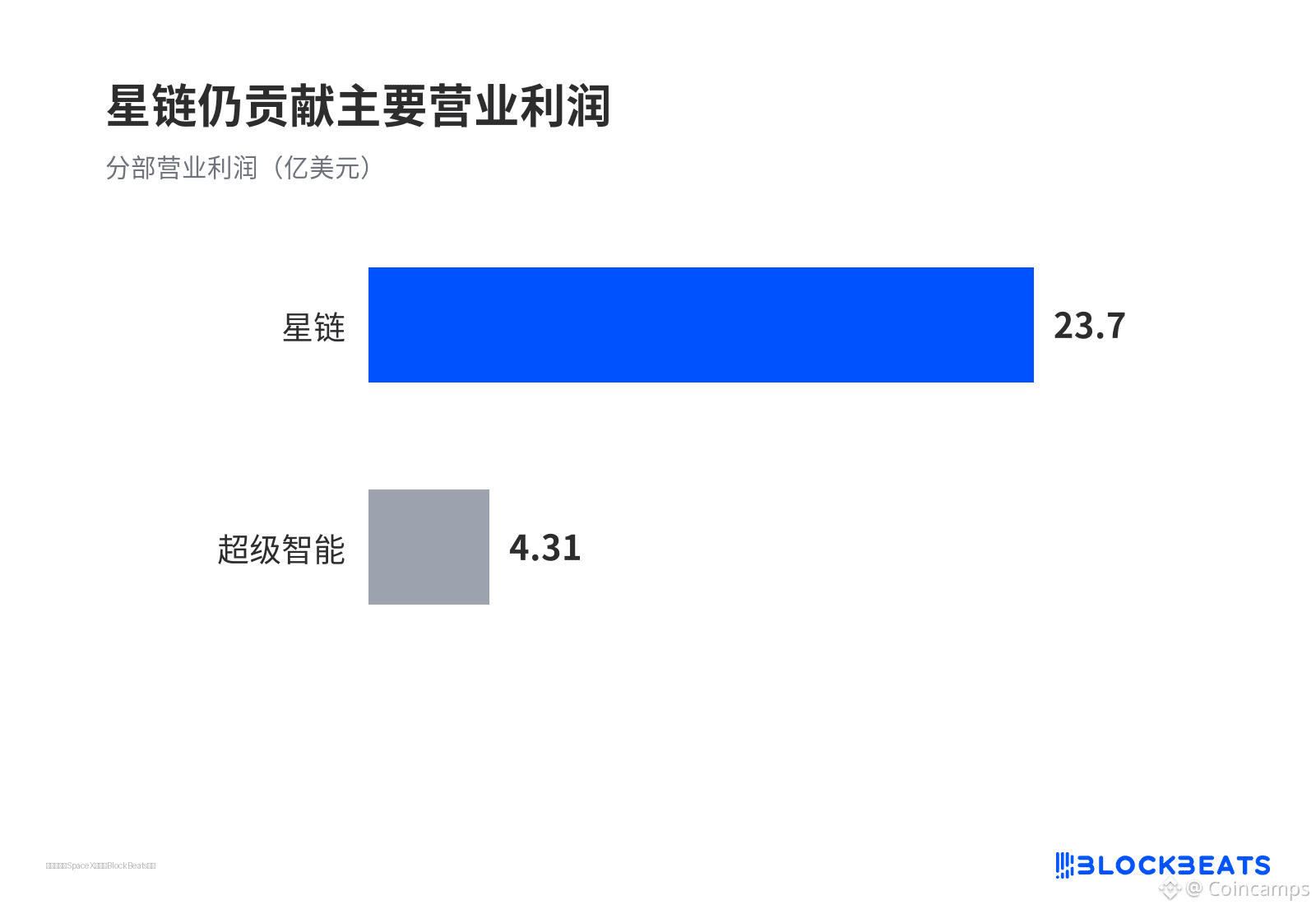
مقالة
ما الأرقام الرئيسية التي ينبغي متابعتها في الاندماج المحتمل بين SpaceX وTesla؟الخلاصة
· خلال مكالمة إعلان أرباح SpaceX في 20 أكتوبر، أكد ماسك أن كلاً من Tesla وSpaceX شكّلت لجنة خاصة مستقلة من أعضاء مجلس إدارتها لمناقشة احتمال الاندماج؛ وقد تنحّى عن المشاركة بسبب تضارب المصالح، وقال إنه لم يتم التوصل إلى أي شروط.
· من جانب Tesla، يلزم الحصول على موافقة 50% من جميع الأسهم القائمة، وتُحتسب الأصوات الممتنعة على أنها معارضة. وتتعارض هذه العتبة مع توقعات المحللين بـ«إعلان قبل الاجتماع السنوي» و«احتمال بنسبة 90% بحلول نهاية العام المقبل».
ما الأرقام الرئيسية التي ينبغي متابعتها في الاندماج المحتمل بين SpaceX وTesla؟
الخلاصة
· خلال مكالمة إعلان أرباح SpaceX في 20 أكتوبر، أكد ماسك أن كلاً من Tesla وSpaceX شكّلت لجنة خاصة مستقلة من أعضاء مجلس إدارتها لمناقشة احتمال الاندماج؛ وقد تنحّى عن المشاركة بسبب تضارب المصالح، وقال إنه لم يتم التوصل إلى أي شروط.
· من جانب Tesla، يلزم الحصول على موافقة 50% من جميع الأسهم القائمة، وتُحتسب الأصوات الممتنعة على أنها معارضة. وتتعارض هذه العتبة مع توقعات المحللين بـ«إعلان قبل الاجتماع السنوي» و«احتمال بنسبة 90% بحلول نهاية العام المقبل».
361
·
--
إذا اندمجت تسلا وسبيس إكس، فهل يمكن أن يصل سهم TSLA إلى 480 دولارًا؟كان هذا ثاني تقرير ربع سنوي لسبيس إكس منذ طرحها للاكتتاب العام، وقد حققت فيه أرباحًا للمرة الأولى. بلغت الإيرادات 14.6 مليار دولار، بزيادة 161% على أساس سنوي. وبلغ صافي الدخل 4.4 مليار دولار، مقارنة بخسارة قدرها 1.1 مليار دولار في الفترة نفسها من العام الماضي.
ارتفع السهم بنسبة 8.06% في التداولات بعد الإغلاق، ليغلق عند 159.70 دولارًا.
تجاوزت الأرباح التوقعات. لكن ما دفع المتداولين فعليًا إلى إعادة تموضعهم كان مقطعًا من جلسة الأسئلة والأجوبة خلال مكالمة إعلان الأرباح.
سأل إديسون يو، المحلل في دويتشه بنك، ماسك عن نظرته إلى إيجابيات اندماج تسلا وسبيس إكس وسلبياته، وعن العقبات القائمة. أقرّ ماسك أولًا بحرج موقفه المتضارب المصالح، ثم أوضح الأمور بجلاء. وقال إن الشركتين أنشأتا، بناءً على طلب المساهمين، لجنتين خاصتين تضم كل منهما أعضاء مستقلين في مجلس الإدارة.
إذا اندمجت تسلا وسبيس إكس، فهل يمكن أن يصل سهم TSLA إلى 480 دولارًا؟
كان هذا ثاني تقرير ربع سنوي لسبيس إكس منذ طرحها للاكتتاب العام، وقد حققت فيه أرباحًا للمرة الأولى. بلغت الإيرادات 14.6 مليار دولار، بزيادة 161% على أساس سنوي. وبلغ صافي الدخل 4.4 مليار دولار، مقارنة بخسارة قدرها 1.1 مليار دولار في الفترة نفسها من العام الماضي.
ارتفع السهم بنسبة 8.06% في التداولات بعد الإغلاق، ليغلق عند 159.70 دولارًا.
تجاوزت الأرباح التوقعات. لكن ما دفع المتداولين فعليًا إلى إعادة تموضعهم كان مقطعًا من جلسة الأسئلة والأجوبة خلال مكالمة إعلان الأرباح.
سأل إديسون يو، المحلل في دويتشه بنك، ماسك عن نظرته إلى إيجابيات اندماج تسلا وسبيس إكس وسلبياته، وعن العقبات القائمة. أقرّ ماسك أولًا بحرج موقفه المتضارب المصالح، ثم أوضح الأمور بجلاء. وقال إن الشركتين أنشأتا، بناءً على طلب المساهمين، لجنتين خاصتين تضم كل منهما أعضاء مستقلين في مجلس الإدارة.
26
·
--

مقالة
عرض الترجمة
Wall Street Morning Brief: AI jitters shake markets as healthcare leads, SpaceX and Super Micro ignite after-hours, Meta and Tesla face big testsEvery weekday morning, we focus on macro, US equities, AI, precious metals and crude oil, using data to review the market and trends to seize opportunities. Brought to you by us.
US stocks wobble as small caps lead; oil trades the rumor, then the denial
On Tuesday, US stocks were pulled back and forth between rumors of a "US-Iran compromise" and subsequent denials. The Dow rose 1.02%, the S&P 500 gained 0.28% (with more than 400 constituents advancing and the index reclaiming its 50-day moving average), the small-cap Russell 2000 led the way with a 1.66% surge, while the Nasdaq Composite slipped just 0.02%. Nine of the S&P 500's 11 sectors rose and two fell, with healthcare up 2.34% and real estate up 1.69% leading gains, while communication services fell 0.89% and technology fell 0.34% to bring up the rear.
In early trading overnight, Qatari media reported that the US and Iran had tentatively accepted a Pakistani-mediated proposal and could reach a ceasefire agreement as soon as this week. The news instantly detonated short positions, with Brent crude touching a five-month high of $111.99 intraday before plunging more than 3.3% in a straight line and briefly breaking below $106. However, shortly afterward, diplomats involved in the negotiations urgently denied the reports, calling claims that a deal was imminent seriously inaccurate. Tehran went further, reiterating in tougher terms that it would not compromise until the US met "seven conditions" including lifting sanctions and the blockade, and that "not a single particle of enriched nuclear material will leave Iran." Oil prices then sharply narrowed their losses from the lows, with Brent ultimately settling down 0.69% at $108.79, while the November WTI contract settled down 1.80% at $101.79.
In Europe, the energy crisis cloud shows no sign of lifting. The Dutch TTF benchmark natural gas price briefly broke above €90 per megawatt-hour intraday. Rabobank strategists expect that, with Asian LNG storage at its lowest level for this time of year since 2009, a winter energy scramble could be ignited. Meanwhile, France's sovereign debt and fiscal deficit crisis continues to fester. Although US Treasury Secretary Bessent publicly downplayed spillover risks, the French-German government bond spread still widened to a high of 153 basis points, with safe-haven funds accelerating into short-term German bunds and the Swiss franc. In addition, the US, Ukraine and Europe reached consensus on a peace framework, but the US government was thrown into disarray internally after Musk's "Starshield" system rate-limiting paralyzed Ukrainian military drones, further aggravating US-Ukraine differences over strikes on Russian oil refineries.
At the same time, the US dollar index weakened to the 101.7 area, a three-week low. Spot gold came under pressure late in New York trading, falling 0.45% to $4,122.38, while spot silver, buoyed by its industrial and catch-up attributes, extended its rebound, settling up 1.32% at $57.66. Gold's underlying support remains solid: Swiss gold exports rose 6% month-over-month in September to 165.2 tonnes, with exports to the UK surging 24% to 126.2 tonnes, a record high since 2012. World Gold Council data shows Q3 global physical gold ETF net inflows hit a record $31 billion (with the UK accounting for $7.5 billion). On the industrial metals front, Sonny McNess, a star aluminum trader formerly of JPMorgan and Mercuria, is aggressively going long October LME copper and short November copper through Hartree Partners, pushing the front-month spot premium to as much as $91.99 per tonne at one point.
Wall Street's "AI phobia" sees a turning point, but AI infrastructure expansion faces multiple challenges
The "AI capex phobia" that has hung over Wall Street over the past week saw a turning point. Goldman Sachs' risk appetite indicator turned negative for the first time since March, prompting Christian Mueller-Glissmann, the bank's London-based head of asset allocation, to tactically upgrade his three-month equity allocation to "overweight," noting that earnings support, light positioning and valuation pullbacks will fuel a year-end rally. At the same time, Wells Fargo's buy-sell sentiment indicator fell below -1 for the first time since June 2025, triggering a "buy" signal (historical data shows the S&P 500 has averaged a 6.5% gain over the following three months, with an 89% hit rate). Its chief strategist Ohsung Kwon said bluntly that the market has become overly pessimistic about AI financing and the Iran situation, and expects capital discipline to let hyperscale cloud providers replace chip stocks driven purely by cash burn as the new leaders, with the bullish case for AI infrastructure now pointing all the way to 2027.
Before the after-hours earnings bombs detonated, intraday traders were still voting with their feet, fleeing highly leveraged AI assets and rotating into defensive sectors such as healthcare (up 2.34%) and real estate (up 1.69%). Plante Moran chief investment officer Jim Baird said doubts about whether AI investment can be monetized are driving funds to rotate into small caps and healthcare stocks.
The panic was triggered by two factors: first, South Korea's rare profitable "new cloud" data center Elice plunged 32% on its first day of trading on October 20; second, The Wall Street Journal exposed a draft of Anthropic's IPO prospectus showing that although first-half revenue soared to $16.3 billion (with Q3 up another 45% quarter-over-quarter to $16.8 billion and adjusted profitability), its net loss reached a staggering $80.7 billion (including $72 billion in accounting charges from changes in the valuation of financing instruments), and future committed compute spending could reach an astonishing $750 billion at the high end. This directly led investors to slash their valuation expectations from $2 trillion to $1.5 trillion.
Moreover, the physical bottlenecks of AI expansion are becoming increasingly glaring. The US research group Center for Western Priorities revealed that there are already 35 data center and related applications on public lands across six western states (covering more than 24,000 acres, with one Utah project even proposing to use SMR nuclear power that has not yet been commercialized). Although the Trump administration views data center expansion as a national priority, public opposition to these projects is growing, with concerns centered on electricity demand, water consumption, wildlife impacts and the use of public lands.
Specific project moves and stock price swings:
Eli Lilly bucked the trend on Tuesday, surging 3.49% to another record high: The company announced that its Omvoh injection for pediatric ulcerative colitis patients achieved major success in late-stage clinical trials, and it plans to seek regulatory approval to expand the indication for this bowel disease therapy. Combined with intraday funds pulling out of tech stocks in search of a safe haven, this pushed the stock to a fresh all-time high.
The healthcare sector jumped 2.34% to lead the market: Weight-loss drug and biopharma themes broke out across the board, with Kailera Therapeutics soaring 12.77%, Viking Therapeutics up 6.63%, Moderna surging more than 6% to its highest since 2022 (up more than 720% year-to-date), Amgen up 3.29%, UnitedHealth up 3.04%, and Novo Nordisk up 2.42%.
SpaceX slipped 0.11%, then surged more than 8% in overnight trading: Third-quarter results crushed Wall Street across the board, with net profit of $4.4 billion far exceeding the expected $1.88 billion, and AI superintelligence (SI) business revenue soaring 830% to $7.56 billion while turning operating profit positive for the first time. On the earnings call, Musk confirmed that SpaceX and Tesla have each set up special committees to discuss a merger of the two giants, and declared that annual recurring revenue is sprinting toward $1 trillion and the compute payback period has shortened to six months, dispelling market doubts about whether infrastructure investment can be realized.
Super Micro Computer closed up 1.15%, then soared more than 15% after hours: The company's preliminary fiscal-quarter revenue estimate reached $18.5 billion–$19.5 billion (far exceeding the midpoint of its original guidance by 26.7% and analysts' expectations of $15.2 billion), with gross margin jumping to 12.0%–12.5%. Evercore ISI analyst Amit Daryanani noted that the combination of better-than-expected revenue and margins is striking, directly driving Dell Technologies up 6% in overnight trading, Hewlett Packard Enterprise up nearly 5%, and compute cloud firm CoreWeave up more than 4%.
Netflix closed down 1.66%, then plunged nearly 6% after hours: Fourth-quarter revenue growth guidance fell to 11.5% (slowing for a fourth consecutive quarter), net profit guidance missed expectations, and the company further cut its full-year advertising revenue forecast from $3 billion to $2.7 billion. Although third-quarter EPS beat expectations, management turmoil, layoff costs and the challenge of losing user time to YouTube sent funds fleeing.
CoreWeave & Nebius both surged more than 4% after hours: Boosted by Musk's massive GPU orders and the AI infrastructure boom, the US cloud services and compute leasing sector staged a dramatic comeback. CoreWeave, which had fallen as much as 6% intraday to a new post-IPO low, was supported by a Goldman Sachs rating upgrade to close up 1.65%, then soared more than 4% after hours along with the sector. Nebius rose 0.71% intraday and surged more than 4% after hours. Only data center operator IREN closed down 4.00% intraday.
The Philadelphia Semiconductor Index slipped 0.29%: Lam Research fell 3.21%, ARM fell 3.07%, ASML fell 0.99%, AMD fell 0.62%, Intel fell 0.37%, and Broadcom fell 0.07%.
The memory sector was mixed: Western Digital rose 3.44%, Seagate Technology rose 2.17%, SanDisk fell 0.42%, SK Hynix fell 2.16%, and Micron Technology fell 0.98% intraday (the company announced an investment in New York State's Indium Corporation to strengthen its high-purity mineral supply chain, but workers at its Taoyuan, Taiwan plant plan to strike this Thursday in solidarity with the Taichung union's push for profit sharing, which could severely disrupt chip production).
The optical communications sector broadly fell: AAOI fell 1.87%, Lumentum fell 1.44%, CRDO fell 0.75%, Coherent fell 0.09%, and only Marvell Technology rose 1.4%.
Tesla closed up 1.54% (extending gains of more than 1.5% in overnight trading): Ferrari's CEO publicly praised the new Roadster's design as showing bold innovation, and after hours Musk confirmed the formation of a special committee with SpaceX to explore a merger of the century, sending bullish sentiment into a frenzy. Watch for the earnings release after Wednesday's close.
Amazon edged up 0.07%: The company announced it will invest more than €16 billion in Germany in 2027 to expand AI and cloud infrastructure (full-year total capex is expected to reach $220 billion, with free cash flow already turning negative last quarter). However, internal emails revealed that AWS has activated an early-receipt process, taking delivery of $5 billion worth of Nvidia GB300 racks upfront (followed by $3 billion per month thereafter), but due to power shortages at some sites, the hardware can only be temporarily stored in transit warehouses awaiting deployment.
Nvidia closed down 0.29% (turning positive after hours, up more than 2.2%): Jensen Huang reached cooperation with the German government and Siemens at the Berlin summit on AI factories and startup investment, emphasizing that AI is a new tool to augment humans. After hours, Musk's announcement of a frenzied order to bring 200,000 GB300 units online each month and deploy 440,000 Vera Rubin units in Q2 next year directly injected a shot of adrenaline.
Microsoft slipped 0.31%: The company confirmed that Windows Server 2025 officially supports the fast machine recovery feature after installing the October security update.
Apple closed down 1.00%: Although the company, as part of its $600 billion "Made in America" plan, invested $100 million in Pennsylvania's Perryman to purchase recycled titanium and expanded its partnership with Qnity to produce variable-aperture film for the iPhone 18 Pro, the first foldable iPhone Duo going on sale this Friday is facing severe supply bottlenecks. Morgan Stanley noted that online delivery wait times have reached 14 weeks, the longest in a decade, while JPMorgan also cut its full-year shipment forecast from 10 million units to 8–9 million units due to capacity constraints.
Google fell 1.13%: Although its Waymo unit plans to use $5 billion in recently borrowed funds to double its autonomous vehicle fleet from 4,000 to 8,000 by the end of this year and expand to 20,000 by the end of next year, the stock was still dragged down intraday by selling pressure in the communication services sector.
Meta closed down 1.59%: As the first AI hyperscale giant to face the earnings gauntlet after Wednesday's close, funds chose to de-risk and front-run ahead of the results amid concerns over its massive capex guidance.
Other US stock moves: Braze soared 51.70% (Salesforce announced it will acquire the customer engagement platform Braze for $5.66 billion); Hasbro surged 11.2% to a one-year high (raising full-year revenue and digital gaming guidance); 3M rose 5.8% (announcing an expanded data center partnership with Amazon and raising its profit forecast); General Motors plunged 6.8% (warning of rising commodity costs and declining truck sales).
What to watch next:
October 21 (Wednesday)
17:00 Jensen Huang GTC keynote: European sovereign AI, inference demand, new architecture and partnership scale are the focus; the market needs concrete orders, not just long-term vision.
The World Intelligent Connected Vehicles Conference opens; the China-Europe Investment, Trade and Technology Cooperation Fair runs through the 23rd: watch for autonomous driving, vehicle-road-cloud standards and cross-border industrial cooperation.
Bessent and Druckenmiller attend the JPMorgan–Robinhood investor conference: the event is closed to media; if public information emerges, watch for views on fiscal financing, interest rates and market risk.
US earnings: IBM and AT&T before the open; Meta, Tesla, Lam Research and Texas Instruments after the close.
October 22 (Thursday)
Micron Taiwan Taoyuan plant strike and second round of negotiations with the Taichung union: Workers at Micron's Taoyuan plant are set to strike on Thursday in solidarity with the Taichung union's push for profit sharing. If negotiations break down and the strike is prolonged, it could directly cut off critical global DRAM and HBM chip production capacity, triggering sharp swings in memory chip prices and related stock prices.
04:30 Meta earnings call; 05:30 Tesla Q&A livestream: For Meta, the key is whether AI spending can be covered by advertising growth, with the market expecting revenue of $63.29 billion, capex of $40.97 billion and negative free cash flow of $9.14 billion; for Tesla, the key is how deliveries of more than 486,000 vehicles and 13.7 GWh of energy storage deployments translate into profit.
Bank of Korea rate decision: A pause is expected after consecutive hikes; if it tightens further, the won may find support, but chip stocks and companies with large financing needs would come under pressure.
US 20-year Treasury auction: The key is the strength of demand and whether the final yield comes in higher than expected, testing whether this round of the Treasury rally can continue and feeding through to gold and tech stocks.
Earnings: Nokia, Spotify, American Airlines, Procter & Gamble; after the close, watch Bloom Energy, Western Digital and Newmont.
Join the official Coincamps community:
X: https://x.com/coincamps
Telegram: https://t.me/coin_camps
Wall Street Morning Brief: AI jitters shake markets as healthcare leads, SpaceX and Super Micro ignite after-hours, Meta and Tesla face big tests
Every weekday morning, we focus on macro, US equities, AI, precious metals and crude oil, using data to review the market and trends to seize opportunities. Brought to you by us.
US stocks wobble as small caps lead; oil trades the rumor, then the denial
On Tuesday, US stocks were pulled back and forth between rumors of a "US-Iran compromise" and subsequent denials. The Dow rose 1.02%, the S&P 500 gained 0.28% (with more than 400 constituents advancing and the index reclaiming its 50-day moving average), the small-cap Russell 2000 led the way with a 1.66% surge, while the Nasdaq Composite slipped just 0.02%. Nine of the S&P 500's 11 sectors rose and two fell, with healthcare up 2.34% and real estate up 1.69% leading gains, while communication services fell 0.89% and technology fell 0.34% to bring up the rear.
In early trading overnight, Qatari media reported that the US and Iran had tentatively accepted a Pakistani-mediated proposal and could reach a ceasefire agreement as soon as this week. The news instantly detonated short positions, with Brent crude touching a five-month high of $111.99 intraday before plunging more than 3.3% in a straight line and briefly breaking below $106. However, shortly afterward, diplomats involved in the negotiations urgently denied the reports, calling claims that a deal was imminent seriously inaccurate. Tehran went further, reiterating in tougher terms that it would not compromise until the US met "seven conditions" including lifting sanctions and the blockade, and that "not a single particle of enriched nuclear material will leave Iran." Oil prices then sharply narrowed their losses from the lows, with Brent ultimately settling down 0.69% at $108.79, while the November WTI contract settled down 1.80% at $101.79.
In Europe, the energy crisis cloud shows no sign of lifting. The Dutch TTF benchmark natural gas price briefly broke above €90 per megawatt-hour intraday. Rabobank strategists expect that, with Asian LNG storage at its lowest level for this time of year since 2009, a winter energy scramble could be ignited. Meanwhile, France's sovereign debt and fiscal deficit crisis continues to fester. Although US Treasury Secretary Bessent publicly downplayed spillover risks, the French-German government bond spread still widened to a high of 153 basis points, with safe-haven funds accelerating into short-term German bunds and the Swiss franc. In addition, the US, Ukraine and Europe reached consensus on a peace framework, but the US government was thrown into disarray internally after Musk's "Starshield" system rate-limiting paralyzed Ukrainian military drones, further aggravating US-Ukraine differences over strikes on Russian oil refineries.
At the same time, the US dollar index weakened to the 101.7 area, a three-week low. Spot gold came under pressure late in New York trading, falling 0.45% to $4,122.38, while spot silver, buoyed by its industrial and catch-up attributes, extended its rebound, settling up 1.32% at $57.66. Gold's underlying support remains solid: Swiss gold exports rose 6% month-over-month in September to 165.2 tonnes, with exports to the UK surging 24% to 126.2 tonnes, a record high since 2012. World Gold Council data shows Q3 global physical gold ETF net inflows hit a record $31 billion (with the UK accounting for $7.5 billion). On the industrial metals front, Sonny McNess, a star aluminum trader formerly of JPMorgan and Mercuria, is aggressively going long October LME copper and short November copper through Hartree Partners, pushing the front-month spot premium to as much as $91.99 per tonne at one point.
Wall Street's "AI phobia" sees a turning point, but AI infrastructure expansion faces multiple challenges
The "AI capex phobia" that has hung over Wall Street over the past week saw a turning point. Goldman Sachs' risk appetite indicator turned negative for the first time since March, prompting Christian Mueller-Glissmann, the bank's London-based head of asset allocation, to tactically upgrade his three-month equity allocation to "overweight," noting that earnings support, light positioning and valuation pullbacks will fuel a year-end rally. At the same time, Wells Fargo's buy-sell sentiment indicator fell below -1 for the first time since June 2025, triggering a "buy" signal (historical data shows the S&P 500 has averaged a 6.5% gain over the following three months, with an 89% hit rate). Its chief strategist Ohsung Kwon said bluntly that the market has become overly pessimistic about AI financing and the Iran situation, and expects capital discipline to let hyperscale cloud providers replace chip stocks driven purely by cash burn as the new leaders, with the bullish case for AI infrastructure now pointing all the way to 2027.
Before the after-hours earnings bombs detonated, intraday traders were still voting with their feet, fleeing highly leveraged AI assets and rotating into defensive sectors such as healthcare (up 2.34%) and real estate (up 1.69%). Plante Moran chief investment officer Jim Baird said doubts about whether AI investment can be monetized are driving funds to rotate into small caps and healthcare stocks.
The panic was triggered by two factors: first, South Korea's rare profitable "new cloud" data center Elice plunged 32% on its first day of trading on October 20; second, The Wall Street Journal exposed a draft of Anthropic's IPO prospectus showing that although first-half revenue soared to $16.3 billion (with Q3 up another 45% quarter-over-quarter to $16.8 billion and adjusted profitability), its net loss reached a staggering $80.7 billion (including $72 billion in accounting charges from changes in the valuation of financing instruments), and future committed compute spending could reach an astonishing $750 billion at the high end. This directly led investors to slash their valuation expectations from $2 trillion to $1.5 trillion.
Moreover, the physical bottlenecks of AI expansion are becoming increasingly glaring. The US research group Center for Western Priorities revealed that there are already 35 data center and related applications on public lands across six western states (covering more than 24,000 acres, with one Utah project even proposing to use SMR nuclear power that has not yet been commercialized). Although the Trump administration views data center expansion as a national priority, public opposition to these projects is growing, with concerns centered on electricity demand, water consumption, wildlife impacts and the use of public lands.
Specific project moves and stock price swings:
Eli Lilly bucked the trend on Tuesday, surging 3.49% to another record high: The company announced that its Omvoh injection for pediatric ulcerative colitis patients achieved major success in late-stage clinical trials, and it plans to seek regulatory approval to expand the indication for this bowel disease therapy. Combined with intraday funds pulling out of tech stocks in search of a safe haven, this pushed the stock to a fresh all-time high.
The healthcare sector jumped 2.34% to lead the market: Weight-loss drug and biopharma themes broke out across the board, with Kailera Therapeutics soaring 12.77%, Viking Therapeutics up 6.63%, Moderna surging more than 6% to its highest since 2022 (up more than 720% year-to-date), Amgen up 3.29%, UnitedHealth up 3.04%, and Novo Nordisk up 2.42%.
SpaceX slipped 0.11%, then surged more than 8% in overnight trading: Third-quarter results crushed Wall Street across the board, with net profit of $4.4 billion far exceeding the expected $1.88 billion, and AI superintelligence (SI) business revenue soaring 830% to $7.56 billion while turning operating profit positive for the first time. On the earnings call, Musk confirmed that SpaceX and Tesla have each set up special committees to discuss a merger of the two giants, and declared that annual recurring revenue is sprinting toward $1 trillion and the compute payback period has shortened to six months, dispelling market doubts about whether infrastructure investment can be realized.
Super Micro Computer closed up 1.15%, then soared more than 15% after hours: The company's preliminary fiscal-quarter revenue estimate reached $18.5 billion–$19.5 billion (far exceeding the midpoint of its original guidance by 26.7% and analysts' expectations of $15.2 billion), with gross margin jumping to 12.0%–12.5%. Evercore ISI analyst Amit Daryanani noted that the combination of better-than-expected revenue and margins is striking, directly driving Dell Technologies up 6% in overnight trading, Hewlett Packard Enterprise up nearly 5%, and compute cloud firm CoreWeave up more than 4%.
Netflix closed down 1.66%, then plunged nearly 6% after hours: Fourth-quarter revenue growth guidance fell to 11.5% (slowing for a fourth consecutive quarter), net profit guidance missed expectations, and the company further cut its full-year advertising revenue forecast from $3 billion to $2.7 billion. Although third-quarter EPS beat expectations, management turmoil, layoff costs and the challenge of losing user time to YouTube sent funds fleeing.
CoreWeave & Nebius both surged more than 4% after hours: Boosted by Musk's massive GPU orders and the AI infrastructure boom, the US cloud services and compute leasing sector staged a dramatic comeback. CoreWeave, which had fallen as much as 6% intraday to a new post-IPO low, was supported by a Goldman Sachs rating upgrade to close up 1.65%, then soared more than 4% after hours along with the sector. Nebius rose 0.71% intraday and surged more than 4% after hours. Only data center operator IREN closed down 4.00% intraday.
The Philadelphia Semiconductor Index slipped 0.29%: Lam Research fell 3.21%, ARM fell 3.07%, ASML fell 0.99%, AMD fell 0.62%, Intel fell 0.37%, and Broadcom fell 0.07%.
The memory sector was mixed: Western Digital rose 3.44%, Seagate Technology rose 2.17%, SanDisk fell 0.42%, SK Hynix fell 2.16%, and Micron Technology fell 0.98% intraday (the company announced an investment in New York State's Indium Corporation to strengthen its high-purity mineral supply chain, but workers at its Taoyuan, Taiwan plant plan to strike this Thursday in solidarity with the Taichung union's push for profit sharing, which could severely disrupt chip production).
The optical communications sector broadly fell: AAOI fell 1.87%, Lumentum fell 1.44%, CRDO fell 0.75%, Coherent fell 0.09%, and only Marvell Technology rose 1.4%.
Tesla closed up 1.54% (extending gains of more than 1.5% in overnight trading): Ferrari's CEO publicly praised the new Roadster's design as showing bold innovation, and after hours Musk confirmed the formation of a special committee with SpaceX to explore a merger of the century, sending bullish sentiment into a frenzy. Watch for the earnings release after Wednesday's close.
Amazon edged up 0.07%: The company announced it will invest more than €16 billion in Germany in 2027 to expand AI and cloud infrastructure (full-year total capex is expected to reach $220 billion, with free cash flow already turning negative last quarter). However, internal emails revealed that AWS has activated an early-receipt process, taking delivery of $5 billion worth of Nvidia GB300 racks upfront (followed by $3 billion per month thereafter), but due to power shortages at some sites, the hardware can only be temporarily stored in transit warehouses awaiting deployment.
Nvidia closed down 0.29% (turning positive after hours, up more than 2.2%): Jensen Huang reached cooperation with the German government and Siemens at the Berlin summit on AI factories and startup investment, emphasizing that AI is a new tool to augment humans. After hours, Musk's announcement of a frenzied order to bring 200,000 GB300 units online each month and deploy 440,000 Vera Rubin units in Q2 next year directly injected a shot of adrenaline.
Microsoft slipped 0.31%: The company confirmed that Windows Server 2025 officially supports the fast machine recovery feature after installing the October security update.
Apple closed down 1.00%: Although the company, as part of its $600 billion "Made in America" plan, invested $100 million in Pennsylvania's Perryman to purchase recycled titanium and expanded its partnership with Qnity to produce variable-aperture film for the iPhone 18 Pro, the first foldable iPhone Duo going on sale this Friday is facing severe supply bottlenecks. Morgan Stanley noted that online delivery wait times have reached 14 weeks, the longest in a decade, while JPMorgan also cut its full-year shipment forecast from 10 million units to 8–9 million units due to capacity constraints.
Google fell 1.13%: Although its Waymo unit plans to use $5 billion in recently borrowed funds to double its autonomous vehicle fleet from 4,000 to 8,000 by the end of this year and expand to 20,000 by the end of next year, the stock was still dragged down intraday by selling pressure in the communication services sector.
Meta closed down 1.59%: As the first AI hyperscale giant to face the earnings gauntlet after Wednesday's close, funds chose to de-risk and front-run ahead of the results amid concerns over its massive capex guidance.
Other US stock moves: Braze soared 51.70% (Salesforce announced it will acquire the customer engagement platform Braze for $5.66 billion); Hasbro surged 11.2% to a one-year high (raising full-year revenue and digital gaming guidance); 3M rose 5.8% (announcing an expanded data center partnership with Amazon and raising its profit forecast); General Motors plunged 6.8% (warning of rising commodity costs and declining truck sales).
What to watch next:
October 21 (Wednesday)
17:00 Jensen Huang GTC keynote: European sovereign AI, inference demand, new architecture and partnership scale are the focus; the market needs concrete orders, not just long-term vision.
The World Intelligent Connected Vehicles Conference opens; the China-Europe Investment, Trade and Technology Cooperation Fair runs through the 23rd: watch for autonomous driving, vehicle-road-cloud standards and cross-border industrial cooperation.
Bessent and Druckenmiller attend the JPMorgan–Robinhood investor conference: the event is closed to media; if public information emerges, watch for views on fiscal financing, interest rates and market risk.
US earnings: IBM and AT&T before the open; Meta, Tesla, Lam Research and Texas Instruments after the close.
October 22 (Thursday)
Micron Taiwan Taoyuan plant strike and second round of negotiations with the Taichung union: Workers at Micron's Taoyuan plant are set to strike on Thursday in solidarity with the Taichung union's push for profit sharing. If negotiations break down and the strike is prolonged, it could directly cut off critical global DRAM and HBM chip production capacity, triggering sharp swings in memory chip prices and related stock prices.
04:30 Meta earnings call; 05:30 Tesla Q&A livestream: For Meta, the key is whether AI spending can be covered by advertising growth, with the market expecting revenue of $63.29 billion, capex of $40.97 billion and negative free cash flow of $9.14 billion; for Tesla, the key is how deliveries of more than 486,000 vehicles and 13.7 GWh of energy storage deployments translate into profit.
Bank of Korea rate decision: A pause is expected after consecutive hikes; if it tightens further, the won may find support, but chip stocks and companies with large financing needs would come under pressure.
US 20-year Treasury auction: The key is the strength of demand and whether the final yield comes in higher than expected, testing whether this round of the Treasury rally can continue and feeding through to gold and tech stocks.
Earnings: Nokia, Spotify, American Airlines, Procter & Gamble; after the close, watch Bloom Energy, Western Digital and Newmont.
Join the official Coincamps community:
X: https://x.com/coincamps
Telegram: https://t.me/coin_camps
سجّل الدخول لاستكشاف المزيد من المُحتوى
انضم إلى مُستخدمي العملات الرقمية حول العالم على Binance Square
⚡️ احصل على أحدث المعلومات المفيدة عن العملات الرقمية.
💬 موثوقة من قبل أكبر منصّة لتداول العملات الرقمية في العالم.
👍 اكتشف الرؤى الحقيقية من صنّاع المُحتوى الموثوقين.
البريد الإلكتروني / رقم الهاتف
المواضيع الرائجة
FOMCWatch
8.9M مشاهدات
26,644 يقومون بالنقاش
🚨 مراقبة اجتماع الفيدرالي أصبحت جادة! 📊
ثلاثة من مسؤولي الاحتياطي الفيدرالي دعموا رفع الفائدة في اجتماع يوليو بينما بقيت الفائدة عند 3.50%–3.75%.
قد يؤدي هذا الانقسام إلى تذبذبات كبيرة للأصول ذات المخاطر مثل $BTC، $ETH و$BNB عند وصول بيانات اقتصادية جديدة.
#fomcwatch
CryptoMahibaloch
·0 إعجاب
·44 مشاهدات
EthereumDropsBelow$2300
2,232 مشاهدات
89 يقومون بالنقاش
BitcoinSlipsBelow$80KAgain
6,223 مشاهدات
58 يقومون بالنقاش