

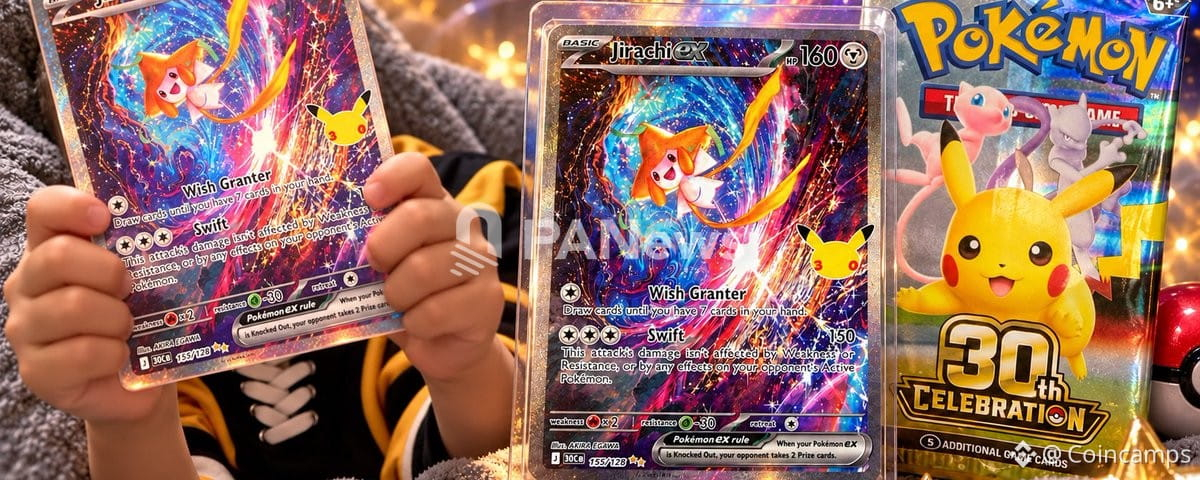

On Courtyard's product page, collectors are presented with several choices: open a random pack, leave the card they pulled in the vault, request it be shipped home, or accept the platform's quote and sell immediately to recoup funds.
A Pokémon card sealed in a transparent hard case thus gains different destinations. For one person, it's exit capital after failing to pull the target; for another, it might be the version long missing from their collection binder. When a trade happens, the physical card stays where it is — what changes is ownership, and who is willing to pay for it.
After trading card games — TCG — moved on-chain, the most noteworthy change is hidden right here. In the past, once a pack was sold, the operator waited for the next customer; now, opening packs, quoting, buybacks, and repurchasing can be linked together. The same card, the same budget, has the chance to participate in multiple transactions in a row. Inventory doesn't move, but trading volume grows geometrically.
Human nature loves to gamble, which means: some people are willing to spend a little money to buy a chance at a big outcome. But where do they spend it? Some buy into wall-to-wall promotional posters, some into KOL endorsements, and some choose a cultural IP they're familiar with — TCG is that vehicle.
Rather than play a slot machine in a casino whose graphics you can't even understand, you might as well buy Pokémon cards — why? Pokémon, I know it~
A few numbers for context
As of the end of March 2026, cumulative Pokémon card production has exceeded 85 billion cards, with sales covering more than 90 countries and regions. The digital card app Pokémon TCG Pocket announced in October 2025 that cumulative downloads had surpassed 150 million.
Research firm Straits Research, in a report updated in October 2026, forecast the global trading card game market size for that year at roughly $16.3 billion.
Business Insider reported in December 2025, citing eBay data, that trading cards were the secondhand goods category most purchased by U.S. Gen Z on the platform that year as of the time of reporting.
Background
When it comes to TCG, this business is far older than cryptocurrency. In 1993, Magic: The Gathering debuted, and Wizards of the Coast co-founder Peter Adkison traveled along the U.S. West Coast visiting game stores, introducing players to this new way of buying cards, building decks, and battling through demonstrations. And so, one small shop after another opened up. Don't underestimate these unassuming
storefronts — they were both sales channels and social venues for fans.
More than thirty years later, the elementary school kids of back then have money now, and cards have transformed from game props into collectibles and investment assets. Some study deck builds, some chase illustrations and editions, and some buy back the "white moonlight" they couldn't bear to buy as children. Whatever the reason, the target audience keeps growing.
Hasbro's 2025 investor materials show that the average Magic: The Gathering tabletop player is about 35 years old, with average engagement exceeding five years, and the Wizards Play Network covers roughly 9,600 stores. In 2025, Magic: The Gathering tabletop and digital products combined revenue reached $1.72 billion, up 59% year over year.
Why are there so many participants?
The most obvious reason is that young people can't see hope anymore?
The threshold for traditional wealth accumulation keeps rising. A 2025 survey by the National Association of Realtors shows that first-time buyers fell to 21% of all homebuyers, and the median age of first-time buyers rose to 40. Northwestern Mutual's 2026 survey found that among U.S. Gen Z respondents who use or are considering high-risk speculative instruments, 80% said they are financially behind and hope these tools (aka TCG / Crypto) will help them reach their goals faster.
These figures present two realities that exist simultaneously: large assets require long-term accumulation; small, instant products with high-return imagination are competing for some people's attention.
Cards also have cultural familiarity as an entry point. A person may not understand a company's cash flow, but they know which character they like and which edition is popular in the community. Familiarity doesn't equal profit, but it makes participation easier; even if the price hasn't risen yet, collecting and displaying provide a reason to keep holding, because participants get a feeling that they "know better than the old-timers."
A 2025 Australian collectibles study commissioned by eBay and conducted by Deloitte found that 35% of surveyed collectors view collecting as a good investment; among those collecting for investment purposes, 40% expect returns above 50%. eBay data cited in the report also shows that One Piece OP-01 booster boxes have risen 200% in transaction price since 2022. We have to ask, who wouldn't love a story like that? These get-rich-quick stories easily turn a hobby into an investment attempt.
Buying the white moonlight of your childhood while the asset appreciates — why not?
So whether this card money counts as consumption or investment isn't something even the buyer strictly distinguishes.
A beloved character gives a reason to buy, a rare edition gives a reason to hold, and other people's profit stories provide the imagination of appreciation — and so it spreads from one to ten, from ten to a hundred.
But is that enough? No, because holding physical goods is too slow. Cards are non-standardized items (similar to NFTs), hard to price uniformly, so trading volume, turnover rate, and liquidity can't rise — and therefore there's no so-called derivatives trading market. So, to stimulate "spot" trading and the "get-rich-quick" effect, merchants put probability games like "blind boxes" and "card pulls" into a single sale.
Cards thus offer two different kinds of multiple imagination: buy a card and wait for it to rise from $100 to $300; or spend a few dozen dollars and pull a card worth far more. The former waits for the next buyer to raise the offer, the latter relies on prize-pool probability. But the problem is that the steps in the traditional model are either too slow or opaque, making it hard to scale.
To seat more people at this trading table, you first have to solve the problem of a card being shipped back and forth.
Traditional card selling requires photographing, confirming condition, packaging, and shipping, and cross-border transactions also face customs clearance and taxes. According to eBay's U.S. basic fee schedule, trading cards are charged a 13.25% final value fee on the first $7,500 of each item's total transaction amount, plus a per-order fee. Suppose this is a $100 order with no taxes or shipping — after deducting 13.25% and the $0.40 order fee, the seller takes home $86.35.
Under this cost structure, even if a card rises from $100 to $110, a 10% gain may not be worth taking profit. Because the "wear and tear" of the card market — including the condition risk from shipping — may not even be enough to cover the costs.
So some players (like Fanatics Collect) adopted centralized custody to separate physical movement from trading: once cards enter the warehouse, they can change owners multiple times, only leaving when someone requests withdrawal. This largely solves the efficiency problem.
But it's still not fast enough, and it doesn't solve the ownership problem.
On-chain credentials provide another layer of possibility on top of this: when the product allows, credentials can be transferred to external wallets, used by other marketplaces and smart contracts, and payments can connect with stablecoins. Custody solves the problem of cards not needing to be moved repeatedly; going on-chain expands where credentials can circulate and which services can call on them.
Price discovery and turnover rate are the two key words for understanding this business.
A card priced at $100, with a platform valuation of $100, doesn't mean someone is willing to pay $100 right now. The listing price expresses the seller's expectation, the transaction price records past trades, and the bid price tells the holder how much they can get by exiting now. The more independent buyers there are, the more complete the quotes and transactions, the easier it is for collectors to judge whether to hold or sell.
Turnover rate determines another thing: how many transactions the same batch of inventory can participate in. Suppose inventory is worth $1 million, with price and inventory scale unchanged — turning over once a month corresponds to $1 million in transaction volume; turning over ten times a month corresponds to $10 million. If it originally took an average of ten months to turn over once, and that rises to ten times a month, the turnover becomes 100 times the original.
Courtyard founder Nico Le Jeune once said that the same card sells an average of eight times a month on the platform. Sporting Crypto, compiling data from CryptoSlam, found that the platform's monthly sales grew from about $449,000 in April 2024 to about $66 million in April 2025. This case of a collectibles platform expanding from a small base demonstrates the potential when trading frequency and distribution range expand together.
In this system, random packs and instant buybacks further accelerate turnover. When users pull a card they don't like, they don't have to wait for someone else to buy it — they can accept the platform's quote and convert the result back into balance. The platform then reclaims the inventory and continues organizing sales.
From the perspective of random rewards and redemption mechanisms, this looks like a new gambling table dressed in IP clothing. But whether the operator can make money comes back to the probability, cost, and cash reserves of the entire card pool — you can't just look at how much of a discount the buyback is.
Suppose a user spends $50 to pull a card valued at $100, then sells it back to the platform for $85. After the full cycle, the card returns to the platform, and the cash change for the platform is:
50 - 85 = -$35
An example to illustrate: the pack sells for $50, the probability-weighted average card valuation is $45, and the buyback ratio is 85%. If all cards are sold back immediately, with probability and valuation unchanged, the average buyback expenditure per round is $38.25, leaving an average of $11.75 in cash (simplified calculation, excluding any costs).
$11.75 = the $5 between the sale price and average valuation, plus the $6.75 buyback on the $45 valuation.
How much capital users get back determines whether the next round can continue. In the above model, the average return ratio is 76.5%. If we further assume that funds can be infinitely subdivided, the return ratio is constant, all balance is reinvested, and there is no minimum purchase amount, then the theoretical cumulative purchase amount supported by a $50 initial budget is:
50 / (1 - 76.5%) = $212.77
Real products have pack denomination limits, and pull results fluctuate. If each pack is fixed at $50, after getting back $38.25 you'd need to top up or switch to cheaper products.
In reality it's of course not this simple — after all, users don't sell back every card. Some keep the cards they like, some request withdrawal, and some go to the secondary market for higher offers. Even if a card never leaves the warehouse, as long as it belongs to a user, it's no longer inventory the platform can freely put back into the prize pool. The platform needs to purchase new cards to maintain the pool's appeal, and also handle buyback expenditures when high-value results cluster.
Courtyard's fee arrangements reflect the difference between different lines of business:
The platform fee for peer-to-peer (P2P) secondary trading is zero; pack-pull buyback quotes have a seven-day acceptance window, with valuation referencing recent transactions, market trends, and grading differences; transfers triggered by accepting a pack-pull buyback incur a 6% fee, while ordinary market trades don't charge this fee.
Therefore, TCG platforms both operate a trading marketplace and bear the inventory risk of quoted buybacks.
This forms a noteworthy similarity with perpetual contracts: the same product reduces trading friction while accommodating different reasons for participation. In the perpetual market, some bet on direction, some hedge, some earn funding rates, some make markets; in the card market, some chase IP, some collect (hoard) cards (coins), some draw prizes, some play the game, some seek price spreads, and some manage inventory.
Outlook
More than thirty years ago, Magic: The Gathering brought people together through one game store after another. Today, card platforms try to get people scattered across different places, with different purposes, to trade around the same batch of physical goods. Culture lets them recognize what's on the table, mechanisms let them trade faster and more effectively, and custody and settlement mean the next round doesn't have to wait for a courier.
Some people are willing to spend a little money to buy a chance to change the outcome; others are willing to spend a certain amount to buy the outcome they like. Connecting these two kinds of people is the business most worth looking forward to in on-chain TCG.
Whether the platform can consistently deliver these things — a steady supply of cards, randomness/fairness, ongoing buybacks, and competitive quotes — matters far more than how many times a card gets flipped in a vault in determining how long and how big this trading table can run.
Afterword
If you've heard of Pokémon before, today allow me to introduce another Pokémon from this series: the Wish Pokémon — Jirachi. There's a touching story behind it.
There was a child named Avery who, from the age of four, endured the torment of cancer treatment. Pokémon cards were his spiritual refuge during those painful moments, and his favorite card was Jirachi — but sadly, he never managed to get it.
Just as he entered the final moments of his life, he finally pulled Jirachi.
The boy on screen stood frozen, exclaiming repeatedly: "I can't believe it..."
This recording turned out to be his last card-opening record in this world. Not long after, having endured the long torment of treatment, he passed away peacefully, bidding farewell to the world.
Through those long, cold chemotherapy years, it was these cards that gave him the strength to carry on. In this card community filled with gimmicks, hype, rarity, and investment returns, this twelve-year-old boy:
"What moves people is never the price or the card's grade, but the beauty you genuinely love from the bottom of your heart and are willing to treasure for a lifetime."
Legend has it that Jirachi sleeps for a thousand years, waking for only seven short days, and only a clear, pure voice can awaken it. May you, reading this, always keep that pure love.
Because only with purity is there hope.
Join the official Coincamps community:
X: https://x.com/coincamps
Telegram: https://t.me/coin_camps