

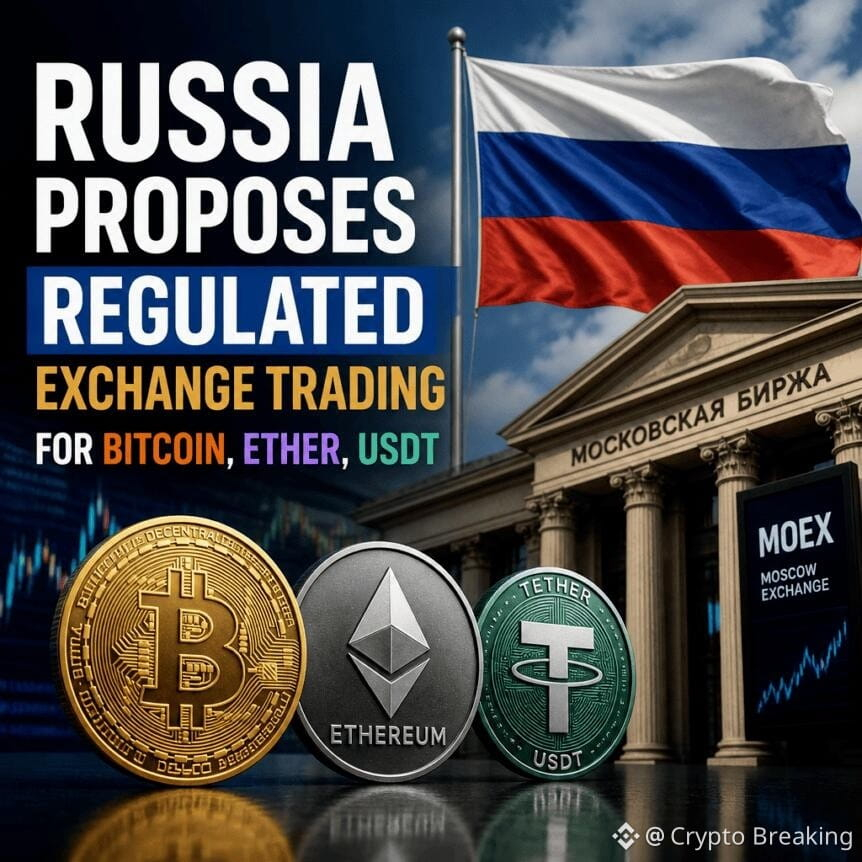
Russia’s central bank has drawn up a proposed shortlist of crypto assets that, if approved, could be eligible for trading on regulated platforms under the country’s newly enacted crypto framework. The regulator said the candidate assets include Bitcoin, Ether, and the stablecoin USDT.
The proposal is part of broader rules taking shape after President Vladimir Putin signed a law on Aug. 4 granting the Bank of Russia authority to decide which digital currencies may be admitted to “organized” trading and to set investor-access requirements. The central bank is now inviting public comments on the draft through Aug. 24.
Key takeaways
The Bank of Russia’s draft list names Bitcoin, Ether, and Tether’s USDT as potential candidates for admission to organized exchange trading.
Eligibility is tied to criteria such as market capitalization, average daily trading volume, and at least five years of price history on overseas markets.
New access rules would cap purchases for non-qualified investors at 300,000 Russian rubles (about $3,650) per year per intermediary, while qualified investors face no such limit.
All investors would need to complete a test and review crypto risk information before trading, regardless of their classification.
The regulator is accepting comments on the proposal until Aug. 24, meaning the draft could change before final rules are set.
Draft eligibility list: what assets could be admitted
In a statement Tuesday, the Bank of Russia said it has compiled a proposed set of crypto assets that could be allowed for public trading on exchanges under the incoming regulatory regime. The announcement, published on the regulator’s website, also specified that the assets must satisfy a number of benchmark conditions.
According to the central bank, those conditions include a requirement tied to market capitalization, average daily trading volume, and at least five years of price history on international markets. By emphasizing both scale and long-running market data, the approach appears designed to narrow eligibility toward more established assets rather than newer tokens.
Among the named candidates are Bitcoin and Ether—two of the most liquid and widely traded cryptocurrencies globally—as well as USDT, a stablecoin issued by Tether. The inclusion of a major stablecoin signals that the regulator’s framework is not limited strictly to volatile coins, at least at the eligibility stage.
Why the new law changes the regulator’s role
The draft list does not stand alone; it follows a shift in Russia’s regulatory structure created by federal law that took effect after being signed by Putin on Aug. 4. That law gives the Bank of Russia the power to determine which crypto assets can enter organized trading and to create the operating rules for that process.
Earlier reporting from Cointelegraph noted that the core rules were set to take effect in 2026 as part of the new legal framework. With the central bank now moving to propose an asset list and investor rules, the practical implementation of that authority is beginning to take shape.
For market participants, the key implication is that not all tokens may be treated equally under the same umbrella. The regulator’s criteria—and the fact that eligibility is decided by the central bank—introduces an additional layer of compliance and potentially affects which assets exchanges can list for retail access.
Investor access rules: limits, “qualified” status, and risk testing
Beyond which assets could trade, the Bank of Russia’s proposal also addresses who can buy and how much. Under the draft rules, non-qualified investors would be limited to purchasing up to 300,000 rubles per year (about $3,650) of cryptocurrency through each intermediary. Intermediaries explicitly referenced include brokers, crypto exchange services, and asset managers.
Qualified investors, by contrast, would not face purchase limits for crypto assets traded on exchanges or through over-the-counter markets. The distinction between “qualified” and “non-qualified” investors matters because it shapes the effective scale at which different classes of customers can participate.
Importantly, the Bank of Russia said the framework requires a pre-trade step for everyone. “Before making transactions, all investors, regardless of their status, will have to pass a test and familiarize themselves with the risks of investing in crypto assets,” the central bank stated.
This requirement is designed to apply across the board, potentially limiting impulsive participation by ensuring buyers demonstrate awareness of crypto risk—while still allowing higher-volume activity for those who qualify.
Regulator rationale and what to watch next
The central bank said the restrictions are intended to protect non-qualified investors from sharp and unpredictable crypto price fluctuations. The logic is straightforward: if retail access is permitted, the regulator wants guardrails to reduce the likelihood of outsized losses among less experienced participants.
Russia’s draft also signals where the regulator’s focus may be during implementation. First, asset eligibility appears to rely on objective market metrics and longevity, which may constrain the range of tokens available for public exchange trading. Second, investor limits and required testing could reshape the economics of retail trading—especially if intermediaries must build compliance processes around classification and risk education.
The proposal remains open for public comment until Aug. 24, so investors and industry participants should watch for any changes to the eligibility criteria, the list of assets, or the specifics of the investor test and qualification thresholds.
For now, the central development is clear: Russia’s crypto market is moving toward a regulated structure where both the tradable universe and retail access conditions are determined by the Bank of Russia. The next key moment will be how the regulator responds to feedback and finalizes the framework ahead of full implementation of the new law.
This article was originally published as Russia Proposes Regulated Exchange Trading for Bitcoin, Ether, USDT on Crypto Breaking News – your trusted source for crypto news, Bitcoin news, and blockchain updates.