
In the current Web3 landscape, the ultimate stamp of security has always been the third-party smart contract audit. Protocols spend hundreds of thousands of dollars to ensure their bytecode is free of logic flaws. Yet, we routinely witness audited, multi-million-dollar vaults drained in a matter of blocks.
The structural flaw isn't necessarily the quality of the audits; it is their static nature. An audit is a snapshot of code in a vacuum. It cannot predict dynamic economic anomalies, flash-loan-induced oracle manipulations, or the erratic mempool behaviors of high-velocity capital.
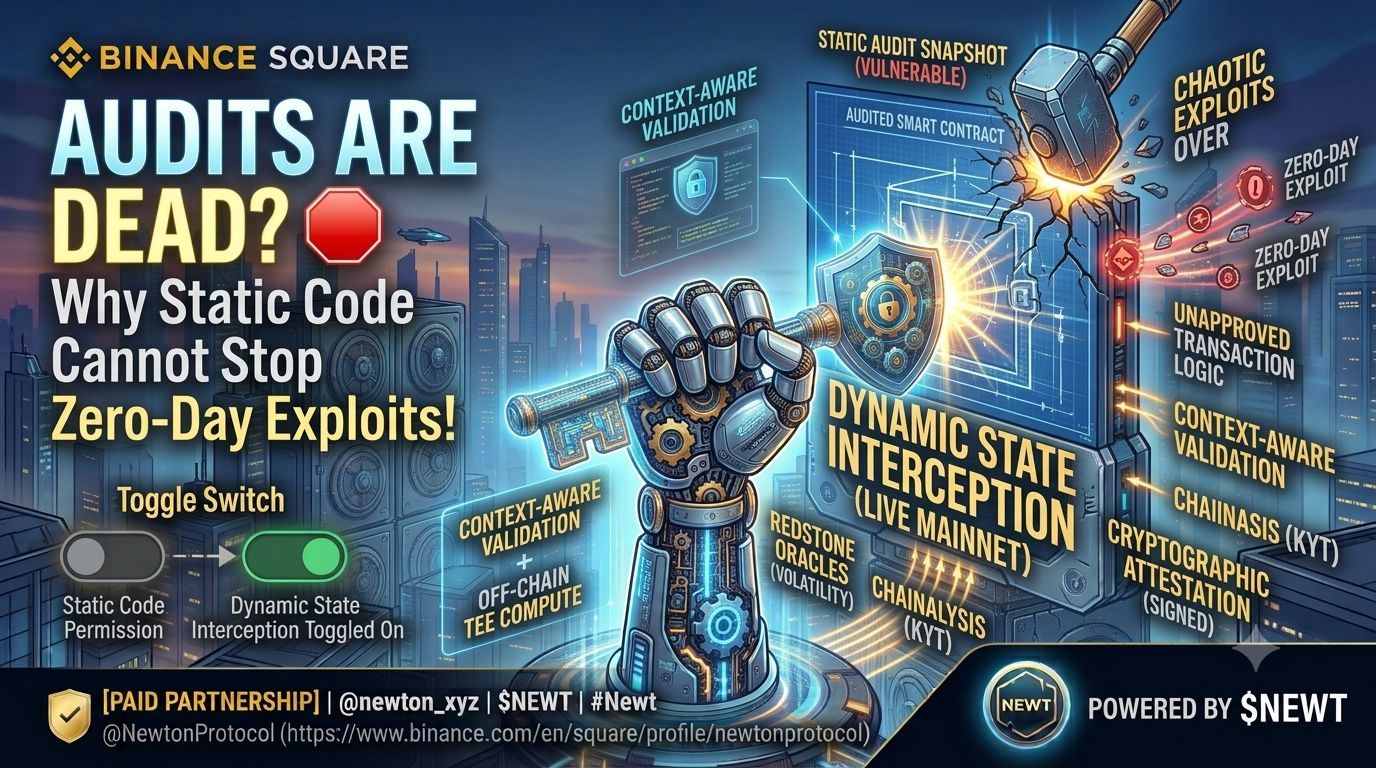
With the launch of the Newton Mainnet Beta on Ethereum and Base, the conversation is shifting from static code verification to Dynamic State Interception. Through its developer framework, Newton VaultKit, the network introduces a primitive that evaluates transactions based on real-time systemic context, rather than just code permissions.
Moving Beyond "Allowed" to "Contextually Safe"
Traditional blockchain execution is binary: if a transaction has the correct cryptographic signature and doesn't explicitly break a hardcoded smart contract rule, it executes.
Newton’s active authorization layer adds a crucial conditional step. It asks a deeper question before state commitment occurs: “Given the current market volatility, oracle health, and counterparty risk, should this transaction be allowed to settle right now?”
[Transaction Initiated]
│
▼
[Legacy Chain]: Meets Code Rules? ──► YES ──► [Exploit Settles / Capital Drained]
│
▼
[Newton VaultKit Toggled On]: Meets Real-Time Context?
├──► NO ──► [Transaction Intercepted & Voided Upstream]
└──► YES ──► [Cryptographic Receipt Signed ──► Safe Settlement]
By deploying modular sandboxes around high-value capital pools, VaultKit allows curators to write dynamic compliance-as-code policies. These policies constantly digest live threat and risk vectors from data stalwarts like RedStone Oracles, Chainalysis, and Hexagate. If an automated exploit attempt relies on an artificial oracle spike to drain a vault, Newton intercepts and blocks the execution upstream before it ever commits to the ledger.
The Cryptographic Engine: TEEs and Shared Security
Executing complex, context-aware policy checks instantly during a transaction lifecycle usually introduces massive gas overhead and latency. Newton resolves this bottleneck through an off-chain, cryptographically secure compute matrix.
The logic engine runs entirely inside isolated Trusted Execution Environments (TEEs). These hardware-secured enclaves process the transaction intents and real-time data feeds in absolute privacy and at hardware speeds. To ensure this off-chain processing remains entirely decentralized and permissionless, the entire network operates as an EigenLayer Actively Validated Service (AVS).
Every successful context validation produces a signed cryptographic attestation. This receipt acts as a mandatory green light that the underlying smart contract requires before it alters its on-chain state.
Hardcoding the Economic Utility of $NEWT
This decentralized coordination matrix is kept economically aligned by the $NEWT token. Rather than functioning as a speculative asset, $NEWT is embedded into the plumbing of every state interception cycle:
* Node Validation Staking: TEE operators must stake Newton to participate in the EigenLayer AVS validation pool, aligning their economic incentives with network accuracy.
* Dynamic Condition Processing: Running complex, multi-variable policy checks requires compute resources, which are fueled via permission handling fees paid in $NEWT .
* Systemic Risk Collateral: Advanced autonomous agent operators pool Newton as backing collateral, creating an economic cushion against unpredictable execution loops.
Static security models are proving insufficient for an ecosystem increasingly driven by automated institutional vaults and fast-moving AI agents. By introducing an active layer capable of intercepting threats at the zero-hour, the Mainnet Beta is building the practical framework required for a resilient, risk-mitigated DeFi landscape.
To follow the official rollout and updates, check out the core hub: @NewtonProtocol