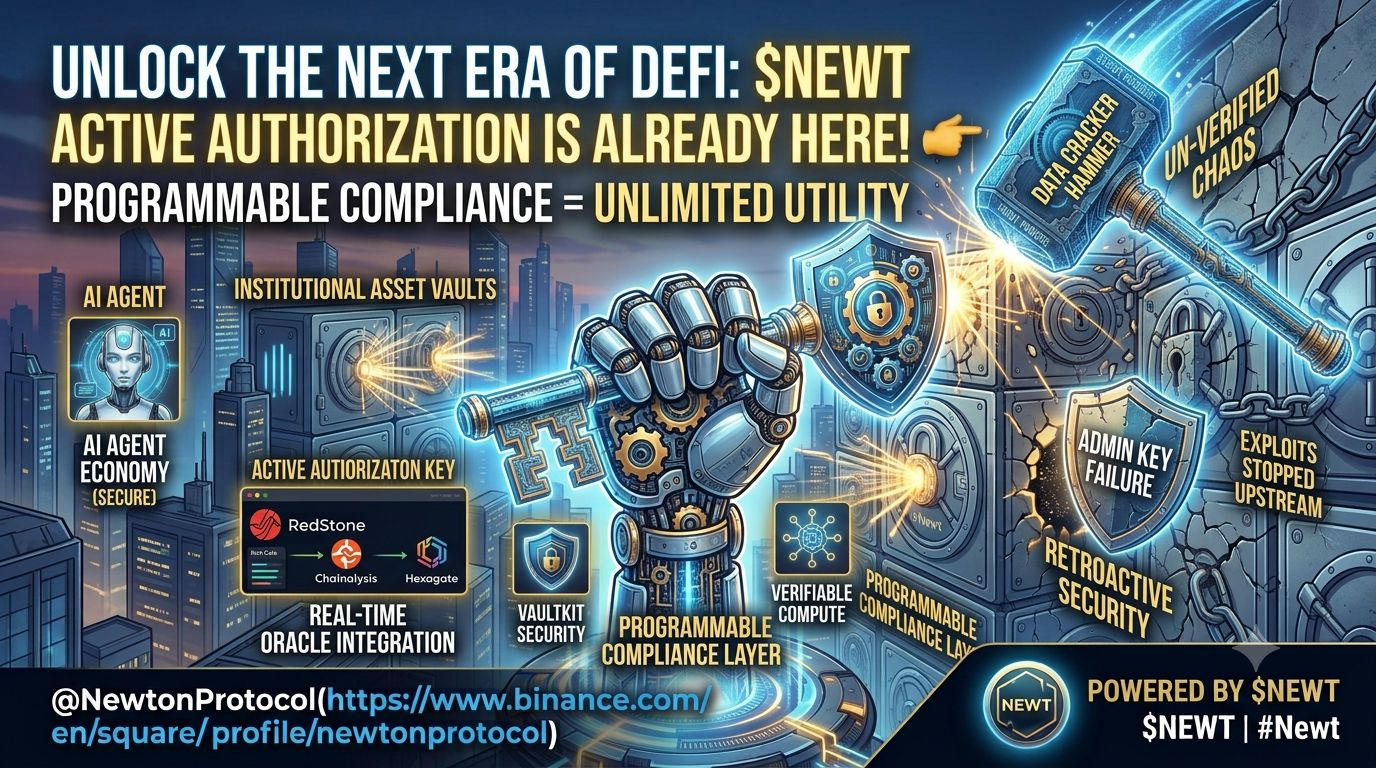

Most discussions surrounding infrastructure upgrades focus entirely on execution speed, gas optimization, or cross-chain liquidity bridging. While vital, these parameters ignore a fundamental architecture problem that has plagued decentralized finance from day one: the complete lack of an active on-chain authorization layer.
Currently, when capital interacts with a smart contract, the system assumes full permission unless explicitly halted by a hardcoded rule or a manual administrative key. If a manager key is compromised, or an autonomous agent exhibits erratic logic, the transaction settles anyway. This is the structural gap that @NewtonProtocol aims to solve through its recently deployed Newton Mainnet Beta.
Instead of attempting to build another isolated blockchain ecosystem, the team is introducing a programmable compliance framework upstream. By leveraging Trusted Execution Environments (TEEs), it allows developers to build verifiable "constraint boxes" directly into their transaction pipelines.
Beyond the Alpha: The Practicality of Newton VaultKit
The real-world validation of this infrastructure isn't just theoretical; it is actively rolling out via Newton VaultKit across major networks like Base and Ethereum.
Take their initial integrations with modular credit ecosystems like Euler. Historically, depositing into a managed lending vault required complete trust in the curator’s human judgment or internal security. If a curator made an unexpected asset reallocation or fell victim to a phishing exploit, the capital was exposed.
With VaultKit, the nature of that trust changes. A vault operator can program rigid policy boundaries—such as integrating real-time risk data streams from oracles like RedStone or compliance verifiers like Chainalysis and Hexagate. If a transaction attempts to breach those predefined rules, the Newton active authorization layer halts it before execution. The curator still retains the flexibility to write the rules, but Newton automatically enforces them on-chain.
Building the Core Utilities of $NEWT
At the center of this authorization economy sits the native token, $NEWT . For an on-chain authorization layer to stay decentralized, the compute nodes verifying transaction intent inside TEEs must be securely coordinated, incentivized, and governed. As more protocols implement VaultKit to protect institutional capital, manage complex AI agent behavior, or guard multi-asset lending pools, the underlying demand for verifiable network compute scales directly alongside it.
The Mainnet Beta phase marks a critical shift from "the technology exists" to "the technology is actively running under real vaults." Watching how fluidly developers and risk curators adopt this programmable constraint layer will likely outline the next era of secure, automated Web3 infrastructure.