
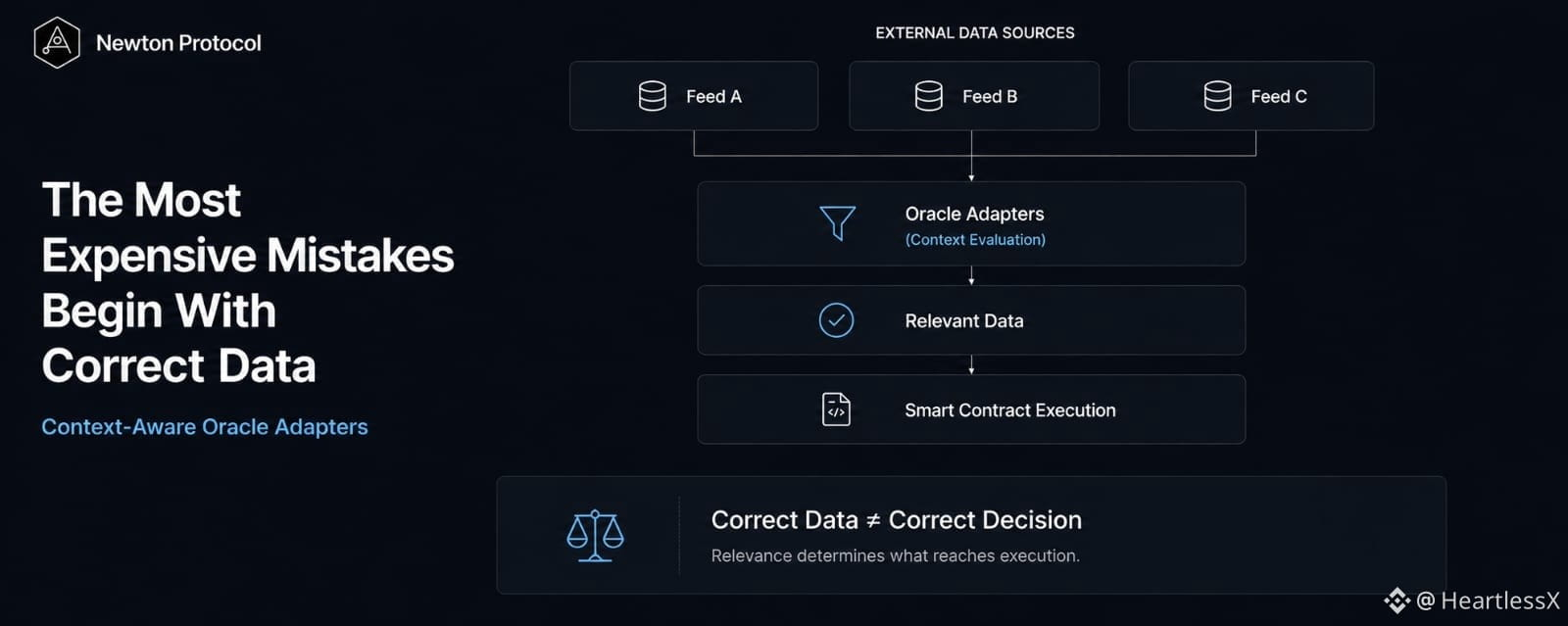

One assumption kept breaking every time I looked at autonomous systems. We spend so much time asking whether information is correct that we rarely stop to ask a second question: should this information influence the decision at all? Those aren't the same problem. Some of the most expensive failures begin with data that's completely accurate.
That changed how I read Newton's documentation. Its Oracle Adapters don't treat every external signal as equally valuable. Instead, relevance becomes part of the infrastructure before execution. The feature itself wasn't what stayed with me. It was the idea that deciding what matters could become infrastructure instead of another responsibility for every developer.
The comparison that kept coming back to me was film editing. A director might record forty hours of perfectly valid footage, yet only two hours make it into the final movie. The missing thirty-eight hours aren't wrong. They're simply not the right scenes for that story. I think autonomous systems face the same challenge. Collecting more information is relatively easy. Deciding what deserves a place inside a decision is where the real engineering begins.
That shifted how I think about oracle infrastructure. Data keeps getting cheaper to collect. Relevance doesn't. Collecting information scales with hardware. Deciding what deserves attention scales with judgment. The protocols creating the most value may not be the ones gathering the most data. They may be the ones preventing unnecessary information from ever shaping a decision.
Good infrastructure isn't defined by everything it includes. It's defined by everything it refuses to let influence a decision.
Source: Newton Protocol Documentation (Oracle Adapters). Not financial advice. DYOR. @NewtonProtocol #Newt $NEWT