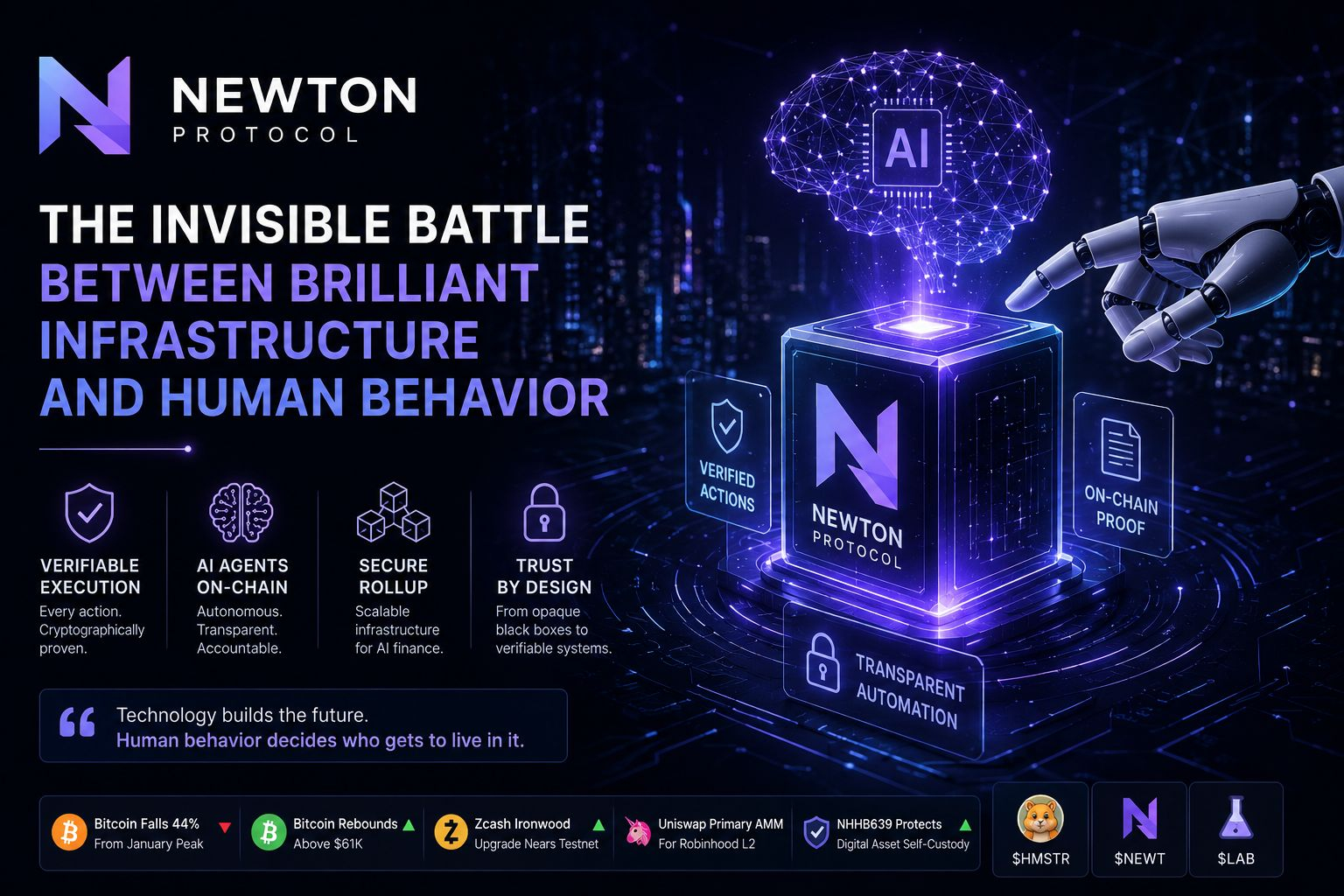
🚨 Every time I revisit Newton Protocol, I end up asking the same question—not about cryptography, rollups, or AI agents, but about people.
Will users change their behavior simply because a better technology exists?
That question may determine Newton's future more than any technical milestone.
The protocol is built around a compelling vision: AI agents that can perform on-chain actions while every decision remains verifiable through transparent, cryptographic guarantees. In theory, this removes much of the blind trust that exists in today's automated financial tools.
It's a powerful concept.
But history reminds us that technology rarely succeeds because it's technically superior. It succeeds when it solves a problem people already feel.
Today, most crypto users already have access to trading bots, portfolio automation, and AI-powered assistants. They may rely on centralized platforms, but those services are familiar, fast, and easy to use. For many people, convenience outweighs architectural purity.
That's where Newton faces its biggest hurdle.
The protocol isn't just introducing another automation platform—it is introducing a new standard for accountability.
Automation asks:
"Can software do this for me?"
Newton asks something different:
"Can I verify every action the software takes?"
That distinction may not matter to every retail trader, but it could become increasingly valuable for institutions, treasury managers, regulated businesses, and anyone responsible for large pools of capital. As AI begins making financial decisions, proving why an action happened may become just as important as the action itself.
Still, better security doesn't automatically create demand.
Security is often invisible when everything works correctly. Most users only appreciate stronger guarantees after experiencing a costly mistake, a hacked account, or an unexpected loss. Until then, additional protection can feel like unnecessary complexity.
Newton is therefore betting on something larger than blockchain.
It is betting that financial AI will become common enough that verifiable execution shifts from a premium feature to a basic expectation.
Another important reality is that decentralization never completely removes trust—it changes where trust lives.
Instead of trusting a centralized company, users place confidence in open rules, validators, governance mechanisms, and transparent economic incentives. Newton extends that philosophy to AI by making autonomous actions observable rather than opaque.
That doesn't eliminate trust.
It makes trust easier to inspect.
Timing may ultimately be the deciding factor.
Many transformative technologies arrived before the market recognized their value. Cloud computing, smartphones, and digital payments all spent years looking unnecessary before becoming essential infrastructure.
Newton could follow a similar path.
If AI agents evolve into everyday financial participants, protocols that verify their behavior may become critical infrastructure rather than optional upgrades.
If adoption moves more slowly, Newton may spend years building for a future that hasn't fully arrived.
Infrastructure projects have always lived with this uncertainty.
The strongest foundations often receive the least attention—until an entire ecosystem begins depending on them.
In the long run, Newton won't be judged by the sophistication of its architecture alone. Its success will depend on whether developers continue building applications, whether users trust AI with increasingly valuable assets, and whether real economic activity grows without relying solely on speculative excitement.
Those outcomes cannot be engineered directly.
They emerge from adoption.
Perhaps that's the most interesting lesson behind Newton Protocol.
The biggest experiment isn't whether AI can automate finance.
It's whether people are ready to trust verifiable AI enough to change the way they interact with money.
Technology creates possibilities.
Human behavior determines which possibilities become reality.
#Crypto #blockchain #DeFi #Newt $NEWT