
MiSHI_ Khan
2.1k منشورات

MiSHI_ Khan
Trading Small , Scalping , Spot Holder, X: @mishi_write1 My Thinking My attitude
مُتداول بمُعدّل مرتفع
10.4 أشهر
66 تتابع
1.2K+ المتابعون
1.2K+ إعجاب
منشورات
الكل
Live
$SOL / USDT crypto
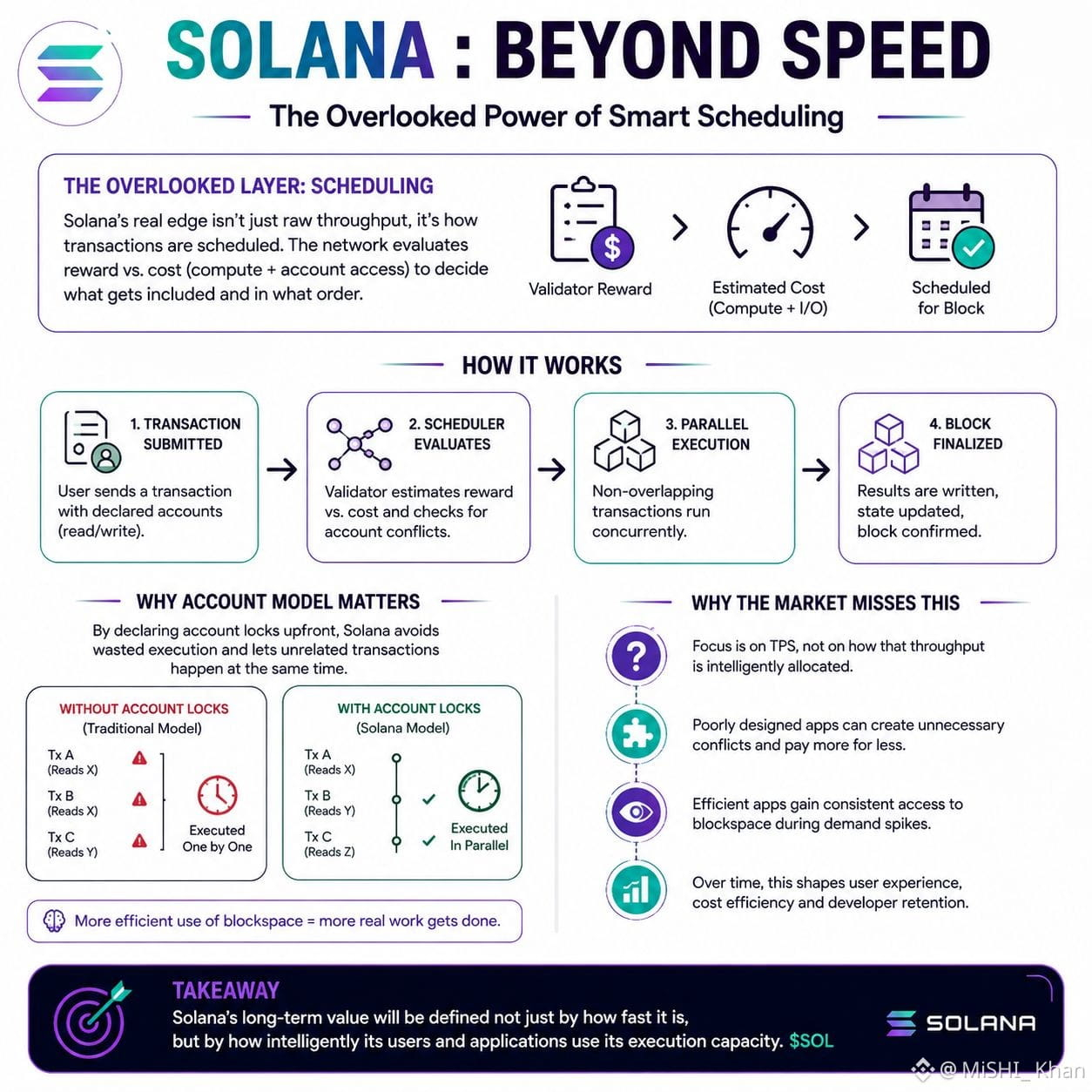
Most SOL discussions start with throughput. Scheduling: the overlooked layer.
On Solana, priority is not simply “pay more, go first.” The scheduler weighs validator reward against estimated transaction cost, including write locks, execution and loaded account data. Application design can affect how efficiently block capacity is used.
Solana transactions declare which accounts they read and write, allowing non-overlapping work to run concurrently. Apps shape how execution resources are allocated.
Users rarely see this layer. But when demand competes for blockspace, efficient transaction design can become an advantage.
My takeaway: SOL’s long-term value may depend not only on attracting activity, but on how intelligently that activity uses Solana’s execution capacity.
#solana #SOL空投
Most SOL discussions start with throughput. Scheduling: the overlooked layer.
On Solana, priority is not simply “pay more, go first.” The scheduler weighs validator reward against estimated transaction cost, including write locks, execution and loaded account data. Application design can affect how efficiently block capacity is used.
Solana transactions declare which accounts they read and write, allowing non-overlapping work to run concurrently. Apps shape how execution resources are allocated.
Users rarely see this layer. But when demand competes for blockspace, efficient transaction design can become an advantage.
My takeaway: SOL’s long-term value may depend not only on attracting activity, but on how intelligently that activity uses Solana’s execution capacity.
#solana #SOL空投
تمّ التحقق
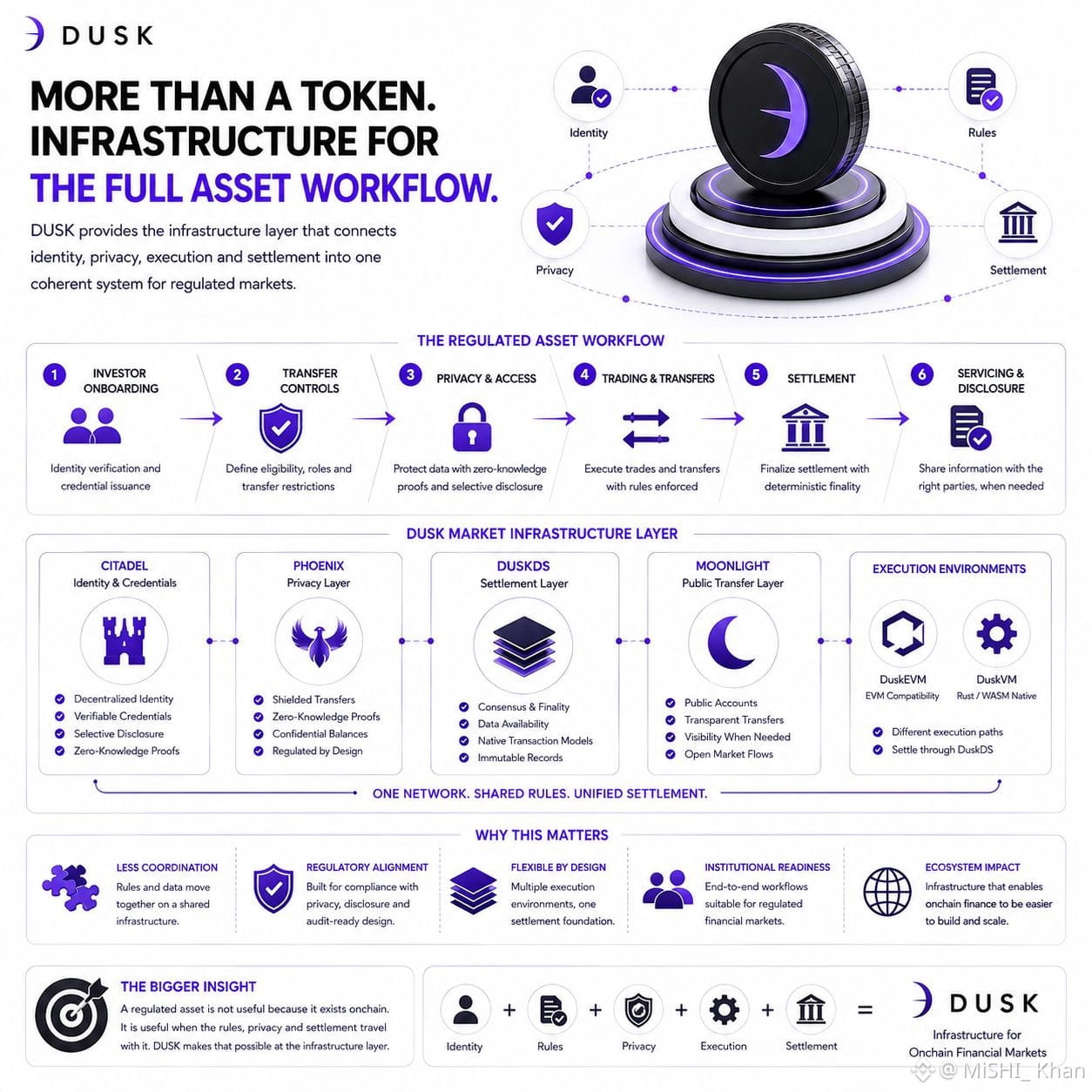
@DuskFoundation sits below the usual privacy narrative: its market infrastructure is designed around the full asset workflow, not the token. Dusk maps that workflow from investor onboarding and transfer controls to trading, settlement, servicing and selective disclosure.
Citadel provides identity and credential primitives with selective disclosure. Phoenix supports shielded transfers, while Moonlight provides public account-based transfers. DuskDS supplies consensus, finality, data availability and native transaction models. DuskEVM and DuskVM give builders execution paths while settling through DuskDS.
Why does this matter? A regulated asset is not useful because it exists onchain. The rules must travel with it: who can access it, who can transfer it, what information can be shared, and how settlement is finalized. DUSK treats those rules as part of the infrastructure. That could reduce coordination pushed into separate systems. It could make workflows easier to coordinate on-chain.
#dusk $DUSK @Dusk
Citadel provides identity and credential primitives with selective disclosure. Phoenix supports shielded transfers, while Moonlight provides public account-based transfers. DuskDS supplies consensus, finality, data availability and native transaction models. DuskEVM and DuskVM give builders execution paths while settling through DuskDS.
Why does this matter? A regulated asset is not useful because it exists onchain. The rules must travel with it: who can access it, who can transfer it, what information can be shared, and how settlement is finalized. DUSK treats those rules as part of the infrastructure. That could reduce coordination pushed into separate systems. It could make workflows easier to coordinate on-chain.
#dusk $DUSK @Dusk
تمّ التحقق
You’re watching DUSK, but have you considered what happens when the market stops valuing it as a privacy coin and starts valuing it as financial infrastructure?
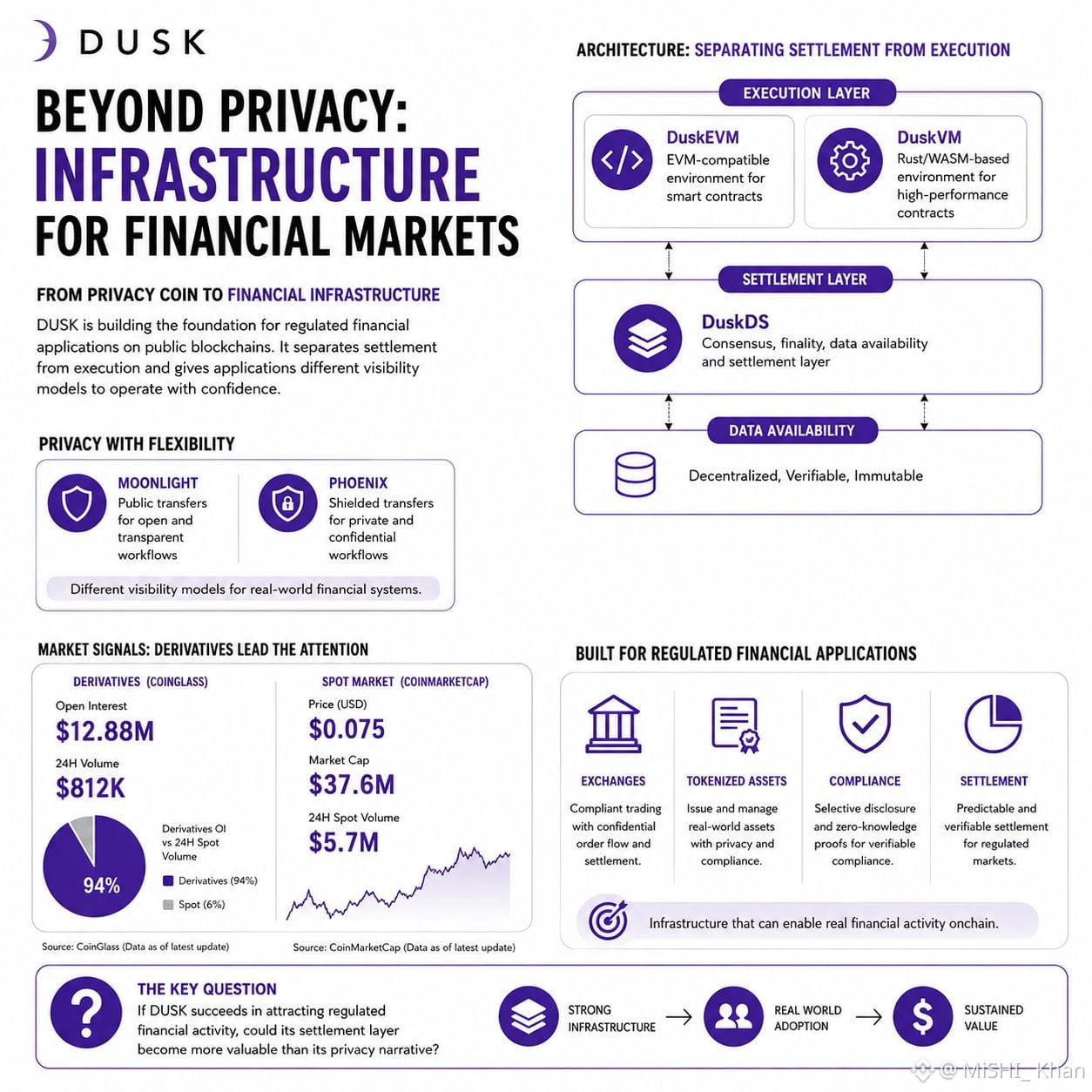
When I analyzed DUSK again, I noticed the stronger angle is not simply confidential transfers. Its architecture separates settlement from execution: DuskDS provides consensus, finality, data availability and settlement, while DuskEVM and DuskVM handle different application needs. That separation could be useful for regulated markets, where an exchange, asset issuer, or financial application may need predictable settlement without forcing every workload into the same execution environment.
The privacy design adds another layer. DUSK supports Moonlight for public transfers and Phoenix for shielded transfers, giving applications different visibility models instead of treating privacy as an all-or-nothing switch. That feels closer to how real financial systems operate.
There is also a market signal worth watching. CoinGlass currently shows DUSK futures open interest around $12.88 million, while its displayed spot volume is about $812,000 over 24 hours. That imbalance tells me derivatives are attracting meaningful attention relative to spot activity. For traders, it means price moves can be influenced heavily by positioning rather than genuine network demand.
CoinMarketCap currently shows DUSK near $0.075. At this stage, I think the important question is whether infrastructure usage can eventually become the driver behind liquidity, rather than speculation alone.
That is what I would monitor before assuming breakouts have staying power. If DUSK succeeds in attracting regulated financial activity, could its settlement layer become more valuable than its privacy narrative?
#dusk $DUSK @Dusk
When I analyzed DUSK again, I noticed the stronger angle is not simply confidential transfers. Its architecture separates settlement from execution: DuskDS provides consensus, finality, data availability and settlement, while DuskEVM and DuskVM handle different application needs. That separation could be useful for regulated markets, where an exchange, asset issuer, or financial application may need predictable settlement without forcing every workload into the same execution environment.
The privacy design adds another layer. DUSK supports Moonlight for public transfers and Phoenix for shielded transfers, giving applications different visibility models instead of treating privacy as an all-or-nothing switch. That feels closer to how real financial systems operate.
There is also a market signal worth watching. CoinGlass currently shows DUSK futures open interest around $12.88 million, while its displayed spot volume is about $812,000 over 24 hours. That imbalance tells me derivatives are attracting meaningful attention relative to spot activity. For traders, it means price moves can be influenced heavily by positioning rather than genuine network demand.
CoinMarketCap currently shows DUSK near $0.075. At this stage, I think the important question is whether infrastructure usage can eventually become the driver behind liquidity, rather than speculation alone.
That is what I would monitor before assuming breakouts have staying power. If DUSK succeeds in attracting regulated financial activity, could its settlement layer become more valuable than its privacy narrative?
#dusk $DUSK @Dusk
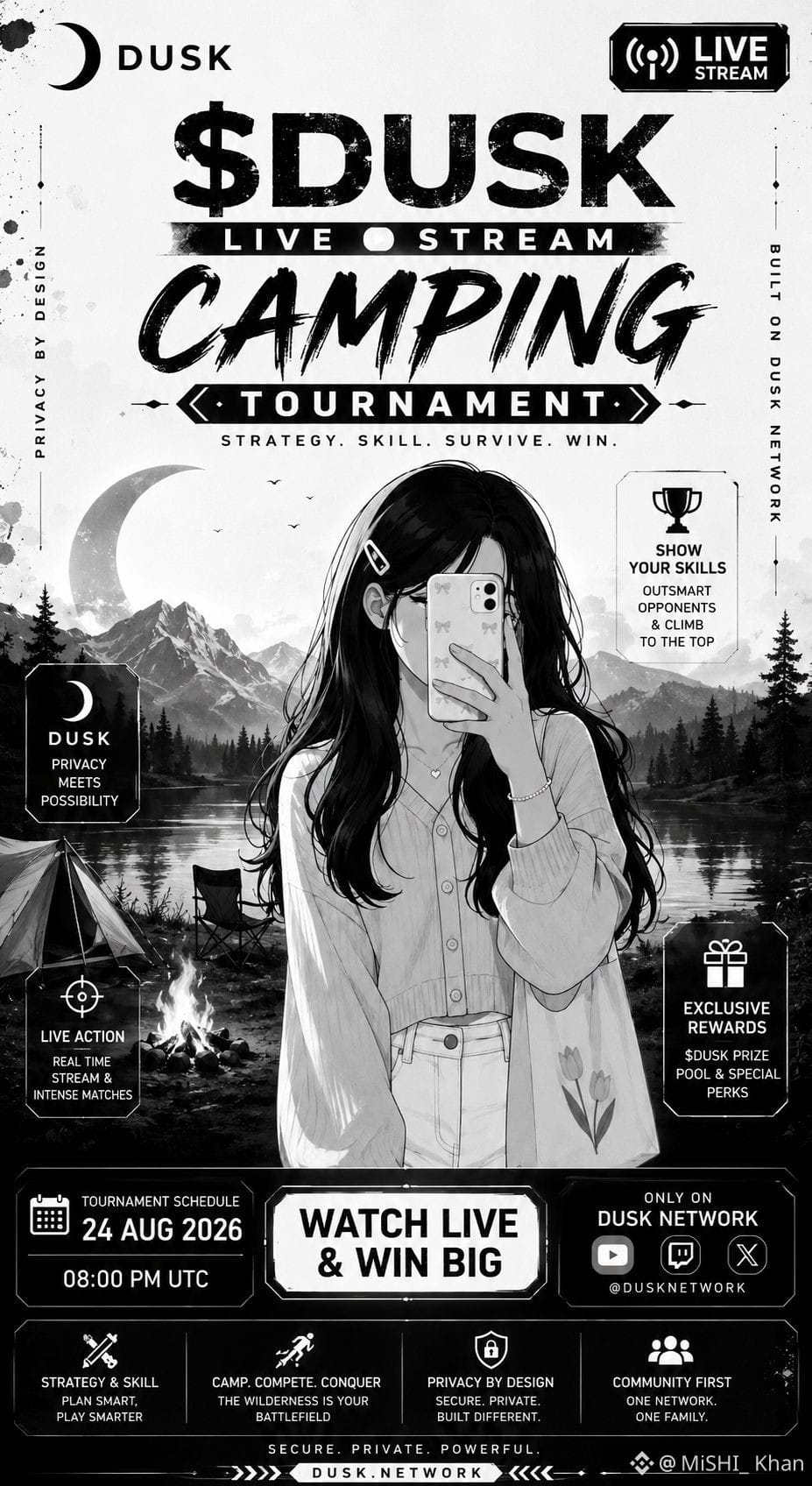
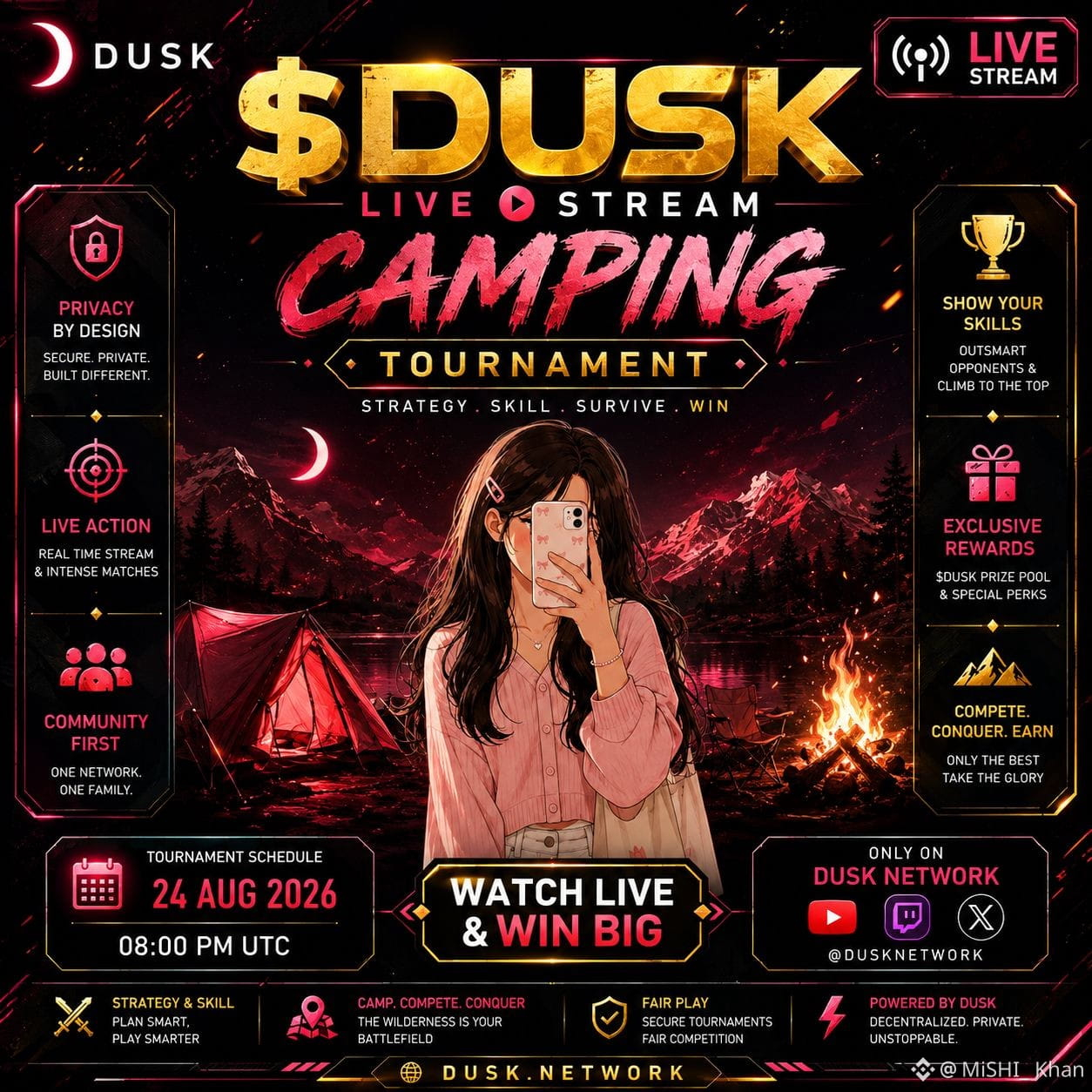
The image makes $DUSK look like a competition network, but the more interesting story is what happens when privacy becomes part of the game’s infrastructure.
A live tournament is built around public action, yet the systems behind participation can involve identity, rewards, transactions, and sensitive information. That creates an interesting design challenge: how do you keep the experience transparent enough to trust without making every detail public?
That is where I see a deeper angle in DUSK.
Privacy does not have to mean hiding everything. It can mean deciding what should remain private, what can be verified, and what can be disclosed when necessary.
For me, that makes DUSK less about a “privacy blockchain” label and more about controlled coordination.
As more real-world activity moves onchain, that distinction could become increasingly important.
The strongest privacy infrastructure may be the kind users barely notice because it simply makes participation safer and more practical.
#livetardinghub #Dusk/usdt✅
A live tournament is built around public action, yet the systems behind participation can involve identity, rewards, transactions, and sensitive information. That creates an interesting design challenge: how do you keep the experience transparent enough to trust without making every detail public?
That is where I see a deeper angle in DUSK.
Privacy does not have to mean hiding everything. It can mean deciding what should remain private, what can be verified, and what can be disclosed when necessary.
For me, that makes DUSK less about a “privacy blockchain” label and more about controlled coordination.
As more real-world activity moves onchain, that distinction could become increasingly important.
The strongest privacy infrastructure may be the kind users barely notice because it simply makes participation safer and more practical.
#livetardinghub #Dusk/usdt✅
تمّ التحقق
Traders, if you are looking at DUSK only because of its privacy story, I think you may be missing a bigger point.
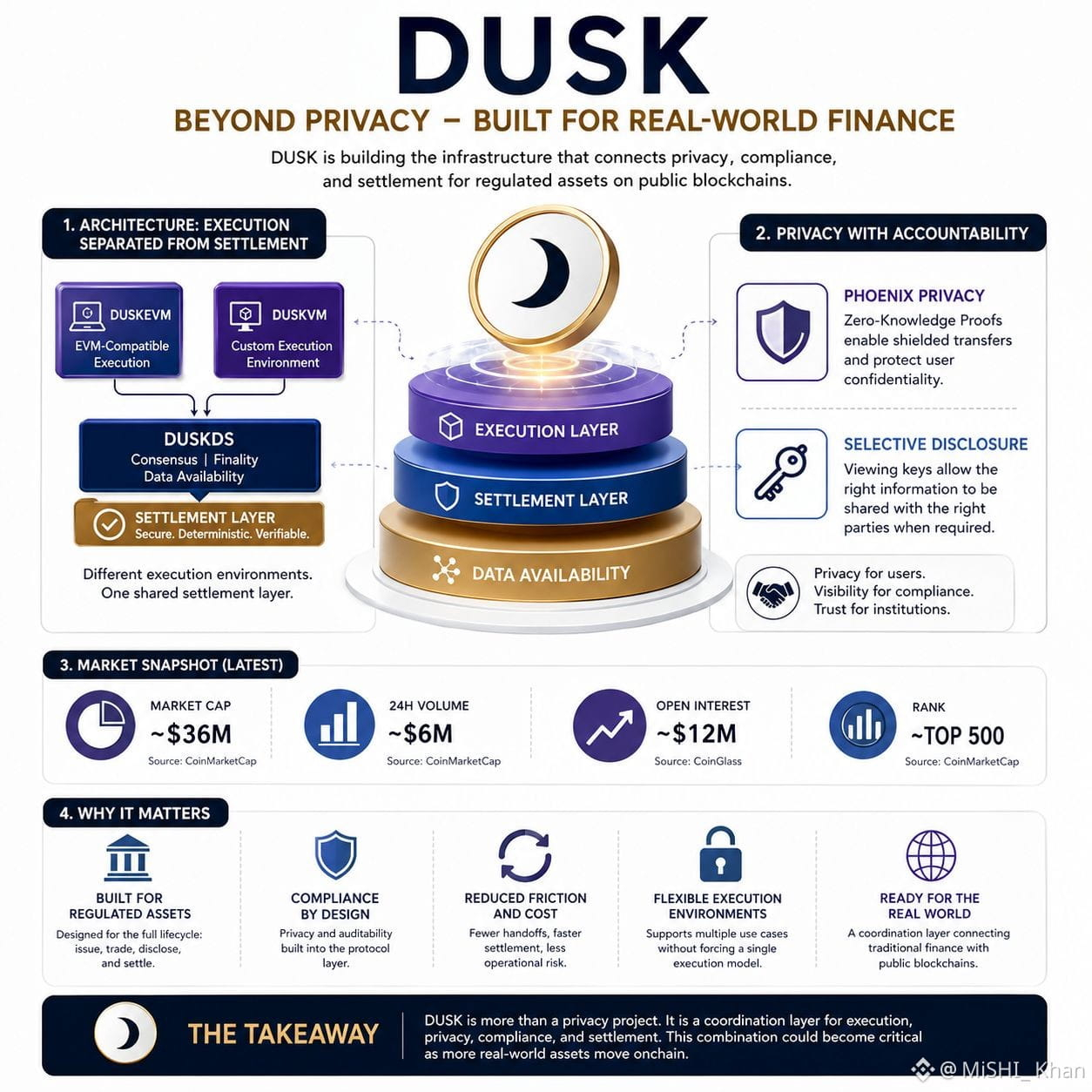
I checked @Duskfoundation’s recent updates, the whitepaper, and market data. The part that stood out to me was how DUSK separates execution from settlement. DuskDS handles consensus, finality, and data availability, while DuskEVM and DuskVM can support different execution needs. For regulated assets, this could be useful because every application does not have to use the exact same execution environment.
The privacy model is also more than simply hiding everything. Phoenix uses zero-knowledge proofs for shielded transfers, while viewing keys can support selective disclosure. In simple terms, DUSK is trying to keep sensitive information private while still allowing the right information to be verified when needed.
The market data is interesting too. CoinMarketCap has recently shown DUSK with a market cap around the tens of millions of dollars and daily trading volume in the millions, while CoinGlass has shown futures open interest in the low tens of millions. To me, this means short-term price moves can be strongly affected by derivatives activity, not just by the project’s fundamentals.
That distinction could become important if more real-world financial assets move onto public blockchain infrastructure.
My main takeaway is simple: DUSK may be bigger than a privacy narrative. Its real value could come from coordinating execution, privacy, compliance, and settlement for regulated assets.
What do you think is DUSK’s biggest advantage: privacy, or the way it separates execution from settlement?
#dusk $DUSK @Dusk
I checked @Duskfoundation’s recent updates, the whitepaper, and market data. The part that stood out to me was how DUSK separates execution from settlement. DuskDS handles consensus, finality, and data availability, while DuskEVM and DuskVM can support different execution needs. For regulated assets, this could be useful because every application does not have to use the exact same execution environment.
The privacy model is also more than simply hiding everything. Phoenix uses zero-knowledge proofs for shielded transfers, while viewing keys can support selective disclosure. In simple terms, DUSK is trying to keep sensitive information private while still allowing the right information to be verified when needed.
The market data is interesting too. CoinMarketCap has recently shown DUSK with a market cap around the tens of millions of dollars and daily trading volume in the millions, while CoinGlass has shown futures open interest in the low tens of millions. To me, this means short-term price moves can be strongly affected by derivatives activity, not just by the project’s fundamentals.
That distinction could become important if more real-world financial assets move onto public blockchain infrastructure.
My main takeaway is simple: DUSK may be bigger than a privacy narrative. Its real value could come from coordinating execution, privacy, compliance, and settlement for regulated assets.
What do you think is DUSK’s biggest advantage: privacy, or the way it separates execution from settlement?
#dusk $DUSK @Dusk
تداول لمدة 30 يومًا $DUSK 189.4 USDT
One angle on DUSK that gets less attention: the value of predictable privacy increases as onchain markets become more complex. @Dusk
When financial applications involve multiple participants, revealing every position, transaction detail, or strategy publicly can create unnecessary information leakage. Yet completely private systems create another problem: counterparties and regulators still need meaningful evidence.
DUSK is interesting because it approaches this as a coordination problem. The goal is not simply to make activity invisible, but to create a framework where sensitive information can remain protected while the right facts can still be verified or disclosed when required.
That changes how I view the network.
The real opportunity may sit between two extremes: total transparency and total secrecy.
If blockchain infrastructure can make that middle ground practical, privacy stops being a niche feature and becomes part of the settlement architecture itself.
That is the layer I would watch around DUSK.
#livetrading $DUSK #livestremDusk
When financial applications involve multiple participants, revealing every position, transaction detail, or strategy publicly can create unnecessary information leakage. Yet completely private systems create another problem: counterparties and regulators still need meaningful evidence.
DUSK is interesting because it approaches this as a coordination problem. The goal is not simply to make activity invisible, but to create a framework where sensitive information can remain protected while the right facts can still be verified or disclosed when required.
That changes how I view the network.
The real opportunity may sit between two extremes: total transparency and total secrecy.
If blockchain infrastructure can make that middle ground practical, privacy stops being a niche feature and becomes part of the settlement architecture itself.
That is the layer I would watch around DUSK.
#livetrading $DUSK #livestremDusk
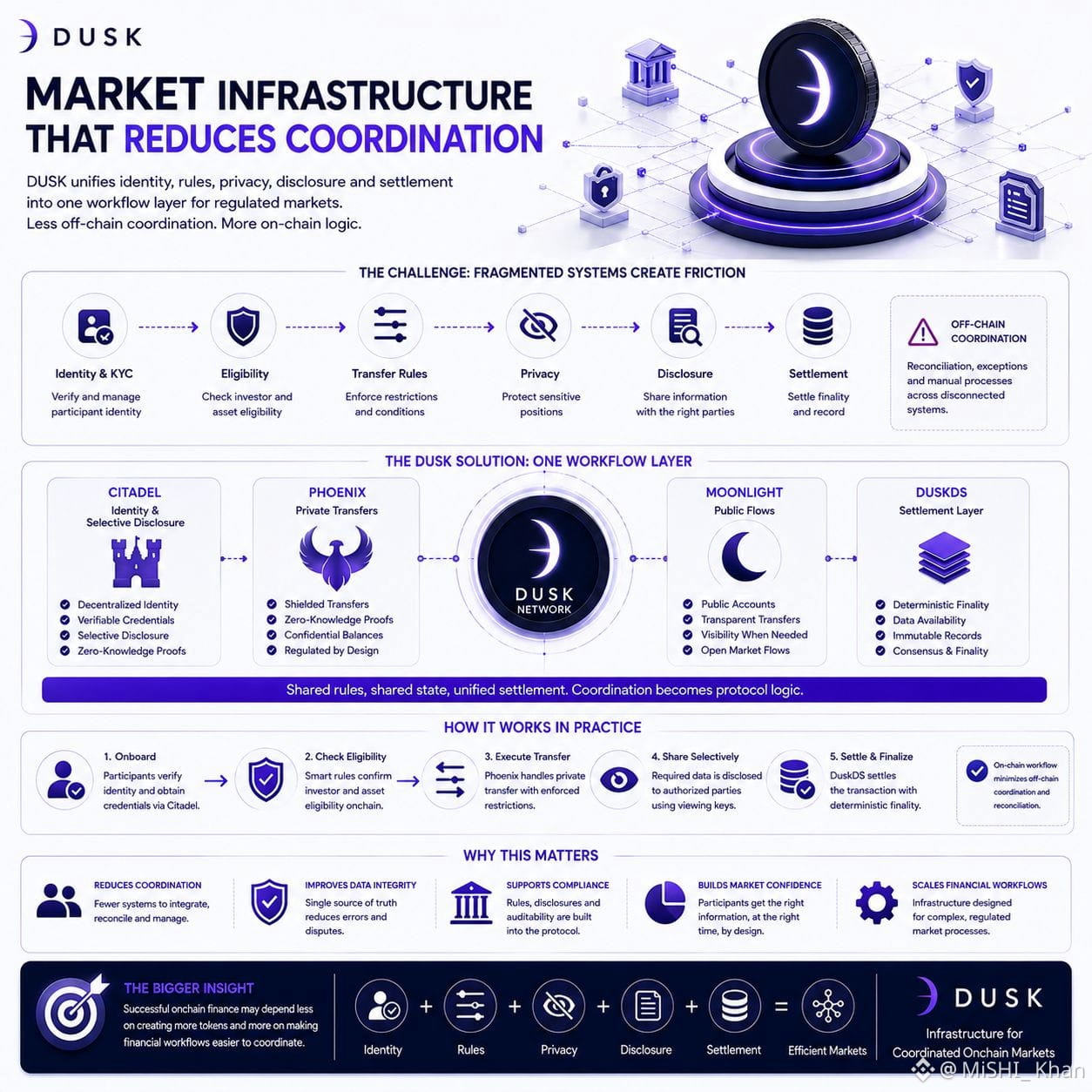
@DuskFoundation is worth studying because market infrastructure can truly reduce coordination outside the blockchain. Tokenization is usually framed as putting an asset onchain, but regulated markets involve identity, eligibility, transfer rules, privacy, disclosure and settlement.
Dusk brings these pieces into a common workflow. Citadel provides identity and selective-disclosure primitives; Phoenix supports shielded transfers with zero-knowledge proofs; Moonlight offers open public flows; and DuskDS provides the settlement foundation.
The important part is how these components interact. If each function lives in a separate system, participants must reconcile records and manage exceptions between them. If rules and transaction states can be enforced on shared infrastructure, some coordination can become protocol logic.
That could matter beyond DUSK itself: successful onchain finance may depend less on creating more tokens and more on making financial workflows easier to coordinate!
#dusk $DUSK @Dusk
Dusk brings these pieces into a common workflow. Citadel provides identity and selective-disclosure primitives; Phoenix supports shielded transfers with zero-knowledge proofs; Moonlight offers open public flows; and DuskDS provides the settlement foundation.
The important part is how these components interact. If each function lives in a separate system, participants must reconcile records and manage exceptions between them. If rules and transaction states can be enforced on shared infrastructure, some coordination can become protocol logic.
That could matter beyond DUSK itself: successful onchain finance may depend less on creating more tokens and more on making financial workflows easier to coordinate!
#dusk $DUSK @Dusk
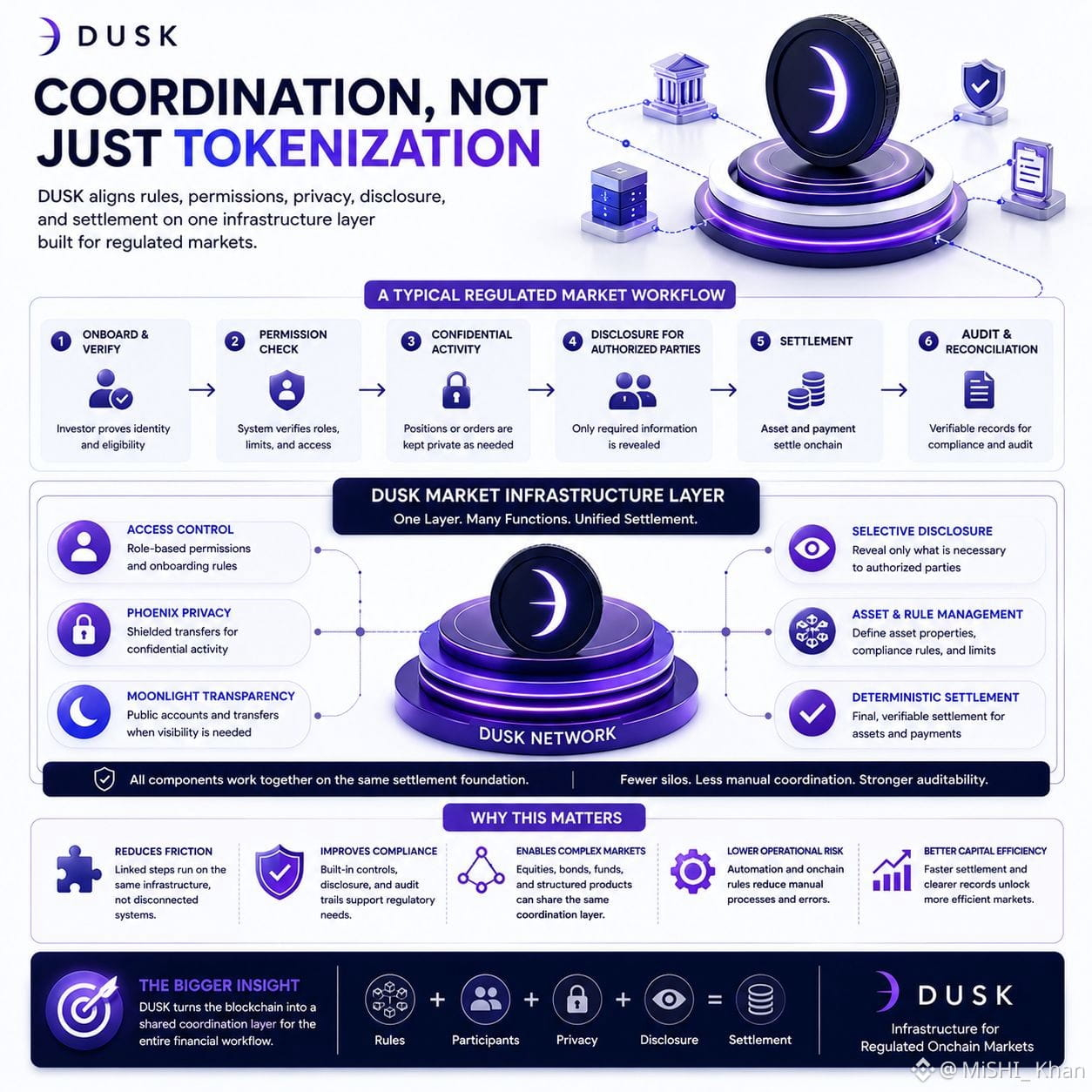
One overlooked DUSK idea is that regulated markets need coordination, not just tokenization. Dusk’s market-infrastructure design puts asset rules, participant permissions, privacy, disclosure and settlement around the same base layer.
The reason is simple: workflows have linked steps. An investor may need to prove eligibility, an issuer may need visibility, and a payment leg may need to settle with an asset. If each function sits in a separate system, reconciliation and off-chain coordination become part of the process.
DUSK provides access control, Phoenix shielded transfers, Moonlight public flows, selective disclosure and deterministic settlement. The deeper insight is that the blockchain becomes a shared coordination layer for the workflow, not merely a ledger for the final transfer.
#dusk $DUSK @Dusk
The reason is simple: workflows have linked steps. An investor may need to prove eligibility, an issuer may need visibility, and a payment leg may need to settle with an asset. If each function sits in a separate system, reconciliation and off-chain coordination become part of the process.
DUSK provides access control, Phoenix shielded transfers, Moonlight public flows, selective disclosure and deterministic settlement. The deeper insight is that the blockchain becomes a shared coordination layer for the workflow, not merely a ledger for the final transfer.
#dusk $DUSK @Dusk
تمّ التحقق
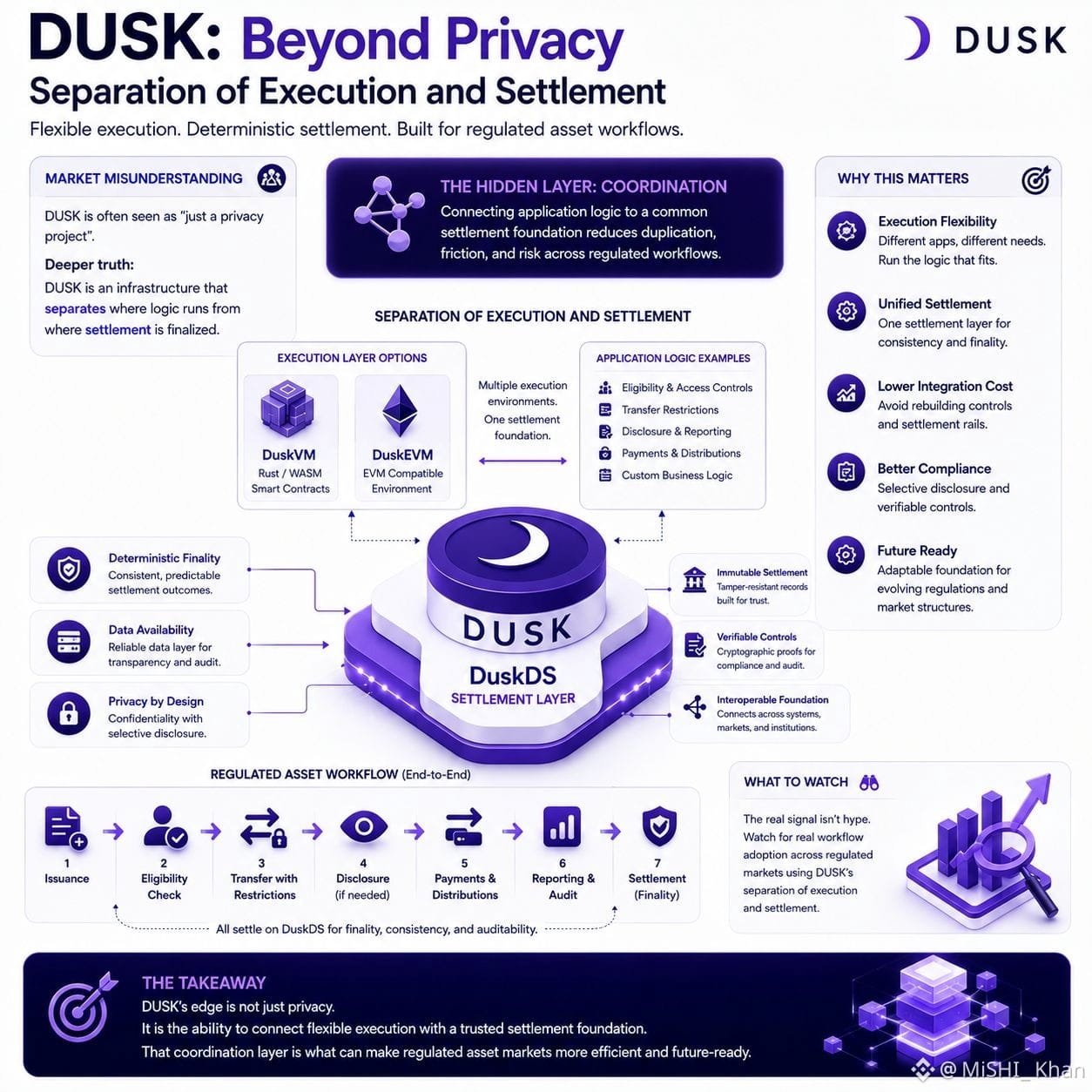
@DUSK is often seen as a privacy project, but that misses the design choice: separating execution from settlement. DuskDS provides settlement, data availability and deterministic finality, while DuskVM supports Rust/WASM contracts and DuskEVM provides an EVM-compatible path. That flexibility matters because regulated finance rarely follows one workflow. An asset may need eligibility, transfer restrictions, disclosure, reporting and settlement. DUSK’s influence could be coordination: connecting application logic to a settlement foundation instead of rebuilding controls across systems. The market may focus on confidentiality, while the harder problem is making regulated workflows fit together. I’d watch workflow adoption now. Infrastructure wins when it becomes invisible.
#dusk $DUSK @Dusk
#dusk $DUSK @Dusk
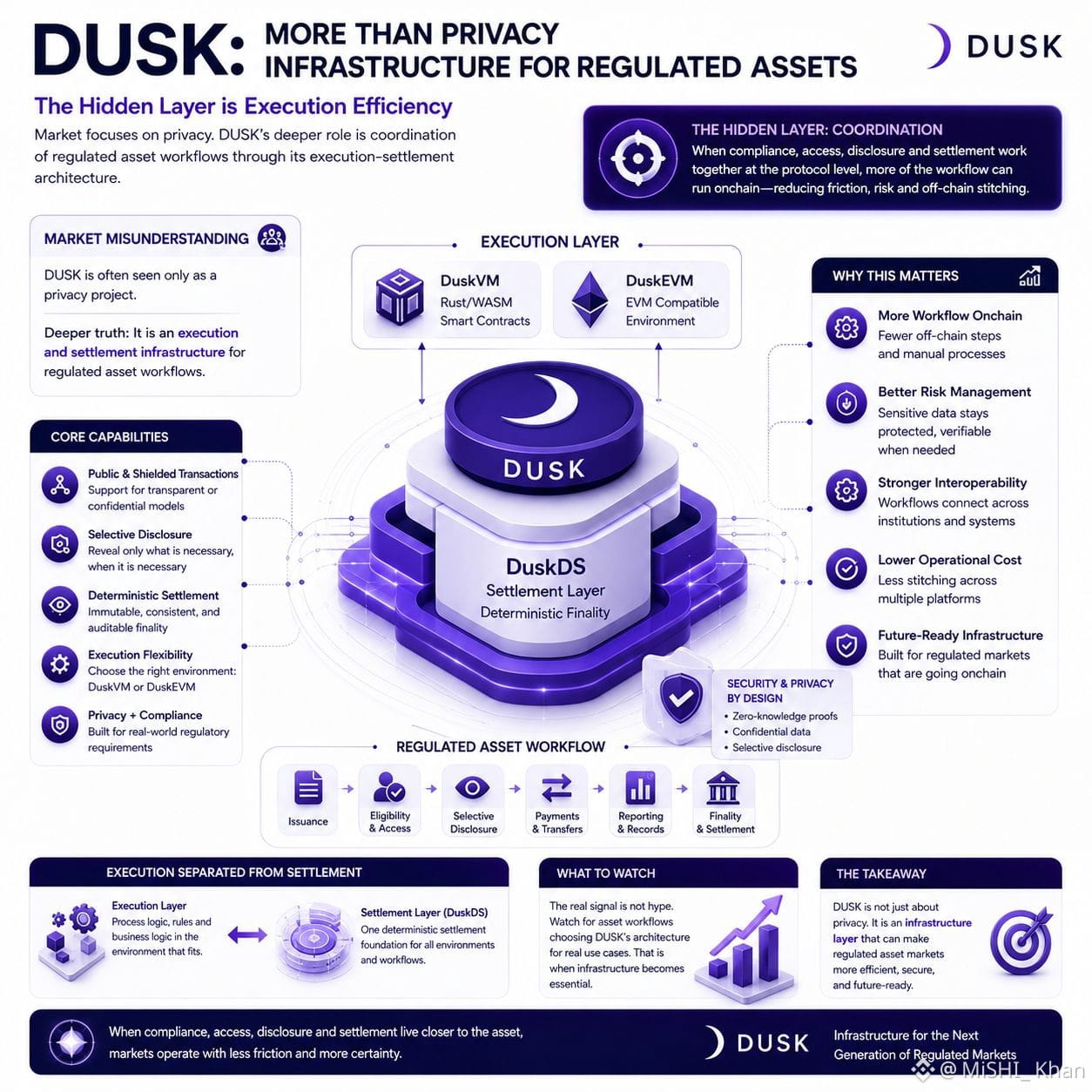
market can miss DUSK when it is reduced to a privacy narrative. The deeper layer is execution efficiency for regulated assets. Dusk separates execution from settlement: DuskVM handles Rust/WASM contracts, while DuskEVM offers an EVM-compatible path that settles through DuskDS. Regulated markets need more than transfers. Eligibility, access, disclosure, issuance, payments, reporting and finality must fit together. Dusk supports public and shielded transaction models, with selective disclosure when evidence is needed. The hidden effect is coordination: more of workflow can live at the protocol level instead of being stitched across systems. I would watch whether asset workflows use this architecture. The strongest signal is infrastructure becoming essential now, not hype.
#dusk $DUSK @Dusk
#dusk $DUSK @Dusk
تمّ التحقق
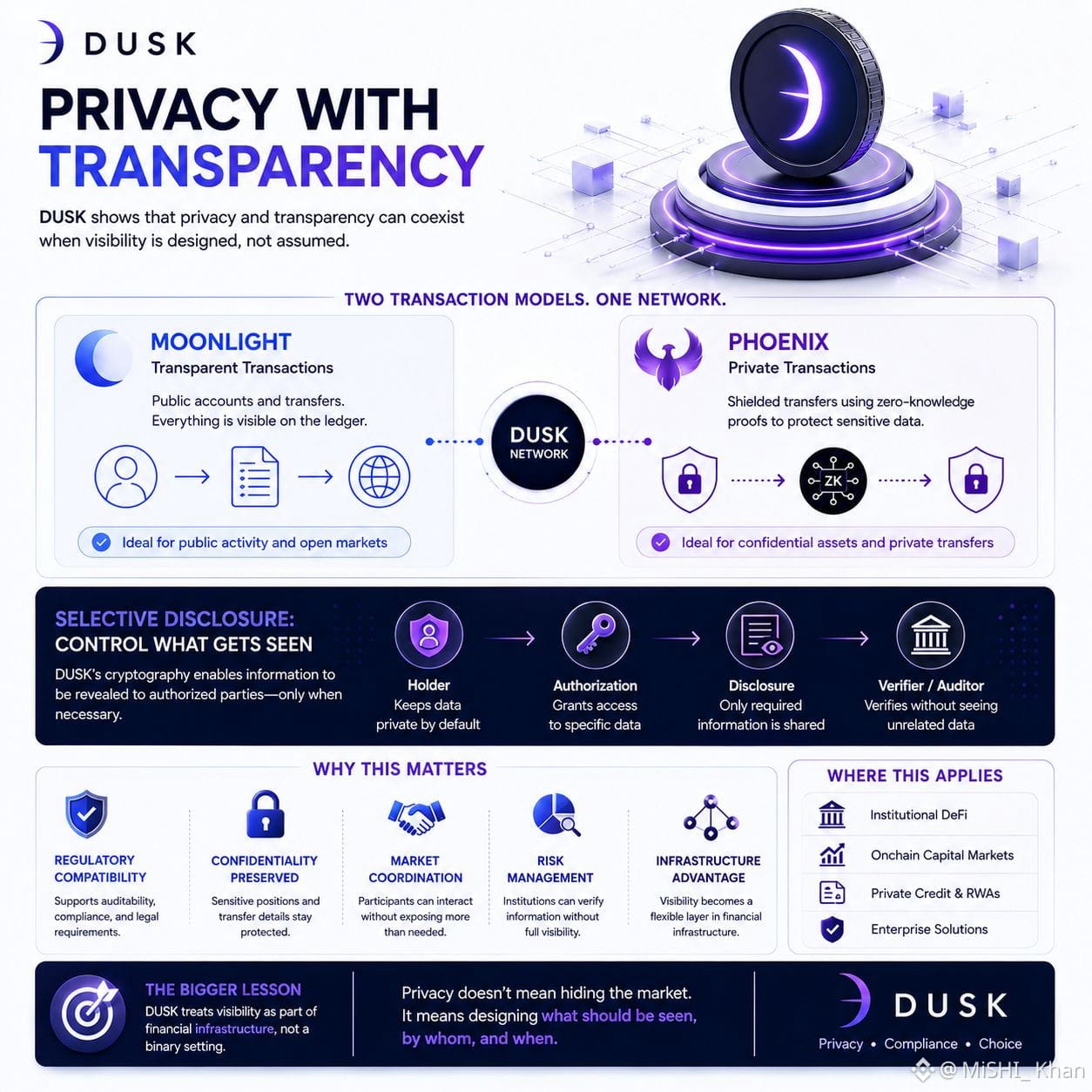
One part of DUSK that deserves attention is how its privacy model can coexist with transparency. Dusk supports Moonlight for public accounts and Phoenix for shielded transfers, while its cryptography stack enables selective disclosure.
That creates a design choice: privacy does not have to mean hiding the market. An application can keep balances or transfer details confidential while allowing information to be revealed when required.
Why does this matter? Regulated markets need auditability and controlled access. If every detail is public, positions can be exposed. If everything is private, verification becomes harder.
The deeper lesson is that DUSK treats visibility as part of financial infrastructure, not a binary setting. That could make onchain markets easier to coordinate at scale.
#dusk $DUSK @Dusk
That creates a design choice: privacy does not have to mean hiding the market. An application can keep balances or transfer details confidential while allowing information to be revealed when required.
Why does this matter? Regulated markets need auditability and controlled access. If every detail is public, positions can be exposed. If everything is private, verification becomes harder.
The deeper lesson is that DUSK treats visibility as part of financial infrastructure, not a binary setting. That could make onchain markets easier to coordinate at scale.
#dusk $DUSK @Dusk
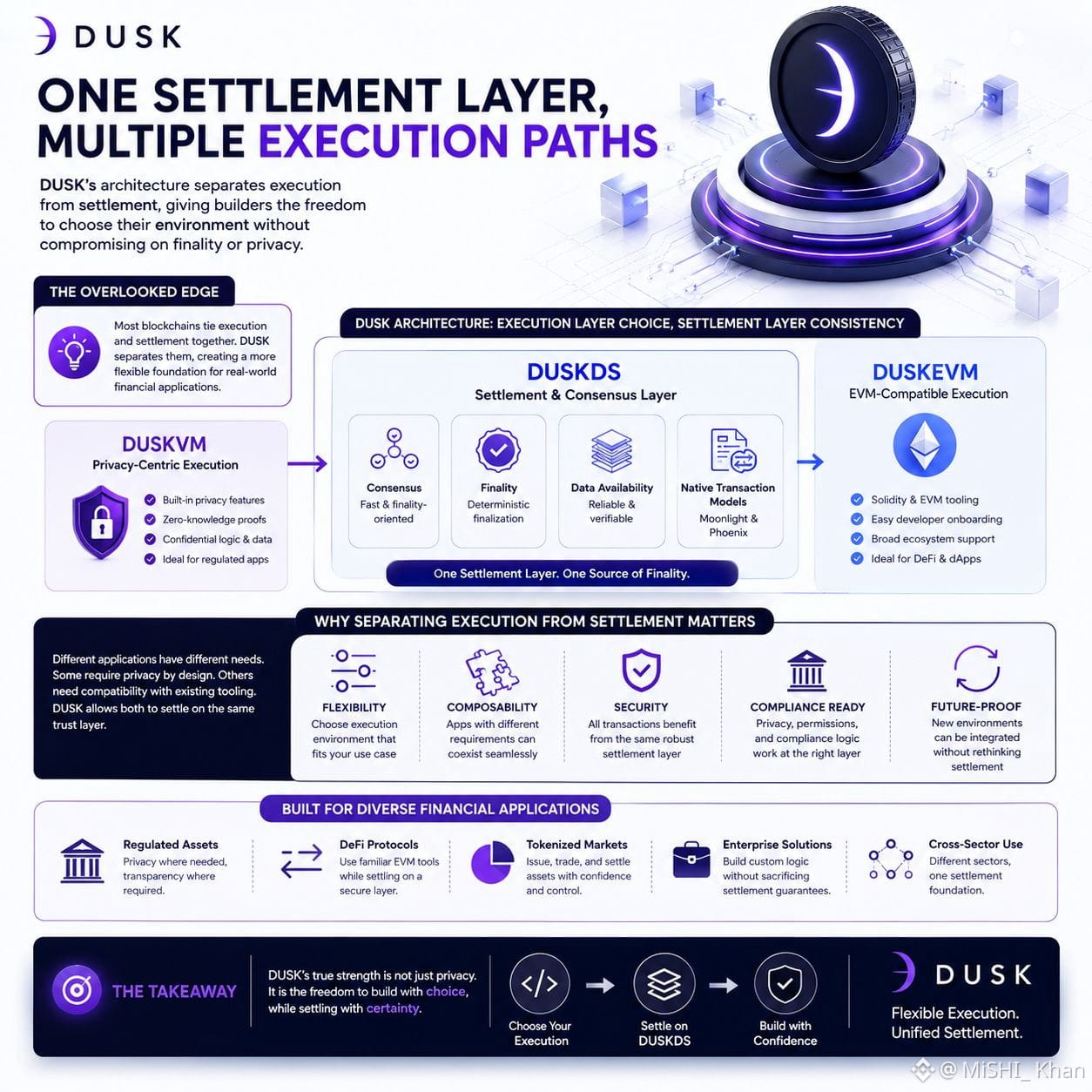
An overlooked part of DUSK is how its architecture separates execution from settlement. DuskDS handles consensus, finality, data availability, and native transaction models, while DuskVM and DuskEVM provide different environments for application logic.
Why does that matter? Financial applications have different needs. It may need privacy features, while another may prefer Solidity and familiar EVM tooling. DUSK lets both paths settle through the same layer instead of forcing applications into one execution model.
The deeper implication is infrastructure flexibility. Builders can choose the execution environment without abandoning DuskDS as the settlement foundation. That matters for regulated applications, where privacy, compliance logic, and predictable settlement need to work together.
#dusk $DUSK @Dusk
Why does that matter? Financial applications have different needs. It may need privacy features, while another may prefer Solidity and familiar EVM tooling. DUSK lets both paths settle through the same layer instead of forcing applications into one execution model.
The deeper implication is infrastructure flexibility. Builders can choose the execution environment without abandoning DuskDS as the settlement foundation. That matters for regulated applications, where privacy, compliance logic, and predictable settlement need to work together.
#dusk $DUSK @Dusk
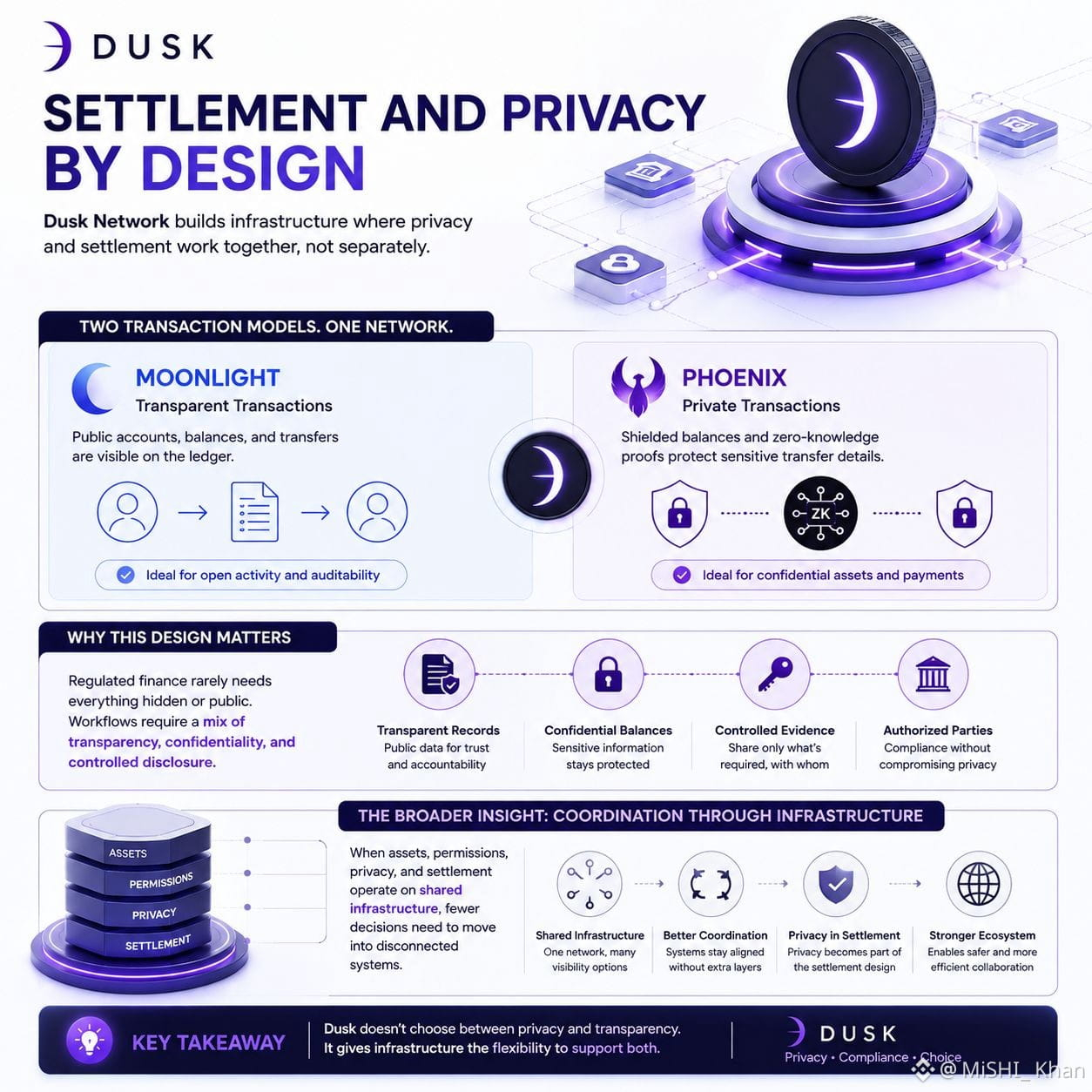
@DuskFoundation is interesting because it treats settlement and privacy as design problems. DuskDS supports two transaction models: Moonlight exposes public account activity, while Phoenix uses shielded transfers with zero-knowledge proofs.
That matters because regulated finance rarely needs everything hidden or public. A workflow may require transparent records, confidential balances, and controlled evidence for an authorized parties. Dusk lets these visibility choices coexist instead of forcing one privacy setting across the system.
The broader insight is coordination. If assets, permissions, privacy, and settlement operate around shared infrastructure, fewer decisions need to move into disconnected systems. Privacy becomes part of settlement design rather than merely a user preference.
@Dusk #dusk $DUSK
That matters because regulated finance rarely needs everything hidden or public. A workflow may require transparent records, confidential balances, and controlled evidence for an authorized parties. Dusk lets these visibility choices coexist instead of forcing one privacy setting across the system.
The broader insight is coordination. If assets, permissions, privacy, and settlement operate around shared infrastructure, fewer decisions need to move into disconnected systems. Privacy becomes part of settlement design rather than merely a user preference.
@Dusk #dusk $DUSK
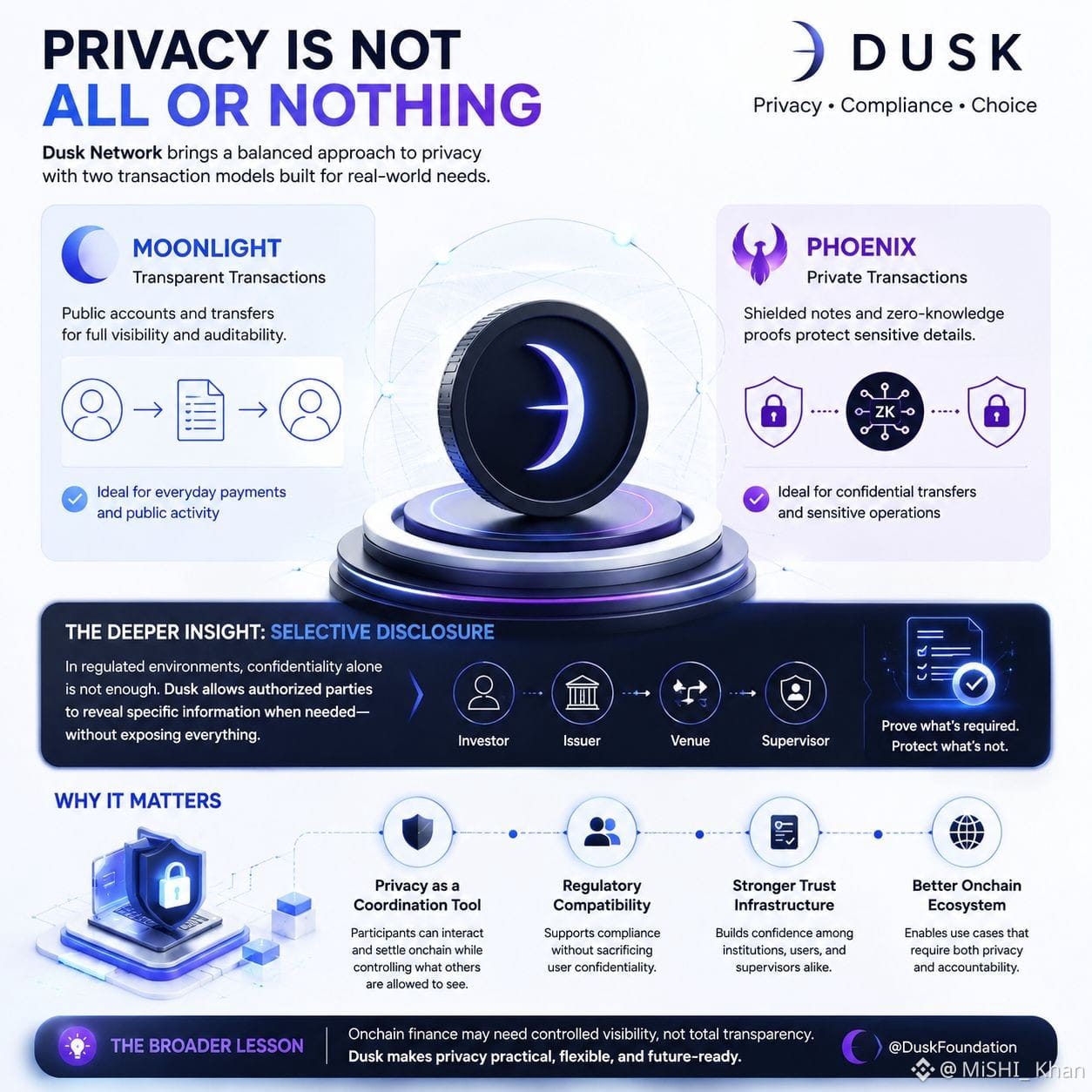
One detail the market can miss about @DuskFoundation is that privacy is not treated as all-or-nothing. Dusk uses two transaction models: Moonlight keeps accounts and transfers public, while Phoenix uses shielded notes and zero-knowledge proofs to hide sensitive transfer details.
The deeper point is selective disclosure. In regulated markets, confidentiality alone is not enough. An investor, issuer, venue, or supervisor may need proof of eligibility or ownership without seeing unrelated data. Dusk lets authorized parties reveal some information when required.
That makes privacy a coordination tool, not just a shield. Participants can work on a settlement layer while controlling what others can see. The broader lesson: onchain finance may need controlled visibility, not total transparency.
@Dusk #dusk $DUSK
The deeper point is selective disclosure. In regulated markets, confidentiality alone is not enough. An investor, issuer, venue, or supervisor may need proof of eligibility or ownership without seeing unrelated data. Dusk lets authorized parties reveal some information when required.
That makes privacy a coordination tool, not just a shield. Participants can work on a settlement layer while controlling what others can see. The broader lesson: onchain finance may need controlled visibility, not total transparency.
@Dusk #dusk $DUSK
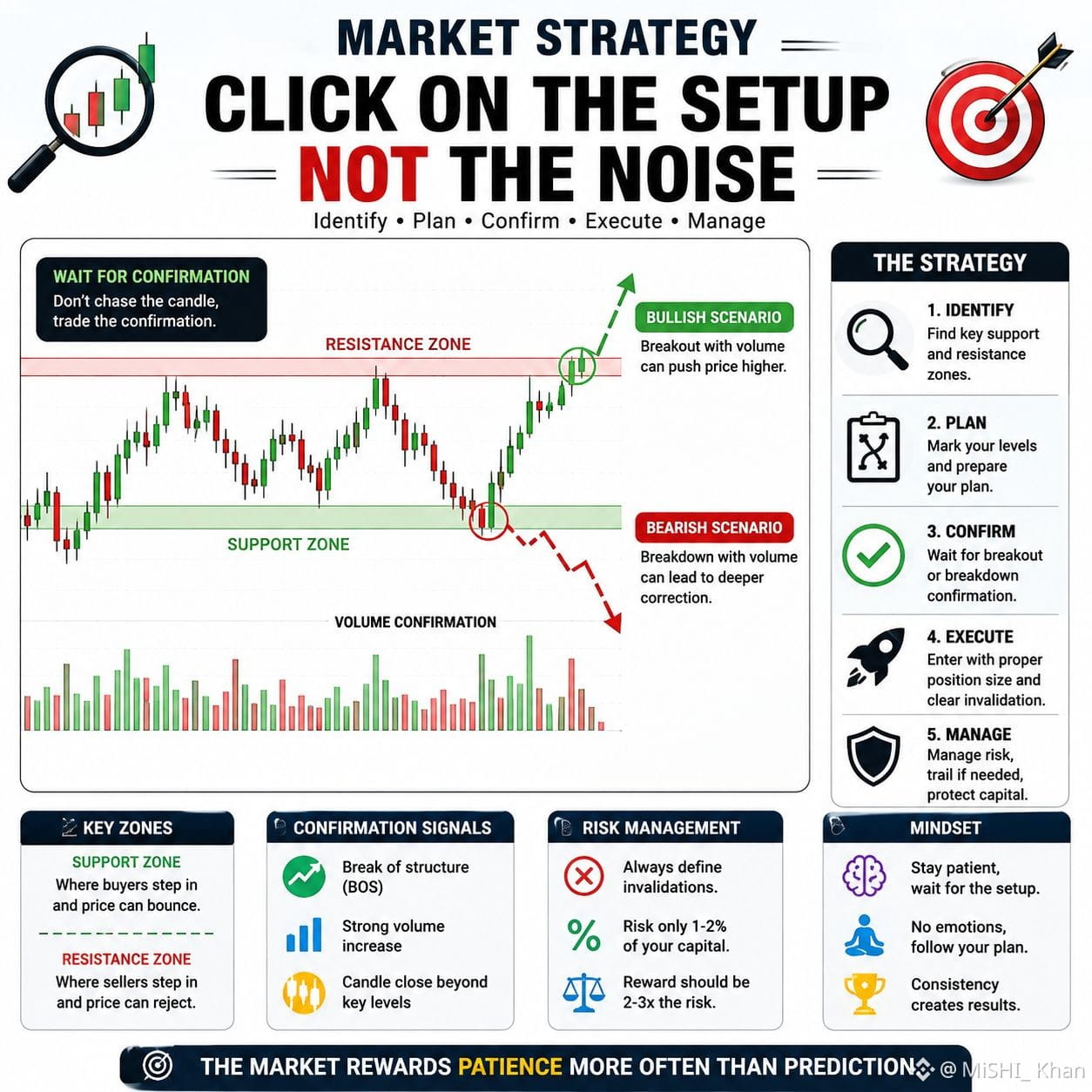
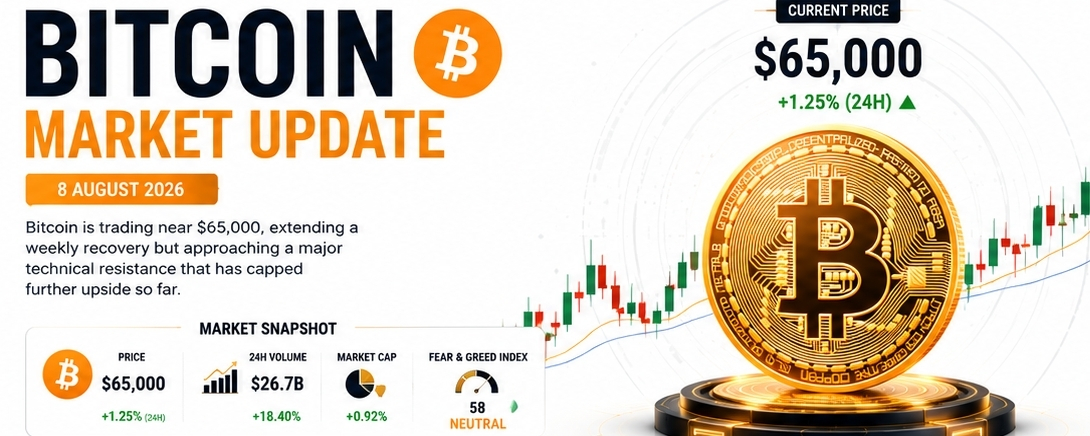
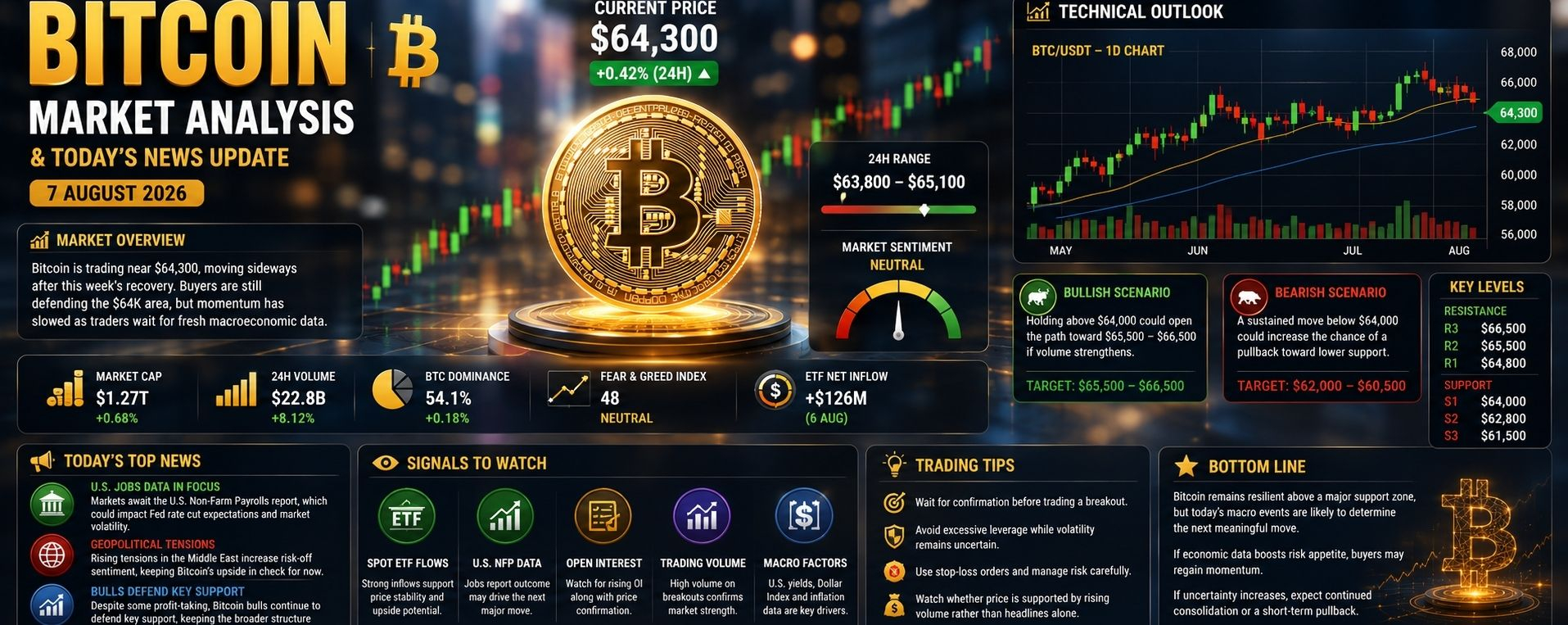
Market Strategy: Click on the Setup, Not the Noise
Markets rarely move in a straight line. The smarter approach is to identify where price is consolidating, mark the key support and resistance zones, then wait for confirmation before entering.
If support holds and volume expands, momentum can shift upward. If support breaks with strong selling pressure, the next move may be a deeper correction.
The key strategy is simple: don’t chase the candle—trade the confirmation.
Risk management matters more than predicting the exact top or bottom. Keep invalidation clear, position size controlled, and avoid emotional entries.
The market rewards patience more often than prediction.
#MarketSentimentToday
Markets rarely move in a straight line. The smarter approach is to identify where price is consolidating, mark the key support and resistance zones, then wait for confirmation before entering.
If support holds and volume expands, momentum can shift upward. If support breaks with strong selling pressure, the next move may be a deeper correction.
The key strategy is simple: don’t chase the candle—trade the confirmation.
Risk management matters more than predicting the exact top or bottom. Keep invalidation clear, position size controlled, and avoid emotional entries.
The market rewards patience more often than prediction.
#MarketSentimentToday
The market is not waiting for your entry. 👀
Right now, chasing every green candle is the easiest way to become exit liquidity.
The better strategy is simple: watch price + volume + liquidity together.
If price breaks resistance but volume stays weak → don’t chase.
If price retests support and buyers defend it with stronger volume → the setup becomes more interesting.
If BTC loses a key support level → reduce risk across high-beta altcoins.
The biggest opportunity is often not the first candle. It is the confirmation after the market shows its hand.
Trade the reaction, not the emotion.
Your edge is patience. 🎯
#SheinToStartHKIPOBookbuildingAsSoonAsNextWeek
Right now, chasing every green candle is the easiest way to become exit liquidity.
The better strategy is simple: watch price + volume + liquidity together.
If price breaks resistance but volume stays weak → don’t chase.
If price retests support and buyers defend it with stronger volume → the setup becomes more interesting.
If BTC loses a key support level → reduce risk across high-beta altcoins.
The biggest opportunity is often not the first candle. It is the confirmation after the market shows its hand.
Trade the reaction, not the emotion.
Your edge is patience. 🎯
#SheinToStartHKIPOBookbuildingAsSoonAsNextWeek

سجّل الدخول لاستكشاف المزيد من المُحتوى