

Muhammad BR Crypto
72 貼文

Muhammad BR Crypto
舉報
封鎖用戶
36 關注
232 粉絲
46 點讚數
貼文
全部
引用
直播
#BinancePick 日復一日,我在 #BinancePick 的積分排行榜上不斷攀升。完成市場任務、做出明智預測,享受活動的每一步!📈
#BinancePick 日復一日,我在 #BinancePick 的積分排行榜上不斷攀升。完成市場任務、做出明智預測,享受活動的每一步!📈
1
#BinancePick 剛加入 Binance Pick,發現這是檢驗我市場預測能力的有趣方式!選擇市場,做出預測,一路賺取積分。迫不及待想看看這周能解鎖多少積分。
#BinancePick 剛加入 Binance Pick,發現這是檢驗我市場預測能力的有趣方式!選擇市場,做出預測,一路賺取積分。迫不及待想看看這周能解鎖多少積分。
9
查看翻譯
#BinancePick Just joined Binance Pick and it's a fun way to put my market predictions to the test! Pick your markets, make your calls, and earn Scores along the way. Can't wait to see how many I can unlock this week.
#BinancePick Just joined Binance Pick and it's a fun way to put my market predictions to the test! Pick your markets, make your calls, and earn Scores along the way. Can't wait to see how many I can unlock this week.
11
#BinancePick 預測市場讓加密貨幣更加令人興奮。每天參與#BinancePick ,完成任務並登上排行榜。
#BinancePick 預測市場讓加密貨幣更加令人興奮。每天參與#BinancePick ,完成任務並登上排行榜。
3


查看翻譯
#BinancePick Prediction Market se market samajhna mazedaar hai. Bina FOMO ke, sahi analysis ke saath predict karo!
#BinancePick Prediction Market se market samajhna mazedaar hai. Bina FOMO ke, sahi analysis ke saath predict karo!
查看翻譯
#BinancePick Prediction markets make trading feel more interactive. I'm taking my time to research each market on Binance Pick before making a call. Who else is participating?
#BinancePick Prediction markets make trading feel more interactive. I'm taking my time to research each market on Binance Pick before making a call. Who else is participating?
查看翻譯
#BinancePick Prediction markets make crypto even more exciting. Participating daily to complete tasks and climb the leaderboard. Who else is in?
#BinancePick Prediction markets make crypto even more exciting. Participating daily to complete tasks and climb the leaderboard. Who else is in?
3
#BinancePick 剛完成了今天的#BinancePick 任務!參與預測市場是更好地瞭解加密貨幣的一種新穎有趣的方式。你試過 Predict 了嗎? ?
#BinancePick 剛完成了今天的#BinancePick 任務!參與預測市場是更好地瞭解加密貨幣的一種新穎有趣的方式。你試過 Predict 了嗎? ?
63
查看翻譯
#BinancePick Prediction markets are a whole new way to put your insights to work. 📊 On Binance Pick, you can back your read on different markets and earn rewards along the way. Joined a few markets today. Give it a try!
#BinancePick Prediction markets are a whole new way to put your insights to work. 📊 On Binance Pick, you can back your read on different markets and earn rewards along the way. Joined a few markets today. Give it a try!
53
查看翻譯
#BinancePick
Prediction markets mein hissa lena ek naya aur interesting experience hai! Market trends ko samajh kar sahi predict karna sach mein maza deta hai.
#BinancePick
Prediction markets mein hissa lena ek naya aur interesting experience hai! Market trends ko samajh kar sahi predict karna sach mein maza deta hai.
Prediction markets mein hissa lena ek naya aur interesting experience hai! Market trends ko samajh kar sahi predict karna sach mein maza deta hai.
66
查看翻譯
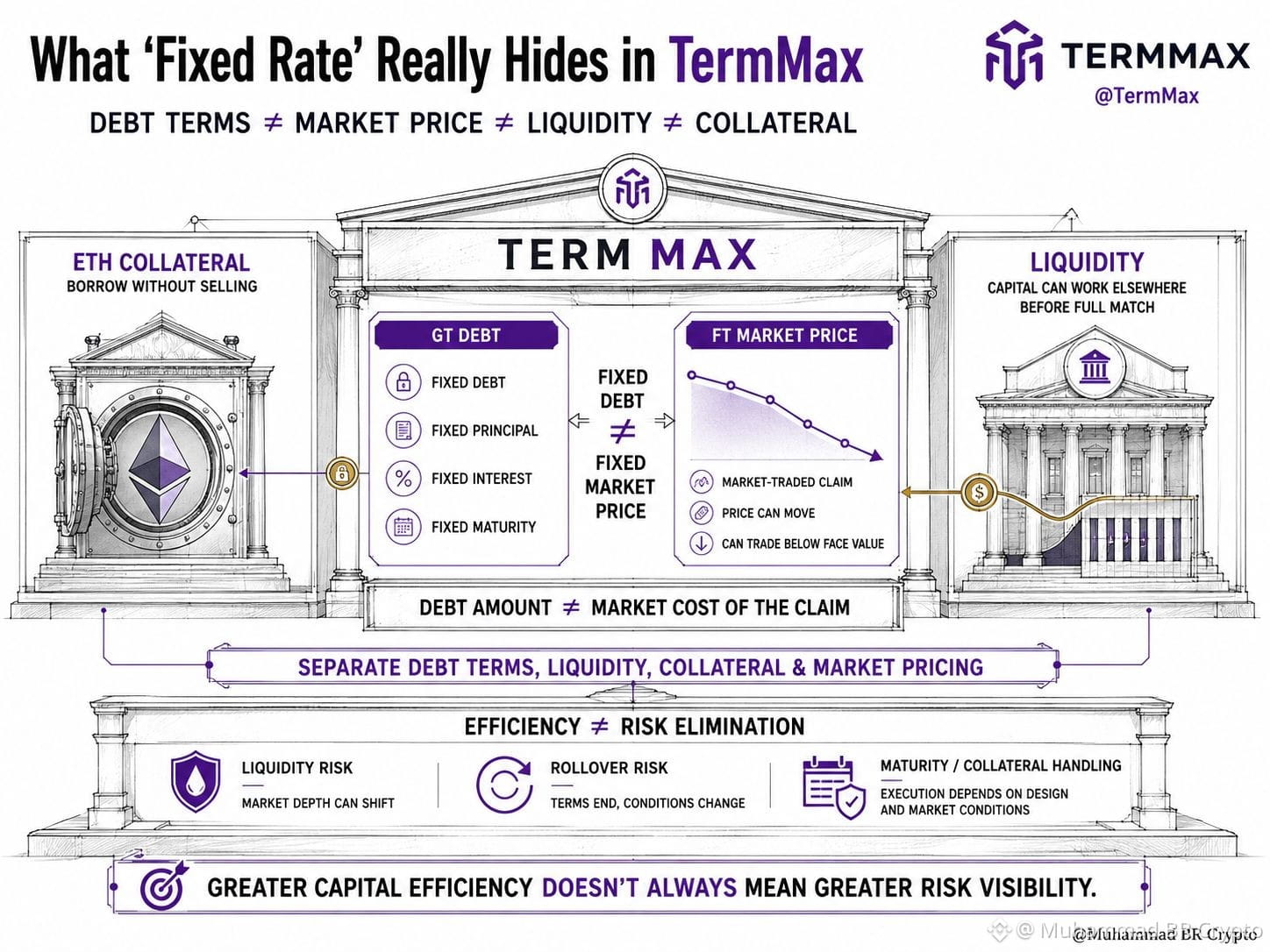
#termmax @termmax I used to think the interesting part of TermMax was simply fixed-rate borrowing. The more I looked at how its products connect, the more I realized that was only the surface.
A borrower can use ETH as collateral without selling it, while lenders can have capital working elsewhere even before an order is fully matched. But large protocol TVL doesn’t necessarily mean deep liquidity or easy execution in every market.
What really changed my view was seeing how differently capital behaves depending on where it sits. A GT debt can remain fixed while the FT linked to that debt trades below face value — so the amount of debt and the market cost of acquiring the claim are not necessarily the same.
That made me see @termmax less as a simple lending market and more as an attempt to separate debt terms, liquidity, collateral and market pricing instead of treating them as one thing.
The trade-off is that this can improve capital efficiency, but it doesn’t automatically remove liquidity or rollover risk — especially as a position approaches maturity or collateral needs to be handled after a default.
The bigger question, then, isn’t simply whether @termmax makes capital more efficient. It’s whether separating debt, liquidity, collateral and market pricing makes capital easier to manage — or simply makes the risks harder to see.
#termmax @TermMax I used to think the interesting part of TermMax was simply fixed-rate borrowing. The more I looked at how its products connect, the more I realized that was only the surface.
A borrower can use ETH as collateral without selling it, while lenders can have capital working elsewhere even before an order is fully matched. But large protocol TVL doesn’t necessarily mean deep liquidity or easy execution in every market.
What really changed my view was seeing how differently capital behaves depending on where it sits. A GT debt can remain fixed while the FT linked to that debt trades below face value — so the amount of debt and the market cost of acquiring the claim are not necessarily the same.
That made me see @TermMax less as a simple lending market and more as an attempt to separate debt terms, liquidity, collateral and market pricing instead of treating them as one thing.
The trade-off is that this can improve capital efficiency, but it doesn’t automatically remove liquidity or rollover risk — especially as a position approaches maturity or collateral needs to be handled after a default.
The bigger question, then, isn’t simply whether @TermMax makes capital more efficient. It’s whether separating debt, liquidity, collateral and market pricing makes capital easier to manage — or simply makes the risks harder to see.
A borrower can use ETH as collateral without selling it, while lenders can have capital working elsewhere even before an order is fully matched. But large protocol TVL doesn’t necessarily mean deep liquidity or easy execution in every market.
What really changed my view was seeing how differently capital behaves depending on where it sits. A GT debt can remain fixed while the FT linked to that debt trades below face value — so the amount of debt and the market cost of acquiring the claim are not necessarily the same.
That made me see @TermMax less as a simple lending market and more as an attempt to separate debt terms, liquidity, collateral and market pricing instead of treating them as one thing.
The trade-off is that this can improve capital efficiency, but it doesn’t automatically remove liquidity or rollover risk — especially as a position approaches maturity or collateral needs to be handled after a default.
The bigger question, then, isn’t simply whether @TermMax makes capital more efficient. It’s whether separating debt, liquidity, collateral and market pricing makes capital easier to manage — or simply makes the risks harder to see.
2
82
查看翻譯
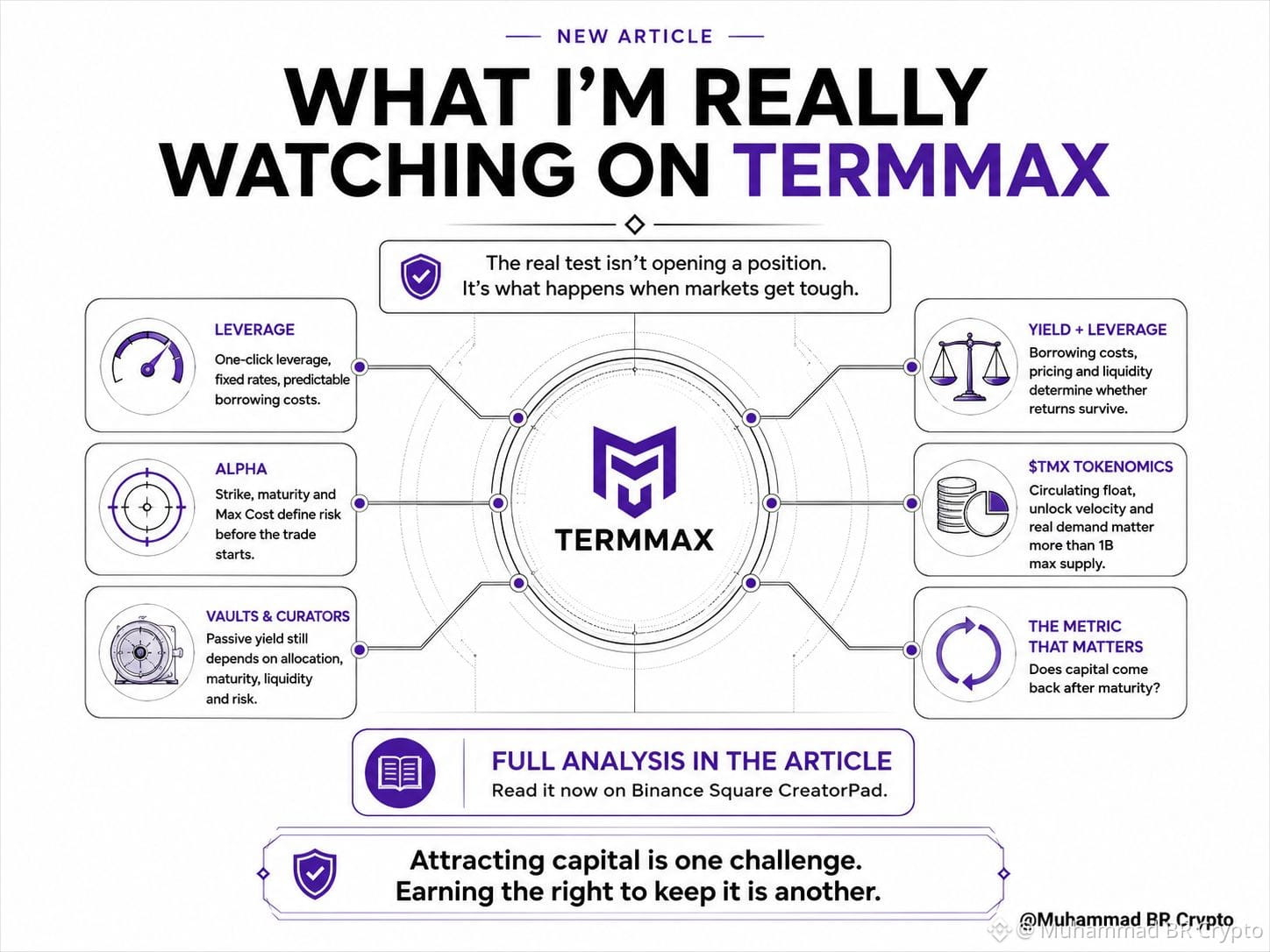
#termmax @termmax I’ve been looking at @TermMax from different angles over the last few days, and I keep coming back to one question:
Is TermMax actually making DeFi simpler, or just making complexity easier to access?
One-click leverage is a good example. It bundles multiple steps into one transaction, while fixed rates make borrowing costs more predictable.
Alpha takes the same idea into risk management. Strike, maturity and Max Cost define the trade before it starts. The market can still move against you, but the downside has a clearer boundary.
Then there’s the Vault and Curator layer.
Passive yield doesn’t remove risk. It shifts the responsibility of choosing markets, maturities, liquidity and risk levels to another layer.
That matters even more with leverage and yield-bearing assets, where borrowing costs, pricing and liquidity can determine whether the expected return actually survives.
Even TMX tokenomics points to the same lesson. The 1B maximum supply matters less than circulating float, unlock velocity and real demand.
And I’m less interested in headline wallet counts or TVL than one simple metric:
Does capital come back after maturity?
Because the real test isn’t opening a position when markets are calm.
It’s what happens when volatility rises, liquidity gets tight and users want to unwind.
Attracting capital is one challenge. Earning the right to keep it is another.
#termmax @TermMax I’ve been looking at @TermMax from different angles over the last few days, and I keep coming back to one question:
Is TermMax actually making DeFi simpler, or just making complexity easier to access?
One-click leverage is a good example. It bundles multiple steps into one transaction, while fixed rates make borrowing costs more predictable.
Alpha takes the same idea into risk management. Strike, maturity and Max Cost define the trade before it starts. The market can still move against you, but the downside has a clearer boundary.
Then there’s the Vault and Curator layer.
Passive yield doesn’t remove risk. It shifts the responsibility of choosing markets, maturities, liquidity and risk levels to another layer.
That matters even more with leverage and yield-bearing assets, where borrowing costs, pricing and liquidity can determine whether the expected return actually survives.
Even TMX tokenomics points to the same lesson. The 1B maximum supply matters less than circulating float, unlock velocity and real demand.
And I’m less interested in headline wallet counts or TVL than one simple metric:
Does capital come back after maturity?
Because the real test isn’t opening a position when markets are calm.
It’s what happens when volatility rises, liquidity gets tight and users want to unwind.
Attracting capital is one challenge. Earning the right to keep it is another.
Is TermMax actually making DeFi simpler, or just making complexity easier to access?
One-click leverage is a good example. It bundles multiple steps into one transaction, while fixed rates make borrowing costs more predictable.
Alpha takes the same idea into risk management. Strike, maturity and Max Cost define the trade before it starts. The market can still move against you, but the downside has a clearer boundary.
Then there’s the Vault and Curator layer.
Passive yield doesn’t remove risk. It shifts the responsibility of choosing markets, maturities, liquidity and risk levels to another layer.
That matters even more with leverage and yield-bearing assets, where borrowing costs, pricing and liquidity can determine whether the expected return actually survives.
Even TMX tokenomics points to the same lesson. The 1B maximum supply matters less than circulating float, unlock velocity and real demand.
And I’m less interested in headline wallet counts or TVL than one simple metric:
Does capital come back after maturity?
Because the real test isn’t opening a position when markets are calm.
It’s what happens when volatility rises, liquidity gets tight and users want to unwind.
Attracting capital is one challenge. Earning the right to keep it is another.
2
75
#termmax @termmax 我原以爲,“固定利率”在 @termmax 的語境裏意味着整個訂單適用同一個利率。
後來我再仔細看了範圍訂單(Range Orders)的實際運作方式,才意識到我之前想得太簡單了。
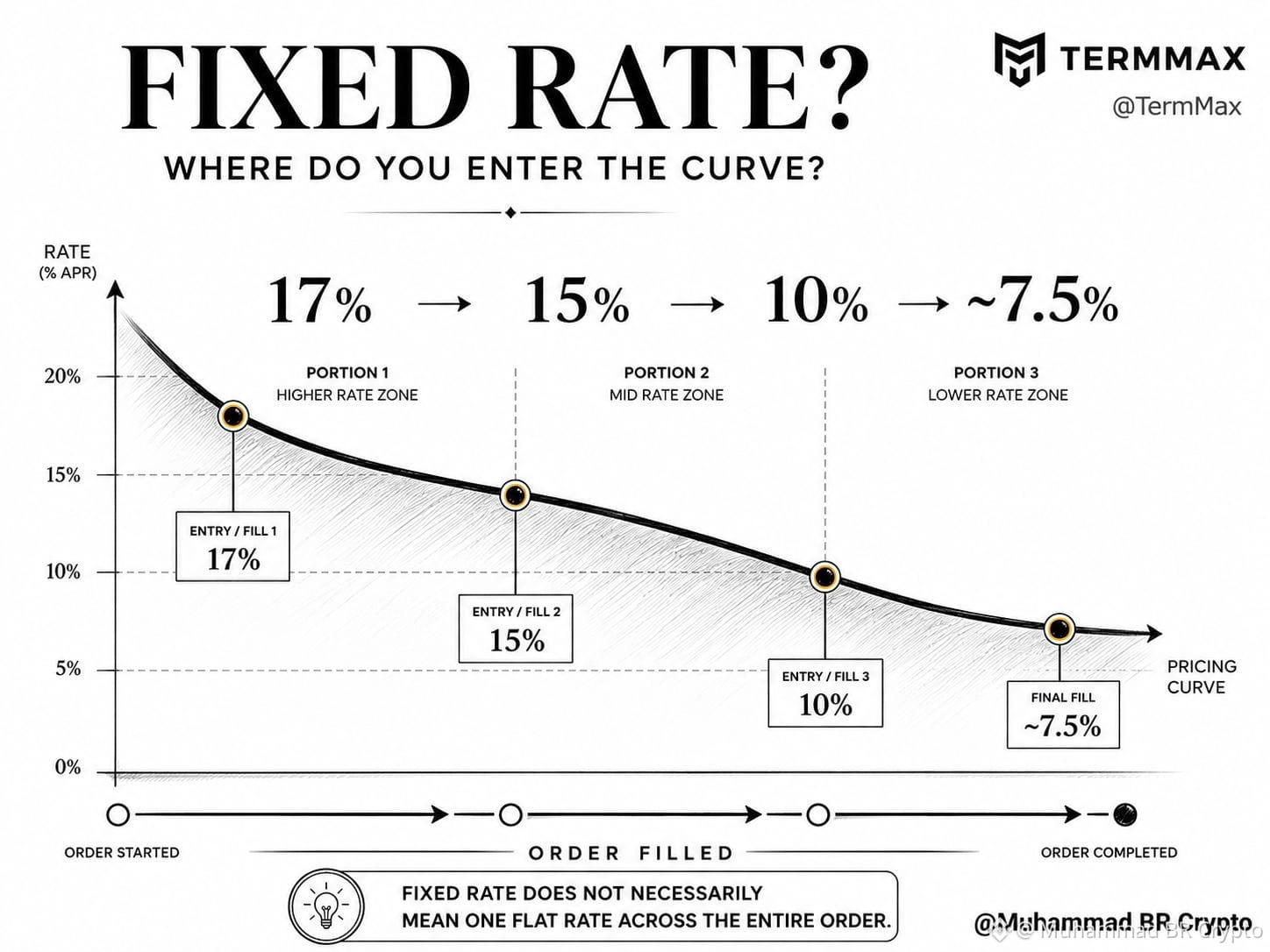
它們是由定價曲線(pricing curves)構建的,而不是固定的單一利率。在 TermMax 的借貸示例中,前 150 萬(1.5M)的區間從 17% 逐步過渡到 15%,接下來的 20 萬(0.2M)從 15% 過渡到 10%,最後的 17 萬(0.17M)從 10% 過渡到大約 7.5%。
所以,一旦你的那一部分被匹配(matched),它的利率就會被固定——但不同的部分可能會在曲線的不同位置被匹配,從而鎖定不同的利率。
這也意味着:訂單的成交(fill)位置比我最初以爲的更重要。
對做喫單方(taker)來說,第一 個要問的問題應該是“利率是多少?”——還是“我將從曲線的哪裏進入?”
#termmax @TermMax 我原以爲,“固定利率”在 @TermMax 的語境裏意味着整個訂單適用同一個利率。
後來我再仔細看了範圍訂單(Range Orders)的實際運作方式,才意識到我之前想得太簡單了。
它們是由定價曲線(pricing curves)構建的,而不是固定的單一利率。在 TermMax 的借貸示例中,前 150 萬(1.5M)的區間從 17% 逐步過渡到 15%,接下來的 20 萬(0.2M)從 15% 過渡到 10%,最後的 17 萬(0.17M)從 10% 過渡到大約 7.5%。
所以,一旦你的那一部分被匹配(matched),它的利率就會被固定——但不同的部分可能會在曲線的不同位置被匹配,從而鎖定不同的利率。
這也意味着:訂單的成交(fill)位置比我最初以爲的更重要。
對做喫單方(taker)來說,第一 個要問的問題應該是“利率是多少?”——還是“我將從曲線的哪裏進入?”
後來我再仔細看了範圍訂單(Range Orders)的實際運作方式,才意識到我之前想得太簡單了。
它們是由定價曲線(pricing curves)構建的,而不是固定的單一利率。在 TermMax 的借貸示例中,前 150 萬(1.5M)的區間從 17% 逐步過渡到 15%,接下來的 20 萬(0.2M)從 15% 過渡到 10%,最後的 17 萬(0.17M)從 10% 過渡到大約 7.5%。
所以,一旦你的那一部分被匹配(matched),它的利率就會被固定——但不同的部分可能會在曲線的不同位置被匹配,從而鎖定不同的利率。
這也意味着:訂單的成交(fill)位置比我最初以爲的更重要。
對做喫單方(taker)來說,第一 個要問的問題應該是“利率是多少?”——還是“我將從曲線的哪裏進入?”
1
79
查看翻譯
#termmax @termmax I used to think fixed-rate lending was mainly about knowing the rate and maturity upfront.
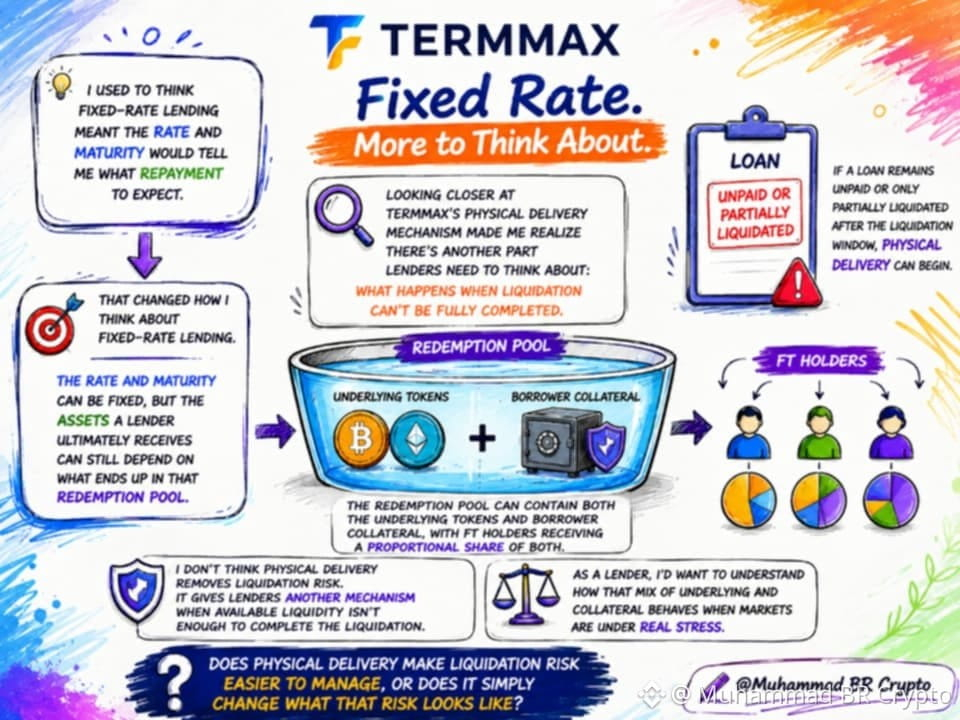
But looking closer at @termmax physical delivery mechanism made me realize there’s another question: what happens when liquidation can’t be fully completed?
If a loan remains unpaid or only partially liquidated after the liquidation window, physical delivery can begin. The redemption pool can contain both the underlying tokens and borrower collateral, with FT holders receiving a proportional share of both.
That changed how I think about fixed-rate lending.
The rate and maturity can be fixed, but what a lender ultimately receives can still depend on what ends up in that pool.
That’s also where I see the practical value of TermMax: lenders can target fixed returns, borrowers can access defined-rate liquidity, and LPs can provide liquidity to the market.
I don’t think physical delivery removes liquidation risk. It gives lenders another mechanism when available liquidity isn’t enough to complete the liquidation.
Does physical delivery make liquidation risk easier to manage, or simply change what that risk looks like?
#termmax @TermMax I used to think fixed-rate lending was mainly about knowing the rate and maturity upfront.
But looking closer at @TermMax physical delivery mechanism made me realize there’s another question: what happens when liquidation can’t be fully completed?
If a loan remains unpaid or only partially liquidated after the liquidation window, physical delivery can begin. The redemption pool can contain both the underlying tokens and borrower collateral, with FT holders receiving a proportional share of both.
That changed how I think about fixed-rate lending.
The rate and maturity can be fixed, but what a lender ultimately receives can still depend on what ends up in that pool.
That’s also where I see the practical value of TermMax: lenders can target fixed returns, borrowers can access defined-rate liquidity, and LPs can provide liquidity to the market.
I don’t think physical delivery removes liquidation risk. It gives lenders another mechanism when available liquidity isn’t enough to complete the liquidation.
Does physical delivery make liquidation risk easier to manage, or simply change what that risk looks like?
But looking closer at @TermMax physical delivery mechanism made me realize there’s another question: what happens when liquidation can’t be fully completed?
If a loan remains unpaid or only partially liquidated after the liquidation window, physical delivery can begin. The redemption pool can contain both the underlying tokens and borrower collateral, with FT holders receiving a proportional share of both.
That changed how I think about fixed-rate lending.
The rate and maturity can be fixed, but what a lender ultimately receives can still depend on what ends up in that pool.
That’s also where I see the practical value of TermMax: lenders can target fixed returns, borrowers can access defined-rate liquidity, and LPs can provide liquidity to the market.
I don’t think physical delivery removes liquidation risk. It gives lenders another mechanism when available liquidity isn’t enough to complete the liquidation.
Does physical delivery make liquidation risk easier to manage, or simply change what that risk looks like?
2
57
查看翻譯
😍
😍

Ahmad Wêb³
·
--
看漲我測試了 Babylon 的無需信任比特幣金庫(TBV)流程,留在我腦海裏的一點並不是借出 BTC。而是鎖倉後的等待。那小小的延遲凸顯了核心權衡:TBV 的設計圍繞比特幣原生的驗證,並減少信任假設,而不是提供即時的 DeFi 便捷性。
然後我查看了市場。
$BABY 目前的交易價格約爲 0.0129 美元,市值接近 50.7M;而該代幣在過去 7 天內下跌了大約 9%。市場仍在等待證明:Babylon 的生態增長能否轉化爲可持續的代幣需求。
但生態講述了另一個故事。
Babylon 的 TVL 約爲 32.5 億美元,表明該協議已經與大量 BTC 價值相連接。關鍵問題在於:這項活動是否會通過採用(adoption)和網絡增長,爲 $BABY 產生真正的價值捕獲。
供給端又增加了一層。
BABY 的流通供應量約爲 40.2 億,位於總供應量 108.9 億之中。8 月 10 日的下一次解鎖將釋放 1.3611 億枚 BABY 代幣,約佔總供應量的 1.2%,用於顧問、早期投資者以及團隊分配。
所以市場正在權衡兩件事:
Babylon 能否在管理未來供給擴張的同時,把 BTC 的採用轉化爲持久的代幣需求?
真正的挑戰或許不在於搭建比特幣基礎設施——而在於證明,比特幣持有者會選擇這種信任模型,而不是選擇更快的替代方案。
Babylon 會不會成爲將充足 BTC 流動性引入 DeFi 的那一層?還是便捷性會繼續佔上風?
@BabylonLabs_io
#baby $BABY
然後我查看了市場。
$BABY 目前的交易價格約爲 0.0129 美元,市值接近 50.7M;而該代幣在過去 7 天內下跌了大約 9%。市場仍在等待證明:Babylon 的生態增長能否轉化爲可持續的代幣需求。
但生態講述了另一個故事。
Babylon 的 TVL 約爲 32.5 億美元,表明該協議已經與大量 BTC 價值相連接。關鍵問題在於:這項活動是否會通過採用(adoption)和網絡增長,爲 $BABY 產生真正的價值捕獲。
供給端又增加了一層。
BABY 的流通供應量約爲 40.2 億,位於總供應量 108.9 億之中。8 月 10 日的下一次解鎖將釋放 1.3611 億枚 BABY 代幣,約佔總供應量的 1.2%,用於顧問、早期投資者以及團隊分配。
所以市場正在權衡兩件事:
Babylon 能否在管理未來供給擴張的同時,把 BTC 的採用轉化爲持久的代幣需求?
真正的挑戰或許不在於搭建比特幣基礎設施——而在於證明,比特幣持有者會選擇這種信任模型,而不是選擇更快的替代方案。
Babylon 會不會成爲將充足 BTC 流動性引入 DeFi 的那一層?還是便捷性會繼續佔上風?
@BabylonLabs_io
#baby $BABY
2
查看翻譯
Spain vs Argentina feels like a classic football rivalry on the biggest stage! ⚽ Both teams have world class attackers, creative midfielders, and strong defenses. I’m expecting a high intensity final with plenty of chances and dramatic moments. My prediction: an entertaining match that goes right down to the final whistle. Who are you supporting tonight? #BinancePickAndWin
Spain vs Argentina feels like a classic football rivalry on the biggest stage! ⚽ Both teams have world class attackers, creative midfielders, and strong defenses. I’m expecting a high intensity final with plenty of chances and dramatic moments. My prediction: an entertaining match that goes right down to the final whistle. Who are you supporting tonight? #BinancePickAndWin
74
登入以探索更多內容
加入幣安廣場中的全球加密貨幣用戶
⚡️ 獲取加密貨幣的最新和實用資訊。
💬 受到全球最大加密貨幣交易所的信任。
👍 發掘來自經過驗證創作者的真實見解。
電子郵件 / 電話號碼