

LadyChain 1
144 貼文

LadyChain 1
舉報
封鎖用戶
Crypto & Web3 enthusiast | Exploring blockchain & AI | Sharing thoughts, trends & fresh ideas for the future of tech | Open collaboration.
0 關注
6 粉絲
5 點讚數
貼文
·
--
查看翻譯
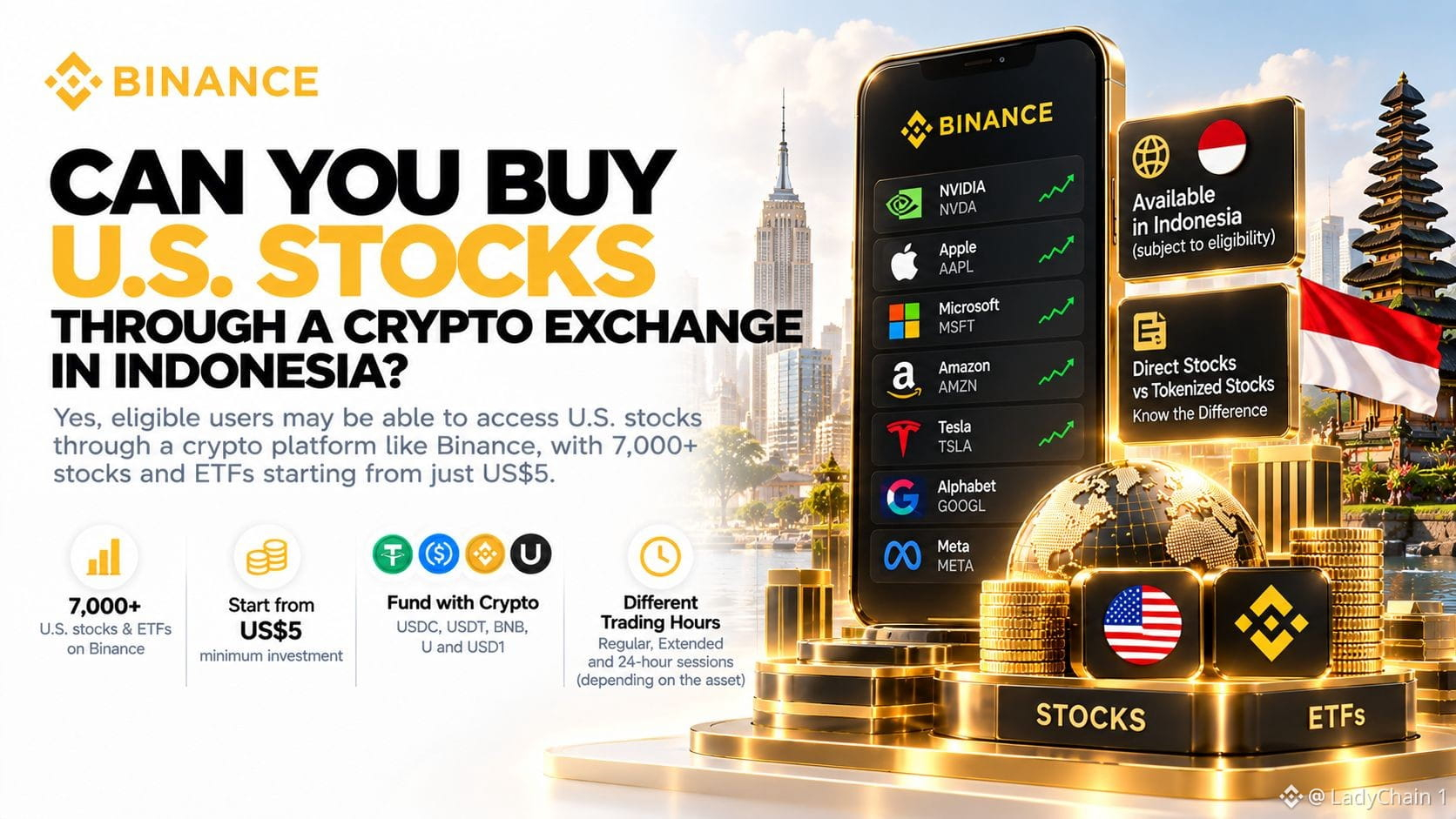
Can You Buy U.S. Stocks Through a Crypto Exchange in Indonesia? Yes, eligible users may be able to access U.S. stocks through a crypto platform in Indonesia, but availability depends on the platform, product, jurisdiction, and account eligibility. One example is Binance Stock Trading, which offers eligible users access to 7,000+ U.S.-listed stocks and ETFs, with investments starting from US$5. How Does It Work? Eligible users can fund stock purchases with supported crypto assets. USDC is the primary settlement asset, while BNB, USDT, U, and USD1 are also supported and can be converted to USDC when an order is submitted. The basic flow is: Crypto balance → USDC conversion → U.S. stock purchase Trading sessions can vary depending on the security. Which U.S. Stocks Can You Trade? The Binance Stocks offering includes companies such as NVIDIA, Apple, Microsoft, Amazon, Tesla, Alphabet, and Meta, along with ETFs. The available selection may change over time and can vary by eligibility. What About Binance bStocks? Direct stock trading and tokenized stocks are different products. Through Stock Trading, eligible users can purchase listed securities with beneficial ownership through the applicable brokerage and custody structure. bStocks are tokenized financial products that provide exposure to underlying securities. They have a separate structure and should not automatically be treated as equivalent to owning the underlying shares. Can Indonesians Access U.S. Stocks Through Binance? Potentially, but access is not automatic for every Indonesian account. Binance states that stock-trading availability varies by jurisdiction and account eligibility. Before trading, check whether the Stocks feature is available on your account and review the applicable product terms. Key takeaway: Crypto platforms can provide access to U.S. stock exposure, but users should verify eligibility and understand whether they are buying a listed security or a tokenized product.
Can You Buy U.S. Stocks Through a Crypto Exchange in Indonesia? Yes, eligible users may be able to access U.S. stocks through a crypto platform in Indonesia, but availability depends on the platform, product, jurisdiction, and account eligibility. One example is Binance Stock Trading, which offers eligible users access to 7,000+ U.S.-listed stocks and ETFs, with investments starting from US$5. How Does It Work? Eligible users can fund stock purchases with supported crypto assets. USDC is the primary settlement asset, while BNB, USDT, U, and USD1 are also supported and can be converted to USDC when an order is submitted. The basic flow is: Crypto balance → USDC conversion → U.S. stock purchase Trading sessions can vary depending on the security. Which U.S. Stocks Can You Trade? The Binance Stocks offering includes companies such as NVIDIA, Apple, Microsoft, Amazon, Tesla, Alphabet, and Meta, along with ETFs. The available selection may change over time and can vary by eligibility. What About Binance bStocks? Direct stock trading and tokenized stocks are different products. Through Stock Trading, eligible users can purchase listed securities with beneficial ownership through the applicable brokerage and custody structure. bStocks are tokenized financial products that provide exposure to underlying securities. They have a separate structure and should not automatically be treated as equivalent to owning the underlying shares. Can Indonesians Access U.S. Stocks Through Binance? Potentially, but access is not automatic for every Indonesian account. Binance states that stock-trading availability varies by jurisdiction and account eligibility. Before trading, check whether the Stocks feature is available on your account and review the applicable product terms. Key takeaway: Crypto platforms can provide access to U.S. stock exposure, but users should verify eligibility and understand whether they are buying a listed security or a tokenized product.
29
·
--
查看翻譯
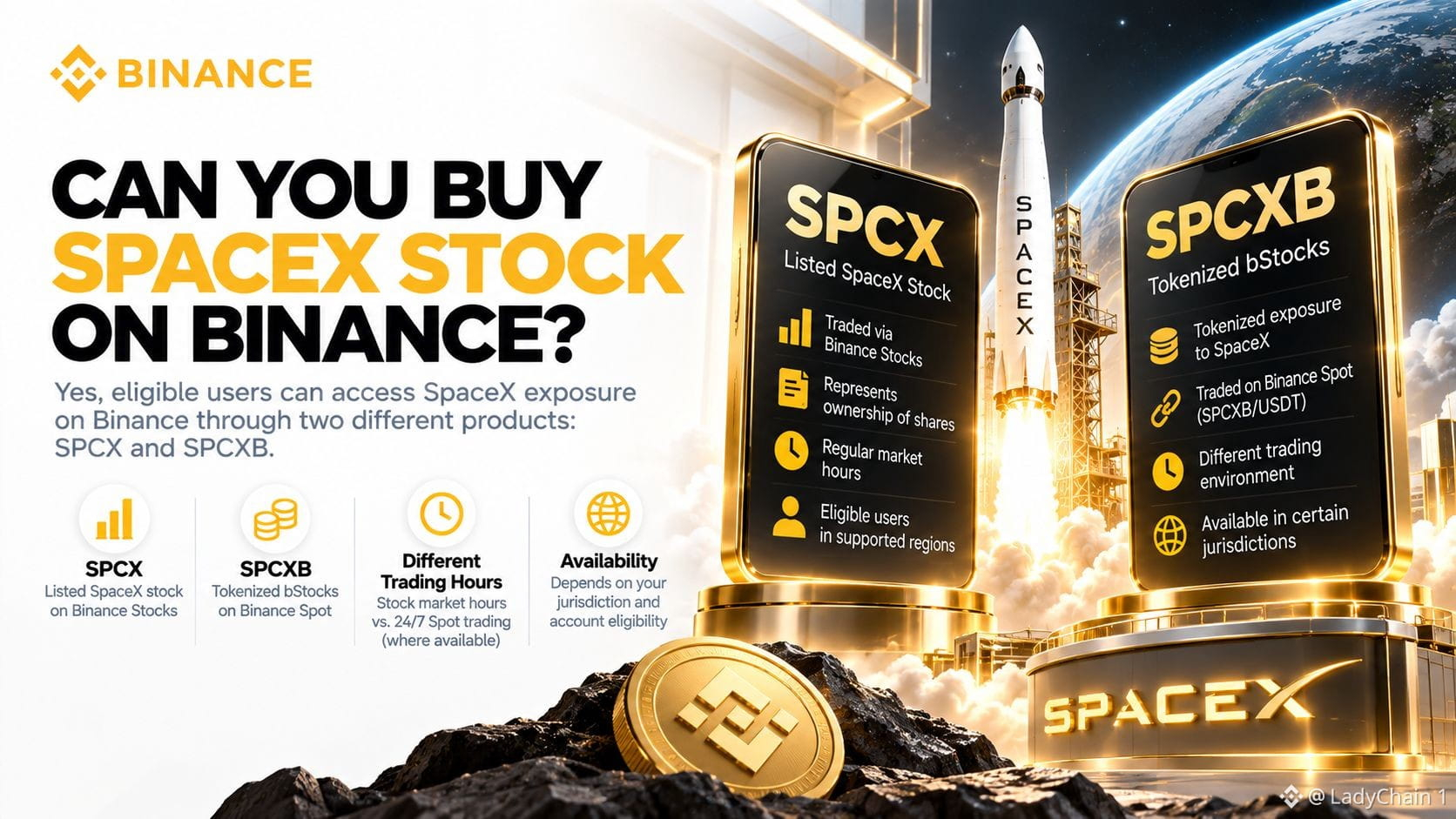
Can You Buy SpaceX Stock on Binance? Yes, eligible Binance users can access SpaceX exposure through two different products: SPCX, the listed SpaceX stock available through Binance Stocks, and SPCXB, a tokenized bStocks product linked to SpaceX securities. The two products are different, so it’s important not to treat them as interchangeable. SPCX: Listed SpaceX Stock Binance Stocks allows eligible users to trade SPCX through a traditional securities structure. Binance introduced whole-share, regular-hours limit orders for SPCX in June 2026. Users who want exposure to the listed SpaceX equity should distinguish SPCX from the tokenized product. SPCXB: SpaceX Tokenized bStocks SPCXB is a tokenized security linked to underlying SpaceX securities. It trades on Binance Spot through the SPCXB/USDT pair. Unlike direct stock ownership, holding SPCXB does not mean directly owning the underlying SpaceX shares. Instead, it provides tokenized exposure through a separate legal and trading structure. Another difference is trading hours. SPCX follows applicable stock-market sessions, while SPCXB trades through Binance Spot, allowing a different trading environment where the product is available. So, can you buy SpaceX stock on Binance? Yes, but the answer depends on which product you mean. SPCX = listed SpaceX stock through Binance Stocks SPCXB = tokenized SpaceX security traded on Binance Spot For users in Indonesia and other jurisdictions, availability depends on location and account eligibility. The fact that a product is listed on Binance does not mean it is available to every user. Before trading, check the product page and applicable terms for your account and jurisdiction. This content is for educational purposes only and is not investment advice. Product availability, eligibility, fees, trading hours, and regulatory treatment may change.
Can You Buy SpaceX Stock on Binance? Yes, eligible Binance users can access SpaceX exposure through two different products: SPCX, the listed SpaceX stock available through Binance Stocks, and SPCXB, a tokenized bStocks product linked to SpaceX securities. The two products are different, so it’s important not to treat them as interchangeable. SPCX: Listed SpaceX Stock Binance Stocks allows eligible users to trade SPCX through a traditional securities structure. Binance introduced whole-share, regular-hours limit orders for SPCX in June 2026. Users who want exposure to the listed SpaceX equity should distinguish SPCX from the tokenized product. SPCXB: SpaceX Tokenized bStocks SPCXB is a tokenized security linked to underlying SpaceX securities. It trades on Binance Spot through the SPCXB/USDT pair. Unlike direct stock ownership, holding SPCXB does not mean directly owning the underlying SpaceX shares. Instead, it provides tokenized exposure through a separate legal and trading structure. Another difference is trading hours. SPCX follows applicable stock-market sessions, while SPCXB trades through Binance Spot, allowing a different trading environment where the product is available. So, can you buy SpaceX stock on Binance? Yes, but the answer depends on which product you mean. SPCX = listed SpaceX stock through Binance Stocks SPCXB = tokenized SpaceX security traded on Binance Spot For users in Indonesia and other jurisdictions, availability depends on location and account eligibility. The fact that a product is listed on Binance does not mean it is available to every user. Before trading, check the product page and applicable terms for your account and jurisdiction. This content is for educational purposes only and is not investment advice. Product availability, eligibility, fees, trading hours, and regulatory treatment may change.
31
·
--
查看翻譯
The AI Narrative Is Evolving From Models to Autonomous Agents
Artificial Superintelligence Alliance ($FET ) sits at an interesting intersection between artificial intelligence, decentralized infrastructure, and autonomous agents.
The broader AI narrative in crypto is gradually shifting.
Early projects mainly focused on bringing machine learning models and AI-related computing into blockchain ecosystems. The next question is whether AI agents can actually interact with digital markets, applications, and other agents without requiring humans to control every step.
This is where projects like the Artificial Superintelligence Alliance become interesting.
The alliance brings together Fetch.ai , SingularityNET, and CUDOS with the broader goal of developing decentralized AI infrastructure and services.
AI agents could potentially perform tasks such as finding information, coordinating services, interacting with applications, or executing predefined actions based on user instructions.
But the infrastructure needs to solve several difficult problems.
Agents need reliable data. They need access to computing resources. They need ways to communicate with other systems. And most importantly, users need to be able to trust the outputs and actions generated by these systems.
Blockchain can potentially provide useful infrastructure for coordination, payments, identity, and verification, but it does not automatically solve every AI problem.
That is why real adoption will matter more than the AI narrative itself.
The $FET token is part of the economic layer supporting the ecosystem, while the larger thesis depends on whether decentralized AI services can attract developers and real users.
The interesting question is:
Will AI agents become another crypto narrative, or will they eventually become actual users of blockchain infrastructure?
$FET #ASI #ArtificialIntelligence #AIAgents
The AI Narrative Is Evolving From Models to Autonomous Agents
Artificial Superintelligence Alliance ($FET ) sits at an interesting intersection between artificial intelligence, decentralized infrastructure, and autonomous agents.
The broader AI narrative in crypto is gradually shifting.
Early projects mainly focused on bringing machine learning models and AI-related computing into blockchain ecosystems. The next question is whether AI agents can actually interact with digital markets, applications, and other agents without requiring humans to control every step.
This is where projects like the Artificial Superintelligence Alliance become interesting.
The alliance brings together Fetch.ai , SingularityNET, and CUDOS with the broader goal of developing decentralized AI infrastructure and services.
AI agents could potentially perform tasks such as finding information, coordinating services, interacting with applications, or executing predefined actions based on user instructions.
But the infrastructure needs to solve several difficult problems.
Agents need reliable data. They need access to computing resources. They need ways to communicate with other systems. And most importantly, users need to be able to trust the outputs and actions generated by these systems.
Blockchain can potentially provide useful infrastructure for coordination, payments, identity, and verification, but it does not automatically solve every AI problem.
That is why real adoption will matter more than the AI narrative itself.
The $FET token is part of the economic layer supporting the ecosystem, while the larger thesis depends on whether decentralized AI services can attract developers and real users.
The interesting question is:
Will AI agents become another crypto narrative, or will they eventually become actual users of blockchain infrastructure?
$FET #ASI #ArtificialIntelligence #AIAgents
Artificial Superintelligence Alliance ($FET ) sits at an interesting intersection between artificial intelligence, decentralized infrastructure, and autonomous agents.
The broader AI narrative in crypto is gradually shifting.
Early projects mainly focused on bringing machine learning models and AI-related computing into blockchain ecosystems. The next question is whether AI agents can actually interact with digital markets, applications, and other agents without requiring humans to control every step.
This is where projects like the Artificial Superintelligence Alliance become interesting.
The alliance brings together Fetch.ai , SingularityNET, and CUDOS with the broader goal of developing decentralized AI infrastructure and services.
AI agents could potentially perform tasks such as finding information, coordinating services, interacting with applications, or executing predefined actions based on user instructions.
But the infrastructure needs to solve several difficult problems.
Agents need reliable data. They need access to computing resources. They need ways to communicate with other systems. And most importantly, users need to be able to trust the outputs and actions generated by these systems.
Blockchain can potentially provide useful infrastructure for coordination, payments, identity, and verification, but it does not automatically solve every AI problem.
That is why real adoption will matter more than the AI narrative itself.
The $FET token is part of the economic layer supporting the ecosystem, while the larger thesis depends on whether decentralized AI services can attract developers and real users.
The interesting question is:
Will AI agents become another crypto narrative, or will they eventually become actual users of blockchain infrastructure?
$FET #ASI #ArtificialIntelligence #AIAgents
48
·
--
查看翻譯
Aave V4 Shows How DeFi Lending Is Evolving Beyond Simple Borrowing
Aave ($AAVE ) continues to expand its lending infrastructure as the protocol moves deeper into its V4 development.
One development worth watching is the growth of Aave V4 deposits, which recently crossed $1 billion according to CoinMarketCap’s latest coverage. The protocol has also been working through new collateral proposals and expanding the range of assets that can interact with its lending markets.
This matters because decentralized lending is becoming more complex.
The early DeFi model was relatively simple: deposit an asset, borrow another asset, and manage the collateral ratio.
Modern lending protocols are trying to support a much broader financial system. That requires better risk management, more flexible markets, deeper liquidity, and mechanisms that can respond to different types of collateral.
Aave’s V4 is designed around that evolution.
The protocol is also expanding across multiple blockchain ecosystems, which creates another challenge: liquidity can become fragmented when users and assets are distributed across different networks.
A successful lending protocol therefore needs more than high total value locked. It needs active borrowers, sustainable liquidity, efficient risk management, and continued developer activity.
The $AAVE token is part of the protocol’s governance and broader ecosystem, while the underlying lending markets generate the activity that ultimately determines whether the infrastructure is useful.
The interesting question is no longer simply how much liquidity a DeFi protocol can attract.
It is whether that liquidity can support sustainable borrowing demand.
Can Aave V4 turn deeper liquidity and more flexible markets into the next stage of decentralized lending?
$AAVE #Aave #DeFi #Lending
Aave V4 Shows How DeFi Lending Is Evolving Beyond Simple Borrowing
Aave ($AAVE ) continues to expand its lending infrastructure as the protocol moves deeper into its V4 development.
One development worth watching is the growth of Aave V4 deposits, which recently crossed $1 billion according to CoinMarketCap’s latest coverage. The protocol has also been working through new collateral proposals and expanding the range of assets that can interact with its lending markets.
This matters because decentralized lending is becoming more complex.
The early DeFi model was relatively simple: deposit an asset, borrow another asset, and manage the collateral ratio.
Modern lending protocols are trying to support a much broader financial system. That requires better risk management, more flexible markets, deeper liquidity, and mechanisms that can respond to different types of collateral.
Aave’s V4 is designed around that evolution.
The protocol is also expanding across multiple blockchain ecosystems, which creates another challenge: liquidity can become fragmented when users and assets are distributed across different networks.
A successful lending protocol therefore needs more than high total value locked. It needs active borrowers, sustainable liquidity, efficient risk management, and continued developer activity.
The $AAVE token is part of the protocol’s governance and broader ecosystem, while the underlying lending markets generate the activity that ultimately determines whether the infrastructure is useful.
The interesting question is no longer simply how much liquidity a DeFi protocol can attract.
It is whether that liquidity can support sustainable borrowing demand.
Can Aave V4 turn deeper liquidity and more flexible markets into the next stage of decentralized lending?
$AAVE #Aave #DeFi #Lending
Aave ($AAVE ) continues to expand its lending infrastructure as the protocol moves deeper into its V4 development.
One development worth watching is the growth of Aave V4 deposits, which recently crossed $1 billion according to CoinMarketCap’s latest coverage. The protocol has also been working through new collateral proposals and expanding the range of assets that can interact with its lending markets.
This matters because decentralized lending is becoming more complex.
The early DeFi model was relatively simple: deposit an asset, borrow another asset, and manage the collateral ratio.
Modern lending protocols are trying to support a much broader financial system. That requires better risk management, more flexible markets, deeper liquidity, and mechanisms that can respond to different types of collateral.
Aave’s V4 is designed around that evolution.
The protocol is also expanding across multiple blockchain ecosystems, which creates another challenge: liquidity can become fragmented when users and assets are distributed across different networks.
A successful lending protocol therefore needs more than high total value locked. It needs active borrowers, sustainable liquidity, efficient risk management, and continued developer activity.
The $AAVE token is part of the protocol’s governance and broader ecosystem, while the underlying lending markets generate the activity that ultimately determines whether the infrastructure is useful.
The interesting question is no longer simply how much liquidity a DeFi protocol can attract.
It is whether that liquidity can support sustainable borrowing demand.
Can Aave V4 turn deeper liquidity and more flexible markets into the next stage of decentralized lending?
$AAVE #Aave #DeFi #Lending
58
·
--
查看翻譯
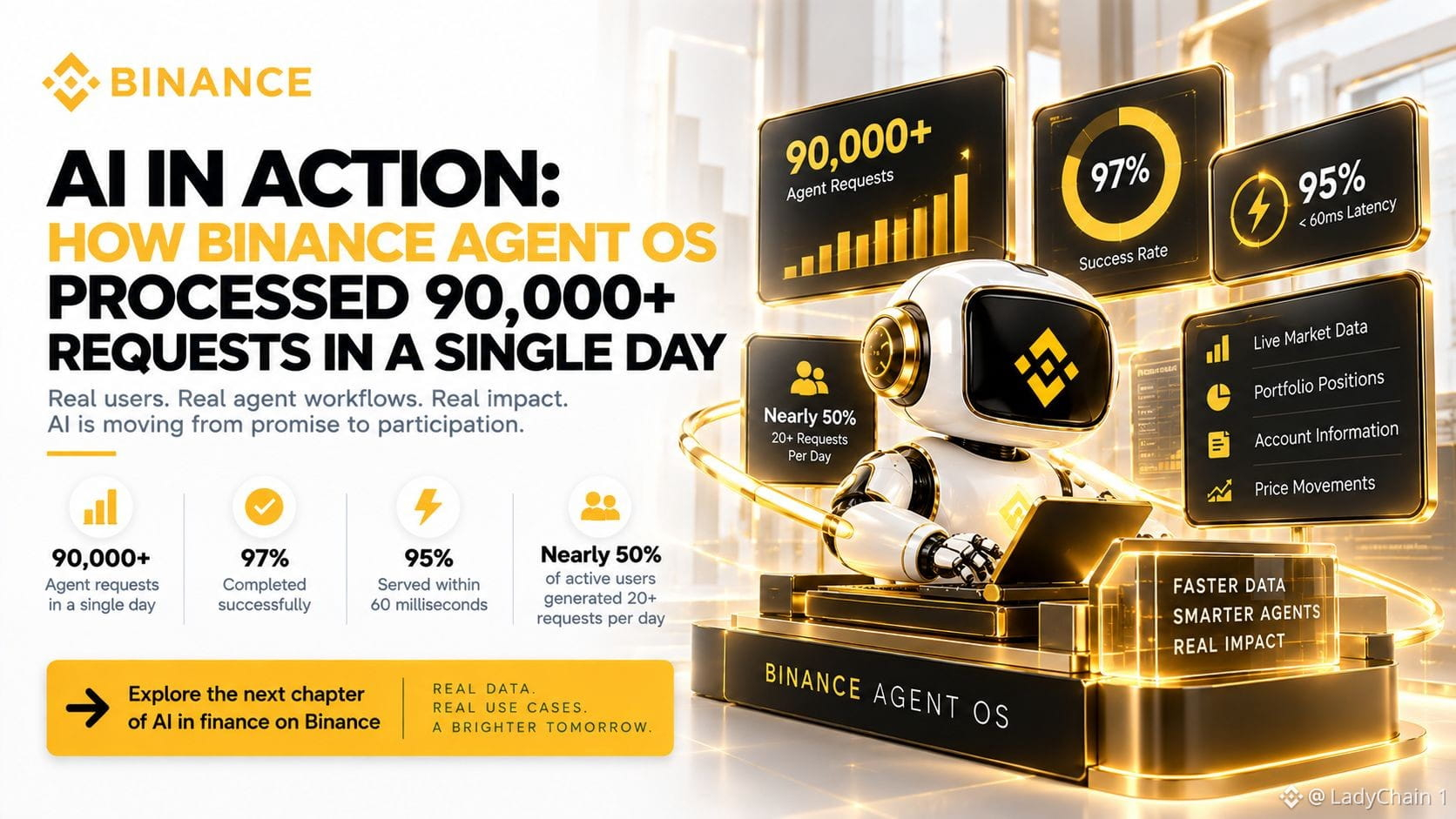
AI in Action: How Binance Agent OS Processed 90,000+ Requests in a Single Day AI is moving from promise to participation. Binance Agent OS's first-week production data makes the transition concrete. The performance numbers In a single day: 90,000+ agent requests processed. 97% completed successfully. 95% served within 60 milliseconds. Each number addresses a different dimension of production readiness. Volume confirms genuine adoption. 97% success rate at this scale reflects serious reliability engineering — in a distributed system under load, keeping failures below 3% requires architectural discipline. 95% sub-60ms is the critical one for financial use: agents monitoring live markets need responses fast enough to act on current data, not data that has already moved. Binance Agent OS meets that requirement for 95% of requests. How users are actually using it Nearly half of active users generated 20+ requests daily — the behavioral signature of genuine agentic workflows, not manual queries. The most-used capabilities: live market data, portfolio positions, account information, price movements. These are the continuous inputs a financial monitoring agent needs to function. The user base adopting Binance Agent OS in its first weeks is running agents persistently, not experimenting casually. What this means for the AI economy The question that has followed record AI infrastructure investment — whether capability translates into durable, useful applications — is being answered in production. 90,000 daily requests. 97% success. 95% under 60ms. These are not benchmark results. They are operating metrics from a live financial infrastructure product with real users running real agent workflows. The next chapter of AI is not about intelligence. It is about useful action at scale. For informational purposes only. Not financial advice.
AI in Action: How Binance Agent OS Processed 90,000+ Requests in a Single Day AI is moving from promise to participation. Binance Agent OS's first-week production data makes the transition concrete. The performance numbers In a single day: 90,000+ agent requests processed. 97% completed successfully. 95% served within 60 milliseconds. Each number addresses a different dimension of production readiness. Volume confirms genuine adoption. 97% success rate at this scale reflects serious reliability engineering — in a distributed system under load, keeping failures below 3% requires architectural discipline. 95% sub-60ms is the critical one for financial use: agents monitoring live markets need responses fast enough to act on current data, not data that has already moved. Binance Agent OS meets that requirement for 95% of requests. How users are actually using it Nearly half of active users generated 20+ requests daily — the behavioral signature of genuine agentic workflows, not manual queries. The most-used capabilities: live market data, portfolio positions, account information, price movements. These are the continuous inputs a financial monitoring agent needs to function. The user base adopting Binance Agent OS in its first weeks is running agents persistently, not experimenting casually. What this means for the AI economy The question that has followed record AI infrastructure investment — whether capability translates into durable, useful applications — is being answered in production. 90,000 daily requests. 97% success. 95% under 60ms. These are not benchmark results. They are operating metrics from a live financial infrastructure product with real users running real agent workflows. The next chapter of AI is not about intelligence. It is about useful action at scale. For informational purposes only. Not financial advice.
2
·
--
Bitget 剛成爲最新的提醒:交易所安全不僅僅在於資金有多少被放在保護基金裏。據報道,約有 3.516 億美元從 Bitget 的熱錢包和溫錢包中被轉出,而其冷錢包據稱未受影響。提現被暫停,交易所表示其 4.64 億美元的用戶保護基金足以覆蓋據稱的損失。讓我覺得更有意思的是,圍繞此次攻擊本身仍存在不確定性。攻擊的確切路徑(向量)仍在調查中,而鏈上追蹤者已識別出有一小部分資金從標記地址中轉出。這個時間差使得即將到來的 24 小時報告格外重要。襲擊者似乎還將一大筆資金轉換成了以太坊(ETH),從而讓資金更難被凍結。就我個人而言,我認爲保護基金令人安心,但它並不能回答更大的問題:這些資金究竟是如何在第一時間離開的?在確認攻擊向量之前,很難判斷這是否只是一次孤立事件,還是其他交易所也應該引起注意的情況。對我來說,下一份報告比頭條數字更關鍵。如果攻擊向量被清晰識別並得到修復,信心就能開始恢復;否則,提現方面的擔憂可能會在週末前演變成更大的故事。
Bitget 剛成爲最新的提醒:交易所安全不僅僅在於資金有多少被放在保護基金裏。據報道,約有 3.516 億美元從 Bitget 的熱錢包和溫錢包中被轉出,而其冷錢包據稱未受影響。提現被暫停,交易所表示其 4.64 億美元的用戶保護基金足以覆蓋據稱的損失。讓我覺得更有意思的是,圍繞此次攻擊本身仍存在不確定性。攻擊的確切路徑(向量)仍在調查中,而鏈上追蹤者已識別出有一小部分資金從標記地址中轉出。這個時間差使得即將到來的 24 小時報告格外重要。襲擊者似乎還將一大筆資金轉換成了以太坊(ETH),從而讓資金更難被凍結。就我個人而言,我認爲保護基金令人安心,但它並不能回答更大的問題:這些資金究竟是如何在第一時間離開的?在確認攻擊向量之前,很難判斷這是否只是一次孤立事件,還是其他交易所也應該引起注意的情況。對我來說,下一份報告比頭條數字更關鍵。如果攻擊向量被清晰識別並得到修復,信心就能開始恢復;否則,提現方面的擔憂可能會在週末前演變成更大的故事。
1
·
--
5%的美國國債收益率聽起來像是比特幣的一個問題,但歷史讓這幅畫面變得更復雜一些。10年期收益率升至5.12%,使BTC所處的環境與我們習慣的局面截然不同。當投資者在不承受加密貨幣級別波動的情況下,就能從美國政府債務中獲得相對較高的收益時,持有BTC的機會成本自然就更難被忽視。這或許能解釋圍繞84K附近的部分壓力。但我不認爲更高的收益率會自動意味着比特幣的反彈就此結束。即使在國債收益率走高的情況下,我們也見過BTC表現強勁。更關鍵的問題是:收益率爲何在上升,以及這種壓力是否會持續。對我來說,83K是一個值得關注的有趣水平。如果BTC在收益率上升的情況下還能守住它,那將體現出一定的韌性。若守不住,80K和75K可能會變得更重要。就我個人而言,我關注的是收益率與BTC之間的關係,而不是單看任何一張圖表。更高的收益率可以沖刷掉槓桿和投機倉位——但這種“清理”也可能在壓力消退後讓市場變得更健康。那麼,5%的美國國債收益率會與比特幣展開競爭嗎?當然會。但它究竟會成爲長期的逆風,還是僅僅又一輪波動階段,這正是我接下來要觀察的內容。
5%的美國國債收益率聽起來像是比特幣的一個問題,但歷史讓這幅畫面變得更復雜一些。10年期收益率升至5.12%,使BTC所處的環境與我們習慣的局面截然不同。當投資者在不承受加密貨幣級別波動的情況下,就能從美國政府債務中獲得相對較高的收益時,持有BTC的機會成本自然就更難被忽視。這或許能解釋圍繞84K附近的部分壓力。但我不認爲更高的收益率會自動意味着比特幣的反彈就此結束。即使在國債收益率走高的情況下,我們也見過BTC表現強勁。更關鍵的問題是:收益率爲何在上升,以及這種壓力是否會持續。對我來說,83K是一個值得關注的有趣水平。如果BTC在收益率上升的情況下還能守住它,那將體現出一定的韌性。若守不住,80K和75K可能會變得更重要。就我個人而言,我關注的是收益率與BTC之間的關係,而不是單看任何一張圖表。更高的收益率可以沖刷掉槓桿和投機倉位——但這種“清理”也可能在壓力消退後讓市場變得更健康。那麼,5%的美國國債收益率會與比特幣展開競爭嗎?當然會。但它究竟會成爲長期的逆風,還是僅僅又一輪波動階段,這正是我接下來要觀察的內容。
BTC+0.47%
IEFETF+0.29%
25
·
--
查看翻譯
$18B in BTC and ETH options expiring on Friday sounds scary at first, but I think the headline can be a little misleading. The interesting part isn’t just the size of the expiry. It’s the gap between the current BTC price and the $75K max pain level. A move back there would be significant, but max pain isn’t a price target that automatically pulls Bitcoin toward it. What I’m watching instead is how the market behaves as the expiry gets closer. With so much open interest, dealer hedging could create some sharp moves in either direction, especially if BTC approaches the major positioning levels. The bullish side is also worth considering. A put/call ratio around 0.66 suggests the options book isn’t overwhelmingly defensive, and some traders may simply be using puts as protection after the recent rally. Personally, I wouldn’t read Friday’s expiry as either an automatic crash signal or a bullish catalyst. For me, the real test comes after the options settle. Does BTC hold the higher range once the hedging pressure disappears, or does the market finally give back some of the recent gains?
$18B in BTC and ETH options expiring on Friday sounds scary at first, but I think the headline can be a little misleading. The interesting part isn’t just the size of the expiry. It’s the gap between the current BTC price and the $75K max pain level. A move back there would be significant, but max pain isn’t a price target that automatically pulls Bitcoin toward it. What I’m watching instead is how the market behaves as the expiry gets closer. With so much open interest, dealer hedging could create some sharp moves in either direction, especially if BTC approaches the major positioning levels. The bullish side is also worth considering. A put/call ratio around 0.66 suggests the options book isn’t overwhelmingly defensive, and some traders may simply be using puts as protection after the recent rally. Personally, I wouldn’t read Friday’s expiry as either an automatic crash signal or a bullish catalyst. For me, the real test comes after the options settle. Does BTC hold the higher range once the hedging pressure disappears, or does the market finally give back some of the recent gains?
25
·
--
查看翻譯
Bitcoin hitting an eight-month high is impressive, but what caught my attention was how quickly four other major alts started moving even faster. BCH, NEAR, DOGE and XRP all had strong sessions, but I don’t think they should be treated as one big “altseason” trade. Each move has a different story behind it. BCH has the CME futures catalyst, NEAR has activity around Intents, while XRP and DOGE also benefited from a wave of short liquidations. That’s why I’m more interested in what happens after the initial pump. A big green candle can show momentum, but it doesn’t necessarily mean the market has found lasting demand. For me, the real test is whether these assets can hold their gains and maintain strong spot volume once the short squeeze fades. If they can, the move becomes much more interesting. If most of the gains disappear within a few sessions, then it may have been more about positioning than genuine rotation. Right now, I’m watching the follow-through more than the percentage gains.
Bitcoin hitting an eight-month high is impressive, but what caught my attention was how quickly four other major alts started moving even faster. BCH, NEAR, DOGE and XRP all had strong sessions, but I don’t think they should be treated as one big “altseason” trade. Each move has a different story behind it. BCH has the CME futures catalyst, NEAR has activity around Intents, while XRP and DOGE also benefited from a wave of short liquidations. That’s why I’m more interested in what happens after the initial pump. A big green candle can show momentum, but it doesn’t necessarily mean the market has found lasting demand. For me, the real test is whether these assets can hold their gains and maintain strong spot volume once the short squeeze fades. If they can, the move becomes much more interesting. If most of the gains disappear within a few sessions, then it may have been more about positioning than genuine rotation. Right now, I’m watching the follow-through more than the percentage gains.
32
·
--
查看翻譯
Stellar’s Next Challenge Is Turning Blockchain Rails Into Real Payment Volume
Stellar ($XLM ) has spent years positioning itself as infrastructure for moving money across borders. The latest developments show why that payment-focused approach remains relevant as stablecoins become a bigger part of the financial system.
One development worth watching is BVNK’s integration of the Stellar network into its global stablecoin payments platform. According to recent coverage, customers can use Stellar for payments, remittances, and treasury flows across more than 130 markets through BVNK’s existing infrastructure.
The significance goes beyond a single integration.
For blockchain payment networks, the important question is not simply whether transactions are fast or inexpensive. The bigger challenge is whether businesses actually use the network to move meaningful amounts of money.
Stellar is designed around that use case. XLM serves as the native asset of the network and supports transaction fees and multi-currency transfers, while the underlying blockchain provides the settlement infrastructure.
Stellar has also been expanding its role in the stablecoin ecosystem. USDT0 launched on Stellar earlier this month through LayerZero, adding another stablecoin-related use case to the network.
This creates an interesting intersection between traditional financial infrastructure and blockchain rails.
If more payment providers, fintech companies, and financial institutions connect their existing systems to blockchain networks, networks like Stellar could become part of the infrastructure behind those transactions.
But adoption still needs to be measured through actual payment volume, active users, stablecoin activity, and the number of businesses integrating the network.
The key question is:
Can Stellar turn its growing list of payment integrations into sustained real-world usage?
$XLM #Stellar #Blockchain #Stablecoins #Payments
Stellar’s Next Challenge Is Turning Blockchain Rails Into Real Payment Volume
Stellar ($XLM ) has spent years positioning itself as infrastructure for moving money across borders. The latest developments show why that payment-focused approach remains relevant as stablecoins become a bigger part of the financial system.
One development worth watching is BVNK’s integration of the Stellar network into its global stablecoin payments platform. According to recent coverage, customers can use Stellar for payments, remittances, and treasury flows across more than 130 markets through BVNK’s existing infrastructure.
The significance goes beyond a single integration.
For blockchain payment networks, the important question is not simply whether transactions are fast or inexpensive. The bigger challenge is whether businesses actually use the network to move meaningful amounts of money.
Stellar is designed around that use case. XLM serves as the native asset of the network and supports transaction fees and multi-currency transfers, while the underlying blockchain provides the settlement infrastructure.
Stellar has also been expanding its role in the stablecoin ecosystem. USDT0 launched on Stellar earlier this month through LayerZero, adding another stablecoin-related use case to the network.
This creates an interesting intersection between traditional financial infrastructure and blockchain rails.
If more payment providers, fintech companies, and financial institutions connect their existing systems to blockchain networks, networks like Stellar could become part of the infrastructure behind those transactions.
But adoption still needs to be measured through actual payment volume, active users, stablecoin activity, and the number of businesses integrating the network.
The key question is:
Can Stellar turn its growing list of payment integrations into sustained real-world usage?
$XLM #Stellar #Blockchain #Stablecoins #Payments
Stellar ($XLM ) has spent years positioning itself as infrastructure for moving money across borders. The latest developments show why that payment-focused approach remains relevant as stablecoins become a bigger part of the financial system.
One development worth watching is BVNK’s integration of the Stellar network into its global stablecoin payments platform. According to recent coverage, customers can use Stellar for payments, remittances, and treasury flows across more than 130 markets through BVNK’s existing infrastructure.
The significance goes beyond a single integration.
For blockchain payment networks, the important question is not simply whether transactions are fast or inexpensive. The bigger challenge is whether businesses actually use the network to move meaningful amounts of money.
Stellar is designed around that use case. XLM serves as the native asset of the network and supports transaction fees and multi-currency transfers, while the underlying blockchain provides the settlement infrastructure.
Stellar has also been expanding its role in the stablecoin ecosystem. USDT0 launched on Stellar earlier this month through LayerZero, adding another stablecoin-related use case to the network.
This creates an interesting intersection between traditional financial infrastructure and blockchain rails.
If more payment providers, fintech companies, and financial institutions connect their existing systems to blockchain networks, networks like Stellar could become part of the infrastructure behind those transactions.
But adoption still needs to be measured through actual payment volume, active users, stablecoin activity, and the number of businesses integrating the network.
The key question is:
Can Stellar turn its growing list of payment integrations into sustained real-world usage?
$XLM #Stellar #Blockchain #Stablecoins #Payments
54
·
--
查看翻譯
Injective’s Meridian Upgrade Pushes RWA Infrastructure Further Onchain
Injective ($INJ ) is expanding its role in financial infrastructure with the launch of the Meridian mainnet upgrade.
The upgrade went live on September 24 and introduces new capabilities around regulated real-world assets and tokenized stocks. The goal is to make it easier for financial products to be issued, traded, and settled onchain.
This is an important direction for blockchain-based finance because tokenization is only one part of the process. Financial markets also require trading infrastructure, settlement mechanisms, compliance considerations, and liquidity.
Injective is positioning its blockchain around these use cases rather than treating RWA as a separate application layer.
Another interesting part of the ecosystem is its focus on financial markets. Injective is designed to support decentralized applications for trading and other financial activities, while $INJ is used for governance, staking, and the network’s economic mechanisms.
The Meridian upgrade could therefore be viewed as more than a technical update. It represents an attempt to connect blockchain infrastructure with financial products that operate within more structured regulatory frameworks.
The key question now is how developers, institutions, and users will adopt these new capabilities.
Will tokenized stocks and regulated RWAs become a meaningful part of onchain markets, or will adoption remain concentrated among early users?
$INJ #Injective #RWA #RealWorldAssets
Injective’s Meridian Upgrade Pushes RWA Infrastructure Further Onchain
Injective ($INJ ) is expanding its role in financial infrastructure with the launch of the Meridian mainnet upgrade.
The upgrade went live on September 24 and introduces new capabilities around regulated real-world assets and tokenized stocks. The goal is to make it easier for financial products to be issued, traded, and settled onchain.
This is an important direction for blockchain-based finance because tokenization is only one part of the process. Financial markets also require trading infrastructure, settlement mechanisms, compliance considerations, and liquidity.
Injective is positioning its blockchain around these use cases rather than treating RWA as a separate application layer.
Another interesting part of the ecosystem is its focus on financial markets. Injective is designed to support decentralized applications for trading and other financial activities, while $INJ is used for governance, staking, and the network’s economic mechanisms.
The Meridian upgrade could therefore be viewed as more than a technical update. It represents an attempt to connect blockchain infrastructure with financial products that operate within more structured regulatory frameworks.
The key question now is how developers, institutions, and users will adopt these new capabilities.
Will tokenized stocks and regulated RWAs become a meaningful part of onchain markets, or will adoption remain concentrated among early users?
$INJ #Injective #RWA #RealWorldAssets
Injective ($INJ ) is expanding its role in financial infrastructure with the launch of the Meridian mainnet upgrade.
The upgrade went live on September 24 and introduces new capabilities around regulated real-world assets and tokenized stocks. The goal is to make it easier for financial products to be issued, traded, and settled onchain.
This is an important direction for blockchain-based finance because tokenization is only one part of the process. Financial markets also require trading infrastructure, settlement mechanisms, compliance considerations, and liquidity.
Injective is positioning its blockchain around these use cases rather than treating RWA as a separate application layer.
Another interesting part of the ecosystem is its focus on financial markets. Injective is designed to support decentralized applications for trading and other financial activities, while $INJ is used for governance, staking, and the network’s economic mechanisms.
The Meridian upgrade could therefore be viewed as more than a technical update. It represents an attempt to connect blockchain infrastructure with financial products that operate within more structured regulatory frameworks.
The key question now is how developers, institutions, and users will adopt these new capabilities.
Will tokenized stocks and regulated RWAs become a meaningful part of onchain markets, or will adoption remain concentrated among early users?
$INJ #Injective #RWA #RealWorldAssets
71
·
--
查看翻譯
Bittensor’s Bigger Test Is Turning AI Competition Into Useful Products
Bittensor ($TAO ) is one of the more interesting projects at the intersection of AI and crypto because it does not simply put an AI application on a blockchain.
Its model is built around a network of specialized subnets, where participants provide different forms of machine intelligence and are rewarded according to the value of their contributions.
This creates a marketplace for AI rather than a single centralized model.
The concept is compelling, but it also creates a difficult question: how do you measure whether a subnet is actually providing useful intelligence?
Bittensor's incentive system is designed to reward valuable contributions, but the long-term success of the network depends on whether those incentives lead to services that developers and users genuinely need.
The growing number of subnets also creates another challenge. More specialized markets can increase experimentation, but they can make the ecosystem harder for newcomers to understand and navigate.
This is where infrastructure, data quality, model performance, and real demand become important.
The $TAO token sits at the center of Bittensor's economic system, while subnet tokens allow individual AI markets to develop within the broader network.
Recent market activity has again put attention on Bittensor, but price movement is not the most important metric for evaluating the project.
The bigger question is whether decentralized AI markets can produce useful services that compete with centralized alternatives.
If Bittensor can turn experimentation into sustained demand, its model could become more significant as the AI economy develops.
Which matters more for decentralized AI: better models or better incentives?
$TAO #Bittensor #AI #DePIN
Bittensor’s Bigger Test Is Turning AI Competition Into Useful Products
Bittensor ($TAO ) is one of the more interesting projects at the intersection of AI and crypto because it does not simply put an AI application on a blockchain.
Its model is built around a network of specialized subnets, where participants provide different forms of machine intelligence and are rewarded according to the value of their contributions.
This creates a marketplace for AI rather than a single centralized model.
The concept is compelling, but it also creates a difficult question: how do you measure whether a subnet is actually providing useful intelligence?
Bittensor's incentive system is designed to reward valuable contributions, but the long-term success of the network depends on whether those incentives lead to services that developers and users genuinely need.
The growing number of subnets also creates another challenge. More specialized markets can increase experimentation, but they can make the ecosystem harder for newcomers to understand and navigate.
This is where infrastructure, data quality, model performance, and real demand become important.
The $TAO token sits at the center of Bittensor's economic system, while subnet tokens allow individual AI markets to develop within the broader network.
Recent market activity has again put attention on Bittensor, but price movement is not the most important metric for evaluating the project.
The bigger question is whether decentralized AI markets can produce useful services that compete with centralized alternatives.
If Bittensor can turn experimentation into sustained demand, its model could become more significant as the AI economy develops.
Which matters more for decentralized AI: better models or better incentives?
$TAO #Bittensor #AI #DePIN
Bittensor ($TAO ) is one of the more interesting projects at the intersection of AI and crypto because it does not simply put an AI application on a blockchain.
Its model is built around a network of specialized subnets, where participants provide different forms of machine intelligence and are rewarded according to the value of their contributions.
This creates a marketplace for AI rather than a single centralized model.
The concept is compelling, but it also creates a difficult question: how do you measure whether a subnet is actually providing useful intelligence?
Bittensor's incentive system is designed to reward valuable contributions, but the long-term success of the network depends on whether those incentives lead to services that developers and users genuinely need.
The growing number of subnets also creates another challenge. More specialized markets can increase experimentation, but they can make the ecosystem harder for newcomers to understand and navigate.
This is where infrastructure, data quality, model performance, and real demand become important.
The $TAO token sits at the center of Bittensor's economic system, while subnet tokens allow individual AI markets to develop within the broader network.
Recent market activity has again put attention on Bittensor, but price movement is not the most important metric for evaluating the project.
The bigger question is whether decentralized AI markets can produce useful services that compete with centralized alternatives.
If Bittensor can turn experimentation into sustained demand, its model could become more significant as the AI economy develops.
Which matters more for decentralized AI: better models or better incentives?
$TAO #Bittensor #AI #DePIN
·
--
查看翻譯
0G Is Building Infrastructure for the AI Economy
0G ( $0G ) is approaching blockchain from an AI infrastructure perspective, combining storage, data availability, computing, and a Layer 1 designed for onchain AI applications.
The idea is important because AI workloads require large amounts of data and computing power. Traditional cloud infrastructure can provide these resources, but decentralized networks are exploring a different model where resources can be supplied by multiple participants.
0G separates several functions across its architecture, including 0G Chain, 0G Storage, 0G Data Availability, and 0G Compute.
A recent development is Ascend, which connects staked 0G with AI compute credits. The project is also preparing Infinite AI, adding another layer to its decentralized AI ecosystem.
The challenge is turning infrastructure into actual demand.
AI developers need reliable performance, competitive costs, sufficient computing capacity, and simple tools. A decentralized network must compete on those factors rather than on narrative alone.
The $0G token is part of the network's economic system, connecting participation with infrastructure usage.
For 0G, the most useful metrics to watch are compute demand, storage usage, developer activity, and applications running on the network.
The broader question is whether decentralized infrastructure can become practical enough for everyday AI workloads.
If it can, projects like 0G could play a role in connecting blockchain networks with the growing AI economy.
$0G #0G #AI #DePIN
0G Is Building Infrastructure for the AI Economy
0G ( $0G ) is approaching blockchain from an AI infrastructure perspective, combining storage, data availability, computing, and a Layer 1 designed for onchain AI applications.
The idea is important because AI workloads require large amounts of data and computing power. Traditional cloud infrastructure can provide these resources, but decentralized networks are exploring a different model where resources can be supplied by multiple participants.
0G separates several functions across its architecture, including 0G Chain, 0G Storage, 0G Data Availability, and 0G Compute.
A recent development is Ascend, which connects staked 0G with AI compute credits. The project is also preparing Infinite AI, adding another layer to its decentralized AI ecosystem.
The challenge is turning infrastructure into actual demand.
AI developers need reliable performance, competitive costs, sufficient computing capacity, and simple tools. A decentralized network must compete on those factors rather than on narrative alone.
The $0G token is part of the network's economic system, connecting participation with infrastructure usage.
For 0G, the most useful metrics to watch are compute demand, storage usage, developer activity, and applications running on the network.
The broader question is whether decentralized infrastructure can become practical enough for everyday AI workloads.
If it can, projects like 0G could play a role in connecting blockchain networks with the growing AI economy.
$0G #0G #AI #DePIN
0G ( $0G ) is approaching blockchain from an AI infrastructure perspective, combining storage, data availability, computing, and a Layer 1 designed for onchain AI applications.
The idea is important because AI workloads require large amounts of data and computing power. Traditional cloud infrastructure can provide these resources, but decentralized networks are exploring a different model where resources can be supplied by multiple participants.
0G separates several functions across its architecture, including 0G Chain, 0G Storage, 0G Data Availability, and 0G Compute.
A recent development is Ascend, which connects staked 0G with AI compute credits. The project is also preparing Infinite AI, adding another layer to its decentralized AI ecosystem.
The challenge is turning infrastructure into actual demand.
AI developers need reliable performance, competitive costs, sufficient computing capacity, and simple tools. A decentralized network must compete on those factors rather than on narrative alone.
The $0G token is part of the network's economic system, connecting participation with infrastructure usage.
For 0G, the most useful metrics to watch are compute demand, storage usage, developer activity, and applications running on the network.
The broader question is whether decentralized infrastructure can become practical enough for everyday AI workloads.
If it can, projects like 0G could play a role in connecting blockchain networks with the growing AI economy.
$0G #0G #AI #DePIN
32
·
--
查看翻譯
BTC just closed above its 50-week moving average for the first time in 45 weeks, and that’s a pretty important technical shift. What I find interesting is that this level has rejected Bitcoin several times before, so reclaiming it is only part of the story. The bigger question is whether $78K–$79K can now turn into support. The next levels are fairly clear: $86K is the next resistance, followed by $90K and potentially $93K if momentum continues. But I wouldn’t ignore how this move happened. Part of the push toward $85K appears to have been driven by short liquidations, which can make a rally look stronger than the underlying spot demand actually is. For me, the weekly close matters more than the initial breakout. If BTC can hold above the 50W MA and buyers keep showing up, this could be a meaningful shift in structure. If it falls back below, we may learn that the reclaim was another failed attempt. Now the real test is whether the former resistance can become support.
BTC just closed above its 50-week moving average for the first time in 45 weeks, and that’s a pretty important technical shift. What I find interesting is that this level has rejected Bitcoin several times before, so reclaiming it is only part of the story. The bigger question is whether $78K–$79K can now turn into support. The next levels are fairly clear: $86K is the next resistance, followed by $90K and potentially $93K if momentum continues. But I wouldn’t ignore how this move happened. Part of the push toward $85K appears to have been driven by short liquidations, which can make a rally look stronger than the underlying spot demand actually is. For me, the weekly close matters more than the initial breakout. If BTC can hold above the 50W MA and buyers keep showing up, this could be a meaningful shift in structure. If it falls back below, we may learn that the reclaim was another failed attempt. Now the real test is whether the former resistance can become support.
26
·
--
查看翻譯
The Fed hiked rates, but Bitcoin didn’t exactly follow the script. BTC briefly dropped below $75K around the decision, then bounced back toward $80K within 48 hours. What caught my attention is that the market seems to be focusing less on the rate hike itself and more on what’s happening with liquidity underneath. The Fed is still tightening the price of money, but its balance sheet and reserve levels tell a more complicated story. Treasury purchases and reserve management can provide support without necessarily meaning we’re back to full-blown QE. That distinction matters. Personally, I’m not ready to call this a new liquidity wave just because BTC bounced. ETF flows still need to show more consistency, especially after recent outflows. For me, $81K is the level to watch next. If BTC can hold above it with real spot demand, the recovery starts to look more convincing. The big question isn’t whether the Fed is easing or tightening. It’s whether liquidity is actually finding its way back into Bitcoin.
The Fed hiked rates, but Bitcoin didn’t exactly follow the script. BTC briefly dropped below $75K around the decision, then bounced back toward $80K within 48 hours. What caught my attention is that the market seems to be focusing less on the rate hike itself and more on what’s happening with liquidity underneath. The Fed is still tightening the price of money, but its balance sheet and reserve levels tell a more complicated story. Treasury purchases and reserve management can provide support without necessarily meaning we’re back to full-blown QE. That distinction matters. Personally, I’m not ready to call this a new liquidity wave just because BTC bounced. ETF flows still need to show more consistency, especially after recent outflows. For me, $81K is the level to watch next. If BTC can hold above it with real spot demand, the recovery starts to look more convincing. The big question isn’t whether the Fed is easing or tightening. It’s whether liquidity is actually finding its way back into Bitcoin.
36
·
--
Creditcoin 正在將 RWA 推進到代幣化資產之外
Creditcoin($CTC)從信用基礎設施的角度切入真實世界資產領域。
與其只關注將實體或金融資產進行代幣化,Creditcoin 的設計目標是記錄信用交易,並在區塊鏈網路之間連接出借人與借款人。
這個想法解決了新興市場中的一個真實問題。個人與企業可能在非銀行放貸者那裡有借貸歷史,但這些紀錄不一定會被傳統金融機構所承認。
Creditcoin 希望在公有區塊鏈上建立一份客觀的信用活動紀錄。這可能讓信用歷史更容易被驗證,並進而將其連接到更廣泛的數位金融體系。
這也使得該專案在 RWA 的敘事中格外引人關注。
真實世界的金融活動並不僅限於不動產或債券等資產。信用紀錄、借貸關係與還款歷史,也都可能成為鏈上金融基礎設施的一部分。
但僅靠技術還不夠。
一個信用網路需要可靠的數據、出借人與借款人、風險評估、流動性,以及可持續的還款活動。
$CTC 代幣是 Creditcoin 網路的原生資產,並支援其更廣泛的生態系。
因此,最關鍵的指標應該是實際的信用活動,而不只是代幣交易。
以區塊鏈為基礎的信用紀錄,能否在提高融資可及性的同時,也讓借貸資料更透明?
$CTC #Creditcoin #RWA #RealWorldAssets
Creditcoin 正在將 RWA 推進到代幣化資產之外
Creditcoin($CTC)從信用基礎設施的角度切入真實世界資產領域。
與其只關注將實體或金融資產進行代幣化,Creditcoin 的設計目標是記錄信用交易,並在區塊鏈網路之間連接出借人與借款人。
這個想法解決了新興市場中的一個真實問題。個人與企業可能在非銀行放貸者那裡有借貸歷史,但這些紀錄不一定會被傳統金融機構所承認。
Creditcoin 希望在公有區塊鏈上建立一份客觀的信用活動紀錄。這可能讓信用歷史更容易被驗證,並進而將其連接到更廣泛的數位金融體系。
這也使得該專案在 RWA 的敘事中格外引人關注。
真實世界的金融活動並不僅限於不動產或債券等資產。信用紀錄、借貸關係與還款歷史,也都可能成為鏈上金融基礎設施的一部分。
但僅靠技術還不夠。
一個信用網路需要可靠的數據、出借人與借款人、風險評估、流動性,以及可持續的還款活動。
$CTC 代幣是 Creditcoin 網路的原生資產,並支援其更廣泛的生態系。
因此,最關鍵的指標應該是實際的信用活動,而不只是代幣交易。
以區塊鏈為基礎的信用紀錄,能否在提高融資可及性的同時,也讓借貸資料更透明?
$CTC #Creditcoin #RWA #RealWorldAssets
Creditcoin($CTC)從信用基礎設施的角度切入真實世界資產領域。
與其只關注將實體或金融資產進行代幣化,Creditcoin 的設計目標是記錄信用交易,並在區塊鏈網路之間連接出借人與借款人。
這個想法解決了新興市場中的一個真實問題。個人與企業可能在非銀行放貸者那裡有借貸歷史,但這些紀錄不一定會被傳統金融機構所承認。
Creditcoin 希望在公有區塊鏈上建立一份客觀的信用活動紀錄。這可能讓信用歷史更容易被驗證,並進而將其連接到更廣泛的數位金融體系。
這也使得該專案在 RWA 的敘事中格外引人關注。
真實世界的金融活動並不僅限於不動產或債券等資產。信用紀錄、借貸關係與還款歷史,也都可能成為鏈上金融基礎設施的一部分。
但僅靠技術還不夠。
一個信用網路需要可靠的數據、出借人與借款人、風險評估、流動性,以及可持續的還款活動。
$CTC 代幣是 Creditcoin 網路的原生資產,並支援其更廣泛的生態系。
因此,最關鍵的指標應該是實際的信用活動,而不只是代幣交易。
以區塊鏈為基礎的信用紀錄,能否在提高融資可及性的同時,也讓借貸資料更透明?
$CTC #Creditcoin #RWA #RealWorldAssets
43
·
--
黃昏(Dusk)正在為受監管的鏈上金融打造基礎設施
Dusk($DUSK)採取了不同的方式來對待真實世界資產(RWA)——聚焦於受監管金融市場所需的基礎設施。
Dusk 是一條用於發行、交易與結算 RWA 的 Layer 1。其架構結合了注重隱私的技術、零知識證明,以及合規工具,來支撐數位證券與其他受監管資產。
這種聚焦很重要,因為代幣化只是開始。
金融機構還需要可靠的結算、所有權記錄、合規流程,以及用於二級市場的基礎設施。Dusk 的設計目標是在同一個區塊鏈環境中滿足這些需求。
值得關注的一項重大進展是 DuskEVM。其測試網允許開發者使用熟悉的以太坊工具部署 Solidity 應用,可能會降低在 Dusk 上打造金融應用的門檻。
專案也在推進受監管的 RWA 應用,包括其預定的與 NPEX 相關的生態系。
$DUSK 代幣在網路內使用,包括作為 gas 與質押之用。它應該與透過該基礎設施所發行的真實世界資產區分開來。
有趣的問題在於:Dusk 能否把其監管與技術基礎設施轉化為真正的網路活動?
RWA 的採用不會只需要代幣發行。它還需要發行方、開發者、流動性與使用者。
一條以合規為導向的區塊鏈,能否成為受監管鏈上市場的實用基礎?
$DUSK #Dusk #RWA #RealWorldAssets
黃昏(Dusk)正在為受監管的鏈上金融打造基礎設施
Dusk($DUSK)採取了不同的方式來對待真實世界資產(RWA)——聚焦於受監管金融市場所需的基礎設施。
Dusk 是一條用於發行、交易與結算 RWA 的 Layer 1。其架構結合了注重隱私的技術、零知識證明,以及合規工具,來支撐數位證券與其他受監管資產。
這種聚焦很重要,因為代幣化只是開始。
金融機構還需要可靠的結算、所有權記錄、合規流程,以及用於二級市場的基礎設施。Dusk 的設計目標是在同一個區塊鏈環境中滿足這些需求。
值得關注的一項重大進展是 DuskEVM。其測試網允許開發者使用熟悉的以太坊工具部署 Solidity 應用,可能會降低在 Dusk 上打造金融應用的門檻。
專案也在推進受監管的 RWA 應用,包括其預定的與 NPEX 相關的生態系。
$DUSK 代幣在網路內使用,包括作為 gas 與質押之用。它應該與透過該基礎設施所發行的真實世界資產區分開來。
有趣的問題在於:Dusk 能否把其監管與技術基礎設施轉化為真正的網路活動?
RWA 的採用不會只需要代幣發行。它還需要發行方、開發者、流動性與使用者。
一條以合規為導向的區塊鏈,能否成為受監管鏈上市場的實用基礎?
$DUSK #Dusk #RWA #RealWorldAssets
Dusk($DUSK)採取了不同的方式來對待真實世界資產(RWA)——聚焦於受監管金融市場所需的基礎設施。
Dusk 是一條用於發行、交易與結算 RWA 的 Layer 1。其架構結合了注重隱私的技術、零知識證明,以及合規工具,來支撐數位證券與其他受監管資產。
這種聚焦很重要,因為代幣化只是開始。
金融機構還需要可靠的結算、所有權記錄、合規流程,以及用於二級市場的基礎設施。Dusk 的設計目標是在同一個區塊鏈環境中滿足這些需求。
值得關注的一項重大進展是 DuskEVM。其測試網允許開發者使用熟悉的以太坊工具部署 Solidity 應用,可能會降低在 Dusk 上打造金融應用的門檻。
專案也在推進受監管的 RWA 應用,包括其預定的與 NPEX 相關的生態系。
$DUSK 代幣在網路內使用,包括作為 gas 與質押之用。它應該與透過該基礎設施所發行的真實世界資產區分開來。
有趣的問題在於:Dusk 能否把其監管與技術基礎設施轉化為真正的網路活動?
RWA 的採用不會只需要代幣發行。它還需要發行方、開發者、流動性與使用者。
一條以合規為導向的區塊鏈,能否成為受監管鏈上市場的實用基礎?
$DUSK #Dusk #RWA #RealWorldAssets
54
·
--
查看翻譯
Privacy coins are getting attention again, but the interesting part isn’t just the price action.
ZEC pushed above $1,400 while XMR moved into the top 10, yet the debate around these two projects is very different. Monero focuses on privacy by default, while Zcash gives users the option of shielded transactions.
Personally, I find the adoption question more interesting than the narrative around which one is “better.”
Recent events show that privacy still has real-world use cases, but speculation can also push these assets far beyond their fundamentals. The harder question is whether this momentum can turn into sustainable demand.
For ZEC, institutional interest and recent price strength are worth watching. For XMR, its long-standing privacy model remains the core of its identity.
Maybe the real test isn’t which privacy coin wins the narrative.
It’s whether people actually keep using them when the hype fades.
Privacy coins are getting attention again, but the interesting part isn’t just the price action.
ZEC pushed above $1,400 while XMR moved into the top 10, yet the debate around these two projects is very different. Monero focuses on privacy by default, while Zcash gives users the option of shielded transactions.
Personally, I find the adoption question more interesting than the narrative around which one is “better.”
Recent events show that privacy still has real-world use cases, but speculation can also push these assets far beyond their fundamentals. The harder question is whether this momentum can turn into sustainable demand.
For ZEC, institutional interest and recent price strength are worth watching. For XMR, its long-standing privacy model remains the core of its identity.
Maybe the real test isn’t which privacy coin wins the narrative.
It’s whether people actually keep using them when the hype fades.
ZEC pushed above $1,400 while XMR moved into the top 10, yet the debate around these two projects is very different. Monero focuses on privacy by default, while Zcash gives users the option of shielded transactions.
Personally, I find the adoption question more interesting than the narrative around which one is “better.”
Recent events show that privacy still has real-world use cases, but speculation can also push these assets far beyond their fundamentals. The harder question is whether this momentum can turn into sustainable demand.
For ZEC, institutional interest and recent price strength are worth watching. For XMR, its long-standing privacy model remains the core of its identity.
Maybe the real test isn’t which privacy coin wins the narrative.
It’s whether people actually keep using them when the hype fades.
230
·
--
查看翻譯
AIOZ Is Building Decentralized Infrastructure for AI and Content
AIOZ Network ( $AIOZ ) is combining decentralized physical infrastructure with AI, storage, and digital content distribution.
The core idea behind DePIN is to connect unused computing, storage, and bandwidth resources through a decentralized network instead of relying entirely on centralized data centers.
AIOZ applies this model across several areas. Its infrastructure supports decentralized storage, AI computation, and content delivery, giving the network use cases beyond simple blockchain transactions.
The AI side is particularly interesting. AI applications require increasing amounts of computing power and storage, while decentralized infrastructure offers another way to distribute those resources across a network.
However, connecting hardware is only the beginning.
A decentralized infrastructure network still needs reliable nodes, competitive costs, consistent performance, and applications that create real demand. Without sustained usage, a large network of resources does not automatically create meaningful utility.
AIOZ also supports interoperability with Ethereum and Cosmos, giving developers additional ways to interact with its ecosystem.
The $AIOZ token is used within the network for transactions and ecosystem participation, connecting the token economy with network activity.
For AIOZ, the metrics worth watching are practical ones: network usage, storage demand, AI workloads, content delivery, and developer adoption.
The broader DePIN sector is still developing. Its long-term potential will depend on whether decentralized infrastructure can provide useful services at competitive costs.
AIOZ is one project testing that model across multiple areas of digital infrastructure.
$AIOZ #AIOZ #DePIN #AI
AIOZ Is Building Decentralized Infrastructure for AI and Content
AIOZ Network ( $AIOZ ) is combining decentralized physical infrastructure with AI, storage, and digital content distribution.
The core idea behind DePIN is to connect unused computing, storage, and bandwidth resources through a decentralized network instead of relying entirely on centralized data centers.
AIOZ applies this model across several areas. Its infrastructure supports decentralized storage, AI computation, and content delivery, giving the network use cases beyond simple blockchain transactions.
The AI side is particularly interesting. AI applications require increasing amounts of computing power and storage, while decentralized infrastructure offers another way to distribute those resources across a network.
However, connecting hardware is only the beginning.
A decentralized infrastructure network still needs reliable nodes, competitive costs, consistent performance, and applications that create real demand. Without sustained usage, a large network of resources does not automatically create meaningful utility.
AIOZ also supports interoperability with Ethereum and Cosmos, giving developers additional ways to interact with its ecosystem.
The $AIOZ token is used within the network for transactions and ecosystem participation, connecting the token economy with network activity.
For AIOZ, the metrics worth watching are practical ones: network usage, storage demand, AI workloads, content delivery, and developer adoption.
The broader DePIN sector is still developing. Its long-term potential will depend on whether decentralized infrastructure can provide useful services at competitive costs.
AIOZ is one project testing that model across multiple areas of digital infrastructure.
$AIOZ #AIOZ #DePIN #AI
AIOZ Network ( $AIOZ ) is combining decentralized physical infrastructure with AI, storage, and digital content distribution.
The core idea behind DePIN is to connect unused computing, storage, and bandwidth resources through a decentralized network instead of relying entirely on centralized data centers.
AIOZ applies this model across several areas. Its infrastructure supports decentralized storage, AI computation, and content delivery, giving the network use cases beyond simple blockchain transactions.
The AI side is particularly interesting. AI applications require increasing amounts of computing power and storage, while decentralized infrastructure offers another way to distribute those resources across a network.
However, connecting hardware is only the beginning.
A decentralized infrastructure network still needs reliable nodes, competitive costs, consistent performance, and applications that create real demand. Without sustained usage, a large network of resources does not automatically create meaningful utility.
AIOZ also supports interoperability with Ethereum and Cosmos, giving developers additional ways to interact with its ecosystem.
The $AIOZ token is used within the network for transactions and ecosystem participation, connecting the token economy with network activity.
For AIOZ, the metrics worth watching are practical ones: network usage, storage demand, AI workloads, content delivery, and developer adoption.
The broader DePIN sector is still developing. Its long-term potential will depend on whether decentralized infrastructure can provide useful services at competitive costs.
AIOZ is one project testing that model across multiple areas of digital infrastructure.
$AIOZ #AIOZ #DePIN #AI
82
·
--
查看翻譯
Chintai Is Building Infrastructure for Institutional Tokenization
Chintai ( $CHEX ) is focused on one of the more practical areas of the RWA sector: creating infrastructure for tokenized assets and regulated digital markets.
The project aims to provide a blockchain-based environment where real-world assets can be issued, managed, and traded onchain. This includes assets that traditionally exist within financial markets but can benefit from blockchain-based settlement and ownership records.
What makes Chintai interesting is its focus on the infrastructure behind tokenization.
Creating a token is only one part of the process. Institutional assets also require compliance, controlled access, reliable settlement, and a market where those assets can actually be used or transferred.
Chintai is designed around these requirements, with its network supporting asset issuance and liquidity while targeting institutional use cases.
The CHEX token is the utility token of the Chintai Network. It is used for resource handling and various mechanisms designed to support liquidity within the ecosystem.
This distinction is important when evaluating RWA projects. CHEX itself is not a direct claim on every real-world asset issued through Chintai. Instead, it supports the network infrastructure surrounding those assets.
The bigger question is adoption.
For tokenization to become meaningful, projects need real assets, credible issuers, sufficient liquidity, and users willing to interact with the resulting markets.
Chintai is interesting because it is trying to address several of these infrastructure requirements at the network level.
The RWA sector may ultimately be judged less by how many assets are tokenized and more by whether those assets can become useful and transferable financial instruments onchain.
$CHEX #Chintai #RWA #RealWorldAssets
Chintai Is Building Infrastructure for Institutional Tokenization
Chintai ( $CHEX ) is focused on one of the more practical areas of the RWA sector: creating infrastructure for tokenized assets and regulated digital markets.
The project aims to provide a blockchain-based environment where real-world assets can be issued, managed, and traded onchain. This includes assets that traditionally exist within financial markets but can benefit from blockchain-based settlement and ownership records.
What makes Chintai interesting is its focus on the infrastructure behind tokenization.
Creating a token is only one part of the process. Institutional assets also require compliance, controlled access, reliable settlement, and a market where those assets can actually be used or transferred.
Chintai is designed around these requirements, with its network supporting asset issuance and liquidity while targeting institutional use cases.
The CHEX token is the utility token of the Chintai Network. It is used for resource handling and various mechanisms designed to support liquidity within the ecosystem.
This distinction is important when evaluating RWA projects. CHEX itself is not a direct claim on every real-world asset issued through Chintai. Instead, it supports the network infrastructure surrounding those assets.
The bigger question is adoption.
For tokenization to become meaningful, projects need real assets, credible issuers, sufficient liquidity, and users willing to interact with the resulting markets.
Chintai is interesting because it is trying to address several of these infrastructure requirements at the network level.
The RWA sector may ultimately be judged less by how many assets are tokenized and more by whether those assets can become useful and transferable financial instruments onchain.
$CHEX #Chintai #RWA #RealWorldAssets
Chintai ( $CHEX ) is focused on one of the more practical areas of the RWA sector: creating infrastructure for tokenized assets and regulated digital markets.
The project aims to provide a blockchain-based environment where real-world assets can be issued, managed, and traded onchain. This includes assets that traditionally exist within financial markets but can benefit from blockchain-based settlement and ownership records.
What makes Chintai interesting is its focus on the infrastructure behind tokenization.
Creating a token is only one part of the process. Institutional assets also require compliance, controlled access, reliable settlement, and a market where those assets can actually be used or transferred.
Chintai is designed around these requirements, with its network supporting asset issuance and liquidity while targeting institutional use cases.
The CHEX token is the utility token of the Chintai Network. It is used for resource handling and various mechanisms designed to support liquidity within the ecosystem.
This distinction is important when evaluating RWA projects. CHEX itself is not a direct claim on every real-world asset issued through Chintai. Instead, it supports the network infrastructure surrounding those assets.
The bigger question is adoption.
For tokenization to become meaningful, projects need real assets, credible issuers, sufficient liquidity, and users willing to interact with the resulting markets.
Chintai is interesting because it is trying to address several of these infrastructure requirements at the network level.
The RWA sector may ultimately be judged less by how many assets are tokenized and more by whether those assets can become useful and transferable financial instruments onchain.
$CHEX #Chintai #RWA #RealWorldAssets
97
登入以探索更多內容
加入幣安廣場中的全球加密貨幣用戶
⚡️ 獲取加密貨幣的最新和實用資訊。
💬 受到全球最大加密貨幣交易所的信任。
👍 發掘來自經過驗證創作者的真實見解。
電子郵件 / 電話號碼
熱門話題
Circle在Solana增发5亿枚USDC
113,042 次瀏覽
533 討論中
$SOL
臥槽
鏈上大額動作
Circle 在 Solana 分兩批鑄造 5 億枚 USDC
兄弟們
Circle這個鏈上印鈔機又TM開了
最新的數據顯示
Circle在騷娜娜上增發了約5億美元USDC
現在SOL上的穩定幣總供應量
也衝到了大約173億美元的的歷史新高
USD是Circle發行的美元穩定幣
1枚對標1美元
所以每鑄造一枚
Circle就要存入對應的美元儲備
爲啥鑄這麼多穩定幣?
其實本質上還是SOL生態裏的機構、DeFi、交易所
對USDC的需求越來越高了
所以提前鑄幣是爲了提供流動性
現在SOL的公鏈
是USDC增長最快的網絡
HYPE還有各種代幣化資產都是在大量用SOL的USDC
但是大家月底給你要明白
鑄幣不等於資金馬上進場買幣
後續這筆錢要去哪裏
還要看機構、大戶怎麼用
資金持續的向SOL遷移
是最近的大趨勢
現在鑄幣只是供給擴容
如果這筆穩定幣只是存着
還沒有流入現貨市場
行情還不一定要馬上大漲
要持續觀察後續的資金去向
#circle在solana增发5亿枚usdc
孔大锤
·8 人按讚
·18.8k 次瀏覽
Polymarket银行倒闭押注引FDIC关注
69,042 次瀏覽
324 討論中
贝莱德为Ondo开发代币化组合策略
39,469 次瀏覽
229 討論中