

Shaminem 1
164 貼文

Shaminem 1
舉報
封鎖用戶
Crypto insights | Market analysis | Real-time updates | Representing top exchanges in the Web3 space.
0 關注
5 粉絲
17 點讚數
貼文
·
--
查看翻譯
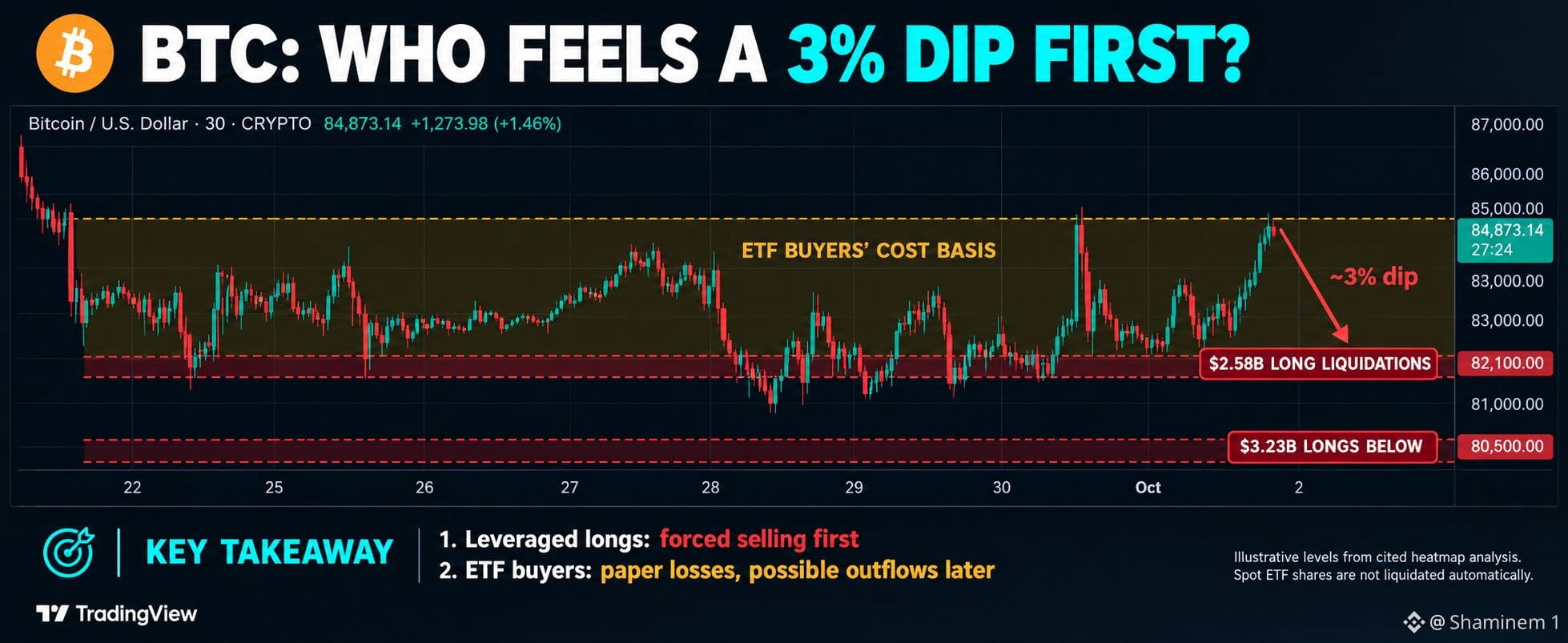
Different kinds of pain, and that's the actual answer. Leveraged longs get hit first, mechanically and instantly. The heatmap shows roughly $2.58 billion in long liquidations clustered right around $82,100, with another $3.23 billion stacked just below $80,500. A 3% dip in $BTC from current levels in the low $84,000s lands almost exactly on that first cluster. Those positions close the moment price touches them, no decision involved. ETF buyers don't get liquidated in that mechanical sense, there's no forced selling button on a spot ETF share. But they're not immune either. The $82,000 to $85,000 zone has become the densest cost basis band from September's rally, meaning a dip through $82K would push the most recent buyers straight into a loss. That's where the real second-order risk sits, not a forced close, but the kind of paper loss that shows up as outflows a day or two later if the dip holds. Worth knowing why $82K specifically matters so much. Below it, liquidation clusters thin out fast, so losing the level tends to accelerate a move rather than cushion it. ETF flows already cooled hard into month end too, from $999 million on September 21 down to just $31 million a few days later, so there's less fresh buying ready to absorb a flush than there was two weeks ago. So on a 3% dip Longs liquidate first, in minutes. The newest ETF buyers are the ones who actually feel it next, not through forced selling, but through being underwater and deciding whether to hold. #BTC Price Analysis#
Different kinds of pain, and that's the actual answer. Leveraged longs get hit first, mechanically and instantly. The heatmap shows roughly $2.58 billion in long liquidations clustered right around $82,100, with another $3.23 billion stacked just below $80,500. A 3% dip in $BTC from current levels in the low $84,000s lands almost exactly on that first cluster. Those positions close the moment price touches them, no decision involved. ETF buyers don't get liquidated in that mechanical sense, there's no forced selling button on a spot ETF share. But they're not immune either. The $82,000 to $85,000 zone has become the densest cost basis band from September's rally, meaning a dip through $82K would push the most recent buyers straight into a loss. That's where the real second-order risk sits, not a forced close, but the kind of paper loss that shows up as outflows a day or two later if the dip holds. Worth knowing why $82K specifically matters so much. Below it, liquidation clusters thin out fast, so losing the level tends to accelerate a move rather than cushion it. ETF flows already cooled hard into month end too, from $999 million on September 21 down to just $31 million a few days later, so there's less fresh buying ready to absorb a flush than there was two weeks ago. So on a 3% dip Longs liquidate first, in minutes. The newest ETF buyers are the ones who actually feel it next, not through forced selling, but through being underwater and deciding whether to hold. #BTC Price Analysis#
74
·
--
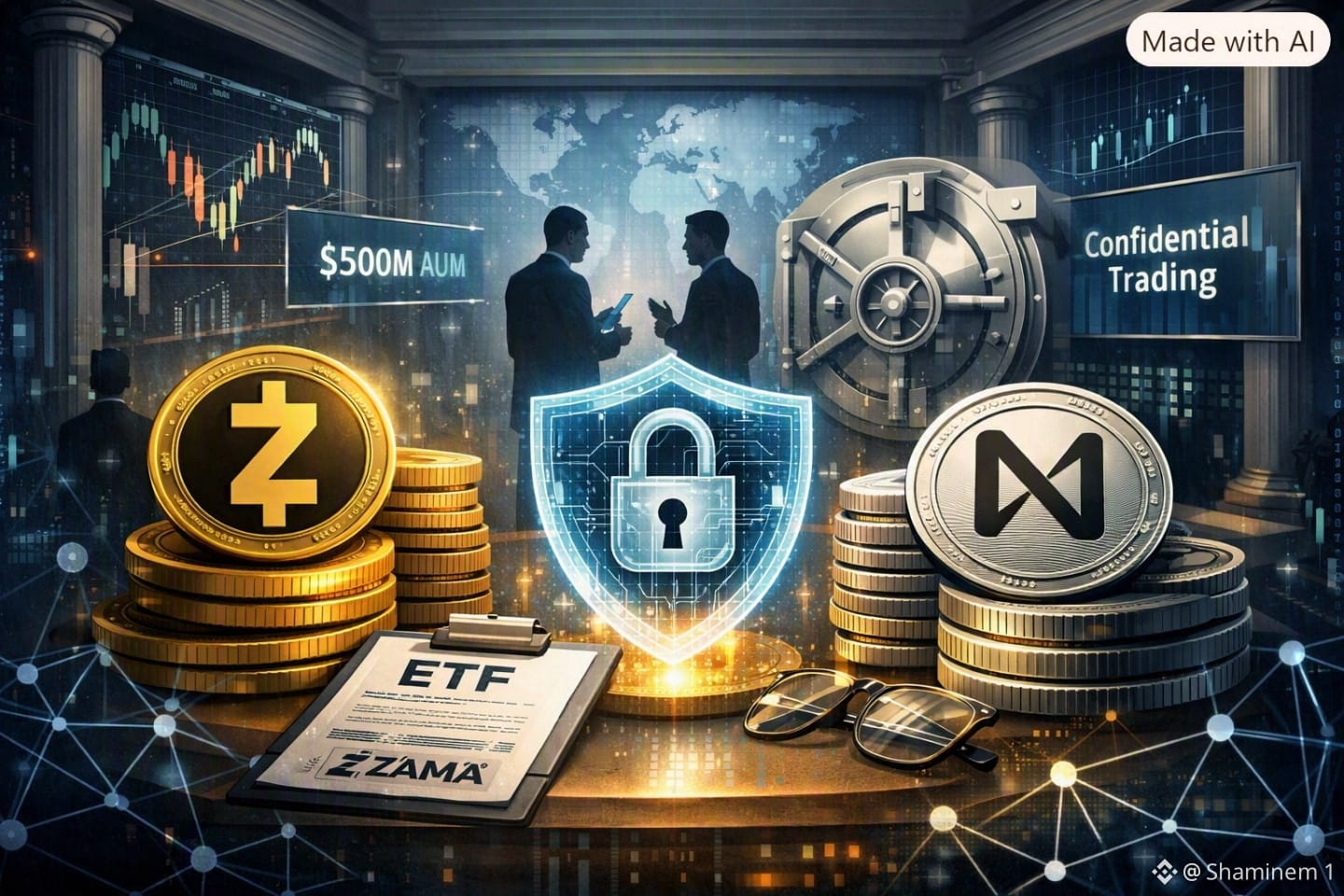
隱私不再只是小眾的加密敘事;如今它已成為機構級的基礎設施。而 $ZEC 和 #NEAR 是讓這種轉變最清晰可見的兩種資產。ZEC 在 7 月完成了 Ironwood 緊急升級,淘汰了具脆弱性的 Orchard 分流池,並以經過密碼學校正的版本取代。這確實消除了既存的安全性疑慮。隨後,NU7 以將近 240 萬顆 ZEC 的投票量與 99.9% 的支持率通過,將目標區塊時間從 75 秒縮短到 25 秒。再加上 Grayscale 的 ZCSH ETF:其在 NYSE Arca 上市後兩週內 AUM 便突破 5 億美元——你就看到的是,隱私幣首次以「機構產品」的方式被交易。自 8 月中旬以來,ZEC 上漲超過 200%。$NEAR 則走向了通往相同敘事的另一條路徑。透過其與 Hyperliquid 的整合,$NEAR 使永續期貨預設就成為保密形式:把存款路由到一個保密分片,讓交易者身分與資金來源保持隱藏,但交易仍能在 Hyperliquid 的公開訂單簿上執行。這是一種「把隱私疊加到既有流動性」的做法,而不是從零開始自建。宣佈後的那一週,NEAR 上漲到 80%,同時 Confidential Intents 的 TVL 也突破 7000 萬美元。能把它們連在一起的是「敘事框架」的改變。這不再是為了規避監管。這是附帶機構級通道(institutional rails)的、可自行選擇啟用的保密性;ETF、TEEs,以及從一開始就內建的合規意識型架構。#Zama 也把這點延伸到使用 FHE 的智慧合約保密性,值得關注,因為它是這個堆疊的第三層。這三種隱私資產都可在 Bitget 交易。非投資建議。自行研究。 [link]
隱私不再只是小眾的加密敘事;如今它已成為機構級的基礎設施。而 $ZEC 和 #NEAR 是讓這種轉變最清晰可見的兩種資產。ZEC 在 7 月完成了 Ironwood 緊急升級,淘汰了具脆弱性的 Orchard 分流池,並以經過密碼學校正的版本取代。這確實消除了既存的安全性疑慮。隨後,NU7 以將近 240 萬顆 ZEC 的投票量與 99.9% 的支持率通過,將目標區塊時間從 75 秒縮短到 25 秒。再加上 Grayscale 的 ZCSH ETF:其在 NYSE Arca 上市後兩週內 AUM 便突破 5 億美元——你就看到的是,隱私幣首次以「機構產品」的方式被交易。自 8 月中旬以來,ZEC 上漲超過 200%。$NEAR 則走向了通往相同敘事的另一條路徑。透過其與 Hyperliquid 的整合,$NEAR 使永續期貨預設就成為保密形式:把存款路由到一個保密分片,讓交易者身分與資金來源保持隱藏,但交易仍能在 Hyperliquid 的公開訂單簿上執行。這是一種「把隱私疊加到既有流動性」的做法,而不是從零開始自建。宣佈後的那一週,NEAR 上漲到 80%,同時 Confidential Intents 的 TVL 也突破 7000 萬美元。能把它們連在一起的是「敘事框架」的改變。這不再是為了規避監管。這是附帶機構級通道(institutional rails)的、可自行選擇啟用的保密性;ETF、TEEs,以及從一開始就內建的合規意識型架構。#Zama 也把這點延伸到使用 FHE 的智慧合約保密性,值得關注,因為它是這個堆疊的第三層。這三種隱私資產都可在 Bitget 交易。非投資建議。自行研究。 [link]
21
·
--
查看翻譯
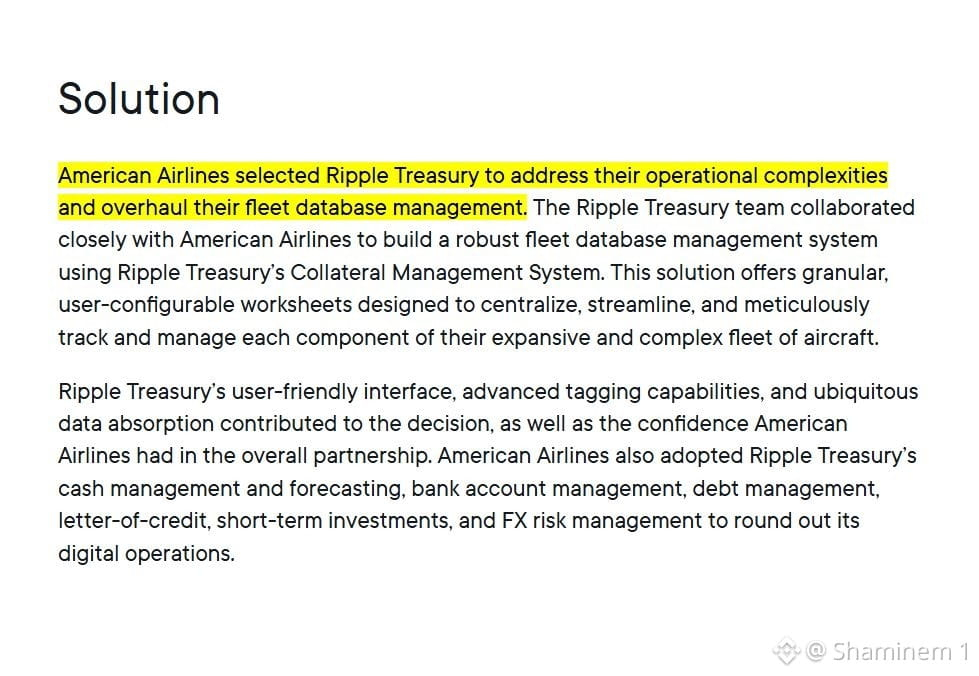
🚨AMERICAN AIRLINES IS USING RIPPLE TREASURY! The US airline GIANT is using #Ripple to help manage its massive global operation from fleet data to cash, debt and FX risk. Ripple embedding itself deeper into corporate finance as major companies, see the long term opportunity in using the $XRP ecosystem.
🚨AMERICAN AIRLINES IS USING RIPPLE TREASURY! The US airline GIANT is using #Ripple to help manage its massive global operation from fleet data to cash, debt and FX risk. Ripple embedding itself deeper into corporate finance as major companies, see the long term opportunity in using the $XRP ecosystem.

35
·
--
🚨韓國央行正在將韓元推向24小時全球結算。時間點很有意思:韓國已經透過像Kbank和全北銀行這樣的銀行,與@Ripple有龐大的主要連結;而KRW1正透過BDACS/Woori Bank在Avax上即時運作!這裡尚未宣布任何官方的$XRP或$AVAX參與,但韓國顯然正朝向更快速、永遠在線的數位金融邁進,並且認為這兩者可能在某種程度上會參與也並不誇張!
🚨韓國央行正在將韓元推向24小時全球結算。時間點很有意思:韓國已經透過像Kbank和全北銀行這樣的銀行,與@Ripple有龐大的主要連結;而KRW1正透過BDACS/Woori Bank在Avax上即時運作!這裡尚未宣布任何官方的$XRP或$AVAX參與,但韓國顯然正朝向更快速、永遠在線的數位金融邁進,並且認為這兩者可能在某種程度上會參與也並不誇張!

38
·
--
查看翻譯
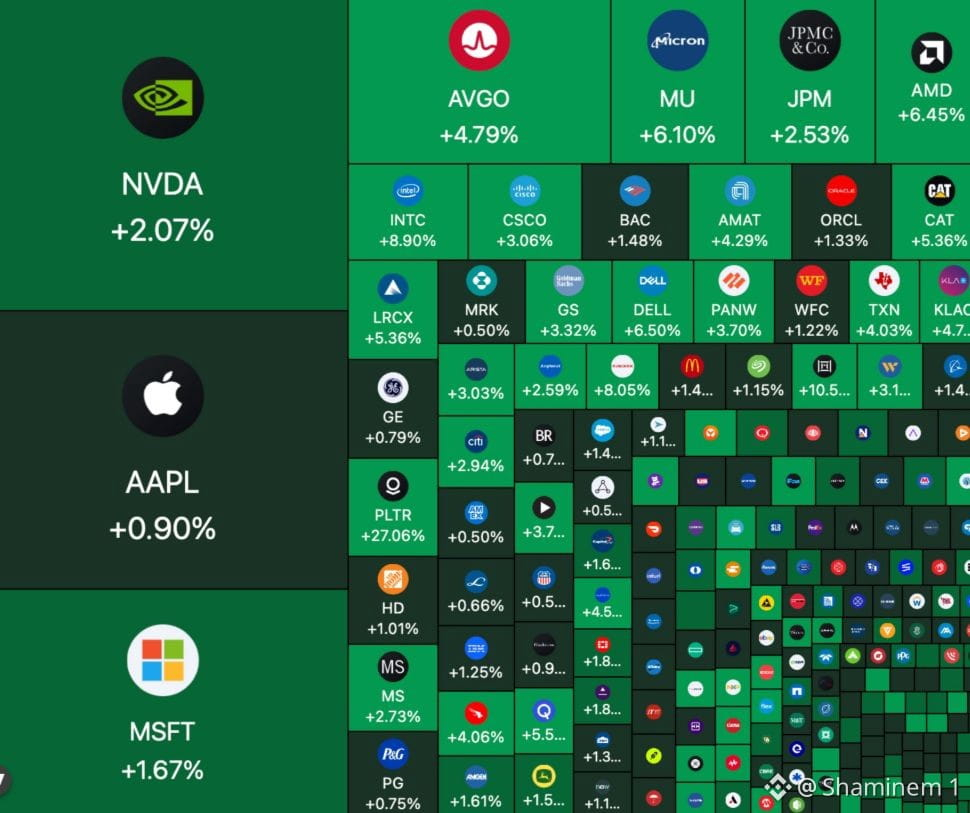
🚨THE U.S. STOCK MARKET ADDED OVER $500 BILLION AT THE OPEN, WHILE CRYPTO IS RIPPING TOO. $MUBARAK Risk appetite is flooding back across markets. When stocks and crypto start moving together like this, it looks like capital is switching back into risk-on mode. $MU
🚨THE U.S. STOCK MARKET ADDED OVER $500 BILLION AT THE OPEN, WHILE CRYPTO IS RIPPING TOO. $MUBARAK Risk appetite is flooding back across markets. When stocks and crypto start moving together like this, it looks like capital is switching back into risk-on mode. $MU
67
·
--
🚨北韓駭客現在偽裝成加密貨幣與 AI 招募人員,鎖定求職者。據稱,$SOL WaterPlum 已在全球感染 30,000+ 台裝置,並至少竊取了 1,070 萬美元。加密貨幣最大的威脅不一定是市場,有時候是點錯了那份「工作邀請」。$BTC
🚨北韓駭客現在偽裝成加密貨幣與 AI 招募人員,鎖定求職者。據稱,$SOL WaterPlum 已在全球感染 30,000+ 台裝置,並至少竊取了 1,070 萬美元。加密貨幣最大的威脅不一定是市場,有時候是點錯了那份「工作邀請」。$BTC

59
·
--
查看翻譯
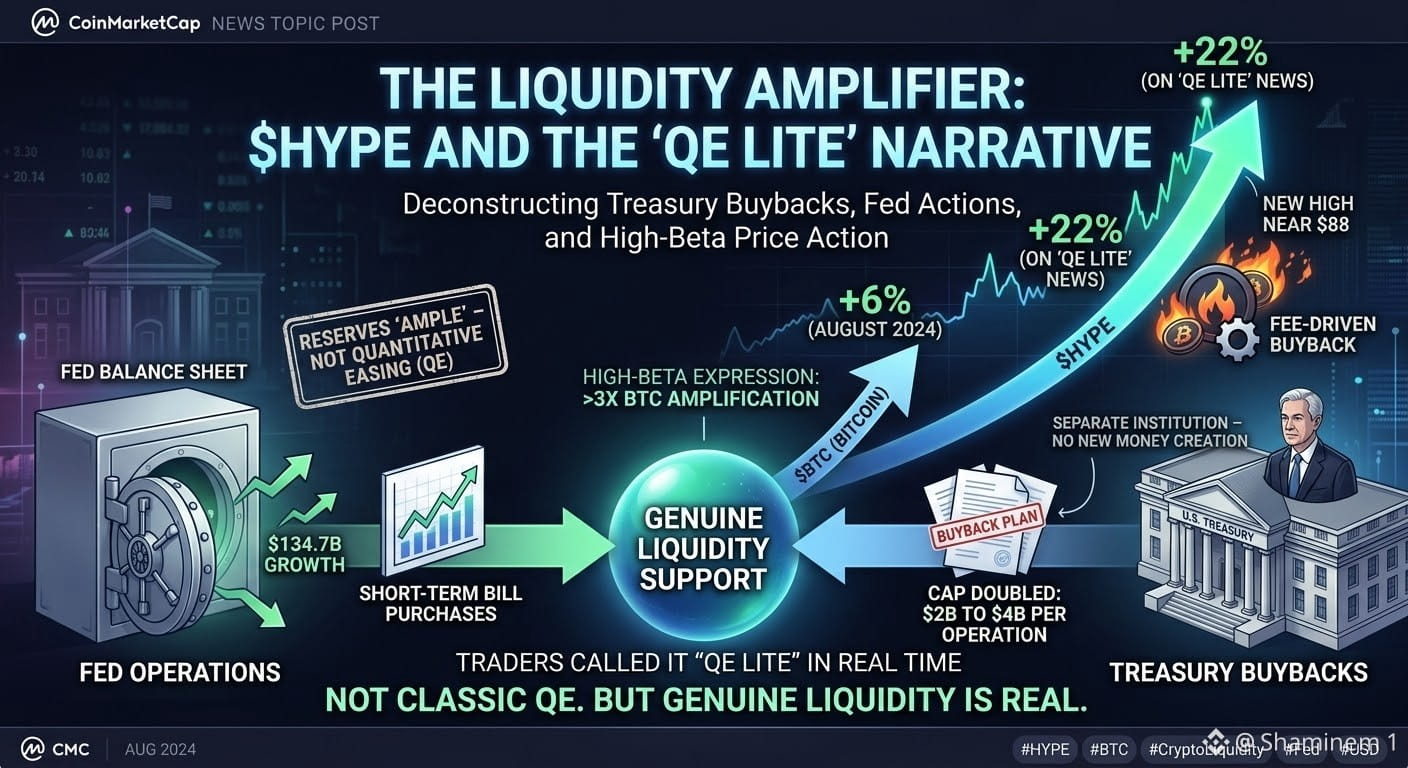
"Stealth QE" is doing more work than the mechanics support. Real QE is Fed-only, it creates new bank reserves and expands the balance sheet to ease conditions. What's actually happening is more tangled. Fed officials Jefferson and Perli have gone on record separating their reserve management purchases from QE entirely, calling them plumbing to keep reserves "ample," not stimulus, entirely in short-term bills rather than the longer-duration buying that actually eases conditions. The optics feed the theory anyway. No press conference, no dramatic headline, and the balance sheet is still up roughly $134.7 billion recently. $BTC ripped on exactly that kind of quiet growth. $HYPE is the clearest proof this liquidity story is real. When the original Treasury buyback news hit in August, traders nicknamed it "QE Lite" in real time, and HYPE ran 22% that day against Bitcoin's 6%, over three times the move on identical news. It's doing it again now, printing highs near $88 on the same easing Fed-hike expectations. High beta to this exact mechanism, not coincidence. The bigger driver isn't even the Fed though. It's Treasury, under Bessent, running buybacks since the original rally in August, when the cap doubled to $4 billion per operation. Separate institution, doesn't expand the money supply either, but the liquidity impact is real regardless of the label. So no, not classic stealth QE. Two agencies running technical operations that add up to genuine support without anyone saying "easing" out loud. HYPE moving three times harder than BTC on the same headline is the best evidence of that.
"Stealth QE" is doing more work than the mechanics support. Real QE is Fed-only, it creates new bank reserves and expands the balance sheet to ease conditions. What's actually happening is more tangled. Fed officials Jefferson and Perli have gone on record separating their reserve management purchases from QE entirely, calling them plumbing to keep reserves "ample," not stimulus, entirely in short-term bills rather than the longer-duration buying that actually eases conditions. The optics feed the theory anyway. No press conference, no dramatic headline, and the balance sheet is still up roughly $134.7 billion recently. $BTC ripped on exactly that kind of quiet growth. $HYPE is the clearest proof this liquidity story is real. When the original Treasury buyback news hit in August, traders nicknamed it "QE Lite" in real time, and HYPE ran 22% that day against Bitcoin's 6%, over three times the move on identical news. It's doing it again now, printing highs near $88 on the same easing Fed-hike expectations. High beta to this exact mechanism, not coincidence. The bigger driver isn't even the Fed though. It's Treasury, under Bessent, running buybacks since the original rally in August, when the cap doubled to $4 billion per operation. Separate institution, doesn't expand the money supply either, but the liquidity impact is real regardless of the label. So no, not classic stealth QE. Two agencies running technical operations that add up to genuine support without anyone saying "easing" out loud. HYPE moving three times harder than BTC on the same headline is the best evidence of that.
55
·
--
查看翻譯
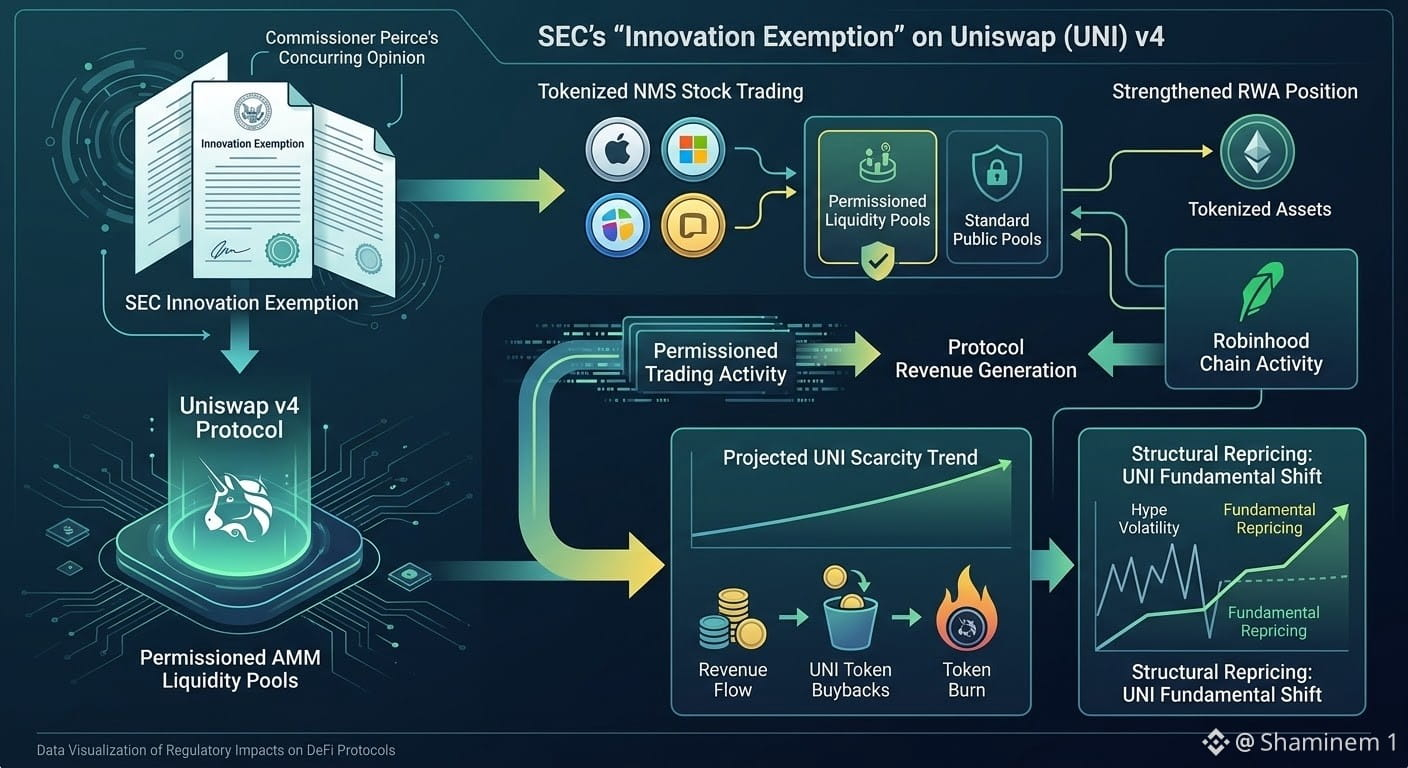
The SEC just handed Uniswap a real regulatory pathway, and $UNI is responding accordingly. On September 17, the SEC issued a five-year "Innovation Exemption" letting Tokenized Securities Venues trade tokenized NMS stock through permissioned AMM liquidity pools. Hayden Adams called Commissioner Peirce's concurring opinion the most important part of the order, cos it directly applies the exemption to permissioned pools on Uniswap v4. Uniswap is now positioned to submit comment letters shaping how this framework develops. Why does this matter for the fee switch narrative I've been tracking? Higher permissioned trading activity through v4 feeds directly into protocol revenue, which now routes toward UNI buybacks and burns. Robinhood Chain activity adds another leg, strengthening Uniswap's position across tokenised assets generally, not just crypto pairs. UNI is up 28% in 24 hours and 47% over the week. That's not hype-driven. That's a structural repricing around real regulatory clarity, the kind RWA has needed for a long time. I've got UNI on my watchlist for a breakout continuation setup, using the fee-switch mechanism as my core thesis rather than the price action alone. Trading $UNI on Bitget right now, and there's a Uni Trading Club championship running for anyone who wants to join in. NFA. DYOR.
The SEC just handed Uniswap a real regulatory pathway, and $UNI is responding accordingly. On September 17, the SEC issued a five-year "Innovation Exemption" letting Tokenized Securities Venues trade tokenized NMS stock through permissioned AMM liquidity pools. Hayden Adams called Commissioner Peirce's concurring opinion the most important part of the order, cos it directly applies the exemption to permissioned pools on Uniswap v4. Uniswap is now positioned to submit comment letters shaping how this framework develops. Why does this matter for the fee switch narrative I've been tracking? Higher permissioned trading activity through v4 feeds directly into protocol revenue, which now routes toward UNI buybacks and burns. Robinhood Chain activity adds another leg, strengthening Uniswap's position across tokenised assets generally, not just crypto pairs. UNI is up 28% in 24 hours and 47% over the week. That's not hype-driven. That's a structural repricing around real regulatory clarity, the kind RWA has needed for a long time. I've got UNI on my watchlist for a breakout continuation setup, using the fee-switch mechanism as my core thesis rather than the price action alone. Trading $UNI on Bitget right now, and there's a Uni Trading Club championship running for anyone who wants to join in. NFA. DYOR.
75
·
--
查看翻譯
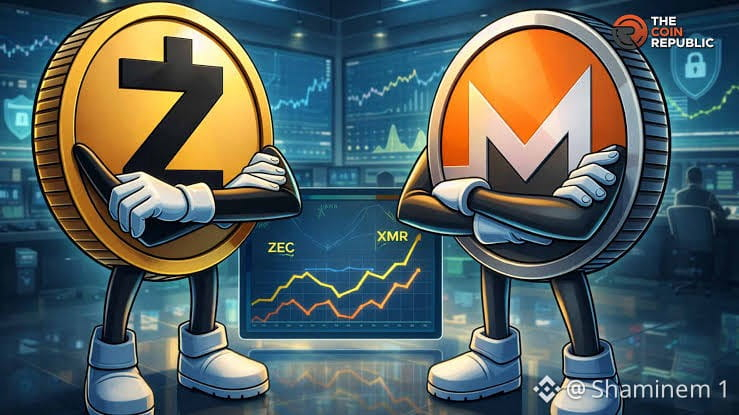
Monero's privacy is mandatory. Every transaction uses ring signatures and stealth addresses by default, so every user gets folded into the same anonymity set whether they think about it or not. That's exactly why ransomware operators and darknet markets lean on $XMR , there's no wrong setting to forget. Zcash's privacy is optional. Built on zk-SNARKs, arguably more advanced cryptography, but the anonymity set is only as strong as how many people actually use the shielded pool. Most $ZEC transactions historically have stayed transparent. Stronger maths, weaker practical privacy, that's the honest trade-off. Here's my take though, and it leans on Zcash, for a reason that has nothing to do with which one hides you better. Monero keeps getting delisted, Kraken pulled it for European users back in 2024, and that pattern isn't reversing. Zcash still trades on Coinbase and Robinhood, and the SEC even held a roundtable on it in 2025. Multicoin Capital disclosed a real position in May, framing it as protection against wealth taxes and government scrutiny, not hiding crimes. That access to regulated capital is the actual moat. The price action backs this up too. Monero hit a fresh high in January, then corrected hard, down from near $797 to around $343 by mid year. Zcash's run has been steadier and more recent, still climbing into the second half of the year. So it's Zcash for the trade specifically, not the tool itself but Monero's the more honest privacy coin, but an asset that keeps getting kicked off exchanges has a shrinking room to grow into.
Monero's privacy is mandatory. Every transaction uses ring signatures and stealth addresses by default, so every user gets folded into the same anonymity set whether they think about it or not. That's exactly why ransomware operators and darknet markets lean on $XMR , there's no wrong setting to forget. Zcash's privacy is optional. Built on zk-SNARKs, arguably more advanced cryptography, but the anonymity set is only as strong as how many people actually use the shielded pool. Most $ZEC transactions historically have stayed transparent. Stronger maths, weaker practical privacy, that's the honest trade-off. Here's my take though, and it leans on Zcash, for a reason that has nothing to do with which one hides you better. Monero keeps getting delisted, Kraken pulled it for European users back in 2024, and that pattern isn't reversing. Zcash still trades on Coinbase and Robinhood, and the SEC even held a roundtable on it in 2025. Multicoin Capital disclosed a real position in May, framing it as protection against wealth taxes and government scrutiny, not hiding crimes. That access to regulated capital is the actual moat. The price action backs this up too. Monero hit a fresh high in January, then corrected hard, down from near $797 to around $343 by mid year. Zcash's run has been steadier and more recent, still climbing into the second half of the year. So it's Zcash for the trade specifically, not the tool itself but Monero's the more honest privacy coin, but an asset that keeps getting kicked off exchanges has a shrinking room to grow into.
78
·
--
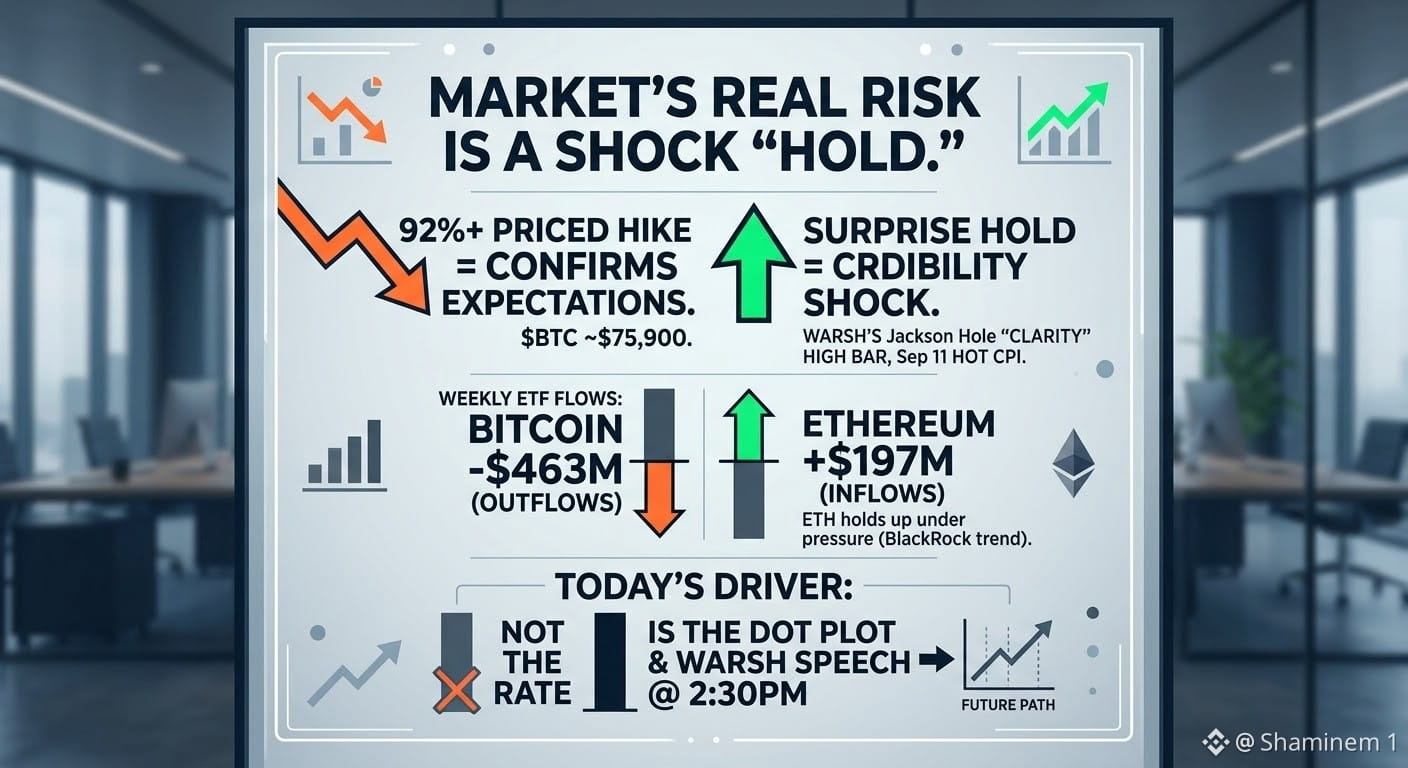
光是這段上行路徑本身,基本上已經定價了,勝率達 92% 以上,這也是自 2023 年以來首次。這正是今天真正風險不在於「上行」而在於相反方向的原因。以下是值得理解的反向邏輯。當市場對某個結果確信到這種程度時,部位(持倉)已經先行調整,消化了可能承受的痛點。$BTC 本週已經跌到約 $75,900,部分原因是 CLARITY 的終局(cloture)投票昨天未能通過,另一部分則是因為對上行(本次升息)的預期。上行如預期落地,多半只是確認了已被定價的內容。而「意外維持」才是真正的震撼。Warsh 在傑克森霍爾(Jackson Hole)期間設定了較高的門檻,表示聯準會需要看到通膨「朝向目標」且要「有清晰度(clarity)並且速度足夠(sufficient speed)」。9 月 11 日強勁的 Hot CPI 更進一步強化了上行的論點。如果聯準會在剛剛強化這套框架之後、現在又退回,市場接下來要問的很可能不會是「終於鬆一口氣了嗎」,而是:「他們知道些什麼,而我們不知道?」這種可信度遭遇的衝擊,通常會比任何預期中的壞消息本身更能嚇到風險資產。也值得回頭對照 ETH 的故事。即使在這種壓力很大的本週期間,$BTC ETF 仍出現 4.63 億美元的資金流出,而 $ETH 基金則仍淨流入 1.97 億美元。這和幾週前那種由 BlackRock 驅動的模式一致:是在真正的壓力下仍能撐住,而不只是出現在平靜的週期。今天真正推動價格的並不是利率數字——大家早就看過那種硬幣翻面(coin flip)的結果了。真正關鍵在於點陣圖(dot plot)以及 Warsh 在 2:30 所說的內容:這一次的上行到底只是全部故事,還是只是接下來更多上行的第一步。
光是這段上行路徑本身,基本上已經定價了,勝率達 92% 以上,這也是自 2023 年以來首次。這正是今天真正風險不在於「上行」而在於相反方向的原因。以下是值得理解的反向邏輯。當市場對某個結果確信到這種程度時,部位(持倉)已經先行調整,消化了可能承受的痛點。$BTC 本週已經跌到約 $75,900,部分原因是 CLARITY 的終局(cloture)投票昨天未能通過,另一部分則是因為對上行(本次升息)的預期。上行如預期落地,多半只是確認了已被定價的內容。而「意外維持」才是真正的震撼。Warsh 在傑克森霍爾(Jackson Hole)期間設定了較高的門檻,表示聯準會需要看到通膨「朝向目標」且要「有清晰度(clarity)並且速度足夠(sufficient speed)」。9 月 11 日強勁的 Hot CPI 更進一步強化了上行的論點。如果聯準會在剛剛強化這套框架之後、現在又退回,市場接下來要問的很可能不會是「終於鬆一口氣了嗎」,而是:「他們知道些什麼,而我們不知道?」這種可信度遭遇的衝擊,通常會比任何預期中的壞消息本身更能嚇到風險資產。也值得回頭對照 ETH 的故事。即使在這種壓力很大的本週期間,$BTC ETF 仍出現 4.63 億美元的資金流出,而 $ETH 基金則仍淨流入 1.97 億美元。這和幾週前那種由 BlackRock 驅動的模式一致:是在真正的壓力下仍能撐住,而不只是出現在平靜的週期。今天真正推動價格的並不是利率數字——大家早就看過那種硬幣翻面(coin flip)的結果了。真正關鍵在於點陣圖(dot plot)以及 Warsh 在 2:30 所說的內容:這一次的上行到底只是全部故事,還是只是接下來更多上行的第一步。
63
·
--
查看翻譯
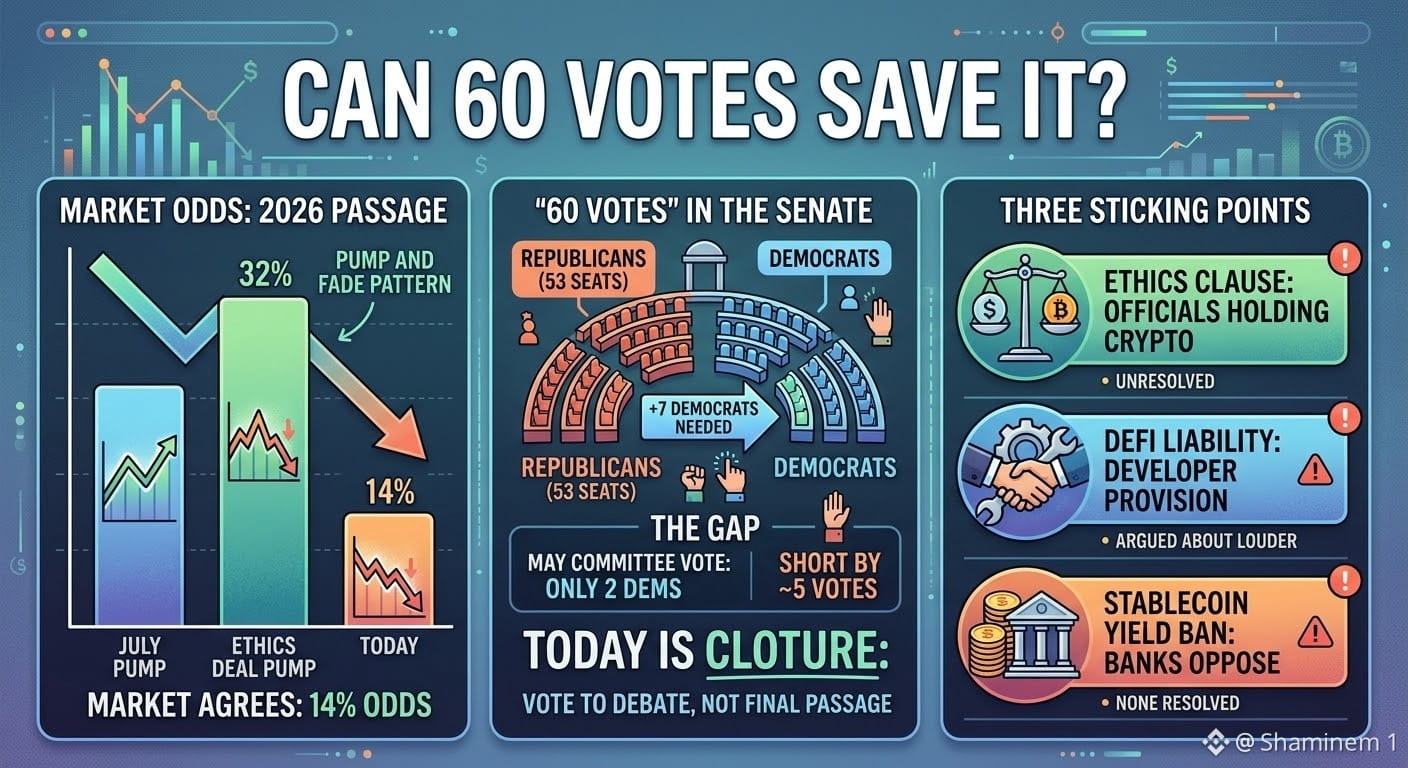
Third time's not been the charm so far, and this is the one post in this series I get to say "told you so" on. Back when the first Trump ethics deal pushed odds to 32%, I flagged that this exact pump had already happened once in July and faded hard. It's now happened again, this bump also crashed, odds sliding from roughly 30% down to 14% for full 2026 passage heading into today. $BTC Here's what "60 votes" actually means, since it trips people up. Today's vote isn't final passage, it's cloture, the procedural step just to start debating the bill. Republicans hold 53 Senate seats, so they need at least seven Democrats to cross over just to get that far. The committee vote back in May only pulled two. That's the real story, not the headline number, the coalition's short by roughly five votes and nothing this month has closed that gap. Three sticking points are why: An ethics clause on officials holding crypto, a DeFi developer liability provision, and a stablecoin yield ban banks don't want. None of those got resolved, they just got argued about louder. So can 60 votes save it? The math says probably not today, and the market agrees, pricing full year passage at just 14%. But this is genuinely different from the last two pumps I covered, those were pure sentiment on rumoured deals. This is an actual roll call, the first real, countable test all year instead of another headline that fades on its own. $ETH
Third time's not been the charm so far, and this is the one post in this series I get to say "told you so" on. Back when the first Trump ethics deal pushed odds to 32%, I flagged that this exact pump had already happened once in July and faded hard. It's now happened again, this bump also crashed, odds sliding from roughly 30% down to 14% for full 2026 passage heading into today. $BTC Here's what "60 votes" actually means, since it trips people up. Today's vote isn't final passage, it's cloture, the procedural step just to start debating the bill. Republicans hold 53 Senate seats, so they need at least seven Democrats to cross over just to get that far. The committee vote back in May only pulled two. That's the real story, not the headline number, the coalition's short by roughly five votes and nothing this month has closed that gap. Three sticking points are why: An ethics clause on officials holding crypto, a DeFi developer liability provision, and a stablecoin yield ban banks don't want. None of those got resolved, they just got argued about louder. So can 60 votes save it? The math says probably not today, and the market agrees, pricing full year passage at just 14%. But this is genuinely different from the last two pumps I covered, those were pure sentiment on rumoured deals. This is an actual roll call, the first real, countable test all year instead of another headline that fades on its own. $ETH
64
·
--
查看翻譯
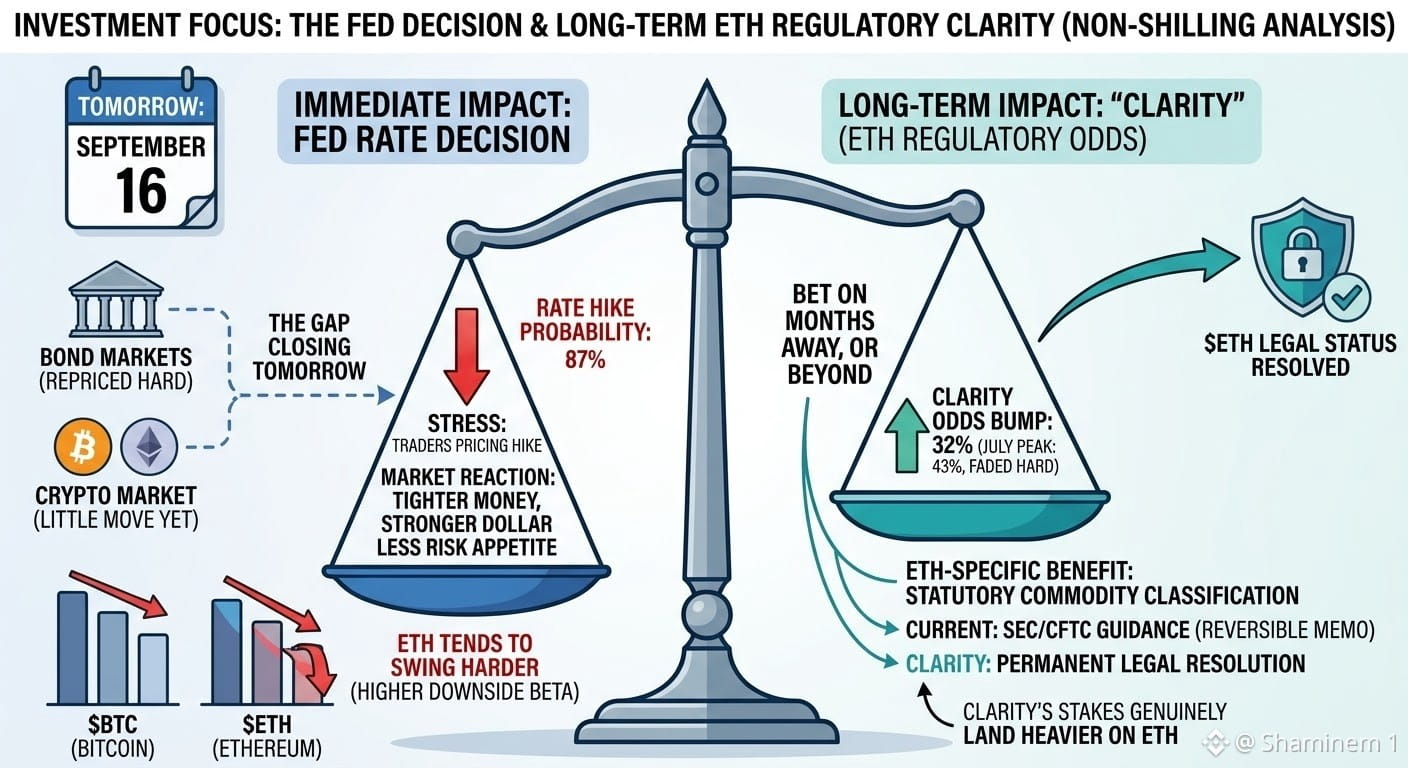
The Fed's decision lands on September 16, and traders now price an 87% chance of a hike, the first since July 2023. CLARITY's odds bump to 32% is real, but it's a bet on something that might not happen for months, if this year at all. We've watched this exact CLARITY movie before back in July, a similar Trump ethics deal pushed odds from 14% to 43% within days, then faded hard, crashing back toward 14-16% by early September. One good headline hasn't held yet this year. CLARITY would finally give Ethereum a legal, statutory commodity classification. Right now that status only exists as #SEC and CFTC administrative guidance from March, which a future SEC chair could undo with a memo. Bitcoin's commodity status has barely been in question. Ethereum's has been the single biggest unresolved fight in crypto regulation for years, so CLARITY's stakes land heavier on $ETH than on BTC. That's a legal outcome months away though. The Fed hike is tomorrow, and it hits both assets through the same channel, tighter money, stronger dollar, less appetite for risk. ETH tends to swing harder than $BTC in both directions, it gained close to 30% during the recent rally against BTC's 23%, so the downside beta cuts the same way if this goes badly. Bonds have already repriced hard for a hike, yet neither BTC nor ETH has moved much yet. That gap closes tomorrow, one way or another. So no, CLARITY doesn't beat the Fed for either coin on speed. It matters more for ETH long term, the Fed matters more for both right now.
The Fed's decision lands on September 16, and traders now price an 87% chance of a hike, the first since July 2023. CLARITY's odds bump to 32% is real, but it's a bet on something that might not happen for months, if this year at all. We've watched this exact CLARITY movie before back in July, a similar Trump ethics deal pushed odds from 14% to 43% within days, then faded hard, crashing back toward 14-16% by early September. One good headline hasn't held yet this year. CLARITY would finally give Ethereum a legal, statutory commodity classification. Right now that status only exists as #SEC and CFTC administrative guidance from March, which a future SEC chair could undo with a memo. Bitcoin's commodity status has barely been in question. Ethereum's has been the single biggest unresolved fight in crypto regulation for years, so CLARITY's stakes land heavier on $ETH than on BTC. That's a legal outcome months away though. The Fed hike is tomorrow, and it hits both assets through the same channel, tighter money, stronger dollar, less appetite for risk. ETH tends to swing harder than $BTC in both directions, it gained close to 30% during the recent rally against BTC's 23%, so the downside beta cuts the same way if this goes badly. Bonds have already repriced hard for a hike, yet neither BTC nor ETH has moved much yet. That gap closes tomorrow, one way or another. So no, CLARITY doesn't beat the Fed for either coin on speed. It matters more for ETH long term, the Fed matters more for both right now.
31
·
--
查看翻譯
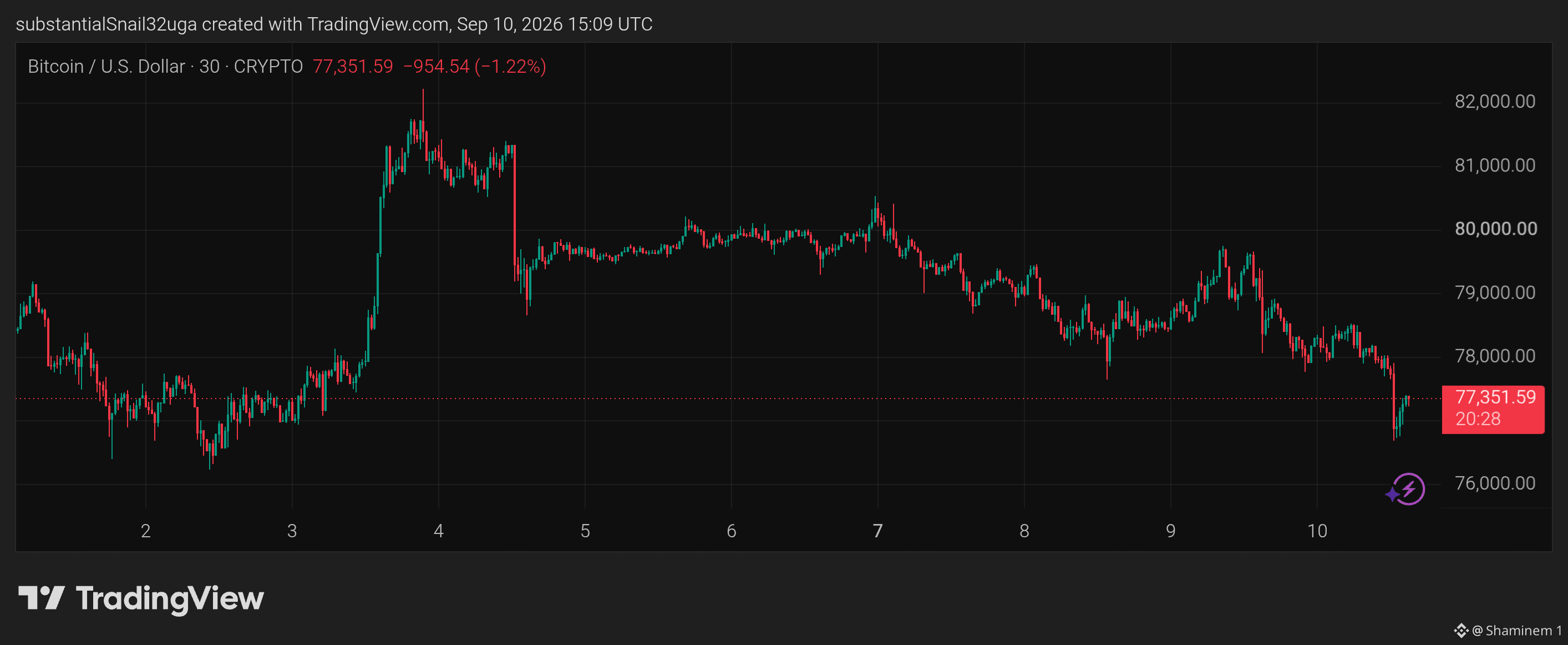
This one already has a real-world answer. Trump's newer $5,000 dividend plan, big enough to add up to roughly $1 trillion if it reaches all adult Americans, has already been announced. Bitcoin's reaction Muted, sideways, couldn't even push through $78,000. The test already ran. Here's why 2020 isn't repeating. Back then, Bitcoin had no spot ETFs, fragmented custody, and a genuinely tiny market by today's standards, so retail stimulus money buying in actually moved the needle. That's also why $1,200 invested in April 2020 at around $6,800 is worth over $21,000 today, $BTC was deeply discounted and the market was thin enough for new money to matter. Even back then though, the effect gets oversold. Cleveland Fed researchers who actually studied it found stimulus checks produced roughly a 0.07% permanent price bump, which they themselves called modest next to Bitcoin's normal 4.6% daily swings. The "stimmy money built the 2020 rally" story is a fun meme, the real driver was Bitcoin being cheap and small, not the checks themselves. Today's market has neither of those conditions. It's ETF-driven, institutionally dominated, with single days of fund flows worth more than a stimulus rollout spread over months. $1 trillion trickling into household budgets over time is a rounding error against that. So no, it doesn't repeat, and the market already told us that within hours of the announcement.
This one already has a real-world answer. Trump's newer $5,000 dividend plan, big enough to add up to roughly $1 trillion if it reaches all adult Americans, has already been announced. Bitcoin's reaction Muted, sideways, couldn't even push through $78,000. The test already ran. Here's why 2020 isn't repeating. Back then, Bitcoin had no spot ETFs, fragmented custody, and a genuinely tiny market by today's standards, so retail stimulus money buying in actually moved the needle. That's also why $1,200 invested in April 2020 at around $6,800 is worth over $21,000 today, $BTC was deeply discounted and the market was thin enough for new money to matter. Even back then though, the effect gets oversold. Cleveland Fed researchers who actually studied it found stimulus checks produced roughly a 0.07% permanent price bump, which they themselves called modest next to Bitcoin's normal 4.6% daily swings. The "stimmy money built the 2020 rally" story is a fun meme, the real driver was Bitcoin being cheap and small, not the checks themselves. Today's market has neither of those conditions. It's ETF-driven, institutionally dominated, with single days of fund flows worth more than a stimulus rollout spread over months. $1 trillion trickling into household budgets over time is a rounding error against that. So no, it doesn't repeat, and the market already told us that within hours of the announcement.
362
·
--
查看翻譯
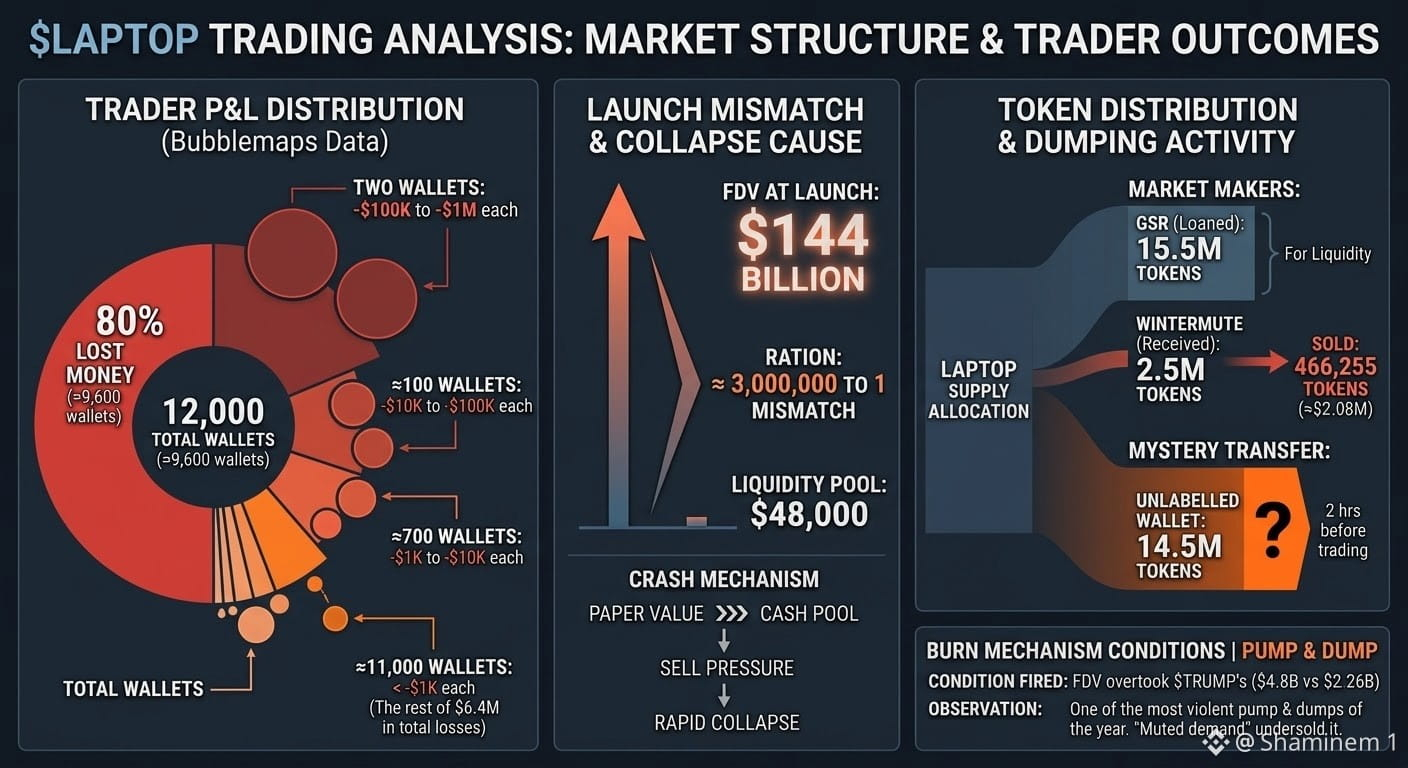
Bubblemaps data shows 80% of $LAPTOP traders lost money, roughly 12,000 wallets in total, split into two down $100K to $1M each, about 100 down over $10K, 700 down over $1K, and 11,000 smaller losses making up the rest of that $6.4M. Here's the simple reason it happened At launch, LAPTOP's fully diluted valuation briefly hit $144 billion against a liquidity pool of just $48,000. That's a mismatch of roughly three million to one. Any price built on that little real money underneath it was always going to collapse the moment people tried to actually sell into it. So who was dumping? Mostly market makers doing exactly what they're paid to do. GSR held a loan of 15.5 million tokens for liquidity, Wintermute received 2.5 million from the project and sold 466,255 of them for about $2.08 million. There's also a mystery: one unlabelled wallet received the single largest transfer, 14.5 million tokens, roughly two hours before trading even opened, and nobody's identified who that is yet. Quick update on yesterday's post too I flagged three conditions that could trigger LAPTOP's burn mechanism, and one already fired, its FDV briefly overtook $TRUMP , $4.8 billion versus $2.26 billion. The "muted demand" read I mentioned undersold it badly, this turned into one of the most violent pump and dumps of the year before it went quiet again. Takeaway When the paper value is millions of times bigger than the actual cash sitting in the pool, the crash isn't a surprise, it's the plan working exactly as designed for whoever got there first.
Bubblemaps data shows 80% of $LAPTOP traders lost money, roughly 12,000 wallets in total, split into two down $100K to $1M each, about 100 down over $10K, 700 down over $1K, and 11,000 smaller losses making up the rest of that $6.4M. Here's the simple reason it happened At launch, LAPTOP's fully diluted valuation briefly hit $144 billion against a liquidity pool of just $48,000. That's a mismatch of roughly three million to one. Any price built on that little real money underneath it was always going to collapse the moment people tried to actually sell into it. So who was dumping? Mostly market makers doing exactly what they're paid to do. GSR held a loan of 15.5 million tokens for liquidity, Wintermute received 2.5 million from the project and sold 466,255 of them for about $2.08 million. There's also a mystery: one unlabelled wallet received the single largest transfer, 14.5 million tokens, roughly two hours before trading even opened, and nobody's identified who that is yet. Quick update on yesterday's post too I flagged three conditions that could trigger LAPTOP's burn mechanism, and one already fired, its FDV briefly overtook $TRUMP , $4.8 billion versus $2.26 billion. The "muted demand" read I mentioned undersold it badly, this turned into one of the most violent pump and dumps of the year before it went quiet again. Takeaway When the paper value is millions of times bigger than the actual cash sitting in the pool, the crash isn't a surprise, it's the plan working exactly as designed for whoever got there first.
63
·
--
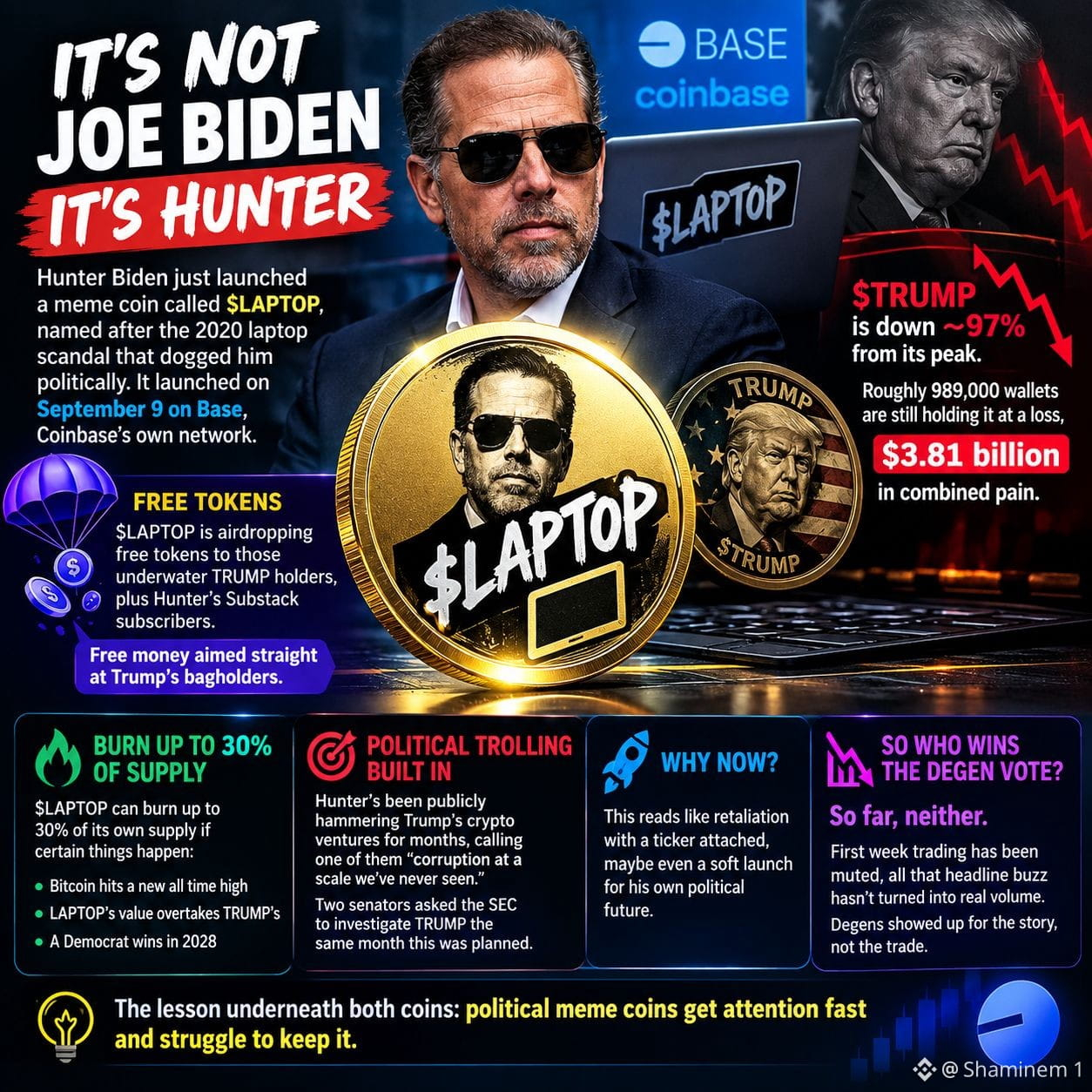
澄清一下,這不是喬·拜登。這是他的兒子——亨特·拜登,推出了一種名爲 $LAPTOP 的梗幣,並以 2020 年那起纏住他政治生涯的“筆記本電腦醜聞”命名。它於 9 月 9 日在 Base(Coinbase 自家的網絡)上線。下面是實際機制。#TRUMPOFFICIAL 這枚梗幣來自 2025 年 1 月,目前較其峯值大約下跌了 97%。仍有大約 989,000 個錢包在虧損中持有它,總計約 38.1 億美元的痛苦。LAPTOP 會空投免費代幣,專門給那些“在水下”的 TRUMP 持有者,以及亨特的 Substack 訂閱用戶。把“白送的錢”直接砸向特朗普的接盤者。還不止這些。只要發生某些情況,LAPTOP 最多可以銷燬其自身供應量的 30%:比如 $BTC 創出新的歷史最高價、LAPTOP 的價值超過 TRUMP,或者在 2028 年有一位民主黨人贏得勝利。政治惡搞被直接內置進代幣經濟模型(tokenomics)裏。爲什麼是現在?亨特過去幾個月一直在公開“猛擊”特朗普的加密業務,稱其中一項爲“我們從未見過的規模的腐敗”。在計劃這件事的同一個月,兩位參議員還請求美國證券交易委員會(SEC)調查 #TRUMP 。這看起來像是帶着代碼牌號的報復,甚至可能是對他未來政治前景的一種“軟啓動”。那究竟是誰贏了‘賭徒(degenerate)投票’?到目前爲止,兩邊都沒有。第一週的交易相當平淡,所有這些聳人聽聞的熱搜並沒有轉化爲真正的成交量。賭徒們是爲故事而來,而不是爲交易而來。兩枚幣背後的教訓是:政治類梗幣傳播得很快,但很難維持熱度。
澄清一下,這不是喬·拜登。這是他的兒子——亨特·拜登,推出了一種名爲 $LAPTOP 的梗幣,並以 2020 年那起纏住他政治生涯的“筆記本電腦醜聞”命名。它於 9 月 9 日在 Base(Coinbase 自家的網絡)上線。下面是實際機制。#TRUMPOFFICIAL 這枚梗幣來自 2025 年 1 月,目前較其峯值大約下跌了 97%。仍有大約 989,000 個錢包在虧損中持有它,總計約 38.1 億美元的痛苦。LAPTOP 會空投免費代幣,專門給那些“在水下”的 TRUMP 持有者,以及亨特的 Substack 訂閱用戶。把“白送的錢”直接砸向特朗普的接盤者。還不止這些。只要發生某些情況,LAPTOP 最多可以銷燬其自身供應量的 30%:比如 $BTC 創出新的歷史最高價、LAPTOP 的價值超過 TRUMP,或者在 2028 年有一位民主黨人贏得勝利。政治惡搞被直接內置進代幣經濟模型(tokenomics)裏。爲什麼是現在?亨特過去幾個月一直在公開“猛擊”特朗普的加密業務,稱其中一項爲“我們從未見過的規模的腐敗”。在計劃這件事的同一個月,兩位參議員還請求美國證券交易委員會(SEC)調查 #TRUMP 。這看起來像是帶着代碼牌號的報復,甚至可能是對他未來政治前景的一種“軟啓動”。那究竟是誰贏了‘賭徒(degenerate)投票’?到目前爲止,兩邊都沒有。第一週的交易相當平淡,所有這些聳人聽聞的熱搜並沒有轉化爲真正的成交量。賭徒們是爲故事而來,而不是爲交易而來。兩枚幣背後的教訓是:政治類梗幣傳播得很快,但很難維持熱度。
47
·
--
查看翻譯
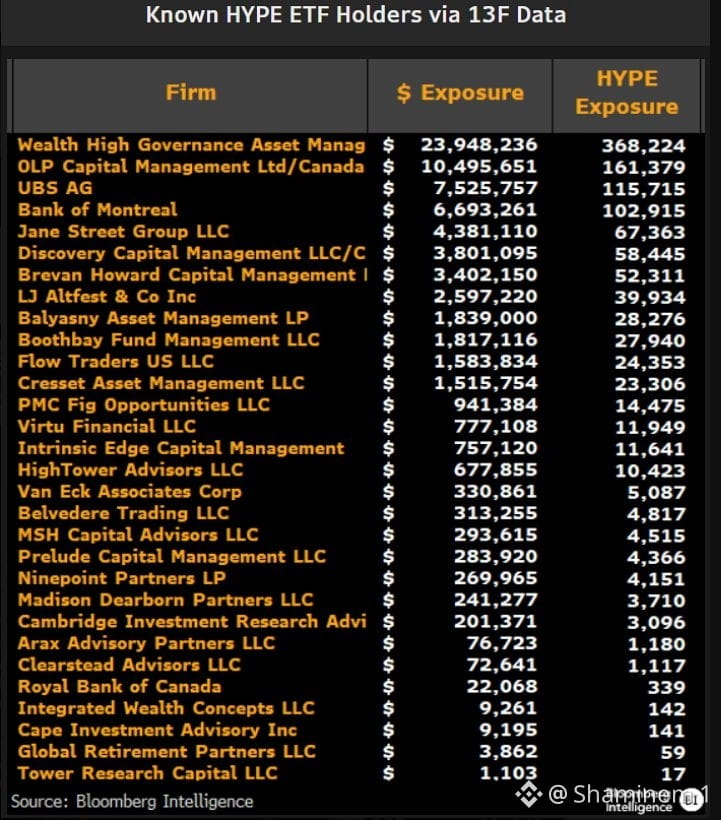
🚨Wall Street is loading up on HYPE! 13F filings show UBS, Bank of Montreal and Jane Street among confirmed $HYPE ETF holders. Institutional exposure to #HyperLiquid is becoming VERY real.
🚨Wall Street is loading up on HYPE! 13F filings show UBS, Bank of Montreal and Jane Street among confirmed $HYPE ETF holders. Institutional exposure to #HyperLiquid is becoming VERY real.
55
·
--
比特幣的交易更像黃金,而不像科技股。$BTC 與黃金的 90 天相關性剛剛創下自 2020 年以來的最高水平,而它與納斯達克的聯動則大幅下降。“數字黃金”的敘事已不再只是敘事,市場開始對其進行定價。
比特幣的交易更像黃金,而不像科技股。$BTC 與黃金的 90 天相關性剛剛創下自 2020 年以來的最高水平,而它與納斯達克的聯動則大幅下降。“數字黃金”的敘事已不再只是敘事,市場開始對其進行定價。
30
·
--
查看翻譯
🚨North Korea linked hacking group Lazarus is back moving millions in crypto. After the $292M KelpDAO exploit in April linked by LayerZero to Lazarus and the record $1.4B exchange hack in 2025... Arkham now says Lazarus-linked wallets moved another $30M through $HYPE . Are they just laundering old funds… or lining up the next target?
🚨North Korea linked hacking group Lazarus is back moving millions in crypto. After the $292M KelpDAO exploit in April linked by LayerZero to Lazarus and the record $1.4B exchange hack in 2025... Arkham now says Lazarus-linked wallets moved another $30M through $HYPE . Are they just laundering old funds… or lining up the next target?

55
·
--
查看翻譯
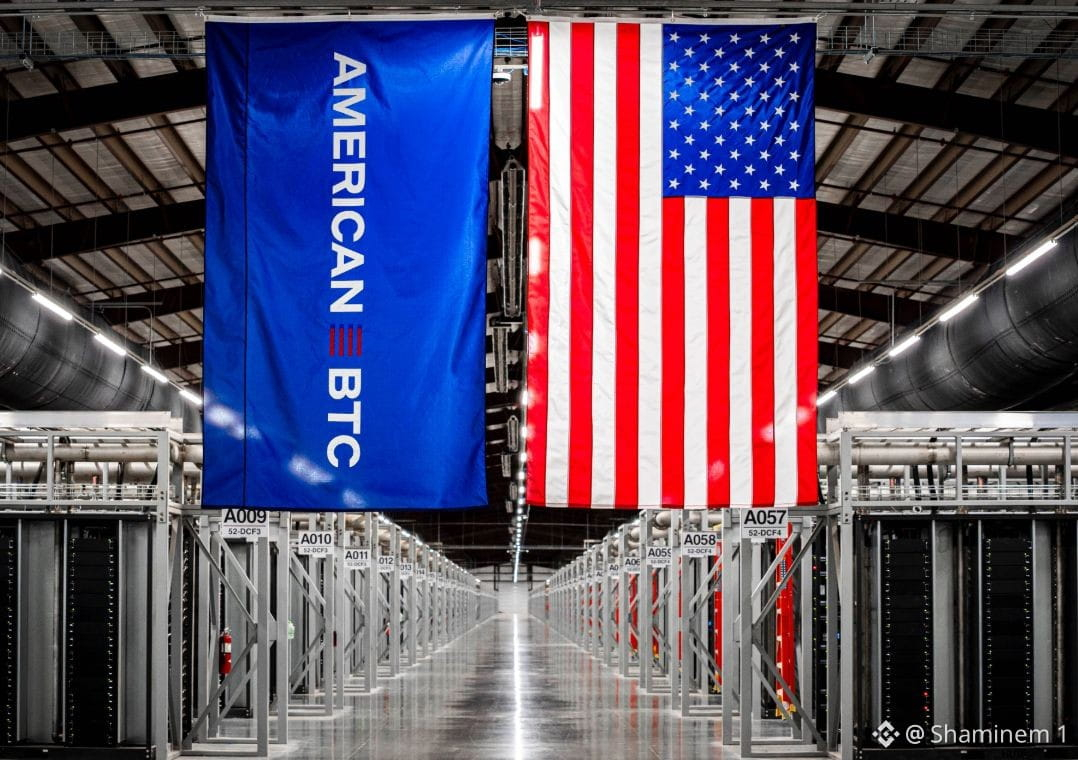
American Bitcoin marks ONE YEAR on Nasdaq with 8,300 $BTC on its balance sheet and nearly 90,000 miners. 🇺🇸 In just over a year, it has built one of the world’s largest public Bitcoin treasuries. Corporate Bitcoin accumulation is only getting bigger.
American Bitcoin marks ONE YEAR on Nasdaq with 8,300 $BTC on its balance sheet and nearly 90,000 miners. 🇺🇸 In just over a year, it has built one of the world’s largest public Bitcoin treasuries. Corporate Bitcoin accumulation is only getting bigger.
54
·
--
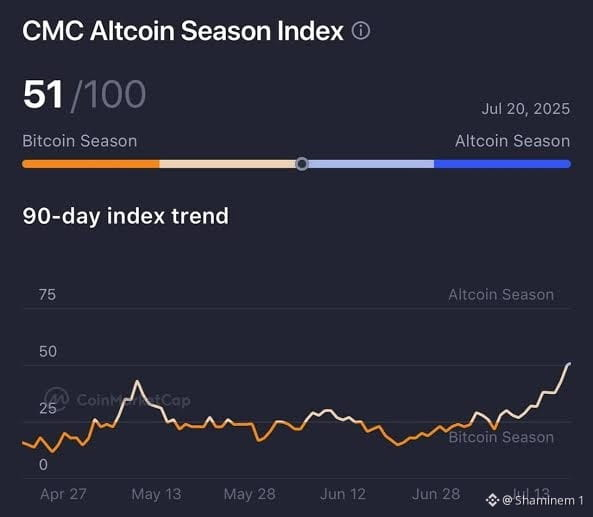
我的答案是否定的,而且主導率圖表就是原因。在真正的山寨季中,隨着資金沿風險曲線向下輪動到山寨幣,比特幣主導率會下降。而現在情況正好相反,BTC 主導率剛剛自八個月以來首次突破 60%,並正指向 66% 的週期高點。目前,$BTC 上漲了 1.43%,而 $ZEC 上漲了 8.54%。比特幣仍然是定節奏的那個,山寨幣只是偶爾在短時間內跑得更快。CoinMarketCap 自家的山寨季指數也印證了這一點,它目前處於 30 多到 40 多的高位,大約只有 75 這一真正定義山寨季的讀數的一半。真正發生的情況比這個話題聽起來要窄得多。$ZEC 因其自身的隱私敘事和 ETF 申請消息,在過去一週左右上漲了約 75%,這並不是整個市場範圍的主題。$XRP 也因自身催化因素在同一時間段內上漲了近 44%。與此同時,大多數其他成熟山寨幣這一週只有個位數漲幅,幾乎沒有表現。這只是少數幾個幣種在強勢上漲,而不是全面輪動。歷史上還存在一個時間問題。山寨季往往出現在比特幣創下新的歷史高點之後,而不是從回撤中恢復的時候,而且 BTC 仍遠低於 10 月份的峯值。所以,這只是 $ZEC 和 #XRP 在比特幣主導的市場中各自度過了不錯的一週,並不是山寨季的發令槍。真正的發令槍會在主導率真正轉頭向下時響起,而不是在少數山寨幣強勢上漲、主導率卻還在上升的時候
我的答案是否定的,而且主導率圖表就是原因。在真正的山寨季中,隨着資金沿風險曲線向下輪動到山寨幣,比特幣主導率會下降。而現在情況正好相反,BTC 主導率剛剛自八個月以來首次突破 60%,並正指向 66% 的週期高點。目前,$BTC 上漲了 1.43%,而 $ZEC 上漲了 8.54%。比特幣仍然是定節奏的那個,山寨幣只是偶爾在短時間內跑得更快。CoinMarketCap 自家的山寨季指數也印證了這一點,它目前處於 30 多到 40 多的高位,大約只有 75 這一真正定義山寨季的讀數的一半。真正發生的情況比這個話題聽起來要窄得多。$ZEC 因其自身的隱私敘事和 ETF 申請消息,在過去一週左右上漲了約 75%,這並不是整個市場範圍的主題。$XRP 也因自身催化因素在同一時間段內上漲了近 44%。與此同時,大多數其他成熟山寨幣這一週只有個位數漲幅,幾乎沒有表現。這只是少數幾個幣種在強勢上漲,而不是全面輪動。歷史上還存在一個時間問題。山寨季往往出現在比特幣創下新的歷史高點之後,而不是從回撤中恢復的時候,而且 BTC 仍遠低於 10 月份的峯值。所以,這只是 $ZEC 和 #XRP 在比特幣主導的市場中各自度過了不錯的一週,並不是山寨季的發令槍。真正的發令槍會在主導率真正轉頭向下時響起,而不是在少數山寨幣強勢上漲、主導率卻還在上升的時候
80
登入以探索更多內容
加入幣安廣場中的全球加密貨幣用戶
⚡️ 獲取加密貨幣的最新和實用資訊。
💬 受到全球最大加密貨幣交易所的信任。
👍 發掘來自經過驗證創作者的真實見解。
電子郵件 / 電話號碼