
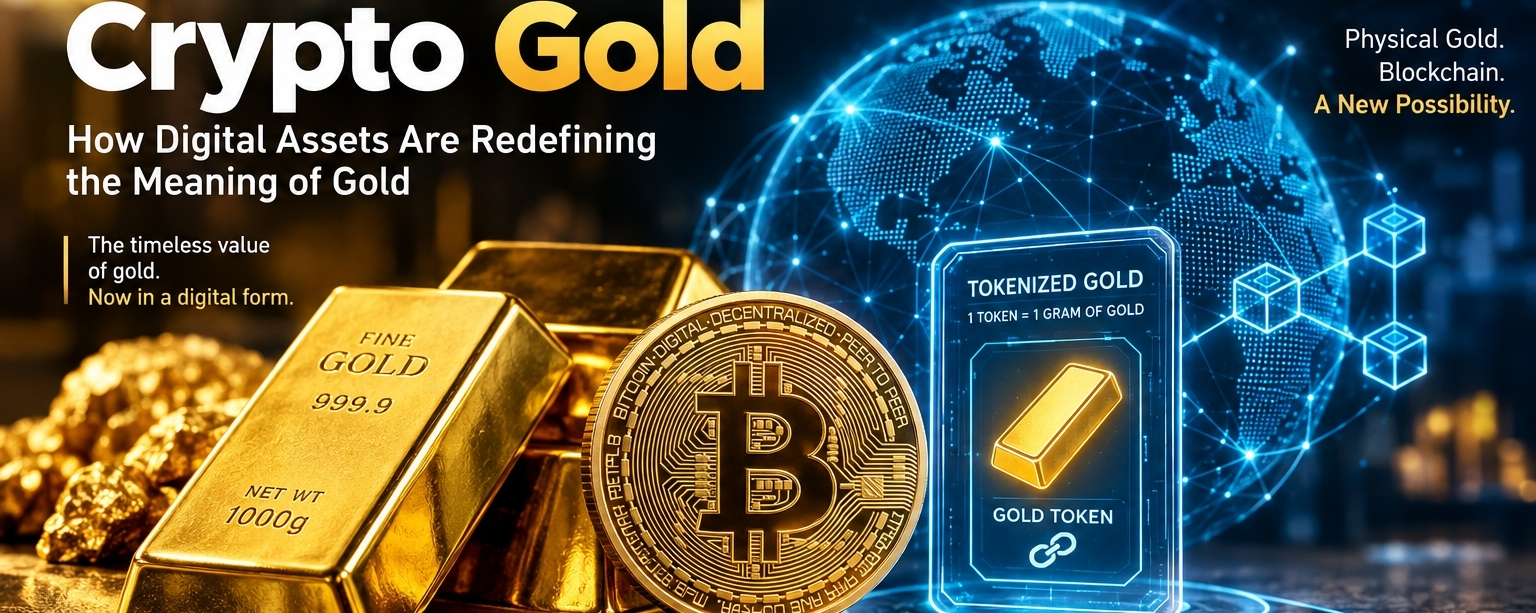


For thousands of years gold has represented wealth, scarcity, and a store of value. It is tangible, recognizable, and limited by nature. But in the digital era, a new question is emerging:
Can the principles that made gold valuable be transformed for the internet?
The idea of “Crypto Gold” sits at the intersection of traditional gold and blockchain technology. It can refer to digital assets designed to capture some of gold’s characteristics scarcity, portability, divisibility, and potential use as a store of value while using blockchain infrastructure to make ownership and transfer digital.
From Physical Gold to Digital Scarcity
Traditional gold has several characteristics that have supported its role as an asset for centuries:
• Limited supply
• Global recognition
• Durability
• Divisibility
• Ability to hold value independently of a single company
Cryptocurrency introduced a new form of scarcity.
Bitcoin, for example, has a predetermined maximum supply of 21 million coins. Instead of scarcity being created by geological limitations, it is enforced through software and a decentralized network.
This distinction is important.
Gold's scarcity comes from nature. Digital scarcity comes from code and network consensus.
That creates a completely different model for thinking about ownership and value.
Why Crypto Is Sometimes Compared With Gold
Bitcoin is frequently described as “digital gold” because supporters point to similarities between the two assets.
Both can be held without necessarily depending on a traditional bank account. Both have globally accessible markets, and both can be divided into smaller units.
But they are not identical.
Gold has thousands of years of history as a physical commodity and monetary asset. Bitcoin is a relatively new technological and financial asset whose value depends heavily on adoption, market demand, infrastructure, regulation, and investor expectations.
Therefore, calling Bitcoin “digital gold” is best understood as a comparison of certain characteristics—not as proof that the two assets behave the same way.
The Rise of Tokenized Gold
Another interpretation of Crypto Gold is tokenized physical gold.
In this model, a blockchain token represents ownership or an economic claim connected to a quantity of physical gold held by a custodian.
The concept attempts to combine two worlds:
Physical gold + Blockchain infrastructure = Digitized ownership
Potential advantages include easier transfer, fractional ownership, transparent transaction records, and access through digital platforms.
However, tokenized gold introduces an important question:
Who actually controls and verifies the underlying physical gold?
Unlike a purely decentralized cryptocurrency, a gold-backed token generally depends on custodians, auditors, legal agreements, and redemption mechanisms.
That means investors need to examine not only the blockchain but also the organization responsible for the underlying assets.
Why Blockchain Changes the Equation
Blockchain technology provides a shared digital ledger that can record transactions without requiring every transfer to be manually processed by a traditional intermediary.
For digital assets, this can create several useful properties:
Transparency: Transactions can potentially be verified on a public blockchain.
Portability: Digital assets can be transferred across borders without physically transporting an object.
Fractionalization: Ownership can potentially be divided into very small units.
Programmability: Tokens can interact with decentralized applications and smart contracts.
These characteristics could make precious-metal ownership more compatible with the digital economy.
But Is Crypto Gold Risk-Free?
Absolutely not.
The term “digital gold” should not be interpreted as a guarantee of stability or profitability.
Crypto assets can experience substantial price volatility. Regulatory frameworks differ between jurisdictions. Exchanges and custodians can face operational or security problems. Smart contracts can contain vulnerabilities. And tokenized commodities introduce additional counterparty and custody risks.
For investors, the technology behind an asset is only one part of the analysis.
It is also important to understand:
• Who issues the asset?
• What exactly does the token represent?
• Is there verifiable collateral?
• How is the underlying asset stored?
• Can holders redeem it?
• What fees apply?
• Which jurisdiction governs the arrangement?
• What happens if the issuer or custodian fails?
These questions can be more important than an attractive marketing slogan.
Crypto Gold and the Future of Finance
The larger story is not simply about replacing gold with cryptocurrency.
It is about turning traditionally physical assets into programmable digital assets.
Real-world assets such as commodities, securities, property, and other financial instruments are increasingly being explored through tokenization. If this trend continues, blockchain networks could become an additional infrastructure layer for representing ownership and transferring assets.
Gold could be one part of that transformation.
Imagine a future where a person can own a tiny fraction of a gold-backed asset, transfer it globally within minutes, use it within a digital financial application, and independently verify relevant transaction information on a blockchain.
That would not make physical gold obsolete.
Instead, it would give an ancient asset a new digital interface.
The Bigger Web3 Opportunity
Crypto Gold represents an interesting bridge between traditional finance and Web3.
Traditional finance provides established markets, legal structures, custody systems, and physical assets.
Blockchain provides digital ownership, programmability, and potentially global accessibility.
The challenge is connecting these systems while maintaining transparency, security, legal clarity, and user protection.
The winners of this transformation may not simply be the projects with the most impressive technology. Long-term adoption will also depend on whether users can understand what they own and trust the infrastructure supporting it.
Final Thoughts
Gold has survived changing civilizations, currencies, and financial systems because its fundamental properties have remained valuable.
Blockchain introduces a new possibility: digital scarcity and programmable ownership.
Crypto Gold therefore represents more than a catchy phrase. It reflects a broader movement toward connecting physical value with digital infrastructure.
Whether that future is dominated by Bitcoin, tokenized commodities, stablecoins, or entirely new blockchain-based financial instruments remains an open question.
One thing is becoming increasingly clear:
The next evolution of money may not be about choosing between physical and digital assets. It may be about building systems where both can exist together.
💬 Join the Conversation
If you could choose one asset to represent wealth in the digital economy, would you choose physical gold, Bitcoin, tokenized gold, or another digital asset and why?