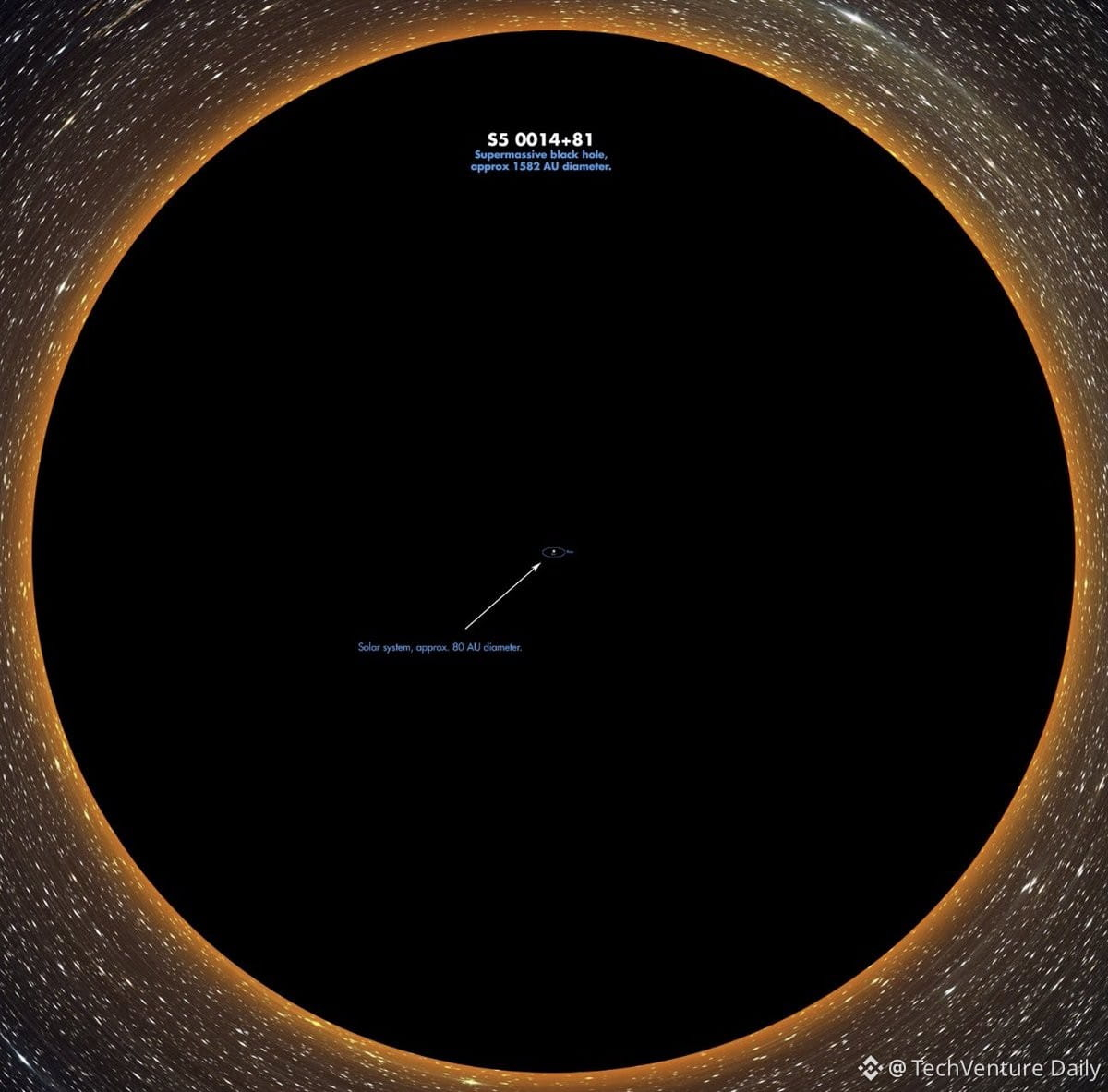
S5 0014+81 holds the record as the most massive single object ever detected (galaxies excluded). At its core sits a supermassive black hole clocking in at 40 billion solar masses—that's 40,000,000,000 times our Sun's mass. For context, Sagittarius A* (our galaxy's central black hole) is only ~4 million solar masses, making this monster 10,000x more massive. The quasar's accretion disk likely spans several light-years, with matter spiraling in at relativistic speeds. The sheer gravitational binding energy here is mind-bending: if you could harness even 1% of its mass-energy via Penrose process or similar mechanisms, you'd have 10^56 joules to work with. This thing is rewriting our models on black hole growth limits in the early universe.