
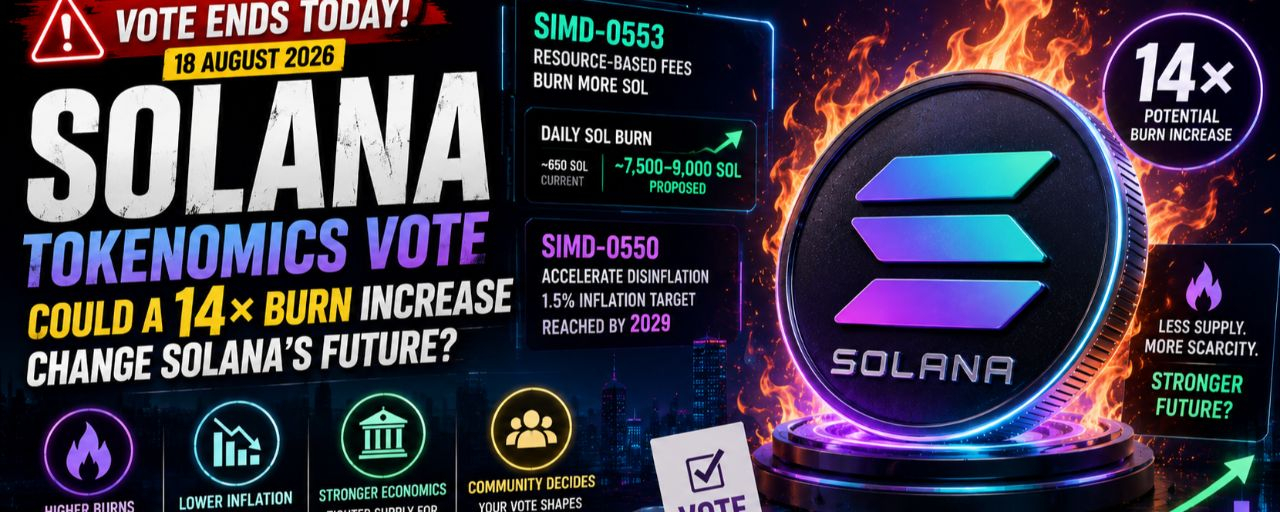

Solana is approaching a potentially important turning point.
Today, August 18, the governance window for proposals aimed at changing SOL's supply economics is closing.
One proposal could dramatically increase the amount of SOL burned through transaction fees, while another would accelerate the network's long-term reduction in new SOL issuance.
At first glance, this sounds extremely bullish.
But there is a catch:
More burns do not automatically mean SOL becomes deflationary overnight.
And that's where the real story begins.
🔥 The 14× Burn Proposal
The main proposal, SIMD-0553, would change how Solana charges for computational resources.
Instead of relying primarily on a flat transaction fee, the proposal would introduce resource-based fees.
The portion tied to resource consumption would be burned, permanently removing SOL from circulation.
Current daily SOL burns are roughly 650 SOL.
Under the proposed system, estimates put potential burns at around 7,500–9,000 SOL per day once the highest fee phase is reached.
That's potentially around a 12–14× increase.
And naturally, the crypto market is asking:
Could this become a major supply shock for SOL?
📉 But Here's What Many Traders Could Miss
Even if Solana reaches a 9,000 SOL daily burn rate, the network would not immediately become deflationary.
Why?
Because Solana currently issues substantially more new SOL than the proposed burn would destroy.
One recent analysis estimates current issuance at around 60,000 SOL per day.
So the simplified picture looks like this:
New SOL entering circulation → ~60K/day
Potential SOL burned → ~9K/day
That still leaves net positive issuance.
Therefore, the proposal is better understood as:
“Reducing the rate of supply expansion”
rather than:
“SOL becomes instantly deflationary.”
That's an important distinction.
⚡ SIMD-0550 Could Change the Other Side of the Equation
The burn proposal isn't the only change being discussed.
SIMD-0550 proposes doubling Solana's annual disinflation rate from 15% to 30%.
According to the proposal's own modelling, this could bring Solana's long-term 1.5% inflation rate forward from roughly H1 2032 to H1 2029.
The modelling estimates approximately 18.9 million fewer SOL issued over six years compared with the existing schedule.
So Solana is effectively attacking supply from two directions:
🔥 SIMD-0553
More SOL gets burned
📉 SIMD-0550
Less new SOL gets created
Together, that's much more significant than either proposal on its own.
🏦 Why Does This Matter for SOL Holders?
Tokenomics matters because long-term asset value isn't determined by demand alone.
Supply matters too.
Imagine two networks with identical demand.
If Network A continually creates large amounts of new tokens while Network B gradually reduces issuance and burns more tokens, their long-term supply dynamics can look very different.
That's the thesis behind these Solana proposals.
The objective isn't necessarily to create an immediate price pump.
It's to make SOL's supply curve tighter over time.
🚨 But There Is a Risk Bulls Shouldn't Ignore
Lower issuance sounds great for token holders.
But staking rewards are partly tied to SOL issuance.
If inflation falls faster, staking yields can also decline.
The SIMD-0550 proposal models nominal staking yields falling faster under the accelerated disinflation schedule.
That creates a trade-off:
Lower inflation = potentially better supply dynamics
but also:
Lower staking rewards = potentially less incentive for some validators/stakers.
The proposal's own modelling estimates that some validators could become unprofitable faster under the accelerated schedule.
So this isn't a free lunch.
⚔️ The Real Battle: Supply vs Demand
Here's the most important point for investors:
Reducing supply does not guarantee higher prices.
If demand remains weak, a lower inflation rate alone may not be enough to create a major rally.
This is why the Solana thesis ultimately depends on both sides:
Supply
🔥 More burns
📉 Lower issuance
💎 Tighter long-term supply
Demand
👥 More users
💰 More economic activity
🏦 Institutional adoption
📊 More fees
🌐 More applications
If supply becomes tighter while demand continues growing, the long-term setup becomes much more interesting.
📈 Could This Become a Catalyst for SOL?
Potentially—but traders should separate short-term reaction from long-term fundamentals.
The market could initially react to the headline:
“SOL burn could increase 14×.”
That sounds extremely bullish.
But sophisticated investors will probably look deeper.
They'll ask:
How much SOL is actually burned?
How quickly does the new fee system reach its terminal phase?
Does network activity continue growing?
How much issuance remains?
What happens to staking participation?
Does SOL demand increase alongside the supply changes?
Those questions matter more than the headline number.
👀 The Vote Is the Immediate Catalyst
The governance process is what makes today's story particularly interesting.
The vote window is scheduled to close on August 18, 2026.
That means traders are watching for a clear outcome:
🟢 If the proposals advance
The market could interpret it as a major step toward tighter SOL tokenomics.
🔴 If support weakens
Expectations for the supply changes could be pushed back.
🟡 If the outcome is uncertain
SOL could remain driven primarily by Bitcoin, liquidity and broader altcoin sentiment.
And remember:
A governance proposal is not the same thing as an implemented protocol change.
Even if approved, implementation would occur through future network upgrades and phased activation.
🧠 What I'm Watching After the Vote
For me, the most important signals aren't just the headline.
I'd watch these five things:
1️⃣ Final governance outcome
Does the proposal receive enough support?
2️⃣ Actual implementation timeline
When do the proposed fee changes become active?
3️⃣ SOL burn rate
Does the network actually approach the projected levels?
4️⃣ SOL issuance
How quickly does new supply decline?
5️⃣ Network demand
Does Solana continue attracting users, applications and economic activity?
The fifth point may ultimately be the most important.
Because scarcity without demand isn't enough.
🚀 My Take
Solana's tokenomics proposals are interesting because they represent a shift in how the network thinks about SOL's long-term economics.
SIMD-0553 could dramatically increase SOL burns.
SIMD-0550 could accelerate disinflation.
Together, they could make the long-term supply curve meaningfully tighter.
But I wouldn't call this an automatic “SOL price explosion” catalyst.
The proposals still have to translate into something much more important:
More sustainable economic demand for SOL.
If Solana can combine tighter supply with continued network growth, the long-term tokenomics story could become much stronger.
If demand doesn't keep up, however, lower issuance alone may not be enough.
That's why today's vote is important—but what happens to Solana's actual usage afterward could matter even more.
💬 What Do YOU Think?
If Solana's proposals increase burns and accelerate disinflation, what happens to SOL over the next 1–2 years? 👀
🟢 Major bullish catalyst 🚀
🔵 Long-term positive, but slow
🔴 Supply changes won't matter without demand
🟡 Too early to tell
👇 Vote and tell me WHY.
#Solana #SOL #Crypto #SolanaNews #Tokenomics #DeFi #Altcoins #CryptoMarket #Blockchain #BinanceSquare